

Submitted:
10 November 2026
Posted:
12 November 2026
You are already at the latest version
Abstract
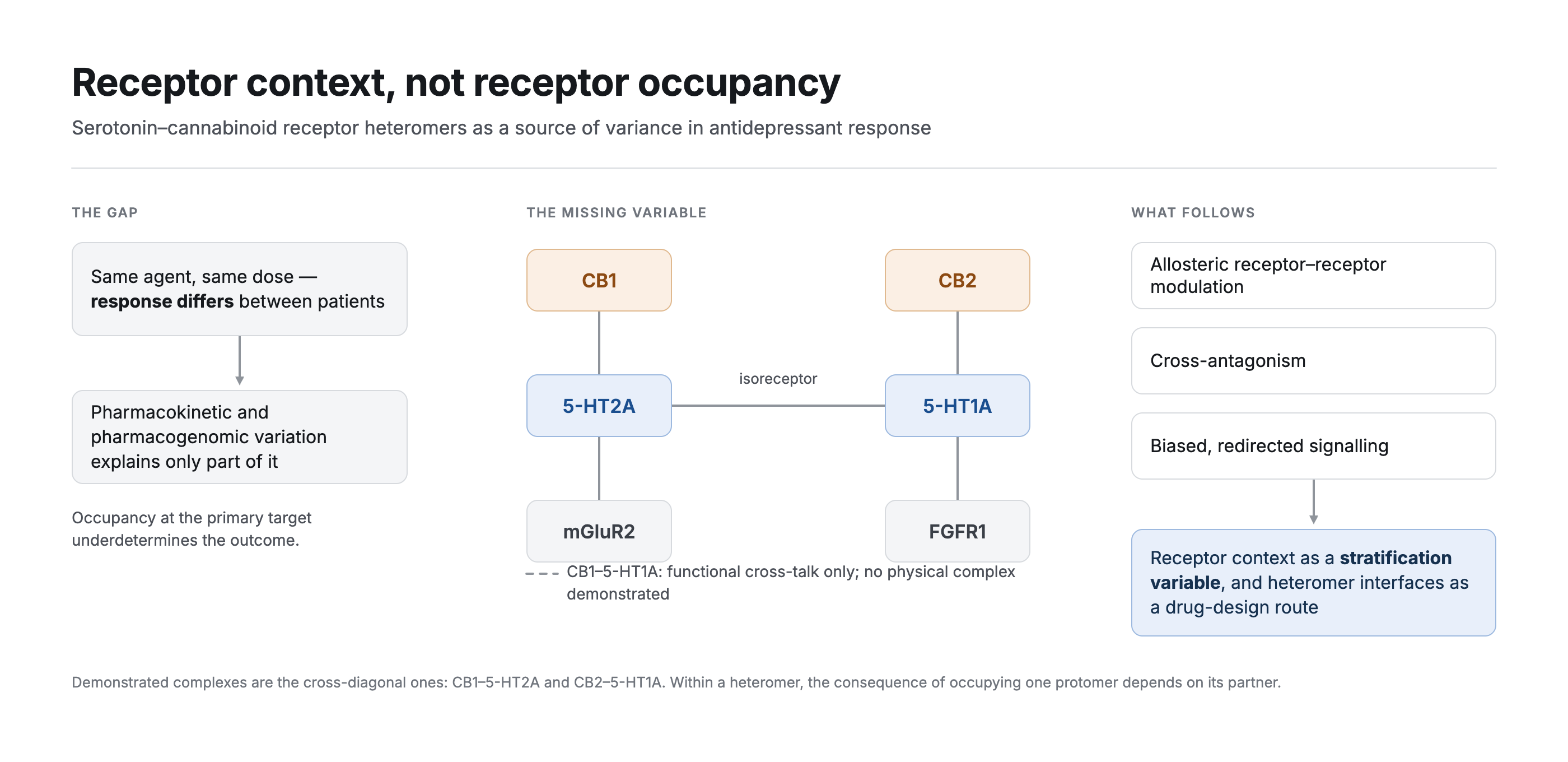
Antidepressant and mood-stabilizer pharmacology is still largely described in terms of occupancy at individual receptors, yet clinical response is heterogeneous across patients given identical compounds at identical doses. G protein-coupled receptor (GPCR) heteromerization offers one underused explanation. Within a heteromer, allosteric receptor–receptor interaction, cross-antagonism, redirected or biased signalling and altered trafficking make the functional consequence of occupying a receptor depend on which partner shares its membrane, so that occupancy underdetermines outcome. This review applies that principle to the serotonin–cannabinoid interface, which is of direct interest for mood disorders because both systems are targets of current and emerging treatments. The demonstrated complexes are cross-diagonal: CB1–5-HT2A, supported by bimolecular fluorescence complementation, bioluminescence resonance energy transfer (BRET), proximity ligation assay (PLA) and by disruption experiments in which abolishing the complex removes Δ9-tetrahydrocannabinol-induced cognitive impairment while sparing other drug effects; and CB2–5-HT1A, supported by BRET and PLA, modulated by cannabidiol, and the basis of a dual-agonist program for depression and anxiety. The widely assumed CB1–5-HT1A pairing has never been demonstrated as a physical complex. A parallel network of 5-HT1A heteroreceptor complexes in raphe–hippocampal circuits, and the 5-HT2A–mGluR2 complex that distinguishes hallucinogenic from antipsychotic signalling, together indicate that receptor context is a tractable variable for drug design, for patient stratification, and for the unresolved question of whether the subjective state produced by rapid-acting serotonergic agents is required for their antidepressant effect. Evidential strength is graded throughout, and a reproducibility ledger and research agenda are provided.
Keywords:
receptor heteromer
; antidepressant
; mood stabilizer
; 5-HT1A
; 5-HT2A
; cannabinoid CB1 receptor
; cannabidiol
; allosteric modulation
; biased agonism
; personalized medicine
Copyright: This open access article is published under a Creative Commons CC BY 4.0 license, which permit the free download, distribution, and reuse, provided that the author and preprint are cited in any reuse.