

Submitted:
11 November 2026
Posted:
12 November 2026
You are already at the latest version
Abstract
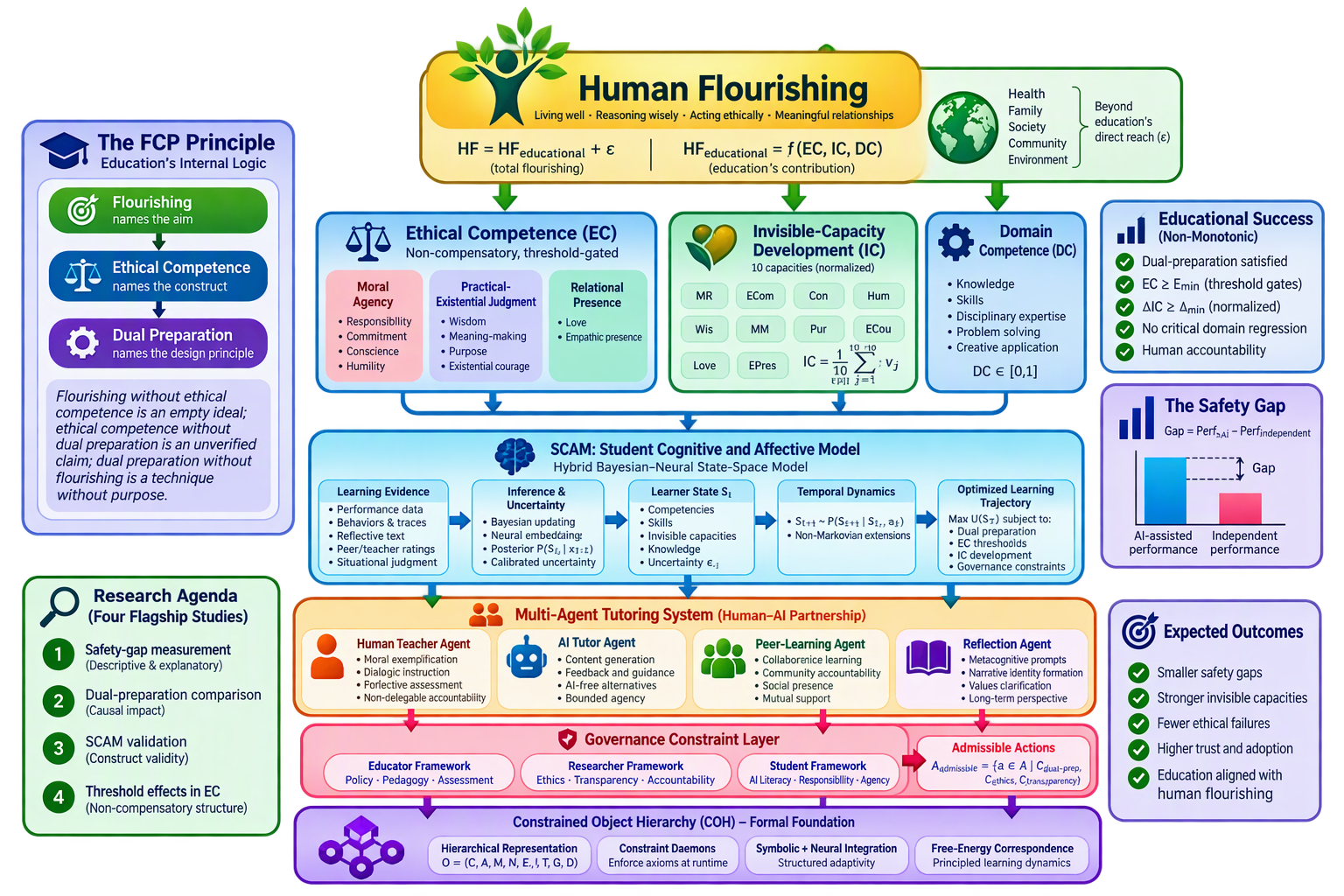
Generative AI now performs tasks long treated as markers of human cognitive distinctiveness. This does not make education obsolete; it makes the question of what education is for more urgent. This article develops a Computational Theory of Education for Human Flourishing in the AI Era (CTE-HF-AI) that formalizes education's role in cultivating human flourishing as its root objective, and specifies the cultivation of ethically competent, relationally present, and existentially grounded persons as education's developmental target, while treating AI as a bounded and accountable partner. The theory is a domain-specific instantiation of Constrained Object Hierarchies (COH), the general mathematical theory of intelligence developed in the MDPI Computers paper and its preprints' foundations. The theory's organizing logic is named the Flourishing-Competence-Preparation (FCP) Principle; flourishing names education's aim, ethical competence names the developmental construct through which that aim is educationally approached, and dual preparation names the design principle that operationalizes the construct. The FCP Principle is design-theoretic and normative rather than descriptive. Formally, an educational system is \(\mathcal{E} = \langle \mathcal{S}, \mathcal{A}, \mathcal{T}, \mathcal{C}, \mathcal{O} \rangle\), where \(\delta\) is a bounded, uncertainty-annotated learner state. All nine COH components are instantiated: the component hierarchy \(\mathcal{C}\) is the FCP structure; the attributes \(\mathcal{A}\) are the learner state variables; the methods \(\mathcal{M}\) are pedagogical actions; the neural components \(\mathcal{N}\) are SCAM's neural sub-model; the embedding \(\mathcal{E}\) is formalized as three shared-Hilbert-space maps (\(\S\)3.2.2); the identity constraints \(\mathcal{I}\) are the axioms and thresholds; the trigger constraints \(\mathcal{T}\) are formalized as ECA rules, including the safety-gap daemon (\(\S\)3.8); the goal constraints \(\mathcal{G}\) are the constrained objective; and the daemons \(\mathcal{D}\) are formalized as trajectory monitors (\(\S\)5). The ten invisible capabilities are represented as an explicit vector, and ethical competence uses a threshold-gated non-compensatory formulation. Domain competence \(\mathcal{DC}\) is specified as a three-constituent composite of disciplinary mastery, professional performance, and transferable competencies (\(\S\)3.2.3). Flourishing is formalized in two registers: an educational register \(HF_{educational} = f(\mathcal{EC}, \mathcal{ID}, \mathcal{DC})\) and a total register \(HF = HF_{educational} + \epsilon\). Invisible-capacity development is partially compensatory while critical domains are protected by non-regression. Educational success is defined non-monotonically. Relational presence is grounded in Buber, Noddings, and Palmer. SCAM's structured prior and Bayesian update are shown to realize COH's free-energy correspondence when the COH theorem's conjugacy and regularity conditions are met (\(\S\)4.2, Theorem 4.1), and the theory adopts COH's hybrid continuous-discrete formulation (\(\S\)3.9), from which existence and uniqueness follow under the Lipschitz and measurability conditions of Theorem 3.1. A research agenda of four flagship empirical studies is derived, alongside formalizations of the educational safety gap with an interpretation guide. Five limitations are specified. The article positions the framework as a theory of education whose formal structure is portable to broader human-development and AI-governance contexts, while its central claims remain educational.
Keywords:
human flourishing
; computational theory of education
; generative AI
; invisible capacities
; ethical competence
; dual preparation
; FCP Principle
; bounded AI agency
; non-compensatory measurement
; constrained object hierarchies
; free-energy principle
; hybrid dynamical systems
Copyright: This open access article is published under a Creative Commons CC BY 4.0 license, which permit the free download, distribution, and reuse, provided that the author and preprint are cited in any reuse.