
Submitted:
11 November 2026
Posted:
12 November 2026
You are already at the latest version
Abstract
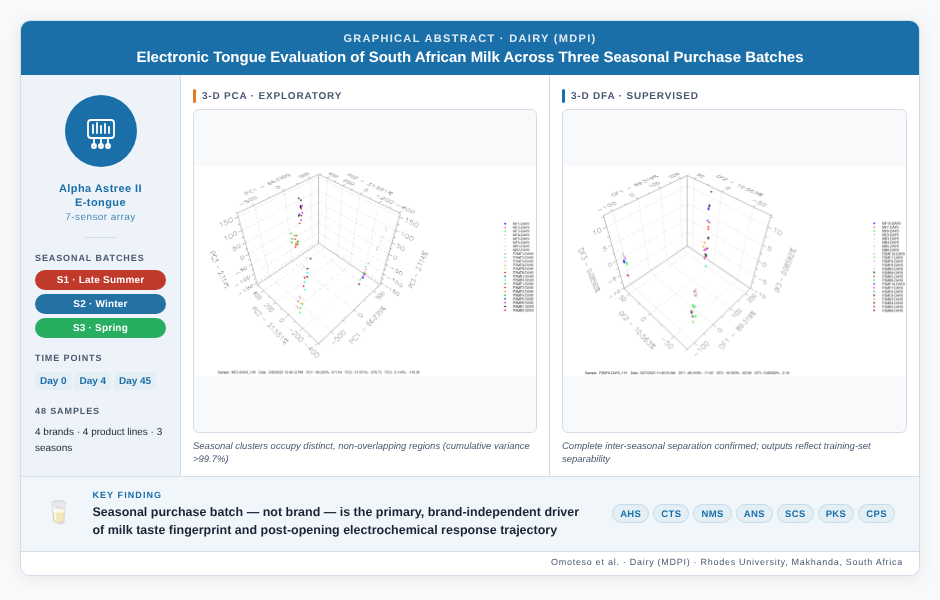
This study applied the Alpha Astree II electronic tongue (E-tongue) to characterize and longitudinally monitor the taste profiles of four commercially available South African milk brands, ultra-pasteurized and UHT-processed, full-cream and low-fat variants, purchased across three seasons: late summer (March 2025), winter (June 2025), and spring (September 2025) in Makhanda, Eastern Cape. Forty-eight samples were analyzed on Days 0, 4, and 45 post-opening. Three-dimensional principal component analysis (PCA) score plots achieved cumulative variances exceeding 99.7%. Discriminant function analysis (DFA) score plots demonstrated complete visual separation of the three seasonal clusters with no inter-seasonal overlap; as no cross-validation was applied, DFA outputs reflect training-set group separability rather than validated predictive performance. Three distinct seasonal electrochemical fingerprints were identified at Day 0, with inter-seasonal separation retained at Day 45 despite advanced deterioration in quality. Winter milk consistently registered the highest CTS (saltiness) and NMS (umami) sensor responses across all brands during refrigerated storage. A universal crossover in AHS (sourness) and SCS (bitterness) dominance from spring at Day 0 to late summer at Day 4 was confirmed as a brand-independent seasonal signature across all UHT brands. Seasonal purchase batch was a consistent, brand-independent determinant of E-tongue taste fingerprint and post-opening sensor response trajectory, with direct implications for quality monitoring in dairy markets with variable cold-chain provision.
Keywords:
electronic tongue
; seasonal taste variation
; ultra-pasteurized milk
; ultra-high temperature milk
; principal component analysis
; south african dairy
Copyright: This open access article is published under a Creative Commons CC BY 4.0 license, which permit the free download, distribution, and reuse, provided that the author and preprint are cited in any reuse.