

Submitted:
11 November 2026
Posted:
12 November 2026
You are already at the latest version
Abstract
Cancer remains one of the leading causes of morbidity and mortality worldwide, necessitating continuous advances in therapeutic strategies to improve treatment efficacy and patient outcomes. Over recent decades, cancer management has evolved from conventional cytotoxic approaches toward more sophisticated, individualized interventions that target specific molecular alterations and harness the immune system. This review provides a comprehensive overview of the paradigm shift in cancer treatment, tracing the evolution from conventional chemotherapy to modern precision oncology and immunotherapy. We examine traditional diagnostic staging and highlight the integration of liquid biopsies and advanced biosensor technologies for real-time, non-invasive clinical monitoring. The review explores the mechanistic pillars of cell cycle-specific and non-specific chemotherapeutic agents, alongside the complex multidrug resistance pathways and metabolic rewiring that drive chemoresistance. We also evaluate the growing efficacy of targeted treatments, including small-molecule kinase inhibitors and antibody-drug conjugates, and detail the transformative clinical impact of immune checkpoint inhibitors, CAR-T cell therapies, and therapeutic vaccines. Emphasizing personalized medicine, we discuss the critical role of pharmacogenomics, biomarker-guided therapies, and the integration of artificial intelligence and quantitative systems pharmacology in optimizing dosing. Finally, we address future directions, including CRISPR-engineered cellular therapies and the modulation of the hypoxic tumor microenvironment using natural phytochemicals.
Keywords:
cancer therapy
; precision oncology
; immunotherapy
; chemoresistance
; biosensors
; tumor microenvironment
; artificial intelligence
; pharmacogenomics
1. Introduction
1.1. The Hallmarks of Cancer and Therapeutic Targets
Cancer is a heterogeneous genetic disease basically defined by uncontrolled cell division and proliferation follow-on from a serious physiological imbalance between mitotic events and cell loss by differentiation or programmed death. The regulation of this physiological process is performed through a coordinated system of cellular signaling pathways, where each unique sub-pathway is designed to control specific functions, known as the hallmarks: self-sufficiency in growth signals, resistance to growth inhibition, insensitivity to anti-growth signals, evasion of programmed cell death, unlimited replicative potential, sustained angiogenesis, and metastasis [1].
These features can be detected at the molecular level through the abnormal activity of signaling pathways. Some examples of these targets are the Ras-Raf-MAPK pathway, which has an important role in mediating the effects of growth factors on cell proliferation and stress response, and the PI3K-Akt-mTOR pathway, which regulates the cellular metabolic activities and autophagy via GPCRs or RTKs. These hallmarks are characterized by high frequency genetic alterations in some specific malignancies such as cholangiocarcinoma (CCA); AXIN1 (40%), TP53 (35%), ARID1A (25%), SMAD4 (25%) and KRAS (20%) [2].
Metabolic reprogramming, specifically the Warburg effect is described by (increased glycolytic metabolism resulting in elevated intracellular ATP within cell), is known as a near-universal hallmark that enables cell survival under cytotoxic conditions. Moreover, cancer cells activity the GSH-GST detoxification system and energy-dependent efflux pumps, for example P-glycoprotein (ABCB1) and MRP1 (ABCC1), to establish Multidrug Resistance (MDR) [3]. Current target identification also emphases on metabolic plasticity and mechanisms of immune evasion inside the Tumor Microenvironment (TME), requiring indicators like the TMEPRE computational method to score T-cell infiltration and response to protected checkpoints [4].
1.2. Evolution of Cancer Treatment
A structured system of study in oncology was first established by the passage of the National Cancer Act of 1971 (“War on Cancer”). During the 1970s and 1980s, treatment advances have been made possible by the use of microscopy and molecular cloning, resulting in the discovery of chromosomal changes, including the BCR-ABL translocation in chronic myeloid leukemia and ERBB2 (HER2) in breast cancer [5].
The conclusion of the Human Genome Project in 2003 served as a model shift, allowing the identification of tumor-specific somatic alterations [5]. This was followed by the start of Next-Generation Sequencing (NGS) in 2005, which allowed for the characterization of cancer genomes at single-nucleotide resolution [1]. The methodology of clinical trials has followed a similar path and has moved from anatomical based recruitment to genotype based recruitment. The IMPACT trial that began in 2007 demonstrated that using matching treatment protocols to molecular testing resulted in a significant increase in response rate (27 percent for matched versus 5 percent for mismatched participants) (Song et al., 2023). This led to basket type studies such as NCI-MATCH (2015), TAPUR (2016) and DRUP (2016) where patients are assigned to drugs based on specific genotypic characteristics, regardless of their tumor type [6].
The development of modern medicine is characterized by highly efficacious drug antibodies called ADCs, such as Sacituzumab govitecan, used in the delivery of SN-38 (about 1000 times stronger than irinotecan). Another example of an advanced treatment is the CAR T-cell therapy, where T-cells can be programmed to target the CD19 antigen [7]. The current cutting edge involves the merging of Artificial Intelligence (AI) and deep learning exemplified by the work of AlphaFold in protein structure prediction and PocketMiner in determining cryptic pockets of previously un-druggable targets to predict how tumor cells respond to drug interactions [1].
We conducted a literature search using PubMed, Scopus, and Google Scholar on 20 May 2026 to identify publications relevant to the evolution of cancer treatment from conventional chemotherapy to precision oncology. The search focused primarily on literature published over the preceding 10 years, while five older publications were retained when necessary to provide important historical background or foundational evidence. The search strategy covered conventional chemotherapy, targeted therapies, immunotherapy, drug resistance, the tumor microenvironment, liquid biopsies, biosensing technologies, artificial intelligence, machine learning, and pharmacogenomics.
The following search query was used:
(Neoplasms OR Cancer) AND (Precision Oncology OR Targeted Therapy OR Immunotherapy OR CAR-T) AND (Drug Resistance OR Chemoresistance OR Tumor Microenvironment) AND (Biosensing Techniques OR Liquid Biopsy OR Machine Learning OR Artificial Intelligence OR Pharmacogenomics).
Publications were considered eligible when they addressed one or more of the principal themes of this review, including conventional and emerging cancer therapies, molecular mechanisms of treatment resistance, biomarker-guided treatment, cancer diagnostics and monitoring, pharmacogenomics, and computational approaches to personalized oncology. We considered relevant original research articles, clinical studies, and review articles. We retained older publications when they provided essential historical or conceptual information.
Publications were excluded when they were not sufficiently relevant to the review objectives or did not provide meaningful information on the therapeutic, diagnostic, molecular, or technological themes under consideration.
The selection process involved assessing the relevance of retrieved publications to the scope of the review and identifying studies that contributed to the discussion of the major themes. [Specify whether titles and abstracts and/or full-text articles were screened, whether selection was performed independently by multiple authors, and how disagreements were resolved, if applicable.]
We organized information from the selected publications by the major topics addressed in the review. These included cancer diagnosis and staging, conventional chemotherapy, mechanisms of chemoresistance, targeted therapies, cancer immunotherapy, personalized medicine, pharmacogenomics, biomarker-guided treatment, artificial intelligence, and emerging therapeutic strategies. We compiled a summary matrix in Appendix A (Table A1) presenting relevant study characteristics, including population or experimental model, sample size where available, study design, geographical setting, outcomes, principal findings, and references.
The findings were synthesized narratively to provide an integrated overview of developments in cancer treatment, highlight advances in precision oncology, and discuss current challenges and future directions. Given the review’s broad scope and the diversity of the included evidence, the synthesis was descriptive and thematic rather than a quantitative meta-analysis.
2. Principles of Cancer Diagnosis and Staging
The diagnosis and staging of cancer have high importance in clinical oncology; they facilitate the prediction of patient prognosis and therapeutic selection. Historically, oncological staging has relied heavily on the anatomical extent of the disease, but the clinical paradigm is rapidly shifting toward a more comprehensive, molecularly driven approach [8,9]. In Cancer therapy, understanding the transition from traditional surgical approach to highly sensitive biosensing technologies is absolutely required because it directly impacts the development and application of precision medicines in this field [10,11]. Figure 1 demonstrates the general TNM staging system.
2.1. Traditional Staging Methods
The beginning of traditional cancer staging is the Tumor, Node, Metastasis (TNM) classification system, was developed by organizations such as the International Union against Cancer (UICC) and the American Joint Committee on Cancer (AJCC). The TNM system evaluates the size of how much the primary tumor has invaded the nearby tissues (T), if the cancer spread into the lymph node (N), and the presence of the tumor cell in different parts of the body (M). for example, the 8th edition of the lung cancer TNM staging system refined the ‘M’ descriptor by introducing the M1b category to designate patients with a single extrathoracic metastasis (oligometastatic disease), distinguishing them from the M1c category characterized by multiple metastatic lesions. there are more grading systems, for example the Dukes and Jass classifications for colorectal carcinoma, they classified tumors based on bowel wall and its morphological features [8,9].
Even with constant improvements on the traditional staging methods there was still a noticeable limitation in clinical practice. for example, wherein patients classified within the exact same TNM stage can experience vastly different clinical outcomes, survival rates, and responses to chemotherapy. This variability highlights a pressing clinical need to incorporate non-anatomic factors—such as molecular markers, tumor grade, and vascular invasion—into staging algorithms to more accurately classify patient risk categories [9].
Moreover, standard tissue biopsies that are used to assess these stages are limited, as they only provide a snapshot of a very heterogeneous tumor at a given timepoint, and involve many hazards for the patient and are often hard to access [12].
2.2. Liquid Biopsies and Advanced Biosensors in Clinical Monitoring
Liquid biopsies have evolved as a novel alternative for clinical monitoring to address the constraints of conventional tissue biopsies. Liquid biopsies analyze the tumor-derived materials shed into biological fluids such as blood, saliva and urine, and capture the whole geographic and temporal heterogeneity of a patient’s cancer [13]. This approach looks for several key circulating biomarkers, primarily circulating tumor DNA (ctDNA), circulating tumor cells (CTCs), extracellular vesicles (exosomes), and microRNAs (miRNAs) [14].
The clinical utility of ctDNA is particularly profound in the detection of minimal residual disease (MRD) and the ongoing assessment of adjuvant therapy efficacy [14,15]. The ctDNA monitoring enables the early detection of molecular relapse, giving a significant lead time of several months before clinical or radiological progression becomes seen on standard CT or other scans [15]. For example, dynamic ctDNA analysis in patients with esophageal adenocarcinoma is highly prognostic; patients whose ctDNA status converts from positive pre-surgery to negative post-surgery demonstrate highly disease-free survival, whereas continued ctDNA positivity strongly predicts the relapse [16]. in case of lymphomas, there are some advanced new techniques, such as Cancer Personalized Profiling by Deep Sequencing (CAPP-seq) and Phased Variant Enrichment and Detection Sequencing (PhasED-seq), allow for more sensitive ctDNA monitoring, achieving a very low analytical detection threshold [17]. Moreover, CTC molecular profiling provide real-time information to the metastatic cascade, cellular plasticity, and acquired resistance mechanisms, which are critical for deciding on therapy decisions [18].
To use these circulating biomarkers into actionable clinical tools requires using of advanced biosensor technologies [10]. Pharmaceutical and bioengineering research has some advancements in the development of highly sensitive systems capable of detecting very low concentrations of biomarkers in undiluted biofluids of the body [11].
Below are some examples of new technological innovations, which are also summarized in Figure 2:
- Vertical Graphene Field-Effect Transistors (VGFETs)
Combined with Mesoporous Silica Nanospheres (MSNs) to enhance the local electric field, these immunosensors achieve sub-femtomolar detection limits for lung cancer tumor markers, including Carcinoembryonic Antigen (CEA), Cyfra21-1, and Neuron-Specific Enolase (NSE) [11].
- 2.
- NanoBiT-Nanobody (NBNB) Biosensors
The NBNB biosensor is a novel platform that combines split nano-luciferase fragments for target-specific nanobodies. Based on the proximity-induced complementation idea, the fragments re-assemble an active enzyme upon binding to a biomarker and provide a measurable bioluminescent signal. The major advantage of this method is the ability to do quick, wash-free, sub-picomolar detection directly in complicated biofluids, such as serum. This technique is very useful in early cancer screening [19].
- 3.
- Acoustic Wave Sensors:
The development of a very sensitive acoustic biosensor for early detection of ovarian cancer by the identification of the biomarker Lysophosphatidic Acid (LPA). To overcome the problem of measuring such a small molecule in complicated fluids like human serum, the researchers employed a gelsolin-actin protein probe that loses mass upon binding with LPA, a change easily detected by the sensor’s Thickness Shear Mode (TSM-D) technology [20].
- 4.
- Quartz Crystal Microbalance (QCM) Aptasensors:
Quartz Crystal Microbalance aptasensor used for selective detection of Carcinoembryonic Antigen (CEA), an important biomarker for cancer diagnosis. Scientists electrochemically attached a thiol-terminated nanofilm to a gold surface and then strengthened this attachment using gold nanoparticles that could bind two specific DNA aptamers to build the platform. The study reveals that this technology is capable of detecting CEA at very low detection limits of 102 and 108 pg/mL with higher binding affinity than previous methods. The authors successfully tested the sensor in spiked human serum, proving its practical utility as a cost-effective, quick, and accurate alternative to current clinical immunoassays [21].
- 5.
- Plasmonic Biosensors:
New three-layer plasmonic sensor for the portable and ultra-sensitive detection of exosomes, a critical biological marker for early cancer diagnosis. The researchers sandwiched a silica spacer between a gold mirror and a gold nanohole array to form an optical cavity that causes mode hybridization, which greatly narrows the resonance signal and enhances the electromagnetic field. This structural modification allows the gadget to reach an impressive low limit of detection of 600 particles per microliter without the need for complicated signal amplification tags. Also, the sensor can differentiate between healthy and tumor produced exosomes using specialized aptamers and it works reliably in difficult conditions such as fake serum. Finally, the paper proposes a low-cost production method – nanosphere self-assembly – to translate complex surface plasmon resonance technology from the laboratory to the clinic [22].
3. Conventional Chemotherapy
3.1. Cell Cycle–Specific Agents
Cell cycle–specific therapeutic agents are formulated to selectively target cancer cells during definite phases of active cellular division. Among these, antimetabolites, such as cytarabine (Ara-C) and gemcitabine, target cells at the S-phase of cell cycle by incorporating into DNA or inhibiting replication enzymes. In vitro studies of acute megakaryoblastic leukemia have demonstrated that Ara-C exerts its antileukemic effect by inducing S-phase damage. Nevertheless, resistant cells manage to escape this type of treatment by pausing their growth in the G1 phase, thereby bypassing the S-phase where most of the DNA fragmentation normally occurs, this helps them survive despite the drug’s effect [23]. The therapeutic efficacy of S-phase targeting can be improved; for instance, the addition of the ATR kinase inhibitor berzosertib to gemcitabine was found to significantly prolong progression-free survival in platinum-resistant high-grade ovarian cancer mainly by preventing DNA damage repair during replication [24]
Taxanes (e.g., paclitaxel and docetaxel) belong to a chemical class of microtubule stabilizers which bind to the -tubulin subunit, inhibiting microtubule depolymerization and leading to an irreversible G2/M phase mitotic arrest [25,26]. Advanced formulations, such as albumin-bound paclitaxel, have been shown to enhance drug penetration in glioblastoma (GBM) models and to uniquely interfere with the nuclear transport of nucleotide excision repair (NER) proteins like ERCC1 and XPC. Taxanes are the backbone of clinical breast cancer therapy, and combination regimens of taxanes with carboplatin have been associated with high pathological complete response (pCR) rates in patients with stage II-III triple-negative breast cancer (TNBC) [27]. However, comprehensive genomic analysis of pre-treatment and post-treatment biopsies indicates that tumor cells may fully evade phase-specific chemotherapeutic pressure by suppressing proliferative activity, including downregulation of markers such as Ki67. By doing so, they can transition into a reversible dormant or senescence-like state enabling them to withstand genotoxic stress and persist despite treatment [28].
3.2. Cell Cycle–Nonspecific Agents
These agents inflict massive macromolecular damage independent of the cell cycle phase. Alkylating agents, such as cyclophosphamide and temozolomide (TMZ), create highly reactive intermediates that covalently bind to DNA bases. Though alkylating chemotherapy using high doses has been tested in BRCA-altered TNBC for increased induction of double-stranded DNA breaks, it has not been applied clinically due to sever side effects. [29]. In addition, TMZ efficacy can be boosted further by combination therapy with HDAC inhibitors like PCI-24781. The mechanism of action for the increased efficacy is mostly through the inhibition of the DNA repair processes that are based on homologous recombination pathways. [30]. Another alkylating agent, dacarbazine, also demonstrates immunomodulatory activity. Besides having cytotoxic activity, it has also been found to overcome resistance to checkpoint inhibitors by inducing the expression of MHC class I and NKG2D ligands in melanoma cells [31]
The cytotoxic activity of platinum complexes, like cisplatin, carboplatin, oxaliplatin, and lobaplatin, occurs through the induction of crosslinking of DNA at purine nucleotide bases. Cisplatin (CDDP) activity is highly influenced by the interaction pathway of the HDAC/RXR/HtrA1 signaling axis [32]. The process of oxaliplatin internalization is regulated by the OCTN1 protein of the organic cation transporter family. In addition, oxaliplatin has a significant relationship between its metabolic impact and the metabolism of polyamines [33]. The incorporation of carboplatin into sequential treatment, which consists of taxane-anthracsycline chemotherapy, significantly enhances the EFS in TNBC [34]. Lobaplatin combined with taxanes represents an effective and anthracycline-free regimen that shows very high percentages of complete response [35]. Conversely, newly discovered platinum(IV) derivatives such as cisPt(PhB)2 affect lipids metabolism and exploit the mechanism known as the Warburg effect; therefore, they are able to overcome the intrinsic resistance of cancer cells to cisplatin [36]. In advanced disease settings, cisplatin-gemcitabine doublet regimens are commonly employed as a strategy for maintenance chemotherapy. Aiming to sustain disease control following initial therapeutic response [37].
Anthracyclines such as doxorubicin and daunorubicin exert cytotoxicity by inhibiting topoisomerase II, leading to DNA double-strand breaks. The expression levels of APE1 and NPM1 have independently emerged as prognostic indicators of cellular tolerance to both anthracycline- and platinum-induced DNA damage [38]. It is worth noting that the anthracycline aclarubicin kills cancer cells just by damaging the chromatin and histones, but not via DNA double-stranded breaks, demonstrating meaningful efficacy in relapsed AML without the cardiotoxic profile characteristic of conventional doxorubicin therapy [39]. In addition, structurally altered oxazolinoanthracyclines, namely O-DOX and O-DAU, can trigger apoptosis and autophagy through activation of neutral sphingomyelinase and mitochondrial membrane permeabilization [39].
To provide a comprehensive overview of how these classical pillars of chemotherapy disrupt neoplastic replication, the distinct intersection of phase-specific and phase-nonspecific agents across the cellular lifecycle is presented diagrammatically in Figure 3.
3.3. Adverse Effects of Chemotherapy
Chemotherapy toxicity is strongly associated with the classes of agents causing the toxicity. The worst dose-limiting effect caused by conventional anthracyclines is cardiotoxicity. This is because anthracycline-induced cardiotoxicity results from the secondary alcohols formed by the reduction reaction mediated by AKR1C3 and CBR1 in the metabolism of anthracyclines; studies in silico and in vitro show that inhibition of both enzymes by ASP9521 is potent in protecting cardiomyocytes from the damage [40].
Non-hematological toxicities in observational studies have been well-classified, where anthracyclines mostly cause asthenia, vomiting, and mucositis, while taxanes commonly produce peripheral sensory neuropathies, hypersensitivity reactions, and arthromyalgias [41]. Myelosuppression, including leukopenia, neutropenia, and anemia, is common The use of regimens with high levels of alkylators (cyclophosphamide) increases the incidence of grades 3-4 infection events and febrile neutropenia, according to clinical studies [29]. In studies conducted in clinics, it was found that regimes of CbD (carboplatin with docetaxel, but no anthracyclines) chemotherapy had lower grades of 3-4 neutropenia than CbP->AC chemotherapy regimes [42]. Similarly, replacing anthracyclines with lobaplatin results in changes in the toxicity profile, characterized by lower grades of 3-4 neutropenia, as well as higher anemia [35]. Regarding the use of maintenance therapy, it is evident that doublet platinum therapy causes increased rates of hematological toxicity in contrast to monotherapy [37]. The addition of atezolizumab to cytotoxic backbones introduces immune-mediated toxicities such as rash and hypothyroidism, without appearing to compound the underlying chemotherapy toxicity profile [43].
3.4. Mechanisms of Chemoresistance
ABC Transporters: Beyond efflux, resistance is further sustained through enhanced DNA repair and apoptosis evasion overexpression of ATP-binding cassette (ABC) transporter proteins, especially the P-glycoprotein (P-gp/ABCB1) type, helps transport anthracyclines and taxane drugs actively from the cells through the efflux pathway [44,45,46,47]. From whole exome sequencing, it is apparent that the progression of docetaxel resistance follows a stepwise process, which is through the amplification of ABCB1 [45]. FOXM1, acting as a transcription factor, is responsible for the upregulation of these transporters, leading to the enrichment of the cancer stem cells population [26]. The expression of P-glycoprotein can be inhibited transcriptionally through C/EBP-beta LIP. This is accomplished pharmacologically by co-administration of chloroquine and bortezomib which inhibits the breakdown of C/EBP-beta LIP and boosts nitric oxide production, thereby suppressing the activity of P-gly [46]. Nanotechnology bypasses efflux completely because solid lipid nanoparticles loaded with stearoyl gemcitabine use clathrin-mediated endocytosis for drug delivery via lysosomes in addition, silica-based nanoparticles carrying both PTX and let-7a molecules inhibit MDR pathways via silencing of mTOR/STAT3/EZH2 genes [48]. Additionally, Cytochrome P450 enzymes within the tumor mass (CYP3A4/ CYP2C8) efficiently metabolize the taxanes within the tumor mass itself, but this process may be inhibited by antiretroviral protease inhibitors such as ritonavir [47].
Cisplatin resistance is also driven by adaptive enhancements in DNA repair capacity, most notably through the expansion of mutational signatures linked to nucleotide excision repair (NER) pathway upregulation [49]. The MKP-1 phosphatase blocks the breakdown of PARP-1 through JNK1/2 dephosphorylation but remains capable of repairing DNA; therefore, cisplatin-resistant [50]. It has been reported that SIRT7 interacts epigenetically with EZH2 to regulate RND3 resistance to platinum [51]. The phenomenon of resistance occurs due to apoptosis evasion as well, where the oncoprotein LEDGF/p75 causes taxane resistance by surviving without caspase-3 activation [52]. TRIB2 up-regulation and CEBPA down-regulation confer cancer stem-like properties, making them resistant to cisplatin-induced cell death [53]. On the other hand, tumorigenesis and platinum resistance are determined by the expression level of MYPT1 within the Hippo signaling pathway [54].
Cancer Cells with Drug Resistance Reprogram metabolism and ER Stress: Ovarian cancer cells resistant to platinum decrease the levels of GSH and depend on TXNRD1 as a survival mechanism under oxidative stress conditions. [55]. TMZ resistance in GBM cells is caused by SH3GLB1-dependent autophagy, leading to mitochondrial OXPHOS rewiring. The inhibition of the gene ATG4C involved in the autophagy process leads to resistance breakdown in gliomas [56]. Multidrug-resistant gastric cancer cells are characterized by high ER stress levels; the antibiotic tunicamycin selectively targets this condition by inhibiting N-glycosylation, increasing the ER stress to lethal levels to cause apoptosis [57]. Rather than relying on a solitary pathway, persistent tumor clones dynamically orchestrate a multi-tiered molecular network to survive genotoxic insults, mapping across efflux, repair, and energetic adaptations (Figure 4).
Predictive Biomarkers and Advanced Models: Genomic and transcriptomic profiling has identified several pre-treatment biomarkers of resistance. Elevated PRSS1 expression, for instance, reliably predicts poor outcomes and platinum resistance [58]. NCOR2 and PDXK are predictive genes for detection of resistance to platinum/taxanes combination therapy [59]. Chromosomal Instability (CIN) Signatures have been discovered using Retrospective Whole Genome Sequencing that successfully predicted resistance among taxane, anthracycline, and platinum families by identifying cancers that exploit the use of cGAS-STING pathway to cope with chemotherapeutic drugs that generate micronuclei [60]. Organoids grown in 3D culture systems prove to be far more advanced than the 2D models in researching evolutionary pathways, since organoids are able to mimic actual real-life architecture and acquire mutations to EGFR, HER2, and KRAS from paclitaxel and etoposide treatment [61].
4. Targeted Therapies
4.1. Small-Molecule Kinase Inhibitors
Inhibitors are small molecules that can cross the cell membrane to disrupt the signal transduction pathway. PLK1 Inhibitors (for example, BI2536 and BI6727) lead to G2/M arrest, hence causing disruption in cell division. Dehydrodiisoeugenol (DHIE), which is a natural substance, acts as a PLK1 inhibitor and disrupts the PLK1-p53 pathway in such a way that the mutant form of p53 is down-regulated in TNBC cells and up-regulated in the case of Luminal breast cancer [25]. On the other hand, pterostilbene inhibits both Tdp1 (Tyrosyl-DNA phosphodiesterase 1) and topoisomerase I; thus, overcoming CPT resistance [62].
Kinase inhibitors become resistant due to the phenomenon of bypass signaling. Cells which are resistant to EGFR/HER2 kinase inhibitors, for example, lapatinib, are known to acquire resistance through EMT and escape apoptosis. Subsequently, FGFR1 and NRP1 get activated due to EMT. Bypass signaling gets epigenetically blocked by inhibition of BRD4/BET, resulting in decreased NRP1 and increased cellular sensitivity [63]. On another front, hepatocellular carcinoma is known to develop resistance against multi-kinase inhibitors such as sorafenib by increasing GRP78 expression, ensuring VEGFR/FGFR signaling persists. Polyphyllin I works against GRP78 binding and thus blocks bypass signaling [64].
In relation to synthetic lethality, the inhibitors are used as a way of targeting certain gene mutations. An example of this can be seen from PARG inhibitors, which include compounds like PDD00017273, where cell death occurs through NAD+ depletion and replicative stress; however, this is only achieved in cancers with mutations in DNA polymerase beta (Pol-β), thus overcoming the inherent problem with PARP inhibitors [65]. Furthermore, bortezomib in conjunction with the ALDH inhibitor disulfiram and copper causes cell death in leukemia types that are mutated in PSMB5 (Q62P); this allows cells to bypass the resistance to Ara-C and bortezomib [23].
4.2. Monoclonal Antibodies
Monoclonal antibodies act by engaging extra-cellular receptors to prevent ligand binding or to cause immune-mediated cytotoxicity. Trastuzumab and pertuzumab represent the two major drugs for treating HER2-overexpressing cancer cells. However, spatial single-cell multi-omics demonstrates marked spatial heterogeneity of HER2 expression within tumors and its ability to affect CD80/CD86 and PD1-PDL1 interaction, thus explaining resistance to HER2-targeted antibodies in some patients Immunophenotyping studies conducted on several patient groups have confirmed that understanding the interaction between these cells and their environment is crucial for predicting treatment outcomes for HER2-targeted treatments [66].
Immune checkpoint inhibitors, such as the monoclonal PD-L1 inhibitor, atezolizumab, interfere with immunosuppressive receptors by blocking their signals. As an example, the administration of atezolizumab along with nab-paclitaxel and anthracyclines is associated with high pCR in patients with triple-negative breast cancer. [43]. In conditions of primary checkpoint inhibitor resistance, intermittent dacarbazine exposure has been shown to overcome this barrier by driving CD8+ T-cell infiltration and NK cell activation, achieved through upregulation of MHC class I and NKG2D ligands on the tumor surface. [31].
4.3. Antibody–Drug Conjugates
ADCs serve as pharmacological Trojan horses, which consist of three major components: highly specific monoclonal antibody, chemical linker, cleavable or non-cleavable, and cytotoxic payload [67]. A case in point is HER3-DXd, which entails attachment of a HER3-directed antibody to a topoisomerase I inhibitor drug through a cleavable linker. One key limitation in the effectiveness of an ADC involves the low basal level of receptors. However, treatment of NSCLC cells with EGFR-kinase inhibitors, such as osimertinib, leads to induction of HER3 receptor levels at the plasma membrane of the target tumor. [67]. The increased availability of receptors greatly increases the ability of the ADC HER3-DXd to internalize into the cells and localize within the lysosomes. Subsequently, through cleavage of the linker, the drug gains the ability to penetrate through the cell membrane and diffuse inside the target cells. Lastly, the cytotoxicity elicited by the agent results in killing of tumor cells in the targeted tumor mass and even neighboring tumors that lack the receptor [67]. Once cleaved inside the lysosome, the membrane-permeable DXd payload destroys the targeted cell and subsequently diffuses to eradicate adjacent, receptor-negative tumor cells, an essential ‘bystander effect’ that effectively overcomes local tumor heterogeneity (Figure 5).
4.4. The Role of TME in Immune Evasion
TME is a hard-to-pass barrier to the success of modern immunotherapies because it fosters conditions of immune exclusion, exhaustion, and suppression. A primary driver of this immunosuppression is the heavy infiltration of specific myeloid populations, most notably Tumor-Associated Macrophages (TAMs) and Myeloid-Derived Suppressor Cells (MDSCs) [68]. Quite recently, single-cell RNA sequencing and spatial transcriptomic analyses demonstrated a high heterogeneity of TAMs across primary Colorectal Cancer (CRC) and its metastatic features, revealing two distinctly polarized subtypes: SEPP1+ TAMs and SPP1+ TAMs. While SEPP1+ TAMs are heavily surrounded adjacent normal tissues and perform standard immune-related functions, SPP1+ TAMs on the other hand are heavily enriched in the primary tumor and liver metastases, where they are closely linked to several complications such as tumor angiogenesis, immune evasion, and eventually, a poorer prognosis for the patient [69].
It was also shown that the TME exerts selective metabolic pressures that further differentiate SPP1+ TAMs into distinct, tissue-specific functional subsets. Single-cell transcriptomic profiling indicates that an ATP5F1E+ SPP1+ TAM subpopulation, which highly relies on glycolysis, is mainly enriched in primary lesions and lymph node metastases. On the other hand, an MT-CO1+ SPP1+ TAM subset, which relies on oxidative phosphorylation, dominates the microenvironment of colorectal liver metastases. Spatial transcriptomic maps validate this adaptive divergence, showing that glycolytic ATP5F1E+ TAMs reside in the hypoxic cores of tumors, whereas MT-CO1+ TAMs localize to the oxygen-rich invasive margins. Functionally, these SPP1+ TAMs directly drive the exhaustion and spatial exclusion of critical CD8+ cytotoxic T-cells. Modulating the TME to overcome these barriers is a major therapeutic goal. Using regorafenib (a multi-kinase inhibitor) with an anti-PD-1 reduced the infiltration of SPP1+ TAMs significantly, reversing local immunosuppression and putting a stop to tumor growth and metastasis indefinitely in preclinical models [69].
4.5. Immune Checkpoint Inhibitors
Immune Checkpoint Inhibitors (ICIs), mainly targeting the PD-1 and CTLA-4 pathways, have updated the therapeutic view by releasing the brakes on adaptive anti-tumor immunity. While anti-PD-1 monotherapy is a standard first-line therapy, combined checkpoint blockade using both nivolumab (an anti-PD-1) and ipilimumab (an anti-CTLA-4) shows a remarkable clinical efficacy, particularly across diverse and notoriously rare malignancies. As it is shown in the MoST-CIRCUIT phase 2 basket trial, patients with advanced mismatch repair (MMR) deficiencies or microsatellite instability-high (MSI-H) non-CRC achieved an impressive objective response rate (ORR) of 63% and a 6-month progression-free survival (PFS) of 71% [70]. This dual blockade has demonstrated its usefulness even in ultrarare diseases evaluated in the large-scale DART/SWOG S1609 basket trials. Nivolumab plus ipilimumab in heavily pre-treated desmoid tumors achieved an ORR of 18.8% with a durable clinical benefit rate of 62.5% [71]. Rare gynecologic CRC and high-grade Pancreatic Neuroendocrine Neoplasms (PNEN) showed relevant activity with tolerable toxicity [72,73].
Leaving the metastatic setting aside, ICIs are also reshaping neoadjuvant standards. The MATISSE trial investigated neoadjuvant nivolumab alone or combined with ipilimumab in patients with resectable stage I-IVa Cutaneous Squamous Cell Carcinoma (CSCC). The combination regimen achieved major pathological response rates up to 83% of patients. Crucially, this robust downstaging allowed a subset of patients to skip standard, often highly disfiguring, surgical resections entirely. Organ preservation was durable with no surgical delays in patients with complete response and statistically significant improvement in health-related quality of life and decreased surgery was achieved [74]. FRACTION-RCC (an adaptive platform trial) showed the advantages of dual ICIs as a salvage strategy, achieving disease control rates of 58.7% in advanced renal cell carcinoma patients who had already progressed on prior immunotherapies [75].
4.6. CAR-T Cell Therapy
Chimeric Antigen Receptor (CAR) T-cell therapy succeeded exceptionally in hematologic malignancies. However, its application in solid tumors has been hindered severely by the lack of unique target antigens, poor persistence, the immunosuppressive TME, and dangerous on-target/off-tumor toxicities [68,76]. Early generation clinical trials highlighted these limitations. As an example, testing first-generation CAR-T cells targeting the CEACAM5 antigen in metastatic gastrointestinal malignancies resulted in poor systemic CAR-T persistence and caused acute, preconditioning-dependent respiratory toxicity due to low-level CEACAM5 expression on normal lung epithelium. Similarly, CAR-T cells targeting TAG-72 in CRC proved to be actually safe but showed very limited clinical efficacy and persistence [77,78].
However, next generation CAR engineering and non-traditional immune cell investigation are overcoming solid tumor barriers. Phase I trial of GCC19CART (a novel CAR-T targeting guanylate cyclase-C) showed an encouraging 40% ORR in heavily pre-treated metastatic CRC patients with well-tolerated, target-specific toxicities [79]. In order to address the immunosuppressive TME, researchers have engineered Prostate-Specific Membrane Antigen (PSMA) directed CAR-T cells to co-express a dominant-negative TGF-β receptor (TGFβRDN). This modification protects the CAR-T cells from TGF-β mediated suppression, leading to massive in vivo clonal expansion and improved functional persistence in patients with metastatic castration-resistant prostate cancer [80].
At the same time, the field is advancing toward universal “off-the-shelf” allogeneic therapies to resolve the high costs and logistical failures of autologous CAR-T production. Utilizing hematopoietic stem and progenitor cells from umbilical cord blood, researchers have successfully manufactured highly pure, allogeneic CAR-engineered invariant natural killer T (CAR-NKT) cells. When engineered to target mesothelin and express IL-15 (Allo15MCAR-NKT), these cells demonstrated superior tumor-homing capacities and robust, sustained tumor suppression in murine triple-negative breast cancer xenograft models. Importantly, because NKT cells do not express highly polymorphic endogenous T-cell receptors, this allogeneic platform exerted potent antitumor cytotoxicity without inducing Graft-versus-Host Disease (GvHD), presenting a scalable, safe, and highly effective therapeutic avenue for solid tumors [68].
4.7. Therapeutic Vaccines
Cancer vaccines are designed usually to actively prime the patient’s immune system to recognize and eradicate tumor-associated antigens. They stimulate durable cellular and humoral immunity, resulting in a highly synergistic complement to ICIs. Dendritic Cell (DC) vaccines, which utilize the most potent professional antigen-presenting cells, are the head of this strategy. In an expansion cohort of phase II including patients with resected pancreatic ductal adenocarcinoma, adjuvant DC-based immunotherapy led to potent vaccine-specific T-cell responses. This particular immune activation was correlated with a very promising 2-year recurrence-free survival rate of 64% and an overall survival rate of 83%, demonstrating their ability to delay or prevent disease relapse even in a notoriously aggressive cancer [81].
Rationally designed combination therapies can greatly enhance the efficacy of vaccines. Combining DC vaccines targeting tumor blood vessel antigens with immediate co-administration of dasatinib (a tyrosine kinase inhibitor) was found to be really useful in patients with checkpoint-refractory advanced melanoma. Immediate administration of dasatinib resulted in vastly superior systemic immune response rates (66.7% vs. 28.6%) and striking objective clinical responses (66.7% vs. 0%) in comparison to a delayed administration approach. This combination altered the T-cell inventory, hurling epitope spreading and reversing established therapeutic resistance [82].
Apart from cell-based platforms, highly innovative bio-friendly nanoparticle vaccines are showing preclinical and clinical success. A lambda phage-based vaccine targeting the oncofetal protein aspartate β-hydroxylase (ASPH) showed a huge antigen-specific CD8+ and CD4+ T-cell responses. The mentioned vaccine in combination with a PD-1 checkpoint inhibitor was able to suppress primary tumor growth and eliminate distant pulmonary metastases in models of hepatocellular carcinoma and triple-negative breast cancer by inducing the formation of Tertiary Lymphoid Structures (TLSs) [83]. A Viral-Based Immunotherapy Regimen (VBIR) using an adenoviral vector (AdC68) combined with plasmid DNA was also tested and evaluated in a first-in-human phase I trial for prostate cancer. The above regimen with ICIs was well-tolerated, and consistently broke immune tolerance to induce targeted T-cell immunity, with 50% PSA declines and durable tumor control in biochemically recurrent patients [84].
5. Personalized Medicine in Oncology
5.1. Pharmacogenomics
Pharmacogenomics integrates the study of genetic mutations and exome evolution to predict the individual patient’s response to specific oncological therapies accurately. For precision immunotherapy, the detection of MMR deficiency, MSI-H, and overall tumor mutational burden (TMB) are very reliable pharmacogenomic predictors of clinical benefit. MMR deficiency, resulting from structural mutations in proteins such as MLH1, PMS2, MSH2, or MSH6, causes profound genomic instability. This generates significant amounts of neoantigens, which in turn lead to heavy infiltration of cytotoxic T-cells in the tumor and make these tumors highly susceptible to immune checkpoint inhibitors. In particular, the MoST-CIRCUIT clinical trial employed these genomic markers to direct therapy, showing that MMR deficient/MSI-H advanced non-colorectal cancers have very high objective response rates (63%) to combination nivolumab and ipilimumab, regardless of their specific underlying anatomical tumor origin [70].
Pharmacogenomic analysis is also critical in predicting intrinsic or acquired resistance to immunotherapy. Stepwise exome evolution analysis suggests that non-responders to PD-1 blockades often harbor distinct somatic structural mutations in particular molecular pathways. Genetic aberrations in interferon-gamma signaling (JAK2, IFNGR1), antigen presentation (B2M) and other important oncogenic drivers (CTNNB1, PTEN) promote immune evasion actively and directly influence resistance to T-cell-mediated cytotoxicity [70].
In addition to structural mutations, full pharmacogenomic profiling should evaluate the dynamic modulation of gene expression by exogenous factors, including dietary and herbal supplements. For example, traditional medicinal plants can strongly alter the mRNA expression of key pharmacokinetic targets, e.g., the cytochrome P450 enzyme CYP1A1 and the efflux transporter P-gp. In vitro studies have demonstrated that extracts from plants such as Paronychia argentea and Ruta graveolens induce CYP1A1 expression in breast and colon cancer cell lines, whereas extracts from other plants, e.g., Teucrium polium, have inhibitory effects on P-gp. Since CYP enzymes are responsible for the metabolism of xenobiotics and P-gp actively protects cells by expelling toxic molecules, these transcriptomic changes represent a major risk for pharmacokinetic herb-drug interactions. Therefore, such gene expression variables need to be incorporated for precision dosing regimens to avoid unexpected toxicity or therapeutic failure in oncology patients using complementary medicine [85].
Moreover, pharmacogenomic principles are broadly applicable to the pharmacokinetic behavior of engineered living drugs such as CAR-T cells. Researchers can precisely map where viral vectors have integrated into the patient’s genome through comprehensive integration site profiling by sequencing. In trials of PSMA-directed CAR-T therapies for prostate cancer, massive and sudden in vivo clonal expansion of the therapeutic T-cells was directly associated with specific lentiviral integration events into the NELL2 and GLCCI1 gene loci. Additionally, these genomic integration sites can be followed in conjunction with vector copy numbers for accurate monitoring of the safety, clonality and persistence of the cell product in the peripheral blood, alleviating the concerns of insertional mutagenesis and unregulated proliferation [68,80].
5.2. Biomarker-Guided Therapy
The success of personalized oncology is strongly reliant on the identification and validation of predictive biomarkers to select those patients most likely to benefit from a particular therapy. In the TME, the spatial distribution and density of specific immune cells are highly prognostic markers. Clinical testing proved that the presence of TLSs combined with a high count of infiltrating CD8+ cytotoxic T-cells are important factors that can be used to predict accurate and clean objective clinical responses and prolonged progression-free survival in patients receiving therapeutic vaccines and ICIs [83,86]. Also, overly enriched immunosuppressive signatures, like high density of SPP1+ TAMs, can act as a negative predictive biomarker indicating exhausted CD8+ T-cell state, high chance of liver metastasis in CRC and the need for specific precision medicine [69].
Usually, Targeted adoptive cell therapies rely mainly on the molecular validation of target antigen expression to achieve their targeting ability. Pre-treatment biopsy screening in phase I trials of IMA203 (a T-cell receptor (TCR) therapy targeting the melanoma-associated antigen PRAME) confirmed that patients had the necessary HLA-A*02:01 haplotype and shown satisfactory baseline PRAME mRNA expression. Retrospective analysis revealed that the higher baseline PRAME expression the higher its connection to greater tumor regression and improved progression-free survival. Baseline antigen expression aside, CAR-T or TCR T-cell engraftment degree in peripheral blood and infiltration density into the solid tumor (measured as vector copies/μg of genomic DNA) is an important, potent and dynamic biomarker that impacts the magnitude of clinical response directly [86].
Liquid biopsies and profiling of peripheral blood also allow for minimally invasive, real-time monitoring of biomarkers. For example, the analysis of TCR convergence in the blood, which is the phenomenon when different nucleotide sequences encode for the same functional TCR amino acid sequence, accurately identifies patients with a focused, antigen-specific adaptive immune response. In trials that combined both dendritic cell vaccines with precision medicine, measurable peripheral TCR convergence was directly proportional with patients achieving high objective clinical response rates, confirming its value as an early systemic biomarker of therapeutic efficacy [82].
5.3. Bioinformatics and Machine Learning in Treatment Design
The rapid evolution of precision oncology is heavily supported by the integration of bioinformatics and machine learning (ML) models, which automate the interpretation of massive, multidimensional biological datasets. It is an important aspect to ensure the quality and functional potency of manufactured CAR T-cells in cellular immunotherapy, before patient administration. The main determinant of CAR-T efficacy is the quality of the Immunological Synapse (IS) (which can be defined as the highly organized structural interface formed between the CAR-T cell and the tumor cell). Evaluating the traditional IS parameters like F-actin accumulation and the polarization of lytic granules has been a low-throughput, labor-intensive, and subjective manual process [87,88].
To overcome such limitations, advanced Artificial Neural Networks (ANN) were developed to automate the quantification of CAR-T IS quality from in vitro planar lipid bilayer imaging. Exploiting state-of-the-art multi-scale cell instance segmentation, these ML algorithms can accurately detect even single CAR-T cells, separate irregular overlapping cellular boundaries from complex background noise, and generate precise predictive masks and contours. The said ML practice can swiftly quantify the total fluorescence intensities of crucial IS biomarkers, including F-actin, perforin, tumor antigen clustering, and phosphorylated Zeta (pZeta) signaling molecules. After using this ML practice with actual clinical data, the ML-quantified IS parameters reported highly significant statistical differences between patient samples, directly correlating high IS quality scores with patients who achieved positive clinical responses (responders) rather than those who failed treatment (non-responders) [87].
Beyond the traditional image analysis, machine learning algorithms such as Random Forests (RFs) are routinely employed in bioinformatics to work on and process vast clinical datasets and rank the predictive power of various biomarkers. In computational systems analyzing advanced hepatocellular carcinoma, RF models processed simulated patient outcomes and successfully isolated and identified six top-tier predictive variables out of hundreds of parameters. The used RF models confirmed that baseline T-cell density, regulatory T-cell (Treg) density, the T-cell-to-Treg ratio, and the total number of tumor-specific T-cell clones are the most important predictive biomarkers for deciding whether a patient will respond to combined PD-1 and CTLA-4 immune checkpoint blockade [89].
5.4. Integrating PK/PD Modeling for Dose Optimization
When developing a complex immunotherapy treatment plan, standard trial-and-error approaches to early-phase clinical testing are usually hugely expensive and time-consuming. In order to avoid these limitations, integrating Quantitative Systems Pharmacology (QSP) modeling (a mathematical framework that bridges the pharmacokinetic (PK) profiles of drugs with their dynamic pharmacodynamic (PD) interactions across biological pathways) is the practice under trial now. By using and exploiting detailed PK compartmental models that represent the tumor, the draining lymph nodes, central blood circulation, and peripheral tissues, QSP platforms allow clinicians to conduct hi-fi virtual clinical trials [89].
A real-life application of this approach was the development of the first QSP model for advanced Hepatocellular Carcinoma (aHCC) to optimize ICIs dosing. The model begins by defining physiologically realistic parameters based on human data. Using Latin Hypercube Sampling (LHS), the clinicians generated a virtual cohort of 5,000 unique virtual patients, recording rather important interpatient diversity in highly critical variables like tumor mutational burden and baseline immune cell densities. Rejection sampling was used then to filter this pool into a “plausible” (or accepted) population that strictly aligned with the physiological T-cell ranges and tumor diameters documented in the real-world CheckMate 040 clinical trial [89].
Once these processes are done, this virtual patient cohort was subjected to multiple simulated treatment plans evaluating nivolumab monotherapy and various nivolumab/ipilimumab combination dosing regimens. The QSP model accurately simulated and predicted the temporal changes in target lesions and immune cell dynamics, ultimately predicting ORRs that perfectly matched the actual CheckMate 040 trial outcomes. By running these rapid computational simulations, oncologists can virtually evaluate thousands of different PK/PD interactions, identifying the optimal drug dosages and synergistic scheduling combinations that maximize the critical CD8+ T-cell to Treg ratio within the tumor, thereby accelerating the safe transition of novel regimens into human patients and skipping the so-dangerous trail-and-error practices [89].
6. Future Directions in Cancer Treatment
6.1. Next-Generation Cellular Immunotherapy and Gene Editing
6.1.1. Overcoming the Immunosuppressive Tumor Microenvironment
The immunosuppressive tumor microenvironment (TME) is a major obstacle for cellular therapies. To keep these therapies working effectively, we need advanced bioengineering techniques[90,91]. Recently engineered structures have led to the development of an implantable iCAR-M system within a three-dimensional structure printed using GelMA, it acts as a biologically active reservoir to deliver IL13Rα2-directed CAR-M along with SIRPα-overexpressing extracellular vesicles, thereby negating CD47-based immune escape and anoikis [92]. CircCAR-NK has been designed by using circRNA engineering to avoid the loss of antigens from stromal cells. The circCAR-NK system remains efficient in killing cancer cells despite antigen shedding caused by the cancer-associated fibroblasts. In addition, by creating CAR-NK cells targeted against CEACAM5 via the deletion of the glucocorticoid receptor, there is no immunosuppression caused by steroids, and consequently, the body can still use its innate capability for tumor rejection[93].
6.1.2. CRISPR and Synthetic Biology Applications
The implementation of CRISPR-based technology with synthetic biological approaches can improve therapeutic safety, efficacy, and efficiency in cellular engineering[94]. Simultaneous genome editing by applying non-viral delivery systems accelerated the rapid development of allogeneic CAR-T and CAR-NK cell-based immunotherapy through silencing of innate immune checkpoints and receptors to minimize host immune responses[95]. To prevent off-target toxic effects, synthetic biological approaches have employed combinatorial genetic circuits such as AND, OR, and IF-THEN gates for combinatorial antigen detection before cellular activation[90]. Furthermore, spatial-temporal precision can be achieved through the application of ultrasound-responsive genetic switches, whereby ultrasound induces HSP-mediated CAR induction, and suicide switches, for example, iCas9, enable rapid cell elimination in response to toxic effects[90,96]. Conventional CAR constructs are restricted due to they only enable targeting of surface-expressed proteins, while the TCR-engineered immunotherapy allows for targeting of intracellular proteins using genetic modification strategies,this approach efficient for targeting and maintains an efficient approach for attacking solid malignancies that are deeply invasive [95].
6.2. Natural Phytochemicals and Hypoxic Stress Modulation
6.2.1. Overcoming Chemoresistance via Phytochemical Signaling Pathways
The employment of bioactive compounds derived from nature helps us successfully target the MDR phenotype, which is mainly due to the expression of membrane transport proteins, and enhances the activity of signaling pathways that inhibit apoptosis [97]. In particular, unique multi-target mechanisms mediated through melatonin thoroughly neutralize complex chemoresistance across a broad spectrum of non-responsive neoplastic diseases [98]. Co-administered inside next-generation nanocarrier systems, melatonin Acts as a site-specific therapeutic enhancer, Facilitating intractable anti-apoptotic cascades thoroughly suppressed and chemotherapeutic impact is significantly enhanced [98]. As a result, therapeutic susceptibility is fundamentally restored via these phytochemicals, which lead to disabling established MDR pathways and establish phytochemical signaling modulation as an essential clinical strategy [98].
6.2.2. Targeting Hypoxic Stress and Cellular Plasticity in the TME
Across the oncological landscape, sustained oxygen deprivation continuously reorganizes phenotypic flexibility, and aggressively promotes malignant stem-like properties, and upregulates compensatory gene expression profiles for chemotherapeutic escape [99]. To determine the adaptive survival response, we should use hepatocyte nuclear factor 4 alpha (HNF4A)because it has been used as a marker that can be used as a tool for identifying the genes responsible for their gene expression under long-term oxygen deficiency[99,100]. So inhibiting these specific oxygen-deprivation responses will lead to reduced TME-mediated survival mechanisms and a site-specific molecular intervention to overcome Therapeutic escape through non-responsive tumor models [101]. Figure 6 summarizes these natural hypoxic stress modulation pathways.
6.3. Artificial Intelligence and Multi-Omics Integration
6.3.1. AI-Driven Target Prediction and Drug Repurposing
AI technology and systems biology are demonstrating the field of therapeutic target discovery and the science of cancer structural biology [102]. The application of deep learning offers the potential to model protein structures and interactions and to identify neoantigens. In addition, deep learning allows for highly predictive models of peptide-MHC interactions [102]. This predictive computational capability enhances drug repurposing by linking SL discovery to in silico drug screening. For instance, AI models have also found context-dependent SL of common compounds; metformin, an activator of AMPK, can be used to exert metabolic stress on only those cancer cells that lack LKB1 or contain mutated mitochondrial DNA[102].
6.3.2. Biomarker Discovery Through Multi-Omics
Achieving the promise of precision medicine is becoming more dependent upon developing a system of oncology that regularly responds to new information, with therapy being modified according to real-time feedback at the molecular level [102]. The framework of this approach applies high-throughput omics-based profiling, which involves genomics, transcriptomics, proteomics, metabolomics, and epigenomics, to address the heterogeneity burden of tumor cells [102,103]. Also, the routine monitoring of somatic mutations and other advanced analytic domains, for instance, multidimensional fragment omics and methylation of ctDNA, enables deep understanding of subclonal structure, epigenomic remodeling, and changes within the tumor microenvironment [102] However, the huge amount of data collected by using these techniques requires highly advanced data interpretation skills. When these huge amounts of data obtained through these omics techniques are then input into artificial intelligence and machine learning algorithms, they help clinicians to predict resistance patterns and detect drug tolerance before the disease advances clinically or radiologically [102,103].
Supplementary Materials
NA.
Author Contributions
Conceptualization, A.R.A., M.M.A.-B., M.A.-Q., M.A.-D., S.A.-S. and N.S.; methodology, A.R.A., M.M.A.-B., M.A.-Q., M.A.-D., S.A.-S. and N.S.; investigation, A.R.A., M.M.A.-B., M.A.-Q., M.A.-D., S.A.-S. and N.S.; writing—original draft preparation, A.R.A., M.M.A.-B., M.A.-Q., M.A.-D., S.A.-S. and N.S.; writing—review and editing, A.R.A., M.M.A.-B., M.A.-Q., M.A.-D., S.A.-S. and N.S.; visualization, A.R.A., M.M.A.-B., M.A.-Q., M.A.-D., S.A.-S. and N.S.; supervision, A.R.A.,.; All authors have read and agreed to the published version of the manuscript.
Funding
This research received no external funding.
Institutional Review Board Statement
NA.
Informed Consent Statement
NA.
Data Availability Statement
NA.
Acknowledgments
NA. Generative AI (GenAI) was used to generate the figures in this manuscript and to generate some text, which we then edited.
Conflicts of Interest
The authors declare no conflicts of interest.
Abbreviations
The following abbreviations are used in this manuscript:
| Abbreviation | Definition |
| ABC | ATP-binding cassette |
| ADCs | Antibody-drug conjugates |
| AdC68 | Adenoviral vector |
| aHCC | Advanced Hepatocellular Carcinoma |
| AI | Artificial Intelligence |
| AJCC | American Joint Committee on Cancer |
| ANN | Artificial Neural Networks |
| Ara-C | Cytarabine |
| ASPH | Aspartate β-hydroxylase |
| CAPP-seq | Cancer Personalized Profiling by Deep Sequencing |
| CAR | Chimeric Antigen Receptor |
| CAR-NKT | CAR-engineered invariant natural killer T |
| CbD | Carboplatin with docetaxel |
| CbP->AC | Carboplatin-Paclitaxel followed by Adriamycin-Cyclophosphamide |
| CCA | Cholangiocarcinoma |
| CDDP | Cisplatin |
| CEA | Carcinoembryonic Antigen |
| CIN | Chromosomal Instability |
| CRC | Colorectal Cancer |
| CSCC | Cutaneous Squamous Cell Carcinoma |
| CTCs | Circulating tumor cells |
| ctDNA | Circulating tumor DNA |
| DC | Dendritic Cell |
| DHIE | Dehydrodiisoeugenol |
| EFS | Event-Free Survival |
| EMT | Epithelial-Mesenchymal Transition |
| GBM | Glioblastoma |
| GenAI | Generative AI |
| GSH | Glutathione |
| GvHD | Graft-versus-Host Disease |
| HNF4A | Hepatocyte nuclear factor 4 alpha |
| ICIs | Immune checkpoint inhibitors |
| IS | Immunological Synapse |
| LHS | Latin Hypercube Sampling |
| LPA | Lysophosphatidic acid |
| MDR | Multidrug resistance |
| MDSCs | Myeloid-Derived Suppressor Cells |
| miRNAs | MicroRNAs |
| ML | Machine learning |
| MMR | Mismatch repair |
| MRD | Minimal residual disease |
| MSI-H | Microsatellite instability-high |
| MSNs | Mesoporous silica nanospheres |
| NBNB | NanoBiT-Nanobody |
| NER | Nucleotide excision repair |
| NGS | Next-Generation Sequencing |
| NSE | Neuron-Specific Enolase |
| ORR | Objective response rate |
| OXPHOS | Oxidative phosphorylation |
| pCR | Pathological complete response |
| PD | Pharmacodynamic |
| PFS | Progression-free survival |
| P-gp | P-glycoprotein |
| PhasED-seq | Phased Variant Enrichment and Detection Sequencing |
| PK | Pharmacokinetic |
| PNEN | Pancreatic Neuroendocrine Neoplasms |
| Pol-β | DNA polymerase beta |
| PSMA | Prostate-Specific Membrane Antigen |
| pZeta | Phosphorylated Zeta |
| QCM | Quartz Crystal Microbalance |
| QSP | Quantitative Systems Pharmacology |
| RFs | Random Forests |
| SL | Synthetic Lethality |
| TAMs | Tumor-Associated Macrophages |
| TCR | T-cell receptor |
| Tdp1 | Tyrosyl-DNA phosphodiesterase 1 |
| TGFβRDN | Dominant-negative TGF-β receptor |
| TLSs | Tertiary Lymphoid Structures |
| TMB | Tumor mutational burden |
| TME | Tumor Microenvironment |
| TMZ | Temozolomide |
| TNBC | Triple-negative breast cancer |
| TNM | Tumor, Node, Metastasis |
| Treg | Regulatory T-cell |
| TSM-D | Thickness shear mode |
| UICC | International Union against Cancer |
| VBIR | Viral-Based Immunotherapy Regimen |
| VGFETs | Vertical Graphene Field-Effect Transistors |
Appendix A

Table A1.
Summary of the main included studies.
| No. | Population | Sample size | Methods/Study design | Location | Outcomes | Main Findings | Reference |
|---|---|---|---|---|---|---|---|
| 1 | General cancer population | N/A (Review) | Review of foundations and frontiers in precision oncology | India | Analysis of signaling pathway deregulation and the role of Multi-Omics and AI. | Precision oncology identifies specific molecular alterations for tailored treatment; integration with AI and multi-omics is essential for a holistic cure. | [1] |
| 2 | Patients with advanced or metastatic Cholangiocarcinoma (CCA) | N/A (Review) | Clinical trial and genetic landscape review | Italy and Spain | Comparison of traditional chemotherapy (cisplatin/gemcitabine) versus target-oriented drugs. | Actionable targets like FGFR2 fusions and IDH1 mutations allow for more effective precision treatments compared to standard palliative chemotherapy | [2] |
| 3 | Patients with various cancers (focused on chemo-resistant types) | N/A (Review) | Systematic literature review | Jordan | Identification of natural products targeting MDR biomarkers (P-gp, MRP, BCRP, etc.) | Natural products provide a cost-effective way to overcome multidrug resistance by targeting multiple molecular mechanisms simultaneously. | [3] |
| 4 | General cancer population | N/A (Editorial) | Research topic editorial/Metadata study | Luxembourg, Italy, South Korea | Overview of innovative precision immuno-oncology markers and stratified response prediction. | While personalized therapies offer benefit, trials like NCI-MATCH show only 18% of patients with actionable mutations derive significant clinical benefit | [4] |
| 5 | Cancer patients undergoing genomic profiling | N/A (Editorial | Overview of current applications of genomics in clinical translation | USA | Review of the trajectory from microscopy-based studies to single-nucleotide resolution sequencing. | Advances in sequencing technology (NGS) have enabled clinicians to intelligently exploit genomic vulnerabilities using target-specific small molecule inhibitors | [5] |
| 6 | Patients with advanced/metastatic cancer across diverse tumor types | Multiple trials (e.g., IMPACT N=3487; NCI-MATCH N=1199) | Comparative review of selected clinical trials (IMPACT, SHIVA, NCI-MATCH, TAPUR, DRUP) | USA | Evaluation of matched targeted therapy (MTT) vs. non-matched therapy outcomes. | Matched targeted therapy is consistently associated with superior response rates, progression-free survival, and overall survival across independent cohorts. | [6] |
| 7 | General cancer population | N/A (Editorial) | Policy and research review | USA | Summary of FDA breakthrough designations, ADCs, and CAR T-cell therapies. | The focus has shifted from histology-based treatment to mutation-specific treatment, with ADCs and immunotherapies transforming the clinical landscape | [7] |
| 8 | Patients with M1b NSCLC (single extrathoracic metastasis) | Not specified | Retrospective clinical cohort study | USA | Overall survival by metastasis pattern | Validated the clinical relevance of the 8th edition M1b descriptors, illustrating survival differences (e.g., single liver metastasis vs. others) crucial for oligometastatic treatment decisions. | [8] |
| 9 | Colorectal carcinoma patients | N/A (Review) | Critical Appraisal / Review | Italy | TNM staging refinement, prognosis | Although the TNM classification remains essential, integrating non-anatomic, morphologic, and molecular factors is required to more accurately stratify patient risk and plan treatments. | [9] |
| 10 | Biosensor technologies for healthcare | N/A (Review) | Literature Review | China | Machine learning applications in biosensing | Integrating AI algorithms (e.g., SVM, PCA, CNN) with biosensors revolutionizes diagnostics by improving accuracy and data analysis, though seamless system integration remains challenging. | [10] |
| 11 | Lung cancer patients and ordinary controls | 8 clinical serum samples | Experimental / Biosensor development | China | Detection limits of CEA, Cyfra21-1, NSE | The vertical graphene field effect transistor (VGFET) combined with C60 and mesoporous silica achieved sub-femtomolar detection limits for multiple lung cancer markers with high accuracy. | [11] |
| 12 | Non-small cell lung cancer (NSCLC) patients | N/A (Review) | Literature Review | France | Treatment selection, acquired resistance | Liquid biopsies exhibit great potential across all stages of NSCLC for screening, monitoring responses to immunotherapy/targeted therapies, and tracking acquired resistance. | [12] |
| 13 | Patients with oral precancerous and cancerous lesions | N/A (Review) | Literature Review | Italy | Identification of circulating miRNAs and proteins | Saliva and blood liquid biopsies offer a promising, non-invasive method for early oral cancer diagnosis via reliable profiling of circulating miRNAs and proteins. | [13] |
| 14 | Patients with solid tumors | N/A (Review) | Literature Review | Australia | Prognostic value (RFS, OS, MRD detection) | ctDNA provides robust prognostic value across multiple solid tumors for minimal residual disease detection and predicting recurrence, facilitating precision medicine. | [14] |
| 15 | Stage III colorectal cancer patients | 160 patients | Prospective observational cohort study | Spain & Denmark | Recurrence-free survival, early relapse detection | Serial ctDNA monitoring accurately assesses adjuvant chemotherapy efficacy, enables early detection of relapse, and allows clinicians to distinguish fast- versus slow-growing tumors. | [15] |
| 16 | Esophageal adenocarcinoma (EAC) patients | 20 patients | Prospective observational cohort study | UK & USA | Disease-free survival (DFS), ctDNA status | Dynamic ctDNA monitoring is highly prognostic; patients who convert from pre-surgery ctDNA-positive to post-surgery ctDNA-negative show good prognoses, whereas post-surgery positivity predicts relapse. | [16] |
| 17 | Lymphoma patients (e.g., DLBCL, MCL, BL) | N/A (Review) | Literature Review | China | Mutation tracking, diagnostic accuracy, MRD | Modern ctDNA sequencing (CAPP-seq, PhasED-seq) provides high-sensitivity molecular profiling, aiding in lymphoma classification, predicting progression-free survival, and adapting therapy. | [17] |
| 18 | Patients with solid metastatic cancers | N/A (Review) | Literature Review | USA | CTC enumeration, metastasis biology | CTC analysis enables real-time insights into cancer metastasis, EMT plasticity, and therapeutic resistance (e.g., AR-V7 in prostate cancer), guiding clinical decision-making. | [18] |
| 19 | Esophageal cancer (EC) patients, healthy controls | 96 EC patients, 99 controls | Experimental / Biosensor assay | China | Serum FGL1 levels, diagnostic ROC (AUC) | A novel mix-and-read NBNB biosensor successfully detected ultra-low levels of FGL1 (11.38 pM). FGL1 was found to be significantly elevated in early EC patients compared to controls. | [19] |
| 20 | Lysophosphatidic acid (LPA) in PBS & human serum | N/A (In vitro sensor development) | Experimental / Thickness shear mode acoustic sensor (TSM-D) | Canada & Slovakia | Limit of detection for LPA | TSM-D sensors with antifouling surface chemistry successfully detected the early-stage ovarian cancer 55biomarker LPA even in complex media like human serum. | [20] |
| 21 | Human serum samples spiked with CEA | N/A (Method validation) | Experimental / QCM Aptasensor development | Turkey | Detection limit and analytical recovery of CEA | The QCM aptasensor detected CEA with a limit of detection of 102 pg/mL (antiCEA1) and >95.4% recovery in real human serum, demonstrating practical applicability. | [21] |
| 22 | Exosomes (HepG2 and L02) / Artificial serum | N/A (In vitro sensor development) | Experimental / Biosensor development | China | Exosome detection, bulk sensitivity | The designed three-layer CIMH (cavity induced mode hybridization) sensor optimized surface plasmon resonance performance, demonstrating high sensitivity for exosome detection. | [22] |
| 23 | Acute Megakaryoblastic Leukemia (AMKL) cell lines | Not specified (in vitro study) | Colony formation, flow cytometry, proteasome assays | Phoenix, AZ, USA | Cell viability, apoptosis, clonogenic survival, CT-like proteasome activity, and drug resistance markers | Disulfiram (DSF) combined with copper overcomes resistance to Bortezomib (BTZ) and Ara-C in AMKL cells | [23] |
| 24 | Platinum-resistant high-grade serous ovarian cancer patients | 70 randomized patients | Phase 2, open-label, randomized trial | 11 cancer centers, USA | Progression-free survival (PFS), overall survival (OS), objective response rate, clinical benefit rate, duration of response, and adverse events | The addition of berzosertib to gemcitabine improved progression-free survival (HR 0.57) compared to gemcitabine alone |
[24] |
| 25 | Human hepatoma cell lines | Not specified (in vitro study) | IHC, molecular docking, Western blot | Guangdong, China | Cell cycle progression, cell viability, and expression of PLK1 and p53 | Dehydrodiisoeugenol modulates PLK1-p53 pathways, affecting cell cycle and proliferation markers in hepatoma | [25] |
| 26 | Prostate, NPC, and ovarian cancer cell lines | In vitro/in vivo | RT-PCR, ChIP-PCR, clonogenic assays | Changsha, China | Cell survival/viability (IC50), relative colony formation ability, apoptosis-associated molecule expression (XIAP, Survivin), and tumor size | FOXM1 overexpression promotes taxane resistance and expansion of cancer stem cells (CSCs) via regulation of UHRF1 | [26] |
| 27 | Stage II-III TNBC patients | 273 patients | Retrospective study | Harbin, China | Pathological complete response (pCR), residual cancer burden (RCB), event-free survival (EFS), and overall survival (OS) | Patients achieving pCR and RCB 0-1 experienced significantly prolonged survival. Treatment groups showed differential baseline responses | [27] |
| 28 | Locally advanced breast cancer patients (LUM and TN) | 317 patients | WES, RNAseq on pre- and post-treatment biopsies | Amsterdam, Netherlands | Neoadjuvant Response Index (NRI), pathological complete response (pCR), residual breast cancer burden (RCB), recurrence-free survival (RFS), and cell viability (IC50) | Proliferation rate (e.g., CCND1), immune response, and ECM jointly predict therapy response and potential resistance mechanisms | [28] |
| 29 | Stage II-III BRCA-altered TNBC patients | 122 patients | Randomized, open-label, multicenter trial | 13 hospitals, Netherlands | Neoadjuvant Response Index (NRI), pathological complete response (pCR), recurrence-free survival (RFS), overall survival (OS), and adverse events (AEs) | High-dose alkylating chemotherapy didn’t improve pCR over conventional therapy but showed a potential RFS benefit in stage III patients, albeit with higher toxicity | [29] |
| 30 | Glioblastoma (GBM) mouse models and cells | In vitro and mouse cohorts | In silico, MRI, and photon data analysis | Omaha, NE, USA | Connectivity score, cell viability, apoptosis, tumor volume/growth, and overall survival | Differential gene expression and Connectivity Map analysis identified novel combinations targeting specific GBM molecular signatures | [30] |
| 31 | Melanoma patients with primary resistance to checkpoint inhibitors | 38 patients | Clinical study | Erlangen, Regensburg, Würzburg, Munich, Germany | Overall response rate (ORR), progression-free survival (PFS), overall survival (OS), and physical/role-functioning Quality of Life (QoL) | Re-exposure to therapy with dacarbazine yielded specific clinical responses and significantly improved physical and role-functioning QoL | [31] |
| 32 | Non-small-cell lung carcinoma (NSCLC) cells | Not specified (in vitro study) | Real-time cell analysis, ChIP, RNA sequencing | Shenyang, China (and NY, USA) | IC50 values, reversal of resistance, and cell viability metrics | Elucidated the mechanism by which the HDAC/RXR/HtrA1 pathway mediates cisplatin (CDDP) resistance | [32] |
| 33 | Colon cancer cells (HCT116) | In vitro | ICP-MS (metallomics) and HILIC-HR-MS (metabolomics) | Vienna, Austria | Drug accumulation (platinum levels), cell viability, metabolic perturbation (changes in low molar mass fraction), cell number, and protein amount | Acquired oxaliplatin resistance correlates with altered drug accumulation, alongside massive changes in energy, fatty acid, and polyamine metabolism | [33] |
| 34 | TNBC patients (stage I-III) | 720 patients | Phase III randomized clinical trial | Single tertiary center, India | Event-free survival (EFS), overall survival (OS), pathologic complete response (pCR), toxicity, and residual cancer burden | Adding carboplatin improved pCR significantly (54.5% vs 40.3%), and increased OS and EFS specifically in premenopausal patients | [34] |
| 35 | Stage I-III TNBC patients | 103 patients | Phase II randomized controlled trial | Chongqing, China | Pathological complete response (pCR), event-free survival (EFS), overall survival (OS), and grade 3/4 treatment-related toxicity (leukopenia, neutropenia, anemia, thrombocytopenia) | Taxane + lobaplatin achieved a significantly higher pCR (41.2%) than taxane + anthracycline (21.2%), with differing hematologic toxicities but similar OS/EFS | [35] |
| 36 | Broad panel of cancer cells and mice models | Multiple cell lines and mice | ICP-MS, Live-cell microscopy, allografts | Vienna, Austria | Drug accumulation (platinum levels), mode of action of PhB, IC50, cell migration, cell viability, and metabolic perturbation | cisPt(PhB)2 exhibits high nano-molar activity across cell lines, including platinum-resistant variants, deeply tied to lipid/energy metabolism alterations | [36] |
| 37 | Metastatic/recurrent breast cancer patients | 40 patients | Retrospective analysis | Asia (inferred) | Progression-free survival (PFS) and overall survival (OS) | No significant differences in PFS or OS were found between doublet vs. single maintenance chemotherapy, though doublet had more hematologic toxicity | [37] |
| 38 | Triple-negative breast cancer (TNBC) patients and cell lines | 111 patients | Retrospective cohort and in vitro study | Udine, Italy | Event-free survival (EFI), overall survival (OS) compared below/above 5 years, disease recurrence, and platinum compound IC50 values | APE1 and NPM1 protect TNBC cells from platinum cytotoxicity, and low NPM1 levels are associated with worse EFI prognosis in anthracycline-naïve patients |
[38] |
| 39 | HepG2, SKOV-3 cell lines | In vitro | Sphingomyelinase assay, JC-1 assay, RNS detection | Poland | Cell viability, migration (wound width), oxidative/nitrosative stress generation, mitochondrial membrane potential, intracellular calcium levels, and apoptosis/autophagy markers | Oxazolinoanthracyclines trigger apoptosis and autophagy via neutral sphingomyelinase and mitochondrial pathways, with O-DAU generating high RNS | [39] |
| 40 | Lung carcinoma (A549) and cardiomyocytes | In vitro | Cell viability, in silico molecular modeling | Cracow, Poland | Cell viability and IC50 values for DNR | The AKR1C3 inhibitor ASP9521 inhibits CBR1 and has the potential to sensitize cancer cells to anthracycline therapy | [40] |
| 41 | Women with localized breast cancer | 122 patients | Observational structured interview/survey | Marrakech, Morocco | Short-term side effects including asthenia, vomiting, mucositis, allergies, neuropathy, arthromyalgia, hospitalizations, and premature cessation of chemotherapy | Anthracyclines were linked to more asthenia, vomiting, and mucositis, while taxanes caused more allergies, neuropathy, and arthromyalgia | [41] |
| 42 | Stage I-III TNBC patients | 100 patients | Phase II randomized trial (NeoSTOP) | Kansas, USA | Pathological complete response (pCR), residual cancer burden (RCB), event-free survival (EFS), overall survival (OS), and treatment-related toxicity (leukopenia, neutropenia, anemia) | Carboplatin plus docetaxel achieved similar pCR (54%) to anthracycline-containing regimens but with a significantly more favorable toxicity profile and lower cost | [42] |
| 43 | Early-stage TNBC patients | 333 patients | Phase 3, randomized, double-blind trial | 13 countries (75 centres) | Pathological complete response (pCR), event-free survival (EFS), disease-free survival (DFS), and overall survival (OS) | Combining atezolizumab with sequential chemotherapy significantly increased pCR rates (58%) vs. placebo plus chemotherapy (41%) | [43] |
| 44 | Tumor resistance models | Literature review | Review | Inner Mongolia, China / Texas, USA | Tumor volume, cell viability (cytotoxicity), tumor resistance/sensitivity, and cellular uptake | Nanoparticles bypass efflux pumps and leverage lysosomal pathways, showing benefits like stearoyl gemcitabine-incorporated lipid nanoparticles | [44] |
| 45 | Breast cancer cell lines (MCF-7, MDA-MB-231) | In vitro | Whole exome sequencing, CNA analysis | Copenhagen, Denmark | Cell viability (absorbance), cell cycle distribution (G1, S, G2/M, SubG1), genomic single point mutations, insertions/deletions, copy number alterations (CNAs), and gene expression | Exome evolution during docetaxel resistance is step-wise; key alterations like ABCB1 amplification and structural gene mutations accumulate progressively | [45] |
| 46 | Murine tumor cells and draining lymph nodes | In vitro and in vivo models | qRT-PCR, ChIP, Griess method, immunofluorescence | Turin, Italy | Dose-dependent cell viability, IC50, lysosome/proteasome activity, nitrite/NO production levels, and Pgp expression/activity | Modulating C/EBP-beta and NO levels alters Pgp expression and mitigates multidrug resistance in the tumor microenvironment | [46] |
| 47 | Breast, prostate, lung, endometrial, ovarian tumors | Literature review | Review article | Amsterdam & Utrecht, Netherlands | Expression levels of CYP3A4, CYP3A5, and CYP2C8 (protein and mRNA), and clinical benefit/tumor response | Intratumoral CYP enzyme expression limits taxane efficacy; concomitant treatment with protease inhibitors (e.g., ritonavir) can reverse this | [47] |
| 48 | Glioblastoma stem cells and various cancer models | Not specified (in vitro/in vivo models) | Experimental in vitro and animal models | Zhengzhou, China | Target cell uptake, cell apoptotic rate, relative protein levels (Mcl-1, Bax, Bcl-xl), tumor volume, and mouse health status | Active targeting co-delivery of siRNA and antineoplastic drugs via magnetic nanoparticles induces synergistic programmed cell death | [48] |
| 49 | Muscle-invasive bladder cancer (MIBC) | 101 patients | Whole exome sequencing of pre/post-treatment tumors | USA (DFCI, MSKCC, FCCC) | Mutational signatures, clonal evolution, and overall survival (prop survival) | Cisplatin treatment induces specific mutational signatures; analyzing clonal evolution uncovers heterogenous resistance mechanisms | [49] |
| 50 | Ovarian cancer cell lines (CAOV3) and MEFs | In vitro | siRNA knockdown, Immunoprecipitation, Immunoblotting | USA (NIH supported) | Cell viability/proliferation, apoptosis (Annexin V/PI), PARP-1 and PAR protein levels, and JNK phosphorylation/activation | MKP-1 suppresses PARP-1 degradation via JNK signaling pathways, thereby contributing directly to cisplatin resistance | [50] |
| 51 | Bladder cancer/urothelial carcinoma | 126 patients | Co-IP, Kaplan-Meier, Cox regression | Beijing, China | Overall survival (OS), disease-free survival (DFS), and SIRT7 / RND3 expression levels | SIRT7 physically interacts with EZH2; its high expression correlates with platinum resistance and significantly worse patient prognosis | [51] |
| 52 | Prostate cancer cell lines | In vitro | Cell survival assays, clonogenic assays | Loma Linda, CA, USA | Cellular survival/cell death and expression of LEDGF/p75 | LEDGF/p75 promotes multi-taxane resistance; depleting it re-sensitizes cells to taxanes, though cells remain sensitive to TRAIL | [52] |
| 53 | Small cell lung cancer (SCLC) cells and patients | 10 mice, 2 patients | In vivo resistance generation, microarray, IHC | USA | Cell viability (IC50), tumor volume, TRIB2 and CEBPA protein expression levels, and cisplatin resistance | Upregulation of TRIB2 and degradation of CEBPA promote cisplatin resistance and confer cancer stem-cell-like properties in SCLC | [53] |
| 54 | Platinum-sensitive and resistant ovarian cancer patients/cells | 22 patients | IHC, Western blot, FACS, RNA expression | Sevilla, Spain | MYPT1 expression, Hippo target gene expression (BIRC5, CTGF, FGF1, GLI2), overall survival, and cancer stem cell (CSC) markers | Resistance to platinum is driven by MYPT1 downregulation and miR-30b upregulation, correlating with poorer survival probability | [54] |
| 55 | High-Grade Serous Ovarian Cancer (HGSOC) cells and patients | N/A (in vitro/datasets) | In vitro metabolomics, qPCR, survival dataset analysis | Naples & Florence, Italy | Glutathione (GSH) levels, changes in metabolite levels, changes in gene expression levels, overall survival (OS), response to platinum-based therapy, and post-progression survival | Resistant cells lower GSH levels and activate alternative antioxidant pathways (like TXNRD1); high TXNRD1 correlates with worse survival | [55] |
| 56 | Glioma patients and cell lines | 975 patients (datasets) | Prognostic analysis, qPCR, flow cytometry, xenografts | Changsha, China | Gene expression levels via qPCR, overall survival, cell growth, and in vivo tumorigenesis (tumor volume) | High ATG4C expression predicts poor prognosis; its knockdown inhibits glioblastoma cell growth and tumorigenesis in vivo | [56] |
| 57 | Gastric cancer cells (SGC7901) | In vitro | Cytotoxicity, PCR array, Immunofluorescence | Xi’an, China | Cell viability, combination index (CI) values for synergism/antagonism, ER stress/UPR response, and upregulated/downregulated gene expression | Multidrug-resistant (MDR) cells are more sensitive to Tunicamycin due to basal ER stress; blocking autophagy further enhances Tunicamycin’s toxicity | [57] |
| 58 | Epithelial Ovarian Cancer (EOC) patients and cell lines | 20 pairs of EOC tissues | Tissue microarray, IHC, in vitro assays | Shanghai, China | COPS5 expression level via IHC, cell viability (IC50), number of clones in colony formation, cell cycle phase percentages, cell migration, tumor weight/volume, PFS, and OS | COPS5 is overexpressed in platinum-resistant lines, enhancing proliferation and migration, conferring resistance to platinum therapies | [58] |
| 59 | Ovarian cancer patients | 1816 dataset samples, 81 tissues | ROC plotter database mining, RT-PCR validation | Budapest, Hungary | Relapse-free survival (RFS) at 6 months, pathological complete response (PCR), and gene expression levels | Identified genes like TFE3, NCOR2, PDXK, and MARVELD1 as significant biomarker candidates for combined platinum and taxane resistance | [59] |
| 60 | Ovarian, breast, prostate, and sarcoma patients | 840 patients | Retrospectively emulated randomized-control trials (WGS, cell-free DNA) | Madrid, Spain & Cambridge, UK | Time to treatment failure (TTF), hazard ratios (HR), progression-free survival (PFS), cell line dose response (AUC), and chromosomal instability (CIN) signature activity | Chromosomal instability (CIN) signatures can accurately predict resistance to platinum, taxanes, and anthracyclines from a single genomic test | [60] |
| 61 | Lung cancer models | In vitro/in vivo models | Drug sensitivity tests, mutation profiling | China | Drug sensitivity/resistance evolution, 3D spatial structure simulation, morpho-functional advantages, and de novo mutations (EGFR/HER2) | Organoids better simulate 3D spatial structures and detect de novo resistance mutations (e.g., EGFR, HER2) compared to adherent models post-chemotherapy | [61] |
| 62 | Colorectal cancer cell lines and nude mice | In vitro and in vivo models | CCK-8 assay, LC-MS/MS, xenografts with HE staining | Nanjing & Jiangsu, China | Cell inhibition/survival rates, IC50 values, tumor volume, tumor weight, and Top1/Tdp1 expression | Pterostilbene is highly distributed to the nucleus/mitochondria, inhibiting Top1 and showing stronger anti-colon cancer efficacy than resveratrol | [62] |
| 63 | Breast cancer models and TCGA datasets | 1105 TCGA tumors; mice | Bioinformatics, in vivo metastasis assays | West Lafayette, IN, USA | Tumor cell growth, invasion of resistant cells, tumor cell migration, gene expression changes (NRP1, FGFR1), and acquired resistance | Elevated FGFR1 links to poor prognosis; targeting NRP1 epigenetically may prevent bypass signaling in FGFR1-amplified tumors | [63] |
| 64 | Hepatoma cells | In vitro / mouse models | CCK-8, flow cytometry, immunofluorescence, docking | Shenzhen, China | Cell viability (OD at 450nm), expression of GRP78, E-cadherin, Vimentin, ABCG2, and markers of cell invasion and metastasis | Polyphyllin I (PPI) targets GRP78 to overcome sorafenib resistance and reduce invasion and metastasis in hepatocellular carcinoma | [64] |
| 65 | Ovarian cancer cells | In vitro | Exome sequencing, bioinformatics, cell viability, IF | Nottingham, UK | DNA repair markers, cell survival/viability, platinum sensitisation, and mutation impact | Resistant cells have variants in Polβ-interacting proteins; knocking down Polβ effectively re-sensitizes these cells to cisplatin | [65] |
| 66 | Cancer patients | Clinical datasets | Statistical correlation of clinical data | Shenzhen, China | Pathological complete response (pCR), Residual Cancer Burden (RCB) scores, and Miller-Payne grading system scores | Analyzed the most prominent immunophenotypes at the patient level to determine their association with dynamic treatment responses and outcomes | [66] |
| 67 | NSCLC cell lines and PDX models | Multiple PDX models | In vitro flow cytometry, in vivo PDX | Boston, MA, USA | Cellular uptake/internalization of HER3-DXd, tumor regression/growth delay, tumor volume, viability of PDX fragments, and HER3 membrane expression | EGFR inhibition upregulates HER3 membrane expression, enhancing the internalization and efficacy of the HER3-DXd antibody-drug conjugate | [67] |
| 68 | Mice bearing human triple-negative breast cancer (TNBC) xenografts | Exact n not provided (multiple mouse cohorts utilized) | In vivo orthotopic and metastasis murine TNBC xenograft models | UCLA and Cedars-Sinai Medical Center, CA, USA | Tumor load, survival, tissue biodistribution, immune cell activation/exhaustion | Allo15MCAR-NKT cells demonstrated superior tumor suppression, prolonged survival, and targeted tumor homing compared to conventional CAR-T cells without inducing GvHD. | [68] |
| 69 | Human CRC patients and MC38 murine CRC models | 420 human samples (998,204 cells) & 200 validation tissues | scRNA-seq, spatial transcriptomics, multiplex IHC, and in vivo murine subcutaneous/liver metastasis models | Peking University People’s Hospital, Beijing, China | TAM subpopulation mapping, tumor growth/metastasis, immune infiltration | SPP1+TAMs drive CD8+ T-cell exhaustion/exclusion. Regorafenib combined with anti-PD-1 reversed this, reducing SPP1+TAMs and suppressing tumor growth/metastasis. | [69] |
| 70 | Patients with advanced dMMR/MSI-H non-colorectal cancers | 52 patients | Phase 2 nonrandomized clinical basket trial (MoST-CIRCUIT) of nivolumab + ipilimumab | Multiple centers, Australia | Objective response rate (ORR), PFS, overall survival, safety/irAEs | Dual blockade achieved an ORR of 63% and a 6-month PFS of 71%, demonstrating significant activity in dMMR/MSI-H non-CRC malignancies. | [70] |
| 71 | Patients with desmoid tumors | 16 evaluable patients | Prospective, open-label, multicenter phase II basket trial (ipilimumab + nivolumab) | 1,016 US sites (SWOG network), USA | ORR, PFS, OS, clinical benefit rate (CBR), toxicity | First prospective study of this combo in desmoid tumors yielded an ORR of 18.8% and a CBR of 62.5% with durable responses and manageable toxicities. | [71] |
| 72 | Patients with gynecologic clear cell carcinomas (ovary, endometrium, cervix) | 32 evaluable patients | Phase II basket trial (DART SWOG S1609) of nivolumab plus ipilimumab | 23 US National Clinical Trial Network institutions, USA | ORR, safety/toxicities | Detailed the safety and potential efficacy of combined immunotherapy in rare gynecologic clear cell tumors, mapping toxicities and prior therapy impacts. | [72] |
| 73 | Patients with pancreatic neuroendocrine neoplasms (PNEN) | 19 patients | Phase II basket two-stage trial of ipilimumab and nivolumab | 12 US National Clinical Trials Network institutions, USA | ORR, PFS, OS, CBR, toxicity assessment | Evaluated the clinical activity of dual checkpoint blockade in refractory PNENs (efficacy specifics truncated in text, but trial endpoints successfully evaluated). | [73] |
| 74 | Patients with stage I–IVa resectable cutaneous squamous cell carcinoma (CSCC) | 50 patients (40 underwent surgery, 10 declined surgery) | Randomized phase 2 trial (MATISSE) comparing nivolumab alone vs nivolumab + ipilimumab before standard of care (surgery RT) | Netherlands Cancer Institute, Amsterdam, Netherlands | Pathological response rate (MPR, PPR), disease-specific survival (DSS), HRQoL, toxicity | High pathological response rates were observed (80% for combo vs 55% for monotherapy), allowing durable organ preservation for patients opting out of surgery, without surgical delays. | [74] |
| 75 | Patients with advanced renal cell carcinoma (aRCC) previously treated with IO therapies | 46 patients | FRACTION-RCC adaptive platform trial (Track 2), phase II, assessing nivolumab + ipilimumab | Multicenter (USA, Israel, Italy, Canada, France) | ORR, duration of response, PFS, OS, disease control rate | Demonstrated an ORR of 17.4% and a disease control rate of 58.7%, showing ongoing clinical benefits with manageable safety in heavily pre-treated patients. | [75] |
| 76 | Women with c-Met expressing metastatic breast cancer | 6 patients | Phase 0/1 clinical trial (intratumoral injection of mRNA c-Met-CAR T cells) and NSG mouse models | University of Pennsylvania, Philadelphia, PA, USA | Safety, pharmacokinetics, tumor c-Met expression, necrosis | c-Met was expressed in ~50% of tumors. Intratumoral CAR-T injection was well-tolerated, inducing tumor necrosis and localized loss of c-Met expression at the injection site. | [76] |
| 77 | Patients with metastatic colorectal cancer | 16 treated patients | Phase I clinical trials (C-9701 and C-9702) assessing intravenous or intra-hepatic artery CAR-T infusions | Cell Genesys, UCSF, and Stanford University, USA | Safety, tumor trafficking (CC49- DNA copies), anti-tumor activity | As one of the first human CAR-T trials for solid tumors, it demonstrated safety but showed limited clinical efficacy and CAR-T cell persistence. | [77] |
| 78 | Patients with metastatic gastrointestinal malignancies (CEACAM5+) | 14 treated patients | Phase I clinical trial assessing pre-conditioning chemotherapy, MFEz CAR T cells, and systemic IL-2 | The Christie NHS Foundation Trust, Manchester, UK | Tumor response, MFEz T cell persistence, toxicity | Clinical efficacy was limited (mostly stable or progressive disease) due to poor CAR T cell persistence and transient respiratory toxicities dependent on pre-conditioning. | [78] |
| 79 | Patients with metastatic colorectal cancer (mCRC) expressing GCC | 15 treated patients | Phase 1 nonrandomized clinical trial of GCC19CART cells following fludarabine/cyclophosphamide lymphodepletion | First Hospital of Jilin University, Changchun, China | Safety, objective response, overall survival | GCC19CART achieved an ORR of 40% in heavily pretreated mCRC patients. The therapy was well tolerated, with on-target diarrhea being the primary toxic effect. | [79] |
| 80 | Patients with metastatic castration-resistant prostate cancer (mCRPC) and NSG mouse models | 13 patients treated in phase I; various mouse cohorts | Phase 1 trial and preclinical xenograft models evaluating PSMA-directed CAR-T cells resisting TGF- | University of Pennsylvania, Philadelphia, PA, USA | Safety (DLTs, CRS), CAR T-cell expansion, PSA decline, clonal expansion integration | Evaluated feasibility/safety; induced massive clonal expansion of CAR-T cells due to integration in NELL2/GLCCI1 genes. | [80] |
| 81 | Patients with resected pancreatic ductal adenocarcinoma (PDAC) post standard-of-care | 38 patients (10 safety, 28 expansion cohort) | Phase I/II single-center, open-label trial of adjuvant dendritic cell (DC) therapy | Erasmus MC Cancer Institute, Rotterdam, Netherlands | 2-year recurrence-free survival (RFS), overall survival (OS), immune responses | DC therapy was able to induce robust vaccine-specific immune responses, yielding a promising 2-year RFS rate of 64% and an OS rate of 83%. | [81] |
| 82 | HLA-A2+ patients with advanced-stage melanoma (mostly PD-1 refractory) | 16 accrued patients (13 evaluable) | Randomized pilot phase II clinical trial comparing immediate (week 1) vs delayed (week 5) dasatinib combined with dendritic cell vaccines | University of Pittsburgh/UPCI, PA, USA | T cell response (IFN- ELISpot), objective clinical response (ORR), tumor/blood profiling | Immediate dasatinib yielded vastly superior immune response rates (66.7% vs 28.6%) and ORR (66.7% vs 0%) compared to delayed administration, correlating with TCR convergence. | [82] |
| 83 | Female immunocompetent BALB/c mice | n=6 to 10 per group | Subcutaneous HCC and orthotopic TNBC murine models treated with ASPH-based lambda phage vaccine and PD-1 blockade | Rhode Island Hospital and Brown University, RI, USA | Tumor volume/weight, survival rate, pulmonary metastases, TIL infiltration | The combined vaccine and PD-1 blockade significantly suppressed primary tumor growth and distant metastases, driving adaptive immune responses and CD4+/CD8+ T cell expansion. | [83] |
| 84 | Patients with mCRPC and biochemical recurrence (BCR) prostate cancer | 91 patients (35 BCR, 56 mCRPC) | Phase 1 dose escalation and expansion study of a VBIR (AdC68 + pDNA) combined with immune checkpoint inhibitors | Multiple centers (MSKCC, Fred Hutchinson, Duke, etc.), USA | Safety, PSA decline (PSA-50), antigen-specific T-cell response, radiographic PFS | The regimen was generally safe, stimulated antigen-specific immunity in most patients, and led to a 50% PSA decline in 25.7% of BCR patients without androgen deprivation therapy. | [84] |
| 85 | Human breast cancer (MCF7) and colon adenocarcinoma (Caco2) cell lines | In vitro model evaluating 10 different medicinal plant extracts | In vitro experimental study utilizing MTT cell proliferation assays and relative Real-Time PCR (RT-PCR) | Amman, Jordan | Cytotoxicity (cell survival percentage) and relative mRNA expression levels of CYP1A1 and P-glycoprotein (P-gp) | Only Catha edulis showed anti-proliferative effects on MCF7; numerous plant extracts significantly induced CYP1A1 expression while exerting varying, concentration-dependent induction or inhibition on P-gp, suggesting a high potential for herb-drug interactions. | [85] |
| 86 | HLA-A*02+ patients with PRAME+ recurrent/refractory solid tumors (e.g., melanoma, synovial sarcoma) | 40 treated patients | Phase 1a dose-escalation and phase 1b dose-expansion open-label, multicenter trial of IMA203 T cells | Multiple centers (Immatics, MD Anderson, etc.), Germany and USA | Safety/tolerability (DLTs, CRS), ORR, progression-free survival (PFS), duration of response | IMA203 T cells were safe (MTD not reached) and showed promising anti-tumor activity (unconfirmed/confirmed ORR of 52.5%) with rapid engraftment and long-term persistence. | [86] |
| 87 | Primary kappa-CAR-modified T cells derived from NHL/CLL patients | Samples from clinical trial patients | In vitro imaging of CAR immunological synapse (IS) using planar lipid bilayers, combined with Artificial Neural Network (ANN) modeling | Rutgers University, Newark, NJ, USA | IS quality (F-actin, perforin, pZeta intensity), model prediction accuracy | Successfully developed an ML-based method to quantify CAR T cell IS images. IS quality (e.g., F-actin, perforin) correlated significantly with patient clinical responses (responders vs non-responders). | [87] |
| 88 | Geriatric Population | N/A (Review) | Literature review | Jordan | Pharmacokinetic/Pharmacodynamic (PopPK/PD) and Bayesian models to optimize precision dosing in geriatric patients with age-related organ decline and polypharmacy | Machine learning models (e.g., Random Forest, ANNs, XGBoost) consistently outperform traditional PopPK models in predicting drug exposure in elderly patients | [88] |
| 89 | Virtual patients (modeled after aHCC patients in CheckMate 040) | 5,000 proposed; 1,365 generated virtual patients | Quantitative systems pharmacology (QSP) modeling and random forest machine learning for virtual clinical trials | Johns Hopkins University, Baltimore, MD, USA | Model-predicted ORR, tumor size percent change, predictive biomarker identification | The first QSP model for HCC with ICIs successfully predicted outcomes matching the CheckMate 040 trial, identifying T cell density and T cell:Treg ratios as key predictive biomarkers. | [89] |
| 90 | Solid malignancy patients | Not reported | Literature review | China | CAR-T efficacy, safety, tumor infiltration | Reviews AI, CRISPR, and synthetic biology approaches to overcome solid tumor barriers like heterogeneity. | [90] |
| 91 | Cancer patients | Not reported | Literature review | Ecuador | Immune response, combination therapy efficacy | Explores next-generation combinations (e.g., CAR-T with oncolytic viruses) to reprogram tumor immunity. | [91] |
| 92 | BALB/c mice (4T1 mammary carcinoma model) | 25 mice | Experimental study (In vivo/In vitro) | China | Tumor recurrence, macrophage polarization | Implantable hydrogels delivering CAR-macrophages prevent tumor recurrence by remodeling the immunosuppressive niche. | [92] |
| 93 | Mice (C57BL/6J, NSG), human primary NK cells, NSCLC patients | 421 patient datasets, multiple mouse cohorts | Experimental study (In vivo/In vitro) | United Kingdom | Immune evasion, tumor growth, survival | Cortisol-resistant CAR-NK cells demonstrate improved efficacy in overcoming steroid-induced immune evasion. | [93] |
| 94 | Cancer patients | Not reported | Literature review | USA | Gene editing precision, CAR-T cell functionality | CRISPR-Cas9 targeted editing and combination therapies significantly improve CAR-T outcomes and limit toxicities | [94] |
| 95 | Cancer patients | Not reported | Literature review | China / UK | TCR pairing, immunosuppression resistance | Details genetic engineering strategies for T cells to overcome tumor microenvironment suppression and avoid antigen loss. | [95] |
| 96 | Cancer patients | Not reported | Literature review | Poland | Checkpoint inhibition, oncolytic virus efficacy | Highlights combined biological therapies improving outcomes. | [96] |
| 97 | N/A (In vitro, in vivo, and clinical studies reviewed) | N/A (Literature review) | Literature review | Amman, Jordan | Mechanisms of cancer drug resistance (e.g., drug efflux, evasion of apoptosis) and the role of natural products in overcoming them | Natural products possess multiple mechanisms to inhibit targets causing chemotherapy resistance. Efflux pumps like P-glycoprotein and breast cancer resistance protein (BCRP) are highly sensitive targets for many natural phytochemicals. | [97] |
| 98 | N/A (Epidemiological, experimental, and clinical studies reviewed) | N/A (Literature review) | Literature Review | Amman, Jordan | Melatonin’s biosynthesis, bioavailability, prophylactic properties, and mechanisms targeting cancer hallmarks | Melatonin demonstrates varied anti-cancer activities, including apoptosis induction, proliferation inhibition, and metastasis reduction. It functions as an effective adjuvant that decreases drug resistance and mitigates the toxicity of conventional therapies. |
[98] |
| 99 | PANC-1 human pancreatic cancer cell line | 7,000 cells (MTT assay); 50,000 cells (wound healing) | In vitro experimental study using RT-PCR arrays, MTT proliferation assay, and wound-healing assay | Amman and Zarqa, Jordan | Gene expression changes linked to chronic hypoxia, cell migration behavior, and doxorubicin chemoresistance | Prolonged hypoxic exposure (20 and 40 episodes) induces distinct gene alterations and sanctions doxorubicin resistance. Genes HIF1AN, HMOX-1, and PKM were significantly up-regulated and may serve as promising hypoxia biomarkers. | [99] |
| 100 | MCF-7 human breast cancer cell lines | MCF-7 human breast cancer cell lines | In vitro experimental study using RT-PCR arrays, transwell migration assays, and Western blotting | Amman, Jordan & Rochester, Minnesota, USA | Genetic expression alterations and cellular migration capabilities following short-term vs. chronic/acute long-term hypoxia | HNF4A expression significantly increased by 32.71-fold and 14.95-fold after 12 continuous and 60 intermittent hypoxic episodes, respectively. Cell migration capacity increased, establishing HNF4A as a highly viable biomarker for chronic tumor hypoxia. | [100] |
| 101 | N/A (In vitro, in vivo, and clinical studies reviewed) | N/A (Literature review) | Literature Review | Amman, Jordan & Abu Dhabi, UAE | Tumor microenvironment (TME) targets of resveratrol and the pharmacological mechanisms manipulating these cellular components | Resveratrol efficiently coordinates and disrupts TME components by suppressing reactive oxygen species (ROS), tumor-associated macrophages, VEGF, fibrosis, and Interleukin-6 (IL-6). It is a promising prophylactic and anti-cancer treatment. | [101] |
| 102 | Cancer patients | Not reported | Literature review | Italy | Synthetic lethality, precision oncology | Proposes AI-driven integration of multi-omics and drug repurposing to tackle tumor heterogeneity. | [102] |
| 103 | Cancer patients | Not reported | Literature review | Ethiopia | Biomarker detection, targeted therapy specificity | Emphasizes personalized medicine using biomarkers for precise treatment | [103] |
References
- Kumar, M. Targeting Cancer Cell Signaling Using Precision Oncology Towards a Holistic Approach to Cancer Therapeutics 2023. [CrossRef]
- Capuozzo, M.; Santorsola, M.; Landi, L.; Granata, V.; Perri, F.; Celotto, V.; Gualillo, O.; Nasti, G.; Ottaiano, A. Evolution of Treatment in Advanced Cholangiocarcinoma: Old and New towards Precision Oncology. Int. J. Mol. Sci. 2022, 23, 15124. [Google Scholar] [CrossRef] [PubMed]
- Talib, W.H.; Alsayed, A.R.; Barakat, M.; Abu-Taha, M.I.; Mahmod, A.I. Targeting Drug Chemo-Resistance in Cancer Using Natural Products. Biomedicines 2021, 9, 1353. [Google Scholar] [CrossRef] [PubMed]
- Cerella, C.; Lorant, A.; Aquilano, K.; Diederich, M. Editorial: Next-Generation Cancer Therapies Based on a (R)Evolution of the Biomarker Landscape. Front. Pharmacol. 2022, 13, 861424. [Google Scholar] [CrossRef] [PubMed]
- Carpten, J.C.; Mardis, E.R. The Era of Precision Oncogenomics. Mol. Case Stud. 2018, 4, a002915. [Google Scholar] [CrossRef] [PubMed]
- Song, I.-W.; Vo, H.H.; Chen, Y.-S.; Baysal, M.A.; Kahle, M.; Johnson, A.; Tsimberidou, A.M. Precision Oncology: Evolving Clinical Trials across Tumor Types. Cancers 2023, 15, 1967. [Google Scholar] [CrossRef] [PubMed]
- Bode, A.M.; Dong, Z. Recent Advances in Precision Oncology Research. npj Precis. Oncol. 2018, 2(11), s41698-018-0055–0. [Google Scholar] [CrossRef] [PubMed]
- Park, H.; Dahlberg, S.E.; Lydon, C.A.; Araki, T.; Hatabu, H.; Rabin, M.S.; Johnson, B.E.; Nishino, M. M1b Disease in the 8th Edition of TNM Staging of Lung Cancer: Pattern of Single Extrathoracic Metastasis and Clinical Outcome. The Oncologist 2019, 24, e749–e754. [Google Scholar] [CrossRef] [PubMed]
- Puppa, G.; Sonzogni, A.; Colombari, R.; Pelosi, G. TNM Staging System of Colorectal Carcinoma: A Critical Appraisal of Challenging Issues. Arch. Pathol. Lab. Med. 2010, 134, 837–852. [Google Scholar] [CrossRef] [PubMed]
- Jin, X.; Liu, C.; Xu, T.; Su, L.; Zhang, X. Artificial Intelligence Biosensors: Challenges and Prospects. Biosens. Bioelectron. 2020, 165, 112412. [Google Scholar] [CrossRef] [PubMed]
- Liu, R.; Song, H.; Wu, H.; Yang, Z.; Fang, S.; Zhu, J.; Ba, L. Sub-Femtomolar Vertical Graphene Field Effect Immunosensor for Detection of Lung Tumor Markers. Talanta 2024, 278, 126498. [Google Scholar] [CrossRef] [PubMed]
- Guibert, N.; Pradines, A.; Favre, G.; Mazieres, J. Current and Future Applications of Liquid Biopsy in Nonsmall Cell Lung Cancer from Early to Advanced Stages. Eur. Respir. Rev. 2020, 29. [Google Scholar] [CrossRef] [PubMed]
- Gattuso, G.; Crimi, S.; Lavoro, A.; Rizzo, R.; Musumarra, G.; Gallo, S.; Facciponte, F.; Paratore, S.; Russo, A.; Bordonaro, R.; et al. Liquid Biopsy and Circulating Biomarkers for the Diagnosis of Precancerous and Cancerous Oral Lesions. Non-Coding RNA 2022, 8, 60. [Google Scholar] [CrossRef] [PubMed]
- Hitchen, N.; Shahnam, A.; Tie, J. Circulating Tumor DNA: A Pan-Cancer Biomarker in Solid Tumors with Prognostic and Predictive Value. Annu. Rev. Med. 2025, 76, 207–223. [Google Scholar] [CrossRef] [PubMed]
- Henriksen, T.V.; Tarazona, N.; Frydendahl, A.; Reinert, T.; Gimeno-Valiente, F.; Carbonell-Asins, J.A.; Sharma, S.; Renner, D.; Hafez, D.; Roda, D.; et al. Circulating Tumor DNA in Stage III Colorectal Cancer, beyond Minimal Residual Disease Detection, toward Assessment of Adjuvant Therapy Efficacy and Clinical Behavior of Recurrences. Clin. Cancer Res. Off. J. Am. Assoc. Cancer Res. 2022, 28, 507–517. [Google Scholar] [CrossRef] [PubMed]
- Ococks, E.; Sharma, S.; Ng, A.W.T.; Aleshin, A.; Fitzgerald, R.C.; Smyth, E. Serial Circulating Tumor DNA Detection Using a Personalized, Tumor-Informed Assay in Esophageal Adenocarcinoma Patients Following Resection. Gastroenterology 2021, 161, 1705–1708.e2. [Google Scholar] [CrossRef] [PubMed]
- Fu, L.; Zhou, X.; Zhang, X.; Li, X.; Zhang, F.; Gu, H.; Wang, X. Circulating Tumor DNA in Lymphoma: Technologies and Applications. J. Hematol. Oncol.J Hematol. Oncol. 2025, 18, 29. [Google Scholar] [CrossRef] [PubMed]
- Dai, C.S.; Mishra, A.; Edd, J.; Toner, M.; Maheswaran, S.; Haber, D.A. Circulating Tumor Cells: Blood-Based Detection, Molecular Biology, and Clinical Applications. Cancer Cell 2025, 43, 1399–1422. [Google Scholar] [CrossRef] [PubMed]
- Li, L.; Lan, Z.; Qiao, H.; Meng, X.; Shi, Z.; Zhang, W.; Wang, Y.; Sun, Z.; Cui, Q.; Wang, L.; et al. Design of NanoBiT-Nanobody-Based FGL1 Biosensors for Early Assisted Diagnosis of Esophageal Cancer. Biomaterials 2025, 320, 123286. [Google Scholar] [CrossRef] [PubMed]
- Davoudian, K.; Spagnolo, S.; Chan, E.; Hianik, T.; Thompson, M. Acoustic Wave Sensor Detection of an Ovarian Cancer Biomarker with Antifouling Surface Chemistry. Sensors 2024, 24, 7884. [Google Scholar] [CrossRef] [PubMed]
- Erkal-Aytemur, A.; Mülazımoğlu, İ.E.; Üstündağ, Z.; Caglayan, M.O. A Novel Aptasensor Platform for the Detection of Carcinoembryonic Antigen Using Quartz Crystal Microbalance. Talanta 2024, 277, 126376. [Google Scholar] [CrossRef] [PubMed]
- Luo, X.; Yan, S.; Chen, G.; Wang, Y.; Zhang, X.; Lan, J.; Chen, J.; Yao, X. A Cavity Induced Mode Hybridization Plasmonic Sensor for Portable Detection of Exosomes. Biosens. Bioelectron. 2024, 261, 116492. [Google Scholar] [CrossRef] [PubMed]
- Bista, R.; Lee, D.W.; Pepper, O.B.; Azorsa, D.O.; Arceci, R.J.; Aleem, E. Disulfiram Overcomes Bortezomib and Cytarabine Resistance in Down-Syndrome-Associated Acute Myeloid Leukemia Cells. J. Exp. Clin. Cancer Res. 2017, 36, 22. [Google Scholar] [CrossRef] [PubMed]
- Konstantinopoulos, P.A.; Cheng, S.-C.; Wahner Hendrickson, A.E.; Penson, R.T.; Schumer, S.T.; Doyle, L.A.; Lee, E.K.; Kohn, E.C.; Duska, L.R.; Crispens, M.A.; et al. Berzosertib plus Gemcitabine versus Gemcitabine Alone in Platinum-Resistant High-Grade Serous Ovarian Cancer: A Multicentre, Open-Label, Randomised, Phase 2 Trial. Lancet Oncol. 2020, 21, 957–968. [Google Scholar] [CrossRef] [PubMed]
- Li, L.; Zheng, Y.; Yang, Y.; Shi, S.; Liu, S.; Huang, K.; Qiu, L.; Zhang, R.; Huang, W.; Leng, Y. Dehydrodiisoeugenol Targets the PLK1-P53 Axis to Inhibit Breast Cancer Cell Cycle. Front. Pharmacol. 2025, 16, 1545498. [Google Scholar] [CrossRef] [PubMed]
- Yuan, B.; Liu, Y.; Yu, X.; Yin, L.; Peng, Y.; Gao, Y.; Zhu, Q.; Cao, T.; Yang, Y.; Fan, X.; et al. FOXM1 Contributes to Taxane Resistance by Regulating UHRF1-Controlled Cancer Cell Stemness. Cell Death Dis. 2018, 9, 562. [Google Scholar] [CrossRef] [PubMed]
- Wang, H.; Zhang, N.; Sun, Q.; Zhao, Z.; Pang, H.; Huang, X.; Zhang, R.; Kang, W.; Shan, M. Comparison of the Efficacy of Taxanes with Carboplatin and Anthracyclines with Taxanes in Neoadjuvant Chemotherapy for Stage II–III Triple Negative Breast Cancer: A Retrospective Analysis. J. Cancer Res. Clin. Oncol. 2024, 150, 291. [Google Scholar] [CrossRef] [PubMed]
- Hoogstraat, M.; Lips, E.H.; Mayayo-Peralta, I.; Mulder, L.; Kristel, P.; Van Der Heijden, I.; Annunziato, S.; Van Seijen, M.; Nederlof, P.M.; Sonke, G.S.; et al. Comprehensive Characterization of Pre- and Post-Treatment Samples of Breast Cancer Reveal Potential Mechanisms of Chemotherapy Resistance. npj Breast Cancer 2022, 8, 60. [Google Scholar] [CrossRef] [PubMed]
- Vliek, S.; Hilbers, F.S.; Van Werkhoven, E.; Mandjes, I.; Kessels, R.; Kleiterp, S.; Lips, E.H.; Mulder, L.; Kayembe, M.T.; Loo, C.E.; et al. High-Dose Alkylating Chemotherapy in BRCA-Altered Triple-Negative Breast Cancer: The Randomized Phase III NeoTN Trial. npj Breast Cancer 2023, 9, 75. [Google Scholar] [CrossRef] [PubMed]
- Vengoji, R.; Atri, P.; Macha, M.A.; Seshacharyulu, P.; Perumal, N.; Mallya, K.; Liu, Y.; Smith, L.M.; Rachagani, S.; Mahapatra, S.; et al. Differential Gene Expression-Based Connectivity Mapping Identified Novel Drug Candidate and Improved Temozolomide Efficacy for Glioblastoma. J. Exp. Clin. Cancer Res. 2021, 40, 335. [Google Scholar] [CrossRef] [PubMed]
- Haferkamp, S.; Schilling, B.; Berking, C.; Drexler, K.; Gesierich, A.; Tomsitz, D.; Erdmann, M.; Jakob, L.; Geissler, E.K.; Zeman, F.; et al. Breaking Primary Checkpoint Inhibitor Resistance with Intermittent Alkylating Chemotherapy in Patients with Metastatic Melanoma: Results of a Multicentre Phase II Trial. [CrossRef] [PubMed]
- Wang, W.; Zhao, M.; Cui, L.; Ren, Y.; Zhang, J.; Chen, J.; Jia, L.; Zhang, J.; Yang, J.; Chen, G.; et al. Characterization of a Novel HDAC/RXR/HtrA1 Signaling Axis as a Novel Target to Overcome Cisplatin Resistance in Human Non-Small Cell Lung Cancer. Mol. Cancer 2020, 19, 134. [Google Scholar] [CrossRef] [PubMed]
- Galvez, L.; Rusz, M.; Schwaiger-Haber, M.; El Abiead, Y.; Hermann, G.; Jungwirth, U.; Berger, W.; Keppler, B.K.; Jakupec, M.A.; Koellensperger, G. Preclinical Studies on Metal Based Anticancer Drugs as Enabled by Integrated Metallomics and Metabolomics. Metallomics 2019, 11, 1716–1728. [Google Scholar] [CrossRef] [PubMed]
- Gupta, S.; Nair, N.; Hawaldar, R.W.; Joshi, S.; Gulia, S.; Shet, T.; Sarin, R.; Parmar, V.; Desai, S.; Ghosh, J.; et al. Addition of Carboplatin to Sequential Taxane-Anthracycline Neoadjuvant Chemotherapy in Triple-Negative Breast Cancer: A Phase III Randomized Controlled Trial. J. Clin. Oncol. 2026, 44, 9–19. [Google Scholar] [CrossRef] [PubMed]
- Wang, C.; Yuan, L.; Wu, X.; Wang, Y.; Tian, H.; Zhang, G.; Wan, A.; Xiong, S.; Wang, C.; Zhou, Y.; et al. Taxane Combined with Lobaplatin or Anthracycline for Neoadjuvant Chemotherapy of Triple-Negative Breast Cancer: A Randomized, Controlled, Phase II Study. BMC Med. 2024, 22, 252. [Google Scholar] [CrossRef] [PubMed]
- Mendrina, T.; Poetsch, I.; Schueffl, H.; Baier, D.; Pirker, C.; Ries, A.; Keppler, B.K.; Kowol, C.R.; Gibson, D.; Grusch, M.; et al. Influence of the Fatty Acid Metabolism on the Mode of Action of a Cisplatin(IV) Complex with Phenylbutyrate as Axial Ligands. Pharmaceutics 2023, 15, 677. [Google Scholar] [CrossRef] [PubMed]
- Joung, E.K.; Yang, J.H.; Oh, S.; Park, S.J.; Lee, J. Maintenance Chemotherapy after 6 Cycles of Platinum-Doublet Regimen in Anthracycline-and Taxane-Pretreated Metastatic Breast Cancer. Korean J. Intern. Med. 2021, 36, 182–193. [Google Scholar] [CrossRef] [PubMed]
- Malfatti, M.C.; Gerratana, L.; Dalla, E.; Isola, M.; Damante, G.; Di Loreto, C.; Puglisi, F.; Tell, G. APE1 and NPM1 Protect Cancer Cells from Platinum Compounds Cytotoxicity and Their Expression Pattern Has a Prognostic Value in TNBC. J. Exp. Clin. Cancer Res. 2019, 38, 309. [Google Scholar] [CrossRef] [PubMed]
- Rogalska, A.; Gajek, A.; Łukawska, M.; Oszczapowicz, I.; Marczak, A. Novel Oxazolinoanthracyclines as Tumor Cell Growth Inhibitors—Contribution of Autophagy and Apoptosis in Solid Tumor Cells Death. PLoS ONE 2018, 13, e0201296. [Google Scholar] [CrossRef] [PubMed]
- Jamrozik, M.; Piska, K.; Bucki, A.; Koczurkiewicz-Adamczyk, P.; Sapa, M.; Władyka, B.; Pękala, E.; Kołaczkowski, M. In Silico and In Vitro Assessment of Carbonyl Reductase 1 Inhibition Using ASP9521—A Potent Aldo-Keto Reductase 1C3 Inhibitor with the Potential to Support Anticancer Therapy Using Anthracycline Antibiotics. Molecules 2023, 28, 3767. [Google Scholar] [CrossRef] [PubMed]
- Choulli, F.; Tafenzi, H.A.; Hattimy, F.E.; Choulli, M.K.; Belbaraka, R. Chemotherapy-Related Adverse Effects with Anthracycline and Taxane-Containing Regimens in Patients with Localized Breast Cancer: A Descriptive Study: Mohammed VI University Hospital, Medical Oncology Department, Marrakech, Morocco. BMC Cancer 2024, 24, 17. [Google Scholar] [CrossRef] [PubMed]
- Sharma, P.; Kimler, B.F.; O’Dea, A.; Nye, L.; Wang, Y.Y.; Yoder, R.; Staley, J.M.; Prochaska, L.; Wagner, J.; Amin, A.L.; et al. Randomized Phase II Trial of Anthracycline-Free and Anthracycline-Containing Neoadjuvant Carboplatin Chemotherapy Regimens in Stage I–III Triple-Negative Breast Cancer (NeoSTOP). Clin. Cancer Res. 2021, 27, 975–982. [Google Scholar] [CrossRef] [PubMed]
- Mittendorf, E.A.; Zhang, H.; Barrios, C.H.; Saji, S.; Jung, K.H.; Hegg, R.; Koehler, A.; Sohn, J.; Iwata, H.; Telli, M.L.; et al. Neoadjuvant Atezolizumab in Combination with Sequential Nab-Paclitaxel and Anthracycline-Based Chemotherapy versus Placebo and Chemotherapy in Patients with Early-Stage Triple-Negative Breast Cancer (IMpassion031): A Randomised, Double-Blind, Phase 3 Trial. The Lancet 2020, 396, 1090–1100. [Google Scholar] [CrossRef] [PubMed]
- Chen, Z.; Zheng, Y.; Shi, Y.; Cui, Z. Overcoming Tumor Cell Chemoresistance Using Nanoparticles: Lysosomes Are Beneficial for (Stearoyl) Gemcitabine-Incorporated Solid Lipid Nanoparticles. Int. J. Nanomed. 2018, 13, 319–336. [Google Scholar] [CrossRef] [PubMed]
- Hansen, S.N.; Ehlers, N.S.; Zhu, S.; Thomsen, M.B.H.; Nielsen, R.L.; Liu, D.; Wang, G.; Hou, Y.; Zhang, X.; Xu, X.; et al. The Stepwise Evolution of the Exome during Acquisition of Docetaxel Resistance in Breast Cancer Cells. BMC Genom. 2016, 17, 442. [Google Scholar] [CrossRef] [PubMed]
- Salaroglio, I.C.; Gazzano, E.; Abdullrahman, A.; Mungo, E.; Castella, B.; Abd-elrahman, G.E.F.A.; Massaia, M.; Donadelli, M.; Rubinstein, M.; Riganti, C.; et al. Increasing Intratumor C/EBP-β LIP and Nitric Oxide Levels Overcome Resistance to Doxorubicin in Triple Negative Breast Cancer. J. Exp. Clin. Cancer Res. 2018, 37, 286. [Google Scholar] [CrossRef] [PubMed]
- Van Eijk, M.; Boosman, R.J.; Schinkel, A.H.; Huitema, A.D.R.; Beijnen, J.H. Cytochrome P450 3A4, 3A5, and 2C8 Expression in Breast, Prostate, Lung, Endometrial, and Ovarian Tumors: Relevance for Resistance to Taxanes. Cancer Chemother. Pharmacol. 2019, 84, 487–499. [Google Scholar] [CrossRef] [PubMed]
- Wang, X.; Xiong, T.; Cui, M.; Li, N.; Li, Q.; Zhu, L.; Duan, S.; Wang, Y.; Guo, Y. A Novel Targeted Co-Delivery Nanosystem for Enhanced Ovarian Cancer Treatment via Multidrug Resistance Reversion and mTOR-Mediated Signaling Pathway. J. Nanobiotechnology 2021, 19, 444. [Google Scholar] [CrossRef] [PubMed]
- Liu, D.; Abbosh, P.; Keliher, D.; Reardon, B.; Miao, D.; Mouw, K.; Weiner-Taylor, A.; Wankowicz, S.; Han, G.; Teo, M.Y.; et al. Mutational Patterns in Chemotherapy Resistant Muscle-Invasive Bladder Cancer. Nat. Commun. 2017, 8, 2193. [Google Scholar] [CrossRef] [PubMed]
- Wang, J.; Kho, D.H.; Zhou, J.-Y.; Davis, R.J.; Wu, G.S. MKP-1 Suppresses PARP-1 Degradation to Mediate Cisplatin Resistance. Oncogene 2017, 36, 5939–5947. [Google Scholar] [CrossRef] [PubMed]
- Cao, Y.; Wang, S.; Ma, J.; Long, M.; Ma, X.; Yang, X.; Ji, Y.; Tang, X.; Liu, J.; Lin, C.; et al. Mechanistic Insights into SIRT7 and EZH2 Regulation of Cisplatin Resistance in Bladder Cancer Cells. Cell Death Dis. 2024, 15, 931. [Google Scholar] [CrossRef] [PubMed]
- Ríos-Colón, L.; Cajigas-Du Ross, C.K.; Basu, A.; Elix, C.; Alicea-Polanco, I.; Sanchez, T.W.; Radhakrishnan, V.; Chen, C.-S.; Casiano, C.A. Targeting the Stress Oncoprotein LEDGF/P75 to Sensitize Chemoresistant Prostate Cancer Cells to Taxanes. Oncotarget 2017, 8, 24915–24931. [Google Scholar] [CrossRef] [PubMed]
- Liang, Y.; Yu, D.; Perez-Soler, R.; Klostergaard, J.; Zou, Y. TRIB2 Contributes to Cisplatin Resistance in Small Cell Lung Cancer. Oncotarget 2017, 8, 109596–109608. [Google Scholar] [CrossRef] [PubMed]
- Muñoz-Galván, S.; Felipe-Abrio, B.; Verdugo-Sivianes, E.M.; Perez, M.; Jiménez-García, M.P.; Suarez-Martinez, E.; Estevez-Garcia, P.; Carnero, A. Downregulation of MYPT1 Increases Tumor Resistance in Ovarian Cancer by Targeting the Hippo Pathway and Increasing the Stemness. Mol. Cancer 2020, 19, 7. [Google Scholar] [CrossRef] [PubMed]
- Criscuolo, D.; Avolio, R.; Parri, M.; Romano, S.; Chiarugi, P.; Matassa, D.S.; Esposito, F. Decreased Levels of GSH Are Associated with Platinum Resistance in High-Grade Serous Ovarian Cancer. Antioxidants 2022, 11, 1544. [Google Scholar] [CrossRef] [PubMed]
- Wen, Z.; Zeng, W.; Chen, Y.; Li, H.; Wang, J.; Cheng, Q.; Yu, J.; Zhou, H.; Liu, Z.; Xiao, J.; et al. Knockdown ATG4C Inhibits Gliomas Progression and Promotes Temozolomide Chemosensitivity by Suppressing Autophagic Flux. J. Exp. Clin. Cancer Res. 2019, 38, 298. [Google Scholar] [CrossRef] [PubMed]
- Wu, J.; Chen, S.; Liu, H.; Zhang, Z.; Ni, Z.; Chen, J.; Yang, Z.; Nie, Y.; Fan, D. Tunicamycin Specifically Aggravates ER Stress and Overcomes Chemoresistance in Multidrug-Resistant Gastric Cancer Cells by Inhibiting N-Glycosylation. J. Exp. Clin. Cancer Res. 2018, 37, 272. [Google Scholar] [CrossRef] [PubMed]
- Zhang, H.; Yan, T.; Zhong, A.; Guo, L.; Lu, R. COPS5 Conferred the Platinum Resistance in Epithelial Ovarian Cancer. Curr. Issues Mol. Biol. 2022, 44, 3948–3958. [Google Scholar] [CrossRef] [PubMed]
- Fekete, J.T.; Ősz, Á.; Pete, I.; Nagy, G.R.; Vereczkey, I.; Győrffy, B. Predictive Biomarkers of Platinum and Taxane Resistance Using the Transcriptomic Data of 1816 Ovarian Cancer Patients. Gynecol. Oncol. 2020, 156, 654–661. [Google Scholar] [CrossRef] [PubMed]
- Thompson, J.S.; Madrid, L.; Hernando, B.; Sauer, C.M.; Vias, M.; Escobar-Rey, M.; Leung, W.-K.; Garcia-Lopez, D.; Huckstep, J.; Sekowska, M.; et al. Predicting Resistance to Chemotherapy Using Chromosomal Instability Signatures. Nat. Genet. 2025, 57, 1708–1717. [Google Scholar] [CrossRef] [PubMed]
- Yun, W.; Li, Y.; Ge, Y.; Zhang, X.; Liu, H.; Chen, W.; Xiao, L. Tumor Organoids May Be More Suitable for Clinical Personalized Chemotherapeutic Drug Screening in Lung Adenocarcinoma. Front. Cell Dev. Biol. 2025, 13, 1639922. [Google Scholar] [CrossRef] [PubMed]
- Zhang, Y.; Li, Y.; Sun, C.; Chen, X.; Han, L.; Wang, T.; Liu, J.; Chen, X.; Zhao, D. Effect of Pterostilbene, a Natural Derivative of Resveratrol, in the Treatment of Colorectal Cancer through Top1/Tdp1-Mediated DNA Repair Pathway. Cancers 2021, 13, 4002. [Google Scholar] [CrossRef] [PubMed]
- Abdullah, A.; Akhand, S.S.; Paez, J.S.P.; Brown, W.; Pan, L.; Libring, S.; Badamy, M.; Dykuizen, E.; Solorio, L.; Andy Tao, W.; et al. Epigenetic Targeting of Neuropilin-1 Prevents Bypass Signaling in Drug-Resistant Breast Cancer. Oncogene 2021, 40, 322–333. [Google Scholar] [CrossRef] [PubMed]
- Du, H.; Wu, H.; Kang, Q.; Liao, M.; Qin, M.; Chen, N.; Huang, H.; Huang, D.; Wang, P.; Tong, G. Polyphyllin I Attenuates the Invasion and Metastasis via Downregulating GRP78 in Drug-Resistant Hepatocellular Carcinoma Cells. Aging 2023, 15, 12251–12263. [Google Scholar] [CrossRef] [PubMed]
- Ali, R.; Alblihy, A.; Miligy, I.M.; Alabdullah, M.L.; Alsaleem, M.; Toss, M.S.; Algethami, M.; Abdel-Fatah, T.; Moseley, P.; Chan, S.; et al. Molecular Disruption of DNA Polymerase β for Platinum Sensitisation and Synthetic Lethality in Epithelial Ovarian Cancers. Oncogene 2021, 40, 2496–2508. [Google Scholar] [CrossRef] [PubMed]
- Jin, H.; Yang, Y.; Yan, C.; Liu, M.; He, X.; Yuan, D.; Zhang, W.; Mu, Y.; Wu, C.; Liu, X.; et al. The Landscape of Dynamic Tumor Immunophenotyping on Neoadjuvant Chemotherapy Combined with Trastuzumab for the Treatment of HER2-Positive Breast Cancer. Mol. Cancer 2025, 24, 287. [Google Scholar] [CrossRef] [PubMed]
- Haikala, H.M.; Lopez, T.; Köhler, J.; Eser, P.O.; Xu, M.; Zeng, Q.; Teceno, T.J.; Ngo, K.; Zhao, Y.; Ivanova, E.V.; et al. EGFR Inhibition Enhances the Cellular Uptake and Antitumor-Activity of the HER3 Antibody–Drug Conjugate HER3–DXd. Cancer Res. 2022, 82, 130–141. [Google Scholar] [CrossRef] [PubMed]
- Li, Y.-R.; Shen, X.; Zhu, Y.; Li, Z.; Hon, R.; Tian, Y.; Huang, J.; Zhao, A.S.; Ma, N.Y.; Zhang, C.; et al. Targeting Triple-Negative Breast Cancer Using Cord-Blood CD34+ HSPC-Derived Mesothelin-Specific CAR-NKT Cells with Potent Antitumor Activity. J. Hematol. Oncol.J Hematol. Oncol. 2025, 18, 86. [Google Scholar] [CrossRef] [PubMed]
- Lin, Y.; Chen, Z.; Zhao, S.; Zhao, L.; Yang, C.; Zhu, M.; Ye, Y.; Wang, S.; Shen, Z. Targeting SPP1+ TAMs Associated with Liver Metastasis Reverses Immunosuppression and Synergizes with Immunotherapy in Colorectal Cancer. J. Immunother. Cancer 2026, 14, e014128. [Google Scholar] [CrossRef] [PubMed]
- Carlino, M.S.; Gao, B.; Michael, M.; Marshall, H.; Gunjur, A.; Chan, H.; Zielinski, R.; So, J.; Harris, S.J.; Kee, D.; et al. Nivolumab and Ipilimumab in Advanced Mismatch Repair–Deficient/Microsatellite Instability–High Noncolorectal Cancers: A Nonrandomized Clinical Trial. JAMA Oncol. 2026, 12, 39. [Google Scholar] [CrossRef] [PubMed]
- Chae, Y.K.; Othus, M.; Patel, S.; Powers, B.; Hsueh, C.-T.; Govindarajan, R.; Bucur, S.; Kim, H.S.; Chung, L.I.-Y.; McLeod, C.; et al. Phase II Basket Trial of Dual Anti-CTLA-4 and Anti-PD-1 Blockade in Rare Tumors (DART) SWOG S1609: The Desmoid Tumors. J. Immunother. Cancer 2024, 12, e009128. [Google Scholar] [CrossRef] [PubMed]
- Chae, Y.K.; Othus, M.; Patel, S.P.; Backes, F.J.; O’Malley, D.M.; Cristea, M.; Naing, A.; Kurnit, K.; Eskander, R.N.; T Goodrich, S.; et al. DART/SWOG/NCI Phase II Anti-CTLA-4/PD-1 Trial: Clear Cell Carcinomas of Ovary, Endometrium, Cervix. J. Immunother. Cancer 2026, 14, e012805. [Google Scholar] [CrossRef] [PubMed]
- Patel, S.P.; Fisher, J.; Chae, Y.K.; Soto, L.S.; Kasi, A.; Konda, B.; Walshauser, M.; Parra, E.; Zhang, J.; Duault, C.; et al. Phase II Basket Trial of Dual Anti-CTLA-4 and Anti-PD-1 Blockade in Rare Tumors (DART) SWOG S1609: Pancreatic Neuroendocrine Neoplasm (PNEN) Cohort. J. Immunother. Cancer 2025, 13, e011760. [Google Scholar] [CrossRef] [PubMed]
- Breukers, S.E.; Traets, J.J.H.; Van Dijk, S.W.; Ostos, M.M.; Fraterman, I.; Crommelin, R.D.; Van Der Hulst, H.; Qiao, X.; Boere, T.; Van De Poll-Franse, L.V.; et al. Neoadjuvant Ipilimumab and Nivolumab in Resectable Cutaneous Squamous Cell Carcinoma: A Randomized Phase 2 Trial. Nat. Med. 2025, 31, 4055–4064. [Google Scholar] [CrossRef] [PubMed]
- Choueiri, T.K.; Kluger, H.; George, S.; Tykodi, S.S.; Kuzel, T.M.; Perets, R.; Nair, S.; Procopio, G.; Carducci, M.A.; Castonguay, V.; et al. FRACTION-RCC: Nivolumab plus Ipilimumab for Advanced Renal Cell Carcinoma after Progression on Immuno-Oncology Therapy. J. Immunother. Cancer 2022, 10, e005780. [Google Scholar] [CrossRef] [PubMed]
- Tchou, J.; Zhao, Y.; Levine, B.L.; Zhang, P.J.; Davis, M.M.; Melenhorst, J.J.; Kulikovskaya, I.; Brennan, A.L.; Liu, X.; Lacey, S.F.; et al. Safety and Efficacy of Intratumoral Injections of Chimeric Antigen Receptor (CAR) T Cells in Metastatic Breast Cancer. Cancer Immunol. Res. 2017, 5, 1152–1161. [Google Scholar] [CrossRef] [PubMed]
- Hege, K.M.; Bergsland, E.K.; Fisher, G.A.; Nemunaitis, J.J.; Warren, R.S.; McArthur, J.G.; Lin, A.A.; Schlom, J.; June, C.H.; Sherwin, S.A. Safety, Tumor Trafficking and Immunogenicity of Chimeric Antigen Receptor (CAR)-T Cells Specific for TAG-72 in Colorectal Cancer. J. Immunother. Cancer 2017, 5, 22. [Google Scholar] [CrossRef] [PubMed]
- Thistlethwaite, F.C.; Gilham, D.E.; Guest, R.D.; Rothwell, D.G.; Pillai, M.; Burt, D.J.; Byatte, A.J.; Kirillova, N.; Valle, J.W.; Sharma, S.K.; et al. The Clinical Efficacy of First-Generation Carcinoembryonic Antigen (CEACAM5)-Specific CAR T Cells Is Limited by Poor Persistence and Transient Pre-Conditioning-Dependent Respiratory Toxicity. Cancer Immunol. Immunother. 2017, 66, 1425–1436. [Google Scholar] [CrossRef] [PubMed]
- Chen, N.; Pu, C.; Zhao, L.; Li, W.; Wang, C.; Zhu, R.; Liang, T.; Niu, C.; Huang, X.; Tang, H.; et al. Chimeric Antigen Receptor T Cells Targeting CD19 and GCC in Metastatic Colorectal Cancer: A Nonrandomized Clinical Trial. JAMA Oncol. 2024, 10, 1532. [Google Scholar] [CrossRef] [PubMed]
- Narayan, V.; Barber-Rotenberg, J.S.; Jung, I.-Y.; Lacey, S.F.; Rech, A.J.; Davis, M.M.; Hwang, W.-T.; Lal, P.; Carpenter, E.L.; Maude, S.L.; et al. PSMA-Targeting TGFβ-Insensitive Armored CAR T Cells in Metastatic Castration-Resistant Prostate Cancer: A Phase 1 Trial. Nat. Med. 2022, 28, 724–734. [Google Scholar] [CrossRef] [PubMed]
- Van ‘T Land, F.R.; Willemsen, M.; Bezemer, K.; Van Der Burg, S.H.; Van Den Bosch, T.P.P.; Doukas, M.; Fellah, A.; Kolijn, P.M.; Langerak, A.W.; Moskie, M.; et al. Dendritic Cell–Based Immunotherapy in Patients With Resected Pancreatic Cancer. J. Clin. Oncol. 2024, 42, 3083–3093. [Google Scholar] [CrossRef] [PubMed]
- Storkus, W.J.; Maurer, D.; Lin, Y.; Ding, F.; Bose, A.; Lowe, D.; Rose, A.; DeMark, M.; Karapetyan, L.; Taylor, J.L.; et al. Dendritic Cell Vaccines Targeting Tumor Blood Vessel Antigens in Combination with Dasatinib Induce Therapeutic Immune Responses in Patients with Checkpoint-Refractory Advanced Melanoma. J. Immunother. Cancer 2021, 9, e003675. [Google Scholar] [CrossRef] [PubMed]
- Bai, X.; Zhou, Y.; Yokota, Y.; Matsumoto, Y.; Zhai, B.; Maarouf, N.; Hayashi, H.; Carlson, R.; Zhang, S.; Sousa, A.; et al. Adaptive Antitumor Immune Response Stimulated by Bio-Nanoparticle Based Vaccine and Checkpoint Blockade. J. Exp. Clin. Cancer Res. 2022, 41, 132. [Google Scholar] [CrossRef] [PubMed]
- Autio, K.A.; Higano, C.S.; Nordquist, L.; Appleman, L.J.; Zhang, T.; Zhu, X.-H.; Babiker, H.; Vogelzang, N.J.; Prasad, S.M.; Schweizer, M.T.; et al. First-in-Human, Phase 1 Study of PF-06753512, a Vaccine-Based Immunotherapy Regimen (VBIR), in Non-Metastatic Hormone-Sensitive Biochemical Recurrence and Metastatic Castration-Resistant Prostate Cancer (mCRPC). J. Immunother. Cancer 2023, 11, e005702. [Google Scholar] [CrossRef] [PubMed]
- Zihlif, M.; Tanina, N.; Batah, A.; Tawaha, K.; Qudsi, S.; Hasoun, L.; Alsayed, A. The Medicinal Plants Effects on the Gene Expression of Cytochrome P450 and P-Glycoprotein in Cultured Colon and Breast Cancer Cell Line. Pharm. Pract. 2024, 22, 1–7. [Google Scholar] [CrossRef]
- Wermke, M.; Araujo, D.M.; Chatterjee, M.; Tsimberidou, A.M.; Holderried, T.A.W.; Jazaeri, A.A.; Reshef, R.; Bokemeyer, C.; Alsdorf, W.; Wetzko, K.; et al. Autologous T Cell Therapy for PRAME+ Advanced Solid Tumors in HLA-A*02+ Patients: A Phase 1 Trial. Nat. Med. 2025, 31, 2365–2374. [Google Scholar] [CrossRef] [PubMed]
- Naghizadeh, A.; Tsao, W.; Hyun Cho, J.; Xu, H.; Mohamed, M.; Li, D.; Xiong, W.; Metaxas, D.; Ramos, C.A.; Liu, D. In Vitro Machine Learning-Based CAR T Immunological Synapse Quality Measurements Correlate with Patient Clinical Outcomes. PLoS Comput. Biol. 2022, 18, e1009883. [Google Scholar] [CrossRef] [PubMed]
- Alsayed, A.R.; Al-Darraji, M.; Al-Qaiseiah, M.; Samara, A.; Al-Bayati, M. Machine Learning in Personalized Medication Regimen Design for the Geriatric Population: Integrating Pharmacokinetic and Pharmacodynamic Modeling with Clinical Decision-Making. Technologies 2026, 14, 241. [Google Scholar] [CrossRef]
- Sové, R.J.; Verma, B.K.; Wang, H.; Ho, W.J.; Yarchoan, M.; Popel, A.S. Virtual Clinical Trials of Anti-PD-1 and Anti-CTLA-4 Immunotherapy in Advanced Hepatocellular Carcinoma Using a Quantitative Systems Pharmacology Model. J. Immunother. Cancer 2022, 10, e005414. [Google Scholar] [CrossRef] [PubMed]
- Chen, Y.; Ren, R.; Yan, L.; Zhou, Y.; Sun, R.; Song, H.; Yan, H.; Li, Y. From Bench to Bedside: Emerging Paradigms in CAR-T Cell Therapy for Solid Malignancies. Adv. Sci. 2025, 12, e05822. [Google Scholar] [CrossRef] [PubMed]
- Kyriakidis, N.C.; Echeverría, C.E.; Bautista, J.; Rivera-Orellana, S.; Ramos-Medina, M.J.; Salazar-Santoliva, C.; Izquierdo-Condoy, J.S.; Ortiz-Prado, E.; Guerrero, S.; López-Cortés, A. Reprogramming Cancer Immunity with Next-Generation Combination Therapies. Front. Cell Dev. Biol. 2025, 13, 1652047. [Google Scholar] [CrossRef] [PubMed]
- Nie, D.; Shen, Y.; Xu, Y.; Hu, X.; Qiu, J.; Hu, X.; Meng, Q.-F.; She, P.; Rao, L.; Huang, Q. 3D-Printed Implantable CAR-Macrophages for Post-Surgery Cancer Immunotherapy. J. Nanobiotechnology 2026. [Google Scholar] [CrossRef] [PubMed]
- Chakraborty, S.; Pramanik, J.; Alviter-Raymundo, G.; Ward, C.J.; Shaji, S.K.; Yamashita-Kanemaru, Y.; Ali, F.A.Z.; Banik, D.; Zhang, Z.; Veiga-Villauriz, C.; et al. Cortisol-Resistant CAR-NK Cells Overcome Steroid-Induced Immunosuppression in Lung Cancer. Signal Transduct. Target. Ther. 2026, 11, 128. [Google Scholar] [CrossRef] [PubMed]
- Youssef, E.; Fletcher, B.; Palmer, D. Enhancing Precision in Cancer Treatment: The Role of Gene Therapy and Immune Modulation in Oncology. Front. Med. 2025, 11, 1527600. [Google Scholar] [CrossRef] [PubMed]
- Wei, F.; Cheng, X.-X.; Xue, J.Z.; Xue, S.-A. Emerging Strategies in TCR-Engineered T Cells. Front. Immunol. 2022, 13, 850358. [Google Scholar] [CrossRef] [PubMed]
- Papież, M.A.; Krzyściak, W. Biological Therapies in the Treatment of Cancer—Update and New Directions. Int. J. Mol. Sci. 2021, 22, 11694. [Google Scholar] [CrossRef] [PubMed]
- Talib, W.H.; Alsayed, A.R.; Barakat, M.; Abu-Taha, M.I.; Mahmod, A.I. Targeting Drug Chemo-Resistance in Cancer Using Natural Products. Biomedicines 2021, 9, 1353. [Google Scholar] [CrossRef] [PubMed]
- Talib, W.H.; Alsayed, A.R.; Abuawad, A.; Daoud, S.; Mahmod, A.I. Melatonin in Cancer Treatment: Current Knowledge and Future Opportunities. Molecules 2021, 26, 2506. [Google Scholar] [CrossRef] [PubMed]
- Zihlif, M.; Khader, H.A.; Younis, L.; Sharab, A.; Tahboub, F.; Hasoun, L.; Hajaj, H.; Alawneh, Z.; Alsayed, A.R. The Gene Expression Alterations in Chronic Hypoxic PANC-1 Pancreatic Cancer Cell Line. Pharm. Pract. 2026, 23, 1–8. [Google Scholar] [CrossRef]
- Zihlif, M.; Zakaraya, Z.; Hamdan, F.; Sharab, A.; Tahboub, F.; Qudsi, S.; Abuarab, S.F.; Daghash, R.; R Alsayed, A. Hepatocyte Nuclear Factor 4, Alpha (HNF4A): A Potential Biomarker for Chronic Hypoxia in MCF7 Breast Cancer Cell Lines. Pharm. Pract. 2025, 23, 1–8. [Google Scholar] [CrossRef]
- Talib, W.H.; Alsayed, A.R.; Farhan, F.; Al Kury, L.T. Resveratrol and Tumor Microenvironment: Mechanistic Basis and Therapeutic Targets. Molecules 2020, 25, 4282. [Google Scholar] [CrossRef] [PubMed]
- Di Mauro, A.; Berretta, M.; Santorsola, M.; Ferrara, G.; Picone, C.; Savarese, G.; Ottaiano, A. Towards Post-Genomic Oncology: Embracing Cancer Complexity via Artificial Intelligence, Multi-Targeted Therapeutics, Drug Repurposing, and Innovative Study Designs. Int. J. Mol. Sci. 2025, 26, 7723. [Google Scholar] [CrossRef] [PubMed]
- Molla, G.; Bitew, M. The Future of Cancer Diagnosis and Treatment: Unlocking the Power of Biomarkers and Personalized Molecular-Targeted Therapies. J. Mol. Pathol. 2025, 6, 20. [Google Scholar] [CrossRef]
Figure 1.
TNM staging system.
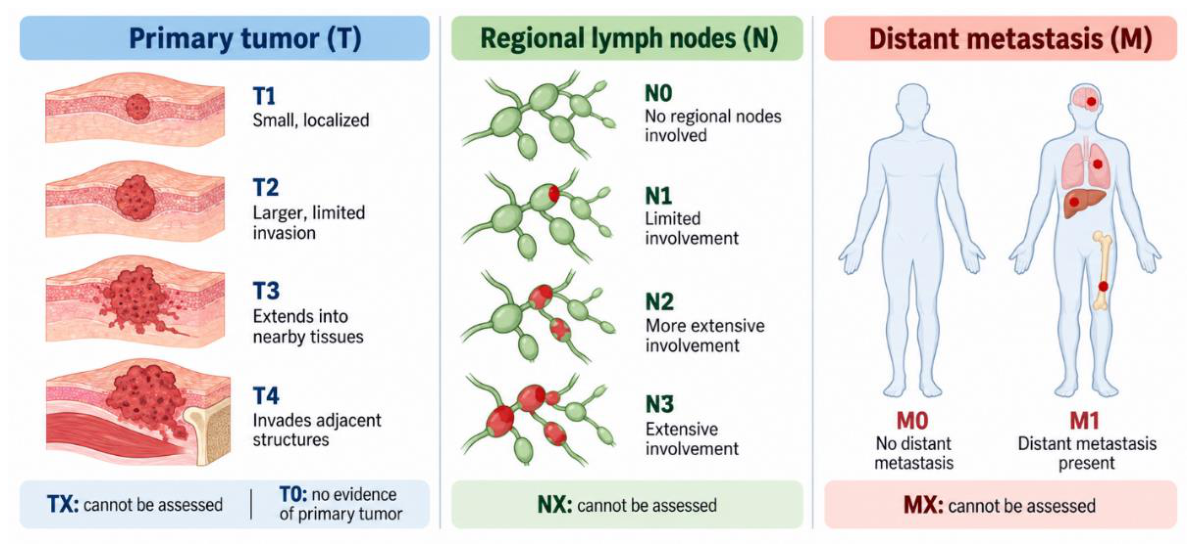
Figure 2.
New technological innovations.
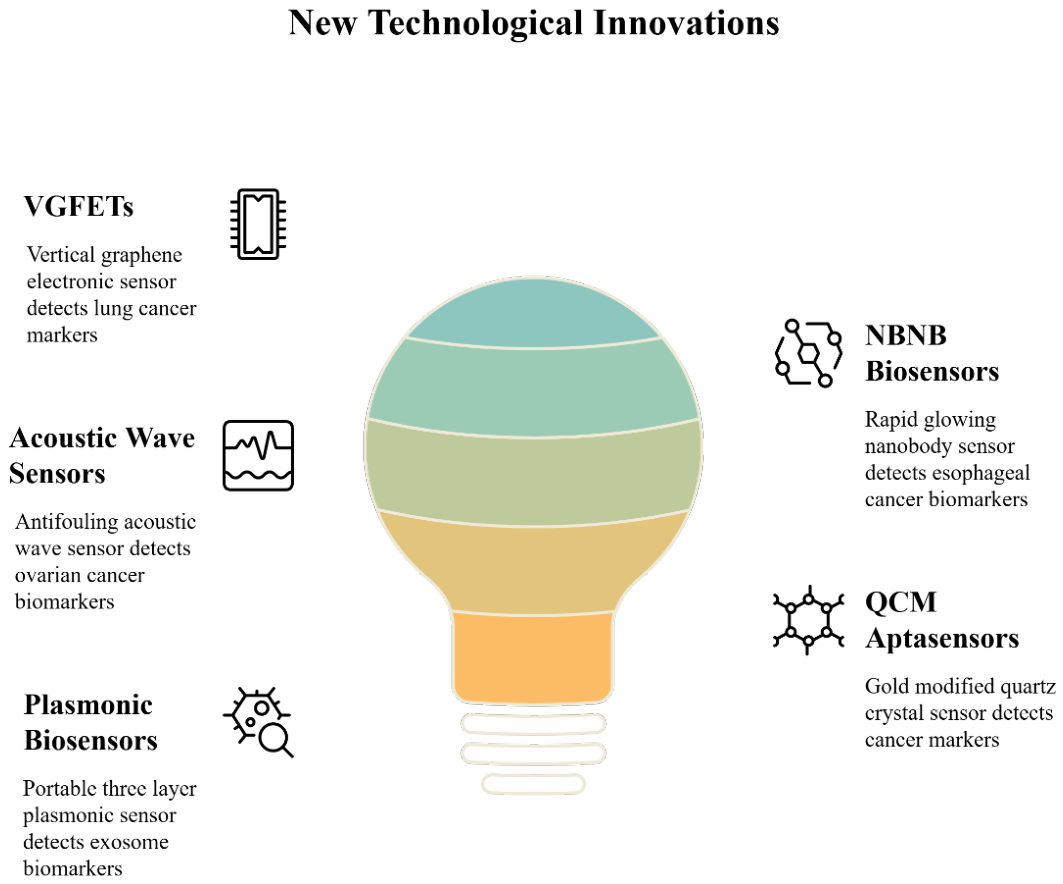
Figure 3.
Comparative Schematics of Phase-Specific and Phase-Nonspecific Chemotherapeutic Dynamics. The left panel highlights cell cycle-specific agents targeting active division windows: antimetabolites (e.g., cytarabine, gemcitabine) interrupting DNA replication during the S-phase, and taxanes (e.g., paclitaxel, docetaxel) stabilizing microtubules to trigger mitotic arrest in the M-phase. The right panel depicts phase-nonspecific macromolecular damage executed indiscriminately throughout the cellular lifespan by DNA-crosslinking platinum complexes (e.g., cisplatin, oxaliplatin) and topoisomerase II-poisoning anthracyclines (e.g., doxorubicin).
Figure 3.
Comparative Schematics of Phase-Specific and Phase-Nonspecific Chemotherapeutic Dynamics. The left panel highlights cell cycle-specific agents targeting active division windows: antimetabolites (e.g., cytarabine, gemcitabine) interrupting DNA replication during the S-phase, and taxanes (e.g., paclitaxel, docetaxel) stabilizing microtubules to trigger mitotic arrest in the M-phase. The right panel depicts phase-nonspecific macromolecular damage executed indiscriminately throughout the cellular lifespan by DNA-crosslinking platinum complexes (e.g., cisplatin, oxaliplatin) and topoisomerase II-poisoning anthracyclines (e.g., doxorubicin).
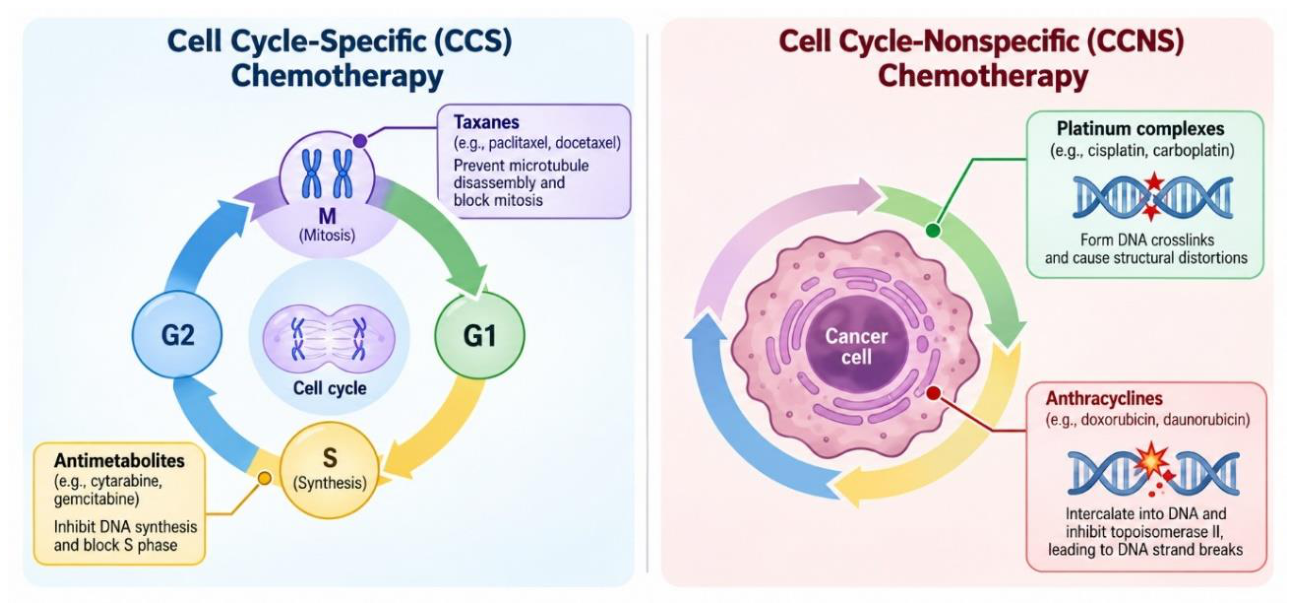
Figure 4.
The Intracellular Landscape of Tumor-Mediated Chemoresistance Pathways. Visual summary of the localized molecular adaptations driving therapeutic evasion across three distinct cellular zones: Zone 1 highlights active drug extrusion via upregulated ABC transporter superfamilies (P-gp/ABCB1); Zone 2 depicts enhanced nuclear DNA repair machinery, notably Nucleotide Excision Repair (NER) adaptations against platinum complexes; Zone 3 displays cytoplasmic metabolic rewiring characterized by altered glutathione (GSH) pools, mitochondrial alterations under duress, and activated ER/organelle stress autophagic fluxes.
Figure 4.
The Intracellular Landscape of Tumor-Mediated Chemoresistance Pathways. Visual summary of the localized molecular adaptations driving therapeutic evasion across three distinct cellular zones: Zone 1 highlights active drug extrusion via upregulated ABC transporter superfamilies (P-gp/ABCB1); Zone 2 depicts enhanced nuclear DNA repair machinery, notably Nucleotide Excision Repair (NER) adaptations against platinum complexes; Zone 3 displays cytoplasmic metabolic rewiring characterized by altered glutathione (GSH) pools, mitochondrial alterations under duress, and activated ER/organelle stress autophagic fluxes.
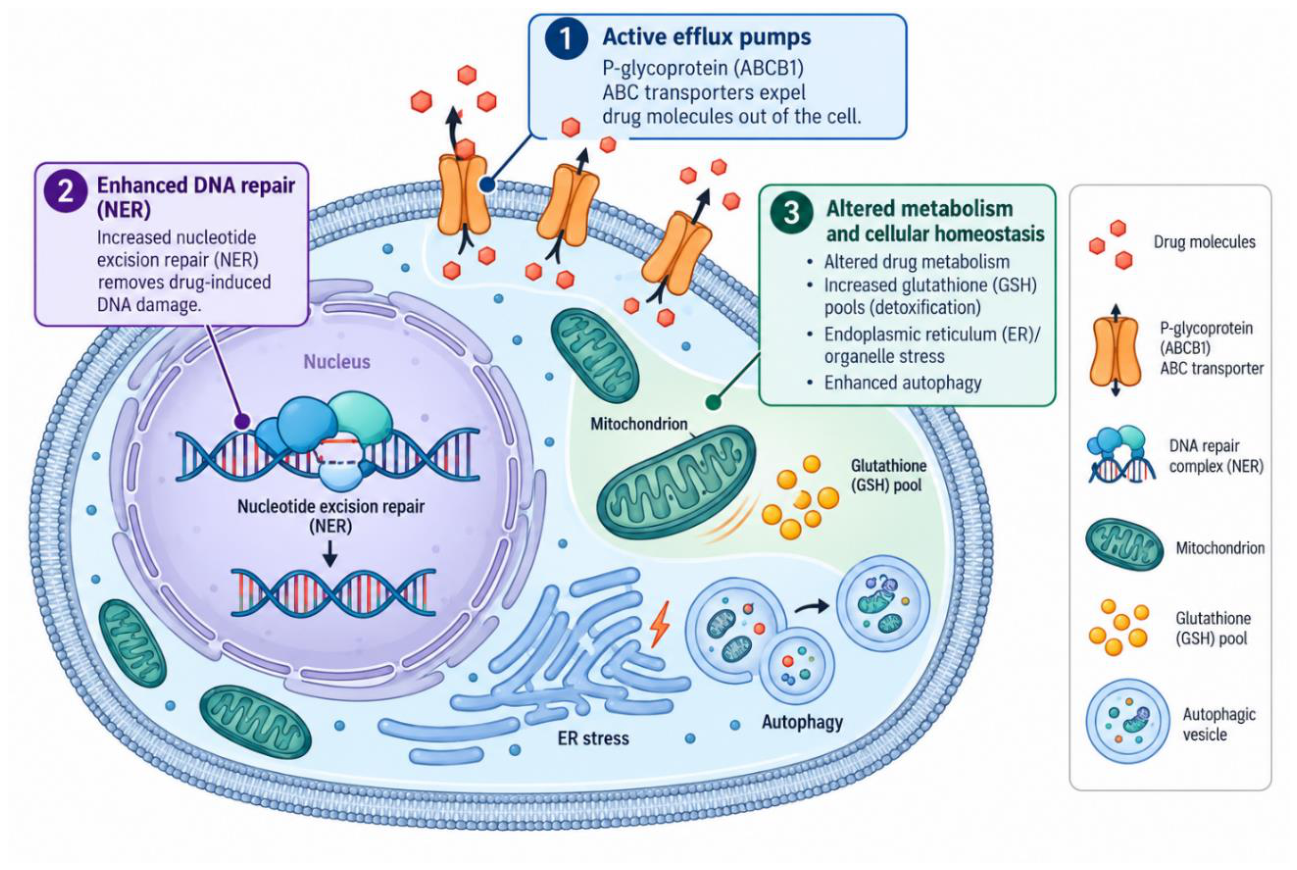
Figure 5.
Mechanism of Receptor-Mediated Internalization and the Cytotoxic Bystander Effect of Antibody-Drug Conjugates (ADCs). The sequential pharmacological cascade highlights Step 1: Upfront small-molecule kinase inhibition (osimertinib) to induce cell-surface HER3 receptor density; Step 2: High-affinity binding of the tripartite antibody-drug conjugate (blue mAb to red payload); Step 3: Receptor-mediated endocytic internalization, lysosomal trafficking, and subsequent enzymatic cleavage via proteases to liberate the free cytotoxic payload; Step 4: Outward free-diffusion of the membrane-permeable payload into the microenvironment, successfully executing bystander killing of neighboring antigen-negative tumor niches [67].
Figure 5.
Mechanism of Receptor-Mediated Internalization and the Cytotoxic Bystander Effect of Antibody-Drug Conjugates (ADCs). The sequential pharmacological cascade highlights Step 1: Upfront small-molecule kinase inhibition (osimertinib) to induce cell-surface HER3 receptor density; Step 2: High-affinity binding of the tripartite antibody-drug conjugate (blue mAb to red payload); Step 3: Receptor-mediated endocytic internalization, lysosomal trafficking, and subsequent enzymatic cleavage via proteases to liberate the free cytotoxic payload; Step 4: Outward free-diffusion of the membrane-permeable payload into the microenvironment, successfully executing bystander killing of neighboring antigen-negative tumor niches [67].
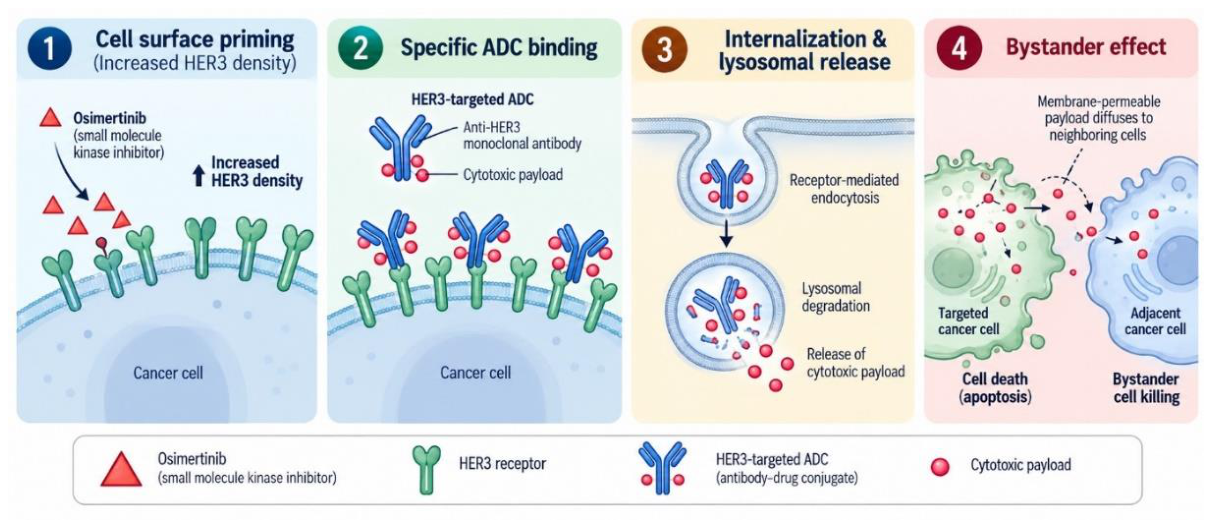
Figure 6.
Therapeutic Pathways of Natural Phytochemicals in Modulating Chemoresistance and TME Hypoxia. This flowchart outlines the dual role of phytochemicals in modern oncology: MDR via melatonin-loaded nanocarrier systems and targeting TME hypoxia using the HNF4A biomarker to disable adaptive survival pathways and restore therapeutic susceptibility.
Figure 6.
Therapeutic Pathways of Natural Phytochemicals in Modulating Chemoresistance and TME Hypoxia. This flowchart outlines the dual role of phytochemicals in modern oncology: MDR via melatonin-loaded nanocarrier systems and targeting TME hypoxia using the HNF4A biomarker to disable adaptive survival pathways and restore therapeutic susceptibility.
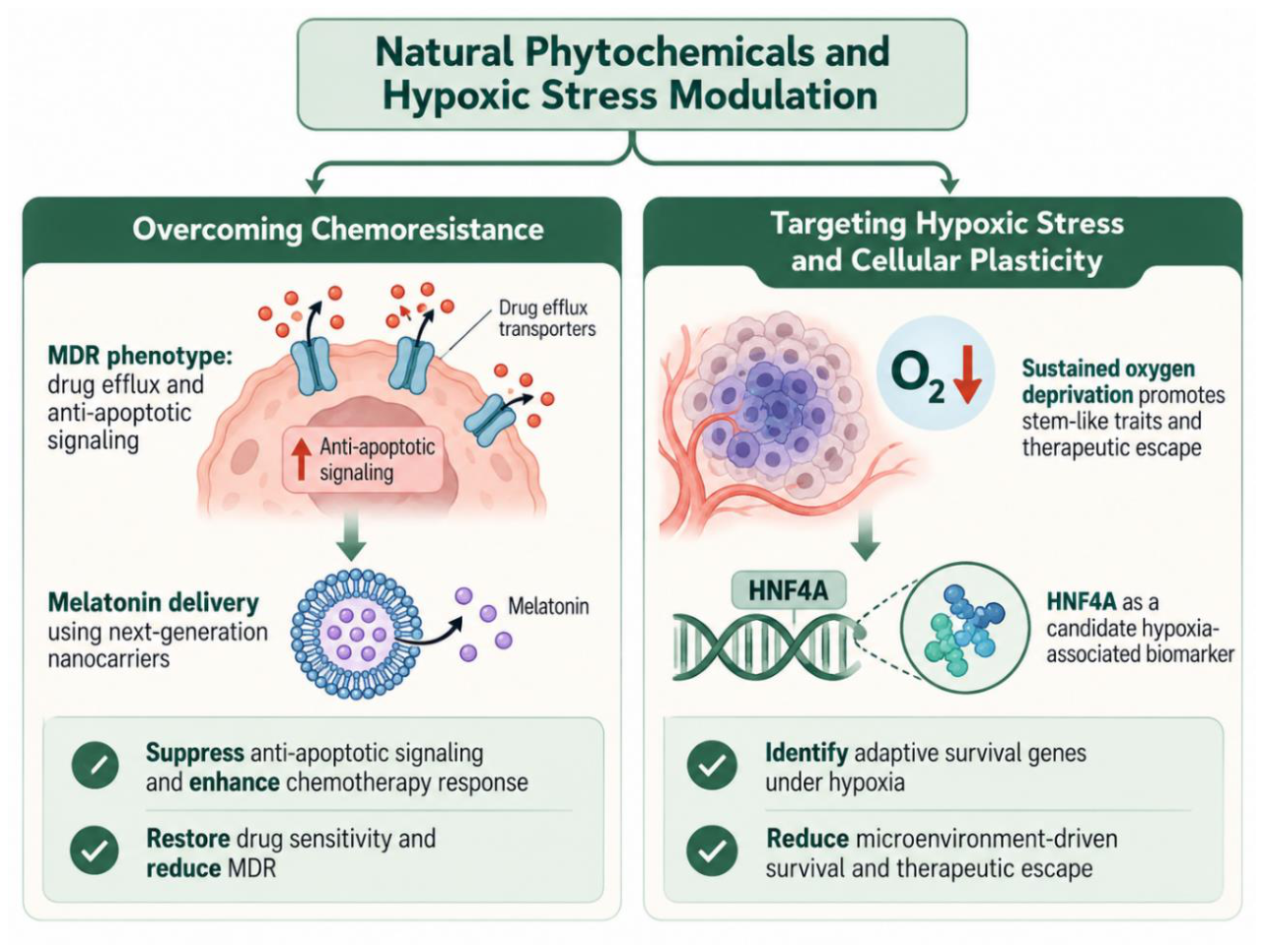
Disclaimer/Publisher’s Note: The statements, opinions and data contained in all publications are solely those of the individual author(s) and contributor(s) and not of MDPI and/or the editor(s). MDPI and/or the editor(s) disclaim responsibility for any injury to people or property resulting from any ideas, methods, instructions or products referred to in the content. |
© 2026 by the authors. Licensee MDPI, Basel, Switzerland. This article is an open access article distributed under the terms and conditions of the Creative Commons Attribution (CC BY) license.
Copyright: This open access article is published under a Creative Commons CC BY 4.0 license, which permit the free download, distribution, and reuse, provided that the author and preprint are cited in any reuse.