
Submitted:
11 November 2026
Posted:
12 November 2026
You are already at the latest version
Abstract
Microbiome studies in lesbian, gay, bisexual, transgender and other sexual and gender minority populations encompass partner-associated ecology, gender-affirming care, infection and prevention. This critical narrative review integrates human evidence by sex assigned at birth, gender identity and expression, sexual orientation and practices, current anatomy, and clinical state. Prevotellaceae-enriched intestinal profiles recur in several MSM cohorts, with geographical, behavioral and HIV-related heterogeneity. Female-partner studies capture both stable Lactobacillus-associated communities and transitions toward bacterial vaginosis. Testosterone-exposed vaginas and surgically reconstructed genital tissues show different relationships between composition, symptoms and inflammation; direct neovaginal testing demonstrates poor diagnostic performance of Nugent scoring. Oral, urinary, seminal and fungal studies broaden the clinical scope, while separately analyzed gender-expression, nonbinary and asexual evidence remains sparse. Intervention findings further distinguish microbial modulation from clinical benefit: resistance determinants can increase without broad taxonomic change, and a dietary trial links baseline community features to exploratory metabolic response. The comparative synthesis identifies tissue, endocrine state and measured endpoint as central to interpreting microbial markers. Clinical translation requires longitudinal exposure contrasts, expressed-function measurements and trials with validated patient-important outcomes.
Keywords:
sexual and gender minorities
; sexual orientation
; gender identity
; gender expression
; sex assigned at birth
; gut microbiome
; vaginal microbiome
; neovaginal microbiome
; gender-affirming hormone therapy
; sexual health
1. Introduction
Microbiome studies in lesbian, gay, bisexual, transgender (LGBT) and other sexual and gender minority (SGM) populations estimate different biological contrasts: partner-associated exposure, endocrine change, infection and treatment, or the creation of new epithelial habitats. Integrating these findings requires separate ascertainment of sex assigned at birth, gender identity and expression, sexual orientation and practices, and current anatomy [1,2]. The largest literatures concern intestinal and anorectal communities in men who have sex with men (MSM), vaginal ecology in women who have sex with women (WSW), and gender-affirming care.
Existing reviews address HIV–gut interactions [3], gender-affirming genital care and neovaginal surgical techniques [4,5,6], and testosterone-associated vaginal changes [7,8]. Recent vaginal ecological synthesis also incorporates social context and antimicrobial resistance [9]. The comparative question extending across these domains is how tissue, exposure and clinical state change the meaning of a microbial signal.
MSM-associated intestinal profiles vary across HIV and prevention settings [10,11], while Lactobacillus abundance has different relationships with symptoms and inflammation in native vaginal, testosterone-exposed and reconstructed tissues [12,13]. This review brings those contrasts together across population dimensions and body sites, connecting community structure and expressed function to the clinical outcome actually measured.
2. Review Approach and Population Classification
This critical narrative review used PubMed searches, primary publisher records and citation tracing through 6 November 2026. Microbiome, microbiota and metagenomics terms were combined with LGBT, SGM, transgender, transmasculine, transfeminine, nonbinary, lesbian, bisexual, MSM, WSW, sexual orientation, gender identity and gender expression. Site- and condition-specific searches addressed hormones, genital reconstruction, HIV, bacterial vaginosis (BV), sexually transmitted infections (STIs), human papillomavirus (HPV), oral, urinary and seminal communities, fungi, diet and microbiome-directed interventions. Primary human community-profiling studies were prioritized; pathogen studies, tissue experiments, guidance and protocols are identified separately. Heterogeneous recruitment, specimens and endpoints precluded a meaningful pooled population effect.
Table 1 separates the population dimensions used throughout the review. Historical classifications are retained where birth assignment or gender identity was unrecorded; MSM and WSW refer to reported behavior. Cohort descriptions identify ascertainment limits when they materially change interpretation.
Population dimensions are ascertained independently [1,2]. MSM and WSW denote reported sexual behavior.
Figure 1 connects independently recorded population dimensions with ecological exposures, anatomical compartments and distinct measurement layers.
3. Sex Assigned at Birth and Current Physiological Context
3.1. Anatomy and Endocrine Exposure
Current tissue and endocrine exposure define the physiological comparison more precisely than birth assignment alone. A retained vagina exposed to testosterone, a skin-lined neovagina and a diverted sigmoid neovagina provide distinct habitats, as examined below. Menopause-associated intestinal and functional differences in 2,300 Hispanic/Latino participants, together with host-genetic associations involving digestion and mucosal biology, identify additional physiological modifiers that cut across identity categories [19,20].
3.2. Asymptomatic and Pooled Minority Samples
Asymptomatic status, negative pathogen testing, virological suppression and absence of systemic disease identify different clinical reference states. In the corrected student pilot, only 41 of 65 enrolled participants provided analyzable stools. Pooled SGM membership was associated with lower Shannon diversity after separate adjustment for perceived stress, anxiety or depression [21,22]. The absence of lesbian-identifying participants and the small, pooled gender/orientation categories limit subgroup interpretation (Table 2).
Table 2 summarizes representative populations, their clinical states and the resolution of the available evidence.
Studies are illustrative rather than independent units for a pooled effect. Participant counts and specimen counts are distinguished; nonbinary participants are identified where reported but were generally not analyzed separately. AMAB, assigned male at birth; ASV, amplicon sequence variant; BV, bacterial vaginosis; GAHT, gender-affirming hormone therapy; IL, interleukin; SGM, sexual and gender minority.
4. Sexual Orientation and Sexual Practices
4.1. Gay and Bisexual Men and Other MSM
4.1.1. Community Structure and Sexual Practices
Prevotellaceae enrichment, including members of the Segatella copri complex, recurs across several MSM cohorts. Independent Barcelona and Stockholm studies found greater Prevotella and lower Bacteroides abundance after accounting for HIV; dietary assessments explained relatively little of the association [10]. A US study subsequently distinguished MSM-associated communities from Prevotella-rich profiles in other participants [11]. These behavior-defined cohorts did not report separate birth-assignment and gender-identity ascertainment and generally lacked gay-versus-bisexual estimates (Table 2).
Shotgun metagenomics resolved coexisting S. copri-complex members and additional Prevotellaceae in a predominantly treated-HIV cohort, whose MSM communities remained distinct from industrialized and nonindustrialized references [16]. Anatomical sampling further changes the contrast: a reanalysis of the Kelley cohort, comprising 35 MSM reporting condomless receptive anal intercourse and 20 controls, identified appreciably different anal and rectal communities despite shared dominant genera [32].
Receptive anal intercourse, partner networks, lubricant exposure and douching provide more specific ecological contrasts than orientation labels. In that cohort, HIV-negative MSM reporting condomless receptive anal intercourse had rectal microbial differences alongside greater Th17 abundance, CD8-cell proliferation and injury-repair transcriptional signatures [33]. The comparison could not separate microbial effects from mechanical exposure, semen or correlated practices. A randomized seven-day study of 60 HIV-negative, self-identified male participants found that a hyperosmolar lubricant decreased Bacteroides abundance without significantly changing rectal tenofovir/emtricitabine concentrations [34].
Two 2026 studies extended this evidence to douching. Among 92 HIV-negative, self-identified cisgender sexual-minority men reporting receptive condomless anal sex, douching was associated with lower rectal microbial diversity and higher inflammatory cytokine/chemokine concentrations; participants who douched also reported more receptive partners [35]. A separate Chinese study of 51 HIV-negative MSM associated douching with fecal compositional and metabolomic differences and higher serum lipopolysaccharide-binding protein [36]. This biomarker supports an association with microbial translocation rather than directly measuring epithelial permeability. Both studies were cross-sectional, leaving exposure frequency, products and correlated behavior as competing explanations.
4.1.2. HIV and Infectious Conditions
HIV-associated differences remain detectable when sexual practice is addressed. In AGEhIV, 80 participants with HIV receiving antiretroviral therapy (ART) and 80 seronegative comparators were matched across MSM, men who have sex with women and female groups; HIV-associated fecal differences persisted, while receptive anal intercourse supplied an additional compositional association [37]. In 383 young MSM, weighted analyses associated viremia category with approximately 1.1% of rectal compositional variation. Undetectable and low-level-viremia groups were similar, and alpha diversity lacked a clear dose-response [38].
Recent studies qualify any uniform HIV signature. Nigerian shotgun metagenomics of 425 MSM identified lower richness and genus-level Prevotella among virally suppressed participants, but no significant P. copri association with HIV status, viral load or receptive anal intercourse [39]. In a Chinese four-group study of 378 men, all participants with HIV had sustained suppression on stable ART. MSM-associated Prevotella enrichment coexisted with HIV-associated taxonomic differences and inflammatory-marker correlations [40]. Its behavior definition included sex with men, exclusively or alongside women, during the preceding six months, rather than gay identity. Conversely, 316 predominantly MSM participants with no HIV or acute/early untreated infection showed broadly preserved rectal diversity and composition during the first six months, with modest richness and selected taxon differences [41]. The contrast between established, treated infection and acute untreated infection places immune history, ART exposure, geography and sampling compartment within the estimated HIV-associated effect.
Temporal and experimental evidence also address different questions. A longitudinal comparison of 27 seroconverters and 28 controls, all assigned male at birth, identified microbial and inflammatory differences before HIV acquisition, with limited further change around early seroconversion [42]. This supports temporal precedence without isolating microbial susceptibility from exposure histories. MSM donor communities induced immune differences in gnotobiotic mice and altered experimental infection in human lamina propria-cell assays; Prevotellaceae largely failed to engraft in the mice, precluding attribution to Segatella itself [43].
Asymptomatic infection modifies the local comparison. Among 105 young MSM, including ART-treated participants, bacterial STI-associated inflammatory transcription was particularly evident with HIV. Broad microbiome differences were limited in the full dataset, although pathogen-concordant analyses identified additional compositional associations; STI was not associated with higher measured tissue HIV RNA or explant replication [44]. A Chinese self-controlled gonorrhea study explicitly required male sex at birth and recent sex with men. Its microbiome analyses included 94 paired anorectal samples from 47 participants: selected genera changed after infection without broad alpha- or beta-diversity differences [45].
Pathogen carriage can also occur without gastrointestinal symptoms. Multiplex fecal PCR detected an enteric pathogen in 27 of 375 asymptomatic Taiwanese MSM, including Giardia, Entamoeba, Shigella and Campylobacter; recent proton-pump-inhibitor exposure was associated with carriage [46]. In a small, predominantly asymptomatic Tokyo MSM cohort, metagenomics and separate laboratory parasite assays suggested a possible bile-acid–Entamoeba histolytica interaction, but adjusted human taxonomic associations were not significant and the proposed pathway was not demonstrated in patients [47].
HPV studies similarly distinguish community associations from progression mechanisms. In 58 HIV-negative MSM not using HIV pre-exposure prophylaxis (PrEP), persistent anal HPV detection was associated with higher Bacteroides fragilis abundance without overall diversity differences; microbiota were sampled at the final visit rather than prospectively before persistence [48]. Among virally suppressed MSM with HIV, anal communities differed from matched stool, and high-grade squamous intraepithelial lesions were associated with selected anal taxa [49]. Cross-sectional lesion comparisons, small subgroups and unequal HPV-genotype distributions limit inference about microbial causation or cancer prevention.
4.1.3. Prevention Exposures
Oral HIV PrEP introduces both pharmacological exposure and prevention-care correlates. In our mini-review, we synthesized three small PrEP studies, highlighting variable taxonomic findings, methodological heterogeneity and limited long-term microbiome evidence [50]. A propensity-matched comparison of 37 PrEP users and 37 nonusers found selected rectal differences, whereas an eight-person longitudinal tenofovir disoproxil fumarate/emtricitabine (TDF/FTC) study reported decreased Streptococcus and increased Erysipelotrichaceae [51,52]. A separate 27-person cross-sectional study compared 14 long-term PrEP users with 13 nonusers and reported greater Catenibacterium and Prevotella and lower Finegoldia abundance in self-collected rectal samples [53]. The differing Streptococcus directions across designs, small samples and concurrent behavior or antibiotic histories prevent a stable drug-specific signature from being established.
Antibiotic prophylaxis provides stronger evidence for functional selection. The randomized doxycycline post-exposure prophylaxis (DoxyPEP) microbiome substudy selected 150 participants assigned male at birth, with usable metagenomic data from 89 and metatranscriptomic data from 70. Over six months, tetracycline-resistance determinants increased from 46% to 51% of the measured DNA resistome and from 4% to 15% of its RNA counterpart, despite no major detected community restructuring [54]. These are proportions within resistance-gene pools, not percentages of resistant organisms. A separate randomized daily doxycycline pre-exposure prophylaxis (doxyPrEP) pilot included 41 participants taking HIV PrEP: 39 self-identified cisgender males and two reported “other” gender. Rectal 16S profiling showed limited overall compositional change over 48 weeks, but did not measure the resistome [55]. Event-driven doxyPEP and daily doxyPrEP consequently inform different exposure regimens and microbial endpoints.
4.2. Lesbian and Bisexual Women and Other WSW
Most direct evidence concerns women reporting female partners. Historical cohorts used recent partner history, whereas the 2026 Brazilian comparison explicitly recruited cisgender women and classified exposure by exclusively female or male partners during the preceding year [25].
4.2.1. Asymptomatic Communities and Partner Networks
WSW cohorts contain stable Lactobacillus-dominated communities as well as transitions toward anaerobe-rich states, within the broader variation described in asymptomatic vaginal surveys [56]. In the Belgian Isala study of 3,345 donors, a partner-sex analysis compared 58 participants reporting female partners with 2,317 reporting male partners. Female-partner status was associated with greater abundance of an L. crispatus-containing co-abundance module after adjustment for technical factors, age, recent intercourse and antibiotics; overall alpha- and beta-diversity contrasts were not significant [26]. The module association adds a partner-based ecological comparison, rather than a demonstrated BV outcome.
The WOW publications connect partner concordance at baseline to later ecological transitions within the same cohort. Baseline Nugent-defined BV affected 27% of participants, while most repeated samples remained in normal Nugent categories; couples were often concordant for normal microbiota, particularly in longer relationships [23]. In the selected, initially BV-negative sequencing subset, 90% had Lactobacillus-dominated communities at baseline [24].
Culture and strain typing provide direct evidence that female partners can share lactobacilli. In a study of 237 women, identical rep-PCR fingerprints were recovered from both partners in 23 of 31 couples with available isolates [57]. More recent genome-resolved analysis of a chlamydia-enriched sexual network identified putative L. iners exchange in one of only two female–female contact dyads. However, most strain-concordance events occurred between participants not identified as sexual contacts [58]. Shared strains support microbial exchange, while incomplete network ascertainment, common regional strains and nonsexual sources complicate attribution to a specific contact.
Longitudinal epidemiology connects these networks to BV acquisition. Among 298 initially BV-negative WOW participants, 51 incident cases occurred; new partners were associated with greater acquisition risk (adjusted hazard ratio, 2.51), whereas coenrollment with a BV-negative partner was associated with lower risk [59]. Within the nested sequencing study, new partners, predominantly female, were associated with greater diversity, community-state changes and Gardnerella- or anaerobe-rich communities relative to L. crispatus dominance [24].
Host timing and resident populations also matter. In a Seattle WSW cohort, baseline detection of BV-associated organisms predicted subsequent BV, whereas L. crispatus detection predicted lower risk [60]. A small, nested analysis associated oral or anal carriage of selected BV-associated bacteria with later vaginal BV [61]. Daily sampling in an African American WSW cohort showed increases in P. bivia and G. vaginalis before incident BV; sequencing involved 14 cases and eight participants maintaining normal Nugent scores [62]. A related diary analysis associated incident BV with sexual activity and recent menses [63]. These findings favor models integrating inoculation, endogenous expansion and menstrual perturbation; they do not identify an obligatory single transmission route.
A contemporary comparison illustrates why ecological and infection outcomes require separate assessment. Among 54 WSW and 55 women reporting exclusively male partners, Shannon diversity was higher in WSW, and Nugent BV occurred in 21/53 versus 8/54 evaluable participants. Overall community-state distribution was not significantly different, nor were comparisons for HPV, high-risk HPV, chlamydia, trichomoniasis or Candida morphotypes [25]. Recruitment setting, smoking, contraception and socioeconomic characteristics differed between groups, limiting attribution to partner sex alone.
4.2.2. HPV and Fungal Outcomes
HPV studies establish exposure without defining a bacterial mechanism. In an early series of 149 WSW, HPV DNA and squamous intraepithelial lesions were detected among participants reporting no previous male partners [64]. A subsequent study found cervical/vaginal HPV DNA in 31 of 248 WSW and documented screening gaps among those without male sexual histories [65]. Sampling differed, including vulvar testing in the earlier study, so the prevalence estimates do not establish a temporal trend.
Disaggregation changes interpretation. In NHANES data from 7,132 women, genital HPV prevalence differed between bisexual and lesbian identities and between histories involving partners of both sexes or exclusively female partners; adjustment attenuated several aggregate differences [66]. Identity cannot substitute for exposure history or healthcare access. In a 12-participant experiment, HPV DNA remained detectable on some vaginally inserted devices after cleaning [67]. DNA persistence demonstrates a potential vehicle, without establishing viable virions or partner infection. Genotyping of Trichomonas vaginalis from three mutually positive female couples found matching fingerprints in one pair, providing small-scale evidence consistent with female-to-female transmission [68].
Fungal findings resist a uniform transmission account. A London clinic study associated greater numbers of female partners with vulvovaginal Candida detection [69]. In a separate culture study of 196 WSW, 105 carried Candida, but only 13 of those 105 had symptomatic candidiasis; all 13 mutually colonized couples had discordant molecular fingerprints [70]. Colonization, symptomatic disease and demonstrated strain sharing are separate endpoints.
4.2.3. Endocrine and Anatomical Context
Menopausal state modifies the native vaginal comparison. A study of 87 pre-, peri- and postmenopausal women associated reproductive stage and atrophy with distinct communities, including Lactobacillus-depleted states [71]. Endocrine manipulation and partner-directed prevention provide different intervention contrasts, compared in Section 8.2 [72,73,74].
Direct WSW-specific gut and urinary community evidence remains much thinner than the vaginal literature. Rectal lactobacillus cultures and anal bacterial PCR identify potential reservoirs; paired-site community studies would clarify their relationship to intestinal ecology.
5. Gender Identity and Gender-Affirming Care
Prospective hormone studies permit within-person endocrine contrasts. In paired fecal shotgun metagenomics, 12 weeks of gender-affirming hormone therapy (GAHT) was followed by species-level and functional changes despite unchanged overall alpha and beta diversity. The treatment-direction–time interaction explained 4.1% of functional metagenomic variation; regimens were heterogeneous and similarly processed cisgender controls were absent [17,75]. These endpoints describe encoded microbial potential rather than measured metabolite production.
5.1. Transgender Men, Transmasculine and Nonbinary Participants
The transmasculine genital literature principally samples a retained vagina during testosterone exposure, with relatively few hormone-unexposed comparators and limited separately analyzed nonbinary evidence.
5.1.1. Endocrine Exposure and Mucosal Function
The initial study found less frequent Lactobacillus dominance and greater diversity in self-described healthy transgender men receiving testosterone than in cisgender comparators [76]. Feil and colleagues subsequently compared trans men with premenopausal and menopausal women. Both trans men and menopausal women had greater alpha diversity than premenopausal controls, but their overall compositions remained distinguishable. Longer testosterone exposure correlated with lower Shannon diversity within the trans group; none had a Nugent score of 7–10 [77]. Concomitant GnRH-agonist use and variation in serum estradiol further complicate attribution to testosterone concentration alone [77].
Prospective studies now establish temporal change. A Thai paired study found reduced Lactobacillus dominance, greater alpha diversity and changes in pH, symptoms and atrophy-related measures after 12 weeks of intramuscular testosterone enanthate [27]. A separate US study collected daily specimens for seven days before and up to 90 days after testosterone initiation in nine participants selected for baseline Nugent scores of 0–3 and absence of current STIs. Eight developed episodes meeting the study’s Nugent-based alteration threshold, and five developed incident BV defined by scores ≥7 on consecutive days, commonly around days 20–40. Only one of those five reported symptoms requiring treatment [28]. Intensive within-person sampling strengthens temporal inference, but this selected, all-White cohort cannot supply a general prevalence estimate or separate testosterone from concurrent bleeding and sexual exposures.
Longer-term data challenge simple mapping of Lactobacillus depletion onto disease. TransBiota followed testosterone-exposed participants, including nonbinary identities, over three weekly collections; mean treatment duration was 5.1 years (Table 2). Fewer than 10% had Lactobacillus-dominant communities. Dominance was associated with odor and higher interleukin-1α, but not dryness or dyspareunia. Four current users of local estradiol had no Lactobacillus-dominant profiles [12]. The latter observation contrasts with the positive association between intravaginal estrogen and Lactobacillus in the smaller 2019 cohort [76]. Local estrogen use was observational in both cohorts.
Epithelial studies provide complementary mechanisms. Vaginal biopsies from 16 testosterone-treated participants undergoing gender-affirming surgery showed depleted glycogen and reduced epithelial maturation, proliferation and estrogen-receptor expression relative to comparator tissues; the regimen was characterized as supraphysiological by the investigators [78]. A 2026 reconstructed-epithelium experiment found thinner testosterone-exposed tissue and altered junctional and chemokine transcription, yet no detected impairment of barrier function [79].
5.1.2. Infection Screening and Prevention
Cervicovaginal cytology illustrates the distinction between hormone-associated morphology and infectious disease. In a retrospective series of 61 transmasculine individuals receiving testosterone, slide review commonly identified atrophy and reduced lactobacilli, yet no clinical or cytological BV. High-risk HPV testing and histological follow-up identified clinically relevant lesions within this selected referral population [80]. Exposure remains important: a separate cervical HPV study associated recent receptive penile–vaginal contact with higher odds of high-risk HPV detection, emphasizing sexual practices alongside identity and hormone use [81].
HIV prevention data remain small but unusually informative because hormone-exposed and unexposed trans men were both included. Hastie and colleagues assessed cervicovaginal specimens from 13 trans men taking oral tenofovir disoproxil fumarate/emtricitabine PrEP, seven using testosterone, and 32 cisgender women. Lactobacillus relative abundance was lower in trans men overall; the testosterone subgroup had numerically lower cervicovaginal tenofovir concentrations, but the concentration difference and measured cytokine differences were not significant [82]. Separate recruitment cohorts, age and measurement of parent drug in cervicovaginal fluid limit comparison with intracellular exposure or clinical PrEP efficacy.
Urinary outcomes likewise resist direct prediction from vaginal ecology. A matched retrospective cohort included 2,401 testosterone-using gender-diverse people assigned female at birth and 2,401 cisgender women; recorded UTI rates were 0.09 and 0.10 per person-year, respectively, without a significant difference [83]. UTI ascertainment combined diagnostic codes with antibiotic dispensing, rather than urinary microbiome sequencing. The cohort excluded genital reconstructive procedures relevant to urinary anatomy, limiting application to people after urethral lengthening or phalloplasty.
5.1.3. Intestinal Evidence
Evidence outside the genital tract remains smaller and should retain its own endpoints. Shotgun metagenomics of 26 stools from nine adolescents and young adults before and up to eight months after testosterone initiation detected changes in predicted glutamate-related metabolic pathways, without a species-level association with treatment duration [84]. Fecal calprotectin did not change significantly, separating the genomic signal from a detected inflammatory response.
5.2. Transgender Women, Transfeminine and Nonbinary Participants
5.2.1. Hormone Exposure and Rectal Ecology
Rectal community comparisons reveal geographical and exposure heterogeneity. Van Doren and colleagues compared transgender women receiving feminizing hormones with cisgender MSM, all without HIV, in Atlanta and Bangkok, with a separate longitudinal initiation cohort (Table 2). Community differences involved both gender category and location; MSM-associated Prevotellaceae enrichment occurred in Atlanta only, while alpha diversity varied geographically. Short-term initiation produced no significant community shift, potentially reflecting subtherapeutic exposure [29]. Differences from the paired fecal metagenomic study may reflect exposure intensity, sampling compartment and analytical resolution.
5.2.2. Neovaginal Tissue and Microbial Assembly
The neovagina constitutes several surgically created habitats. Penile-inversion procedures use penile skin, frequently supplemented by scrotal grafts; intestinal procedures retain bowel mucosa after diversion from the fecal stream; peritoneal augmentation introduces another lining and may create composite tissue environments.
Early skin-lined studies established polymicrobial communities. Weyers and colleagues examined 50 postoperative women using microscopy, targeted molecular assays and, in 30 participants, culture; lactobacilli were cultured from one participant, alongside mixed aerobic and anaerobic organisms [85]. Conversely, Lactobacillus-targeted molecular profiling detected these organisms in 47 of 63 asymptomatic women [86]. This difference concerns detection methods and cohorts: detecting a genus establishes neither numerical dominance nor clinical benefit. In a later sequencing study of 15 asymptomatic transgender/gender-nonbinary participants and eight cisgender comparators, neovaginal communities were diverse and Lactobacillus represented at most 3% of reads; 11 participants reported penile inversion and four had unspecified techniques [87]. Pooled identity categories and incomplete surgical histories limit nonbinary-specific interpretation.
Within-person sampling now clarifies early assembly. In 30 explicitly AMAB transgender women, von Bargen and colleagues compared preoperative penile, scrotal, urethral and rectal microbiota with neovaginal communities 2–13 months after penile inversion. Prevotella, Peptoniphilus, Anaerococcus and Porphyromonas were prominent; more than half of neovaginal amplicon sequence variants (ASVs) were unshared with sampled donor sites, while the rectum showed the greatest sharing. Estrogen use was reported by 27 participants, and interval antibiotic exposure was common [30]. These data characterize retained genital and urethral sites as well as postoperative colonization, but ASV overlap supplies source compatibility rather than strain-resolved transmission.
Sigmoid neovaginas require a different interpretation. In 28 recipients, paired rectal, skin and neovaginal interspacer profiling showed that diverted sigmoid communities differed from rectal communities, particularly through reduced abundance and diversity of Bacteroidetes [88]. Thus bowel origin preserves a distinct epithelial context while altered luminal supply reshapes its microbiota. In a prospective endoscopic study of 34 sigmoid-neovagina recipients, discharge and malodor correlated with inflammatory changes, while retained rectosigmoid examinations were normal [89]. This identifies diversion-associated inflammation as a tissue-specific clinical process alongside microbial compositional change.
Peritoneal augmentation should be separated from both skin-only and intestinal reconstruction. The 2026 DIVA clinical-outcomes analysis included 29 peritoneal-augmented and eight penile-inversion recipients, with frequent reported pain, bleeding and discharge in both groups. It measured postoperative experiences and satisfaction, rather than comparative microbial communities [90]. Peritoneal-specific community profiles and mixed-lining spatial heterogeneity therefore remain priorities for direct characterization; observations from peritoneal vaginoplasty in MRKH populations cannot substitute for transfeminine data.
5.2.3. Symptoms, Inflammation and Infection
Functional evidence initially came from five neovaginal metaproteomes, four skin-lined and one with a sigmoid extension. Birse and colleagues identified diverse anaerobic taxa and differences in immune-response and epithelial proteins relative to cisgender vaginal comparators [91]. Tissue composition and the small mixed-surgery sample constrain attribution of those protein differences to microbial pathogenicity.
The larger TransBiota study related 133 successfully sequenced samples from 47 penile-inversion recipients to cytokines and symptoms over three weekly collections. Co-occurring taxa formed clusters with distinct immune profiles. Symptoms occurred at 26.3% of sampled visits; malodor was associated with taxa belonging to a lower-cytokine cluster, including Propionimicrobium lymphophilum and Facklamia sanguinis [13]. Odor, inflammatory activation and taxonomic diversity therefore require separate clinical interpretation. Cross-sectional exposure associations also permit reverse causation when discomfort prompts changes in cleansing or dilation.
Specific infections provide firmer clinical endpoints than community resemblance. A five-patient series documented symptomatic, swab-positive neovaginal candidiasis after penile inversion, with clinical and microbiological clearance following topical treatment [92]. Two Chlamydia trachomatis cases followed penile-inversion procedures incorporating peritoneal or urethral grafts, illustrating the relevance of the actual reconstructed tissue to pathogen susceptibility [93].
HPV detection can also occur without symptoms. In a Dutch postoperative cohort, six of 54 valid neovaginal samples contained high-risk HPV; positives occurred among sexually active participants without concomitant neovaginal lesions or symptoms [94]. A Thai study recruited 57 women but obtained only 35 valid neovaginal HPV results, including eight positives [95]. Sampling adequacy and selected clinic populations materially affect prevalence estimates. Neither study establishes bacterial mediation of HPV persistence or supports importing cervical screening algorithms into a reconstructed organ.
Direct diagnostic testing reinforces the tissue distinction. In an overlapping TransBiota subset of 39 penile-inversion recipients, more than 70% of first evaluable neovaginal smears received Nugent scores of 7–10, yet scoring poorly reflected the corresponding taxa and did not track measured cytokines or symptoms [96]. The score therefore failed to identify the measured neovaginal health states in this cohort. Implications for short probiotic trials using this surrogate are considered in Section 8.2. Figure 2 compares the native and reconstructed genital habitats.
6. Gender Expression and Social Context
Gender expression has rarely been isolated as an exposure in microbiome studies. The structured title-and-abstract search identified no study specifically testing its independent association with microbial communities. Expression, social recognition, discrimination and access to care may covary with material exposures; hormone use or a surgical procedure cannot stand in for their measurement. Nonbinary participants occur in several genital and hormone cohorts, and one intensively sampled testosterone-initiation cohort included an asexual participant, but category-specific microbial estimates were generally unavailable [12,28].
The social microbiome provides an empirically grounded context for contact. Large strain-resolved studies demonstrate sharing within households and wider human networks, with longitudinal convergence among connected individuals [14,15]. Partner sex and sexual practice capture parts of this network, alongside cohabitation, shared environments and nonsexual contacts. These routes matter when interpreting strain concordance in WSW couples or community resemblance within MSM cohorts.
Minority stress supplies a separate recipient-side hypothesis. Meyer’s framework links discrimination and proximal stress processes with coping and social support [97]. In 70 Black and Latino MSM without HIV, reported homophobic victimization was associated with adversity-related leukocyte transcription [98]. Among 250 young sexual-minority men with and without HIV, greater baseline community connection was associated with lower composite conserved transcriptional response to adversity across three visits over approximately two years; measured homophobia and racism scales were not associated with that endpoint [99]. An experimental acute-stress study in healthy volunteers found increased rectal paracellular probe flux and predominantly reduced local immune-related transcription [100]. Together these studies motivate temporally ordered tests of stress, mucosal conditions and microbial persistence; they do not establish microbiome mediation of minority-stress-associated disease.
In the mSTUDY population, methamphetamine use was associated with 0.5% of rectal compositional variation among 381 MSM after extensive covariate weighting, with selected genus-level and HIV-interaction associations [101]. This analysis and the viremia study above sampled substantially overlapping populations. Problematic cannabis use was associated with reduced rectal richness in a separate 42-person young SGM pilot [102]. Together with the network and stress findings, these observations nominate socially structured microbial exposure and recipient physiology as distinct routes for longitudinal analysis.
7. Oral, Urinary, Seminal and Cutaneous Communities
7.1. Oral Bacterial Communities and Hormone Exposure
Oral studies expose strong compartment and clinical effects. A longitudinal study of 15 MSM with acute HIV, 15 with chronic HIV and 15 without HIV found lower oral bacterial diversity in the infection groups, persisting after 12 weeks of ART [103]. In another study, shotgun sequencing of 130 oral and anal samples from 78 MSM and transgender women identified associations with HIV, immune state, sexual behavior and HPV-associated anal lesions; oral HIV-associated profiles were enriched for periodontal-associated organisms [104]. Correlated sex-work exposure and clinical characteristics restricted interpretation of gender-category contrasts, and the microbial lesion classifiers were exploratory.
A prospective oral-health study followed 21 transmasculine and 18 transfeminine, systemically healthy participants for one year after GAHT initiation. Salivary proteins and gingival bleeding showed transient changes, while overall Shannon diversity and unsupervised community composition remained largely stable across visits. Supervised analyses identified hormone- or group-associated microbial patterns [31]. Broad community stability coexisted with model-dependent associations; these small-cohort models require external validation and cannot isolate identity from endocrine history.
Perturbation does not necessarily improve an infection endpoint. In the OMEGA substudy, 306 specimens from 153 MSM showed no broad oropharyngeal community shift after 12 weeks of daily Listerine or Biotène; selected taxa decreased with Biotène [105]. In the 530-participant parent trial, Listerine did not reduce oropharyngeal gonorrhea relative to Biotène [106].
7.2. Urinary, Urethral and Seminal Microbiota
In idiopathic nongonococcal urethritis, 16S profiling associated Haemophilus influenzae with cases among MSM and Corynebacterium with cases among men reporting female partners after exclusion of established pathogens [107]. These associations nominate organisms for etiological testing; detection alone does not determine which community members require treatment. In a South African MSM study, 200 urine samples underwent chlamydia testing but only 23 underwent community sequencing; no significant overall compositional difference was detected by Chlamydia trachomatis status [108].
Semen profiling in 49 MSM, including 22 without HIV and 27 with HIV sampled around ART initiation, linked HIV to lower bacterial diversity and richness, with recovery after six months of ART. Seminal bacterial load correlated with local inflammatory cytokines and HIV RNA [109]. These historical mechanistic associations do not quantify transmission risk under sustained viral suppression; clinical evidence in serodifferent gay couples supports effectively zero sexual transmission with suppressive ART [110].
7.3. Fungi, Viral Communities and Skin
Fungal studies expand the ecological scope while emphasizing technical and clinical heterogeneity. Small salivary internal transcribed spacer (ITS) studies in MSM with and without HIV reported Candida enrichment in one 36-participant cohort and Pseudogymnoascus dominance in another 25-participant cohort [111,112]. In a 131-person intestinal study of MSM spanning untreated HIV, treated HIV and no HIV, overall fungal diversity did not differ significantly, although immune status and Candida-associated patterns explained selected variation [113]. Primer bias, low biomass and dietary or environmental organisms constrain interpretation.
Salivary shotgun metagenomics in 25 MSM, five per HIV/immune stratum and none receiving ART, identified composition differences and greater Lymphocryptovirus abundance with HIV; the small groups and annotation-based analysis constrain clinical interpretation [114]. A recent NHANES analysis found an oral high-risk HPV association with lifetime female same-sex contact that attenuated after adjustment for partner number; most WSW participants also reported male partners [115]. Community-wide viromes and their bacterial or fungal interactions require more direct, population-stratified characterization.
Cutaneous community evidence remains limited. A retrospective cohort of 988 testosterone-treated transgender and gender-diverse adults documented increased acne, without microbial sampling [116]. It establishes a clinical phenotype for prospective microbial analysis rather than a measured Cutibacterium-mediated pathway.
8. Health States, Disease and Microbiome-Directed Interventions
8.1. Clinical Endpoints Across Populations
The direction and clinical meaning of a microbial signal change with the habitat. Lactobacillus dominance characterized stable native vaginal communities but coincided with odor and higher IL-1α in the testosterone-exposed TransBiota cohort; neovaginal malodor instead tracked a lower-cytokine taxon cluster [12,13,23]. Direct neovaginal scoring discordance further shows why a diagnostic rule requires validation in the tissue where it will be used [96]. These cross-cohort contrasts place endocrine state, sampled tissue and the measured endpoint at the center of clinical interpretation (Table 3).
8.2. Therapeutic Evidence and Its Population Boundaries
Intervention trials repeatedly separate ecological change from clinical efficacy. Lactin-V reduced native vaginal BV recurrence, while a WSW behavioral intervention changed selected practices without reducing BV persistence [73,117]. Concurrent male-partner antibiotics reduced recurrence in StepUp, but female-partner antimicrobial efficacy remains a separate clinical question [74]. The HIV fecal-transfer pilot showed modest, transient engraftment and an exploratory injury-biomarker improvement, whereas A5350 found no significant soluble-CD14, inflammatory or permeability benefit [118,119].
Diet supplies a completed metabolic intervention contrast. A four-week randomized trial enrolled 66 men across HIV-positive MSM, HIV-negative MSM and HIV-negative MSW groups. In HIV-positive MSM receiving the high-fiber/low-fat agrarian diet, median LDL cholesterol declined by approximately 0.285 mmol/L; baseline Prevotella-rich/Bacteroides-poor profiles predicted larger responses. The prespecified IL-6 endpoint was not significant, lipid outcomes were secondary, and microbiome-response prediction was exploratory [120]. Microbial mediation and cardiovascular-event effects remain untested.
Clinical and compositional responses also diverge in endocrine interventions. Postmenopausal estradiol substantially changed vaginal communities and metabolites without greater symptom improvement than placebo [72]. The British Association for Sexual Health and HIV (BASHH) 2026 statement treats testosterone-associated vulvovaginitis as a clinical syndrome and supports topical estrogen for compatible symptoms after assessing alternative causes; management rests on limited observational evidence and consensus [121]. The neovaginal lactobacilli trial measured a seven-day Nugent surrogate, whose poor performance in direct neovaginal testing limits its clinical interpretation [96,122]. Table 4 compares the actual endpoints, populations and limits of translation.
8.3. Cardiometabolic, Mental and Other Chronic Disease Outcomes
The dietary trial extends evidence to a metabolic risk marker, but microbiome-mediated chronic disease outcomes remain sparsely tested. Hormone cohorts measure encoded metabolic pathways, stress studies assess host transcription, and the large acne cohort documents lesions; these represent different stages of a proposed microbial pathway. XCVD prospectively links microbial measurements with cardiometabolic, inflammatory and patient-reported outcomes during GAHT, but remains a protocol rather than a completed outcome analysis [123].
9. Precision Microbiomics and Research Priorities
Clinical use requires validated prediction of recurrence, inflammatory phenotype, treatment response or relevant drug exposure within a defined anatomical setting. The international testing consensus identifies substantial limitations in the demonstrated utility of current microbiome tests [124]. Category-average taxa and exploratory classifiers provide candidate markers, with external calibration across geographical and clinical settings still required.
Cohorts should combine the population and anatomical variables in Table 1 with repeated sampling around hormone initiation, surgery, infection, dietary change or prevention treatment. Comparators should isolate the intended exposure; partner-linked sampling can evaluate exchange and reinoculation. Quantitative microbial load and strain resolution help distinguish absolute changes from shifts in relative abundance [18,125]. RNA, proteins or metabolites are needed when the hypothesis concerns activity rather than genomic capacity. Collection and reagent controls are especially important in low-biomass genital, urinary and fungal samples. Participant-level separation during model validation prevents repeated specimens from leaking across training and evaluation sets; STORMS reporting can incorporate these exposure and anatomical metadata [126]. Figure 3 outlines longitudinal contrasts linking community measurements to expressed activity and clinical outcomes.
Recruitment should support separately interpretable bisexual, nonbinary, asexual, older and hormone-unexposed groups across geographical settings. Sex characteristics, intersex experience and identity require independent recording. Disease-specific cohorts are also needed for inflammatory bowel, hepatometabolic and psychiatric outcomes. Community partnership and confidential linkage of clinical and network data should support acceptable sampling and clinically meaningful endpoints.
10. Conclusions
Microbial markers in SGM populations have conditional clinical meaning: the same compositional feature can accompany stable ecology, symptoms or inflammation in different tissues and endocrine states. Partner-linked studies, hormone initiation and genital reconstruction provide complementary contrasts for separating exposure from recipient conditions. Intervention trials further show why microbial modulation and clinical efficacy require independent measurement. Progress depends on explicit population ascertainment, anatomy and treatment, functional microbial measurements and validated patient-important outcomes.
Author Contributions
Conceptualization, literature investigation, interpretation, writing—original draft preparation, and writing—review and editing: N.L.B.
Funding
This research received no external funding.
Institutional Review Board Statement
Not applicable. This Review did not involve the recruitment of participants or new experiments.
Informed Consent Statement
Not applicable.
Data Availability Statement
No new datasets were generated or analyzed. Evidence discussed in this Review is available in the cited publications.
Acknowledgments
Conflicts of Interest
The author declares no conflicts of interest.
Abbreviations
AMAB, assigned male at birth; ART, antiretroviral therapy; BASHH, British Association for Sexual Health and HIV; ASV, amplicon sequence variant; BV, bacterial vaginosis; CTRA, conserved transcriptional response to adversity; GAHT, gender-affirming hormone therapy; HIV, human immunodeficiency virus; HPV, human papillomavirus; IL, interleukin; ITS, internal transcribed spacer; LGBT, lesbian, gay, bisexual and transgender; LDL, low-density lipoprotein; MRKH, Mayer–Rokitansky–Küster–Hauser syndrome; MSM, men who have sex with men; PrEP, pre-exposure prophylaxis; sCD14, soluble CD14; SGM, sexual and gender minority; STI, sexually transmitted infection; STORMS, Strengthening The Organizing and Reporting of Microbiome Studies; TDF/FTC, tenofovir disoproxil fumarate/emtricitabine; UTI, urinary tract infection; WSW, women who have sex with women.
References
- National Academies of Sciences; Engineering; and Medicine. Measuring Sex, Gender Identity, and Sexual Orientation; National Academies Press: Washington, DC, USA, 2022. [Google Scholar] [CrossRef] [PubMed]
- Heidari, S.; Babor, T.F.; De Castro, P.; Tort, S.; Curno, M. Sex and Gender Equity in Research: rationale for the SAGER guidelines and recommended use. Res. Integr. Peer Rev. 2016, 1, 2. [Google Scholar] [CrossRef] [PubMed]
- Tuddenham, S.; Koay, W.L.; Sears, C. HIV, Sexual Orientation, and Gut Microbiome Interactions. Dig. Dis. Sci. 2020, 65, 800–817. [Google Scholar] [CrossRef] [PubMed]
- Krakowsky, Y.; Potter, E.; Hallarn, J.; Monari, B.; Wilcox, H.; Bauer, G.; Ravel, J.; Prodger, J.L. The Effect of Gender-Affirming Medical Care on the Vaginal and Neovaginal Microbiomes of Transgender and Gender-Diverse People. Front. Cell. Infect. Microbiol. 2022, 11, 769950. [Google Scholar] [CrossRef] [PubMed]
- Stoehr, J.R.; Moss, C.; Hamidian Jahromi, A. The microbiome of the neovagina: a systematic review and comparison of surgical techniques. Int. J. Transgend Health 2024, 25, 623–633. [Google Scholar] [CrossRef] [PubMed]
- Dias, N.D.M.; Santos, J.B.; Novais, M.C.M.; Barreto, N.M.P.V. The vaginal microbiome of trans men and women: a systematized narrative review. Rev. Inst. Adolfo Lutz 2026, 85, 1–21. [Google Scholar] [CrossRef]
- Rafferty, K.; Smith, J.; Ross, S. Impact of testosterone on vaginal health in transmasculine people: a systematic review. Int. J. Transgend Health 2026, 1–27. [Google Scholar] [CrossRef]
- Menon, D.; Rhodes, C.; Guss, S.; Ahmed, B.; Owens, B.D.; Tossas, K.Y. Exogenous testosterone therapy and the vaginal microbiome in transmasculine and other testosterone users: A systematic review. Int. J. Transgend Health 2026, 1–11. [Google Scholar] [CrossRef]
- Webster, S.J.; Cock, I.E.; Matheson, C.; Sweeney, E.L. Vaginal microbiomes and their pertinent social context: a microbial ecological review proffering AMR-STI acquisition and emergence. Biol. Sex. Differ. 2026, 17, 165. [Google Scholar] [CrossRef] [PubMed]
- Noguera-Julian, M.; Rocafort, M.; Guillén, Y.; Rivera, J.; Casadellà, M.; Nowak, P.; Hildebrand, F.; Zeller, G.; Parera, M.; Bellido, R.; et al. Gut Microbiota Linked to Sexual Preference and HIV Infection. EBioMedicine 2016, 5, 135–146. [Google Scholar] [CrossRef] [PubMed]
- Armstrong, A.J.S.; Shaffer, M.; Nusbacher, N.M.; Griesmer, C.; Fiorillo, S.; Schneider, J.M.; Preston Neff, C.; Li, S.X.; Fontenot, A.P.; Campbell, T.; et al. An exploration of Prevotella-rich microbiomes in HIV and men who have sex with men. Microbiome 2018, 6, 198. [Google Scholar] [CrossRef] [PubMed]
- Monari, B.; Wilcox, H.; Haywood, P.; Gajer, P.; Rojas-Vargas, J.; Zuanazzi, D.; Rutt, L.; Shouldice, A.; Parmar, R.; Waetjen, L.E.; et al. The vaginal microbiota, symptoms, and local immune correlates in transmasculine individuals using sustained testosterone therapy. Cell Rep. 2025, 44, 116632. [Google Scholar] [CrossRef] [PubMed]
- Rojas-Vargas, J.; Wilcox, H.; Monari, B.; Gajer, P.; Zuanazzi, D.; Shouldice, A.; Parmar, R.; Haywood, P.; Tai, V.; Krakowsky, Y.; et al. The neovaginal microbiota, symptoms, and local immune correlates in transfeminine individuals with penile inversion vaginoplasty. Cell Rep. 2025, 44, 116546. [Google Scholar] [CrossRef] [PubMed]
- Valles-Colomer, M.; Blanco-Míguez, A.; Manghi, P.; Asnicar, F.; Dubois, L.; Golzato, D.; Armanini, F.; Cumbo, F.; Huang, K.D.; Manara, S.; et al. The person-to-person transmission landscape of the gut and oral microbiomes. Nature 2023, 614, 125–135. [Google Scholar] [CrossRef] [PubMed]
- Beghini, F.; Pullman, J.; Alexander, M.; Shridhar, S.V.; Prinster, D.; Singh, A.; Matute Juárez, R.; Airoldi, E.M.; Brito, I.L.; Christakis, N.A. Gut microbiome strain-sharing within isolated village social networks. Nature 2025, 637, 167–175. [Google Scholar] [CrossRef] [PubMed]
- Huang, K.D.; Amend, L.; Gálvez, E.J.C.; Lesker, T.R.; de Oliveira, R.; Bielecka, A.; Blanco-Míguez, A.; Valles-Colomer, M.; Ruf, I.; Pasolli, E.; et al. Establishment of a non-Westernized gut microbiota in men who have sex with men is associated with sexual practices. Cell Reports. Med. 2024, 5, 101426. [Google Scholar] [CrossRef] [PubMed]
- Liwinski, T.; Auer, M.K.; Schröder, J.; Pieknik, I.; Casar, C.; Schwinge, D.; Henze, L.; Stalla, G.K.; Lang, U.E.; von Klitzing, A.; et al. Gender-affirming hormonal therapy induces a gender-concordant fecal metagenome transition in transgender individuals. BMC Med. 2024, 22, 346. [Google Scholar] [CrossRef] [PubMed]
- Vandeputte, D.; Kathagen, G.; D’hoe, K.; Vieira-Silva, S.; Valles-Colomer, M.; Sabino, J.; Wang, J.; Tito, R.Y.; De Commer, L.; Darzi, Y.; et al. Quantitative microbiome profiling links gut community variation to microbial load. Nature 2017, 551, 507–511. [Google Scholar] [CrossRef] [PubMed]
- Peters, B.A.; Lin, J.; Qi, Q.; Usyk, M.; Isasi, C.R.; Mossavar-Rahmani, Y.; Derby, C.A.; Santoro, N.; Perreira, K.M.; Daviglus, M.L.; et al. Menopause Is Associated with an Altered Gut Microbiome and Estrobolome, with Implications for Adverse Cardiometabolic Risk in the Hispanic Community Health Study/Study of Latinos. mSystems 2022, 7, e0027322. [Google Scholar] [CrossRef] [PubMed]
- Dekkers, K.F.; Pertiwi, K.; Baldanzi, G.; Lundmark, P.; Hammar, U.; Moksnes, M.R.; Coward, E.; Nethander, M.; Salih, G.A.; Miari, M.; et al. Genome-wide association analyses highlight the role of the intestinal molecular environment in human gut microbiota variation. Nat. Genet 2026, 58, 540–549. [Google Scholar] [CrossRef] [PubMed]
- Guy, A.; McAuliffe, S.; Cross, R.; Zhang, Y.; Kennedy, R.E.; Estes, N.R.; Giordano-Mooga, S.; Loyd, C. Pilot study assessing gut microbial diversity among sexual and gender minority young adults. PLoS ONE 2024, 19, e0306638. [Google Scholar] [CrossRef] [PubMed]
- Guy, A.; McAuliffe, S.; Cross, R.; Zhang, Y.; Kennedy, R.E.; Estes, N.R.; Giordano-Mooga, S.; Loyd, C. Correction: Pilot study assessing gut microbial diversity among sexual and gender minority young adults. PLoS ONE 2026, 21, e0347379. [Google Scholar] [CrossRef] [PubMed]
- Bradshaw, C.S.; Walker, S.M.; Vodstrcil, L.A.; Bilardi, J.E.; Law, M.; Hocking, J.S.; Fethers, K.A.; Fehler, G.; Petersen, S.; Tabrizi, S.N.; et al. The influence of behaviors and relationships on the vaginal microbiota of women and their female partners: the WOW Health Study. J. Infect. Dis. 2014, 209, 1562–1572. [Google Scholar] [CrossRef] [PubMed]
- Plummer, E.L.; Vodstrcil, L.A.; Fairley, C.K.; Tabrizi, S.N.; Garland, S.M.; Law, M.G.; Hocking, J.S.; Fethers, K.A.; Bulach, D.M.; Murray, G.L.; et al. Sexual practices have a significant impact on the vaginal microbiota of women who have sex with women. Sci. Rep. 2019, 9, 19749. [Google Scholar] [CrossRef] [PubMed]
- de Oliveira Ignacio, M.A.; Marconi, C.; Bidinotto, L.T.; Balsanelli, E.; Belleti, R.; da Silva, M.G.; Duarte, M.T.C. Characteristics associated with Lactobacillus-depleted vaginal microbiota in women with different sexual behavior. Sci. Rep. 2026, 16, 9642. [Google Scholar] [CrossRef] [PubMed]
- Lebeer, S.; Ahannach, S.; Gehrmann, T.; Wittouck, S.; Eilers, T.; Oerlemans, E.; Condori, S.; Dillen, J.; Spacova, I.; Vander Donck, L.; et al. A citizen-science-enabled catalogue of the vaginal microbiome and associated factors. Nat. Microbiol. 2023, 8, 2183–2195. [Google Scholar] [CrossRef] [PubMed]
- Panichaya, P.; Panyakhamlerd, K.; Suwan, A.; Ariyasriwatana, C.; Visedthorn, S.; Chanchaem, P.; Klomkliew, P.; Payungporn, S.; Nilgate, S.; Chatsuwan, T.; et al. Characteristics of the Vaginal Microbiome Before and After Testosterone Treatment in Transgender Men. Transgend Health 2026, 11, 55–64. [Google Scholar] [CrossRef]
- Van Gerwen, O.T.; Aaron, K.J.; Kay, E.S.; Siwakoti, K.; Pontius, A.; Richter, S.; Sherman, Z.A.; Graves, K.J.; Tamhane, A.; Elnaggar, J.H.; et al. The Impact of Testosterone Therapy on the Vaginal Microbiota of Transgender Men and Nonbinary People: A Prospective Study. J. Infect. Dis. 2025, 232, 649–658. [Google Scholar] [CrossRef] [PubMed]
- Van Doren, V.E.; Smith, S.A.; Grimsley Ackerley, C.; Keith, J.; Arthur, R.A.; Claussen, H.; Murray, P.; Tangpricha, V.; Hu, Y.J.; Su, C.; et al. Biosocial influences of gender identity and geography on mucosal microbial phenotypes. Commun. Med. (Lond) 2026. [Google Scholar] [CrossRef] [PubMed]
- von Bargen, L.; Patangia, D.; von Ostau, N.; Buer, J.; Heß, J.; Kehrmann, J. Microbial community structure and source contribution to the early neovaginal microbiota following penile inversion vaginoplasty. Front Cell Infect. Microbiol. 2026, 16, 1816814. [Google Scholar] [CrossRef] [PubMed]
- Cornejo Ulloa, P.E.; van der Ploeg, G.R.; Heintz-Buschart, A.; Westerhuis, J.A.; Smilde, A.K.; Zaura, E.; Brandt, B.W.; Buijs, M.J.; Bostanci, N.; Silbereisen, A.; et al. Shifting hormones, shaping health: Gender-affirming therapy & oral care. Int. J. Transgend Health 2026, 27, 2544–2560. [Google Scholar] [CrossRef] [PubMed]
- Pescatore, N.A.; Pollak, R.; Kraft, C.S.; Mulle, J.G.; Kelley, C.F. Short Communication: Anatomic Site of Sampling and the Rectal Mucosal Microbiota in HIV Negative Men Who Have Sex with Men Engaging in Condomless Receptive Anal Intercourse. AIDS Res. Hum. Retroviruses 2018, 34, 277–281. [Google Scholar] [CrossRef] [PubMed]
- Kelley, C.F.; Kraft, C.S.; de Man, T.J.; Duphare, C.; Lee, H.W.; Yang, J.; Easley, K.A.; Tharp, G.K.; Mulligan, M.J.; Sullivan, P.S.; et al. The rectal mucosa and condomless receptive anal intercourse in HIV-negative MSM: implications for HIV transmission and prevention. Mucosal Immunol. 2017, 10, 996–1007. [Google Scholar] [CrossRef] [PubMed]
- Haaland, R.E.; Fountain, J.; Hu, Y.; Holder, A.; Dinh, C.; Hall, L.; Pescatore, N.A.; Heeke, S.; Hart, C.E.; Xu, J.; et al. Repeated rectal application of a hyperosmolar lubricant is associated with microbiota shifts but does not affect PrEP drug concentrations: results from a randomized trial in men who have sex with men. J. Int. AIDS Soc. 2018, 21, e25199. [Google Scholar] [CrossRef] [PubMed]
- Broedlow, C.A.; McGaugh, A.; Glynn, T.R.; Cherenack, E.M.; Miller, C.; Alcaide, M.L.; Bauermeister, J.A.; Grov, C.; Parisi, R.; Martinez, D.; et al. Douching Is Associated With Dysregulated Rectal Mucosal Immunity in Sexual Minority Men. J. Infect. Dis. 2026, 233, e828–e838. [Google Scholar] [CrossRef] [PubMed]
- Zhao, H.; Feng, A.; Luo, D.; Da, F.; Li, L.; Zou, H. Rectal douching is associated with gut dysbiosis and metabolic disruption in HIV-uninfected men who have sex with men. Commun. Med. 2026, 6, 317. [Google Scholar] [CrossRef] [PubMed]
- Vujkovic-Cvijin, I.; Sortino, O.; Verheij, E.; Sklar, J.; Wit, F.W.; Kootstra, N.A.; Sellers, B.; Brenchley, J.M.; Ananworanich, J.; Loeff, M.S.V.; et al. HIV-associated gut dysbiosis is independent of sexual practice and correlates with noncommunicable diseases. Nat. Commun. 2020, 11, 2448. [Google Scholar] [CrossRef] [PubMed]
- Cook, R.R.; Fulcher, J.A.; Tobin, N.H.; Li, F.; Lee, D.; Javanbakht, M.; Brookmeyer, R.; Shoptaw, S.; Bolan, R.; Aldrovandi, G.M.; et al. Effects of HIV viremia on the gastrointestinal microbiome of young MSM. AIDS 2019, 33, 793–804. [Google Scholar] [CrossRef] [PubMed]
- Nowak, R.G.; Gough, E.; Holm, J.H.; Hu, F.; Akinyombo, K.; Okudo, C.; Ozumba, P.J.; Jonathan, E.C.; Tiamiyu, A.B.; Kokogho, A.; et al. Metagenomic analysis reveals rectal microbiota features associated with HIV and behavioral factors in Nigerian men who have sex with men. Sci. Rep. 2026, 16, 12275. [Google Scholar] [CrossRef] [PubMed]
- Xin, X.; Chen, P.; Zhu, L.; Chen, L.; Li, H.; Shao, P.; Xiao, S.; Ding, Y.; He, N. Interacting effects of HIV infection and sexual behavior on the male gut microbiota and host immune-inflammatory responses. Eur. J. Med. Res. 2026, 31, 1110. [Google Scholar] [CrossRef]
- Trunfio, M.; Gianella, S.; Gaitan, N.; Porrachia, M.; Gomez-Moreno, V.; Lapke, B.; Navarrete, A.; Wells, A.; Smith, D.; Little, S.J.; et al. Minimal Disruption of the Rectal Microbiome in Acute and Early Untreated HIV Infection. J. Acquir. Immune Defic. Syndr. 1999) 2026, 101, 940–947. [Google Scholar] [CrossRef] [PubMed]
- Fulcher, J.A.; Li, F.; Tobin, N.H.; Zabih, S.; Elliott, J.; Clark, J.L.; D’Aquila, R.; Mustanski, B.; Kipke, M.D.; Shoptaw, S.; et al. Gut dysbiosis and inflammatory blood markers precede HIV with limited changes after early seroconversion. EBioMedicine 2022, 84, 104286. [Google Scholar] [CrossRef] [PubMed]
- Li, S.X.; Sen, S.; Schneider, J.M.; Xiong, K.N.; Nusbacher, N.M.; Moreno-Huizar, N.; Shaffer, M.; Armstrong, A.J.S.; Severs, E.; Kuhn, K.; et al. Gut microbiota from high-risk men who have sex with men drive immune activation in gnotobiotic mice and in vitro HIV infection. PLoS Pathog. 2019, 15, e1007611. [Google Scholar] [CrossRef] [PubMed]
- Van Doren, V.E.; Smith, S.A.; Hu, Y.J.; Tharp, G.; Bosinger, S.; Ackerley, C.G.; Murray, P.M.; Amara, R.R.; Amancha, P.K.; Arthur, R.A.; et al. HIV, asymptomatic STI, and the rectal mucosal immune environment among young men who have sex with men. PLoS Pathog. 2023, 19, e1011219. [Google Scholar] [CrossRef] [PubMed]
- Li, Z.; Li, G.; Wang, J.; Liu, Y.; Hu, Y.; Zhang, L.; Zhang, L. Changes in anorectal and oropharyngeal microbiota following infection of Neisseria gonorrhoeae in men who have sex with men: a prospective cohort study. BMC Microbiol. 2026, 26, 277. [Google Scholar] [CrossRef] [PubMed]
- Tsai, C.S.; Lee, N.Y.; Chen, P.L.; Chen, S.Y.; Lin, Y.J.; Tsai, P.F.; Tsai, H.P.; Wang, J.L.; Ko, W.C. Asymptomatic enteric pathogen carriage and its association with proton pump inhibitors use in men who have sex with men in Taiwan, 2019-2022. International journal of infectious diseases: IJID: official publication of the International Society for Infectious Diseases 2024, 149, 107273. [Google Scholar] [CrossRef] [PubMed]
- Yanagawa, Y.; Yoshida, N.; Makiuchi, T.; Kawashima, A.; Uemura, H.; Aoki, T.; Mizushima, D.; Gatanaga, H.; Watanabe, K. Multi-omics profiling and bile-acid exposure assays implicate a gut microbiome-parasite axis linked to persistent Entamoeba histolytica carriage. Gut Pathog. 2026, 18, 69. [Google Scholar] [CrossRef] [PubMed]
- Yang, H.; Bian, J.; Yu, W.; Asilibieke, S.; Tian, T.; Zhang, W.; Lynn, H.S.; He, J.; Dai, J.; Zhang, G. Gut microbiota profiles associated with persistent anal HPV infection in men who have sex with men. BMC Infect. Dis. 2025, 25, 1247. [Google Scholar] [CrossRef] [PubMed]
- Brickman, C.E.; Agnello, M.; Imam, N.; Camejo, P.; Pino, R.; Carroll, L.N.; Chein, A.; Palefsky, J.M. Distinct anal microbiome is correlated with anal cancer precursors in MSM with HIV. AIDS 2024, 38, 1476–1484. [Google Scholar] [CrossRef] [PubMed]
- Bragazzi, N.L.; Khamisy-Farah, R.; Tsigalou, C.; Mahroum, N. HIV Pre-exposure Prophylaxis and Its Impact on the Gut Microbiome in Men Having Sex With Men. Front. Microbiol. 2022, 13, 922887. [Google Scholar] [CrossRef] [PubMed]
- Fulcher, J.A.; Li, F.; Cook, R.R.; Zabih, S.; Louie, A.; Okochi, H.; Tobin, N.H.; Gandhi, M.; Shoptaw, S.; Gorbach, P.M.; et al. Rectal Microbiome Alterations Associated With Oral Human Immunodeficiency Virus Pre-Exposure Prophylaxis. Open Forum Infect. Dis. 2019, 6, ofz463. [Google Scholar] [CrossRef] [PubMed]
- Dubé, M.P.; Park, S.Y.; Ross, H.; Love, T.M.T.; Morris, S.R.; Lee, H.Y. Daily HIV pre-exposure prophylaxis (PrEP) with tenofovir disoproxil fumarate-emtricitabine reduced Streptococcus and increased Erysipelotrichaceae in rectal microbiota. Sci. Rep. 2018, 8, 15212. [Google Scholar] [CrossRef] [PubMed]
- Perler, B.K.; Reinhart, E.M.; Montgomery, M.; Maynard, M.; Shapiro, J.M.; Belenky, P.; Chan, P.A. Evaluation of the Microbiome in Men Taking Pre-exposure Prophylaxis for HIV Prevention. AIDS Behav. 2021, 25, 2005–2013. [Google Scholar] [CrossRef] [PubMed]
- Chu, V.T.; Glascock, A.; Donnell, D.; Grabow, C.; Brown, C.E.; Ward, R.; Love, C.; Kalantar, K.L.; Cohen, S.E.; Cannon, C.; et al. Impact of doxycycline post-exposure prophylaxis for sexually transmitted infections on the gut microbiome and antimicrobial resistome. Nat. Med. 2025, 31, 207–217. [Google Scholar] [CrossRef] [PubMed]
- Knodel, S.; Main, L.; DeLeon, M.; Lamont, A.; Edward, J.; Gupta, A.K.; Noel-Romas, L.; Mohammed, S.; Tattersall, T.; Wong, J.; et al. Impact of doxycycline pre-exposure prophylaxis (doxyPrEP) for sexually transmitted infections on the microbiome of men who have sex with men on HIV PrEP. Nat. Commun. 2025, 16, 6143. [Google Scholar] [CrossRef] [PubMed]
- Ravel, J.; Gajer, P.; Abdo, Z.; Schneider, G.M.; Koenig, S.S.; McCulle, S.L.; Karlebach, S.; Gorle, R.; Russell, J.; Tacket, C.O.; et al. Vaginal microbiome of reproductive-age women. Proc. Natl. Acad. Sci. U S A 2011, 108, 4680–4687. [Google Scholar] [CrossRef] [PubMed]
- Marrazzo, J.M.; Antonio, M.; Agnew, K.; Hillier, S.L. Distribution of genital Lactobacillus strains shared by female sex partners. J. Infect. Dis. 2009, 199, 680–683. [Google Scholar] [CrossRef] [PubMed]
- Carter, K.A.; France, M.T.; Rutt, L.; Bilski, L.; Martinez-Greiwe, S.; Regan, M.; Brotman, R.M.; Ravel, J. Sexual transmission of urogenital bacteria: whole metagenome sequencing evidence from a sexual network study. mSphere 2024, 9, e0003024. [Google Scholar] [CrossRef] [PubMed]
- Vodstrcil, L.A.; Walker, S.M.; Hocking, J.S.; Law, M.; Forcey, D.S.; Fehler, G.; Bilardi, J.E.; Chen, M.Y.; Fethers, K.A.; Fairley, C.K.; et al. Incident bacterial vaginosis (BV) in women who have sex with women is associated with behaviors that suggest sexual transmission of BV. Clin. Infect. Dis. 2015, 60, 1042–1053. [Google Scholar] [CrossRef] [PubMed]
- Marrazzo, J.M.; Thomas, K.K.; Fiedler, T.L.; Ringwood, K.; Fredricks, D.N. Risks for acquisition of bacterial vaginosis among women who report sex with women: a cohort study. PLoS ONE 2010, 5, e11139. [Google Scholar] [CrossRef] [PubMed]
- Marrazzo, J.M.; Fiedler, T.L.; Srinivasan, S.; Thomas, K.K.; Liu, C.; Ko, D.; Xie, H.; Saracino, M.; Fredricks, D.N. Extravaginal reservoirs of vaginal bacteria as risk factors for incident bacterial vaginosis. J. Infect. Dis. 2012, 205, 1580–1588. [Google Scholar] [CrossRef] [PubMed]
- Muzny, C.A.; Blanchard, E.; Taylor, C.M.; Aaron, K.J.; Talluri, R.; Griswold, M.E.; Redden, D.T.; Luo, M.; Welsh, D.A.; Van Der Pol, W.J.; et al. Identification of Key Bacteria Involved in the Induction of Incident Bacterial Vaginosis: A Prospective Study. J. Infect. Dis. 2018, 218, 966–978. [Google Scholar] [CrossRef] [PubMed]
- Muzny, C.A.; Lensing, S.Y.; Aaron, K.J.; Schwebke, J.R. Incubation period and risk factors support sexual transmission of bacterial vaginosis in women who have sex with women. Sex. Transm. Infect. 2019, 95, 511–515. [Google Scholar] [CrossRef] [PubMed]
- Marrazzo, J.M.; Koutsky, L.A.; Stine, K.L.; Kuypers, J.M.; Grubert, T.A.; Galloway, D.A.; Kiviat, N.B.; Handsfield, H.H. Genital human papillomavirus infection in women who have sex with women. J. Infect. Dis. 1998, 178, 1604–1609. [Google Scholar] [CrossRef] [PubMed]
- Marrazzo, J.M.; Koutsky, L.A.; Kiviat, N.B.; Kuypers, J.M.; Stine, K. Papanicolaou test screening and prevalence of genital human papillomavirus among women who have sex with women. Am. J. Public Health 2001, 91, 947–952. [Google Scholar] [CrossRef] [PubMed]
- Reiter, P.L.; McRee, A.L. HPV infection among a population-based sample of sexual minority women from USA. Sex. Transm. Infect. 2017, 93, 25–31. [Google Scholar] [CrossRef] [PubMed]
- Anderson, T.A.; Schick, V.; Herbenick, D.; Dodge, B.; Fortenberry, J.D. A study of human papillomavirus on vaginally inserted sex toys, before and after cleaning, among women who have sex with women and men. Sex. Transm. Infect. 2014, 90, 529–531. [Google Scholar] [CrossRef] [PubMed]
- Muzny, C.A.; Rivers, C.A.; Mena, L.A.; Schwebke, J.R. Genotypic characterization of Trichomonas vaginalis isolates among women who have sex with women in sexual partnerships. Sex. Transm. Dis. 2012, 39, 556–558. [Google Scholar] [CrossRef] [PubMed]
- Bailey, J.V.; Benato, R.; Owen, C.; Kavanagh, J. Vulvovaginal candidiasis in women who have sex with women. Sex. Transm. Dis. 2008, 35, 533–536. [Google Scholar] [CrossRef] [PubMed]
- Muzny, C.A.; Rivers, C.A.; Parker, C.J.; Mena, L.A.; Austin, E.L.; Schwebke, J.R. Lack of evidence for sexual transmission of genital Candida species among women who have sex with women: a mixed methods study. Sex. Transm. Infect. 2014, 90, 165–170. [Google Scholar] [CrossRef] [PubMed]
- Brotman, R.M.; Shardell, M.D.; Gajer, P.; Fadrosh, D.; Chang, K.; Silver, M.I.; Viscidi, R.P.; Burke, A.E.; Ravel, J.; Gravitt, P.E. Association between the vaginal microbiota, menopause status, and signs of vulvovaginal atrophy. Menopause 2014, 21, 450–458. [Google Scholar] [CrossRef] [PubMed]
- Srinivasan, S.; Hua, X.; Wu, M.C.; Proll, S.; Valint, D.J.; Reed, S.D.; Guthrie, K.A.; LaCroix, A.Z.; Larson, J.C.; Pepin, R.; et al. Impact of Topical Interventions on the Vaginal Microbiota and Metabolome in Postmenopausal Women: A Secondary Analysis of a Randomized Clinical Trial. JAMA Netw. Open 2022, 5, e225032. [Google Scholar] [CrossRef] [PubMed]
- Marrazzo, J.M.; Thomas, K.K.; Ringwood, K. A behavioural intervention to reduce persistence of bacterial vaginosis among women who report sex with women: results of a randomised trial. Sex. Transm. Infect. 2011, 87, 399–405. [Google Scholar] [CrossRef] [PubMed]
- Vodstrcil, L.A.; Plummer, E.L.; Fairley, C.K.; Hocking, J.S.; Law, M.G.; Petoumenos, K.; Bateson, D.; Murray, G.L.; Donovan, B.; Chow, E.P.F.; et al. Male-Partner Treatment to Prevent Recurrence of Bacterial Vaginosis. N Engl. J. Med. 2025, 392, 947–957. [Google Scholar] [CrossRef] [PubMed]
- Liwinski, T.; Auer, M.K.; Schröder, J.; Pieknik, I.; Casar, C.; Schwinge, D.; Henze, L.; Stalla, G.K.; Lang, U.E.; von Klitzing, A.; et al. Correction: Gender-affirming hormonal therapy induces a gender-concordant fecal metagenome transition in transgender individuals. BMC Med. 2025, 23, 295. [Google Scholar] [CrossRef] [PubMed]
- Winston McPherson, G.; Long, T.; Salipante, S.J.; Rongitsch, J.A.; Hoffman, N.G.; Stephens, K.; Penewit, K.; Greene, D.N. The Vaginal Microbiome of Transgender Men. Clin. Chem. 2019, 65, 199–207. [Google Scholar] [CrossRef] [PubMed]
- Feil, K.; Pabst, L.; Reider, S.; Schuchter, S.; Ciresa-König, A.; Toth, B. The vaginal microbiome of transgender men receiving gender-affirming hormonal therapy in comparison to that of cisgender women. Sci. Rep. 2024, 14, 21526. [Google Scholar] [CrossRef] [PubMed]
- Baldassarre, M.; Giannone, F.A.; Foschini, M.P.; Battaglia, C.; Busacchi, P.; Venturoli, S.; Meriggiola, M.C. Effects of long-term high dose testosterone administration on vaginal epithelium structure and estrogen receptor-α and -β expression of young women. Int. J. Impot Res. 2013, 25, 172–177. [Google Scholar] [CrossRef] [PubMed]
- Montgomery, S.; Ingalls, R.R. Epithelial Changes in the Testosterone-Dominant Vagina: Implications for Menopause, Transgender Care, and Beyond. Cells 2026, 15, 745. [Google Scholar] [CrossRef] [PubMed]
- Lin, L.H.; Zhou, F.; Elishaev, E.; Khader, S.; Hernandez, A.; Marcus, A.; Adler, E. Cervicovaginal cytology, HPV testing and vaginal flora in transmasculine persons receiving testosterone. Diagn. Cytopathol. 2022, 50, 518–524. [Google Scholar] [CrossRef] [PubMed]
- Deutsch, M.B.; Reisner, S.L.; Peitzmeier, S.; Potter, J.; Pardee, D.; Hughto, J.M.W. Recent Penile Sexual Contact Is Associated With an Increased Odds of High-Risk Cervical Human Papillomavirus Infection in Transgender Men. Sex. Transm. Dis. 2020, 47, 48–53. [Google Scholar] [CrossRef] [PubMed]
- Hastie, E.; Srivatsa, M.S.; Gianella, S.; Cottrell, M.; Forsyth, K.; Porrachia, M.; Burke, L.; Morris, S.; Rawlings, S.A.; Karris, M.; et al. Brief Report: Genital Microbiome, Inflammation, and Tenofovir Levels in Transgender Men and Cisgender Women Taking Oral PrEP. J. Acquir Immune Defic. Syndr. 2024, 97, 477–481. [Google Scholar] [CrossRef] [PubMed]
- Wong, J.W.H.; Xu, R.H.; Ramm, O.; Tucker, L.Y.; Zaritsky, E.F. Urinary Tract Infections Among Gender Diverse People Assigned Female at Birth on Testosterone. Urogynecology (Phila) 2023, 29, 295–301. [Google Scholar] [CrossRef] [PubMed]
- Harris, R.M.; Pace, F.; Kuntz, T.M.; Morgan, X.C.; Hyland, P.; Summers, K.; McDermott, E.; Blumen, K.; Watnick, P.I. Testosterone treatment impacts the intestinal microbiome of transgender individuals. mSphere 2024, 9, e0055724. [Google Scholar] [CrossRef] [PubMed]
- Weyers, S.; Verstraelen, H.; Gerris, J.; Monstrey, S.; Santiago, G.d.o.s.S.; Saerens, B.; De Backer, E.; Claeys, G.; Vaneechoutte, M.; Verhelst, R. Microflora of the penile skin-lined neovagina of transsexual women. BMC Microbiol. 2009, 9, 102. [Google Scholar] [CrossRef] [PubMed]
- Petricevic, L.; Kaufmann, U.; Domig, K.J.; Kraler, M.; Marschalek, J.; Kneifel, W.; Kiss, H. Molecular detection of Lactobacillus species in the neovagina of male-to-female transsexual women. Sci. Rep. 2014, 4, 3746. [Google Scholar] [CrossRef] [PubMed]
- Winston McPherson, G.; Goldstein, Z.; Salipante, S.J.; Rongitsch, J.; Hoffman, N.G.; Dy, G.W.; Penewit, K.; Greene, D.N. The Vaginal Microbiome of Transgender and Gender Nonbinary Individuals. Transgend Health 2024, 9, 205–211. [Google Scholar] [CrossRef] [PubMed]
- van der Sluis, W.B.; Bouman, M.B.; Mullender, M.G.; Degen, M.C.; Savelkoul, P.H.M.; Meijerink, W.J.H.J.; de Boer, N.K.H.; van Bodegraven, A.A.; Budding, A.E. The effect of surgical fecal stream diversion of the healthy colon on the colonic microbiota. Eur. J. Gastroenterol. Hepatol. 2019, 31, 451–457. [Google Scholar] [CrossRef] [PubMed]
- van der Sluis, W.B.; Bouman, M.B.; Meijerink, W.J.H.J.; Elfering, L.; Mullender, M.G.; de Boer, N.K.H.; van Bodegraven, A.A. Diversion neovaginitis after sigmoid vaginoplasty: endoscopic and clinical characteristics. Fertil. Steril. 2016, 105, 834–839.e1. [Google Scholar] [CrossRef] [PubMed]
- Sahmoud, A.; Whitt, T.N.; Gupta, S.; Zuend, C.F.; Pope, R. Gynecologic outcomes and satisfaction among transgender women and gender diverse individuals following penile inversion or peritoneal augmented vaginoplasty. Discov. Med. 2026, 3, 58. [Google Scholar] [CrossRef]
- Birse, K.D.; Kratzer, K.; Zuend, C.F.; Mutch, S.; Noël-Romas, L.; Lamont, A.; Abou, M.; Jalil, E.; Veloso, V.; Grinsztejn, B.; et al. The neovaginal microbiome of transgender women post-gender reassignment surgery. Microbiome 2020, 8, 61. [Google Scholar] [CrossRef] [PubMed]
- de Haseth, K.B.; Buncamper, M.E.; Özer, M.; Elfering, L.; Smit, J.M.; Bouman, M.B.; van der Sluis, W.B. Symptomatic Neovaginal Candidiasis in Transgender Women After Penile Inversion Vaginoplasty: A Clinical Case Series of Five Consecutive Patients. Transgend Health 2018, 3, 105–108. [Google Scholar] [CrossRef] [PubMed]
- Radix, A.E.; Harris, A.B.; Belkind, U.; Ting, J.; Goldstein, Z.G. Chlamydia trachomatis Infection of the Neovagina in Transgender Women. Open Forum Infect. Dis. 2019, 6, ofz470. [Google Scholar] [CrossRef] [PubMed]
- van der Sluis, W.B.; Buncamper, M.E.; Bouman, M.B.; Elfering, L.; Özer, M.; Bogaarts, M.; Steenbergen, R.D.; Heideman, D.A.; Mullender, M.G. Prevalence of Neovaginal High-Risk Human Papillomavirus Among Transgender Women in The Netherlands. Sex. Transm. Dis. 2016, 43, 503–505. [Google Scholar] [CrossRef] [PubMed]
- Uaamnuichai, S.; Panyakhamlerd, K.; Suwan, A.; Suwajo, P.; Phanuphak, N.; Ariyasriwatana, C.; Janamnuaysook, R.; Teeratakulpisarn, N.; Vasuratna, A.; Taechakraichana, N. Neovaginal and Anal High-Risk Human Papillomavirus DNA Among Thai Transgender Women in Gender Health Clinics. Sex. Transm. Dis. 2021, 48, 547–549. [Google Scholar] [CrossRef] [PubMed]
- Parmar, R.; Monari, B.; Potter, E.; Rojas-Vargas, J.; Wilcox, H.; Zuanazzi, D.; Poon, A.; Shouldice, A.C.; Edwards, V.L.; Krakowsky, Y.; et al. The Nugent score is an inappropriate diagnostic tool for neovaginal bacteria in transfeminine people. Commun. Med. (Lond) 2026, 6, 136. [Google Scholar] [CrossRef] [PubMed]
- Meyer, I.H. Prejudice, social stress, and mental health in lesbian, gay, and bisexual populations: conceptual issues and research evidence. Psychol. Bull. 2003, 129, 674–697. [Google Scholar] [CrossRef] [PubMed]
- Li, M.J.; Takada, S.; Okafor, C.N.; Gorbach, P.M.; Shoptaw, S.J.; Cole, S.W. Experienced homophobia and gene expression alterations in Black and Latino men who have sex with men in Los Angeles County. Brain Behav. Immun. 2020, 83, 120–125. [Google Scholar] [CrossRef] [PubMed]
- Alley, J.; Gassen, J.; Parra, L.A.; Kipke, M.D.; Goldbach, J.T.; Cole, S.W.; Slavich, G.M. How community connection, homophobia, and racism shape gene expression in sexual minority men with and without HIV. Health Psychol. 2025, 44, 176–187. [Google Scholar] [CrossRef] [PubMed]
- Gerdin, L.; González-Castro, A.M.; Ericson, A.C.; Persborn, M.; Santos, J.; Walter, S.A.; Keita, Å.V.; Vicario, M.; Söderholm, J.D. Acute psychological stress increases paracellular permeability and modulates immune activity in rectal mucosa of healthy volunteers. United Eur. Gastroenterol. J. 2023, 11, 31–41. [Google Scholar] [CrossRef] [PubMed]
- Cook, R.R.; Fulcher, J.A.; Tobin, N.H.; Li, F.; Lee, D.J.; Woodward, C.; Javanbakht, M.; Brookmeyer, R.; Shoptaw, S.; Bolan, R.; et al. Alterations to the Gastrointestinal Microbiome Associated with Methamphetamine Use among Young Men who have Sex with Men. Sci. Rep. 2019, 9, 14840. [Google Scholar] [CrossRef] [PubMed]
- Morgan, E.; Manuzak, J.A.; Broedlow, C.; Hudson, H.; D’Aquila, R.; Carrico, A.W.; Klatt, N.R.; Mustanski, B. Problematic Cannabis Use Is Associated with Reduced Rectal Microbial Species Richness and Diversity Among a Pilot Sample of Young Sexual and Gender Minorities. AIDS Res. Hum. Retroviruses 2024, 40, 1–6. [Google Scholar] [CrossRef] [PubMed]
- Li, S.; Zhu, J.; Su, B.; Wei, H.; Chen, F.; Liu, H.; Wei, J.; Yang, X.; Zhang, Q.; Xia, W.; et al. Alteration in Oral Microbiome Among Men Who Have Sex With Men With Acute and Chronic HIV Infection on Antiretroviral Therapy. Front Cell Infect. Microbiol. 2021, 11, 695515. [Google Scholar] [CrossRef] [PubMed]
- Lacunza, E.; Fink, V.; Salas, M.E.; Canzoneri, R.; Naipauer, J.; Williams, S.; Coso, O.; Sued, O.; Cahn, P.; Mesri, E.A.; et al. Oral and anal microbiome from HIV-exposed individuals: role of host-associated factors in taxa composition and metabolic pathways. npj Biofilms Microbiomes 2023, 9, 48. [Google Scholar] [CrossRef] [PubMed]
- Plummer, E.L.; Maddaford, K.; Murray, G.L.; Fairley, C.K.; Pasricha, S.; Mu, A.; Bradshaw, C.S.; Williamson, D.A.; Chow, E.P.F. The Impact of Mouthwash on the Oropharyngeal Microbiota of Men Who Have Sex with Men: a Substudy of the OMEGA Trial. Microbiol. Spectr. 2022, 10, e0175721. [Google Scholar] [CrossRef] [PubMed]
- Chow, E.P.F.; Williamson, D.A.; Hocking, J.S.; Law, M.G.; Maddaford, K.; Bradshaw, C.S.; McNulty, A.; Templeton, D.J.; Moore, R.; Murray, G.L.; et al. Antiseptic mouthwash for gonorrhoea prevention (OMEGA): a randomised, double-blind, parallel-group, multicentre trial. Lancet Infect. Dis. 2021, 21, 647–656. [Google Scholar] [CrossRef] [PubMed]
- Plummer, E.L.; Ratten, L.K.; Vodstrcil, L.A.; Murray, G.L.; Danielewski, J.A.; Fairley, C.K.; Garland, S.M.; Chow, E.P.F.; Bradshaw, C.S. The Urethral Microbiota of Men with and without Idiopathic Urethritis. mBio 2022, 13, e0221322. [Google Scholar] [CrossRef] [PubMed]
- Mofolorunsho, K.C.; Mabaso, N.G.; Nundlall, N.; Ojo, A.O.; Cason, E.D.; Abbai, N.S. Comparison of the urinary microbiome in men who have sex with men with and without Chlamydia trachomatis infection. Eur. J. Clin. Microbiol. Infect. Dis. 2024, 43, 2159–2170. [Google Scholar] [CrossRef] [PubMed]
- Liu, C.M.; Osborne, B.J.; Hungate, B.A.; Shahabi, K.; Huibner, S.; Lester, R.; Dwan, M.G.; Kovacs, C.; Contente-Cuomo, T.L.; Benko, E.; et al. The semen microbiome and its relationship with local immunology and viral load in HIV infection. PLoS Pathog. 2014, 10, e1004262. [Google Scholar] [CrossRef] [PubMed]
- Rodger, A.J.; Cambiano, V.; Bruun, T.; Vernazza, P.; Collins, S.; Degen, O.; Corbelli, G.M.; Estrada, V.; Geretti, A.M.; Beloukas, A.; et al. Risk of HIV transmission through condomless sex in serodifferent gay couples with the HIV-positive partner taking suppressive antiretroviral therapy (PARTNER): final results of a multicentre, prospective, observational study. Lancet 2019, 393, 2428–2438. [Google Scholar] [CrossRef] [PubMed]
- Lin, L.; Zhang, M.; Guan, M.; Chen, S.; Wang, Y.; Cao, J.; An, W.; Guo, Y. Salivary Mycobiome and Metabolomic Profiles in HIV-Infected Men Who Have Sex with Men: An Exploratory Study. Curr. Microbiol. 2026, 83, 531. [Google Scholar] [CrossRef] [PubMed]
- Guo, Y.; Lin, L.; Zhang, M.; Yu, Y.; Wang, Y.; Cao, J.; Li, Y.; Sun, X.; Guan, M.; Wen, S.; et al. Salivary mycobiome alterations in HIV-infected MSM: dominance of Pseudogymnoascus and functional shifts across disease stages. Front Cell Infect. Microbiol. 2025, 15, 1564891. [Google Scholar] [CrossRef] [PubMed]
- Chávez-Torres, M.; Peralta-Prado, A.; Ávila-Ríos, S.; Romero-Mora, K.; Pinto-Cardoso, S.M. Limited impact of HIV infection and immune status on the gut mycobiota. BMC Microbiol. 2026, 26, 534. [Google Scholar] [CrossRef] [PubMed]
- Guo, Y.; Huang, X.; Sun, X.; Yu, Y.; Wang, Y.; Zhang, B.; Cao, J.; Wen, S.; Li, Y.; Wang, X.; et al. The Underrated Salivary Virome of Men Who Have Sex With Men Infected With HIV. Front Immunol. 2021, 12, 759253. [Google Scholar] [CrossRef] [PubMed]
- Meller, N.; Rothman, N.; Baum, M. Oral High-Risk Human Papillomavirus Infection Among Women Reporting Same-Sex Sexual Contact: A Propensity Score-Matched Analysis of the National Health and Nutrition Examination Survey 2009-2016. Sex. Transm. Dis. 2026. [Google Scholar] [CrossRef] [PubMed]
- Thoreson, N.; Park, J.A.; Grasso, C.; Potter, J.; King, D.S.; Marc, L.G.; Shen, C.; Peebles, J.K.; Dommasch, E.D. Incidence and Factors Associated With Acne Among Transgender Patients Receiving Masculinizing Hormone Therapy. JAMA Dermatol. 2021, 157, 290–295. [Google Scholar] [CrossRef] [PubMed]
- Cohen, C.R.; Wierzbicki, M.R.; French, A.L.; Morris, S.; Newmann, S.; Reno, H.; Green, L.; Miller, S.; Powell, J.; Parks, T.; et al. Randomized Trial of Lactin-V to Prevent Recurrence of Bacterial Vaginosis. N Engl. J. Med. 2020, 382, 1906–1915. [Google Scholar] [CrossRef] [PubMed]
- Serrano-Villar, S.; Talavera-Rodríguez, A.; Gosalbes, M.J.; Madrid, N.; Pérez-Molina, J.A.; Elliott, R.J.; Navia, B.; Lanza, V.F.; Vallejo, A.; Osman, M.; et al. Fecal microbiota transplantation in HIV: A pilot placebo-controlled study. Nat. Commun. 2021, 12, 1139. [Google Scholar] [CrossRef] [PubMed]
- Presti, R.M.; Yeh, E.; Williams, B.; Landay, A.; Jacobson, J.M.; Wilson, C.; Fichtenbaum, C.J.; Utay, N.S.; Dube, M.P.; Klingman, K.L.; et al. A Randomized, Placebo-Controlled Trial Assessing the Effect of VISBIOME ES Probiotic in People With HIV on Antiretroviral Therapy. Open Forum Infect. Dis. 2021, 8, ofab550. [Google Scholar] [CrossRef] [PubMed]
- O’Connor, J.B.; Fouquier, J.; Neff, C.P.; Sterrett, J.D.; Marden, T.; Fiorillo, S.; Siebert, J.C.; Schneider, J.; Nusbacher, N.; Noe, A.T.; et al. Agrarian diet improves metabolic health in HIV-positive men with Prevotella-rich microbiomes: results from a randomized trial. mSystems 2025, 10, e0118525. [Google Scholar] [CrossRef] [PubMed]
- Smith, J.; Ross, S.; Nambiar, K.; Rafferty, K.; Crow, M.; Bond, R.; Graves, R. BASHH best practice statement on the management of testosterone-associated vulvovaginitis. Int. J. STD AIDS 2026, 37, 984–994. [Google Scholar] [CrossRef] [PubMed]
- Kaufmann, U.; Domig, K.J.; Lippitsch, C.I.; Kraler, M.; Marschalek, J.; Kneifel, W.; Kiss, H.; Petricevic, L. Ability of an orally administered lactobacilli preparation to improve the quality of the neovaginal microflora in male to female transsexual women. Eur. J. Obstet. Gynecol. Reprod. Biol. 2014, 172, 102–105. [Google Scholar] [CrossRef] [PubMed]
- Franz, K.; Markó, L.; Mähler, A.; Chakaroun, R.; Heinitz, S.; Schlögl, H.; Sacher, J.; Steckhan, N.; Dechend, R.; Adams, N.; et al. Sex hormone-dependent host-microbiome interactions and cardiovascular risk (XCVD): design of a longitudinal multi-omics cohort study. BMJ Open 2025, 15, e087982. [Google Scholar] [CrossRef] [PubMed]
- Porcari, S.; Mullish, B.H.; Asnicar, F.; Ng, S.C.; Zhao, L.; Hansen, R.; O’Toole, P.W.; Raes, J.; Hold, G.; Putignani, L.; et al. International consensus statement on microbiome testing in clinical practice. Lancet Gastroenterol. Hepatol. 2025, 10, 154–167. [Google Scholar] [CrossRef] [PubMed]
- Gloor, G.B.; Macklaim, J.M.; Pawlowsky-Glahn, V.; Egozcue, J.J. Microbiome Datasets Are Compositional: And This Is Not Optional. Front. Microbiol. 2017, 8, 2224. [Google Scholar] [CrossRef] [PubMed]
- Mirzayi, C.; Renson, A. Genomic Standards Consortium; Massive Analysis and Quality Control Society Reporting guidelines for human microbiome research: the STORMS checklist. In Nat Med; Furlanello, C., Sansone, S.A., Zohra, F., Elsafoury, S., Geistlinger, L., Kasselman, L.J., et al., Eds.; 2021; Volume 27, pp. 1885–1892. [Google Scholar] [CrossRef] [PubMed]
Figure 1.
Independent population dimensions, ecological exposures and anatomical sampling. Birth assignment, gender identity and expression, orientation and current anatomy require separate ascertainment. Exposure-specific evidence is interpreted within the sampled habitat. Community composition, encoded potential, expressed activity and clinical state are distinct measurements. Unheaded lines denote joint ascertainment or sampling; dashed arrows denote candidate pathways. Person and microbial icons are schematic [1,2,14,15,16,17,18]. Created with BioRender.com.
Figure 1.
Independent population dimensions, ecological exposures and anatomical sampling. Birth assignment, gender identity and expression, orientation and current anatomy require separate ascertainment. Exposure-specific evidence is interpreted within the sampled habitat. Community composition, encoded potential, expressed activity and clinical state are distinct measurements. Unheaded lines denote joint ascertainment or sampling; dashed arrows denote candidate pathways. Person and microbial icons are schematic [1,2,14,15,16,17,18]. Created with BioRender.com.
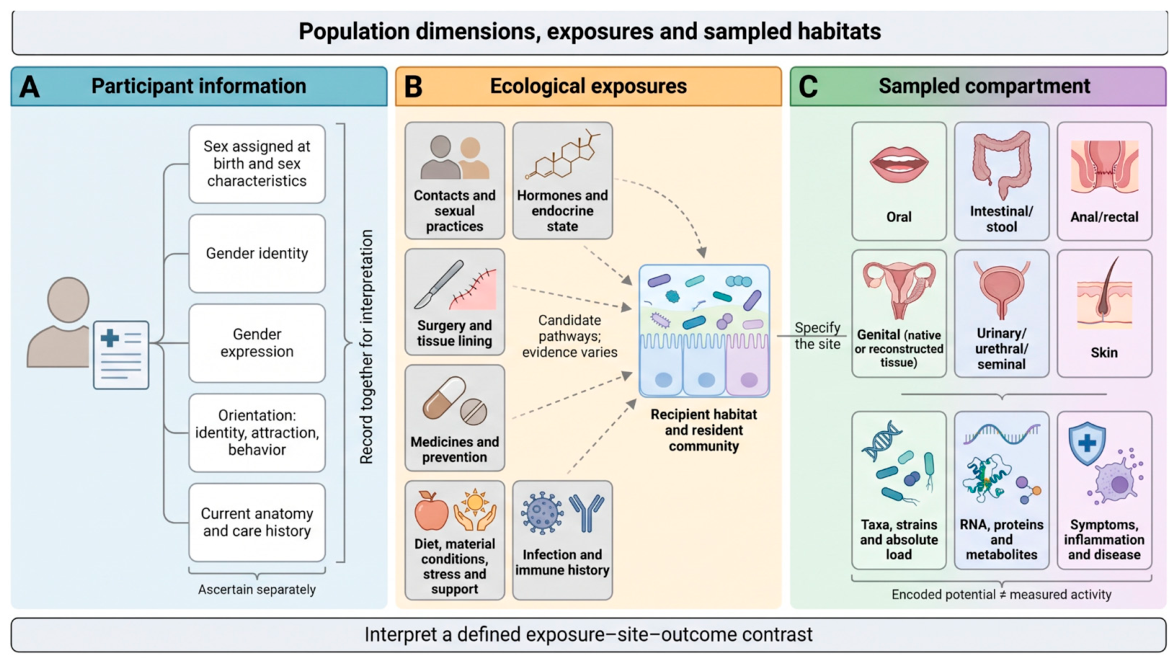
Figure 2.
Tissue-specific interpretation of genital communities. Native vaginal, testosterone-exposed, skin-lined, sigmoid and peritoneal-augmented environments differ in lining, luminal conditions and available evidence. Composition, symptoms and cytokines can diverge. Direct Nugent testing in an overlapping TransBiota subset showed poor correspondence with taxa, cytokines and symptoms. Sigmoid community profiling and diversion inflammation derive from separate studies. The cited peritoneal comparison measured clinical outcomes rather than microbial composition [12,13,27,56,88,89,90,96]. Created with BioRender.com.
Figure 2.
Tissue-specific interpretation of genital communities. Native vaginal, testosterone-exposed, skin-lined, sigmoid and peritoneal-augmented environments differ in lining, luminal conditions and available evidence. Composition, symptoms and cytokines can diverge. Direct Nugent testing in an overlapping TransBiota subset showed poor correspondence with taxa, cytokines and symptoms. Sigmoid community profiling and diversion inflammation derive from separate studies. The cited peritoneal comparison measured clinical outcomes rather than microbial composition [12,13,27,56,88,89,90,96]. Created with BioRender.com.
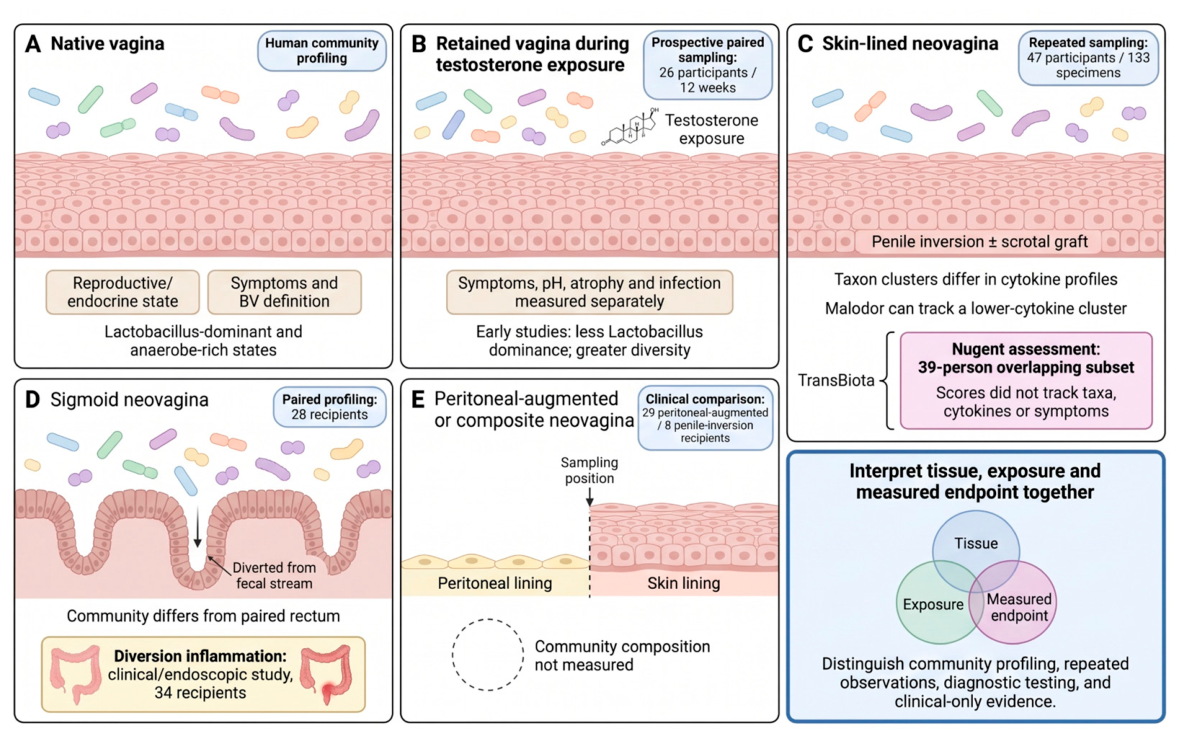
Figure 3.
Longitudinal contrasts connecting exposure, microbial activity and clinical outcomes. Contact networks, hormone initiation and prevention treatment provide different temporal comparisons. Strain resolution, absolute load and activity measurements can connect community observations to host and clinical endpoints while allowing direct exposure effects and shared sources. The DoxyPEP inset reports fractions within DNA or RNA resistance-gene pools, not resistant-organism prevalence. Solid timeline arrows denote chronology; unheaded links denote recorded contact; dashed arrows identify predictive or mechanistic links requiring testing [14,15,17,27,54,55,98,99,100,126]. Created with BioRender.com.
Figure 3.
Longitudinal contrasts connecting exposure, microbial activity and clinical outcomes. Contact networks, hormone initiation and prevention treatment provide different temporal comparisons. Strain resolution, absolute load and activity measurements can connect community observations to host and clinical endpoints while allowing direct exposure effects and shared sources. The DoxyPEP inset reports fractions within DNA or RNA resistance-gene pools, not resistant-organism prevalence. Solid timeline arrows denote chronology; unheaded links denote recorded contact; dashed arrows identify predictive or mechanistic links requiring testing [14,15,17,27,54,55,98,99,100,126]. Created with BioRender.com.
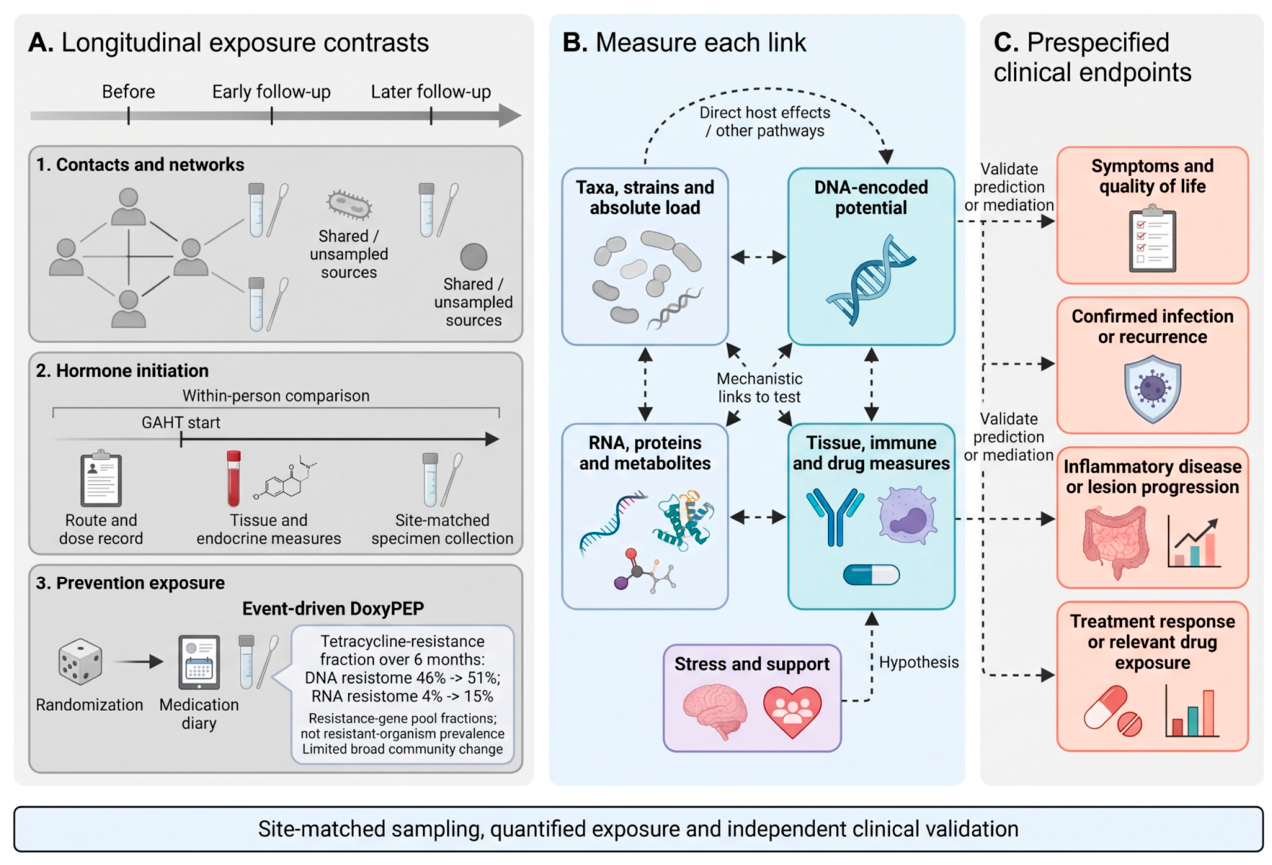

Table 1.
Population dimensions and variables needed for microbiome interpretation.
| Dimension | Minimum informative ascertainment | Analytical implication |
|---|---|---|
| Sex assigned at birth and sex characteristics | Birth assignment and relevant reproductive/endocrine characteristics; record intersex variations when reported | Historical male/female categories do not specify birth assignment or current gender identity |
| Gender identity | Self-described identity, including nonbinary/multiple responses; retain the original recruitment definition | Identity groups include multiple orientations, anatomical states and hormone exposures |
| Gender expression | Self-reported expression and social recognition, separately from identity and medical care | Independent expression-associated community effects are scarcely studied; hormones are an inadequate proxy |
| Gendered social context | Discrimination, support, housing, food/healthcare access, cohabitation and network contacts | Estimate social/material exposure effects separately from identity categories |
| Sexual orientation | Identity, attraction and behavior, with partner histories and explicit time windows | MSM/WSW describe behavior; identity does not specify current practices |
| Anatomy and endocrine exposure | Sampled organ and lining, surgical interval, menstrual/menopausal state and systemic/local hormones | Match tissue and exposure across identity groups |
| Clinical state and treatment | Symptoms, pathogens, HIV/immune status, antimicrobials, prevention and relevant comorbidities | Separate asymptomatic variation, infection, inflammation and treatment effects |
Table 2.
Representative directly studied populations and the resolution of their evidence.
| Population and ascertainment | Design, site and clinical state | Main finding and scope |
|---|---|---|
| MSM classification; birth assignment and gender identity not separately documented | Independent fecal cohorts in Barcelona (156 participants) and Stockholm (84), spanning HIV strata [10] | Prevotella enrichment and lower Bacteroides abundance; findings concern behavior/recruitment categories rather than a gay or cisgender identity effect |
| MSM and non-MSM in a predominantly treated-HIV sample | Shotgun fecal metagenomics: 93 MSM and 31 comparators, including 26 men and five women [16] | Multiple Segatella-complex members and additional Prevotellaceae; resemblance to nonindustrialized communities did not imply taxonomic equivalence |
| Women reporting female partners in the WOW cohort | 458 participants, including 96 coenrolled couples; nested sequencing in 100 initially BV-negative women [23,24] | Stable normal communities and partner-associated transitions coexist; nested publications are not independent cohorts |
| Explicitly cisgender WSW versus women reporting male partners | Brazilian vaginal comparison: 54 WSW and 55 comparators, classified by exclusive partner sex in the previous year [25] | Higher Shannon diversity and more Nugent BV among WSW; no significant overall community-state or measured STI distribution difference |
| Women reporting a female or male partner in the Belgian Isala cohort | 3,345 vaginal donors; partner-sex model in 58 female-partner and 2,317 male-partner participants [26] | Female-partner status associated with greater L. crispatus co-abundance-module abundance; overall alpha/beta-diversity contrasts were not significant |
| Testosterone-naive trans men | Prospective vaginal sampling in Thailand: 26 participants before and 12 weeks after testosterone [27] | Reduced Lactobacillus dominance with increased diversity and changes in pH, symptoms and atrophy-related measures |
| Trans men and a nonbinary participant initiating testosterone | Nine participants with normal baseline Nugent scores and negative STI testing; daily vaginal sampling [28] | Five developed study-defined incident Nugent BV, but only one reported symptoms requiring treatment; selected sample, not prevalence surveillance |
| Testosterone-exposed transmasculine participants, including nonbinary identities | TransBiota: 85 participants, 208 weekly vaginal samples over three weeks [12] | Fewer than 10% were Lactobacillus-dominant; dominance associated with odor and IL-1α, not dryness or dyspareunia |
| Trans men and trans women initiating GAHT | Paired fecal shotgun metagenomics: 19 and 17 participants, respectively, over 12 weeks [17] | Species and encoded pathways changed despite stable broad diversity; treatment directions belong to one shared study |
| Transgender women versus explicitly cisgender MSM, all without HIV | Atlanta/Bangkok rectal study: 122 women and 83 MSM; additional 21 women sampled around hormone initiation [29] | Geography modified category-associated patterns; no significant short-term community shift after initiation |
| AMAB transgender women undergoing penile inversion | Paired preoperative donor-site and postoperative neovaginal sampling in 30 participants [30] | Postoperative assembly included donor-compatible and previously undetected ASVs; ASV sharing does not establish strain-level transfer |
| Penile-inversion recipients | TransBiota: 47 participants, 133 successfully sequenced weekly neovaginal samples [13] | Taxon clusters differed in cytokines; malodor associated with a lower-cytokine cluster |
| Pooled SGM young adults versus cisgender heterosexual participants | Corrected pilot: 41 analyzable stools from 65 enrolled students; 14 SGM and 27 comparators [21,22] | Lower Shannon diversity in pooled SGM models; no lesbian-identifying participant and no adequately powered category-specific estimates |
| Transmasculine and transfeminine participants starting GAHT | Prospective oral study: 21 and 18 participants, respectively, followed for one year [31] | Transient salivary and gingival changes; broad community diversity/composition largely stable, with supervised model associations |
Table 3.
Clinical interpretation across anatomical sites and health states.
| Site and population context | Observed community or clinical contrast | Outcome needed for clinical interpretation |
|---|---|---|
| Intestinal/rectal; MSM with and without HIV | Practice-associated profiles overlap with HIV-, immune-history- and ART-associated variation [37,39,41] | Specify infection stage, suppression, sampling compartment, symptoms and inflammatory measures; higher diversity alone does not indicate benefit |
| Anorectal; asymptomatic bacterial STI or HPV-associated lesions | Selected taxonomic or inflammatory associations may occur without broad diversity differences [44,45,49] | Separate pathogen detection, persistence, lesion grade and progression; community associations do not replace pathogen or histological assessment |
| Native vagina; WSW | Normal Lactobacillus-dominated states coexist with incident or prevalent Nugent BV [23,59] | Report symptoms and diagnostic definition alongside composition; evaluate recurrence and partner-linked strains |
| Testosterone-exposed native vagina | Lactobacillus depletion and increased diversity can occur without symptomatic BV [12,28,77] | Distinguish cytology, atrophy, Nugent categories, pain, dryness, odor and confirmed infection |
| Skin-lined neovagina | Diverse communities with low Lactobacillus abundance in asymptomatic as well as symptomatic recipients [13,87] | Assess symptoms, structural causes and tissue-specific inflammation; in a 39-person TransBiota subset, Nugent scores did not track target taxa, cytokines or symptoms [96] |
| Intestinal neovagina | Diverted sigmoid communities differ from rectum; discharge and odor may accompany diversion-related inflammation [88,89] | Document surgical lining and diversion history, with clinical or endoscopic assessment where indicated |
| Oral compartment; HIV and GAHT cohorts | Bacterial and fungal associations vary with immune state, treatment and analytical method [31,103,111] | Measure periodontal/gingival disease or symptomatic fungal infection separately from sequence detection |
| Urethral, urinary and seminal compartments | Organism associations in idiopathic urethritis; seminal microbial changes around HIV treatment [107,109] | Use site-specific specimens, established pathogen testing and explicit syndrome definitions; do not infer fertility or transmission from community profiles |
| Skin; testosterone-treated populations | Acne burden has been characterized clinically, without a measured microbial pathway in the large cohort [116] | Direct microbial sampling linked to lesion phenotype is needed to test microbial mediation |
These contrasts are not interchangeable definitions of dysbiosis. ART, antiretroviral therapy; HPV, human papillomavirus; STI, sexually transmitted infection.
Table 4.
Intervention evidence and limits of population-specific translation.
| Intervention and study population | Design and measured outcome | Clinical scope |
|---|---|---|
| DoxyPEP; participants assigned male at birth | Six-month substudy selected 150 participants; usable DNA and RNA datasets from 89 and 70 showed increased tetracycline-resistance fractions without major broad community change [54] | Selection within the resistome and its expression is detectable despite limited taxonomic change; the fractions do not quantify resistant-organism prevalence |
| Antiseptic mouthwash; MSM | OMEGA randomized 530 participants; its 153-participant microbiome subset showed no broad 12-week community shift [105,106] | Listerine did not reduce oropharyngeal gonorrhea relative to Biotène; antibacterial activity does not establish prevention efficacy |
| High-fiber/low-fat agrarian diet; MSM/MSW across HIV strata | Four-week randomized trial in 66 men: 36 HIV-positive MSM, 21 HIV-negative MSM and nine HIV-negative MSW; secondary LDL response in HIV-positive MSM; primary IL-6 endpoint not significant [120] | Baseline Prevotella-rich/Bacteroides-poor profiles predicted larger LDL responses in exploratory analyses; no demonstrated microbial mediation or cardiovascular-event effect |
| Oral fecal microbiota transfer; treated HIV | Thirty-person placebo-controlled safety pilot: modest, transient engraftment, increased diversity and an exploratory intestinal-injury biomarker improvement [118] | No established reduction in clinical morbidity; durability and patient-important endpoints require larger trials |
| Visbiome probiotic; ART-treated HIV | A5350 randomized 93 participants: microbial changes without significant sCD14, inflammatory or permeability benefit [119] | No demonstrated SGM-specific clinical effect or general anti-inflammatory efficacy |
| Lactin-V after metronidazole; native vaginal BV | Randomized trial in 228 women: 12-week recurrence 30% versus 45% [117] | Strain- and setting-specific efficacy; no demonstrated extension to testosterone-exposed vaginas or neovaginas |
| Behavioral intervention after BV treatment; WSW | Eighty-nine randomized women: 30-day BV persistence 27.9% versus 21.1% in evaluable intervention/control groups despite selected behavioral change [73] | The trial did not test simultaneous antimicrobial treatment of female partners |
| Concurrent male-partner BV treatment; adjacent evidence | Oral/topical male-partner antibiotics plus treatment of women: 12-week BV recurrence 24/69 (35%) versus 43/68 (63%) in modified intention-to-treat analysis [74] | Successful male-partner treatment does not establish an effective regimen for female couples |
| Local estrogen; native vaginal contexts | Postmenopausal estradiol trial (144 participants): Lactobacillus/Bifidobacterium dominance 80% versus 26% at 12 weeks, without greater symptom benefit; testosterone-cohort estrogen associations were observational [12,72,76] | Assess symptom benefit within each population; compositional restoration and clinical relief are distinct endpoints |
| Short-course oral lactobacilli; neovagina | Sixty-person randomized seven-day study improved microbial/Nugent surrogate measures [122] | Seven-day surrogate result; direct neovaginal diagnostic testing found poor Nugent performance, and durable symptom, recurrence or STI benefit was not established [96] |
Effects are interpreted within the studied tissue and population. sCD14, soluble CD14.
Disclaimer/Publisher’s Note: The statements, opinions and data contained in all publications are solely those of the individual author(s) and contributor(s) and not of MDPI and/or the editor(s). MDPI and/or the editor(s) disclaim responsibility for any injury to people or property resulting from any ideas, methods, instructions or products referred to in the content. |
© 2026 by the authors. Licensee MDPI, Basel, Switzerland. This article is an open access article distributed under the terms and conditions of the Creative Commons Attribution (CC BY) license (http://creativecommons.org/licenses/by/4.0/).
Copyright: This open access article is published under a Creative Commons CC BY 4.0 license, which permit the free download, distribution, and reuse, provided that the author and preprint are cited in any reuse.