

Submitted:
11 November 2026
Posted:
12 November 2026
You are already at the latest version
Abstract
ALICE collaboration data of multiplicity distribution of charged particles in pp collisions at the centre-of-mass energies = 2.76TeV within the pseudo-rapidity interval −0.8 < η ≤ 0.8 and transverse momentum range 0.15 GeV/c <pT<10 GeV/c has been fitted with Weibull distribution function. The experimental analysis has been compared with UrQMD simulation. The study reveals that both the experimental and UrQMD simulated multiplicity distribution can be nicely described by the Weibull distribution function. A study of multiplicity fluctuation by the scaled variance method and also a comprehensive analysis of skewness and Kurtosis of multiplicity distribution for both experimental and UrQMD simulated data has been carried out.
Keywords:
pp collisions
; LHC
; weibull distribution
= 2.76TeV‒ALICE Experimental Data vs.UrQMD Simulation
Swarnapratim Bhattacharyya
Department of Physics, New Alipore College, L Block, New Alipore, Kolkata 700053, India; swarna_pratim@yahoo.com
Introduction
Exploring the behaviour of nuclear matter under extreme conditions remains one of the major objectives of contemporary nuclear and particle physics research. In this context, studies of heavy-ion collisions have provided valuable insights into the properties of strongly interacting matter, supported by significant developments in both experimental observations and theoretical descriptions. Although heavy-ion collisions offer an excellent environment to study nuclear matter at extreme temperatures and densities, a comprehensive understanding of the underlying particle-production processes also requires detailed investigations of proton–proton (pp) collisions. pp collisions represent the simplest hadronic collision system and provide a relatively clean and well-controlled environment for investigating the fundamental mechanisms of particle production at high energies. Unlike collisions involving nuclei, pp collisions are largely free from the complex effects associated with the presence of nuclear matter, such as multiple nucleon interactions. Comparisons between pp and heavy-ion collision systems enable the identification and quantification of nuclear and medium-induced effects, making pp collisions an indispensable reference for understanding proton–nucleus and nucleus–nucleus interactions at relativistic and ultra-relativistic energies.
The Large Hadron Collider (LHC) enables the study of particle production in proton–proton collisions at very high energies under well-defined experimental conditions, allowing investigations of the underlying production mechanisms across a broad energy range. The data collected by the LHC experiments in pp collisions has enabled detailed studies of multiparticle production, particle correlations and event-by-event fluctuations. Moreover it was thought that due to the very small dimensions of proton compared to Au or Pb nucleus, the formation of a QGP medium was not expected in such small collision systems. Consequently, pp collisions were widely used as a non-QGP baseline for identifying QGP-related signatures in heavy-ion collisions. However, observations of collective behaviour [1] and enhanced production of strange hadrons [2] in high-multiplicity pp events have revealed features reminiscent of those observed in heavy-ion collisions. These findings suggest that final-state collective dynamics, which were previously thought to be present only in heavy-ion collisions, may also occur in high-multiplicity pp collisions. This challenges the traditional view that the Quark-Gluon-Plasma (QGP) can only form in large, heavy-ion systems, suggesting instead that QGP-like phenomena might emerge even in small collision systems, provided they reach a sufficiently high energy density. This paradigm shift has made pp collision studies an important area of contemporary nuclear and particle physics research, providing new opportunities to understand the mechanisms of particle production, collective behaviour, and the properties of strongly interacting matter [3,4,5].
Charged particle multiplicity is one of the most important observables in pp collisions and it denotes the number of charged particles produced in a collision. The distribution of particle multiplicity constitutes a fundamental observable and it describes the probability of observing a given multiplicity. Mathematically, the multiplicity distribution is represented by the probability distribution function PN, which gives the probability of producing N particles in a single collision event. Multiplicity distribution provides valuable information about the underlying particle-production mechanism. The shape of the multiplicity distribution depends strongly on both the collision energy and the nature of the colliding system. As the collision energy increases, a larger amount of energy becomes available for particle production, resulting in a greater average multiplicity of charged particles. Consequently, the multiplicity distributions become broader and exhibit stronger event-by-event fluctuations, indicating a wider range of possible particle yields in individual collisions. The studies of multiplicity distributions at different collision energies provide important insights into the multiparticle production dynamics and particle correlations. Proton–proton collisions at LHC energies produce a wide spectrum of final-state charged particles, and the corresponding charged particle multiplicity distributions are expected to reveal important aspects of the underlying dynamics of strong interactions. To develop profound insight into the underlying particle-production mechanisms and event-by-event fluctuations, it is essential to describe the multiplicity distributions of charged particles in pp collision within an appropriate statistical framework. Weibull distribution in this regard may be an effective tool in this regard. Therefore the present work investigates the charged particle multiplicity distributions in proton–proton (pp) collisions at =2.76 TeV using the ALICE experimental data [6] in the framework of Weibull distribution function within the pseudo-rapidity interval −0.8<η≤0.8 and transverse momentum range 0.15 GeV/c<pT< 10 GeV/c. The pseudo-rapidity interval corresponds to the central rapidity region, where detector acceptance and tracking performance are optimal. The selected transverse momentum range includes the majority of the charged particles produced in the collision while excluding very low-momentum tracks that are difficult to reconstruct reliably. A study of event-by-event multiplicity fluctuation by scaled variance method and an investigation of skewness and kurtosis of multiplicity distribution have also been presented. The experimental analysis has been compared with the analysis of multiplicity distribution generated by UrQMD model.
Before going to the details of the analysis, it will be convenient for the readers to have a brief introduction about the Weibull distribution function. The Weibull distribution, a well-established two-parameter probability distribution proposed by W. Weibull [7], is expressed as. Here k is known as the shape parameter and λ is known as the scale parameter of the distribution [7]. Here, N represents the random variable of the distribution, which in the present analysis corresponds to the charged particle multiplicity, i.e., the number of charged particles produced in a collision event. The Weibull distribution has proven to be a versatile statistical model, with widespread applications across several scientific domains such as to characterize size distributions in various disciplines, including material fragmentation [8], size distribution of cloud droplets [9], biological systems [10,11], extreme value statistics [12,13] and also for the assessment of speed of wind energy [14]. Since the final state particle multiplicity can be considered as an outcome of the evolution from initial hadron-hadron interactions, the Weibull distribution is a suitable candidate for modelling the probability distribution of the produced charged particles. Recent experimental findings in particle collision experiments have demonstrated that this two-parameter distribution effectively reflects the key features of charged particle multiplicities [15,16,17,18].
Multiplicity Fluctuations and Higher Order Moments
In recent years, considerable attention has been devoted to the investigation of multiplicity fluctuations in high-energy relativistic and ultra-relativistic heavy ion collisions. Event-by-event fluctuations of particle multiplicities provide valuable information on the underlying mechanisms of multiparticle production. While such fluctuations have been extensively investigated in heavy-ion collisions to explore the properties of hot and dense QCD matter, studies of proton–proton (pp) collisions are also important for understanding particle-production dynamics in a comparatively smaller collision system. The analysis of multiplicity fluctuations in pp collisions can therefore provide useful insights into the statistical characteristics and dynamical processes governing particle production at high energies.
The simplest method of investigating the fluctuations of an observable is to calculate its variance, which quantifies the spread of its values around the mean. Although the variance provides a measure of the magnitude of fluctuations, its value is also influenced by the average multiplicity. Consequently, a direct comparison of variances may not provide an appropriate assessment of the relative strength of multiplicity fluctuations when the mean multiplicities differ. The scaled variance accounts for this dependence by normalizing the variance to the mean multiplicity, thereby facilitating comparisons of multiplicity fluctuations across different collision energies and between experimental data and model simulations particularly when their mean multiplicities differ. So mathematically the scaled variance is defined as . Here 〈N〉 is the average multiplicity of the produced charged particles. 〈N2〉 is the second moment of the multiplicity distribution of the produced charged particles. The 〈……..〉sign denotes the event-by-event averaging of the concerned observables.If the value of ω is greater than 1, it may be said that there is pronounced correlation among the produced particles. On the contrary, if the value of ω is close to 1, feeble correlation is indicated. When ω=1 the particles are produced independently and hence no correlation is present among the produced particles. The scaled variance thus provides a quantitative measure of event-by-event multiplicity fluctuations by characterizing the spread of the distribution relative to its average value. It is therefore useful for comparing the magnitude of multiplicity fluctuations at different collision energies and between experimental data and model simulations. Numerous papers [19,20,21,22,23,24,25,26,27,28,29] are available in the literature where multiplicity fluctuation has been studied theoretically and experimentally with the help of scaled variance in nucleus-nucleus collisions. Apart from the studies of nucleus-nucleus collisions, studies of multiplicity fluctuations in pp collisions may also be an interesting subject of research as precise measurement of multiplicity fluctuation of produced hadrons is important in the sense that such a study may contribute to a better understanding of particle production mechanism in pp collisions.
The moments of the multiplicity distribution provide important information about the characteristics of particle production and event-by-event fluctuations. Lower-order statistical moments such as the mean multiplicity <N> and variance (σ2) measure average yield and overall width of multiplicity distribution, they do not fully constrain the structural shape or the behaviour of the distribution at the high multiplicity region. So these quantities do not completely specify the shape of the multiplicity distribution. Higher-order moments are therefore useful for identifying features that are not evident from the mean and variance alone. The third standardized central moment, referred to as skewness, provides a quantitative measure of the asymmetry of the multiplicity distribution. It is defined as where σ is the standard deviation of the multiplicity distribution. The sign of skewness indicates the direction of the asymmetry, while its magnitude reflects the extent to which the distribution departs from a symmetric form. A value near zero corresponds to an approximately symmetric distribution. Positive skewness indicates a longer or more pronounced high-multiplicity side, whereas negative skewness corresponds to a relatively extended low-multiplicity side. Thus, skewness can distinguish distributions having similar means and variances but different asymmetric structures.
In the context of charged particle production, the high-multiplicity region can have an appreciable influence on the third central moment because the contribution of an event depends on the cube of its deviation from the mean. Consequently, even when high-multiplicity events constitute only a small fraction of the sample, they may produce a measurable change in skewness. This makes the quantity useful for examining how the shape of the multiplicity distribution changes with collision energy, event sample, or the underlying description of particle production. Kurtosis provides information from the fourth standardized central moment and is particularly useful for characterizing the non-Gaussian structure of a multiplicity distribution. It is defined as K= . The fourth power of the deviation strongly enhances the contribution from events lying far from the mean. Consequently, kurtosis is especially sensitive to the tails of the distribution and to the occurrence of unusually high or lowmultiplicity events. A comparison of kurtosis between different distributions can therefore reveal differences in their tail behaviour even when their mean multiplicities and variances are similar. For a Gaussian distribution, the kurtosis is equal to 3. Excess kurtosis is obtained by subtracting 3 from the kurtosis so that the Gaussian distribution has zero excess kurtosis. Thus, positive excess kurtosis indicates relatively stronger tail contributions compared with a Gaussian distribution, whereas negative excess kurtosis indicates relatively weaker tails. Therefore, the primary difference is that kurtosis has a Gaussian reference value of 3, while excess kurtosis has a Gaussian reference value of zero.
Skewness and kurtosis consequently provide complementary information. Skewness primarily quantifies the directional asymmetry of the distribution, while kurtosis measures the relative importance of observations away from the mean and hence the strength of its tail and non-Gaussian character. Together, they provide a more detailed description of the multiplicity distribution than can be obtained from the first two moments alone. A histogram remains useful for visualizing the overall form, but these moments provide compact numerical measures that permit quantitative comparisons among data sets and theoretical descriptions. Detailed statistical definitions and properties of these quantities may be found in [30,31].
Higher-order moments have acquired considerable importance in the studies of heavy-ion collisions. Moments of conserved-charge distributions, including net-baryon number, net charge, and net strangeness, are related to generalized susceptibilities and have been investigated in theoretical frameworks such as lattice QCD and the Hadron Resonance Gas model [32,33,34,35,36,37]. Their behaviour has been discussed in connection with fluctuations and correlations near the QCD phase-transition region [37,38,39,40,41]. The present analysis does not attempt to extract such thermodynamic information from pp multiplicities; rather, the same statistical concepts are used here to obtain a more complete description of the charged particle multiplicity distribution in proton–proton (pp) collisions at =2.76 TeV.
Results and Discussions
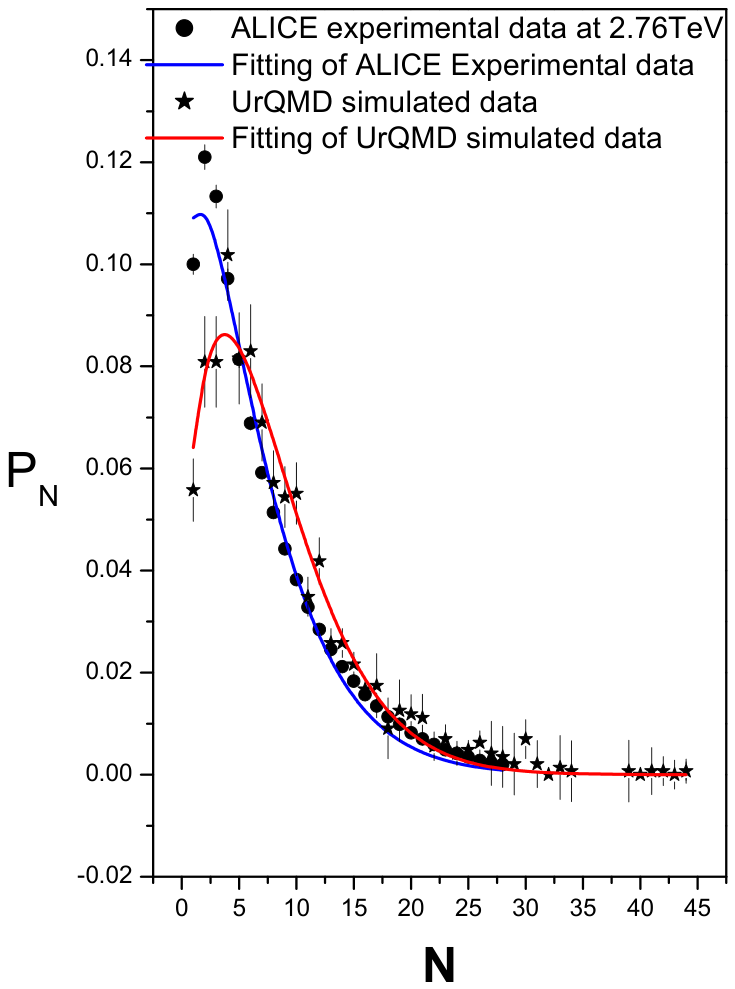
In a recent publication ALICE Collaboration investigated the charged particle multiplicity distributions in pp collisions at = 2.76 TeV within the kinematic acceptance defined by −0.8 < η ≤ 0.8 and 0.15 GeV/c <pT< 10 GeV/c [6]. A multiplicity-based selection criterion was imposed on the minimum-bias (MB) event sample of the experimental data of ALICE collaboration to select inelastic pp collisions, retaining only those events containing at least one charged particle within the specified kinematic acceptance. This criterion effectively eliminates the single-diffractive events, which typically produce few particles confined to the forward rapidity region. For the selected event sample, the average charged particle multiplicities measured by the ALICE collaboration along with the values of σ(N) are presented in Table 1. Now to explore the multiparticle production mechanism in more details in the present paper, the author has fitted the multiplicity distributions of charged particles produced in pp collisions at = 2.76 [6] by the Weibull distribution function and presented the fitted multiplicity distribution in Figure 1 indicated by a blue solid line. The fitting parameters for the Weibull distribution function have been determined using the χ² minimization method. This method accounts for the best possible fitting of the experimental data by the theoretical function. The calculated values of the fitting parameters along with the χ²/DOF value have been shown in Table 1. From the value of χ²/DOF it may be concluded that the experimental multiplicity distribution of charged particles produced in proton–proton (pp) collisions at = 2.76 TeV can be nicely described by the Weibull distribution function. The successful description of the charged particle multiplicity distribution by the Weibull function indicates that this phenomenological distribution is capable of reproducing the overall shape of observed multiplicity distribution in pp collisions.
Monte Carlo (MC) event generators play a fundamental and multifaceted role in high-energy physics. They function not only as powerful computational tools for performing precise numerical simulations but also as phenomenological approaches for describing complex non-perturbative processes. Moreover, they provide a crucial connection between theoretical models and experimentally measured observables, enabling meaningful comparisons between predictions and the data. Therefore, these generators serve as an essential framework for investigating particle production mechanisms and understanding the underlying dynamics of high-energy interactions. In particular, the application of such models to proton–proton collision systems allows a detailed investigation of particle production processes and provides valuable insights into the characteristics of the final-state particle distributions. To investigate the mechanism of charged particle production and the dynamical features associated with high-energy proton–proton collisions, a detailed simulation study is essential. Such simulations provide a reliable theoretical framework for interpreting the experimentally observed multiplicity distributions and for comparing model predictions with experimental results. In the present work, the experimental data of the ALICE Collaboration at the centre-of-mass energies = 2.76 TeV have been simulated using the Ultra-relativistic Quantum Molecular Dynamics model (version 3.3p1). The UrQMD model is a microscopic transport model based on the covariant propagation of hadrons, which describes multiple particle production through string excitation and fragmentation at high energies [42,43,44]. In terms of partonic interactions and string formation by Lund model [45], the early stages of collisions are described in UrQMD. The later stages of the collision have been described by the hadronic transport component of this model. Excitation and fragmentation of the string along with the decay of hadronic resonances are responsible for particle creation by UrQMD model. Hard collisions involving large momentum transfer have been implemented in this model through the PYTHIA program. For details about this model, readers are requested to consult [42,43,44]. Here it may be mentioned that the UrQMD model has been widely used by the physicists in high-energy physics as an event generator. It provides a detailed computational framework for investigating the behaviour of nuclear matter in high-energy collisions. The UrQMD model effectively reproduces particle production characteristics across a broad energy spectrum, ranging from the Bevalac accelerator domain to experiments conducted at RHIC and the LHC, in both heavy-ion and proton–proton (pp) collisions.
To explore the charged particle multiplicity distributions in proton–proton (pp) collisions within the framework of the UrQMD model, a large ensemble of minimum-bias (MB) events was generated at the centre-of-mass energies = 2.76 TeV [46]. The analysis of the UrQMD generated events was carried out in the same kinematic coverage as that of ALICE measurements [6]. To ensure a meaningful comparison with the experimental results, the same event-selection criteria was applied to the simulated sample by retaining only those minimum-bias events which contain at least one charged particle within the same kinematic acceptance as the experimental data. Consequently, the simulated event sample closely matches the characteristics of the experimental dataset, thereby minimizing potential biases associated with the differences in event selection. The author has calculated the values of average multiplicity of charged particles 〈N〉 along with the values of σ(N) for the UrQMD simulated data sample of pp collisions at and presented the calculated values in Table 1.
The UrQMD simulated multiplicity distributions of the charged particles in pp collisions at =2.76 TeV have been fitted with Weibull distribution function. The fitted multiplicity distribution together with the corresponding experimental counterpart has been presented in Figure 1. In the figure the red solid line represents the corresponding statistical fitting of the UrQMD events. Now for a quantitative evaluation of the quality of the fit and to extract the corresponding distribution parameters, the χ² minimization method has been applied in case of UrQMD simulated analysis. The obtained fitting parameters together with the corresponding χ²/DOF values are presented in Table 1 for the Weibull distribution along with their experimental counterparts. From the values of χ² per degrees of freedom (χ²/DOF) of the fit it may be said that the Weibull distribution function can successfully reproduce the simulated multiplicity distribution.
To investigate the event-by-event fluctuations in charged particle production, the scaled variance ω has been computed for boththe experimental and UrQMD-simulated pp collisions at The values of scaled variance have also been calculated from the probability distribution of Weibull distribution function for both experimental and UrQMD simulated events as well as the from the fitted parameters of the Weibull distribution function of experimental and UrQMD simulated data. The evaluated values of the scaled variance ω are given in Table 2. From Table 2 it can be seen that the calculated values of scaled variance ω are greater than 1 for the experimental analysis and also for all the other cases suggesting strong evidence of multiplicity fluctuations in pp collisions. From the table it can be seen that in proton-proton collisions, the experimental scaled variance indicates a lower degree of event-by-event fluctuation compared to the higher value predicted by the UrQMD simulation, showing that the model tends to overestimate these fluctuations. The scaled variance ω can also be calculated from the probability distribution of Weibull distribution function and also from the Weibull parameters k and λ according to the relation Applying the Weibull distribution effectively bridges this gap, as its predictions remain stable and close to the experimental baseline regardless of whether the input stems from physical data or simulated collisions
In the present work, skewness and kurtosis have been evaluated for the charged particle multiplicity distribution in pp collisions at = 2.76 TeV using the ALICE data and UrQMD simulated data. Their inclusion supplements the previously considered mean multiplicity and fluctuation measures and enables the distribution to be investigated through its asymmetry and higher-order tail characteristics. The values of skewness and Kurtosis have also been calculated from the probability distribution of Weibull distribution function for both experimental and UrQMD simulated events as well as the from the fitted parameters of the Weibull distribution function of experimental and UrQMD simulated data. The evaluated values of the skewness and Kurtosis for the experimental data, UrQMD simulated data and also from Weibull distribution predictions are given in Table 2.The Table 2 thus represents the higher-order multiplicity moments in proton-proton collisions by evaluating the asymmetry and tail of the charged particle multiplicity distribution. The experimental data exhibits lower skewness and kurtosis compared to the UrQMD transport model, indicating that physical particle production produces a less asymmetric distribution with less frequent extreme multiplicity events than predicted by the simulation. The Weibull predictions derived directly from the probability distribution closely match the experimental asymmetry while capturing moderate tail behavior. Conversely, predictions derived analytically from the fitted Weibull shape parameters yield higher skewness and kurtosis values, reflecting how parameter-based calculations emphasize the exponential tail structure of the distribution. The comparison demonstrates that while the Weibull framework effectively models the bulk features of multi-particle dynamics, parameter-based derivations tend to enhance sensitivity to rare, high-multiplicity collisions. Moreover, the Table 2 indicates that the values of excess kurtosis for the studied experimental and simulated multiplicity distributions along with the Weibull based predictions are positive. This indicates that the charged particle multiplicity distributions in all the said cases exhibit heavier tails than a Gaussian distribution. The positive excess kurtosis observed in the experimental data, UrQMD simulations and Weibull-based predictions further suggests that the Weibull distribution reasonably captures the non-Gaussian tail characteristics of the multiplicity distributions.
Conclusions
This work presents an analysis of charged particle multiplicity distributions and event-by-event fluctuations in pp collisions = 2.76 TeV measured by the ALICE detector within the central pseudo-rapidity window −0.8 < η ≤ 0.8 and the transverse-momentum range 0.15 GeV/c<pT< 10 GeV/c by Weibull distribution function. In addition to the multiplicity distributions and multiplicity fluctuations of charged particles, the higher-order statistical moments, including skewness and kurtosis, are studied to characterize the shape and fluctuations of the multiplicity distributions. The selected events correspond to the INEL>0 inelastic event class, characterized by the presence of at least one charged primary track within the central pseudo-rapidity region. To benchmark these empirical findings, a parallel analysis was performed using UrQMD transport model predictions. The primary insights derived from this comparative study are summarized below:
- The χ²/DOF values of the Weibull distribution fitting for both experimental and UrQMD simulation demonstrate that this statistical distribution provides a good fit to the multiplicity distributions of charged particles in pp collisions at
= 2.76 TeV.
- Ø The extracted Weibull parameters are higher for the UrQMD simulated events than for the experimental data reflecting a broader multiplicity distribution in the transport model.
- Ø The experimental value of scaled variance is lower than that of calculated from the analysis of UrQMD model simulated data, indicating that the model overestimates event-by-event multiplicity fluctuations.
- Ø Calculating scaled variance directly from the probability distribution curve versus deriving it analytically from the Weibull parameters for both experimental and UrQMD simulation yields nearly identical results, confirming the robust internal consistency of the Weibull parameterization approach.
- Ø The experimental charged particle multiplicity distributions display lower skewness and kurtosis than the UrQMD simulation, demonstrating that real-world collision events generate less asymmetric particle distributions and fewer extreme high-multiplicity tails than predicted by the transport model.
- Ø Weibull predictions extracted directly from the probability distribution function capture the bulk asymmetry (skewness) and peak structure effectively, closely mirroring the empirical behaviour of physical collisions.
- Ø Calculating skewness and kurtosis directly from the Weibull parameter yields higher values for both the moments, illustrating that analytical parameter derivations place greater weight on the heavy exponential tail of the multi-particle production spectrum.
- Ø The UrQMD model systematically overestimates both higher-order moments, confirming that non-equilibrium transport models tend to produce broader, more fluctuating event topologies than observed in experimental study and measurements.
- Ø Overall, while direct integration of the Weibull probability distribution provides a faithful representation of the experimental profile, parameter-based calculations serve as a sensitive probe for investigating rare, high-density particle production mechanisms.
The significance of this study lies in establishing how effectively the Weibull distribution describes not only the experimental and simulated multiplicity distribution but also the underlying fluctuations and higher-order characteristics of charged particle production. The combined analysis of skewness, kurtosis and scaled variance provides additional statistical constraints for testing the reliability of particle-production models and improving our understanding of multiplicity fluctuations in high-energy pp collisions.
=2.76 TeV (ALICE data) and the corresponding UrQMD simulated data fitted with the Weibull distribution function in the pseudo-rapidity interval −0.8 < η ≤ 0.8 and transverse momentum range 0.15 GeV/c <pT< 10 GeV/c.
Table 1 represents the values of 〈N〉 and σ(N) defined in the pseudo-rapidity interval −0.8 < η ≤ 0.8 and transverse momentum range 0.15 GeV/c <pT< 10 GeV/c and also the Weibull distribution parameters along with the corresponding χ²/DOF values of the theoretical fitting for the experimental data of ALICE collaboration and UrQMD simulated pp collision data at = 2.76 TeV.
for the experimental data and UrQMD simulations, compared against Weibull distribution predictions calculated from the probability distribution and analytical Weibull parameters.
References
- V. Khachatryan et al. (CMS Collaboration); et al. Phys. Lett. B 2017, 765, 193. [CrossRef]
- F. Becattini et al. (ALICE Collaboration); et al. Nat. Phys. 2017, 13, 531.
- S. Acharya et al. (ALICE Collaboration); et al. Eur. Phys. J. A 2025, 61, 194.
- S. Acharya et al. (ALICE Collaboration); et al. Eur. Phys. J. C 2020, 80, 693.
- 5]I. J. Abualrob et al (ALICE Collaboration) Euro. Phy. Jour. C 2026, 141, 914.
- S. Acharya et al. (ALICE Collaboration); et al. Phys. Lett. B 2023, 845, 138110.
- Weibull, W. J. Appl. Mech. 1951, 18, 293.
- Brown, W. K.; Wohletz, K. H. J. Appl. Phys. 1995, 78, 2758.
- Yangang, L. Atmos. Res. 1995, 35, 201.
- Jo, J.; Choi, M. Y.; Koh, D. S. Biophys. J. 2007, 93, 2655. [PubMed]
- Jo, J.; Fortin, J. Y.; Choi, M. Y. Phys. Rev. E 2011, 83, 031123.
- Bertin, E.; M. Clusel, J. Phys. A 2006, 39, 7607.
- Moloney, N. R.; Davidsen, J. Phys. Rev. E 2009, 79, 041131.
- Aljeddani, S. M. A.; Mohammed, M. A. Alex. Eng. J. 2023, 78 56.
- Pandey, K. Phys. Rev. D. 2017, 96, 074006.
- Dash, S. Phys. Rev. D. 2016, 93, 114022.
- Nayak, R.; S. Dash, J. Phys. G. 2019, 46, 075003.
- Dash, S. Phys. Rev. D. 2016, 94, 074044.
- Alt, C. Phys. Rev. C 2008, 78, 034914.
- Begun, V. V.; Gaździcki, M.; Gorenstein, M. I.; Zozulya, O. S. Phys. Rev. C 2004, 70, 034901.
- Begun, V. V.; Gorenstein, M. I.; Kostyuk, A. P.; Zozulya, O. S. Phys. Rev. C 2005, 71, 054904.
- Begun, V. V. Phys. Rev. C 2007, 76, 024902.
- Lungwitz, B.; Bleicher, M. Phys. Rev. C 2007, 76, 044904.
- Konchakovski, V. P. Phys. Rev. C 2008, 78, 024906.
- Ghosh, D.; Deb, A.; Bhattacharyya, S. Phys. Scr. 2011, 84, 015201.
- Ghosh, D.; Deb, A.; Bhattacharyya, S.; Datta, U. Pramana J. Phys. 2011, 77, 297.
- Bhattacharyya, S. Int. J. Mod. Phys. E 2017, 26, 1750016.
- Gorenstein, M. I.; O. N. Moroz, J. Phys. G. 2009, 36, 075102.
- V. P. Konchakovski, J. Phys. G. Nucl. Part. Phys. 2010, 37, 073101.
- M. G. Bulmer, Principles of Statistics; Dover Publications, Inc., New York, 1979.
- Balanda, K. P.; MacGillivray, H. L. Am. Stat. 1988, 42 111.
- Stephanov, M. A. Phys. Rev. Lett. 2009, 102, 032301. [PubMed]
- Gavai, R. V.; Gupta, S. Phys. Rev. D. 2008, 78, 114503.
- Cheng, M. Phys. Rev. D. 2009, 79, 074505.
- Bazavov. Phys. Rev. D. 2012, 86, 034509.
- Borsanyi, S. JHEP 01 (2012); p. 138.
- Karsch, F.; Redlich, K. Phys. Lett. 2011, B 695, 136.
- Gupta, S.; Luo, X.; Mohanty, B.; Ritter, H. G.; Xu, N. Science 2011, 332, 1525. [PubMed]
- Asakawa, M. Phys. Rev. Lett. 2009, 103, 262301. [PubMed]
- Stephanov, M. A. Phys. Rev. Lett. 2011, 107, 052301. [PubMed]
- Aggarwal, M. M.; et al. (STAR Collaboration). Phys. Rev. Lett. 2010, 105, 022302. [Google Scholar] [PubMed]
- Bleicher, M. J. Phys. G. 1999, 25, 1859.
- Bass, S. A. Prog. Part. Nucl. Phys. 1998, 41, 255.
- Petersen, H. arXiv [hep-th. 2008, arXiv:0805.0567.
- Andersson, B. Z. Phys. C 1983, 20, 317.
- Bhattacharyya, S. EPL 154 (2026) 34001.
Figure 1.
represents the multiplicity distribution of charged particles produced in pp collisions at
Figure 1.
represents the multiplicity distribution of charged particles produced in pp collisions at

|
pp collisions at |
〈N〉 | σ(NCh) | k | λ | χ²/DOF |
| Experimental |
7.18±0.24 | 6.05±0.17 | 1.21±0.02 |
6.27±0.13 | 0.968 |
| UrQMD simulated |
8.49±0.15 |
6.53±0.11 | 1.42±0.03 |
8.48±0.19 | 0.950 |
Table 2.
Values of scaled variance ω, Skewness, Kurtosis and excess Kurtosis of multiplicity distribution of pp collisions at Table 2.
Table 2.
Values of scaled variance ω, Skewness, Kurtosis and excess Kurtosis of multiplicity distribution of pp collisions at Table 2.
|
pp collisions at |
Scaled varianceω | Skewness | Kurtosis | Excess Kurtosis |
| Experimental | 3.73±0.11 | 1.28±0.04 | 4.29±0.11 | 1.29±0.11 |
| UrQMD simulated | 5.00±0.19 | 1.52±0.11 | 5.87±0.13 | 2.87±0.13 |
| Weibull Distribution Prediction(Experimental) from probability distribution | 4.09±0.13 | 1.28±0.03 | 4.63±0.13 | 1.63±0.13 |
| Weibull Distribution Prediction(UrQMD) from probability distribution | 3.84±0.16 | 1.14±0.06 | 4.48±0.10 | 1.48±0.10 |
| Weibull Distribution Prediction(experimental) from Weibull parameters, Average multiplicity | 4.05±0.11 | 1.50±0.11 | 6.14±0.11 | 3.14±0.11 |
| Weibull Distribution Prediction(UrQMD) from Weibull parameters | 3.93±0.16 | 1.17±0.16 | 4.74±0.08 | 1.74±0.08 |
Disclaimer/Publisher’s Note: The statements, opinions and data contained in all publications are solely those of the individual author(s) and contributor(s) and not of MDPI and/or the editor(s). MDPI and/or the editor(s) disclaim responsibility for any injury to people or property resulting from any ideas, methods, instructions or products referred to in the content. |
© 2026 by the authors. Licensee MDPI, Basel, Switzerland. This article is an open access article distributed under the terms and conditions of the Creative Commons Attribution (CC BY) license (http://creativecommons.org/licenses/by/4.0/).
Copyright: This open access article is published under a Creative Commons CC BY 4.0 license, which permit the free download, distribution, and reuse, provided that the author and preprint are cited in any reuse.