

Submitted:
11 November 2026
Posted:
12 November 2026
You are already at the latest version
Abstract
Parks in warm climates depend heavily on tree canopy to remain comfortable, yet it is unclear whether perceived shade deficiency actually reduces how often older adults visit. This study asked whether shade deficiency independently predicts frequent park visitation among this population, alongside other park improvement needs and accessibility factors. We surveyed 1,237 Florida adults aged 45 and older using a cross-sectional online questionnaire. Frequent visitation was defined as at least once per week. Stepwise binary logistic regression identified independent predictors from a candidate set that included park improvement motivators, travel mode, travel time, age, and gender. Walking or biking to the park was the strongest predictor of frequent visitation (OR = 3.728, p < 0.001), followed by shorter travel time (OR = 0.627, p < 0.001), male gender (OR = 1.939, p < 0.001), and younger age (OR = 0.967, p < 0.001). Among park improvement motivators, shade deficiency (OR = 0.648, p = 0.014) and safety concerns (OR = 0.650, p = 0.032) independently reduced the likelihood of frequent visitation. Conversely, respondents who wanted better walking and biking paths (OR = 1.553, p = 0.008) or better lighting (OR = 1.918, p = 0.004) were more likely to be frequent visitors. Natural vegetation and trees ranked as the fourth most important park feature (39.0%). Shade deficiency reduces frequent park visitation among older Florida adults independent of proximity and travel behavior. Canopy investment, combined with improvements to active transportation infrastructure and park safety, may meaningfully increase regular park use in this population.
Keywords:
aging population
; older adults
; park visitation
; thermal comfort
; urban tree canopy
Introduction
Urban parks support physical activity, stress reduction, and social connection, and these benefits are well established across age groups (Hughey et al. 2021; Rivera et al. 2024). Visiting parks at least once per week has been associated with improved wellbeing, making weekly visitation a meaningful threshold for realizing health benefits (Rivera et al. 2024). For older adults in particular, parks represent one of the few freely accessible settings for regular physical activity and restorative engagement (Gaikwad and Shinde 2019; Van Puyvelde et al. 2023). In Florida, where adults aged 45 and older contend with subtropical heat and elevated rates of chronic conditions, understanding what enables or prevents regular park engagement carries direct public health relevance.
Despite the documented benefits of frequent visitation, a large proportion of older adults visit parks infrequently. Studies have consistently identified older adults, racial and ethnic minorities, and lower-income populations as among the demographic groups least likely to visit parks regularly (Bedimo-Rung et al. 2005). In the present study, only one-third of Florida adults aged 45 and older (33.0%, n = 408) visited their most frequented park at least once per week, while 30.9% visited less than once per month (Suhendy et al. 2026a). Identifying what differentiates frequent from infrequent visitors is therefore a practical priority for park managers and urban foresters.
One environmental characteristic likely to matter in warm climates is tree canopy and shade availability. Urban trees cool outdoor environments through shading and evapotranspiration, and this cooling is greatest under conditions of high insolation and heat (Bowler et al. 2010; Loughner et al. 2012), conditions that characterize Florida for much of the year. At the park scale, increased canopy coverage has been shown to directly improve outdoor thermal comfort (Zhou et al. 2025). Research on park attendance under heat stress shows that visitor numbers decline as thermal stress increases, particularly among those with flexibility in whether they go outdoors at all (Lin et al. 2013). Shade deficiency in parks may therefore act as a functional barrier to regular use, not merely a matter of comfort preference.
This concern is heightened for older adults, who face well-documented physiological vulnerability to heat. Age-related declines in sweating capacity, cardiovascular response, and thermal perception result in faster increases in core temperature and greater risk of heat-related illness during outdoor exertion compared to younger adults (Millyard et al. 2020; Núñez-Rodríguez et al. 2025). Florida's coastal regions have been identified as population-level hotspots where high heat exposure and concentrations of older residents converge (Carr et al. 2024), making the thermal quality of park environments a likely influence on whether older residents use parks at all.
The 3-30-300 rule, introduced by Konijnendijk (2023) as an evidence-based guideline for urban forestry planning, provides a useful framework for this inquiry. The rule holds that local tree canopy cover is positively associated with cooling and climate moderation, and that public green spaces in proximity to one's home stimulate regular use with positive impacts on mental, physical, and social health (Konijnendijk 2023; Koeser et al. 2024). A Florida-specific assessment found that only 37.3% of Florida residents met all three criteria of the rule, and that despite widespread canopy deficits, half of surveyed residents preferred more trees in their neighborhoods (Koeser et al. 2024). The third criterion, requiring proximity to a park or green space within 300 meters, underscores park access as foundational to regular use. However, proximity alone may be insufficient if environmental conditions within parks, including inadequate shade, deter older adults from visiting regularly. Prior work from this research program found that active and regular engagement with green spaces mattered more than simple proximity or passive tree exposure for stress reduction benefits among Florida adults aged 45 and older, with weekly park visits associated with lower stress levels (Suhendy et al. 2026b). These findings collectively suggest that both the accessibility of parks and the quality of the park environment, particularly tree canopy and shade, may shape whether green space access translates into frequent behavioral engagement.
This study used a cross-sectional survey of 1,237 Florida adults aged 45 and older to address this gap. Drawing on a comprehensive set of park improvement motivators alongside established accessibility predictors, the study had two specific objectives: (1) to examine whether perceived shade deficiency independently predicts frequent park visitation among older Florida adults after controlling for accessibility and other park improvement motivators; and (2) to characterize park feature priorities among this population, with particular attention to vegetative and shade-related features.
Methods
Study Design and Participants
This study used a cross-sectional online survey of Florida adults aged 45 and older. Data were collected in February 2026 through an audience panel service (Centiment, Denver, Colorado, USA), using quota sampling to approximate Florida's adult population aged 45 and older in terms of gender and race according to US Census Bureau estimates (2023). Participation was voluntary and the study was reviewed and approved by the University of Florida Institutional Review Board (IRB protocol #: ET00049361, Approval date: 02/09/2026). A total of 1,239 respondents completed the survey, of whom 1,237 passed an embedded attention check question and were retained for analysis. The attention check required respondents to select a specified response option to confirm active engagement with the survey items, following the approach used in Suhendy et al. (2026c) and Koeser et al. (2024).
Survey Instrument and Measures
The survey asked respondents to report on the park they visited most often, with all park-specific questions referring to that park. Park visitation frequency was assessed using a single item with six response options: daily, several times a week, once a week, two to three times a month, once a month, and less than once a month. For analysis, this variable was divided into frequent (once per week or more, combining daily, several times per week, and once per week) and infrequent (less than once per week) visitation. This threshold is consistent with prior research linking weekly park visitation to measurable wellbeing benefits (Rivera et al. 2024; Veitch et al. 2022).
Perceived shade deficiency was measured using a single item from a multi select question that asked respondents what would encourage them to visit parks more often. Respondents who selected "more shade" were coded as perceiving shade deficiency (1 = yes, 0 = no). This approach captures shade as a motivational barrier to more frequent visitation rather than as a passive preference, which aligns with the study's focus on behavioral engagement.
Park feature priorities were assessed using a multi-select question asking respondents to identify the three most important park features from a list of eight options: natural vegetation and trees, open green spaces, water features, recreational facilities, walking and biking trails, seating and picnic areas, safety and visibility, and quiet and peaceful atmosphere. The proportion of respondents selecting each feature was calculated across the full sample.
Travel time to the park was measured using five categories: less than 5 minutes, 5 to 10 minutes, 11 to 20 minutes, 21 to 30 minutes, and more than 30 minutes. Travel mode was recorded as personal vehicle, walking, biking, public transportation, or other. For the logistic regression analysis, travel mode was recoded into active modes, which included walking and biking, and passive modes, which included personal vehicle, public transportation, and other, to better capture differences relevant to park accessibility and habitual use. Additional covariates included age as a continuous variable, gender coded as female versus male, with the one nonbinary respondent excluded from regression analyses due to a small sample size.
Statistical Analysis
All analyses were conducted in JASP (version 0.19.3). Descriptive statistics were calculated for all demographic and behavioral variables, and the proportion of respondents selecting each park feature priority was reported as frequencies and percentages. Stepwise binary logistic regression was used to identify independent predictors of frequent park visitation from a candidate set that included all park improvement motivator items, travel mode, travel time, age, and gender. Frequent visitation (once per week or more) was entered as the binary outcome variable. Model fit was evaluated using Nagelkerke R-squared and the Akaike Information Criterion (AIC). Results are reported as odds ratios with 95% confidence intervals. The significance threshold was set at p < 0.05.
Results
Sample Characteristics
The final analytic sample consisted of 1,237 Florida adults aged 45 and older (mean age 62.7 years, SD = 10.8, range 45 to 96). Just over half of respondents identified as female (51.4%), and the majority identified as White (66.6%), followed by Hispanic or Latino (15.6%), Black or African American (12.8%), Asian (2.2%), and other or prefer not to say (2.8%). In terms of employment, 46.5% were retired, 30.1% were employed full-time, 9.8% employed part-time, 8.2% unemployed, and 5.2% other. Most respondents traveled to their park by personal vehicle (69.7%), followed by walking (20.7%), biking (4.3%), public transportation (3.2%), and other means (2.2%). Travel time to the park was less than 5 minutes for 17.8% of respondents, 5 to 10 minutes for 33.4%, 11 to 20 minutes for 24.7%, 21 to 30 minutes for 10.3%, and more than 30 minutes for 13.7%. Full sample characteristics are presented in Table 1.
Descriptive Findings
Overall, 33.0% of respondents (n = 408) visited their most frequented park at least once per week and were classified as frequent visitors, while the remaining 67.0% (n = 829) visited less frequently. In terms of park feature priorities, quiet and peaceful atmosphere was the most commonly selected feature (n = 693, 56.0%), followed by safety and visibility (n = 577, 46.6%), walking and biking trails (n = 558, 45.1%), natural vegetation and trees (n = 483, 39.0%), seating and picnic areas (n = 446, 36.1%), water features (n = 434, 35.1%), open green spaces (n = 268, 21.7%), and recreational facilities (n = 239, 19.3%), as presented in Figure 1.
Regarding park improvement motivators, better walking and biking paths was the most commonly selected item (n = 317, 25.6%), followed by better restroom facilities (n = 312, 25.2%), more shade (n = 289, 23.4%), more natural areas (n = 275, 22.2%), more seating areas (n = 254, 20.5%), more safety and security (n = 226, 18.3%), more activities and programs (n = 199, 16.1%), improved parking (n = 175, 14.1%), social events (n = 171, 13.8%), better maintenance and cleanliness (n = 170, 13.7%), and better lighting (n = 128, 10.3%). Nearly one-third of respondents (n = 393, 31.8%) indicated they were satisfied with their current visitation frequency and did not select any motivator.
Binary Logistic Regression
One respondent identifying as non-binary was excluded from the regression analysis due to insufficient cell size, resulting in an analytic sample of 1,236. Stepwise binary logistic regression was conducted with frequent park visitation as the outcome and all park improvement motivator items, travel mode, travel time, age, and gender as candidate predictors. The stepwise procedure retained nine predictors across nine steps. The final model (M1) showed good fit and discriminatory ability (Nagelkerke R² = 0.304, AUC = 0.789, overall classification accuracy = 75.7%). Table 2 presents the full M1 coefficients.
Active travel mode was the strongest predictor, with respondents who walked or biked to the park being nearly four times more likely to be frequent visitors compared to those who used a personal vehicle or public transportation (OR = 3.728, 95% CI [2.738, 5.076], p < 0.001). Shorter travel time was also strongly associated with frequent visitation, with each step increase in travel time category associated with reduced odds of visiting at least once per week (OR = 0.627, 95% CI [0.551, 0.713], p < 0.001). Male respondents were approximately twice as likely as female respondents to be frequent visitors (OR = 1.939, 95% CI [1.469, 2.559], p < 0.001). Older age was associated with modestly lower odds of frequent visitation (OR = 0.967, 95% CI [0.955, 0.980], p < 0.001).
Among the park improvement motivator items, more shade was a significant negative predictor of frequent visitation (OR = 0.648, 95% CI [0.458, 0.916], p = 0.014), indicating that respondents who identified shade deficiency as a barrier were less likely to be frequent park visitors. More safety and security was also a significant negative predictor (OR = 0.650, 95% CI [0.438, 0.965], p = 0.032), suggesting that perceived safety concerns similarly reduce the likelihood of frequent visitation. By contrast, wanting better walking and biking paths (OR = 1.553, 95% CI [1.119, 2.154], p = 0.008) and better lighting (OR = 1.918, 95% CI [1.225, 3.004], p = 0.004) were significant positive predictors, indicating that respondents who identified these as motivators were more likely to be frequent visitors, possibly reflecting that active park users are more attentive to infrastructure quality. More natural areas was retained in the model but did not reach significance (OR = 1.300, 95% CI [0.917, 1.845], p = 0.141).
Discussion
This study examined predictors of frequent park visitation among Florida adults aged 45 and older, with particular attention to the role of perceived shade deficiency alongside park accessibility and other park improvement motivators. The stepwise logistic regression model retained nine significant predictors, together explaining approximately 30% of the variance in frequent visitation. The findings support our primary hypothesis: shade deficiency was a significant independent predictor of lower park visitation frequency, even after controlling for travel mode, travel time, age, and gender. This positions tree canopy investment as a meaningful lever for promoting regular park engagement among older adults in warm climates, alongside broader efforts to improve physical accessibility.
Active travel mode was the strongest predictor in the model, with respondents who walked or biked to the park nearly four times more likely to be frequent visitors compared to those who drove. This finding is consistent with a substantial body of evidence showing that active transportation to parks is one of the most robust correlates of frequent visitation across age groups (Hughey et al. 2021; Kaczynski et al. 2014). For older adults specifically, walking and cycling to parks implies both proximity and a habitual relationship with the local environment that reinforces regular use. The 300-meter proximity criterion of the 3-30-300 rule is founded on precisely this logic: parks within safe walking distance are more likely to be used regularly (Konijnendijk 2023). Our findings extend this reasoning by showing that active travel behavior, not just proximity, is the operational pathway through which accessibility translates into frequent engagement. Urban foresters and planners may therefore find greater behavioral returns from investments in shaded pedestrian and cycling infrastructure connecting residential areas to parks than from canopy improvements within park boundaries alone.
The significant negative association between shade deficiency and frequent visitation strengthens the theoretical case for tree canopy as a functional park amenity rather than merely an aesthetic feature. Respondents who identified inadequate shade as a barrier to more frequent visitation were approximately one-third less likely to be frequent park visitors. In Florida's subtropical climate, where ambient temperatures and solar radiation remain high for much of the year, shade from tree canopy directly affects whether parks are thermally comfortable for older adults to use regularly (Bowler et al. 2010; Loughner et al. 2012). Older adults face well-documented physiological vulnerability to heat, including reduced sweating capacity, attenuated cardiovascular response, and altered thermal perception, all of which make shaded park environments particularly important for this population (Millyard et al. 2020; Núñez-Rodríguez et al. 2025). The present findings provide behavioral evidence consistent with this physiological argument, showing that perceived shade deficiency is associated with reduced frequency of actual park use among older Floridians.
Perceived safety deficiency was also a significant negative predictor of frequent visitation, with respondents who identified safety concerns being approximately one-third less likely to visit parks at least once per week. This finding is consistent with prior research showing that perceived safety is a consistent correlate of park use frequency across adult populations (Bedimo-Rung et al. 2005; Veitch et al. 2022). In our sample, safety and visibility was the second most commonly selected park feature priority overall (46.6%), underscoring its salience for older Florida adults. Notably, both shade deficiency and safety concerns operated as negative predictors, while desire for better walking and biking paths and better lighting operated as positive predictors. The positive association between wanting better paths and lighting and frequent visitation likely reflects a pattern in which more active park users are more attuned to infrastructure quality rather than being deterred by current conditions, a distinction that warrants further investigation.
Natural vegetation and trees was selected as an important park feature by 39.0% of respondents, ranking fourth among eight features, yet the desire for more natural areas was retained in the stepwise model without reaching significance (OR = 1.300, p = 0.141). This distinction between valuing natural vegetation as a park feature and identifying shade deficiency as a behavioral barrier is worth noting. It suggests that while trees and greenery are broadly valued, the behavioral consequence of insufficient shade is more specific and operates independently of general nature preference. This aligns with the interpretation that shade in Florida's climate functions as a thermal comfort necessity rather than a preference, and that its absence constitutes a functional barrier to park use rather than simply a dissatisfier.
The dominance of passive and restorative features in the priority rankings, with quiet atmosphere first (56.0%), safety second (46.6%), and walking trails third (45.1%), suggests that older Florida park users prioritize the experiential quality of the park environment. Tree canopy contributes to multiple dimensions of this quality simultaneously, including perceived tranquility, thermal comfort, and visual naturalness, positioning it as a high-leverage investment relative to built infrastructure.
Several limitations should be noted. The cross-sectional design prevents causal inference. Shade deficiency was measured as self-reported perception rather than as an objective assessment of park canopy coverage, and individual differences in heat sensitivity may influence how respondents interpret shade adequacy. The online panel sample, while approximating Florida's demographic composition for adults aged 45 and older, may underrepresent populations with limited internet access, including lower-income and non-English-speaking Floridians. Finally, the study was conducted at a single time point and does not capture seasonal variation in park visitation, which may be substantial in Florida where summer heat may suppress visitation independently of shade availability within parks. Future research linking objective canopy measurements to self-reported park use behavior would strengthen the evidence base for canopy investment as a park engagement strategy.
Conclusions
Perceived shade deficiency was a significant independent predictor of lower park visitation frequency among Florida adults aged 45 and older, even after controlling for park accessibility and other park improvement motivators. Active travel mode was the strongest overall predictor, underscoring the importance of connected pedestrian and cycling infrastructure for promoting regular park engagement. Perceived safety deficiency similarly reduced the likelihood of frequent visitation, while desire for better walking paths and lighting were associated with higher visitation frequency. Natural vegetation and trees was identified as an important park feature by 39.0% of respondents, ranking fourth among eight features. Together, these findings suggest that urban tree canopy investment is not a passive backdrop to park use but an active determinant of engagement frequency among an aging population in a warm climate. For municipal arborists, park planners, and urban forestry programs operating in Florida and similar subtropical contexts, improving shade within parks and along access routes may be a practical and cost-effective strategy for increasing regular park use and its associated health benefits among older adults.
References
- Bedimo-Rung AL, Mowen AJ, Cohen DA. 2005. The significance of parks to physical activity and public health: A conceptual model. American Journal of Preventive Medicine. 28(2 Suppl 2):159–168. [CrossRef] [PubMed]
- Bowler DE, Buyung-Ali L, Knight TM, Pullin AS. 2010. Urban greening to cool towns and cities: A systematic review of the empirical evidence. Landscape and Urban Planning. 97(3):147–155. [CrossRef]
- Carr D, Falchetta G, Sue Wing I. 2024. Population aging and heat exposure in the 21st century: Which U.S. regions are at greatest risk and why? The Gerontologist. 64(3):gnad050. [CrossRef] [PubMed]
- Gaikwad A, Shinde K. 2019. Use of parks by older persons and perceived health benefits: A developing country context. Cities. 84:134–142. [CrossRef]
- Hughey SMH, Wende ME, Stowe EW, Kaczynski AT, Schipperijn J, Hipp JA. 2021. Frequency of neighborhood park use is associated with physical activity among adults in four US cities. Journal of Physical Activity and Health. 18(5):603–609. [CrossRef] [PubMed]
- Kaczynski AT, Besenyi GM, Stanis SWA, Koohsari MJ, Oestman KB, Bergstrom R, Potwarka LR, Reis RS. 2014. Are park proximity and park features related to park use and park-based physical activity among adults? Variations by multiple socio-demographic characteristics. International Journal of Behavioral Nutrition and Physical Activity. 11(1):146. [CrossRef] [PubMed]
- Koeser AK, Hauer RJ, Andreu MG, Northrop R, Clarke M, Diaz J, Hilbert DR, Konijnendijk CC, Landry SM, Thompson GL, Zarger R. 2024. Using the 3-30-300 rule to assess urban forest access and preferences in Florida (United States). Arboriculture and Urban Forestry. 50(3):241–257. [CrossRef]
- Konijnendijk CC. 2023. Evidence-based guidelines for greener, healthier, more resilient neighbourhoods: Introducing the 3-30-300 rule. Journal of Forestry Research. 34(3):821–830. [CrossRef] [PubMed]
- Lin TP, Tsai KT, Liao CC, Huang YC. 2013. Effects of thermal comfort and adaptation on park attendance regarding different shading levels and activity types. Building and Environment. 59:599–611. [CrossRef]
- Loughner CP, Allen DJ, Zhang DL, Pickering KE, Dickerson RR, Landry L. 2012. Roles of urban tree canopy and buildings in urban heat island effects: Parameterization and preliminary results. Journal of Applied Meteorology and Climatology. 51(10):1775–1793. [CrossRef]
- Millyard A, Layden JD, Pyne DB, Edwards AM, Bloxham SR. 2020. Impairments to thermoregulation in the elderly during heat exposure events. Gerontology and Geriatric Medicine. 6:2333721420932432. [CrossRef] [PubMed]
- Núñez-Rodríguez S, Collazo-Riobó C, Sedano J, Sánchez-Iglesias AI, González-Santos J. 2025. Heat tolerance in older adults: A systematic review of thermoregulation, vulnerability, environmental change, and health outcomes. Healthcare. 13(21):2785. [CrossRef] [PubMed]
- Rivera E, Arundell L, Parker K, Veitch J, Salmon J, Ridgers ND, Timperio A, Sahlqvist SL, Loh VHY. 2024. Influence of park visitation on physical activity, well-being and social connectedness among Australians during COVID-19. Health Promotion International. 39(5):daae137. [CrossRef] [PubMed]
- Suhendy CCV, Koeser AK, Klein RW, Warner LA, van den Bosch M, Hansen G. 2026a. Exploring factors that influence green space engagement in Florida. Preprints.org [Accessed 2026 July 29]. [CrossRef]
- Suhendy CCV, Koeser AK, Klein RW, Warner LA, van den Bosch M, Hansen G. 2026b. The influence of urban forest on stress levels among adults aged 45 and older: An environmental and socioeconomic analysis in Florida, US. Trees, Forests and People. 23:101118. [CrossRef]
- Suhendy CCV, Koeser AK, Klein RW, Warner LA, van den Bosch M, Hansen G. 2026c. Self-reported urban forest exposure and high blood pressure: A survey-based study of Florida residents over 45. Urban Forestry and Urban Greening. 119:129372. [CrossRef]
- Van Puyvelde A, Deforche B, Van Cauwenberg J, Clarys P, Veitch J. 2023. Park features that encourage park visitation among older adults: A qualitative study. Urban Forestry and Urban Greening. 86:128026. [CrossRef]
- Veitch J, Ball K, Rivera E, Loh VHY, Deforche B, Best K, Timperio A. 2022. What entices older adults to parks? Identification of park features that encourage park visitation, physical activity, and social interaction. Landscape and Urban Planning. 217:104254. [CrossRef]
- Zhou SQ, Yu ZW, Ma WY, Yao XH, Xiong JQ, Ma WJ, Xiang SY, Yuan Q, Hao YY, Xu DF, Wang BY, Zhao B. 2025. Vertical canopy structure dominates cooling and thermal comfort of urban pocket parks during hot summer days. Landscape and Urban Planning. 254:105242. [CrossRef]
Figure 1.
Park feature priorities among Florida adults aged 45 and older (N = 1,237). Respondents were asked to select the three most important park features from a list of eight options. Percentages do not sum to 100% because each respondent could select up to three features.
Figure 1.
Park feature priorities among Florida adults aged 45 and older (N = 1,237). Respondents were asked to select the three most important park features from a list of eight options. Percentages do not sum to 100% because each respondent could select up to three features.
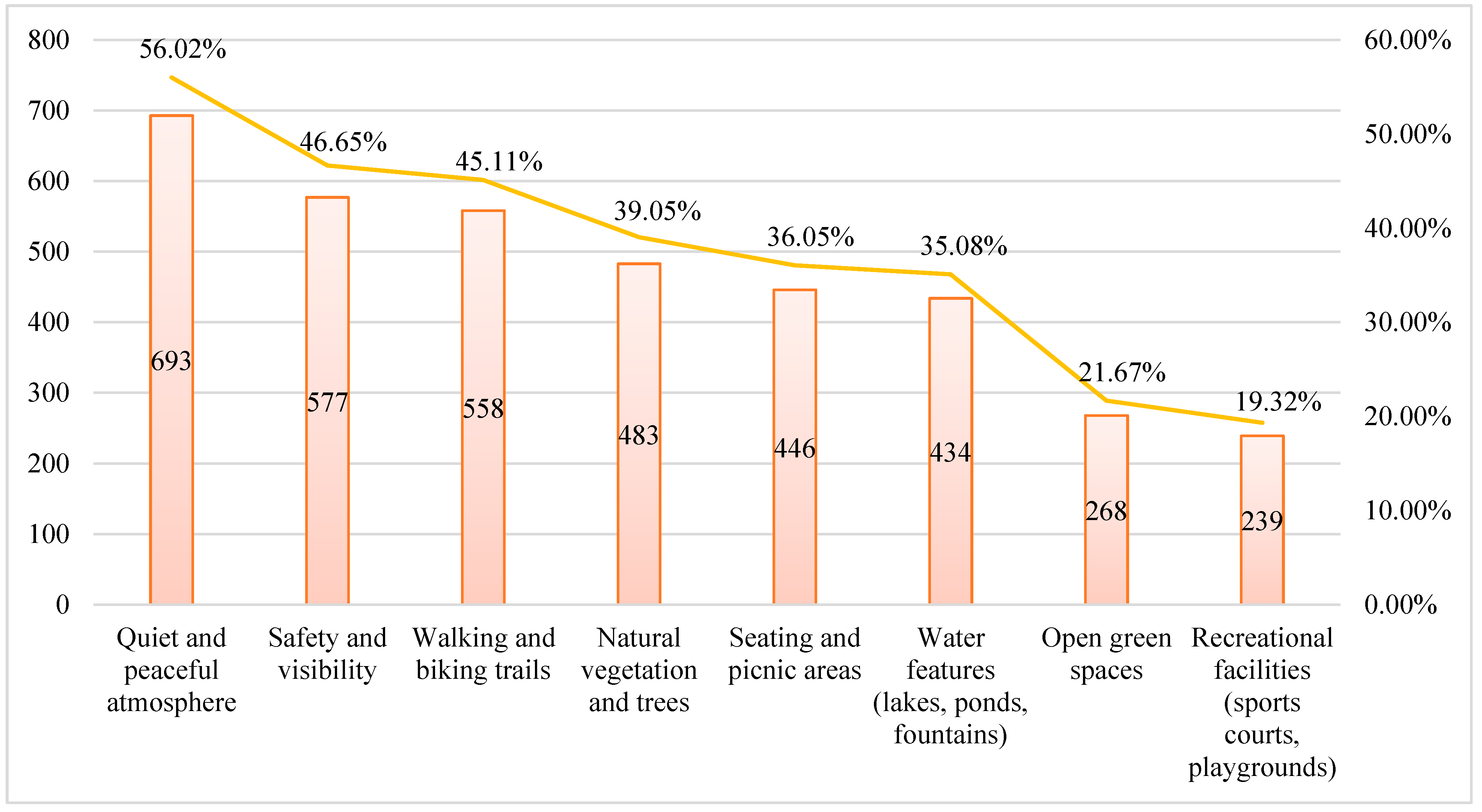

Table 1.
Sample characteristics of Florida adults aged 45 and older (N = 1,237).
| Characteristic | n | % |
| Age (years) | ||
| Mean (SD) | 62.7 | (10.8) |
| Range | 45 | to 96 |
| Gender | ||
| Female | 637 | 51.4 |
| Male | 599 | 48.4 |
| Non-binary | 1 | 0.1 |
| Race/Ethnicity | ||
| White | 825 | 66.6 |
| Hispanic or Latino | 193 | 15.6 |
| Black or African American | 158 | 12.8 |
| Asian | 27 | 2.2 |
| Other or prefer not to say | 34 | 2.8 |
| Education | ||
| Less than high school | 25 | 2.0 |
| High school graduate | 280 | 22.6 |
| Some college | 373 | 30.2 |
| College graduate | 377 | 30.5 |
| Graduate degree | 182 | 14.7 |
| Employment status | ||
| Retired | 575 | 46.5 |
| Employed full-time | 373 | 30.1 |
| Employed part-time | 121 | 9.8 |
| Unemployed | 102 | 8.2 |
| Other | 66 | 5.3 |
| Travel mode to park | ||
| Personal vehicle | 862 | 69.7 |
| Walking | 256 | 20.7 |
| Biking | 53 | 4.3 |
| Public transportation | 39 | 3.2 |
| Other | 27 | 2.2 |
| Travel time to park | ||
| Less than 5 minutes | 220 | 17.8 |
| 5 to 10 minutes | 413 | 33.4 |
| 11 to 20 minutes | 306 | 24.7 |
| 21 to 30 minutes | 128 | 10.3 |
| More than 30 minutes | 170 | 13.7 |
| Park visitation frequency | ||
| Daily | 36 | 2.9 |
| Several times per week | 183 | 14.8 |
| Once per week | 189 | 15.3 |
| 2 to 3 times per month | 253 | 20.5 |
| Once per month | 193 | 15.6 |
| Less than once per month | 383 | 31.0 |
| Shade deficiency | ||
| Yes (selected "more shade/tree coverage") | 289 | 23.3 |
| No | 948 | 76.7 |
Note. SD = standard deviation.
Table 2.
Stepwise binary logistic regression predicting frequent park visitation (once per week or more) among Florida adults aged 45 and older.
Table 2.
Stepwise binary logistic regression predicting frequent park visitation (once per week or more) among Florida adults aged 45 and older.
| Predictor | B | SE | OR | 95% CI | p |
| Intercept | 1.724 | 0.480 | 5.605 | [2.187, 14.362] | < 0.001 |
| Travel mode (active) | 1.316 | 0.157 | 3.728 | [2.738, 5.076] | < 0.001 |
| Travel time | -0.467 | 0.066 | 0.627 | [0.551, 0.713] | < 0.001 |
| Age | -0.033 | 0.007 | 0.967 | [0.955, 0.980] | < 0.001 |
| Gender (male) | 0.662 | 0.142 | 1.939 | [1.469, 2.559] | < 0.001 |
| Better walking/biking paths | 0.440 | 0.167 | 1.553 | [1.119, 2.154] | 0.008 |
| More shade | -0.435 | 0.177 | 0.648 | [0.458, 0.916] | 0.014 |
| Better lighting | 0.651 | 0.229 | 1.918 | [1.225, 3.004] | 0.004 |
| More safety/security | -0.430 | 0.201 | 0.650 | [0.438, 0.965] | 0.032 |
| More natural areas | 0.263 | 0.178 | 1.300 | [0.917, 1.845] | 0.141 |
Note. Reference categories: travel mode = 0 (passive: personal vehicle, public transportation, or other), gender = 0 (female). Travel time coded ordinally from 1 (less than 5 minutes) to 5 (more than 30 minutes). Motivator variables coded 1 = selected, 0 = not selected. Nagelkerke R² = 0.304. AUC = 0.789. Overall classification accuracy = 75.7%.
Disclaimer/Publisher’s Note: The statements, opinions and data contained in all publications are solely those of the individual author(s) and contributor(s) and not of MDPI and/or the editor(s). MDPI and/or the editor(s) disclaim responsibility for any injury to people or property resulting from any ideas, methods, instructions or products referred to in the content. |
© 2026 by the authors. Licensee MDPI, Basel, Switzerland. This article is an open access article distributed under the terms and conditions of the Creative Commons Attribution (CC BY) license (http://creativecommons.org/licenses/by/4.0/).
Copyright: This open access article is published under a Creative Commons CC BY 4.0 license, which permit the free download, distribution, and reuse, provided that the author and preprint are cited in any reuse.