

Submitted:
10 November 2026
Posted:
11 November 2026
You are already at the latest version
Abstract
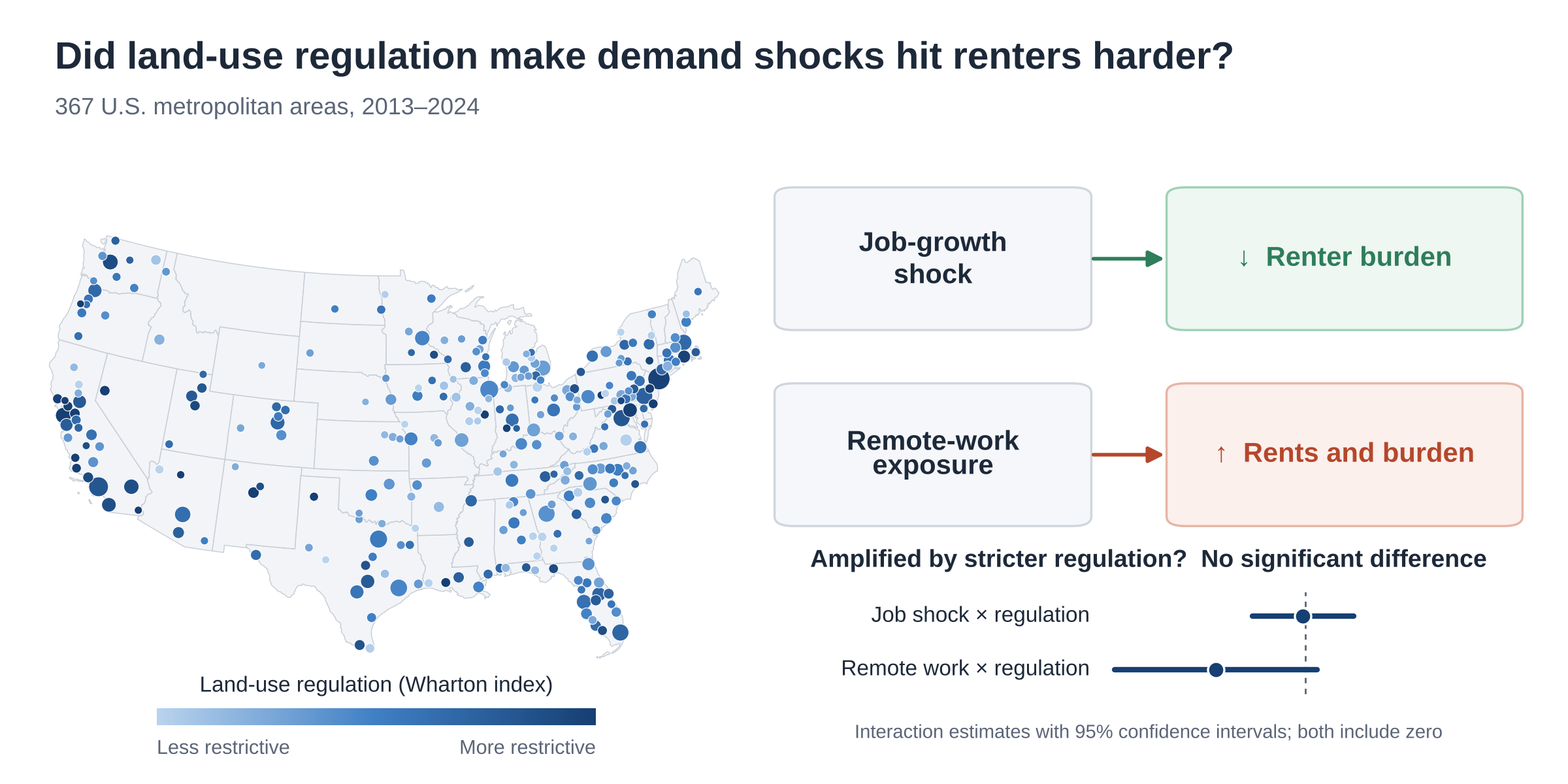
About half of U.S. renter households spend more than 30 percent of their income on housing. Against this backdrop, the study asks whether restrictive land-use regulations make local housing demand shocks more burdensome for renters. The analysis covers 156–163 U.S. metropolitan areas from 2013 to 2024, using the 2018 Wharton Residential Land Use Regulatory Index to examine two sources of demand variation: shift-share predicted employment growth and pre-pandemic exposure to remote work. Employment shocks were associated with lower renter cost burdens, whereas greater remote-work exposure was linked to rising rents and burdens, especially for middle- and higher-income renters. Neither response, however, was significantly larger in metropolitan areas with more restrictive regulations, and permitting was no less responsive to demand shocks in those areas. The findings were consistent across alternative samples and a zoning measure derived from municipal code text. Measured regulatory restrictiveness therefore appears to be a weak predictor of short- and medium-term changes in renter affordability, underscoring the importance of combining land-use reform with targeted rental assistance.
Keywords:
land-use regulation
; housing supply
; rent burden
; affordability
; demand shocks
; metropolitan housing markets
Copyright: This open access article is published under a Creative Commons CC BY 4.0 license, which permit the free download, distribution, and reuse, provided that the author and preprint are cited in any reuse.