

Submitted:
10 November 2026
Posted:
11 November 2026
You are already at the latest version
Abstract
Live transport is a critical component of fish hatchery and nursery operations, particularly when larvae are transferred from hatcheries to nursery facilities. This study evaluated the effects of larval age at transport (24, 48, and 96 hours post-hatch), transport duration (3, 5, 7, and 10 hours), and oxygen management on the post-transport survival and subsequent nursery performance of Pangasius catfish. Three complementary experiments were conducted. In Experiment 1, larvae transported at earlier developmental stages (24–48 hours post-hatch) and for shorter durations (3–5 hours) exhibited significantly higher immediate post-transport survival. In Experiment 2, survival after 10 days of nursery rearing in hapa nets ranged from 12.4% to 23.9% among treatments. These values were 1.5–2.0 times higher than survival rates commonly reported by nursery farmers at 1–2 weeks after transport. Experiment 3 evaluated longer-term survival after 25 days of nursery rearing and confirmed the strong effects of both larval age and transport duration. The research also found that without oxygen replenishment, the highest survival rate (49.7 ± 4.7%) was achieved when larvae were transported within 24 hours post-hatch for no longer than 3 h, whilst oxygen replenishment at 3h intervals further increased survival to 55.3 ± 7.8%. Overall, transporting larvae at an early developmental stage, minimizing transport duration, and maintaining adequate oxygen levels substantially improved post-transport survival and subsequent nursery performance. These practices may therefore enhance production efficiency and fish welfare in Pangasius catfish aquaculture production.
Keywords:
Pangasius catfish
; fish larvae
; fingerling nursery pond
; hapa net system
; transportation
; growth performances
; survival rates
1. Introduction
The extensive network of rivers and canals and the rich alluvial soil of the Mekong Delta create a highly suitable environment for the proliferation of wild and intensive aquaculture production of striped catfish (Pangasianodon hypophthalmus) [1-3]. This region serves as a primary hub for Pangasius farming, providing livelihoods for thousands of local people. Striped catfish species, also widely known as Pangasius catfish or Tra catfish, is recognized as a significant success story in the development of Asian and global aquaculture production (Phuong and Oanh, 2010b). Due to its commercial success, the farming of Pangasius catfish has expanded to other countries in the region, including Bangladesh and Thailand [4-7].
The Pangasius catfish industry is a critical economic driver for Vietnam, with an annual export value between $1.5 billion and $2.4 billion. This species accounts for approximately 16–26% of the nation's total seafood export value, providing substantial economic returns and supporting national growth [8]. While the rapid expansion of Pangasius catfish farming in the Mekong Delta has attracted global attention over the past decade, it has also faced controversy concerning sustainability and market related issues. Despite substantial commercial success, the Pangasius catfish aquaculture sector confronts critical production constraints. Given its economic importance, numerous multidisciplinary studies have emerged to address these issues, focusing on genetics, nutrition and feed management, inbreeding, seed degeneration, hatchery operations, cultivation systems, and environmental sustainability [3, 5, 9-16]. A primary bottleneck to the sustainable growth of this sector in the Mekong Delta is high mortality and inconsistent quality during early life stages (larvae, fry, and fingerlings). This issue severely compromises the stable, year-round supply of high-quality seed required for grow-out production [2, 3, 5, 17].
The initial phase of the Pangasius catfish nursery cycle involves stocking larvae (24 to 48 hours post-hatching) from hatcheries or nursing farms into grow-out ponds. These larvae are typically transported in plastic bags with water and oxygen, via motorbikes and trucks on the road, and by boats on rivers/canals. Survival of newly stocked larvae can be as low as 5–10% within the first 1–2 weeks after stocking. Such low survival may be associated with larval quality, transport duration, distance and methods, as well as farmers’ husbandry skills and pond management practices [18, 19]. Compared with larvae, fry and fingerlings are expected to tolerate handling and stocking stress better and experience lower post-stocking mortality. Nevertheless, transport and stocking remain critical stages in the production cycle, including the transfer of larvae from hatcheries to fingerling nursery farms and the subsequent transfer of fry or fingerlings to grow-out farms. Low mortality during transport does not necessarily translate into high post-stocking survival. Survival during subsequent nursery rearing can vary considerably among farms, with complete stock losses reported in some cases within 5–25 days after transport [1, 3, 5, 20]. These patterns highlight the need to consider both transport conditions and post-stocking husbandry when evaluating survival, as losses occurring after transport may reflect the combined effects of transport stress and subsequent rearing conditions. Therefore, the careful management of fish larvae transportation is a crucial strategy for reducing mortality and the associated economic losses. Discussions with farmers suggest that these high mortalities of fish larvae, fry, and fingerling may be attributed to two main factors: poor handling during transport between the hatcheries and grow-out farms and poor nursing pond management, both of which can cause stress and physical damage to the fish. However, further research was needed to determine the specific factors contributing to this problem and to develop best practices for transporting fish larvae from hatcheries to fingerling nursery ponds. Addressing these issues will not only improve fingerling survival rates but also provide better conditions with very low welfare risk, ultimately increasing the efficiency and profitability of Pangasius aquaculture operations in the long run.
The successful transportation of fish seeds (larvae, fry and fingerlings) is a critical component of the aquaculture industry, particularly in hatchery operations and grow-out production [5, 21, 22]. The transport of fish seeds from hatcheries to remote farms is essential for year-round production, especially in regions where hatchery facilities are scarce [18, 23]. This process facilitates the growth of the aquaculture sector and generates new employment opportunities. When modern larval transportation systems are employed, the transport time and distance are precisely controlled, survival rates can reach 90–95% [5, 18, 20, 24]. This study aimed to identify the current key welfare risk factors affecting survival rates of Pangasius catfish seed transportation from hatcheries to nursery and grow-out farms in the Mekong Delta. Specifically, it evaluated the effects of rearing time of post-hatch larvae, transport duration, and handling practices on larval survival and other welfare outcomes. The study hypothesized that poor handling and prolonged transport lead to increased mortality during and after transport. Transportation practices were therefore assessed across the pre-transport, transport, and post-transport stages to identify critical determinants of larval survival. The results provide evidence based recommendations for improving transportation protocols and enhancing the survival and welfare of Pangasius catfish seed production.
2. Materials and Methods
2.1. Study Site and Research Layout
The study was conducted in 2025 in An Giang and Dong Thap provinces, two major centers of Pangasius catfish aquaculture production in the Mekong Delta of Southern Vietnam. The study comprised two main components. First, a field survey was conducted to document transport protocols and practical experiences among hatchery operators, nursery farmers, and commercial producers involved in the production and transport of Pangasius catfish larvae, post-hatchlings, and fry. Second, controlled transport and post-transport rearing trials were conducted at a hatchery and in hapa nets installed in earthen ponds. Larvae of different ages were subjected to varying transport durations. Survival rates of fish larvae were assessed immediately after each transport treatment and again after 10 and 25 days of rearing in the hapa net systems. The individual components of the study are described in detail below.
2.2. Field Survey Assessment of Fish Larvae Transportation Protocols in the Mekong Delta
The survey focused on understanding the hatchery and transport protocols. 5 hatcheries and 10 nurseries farms located in An Giang and Dong Thap provinces were surveyed. The survey instrument was designed to capture detailed information on broodstock of Pangasius catfish management such as, feed and feeding, spawning seasons, spawning performance, larvae/fry production, hatching ratios, survival rates of larvae/fry, time of larvae/fry rearing after hatching, and transportation practices of fish larvae/fry from hatcheries to nursery, and to grow-out farms. Other survey questions addressed included farmers’ experiences, Pangasius catfish broodstock pond areas and replacement strategies, buyer preferences, and farmers’ perceptions regarding potential improvements in fish welfare. In addition, transport conditions were documented, covering container types, vehicles used, transport duration, stocking densities, use of water additives, and stress-mitigation measures. Farmers were also asked to report larvae/fry survival rates after transport, common problems encountered, methods of stocking into nursery ponds, satisfaction with current practices, and their suggestions for improving transport methods to enhance survival rates and fish welfare during the early stages of production.
2.3. Experimental Assessment of the Effects of Post-Hatch Holding Duration at Hatchery and Transport Duration on Larval Survival
This experiment focused on practices related to the post-hatching of Pangasius catfish rearing and transportation of post-hatch larvae from hatcheries to nursing farms, with particular emphasis on transport duration and post-transport rearing. The primary objective was to identify key factors influencing larval survival rates and to evaluate welfare outcomes during and after transportation.
2.3.1.. Expermental Design of Pre-Transport Rearing of Post-Hatch Larvae
Newly hatched Pangasius catfish larvae were obtained from the Research Center for Aquatic Seed Production, where broodstock spawning and egg incubation were conducted. After hatching, a total of 4.2 million larvae were randomly allocated among 12 larval-rearing tanks. The experiment comprised three treatments, each with four replicate tanks. Each tank had a working volume of 0.5 m³ and was stocked with 350,000 larvae, equivalent to a stocking density of 700,000 larvae m⁻³. Water supplied to the rearing tanks was drawn from a reservoir and treated through biological filtration and ozonation before entering the tanks. Continuous aeration was provided using three air-stone diffusers per tank connected to a medium-pressure electric blower. The experiment aimed to determine an appropriate pre-transport rearing duration and larval age at transport to improve survival during transport and subsequent nursery rearing. Three treatments were established based on post-hatch rearing duration: Treatment 1 (24 h; control), Treatment 2 (48 h), and Treatment 3 (96 h). Larvae in the control treatment were reared for 24 h after hatching without feeding. Larvae in Treatments 2 and 3 were reared for 48 and 96 h after hatching, respectively, and fed Artemia nauplii three times daily at approximately three nauplii per larva per feeding. At the end of the designated rearing period, larvae from each treatment were transported to nursery ponds. Each treatment included three replicates.
2.3.2. Experimental Design of Post-Hatch Larval Survival Rates Under Different Transport Durations
Fish larvae were collected from the hatchery at 24, 48, and 96 hours post-hatching and packed in oxygenated plastic bags at a density of 80,000 larvae per bag containing 5 L of water. The bags were placed in transport containers and transported by motorbike to the nursery farm over four transport durations: 3, 5, 7, and 10 hours. Within each post-hatch rearing group, transport bags were randomly assigned to the four transport durations, with three replicate bags per duration. The 3 hours transport treatment served as the reference treatment, with no oxygen replenishment during transport. For the 5, 7, and 10 hours treatments, oxygen in the bags was replenished at 3 hours intervals during transport. At the end of each transport period, each bag was visually inspected, and an approximately 100-mL water sample containing larvae was collected from each bag to assess larval physical condition, swimming behaviour, and survival and mortality rates.
2.3.3. Experiment of Transport Duration Effects on Survival of 10 and 25-Day Olds Larvae Rearing
The post-transport nursery trial was conducted in a 500-m² earthen pond in My Hoa Hung Commune, An Giang Province (Figure 1). Before the trial, the pond was drained, residual water and bottom sediment were removed, and the pond bottom was allowed to dry for approximately two weeks. Lime (30–40 kg per pond) was then applied, after which the pond bottom was left to dry for an additional week. The pond was subsequently filled with river water to a depth of 2 m.
Thirty-six rectangular hapa nets were installed in the pond to accommodate the experimental fish (Figure 1). Each hapa had a surface area of 1 m², a depth of 1 m, a working volume of 1 m³, and a mesh size of 0.5 mm. Each hapa was secured at its four corners to four melaleuca poles. The experiment evaluated the effects of pre-transport rearing duration and transport duration on the post-transport survival, growth performance, and general condition of Pangasius catfish larvae and fry. A 3 × 4 factorial design was used, comprising three pre-transport rearing durations, corresponding to larval ages of 24, 48, and 96 hours post-hatching, and four transport durations of 3, 5, 7, and 10 hours. Each treatment combination was replicated in three hapas, resulting in 36 experimental units. Immediately after transport, larvae were stocked into the hapas at a density of 30,000 individuals m⁻³ and reared for 10 days. Survival and growth performance were assessed on day 10 after transport. Following this assessment, fry from each replicate were restocked into their respective hapas at approximately 15,000 individuals m⁻³ and reared until day 25 after transport, when survival and growth performance were assessed again. During the first five days of nursery rearing, larvae were fed Moina sp. They were subsequently weaned gradually onto a commercial powdered diet containing 45% crude protein. Approximately 20% of the pond water was replaced with fresh river water after every 10 days to maintain water quality. The hapa nets and feeding trays were cleaned monthly to remove biofouling and accumulated organic matter.
2.4. Water Quality Monitoring in the Larvae-Fingerling Nursery Pond
Dissolved oxygen (DO; mg L⁻¹) and water temperature (°C) were measured twice daily at 08:00 and 17:00 using a portable DO meter (HI98193; Hanna Instruments; accuracy: ±1.5% of the reading or ±1 digit). At the same times, pH was measured using a pH meter (HI9813-5; Hanna Instruments; accuracy: ±0.1 pH unit). Water samples were collected weekly throughout the experiment to determine the concentrations (mg L⁻¹) of nitrite, nitrate, hydrogen sulfide (H₂S), and total ammonia nitrogen (TAN; NH₄⁺ + NH₃).
2.5. Statistical Analysis
The collected data were coded and analysed by descriptive statistics and analysis of variance using MICROSOFT EXCEL and Minitab (version 16) statistical software package (SPSS, Chicago, IL, USA). Differences of different treatments were considered significant at an level of 0.05. All means were given with ± SD.
3. Results and Discussion
3.1. Assessment of Fish Larvae Transportation Protocols Among Hatchery Operators in the Mekong Delta
Table 1 summarizes the characteristics and key findings from Pangasius catfish hatcheries and nurseries surveyed in An Giang and Dong Thap provinces. These provinces are major centres of Pangasius catfish seed production in Vietnam. The survey included family operated and company owned hatcheries supplying larvae, fry, and fingerlings to nursery and grow-out farms throughout the Mekong Delta of Vietnam. Most facilities integrated broodstock ponds, spawning units, larval-rearing systems, and nursery ponds. The survey examined broodstock management, seed production, nursery and transport practices, and factors affecting early survival.
Hatchery operators had an average of 15 ± 3 years of experience (range: 7–23 years), reflecting the long-term development of household-based seed production in the region [1, 2, 5]. Broodstock facilities generally occupied 0.3 – 0.5 ha and contained three to four ponds. Most hatcheries maintained two or three active broodstock groups, together with replacement stocks. Broodstock populations ranged from approximately 3,000 to 6,000 fish and generally contained more females than males to maximize egg production. Broodfish are commonly used for spawning between 3 and 7 years of age and replaced every 5–7 years. These practices reflect recognition of the importance of broodstock age and condition for fecundity, fertilization, hatching success, and larval quality [3, 9, 25, 26]. Broodstock were generally fed twice daily with diets containing 26–35% crude protein. Such nutritional management is important for gonadal development, reproductive performance, egg quality, and larval survival (Izquierdo et al., 2001, 2015; Da et al., 2024b). Spawning occurred primarily from March to September, corresponding to the natural reproductive season of striped catfish. Most hatcheries conducted two main-season spawning cycles and one hormonally induced off-season cycle, enabling extended seed production throughout the year [3, 7, 26].
Larval output varied substantially among hatcheries, ranging from 10 to 100 million larvae per spawning event, with typical production of 10–30 million larvae per crop. Some hatcheries produced as many as 1–2 billion larvae annually. This variation may be linked to differences in broodstock quality, reproductive performance, incubation practices, environmental conditions, and market demand [3, 26-28]. Despite the sector’s production capacity, larval transport and early nursery rearing were identified as major bottlenecks. Larvae were generally sold and transported at 16–24 h after hatching, with operators considering approximately 24 hours post-hatch to be the most suitable age for transport. At this stage, larvae still rely largely on yolk reserves and have not fully transitioned to exogenous feeding. Prolonged holding may lead to yolk depletion, reduced vigor, and increased biting or cannibalism [18, 29-32].
Larvae were transported mainly in oxygenated plastic bags by motorbike or small truck. Operators considered transport durations of less than 3 hours preferable, whereas trips exceeding 4 hours often required oxygen replenishment. The main reported problems were oxygen depletion, temperature fluctuations, ammonia accumulation, and larval cannibalism. These stressors may become more severe as transport duration and stocking density increase [33, 34]. Reported survival after transport and during the first one to two weeks of nursery rearing was generally only 5–10%, although survival occasionally reached 20–30% under favourable conditions. These losses might be associated with interacting biological, environmental, and management factors, including larval quality, temperature fluctuations, low dissolved oxygen, elevated ammonia, high transport densities, delayed first feeding, and inadequate nursery preparation [5, 35, 36]. Overall, the surveyed hatcheries had experienced operators, established broodstock populations, and substantial seed-production capacity. However, low survival during transport and early nursery rearing remains a major constraint. Improvements should prioritize standardized transport protocols, appropriate packing densities, effective oxygen and temperature management, and better nursery preparation. These measures could improve larval survival, seed quality, and production efficiency in the striped catfish seed sector.
3.2. The Survival Rates (%) of Experimental Fish Larvae at Different Ages Under Varying Transport Durations from the Hatchery To Nursing Farm
The survival rates of early hatching of larvae transported at different ages post-hatching (24, 48, and 96 hours) and under varying transport durations (3, 5, 7, and 10 hours) are presented in Table 2. At 24 hours post-hatching, larvae exhibited the highest survival rate (99.3±0.6%) in Treatment 1 (3 hours transport). However, survival declined progressively with increased transport duration, reaching the lowest value (39.0±3.6%) in Treatment 4 (10 hours transport), which also recorded the highest mortality rate (61.0±3.6%) (Table 2). A similar pattern was observed in larvae transported at 48 hours post-hatching. Treatments 1 and 2 of 3 and 5 hours transports showed high survival approximate 96.7±1.5% and 92.3±1.5%, respectively, whilst Treatments 3 and 4 (7 and 10 hours) demonstrated significant reductions in survival to 86.3±1.5% and 61.7±12.6%, respectively. Mortality increased accordingly, peaking at 38.3±12.6% in the 10 hours group. By 96 hours post-hatching, survival decreased sharply across all treatments. Although the highest survival (62.0±10.4%) was still observed in the shortest transport duration (Treatment 1), it was considerably lower than at earlier ages. The lowest survival (15.3±6.1%) were observed in Treatment 4, indicating that older larvae are substantially more sensitive to extended transport durations.
These findings are consistent with previous studies of Pangasius catfish transport conducted in the Mekong Delta, Vietnam, which emphasize that early-stage larval transport (particularly within 24–48 hours after hatching) combined with short transport durations (under 4–5 hours) significantly improves survival outcomes [5, 18, 20, 37]. According to Hao, et al. [38], prolonged transport beyond 6 hours without proper oxygen and temperature management can induce acute stress, reduce larval vitality, and compromise survival.
Similarly, research by Do, Nguyen and Le [37] highlighted that fish transported under suboptimal conditions (e.g., high larval density, long transport time, and poor oxygenation) exhibited higher mortality and post-transport deformities. The decline in survival with increased age and transport duration may be attributed to physiological changes in larvae over time, including higher metabolic rates, increased oxygen demand, and decreased tolerance to handling stress [39, 40]. Moreover, larvae transported beyond 48 hours post-hatching is likely to experience higher levels of cumulative stress due to longer exposure to crowding, mechanical shocks, and deteriorating water quality [5, 30, 35, 40]. Taken together, these results highlight the critical need to optimize transport protocols in the Pangasius catfish hatchery to nursery by initiating transport within 24–48 hours post-hatching and limiting transport duration to within 3–5 hours. Adopting these practices will reduce larval stress, enhance survival, and ultimately improve larvae/fry quality for the nursery operations in the Mekong Delta. The results clearly demonstrate that both the age of fish larvae at the time of transport and the duration of transport have significant effects on survival outcomes. Fish larvae transported shortly after hatching and for shorter durations (e.g., 1–4 hours) consistently exhibited the highest survival rates across all assessment times. These findings underscore the importance of optimizing both the timing of transport post-hatching and transport duration to enhance the viability of fish larvae during transfer from hatcheries to nursing ponds. To maximize survival rates, fish larvae should be transported within 24 hours of hatching, and the transport duration should be limited to less than 4 hours. This confirm why farmers prefer to use this transport protocol as shown from survey results. If transport exceeds 4 hours, it is essential to replace oxygen and add fresh water to the transport bag to reduce stress and prevent shock in the larvae.
3.3. Assessment of Post-Transport Survival and Growth Performance Across Transport-Duration Treatments After 10 Days of Nursery Rearing
The survival rates of Pangasius catfish larvae/fry are presented in Table 3. The results showed that post-transport survival of larvae/fry decreased with increasing transport duration.
Among larvae transported at 24 hours post-hatch, survival after 3 and 5 hours was 21.7 ± 1.5% and 23.9 ± 2.0%, respectively, with no significant difference between treatments (P > 0.05). Survival decreased significantly after 7 hours (17.7 ± 2.6%) and 10 hours (11.5 ± 0.4%) of transport, although these two treatments did not differ significantly from each other (Table 3). A stronger duration dependent response was observed in larvae transported at 48 hours post-hatch. Survival was similar after 3 and 5 hours of transport (13.1 ± 2.4% and 12.4 ± 1.3%, respectively) but decreased significantly to 9.1 ± 3.5% after 7 hours and 4.9 ± 4.2% after 10 hours. In contrast, larvae transported at 96 hours post-hatch exhibited extremely low survival: only 0.4 ± 0.3% and 0.5 ± 0.4% survived after 3 and 5 h, respectively, and no larvae survived after 7 or 10 hours. Across all transport durations, survival was consistently highest for larvae transported at 24 h post-hatch, intermediate for those transported at 48 hours, and lowest for those transported at 96 hours. However, these age-related differences are descriptive because the statistical comparisons reported in Table 3 were conducted among transport durations within each larval age group.
The results suggest a practical transport-duration threshold between 5 and 7 hours, beyond which post-transport survival declined markedly. Prolonged confinement can impair transport-water quality through carbon dioxide and ammonia accumulation, declining pH, temperature fluctuations, and cumulative handling and metabolic stress. Similar duration-dependent changes in water quality, physiological stress, and survival have been reported in Asian seabass fry and juvenile Peruvian grunt [41, 42]. Assessing survival after 10 days of nursery rearing also captures delayed mortality that may not be evident immediately after transport. Fish that survive transportation may subsequently die because of physiological damage, depleted energy reserves, impaired feeding, or reduced capacity to recover from stress. López-Jiménez, et al. [43], for example, reported high immediate survival in transported Nile tilapia fry but a progressive decline during the first 4–5 days of post-transport rearing.
The higher survival of 24 hours larvae may be related to their developmental stage. At this age, larvae still rely largely on endogenous yolk reserves and may have lower metabolic and excretory demands than older larvae. By 48–96 h post-hatch, striped catfish larvae are transitioning to exogenous feeding, when food availability and feeding frequency become critical determinants of survival and growth [44, 45]. This period is also associated with a high risk of injury and lethal biting because of the species’ distinctive oral structures and incomplete development of the pectoral fins [46]. Nevertheless, the apparent age effect should be interpreted cautiously. The 24 hours larvae were unfed, whereas the 48- and 96-h larvae received Artemia before transport. Consequently, larval age, pre-transport rearing duration, and feeding history were not evaluated independently. If equal numbers of larvae were transported per bag, older larvae may also have represented greater biomass, oxygen demand, and waste production. Under the tested conditions, transporting larvae at 24 hours post-hatch for no more than 5 hours produced the highest 10-day survival. Larvae transported at 48 h were less tolerant of prolonged transport, while transport at 96 h was unsuitable regardless of duration. Longer transport routes will require further optimization of packing biomass, oxygen supply, temperature, ammonia control, and post-transport acclimation. Because Table 3 contains survival data only, conclusions regarding growth require separate measurements of length, weight, and specific growth rate.
Table 4 presents endpoint fry-size indices rather than growth rates because initial body weight and length were not measured. The number of fry per gram is inversely related to individual body mass; therefore, fewer fry per gram indicates larger fry. Approximate individual weight was calculated as the reciprocal of the number of fry per gram. Among larvae transported at 24 hours post-hatch, the largest fry were recorded after 5 h of transport (4.11 fry g⁻¹; approximately 0.243 g fry⁻¹), followed by the 3-h treatment (5.00 fry g⁻¹; 0.200 g fry⁻¹). Estimated weight decreased to 0.178 g fry⁻¹ after 7 hours and 0.120 g fry⁻¹ after 10 hours. Thus, fry transported for 10 h were approximately 50% smaller than those transported for 5 h. A similar trend occurred among larvae transported at 48 h post-hatch. Estimated individual weight was highest after 3 h of transport (0.206 g fry⁻¹) and decreased to 0.178, 0.127, and 0.135 g fry⁻¹ after 5, 7, and 10 hours, respectively. Averaged across transport durations, estimated fry weight was slightly higher in the 24 hours group (approximately 0.172 g fry⁻¹) than in the 48 hours group (0.156 g fry⁻¹). No size measurements were available for the 96 hours group because survival was extremely low; these values should therefore be reported as “not determined” rather than zero.
Counts per 1000 mL were variable and did not consistently agree with the weight-based measurements. Volumetric estimates may be influenced by body shape, fish orientation, size variation, and sampling compaction. Consequently, fry number per gram provides a more useful size index, although direct measurements of individual weight and length would be more reliable. Overall, transport durations of 3–5 hours generally produced larger fry than durations of 7–10 hours. Prolonged transport may reduce subsequent growth by increasing energy expenditure for physiological recovery and disrupting feeding and digestion. Confinement can also increase carbon dioxide and ammonia concentrations, reduce pH, and induce metabolic and immune stress. Physiological responses to a 5-h transport period have been documented in juvenile striped catfish [47], while duration-dependent water-quality deterioration and immune responses have been reported in Asian seabass fry (Hong et al., 2021). Post-transport recovery may also require several days, during which somatic growth can remain impaired [48].
Differences among larval-age groups may also reflect developmental and nutritional factors. Larvae transported at 48 hours post-hatch were entering the transition to exogenous feeding, when growth is highly dependent on prey availability, feeding time, and feeding frequency [44, 45]. However, age effects cannot be separated from differences in feeding history and transport biomass because 24-h larvae were unfed, whereas older larvae received Artemia before transport. Because Table 4 provides no replicate-level variation or statistical comparisons for individual treatments, the observed differences should be interpreted as numerical trends. Future studies should measure initial and final weight and length, specific growth rate, size variation, and survival-adjusted biomass. Under the tested conditions, larvae transported at 24 hours post-hatch for 3–5 hours showed the best overall size performance after 10 days of nursery rearing, whereas transport for 7–10 h was associated with smaller fry.
3.4. Assessment Of Post-Transport Survival and Growth Performance Across Transport-Duration Treatments After 25 Days of Nursery Rearing
After the initial 10-day nursery period, 1,500 fry from each replicate hapa were stocked and reared for an additional 25 days. The survival rates presented in Table 5 therefore represent conditional survival from day 10 to day 35 after transport rather than cumulative survival from the time of transport. For larvae transported at 24 hours post-hatch, survival during the additional 25-day period remained relatively consistent across transport durations. Survival was highest after 5 h of transport (55.3 ± 7.8%), followed by 3 hours (49.7 ± 4.7%), 7 hours (48.5 ± 6.4%), and 10 hours (45.9 ± 5.0%). Thus, extending transport from 3 to 10 hours produced only a moderate numerical decline in the survival of this age group. A markedly different pattern was observed among larvae transported at 48 h post-hatch. Survival was similar after 3 and 5 hours of transport (45.8 ± 4.8% and 46.5 ± 0.7%, respectively) but declined to 22.8 ± 4.5% after 7 hours and 11.8 ± 10.4% after 10 hours. Relative to the 5 hours treatment, survival decreased by approximately 51% after 7 hours and 75% after 10 hours. The high variability in the 10 hours treatment, with survival ranging from 0.2% to 20.1%, indicates inconsistent recovery among replicate hapas. No fish from the 96 hours post-hatch group survived to this stage.
These results suggest that the adverse effects of prolonged transport persisted well beyond the initial 10-day nursery period, particularly among larvae transported at 48 hours post-hatch. Transport durations of 3–5 hours appeared comparatively tolerable, whereas durations of 7–10 hours substantially reduced longer-term survival. However, because no statistical superscripts are provided for the survival data, these differences should be described as numerical trends unless supported by a separate statistical analysis. Mean body weight after the additional 25-day period ranged from 1.35 to 1.66 g in the 24 hours group and from 1.37 to 1.58 g in the 48 hours group. All weight means within each larval-age group shared the same superscript letter, indicating no significant effect of transport duration on the final weight of surviving fingerlings (P > 0.05). In the 24 hours group, fingerlings transported for 7 and 10 hours had the greatest numerical weights (1.63 and 1.66 g), whereas the 5 hours treatment had the lowest mean weight (1.35 g). Similarly, mean weight in the 48-h group increased numerically from 1.37 g after 3 hours of transport to 1.58 g after 10 hours, but these differences were not significant. Mean body length ranged from 52.8 to 57.0 mm in the 24 hours group. Fingerlings from the 7 hours treatment were significantly longer than those from the 5 hours treatment, while the 3- and 10 hours treatments were intermediate. In the 48-h group, body length varied only slightly, from 54.3 to 54.9 mm, with no significant differences among transport durations. Overall, transport duration had a much stronger effect on survival than on the final size of surviving fingerlings.
The similar final weights and lengths among transport treatments suggest that fish surviving the initial transport and early nursery period were generally able to resume growth. Post-transport physiological recovery can occur over several days, although the required recovery period varies with species, fish size, transport intensity, and post-transport conditions. Transported Siamese fighting fish, for example, recovered normal somatic growth after approximately eight days of post-transport rearing [48]. Nevertheless, comparable growth among survivors does not indicate that the treatments were equally suitable because substantial differences in survival remained. The numerically greater weight of fingerlings from some longer-duration treatments may reflect density-dependent growth rather than a beneficial effect of transport. High mortality reduces competition for food and space, potentially allowing the remaining fish to grow faster. This interpretation is particularly relevant to the 48-h group, in which the 7 hours and 10 hours treatments produced low survival but surviving fingerlings attained weights and lengths comparable to those in the shorter-duration treatments. Previous research has demonstrated that food availability, prey density, and fish density strongly influence the growth and survival of striped catfish larvae [44, 45]. Therefore, final body size should be interpreted together with survival and biomass yield. The wide ranges in body weight and length also indicate substantial size heterogeneity. Across treatments, individual body weights ranged from approximately 0.18 to 8.96 g, while body lengths ranged from 25 to 95 mm. Such variation may arise from unequal feed access, differences in developmental condition, density-dependent competition, and the rapid growth of dominant individuals. Size heterogeneity is important in striped catfish culture because it can intensify competitive and cannibalistic interactions and reduce uniformity of fingerling production [49].
The persistent reduction in survival after longer transport may be associated with cumulative physiological damage and delayed mortality. During transport, respiration and excretion can increase carbon dioxide and ammonia concentrations, reduce pH, and induce metabolic and immune stress. A 5 hours transport period altered ammonia excretion and metabolic indicators in juvenile striped catfish [47], while longer transport durations caused progressive water-quality deterioration and immune responses in Asian seabass fry [41]. Such stress may reduce disease resistance and recovery capacity even when surviving fish subsequently regain normal growth.
Overall, larvae transported at 24 hours post-hatch maintained relatively stable survival during the additional 25-day nursery period, whereas larvae transported at 48 hours became highly vulnerable when transport exceeded 5 hours. Transport duration did not significantly affect the final weight of surviving fingerlings and had only a limited effect on body length. Therefore, survival and survival-adjusted biomass provide more informative measures of transport success than final body size alone. Under the tested conditions, transporting larvae at 24 hours post-hatch for no more than 5 hours provided the most favorable combination of survival and subsequent nursery performance.
3.5. Water Quality Monitoring in the Experiment of Nursery Pond
Water quality varied during the 1–25-days post-transport nursery period (Table 6). Temperature remained relatively stable, whereas dissolved oxygen (DO), nitrogenous compounds, and hydrogen sulfide (H₂S) showed greater temporal variation. Because all treatments were reared in hapa nets within the same pond, these measurements represent the shared nursery environment rather than treatment-specific conditions.
Water temperature ranged from 30.5 to 32.0 °C and averaged 31.43 ± 0.61 °C. This range was within the recommended temperature of 27–33 °C for Pangasius catfish fry, although slightly above the reported optimum of approximately 30 °C [50]. Temperature was therefore unlikely to explain differences in survival among transport treatments. However, temperatures of 31–32 °C may increase metabolism, oxygen demand, and sensitivity to nitrogenous wastes during post-transport recovery. Water pH ranged from 6.00 to 7.50, with a mean of 6.99 ± 0.48. Most values were near neutral, although the final value of 6.00 indicated a temporary shift toward more acidic conditions. This is relevant because pH influences the proportions and toxicity of both ammonia and sulfide. DO concentrations ranged from 3.75 to 7.50 mg L⁻¹ and averaged 5.08 ± 1.40 mg L⁻¹. Concentrations were comparatively low during the first three sampling occasions (3.75–4.20 mg L⁻¹) but subsequently increased to 4.60–7.50 mg L⁻¹. Although striped catfish can tolerate hypoxic conditions through facultative air breathing, moderate DO may reduce feeding, digestion, and growth. Striped catfish maintained at approximately 7.95 mg L⁻¹ DO showed better growth and nutrient digestibility than fish maintained at 2.38 or 4.77 mg L⁻¹ [51]. Thus, the early DO levels were probably not acutely lethal but may have constrained post-transport recovery and growth.
Nitrite varied from 0.30 to 3.20 mg L⁻¹ and averaged 1.23 ± 1.11 mg L⁻¹. Its increase during the fourth and fifth sampling occasions may indicate temporary organic loading or incomplete nitrification. Nitrite can reduce blood oxygen-carrying capacity by converting hemoglobin to methemoglobin, thereby imposing additional physiological stress [52]. Nitrate ranged from 0.04 to 5.00 mg L⁻¹ and was less likely to cause acute toxicity, although its variation reflected changing nitrogen-transformation processes. The combined NH₄⁺/NH₃ concentration ranged from 0.01 to 2.00 and peaked concurrently with nitrite, suggesting temporary nitrogenous-waste accumulation. Ammonia may impair respiration, suppress feeding, and redirect energy from growth toward physiological maintenance [53]. However, interpretation requires clarification of whether the values represent total ammonia nitrogen, NH₄⁺–N, or un-ionized NH₃–N, together with the appropriate units. H₂S concentrations ranged from 0.01 to 0.15 mg L⁻¹ and increased during the final sampling occasions, possibly because of anaerobic decomposition of accumulated organic matter. If these values represent molecular H₂S, the maximum concentration may be biologically concerning, although toxicity thresholds from other species cannot be applied directly to striped catfish [54].
Overall, fluctuations in DO, nitrite, ammonia, and H₂S may have contributed to background stress and delayed mortality. Fish exposed to longer transport may have been less capable of tolerating these conditions because of greater physiological disturbance and depleted energy reserves. Nevertheless, water quality cannot explain differences among transport treatments because all groups shared the same pond. The poorer survival after 7–10 hours of transport is therefore more consistent with carry-over transport stress. Future studies should report water quality for each independent rearing unit and specify all analytical forms, units, and sampling dates.
5. Conclusions
Larval age and transport duration strongly influenced the post-transport survival and nursery performance of Pangasius catfish. Larvae transported at approximately 24 hours post-hatch achieved the highest survival, particularly when transport was limited to 3–5 hours. Survival declined markedly after longer journeys, especially among larvae transported at 48 h post-hatch, whereas transport at 96 h post-hatch resulted in extremely low or zero survival. These findings demonstrate that developmental stage is a critical determinant of transport tolerance. Mortality during subsequent nursery rearing indicates that immediate survival alone does not adequately represent transport success. Prolonged transport may cause cumulative physiological stress, energy depletion, and impaired metabolic and osmoregulatory function, leading to delayed mortality. Post-transport survival should therefore be monitored throughout an appropriate recovery period.
Hatchery operators should transport larvae at approximately before 24 hours post-hatch and limit transport duration to no more than 5 hours whenever possible. Appropriate packing density, adequate oxygen supply, stable temperature, and effective control of ammonia and carbon dioxide are essential for maintaining transport-water quality. For longer journeys, oxygen should be monitored and replenished as required. Following transport, larvae should be gradually acclimated and maintained in well-aerated hapa nets or nursery ponds for 24–48 hours to support recovery. Future studies should distinguish the effects of larval age from those of feeding history, pre-transport rearing duration, and packing biomass. Research should also evaluate physiological and behavioral stress indicators and continuously monitor oxygen, temperature, pH, carbon dioxide, ammonia, and nitrite during transport. Developing affordable oxygenation and water-quality management technologies for small- and medium-scale hatcheries could further improve larval welfare, fingerling production, and the sustainability of striped catfish aquaculture in the Mekong Delta.
Author Contributions
Conceptualization, design of the experiment and acquisition of funding: Chau Thi Da, Simão Zacarias. Conduct of experiments and data collection: Chau Thi Da. Formal analysis and writing—original draft preparation: Chau Thi Da, Simão Zacarias. Writing—review and editing: Chau Thi Da, Simão Zacarias, Nguyen Ngoc Tuan, Nguyen Vo Xuan Phuong, Nguyen Thi Thu Hang, Minh Tan Pham, Tran Phung Thanh, Doan Xuan Diep, Pham Thu Ha, Phan Kim Long. All authors have read and agreed to the published version of the manuscript.
Funding
From Coefficient Giving through the “Improving Farmed Fish Welfare in Asia” Project managed by the University of Stirling.
Institutional Review Board Statement
The experiments were conducted in accordance with a protocol approved by the Institutional Animal Care and Use Committee (IACUC-106-016).
Informed Consent Statement
Not applicable.
Data Availability Statement
Data are available from the corresponding author on request.
Acknowledgments
We acknowledge the support of time and facilities from Ton Duc Thang University (TDTU) for this study. Gratitude is also extended to the University of Stirling for their valuable support in refining the project design and facilitating access to funding. Finally, the authors gratefully acknowledged Coefficient Giving for their financial support through the Improving Farmed Fish Welfare in Asia Project, which enabled the successful completion of this work.
Conflicts of Interest
The authors declare no conflict of interest.
References
- Phuong, N.T., and D.T.H. Oanh. "Striped Catfish Aquaculture in Vietnam: A Decade of Unprecedented Development." Success stories in Asian aquaculture (2010): 131-47. [CrossRef]
- De Silva, S.S., and N.T. Phuong. "Striped Catfish Farming in the Mekong Delta, Vietnam: A Tumultuous Path to a Global Success." Reviews in Aquaculture 3, no. 2 (2011): 45–73. [CrossRef]
- Da, Chau Thi, Bui Thi Kim Xuyen, Thi Kieu Oanh Nguyen, Van Tai Tang, Pham Thi Thu Ha, Minh Tan Pham, and Håkan Berg. "Vitamin Solutions Effects on Reproduction of Broodstock, Growth Performance, and Survival Rate of Pangasius Catfish Fingerlings." Animals. 14, no. 15 (2024): 2203. [CrossRef]
- Ali, Hazrat, Mohammad Mahfujul Haque, and Ben Belton. "Striped Catfish (Pangasianodon Hypophthalmus, Sauvage, 1878) Aquaculture in Bangladesh: An Overview." Aquaculture Research 44, no. 6 (2013): 950-65. [CrossRef]
- Bui, Tam M, N Thanh Phuong, Gia Hien Nguyen, and Sena S De Silva. "Fry and Fingerling Transportation in the Striped Catfish (Pangasianodon Hypophthalmus) Farming Sector, Mekong Delta, Vietnam: A Pivotal Link in the Production Chain." Aquaculture. 388 (2013): 70 – 75. [CrossRef]
- Hossain, M. R. A , and B. M. S Rahman. "Thai Pangas (Pangasius Sutchi) in Bangladesh: A Review." International Journal of Business, Social and Scientific Research. 1, no. 2 (2014): 98 – 106. Available online: http://www.ijbssr.com/currentissueview/13090117.
- Na-Nakorn, Uthairat, and Thakkina Moeikum. "Genetic Diversity of Domesticated Stocks of Striped Catfish, Pangasianodon Hypophthalmus (Sauvage 1878), in Thailand: Relevance to Broodstock Management Regimes." Aquaculture. 297, no. 1 (2009): 70 – 77. [CrossRef]
- D-Fish. "Vietnam Fish and Shrimp 2023: Farming Output Increases, Exports Are Estimated at 3.8 Billion Usd (Reported on December 10, 2023)." Website of the Directorate of Fisheries, Vietnam. Accessed on 03rd March, 2025. (2024).
- Cacot, P., M. Legendre, T.Q. Dan, L.T. Tung, P.T. Liem, C. Mariojouls, and J. Lazard. "Induced Ovulation of Pangasius Bocourti (Sauvage, 1880) with a Progressive Hcg Treatment." Aquaculture 213, no. 1 (2002): 199 – 206. [CrossRef]
- Legendre, M, J Slembrouck, and J Subagja. "First Results on Growth and Artificial Propagation of Pangasius Djambal (Siluriformes, Pangasiidae) in Indonesia." The biological diversity and aquaculture of clariid and Pangasiid catfishes in South-East Asia : proceedings of the mid-term workshop of the "Catfish Asia project". Jakarta (IDN) ; Can Tho : IRD ; Can Tho University, p. 97-102. Characterisation, Utilis (1998).
- Hung, L. T., L. T. T. Truc, and H. P. V. Huy. "Case Study on the Use of Farm-Made Feeds and Commercially Formulated Pellets for Pangasiid Catfish Culture in the Mekong Delta, Viet Nam: Study and Analysis of Feeds and Fertilizers for Sustainable Aquaculture Development." Food and Agriculture Organization of United Nattion – FAO, Fisheries Technical Paper No. 497. (2007): 363–77.
- Glencross, B., T. T. T Hien, N. T Phuong, and T. L Cam Tu. "A Factorial Approach to Defining the Energy and Protein Requirements of Tra Catfish, Pangasianodon Hypothalamus." Aquaculture Nutrition 17, no. 2 (2011): 396–405. [CrossRef]
- Kabir, Muhammad Anamul, Alireza Ghaedi, Allah Dad Talpur, and Roshada Hashim. "Effect of Dietary Protein Levels on Reproductive Development and Distribution of Amino Acids in the Body Tissues of Female Pangasianodon Hypophthalmus (Sauvage, 1878) Broodstock in Captivity." Aquaculture Research 46, no. 7 (2015): 1736 – 47. [CrossRef]
- Bosma, R. H., C.T.T. Hanh, and J. Potting. "Environmental Impact Assessment of the Pangasius Sector in the Mekong Delta." Wageningen University (2009): 50pp.
- Phuong, N. T., and D. T. H. Oanh. "Striped Catfish (Pangasianodon Hypothalmus) Aquaculture in Vietnam: An Unprecedent Development within a Decade " In: De Silva, S.S., Davy, F.B. (Eds). Success Stories in Asian Aquaculture. (2010): 133–49. [CrossRef]
- Sang, Nguyen Van, Gunnar Klemetsdal, Jørgen Ødegård, and Hans Magnus Gjøen. "Genetic Parameters of Economically Important Traits Recorded at a Given Age in Striped Catfish (Pangasianodon Hypophthalmus)." Aquaculture. 344-349 (2012): 82 – 89. [CrossRef]
- Dinh, N. T, and N. V. Tu. "Effects of Different Loading Densities During Transport on Survival Rates of Asian Seabass (Lates Calcarifer Bloch, 1790) Juvenile." The Journal of Agriculture and Development 21, no. 3 (2022): 36-43. [CrossRef]
- Bui, Tam M, Phan T Lam, Brett A. Ingram, Nguyen T T Thuy, Geoff J. Gooley, Nguyen V Hao, Nguyen T Phuong, and Sena S De Silva. "Seed Production Practices of Striped Catfish (Pangasianodon Hypophthalmus) in the Mekong Delta Region, Vietnam." Aquaculture. 306, no. 1 – 4 (2010): 92 – 100. [CrossRef]
- Phan, T. L., B. M. Tam, N. T. T. Thuy, G. J. Geoff, I. A. Brett, N. V. Hao, N. T. Phuong, and S. S. D. Silva. "Current Status of Farming Practices of Striped Catfish, Pangasianodon Hypophthalmus in the Mekong Delta, Vietnam." Aquaculture 296, no. 3–4 (2009): 227–36. [CrossRef]
- Nguyen, P. T., T. M. Bui, T. A. Nguyen, and S. De Silva. "Developments in Hatchery Technology for Striped Catfish (Pangasianodon Hypophthalmus)." In Advances in Aquaculture Hatchery Technology, edited by Geoff Allan and Gavin Burnell, 498-518: Woodhead Publishing, 2013.
- Branson, Edward J. "Fish Welfare." In Fish Welfare, edited by Editor(s): Edward J. Branson. Blackwell Publishing Ltd, 9600 Garsington Road, Oxford OX4 2DQ, UK: Blackwell Publishing Ltd, 2008.
- King, Henry R. "Fish Transport in the Aquaculture Sector: An Overview of the Road Transport of Atlantic Salmon in Tasmania." Journal of Veterinary Behavior 4, no. 4 (2009): 163-68. [CrossRef]
- Husen, Md. Akbal, Narayan Mehta Shiv, and Md. Saddam Hussain. "Fish Seed Transportation Losses, Its Causes and Good Aquaculture Practices (Gap) for Fish Seed Transportation in Nepal." International Journal of Fisheries and Aquatic Research 6, no. 1 (2021): 32-36.
- Siriwardena, Sunil N. "Role of Freshwater Fish Seed Supply in Rural Aquaculture: Assessment of Freshwater Fish Seed Resources for Sustainable Aquaculture." FAO fisheries technical paper 563 (2007): 564-79.
- Legendre, Marc, Jacques Slembrouck, Jojo Subagja, and Anang Hari Kristanto. "Ovulation Rate, Latency Period and Ova Viability after Gnrh- or Hcg-Induced Breeding in the Asian Catfish Pangasius Hypophthalmus (Siluriformes, Pangasiidae)." Aquatic Living Resources. 13, no. 3 (2000): 145 – 51. [CrossRef]
- Cacot, P., P. Eeckhoutte, D. T. Muon, N. V. Trieu, M. Legendre, C. Mariojouls, and J. M. Lazard. "Induced Spermiation and Milt Management in Pangasius Bocourti (Sauvage, 1880)." Aquaculture. 215 (2003): 67 – 77. [CrossRef]
- Izquierdo, M. S., S. Turkmen, D. Montero, M. J. Zamorano, J. M. Afonso, V. Karalazos, and H. Fernández-Palacios. "Nutritional Programming through Broodstock Diets to Improve Utilization of Very Low Fishmeal and Fish Oil Diets in Gilthead Sea Bream." Aquaculture. 449 (2015): 18-26. [CrossRef]
- Izquierdo, M. S., H. Fernández-Palacios, and A. G. J. Tacon. "Effect of Broodstock Nutrition on Reproductive Performance of Fish." In Reproductive Biotechnology in Finfish Aquaculture, edited by Cheng-Sheng Lee and Edward M. Donaldson, 25 – 42. Amsterdam: Elsevier, 2001. [CrossRef]
- Bui, Tam M., N. Thanh Phuong, Gia Hien Nguyen, and Sena S. De Silva. "Fry and Fingerling Transportation in the Striped Catfish, Pangasianodon Hypophthalmus, Farming Sector, Mekong Delta, Vietnam: A Pivotal Link in the Production Chain." Aquaculture 388-391 (2013): 70-75. [CrossRef]
- Pham, T. N., M. T. Nguyen, and T. P. Vo. "Optimization of Transportation Parameters for Pangasius Fry in Hatchery Systems in Dong Thap Province." Science and Technology Journal of Agriculture and Rural Development 24, no. 1 (2023): 75–82.
- Gisbert, Enric, Ronald Kennedy Luz, Ignacio Fernández, Pravata K. Pradhan, Maria Salhi, Mansour T. Mozanzadeh, Aditya Kumar, Yannis Kotzamanis, Diana Castro-Ruiz, Martin Bessonart, and Maria J. Darias. "Development, Nutrition, and Rearing Practices of Relevant Catfish Species (Siluriformes) at Early Stages." Reviews in Aquaculture 14, no. 1 (2022): 73-105. [CrossRef]
- Heggberget, Tor G., and Jeff C. Wallace. "Incubation of the Eggs of Atlantic Salmon, Salmo Salar, at Low Temperatures." Canadian Journal of Fisheries and Aquatic Sciences 41, no. 2 (1984): 389-91. [CrossRef]
- Wedemeyer, G. A. Physiology of Fish in Intensive Culture Systems, Freshwater & Marine Ecology. Springer New York, NY, 1996.
- Berka, R. "The Transport of Live Fish. A Review." EIFAC Technicla Paper: Food and Agriculture Organization of the United Nations 48 (1986): 1-52.
- Bui, T. M., L. T. Phan, and T. N. Nguyen. "Transport and Handling Practices for Aquaculture Species in the Mekong Delta: Impacts on Survival and Quality." Aquaculture Reports 19 (2021): 100642.
- Phuong, N. T., B. M. Tam, T. A. Nguyen, and S. De Silva. "Chapter 16 - Developments in Hatchery Technology for Striped Catfish (Pangasianodon Hypophthalmus)." In Advances in Aquaculture Hatchery Technology, edited by Geoff Allan and Gavin Burnell, 498 – 518: Woodhead Publishing, 2013. [CrossRef]
- Do, T. T. V., T. H. Nguyen, and H. T. Le. "Effects of Transport Duration and Larval Age on Survival and Deformity in Pangasius Hypophthalmus." Can Tho University Journal of Science (Vietnamese) 57, no. 1 (2021): 45–52.
- Hao, N, V. , Q. K. Doan, and H. C Vo. "Investigation of Transport Techniques for Pangasius Larvae in the Mekong Delta." Journal of Fisheries Science and Technology 2, no. 1 (2009): 22–28.
- Kjørsvik, E., K. Hoehne-Reitan, and K. I. Reitan. "Egg and Larval Quality Criteria as Predictive Measures for Juvenile Production in Turbot (Scophthalmus Maximus L.)." Aquaculture 227, no. 1 (2003): 9-20. [CrossRef]
- Phan, L. T., T. M. Do, and T. N. (2022). Bui. "Stress Physiology in Larval and Juvenile Pangasius Hypophthalmus under Different Environmental Conditions." Vietnam Aquaculture Journal 18, no. 2 (2022): 43–51.
- Hong, Jiawei, Shengjie Zhou, Gang Yu, Chuanxin Qin, Tao Zuo, and Zhenhua Ma. "Effects of Transporting Stress on the Immune Responses of Asian Seabass Lates Calcarifer Fry." Aquaculture Research 52, no. 5 (2021): 2182-93. [CrossRef]
- Espinoza-Ramos, Luis A., Renzo Pepe-Victoriano, Jordan I. Huanacuni, and Manuel Nande. "Effect of Transportation Time and Stocking Density on Seawater Quality and Survival of Anisotremus Scapularis (Perciformes: Haemulidae)." Journal of the World Aquaculture Society 53, no. 5 (2022): 1042-50. [CrossRef]
- López-Jiménez, David, Luis Daniel Espinosa-Chaurand, Alfonso N. Maeda-Martínez, and Viridiana Peraza-Gómez. "Combined Effect of Temperature, Salinity and Dissolved Oxygen on the Survival of Nile Tilapia (Oreochromis Niloticus) Fry During Transportation, at Different Densities and Durations." Aquaculture 580 (2024): 740283. [CrossRef]
- Vu, Ngoc-Ut, and Truong-Giang Huynh. "Optimized Live Feed Regime Significantly Improves Growth Performance and Survival Rate for Early Life History Stages of Pangasius Catfish (Pangasianodon Hypophthalmus)." Fishes, no. 3 (2020). [CrossRef]
- Slembrouck, J., E. Baras, J. Subagja, L. T. Hung, and M. Legendre. "Survival, Growth and Food Conversion of Cultured Larvae of Pangasianodon Hypophthalmus, Depending on Feeding Level, Prey Density and Fish Density." Aquaculture 294, no. 1 (2009): 52-59. [CrossRef]
- Baras, E., J. Slembrouck, C. Cochet, D. Caruso, and M. Legendre. "Morphological Factors Behind the Early Mortality of Cultured Larvae of the Asian Catfish, Pangasianodon Hypophthalmus." Aquaculture 298, no. 3 (2010): 211-19. [CrossRef]
- Boaventura, Tulio Pacheco, Pedro Paulo C. Pedras, Gustavo Soares Costa Júlio, Fabio Aremil Costa dos Santos, André L. Ferreira, Wallison de Souza e Silva, and Ronald K. Luz. "Use of Eugenol, Benzocaine or Salt During the Transport of Panga, Pangasianodon Hypophthalmus (Sauvage, 1878): Effects on Water Quality, Haematology and Blood Biochemistry." Aquaculture Research 53, no. 4 (2022): 1395-403. [CrossRef]
- Thongprajukaew, Karun, Saowalak Malawa, Sukanya Poolthajit, Nutt Nuntapong, and Waraporn Hahor. "Recovery of Male Siamese Fighting Fish (Betta Splendens) after Overland Shipping." Animals, no. 14 (2025). [CrossRef]
- Baras, Etienne, Thomas Raynaud, Jacques Slembrouck, Domenico Caruso, Christophe Cochet, and Marc Legendre. "Interactions between Temperature and Size on the Growth, Size Heterogeneity, Mortality and Cannibalism in Cultured Larvae and Juveniles of the Asian Catfish, Pangasianodon Hypophthalmus (Sauvage)." Aquaculture Research 42, no. 2 (2011): 260-76. [CrossRef]
- Hương, Đỗ Thị Thanh , Nguyễn Tính Em, Nguyễn Minh Ngoc, Kaneko Toyoji, Nguyễn Thị Kim Hà, and Nguyễn Thanh Phương. "Effects of Environmental Temperature on Growth Perfor-Mance and Physiological Responses of Striped Catfish (Pangasianodon Hypophthalmus) Fry. ." Can Tho University Journal of Science 12, no. 2 (2020): 1–10. [CrossRef]
- Hà, Nguyễn Thị Kim, Đoàn Minh Hiếu, Lê Thị Trúc Mơ, Nguyễn Văn Toàn, Đỗ Thị Thanh Hương, and Nguyễn Thanh Phương. "Effects of Dissolved Oxygen Levels on the Growth and Digestibility of Catfish (Pangasianodon Hypophthalmus)." Can Tho University Journal of Sciences., no. 22a (2012): 154-64. Available online: https://ctujsvn.ctu.edu.vn/index.php/ctujsvn/article/view/1212.
- Ha, Nguyen Thi Kim, Do Thi Thanh Huong, Nguyen Thanh Phuong, Mark Bayley, and Frank Bo Jensen. "Impact and Tissue Metabolism of Nitrite at Two Acclimation Temperatures in Striped Catfish (Pangasianodon Hypophthalmus)." Aquatic Toxicology 212 (2019): 154-61. [CrossRef]
- Abd-elaziz, Rehab A., Safaa H. Aboolo, Mustafa Shukry, Mahmoud S. Gewaily, and Hany M. R. Abdel-Latif. "Physiological and Histopathological Responses of Pangasianodon Hypophthalmus to Ammonia Exposure at Varying Thermal Regimes." Scientific Reports 16, no. 1 (2026): 19637. [CrossRef]
- Bergstedt, Julie Hansen, and Peter Vilhelm Skov. "Acute Hydrogen Sulfide Exposure in Post-Smolt Atlantic Salmon (Salmo Salar): Critical Levels and Recovery." Aquaculture 570 (2023): 739405. [CrossRef]
Figure 1.
Overview of the hapa-net system used for larval fish rearing trials.
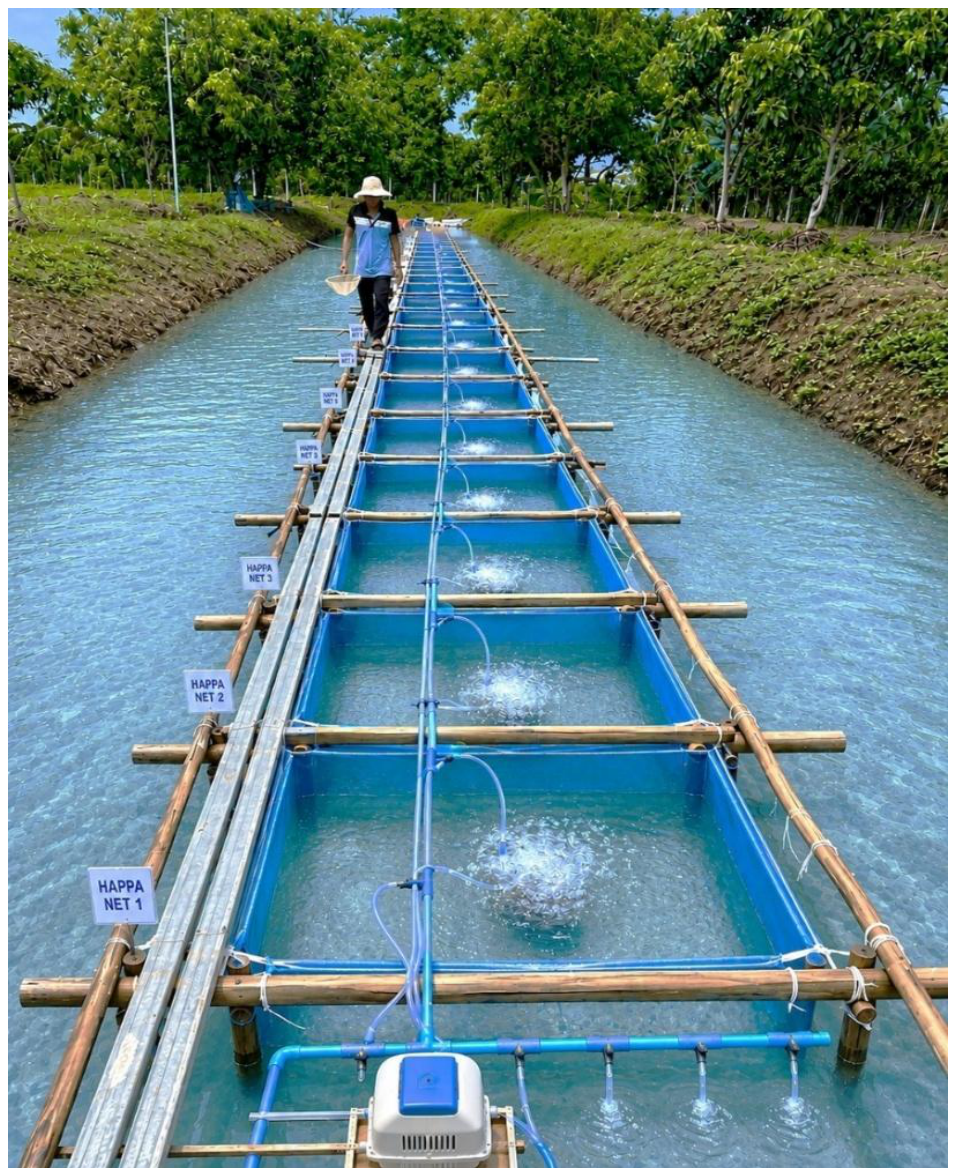

Table 1.
The key questions and findings from a field survey on Pangasius catfish hatchery farmers and transport protocols in An Giang and Dong Thap provinces in the Mekong Delta, Vietnam.
Table 1.
The key questions and findings from a field survey on Pangasius catfish hatchery farmers and transport protocols in An Giang and Dong Thap provinces in the Mekong Delta, Vietnam.
| Key questions | Famer’s response |
|---|---|
| Experience (years) | 15±3 (7 – 23) years |
| Area of broodstock ponds (ha) | 0.35±0.1 (0.3 – 0.5) ha |
| Number of broodstock ponds | 3.2 (3 – 4) ponds |
| Number of broodstock groups | 2.2 ±0.5 (2 – 3) groups |
| Presence of replacement broodstock | Yes |
| Frequency of broodstock replacement (years) | 5.6 ±0.7 (5 – 7) |
| Total number of broodstock (fish) | 45,000 ±551 (3,000 – 6,000) |
| Male broodstock (fish) | 1,450 ± 778 (900 – 2,000) |
| Female broodstock (fish) | 3,150 ± 1,414 2,000 – 4,000 |
| Average age of spawning broodstock (years) | 3 – 7 |
| Feed for broodstock (%CP) | 28 – 35% |
| Feeding frequency of broodstock (times/day) | 2 – 3 |
| Peak spawning season | March to September |
| Number of spawning cycles per year | 2 main cycles + 1 off-season |
| Average fry yield per spawning cycle | 10 – 100 million fry/cycle |
| Average fry yield per production season | 20 million larvae and fry (range: 10 – 30 million) |
| Annual fry production per hatchery | 1 – 2 billion larvae and fry per year |
| Average fry quantity purchased per order | 15 – 20 million fry/order |
| Fry age at time of sale (hours) | Approx. 24 hours; 16–18h in normal weather, 20–24h in cold conditions |
| Fry age preferred by buyers | Within 1 day (16–24h); high mortality after 24h |
| Fry age with highest survival rate | 1 day old (24 hours) |
| Optimal transportation time to nursery ponds | 1–5 hours (ideally under 3 hours) |
| Common fry transport container | Oxygenated plastic bags |
| Max. transport time with oxygenated bags | 1–3 hours for best survival rate |
| Long-distance transport method | - Oxygen replacement during transit; high-density requires full oxygen |
| Main transport vehicles used in the Mekong Delta | Motorbike or small truck |
| Motorbike transport - advantages & disadvantages | -Advantages: Fast, flexible; Disadvantages: Small capacity |
| Truck transport - advantages & disadvantages | -Advantages: Large volume; Disadvantages: Costly, less flexible |
| Boat transport: advantages & disadvantages | -Advantages: Large capacity; Disadvantages: Slow, high fry loss |
| Stocking density during transport | 50,000 – 80,000 larvae and fry per bag (5 litters of water) |
| Use of additives during transport water | No or Anti-shock products |
| Practices for long-distance transport | Water & oxygen renewal |
| Fry survival rate after transport (1–2 weeks) | Approx. 5–10%; 5–30% depending on conditions |
| Common issues during fry transport | Oxygen depletion, thermal shock, aggression |
| Fry release method into nursery ponds | Mostly direct stocking; no aeration or holding |
| Satisfaction with current transport methods | Very satisfied |
| Suggestions for improvement | -Optimize timing, oxygen bag packing; ideal density ~60,000 fry/2.5L water |
Table 2.
The survival rates (%) of fish larvae experiment at different ages during transportation from the hatchery to the nursery pond under varying transport durations.
Table 2.
The survival rates (%) of fish larvae experiment at different ages during transportation from the hatchery to the nursery pond under varying transport durations.
| Treatment | 24h after hatching (%) | 48 h after hatching (%) | 96h after hatching (%) |
|---|---|---|---|
| Transport 1 (3 hours) | 99.3±0.6a (99–100) |
96.7±1.5a (95–98) |
62.0±10.4b (50–58) |
| Transport 2 (5 hours) (*) | 96.3±1.5a (95–98) |
92.3±1.5a (91–94) |
45.0±5.0c (40–50) |
| Transport 3 (7 hours) (*) | 70.0±1.0b (69–70) |
86.3±1.5ab (85–88) |
35.7±7.4c (30–44) |
| Transport 4 (10 hours) (*) | 39.0±3.6c (35–42) |
61.7±12.6b (50–75) |
15.3±6.1d (10–22) |
Note: Means with different superscript letters within column are significantly different (P < 0.05). (*): Indicates the treatments in which oxygen was replenished at 3 hours intervals during transport.
Table 3.
The survival rate of fish larvae/fry of each transportation treatment after 10-day of rearing.
Table 3.
The survival rate of fish larvae/fry of each transportation treatment after 10-day of rearing.
| Treatment | 24h after hatching (%) | 48 h after hatching (%) | 96h after hatching (%) | |
|---|---|---|---|---|
| Transport 1 (3 hours) | 21.7±1.5a (20.1–23.2) |
13.1±2.4a (10.4–14.9) |
0.4±0.3a (0.2–0.8) |
|
| Transport 2 (5 hours) (*) | 23.9±2.0a (21.7–25.6) |
12.4±1.3a (11.5–13.9) |
0.5±0.4a (0.0–0.9) |
|
| Transport 3 (7 hours) (*) | 17.7±2.6b (15.6–20.7) |
9.1±3.5b (5.6–12.5) |
- | |
| Transport 4 (10 hours) (*) | 11.5±0.4b (11.3–11.9) |
4.9±4.2c (0.1–7.7) |
- | |
Note: Means with different superscript letters within column are significantly different (P < 0.05). (*): Indicates the treatments in which oxygen was replenished at 3 hours intervals during transport.
Table 4.
Fish yield and fish density of each transportation treatment after 10-day of rearing.
| Treatment | 24h after hatching | 48h after hatching | 96h after hatching | |||
|---|---|---|---|---|---|---|
| Fry number (1000ml) | Fry number (1g) | Fry number (100ml) | Fry number (1g) | Fry number (100ml) | Fry number (1g) | |
| Transport 1 (3 hours) | 252 | 5.00 | 162.0 | 4.86 | - | - |
| Transport 2 (5 hours) (*) | 172 | 4.11 | 84.0 | 5.61 | - | - |
| Transport 3 (7 hours) (*) | 263 | 5.61 | 177.0 | 27.90 | - | - |
| Transport 4 (10 hours) (*) | 163 | 8.30 | 146.0 | 7.39 | - | - |
| Average | 212.5 ± 52.3 (163 – 263) |
5.8 ± 1.8 (4.1 – 8.3) |
142.3 ± 40.8 (84 – 177) |
6.4 ± 1.4 (4.9 – 7.9) |
- | - |
Note: (*): Indicates the treatments in which oxygen was replenished at 3 hours intervals during transport.
Table 5.
The survival rates and growth performance of Pangasius fingerling after transport durations reared about 25-day following 10 days of rearing.
Table 5.
The survival rates and growth performance of Pangasius fingerling after transport durations reared about 25-day following 10 days of rearing.
| Treatment | Survival rate (%) | Growth performance indices | ||||
|---|---|---|---|---|---|---|
| Body weight (g) | Body length mm | Body weight (g) | Body length mm | |||
| 24h after hatching | 48h after hatching | 24h after hatching | 48h after hatching | 24h after hatching | 48h after hatching | |
| Transport 1 (3 hours) | 49.7±4.7 (45.6-54.9) |
45.83±4.8 (41.8-51.2) |
1.59±0.085a (0.18-5.07) |
1.37±0.104a (0.21-4.26) |
54.8±0.961ab (25.0-80.0) |
54.3±1.177ab (34.0-77.0) |
| Transport 2 (5 hours) (*) | 55.3±7.8 (48.1-63.5) |
46.5±0.7 (45.8-47.1) |
1.35±0.085a (0.28-3.58) |
1.44±0.085a (0.23-4.10) |
52.8±0.961b (78.0-33.0) |
54.3±0.961ab (36.0-75.0) |
| Transport 3 (7 hours) (*) | 48.5±6.4 (44.0-55.8) |
22.8±4.5 (18.3-27.2) |
1.63±0.086a (0.44-5.40) |
1.52±0.085a (0.34-4.63) |
57.0±0.966a (34.0-85.4) |
54.3±0.961ab (34.0-76.0) |
| Transport 4 (10 hours) (*) | 45.9±5.0 (41.5-51.3) |
11.8±10.4 (0.2-20.1) |
1.66±0.085a (0.55-8.96) |
1.58±0.105a (0.19-4.21) |
56.2±0.960ab (39.0-95.0) |
54.9±1.177ab (31.0-78.0) |
Note: Means with different superscript letters within column are significantly different (P < 0.05). There were no survival fish in the treatment of 96h after hatching. (*): Indicates the treatments in which oxygen was replenished at 3 hours intervals during transport.
Table 6.
Temporal variation in pond-water quality during experiments of post-transport nursery rearing of striped catfish fry.
Table 6.
Temporal variation in pond-water quality during experiments of post-transport nursery rearing of striped catfish fry.
| Parameters | Time of water quality sampling (times) | Average | SD | Min | Max | ||||||
|---|---|---|---|---|---|---|---|---|---|---|---|
| 1 | 2 | 3 | 4 | 5 | 6 | 7 | |||||
| ToC | 31 | 32 | 32 | 30.5 | 31 | 31.5 | 32 | 31.43 | 0.61 | 30.50 | 32.00 |
| pH | 7.00 | 7.40 | 7.00 | 7.00 | 7.50 | 7.00 | 6.00 | 6.99 | 0.48 | 6.00 | 7.50 |
| DO(mg/L) | 3.75 | 4.00 | 4.20 | 4.60 | 6.50 | 7.50 | 5.00 | 5.08 | 1.40 | 3.75 | 7.50 |
| NO2(mg/L) | 0.30 | 0.30 | 0.40 | 1.70 | 3.20 | 2.00 | 0.70 | 1.23 | 1.11 | 0.30 | 3.20 |
| NO3(mg/L) | 2.60 | 2.00 | 0.30 | 5.00 | 2.40 | 0.04 | 0.80 | 1.88 | 1.71 | 0.04 | 5.00 |
| H2S(mg/L) | 0.02 | 0.02 | 0.03 | 0.01 | 0.09 | 0.09 | 0.15 | 0.06 | 0.05 | 0.01 | 0.15 |
| NH4/NH3 | 0.02 | 0.01 | 0.02 | 1.00 | 2.00 | 0.50 | 0.04 | 0.51 | 0.76 | 0.01 | 2.00 |
Disclaimer/Publisher’s Note: The statements, opinions and data contained in all publications are solely those of the individual author(s) and contributor(s) and not of MDPI and/or the editor(s). MDPI and/or the editor(s) disclaim responsibility for any injury to people or property resulting from any ideas, methods, instructions or products referred to in the content. |
© 2026 by the authors. Licensee MDPI, Basel, Switzerland. This article is an open access article distributed under the terms and conditions of the Creative Commons Attribution (CC BY) license (http://creativecommons.org/licenses/by/4.0/).
Copyright: This open access article is published under a Creative Commons CC BY 4.0 license, which permit the free download, distribution, and reuse, provided that the author and preprint are cited in any reuse.