
Submitted:
10 November 2026
Posted:
11 November 2026
You are already at the latest version
Abstract
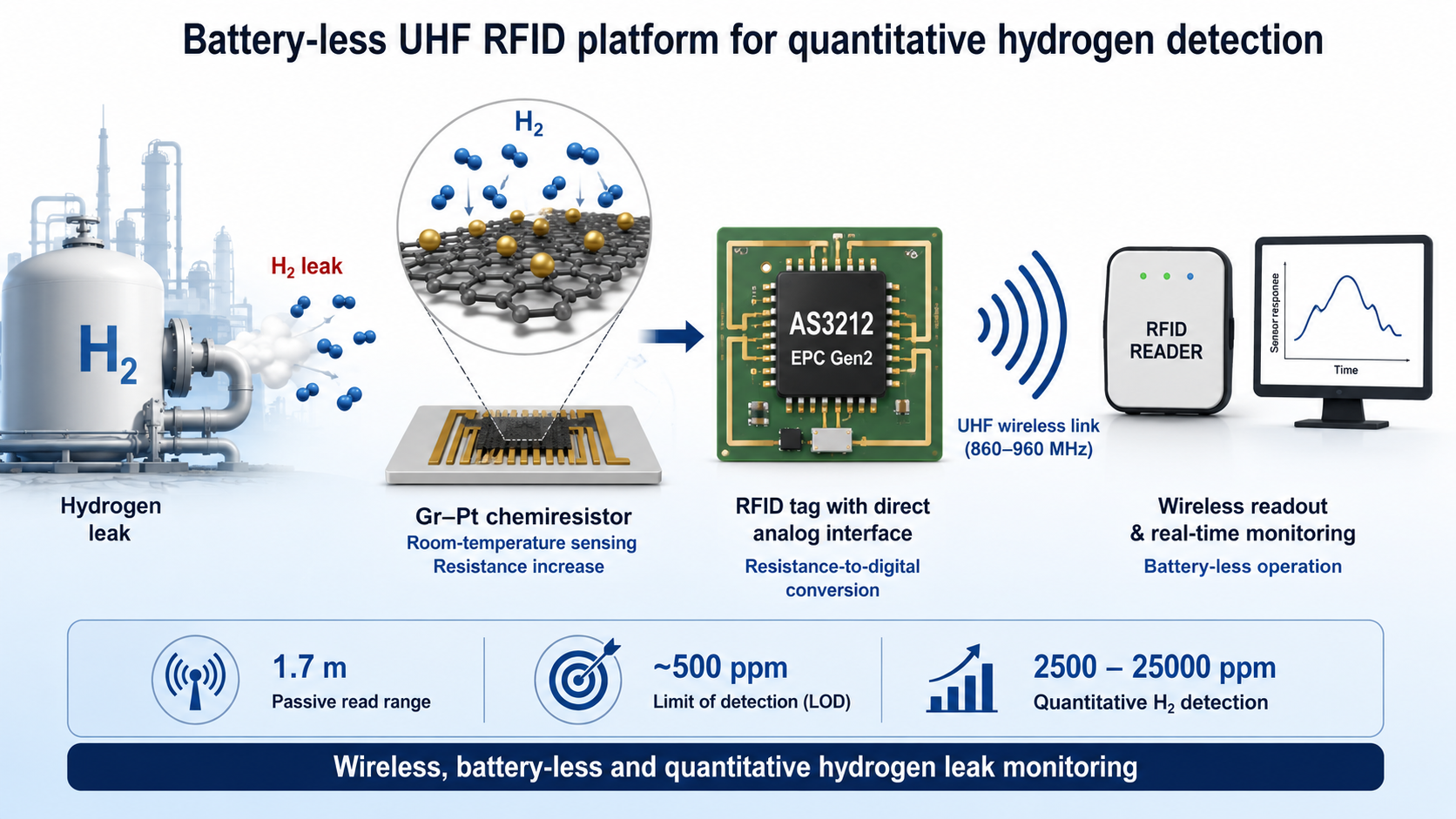
The increasing adoption of hydrogen as a green energy carrier has raised the need for reliable, battery-less sensing solutions for leak detection in storage, distribution, and industrial applications. In this context, radio-frequency identification (RFID) technology offers a promising approach to wireless sensing, enabling battery-free operation and seamless integration with standard RFID infrastructure. This work presents a versatile sensing platform based on passive ultra-high-frequency (UHF) RFID technology, designed for continuous wireless monitoring in safety-critical environments. The platform is specifically conceived to interface with a wide range of DC-operated chemiresistive sensing elements, independently of their sensing materials and functionalization, providing a flexible and scalable solution for wireless chemical sensing. The platform relies on a commercial RFID chip (Asygn AS3212), fully compliant with EPC Gen2 and RAIN RFID standards, whose analog interface enables direct integration of the chemiresistive sensing element. The chip features an integrated switched-capacitor amplifier and a 10-bit analog-to-digital converter, enabling the acquisition and digitization of the sensor response. The system achieves a maximum passive read distance of 1.7 m. As a proof-of-concept demonstration of the platform’s versatility, a chemiresistive sensor based on graphene flakes functionalized with platinum nanoparticles (Gr-Pt) is employed for hydrogen detection. The resulting system enables quantitative hydrogen sensing upon exposure to 25,000 ppm, with a limit of detection (LOD) of approximately 500 ppm. The proposed platform operates in fully passive mode by harvesting energy from the reader’s RF field, eliminating the need for an onboard battery, while also supporting battery-assisted operation to extend the read range.
Keywords:
passive UHF RFID
; wireless sensing
; energy harvesting
; hydrogen sensing
Copyright: This open access article is published under a Creative Commons CC BY 4.0 license, which permit the free download, distribution, and reuse, provided that the author and preprint are cited in any reuse.