
Submitted:
10 November 2026
Posted:
11 November 2026
You are already at the latest version
Abstract
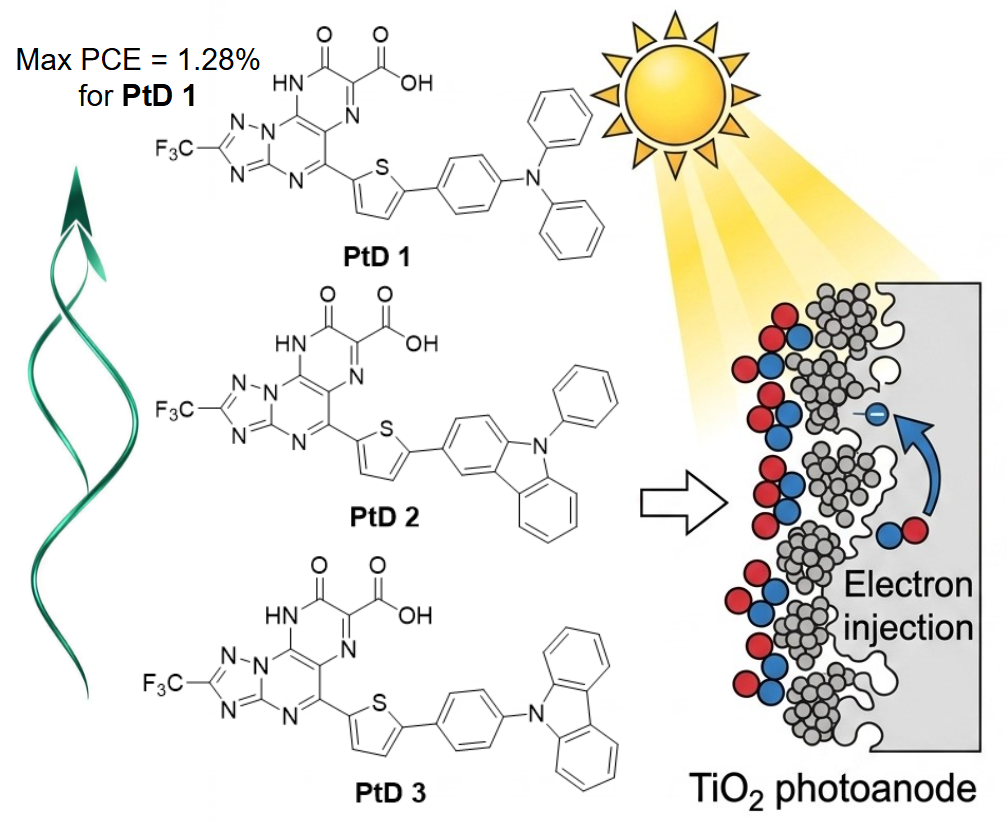
Three novel D–π–A dyes (PtD 1–3) based on a [1,2,4]triazolo[1,5-a]pteridine (TPt) acceptor–anchoring unit and a thiophene π-bridge were synthesized through a modular approach involving nucleophilic aromatic substitution of hydrogen and Suzuki–Miyaura cross-coupling. The electron-donating fragments were varied to investigate their influence on the electronic structure and photophysical properties of the resulting compounds. Their optical and electrochemical properties were examined using experimental and computational methods, including DFT, TD-DFT, and quantitative hole–electron analysis. All three dyes exhibited absorption bands with intramolecular charge-transfer character and energy-level alignment compatible with electron injection into TiO2, consistent with the estimated electron injection efficiencies of 77.7–91.5%. The synthesized dyes were further subjected to a preliminary evaluation as sensitizers in dye-sensitized solar cells (DSSCs). Among the investigated compounds, PtD 1 showed the highest power conversion efficiency of 1.28%. Differences in photovoltaic performance were associated with variations in light harvesting, dye regeneration, and other device-relevant parameters rather than dye loading alone. These findings demonstrate the feasibility of using the TPt framework as an acceptor–anchoring platform and provide a basis for further development of organic dyes for DSSC applications.
Keywords:
[1
; 2
; 4]triazolo[1
; 5-a]pteridine
; organic dyes
; dye-sensitized solar cells
; D–π–A dyes
; acceptor–anchoring unit
; intramolecular charge transfer
; Suzuki–Miyaura coupling
; photovoltaic properties
Copyright: This open access article is published under a Creative Commons CC BY 4.0 license, which permit the free download, distribution, and reuse, provided that the author and preprint are cited in any reuse.