
Submitted:
09 November 2026
Posted:
11 November 2026
You are already at the latest version
Abstract
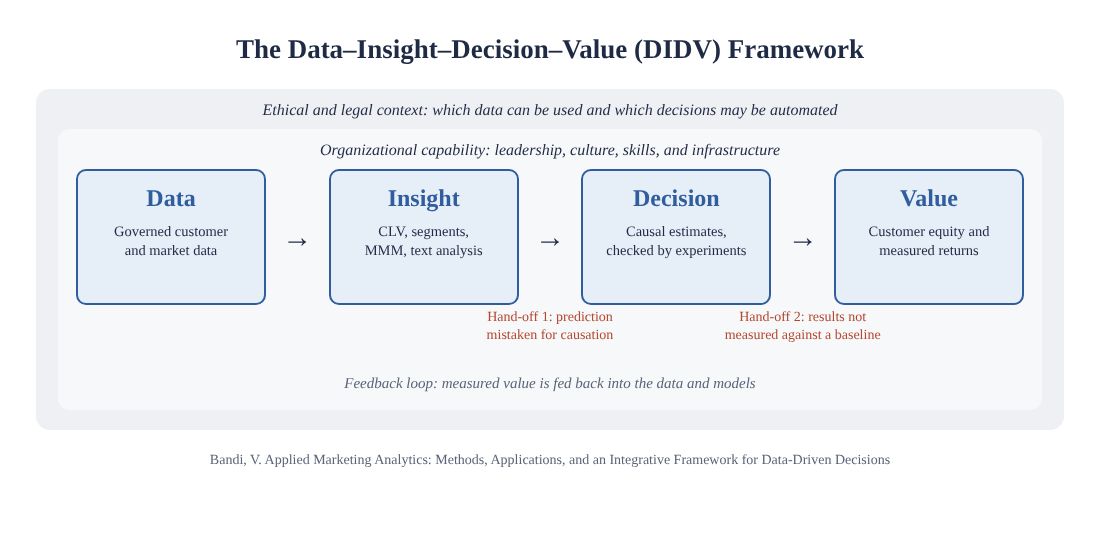
Few corporate functions collect as much data as marketing, and few struggle as visibly to turn it into better decisions. This review takes stock of applied marketing analytics, which I treat as the use of customer and market data, supported by models and technology, to improve specific marketing choices. I organize the literature around six decisions that firms routinely face: which customers to invest in, how to split a media budget, how to credit touchpoints, how to know whether an action worked, what customers are saying, and what to offer each one. Two findings run through the evidence. Firms that use analytics more heavily tend to perform better, but only when senior leaders back it and the organization has the skills and data to act on it. And good prediction is not the same as good decision making: the customers most likely to leave are often not the ones a retention offer will save. I close with the Data–Insight–Decision–Value (DIDV) framework, which traces how data become insight, decisions, and measurable value, and which locates the most common failures at the hand-offs between those stages. An agenda for research on causal machine learning, privacy-preserving measurement, and generative AI follows.
Keywords:
marketing analytics
; customer lifetime value
; marketing-mix modeling
; causal inference
; artificial intelligence
; data privacy
Copyright: This open access article is published under a Creative Commons CC BY 4.0 license, which permit the free download, distribution, and reuse, provided that the author and preprint are cited in any reuse.