

Submitted:
11 November 2026
Posted:
12 November 2026
You are already at the latest version
Abstract
Every single-centred black hole index of the \( \mathbb Z_2 \) CHL model is positive. The proof rests on an exact Rademacher expansion at level two.
Keywords:
CHL models
; single-centred black holes
; mock Jacobi forms
MSC: 11F50 (primary); 11F37; 11F30; 81T30; 83E30
1. Introduction
A quarter-BPS dyon of string theory in four dimensions carries an electric charge Q and a magnetic charge P, and the protected index that counts such states is the helicity trace . When the charges admit a single-centred black hole whose only hair are the zero modes of the broken supersymmetries, the twelve fermion zero modes fix the sign of the trace, and the horizon degrees of freedom contribute . Sen turned this observation into a conjecture about Fourier coefficients of Siegel modular forms [29]: the index of the single-centred black hole, extracted from the inverse of the dyon partition function with the contour of the attractor region, is positive.1
For type II string theory on , where the partition function is the Igusa cusp form [16,19,30], the conjecture is settled. Bringmann and Murthy proved it for the two lowest magnetic charges by writing the finite parts of the first two Fourier–Jacobi coefficients of through class numbers [5]. Rosselló then treated all charges, by writing the single-centred index as a mixed Rademacher series and showing that one of its terms dominates the others; the existence of such series on is due to Bringmann and Manschot [6], and Ferrari and Reys used them for these black holes [18]. The CHL models [9] are the orbifolds of type IIB on in which the acts on by a symplectic automorphism and on by a shift; their partition functions are Siegel modular forms of weight k for subgroups of [13,14,15,23].2 Bhand, Sen and Singh showed that the Fourier–Jacobi coefficients of are meromorphic Jacobi forms, split them into an Appell–Lerch polar part and a mock Jacobi finite part, and identified the single-centred index with the Fourier coefficients of the finite part on an explicit set of charges [8] [Theorem 5.4]. Cardoso, Nampuri and Rosselló computed the polar coefficients of these finite parts through continued fractions and wrote the immortal index as a Rademacher series, taking the existence of such an expansion at level N as an assumption [10].
This paper settles the CHL model. It has , duality group , and charges normalised so that , and are integers; the discriminant is .
Theorem 1.
In the CHL model the single-centred index is positive for every charge with .
The proof has two halves. The first is an exact formula for the coefficients of the finite parts.
Theorem 2.
For every the coefficients of the finite part of the m-th Fourier–Jacobi coefficient of with are given by an absolutely convergent vector-valued Rademacher series over the three cosets of in , with Bessel terms from the principal parts and correction terms and from the shadow. Its principal parts at the cusps 0 and ∞ are explicit sums over Farey walls.
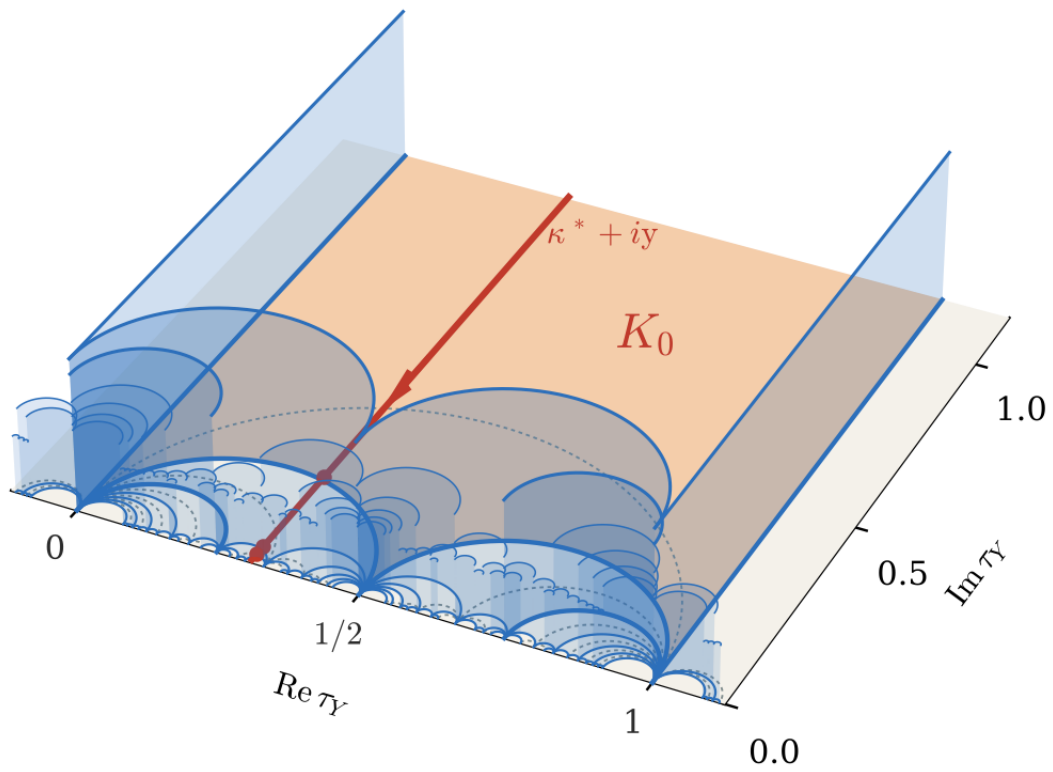
The precise statement is Theorem 5. The wall sums at the cusp 0 have the shape of the continued-fraction formula of Cardoso, Nampuri and Rosselló; we prove them, and their counterpart at the cusp ∞, by following the Fourier coefficients of across the walls of its poles, which are the Farey geodesics with an even denominator (Figure 2), and of a second product at the cusp 0 across all Farey geodesics. The expansion itself comes from the circle method of Rademacher and Zuckerman [25,34], applied to the theta coefficients of the finite parts once the Appell–Lerch sum has been completed in the manner of Zwegers [35]; the completion is proved directly, by a Mordell integral, and the transformation law in all three frames follows from the product formula alone, without any statement about Siegel modular forms.
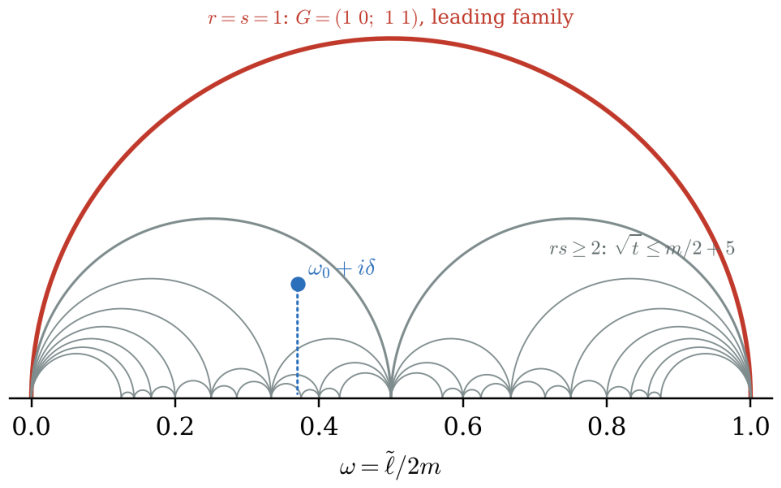
The second half is the sign. Write and , and let be the contribution of the most polar term at the cusp 0, an explicit multiple of a Bessel function . Every charge has, in its duality orbit or after the Fricke exchange of and , a representative with and (Proposition 2); then . The terms of the Rademacher series attached to the leading family of Farey walls, those with the matrix , add up, after division by , to an approximation of
the squared modulus of the generating function of the degeneracies of the electric half-BPS states of the model (Theorem 11). The function stays above on the disc , its minimum being attained at (Proposition 11, Figure 3). Everything else, namely the error of the approximation, the remaining walls, the other two cosets, the terms with and the shadow corrections, is bounded by for by a certificate in interval arithmetic and by for by explicit inequalities (Theorems 12 and 13). The remaining charges have , and for them the index is computed exactly from the product formula (Theorem 4).3
On the first row the theorem also has a short proof by closed formulas. Following Bringmann and Murthy, an identity between Jacobi forms puts into closed form through Hurwitz class numbers and the theta series of , and the sign of every coefficient can be read off (Theorem 3).
The proof draws throughout on the work of Sen on the positivity conjecture and the attractor mechanism, of Bhand, Sen and Singh on the mock modularity of the CHL partition functions, of Cardoso, Nampuri and Rosselló on the decay walls, of Bringmann and Manschot and of Ferrari and Reys on mixed Rademacher series, on the circle method of Rademacher and Zuckerman, on the completions of Zwegers and on the theory of Jacobi forms of Eichler and Zagier [17].
Section 2 recalls the partition function and the decomposition of Bhand, Sen and Singh, and Section 3 treats the first row. Section 4 proves the reduction and the bounded-discriminant theorem, and Section 5 describes the Farey walls. Section 6 states the Rademacher expansion, and Section 7 to Section 10 prove it: the polar data at the two cusps, the transformation law and the circle method. Section 11 proves the eta-quotient picture, Section 12 collects the facts on Bessel functions, Section 13 bounds every remaining term, and Section 14 proves Theorem 1. Section 15 compares the values with the product formula and with Sen’s table, and Section 16 describes the extension to the other CHL models. The appendices describe the exact computation and the interval certificates and list the margins.
2. The Partition Function and the Single-Centred Index
2.1. Notation
Write . The variables of the Siegel upper half-space are ; put , and . For a function of alone we use the expansion in x. The Jacobi theta functions are
with , , and . Let , , , and let
be the Eisenstein series of weight two for . The weak Jacobi forms of weight and 0 and index one are
[17] [§9]; we write and . The Hurwitz class number is extended by and unless D is a nonnegative integer with . Put and
so that every is a positive integer.
2.2. The Product Formula
The twisted elliptic genera of for the symplectic involution are [13]
each a weak Jacobi form of weight 0 and index one for , and permutes them.4 Write . The dyon partition function of the model is [13,14,23]
and the index of the charges is times the coefficient of with
in the expansion of on the appropriate contour [16,23,27].5
Expand . The factors with in (3) have the exponents , equal to for and to 0 for ; together with the prefactor they give
since . Taking the logarithm of the factors with and collecting the powers of ,
The sum over u keeps exactly the integral powers of x, so each is a series in x whose coefficients are Laurent polynomials in y; in particular is entire in v. Hence
Lemma 1.
The functions , , are invariant under , , respectively, acting on σ, and has the elliptic property of index l in v. Every polynomial in that is homogeneous of total index I is a Jacobi form of weight 0 and index I for , even in v and weak at every cusp.
Proof.
Let and . Then
For and , for and , and for and , this matrix lies in , under which every is invariant. This gives the invariance, and is contained in all three groups. Under the variable of the term moves by with , and the elliptic property of index one of produces the factor , which is the elliptic property of index l. Evenness in v is inherited from the genera. For one has with and upper triangular of the same determinant, and permutes the , none of which contains a negative power of q; so every term is weak at every cusp. □
2.3. Polar Part, Finite Part and the Single-Centred Index
By [8] [Theorem 5.2], is a meromorphic Jacobi form of weight and index m for with double poles at . Its polar part is [8] [(5.45)]
where is the coefficient of in , so that . The finite part is a mock Jacobi form.
Let be the set of charges of [8] [(5.46)–(5.47)]: with and the notation (4), the charges with and
such that
By [8] [Theorem 5.4(a)], for every charge in ,
The single-centred index is invariant under the action [8] [(5.17)–(5.19)] of on the charges.
Lemma 2.
Every charge with , and lies in .
Proof.
If , the condition reads , and the bracket is . If , then and , so the bracket is at least . □
2.4. A Positivity Lemma
The last step of Section 3 divides a series of known sign pattern by g.
Lemma 3.
Let with for every n, and let for every . Then has positive coefficients at every with .
Proof.
Let and . We show by induction on s that for and for ; since and the full product agree through , this proves the lemma. The case is the hypothesis. Write and . If , then , all terms being positive. If , then
since every exceeds K and . The right side is for , and at least for . □
We also use the elementary bound for : a reduced form of discriminant has and is determined by , so .
3. The First Row:
Let be the generating function of the Hurwitz class numbers, , the number of representations of D as a sum of three squares,
Then is the theta series of the lattice , with the Jacobi variable on one coordinate vector, at .6 Write , so that and .
Proposition 1.
In the CHL model
Consequently depends only on , and
Proof.
Step 1. We claim that
Every term is a Jacobi form of weight 0 and index two for , even and holomorphic in v and weak at every cusp (Lemma 1; and are modular for ). Let G be the difference of the two sides and . If , the lowest order in v of the transformation law shows that is a modular form of weight for [17] [§3], holomorphic at the cusps because G is weak. Since and the width of the cusp ∞ is four, Sturm’s theorem [31] shows that such a form vanishes once its coefficients of do. The coefficients of G, computed from (6) and (2), vanish through , so . For each the entire function then vanishes to order at least six at , while a nonzero function with the elliptic property of index two has exactly four zeros in a period parallelogram [17] [Theorem 1.2]. Hence .
Step 2. Bringmann and Murthy [5] [Section 3] proved
and the identity
holds because both sides are holomorphic Jacobi forms of weight two and index one for [17] [§7]: the argument of Step 1, with , width two, Sturm bound and two zeros in a period parallelogram, reduces it to the coefficients through , which agree.
Lemma 4.
(i) for , for with , and otherwise.
(ii) for , , for odd , and for .
Proof.
(i) With one has [5] [(4.1)]. So and , and both right sides have positive coefficients at every exponent .
(ii) For every argument is at most , and . At , . For every is by (i), the term is , and ; this gives . For odd D every is , and the term is , so the sum in is at least . Further , from , and . Hence for odd , while . □
Theorem 3.
In the CHL model, for every charge with , and , and for every charge in the orbit of such a charge.
4. Reduction to a Fundamental Set of Charges
From now on m is arbitrary. This section shows that the sign of has to be checked only on charges with and , and proves Theorem 4.
4.1. The Fricke Symmetry of the Product Formula
The duality group acts on the charges by with , that is, c even and odd [8] [(5.17)–(5.19)]. It does not exchange with . The product formula has, however, an extra symmetry that does.
Lemma 5.
Let be the exponent of the factor in (3), where and . Then for all and j. Consequently
as formal products.
Proof.
If A and B have the same parity, the two sides are the same expression. Let A be even and B odd; then and , and
both read off at an integral power of q. By (2),
Since and ,
so identically, and the exponents agree. The prefactor and the range , if , of the product are symmetric under , which gives (17). □
Remark 1.
The substitution is the action on the Siegel upper half-space of the Fricke involution of ; Persson and Volpato showed that the CHL models with a geometric symmetry are self-dual under the corresponding Fricke S-duality [24], and (17) is its shadow on the partition function. We use only the elementary statement of Lemma 5.
4.2. A Chamber Shared by Both Orientations
For a charge and a point of imaginary parts, let
the integral running over a period cell of the real parts. Sen showed [27] [§4] that this number is locally constant in the imaginary parts and jumps only across the walls of marginal stability, which for the CHL model are the hyperplanes
coming from the double zeros of with vanishing coefficient of .
Lemma 6.
Let .
- (i)
- meets no wall (18), so does not depend on the point of .
- (ii)
- .
- (iii)
- If and , then .
Proof.
(i) For one of vanishes and the wall is with , or with , or ; none meets . For the product is negative, so , while on
(ii) The substitution of Lemma 5 maps to itself and exchanges the roles of m and n.
(iii) Let inside with and fixed. The integral over picks out , and is the coefficient of of expanded in the strip , where . Write with (8). The finite part is holomorphic in v, so its expansion does not depend on the strip. In the polar part, expand in the strip: the term is , the terms contain only powers with , and the terms , rewritten through , only powers with . None of these exponents lies in , and the factor does not change the power of y. Hence the polar part contributes nothing at with . □
4.3. Least Representatives
Lemma 7.
Let be a charge with , , and . Then it lies in the set of (10).
Proof.
For the bracket in (10) is . Let , so , and let d be the distance from to the nearest odd multiple of m; the bracket is at least . If , then and
If , then and . □
Definition 1.
A charge is reduced if , and . For a reduced charge put and . Since , every reduced charge has .
Proposition 2.
For every charge with there is a reduced charge with the same discriminant and such that
Proof.
In the orbit of choose a charge with least ; since the form is positive definite, so the least value exists. The matrices with c even fix Q and send ℓ to ; so we may assume . The matrices send m to , and minimality gives . By Lemma 7 the charge lies in , so by (11). The finite part is a mock Jacobi form, even in v, so . If , the charge is reduced. If , then and Lemma 6 gives , and is reduced. The shifts change ℓ by even multiples of m and the sign change does not alter the parity, so . □
From now on we write for a reduced charge, and the conjecture is the statement on reduced charges.
4.4. Bounded Discriminant
Theorem 4.
For every charge of the CHL model with one has .
Proof.
A reduced charge with has and , so there are finitely many. For each orbit with the program of Appendix A finds a charge of least satisfying (10) with , and computes exactly from the product formula, in the cheaper of the two orientations allowed by Lemma 6. For there are 22972 orbits; in every one of them . By Lemma 6(iii) and (11) these numbers are the single-centred indices.7 □
5. Farey Walls
The polar coefficients that enter the Rademacher series are sums over matrices of attached to Farey intervals, the continued-fraction walls of [10,12]. This section collects the elementary facts about them that the estimates need.
5.1. The Walls of a Polar Term
Fix , and with and
Let be the set of with and ; for each such G put
These are the coefficients of the quadratic form transformed by G: , , and is the cross term up to sign.
Lemma 8.
Let and , , so that , and .
- (i)
- .
- (ii)
- , , , and .
- (iii)
- .
- (iv)
- If , put , , and . Thenso ; moreover when .
- (v)
- If , then , and .
- (vi)
- If and , then , that is .
- (vii)
- If , then , , , , and . Conversely every pair of integers with , , and arises from exactly one polar term with in this way.
Proof. (i) has the same discriminant as . (ii) with , and because ; similarly for . For write , which is (19) after expanding and using . The last identity follows from . (iii) Insert (ii) in the definition and use ; then . (iv) By (i), with ; expand and use . For , and . (v) , and in the same way. Since , . From , , and from , . One of is at most ; if it is U, the first inequality gives , so , and the second with gives , so . The other case is symmetric. (vi) If there is nothing to prove. Otherwise, from , , and from , . Adding, when . (vii) and with force , . The formulas follow from (19). Given , put and ; then . □
Remark 2.
Figure 1.
The Farey walls of a polar term at the cusp 0, drawn as geodesics from to in the upper half-plane of . A matrix contributes to the polar coefficient at when its geodesic passes over the point with and (Lemma 8). The outer red geodesic is the leading family ; every other wall lies below height .
Figure 1.
The Farey walls of a polar term at the cusp 0, drawn as geodesics from to in the upper half-plane of . A matrix contributes to the polar coefficient at when its geodesic passes over the point with and (Lemma 8). The outer red geodesic is the leading family ; every other wall lies below height .
5.2. Polar Coefficients
Let , , be the coefficients of
so that in the notation of (8), and put unless is an integer. For a polar term define
and . The sums are finite by Lemma 8(v). Formula (22) is the continued-fraction formula of [10] [(2.43)] for with the coefficients of replaced by and with no congruence condition on G, and () is its parity-restricted form [10] [(4.21)].8
6. The Level-Two Rademacher Expansion
This section states the exact formula for the coefficients of the finite part on which the proof of Theorem 1 rests: a vector-valued Rademacher series over the three cosets of , whose principal parts at the two cusps are the wall sums of Section 5 and whose correction terms come from the shadow. The next four sections prove it.
6.1. Conventions, Frames and Weil Sums
For and we put with the principal logarithm, . All powers below are of numbers in , in the lower half-plane, or in the right half-plane, so they are always defined, and .
Let be the group of matrices of with even upper right entry. It has index three, and
represent its right cosets. For the frame of M is the with . The frames I and T, which differ by a half period, belong to the cusp ∞, and the frame S to the cusp 0.9
Fix . For let be the set of pairs with and . For such a pair let be the inverse of modulo ( if ), , and
all in , with the automorphy factor of , and let be the frame of . For put
This is the matrix coefficient of the Weil representation attached to the lattice , evaluated at [10] [(2.41)]; it depends on only modulo (Lemma 34).
For let be the unary theta series of weight and index m, so that for the theta functions of [17] [§5]. Its coefficients are real, so
With , and , for ,
The first identity is immediate; for the second, the numerator collapses to .
Lemma 9.
, and for every .
Proof.
For the sum has one term. In general, , so up to a factor of modulus one the sum is for an integer b. A quadratic Gauss sum modulo with leading coefficient , , has modulus at most [2] [Chapter 1]. Dividing by gives the claim. □
6.2. Polar Data and Shadows
For the polar terms in each frame are the pairs with and , where in the frame S and in the frames I and T. Their coefficients are the wall sums of Section 5:
By Lemma 8(iv) a wall with has , so only finitely many polar terms have a nonzero coefficient. That these numbers are the principal parts of is the content of two theorems proved below:
- (P∞)
- the principal part of at the cusp ∞ is given by (23) (Theorem 6);
- (P0)
- the principal part of the finite part at the cusp 0, in the frame S, is given by (22) (Theorem 7).
The shadow of the finite part is governed by the coefficient of the polar part (8). In the three frames it enters with the constants and orders
The number is the order of the pole of in the local parameter of the frame: has the term at ∞, and its transform under starts with , by .10 These are the leading coefficients of the functions of Proposition 7 (Remark 8). For and put
the second extended by . Since for real only when and , is continuous on ; it depends on g only modulo .
6.3. The Expansion
For a charge with , and define
where in each line and is attached to as above.
Theorem 5
(Rademacher expansion). For every charge with , and , the three series (29)–(31) converge absolutely, and
This is Theorem 2 of the introduction. The proof occupies Section 7 to Section 10. Section 7 proves (P∞) and Section 8 proves (P0), by following the Fourier coefficients of and of a second product across the Farey walls. Section 9 proves the theta decomposition of the finite parts in the three frames, the completion of the Appell–Lerch sum by a Mordell integral and the resulting transformation law. Section 10 runs the circle method on Farey arcs and ends with the proof of Theorem 5.11
Lemma 10.
The three series (29)–(31) converge absolutely.
Proof.
There are at most pairs in , the polar terms are finitely many, and by Lemma 9. Since is increasing, for . So the -th term of (29) is , that of (30) is . In (31), for one has , so , and for the function takes values in . With the identity for ,
so the -th term of (31) is . Only absolute bounds are used below, except for the terms with in the frame S, which are computed explicitly in Section 11. □
Remark 3.
The proof of Theorem 5 uses no computation; its ingredients were also checked independently. The wall sum (23) agrees with the coefficients of computed exactly from the product formula on all 1498 polar terms with , and (22) agrees with the coefficients of the finite part in the frame S, computed exactly from the second product of Section 8, on all 954 polar terms with . The right side of (32), truncated at in and at in and , agrees with the exact coefficients for , and : the relative difference is below at , at and at , and it decreases with n as the omitted terms with larger γ do. The programs are listed in Appendix B.
Remark 4.
What the proof of Theorem 1 uses from (P0) is the structure of Lemma 8: the leading family of walls and the bound (vi) for the others. From (P∞) it uses only that every wall in it has r or s even, hence , so that Lemma 8(vi) applies.
7. The Polar Coefficients at the Cusp ∞
Theorem 6.
Let , and with . Then
with the wall sum (23). Consequently (P∞) of Section 6 holds: the principal part of at the cusp ∞ in the frame I is given by (23), and in the frame T, which is obtained by , that is , by .
In outline: the product converges on a tube domain and defines a meromorphic function whose poles lie over walls in the space of imaginary parts; the walls are the Farey geodesics with an even denominator; across each wall the Fourier coefficients of jump by a product of two coefficients (a residue computation, transported by ); the polar coefficients of are the coefficients in one chamber ; and following a vertical path from to a chamber in which the coefficient vanishes gives the wall sum. Every statement below is proved here; from Section 2 we take the definitions (2), (3), (8), the identities (5), (6) (rearrangements of the product formula) and Lemma 1, and from Section 4 Lemma 5.
7.1. Notation
Write , with
and let be the open cone of positive definite real symmetric matrices. A charge is a triple ; it stands for the monomial with
so that . In the notation of Lemma 5, the factor of (3) is with the factor charge , its exponent is , and . Let
so that (3) reads .
The coefficient of (3) is the coefficient of in for any with , : this is the usual consequence of the elliptic invariance of index one under , . Since the expansions of the contain no negative powers of q, taking gives
For put
The map is a bijection , and for ,
For the substitution preserves , and
Indeed with , and with , . Since is conjugation by , it maps onto itself. On charges, with , that is
which maps to itself when c is even.
7.2. Convergence
Lemma 11.
There are constants with for all and .
Proof.
For a series with write ; then coefficientwise. By (2) each is a linear combination of (), of and of its products with , , . The coefficients of (, ) in are bounded by the number of representations of an integer as a sum of two squares, hence by a polynomial; those of are . The remaining factors and are eta quotients, , , , so their coefficients in are bounded in absolute value by those of for a fixed . Let be the coefficient of in . For , and give , hence . With and for this gives for . Multiplying the finitely many majorants, the coefficient of in is at most . Finally is the coefficient of with . □
Fix as in Lemma 11, put and
The set is connected (it is under ), and so is .
Lemma 12.
Let with . Then if and B is even, and otherwise. If , then is positive semidefinite and nonzero.
Proof.
Let , so j is odd. The coefficient is the coefficient of in . By (2), with , and , it equals for . Hence if , that is , and if . If then and , so is positive semidefinite; it is zero only for . □
A factor charge with and is called a wall charge, and its wall. By (35) the wall of is the cone over the geodesic
in , whose endpoints are the roots of , a polynomial of discriminant . A Farey edge is a pair of fractions in lowest terms, , , with , viewed as the geodesic of joining them; it is even if is even and odd if are both odd. Two adjacent fractions cannot both have even denominators, so every Farey edge is either even or odd.
Lemma 13.
The map (38) is a bijection from the set of wall charges onto the set of even Farey edges. If the edge of g joins and with , then and
with ; outside the half-disc bounded by the edge. The vertical edges , , are the walls of for and for , with on the side , respectively .
Proof.
Let be a wall charge, so and B is even, and because its square divides the discriminant 1. If , the roots are rational, so by Gauss’s lemma with integers, and comparing coefficients , , and . Since we may take ; then is even. If then and the root is ; the conditions , and if , give each integer exactly once, as stated. Conversely, for an even edge with the charge with the sign making has , and even, so by Lemma 12; it lies in because : the two endpoints lie on the same side of 0, since by Lemma 14(F1) below a Farey edge does not cross the edge . For (39), has real part and imaginary part ; combine with (35). The sign statements follow from (38). □
Lemma 14.
(F3) If with , , then .
- (F1)
- Two distinct Farey edges do not cross: their intersection in is empty.
- (F0)
- For every compact set only finitely many Farey edges meet ; more precisely an edge with meeting has .
Proof. (F3) and , and their sum is , so . (F1) Two geodesics cross only if their endpoints interleave. A vertical edge would have n strictly inside an edge with , so by (F3), which is impossible. For two edges , with all denominators and interleaving endpoints, one endpoint of each lies strictly inside the other; by (F3) its denominator is at least the sum of the denominators of the other edge, and the two inequalities contradict each other. (F0) The edge is a semicircle of radius , and its centre lies within 1 of ; vertical edges meet only for finitely many n. □
Proposition 3.
(i) For every compact and every the set of wall charges with for some is finite, and , taken over the g with , converges uniformly on .
- (ii)
- The product (3) converges absolutely and locally uniformly on , and is holomorphic on .
- (iii)
- The zeros of in are the points with for a wall charge g; there lies on the wall of g, and the zero is a double zero of the factor , all other factors being nonzero. Hence is meromorphic on and holomorphic on the tube over the complement of the walls.
Proof.
(i) Factors with have by (34). For , is positive semidefinite (Lemma 12), and for positive semidefinite S and , and . Hence
By Lemma 11 and on , , and for given there are at most values of j. Since is continuous and positive, these terms are summable uniformly on . For a non-vertical wall charge, , the centre of the edge, so by (39) and , , the inequality implies and with ; on the quantities are bounded and bounded below, so the number of wall charges with is uniformly on (vertical walls contribute ). This gives finiteness and uniform convergence of the sum over wall charges. (ii) By (i), on a neighbourhood of a compact set only finitely many factors have , and the remaining ones satisfy with uniformly convergent; their product converges absolutely and uniformly to a holomorphic function without zeros, and the finitely many others are entire. (iii) The infinite part has no zeros. Among the finitely many remaining factors, those with satisfy , so only wall charges can vanish, exactly when , which forces . Distinct Farey edges are disjoint in (Lemma 14(F1)), so at such a point no other factor vanishes. □
7.3. Chambers and Fourier Coefficients
The walls in are the even Farey edges; by (F0) their union is closed. A chamber is a connected component C of the complement of the walls in , and we put , which is connected. Let be the open ideal quadrilateral with vertices , and the one with vertices .
Lemma 15.
Let C be a chamber.
- (i)
- For each wall charge g the sign of is constant on , and the set of wall charges with on is finite.
- (ii)
- On the tube over ,with , and for every with and .
- (iii)
- Expanding each factor binomially gives with integers , absolutely and locally uniformly convergent on the tube over , and for every
Proof. (i) vanishes only on the wall of g, which does not meet C; the finiteness is Proposition 3(i) at one point. (ii) Use for , and Lemma 12 for . (iii) Each factor is majorised by , and converges locally uniformly by Proposition 3(i). For given T only finitely many products of monomials contribute, because is finite for every (Proposition 3(i) for the walls, and for ); so is a finite sum of integers. has period 1 in and v and period 2 in , and (40) follows from absolute convergence. □
The edge is odd, so is the set of with lying outside the half-discs on and . Every wall charge is positive on . For the vertical walls this is Lemma 13. By (F3) no Farey edge with contains 0 or 1 strictly inside its interval, and only contains ; so the half-disc of a non-vertical wall lies in , in , or in the closed half-disc on or on , and every point of is outside it. Hence , the expansion of Lemma 15 on is the expansion of the product (3) itself, and is a chamber: it is open, connected, contains no wall point, and its boundary consists of wall points.
7.4. Symmetries
Lemma 16.
For :
- (i)
- for , that is ;
- (ii)
- ;
- (iii)
- ;
- (iv)
- for every , and consequently whenever .
Proof.
All substitutions preserve (they act on Y by with ), so both sides are absolutely convergent products on and may be compared factor by factor.
(i) with by (37). This map preserves N, B, and , hence . Among the charges with it maps onto : for , (if then , so ), and the same holds for ; for only occur, is fixed, and . Both exceptional charges have , so the product over acquires the factor , while .
(ii) maps to , which preserves E and maps onto itself except that becomes ; the factors with and have by (34). Since , the two products agree.
(iii) is Lemma 5: the factor sets correspond under with equal exponents, and the products converge absolutely on .
(iv) Let with , so and by (ii) and (iii). Since , (i) and V-invariance give . The matrices E, L and generate : for with , a is odd; replacing A by makes , and then for suitable k the matrix has lower left entry with ; after finitely many steps and . Finally, if and , then by (36), and
so the coefficient of is with , that is . □
7.5. The Chambers
For an even or odd Farey edge with let be the open ideal triangle with vertices , and the mediant , that is, the set of points inside the half-disc of e and outside the half-discs of its two children and ; for let be the open triangle with vertices .
Lemma 17.
(i) The triangles , are pairwise disjoint, and is the union of their closures.
- (ii)
- Each triangle has exactly one odd side.
- (iii)
- The chambers are exactly the ideal quadrilaterals , where is an odd edge and are the two triangles having as a side. In particular and .
- (iv)
- acts transitively on the odd edges; hence every chamber is for some , and every chamber is for some .
Proof.
(i) Let lie on no Farey edge. By (F0) only finitely many edges have in their half-disc, and by (F1) their intervals are nested. If there is none, for some n, and is not in the half-disc of , so . Otherwise let e be the innermost one; is not in the half-disc of a child of e, which would be a smaller such edge, so . Points on edges lie in the closure of adjacent triangles by the same argument applied to nearby points. Moreover no edge meets an open triangle: by (F1) and the argument below, an edge meeting the half-disc of e is e, a child of e, or lies under a child. Hence the open triangles are the components of the complement of all Farey edges. For disjointness, suppose with ; then is in both half-discs, so one interval, say that of , lies strictly inside that of and has an endpoint strictly between and . That endpoint has denominator at least by (F3); if the interval of contained the mediant strictly inside, (F3) applied to would bound the sum of its denominators by , which is impossible. So lies in the closed half-disc of a child of e, and lies inside that child’s half-disc, a contradiction. The cases involving are similar and easier. (ii) The vertices of have denominators , and those of have ; exactly one is even, since no two adjacent fractions both have even denominators. The side joining the two odd ones is odd, the other two are even. (iii) By (i), (F0) and (F1), every edge is a side of exactly two triangles, one on each side: near an interior point of the edge, each side is covered by the closure of a single triangle. By (ii) the sets are pairwise disjoint; each is open and connected and contains no wall point, and their union is the complement of the walls. So they are the components. The triangles and share the odd edge , which gives , and similarly for . (iv) A matrix of maps Farey edges to Farey edges and, if it lies in , preserves the parity of denominators: has denominator . So permutes triangles, walls, odd edges and chambers, and maps to . Given an odd edge with , the matrix lies in and maps , . The last statement follows from (36), since is a bijection of . □
7.6. The Jump Across a Wall
Lemma 18
(Jump lemma). For every charge ,
Proof.
The wall between and is , the wall of , with on . Fix and a compact neighbourhood U of in , symmetric under , which meets no wall other than (Lemma 14(F0),(F1)) and whose two halves , lie in , . On the tube over U all factor charges with have , and since
we have with
holomorphic on the tube over U. By Lemma 16(ii) is even in v, hence so is H.
Take , so , , and apply (40). For fixed real parts of the function is 1-periodic and meromorphic on with poles only at . The difference of the integrals over and is the integral over the positively oriented boundary of a period rectangle, so
Since and , the coefficient of v in is , so and .
For a wall that is not vertical write with for the matrix mapping and , so that are its endpoints; G is unique, and exactly one of is even. For a charge define by (19) with . The inside of the wall is the half-disc it bounds.
Corollary 1
(Transport). Let and be the chambers adjacent to the wall of G outside and inside. Then
Proof.
If r is even, maps onto the wall, and it maps the half-plane , which contains , onto the half-disc of the wall, because the boundary point 1 goes to the mediant , which lies between and ; so , . Let , so ; by (37) , and Lemmas 16(iv) and 18 give . If s is even, maps , and 1 to , which lies outside by (F3), its denominator being positive and smaller than ; so , . With , and , so . □
Crossing an odd edge does not change the chamber, so no coefficient jumps there; correspondingly the bracket in (23) vanishes when r and s are odd.
7.7. Vanishing
Lemma 19.
(i) for .
- (ii)
- Let in lowest terms with even, and let C be the chamber containing for all small . Then for a charge whose first entry is ; hence if .
Proof.
(i) Fix and and let . Then has fixed real part in and imaginary part , and , so for large. In the inverse of the prefactor has modulus , the factors with do not depend on and their product is bounded on the real torus, and the factors with have increasing in , so by Proposition 3(i) and dominated convergence their product tends to 1 uniformly in the real parts. Hence for large , and (40) gives for . (ii) Choose with ; then and . Since , for this point lies in the chamber , , so with , whose first column is . Let A with ; its first column is , and by (37) the first entry of is . Apply Lemma 16(iv) and (i). □
In terms of and , .
7.8. The Polar Coefficients as Chamber Coefficients
Proposition 4.
Let , and . Then .
Proof.
Let .
(a) For and large, , as in the proof of Lemma 19(i). Collecting powers of in the absolutely convergent expansion of Lemma 15, by Lemma 19(i), where converges absolutely and locally uniformly on (for given take large).
(b) On the same region, the factors of (3) with and nonzero exponent have for (they are , with integral, and ), and together with the prefactor they give by (5). Taking logarithms of the factors with is a rearrangement of an absolutely convergent double series, and gives (6). Writing and
uniqueness of Fourier coefficients in gives on . These are the Fourier–Jacobi coefficients of Section 2.
(c) Each is holomorphic on (every term of (6) is a weak Jacobi form evaluated at ), even in v, with the elliptic property of index l (Lemma 1); is weighted homogeneous of weight when has weight l; and with of index one, whose zeros are double zeros along . So is meromorphic on , even in v, has the elliptic property of index m, and has at most double poles, along .
(d) Principal part at . Since are the constants , the sum over u in (6) gives
so and . As , , and by evenness
(e) The polar part (8) has the same principal part at : the sum converges locally uniformly away from its poles , only the term is singular at , and . It also has the elliptic property of index m: under the term s becomes times the term . Hence has index m and at most double poles along , and near the function is holomorphic with vanishing Taylor coefficients of and (both principal parts are even, with the same coefficient). So is holomorphic near , and by the elliptic property on . Thus , independently of .
(f) On the expansion of contains no with : for , and the term s is , with exponents of y at least ; for , and the term is , with exponents at most .
Taking in (e), (b) and (f) give . □
Proposition 4 uses no averaging at or : the chamber is the chamber of the Fourier–Jacobi expansion in the strip , which corresponds to , and the polar part has no terms with there.
Figure 2.
Walls and chambers in the upper half-plane of . The walls are the Farey geodesics with an even denominator, drawn as curtains; the Farey geodesics with two odd denominators (dashed) are not walls. The shaded region is the chamber , the ideal quadrilateral with vertices , in which the polar coefficients of are read off. The path of the proof of Theorem 6 descends from and crosses finitely many walls (dots), each contributing one term of the wall sum.
Figure 2.
Walls and chambers in the upper half-plane of . The walls are the Farey geodesics with an even denominator, drawn as curtains; the Farey geodesics with two odd denominators (dashed) are not walls. The shaded region is the chamber , the ideal quadrilateral with vertices , in which the polar coefficients of are read off. The path of the proof of Theorem 6 descends from and crosses finitely many walls (dots), each contributing one term of the wall sum.
7.9. Proof of Theorem 6
Fix a polar term , and let , t, be as in Section 5; so and . Call a non-vertical wall Grelevant if and ; by Corollary 1 and the definition of , only relevant walls have a nonzero jump.
Lemma 20.
Let and . Every relevant wall whose open interval meets J has . In particular there are finitely many such walls.
Proof.
Let with , put , , so , , and , . By Lemma 8(ii) (whose formulas for , hold for every G), means . Since and , ,
which bounds r; and bound s in the same way. For given the endpoint lies in , which leaves finitely many p, and q is then determined by . □
Let , let be the finite set of endpoints greater than of the relevant walls of Lemma 20, and let . Choose with k so large that
Consider the path , decreasing from to 0 (Figure 2). For it lies in , because . By Lemma 14(F3), a Farey edge whose interval contains strictly has denominators adding up to at most , so meets finitely many walls, each exactly once, transversally, passing from outside to inside; it meets no vertical wall. Distinct walls meet at distinct heights by (F1). Between consecutive walls stays in one chamber (it may cross odd edges), and below the last one it stays in the chamber C of Lemma 19(ii) for , where the coefficient of T vanishes since . Summing Corollary 1 along ,
Only relevant walls contribute. A relevant wall with meets J, so or ; the latter is excluded by , so , and because otherwise and . Conversely, a relevant wall with has an interval meeting J, so , and . Hence the sum runs over the relevant walls in , and since by (), it equals ; the remaining (odd edges, or not relevant) contribute 0. By Proposition 4, . □
Remark 5.
The opposite endpoint convention, , gives the same value. If , choose slightly to the left of , in and closer to than every endpoint smaller than of the walls of Lemma 20; the argument above applies verbatim. If , then , the path starts in , and by Lemma 18. In particular no averaging over the two conventions is needed when .
Remark 6.
The proof does not use the global meromorphy of on the Siegel upper half-space, the identification of with a Borcherds lift or with the square of a theta-type form, nor [8] [Theorem 5.2]: the meromorphy of , its poles and the holomorphy of are proved in Proposition 4 from the product formula. The formula (8) for the polar part is taken from [8] [(5.45)] as a definition.
8. The Polar Coefficients at the Cusp 0
This section proves (P0) of Section 6. For a function f on and integers k, m put
the action of in weight k and index m. The polar part (8) satisfies , because (from ). Accordingly we define the finite part in the frame S by
It is the subtraction recorded by the constants of (28).
Theorem 7.
Let .
- (i)
- is holomorphic on , of period one in σ, and has an expansion with .
- (ii)
- (iii)
- is holomorphic on , even in v, with the elliptic property of index m.
The term in (41) is the transformation defect of the Appell–Lerch sum; it carries no polar terms, see Remark 7. The proof runs parallel to Section 7, for a second product whose Fourier–Jacobi coefficients are the functions : we prove this from the transformation of the twisted genera (Lemmas 21 to 22). For every Farey edge is a wall, the chambers are the Farey triangles, and the group of symmetries is all of . With the factor from (41), the path argument of Section 7 then gives (22).
8.1. The Genera Under
Let act on weak Jacobi forms of weight 0 and index one by , and on from the right by .
Lemma 21.
for all and .
Proof.
Both sides define right actions, so it suffices to take , for which , and , for which . The forms and are invariant under in weights 0 and [17] [§9]. For T the claim is clear from (2), since has period one. For S we use the transformation of the quasimodular E. Applied at and at it gives
so and are exchanged by in weight two, up to the factors and . From one gets , so is invariant under in weight two. Hence , and ; is invariant. □
For an integer matrix with and a function F of index one put
so that for . By Lemma 26(i) of Section 9, a statement of pure matrix algebra, for , and ; these are the terms of the operator of [17] [§4] written without the normalising powers of l.
Lemma 22.
For let
Then , and
where and are the coefficients of , , , in and in the integral-power part of , which is . In particular for , , , , , and
in the notation of (3).
Proof.
Let be the set of integer matrices of determinant l, and let act on by . With and the sign in (6) is , the second entry of the row vector . The term depends only on the orbit of , by Lemma 21 and . The stabiliser of M in is trivial, and every orbit contains exactly one with M upper triangular, , (Hermite normal form). In (6), u runs modulo , and lies in the orbit of ; so each orbit occurs twice, and
Applying and , and substituting , which permutes the orbits, with , gives the same sum with the sign . For upper triangular that sign is , and returning to u modulo gives .
For the expansion, with , and if and 0 otherwise. So the term is , and only integral powers of q survive. Since depends only on and , and for integral n the parity of j is that of , the formula follows. The genera have no negative powers of q, which gives for . The values at are read off from , and . For the integral-power part of note that the integral-power parts of and are both . □
8.2. The Product at the Cusp 0
Let , and for put and . Define
Charges are now triples , and all the notation of Section 7 (Y, , (35), (36), (37), , the tube ) is used unchanged.
Proposition 5.
(i) The product (42) converges absolutely and locally uniformly on . Its zeros there are the double zeros of the factors with , at the points where . The walls of are the cones over all Farey edges: (38) is a bijection from onto the set of Farey edges, each with exponent .
- (ii)
- For in the strip and large, lies in the Farey triangle with vertices , andwith as in the proof of Proposition 4.
- (iii)
- as meromorphic functions on .
Proof.
(i) By Lemma 22 the exponents are sums of coefficients of the genera, so they satisfy the bound of Lemma 11, and they vanish for . For the matrix is positive semidefinite and nonzero, and on , so neither nor vanishes. The proof of Proposition 3 then applies verbatim. A charge with has exponents ; by the first part of the proof of Lemma 13, without the parity condition, these charges correspond bijectively to the Farey edges, with for the edge joining and , , and , for the vertical edges.
(ii) For such , and as , so . The factors with are for and , for , together with ; by the triple product for and , together with the prefactor they give . They have on . For take logarithms, ; collecting the powers of , the exponent of is by Lemma 22. This is a rearrangement of an absolutely convergent series, as in Proposition 4(b).
(iii) By Lemma 22, . The function is even in v (Lemma 1), so , and because the slash is multiplicative in weight and index (Lemma 26(ii)). Moreover , and gives . With (5) and , .
□
8.3. Chambers, Symmetries and the Jump
Since every Farey edge is a wall, the chambers of (the components of the complement of the walls in ) are the open Farey triangles , of Section 7, by Lemma 17(i). Lemma 15 holds for with the same proof, the factor occurring only for ; we write for the coefficient of , , in the chamber C, so that
All wall charges are positive on : by (F3) no Farey edge with contains 0 or 1 strictly inside its interval, so its half-disc lies in , in or is that of ; and the vertical walls are positive there by Lemma 13. Hence the expansion in is the expansion of the product (42) itself.
Lemma 23.
for every (on ), and for every chamber C. The group acts transitively on the Farey triangles, so every chamber is for some .
Proof.
For the proof of Lemma 16(i) applies: preserves N, on which alone the exponents depend, and with one has , compensated by the two exceptional factors as before. Next, (42) is symmetric under , since preserves and N; and it is even in v by the argument of Lemma 16(ii). Together, is invariant under with , and E, J generate . The statement on coefficients is proved as in Lemma 16(iv). Finally maps Farey edges to Farey edges and triangles to triangles, and it is transitive on triangles: the matrix maps to when , hence maps or to a triangle with side , and . □
Lemma 24
(Jump lemma at the cusp 0). For every , .
Proof.
The proof of Lemma 18 applies with and , even and holomorphic near ; it remains to compute . At the factors with given combine to with , and , are the coefficients of in and in the integral part of . So only contributes, and
The coefficient of is . □
For a Farey edge that is not vertical let , , be the matrix with , , and define by (19).
Corollary 2
(Transport at the cusp 0). Let , be the Farey triangles adjacent to the edge of G, outside and inside its half-disc. Then .
Proof.
G maps the edge onto the edge of G, and onto the triangle with third vertex , which is inside; so and . With one has and by (37), and Lemmas 23 and 24 give the claim. No parity condition on occurs. □
Lemma 25.
(i) for .
- (ii)
- Let in lowest terms with , and let C be the Farey triangle containing for all small on the line . Then for a charge whose first entry is ; hence it vanishes if .
Proof. (i) is proved as Lemma 19(i). (ii) With , has non-integral real part and, for , imaginary part above , the largest radius of a non-vertical Farey edge; so it lies in , , and with , whose first column is . Conclude as in Lemma 19(ii) with Lemma 23. □
8.4. Identification and the Proof of the Theorem
Proposition 6.
Theorem 7(i) and (iii) hold, and for , , .
Proof.
By Proposition 5(iii), . Each is holomorphic on , even in v, with the elliptic property of index l, by the argument of Lemma 1 applied to the terms of Lemma 22; so is meromorphic, even, of index m, with at most double poles along , the zeros of A. At , Lemma 22 and for give , so
and . Hence , which is also the principal part of (Proposition 4(e)). Both are even and of index m, so is holomorphic on . Both terms are series in p and y with p-exponents at least (the factor ) and coefficients in , which gives (i). By Proposition 5(ii) and Lemma 15, on , and on the expansion of has no with (Proposition 4(f)). Computing the coefficients of the holomorphic function on a horizontal torus in gives .
For (iii): is even, has the elliptic property of index m and the principal part at (Proposition 4(e)). The slash preserves evenness and the elliptic property of index m (Lemma 26(iii)), and maps the principal part at to , the same. So is holomorphic near and, by the elliptic property, on . □
Proof of Theorem 7(ii).
Fix a polar term , , , and let , t, , , J be as in Section 7. Call a non-vertical Farey edge relevant if ; by Corollary 2 only relevant edges have a nonzero jump, and Lemma 20 applies to them unchanged (its proof uses only Lemma 8(ii), valid for every G). Choose as in the proof of Theorem 6, with , and follow from , where lies in , down to 0. It crosses each Farey edge whose interval contains strictly exactly once, from outside to inside; there are finitely many, by (F3), and no vertical one. Below the last one it lies in the triangle C of Lemma 25(ii), where . Summing Corollary 2,
and the argument at the end of the proof of Theorem 6 shows that the relevant edges in this sum are exactly the relevant . Hence by (22), and by Proposition 6. The opposite endpoint convention is Remark 5 verbatim: for the path starts in , and by Lemma 24 with . □
Remark 7.
By Theorem 7(iii), with and holomorphic on , so that
The functions are period integrals: is the function of the proof of Proposition 8, where it is proved that
(this is there, with in and ). They are not Fourier series in σ. The circle method of Section 10 uses at the frame S the theta coefficients of (Lemma 32, with , Proposition 7(iii)), not those of ; the transformation of under S, including the period integrals , is accounted for by the completion of Proposition 8 in the transformation law (T2b), Theorem 8. So the polar data at the frame S are the coefficients of Theorem 7(ii), with no correction from the Appell–Lerch sum.
9. The Transformation Law of the Finite Parts
This section proves the theta decomposition of the finite parts in the three frames, the completion of the Appell–Lerch sum and the transformation law of the completed theta coefficients, together with the finiteness of the polar parts in every frame. These are the properties (T1)–(T3) on which the circle method of Section 10 runs; the values of the polar coefficients are those of Theorems 6 and 7. The modularity of in all three frames is derived from the explicit formula of Proposition 4(b) and from Proposition 5(iii), without any statement about Siegel modular forms, and the completion is proved directly, by an explicit Mordell integral.
9.1. Conventions and Sources
Powers are principal, as in Section 6.1. In the Jacobi variables , we write , , . For an integer matrix with , integers (or for non-holomorphic ) and a function on put
and write for ; for f a function of alone, . For , . The elliptic law of index m is for . Let , and the frames be as in Section 6.1; , .
Lemma 26.
Let be integer matrices with .
- (i)
- . In particular is a right action of , acts by , and for , and , and .
- (ii)
- .
- (iii)
- If φ satisfies the elliptic law of index m, so does for every ; if φ is even in z, so is .
Proof.
Write , , and , so , and , since .
(i) By definition
The weight factor is , the second argument is , and the exponent is with
This is . For : , . The last two identities are the cases , , and , .
(ii) The weight factors and the exponentials multiply, and the arguments agree.
(iii) Evenness is clear, as commutes with . Let , , , and , i.e. , . Put . Then , and expanding both sides (with ) gives the identity
Hence, by the elliptic law of at ,
the bracket being an integer. □
With and , is the operator of Section 8, and (i) contains the two identities and used there in the proof of Lemma 22.
- (P)
- From Section 2: the genera (2), the products g and (1), the function of (5), the functions defined by the second line of (6), Lemma 1, and the polar part (8). By (2) and [17] [Theorem 9.3], each is even in z, satisfies the elliptic law of index one, and is a series ( and are series in without negative powers); is a weak Jacobi form of weight and index one for .
- (Q)
- From Section 7: Proposition 4(b)–(d).
- (R)
- From Section 8: Lemma 21 (), and Proposition 5(iii) with the function of Proposition 5(ii); its proof uses Lemmas 21, 22 and 1, , and Lemma 26.
No statement about Siegel modular forms is used, and the product (3) enters only through (Q), (R).
9.2. The Functions and the Three Frames
Following Proposition 4(b) define, on ,
where , so that . By Proposition 4(b), is the coefficient of in the expansion of in the Fourier–Jacobi region, i.e. the function of Section 2; we write to avoid a clash with the frame index. We write for the Appell–Lerch sum of (8); note that (denoted A in Section 2) and are different functions. Finally put
as in Lemma 22 and Proposition 5(ii).
Lemma 27.
is generated by , and .
Proof.
The three elements lie in . Let with first row ; b is even, so a is odd. Right multiplication by replaces b by , and by replaces a by ; both preserve . If and , choose k with ; as is even and a odd, . If , choose k with ; stays odd. So decreases strictly until ; then , and the matrix is . Hence . □
Proposition 7.
(i) is meromorphic on , holomorphic off , with at most double poles on ; it is even in v, satisfies the elliptic law of index m, and for .
- (ii)
- Near , with .
- (iii)
- Put (). Then has the properties in (i)(with replaced by ), , and near , where :
- (iv)
- For and , , and ; this is property (T2a) of Section 10.1, with .
Proof. (i) Meromorphy, the location and order of the poles, evenness and the elliptic law are Proposition 4(c): the are holomorphic, even and of index l (Lemma 1), is weighted homogeneous of weight , has index one and its zeros are double zeros along , and has no zeros on . By Lemma 26(i) the set of with is a group, so by Lemma 27 it suffices to treat , and .
: by evenness.
: . Indeed and have period 2, and in the term of (6), with the sign , the substitution replaces u by , which permutes the residues modulo and multiplies the sign by ; so each has period 2.
: by Proposition 5(iii), . The function has period 1 in : and have period 1, and in the term of , replaces u by , which permutes the residues modulo , while the sign does not depend on u; here has period 2 in , by (P). Hence , i.e. , and .
(ii) By Proposition 4(d), , and by (21); as , this is (ii).
(iii) Slashing preserves evenness, the elliptic law (Lemma 26(iii)) and meromorphy, and maps the lattice to itself; since is an action, for . is Proposition 5(iii). Near , for , , so the coefficient is , and evenness excludes a term. For this is ; for it is , and gives .
(iv) , so and . By (i) and the computation in (iii), for , so , i.e. ( is the automorphy factor of N). □
Remark 8.
by (1), with . Hence , has the coefficients multiplied by , and . So with , ; , ; , ; the remaining exponents lie in , , , and the series converge absolutely on . None of the vanishes identically, and has weight 8 and trivial character on by Proposition 7(iii) applied to .
9.3. The Appell–Lerch Sum and Its Completion
Recall
This series converges absolutely and locally uniformly off its poles, which are double, at .
Lemma 28.
is even in z, , it satisfies the elliptic law of index m, and near .
Proof.
Replacing z by in the term s gives , the term . The exponents are integers. Under the term s becomes , and , so ; is clear. Near only the term is singular, and . □
Lemma 29
(Fourier expansion in a strip). For is the absolutely convergent series , where and
Proof.
In the strip for and for . Expand for and for ; the resulting double series converge absolutely. For the coefficient of is when ; for it is when . With one has , and the conditions become , resp. , with . □
For put (as in Section 6.1) and , and
along the imaginary axis; it converges absolutely ( for by Lemma 30 below with , and is bounded for ) and is holomorphic in . The same bound holds in every sector , so the path may be replaced by any path to 0 inside such a sector.
Lemma 30
(Theta transformation). Let with and α as in Section 6.1 (so ), and . Then for
with as in (24). In particular(, )
Proof.
. Write as with , , . Then , and
Since , is a Schwartz function, with
(the Gaussian integral , ). Poisson summation,
and give
where , all sums converging absolutely. depends on x only modulo , and because the difference of the arguments is ; as permutes the classes modulo , depends only on . Grouping gives the claim, since for . □
Lemma 31
(Mordell integral). Let , , and for . For ,
all integrals converging absolutely.
Proof.
Write and . If for some (unique) , which happens exactly when , its term contributes . For the terms with we use, for , (true for , and both sides are holomorphic), with :
by Fubini (the double integral of is finite) and . The last integral is at most , which is summable over p; so summation over p and integration over t may be interchanged (also ). Now integrate by parts, using and the vanishing at of :
The last expression is bounded by , which is summable, so we may sum over p under the integral. With for [1] [Chapter 5, §2.1], , and , one finds, for and ,
and for , summing over and subtracting the term from , the same identity with (even) for , and by continuity at . Hence in both cases
using that is even. Absolute convergence holds because is bounded, by (33), and . □
For and put
the integral along the vertical ray. Integrating term by term along , , and writing ,
so is a non-holomorphic Eichler integral of ; the constant is the one forced by the invariance in the next proposition.
Proposition 8
(Completion of ). With and as in (44), put
Then for every , and satisfies the elliptic law of index m.
Proof.
The elliptic law holds for (Lemma 28) and for each . Since is generated by and S, it suffices to treat these. Put .
T.. Substituting in and using gives , while ; so .
S, the correction term. We show . By Lemma 30,
In substitute : u runs from to 0 (within a sector as above), , , and
(the arguments satisfy : both sides are continuous on , congruent modulo , and agree at ). With and ,
Since , and ,
S, the sum . Let . Both terms are even, satisfy the elliptic law of index m, are holomorphic off and equal at (for : ). So is holomorphic at 0, hence on by the elliptic law, and with holomorphic [17] [Theorem 5.1] (the proof there uses only the elliptic law and holomorphy). We show , .
Unfolding. With for , , and ,
On every horizontal line, , and is bounded on the line away from its poles . So for the Fourier coefficient of on is
where for ; we completed the square, , substituted , and exchanged and ∫ (uniform convergence on the line, Gaussian decay). The line meets no pole, as .
Moving the line. Let if and with if ; no pole lies on . The residue of at is , and the Gaussian decay allows moving lines, so if , if , and otherwise. With and , the first case is and the second is (the term has residue 0). Each crossed pole contributes to , i.e. to ; by Lemma 29 these contributions add up to exactly . Since has Fourier coefficients (),
by [1] [Chapter 5, §2.1].
Evaluation on the imaginary axis. Both sides being holomorphic in , take , , and . Then , and , so in the notation of Section 6.1 (), for ,
For the integrand is on the line ; is holomorphic in , so its part may be moved to , and integration by parts gives , . Hence . In both cases Lemma 31 with , , , and , gives
the last step by in and . So on , hence on .
Conclusion., because . □
9.4. Theta Decomposition and the Transformation Law
For each frame put .
Lemma 32.
is holomorphic on , even, satisfies the elliptic law of index m, and with holomorphic on . For , is the finite part of (8) and
, so ; and has period 2 for and period 1 for .
Proof.
By Proposition 7 and Lemma 28, and are even, of index m, holomorphic off the lattice, and have the same principal part at ; so the difference is holomorphic at 0 and, by the elliptic law, everywhere. Expand (period 1 in z); the elliptic law with gives , so depends only on , which is the theta decomposition. For , is the polar part (8) (Proposition 7(ii)), and inserting gives (45). For use and . The periods: is invariant under (), and so is ; for S, gives , and , have period 1. □
Put
with and as in (44); these are the theta coefficients of the completion .
Theorem 8
(Transformation law). Put . Then for , , and for , ,
Together with Proposition 7(iv) this is property (T2) of Section 10.1, with .
Proof.
By Proposition 7(iv), Proposition 8 and Lemma 26(ii),
Now ; with and Lemma 30,
(, ). The , , have disjoint Fourier supports in z, so . Replace by : and (cocycle of ). As lies in the lower half-plane, and . □
Remark 9.
The completion is not holomorphic: (see the proof of Lemma 40), so the shadow of is times the vector .
9.5. Growth and Finiteness of the Polar Parts
Lemma 33.
For and there is C such that on , .
Proof.
For each term of (47), with and , , (Hermite normal form; replace by if necessary, being even). So by Lemma 26(i) and Lemma 21. Let F be a genus, its theta decomposition; by (P) , so for . With , , . At , : and , so each term is at most . □
Theorem 9
(Finiteness of the polar parts). For each frame F and , is a Laurent series in (, )with finitely many negative powers, converging absolutely and locally uniformly on . Consequently property (T1) of Section 10.1 holds, and with , only finitely many , absolutely convergent on ; in particular at . With Remark 8 this is property (T3) with finite sets ( for , for ).
Proof.
By Lemma 32, is holomorphic with period , so it is an absolutely and locally uniformly convergent Laurent series on (Laurent expansion on ). It suffices to show for , uniformly in : then for .
Shift the coefficient integral to the line ( is entire and 1-periodic in z): , and there. On this line:
(a) for : , the term s has modulus and ; the terms are and the others are smaller.
(b) by Remark 8.
(c) . By (43), , with of weight 0 and index . Hence, by Lemma 26(ii),
with , and (proof of Proposition 7(iii)). is a polynomial in the , bounded by Lemma 33; ; and from the product , on the line, so , and for .
So on the line, for , uniformly in , and the claim follows. The exponents of are (, ) and (), in ; finitely many are negative, and these form with , resp. n. □
10. The Circle Method for the Level-Two Expansion
This section proves Theorem 5 by the circle method on Farey arcs, in the form used by Rademacher and Zuckerman [25,34] and, for mixed mock modular forms, by Bringmann and Manschot [6]. Because the weight is very negative, every error term is estimated absolutely; no cancellation in Kloosterman-type sums is used. The conventions are those of Section 6.1.
10.1. The Three Properties
The coefficients are those of the finite part , , , and we write for . The circle method uses only the following three properties of ; Proposition 9 below records where each is proved.
(T1) Theta decomposition. For each the series of (45) has only finitely many nonzero terms with and converges absolutely and locally uniformly on , and .
(T2) Completion and modularity. There are holomorphic functions on (, ; for they are (45)) and holomorphic functions on , none identically zero, with the following properties. Let be as in (46), with and as in (44). Then for every and , with , and :
- (T2a)
- for a constant ;
- (T2b)
- for and ,
(T3) Expansions in the frames. For each F there are a finite set of pairs with and , numbers , numbers and , such that for
where are countable subsets of and the two series over converge absolutely on .
We use the abbreviations
( if every is empty). and are finite by the absolute convergence in (T3) at , and by (T3), for ,
Proposition 9.
Proof. (T1) is Lemma 32 together with Theorem 9. In (T2) the functions are the of Lemma 32 and , , of Proposition 7(iii); (T2a) with is Proposition 7(iv), and (T2b) is Theorem 8. In (T3) the finiteness of the polar parts and the absolute convergence are Theorem 9, and the expansions of , with the leading terms (28), are Remark 8. The polar coefficients are and in the frames I and T by Theorem 6, and in the frame S by Theorem 7(ii); the latter applies because the are the theta coefficients of (Proposition 7(iii) and (41); see Remark 7). Terms with exponent exactly 0 belong to the remainders. □
10.2. The Statement
For and , with , attached to , and , put
and , , likewise; by Proposition 9 these are the series (29)–(31). Let be the partial sums over .
Theorem 10.
Let , and , and put . Then the series , , converge absolutely, and
equivalently . More precisely, for every integer ,
where, with the constants (51),
The two forms of (56) agree because , and for the second form is (32). So Theorem 10 contains Theorem 5. The constant is the reciprocal of the width 2 of the cusp ∞, and is the value of on every arc (see (62)); for , it combines with in to the real negative number , the factor familiar from weight .
10.3. Auxiliary Results
Lemma 34.
, and .
Proof.
Replacing by replaces T by in x. The summand is periodic in T with period : replacing x by changes the argument of by . So the sum over T is unchanged. The bound is the triangle inequality: terms of modulus one, divided by . □
(The sharper bound of Lemma 9 is not needed here.)
Lemma 35.
Let , and . Then
the integral converging absolutely. Consequently, for , and ,
Moreover is increasing on , so for .
Proof.
First, for ,
Indeed, let for and for . Its Fourier transform is (principal branch; both sides are holomorphic in on the right half-plane and agree for ), which is integrable since . By Fourier inversion, , the equality holding at because is continuous on and the inverse transform is continuous. With this is (60). (It is Hankel’s formula [33] [§12.22] with the loop opened to a line.)
Lemma 36
(Farey arcs). Let . To each with attach the fraction , and let be the denominators of its left and right neighbours in the sequence of reduced fractions in with denominator at most N, where the left neighbour of is taken to be . Put , and . Then the intervals have disjoint interiors, their union is , and
Proof.
The fractions in form the Farey sequence , those in form , and the extension by is the translate by of the last step of . For consecutive fractions in one has and [21] [Chapter III]; translation by an integer preserves both properties. Hence the mediant satisfies and , so runs from the mediant with the left neighbour to the mediant with the right neighbour. Consecutive intervals therefore share an endpoint, the first starts at and the last, belonging to with right neighbour , ends at . The bounds follow from . □
For and put
The last equality holds because and . Then , and . Since , , so and
Lemma 37.
Let and . Then , , and . If moreover , then .
Proof.
, using . Next , which is at least , and, if , at most . □
Lemma 38
Proof.
Write and split the interval as minus and (both nonempty or empty half-open intervals, by Lemma 36). On the two removed pieces , so by Lemma 37; each piece has length at most , so together they contribute at most .
On the symmetric interval, and z runs down the segment from to . Put ; then (as ), , and t runs from to along the arc of the circle (the image of the line ) through , where
This arc is the part of the circle in , and is holomorphic on ; by Cauchy’s theorem the arc may be replaced by the segment . Hence
The full line gives the main term by (59). On , : and ; so the tail is at most . Adding the two errors and using for gives the bound. □
Lemma 39.
For , .
Proof.
For , with , and , so . For , with , , and ; so . Summing, . □
The next lemma extracts from (T2) the transformation of the shadow. With it is the classical transformation law of the vector , proved directly in Lemma 30; the argument below shows that it is forced by (T2).
Lemma 40.
For , and ,
Proof.
Write without indices. The function is holomorphic on (the integrand is holomorphic in , as , and decays like uniformly on compacta), and is its value at . Hence, by (25),
and . Apply to (48). On the left, by the chain rule and , we get , and , so . Cancelling and using (T2a),
The zeros of are isolated and the bracket is continuous, so the bracket vanishes on . Since lies in the lower half-plane, and ; thus and . Take . By (26) and (25), , , and . □
Proposition 10
(The transformation on an arc). Let , , , and let be as in (61). Then for
Proof.
Write without indices, and
By (48) and (46),
Path independence. For and the integral of from a to is the same along every piecewise smooth path in that is vertical from some point on: for one has and , so horizontal connecting segments of bounded length at height Y contribute , and Cauchy’s theorem applies. Also for (compare the sum over the progression with an integral).
Change of variables. Put ; by (26), . Write as the integral along the segment from to followed by the vertical ray from upwards. Substitute : the segment becomes a path in from to , and, since , the ray becomes the vertical segment from down to , which we call . By Lemma 40, (26) and ,
For the four numbers , , and lie in , so is a continuous function on the connected set , hence constant; at it is with . Therefore , the powers of cancel, and
With (T2a), . On the other hand is, by path independence, the integral along followed by the vertical ray from upwards. Subtracting,
the integral along the vertical line ; it converges absolutely by the bound for .
10.4. Proof of Theorem ??
Fix ℓ, n with , , and an integer . Write when is clear.
Step 1: the coefficient as an integral. By (T1) and Proposition 9, , an absolutely and uniformly convergent series on the line (a Laurent series in with finitely many negative powers). Integrating termwise over a period of length 2,
By Lemma 36 the interval is the union of the arcs , . On write , , so that with as in (61), and
By Lemma 37, on every arc, so (52) applies at .
Step 2: decomposition of the integrand. Insert (63), and in it the expansions (T3) at . Since and , the integrand of (65) on equals times the sum of the following terms, with and :
and the error terms
Here runs over , and we used and (principal powers of z, ), and exchanged the order of and (finite sum). Note and .
Step 3: the error terms. We use Lemma 34 (), Lemma 37, (52), (66), and the fact that the arcs have total length 2; the factor of (65) then cancels the length.
- .
- , using .
- In , , and for ,Both Gaussian integrals are at most . With Lemma 39,using .
So the error terms contribute at most to (65).
Step 4: the principal terms. Apply Lemma 38 on : to termwise with , ; to with , ; and to , after exchanging and (continuous integrand on a compact set), for each u with , with and . Since
and , , the main terms of Lemma 38 give exactly
where, by the error bound of Lemma 38, Lemma 34 and Lemma 39,
with . There are at most pairs in . Summing over them and over , with , , and , gives at most
Step 5: conclusion. Steps 1–4 give (57). The absolute convergence and the limit follow from the next lemma, which shows that ; letting in (57) gives (56). □
Lemma 41.
There is a constant C, depending on and the data of(T3), such that for all . In particular the three series converge absolutely, and their tails over are at most .
Proof.
Use and for (Lemma 35). In the factor
is increasing in , so
Similarly
In , and , so by Lemma 39
Each bound is , and . □
10.5. Remarks
Remark 10
(Signs and normalisations). The derivation fixes every constant of (29)–(31): the factor (width of ∞), the phase of (62), the factor and the Bessel orders of Lemma 38 for , the coefficient of (from the term of Lemma 31) and of , both through , i.e. through the normalisation of the completion term forced by the invariance of (Proposition 8). With as in (24) and the frame data (28), the result is the right side of (32). Three features of the formula are forced by the derivation, and each would change under a wrong convention: W enters with the polar index in the first slot and the charge index ℓ in the second; the phase of carries (from , Lemma 40 being an identity for , not ); and and have opposite signs relative to the term of .
Remark 11
(What is not used). No Kloosterman cancellation is used: all sums over δ are estimated by and the trivial bound for W. The only properties of the remainder series in (T3) that are used are (52), which follows from absolute convergence at height ; terms with exponent 0 (constant terms) are harmless because the weight is negative. Lemma 40 shows that (T2b) forces the shadow to transform by the matrix W under , in agreement with the classical transformation of Lemma 30.
11. The Leading Family and an Eta Quotient
Fix and a charge with and ; write , and . The extreme term is
It is the contribution to of the frame S, , and the most polar term , , whose only wall is with and .
11.1. The Terms with
For the set consists of and , both with and . The matrix has frame S, and has frame T. So the terms with are one term in frame S and one in frame T.
In frame S, and the phase in (29) is 1. Since ,
Split , where is the term of in (22) and the sum over the walls with . Lemma 8(vii) identifies the polar terms carrying with the set
by , , with and . For put and
Theorem 11.
Proof.
With one has . Dividing the term of by leaves . The conditions defining other than are symmetric in , and the weight is symmetric; so the terms of and are complex conjugate when both lie in , and the only unpaired terms have , where is real. Hence the sum equals its real part, which is (70). For one has and . Finally by (21), so ; since and the sum is symmetric, it is real and equals (71). □
Lemma 42.
Let and . Then
- (i)
- , and ;
- (ii)
- ;
- (iii)
- , where if and otherwise;
- (iv)
- , and .
Proof. (i) is Lemma 8(iv) with , together with ; and gives . (iv) because ; then and . (ii) follows from (iv): . (iii) If , then by (i); otherwise . □
Proposition 11.
On the closed disc ,
and the minimum is attained at , where .
Proof.
P is holomorphic and zero-free on , so by the minimum modulus principle the minimum of on the disc is attained on the circle . Since the coefficients of P and are nonnegative, and on the circle, so is Lipschitz with constant . Since it suffices to take . We evaluate P at , , in ball arithmetic [22], with the product truncated at and the tail enclosed by . The least lower bound obtained, minus , is . □
Figure 3.
The surface over the disc , where with . The rim is the image of ; the lowest point is , which corresponds to and odd.
Figure 3.
The surface over the disc , where with . The rim is the image of ; the lowest point is , which corresponds to and odd.
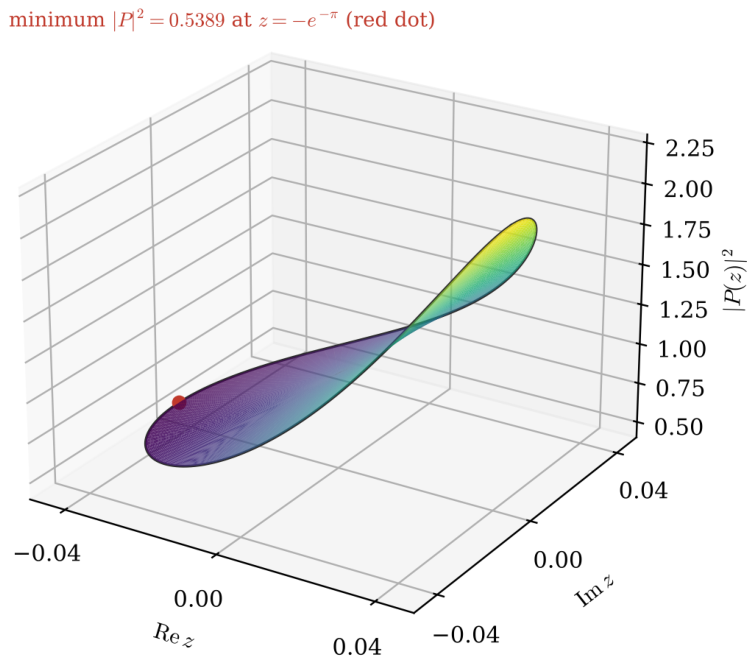
Remark 12.
The function , whose coefficients are , is the generating function of the electric half-BPS degeneracies of the model [28]. Theorem 11 therefore says that, to leading order, the single-centred index of a quarter-BPS black hole is the extreme Bessel term times the squared modulus of the half-BPS generating function, evaluated at the point . The positivity of is automatic; what has to be proved is that the corrections cannot overturn it, and Proposition 11 gives the room.
12. Facts on Bessel Functions
All Bessel functions below have real order and positive argument. We use
Lemma 43.
(i) is increasing; hence for .
- (ii)
- is increasing in z. Consequently, for the function is nonincreasing.
- (iii)
- For , .
- (iv)
- For fixed , is nonincreasing in .
- (v)
- .
Proof. (i) has positive coefficients. (v) follows from the same series and . For (ii) and (iii) we use the Weierstrass product , where are the positive zeros of [32] [§15.41]. It gives
each summand increasing in z, which is the first part of (ii). For the second, . For (iii), the zeros increase with [32] [§15.6], so each summand for is at most the one for . (iv) is a theorem of Cochran [11]. □
Lemma 44.
(i) for all , and as .
- (ii)
- ϕ is positive and decreasing on ; in particular g is increasing on , and for the ratio is nondecreasing on .
- (iii)
- for ; hence there.
- (iv)
- for every and .
Proof.
For half-integral order there is the closed form [32] [§3.71]
which gives . Write ; the recurrences give and (we use and ). On we enclose on a cover of the interval by boxes, in ball arithmetic, by the mean value form ; every enclosure is negative. On we use (73): with , the main part of has positive derivative in w on (checked on 600 subintervals), and the remaining part is together with its derivative, which is far smaller. This proves that is decreasing on , and together with gives positivity. Since g increases on to the limit 1, there; on , (v) of Lemma 43 gives . The monotonicity of is (ii) of Lemma 43 with in place of . (iii) on is checked on a grid of step using that is decreasing, and on from the closed form, where . Finally (iv) follows from (i) and Lemma 43(iv). □
The following monotonicity in x is what makes every bound of Section 13, proved at the smallest admissible x, valid for all larger x.
Lemma 45.
Let and let be as in (67). For a constant , each of the following ratios is a nonincreasing function of :
Proof.
Up to constants, with , and . The first ratio is , nonincreasing by Lemma 43(ii). The logarithmic derivative in x of the second is
by Lemma 43(iii) and (ii). The third is the same with and . □
Remark 13.
In Lemma 45 the extra power of the shadow terms exactly compensates the higher order of the Bessel function. This is the level-two counterpart of the fact, used by Bringmann and Manschot [6] and by Rosselló at level one, that the shadow terms of a mixed mock form grow at most like its principal-part terms.
Lemma 46.
For , . More generally for every .
Proof.
Positivity is clear from the product. The second bound holds since has nonnegative coefficients. With , comparison of the sum with an integral gives , so . Taking gives the first bound. □
13. Bounds for the Remaining Terms
Throughout this section is a reduced charge, , and all bounds are uniform in ℓ and in . We write and . By Lemma 43(i),(ii), is increasing in t and nonincreasing in x, and .
13.1. Decomposition
By Theorem 5, , and Theorem 11 splits this as
where
- over the pairs not in ;
- ;
- is the contribution of the walls with to the frame S term with , divided by ;
- is the frame T term with , divided by ;
- collects the terms of with , and the term , divided by .
We bound each piece in absolute value.
13.2. Parametrising the Walls
Lemma 47.
The map sending a polar term with and a wall to is injective. Given in its image, δ is the unique solution of
so is a function , and .
Proof.
By Lemma 8(ii), and , and ; the left side of (75) is increasing in , which gives uniqueness, and is then determined. The form has coefficients up to the order of the variables, so it is determined; given , the matrices G are (), ; for a fixed form the choice of k shifts by the integer k, that is, by ; the condition fixes k, and then is determined. Finally by Lemma 8(iii). □
13.3. The Leading Family
Lemma 48.
Let with , and put and . Then
Proof.
From one gets with . Since , , and Lemma 44(ii) shows . The expression is affine in , so its modulus is at most the larger of the values at the two ends. □
The supremum of on is attained at or at the unique critical point when , and is computed exactly. Summing,
The pairs not in have (if then ) or (so ) or ; we sum them exactly for , and for larger S use with , by Lemma 46.
For large m a coarser bound is convenient.
Lemma 49.
Let , , , and let be as in Lemma 42. Assume . Then every with satisfies
where with if , and otherwise.
Proof.
Write with and . Then . First, ; here , by Lemma 42(i), and, with and , Lemma 44(ii),(iii) give
when ; trivially . Multiply by . The function is nonincreasing on as soon as , which follows from and ; the function is decreasing for ; and the bound for is nonincreasing in x. So the supremum is at most the value at . □
13.4. The Other Walls at
Dividing (68) restricted to , and the frame T term, by , and using , Lemma 47 and the monotonicity of ,
where if r is even and if s is even. The ranges are finite by Lemma 8(v): , . Only quadruples for which (75) has a solution occur; in the certificate an upper bound for is found by bisection and then certified in ball arithmetic, and a quadruple is discarded only when the left side of (75) exceeds already at the least admissible , again certified.
For we use instead the following bound.
Lemma 50.
For , with , , and ,
Proof.
For a wall with , Lemma 8(vi) gives , and , so . Also with (by Lemma 8(ii), , and on the segment this convex function is at most ; is excluded since must be positive), hence . So . As in Lemma 48, . With , the sum over of is at most , the sum of over , is at most , and there are at most pairs . The factor 64 accounts for the factor 16, the two parity types and a factor 2 of room. □
13.5. The Terms with
Let be the number of with and frame F; then . Each term of with , divided by , is at most , and by Lemma 9. Bounding and by the sums of the absolute values of their walls,
where and are the sums (78) (including the leading family) and () with replaced by . The tail uses , , and . We take .
Lemma 51.
For , with as in Lemma 50,
Proof.
By Lemma 43(i), for . By Lemma 44(i), , and , so , using and as before. Finally . □
13.6. The Shadow Terms
Indeed, the arguments of and are with , so by Lemma 45 each term divided by is largest at ; there by Lemma 43(iv), the factor is at most 1, is increasing in its argument, and the interval of integration has length . The certificate sums exactly and bounds the rest using , and , with for (81) and for ().
Lemma 52.
For , with , and ,
Proof.
Take in (81), (82). Use (Lemma 46), , , , , and . Finally by Lemma 44(i). □
14. Proof of Theorem 1
Let be the sum of the bounds of Section 13, where denote the right sides of (81) and (82) with the tails included.
Theorem 12.
Put , , for and for . Then
with the largest value at . Moreover , , and for .
Proof.
Every term of is a finite sum of explicit quantities, which we evaluate in ball arithmetic with 96 bits [22]. Bessel functions are evaluated by Arb’s certified routines, the suprema in (76) by the exact critical points, and the solutions of (75) are enclosed as described after (79). The values are listed in Appendix C and plotted in Figure 4; the computation takes about twelve minutes.12 □
Theorem 13.
For every , .
Proof.
Leading family and missing pairs. Group the pairs by S. For , Lemma 42 gives , so Lemma 49 applies, and the pairs with contribute at most , where . Missing pairs have and contribute at most . For we use, for the pairs in , (Lemma 42(iv)), and with , so these terms add up to at most with . Evaluated in ball arithmetic, the total is at most for every , the largest value being at .
For we compare with . The bound decreases in m; for one checks (for this is , true for ), and for the function decreases in m; increases, and decreases. Hence whenever . For the term has and , so again . The missing pairs for have , and their terms with are counted at ; those with are in the tail. So the bound at , which is , holds for all .
The other pieces. By Lemmas 50, 51 and 52, with (since c increases with m, the bound with holds for all ),
at . Each bound decreases in m: in Lemma 50 the factor decreases for and increases; in Lemma 51 the factor dominates; in Lemma 52 the exponent decreases. □
Figure 4.
The pieces of the certificate for , on a logarithmic scale and divided by the extreme term : shadow terms, terms with , the frames , the walls with , the missing model terms and the error of the leading family. Only the last one matters numerically; the others are below at and fall off quickly.
Figure 4.
The pieces of the certificate for , on a logarithmic scale and divided by the extreme term : shadow terms, terms with , the frames , the walls with , the missing model terms and the error of the leading family. Only the last one matters numerically; the others are below at and fall off quickly.
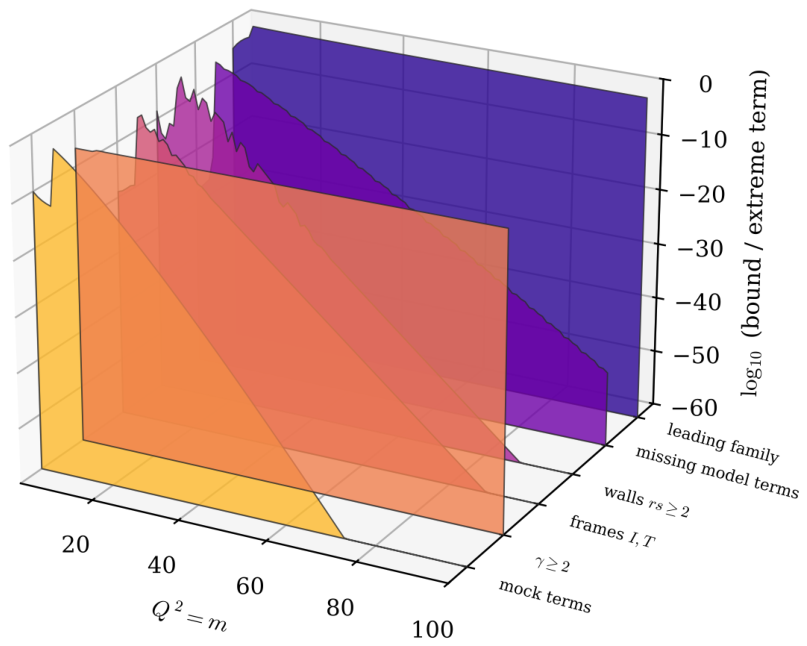
Figure 5.
The total error bound and the margin for . The margin is smallest at , where it is .
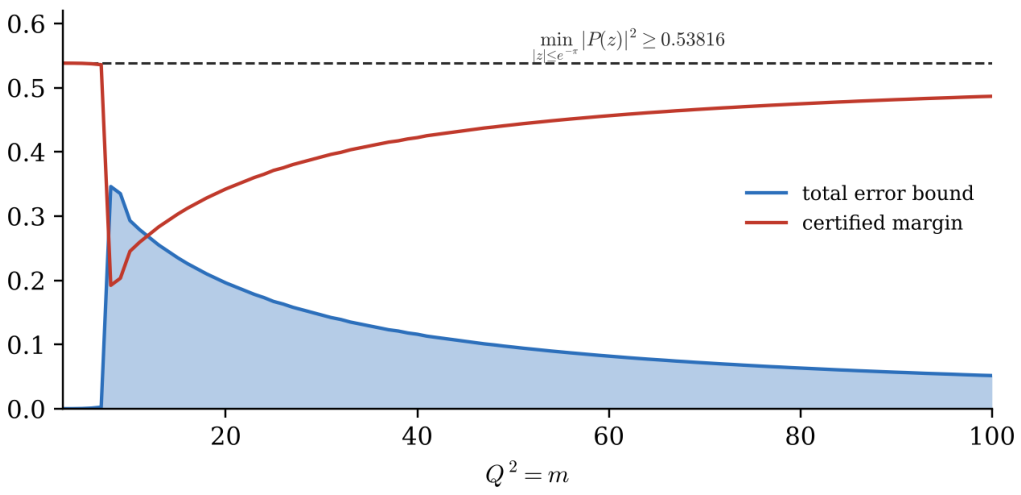
Proof of Theorem 1.
The published input is [8] [Theorem 5.4(a)]: for a charge in the set of (10) the single-centred index is the finite-part coefficient, , as recorded in (11). By Proposition 2, which rests on it and on the invariance of , it suffices to prove for reduced charges. If , this is Theorem 4. Let . Then : for because , and , and for because a reduced charge has . Theorem 5 expresses by the convergent series (32), and by (74) and the bounds of Section 13, which are uniform in and in ℓ,
by Proposition 11 (note ) and Theorems 12 and 13. Since , . □
Corollary 3.
For every reduced charge with ,
In particular as with fixed, and when with bounded, the Bekenstein–Hawking entropy of the black hole.
Proof.
The lower bound is the proof above. For the upper bound, and . The asymptotics follow from (67), , and . □
Remark 14.
The minimum of Proposition 11 is reached in the limit: as along charges with and odd, , and the bounds in the proof of Theorem 13 tend to 0, since for each fixed S. So comes arbitrarily close to , and the factor of the leading family cannot be replaced by a single term: an argument with one dominant term, which suffices at level one, does not reach level two without the resummation of Theorem 11. For moderate charges the picture is already accurate: at , , the exact index gives while , and at , , the two numbers are and .
15. Values and Comparison with the Product Formula
Table 1 lists the first single-centred indices on the rows and , computed exactly from the product (3) by the program of Appendix A; at they are the values of (13). We compared the expansion of the product in exact rational arithmetic with (12) on every coefficient with and ; the two sides agree. Every entry of Table 1 that lies in Sen’s Table 2 [29] coincides with it: at the entries 360, 2164, 4352, 18944, 36024, 125860 and the value 2164 at , and at the entries 198144, 67008, 6912 of the row and 1580672, 671744, 101376, 4352 of the row .13 Figure 6 shows on the two rows.
16. Other CHL Models
The method is not special to . For the CHL models with the leading family of walls again resums, now to evaluated at with . Positivity then reduces in the same way to a lower bound for this modulus on the disc , to the analogue of Theorem 5 for , whose proof requires the polar data at every cusp of and the transformation law of the finite part under the corresponding frames, and to an exact computation below the discriminant at which the error bounds take over.
Funding
No funding was received for conducting this study.
Ethics statement
This study involves no human participants, animals or personal data; no ethical approval was required.
Data availability
The programs and data that support the findings of this study are openly available in the archive [4], at https://doi.org/10.5281/zenodo.24140567. They comprise the exact computation of Appendix A, the interval certificates of Appendix B, the independent checks of the Rademacher expansion listed there, the programs that verify Proposition 1 and the values of Table 1, and the scripts that draw the figures.
Conflicts of Interest
The author has no conflicts of interest to declare that are relevant to the content of this article.
Appendix A. The Exact Computation
The program chl_coefficients.py of the archive [4] proves Theorem 4 in exact integer arithmetic, in five steps.
- (B1)
- Orbits. A charge corresponds to the binary quadratic form of discriminant , and acts by . The orbits with given D are enumerated through the Gauss-reduced forms of discriminant , each with a class of bottom rows modulo 2, taken modulo the automorphs of the reduced form.
- (B2)
- A representative in . In every orbit the program finds a charge with satisfying (10), which it tests in the form for and odd j with , the range of being finite because the left side grows.
- (B3)
- (B4)
- Signs. For every orbit, is computed for every representative found in the box, the values are compared, and the sign is checked. At the values are compared with Proposition 1.
- (B5)
- Least representatives. On the whole range, every charge of least in its orbit is checked to lie in , as Lemma 7 predicts.
For there are 22972 orbits, with for the least representative; all have . The smallest value relative to the extreme term occurs at small D, where x is close to 1; this is the region in which the leading-family error of Lemma 48 is largest, and Theorem 4 covers it for every .
Appendix B. Interval Computations
All the numerical statements used in the proofs are certified in ball arithmetic with Arb [22] through python-flint; each program prints its enclosures.
- (I1)
- pmin.py: Proposition 11. Product truncated at with an explicit tail enclosure, 4001 points on the half circle, Lipschitz constant .
- (I2)
- gmono2.py: Lemma 44. Monotonicity of on by mean-value enclosures on an adaptive cover; the range through the closed form (73).
- (I3)
- cert.py: Theorem 12. For each m, , the program lists the leading family , the walls with and the parity walls through their parameters , encloses , and evaluates the seven bounds of Section 13. In (79) it uses 32 in place of 16.
- (I4)
- analytic.py, analytic2.py: Theorem 13.
- (I5)
- polar.py: the wall sums (22), (23), which supply the polar data in (I3).
The programs in the folder proof_checks of the archive check the proof of Theorem 5 independently, in exact or high-precision arithmetic; none of them is used in the proof. polar_check.py tests the walls, the chambers and the wall sum (23) of Section 7; polar0_check.py tests the transformation of the product, the second product and the wall sum (22) of Section 8; transform_check.py, with tc_series.py, tests the lemmas and the transformation law of Section 9; chk_theta.py tests Lemma 40, and chk_mordell.py, chk_mordell2.py and hp.py test Lemma 31; expansion_check.py, with expansion_series.py, evaluates the truncated right side of (32) (Remark 3). Their outputs are stored next to them.
Appendix C. The Certified Margins
Table A1 lists, for , the total bound of Theorem 12 and the margin . At and , with and , the bounds are and , and the margins and .

Table A1.
The certified total error of Theorem 12 and the margin , for .
| m | margin | m | margin | m | margin | m | margin | ||||
|---|---|---|---|---|---|---|---|---|---|---|---|
| 3 | 0.5380 | 28 | 0.1540 | 0.3842 | 53 | 0.0913 | 0.4467 | 78 | 0.0648 | 0.4732 | |
| 4 | 0.5379 | 29 | 0.1500 | 0.3883 | 54 | 0.0898 | 0.4482 | 79 | 0.0640 | 0.4740 | |
| 5 | 0.5377 | 30 | 0.1460 | 0.3921 | 55 | 0.0884 | 0.4496 | 80 | 0.0633 | 0.4747 | |
| 6 | 0.5370 | 31 | 0.1420 | 0.3958 | 56 | 0.0870 | 0.4510 | 81 | 0.0626 | 0.4754 | |
| 7 | 0.0024 | 0.5356 | 32 | 0.1390 | 0.3993 | 57 | 0.0857 | 0.4523 | 82 | 0.0619 | 0.4761 |
| 8 | 0.3460 | 0.1917 | 33 | 0.1350 | 0.4026 | 58 | 0.0844 | 0.4536 | 83 | 0.0612 | 0.4768 |
| 9 | 0.3350 | 0.2030 | 34 | 0.1320 | 0.4058 | 59 | 0.0831 | 0.4549 | 84 | 0.0605 | 0.4775 |
| 10 | 0.2930 | 0.2450 | 35 | 0.1290 | 0.4089 | 60 | 0.0819 | 0.4561 | 85 | 0.0599 | 0.4781 |
| 11 | 0.2790 | 0.2594 | 36 | 0.1260 | 0.4118 | 61 | 0.0807 | 0.4573 | 86 | 0.0592 | 0.4788 |
| 12 | 0.2670 | 0.2714 | 37 | 0.1230 | 0.4145 | 62 | 0.0795 | 0.4585 | 87 | 0.0586 | 0.4794 |
| 13 | 0.2550 | 0.2828 | 38 | 0.1210 | 0.4172 | 63 | 0.0784 | 0.4596 | 88 | 0.0580 | 0.4800 |
| 14 | 0.2450 | 0.2930 | 39 | 0.1180 | 0.4197 | 64 | 0.0773 | 0.4607 | 89 | 0.0574 | 0.4806 |
| 15 | 0.2350 | 0.3026 | 40 | 0.1160 | 0.4222 | 65 | 0.0763 | 0.4617 | 90 | 0.0568 | 0.4812 |
| 16 | 0.2260 | 0.3115 | 41 | 0.1130 | 0.4245 | 66 | 0.0753 | 0.4627 | 91 | 0.0563 | 0.4817 |
| 17 | 0.2180 | 0.3199 | 42 | 0.1110 | 0.4268 | 67 | 0.0742 | 0.4638 | 92 | 0.0557 | 0.4823 |
| 18 | 0.2100 | 0.3277 | 43 | 0.1090 | 0.4289 | 68 | 0.0733 | 0.4647 | 93 | 0.0551 | 0.4829 |
| 19 | 0.2030 | 0.3350 | 44 | 0.1070 | 0.4310 | 69 | 0.0723 | 0.4657 | 94 | 0.0546 | 0.4834 |
| 20 | 0.1960 | 0.3419 | 45 | 0.1050 | 0.4330 | 70 | 0.0714 | 0.4666 | 95 | 0.0541 | 0.4839 |
| 21 | 0.1900 | 0.3483 | 46 | 0.1030 | 0.4350 | 71 | 0.0705 | 0.4675 | 96 | 0.0536 | 0.4844 |
| 22 | 0.1840 | 0.3544 | 47 | 0.1010 | 0.4368 | 72 | 0.0696 | 0.4684 | 97 | 0.0530 | 0.4850 |
| 23 | 0.1780 | 0.3601 | 48 | 0.0994 | 0.4386 | 73 | 0.0688 | 0.4692 | 98 | 0.0525 | 0.4855 |
| 24 | 0.1730 | 0.3655 | 49 | 0.0976 | 0.4404 | 74 | 0.0679 | 0.4701 | 99 | 0.0520 | 0.4860 |
| 25 | 0.1670 | 0.3706 | 50 | 0.0960 | 0.4420 | 75 | 0.0671 | 0.4709 | 100 | 0.0516 | 0.4864 |
| 26 | 0.1630 | 0.3754 | 51 | 0.0943 | 0.4437 | 76 | 0.0663 | 0.4717 | |||
| 27 | 0.1580 | 0.3799 | 52 | 0.0928 | 0.4452 | 77 | 0.0655 | 0.4725 |
References
- Ahlfors, L. V. Complex Analysis, 3rd ed.; McGraw-Hill: New York, 1979. [Google Scholar]
- Berndt, B. C.; Evans, R. J.; Williams, K. S. Gauss and Jacobi Sums. In Canadian Mathematical Society Series of Monographs and Advanced Texts; Wiley: New York, 1998. [Google Scholar]
- Bhattacharjee, D. Generalization of quartic and quintic Calabi–Yau manifolds fibered by polarized K3 surfaces. Res. Sq. 2022. [Google Scholar] [CrossRef] [PubMed]
- Bhattacharjee, D. Code and data for: Every single-centred black hole index of the Z2 CHL model is positive, version v2.0.0. Zenodo 2026. [Google Scholar] [CrossRef]
- Bringmann, K.; Murthy, S. On the positivity of black hole degeneracies in string theory. Commun. Number Theory Phys. 2013, 7, 15–56. [Google Scholar] [CrossRef]
- Bringmann, K.; Manschot, J. From sheaves on P2 to a generalization of the Rademacher expansion. Amer. J. Math. 2013, 135, 1039–1065. [Google Scholar] [CrossRef]
- Bhattacharjee, D.; Nandi, P. Enriques and Kummer surfaces arising from K3 involutions; Preprints, 2026. [Google Scholar] [CrossRef]
- Bhand, A.; Sen, A.; Singh, R. K. Mock modularity in CHL models. Res. Math. Sci. 2025, 12 8. [Google Scholar] [CrossRef]
- Chaudhuri, S.; Hockney, G.; Lykken, J. D. Maximally supersymmetric string theories in D. Phys. Rev. Lett. 1995, 75, 2264–2267. [Google Scholar] [CrossRef] [PubMed]
- Cardoso, G. L.; Nampuri, S.; Rosselló, M. Arithmetic of decay walls through continued fractions: a new exact dyon counting solution in N=4 CHL models. J. High Energy Phys. 2021, no. 3, 154. [Google Scholar] [CrossRef]
- Cochran, J. A. The monotonicity of modified Bessel functions with respect to their order. J. Math. Phys. 1967, 46, 220–222. [Google Scholar] [CrossRef]
- Cheng, M. C. N.; Verlinde, E. P. Wall crossing, discrete attractor flow and Borcherds algebra. SIGMA 2008, 4, 068. [Google Scholar] [CrossRef]
- David, J. R.; Jatkar, D. P.; Sen, A. Product representation of dyon partition function in CHL models. J. High Energy Phys. 2006, no. 6, 064. [Google Scholar] [CrossRef]
- Dabholkar, A.; Nampuri, S. Spectrum of dyons and black holes in CHL orbifolds using Borcherds lift. J. High Energy Phys. 2007, no. 11, 077. [Google Scholar] [CrossRef]
- David, J. R.; Sen, A. CHL dyons and statistical entropy function from D1-D5 system. J. High Energy Phys. 2006, no. 11, 072. [Google Scholar] [CrossRef]
- Dijkgraaf, R.; Verlinde, E.; Verlinde, H. Counting dyons in N=4 string theory. Nucl. Phys. B 1997, 484, 543–561. [Google Scholar] [CrossRef]
- Eichler, M.; Zagier, D. The Theory of Jacobi Forms. In Progress in Mathematics 55; Birkhäuser, Boston, 1985. [Google Scholar] [CrossRef]
- Ferrari, G.; Reys, V. Mixed Rademacher and BPS black holes. J. High Energy Phys. 2017, no. 7, 094. [Google Scholar] [CrossRef]
- Gritsenko, V. A.; Nikulin, V. V. Siegel automorphic form corrections of some Lorentzian Kac–Moody Lie algebras. Amer. J. Math. 1997, 119, 181–224. [Google Scholar] [CrossRef]
- Hart, W. B. Fast Library for Number Theory: an introduction. In Mathematical Software – ICMS 2010, Lecture Notes in Comput. Sci. 6327; Springer: Berlin, 2010; pp. 88–91. [Google Scholar] [CrossRef]
- Hardy, G. H. E. M. Wright, An Introduction to the Theory of Numbers, 6th ed.; Heath-Brown, D. R., Silverman, J. H., Eds.; Oxford University Press: Oxford, 2008. [Google Scholar]
- Johansson, F. Arb: efficient arbitrary-precision midpoint-radius interval arithmetic. IEEE Trans. Comput. 2017, 66, 1281–1292. [Google Scholar] [CrossRef]
- Jatkar, D. P.; Sen, A. Dyon spectrum in CHL models. J. High Energy Phys. 2006, no. 4, 018. [Google Scholar] [CrossRef]
- Persson, D.; Volpato, R. Fricke S-duality in CHL models. J. High Energy Phys. 2015, no. 12, 156. [Google Scholar] [CrossRef]
- Rademacher, H.; Zuckerman, H. S. On the Fourier coefficients of certain modular forms of positive dimension. Ann. Math. 1938, 39, 433–462. [Google Scholar] [CrossRef]
- Sadhu, R.; Bhattacharjee, D.; Bhattacharya, S.; Thakur, S. N. E8×E8 heterotic gravity and M-theory. SSRN 2026. [Google Scholar] [CrossRef]
- Sen, A. Walls of marginal stability and dyon spectrum in N=4 supersymmetric string theories. J. High Energy Phys. 2007, no. 5, 039. [Google Scholar] [CrossRef]
- Sen, A. Black hole entropy function, attractors and precision counting of microstates. Gen. Relativ. Gravit. 2008, 40, 2249–2431. [Google Scholar] [CrossRef]
- Sen, A. How do black holes predict the sign of the Fourier coefficients of Siegel modular forms? Gen. Relativ. Gravit. 2011, 43, 2171–2183. [Google Scholar] [CrossRef]
- Shih, D.; Strominger, A.; Yin, X. Recounting dyons in N=4 string theory. J. High Energy Phys. 2006, no. 10, 087. [Google Scholar] [CrossRef]
- Sturm, J. On the congruence of modular forms, in: Number Theory (New York, 1984–85). In Lecture Notes in Math. 1240; Springer: Berlin, 1987; pp. 275–280. [Google Scholar] [CrossRef]
- G. N. Watson, A Treatise on the Theory of Bessel Functions, 2nd ed.; Cambridge University Press: Cambridge, 1944.
- Whittaker, E. T.; Watson, G. N. A Course of Modern Analysis, 5th ed.; Cambridge University Press: Cambridge, 2021. [Google Scholar] [CrossRef]
- Zuckerman, H. S. On the coefficients of certain modular forms belonging to subgroups of the modular group. Trans. Amer. Math. Soc. 1939, 45, 298–321. [Google Scholar] [CrossRef]
- Zwegers, S. Zwegers, Mock Theta Functions. PhD thesis, Universiteit Utrecht, 2002. [Google Scholar]
| 1 | |
| 2 | For the model is the heterotic string on obtained from the string by exchanging the two factors together with a half shift on a circle [9]; for the ten-dimensional theory and its relation to M-theory see [26]. Background on the involutions of surfaces and on Calabi–Yau threefolds fibred by surfaces, which underlie the dual type II description, is in [3,7]. |
| 3 | For one dominant term suffices. At level two the dominant contribution is a whole family, and the family resums to an eta quotient; the bound is sharp in the limit (Remark 14). |
| 4 | In the normalisation of [13], , so that is half the elliptic genus of ; the constant terms then give the exponents used below. |
| 5 | The exponent of is , and the power of is , as in [8] [(5.15)]. |
| 6 | A vector of is an integral vector of even coordinate sum; the term selects these, and its norm is when the first coordinate is ℓ and the others contribute . |
| 7 | Every orbit is found with all its representatives inside the computed box, and the program checks that they give the same value; at it reproduces the closed formula of Proposition 1. |
| 8 | In (23) the condition that r or s be even selects the walls that are images of the basic wall under or its conjugate; the factor vanishes unless is an integer. |
| 9 | The duality group acts on the charges; the finite part is a function of on which the relevant group, after the substitution , is . The cusp ∞ has width two, which is why it carries two frames. |
| 10 | With , the substitution is , and , whose expansion starts with . |
| 11 | For weakly holomorphic forms at level N the expansion is the circle method of Rademacher and Zuckerman [25,34]. For mixed mock Jacobi forms on , the case of , it was proved by Bringmann and Manschot [6], with the correction terms coming from the completion of Zwegers [35], and it was used for black holes by Ferrari and Reys [18]. At level two the expansion is written down, and assumed, in the derivation of the immortal index by Cardoso, Nampuri and Rosselló [10] [§4]. |
| 12 | At and the largest pieces are the leading family and the two shadow terms: , , at , and , , at . The thresholds are far below the values needed in the proof of Theorem 1. |
| 13 | In these entries the charge lies in the cone (3.9) of [29], and the index of the full partition function equals the single-centred index. The entries of Sen’s table with , such as at or at , are outside the scope of the theorem, as they should be. |
Figure 6.
for (left) and (right), and with . Every bar is positive, as Theorems 3 and 1 assert.
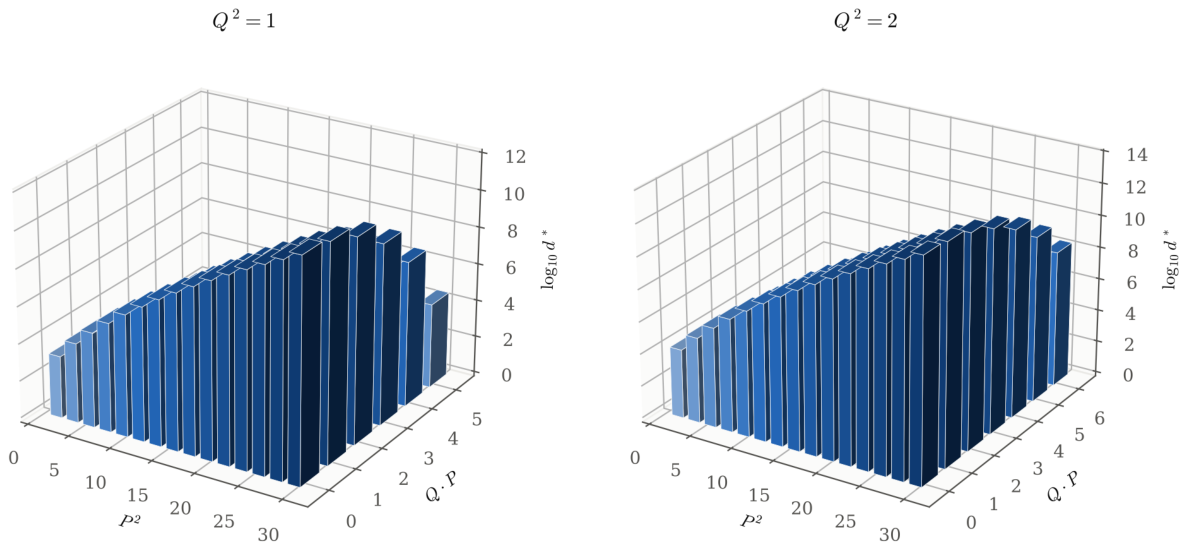
Table 1.
The first single-centred indices on the rows and , as functions of and, at , of modulo 4.
| (ℓodd) | () | () | |||||
| 1 | 360 | 3 | 4352 | 4 | 18944 | 4 | 6912 |
| 2 | 2164 | 7 | 67008 | 8 | 198144 | 8 | 101376 |
| 3 | 4352 | 11 | 671744 | 12 | 1580672 | 12 | 992256 |
| 4 | 18944 | 15 | 5189696 | 16 | 10586880 | 16 | 7550400 |
| 5 | 36024 | 19 | 33581312 | 20 | 62035968 | 20 | 48253952 |
| 6 | 125860 | 23 | 190095232 | 24 | 327011328 | 24 | 270195712 |
| 7 | 233080 | 27 | 968248576 | 28 | 1578794128 | 28 | 1362534400 |
| 8 | 705536 | 31 | 4522209472 | 32 | 7075522048 | 32 | 6304638848 |
Disclaimer/Publisher’s Note: The statements, opinions and data contained in all publications are solely those of the individual author(s) and contributor(s) and not of MDPI and/or the editor(s). MDPI and/or the editor(s) disclaim responsibility for any injury to people or property resulting from any ideas, methods, instructions or products referred to in the content. |
© 2026 by the authors. Licensee MDPI, Basel, Switzerland. This article is an open access article distributed under the terms and conditions of the Creative Commons Attribution (CC BY) license (http://creativecommons.org/licenses/by/4.0/).
Copyright: This open access article is published under a Creative Commons CC BY 4.0 license, which permit the free download, distribution, and reuse, provided that the author and preprint are cited in any reuse.