
Submitted:
09 November 2026
Posted:
10 November 2026
You are already at the latest version
Abstract
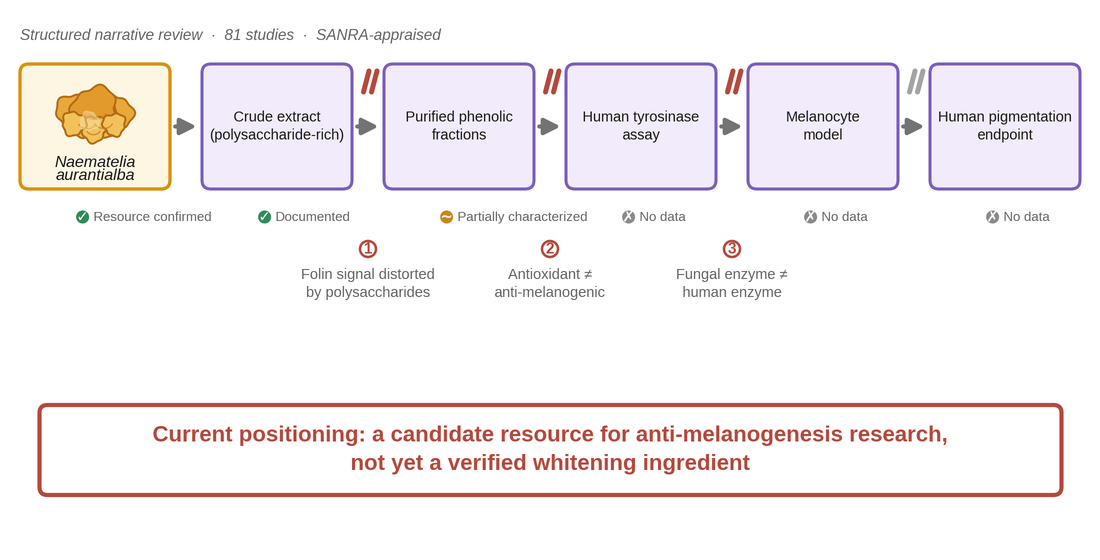
Background: Naematelia aurantialba has a solid research foundation in cultivation and polysaccharide chemistry, yet the systematic characterization of its low-molecular-weight phenolic constituents lags behind, and direct evidence linking them to melanogenesis regulation is lacking. Methods: Following the Scale for the Assessment of Narrative Review Articles (SANRA), we conducted a structured narrative review of PubMed, Web of Science Core Collection, Scopus, and CNKI (from inception to September 2026); 81 studies were included and appraised within three evidence tiers and a methodological/translational reference framework. Results: N. aurantialba contains extractable and quantifiable phenolic and flavonoid constituents, its extracts exhibit chemical antioxidant activity, and processing and fermentation strategies can influence phenolic parameters; however, the evidence stops at chemical occurrence and antioxidant screening, with no compound-level confirmation, human tyrosinase or melanocyte model validation, or human pigmentation endpoint data retrieved, and analogous evidence from Sanghuangporus and Ganoderma cannot be directly extrapolated owing to species specificity. Conclusions: N. aurantialba phenolic fractions should be positioned as a candidate resource for anti-melanogenesis research rather than a proven whitening ingredient; priority should be given to phenolic-targeted liquid chromatography-tandem mass spectrometry (LC-MS/MS) annotation, bioassay-guided fractionation, recombinant human tyrosinase assays, and cytotoxicity-corrected melanocyte models.
Keywords:
Naematelia aurantialba
; phenolic fractions
; anti-melanogenic potential
; tyrosinase
; antioxidant activity
1. Introduction
Edible mushrooms contain structurally diverse bioactive compounds and represent a sustainable source of bioactive molecules; among these, phenolic constituents have attracted considerable attention owing to their antioxidant, metal-chelating, and oxidative-stress-modulating potential [1,2], although such effects are highly species-dependent and cannot be extrapolated across taxa. Naematelia aurantialba (syn. Tremella aurantialba) has a well-established research foundation in cultivation, fermentation, and polysaccharide chemistry [3,4],whereas the systematic characterization of its low-molecular-weight phenolic constituents lags markedly behind. It should be noted that the taxonomic delimitation of the N. aurantialba complex has been updated in recent years; as previous applied studies reported their materials under the names used at the time, this review aggregates evidence under the original names. Several studies [5,6,7,8,9,10] have shown that N. aurantialba fruiting bodies contain total phenolic and flavonoid constituents and exhibit free-radical-scavenging and other antioxidant activities, and that short-wave ultraviolet (UVC) irradiation, microwave-assisted extraction, and fermentation strategies can influence phenolic-related parameters; however, these findings are largely confined to confirming chemical occurrence, determining total phenolic/flavonoid contents, and antioxidant screening, and have not demonstrated direct regulation of the key melanogenic enzymes (tyrosinase and tyrosinase-related proteins 1 and 2, TYRP1/TYRP2) or the microphthalmia-associated transcription factor (MITF) pathway, nor verified any inhibitory effect on human pigmentation. Critically, antioxidant activity and anti-melanogenic activity are two distinct biological endpoints that cannot substitute for each other [11,12,13], and Mayr et al. [14] demonstrated that inhibition data obtained with mushroom-derived tyrosinase cannot reliably predict human pigmentation outcomes.
This lag stems from three bottlenecks: at the chemical level, total phenolic assays are prone to interference from polysaccharides and reducing sugars [15], and although a broad ultra-performance liquid chromatography–quadrupole time-of-flight mass spectrometry (UPLC-Q-TOF/MS)-based screening of N. aurantialba constituents has been reported by Yan et al. [16], phenolic-targeted systematic annotation, standard-confirmed identification, and bioassay-guided fractionation remain absent; at the biological level, relevant studies [17,18,19] have focused mainly on polysaccharide-mediated skin effects, lacking direct validation using recombinant human tyrosinase, cytotoxicity-corrected melanocyte models, and the MITF/TYR/TYRP1/TYRP2 pathway [14,20,21]; at the translational level, a history of dietary consumption cannot substitute for dermal safety evaluation, and objective pigmentation endpoint data compliant with cosmetic efficacy-claim regulations have likewise not been reported [22,23,24]. Natural product research likewise indicates that such effects are highly compound-specific—emodin promotes rather than inhibits melanin synthesis via the ERK/MITF signaling axis [25], whereas green-tea-derived catechins inhibit tyrosinase [26]—and must therefore be confirmed by direct verification at the compound level rather than inferred from chemical class or phylogenetic relatedness.
Accordingly, guided by the Scale for the Assessment of Narrative Review Articles (SANRA), this structured narrative review classifies the included studies into three evidence tiers plus a methodological and translational reference framework, and critically evaluates the available evidence on the anti-melanogenic potential of N. aurantialba phenolic fractions: empirically established chemical findings are distinguished from indirect mechanistic hypotheses and from content awaiting future validation, with the interpretive boundaries of each tier delineated; building on this, a staged validation pathway is proposed along the logic of chemical authenticity, biological relevance, and translational application, providing an operational coordinate system for future research. It should be specifically noted that the term “phenolic fractions” in this review refers primarily to phenolic-containing or phenolic-enriched extract fractions rather than chemically purified phenolic compounds, unless otherwise specified.
2. Literature Search and Evidence Appraisal
This review is a structured narrative review designed and reported with reference to the SANRA items proposed by Baethge et al. [27]; the correspondence with the six SANRA items is provided in Supplementary Table S1. The literature search covered PubMed, Web of Science Core Collection, Scopus, and CNKI from database inception to September 2026, using combinations of the scientific name of N. aurantialba and its synonym with the topic terms “phenolic”, “flavonoid”, “antioxidant”, “tyrosinase”, and “melanogenesis”; methodological, mechanistic, and regulatory references were supplemented by backward citation tracking of included studies and relevant reviews. Eligible studies included: (i) research directly addressing the phenolic, flavonoid, or low-molecular-weight constituents of N. aurantialba; (ii) research providing background evidence on the cultivation, fermentation, polysaccharides, or skin-related effects of N. aurantialba; (iii) studies of other fungi or natural products providing experimental models of tyrosinase inhibition or melanogenesis regulation; and (iv) methodological, mechanistic, or regulatory references. Studies were excluded if they were off-topic, lacked key methodological information needed to assign an evidence tier, could not distinguish the active chemical class (e.g., polysaccharides not separated from phenolics), or were conference papers or abstracts; dissertations were included when they provided irreplaceable primary data. Following these criteria, the initial search retrieved 489 records; after deduplication and removal of clearly irrelevant records, 300 remained; full-text reading and evidence-tier assessment of these 300 records led to the exclusion of 223, leaving 77 eligible studies; citation chasing and targeted supplementary searches (to capture records missed owing to nomenclatural changes and database indexing lag) yielded a net addition of 4 records, for a final sample of 81 studies (489→300→77+4→81; the screening flow is shown in Figure 1). Of these, 11 studies constituted Tier 1 (direct phenolic-related evidence on N. aurantialba), 38 Tier 2 (non-phenolic background evidence on N. aurantialba), 11 Tier 3 (evidence from analogous fungi and natural products), and 21 the methodological/translational reference framework; the tier assignments of all included studies are given in Table 1. As a narrative review, this study was not prospectively registered (e.g., in PROSPERO); the search strategy, eligibility criteria, and evidence-tiering rules are reported in full herein to ensure reproducibility. All databases were searched in September 2026. A uniform search string was used for PubMed, Web of Science Core Collection, and Scopus: (“Naematelia aurantialba” OR “Tremella aurantialba”) AND (phenolic* OR flavonoid* OR antioxidant* OR tyrosinase OR melanogenesis OR pigmentation), applied to the title/abstract/keyword fields; for CNKI, the topic search was 主题=(“金耳” OR “Naematelia aurantialba” OR “Tremella aurantialba”) AND 主题=(“酚” OR “黄酮” OR “抗氧化” OR “酪氨酸酶” OR “黑色素”). Deduplication was performed by manual record-by-record comparison, and screening was conducted independently by the author.
To interpret evidence from different sources in a differentiated manner, the 81 included studies were classified into three evidence tiers according to evidence source and study object, with an additional methodological and translational reference framework: Tier 1 comprises direct evidence on N. aurantialba phenolics; Tier 2 comprises non-phenolic background evidence on N. aurantialba (polysaccharide, cultivation, fermentation, and skin-care studies), defining the resource base and biological relevance; Tier 3 comprises evidence from analogous fungi and natural products, used solely for hypothesis generation. Mechanistic, methodological, and regulatory references, together with background reviews, are not counted as an evidence tier but serve as an independent reference framework, providing the validation logic and translational basis for the review. Interpretation follows a uniform boundary rule: evidence at each tier supports conclusions only at its own level, and background evidence, analogous evidence, and reference-framework literature must not serve as direct evidence of an anti-melanogenic effect of N. aurantialba phenolic fractions. All included references for each tier and the framework (grouped by theme), the conclusions they can support, and warnings against overextension are given in Table 1.
The included studies were additionally coded along five dimensions (Table 2) to ensure consistency and traceability in evidence aggregation. A quantitative overview of the included studies by evidence tier, publication year, and country/region of the first author’s institution is provided in Table 3.
Building on this tiered framework and coding scheme, we constructed a staged validation pathway (Figure 2) that proceeds through five stages in the logical order of evidence accumulation, each with distinct validation tasks and evidence thresholds, to locate existing evidence and plan future research.
Stage 1: Chemical authenticity verification. The task is to confirm the presence and identity of phenolic-related constituents in N. aurantialba. The evidence threshold is compound-level attribution, including quantitative spectral analysis, standard-confirmed identification, and bioassay-guided fractionation.
Stage 2: Processing strategy assessment. The task is to evaluate the efficacy of UVC treatment, extraction optimization, fermentation, and biomass production strategies in enriching the relevant metabolites. The evidence threshold is chemical verification of enrichment rather than inference from total phenolic values or antioxidant assay results alone.
Stage 3: Mechanistic hypothesis construction. The task is to formulate mechanistic hypotheses based on elucidated pigmentation pathways (including tyrosinase regulation, copper-ion interactions, MITF signaling, and related molecular networks [11,12,13]). The evidence threshold is that hypotheses require direct verification; for N. aurantialba they remain theoretical until such verification is performed.
Stage 4: Biological relevance validation. The task is to validate relevance in models that reflect the biology of human pigmentation. Given that Mayr et al. [14] have shown that mushroom tyrosinase assays may not accurately reflect the biology of human pigmentation, the evidence threshold includes recombinant human tyrosinase, melanocyte-based models, cytotoxicity-corrected melanin measurement, and molecular analysis of the MITF/TYR/TYRP1/TYRP2 pathway.
Stage 5: Cosmetic translation assessment. The task is to conduct efficacy validation, dermal safety evaluation, quality control, stability assessment, and regulatory compliance review for cosmetic applications [22,23,24]. The evidence threshold is meeting the regulatory requirements for efficacy claims and registration/filing.
In summary, this pathway does not presume that N. aurantialba phenolic fractions possess anti-melanogenic activity; rather, it provides a rigorous operational coordinate system for verifying, refining, or refuting this hypothesis. Measured against this pathway, the available evidence remains at Stages 1–2: preliminary evidence of chemical occurrence exists, whereas compound-level confirmation is lacking—only extract-level mass-spectrometric annotation by Peng et al. [28] is available—and human-relevant model validation has yet to be undertaken.
3. Current Evidence and Resource Positioning of N. aurantialba Phenolic Fractions
3.1. Biological Characteristics and Cultivation Basis of N. aurantialba
The taxonomic delimitation of the N. aurantialba complex has recently been updated: based on genome skimming of the holotype (collected in Kangding, Sichuan, in 1984), Tang and Yang [29] divided the complex in southwestern China into four species, among which the commercially cultivated “golden ear” was delimited as the new species N. sinensis, whereas N. aurantialba sensu stricto occurs only in subalpine zones above 3000 m; a genome study of cultivated material published in 2026 has since adopted the name N. sinensis, reporting chromosome-scale assemblies of four mating types (approximately 20.8 Mb across 12 chromosomes) and phylogenomic evidence that N. sinensis is more closely related to N. aurantialba sensu stricto than to N. encephala [30]. Because previous applied studies reported their materials under the names used at the time and most did not deposit verifiable specimen or sequence vouchers, this review aggregates evidence under the names used by each original study, and taxonomic identification status is incorporated as a dimension of evidence quality (see Section 2 and Table 1). It should be emphasized that the materials used in previous phenolic and applied research on “N. aurantialba” were predominantly commercially cultivated fruiting bodies or cultivated strains (see Section 3.2 and Section 3.3); under the above delimitation, these materials are more likely to correspond to N. sinensis than to N. aurantialba sensu stricto. The phenolic evidence aggregated in this review therefore reflects, in a strict sense, the chemical profile of cultivated golden ear, and this material attribution should be borne in mind throughout the evidence interpretation that follows.
N. aurantialba is a jelly fungus whose biological characteristics underpin the reproducibility of natural product research. Unlike most commonly cultivated edible mushrooms, its development involves close interactions with an associated fungal community. The morphological and developmental study by Yang and Dong [31] revealed that fruiting body formation depends on the interaction between its own hyphae and the associated crust fungus; this suggests that metabolite synthesis in N. aurantialba is governed not only by its genetic background but may also be influenced by host–symbiont interactions.
Molecular biological research has provided effective tools for this reproducibility issue. Sun et al. [32] completed the first whole-genome sequencing and annotation of N. aurantialba, providing a basis for bioactive-compound mining and molecular breeding; the molecular markers developed by Shen et al. [33] improve strain identification and genetic traceability, which are essential for quality control in future N. aurantialba-derived natural product research; and the mating-type locus analysis by Shen et al. [34] further revealed the genetic complexity of reproduction and differentiation in N. aurantialba, highlighting the need for standardized biological material in bioactivity assessment.
Cultivation studies have confirmed the feasibility of N. aurantialba biomass production. Early work by Luo et al. [35], Zheng and Liu [36], and Wang et al. [37] on strain isolation, domestication, and cultivation techniques showed that successful fruiting depends on suitable strain selection, environmental control, and maintenance of the symbiotic relationship with the companion fungus. These studies focused on strain domestication and fruiting conditions, without assessing phenolic metabolism. More recently, nutritional profiling and quality evaluation of factory-cultivated N. aurantialba [38] and smart-cabin-based year-round cultivation technology [39] have further advanced the standardization and scale-up of its production.
Beyond fruiting-body cultivation, fermentation technology offers a potential platform for the controlled production of N. aurantialba-derived material. Studies by Rong et al. [40] and Ke [41] showed that mycelial biomass can be obtained by submerged fermentation within relatively short cycles. Early fermentation research focused mainly on nutrients, biomass production, and polysaccharides, and has not been optimized for phenolic metabolite production. Process-monitoring techniques such as the electronic nose have also been applied to the submerged fermentation of N. aurantialba [42].
3.2. Chemical Characterization and Phenolic Research on N. aurantialba
Chemical research on N. aurantialba is markedly unbalanced: polysaccharides have been extensively characterized, whereas phenolics and other low-molecular-weight metabolites lag behind. This imbalance directly shapes the current understanding of N. aurantialba bioactivity—most reported functions are associated with polysaccharide preparations rather than phenolic constituents. For clarity, in this review “phenolic constituents” refers to aromatic compounds bearing phenolic hydroxyl groups (e.g., phenolic acids and flavonoids); other low-molecular-weight metabolites detected in extracts by mass-spectrometric annotation—such as alkaloids, organic acids, and quaternary ammonium bases—are not regarded as phenolic constituents here (the term “phenolic fractions” denotes extract-level mixtures containing such constituents).
Existing research has focused heavily on N. aurantialba polysaccharides, whose isolation, structural features, and bioactivities have been specifically reviewed by Yan et al. [43]. Sun et al. [19], Liu et al. [44], Ren et al. [45], and Liu et al. [46] systematically investigated the composition, molecular properties, and bioactivities of N. aurantialba polysaccharides using different extraction and characterization methods; Zhang et al. [47] established a quantitative assay for polysaccharide content; and Deng et al. [48] reported that fermentation-derived N. aurantialba polysaccharides possess antioxidant and metabolism-modulating activities. All these findings belong to the polysaccharide chemical class and cannot serve as evidence for phenolic fractions.
In contrast, direct evidence for N. aurantialba phenolics remains limited and is concentrated at the level of chemical occurrence. Chen et al. [5] compared polyphenol extraction and antioxidant activities among N. aurantialba, Tremella fuciformis, and wood ear (Auricularia sp.); with 80% acetone as the solvent, the polyphenol concentration of the N. aurantialba extract was approximately 64–70 µg/mL (gallic acid equivalents). In a comparative study of the phenolic profiles of edible mushrooms commonly consumed in China, Islam et al. [10] further quantified the total phenolic content (0.80 mg gallic acid equivalent (GAE)/g) and total flavonoid content (0.13 mg catechin equivalent (CAE)/g) of N. aurantialba and detected phenolic acids including protocatechuic acid and p-hydroxybenzoic acid, providing chromatographic evidence for the presence of phenolic constituents. The comparative study by Li et al. [6] on N. aurantialba, T. fuciformis, and Auricularia sp. showed that the three differ in phenolic and flavonoid contents, indicating that N. aurantialba has quantifiable small-molecule chemical features distinct from those of common edible fungi. Studies by Yin et al. [8,9] further confirmed that N. aurantialba contains extractable and quantifiable total flavonoids.
Recent chemical studies have broadened knowledge of the N. aurantialba metabolome. Peng et al. [28] annotated 24 small-molecule constituents from an aqueous N. aurantialba extract using ultra-high-performance liquid chromatography–quadrupole-Orbitrap mass spectrometry (UHPLC-Q-Orbitrap-MS); however, the identifications were based on accurate mass and database matching without standard confirmation, and the annotated constituents were mainly non-phenolic small molecules such as alkaloids, organic acids, and quaternary ammonium bases, so they do not constitute compound-level confirmation of phenolic constituents. Gas chromatography–mass spectrometry (GC-MS) analysis by Li et al. [49] likewise revealed a complex volatile metabolic profile in N. aurantialba extracts, as did analysis of the fermentation system [50]; neither provides compound-level confirmation of phenolic fractions. Table 4 summarizes the quantitative phenolic-related evidence reported by Tier 1 studies. As can be seen, the chemical evidence for N. aurantialba phenolics currently remains at the level of total phenolic/flavonoid colorimetric assays (Folin–Ciocalteu and aluminum-salt colorimetry) and extract-level mass-spectrometric annotation; targeted LC-MS/MS phenolic profiling based on standard-confirmed identification and monomer quantification has not yet been reported for this species.
3.3. Phenolic Extraction and Processing Strategies for N. aurantialba
Developing N. aurantialba phenolic fractions requires a methodological transition from polysaccharide-oriented extraction systems to phenolic-specific extraction, purification, and quality control strategies. Phenolic compounds differ from polysaccharides in polarity, molecular size, chemical stability, and analytical requirements, so extraction systems optimized for polysaccharides cannot be directly adopted.
Green extraction principles provide the theoretical framework for this transition. Chemat et al. [51] proposed that modern natural product extraction should reduce solvent consumption, improve selectivity and energy efficiency, and allow industrial scale-up. Ultrasound-assisted extraction, which improves phenolic recovery through acoustic cavitation and enhanced mass transfer, has been widely applied to plant polyphenols such as those from rose, pomegranate peel, and peony pods [52,53,54,55], although scale-up remains challenging. At the level of parameter optimization, studies on N. aurantialba polysaccharide extraction by Wang [56] and You et al. [57] established systematic optimization paradigms covering solvent type, temperature, time, and solid-to-liquid ratio; however, such parameter systems must be re-optimized for the physicochemical properties of phenolics before they can be transferred. Several assisted extraction techniques have already been applied to N. aurantialba: Yin et al. [9] used microwave-assisted extraction to recover total flavonoids, showing that processing parameters significantly affect extraction efficiency; Feki et al. [58] demonstrated that response-surface-optimized microwave-assisted extraction is well established for plant polyphenols and can serve as a methodological reference for N. aurantialba phenolics; and Niu [59] optimized the ultrasound-assisted extraction of coumarins from N. aurantialba, confirming the technical feasibility of recovering low-molecular-weight compounds from this material—although coumarins differ structurally from phenolics, so that study offers only indirect methodological reference rather than direct evidence of phenolic extraction efficiency.
Fermentation is another potential route for modulating the metabolite profile. Chai [60] reported that bidirectional liquid fermentation of N. aurantialba with Pueraria lobata root improved antioxidant-related indices; however, because the Pueraria substrate itself contains phenolics and intrinsic antioxidant activity, this improvement cannot be attributed solely to the metabolic activity of N. aurantialba or to the generation of N. aurantialba-derived phenolics. Moreover, the strain in that study was reported under the name Tremella mesenterica, which is inconsistent with the accepted name of the golden ear fungus, so the identity of the material also warrants caution. Sun et al. [61] reported higher total polyphenol and total flavonoid contents in a N. aurantialba-fermented soybean beverage than in the unfermented system, but since soy milk is itself phenolic-rich, this result likewise cannot be attributed to the generation of N. aurantialba-derived phenolics. The liquid-state fermentation and bioactivity analysis by Zheng [62] further indicate that fermentation systems may generate or modify bioactive metabolites, and the toxicological study of fermented N. aurantialba extract by Liu and Yang [63] provides preliminary safety data for this route. Regarding process parameters, the early submerged fermentation study by Rong et al. [40] provides baseline values for temperature, pH, aeration, and culture duration. To resolve the substrate-attribution problem, future work could apply a triple-control design: parallel fermentation of uninoculated substrate to subtract the background contribution of the matrix to total phenolic and antioxidant indices; side-by-side comparison of pure N. aurantialba culture with composite-substrate fermentation to separate fungal metabolism from substrate transformation; and, where feasible, isotope-labeled substrates (e.g., 13C-glucose) for carbon-flow tracing to directly determine the biosynthetic origin of target metabolites. Combined with metabolomic fingerprinting, such designs could quantitatively partition phenolic increments into “N. aurantialba-derived” and “substrate-derived” fractions, substantially strengthening the evidentiary value of the fermentation route.
Postharvest handling and environmental stress can also influence phenolic-related parameters of N. aurantialba. Zhu et al. [7] reported that short-wave ultraviolet (UVC) treatment combined with modified-atmosphere packaging increased total phenolic and flavonoid contents during storage, indicating that controlled stress conditions may alter measurements related to secondary metabolites; Zhu et al. [64] likewise reported that such postharvest treatments help maintain moisture and flavor quality during storage. A comparative study of six cooking methods by Li et al. [65] further showed that oil-based cooking yields higher total phenolic and flavonoid contents and antioxidant activity than water-based methods, suggesting that processing can markedly affect these parameters.
3.4. Antioxidant, Anti-Inflammatory, and Skin-Related Evidence for N. aurantialba
Research on the biological effects of N. aurantialba provides background for dermatologically oriented development; the available evidence mainly concerns two chemical classes—polysaccharides and phenolics—covering antioxidant, anti-inflammatory, moisturizing, and skin-repair directions.
Regarding phenolic-related antioxidant research, Chen et al. [5] found that phenolic-containing N. aurantialba extracts exhibit free-radical-scavenging capacity and reducing power in chemical antioxidant assays; Yin et al. [8] reported antioxidant activity of total flavonoid extracts in 1,1-diphenyl-2-picrylhydrazyl (DPPH) radical, hydroxyl radical, and superoxide anion scavenging assays. Improved antioxidant indices have also been reported for the N. aurantialba–Pueraria bidirectional fermentation system, although attribution requires caution owing to interference from the Pueraria substrate [60]. All these results constitute chemical-level antioxidant screening and cannot serve as direct evidence of melanogenesis regulation.
Regarding polysaccharide-mediated skin-related effects, Liu et al. [17] preliminarily reported the anti-inflammatory activity, promotion of HaCaT keratinocyte migration, and skin compatibility of N. aurantialba polysaccharide preparations; Feng et al. [18] showed that acid-degradation products of N. aurantialba polysaccharides regulate hydration-related proteins (aquaporin-3 (AQP3) and claudin-1), indicating moisturizing potential; the comparative study by Sun et al. [19] further showed that crude polysaccharides obtained with different solvents differ in physicochemical properties and effects on HaCaT cell migration; Sun et al. [66] reported that liquid-fermentation-derived N. aurantialba basidiospore polysaccharides (NAPS-A) exhibit photoprotective and anti-inflammatory activity in UVB-damaged L929 fibroblasts; and the traditional pharmacological study by Xiong and Yu [67] also observed anti-inflammatory effects of N. aurantialba preparations. At the crude-extract level, Peng et al. [68] reported that an ethanol extract of N. aurantialba (mainly organic acids such as azelaic acid) alleviates UV-induced skin photoaging, and Yuan et al. [69] reported that N. aurantialba fermentation broth repairs UV-induced skin photodamage via SIRT signaling; the biological endpoints of these studies were photodamage repair rather than melanogenesis, and the chemical composition of the ethanol extract and fermentation broth was not phenolic-specifically characterized, so they cannot serve as evidence of skin efficacy of phenolic fractions. It should be emphasized that the effects described above are all mediated by polysaccharide preparations and cannot be extrapolated to phenolic fractions.
3.5. Evidence from Analogous Fungi and Natural Products
No experimental study has directly examined the anti-melanogenic effect of N. aurantialba phenolic fractions. Among medicinal fungi, genera such as Sanghuangporus and Ganoderma have been investigated for bioactive constituents and melanogenesis regulation. When interpreting this evidence, it should be noted that medicinal fungi are inherently multicomponent mixtures, in which the individual constituents can strengthen, weaken, or complement one another, such that the overall activity of a mixture cannot be simply equated with that of any single pure compound [70]. Their main findings are outlined here as an analogous reference for N. aurantialba research, with the emphasis on distinguishing experimental methods and research paradigms that can be borrowed from biological conclusions that cannot be transferred owing to species specificity.
Research on phenolic compounds from Sanghuangporus provides a cell-level experimental model. As summarized in the review by Lu et al. [71], Sanghuangporus fungi are rich in phenolic constituents such as hispolon; the original study by Chen et al. [72] showed that hispolon isolated from Sanghuangporus inhibits melanogenesis in B16-F10 melanoma cells by downregulating tyrosinase and MITF expression. Kim et al. [73] reported complementary cell-level results: ganodermanondiol from Ganoderma lucidum showed regulatory activity in a melanogenesis cell model; notably, this compound is a triterpenoid rather than a phenolic, indicating that melanogenesis regulation in Ganoderma is not exclusive to phenolics. This “compound isolation–cell validation–mechanism elucidation” paradigm has been further reinforced by recent studies: Park et al. [74] isolated and identified the triterpenoid polycarpol from cultured G. lucidum mycelia, which, in α-MSH-stimulated B16-F10 cells, reduced tyrosinase activity and melanin production at concentrations that did not markedly affect cell viability (2 µg/mL producing an effect comparable to that of arbutin), through downregulation of MITF, tyrosinase, and TYRP1 expression, suppression of CREB phosphorylation, and modulation of MAPK signaling; Wu et al. [75] isolated ergosterol peroxide from a citrinin-free Monascus purpureus strain, which likewise reduced melanin content and tyrosinase activity concentration-dependently in the same cell model. Li et al. [76] found that fermentation of G. lucidum was associated with increased phenolic content and enhanced tyrosinase-inhibitory activity. It should be added that, even among phenolics, the regulation of melanogenesis is highly compound-specific: emodin promotes rather than inhibits melanin synthesis via the ERK/MITF axis [25], whereas green tea catechins inhibit tyrosinase [26]. Extrapolation across species—and indeed across compounds—must therefore be made with particular caution, and the Sanghuangporus and Ganoderma evidence is used in this review solely for hypothesis generation.
At the translational level, research on Volvariella volvacea polysaccharides illustrates a complete evidence chain from raw material to finished product: Sangthong et al. [77] compared hot-water, microwave-assisted, and ultrasonic-assisted extraction in terms of polysaccharide yield and antioxidant, anti-tyrosinase, and anti-elastase activities; the polysaccharides obtained with the optimal method showe.d no cytotoxicity toward human dermal fibroblasts, and a gel cream containing 0.2% polysaccharides significantly improved skin moisture, elasticity, wrinkles, and melanin content in an 8-week human trial. This case indicates that the application value of bioactive constituents from edible and medicinal fungi must be established through stepwise evidence spanning process optimization, in vitro activity, formulation evaluation, and human efficacy.
At the mechanistic level, natural product melanogenesis research has revealed several important regulatory pathways. Reviews by Kim and Uyama [11], Chang [12], and Pang et al. [13] identify tyrosinase inhibition, copper-ion binding interactions, MITF regulation, cAMP/CREB signaling, and MAPK-related pathways as key nodes controlling pigmentation. It must be emphasized that this analogous evidence derives from species taxonomically distant from N. aurantialba and can provide only hypotheses and experklimental paradigms, not direct evidence for N. aurantialba phenolic fractions.
3.6. Overview of Established Anti-Melanogenic Candidates and the Positioning of N. aurantialba
The knowledge base for established anti-melanogenic candidates is relatively mature: classical tyrosinase inhibitors and depigmenting agents such as hydroquinone, kojic acid, arbutin, azelaic acid, and vitamin C derivatives have been structurally confirmed at the compound level and have accumulated varying degrees of validation at the enzymatic, cellular, and even human levels [11,12,13], and natural small molecules such as tea polyphenols [26] and emodin [25] likewise possess compound-level mechanistic data. The dividing line between “verified functional ingredients” and “emerging candidate resources” thus lies precisely in the completeness of the evidence chain.
Compared with these known candidates, the strengths and weaknesses of N. aurantialba phenolic fractions are equally clear (Table 5). Its strengths lie in a long history of dietary safety, mature cultivation and submerged fermentation systems, initially established genomic and molecular marker resources, and a small-molecule metabolome that remains underexplored. Its weakness is that the evidence chain remains at the level of chemical occurrence and antioxidant screening: compound-level confirmation is lacking, and human-enzyme, melanocyte, and human endpoint data remain unreported. In other words, N. aurantialba phenolic fractions do not yet possess efficacy evidence comparable to that of established candidates; their accurate positioning is that of an emerging candidate resource at the starting point of the evidence chain but with distinctive resource endowments.
4. Evidence Gap Analysis
4.1. Evidence Coverage Pattern: “Thick in the Middle, Thin at Both Ends”
Taken together, the evidence coverage of N. aurantialba phenolic research exhibits a typical “thick in the middle, thin at both ends” pattern: the middle of the chain—chemical occurrence—has preliminary data support, with accumulated measurements of total phenolic/flavonoid content, chemical antioxidant screening, and extraction and processing optimization; whereas the front end—compound-level confirmation (purified fractions, structural elucidation, quantitative spectra, and standard confirmation)—is lacking, with only extract-level mass-spectrometric annotation available [28], and the back end—human-relevant biological validation (recombinant human tyrosinase, melanocyte models, MITF pathway analysis) and clinical translation (objective human pigmentation endpoints)—is essentially blank. In other words, the available evidence has answered “whether extractable phenolic-related constituents exist in N. aurantialba”, while remaining silent on both “what exactly these constituents are” and “whether they affect melanogenesis”. From the tier perspective, Tier 1 stops at chemical occurrence and antioxidant screening, Tier 2 is confined to skin-related effects of polysaccharide preparations with an explicit chemical-class limitation, and Tier 3 derives from taxonomically distant fungi; the logical links among the three tiers have not been established.
4.2. Consequences of Evidence Quality Defects: Threefold Signal Attenuation
The core consequence of quality defects in the existing Tier 1 evidence is a threefold signal attenuation. First, as revealed by Sánchez-Rangel et al. [15], interference from polysaccharides distorts total phenolic assays, causing the chemical signal to be distorted and “phenolic content” to be overestimated. Second, as shown by the mechanistic reviews of Kim and Uyama [11], Chang [12], and Pang et al. [13], substituting antioxidant endpoints for melanogenesis endpoints degrades the biological signal, causing “antioxidant” to be misread as “whitening”. Third, the mushroom tyrosinase model has dual defects: as revealed by Mayr et al. [14], phenolic substrates can interfere with inhibition assays, undermining the reliability of inhibition constants; and as demonstrated by Mann et al. [78], structural differences from the human enzyme preclude parallel extrapolation of inhibition profiles—together these break the translational signal, preventing in vitro data from being extrapolated to the clinic. In other words, even if mushroom tyrosinase inhibition data were to be obtained in the future, a further “human enzyme gap” would still have to be bridged before any inference about human efficacy could be made; until then, any efficacy claim exceeding the “candidate resource” positioning lacks evidential support.
The direct consequence of this threefold attenuation is that the usability of existing evidence along the translational chain is systematically degraded. Distortion of the chemical signal prevents “total phenolic content” from serving as a reliable indicator of batch consistency and quality control: in the N. aurantialba–Pueraria bidirectional liquid fermentation system, the Pueraria substrate itself contains phenolic compounds, so the improvement in antioxidant activity cannot be partitioned between fungal metabolism and the plant matrix [60], and the distorted chemical signal further amplifies this attribution ambiguity; likewise, the antioxidant and metabolism-modulating activities observed in fermented polysaccharide preparations cannot be attributed to phenolic constituents without phenolic-specific separation and bioactivity validation [48].
Degradation of the biological signal in turn forces the value of extraction-process research downward: the endpoint evaluations of microwave-assisted and ultrasound-assisted extraction studies all stop at “increased total phenolic content” or “enhanced antioxidant activity”; given that antioxidant endpoints cannot substitute for melanogenesis endpoints, improvements in extraction efficiency currently belong to the category of methodological feasibility and cannot accumulate evidence for efficacy claims.
The broken translational signal means that even if mushroom tyrosinase enzymatic data were added in the future, extrapolation to human pigmentation outcomes would still have to cross the human-enzyme divide. This divide has a clear structural basis: as reviewed by Zolghadri et al. [79], the commonly used mushroom tyrosinase is derived from Agaricus bisporus and is a soluble cytosolic tetramer of about 120 kDa, whereas the structural review by Lai et al. [80] shows that human tyrosinase is a single-chain glycoprotein containing seven N-glycosylation sites and anchored to the melanosomal membrane by a single transmembrane α-helix, with glycosylation being essential for protein maturation. Although the dicopper catalytic centers of the two enzymes are highly conserved, the comparative study by Mann et al. [78] demonstrated that their inhibitor sensitivities are not parallel—most classical inhibitors identified with the mushroom enzyme inhibit the human enzyme only weakly, and the potency ranking can even reverse. Therefore, at the present stage, any efficacy extrapolation based on in vitro antioxidant or analogous enzymatic data will encounter a marked attenuation of evidentiary strength at the translational end.
4.3. Translational Breakpoints: The Missing Chain from Crude Extract to Human Endpoints
From a translational medicine perspective, N. aurantialba phenolic fractions face a validation chain broken at multiple points (Figure 3): crude extract → purified fraction → human enzyme → melanocytes → human endpoint. This chain is the translational unfolding of the staged validation pathway. As shown in Figure 3, current evidence covers only the starting point (chemical occurrence and antioxidant activity at the crude-extract level). Node 1 (crude extract → purified fraction) is broken: bioassay-guided fractionation and standard confirmation are lacking. Node 2 (purified fraction → human enzyme) is broken: recombinant human tyrosinase inhibition data are lacking. Node 3 (human enzyme → melanocytes) is broken: validation in cytotoxicity-corrected melanogenesis models is lacking. Node 4 (melanocytes → human endpoint) is broken: human efficacy trials with objective endpoints such as the melanin index or the individual typology angle (ITA°) are lacking.
Meanwhile, safety and formulation assessments—skin irritation, phototoxicity, transdermal absorption, and formulation stability—have also not been conducted; relevant research [17] and multiple regulatory requirements and methodological standards [22,23,24] indicate that a history of dietary consumption and experience with polysaccharide skin care cannot substitute for dermal safety evaluation of phenolic constituents. Recent skin-cell and animal-model studies of N. aurantialba extracts with photoaging endpoints [66,68,69] do not alter this judgment: their biological endpoint is photodamage repair, not melanogenesis. In this broken state, any efficacy claim exceeding the “candidate resource” positioning lacks evidential support.
5. Discussion
The logical gap between antioxidant activity and anti-melanogenic activity defines the interpretive ceiling of the current evidence on N. aurantialba phenolic fractions. This gap matters because melanin biosynthesis is governed jointly by enzymatic catalysis, transcriptional regulation, signal transduction, and melanocyte-specific responses [11,12,13]: although oxidative stress may participate in pigmentation, chemical antioxidant data cannot substitute for direct validation in melanogenesis-specific models. Furthermore, the overall activity of a multicomponent mixture arises from complex interactions among its constituents rather than from the linear summation of any single compound or chemical class [70]; consequently, antioxidant signals observed at the crude-extract level cannot be exclusively attributed to phenolic fractions. Accordingly, “N. aurantialba phenolic fractions may inhibit melanogenesis” remains a working hypothesis constructed from chemical plausibility (phenolic hydroxyl structure, metal-chelating potential) and analogous evidence (Sanghuangporus, Ganoderma); until recombinant human tyrosinase inhibition data, melanocyte model validation, and molecular analysis of the MITF pathway are obtained, this hypothesis cannot be elevated to a confirmatory conclusion.
Although the evidence chain is incomplete, N. aurantialba retains distinctive scientific value as an object of phenolic research. First, its mature submerged fermentation system provides a platform for controlled biomass production, a prerequisite for batch-to-batch consistency and metabolite standardization [40,41]. Second, recent genomic and molecular marker studies have laid a foundation for strain traceability and quality control, mitigating the reproducibility problems of biological material common in natural product research [33,34]. Third, its small-molecule metabolome remains underexplored, offering room for liquid chromatography–tandem mass spectrometry (LC-MS/MS)-based metabolomics and bioassay-guided fractionation [28,49]. Fourth, N. aurantialba-derived material has completed cosmetic new-ingredient filing in China, so the regulatory channel at the ingredient end is open; however, all existing filings target polysaccharide-based moisturizing claims, and no publicly reported filing centered on phenolic fractions for whitening exists—this gap precisely constitutes the translational space for the phenolic direction [81]. It must be emphasized that these values belong to the category of research resource potential, not verified efficacy: the scientific significance of N. aurantialba lies in providing an under-characterized model system for fungal phenolic chemistry and melanogenesis mechanism research, not in having been confirmed as a whitening active ingredient (for the positioning of N. aurantialba phenolic fractions relative to established candidates, see Table 5).
While evidence gaps objectively exist, some research and commercial narratives have further aggravated the misalignment of evidence tiers. The tendency to over-interpret preliminary antioxidant data or analogous fungal evidence as “whitening potential” reflects three recurrent interpretive problems, which share the use of lower-tier evidence as support for higher-tier efficacy conclusions. First, conflating chemical classes (Tier 2 → Tier 1 overreach): citing background evidence from N. aurantialba polysaccharide preparations—skin barrier repair, moisturizing, and keratinocyte migration [17,18,19]—as support for the anti-melanogenic potential of phenolic fractions; polysaccharides and phenolics differ markedly in chemical structure, targets, and bioavailability, and evidence cannot migrate across chemical classes. Second, conflating evaluation endpoints (chemical → biological endpoints): equating chemical antioxidant indices such as increased total phenolic content [7] or radical-scavenging activity [5,8] with inhibition of melanogenesis; as noted above, the two endpoints cannot substitute for each other, and presenting processing-induced changes in total phenolic and flavonoid contents as improved “whitening” value of a product constitutes endpoint substitution. Third, conflating species boundaries (Tier 3 → Tier 1 overreach): directly applying tyrosinase-related data from Sanghuangporus or Ganoderma to N. aurantialba [71,72,73]; the biosynthetic pathways of fungal phenolics are highly species-dependent—N. aurantialba belongs to Tremellales, whereas Sanghuangporus and Ganoderma belong to Polyporales—and the three may differ fundamentally in secondary metabolite profiles and tyrosinase regulatory mechanisms, so cross-species analogy without N. aurantialba-specific validation does not constitute Tier 1 evidence.
In response to these tendencies, this review delineates the evidence boundaries using three evidence tiers plus a methodological and translational reference framework: in natural product research, neither “mechanistic plausibility” nor “species analogy” can substitute for direct validation; antioxidant activity, extraction-rate optimization, and cross-species data can form a scientific basis for cosmetic efficacy claims only after chemical standardization, human-relevant model validation, and regulatory compliance assessment.
This review has several methodological limitations. First, as a structured narrative review based on the SANRA scale proposed by Baethge et al. [27], it does not include a quantitative meta-analysis, and its conclusions emphasize qualitative appraisal of evidence quality rather than statistical synthesis of effect sizes. Second, as shown by the study of Chen et al. [5] and the methodological analysis of Sánchez-Rangel et al. [15], direct evidence on N. aurantialba phenolic fractions remains weak: existing studies concentrate on total phenolic assays and crude-extract activity screening and lack mechanism verification based on purified compounds or standardized fractions with melanogenesis as the endpoint. Third, the included literature is mainly in Chinese and English, so language bias is possible; in particular, the primary evidence supporting the presence and activity of N. aurantialba phenolics comes almost exclusively from Chinese-language journals and dissertations (e.g., [5,6,7,8,9,59]; see Table 3) and relies on traditional methods such as total phenolic/flavonoid colorimetric assays, constituting a dual language-and-method bias that limits the international verifiability of the evidence. Fourth, conference papers and abstracts were excluded, which may omit some ongoing work. Fifth, Tier 3 evidence from Sanghuangporus and Ganoderma (Lu et al. [71], Chen et al. [72], and Kim et al. [73]), while useful for hypothesis construction, cannot be directly extrapolated to N. aurantialba and should be interpreted with caution. In the future, as compound-level confirmation and human-relevant model validation advance, the evidence boundaries and validation pathway defined in this review can be tested and revised.
6. Conclusions
Phenolic-containing extracts and fractions of N. aurantialba should currently be regarded as a candidate resource for anti-melanogenesis research, not as verified anti-melanogenic molecules or cosmetic whitening ingredients. The available evidence supports biochemical plausibility at the level of chemical authenticity: Tier 1 studies [5,6,7,8,9] have confirmed the presence of phenolic and flavonoid constituents and the in vitro antioxidant activity of extracts; however, species-specific anti-melanogenic effects have not been established—within the literature identified by the present review, no eligible study has demonstrated direct inhibition of melanogenesis by N. aurantialba phenolic constituents, modulation of the MITF/TYR/TYRP1/TYRP2 pathway, or functional effects on human tyrosinase or melanocytes. Until chemical standardization, human-relevant biological validation, and dermal safety assessment are completed, classifying N. aurantialba phenolic fractions as whitening ingredients is not yet supported by the available evidence.
The scientific value of N. aurantialba phenolic fractions lies in providing an under-characterized direction of chemical exploration for fungal natural product research, rather than in assigning a whitening positioning before the evidence chain is closed. Although N. aurantialba-derived materials have been filed as new cosmetic ingredients, existing filings are all positioned for polysaccharide-based moisturizing use [81], and no translational application of phenolic fractions has been reported. Future research should prioritize the two bottlenecks of chemical standardization and human-relevant model validation, building a complete evidence chain from chemical authenticity through biological relevance to translational application, so that subsequent development rests on clearly delineated evidence boundaries.
Supplementary Materials
The following supporting information can be downloaded at the website of this paper posted on Preprints.org. Table S1. Correspondence between this review and the six SANRA quality items.
Author Contributions
Conceptualization, L.Z.; methodology, L.Z.; investigation, L.Z., Q.H., M.H. and Y.S.; data curation, L.Z., Q.H. and Y.S.; writing—original draft preparation, L.Z.; writing—review and editing, L.Z., B.L., M.H. and B.Y.; visualization, L.Z.; supervision, B.Y.; project administration, B.Y.; funding acquisition, L.Z. All authors have read and agreed to the published version of the manuscript.
Funding
This research was funded by the Scientific Research Fund Project of the Yunnan Provincial Department of Education, grant number 2026J2357.
Institutional Review Board Statement
Not applicable.
Informed Consent Statement
Not applicable.
Data Availability Statement
No new data were created or analyzed in this study. Data sharing is not applicable to this article.
Acknowledgments
The authors acknowledge the support of the Zhang Lin Skill Master Studio and the Yunnan Provincial Engineering Research Center for Functional Food Development of Plateau Characteristic Medicinal Fungi.
Conflicts of Interest
The authors declare no conflicts of interest.
References
- Abdelshafy, A.M.; Belwal, T.; Liang, Z.; Wang, L.; Li, D.; Luo, Z.S.; Li, L. A comprehensive review on phenolic compounds from edible mushrooms: occurrence, biological activity, application and future prospective. Crit. Rev. Food Sci. Nutr. 2022, 62, 6204–6224. [Google Scholar] [CrossRef] [PubMed]
- Kim, M.Y.; Seguin, P.; Ahn, J.K.; Kim, J.J.; Chun, S.C.; Kim, E.H.; Seo, S.H.; Kang, E.Y.; Kim, S.L.; Park, Y.J.; Ro, H.M.; Chung, I.M. Phenolic compound concentration and antioxidant activities of edible and medicinal mushrooms from Korea. J. Agric. Food Chem. 2008, 56, 7265–7270. [Google Scholar] [CrossRef] [PubMed]
- He, R.; Luo, X.L.; Li, J.Y.; Zhang, W.S. Research status and prospects of Naematelia aurantialba. Acta Edulis Fungi 2019, 27, 41–47. (In Chinese) [Google Scholar] [CrossRef]
- Wang, Z.X.; Huang, K.; Pu, K.L.; Li, L.; Jiang, W.X.; Wu, J.; Kawagishi, H.; Li, M.L.; Qi, J.Z. Naematelia aurantialba: a comprehensive review of its medicinal, nutritional, and cultivation aspects. Food Med. Homol. 2025, 2, 9420072. [Google Scholar] [CrossRef]
- Chen, L.; Li, W.F.; Ling, B.; Ming, J. Extraction and antioxidant activity of polyphenols from Naematelia aurantialba, Tremella fuciformis, and Auricularia sp. Food Sci. 2011, 32, 52–56. (In Chinese) [Google Scholar]
- Li, X.; Deng, L.; Zhou, Y.; Zhong, L.L.; Zhao, S.; Lei, X.Y.; Zheng, X.G. Comparison of nutritional components among Tremella aurantialba, Tremella fuciformis, and Auricularia sp. Food Res. Dev. 2021, 42, 77–82. (In Chinese) [Google Scholar]
- Zhu, B.H. Effects of short-wave ultraviolet combined with modified atmosphere treatment on the storage quality of Naematelia aurantialba. Master’s Thesis, Northwest A&F University, Yangling, China, 2025. (In Chinese) [Google Scholar]
- Yin, J.L.; Ma, L. In vitro antioxidant effects of total flavonoids from Naematelia aurantialba. China J. Pharm. Econ. 2024, 19, 105–108. (In Chinese) [Google Scholar] [CrossRef]
- Yin, J.L.; Ma, L. Optimization of microwave-assisted extraction of total flavonoids from Naematelia aurantialba. China Food Saf. Mag. 2023, 19, 153-156, 160. (In Chinese) [Google Scholar] [CrossRef]
- Islam, T.; Yu, X.; Xu, B. Phenolic profiles, antioxidant capacities and metal chelating ability of edible mushrooms commonly consumed in China. LWT 2016, 72, 423–431. [Google Scholar] [CrossRef]
- Kim, Y.J.; Uyama, H. Tyrosinase inhibitors from natural and synthetic sources: structure, inhibition mechanism and perspective for the future. Cell. Mol. Life Sci. 2005, 62, 1707–1723. [Google Scholar] [CrossRef] [PubMed]
- Chang, T.S. An updated review of tyrosinase inhibitors. Int. J. Mol. Sci. 2009, 10, 2440–2475. [Google Scholar] [CrossRef] [PubMed]
- Pang, M.; Xu, R.; Xi, R.; Yao, H.; Bao, K.; Peng, R.; Zhi, H.; Zhang, K.; He, R.; Su, Y.; Liu, X.; Ming, D. Molecular understanding of the therapeutic potential of melanin inhibiting natural products. RSC Med. Chem. 2024, 15, 2226–2253. [Google Scholar] [CrossRef] [PubMed]
- Mayr, F.; Sturm, S.; Ganzera, M.; Waltenberger, B.; Martens, S.; Schwaiger, S.; Schuster, D.; Stuppner, H. Mushroom tyrosinase-based enzyme inhibition assays are not suitable for bioactivity-guided fractionation of extracts. J. Nat. Prod. 2019, 82, 136–147. [Google Scholar] [CrossRef] [PubMed]
- Sánchez-Rangel, J.C.; Benavides, J.; Heredia, J.B.; Cisneros-Zevallos, L.; Jacobo-Velázquez, D.A. The Folin–Ciocalteu assay revisited: improvement of its specificity for total phenolic content determination. Anal. Methods 2013, 5, 5990–5999. [Google Scholar] [CrossRef]
- Yan, Y.; Wang, M.; Gan, X.; Wang, X.; Fu, C.; Li, Y.; Chen, N.; Lv, P.; Zhang, Y. Evaluation of pharmacological activities and active components in Tremella aurantialba by instrumental and virtual analyses. Front. Nutr. 2022, 9, 1083581. [Google Scholar] [CrossRef] [PubMed]
- Liu, S.Q.; Yao, L.; Li, R.C.; Yang, L.L.; Zhang, Y.F.; Cheng, S.J.; Cao, C.J. Activity evaluation of Naematelia aurantialba polysaccharides and their application in cosmetics. Flavour Fragr. Cosmet. 2024, 4, 93–99. (In Chinese) [Google Scholar] [CrossRef]
- Feng, B.; Tang, Q.J.; Ma, L.J. Moisturizing efficacy of acid-degradation products of Naematelia aurantialba polysaccharides. Deterg. Cosmet. 2015, 38(9), 19–21. (In Chinese) [Google Scholar] [CrossRef]
- Sun, H.W.; Liu, Y.F.; Feng, J.; Liu, L.P.; Yang, L.L.; Cao, Y.; Zhang, J.S.; Kang, J. Physicochemical properties of Naematelia aurantialba crude polysaccharides extracted with different solvents and their effects on cell migration. Acta Edulis Fungi 2025, 32(1), 53–64. (In Chinese) [Google Scholar] [CrossRef]
- Chen, X.Y.; Song, W.; Tan, X.F.; Wang, T.T.; Geng, Y.C.; Wang, W.D.; Kang, Q.J.; Wu, Y.X. Optimization of extraction process of polyphenols from fibrous roots of Bletilla striata and study on its antioxidant and tyrosinase inhibitory activities. Nat. Prod. Res. Dev. 2020, 32(7), 1134–1142. (In Chinese) [Google Scholar] [CrossRef]
- Zhang, Y.C.; Xie, P.J.; Zhang, C.H.; Deng, Y.J.; Wang, X.; Huang, L.X. Optimization of polyphenol extraction from olive pomace and their antioxidant and tyrosinase inhibitory activities. Chem. Ind. For. Prod. 2025. [Volume, issue and page numbers to be added upon publication]. (In Chinese) [Google Scholar] [CrossRef]
- Liu, S.; Zhou, J.Y. Ethical review of efficacy claim evaluation tests for cosmetics. Chin. Med. Ethics 2024, 37(4), 420–427. (In Chinese) [Google Scholar] [CrossRef]
- Luo, F.Y.; Su, Z.; Huang, X.L.; Xing, S.X.; Sun, L.; Xu, M.D.; Lu, Y. Research progress on next-generation risk assessment in the safety evaluation of cosmetic ingredients. China Surfactant Deterg. Cosmet. 2023, 53(1), 79–85. (In Chinese) [Google Scholar] [CrossRef]
- Liaoning Council for the Brand Development. Test method for anti-oxidant efficacy of cosmetic ingredients: T/LNPC 016—2024. 2024. Available online: https://www.ttbz.org.cn/StandardManage/Detail/130989 (accessed on 23 September 2026).
- Kim, J.; Kim, M.M. The effect of emodin on melanogenesis through the modulation of ERK and MITF signaling pathway. Nat. Prod. Res. 2022, 36(4), 1084–1088. [Google Scholar] [CrossRef] [PubMed]
- No, J.K.; Soung, D.Y.; Kim, Y.J.; Shim, K.H.; Jun, Y.S.; Rhee, S.H.; Yokozawa, T.; Chung, H.Y. Inhibition of tyrosinase by green tea components. Life Sci. 1999, 65(21), PL241–PL246. [Google Scholar] [CrossRef] [PubMed]
- Baethge, C.; Goldbeck-Wood, S.; Mertens, S. SANRA—a scale for the quality assessment of narrative review articles. Res. Integr. Peer Rev. 2019, 4, 5. [Google Scholar] [CrossRef] [PubMed]
- Peng, G.; Sun, B.; Gao, S.; Cheng, J.; Chen, S.; Shi, G.; Zhang, L. Protective and reparative effects of Tremella aurantialba extract against skin photoaging and its underlying mechanisms. J. Microbiol. Biotechnol. 2025, 35, e2507053. [Google Scholar] [CrossRef] [PubMed]
- Tang, J.Y.; Yang, Z.L. Phylogeny and taxonomy of the Naematelia aurantialba complex in southwestern China. J. Fungi 2024, 10, 845. [Google Scholar] [CrossRef] [PubMed]
- Shen, Z.H.; Luo, X.Y.; Yang, L.L.; Cao, Y.; Zeng, Y.K.; Lu, Q.Q.; Zi, L.S.; Li, R.C. Chromosome-scale genome assembly of Naematelia sinensis (Jin Er mushroom) offers new insights into the distinct mating-type genomes feature and genome evolution. Front. Microbiol. 2026, 17, 1669303. [Google Scholar] [CrossRef] [PubMed]
- Yang, Y.; Dong, C. Fruiting body heterogeneity, dimorphism and haustorium-like structure of Naematelia aurantialba (Jin Er mushroom). J. Fungi 2024, 10, 557. [Google Scholar] [CrossRef] [PubMed]
- Sun, T.; Zhang, Y.X.; Jiang, H.; Yang, K.; Wang, S.Y.; Wang, R.; Li, S.; Lei, P.; Xu, H.; Qiu, Y.B.; Sun, D.F. Whole genome sequencing and annotation of Naematelia aurantialba (Basidiomycota, edible-medicinal fungi). J. Fungi 2021, 8, 6. [Google Scholar] [CrossRef] [PubMed]
- Shen, Z.H.; Yang, L.L.; Cao, Y.; Luo, X.Y.; Yang, A.X.; Lu, Q.Q.; Zi, L.S.; Li, R.C. Development of identification markers for Naematelia sinensis (golden ear fungus) strains based on genome resequencing. Mycosystema 2025, 44(4), 240214. (In Chinese) [Google Scholar] [CrossRef]
- Shen, Z.H.; Cao, Y.; Li, M.J.; Yang, L.L.; Luo, X.Y.; Li, R.C. Genome-based analysis of the A and B mating-type locus structures in Naematelia aurantialba. Mycosystema 2024, 43(2), 230173. (In Chinese) [Google Scholar] [CrossRef]
- Luo, X.; Cao, B.; Li, Z. Naematelia aurantialba, a precious mushroom of Yunnan. Yunnan Agric. Sci. Technol. 1987, 2, 44–46. (In Chinese) [Google Scholar]
- Zheng, S.F.; Liu, Z.N. Introduction, domestication, and preservation of elite strains of Naematelia aurantialba. Edible Fungi 1989, 6, 6–7. (In Chinese) [Google Scholar]
- Wang, X.; Liu, P. Artificial cultivation techniques of Naematelia aurantialba. Edible Fungi 1989, 5, 32–33. (In Chinese) [Google Scholar]
- Cao, Y.; Li, R.C.; Yang, L.L.; Li, M.J.; Luo, X.Y.; Shen, Z.H.; Wen, S.F. Nutritional composition determination and quality evaluation of industrially cultivated Naematelia aurantialba. Edible Med. Mushrooms 2021, 29(4), 318–322. (In Chinese) [Google Scholar] [CrossRef]
- Li, S.L.; Liu, G.H.; Wang, L.; Zhang, H.Y. Shelter-type intelligent year-round cultivation techniques for the rare edible and medicinal mushroom Naematelia aurantialba. Edible Fungi 2025, 47(4), 74–77. (In Chinese) [Google Scholar]
- Rong, F.X.; Zhao, B.M.; Zhu, X.J.; Zhao, J.F. Study on submerged fermentation production technology of Naematelia aurantialba. J. Shanxi Agric. Sci. 1987, 12, 6–8. (In Chinese) [Google Scholar]
- Ke, W. Successful submerged fermentation of Tremella aurantialba. China Biotechnol. 1987, 5, 74–75. (In Chinese) [Google Scholar] [CrossRef]
- Huang, X.Y.; Chen, M.Q.; Zhang, Z.C.; Wang, S.; Pan, S.H. Monitoring submerged fermentation of Naematelia aurantialba based on electronic nose technology. Food Ferment. Ind. 2016, 42(6), 102–105. (In Chinese) [Google Scholar] [CrossRef]
- Yan, Y.H.; Wang, M.T.; Chen, N.; Wang, X.; Fu, C.H.; Li, Y.M.; Gan, X.R.; Lv, P.; Zhang, Y. Isolation, structures, bioactivities, application and future prospective for polysaccharides from Tremella aurantialba: a review. Front. Immunol. 2022, 13, 1091210. [Google Scholar] [CrossRef] [PubMed]
- Liu, X.Y.; Liu, L.P.; Liu, Y.F.; Feng, J.; Yang, L.L.; Cao, Y.; Zhang, J.S.; Kang, J. Preparation, physicochemical properties and intestinal flora regulatory activity of aqueous extracts from differently pretreated Naematelia aurantialba. Food Sci. 2025, 46(11), 180–189. (In Chinese) [Google Scholar] [CrossRef]
- Ren, L.R.; Fan, Y.R.; Li, Z.L.; Xiao, Z.C.; Wang, X.F.; Gui, M.Y.; Zheng, T.T.; Fan, J.P. Structure of Tremella aurantialba polysaccharide and its regulatory effect on cyclophosphamide-induced intestinal flora disturbance in mice. J. Yunnan Agric. Univ. (Nat. Sci.) 2024, 39(3), 90–98. (In Chinese) [Google Scholar] [CrossRef]
- Liu, L.P.; Liu, Y.F.; Sun, H.W.; Feng, J.; Yang, L.L.; Cao, Y.; Li, R.C.; Zhang, J.S. Effects of cultivation time on structural characteristics and anti-inflammatory activity of polysaccharides from Naematelia aurantialba. Acta Edulis Fungi 2024, 31(3), 42–50. (In Chinese) [Google Scholar] [CrossRef]
- Zhang, Z.; Tang, Q.J.; Zhou, S.; Zhang, J.S.; Yang, Y.; Liu, Y.F.; Tang, C.H. Determination of polysaccharide in Tremella aurantia fruit bodies using phenol-sulfuric acid method. Acta Edulis Fungi 2013, 20(1), 89–92. (In Chinese) [Google Scholar] [CrossRef]
- Deng, C.; Fu, H.T.; Shang, J.Y.; Qiao, S.Q.; Zhao, C.; Chen, J.H. Preparation, chemical analysis and biological activity of polysaccharides from fermented Tremella aurantiaba. J. Food Sci. Biotechnol. 2017, 36(1), 67–73. (In Chinese) [Google Scholar] [CrossRef]
- Li, Y.W.; Chen, P.; Wang, Q. GC-MS analysis and comparison of in vitro antioxidant activity of. Naematelia Aurantialba Food Ind. 2016, 37(11), 146–150. (In Chinese) [Google Scholar]
- Zhang, Z.C.; Zhang, K.C.; Yu, J.G.; Gu, L.X. Analysis of volatile compounds in Tremella aurantialba broth by GC-MS method. Nat. Prod. Res. Dev. 2007, 19(5), 822–826. (In Chinese) [Google Scholar] [CrossRef]
- Chemat, F.; Vian, M.A.; Cravotto, G. Green extraction of natural products: concept and principles. Int. J. Mol. Sci. 2012, 13(7), 8615–8627. [Google Scholar] [CrossRef] [PubMed]
- Nan, X.S.; Wang, T.L.; Yao, J.J.; Chu, X.; Li, R.F.; Yang, Z.Y. Green extraction strategies for rose bioactives: impacts on chemical composition and anti-aging efficacy. ACS Omega 2026, 11(30), 45343–45356. [Google Scholar] [CrossRef] [PubMed]
- Živković, J.; Šavikin, K.; Janković, T.; Ćujić, N.; Menković, N. Optimization of ultrasound-assisted extraction of polyphenolic compounds from pomegranate peel using response surface methodology. Sep. Purif. Technol. 2018, 194, 40–47. [Google Scholar] [CrossRef]
- Hao, X.; Li, W.; Zhang, H.P.; Li, X.T.; Zhang, M.; Wu, S.Y.; Chen, L.L. Optimization of extraction of polyphenols from perilla seeds by enzyme-assisted ultrasound and their antioxidant and enzyme inhibitory activities. China Condiment 2025, 50(2), 112–120. (In Chinese) [Google Scholar] [CrossRef]
- Zhu, X.A.; Ru, Y.; Yan, K.B.; Zhang, S.Q.; Sun, Y.J.; Du, F.K.; Liu, Y.G.; Niu, Y.Y.; Xi, J.; Liu, K.L. Ultrasound-assisted and resin-based purification of bioactive polyphenols from peony (Paeonia ostii) pods: process optimization and α-glucosidase inhibitory activity. Ultrason. Sonochem. 2026, 127, 107775. [Google Scholar] [CrossRef] [PubMed]
- Wang, X.D. Extraction, isolation, purification and antioxidant activity of polysaccharides from Naematelia aurantialba. Master’s Thesis, Liaocheng University, Liaocheng, China, 2018. (In Chinese) [Google Scholar]
- You, J.K.; Zhu, Y.; Gao, G.S.; Wang, T.T.; Wu, S.R. Optimization of aqueous enzymatic extraction of polysaccharide from Tremella aurantialba. Sci. Technol. Food Ind. 2019, 40(4), 189–194. (In Chinese) [Google Scholar] [CrossRef]
- Feki, F.; Klisurova, D.; Masmoudi, M.A.; Choura, S.; Denev, P.; Trendafilova, A.; Chamkha, M.; Sayadi, S. Optimization of microwave assisted extraction of simmondsins and polyphenols from Jojoba (Simmondsia chinensis) seed cake using Box-Behnken statistical design. Food Chem. 2021, 356, 129670. [Google Scholar] [CrossRef] [PubMed]
- Niu, S.K. Optimization of ultrasound-assisted extraction of coumarins from Naematelia aurantialba. J. Shanxi Agric. Sci. 2019, 47(8), 1493–1496. (In Chinese) [Google Scholar]
- Chai, X.T. Optimization of bidirectional liquid fermentation of Naematelia aurantialba with Pueraria lobata and its antioxidant activity. Light Ind. Sci. Technol. 2020, 36(5), 23–25. (In Chinese) [Google Scholar]
- Sun, T.; Jiang, H.; Yang, K.; Li, X.K.; Wang, S.Y.; Yao, H.Y.; Wang, R.; Li, S.; Gu, Y.A.; Lei, P.; Xu, H.; Sun, D.F. Nutritional function and flavor evaluation of a new soybean beverage based on Naematelia aurantialba fermentation. Foods 2022, 11(3), 272. [Google Scholar] [CrossRef] [PubMed]
- Zheng, J.L.; Tao, G.J.; Peng, L.; Ding, C.Y.; Gu, Z.H.; Zhang, L.; Shi, G.Y. Study on submerged fermentation of Tremella aurantialba based on inhibition of non-enzymatic glycosylation. J. Food Sci. Biotechnol. 2013, 32(8), 861–867. (In Chinese) [Google Scholar]
- Liu, C.H.; Yang, X.W. Study on toxicological experiments of the extract from fermentative products of Tremella aurantialba. Chin. J. Hosp. Pharm. 2010, 30(1), 1–5. (In Chinese) [Google Scholar]
- Zhu, B.H.; Jing, S.; Nian, S.W.; Xi, Y.F.; Xu, H.D.; Mao, Y.M.; Du, Q.; Kou, L.P. Moisture state and volatile flavor behavior characterization of Naematelia aurantialba during postharvest in modified atmosphere packaging storage after treated with ultraviolet radiation C. Postharvest Biol. Technol. 2025, 227, 113611. [Google Scholar] [CrossRef]
- Li, G.Z.; Wang, X.; Na, Z.G.; Xiu, W.; Wang, J.; Guan, Y.; Guo, J.; Ma, Y.Q. The effects of different cooking methods on nutrients, bioactive components and antioxidant activities of Naematelia aurantialba were revealed by simulating in vitro digestion. Food Res. Int. 2024, 198, 115342. [Google Scholar] [CrossRef] [PubMed]
- Sun, L.H.; Liu, S.J.; Sun, T.; Wang, R.; Gu, Y.A.; Sun, L.; Xu, H.; Lei, P. Functional characterization of Naematelia aurantialba basidiospore polysaccharides in L929 cells: photoprotective, antioxidant, and anti-inflammatory effects against UVB-induced damage. Foods 2026, 15(3), 598. [Google Scholar] [CrossRef] [PubMed]
- Xiong, Y.K.; Yu, B. Experimental study on the anti-inflammatory effect of Naematelia aurantialba. J. Zhejiang Coll. Tradit. Chin. Med. 1999, 23(3), 50–51. (In Chinese) [Google Scholar] [CrossRef]
- Peng, G.J.; Sun, B.W.; Chen, S.H.; Zhang, L.Y.; Zeng, Y.Y.; Huang, Z.H.; Liu, Q.Q. Protective and reparative effects of Naematelia aurantialba ethanol extract against UV-induced skin photoaging and its underlying mechanisms. J. Oleo Sci. 2026, 75(8), 1023–1051. [Google Scholar] [CrossRef] [PubMed]
- Yuan, Q.X.; Chen, Y.; Shi, D.D.; You, S.Q.; Cui, M.M.; Wang, C.T.; Li, M. Study on the mechanism of UV-induced skin photodamage repair regulated by Naematelia aurantialba fermentation broth through SIRT signaling pathway. J. Microbiol. Methods 2026, 249, 107657. [Google Scholar] [CrossRef] [PubMed]
- Lindequist, U. Medicinal mushrooms as multicomponent mixtures—demonstrated with the example of Lentinula edodes. J. Fungi 2024, 10(2), 153. [Google Scholar] [CrossRef] [PubMed]
- Lu, J.G.; Su, M.M.; Zhou, X.; Li, D.M.; Niu, X.H.; Wang, Y. Research progress of bioactive components in Sanghuangporus spp. Molecules 2024, 29(6), 1195. [Google Scholar] [CrossRef] [PubMed]
- Chen, Y.S.; Lee, S.M.; Lin, C.C.; Liu, C.Y. Hispolon decreases melanin production and induces apoptosis in melanoma cells through the downregulation of tyrosinase and microphthalmia-associated transcription factor (MITF) expressions and the activation of caspase-3, -8 and -9. Int. J. Mol. Sci. 2014, 15(1), 1201–1215. [Google Scholar] [CrossRef] [PubMed]
- Kim, J.W.; Kim, H.I.; Kim, J.H.; Kwon, O.C.; Son, E.S.; Lee, C.S.; Park, Y.J. Effects of ganodermanondiol, a new melanogenesis inhibitor from the medicinal mushroom Ganoderma lucidum. Int. J. Mol. Sci. 2016, 17(11), 1798. [Google Scholar] [CrossRef] [PubMed]
- Park, C.-H.; Lee, S.-C.; Kang, R.-W.; Park, Y.-J. Isolation and anti-melanogenic activity of polycarpol from Ganoderma lucidum mycelia: expanding the functional potential of cultured mycelial biomass. J. Fungi 2026, 12(8), 625. [Google Scholar] [CrossRef] [PubMed]
- Wu, H.-C.; Chen, Y.-F.; Cheng, M.-J.; Wu, M.-D.; Chen, Y.-L.; Chang, H.-S. Investigations into chemical components from Monascus purpureus with photoprotective and anti-melanogenic activities. J. Fungi 2021, 7(8), 619. [Google Scholar] [CrossRef] [PubMed]
- Li, S.Q.; Liu, G.F.; Wang, Y.H.; Zhao, S.Q. Optimization of fermentation conditions and exploration of whitening factors of Ganoderma lucidum. J. Hunan Agric. Univ. (Nat. Sci.) 2021, 47(6), 655–662. (In Chinese) [Google Scholar] [CrossRef]
- Sangthong, S.; Pintathong, P.; Pongsua, P.; Jirarat, A.; Chaiwut, P. Polysaccharides from Volvariella volvacea mushroom: extraction, biological activities and cosmetic efficacy. J. Fungi 2022, 8(6), 572. [Google Scholar] [CrossRef] [PubMed]
- Mann, T.; Gerwat, W.; Batzer, J.; Eggers, K.; Scherner, C.; Wenck, H.; Stäb, F.; Hearing, V.J.; Röhm, K.H.; Kolbe, L. Inhibition of human tyrosinase requires molecular motifs distinctively different from mushroom tyrosinase. J. Invest. Dermatol. 2018, 138(7), 1601–1608. [Google Scholar] [CrossRef] [PubMed]
- Zolghadri, S.; Bahrami, A.; Hassan Khan, M.T.; Munoz-Munoz, J.; Garcia-Molina, F.; Garcia-Canovas, F.; Saboury, A.A. A comprehensive review on tyrosinase inhibitors. J. Enzym. Inhib. Med. Chem. 2019, 34(1), 279–309. [Google Scholar] [CrossRef] [PubMed]
- Lai, X.; Wichers, H.J.; Soler-Lopez, M.; Dijkstra, B.W. Structure and function of human tyrosinase and tyrosinase-related proteins. Chem. Eur. J. 2018, 24(1), 47–55. [Google Scholar] [CrossRef] [PubMed]
- Wu, R.N.; Zhu, Y.Y.; Ma, R.H.; Ni, Z.J.; Deng, X.J.; Thakur, K.; Wei, Z.J. Purification, structural characteristics, bioactive properties, and applications of Naematelia aurantialba polysaccharides: a comprehensive review. Molecules 2025, 30(20), 4073. [Google Scholar] [CrossRef] [PubMed]
Figure 1.
Literature screening flow of this review (489 records retrieved → 300 after deduplication and removal of clearly irrelevant records → 223 excluded after full-text assessment → 77 eligible; net addition of 4 records through citation chasing and targeted supplementary searches → 81 included).
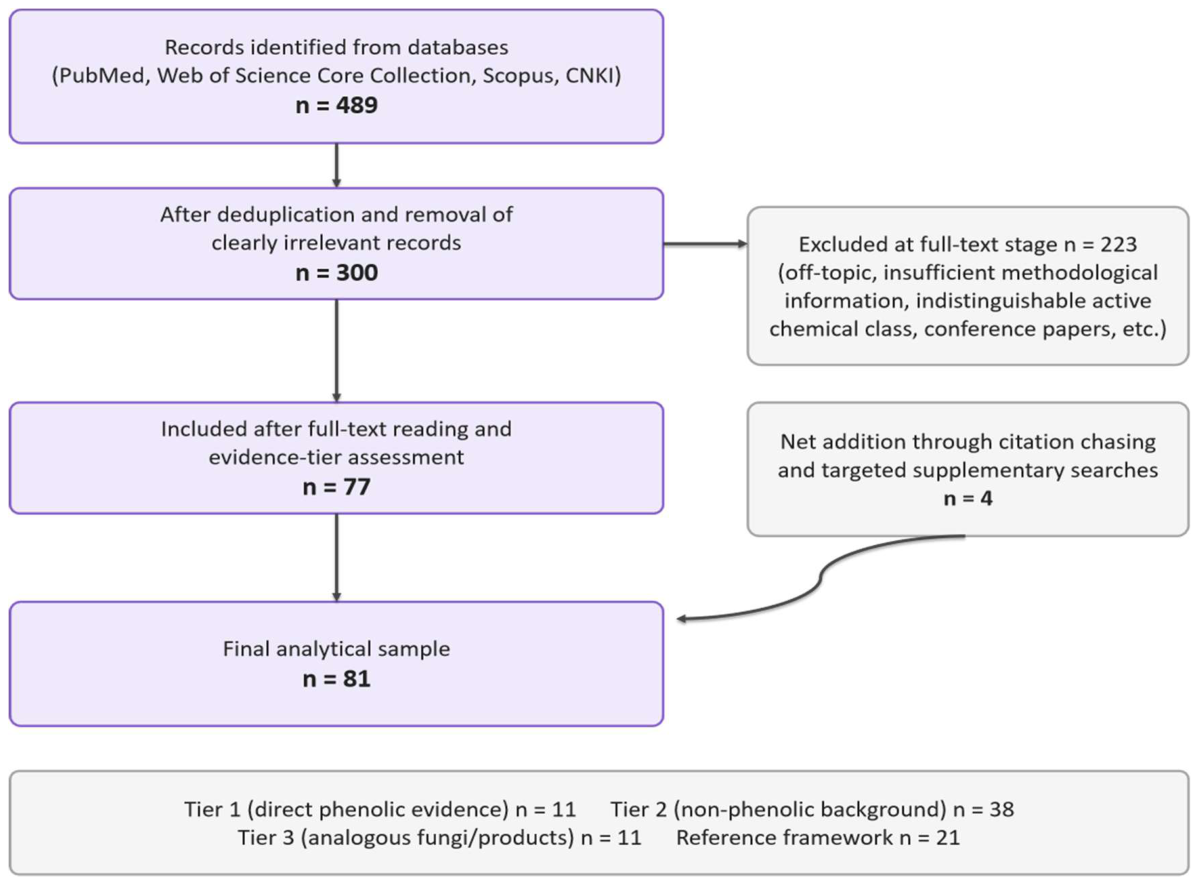
Figure 2.
Five-stage validation pathway and evidence boundaries for anti-melanogenesis research on N. aurantialba phenolic constituents.
Figure 2.
Five-stage validation pathway and evidence boundaries for anti-melanogenesis research on N. aurantialba phenolic constituents.
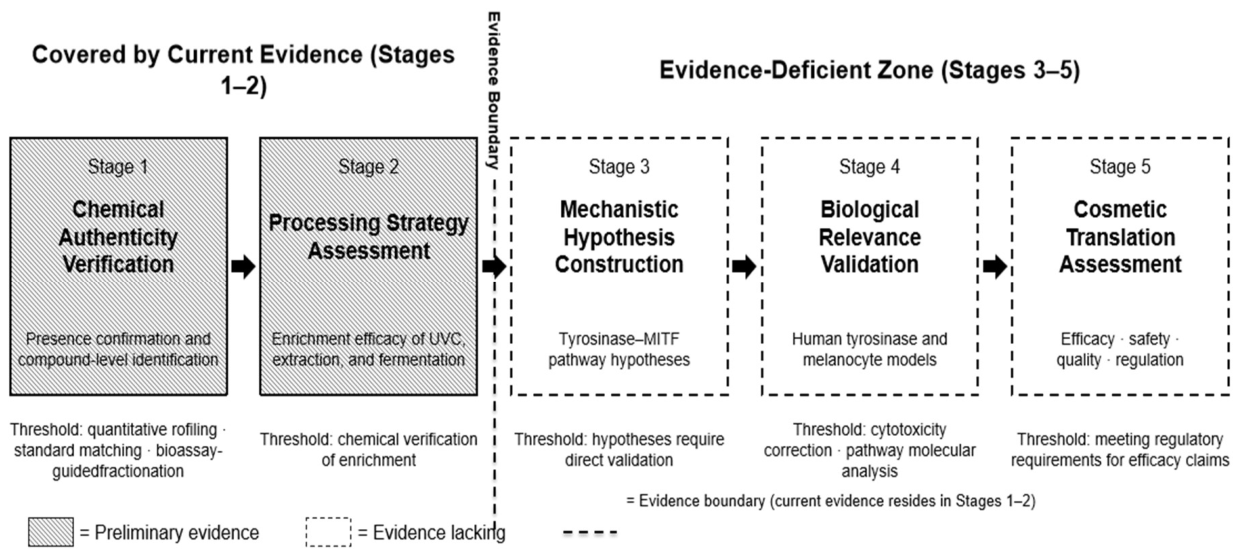
Figure 3.
Evidence gaps in anti-melanogenesis research on N. aurantialba phenolic fractions. Note: Solid boxes with diagonal hatching = preliminary evidence available (Tier 1); gray dashed boxes = evidence lacking; “//” = broken links (Nodes 1–4); the full-width dashed band at the bottom = the parallel missing link of safety/formulation assessment.
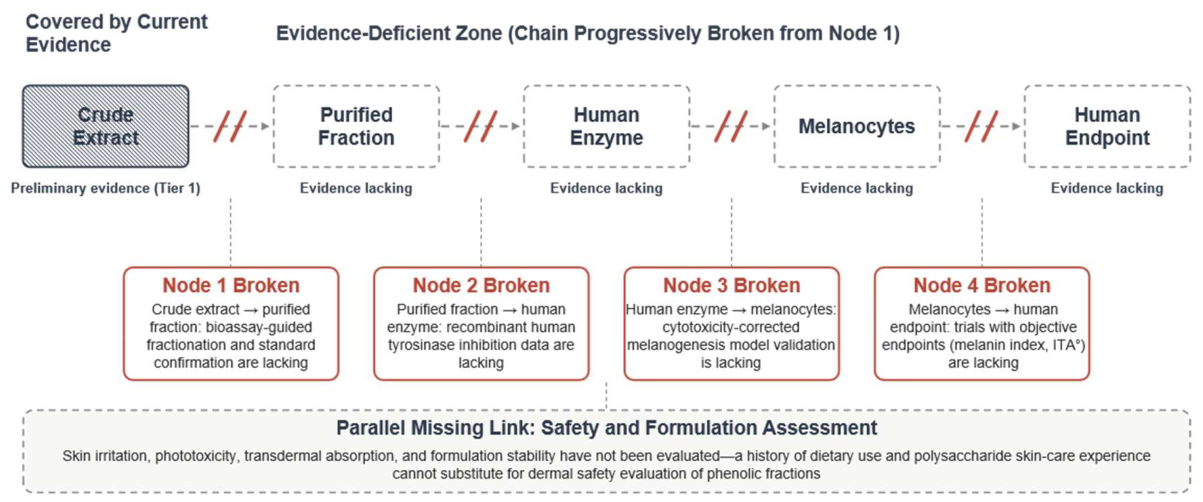

Table 1.
Evidence-tier system for N. aurantialba-related research.
| Evidence tiers and reference framework | Included references (grouped by theme) | Conclusions supported | Conclusions not supported | Evidence boundary warning |
| Tier 1: Direct evidence on N. aurantialba phenolics | [5,6,7,8,9,10,16,49,59,64,65] | N. aurantialba contains phenolic and flavonoid-related constituents; phenolic/flavonoid-containing extracts exhibit antioxidant-related activities; extraction, processing, and small-molecule profiling provide preliminary chemical evidence | Direct inhibition of melanogenesis; regulation of the MITF/TYR/TYRP1/TYRP2 pathway; inhibition of human tyrosinase; verified whitening efficacy | Over-interpretation of total phenolic/flavonoid content and antioxidant assays; insufficient compound-level identification; unpurified fractions cannot be attributed to single molecules; study materials were predominantly commercially cultivated golden ear, which under the latest taxonomic delimitation likely corresponds to N. sinensis rather than N. aurantialba sensu stricto (see Section 3.1) |
| Tier 2: Non-phenolic background evidence on N. aurantialba | [3,4,17,18,19,28,29,30,31,32,33,34,35,36,37,38,39,40,41,42,43,44,45,46,47,48,50,56,57,60,61,62,63,66,67,68,69,81] | N. aurantialba-derived materials (mainly polysaccharide preparations) provide background evidence for anti-inflammatory activity, skin barrier regulation, keratinocyte-related effects, and skin-care relevance | Phenolic-mediated anti-melanogenic effects; tyrosinase inhibition; melanogenesis regulation; whitening effects | Confusing polysaccharide evidence with phenolic evidence; inappropriately applying general skin-care effects to pigmentation regulation |
| Tier 3: Evidence from analogous fungi and natural products | [20,21,25,26,71,72,73,74,75,76,77] | Studies of related fungi and natural products provide mechanistic models revealing the potential roles of fungal metabolites and natural compounds in tyrosinase inhibition and melanogenesis regulation, covering multi-level mechanisms from enzyme activity modulation to intracellular signaling cascades (e.g., MITF and related pathways) | No direct evidence that phenolics from N. aurantialba have equivalent chemical composition, mechanisms, potency, or biological effects | Direct extrapolation of Sanghuangporus or Ganoderma data to N. aurantialba; misuse of analogous evidence as N. aurantialba-specific validation |
| Reference framework: mechanistic, methodological, and regulatory references, and background reviews (not counted as an evidence tier) | [1,2,11,12,13,14,15,22,23,24,27,51,52,53,54,55,58,70,78,79,80] | Provide analytical frameworks and background context for melanogenesis mechanisms, human-relevant validation, assay interpretation, extraction methodology, dermal safety evaluation, and regulatory requirements | Do not verify the efficacy, safety, stability, or cosmetic applicability of N. aurantialba products | Conflating mechanistic plausibility with verified efficacy; misusing methodological or regulatory references as biological validation |
Table 2.
Coding dimensions and rules for the included studies.
| Coding dimension | Coding categories | Coding rules and boundary warnings |
| (1) Biological sample source | Fruiting bodies, mycelia, fermentation products, postharvest-treated materials | Metabolite composition varies with material source, strain characteristics, host–symbiont interactions, and processing status; bioactivity data detached from sample source are not comparable |
| (2) Extraction and preparation strategy | Solvent extraction, ultrasound-assisted extraction, microwave-assisted extraction, fermentation regulation, environmental stress treatment | Improvements in extraction yield or antioxidant indices characterize process performance only and do not constitute evidence of anti-melanogenic superiority; phenolic contributions in plant-substrate bidirectional fermentation cannot be attributed solely to N. aurantialba |
| (3) Chemical characterization strategy | Total phenolic/flavonoid assays → chromatographic profiling → GC-MS untargeted analysis → LC-MS/MS small-molecule annotation → standard-confirmed quantification (increasing analytical depth) | The Folin–Ciocalteu assay measures total reducing capacity, not the identity of phenolic compounds [15]; studies with only total phenolic data are coded at the lowest analytical depth |
| (4) Bioactivity assessment | Chemical antioxidant assays → in vitro enzymatic assays → melanocyte models → molecular mechanism analysis → human-relevant validation (increasing specificity) | Enzyme sources must be stated for enzymatic assays; inhibition results with mushroom tyrosinase do not necessarily predict effects in human systems [14,78] |
| (5) Translational application assessment | Cytotoxicity, skin compatibility, irritation, phototoxicity, formulation stability, efficacy verification, regulatory compliance | Polysaccharide skin-care evidence cannot substitute for dermal safety and anti-melanogenic validation of phenolic fractions; independent assessment per cosmetic efficacy claim and safety evaluation regulations is required [22,23,24] |
Table 3.
Overview of the 81 included studies by evidence tier, publication year, and country/region of the first author’s institution. Note: institutions in Taiwan are counted under China.
Table 3.
Overview of the 81 included studies by evidence tier, publication year, and country/region of the first author’s institution. Note: institutions in Taiwan are counted under China.
| Evidence tier | No. of studies | ≤2010 | 2011–2015 | 2016–2020 | 2021–2026 | Institutions in China (incl. Taiwan) | Institutions in other countries |
| Tier 1: direct evidence on N. aurantialba phenolics | 11 | 0 | 1 | 3 | 7 | 11 | 0 |
| Tier 2: non-phenolic background evidence on N. aurantialba | 38 | 8 | 3 | 6 | 21 | 38 | 0 |
| Tier 3: evidence from analogous fungi and natural products | 11 | 1 | 1 | 2 | 7 | 6 | 5 |
| Methodological/translational reference framework | 21 | 3 | 2 | 6 | 10 | 9 | 12 |
| Total | 81 | 12 | 7 | 17 | 45 | 64 | 17 |
Table 4.
Quantitative phenolic-related evidence reported by Tier 1 studies on N. aurantialba.
| Reference | Material/matrix | Analytes and methods | Reported phenolic-related results | Compound-level confirmation |
| Chen et al. (2011) [5] | Fruiting bodies, 80% acetone extract | Total phenolics (Folin assay) and antioxidant activity | Phenolic concentration of the extract ca. 64–70 µg/mL (gallic acid equivalents) | None |
| Li et al. (2021) [6] | Fruiting bodies | Polyphenol and flavonoid contents (colorimetric) | Polyphenols 0.18%; flavonoids 0.12% | None |
| Zhu (2025) [7] | Fresh fruiting bodies (UVC + modified-atmosphere storage) | Total phenolics (mg GAE/g) and total flavonoids (mg RE/g) | 0.19 kJ/m2 UVC treatment increased total phenolics and flavonoids by 37.39% and 24.8% over the control, respectively | None |
| Yin & Ma (2024) [8] | Total flavonoid extract (microwave-assisted) | Radical scavenging and reducing power (spectrophotometry) | 84% hydroxyl radical scavenging at 0.14 mg/mL; 91% superoxide anion scavenging at 0.07 mg/mL; 90% DPPH scavenging at 0.12 mg/mL | None |
| Yin & Ma (2023) [9] | Fruiting bodies | Microwave-assisted extraction optimization (response surface) | Total flavonoid extraction yield 0.6712% under optimal conditions (solid-to-liquid ratio 1:20, 4 min, 400 W, 60% ethanol) | None |
| Islam et al. (2016) [10] | Commercial fruiting bodies (cultivated, Yunnan) | Total phenolics (Folin), total flavonoids, and HPLC phenolic profiling | Total phenolics 0.80 mg GAE/g; total flavonoids 0.13 mg CAE/g; protocatechuic acid and p-hydroxybenzoic acid detected chromatographically | Partial (chromatographic identification of two phenolic acids) |
| Yan et al. (2022) [16] | Fruiting bodies | UPLC-Q-TOF/MS broad constituent screening + network pharmacology | Annotated constituents dominated by fatty acids, organic acids, amino acid derivatives and saccharides, with only two phenols; no phenolic-targeted confirmation performed | None (accurate mass + database matching) |
| Li et al. (2016) [49] | Fruiting bodies | GC-MS volatile profiling and in vitro antioxidant assays | Complex volatile metabolic profile; no phenolic monomers confirmed | None |
| Niu (2019) [59] | Mycelia (strain “Jin’er 9800”) | Ultrasound-assisted coumarin extraction (orthogonal design) | Total coumarin extraction yield 0.85% under optimal conditions (50% ethanol, liquid-to-solid ratio 25:1, 40 min, 200 W) | None (total content only; no monomers identified) |
| Zhu et al. (2025) [64] | Fresh fruiting bodies, postharvest storage | Moisture state and volatile flavor characterization | No phenolic parameters reported | — |
| Li et al. (2024) [65] | Fruiting bodies (six cooking methods) | Total phenolics, total flavonoids and antioxidant activity | Uncooked control: total phenolics 5.70 mg/g; boiling lowest (2.15 mg/g); oil-based cooking showed higher retention (antioxidant activity ca. 2.18-fold that of boiled samples) | None |
Table 5.
Positioning of N. aurantialba phenolic fractions relative to established anti-melanogenic candidate resources.
Table 5.
Positioning of N. aurantialba phenolic fractions relative to established anti-melanogenic candidate resources.
| Comparison dimension | Established candidate resources (hydroquinone, kojic acid, arbutin, etc. [11,12,13]) | N. aurantialbaphenolic fractions |
| Chemical confirmation | Compound structures confirmed; standards and quality control methods available | Only total phenolic/flavonoid assays and preliminary small-molecule profiles; compound-level confirmation lacking [5,10,28] |
| Mechanistic evidence | Relatively sufficient mechanistic evidence on tyrosinase inhibition and the MITF pathway [11,12,13] | No N. aurantialba-specific mechanistic data; only analogous evidence from Sanghuangporus and Ganoderma [71,72,73] |
| Human and clinical validation | Most have human efficacy or clinical use evidence | No human pigmentation endpoint data |
| Safety and regulatory status | Relatively complete safety dossiers; some ingredients restricted owing to safety concerns | Dietary consumption history and polysaccharide skin-compatibility background [17]; source material has entered the cosmetic new-ingredient filing channel in China, but all filings target polysaccharide-based moisturizing use [81]; dermal safety of phenolic fractions not evaluated [22,23,24] |
| Resource sustainability | Dependent on chemical synthesis or plant extraction | Mature cultivation and submerged fermentation systems enable scalable, controlled production [40,41] |
| Evidence positioning | Verified functional ingredients | Emerging candidate resource at the starting point of the evidence chain |
Disclaimer/Publisher’s Note: The statements, opinions and data contained in all publications are solely those of the individual author(s) and contributor(s) and not of MDPI and/or the editor(s). MDPI and/or the editor(s) disclaim responsibility for any injury to people or property resulting from any ideas, methods, instructions or products referred to in the content. |
© 2026 by the authors. Licensee MDPI, Basel, Switzerland. This article is an open access article distributed under the terms and conditions of the Creative Commons Attribution (CC BY) license (http://creativecommons.org/licenses/by/4.0/).
Copyright: This open access article is published under a Creative Commons CC BY 4.0 license, which permit the free download, distribution, and reuse, provided that the author and preprint are cited in any reuse.