

Submitted:
09 November 2026
Posted:
10 November 2026
You are already at the latest version
Abstract
Rationale: Clinical information is central to clinical judgement and decision-making, but its informativeness, processing, utilisation, and consequences have largely been examined through separate theoretical perspectives. Aims and Objectives: To develop the Clinical Information Framework (CIF), an information-centred framework linking clinical states, information representations, information-processing agents, clinical responses, and subsequent consequences. Method: A conceptual synthesis integrated information theory, information-theoretic models of bounded rationality, Social Judgment Theory, decision-threshold approaches, and decision-analytic and value-of-information perspectives. These traditions were compared according to the aspects of clinical information they address and integrated within a common analytical architecture. Results: CIF distinguishes three evaluative dimensions: clinical informativeness, defined by uncertainty reduction about a task-relevant target; clinical information utilisation, concerning how information is incorporated into clinical judgement or action; and clinical information value, concerning differences in clinically meaningful consequences between information conditions. The framework also addresses information transformation and task-relevant preservation, the conditional contribution of new information, and constraints on information acquisition and processing. Information-response coupling provides an empirical indicator of utilisation but does not by itself establish how information was used, and a change in clinical response does not establish clinical value. Conclusion: CIF provides a common structure for distinguishing what clinical information conveys, how it is transformed and used, and what consequences follow. It may support empirical evaluation of documentation, communication, decision-support, and artificial intelligence-mediated information processes across healthcare.
Keywords:
clinical information
; clinical judgement
; clinical decision-making
; information theory
; information utilisation
; clinical informatics
Introduction
Clinical judgement, clinical reasoning, and clinical decision-making are central to nursing and medical practice. Although these concepts differ in definition and theoretical orientation, they commonly involve recognising and interpreting information about a clinical situation and integrating it into judgement and action. Nursing models describe processes of noticing, interpretation, response, and reflection, while medical accounts similarly emphasise selective acquisition and interpretation of symptoms, signs, findings, and other clinical data in relation to diagnosis and management (Croskerry, 2009; Dickison et al., 2019; Elstein & Schwarz, 2002; Levett-Jones et al., 2010; O’Neill et al., 2005; Tanner, 2006). Across these traditions, clinical information is integral to how clinicians understand situations and decide how to respond.
The primary explanatory focus of these theories, however, is generally the clinician and the cognitive or decisional processes through which information is translated into judgement. Social Judgment Theory, for example, examines how clinicians weight clinical cues, but neither this approach nor the broader clinical reasoning literature usually follows what happens to information across its acquisition, representation, transformation, use, and subsequent consequences (Thompson et al., 2005). Shifting the analytical focus towards clinical information raises distinct questions concerning informativeness, redundancy, transformation, utilisation, and clinical value. Information theory addresses uncertainty and redundancy; cognitive and judgement theories address processing and cue use; and threshold, decision-analytic, and value-of-information approaches connect information to action and expected consequences (Chen & Willan, 2014; Felli & Hazen, 1998; Howard, 1966; Lindley, 1956; Pauker & Kassirer, 1980; Shannon, 1948a, 1948b). These traditions provide complementary resources, but their contributions remain conceptually separated.
Empirical work likewise shows that clinical information problems can arise at different points, including missing important information and environments characterised by overload, underload, scatter, conflict, or error (Beasley et al., 2011; Smith et al., 2005). A common framework that distinguishes what information conveys, how it is transformed and used, and what consequences follow remains less well developed. This paper develops the Clinical Information Framework (CIF) to integrate these perspectives and provide a common structure for studying clinical information under finite processing resources.
Methods
Conceptual Analytic Approach
This article adopts a conceptual analytic approach rather than an empirical or systematic review design. The synthesis integrates established theoretical perspectives that address distinct but connected problems in clinical information processes: uncertainty and target-specific informativeness; information representation and transformation; information processing under finite resources; cue utilisation and translation into clinical responses; and consequence-based clinical value. These perspectives were compared according to the analytical object they address, the relations they formalise, and their implications for empirical study. Integration proceeded by identifying distinctions that should not be collapsed, including information quantity versus task-relevant informativeness, information availability versus utilisation, response change versus clinical value, and preservation of an original representation versus preservation of task-relevant information. These distinctions were then organised within a minimal architecture linking clinical states, information representations, information-processing agents, clinical responses, and consequences. The purpose of the synthesis was theoretical integration rather than exhaustive literature coverage or estimation of empirical effects.
Results
From Information Quantity to Clinical Value: Existing Theoretical Perspectives
An additional clinical observation may clarify a patient’s condition, repeat what is already known, or alter management only when an assessment crosses a decision threshold. Its contribution also depends on whether the clinician can process and use it within available resources. The synthesis is therefore organised around three questions: what information is gained, how is it processed and used, and what clinical value follows from its use?
Information Quantity, Uncertainty, and Redundancy
Shannon’s information theory describes information in terms of uncertainty reduction rather than semantic meaning (Shannon, 1948a, 1948b). In clinical diagnosis, this probabilistic conception implies that the information provided by a test depends on prior uncertainty as well as test performance. Diamond et al. (1981), for example, showed that retaining the magnitude of ST-segment depression provided more diagnostic information than reducing the result to a conventional binary criterion. Mutual information and related measures likewise show that the same test can provide different amounts of information across populations with different pretest probabilities (Benish, 1999, 2003; Somoza & Mossman, 1992). Conversely, additional observations need not provide proportionally more information: repeated laboratory measurements can be substantially redundant (Lee & Maslove, 2015). These findings distinguish data volume from information gain.
This creates a practical tension. Coarse representation can discard clinically relevant distinctions, whereas increasingly detailed or repeated measurement may add little novel information. Rate-distortion theory formalises trade-offs between information rate and tolerated distortion, while the Information Bottleneck method reframes compression around preservation of information about a relevance variable (Shannon, 1959; Tishby et al., 1999). For clinical information, the relevant question is therefore not how much detail a representation retains in the abstract, but which distinctions it preserves for a specified clinical task.
Information Processing by Bounded and Heterogeneous Agents
Classical information measures describe statistical relations between variables, but clinical information is processed by agents with finite capacities. Bounded-rationality models reject the assumption that decision-makers can optimise without processing constraints (Simon, 1955). Information-theoretic formulations make this limitation explicit by treating decision-making as a trade-off between expected utility and the information-processing costs required to adapt behaviour to a state (Genewein et al., 2015; Ortega & Braun, 2013). Rational inattention provides a related account: when processing capacity is limited, observable information cannot all be represented in action with equal precision, so attention must be allocated selectively (Sims, 2003). Behavioural work similarly shows that people adapt information acquisition and decision strategies to task structure, cognitive load, and time pressure (Lai & Gershman, 2024; Payne et al., 1988).
Finite capacity, however, does not explain which information different clinicians use. Social Judgment Theory and the Lens Model distinguish statistical relations between cues and environmental states from the weights decision-makers place on those cues. Nursing studies using this approach demonstrate that available clinical cues are not used uniformly and that cue weights vary between clinicians (Thompson et al., 2005; Yang & Thompson, 2016). Variation also occurs when accumulated evidence is translated into action. Decision-threshold research shows that subjective and contextual factors can alter the point at which information leads to a clinical response (Scarffe et al., 2024). Together, these perspectives distinguish information that is available from information that is selected, weighted, and expressed in judgement or action.
From Information Gain to Clinical Utility
A further distinction is needed between information that changes what is known and information that contributes to better decision-making. Decision theory compares information structures according to the decisions they can support (Blackwell, 1953). In clinical settings, the threshold approach makes the distinction concrete: additional information can change the preferred action when it moves an estimated probability across a consequential decision threshold, whereas a substantial reduction in uncertainty may leave management unchanged (Pauker & Kassirer, 1980). Decision impact therefore depends on the decision problem, not on uncertainty reduction alone.
Clinical utility also extends beyond immediate response change. Hierarchical approaches to diagnostic-test evaluation distinguish diagnostic performance from effects on clinical thinking, management, and patient outcomes (Fryback & Thornbury, 1991), and diagnostic accuracy alone does not establish clinical utility (Bossuyt et al., 2012). Value-of-information approaches similarly define value through expected consequences rather than information gain alone (Chen & Willan, 2014; Felli & Hazen, 1998; Howard, 1966). Information may also have value without changing treatment, as shown for prognostic information (Asch et al., 1990). These perspectives therefore separate uncertainty reduction, response change, and consequence-based value. CIF brings these distinctions together while also incorporating information transformation and resource constraints.
The Clinical Information Framework
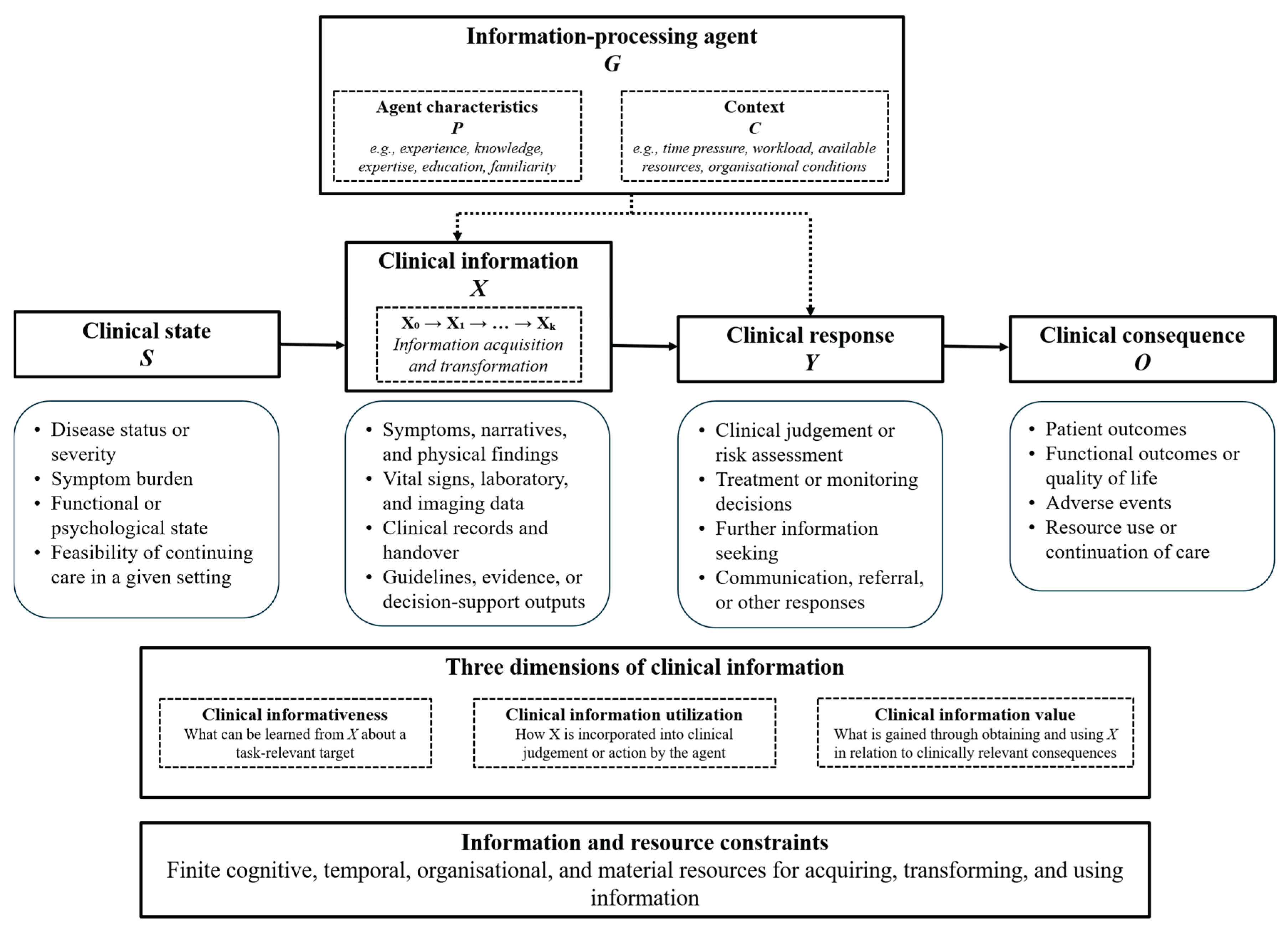
The framework specifies a minimal architecture while allowing internal information representations and transformations to be defined according to the research question. The same architecture can therefore be applied to diagnostic testing, clinical observation, documentation, handover, decision support, guideline information, artificial intelligence-generated summaries, and other forms of clinical information without requiring a fixed sequence of cognitive stages (Figure 1).
Core Architecture and Dimensions of Clinical Information
The minimal architecture of CIF can be represented as:
where S denotes the clinical state of interest, X clinical information, Y a clinical response, and O a clinical consequence or outcome. S represents a clinical state of interest and need not represent a complete or directly observable biological truth. Depending on the research question, it can represent disease status, deterioration, symptom burden, risk, psychological or functional state, or another clinically relevant condition. A task-relevant target T, introduced below, may coincide with S or represent another variable relevant to the task, such as a future outcome or management-relevant target.
S → X → Y → O
Clinical information X is an information representation available, acquired, presented, transmitted, or used in relation to a clinical task. It can include patient-derived observations, information from other healthcare professionals, clinical records and communications, or external sources such as guidelines, scientific evidence, and decision-support outputs. Whether a source is represented as X or as part of the surrounding context depends on its function in the research question rather than on its origin. The relation between S and X does not require all clinical information to be generated directly from S; external information can enter the clinical information process when it is relevant to the task. A further distinction may be required between information that is available and information that is actually acquired. A clinical record may contain relevant observations that a clinician does not retrieve, while a patient's symptoms may remain undocumented because they were not elicited or observed. These situations differ from information that was acquired but subsequently disregarded during judgement. CIF can represent available and acquired information separately when the research question concerns information access, retrieval, or selection. This distinction also prevents information omission from being interpreted uniformly as a failure. Selective acquisition may be appropriate when obtaining additional information requires time, effort, or patient burden and is unlikely to contribute to the clinical task. When multiple information states or representations need to be distinguished, subscripts are used as X0,X1,…,Xk, with their specific meanings defined by the research question.
Clinical response Y is defined broadly to include judgement, information seeking, treatment or monitoring decisions, communication, referral, and other clinically relevant actions. O represents the subsequent consequences of those responses. Separating Y from O is important because a response can change without improving clinically relevant consequences, while a small response change can have substantial consequences in a high-stakes situation.
CIF also makes the information-processing agent explicit. Let G denote the agent who acquires, transforms, interprets, or uses information. Agent characteristics P include relatively stable features such as knowledge, experience, expertise, education, or familiarity, whereas context C includes situational conditions such as workload, time pressure, interruptions, available resources, and organisational conditions. The agent is not confined to the stage between information and response. Clinicians also influence which questions are asked, which observations are recorded, and which sources are consulted. Consequently, differences between clinicians may arise before they encounter an apparently common set of clinical information. CIF distinguishes agent identity from relatively stable characteristics and situational context to locate these differences more precisely. For example, clinical experience may influence the selection and interpretation of cues, while time pressure may change the information acquired by the same clinician. These influences can be examined at different stages without assuming that they operate through a single cognitive mechanism. Studies using Social Judgment Theory have demonstrated between-clinician differences in cue utilisation (Thompson et al., 2005; Yang & Thompson, 2016), while decision-threshold research shows that responses can vary with subjective and contextual factors (Scarffe et al., 2024). At a general level, the distribution of clinical response conditional on information, agent, agent characteristics, and context can be represented as p(Y∣X,G,P,C). This distribution represents the dependence of clinical response on information, agent, agent characteristics, and context. This expression defines a conditioning structure rather than a complete cognitive model; study-specific internal representations can be introduced when required. Within this architecture, CIF distinguishes three evaluative dimensions of clinical information: clinical informativeness, clinical information utilisation, and clinical information value.
Clinical Informativeness
Clinical informativeness concerns how much uncertainty about a specified target is reduced by clinical information. When the clinical state S is the target, informativeness can be represented by mutual information: I(S; X). Here, I(⋅; ⋅) denotes mutual information. More generally, for a task-relevant target T, I(T; X) represents the average reduction in uncertainty about T associated with observing X. The entropy of X alone is therefore not equivalent to clinical informativeness: a variable can contain substantial variation while providing little information about the target. Diagnostic and statistical applications of information theory have similarly treated informativeness as a reduction in uncertainty relative to prior information (Benish, 2003; Diamond et al., 1981; Lindley, 1956). CIF accordingly treats informativeness as a relationship between information and a target rather than as an intrinsic property of a data item. The target must be specified in relation to the clinical task. For example, oxygen saturation may be informative about hypoxaemia but much less informative about hypercapnia. The same distinction applies to external information. A clinical guideline may contribute little new information about a patient's current physiological state while providing information relevant to the choice of management. CIF therefore allows the target to represent a clinical state, a future outcome, or another task-relevant variable. These targets should be distinguished when interpreting informativeness, because a representation that preserves information about one target may lose information relevant to another. For evaluating informativeness as distinct from utilisation, the task-relevant target T should generally be distinguished from the observed clinical response Y. When informativeness is evaluated relative to information already available, this relationship can be expressed conditionally, as developed below under Clinical Information as Conditional Information.
Clinical Information Utilisation
Clinical information utilisation concerns how information is incorporated into clinical judgement or action by an agent. This concept is broader than statistical dependence between observed information and response.
In empirical applications where only X and Y are observed, their mutual information, I(X; Y), can quantify the statistical coupling between information and response. CIF refers to this as information-response coupling. Conditional forms, such as I(X;Y∣G,P,C), can be used when agent or contextual differences are modelled. Information may update a clinical assessment without changing a subsequent treatment decision. Empirically, utilisation will often be assessed by the extent to which variation in X is reflected in variation in the distribution of Y. Conversely, a response may depend strongly on information that provides little information about the specified clinical target. Neither the presence nor the absence of observed coupling establishes how the agent interpreted the information or whether the response was appropriate. Information-response coupling provides a central empirical indicator of utilisation, although an observed association alone does not establish how information was used.
Clinical Information Value
Clinical information value is defined by the consequences associated with one information condition relative to another. The comparison may concern access to a source, its actual acquisition or use, or replacement of one representation by another. Its interpretation depends on which of these conditions the study contrasts. At a general conceptual level, this difference can be represented as:
where E denotes expectation, U(O) denotes the value or utility assigned to clinically relevant consequences O, and X0 and X1 denote the two study-defined information states being compared. This expression does not prescribe a specific estimator. Depending on the task, clinical information value can be operationalised using expected utility, net benefit, regret, Value of Information, observed clinical outcomes, or other explicitly defined consequence-based criteria (Bossuyt et al., 2012; Felli & Hazen, 1998; Fryback & Thornbury, 1991; Howard, 1966; Pauker & Kassirer, 1980).
ΔV = E[U(O)∣X1] − E[U(O)∣X0]
Information may have clinical value even when it leaves immediate management unchanged, as shown in research on prognostic information (Asch et al., 1990). Conversely, a different clinical response does not establish added value unless the consequences relevant to the clinical problem are assessed. Informativeness, utilisation, and clinical value therefore answer different questions about what information conveys, how it is used, and what consequences are associated with its use.
Information Transformation and Optimisation Under Constraints
Clinical information can be observed, selected, recorded, reformatted, summarised, communicated, retrieved, or integrated before use. When such transformation is relevant, X can be expanded as X0 → X1→…→Xk, where each Xi represents a study-defined information state or representation at a particular point in the process. CIF does not prescribe universal labels or stages; intermediate representations are introduced only when they are relevant to the research question. The arrows indicate the direction of an information process rather than a simple causal or Markov chain. New observations, external evidence, or reinterpretation can enter at later stages. The Data Processing Inequality therefore applies only when a specific transformation can legitimately be modelled as a Markov process with no additional downstream information.
A central principle of CIF is task-relevant information preservation. Loss of information from an original representation is not necessarily detrimental if task-relevant information is retained. Rate-distortion theory formalises the trade-off between information rate and tolerated distortion, while the Information Bottleneck method frames compression in terms of preserving information about a relevance variable (Shannon, 1959; Tishby et al., 1999). This distinction motivates separating preservation of the original representation from preservation of task-relevant information.
For a transformation from an original representation X0 to a reduced representation X1, I(X0;X1) quantifies the information shared between the original and reduced representations, whereas I(T;X1) quantifies how informative the reduced representation remains about a task-relevant target T. These measures answer different questions. A clinical summary can therefore contain substantially less information from the original record while preserving most of the information needed for a particular task. A related issue is how distortion should be defined for clinical information. Conventional measures of reconstruction error do not necessarily distinguish information loss according to its relevance to a specified clinical task. A task-specific distortion function could assign different penalties to information loss according to the distinctions that need to be preserved. CIF does not prescribe a universal clinical distortion function. Its specification requires defining the clinical task and the criteria by which information loss is evaluated.
These findings distinguish unnecessary duplication from useful redundancy. Coarse categorisation may discard clinically relevant distinctions, but repeated measurements may also yield little additional information (Diamond et al., 1981; Lee & Maslove, 2015). Some redundancy may protect against missing, erroneous, or poorly transmitted observations, consistent with the role of redundancy in reliable communication and with evidence from clinical handovers (Ong & Coiera, 2010; Shannon, 1948a, 1948b). Whether it is beneficial depends on the clinical task and the processing burden it imposes (Beasley et al., 2011). The optimisation problem is therefore not to minimise information or redundancy, but to balance efficient representation with sufficient robustness for the clinical task. Clinical information acquisition and processing consume finite resources, including clinician time, attention, and cognitive effort, as well as material and organisational resources (Genewein et al., 2015; Ortega & Braun, 2013; Wisner et al., 2019). Information acquisition can also impose costs and burdens on patients, including those associated with unnecessary or repeated testing (Lee & Maslove, 2015). Information-theoretic models of bounded rationality and rational inattention provide a basis for treating information processing as a constrained optimisation problem by formalising trade-offs between expected utility and processing resources (Genewein et al., 2015; Ortega & Braun, 2013; Sims, 2003).
Within CIF, information and resource costs are therefore treated as constraints on acquisition, transformation, and use rather than as a fourth evaluative dimension. At a general conceptual level, information efficiency can be expressed in two complementary forms:
or
where V denotes a defined measure of clinical value, K the information or resource cost, B an available resource budget, and V0 a required level of value. These expressions state the optimisation problem rather than a universal model that must be estimated in every CIF application. The definitions of V and K are task-specific. V can represent patient benefit, avoidance of harm, or other explicitly valued clinical consequences, whereas K can represent information-processing and resource costs such as clinician time, cognitive effort, organisational or material resources, and patient burden. When a selected measure of clinical value already incorporates particular resource consequences, those consequences should not be counted again in K. Information efficiency in CIF concerns the preservation and use of task-relevant information to generate clinical value under finite resources, rather than simply maximising information per unit of time or cost. A representation that requires less processing may be preferable when it achieves comparable clinical value, even if it retains less of the original information. Alternatively, a more resource-intensive process may be justified when it produces a sufficiently greater clinical benefit. These comparisons need not identify a single universally optimal information process. Different clinical settings may require different balances between resource use and valued consequences. The purpose of the optimisation formulation is to make these trade-offs explicit rather than to impose a common efficiency metric across clinical tasks. This extends the information-theoretic problem of efficient representation and transmission to the acquisition, transformation, and use of clinical information.
maxVsubject to K ≤ B,
minKsubject to V ≥ V0,
Clinical Information as Conditional Information
Another important property of clinical information is that its informativeness, utilisation, and value depend on the information already available when new information is obtained. Let X0 denote the information state currently available and X1 the updated information state after additional information has been incorporated. Uncertainty about the clinical state can then be represented by the change from p(S∣X0) to p(S∣X1). These distributions need not represent a clinician’s literal subjective Bayesian beliefs; they can also represent model-based or population-level uncertainty. The incremental informativeness associated with the transition from X0 to X1 can be represented by conditional mutual information: I(S; X1∣X0), or more generally I(T; X1∣X0) for a task-relevant target T. If the transition from X0 to X1 adds little target-relevant information, its incremental contribution is small.
Statistical and diagnostic applications of information theory support this principle: the information contributed by an observation depends on prior uncertainty and on the information already available (Benish, 2003; Diamond et al., 1981; Lindley, 1956). CIF extends this principle to other forms of clinical information. Conditionality operates at three related levels. Informational conditionality concerns the additional task-relevant information gained in moving from X0 to X1, as represented by I(T;X1∣X0). Behavioural conditionality concerns whether the response distribution changes between the two information states, for example by comparing p(Y∣X1,G,P,C) with p(Y∣X0,G,P,C). Value conditionality concerns whether decisions made under X1 improve expected consequences relative to those made under X0. These forms of conditionality need not coincide. A small informational update can cross a decision threshold, whereas a larger one may leave the preferred action unchanged. The consequences of crossing that threshold, rather than the size of the informational update alone, determine its decision value (Chen & Willan, 2014; Felli & Hazen, 1998; Howard, 1966; Pauker & Kassirer, 1980).
CIF therefore treats clinical information as relational and conditional. Its contribution depends on what is already known, the task-relevant target, the agent and context, and the consequences of alternative responses. Table 2 summarises the principal CIF components and possible empirical approaches.

Table 1.
Theoretical foundations and conceptual integration of the Clinical Information Framework.
| CIF component | Theoretical foundations | Integration within CIF |
|---|---|---|
| Clinical informativeness | Information and uncertainty (Shannon, 1948a, 1948b); experimental information (Lindley, 1956); diagnostic information (Benish, 2003; Diamond et al., 1981; Somoza & Mossman, 1992). | Target-specific uncertainty reduction, distinguished from information quantity and evaluated relative to information already available. |
| Clinical information utilisation | Cue utilisation in clinical judgement (Thompson et al., 2005; Yang & Thompson, 2016); decision thresholds linking clinical assessment to action (Pauker & Kassirer, 1980); bounded information processing (Genewein et al., 2015; Ortega & Braun, 2013; Sims, 2003). | Incorporation of information into judgement or action by agents with differing characteristics and processing constraints. |
| Clinical information value | Value of information (Chen & Willan, 2014; Felli & Hazen, 1998; Howard, 1966); decision thresholds and clinical utility (Bossuyt et al., 2012; Fryback & Thornbury, 1991; Pauker & Kassirer, 1980); value without treatment change (Asch et al., 1990). | Comparative evaluation of clinically meaningful consequences, distinguished from uncertainty reduction and response change. |
| Information transformation and task-relevant preservation | Rate-distortion theory (Shannon, 1959); Information Bottleneck (Tishby et al., 1999); clinical redundancy and safety (Lee & Maslove, 2015; Ong & Coiera, 2010). | Preservation of task-relevant information through transformation, balancing efficient representation and robustness. |
| Information-response coupling | Statistical dependence and mutual information (Shannon, 1948a, 1948b; Benish, 2003). | Central empirical indicator of utilisation, capturing statistical relationships between information and response without fully characterising the underlying process. |
| Information and resource constraints | Bounded rationality (Simon, 1955); rational inattention and information-processing costs (Genewein et al., 2015; Ortega & Braun, 2013; Sims, 2003). | Finite resources constrain information acquisition, transformation, and utilisation without constituting a fourth evaluative dimension. |
| Information efficiency | Efficient representation and preservation (Shannon, 1959; Tishby et al., 1999); resource-constrained optimisation (Genewein et al., 2015; Ortega & Braun, 2013); value of information (Felli & Hazen, 1998; Howard, 1966). | Generation of clinical value through task-relevant information acquisition, transformation, and use under finite resources. |
| Conditional contribution of clinical information | Prior information and uncertainty (Benish, 2003; Diamond et al., 1981; Lindley, 1956); decision thresholds and value of information (Chen & Willan, 2014; Pauker & Kassirer, 1980). | Incremental informativeness, relationships with clinical responses, and clinical value depend on information already available and need not change together. |
CIF, Clinical Information Framework. The theoretical foundations identify established concepts and findings informing each component, while the final column describes their integration within CIF. Clinical informativeness, clinical information utilisation, and clinical information value constitute the three evaluative dimensions. The remaining components represent related processes, observable relationships, constraints, optimisation objectives, or cross-cutting principles.
Table 2.
Components of the Clinical Information Framework and possible empirical approaches.
| Concept | Role in CIF | Core question | Possible empirical approaches |
|---|---|---|---|
| Clinical informativeness | One of the three evaluative dimensions | What can be learned from X about a task-relevant target? | I(T; X), I(S; X), conditional mutual information |
| Information transformation and task-relevant preservation | Process / principle | What task-relevant information is retained or lost through transformation? | Comparison of I(T;Xi) across X0,…,Xk |
| Clinical information utilisation | One of the three evaluative dimensions | How is information incorporated into clinical judgement or action? | Cue weighting, judgment analysis, experimental manipulation, process measures |
| Information-response coupling | Central empirical indicator of utilisation, not utilisation itself | To what extent is variation in X reflected in variation in Y? |
I(X;Y), I(X;Y∣G,P,C), response-distribution analyses |
| Clinical information value | One of the three evaluative dimensions | How do clinically meaningful consequences differ between information conditions? | Expected utility, net benefit, regret, Value of Information, clinical outcomes |
| Information and resource constraints | Constraint on the information process, not a fourth evaluative dimension | What finite resources constrain acquisition, transformation, and use? | Time, cognitive effort, workload, monetary/material resources, patient burden |
| Information efficiency | Optimisation objective under resource constraints | How efficiently is task-relevant information converted into clinical value? | Maximise clinical value subject to a resource budget; minimise resource use subject to a specified value or utility level |
CIF, Clinical Information Framework; S, clinical state; X, clinical information; Y, clinical response; T, task-relevant target; G, information-processing agent; P, agent characteristics; C, context; X0,…,Xk denote study-defined information states or representations; when arranged sequentially, they represent stages of acquisition or transformation. The concepts and empirical approaches shown are illustrative rather than prescriptive. Informativeness, utilisation, relationships with clinical responses, and clinical value can depend on information already available, the agent, and the context. CIF does not require a single measure or analytic method for any component.
Discussion
What CIF Adds to Existing Perspectives
Existing accounts of clinical reasoning explain how clinicians notice and interpret cues, develop hypotheses, and translate evidence into action (Elstein & Schwarz, 2002; Pauker & Kassirer, 1980; Tanner, 2006; Thompson et al., 2005). CIF retains these processes within a broader account of how clinical information is acquired, represented, transformed, used, and connected to consequences. It also differs from sociotechnical models, which focus on interactions among technology, people, workflow, communication, and organisational context (Sittig & Singh, 2010). The Clinical Information Quality framework is particularly relevant because it evaluates clinical information in digital health technologies through informativeness, availability, and usability (Fadahunsi et al., 2022, 2025). CIF defines informativeness more narrowly as uncertainty reduction about a specified target and extends analysis to utilisation, clinical responses, and consequence-based value across digital and non-digital settings.
The contribution of CIF lies in treating these as related but non-equivalent questions. An information source may be highly informative without being used; information may alter a response without improving its consequences; and transformation may reduce similarity to the original representation while preserving task-relevant information. These distinctions also localise different intervention problems. Missing observations concern availability; loss of clinically relevant detail during summarisation concerns preservation; failure to incorporate available information concerns utilisation; and a changed response requires separate evaluation of its consequences before clinical value can be established.
These distinctions are increasingly relevant as electronic records, decision-support systems, and artificial intelligence transform large volumes of clinical information. The central problem is not simply whether such systems increase or reduce information, but whether they preserve task-relevant information in a form that can be used effectively and contribute to clinical value (Bednarczyk et al., 2025; Croxford et al., 2025).
Implications for Clinical Practice and Research
An information-centred perspective is relevant across clinical professions because observation, documentation, communication, information integration, judgement, and action all depend on how clinical information is represented and used. Nursing provides a particularly clear example because nurses participate throughout this process and often coordinate information across patients, records, professionals, and care settings. Digital systems can alter several parts of this process simultaneously, including what information is available, how it is represented, and the effort required to retrieve and interpret it (Hants et al., 2023; Wisner et al., 2019). Empirical studies illustrate different points in this information process. A nationwide survey of psychiatric home-visit nurses identified discrepancies between information considered necessary for subsequent care and information actually received from hospitals (Takashima & Ishikawa, 2025), while a randomised simulated home-visit nursing study found that access to guideline-informed artificial intelligence was associated with lower perceived mental effort and task difficulty and greater confidence than no access to external resources (Ishikawa et al., 2026).
For practice, CIF provides a way to locate where an information intervention succeeds or fails rather than evaluating it as a single undifferentiated intervention. The practical questions become which information should be available, what task-relevant distinctions should be preserved, whether clinicians incorporate the information into judgement or action, and whether the resulting consequences are clinically preferable.
For research, these questions can be examined separately within a common design. For example, clinicians could assess the same simulated cases using a conventional clinical record or a structured summary. Investigators could first examine whether the summary preserves information relevant to a specified target, then whether response distributions differ between information conditions, and finally whether resulting judgements or actions meet predefined clinical criteria at acceptable time or processing cost. Process measures could complement information-response coupling by indicating which information was attended to or incorporated. Response entropy, Jensen-Shannon divergence, mutual information, and conditional mutual information can address different distributional or dependency questions, but none alone establishes how information was interpreted or whether a response was clinically preferable. CIF therefore provides a structure for matching empirical measures to the part of the information process being studied.
Scope, Limitations, and Future Development
CIF is a conceptual framework for studying clinical information processes rather than a comprehensive theory of clinical cognition or a model for determining optimal clinical actions. Its minimal architecture allows information representations, transformations, agents, responses, and consequences to be specified according to the research question and applied across observation, documentation, handover, assessment, diagnostic testing, and decision support.
The framework provides conceptual distinctions rather than a complete measurement system. Information-response coupling cannot by itself determine how a cue was incorporated into judgement or exclude alternative explanations. Experimental manipulation, process measures, and other study-specific approaches may therefore be required. Studies of information preservation must specify a task-relevant target; evaluations of clinical value require a comparator and explicit criteria for valued consequences; and resource costs require setting-specific operational definitions.
The minimal architecture also simplifies processes that are often iterative, longitudinal, and distributed across multiple agents and artefacts. Clinical responses can alter subsequent clinical states and information, while information may be selected, reinterpreted, or supplemented as it passes among patients, professionals, records, and artificial systems (Hazlehurst et al., 2007). CIF can represent such processes through successive information states, agents, and responses, but empirical applications are needed to determine where the proposed distinctions are most useful, how reliably they can be measured, and where additional concepts are required.
Conclusion
By treating informativeness, utilisation, and clinical value as separate questions, CIF provides a basis for examining whether an information intervention preserves what matters for a clinical task, changes how information is used, and improves valued consequences. Empirical applications will need to specify task-relevant targets, information conditions, response measures, consequences, and resource constraints. By providing a common structure for these evaluations, CIF may support the design and assessment of documentation, communication, decision-support, and artificial intelligence-mediated information processes across clinical practice and healthcare research.
Ethics Statement
Ethics approval was not required because this conceptual analysis did not involve human participants, animals, or individual-level data.
Data Availability Statement
Data sharing is not applicable to this article as no datasets were generated or analysed during the current study.
Acknowledgments
This research received no specific grant from any funding agency in the public, commercial, or not-for-profit sectors.
Conflicts of Interest Statement
The author declares no conflicts of interest.
References
- Asch, D. A., Patton, J. P., & Hershey, J. C. (1990). Knowing for the sake of knowing: The value of prognostic information. Medical Decision Making, 10(1), 47–57. [CrossRef]
- Beasley, J. W., Wetterneck, T. B., Temte, J., Lapin, J. A., Smith, P., Rivera-Rodriguez, A. J., & Karsh, B.-T. (2011). Information chaos in primary care: Implications for physician performance and patient safety. The Journal of the American Board of Family Medicine, 24(6), 745–751. [CrossRef]
- Bednarczyk, L., Reichenpfader, D., Gaudet-Blavignac, C., Ette, A. K., Zaghir, J., Zheng, Y., Bensahla, A., Bjelogrlic, M., & Lovis, C. (2025). Scientific evidence for clinical text summarization using large language models: Scoping review. Journal of Medical Internet Research, 27, Article e68998. [CrossRef]
- Benish, W. A. (1999). Relative entropy as a measure of diagnostic information. Medical Decision Making, 19(2), 202–206. [CrossRef]
- Benish, W. A. (2003). Mutual information as an index of diagnostic test performance. Methods of Information in Medicine, 42(3), 260–264. [CrossRef]
- Blackwell, D. (1953). Equivalent comparisons of experiments. The Annals of Mathematical Statistics, 24(2), 265–272. [CrossRef]
- Bossuyt, P. M. M., Reitsma, J. B., Linnet, K., & Moons, K. G. M. (2012). Beyond diagnostic accuracy: The clinical utility of diagnostic tests. Clinical Chemistry, 58(12), 1636–1643. [CrossRef]
- Chen, M. H., & Willan, A. R. (2014). Value of information methods for assessing a new diagnostic test. Statistics in Medicine, 33(11), 1801–1815. [CrossRef]
- Croskerry, P. (2009). A universal model of diagnostic reasoning. Academic Medicine, 84(8), 1022–1028. [CrossRef]
- Croxford, E., Gao, Y., Pellegrino, N., Wong, K., Wills, G., First, E., Liao, F., Goswami, C., Patterson, B., & Afshar, M. (2025). Current and future state of evaluation of large language models for medical summarization tasks. npj Health Systems, 2, Article 6. [CrossRef]
- Diamond, G. A., Hirsch, M., Forrester, J. S., Staniloff, H. M., Vas, R., Halpern, S. W., & Swan, H. J. (1981). Application of information theory to clinical diagnostic testing: The electrocardiographic stress test. Circulation, 63(4), 915–921. [CrossRef]
- Dickison, P., Haerling, K. A., & Lasater, K. (2019). Integrating the National Council of State Boards of Nursing Clinical Judgment Model into nursing educational frameworks. Journal of Nursing Education, 58(2), 72–78. [CrossRef]
- Elstein, A. S., & Schwarz, A. (2002). Clinical problem solving and diagnostic decision making: Selective review of the cognitive literature. BMJ, 324(7339), 729–732. [CrossRef]
- Fadahunsi, K. P., Wark, P. A., Mastellos, N., Neves, A. L., Gallagher, J., Majeed, A., & Car, J. (2025). A novel framework to assess clinical information in digital health technologies: Cross-sectional survey study. JMIR Medical Informatics, 13, Article e58125. [CrossRef]
- Fadahunsi, K. P., Wark, P. A., Mastellos, N., Neves, A. L., Gallagher, J., Majeed, A., Webster, A., Smith, A., Choo-Kang, B., Leon, C., Edwards, C., O’Shea, C., Heitz, E., Kayode, O. V., Nash, M., Kowalski, M., Jiwani, M., O’Callaghan, M. E., Zary, N.,... Car, J. (2022). Assessment of clinical information quality in digital health technologies: International eDelphi study. Journal of Medical Internet Research, 24(12), Article e41889. [CrossRef]
- Felli, J. C., & Hazen, G. B. (1998). Sensitivity analysis and the expected value of perfect information. Medical Decision Making, 18(1), 95–109. [CrossRef]
- Fryback, D. G., & Thornbury, J. R. (1991). The efficacy of diagnostic imaging. Medical Decision Making, 11(2), 88–94. [CrossRef]
- Genewein, T., Leibfried, F., Grau-Moya, J., & Braun, D. A. (2015). Bounded rationality, abstraction, and hierarchical decision-making: An information-theoretic optimality principle. Frontiers in Robotics and AI, 2, Article 27. [CrossRef]
- Hants, L., Bail, K., & Paterson, C. (2023). Clinical decision-making and the nursing process in digital health systems: An integrated systematic review. Journal of Clinical Nursing, 32(19–20), 7010–7035. [CrossRef]
- Hazlehurst, B., McMullen, C. K., & Gorman, P. N. (2007). Distributed cognition in the heart room: How situation awareness arises from coordinated communications during cardiac surgery. Journal of Biomedical Informatics, 40(5), 539–551. [CrossRef]
- Howard, R. A. (1966). Information value theory. IEEE Transactions on Systems Science and Cybernetics, 2(1), 22–26. [CrossRef]
- Ishikawa, T., Imura, H., Kitazawa, T., & Takashima, Y. (2026). Guideline-informed AI chat access and perceived mental effort in a simulated home-visit nursing task: A randomized controlled trial. BMC Nursing. [CrossRef]
- Lai, L., & Gershman, S. J. (2024). Human decision making balances reward maximization and policy compression. PLOS Computational Biology, 20(4), Article e1012057. [CrossRef]
- Lee, J., & Maslove, D. M. (2015). Using information theory to identify redundancy in common laboratory tests in the intensive care unit. BMC Medical Informatics and Decision Making, 15, Article 59. [CrossRef]
- Levett-Jones, T., Hoffman, K., Dempsey, J., Jeong, S. Y.-S., Noble, D., Norton, C. A., Roche, J., & Hickey, N. (2010). The “five rights” of clinical reasoning: An educational model to enhance nursing students’ ability to identify and manage clinically “at risk” patients. Nurse Education Today, 30(6), 515–520. [CrossRef]
- Lin, J. (1991). Divergence measures based on the Shannon entropy. IEEE Transactions on Information Theory, 37(1), 145–151. [CrossRef]
- Lindley, D. V. (1956). On a measure of the information provided by an experiment. The Annals of Mathematical Statistics, 27(4), 986–1005. [CrossRef]
- O’Neill, E. S., Dluhy, N. M., & Chin, E. (2005). Modelling novice clinical reasoning for a computerized decision support system. Journal of Advanced Nursing, 49(1), 68–77. [CrossRef]
- Ong, M. S., & Coiera, E. (2010). Safety through redundancy: A case study of in-hospital patient transfers. Quality and Safety in Health Care, 19(5), Article e32. [CrossRef]
- Ortega, P. A., & Braun, D. A. (2013). Thermodynamics as a theory of decision-making with information-processing costs. Proceedings of the Royal Society A: Mathematical, Physical and Engineering Sciences, 469(2153), Article 20120683. [CrossRef]
- Pauker, S. G., & Kassirer, J. P. (1980). The threshold approach to clinical decision making. The New England Journal of Medicine, 302(20), 1109–1117. [CrossRef]
- Payne, J. W., Bettman, J. R., & Johnson, E. J. (1988). Adaptive strategy selection in decision making. Journal of Experimental Psychology: Learning, Memory, and Cognition, 14(3), 534–552. [CrossRef]
- Scarffe, A., Coates, A., Brand, K., & Michalowski, W. (2024). Decision threshold models in medical decision making: A scoping literature review. BMC Medical Informatics and Decision Making, 24, Article 273. [CrossRef]
- Shannon, C. E. (1948a). A mathematical theory of communication. The Bell System Technical Journal, 27(3), 379–423. [CrossRef]
- Shannon, C. E. (1948b). A mathematical theory of communication. The Bell System Technical Journal, 27(4), 623–656. [CrossRef]
- Shannon, C. E. (1959). Coding theorems for a discrete source with a fidelity criterion. IRE National Convention Record, 4, 142–163.
- Simon, H. A. (1955). A behavioral model of rational choice. The Quarterly Journal of Economics, 69(1), 99–118. [CrossRef]
- Sims, C. A. (2003). Implications of rational inattention. Journal of Monetary Economics, 50(3), 665–690. [CrossRef]
- Sittig, D. F., & Singh, H. (2010). A new sociotechnical model for studying health information technology in complex adaptive healthcare systems. Quality and Safety in Health Care, 19(Suppl. 3), i68–i74. [CrossRef]
- Smith, P. C., Araya-Guerra, R., Bublitz, C., Parnes, B., Dickinson, L. M., Van Vorst, R., Westfall, J. M., & Pace, W. D. (2005). Missing clinical information during primary care visits. JAMA, 293(5), 565–571. [CrossRef]
- Somoza, E., & Mossman, D. (1992). Comparing and optimizing diagnostic tests: An information-theoretical approach. Medical Decision Making, 12(3), 179–188. [CrossRef]
- Takashima, Y., & Ishikawa, T. (2025). Assessing the sufficiency of patient information transfer from hospitals to psychiatric home-visit nurses: A nationwide cross-sectional survey. Global Health & Medicine, 7(3), 260–265. [CrossRef]
- Tanner, C. A. (2006). Thinking like a nurse: A research-based model of clinical judgment in nursing. Journal of Nursing Education, 45(6), 204–211. [CrossRef]
- Thompson, C. A., Foster, A., Cole, I., & Dowding, D. W. (2005). Using social judgement theory to model nurses’ use of clinical information in critical care education. Nurse Education Today, 25(1), 68–77. [CrossRef]
- Tishby, N., Pereira, F. C., & Bialek, W. (1999). The information bottleneck method. In Proceedings of the 37th Annual Allerton Conference on Communication, Control, and Computing (pp. 368–377).
- Wisner, K., Lyndon, A., & Chesla, C. A. (2019). The electronic health record’s impact on nurses’ cognitive work: An integrative review. International Journal of Nursing Studies, 94, 74–84. [CrossRef]
- Yang, H., & Thompson, C. (2016). Capturing judgement strategies in risk assessments with improved quality of clinical information: How nurses’ strategies differ from the ecological model. BMC Medical Informatics and Decision Making, 16, Article 7. [CrossRef]
Figure 1.
Conceptual architecture of the Clinical Information Framework (CIF). The minimal architecture links a clinical state (S), clinical information (X), a clinical response (Y), and a clinical consequence (O). Clinical information can be represented as a series of information states (X₀, X₁, …, Xₖ) when acquisition or transformation is relevant to the research question. The information-processing agent (G), including agent characteristics (P), and context (C) can influence information acquisition, transformation, utilisation, and response. CIF distinguishes three evaluative dimensions: clinical informativeness, clinical information utilisation, and clinical information value. Information and resource constraints operate across the clinical information process rather than constituting an additional dimension. Examples shown in the figure are illustrative rather than exhaustive. Arrows indicate the direction of the information process and do not imply a simple causal or Markov chain.
Figure 1.
Conceptual architecture of the Clinical Information Framework (CIF). The minimal architecture links a clinical state (S), clinical information (X), a clinical response (Y), and a clinical consequence (O). Clinical information can be represented as a series of information states (X₀, X₁, …, Xₖ) when acquisition or transformation is relevant to the research question. The information-processing agent (G), including agent characteristics (P), and context (C) can influence information acquisition, transformation, utilisation, and response. CIF distinguishes three evaluative dimensions: clinical informativeness, clinical information utilisation, and clinical information value. Information and resource constraints operate across the clinical information process rather than constituting an additional dimension. Examples shown in the figure are illustrative rather than exhaustive. Arrows indicate the direction of the information process and do not imply a simple causal or Markov chain.
Disclaimer/Publisher’s Note: The statements, opinions and data contained in all publications are solely those of the individual author(s) and contributor(s) and not of MDPI and/or the editor(s). MDPI and/or the editor(s) disclaim responsibility for any injury to people or property resulting from any ideas, methods, instructions or products referred to in the content. |
© 2026 by the authors. Licensee MDPI, Basel, Switzerland. This article is an open access article distributed under the terms and conditions of the Creative Commons Attribution (CC BY) license (http://creativecommons.org/licenses/by/4.0/).
Copyright: This open access article is published under a Creative Commons CC BY 4.0 license, which permit the free download, distribution, and reuse, provided that the author and preprint are cited in any reuse.