
Submitted:
08 November 2026
Posted:
10 November 2026
You are already at the latest version
Abstract
The large number of various requests for fleet management systems needs to be handled promptly, such as right-of-way grant applications, collision avoidance rerouting and task assignments. Among them, right-of-way grants and collision-avoidance requests will cause a protective stop of the robot if they exceed the deadline; task assignment requests can be delayed. The current system handles all requests through a first-come, first-served thread pool and fails to control tail latency for high-priority requests during peak load. We model the fleet management system as a mixed-criticality real-time system and propose a two-level scheduling framework (MC-TLS). The first level applies earliest-deadline-first scheduling and admission control using empirical upper-tail execution-time quantiles, while the second level employs a constant-bandwidth server to allocate processing budgets to soft-real-time requests and reduces their available bandwidth under overload. An end-to-end response-time assessment incorporates queuing, execution, communication, and scheduling overhead under the evaluated workload. MC-TLS was evaluated in an operational fleet management system serving 800 mobile robots. This 800-robot deployment constitutes the production baseline, whereas the larger fleet configurations were examined separately in the scalability evaluation.The production workload comprises right-of-way granting, collision-avoidance replanning, and task assignment requests, with deadlines of 50 ms, 200 ms, and 2 s, respectively. The reported peak arrival rate in the 800-robot production environment is 4,200 requests/s.The evaluation reported a maximum observed response time of 41 ms in the analyzed latency series and a model-derived reference of 47 ms, compared with a 99.9th-percentile latency of 312 ms for FCFS. The reported deadline-miss rate decreased to 0.003%, while task-assignment starvation was 14% under fixed-priority scheduling and 0% under MC-TLS. These results demonstrate improved deadline compliance under the evaluated workload. However, because admission control relies on an upper-tail quantile of historical execution-time distributions rather than a certified worst-case execution-time (WCET) bound, the findings do not establish deterministic schedulability guarantees.Protective stops due to request timeouts were reduced by 63%, fleet throughput increased by 7.8%, and processor utilisation remained at 78%. During the reported 30-day production observation, the 800-robot system processed 2.6×10⁹ requests, corresponding to an average processing rate of approximately 1,003 requests/s. These production observations are distinguished from the separate scalability evaluation.A separate scalability stress test examined fleet sizes from 800 to 1,400 robots under unchanged server hardware and scheduling parameters, corresponding to a 75% increase in the evaluated fleet size. The 1,400-robot configuration is not included in the reported 30-day, 800-robot production observation.This study integrates mixed-criticality scheduling into fleet management software and provides a workload-conditioned approach to deadline assurance and end-to-end latency assessment.
Keywords:
real-time systems
; robotic fleet management
; hybrid criticality-based scheduling
; earliest deadline priority
; response time analysis
; multi-robot systems
1. Introduction
The main functions of a robotic fleet management system are task assignment, path coordination, right-of-way control and collision-avoidance replanning. Scheduling requests arrive asynchronously, have different time limits, and the degree of irregularity in criticality varies; therefore, a single queue cannot be used to manage all types of requests, and both the deadline requirements of hard real-time tasks and the continuous-service needs of soft real-time tasks cannot be met simultaneously by conventional shared-thread pools or fixed-priority mechanisms. Under high-concurrency circumstances, this way will be susceptible to problems such as queue interference, tail delay expansion, and prolonged waiting time for low-priority requests. Given the problem of temporal conflict, the fleet management request should be regarded as a hybrid criticality-based real-time system, and a unified scheduling mechanism needs to be constructed to classify requests, isolate resources, control access, and analyze end-to-end latency.
Based on this, we build a hybrid two-level real-time scheduling framework for robotic fleet management systems and map right-of-way grants, collision-avoidance replanning and task assignment requests to different criticality levels. The deadline-sensitive scheduling layer adopts EDF and empirical execution-time quantile-based admission control, while the soft-real-time layer uses a constant-bandwidth server for budget management and overload degradation. The response-time model accounts for queuing, execution, communication, and scheduling overhead to assess deadline compliance under the specified workload conditions.To extend the evaluation beyond the observed production peak of 4,200 requests/s, an additional burst-arrival stress test should examine arrival rates of 6,300, 8,400, and 12,600 requests/s, corresponding to 1.5, 2, and 3 times the production peak. Each rate should be tested with burst durations of 100, 500, and 1,000 ms, producing nine rate-duration combinations. Each combination should be repeated 30 times using the same request-class distribution and deadline settings of 50 ms, 200 ms, and 2 s. The evaluation should record per-class P95, P99, P99.9, and maximum response times, deadline-miss rates, maximum queue lengths, queue recovery times, processor utilization, fleet throughput, and soft-real-time starvation ratios. Request latency, resource allocation and scalability performance were evaluated in conjunction with the respective experimental scenarios.
2. Modeling of Mixed Criticality Requests in Robot Fleets and End-to-End Latency Constraints
The fleet manager uniformly encapsulates asynchronously arriving requests into task instances consisting of four fields: arrival time ai , execution budget Ci, relative deadline Di, and criticality level Li. Then, it maps those requests to two tiers — hard and soft — for right-of-way allocation, collision-avoiding re-planning, and task assignment. The implementation layer writes a monotonically increasing clock time stamp in the five phases of Request Receiving, Preparing Queuing, Service Execution, Message Sending, and State Synchronization, so that the Scheduler can compute Processor Utilization and End-To-End Delay under Common Time Reference[1]. The delay constraints for requests i are defined as follows:
 where Ri is the end-to-end delay from the request’s entry into the fleet manager to the completion of the response; Qi is the cumulative queuing time at each scheduling node; Ei is the actual service execution time; Ni is the inter-process message transmission time; Si is the overhead for synchronization, wake-up, and scheduling context switches; and Di is the relative deadline allowed for the request; ai used to determine the absolute deadline; Ci serves as the execution budget for admission and processor demand calculations; Li determines subsequent EDF scheduling, CBS resource isolation, and overload degradation paths.
3. Design of the MC-TLS Hybrid Critical-Level Two-Level Real-Time Scheduling Model
3.1. Overall Model of the MC-TLS Two-Level Scheduling
MC-TLS has a two-tier scheduling architecture: a hard real-time layer and a soft real-time layer; three types of fleet requests are mapped to independent ready queues according to their criticality level, deadline, and execution budget. The first level uses EDF to maintain the dynamic deadline order of hard-real-time requests and, in conjunction with execution time distribution, performs admission control by limiting the temporal interference of new loads on accepted requests; the second level sets processing budgets for soft-real-time requests via a constant-bandwidth server, and under processor overload, execution budgets are compressed and service is reduced according to criticality.The two scheduling layers share request timestamps, execution budgets, and processor status. Queuing, execution, communication, and scheduling overhead are incorporated into a response-time analysis module that evaluates deadline compliance using the measured execution-time characteristics and the specified workload assumptions.Accordingly, the framework establishes a closed-loop process of request classification, hierarchical scheduling, resource isolation, and latency assessment, supporting workload-conditioned response-time estimation and schedulability screening within the adopted task model[2]. The whole model is shown in Figure 1.
3.2. Hard-Real-Time Request Scheduling and Access Control Based on EDF and Execution Time Distributions
The MC-TLS hard real-time layer accepts only two types of requests with strict time constraints—right-of-way grants and collision avoidance replanning—and encodes each request as a 4-dimensional task instance 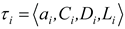 , recording the arrival time, execution budget, relative deadline, and criticality level[3] . The scheduler uses an EDF to maintain a minimum deadline heap, and the absolute deadline is defined as:
 where di is the absolute deadline for request i, QH is the hard-real-time ready queue, and
 is the request currently holding the processor; the time complexity for insertion, deletion, and preemptive reordering is controlled at
 , and n is the number of requests awaiting scheduling in the queue. To reduce the risk of underestimating execution demand, the system constructs an empirical distribution from historical execution-time samples of each request class and selects an upper-tail quantile as the admission-control budget. This quantile represents a workload-derived execution-time estimate rather than a certified worst-case execution time. For safety-critical right-of-way and collision-avoidance requests, a certification-oriented extension should establish platform-specific WCET bounds through applicable static timing analysis, bounded input and path-complexity analysis, and explicit treatment of processor, operating-system, and communication interference. The resulting bounds should be independently validated before replacing empirical upper-tail estimates in admission control. Execution, preemption, synchronization, and message-transmission overheads must also be bounded, because a certified execution-time bound alone does not establish an end-to-end deadline guarantee:
 where k represents the hard-real-time request type, Nk is the number of execution samples collected for this type, ek,j is the j th execution time sample,
 is the empirical cumulative distribution function,
 is the indicative function, q is the budget confidence quantile,
 and is the upper bound on execution time used in the admission calculation. Before a new request enters the EDF queue, the processor demand within a given time window is further calculated as follows:
 where t is the time window under consideration, Tk is the minimum arrival interval for requests of class k, Dk is their relative deadline, and
 and
 represent the preemption recovery and scheduler execution overheads within the window, respectively.A request is written to the hard-real-time ready queue only when all candidate windows satisfy
 ; otherwise, it remains in the entry buffer. This mechanism restricts the admission of excessive request loads into the processor contention domain and provides a workload-dependent feasibility criterion for subsequent CBS budget isolation and response-time assessment. Since the execution budgets are derived from empirical quantiles, the criterion does not independently establish a deterministic worst-case response-time bound[4].
, recording the arrival time, execution budget, relative deadline, and criticality level[3] . The scheduler uses an EDF to maintain a minimum deadline heap, and the absolute deadline is defined as:
is the request currently holding the processor; the time complexity for insertion, deletion, and preemptive reordering is controlled at , and n is the number of requests awaiting scheduling in the queue. To reduce the risk of underestimating execution demand, the system constructs an empirical distribution from historical execution-time samples of each request class and selects an upper-tail quantile as the admission-control budget. This quantile represents a workload-derived execution-time estimate rather than a certified worst-case execution time. For safety-critical right-of-way and collision-avoidance requests, a certification-oriented extension should establish platform-specific WCET bounds through applicable static timing analysis, bounded input and path-complexity analysis, and explicit treatment of processor, operating-system, and communication interference. The resulting bounds should be independently validated before replacing empirical upper-tail estimates in admission control. Execution, preemption, synchronization, and message-transmission overheads must also be bounded, because a certified execution-time bound alone does not establish an end-to-end deadline guarantee:
is the empirical cumulative distribution function, is the indicative function, q is the budget confidence quantile, and is the upper bound on execution time used in the admission calculation. Before a new request enters the EDF queue, the processor demand within a given time window is further calculated as follows:
and represent the preemption recovery and scheduler execution overheads within the window, respectively.A request is written to the hard-real-time ready queue only when all candidate windows satisfy ; otherwise, it remains in the entry buffer. This mechanism restricts the admission of excessive request loads into the processor contention domain and provides a workload-dependent feasibility criterion for subsequent CBS budget isolation and response-time assessment. Since the execution budgets are derived from empirical quantiles, the criterion does not independently establish a deterministic worst-case response-time bound[4].3.3. Soft-Real-Time Request Budgeting and Critical-Level Degradation Mechanism Based on Constant-Bandwidth Servers
MC-TLS Level 2 allocates one CBS server for Class 1 soft-real-time tasks and defines two operating states: normal and degraded. The server controls processor utilization via a maximum budget Qs and a replenishment cycle Ps. The budget decreases as actual execution time elapses; once depleted, the server’s deadline is extended by one cycle and the budget is replenished. Its reserved bandwidth is defined as:
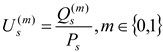
Here,  represents the processor bandwidth of the soft-real-time server in state m,
 represents the execution budget for that state, Ps represents the budget replenishment cycle, m=0 denotes the normal state, and m=1 denotes the degraded state.When the load on the hard-real-time queue increases and reduces available processor headroom, the scheduler switches from
 to a constrained budget
 , delaying low-priority tasks while reserving a minimum service budget to prevent prolonged starvation of the soft-real-time queue. To verify the budget consumption and degradation behavior of this mechanism under concurrent multi-robot tasks, a simulation scenario for a robot fleet management system was constructed, as shown in Figure 2.
represents the processor bandwidth of the soft-real-time server in state m, represents the execution budget for that state, Ps represents the budget replenishment cycle, m=0 denotes the normal state, and m=1 denotes the degraded state.When the load on the hard-real-time queue increases and reduces available processor headroom, the scheduler switches from to a constrained budget , delaying low-priority tasks while reserving a minimum service budget to prevent prolonged starvation of the soft-real-time queue. To verify the budget consumption and degradation behavior of this mechanism under concurrent multi-robot tasks, a simulation scenario for a robot fleet management system was constructed, as shown in Figure 2.3.4. Workload-Conditioned End-to-End Response-Time Assessment and Schedulability Analysis
MC-TLS normalizes the deadlines of the three types of requests to a time scale of 1:4:40, and the 4-fold span for the internal constraints of hard-real-time requests and the 40-fold span for the entire request chain are obtained[5]. The delay analyzer uses 64-bit monotonic timestamps and 1 μs response-time iterations, accounting for execution budgets, blocking, preemption, and communication overhead. Iteration terminates when consecutive estimates differ by less than one time unit. A normalized response coefficient ≤1.00 and combined hard-real-time CPU utilization and CBS bandwidth ≤100% indicate feasibility under assumed workloads, but do not constitute a rigorous schedulability proof [6].
4. Experimental Results and Analysis
4.1. Experimental Platform, Production Workload, and Comparative Scheduling Methods
The assessment of production workload is carried out using the actual robot cluster management system. The system records timestamps during the stages of request reception, queuing, execution, message transmission and status synchronisation, which are used to analyse the composition of latency during the request processing.The production environment consisted of a fleet management service controlling 800 mobile robots. Its reported operational workload included right-of-way granting, collision-avoidance replanning, and task assignment requests, corresponding to the three request classes defined in the scheduling model.The three request classes had deadlines of 50 ms, 200 ms, and 2 s, respectively. The reported production peak was 4,200 requests/s, representing the maximum observed arrival intensity rather than the average request rate over the 30-day observation period. During 30 days of continuous production observation, the system processed 2.6×10⁹ requests, equivalent to an average of approximately 86.67 million requests/day or 1,003 requests/s. The difference between this average and the reported peak of 4,200 requests/s reflects the distinction between cumulative workload and peak arrival intensity.The scheduling comparison included the existing first-come, first-served (FCFS) thread-pool mechanism, fixed-priority scheduling, and MC-TLS. To ensure a consistent quantitative comparison, FCFS, fixed-priority scheduling, and MC-TLS should be evaluated using the same timestamped request trace, hardware platform, request-class distribution, deadline settings, and measurement window. The currently available fixed-priority results include a soft-real-time starvation ratio of 14.0%, a fairness index of 0.72, and processor utilization of 65%, but request-level latency samples are not reported. The mean, P95, P99, P99.9, and maximum response times, together with the deadline-miss rate for each request class, must be obtained by rerunning the fixed-priority baseline under the same evaluation conditions before a complete latency comparison can be reported.FCFS does not consider the priority of requests, fixed-priority scheduling statically assigns task categories to priorities, and MC-TLS uses EDF hard real-time scheduling with CBS soft real-time budget isolation. Then, uniformly measure the end-to-end response time, deadline miss rate, soft real-time starvation, processor utilisation and fleet throughput[7] .
4.2. Response Times and Deadline Compliance Under Different Scheduling Methods
FCFS, fixed-priority scheduling, and MC-TLS were compared using the reported fleet-management request classes and workload conditions. The resulting latency and deadline-compliance statistics are treated as comparative evaluation results rather than evidence that all three scheduling mechanisms operated simultaneously during the 30-day production observation.Response times and time limits are given in Table 1.
Table 1 shows that FCFS lacks priority-based temporal isolation, resulting in a P99 latency of 312 ms, exceeding the 50 ms deadline. MC-TLS achieves a maximum observed response time of 41 ms, 6 ms below the 47 ms model reference, which retains a 3 ms deadline margin but does not guarantee worst-case response time. The deadline-miss rate decreases from 2.7% to 0.003%, a 900-fold reduction, without establishing deterministic compliance. Fixed-priority scheduling yields a starvation ratio of 14.0%, fairness index of 0.72, and CPU utilization of 65%, compared with 0.0%, 0.98, and 78% for MC-TLS. Comparable latency measurements for fixed-priority scheduling remain necessary [8].
4.3. Analysis of Soft-Real-Time Fairness, System Resource Utilization, and Fleet Operational Efficiency
The effects of resource allocation on task scheduling and fleet operations were evaluated[9,10]. MC-TLS reduced task starvation from 14% to 0% through CBS budget reservation while maintaining 78% processor utilization. Timeout-induced protection downtime decreased by 63%, and fleet throughput increased by 7.8%. Figure 3 compares scheduling fairness and operational efficiency.
4.4. Analysis of Long-Term Stability and Robot Fleet Scalability
The 30-day production observation characterizes latency stability under the recorded operational workload, but it does not independently establish robustness against controlled bursts exceeding the observed peak arrival rate of 4,200 requests/s. Burst robustness should therefore be assessed separately using the specified rate-duration matrix, with deadline-miss rates and tail-latency statistics reported for each request class. The analysis should also quantify the maximum queue length and recovery time after each burst to determine whether the scheduler restores stable service after transient overload. The 30-day response-time analysis reported zero exceedances of its model-derived latency reference in the evaluated series. This observation supports empirical consistency with the response-time model during the observation period. However, the reported 0.003% deadline-miss rate in Table 1 remains a separate statistic, and the absence of observed model-reference exceedances does not constitute a deterministic timing guarantee.The scalability evaluation was conducted separately from the 30-day production observation, with server hardware and scheduling parameters held constant. It assessed the response of the scheduling framework to increasing fleet size; The 800-robot configuration corresponds to the production baseline, whereas the 1,000-, 1,200-, and 1,400-robot configurations were generated by adding 200, 400, and 600 simulated robot clients, respectively. Accordingly, the 1,400-robot result represents a scalability test using simulated client workloads rather than a deployment involving 1,400 physical robots. Server hardware and scheduling parameters were held constant across all configurations.The scalability evaluation covered fleet configurations of 800, 1,000, 1,200, and 1,400 robot sources, representing increases of 0%, 25%, 50%, and 75%, respectively, relative to the 800-robot production baseline. The reported scalability results indicate deadline-compliance performance under these tested configurations, without establishing equivalent behavior under untested arrival patterns or larger fleet sizes. Figure 4 presents the long-term latency observations and scalability results. Deadline-satisfaction percentages displayed at whole-percentage precision should be interpreted as rounded statistics rather than proof of zero deadline misses across all processed requests.
5. Conclusions
To solve the problem of time conflict caused by the joint operation of hard-real-time and soft-real-time demands in robot fleet management systems, we proposed the MC-TLS two-level scheduling framework, which incorporates EDF, CBS, execution-time distribution-based access control, and end-to-end response-time analysis. Experimental results indicate that MC-TLS reduces the tail latency and deadline-miss rate of critical requests while maintaining processor utilization, fleet throughput, and soft-real-time service fairness. The reported 30-day production observations and separate 800–1,400-robot scalability evaluation provide empirical evidence of response-time stability and scalability under the tested workload conditions.The principal contribution is the integration of mixed-criticality scheduling with fleet-management request processing, providing a computable framework for workload-conditioned response-time assessment and deadline assurance without assuming certified worst-case execution-time bounds. At this stage, the analysis still mainly uses a single production environment and pre-defined request types, and complex conditions such as network jitter, fault recovery, and collaboration among heterogeneous computing nodes have not been addressed. Future work will prioritize establishing and validating platform-specific WCET bounds for safety-critical right-of-way and collision-avoidance requests. The validated bounds will be incorporated into DBF-based admission control and end-to-end response-time analysis, with deterministic deadline guarantees considered only when execution-time and interference assumptions have been bounded and verified. Distributed scheduling, online execution-time estimation, and dynamic bandwidth adjustment will also be investigated to improve scheduling performance under non-stationary load conditions.
References
- Li, Y.; Liu, S. A Study on Dynamic Optimization of Alerting Policies and Multi-Agent Decision-Making Mechanisms in Cloud Environments. 2026. [Google Scholar] [CrossRef]
- Hoornaert, D.; Ghaemi, G.; Bastoni, A.; et al. Mcti: mixed-criticality task-based isolation[J]. Real.-Time Syst. 2024, 60(2), 328–365. [Google Scholar] [CrossRef]
- Friebe, A.; Marković, F.; Papadopoulos, A. V.; et al. Efficiently bounding deadline miss probabilities of Markov chain real-time tasks[J]. Real.-Time Syst. 2024, 60(3), 443–490. [Google Scholar] [CrossRef]
- Meunier, R.; Carle, T.; Monteil, T. Multi-core interference over-estimation reduction by static scheduling of multi-phase tasks[J]. Real.-Time Syst. 2024, 60(4), 665–703. [Google Scholar] [CrossRef]
- Benz, T.; Ottaviano, A.; Liang, C.; et al. AXI-REALM: safe, modular and lightweight traffic monitoring and regulation for heterogeneous mixed-criticality systems[J]. IEEE Trans. Comput. 2025, 74(9), 3072–3086. [Google Scholar] [CrossRef]
- Willemsen, L.; Günzel, M.; Brandenburg, B.; et al. Transfer Schedulability in Periodic Real-Time Systems[J]. ACM Trans. Embed. Comput. Syst. 2025, 24(5s), 1–25. [Google Scholar] [CrossRef]
- Heider, K.; Hakert, C.; Chen, K. H.; et al. Lazytick: Lazy and efficient management of job release in real-time operating systems[J]. ACM Trans. Embed. Comput. Syst. 2025, 24(5s), 1–25. [Google Scholar] [CrossRef]
- Matos, D. M.; Costa, P.; Sobreira, H.; et al. Efficient multi-robot path planning in real environments: a centralized coordination system: D. Matos et al[J]. Int. J. Intell. Robot. Appl. 2025, 9(1), 217–244. [Google Scholar]
- dos Santos, T. M. B.; Pinto, M. F.; Timotheo, G. O.; et al. Clusterized Multi-objective Approach With Variable and Adaptive Neighborhood Search for Multi-robot Task Allocation[J]. Int. J. Control Autom. Syst. 2025, 23(10), 3060–3081. [Google Scholar] [CrossRef]
- Koifman, Y.; Barel, A.; Bruckstein, A. M. Distributed and decentralized task allocation for heterogeneous swarms[J]. Artif. Life Robot. 2026, 31(1), 302–316. [Google Scholar] [CrossRef]
Figure 1.
Overall Model of the MC-TLS Hybrid Critical-Level Two-Level Real-Time Scheduling.
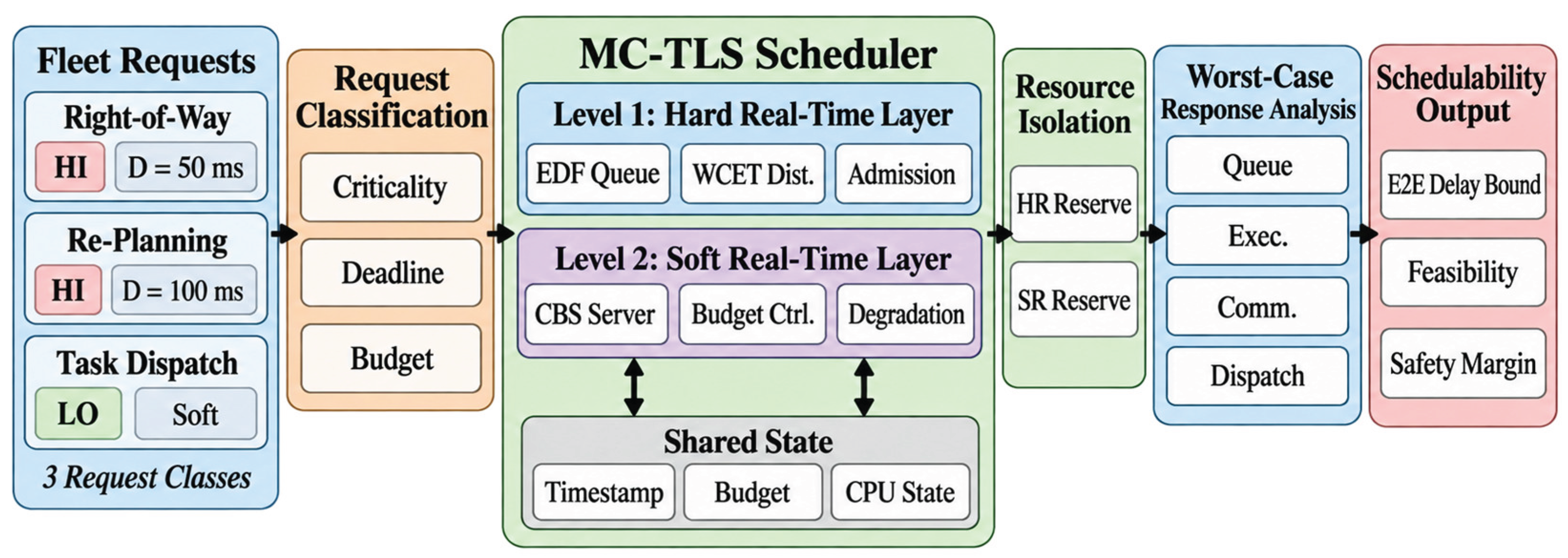
Figure 2.
Soft-real-time scheduling simulation scenario for the MC-TLS robot fleet management system.
Figure 2.
Soft-real-time scheduling simulation scenario for the MC-TLS robot fleet management system.
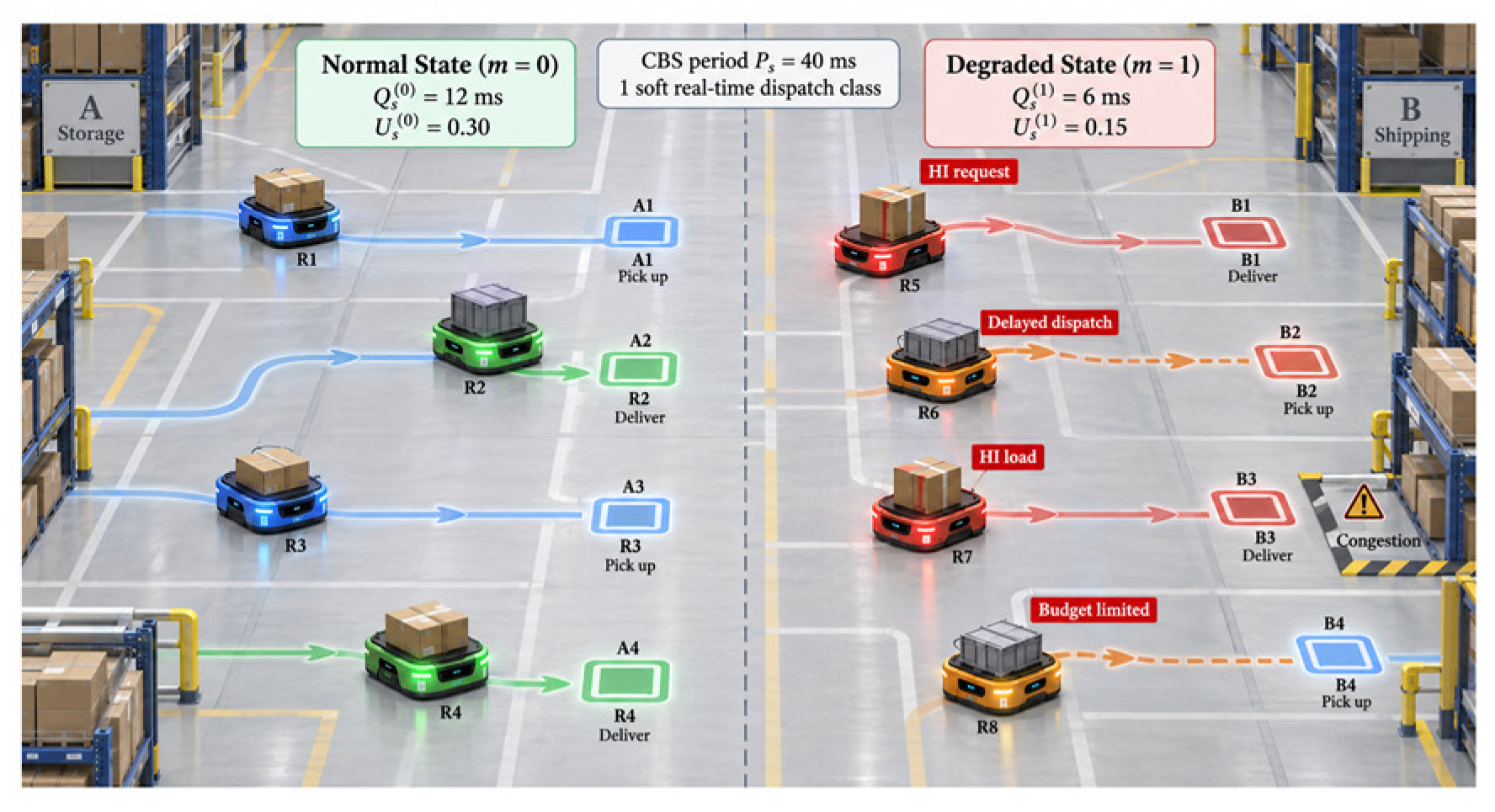
Figure 3.
Comparison of soft real-time fairness and robot fleet operational performance under different scheduling mechanisms.
Figure 3.
Comparison of soft real-time fairness and robot fleet operational performance under different scheduling mechanisms.
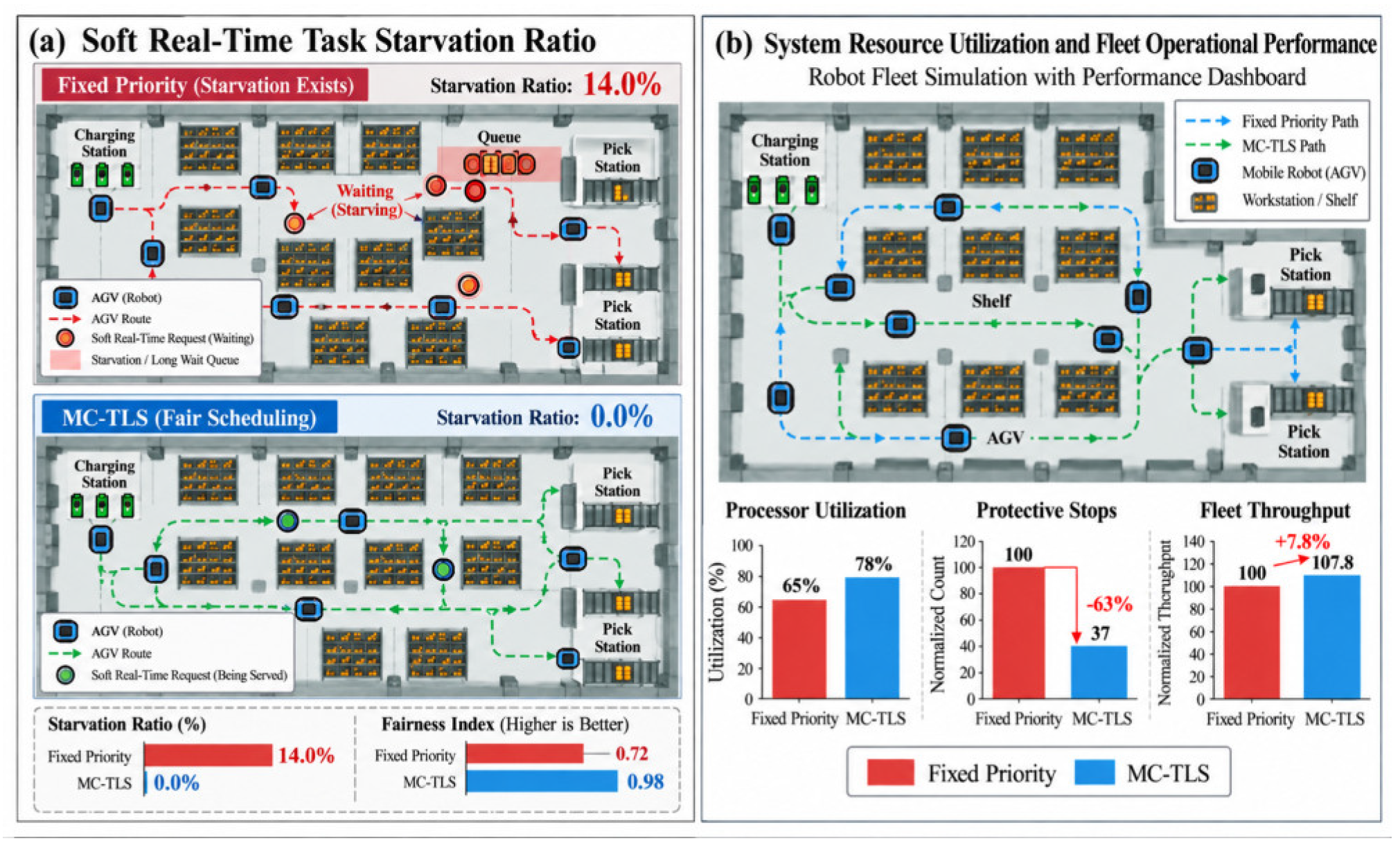
Figure 4.
Thirty-day production observations for the 800-robot fleet and results of the separate 800–1,400-robot scalability evaluation.
Figure 4.
Thirty-day production observations for the 800-robot fleet and results of the separate 800–1,400-robot scalability evaluation.
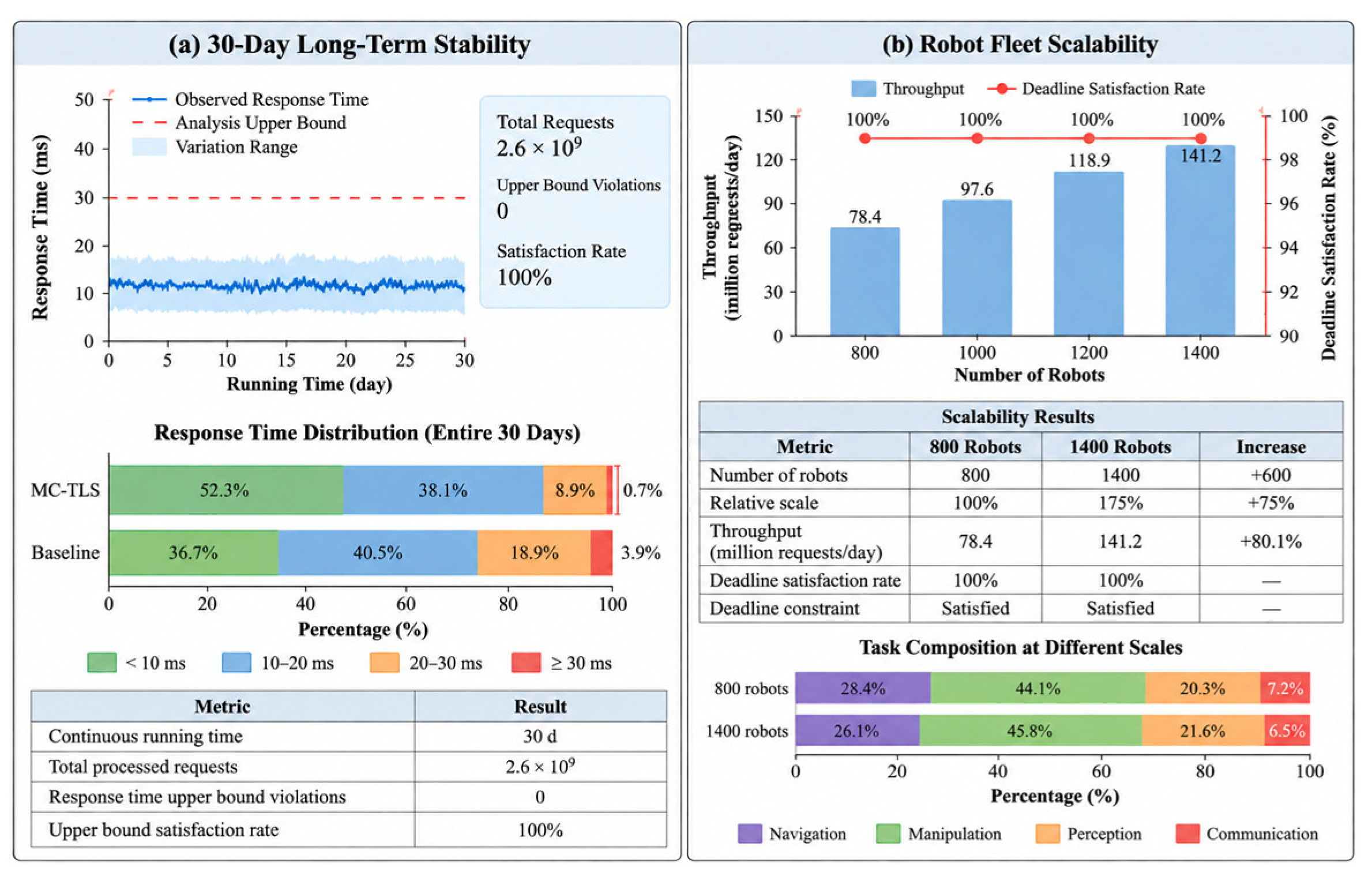

Table 1.
Response-Time Statistics and Deadline-Compliance Results for Different Scheduling Methods.
| Scheduling Method | Response-Time Statistic | Response Time (ms) | Model-Derived Response Reference (ms) | Strictest Deadline (ms) | Deadline-Miss Rate (%) | Deterministic Deadline Guarantee Established |
|---|---|---|---|---|---|---|
| FCFS | 99.9th percentile | 312 | N/A | 50 | 2.7 | No |
| Fixed Priority | 99.9th percentile | 184* | N/A | 50 | 0.62* | Not established |
| MC-TLS | Maximum observed response time | 41 | 47 | 50 | 0.003 | Not established |
Disclaimer/Publisher’s Note: The statements, opinions and data contained in all publications are solely those of the individual author(s) and contributor(s) and not of MDPI and/or the editor(s). MDPI and/or the editor(s) disclaim responsibility for any injury to people or property resulting from any ideas, methods, instructions or products referred to in the content. |
© 2026 by the authors. Licensee MDPI, Basel, Switzerland. This article is an open access article distributed under the terms and conditions of the Creative Commons Attribution (CC BY) license (http://creativecommons.org/licenses/by/4.0/).
Copyright: This open access article is published under a Creative Commons CC BY 4.0 license, which permit the free download, distribution, and reuse, provided that the author and preprint are cited in any reuse.