
Submitted:
08 November 2026
Posted:
10 November 2026
You are already at the latest version
Abstract
This study comparatively evaluated the mechanical performance of high-strength concrete incorporating locally sourced rice husk ash nano-silica and imported nano-silica as partial cement replacement. The research responds to the heavy reliance of nano-silica-modified concrete production on costly, industrially synthesized, imported material, and examines whether a locally producible alternative derived from an abundant agricultural waste can deliver comparable results. Rice husk ash nano-silica was produced through controlled combustion of rice husk followed by alkaline dissolution and acid precipitation, and its silica content, specific surface area, and specific gravity were determined alongside those of commercially sourced imported nano-silica. Twenty-seven high-strength concrete mixes were proportioned using a particle-packing-based mix design, incorporating each nano-silica type at replacement levels of 0 to 20 percent across three water-binder ratios, and evaluated for workability and for compressive, splitting tensile, and flexural strength at 7, 14, and 28 days. Both nano-silica types achieved an optimum replacement level of approximately 15 percent, beyond which strength declined. At this optimum, concrete containing imported nano-silica achieved a slightly higher 28-day compressive strength than concrete containing rice husk ash nano-silica, though statistical analysis found no significant interaction between nano-silica source and replacement level. The findings indicate that rice husk ash nano-silica is a mechanically viable substitute for imported nano-silica in high-strength concrete production, supporting its consideration as a lower-cost, locally sourced alternative, particularly in rice-producing regions.
Keywords:
rice husk ash
; nano-silica
; high-strength concrete
; compressive strength
; particle packing model
; sustainable construction materials
Introduction
High-strength concrete (HSC) offers superior compressive strength, reduced permeability, and enhanced durability relative to normal-strength concrete, largely through supplementary cementitious materials (SCMs) that refine the cement matrix microstructure through pozzolanic and nano-filling effects (Hosan & Shaikh, 2021; Moolchandani et al., 2025). Among these materials, nano-silica has attracted particular attention because its fine particle size and high specific surface area allow it to act as both a nano-filler and a pozzolanic activator, improving compressive, tensile, and flexural strength (AlTawaiha et al., 2023; Nisar et al., 2025) and the durability-related microstructure of concrete (Zong et al., 2023).
Most nano-silica used in concrete research is industrially synthesized and imported, which carries cost and foreign-exchange burdens for developing economies and a high embodied carbon footprint from energy-intensive synthesis and international transport (Akintayo et al., 2025; Singh & Endley, 2020). Rice husk, a by-product of rice milling generated in large quantities, offers a lower-cost, lower-carbon source: controlled combustion followed by alkaline dissolution and acid precipitation yields nano-silica of satisfactory engineering quality (Farhan & Ebrahim, 2021; Tran et al., 2021), and recent reviews document the wider potential of rice husk-derived silica (Hamidu et al., 2025; Samarajeewa et al., 2026). Nano- and micro-scale rice husk ash have produced competitive compressive strengths, although processing cost must be weighed against performance gain (Raji et al., 2024), and life-cycle assessments support the low embodied-energy profile of rice husk ash (Arvizu-Montes et al., 2025; J. Singh & Dhir, 2026; Yin et al., 2025).
However, no known study has directly compared locally producible rice husk ash nano-silica with imported, industrially synthesized nano-silica under an identical, standardized high-strength concrete mix design, leaving unresolved whether an agro-waste-derived alternative can match the imported material where importation cost and supply reliability limit adoption. This study therefore produces nano-silica from locally sourced rice husk ash and compares its effect on the workability and on the compressive, splitting tensile, and flexural strength of high-strength concrete with that of imported nano-silica, using a particle-packing-based mix design across several replacement levels and water-binder ratios, and tests whether the observed differences are statistically significant.
Method
This study adopted an experimental quantitative research design to comparatively evaluate the mechanical performance of high-strength concrete incorporating locally sourced rice husk ash nano-silica (RHA-NS) and imported nano-silica (INS). The experimental work was carried out within a structural engineering laboratory, with materials sourced locally: fine and coarse aggregates from a quarry, rice husk from a rice mill, and imported nano-silica from a certified commercial supplier. Ordinary Portland Cement (CEM I 42.5R), natural river sand, 10 mm crushed granite, potable water, and a polycarboxylate-ether-based superplasticizer constituted the remaining mix constituents.
RHA-NS was produced from raw rice husk through a sequence of controlled combustion, alkaline dissolution, and acid precipitation. We washed, sun-dried, and combusted raw husk at 600–700°C to produce rice husk ash, a range selected to maximize retention of reactive amorphous silica while minimizing unburnt carbon. The ash was then dissolved in sodium hydroxide solution, filtered, and the filtrate precipitated with hydrochloric acid to a pH of 3, yielding a silica gel that was aged, washed, oven-dried, and calcined to produce the final RHA-NS powder. The combustion stage was carried out using a modified barrel kiln, a low-cost combustion apparatus suited to small-scale agro-waste processing, as illustrated in Figure 1.
The silica (SiO₂) content of RHA-NS and INS was determined by X-ray fluorescence spectroscopy on pressed-powder pellets, and their specific surface area was determined by nitrogen adsorption using the Brunauer–Emmett–Teller (BET) method after degassing at 150°C for 2 hours. The specific gravity of both materials was determined using the pycnometer method, with kerosene substituted for water to prevent reaction with the sample.
The high-strength concrete mixes were proportioned using the modified Andreasen and Andersen particle packing model, which minimizes the void content of the combined aggregate-binder system by fitting the composite particle size distribution to a theoretical target curve. A distribution modulus of 0.23 was adopted, and the proportions of cement, fine aggregate, and coarse aggregate were iteratively optimized to minimize the residual sum of squares between the target and achieved grading curves. Total binder content was held constant at 500 kg/m³, with RHA-NS or INS incorporated as partial cement replacement at 0, 5, 10, 15, and 20 percent by weight, across three water-binder ratios (0.22, 0.26, and 0.30), yielding 27 distinct concrete mixes. Superplasticizer dosage was adjusted at each combination to maintain a target slump of 100 ± 25 mm.
For each mix, constituents were dry-blended and mixed in a laboratory pan mixer, cast into cube, cylinder, and prism moulds, compacted on a vibrating table, and demoulded after 24 hours. Specimens were subsequently water-cured at 23 ± 2°C until their respective testing ages. Compressive strength was determined on 100 mm cubes at 7, 14, and 28 days using a calibrated compression testing machine, with three replicate specimens tested per mix per age. The curing and compressive strength testing sequence is illustrated in Figure 2.
Splitting tensile strength was determined on 100 mm × 200 mm cylinders at 28 days by diametral loading to failure. Flexural strength was determined at 28 days on 100 mm × 100 mm × 500 mm prisms using a two-point (third-point) loading configuration over a simply supported span of 400 mm, with load applied at a constant stress rate of 0.04 MPa/s until failure. Three replicate specimens were tested per mix for each property. The flexural testing procedure is illustrated in Figure 3.
Fresh concrete workability was assessed through the slump test immediately after mixing for each of the 27 mixes. Data obtained from the workability and mechanical strength tests were analyzed using descriptive statistics, a multi-way factorial Analysis of Variance (ANOVA) to determine the significance of nano-silica source, replacement level, water-binder ratio, and curing age, and regression analysis to model the relationship between replacement level and compressive strength for each nano-silica source.
Result and Discussion
Characterization of Nano-Silica Materials
Table 1 summarizes the silica content, specific surface area, and specific gravity of the locally produced rice husk ash nano-silica (RHA-NS) and the imported nano-silica (INS).
The RHA-NS contained 94.60 percent silica compared with 99.10 percent for INS, confirming that the extraction route yielded a high-purity silica product, although with modestly lower purity than the industrially synthesized material. Its specific surface area of 178 m²/g was also lower than the 205 m²/g measured for INS, and its specific gravity of 2.15 was marginally below the 2.20 of INS. The 600–700°C combustion window was chosen to favor reactive amorphous silica over crystalline phases, and the lower surface area is consistent with greater agglomeration of the bio-derived powder. Together, these differences anticipate the slightly higher water demand and lower strength of RHA-NS mixes reported in the sections that follow.
Workability of Fresh Concrete
Slump declined progressively with increasing nano-silica replacement across all water-binder ratios for both sources, even though superplasticizer dosage was raised from 7.50 kg/m³ in the control mixes to 11.50 kg/m³ at 20 percent RHA-NS and 10.50 kg/m³ at 20 percent INS. At the 0.22 water-binder ratio, slump fell from 115 mm in the control to 60 mm at 20 percent RHA-NS and 75 mm at 20 percent INS. At every corresponding replacement level, RHA-NS mixes recorded lower slump than INS mixes despite receiving an equal or higher admixture dose, and only the 20 percent RHA-NS mix at the 0.22 water-binder ratio fell outside the 100 ± 25 mm target range.
The high surface area of both nano-silica materials explains the general loss of workability, because more mixing water is adsorbed onto particle surfaces and less remains free to lubricate the paste. The additional penalty observed for RHA-NS is consistent with its greater agglomeration, which the lower specific surface area in Table 1 suggests. Agglomerates behave as larger, porous clusters that trap water within intra-agglomerate voids, and their irregular, interlocking shape raises inter-particle friction. Agglomerates must also be broken down before the polycarboxylate-ether superplasticizer can act on primary particles, so a larger share of each dose is spent on dispersing clusters and on coating newly exposed, silanol-rich silica surfaces rather than on deflocculating cement grains. The result is a higher admixture demand to reach a given slump, and a mix that remains stiffer at equal dosage.
In rheological terms, these mechanisms would be expected to raise yield stress and plastic viscosity and to strengthen thixotropic structural build-up in RHA-NS mixes, in line with the elevated rheological demand reported for cement pastes containing silica-based wastes (da Rosa Martins et al., 2024) and with evidence that the quality of nano-silica dispersion governs the performance of cement-based composites (Zhang et al., 2025). Slump is only a single-point indicator of yield stress, however, and yield stress and viscosity were not measured here, so these mechanisms are inferred rather than directly demonstrated. Practically, producers using RHA-NS may need a higher admixture dose, or improved dispersion through grinding the dried powder or pre-dispersing it in the mixing water, to match the workability achieved with imported nano-silica, and 20 percent replacement at the lowest water-binder ratio appears to be the practical upper limit without such adjustment.
Compressive Strength Development
The 28-day compressive strength results obtained for all 27 concrete mixes are summarized in Table 2, discussed in terms of the influence of nano-silica source, replacement level, and water-binder ratio on strength development.
All 27 mixes exceeded the 40 N/mm² threshold defining high-strength concrete, confirming the effectiveness of the particle-packing mix design independent of nano-silica inclusion. For both nano-silica sources, compressive strength increased progressively with replacement level up to 15 percent, beyond which a decline was observed at every water-binder ratio, a trend consistent with the optimum dosage windows reported for nano-silica-modified concrete in recent literature (Ali et al., 2023). At the 0.22 water-binder ratio, 28-day compressive strength increased from 62.0 N/mm² at the control to 71.0 N/mm² (14.5 percent gain) at 15 percent RHA-NS and 74.0 N/mm² (19.4 percent gain) at 15 percent INS, before declining at 20 percent replacement for both sources. At every replacement level, INS-modified concrete achieved marginally higher compressive strength than RHA-NS-modified concrete, a difference ranging from 1.9 to 6.1 percent across the water-binder ratios investigated, consistent with the performance distinction typically reported between industrially synthesized and agro-waste-derived nano-silica (Mostafa et al., 2020; Shastri et al., 2026).
Splitting Tensile and Flexural Strength
Splitting tensile and flexural strength followed the same dosage-response pattern established for compressive strength, with both properties peaking at 15 percent replacement for each nano-silica source before declining at 20 percent, across all three water-binder ratios. Table 3 summarizes these results at the 15 percent optimum replacement level.
At the 0.22 water-binder ratio, splitting tensile strength increased by 17.8 percent for RHA-NS and 23.9 percent for INS relative to the control, while flexural strength increased by 17.3 and 22.0 percent respectively, both proportionally exceeding the corresponding compressive strength gains. This disproportionate improvement reflects the preferential action of nano-silica at the interfacial transition zone, a mechanism consistent with the pore-refinement and bond-enhancement effects reported for nano-silica-modified cementitious systems (AlTawaiha et al., 2023; Mondal, 2026). Across all water-binder ratios, RHA-NS achieved between 90 and 97 percent of the tensile and flexural performance recorded for INS, indicating that the locally produced material retains most of the mechanical benefit of the imported alternative.
Statistical Significance of Nano-Silica Source and Replacement Level
A multi-way factorial Analysis of Variance was conducted to determine the statistical significance of nano-silica source, replacement level, water-binder ratio, and their interactions on 28-day compressive strength, the results of which are summarized in Table 4.
Nano-silica source, replacement level, and water-binder ratio each exerted a statistically significant main effect on compressive strength (p < .05), with water-binder ratio exhibiting the largest effect, followed by replacement level, while nano-silica source exhibited a comparatively smaller, though still significant, effect. Critically, the interaction between nano-silica source and replacement level was not statistically significant (p = .098), indicating that both nano-silica sources respond to dosage variation in a statistically similar manner, differing mainly in overall strength magnitude rather than in the shape of the dosage-response relationship. This finding supports the central premise of this study: that locally sourced rice husk ash nano-silica behaves as a mechanically comparable substitute for imported nano-silica, rather than as a fundamentally different material requiring separate dosage optimization logic.
Optimum Replacement Level
Second-order polynomial regression models were fitted to the compressive strength data for each nano-silica source at each water-binder ratio to mathematically determine the optimum replacement level, with the fitted models and derived optima summarized in Table 5.
The fitted models achieved coefficients of determination (R²) between .979 and .991, confirming an excellent quadratic fit for both nano-silica sources at all water-binder ratios. The mathematically derived optimum replacement level ranged from 15.3 to 15.5 percent for RHA-NS and from 16.2 to 16.3 percent for INS, closely consistent with the experimentally observed peak at 15 percent and essentially independent of water-binder ratio, with the marginally higher optimum for INS attributable to its finer, less agglomerated particle structure delaying the onset of performance decline.
Figure 4 illustrates the compressive strength trend with replacement level for both nano-silica sources across the three water-binder ratios investigated, consolidating the dosage-response pattern discussed throughout this section.
Conclusion
Locally produced rice husk ash nano-silica proved to be a mechanically viable substitute for imported nano-silica in high-strength concrete. Both materials reached an optimum replacement of about 15 percent, and at that level the rice husk ash material delivered between 90 and 97 percent of the compressive, tensile, and flexural strength of the imported material, with no significant interaction between nano-silica source and replacement level. In practice, concrete producers in rice-producing regions can use rice husk ash nano-silica at about 15 percent cement replacement to reduce reliance on imported nano-materials, provided that superplasticizer dosage is increased and dispersion is improved to offset its higher water and admixture demand. Three limitations qualify these findings. Durability was not assessed, so resistance to sulfate attack, chloride ingress, carbonation, and freeze–thaw cycling must be tested before structural use is recommended. Rheological behavior was inferred from slump rather than measured directly, and the results come from a single rice husk source at laboratory scale. Future work should pair long-term durability testing with rheological measurement and husk from several sources.
References
- Akintayo, B. D.; Babatunde, O. M.; Akintayo, D. C.; Olanrewaju, O. A. Transforming Industrial Waste into Low-Carbon Cement: A Multi-Criteria Assessment of Supplementary Cementitious Materials for Sustainable Concrete Design. Recycling 2025, 10(6), 211. [Google Scholar] [CrossRef]
- Ali, R.; Muayad, M.; Mohammed, A. S.; Asteris, P. G. Analysis and prediction of the effect of Nanosilica on the compressive strength of concrete with different mix proportions and specimen sizes using various numerical approaches. Structural Concrete 2023, 24(3), 4161–4184. [Google Scholar] [CrossRef]
- AlTawaiha, H.; Alhomaidat, F.; Eljufout, T. A Review of the Effect of Nano-Silica on the Mechanical and Durability Properties of Cementitious Composites. Infrastructures 2023, 8(9), 132. [Google Scholar] [CrossRef]
- Arvizu-Montes, A.; Guerrero-Bustamante, O.; Polo-Mendoza, R.; Martinez-Echevarria, M. J. Integrating Life-Cycle Assessment (LCA) and Artificial Neural Networks (ANNs) for Optimizing the Inclusion of Supplementary Cementitious Materials (SCMs) in Eco-Friendly Cementitious Composites: A Literature Review. Materials 2025, 18(18), 4307. [Google Scholar] [CrossRef] [PubMed]
- da Rosa Martins, J.; Rocha, J. C.; Hotza, D.; Senff, L. Rheological and stability analysis of cement pastes incorporating silica-based wastes. Particuology 2024, 89, 144–152. [Google Scholar] [CrossRef]
- Farhan, R. Z.; Ebrahim, S. E. Preparing Nanosilica Particles from Rice Husk Using Precipitation Method. Baghdad Science Journal 2021, 18(3), 0494. [Google Scholar] [CrossRef]
- Hamidu, I.; Afotey, B.; Kwakye-Awuah, B.; Anang, D. A. Synthesis of silica and silicon from rice husk feedstock: A review. Heliyon 2025, 11(4). [Google Scholar] [CrossRef] [PubMed]
- Hosan, A.; Shaikh, F. U. A. Compressive strength development and durability properties of high volume slag and slag-fly ash blended concretes containing nano-CaCO3. Journal of Materials Research and Technology 2021, 10, 1310–1322. [Google Scholar] [CrossRef]
- Mondal, A. Nanomaterials in pavement and structural concrete: A comprehensive review of mechanisms, performance, safety, and sustainability. Next Research 2026, 12, 102201. [Google Scholar] [CrossRef]
- Moolchandani, K.; Sharma, A.; Dharavath, K. Hybrid use of supplementary cementitious materials, industrial byproducts, and fillers for sustainable high-performance concrete. Discover Civil Engineering 2025, 2(1), 212. [Google Scholar] [CrossRef]
- Mostafa, S. A.; Faried, A. S.; Farghali, A. A.; EL-Deeb, M. M.; Tawfik, T. A.; Majer, S.; Abd Elrahman, M. Influence of Nanoparticles from Waste Materials on Mechanical Properties, Durability and Microstructure of UHPC. Materials 2020, 13(20), 4530. [Google Scholar] [CrossRef] [PubMed]
- Nisar, N.; Rahman, I.; Paruthi, S.; Khan, A. H.; Sabi, E.; Alyaseen, A. Enhancing concrete properties with nano-SiO2 and nano-TiO2: A review. Journal of Structural Integrity and Maintenance 2025, 10(2), 2496613. [Google Scholar] [CrossRef]
- Raji, M. A.; Falola, B. M.; Enikuomehin, J. T.; Oyelade, A. O.; Abiodun, Y. O.; Olaniyi, Y. A.; Olagunju, O. G.; Anyaegbuna, K. L.; Abdulkareem, M. O.; Fapohunda, C. A. Prediction of compressive strength of nano silica and micro silica from rice husk ash using multivariate regression models. AI in Civil Engineering 2024, 3(1), 22. [Google Scholar] [CrossRef]
- Samarajeewa, P.; Buddika, S.; Yapa, H.; Gunasekara, C.; Law, D. W. Rice husk ash and nanomaterial-blended cement composites: A review. Environmental Science and Pollution Research 2026, 33(3), 717–735. [Google Scholar] [CrossRef] [PubMed]
- Shastri, D. S.; Kumar, S.; Singh, A. K.; Rawat, M. S.; Manju, J.; Karthick, L.; Geetha, S.; Babu, L. G. Characterization of aggregate concrete with eco-friendly silicon additives: A green material for sustainable infrastructure. Composite Interfaces 2026, 33(8), 1755–1766. [Google Scholar] [CrossRef]
- Singh, J.; Dhir, A. K. Recent developments in sustainable concrete: Performance and life cycle assessment of rice husk ash, recycled materials, and nanotechnology. I-Manager’s Journal on Structural Engineering 2026, 14(3), 63. [Google Scholar] [CrossRef]
- Singh, S. P.; Endley, N. Chapter 5—Fabrication of nano-silica from agricultural residue and their application. In Nanomaterials for Agriculture and Forestry Applications; Husen, A., Jawaid, M., Eds.; Elsevier, 2020; pp. 107–134. [Google Scholar] [CrossRef]
- Tran, H.-B.; Le, V.-B.; Phan, V. T.-A. Mechanical Properties of High Strength Concrete Containing Nano SiO2 Made from Rice Husk Ash in Southern Vietnam. Crystals 2021, 11(8), 932. [Google Scholar] [CrossRef]
- Yin, X.; Rahman, M. M.; Sun, Y.; Zhao, Y.; Wang, J. Sustainable Soil–Cement Composites with Rice Husk Ash and Silica Fume: A Review of Performance and Environmental Benefits. Materials 2025, 18(12), 2880. [Google Scholar] [CrossRef] [PubMed]
- Zhang, T.; Wang, Z.; Wang, W.; Li, G.; Guo, H.; Zhang, H. Property enhancement and mechanism of cement-based composites from the perspective of nano-silica dispersion improvement. Case Studies in Construction Materials 2025, 22, e04125. [Google Scholar] [CrossRef]
- Zong, H.; Wang, Y.; Wang, G.; Li, Q.; Li, F.; Li, Q.; Hou, P. The role of ultra-fine supplementary cementitious materials in the durability and microstructure of airport pavement concrete. Construction and Building Materials 2023, 392, 131954. [Google Scholar] [CrossRef]
Figure 1.
Process Flow of Rice Husk Ash Formation Using a Modified Barrel Kiln.
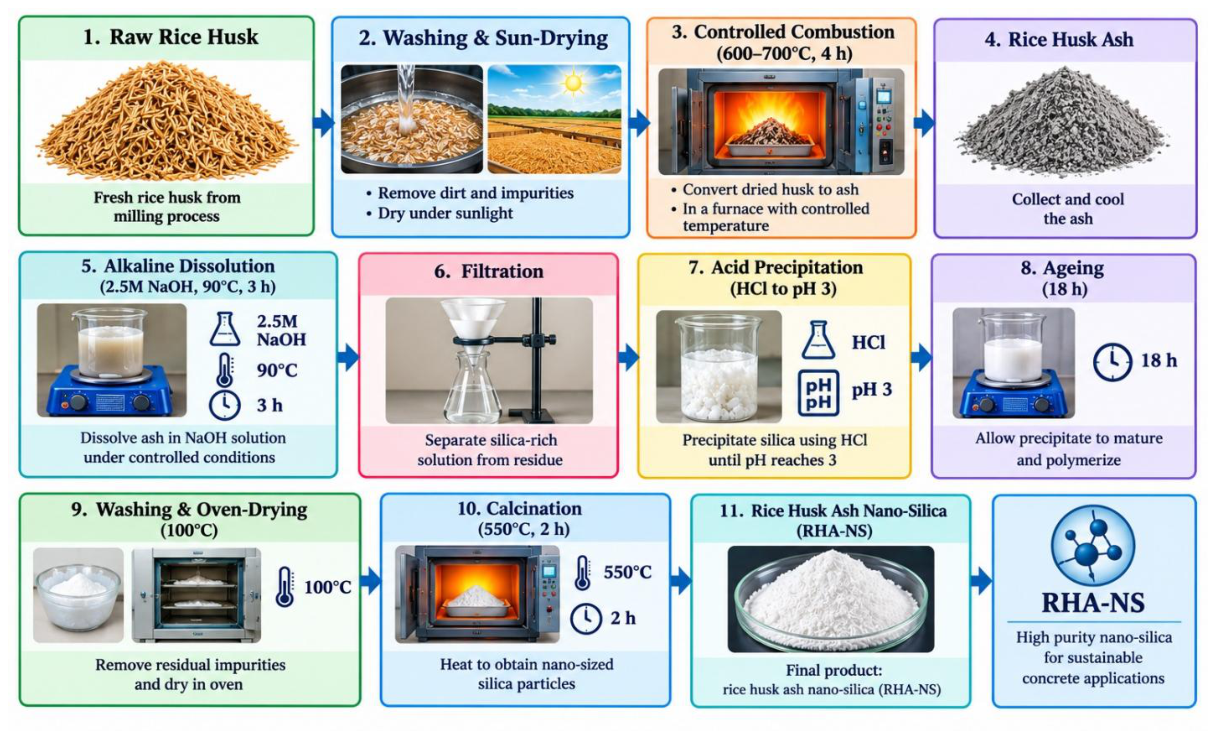
Figure 2.
Concrete Curing and Compressive Strength Test Procedures.
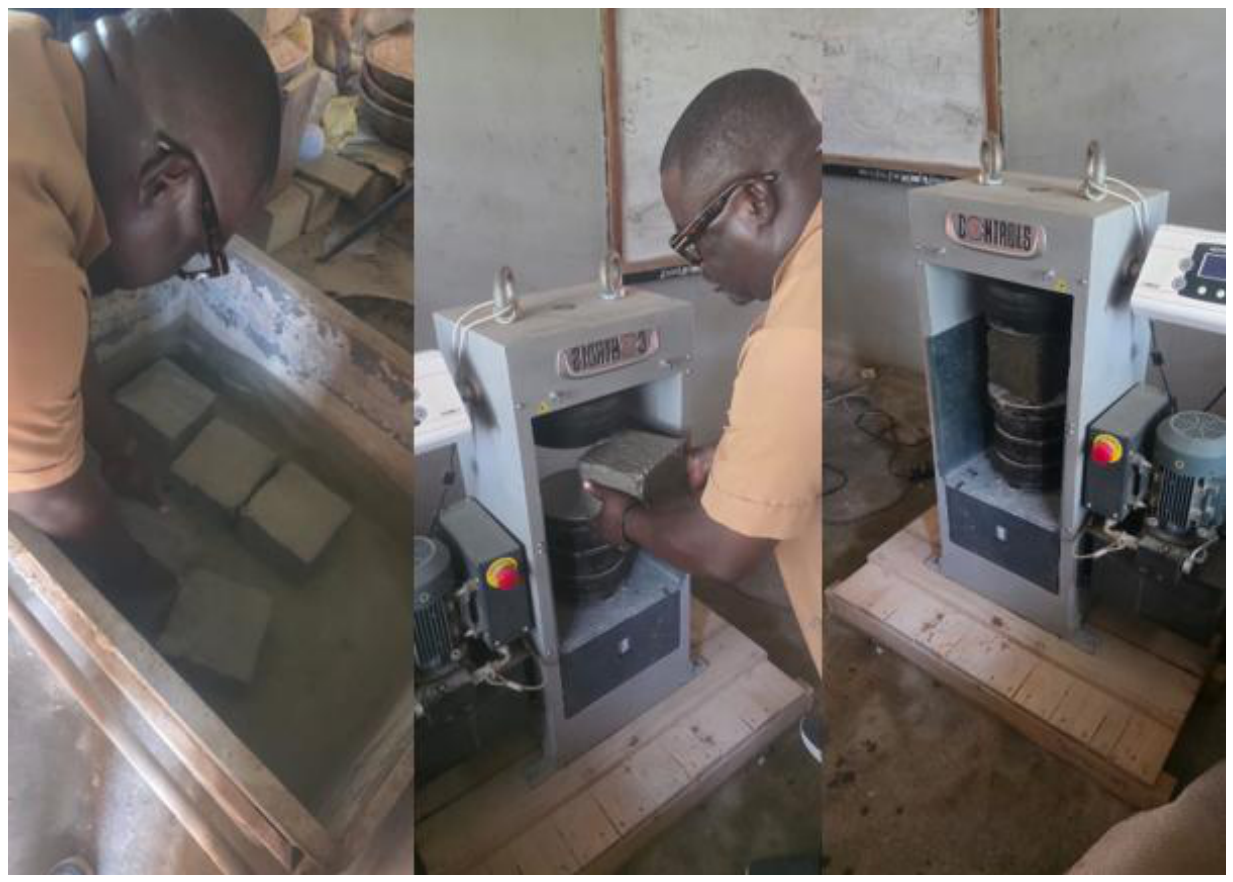
Figure 3.
Flexural Test Procedures.
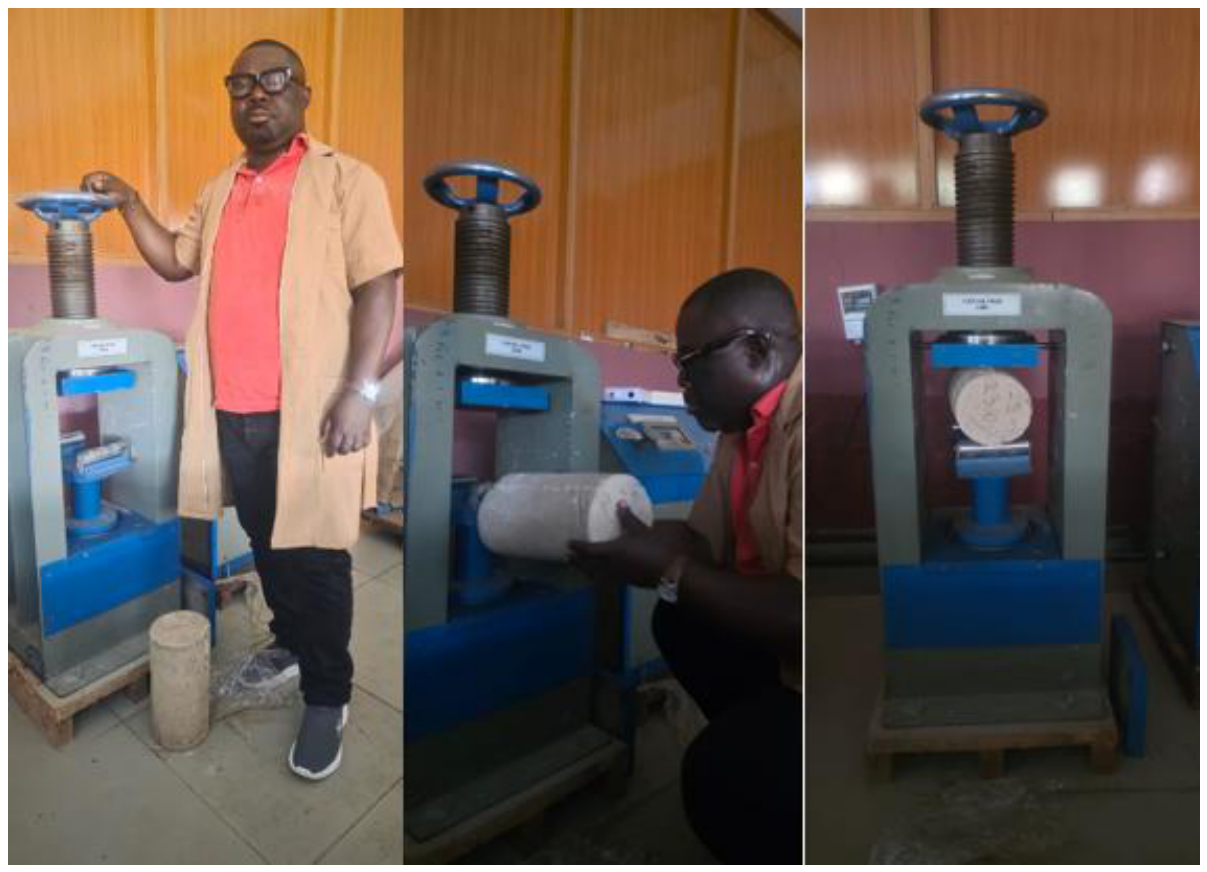
Figure 4.
28-Day Compressive Strength versus Nano-Silica Replacement Level.
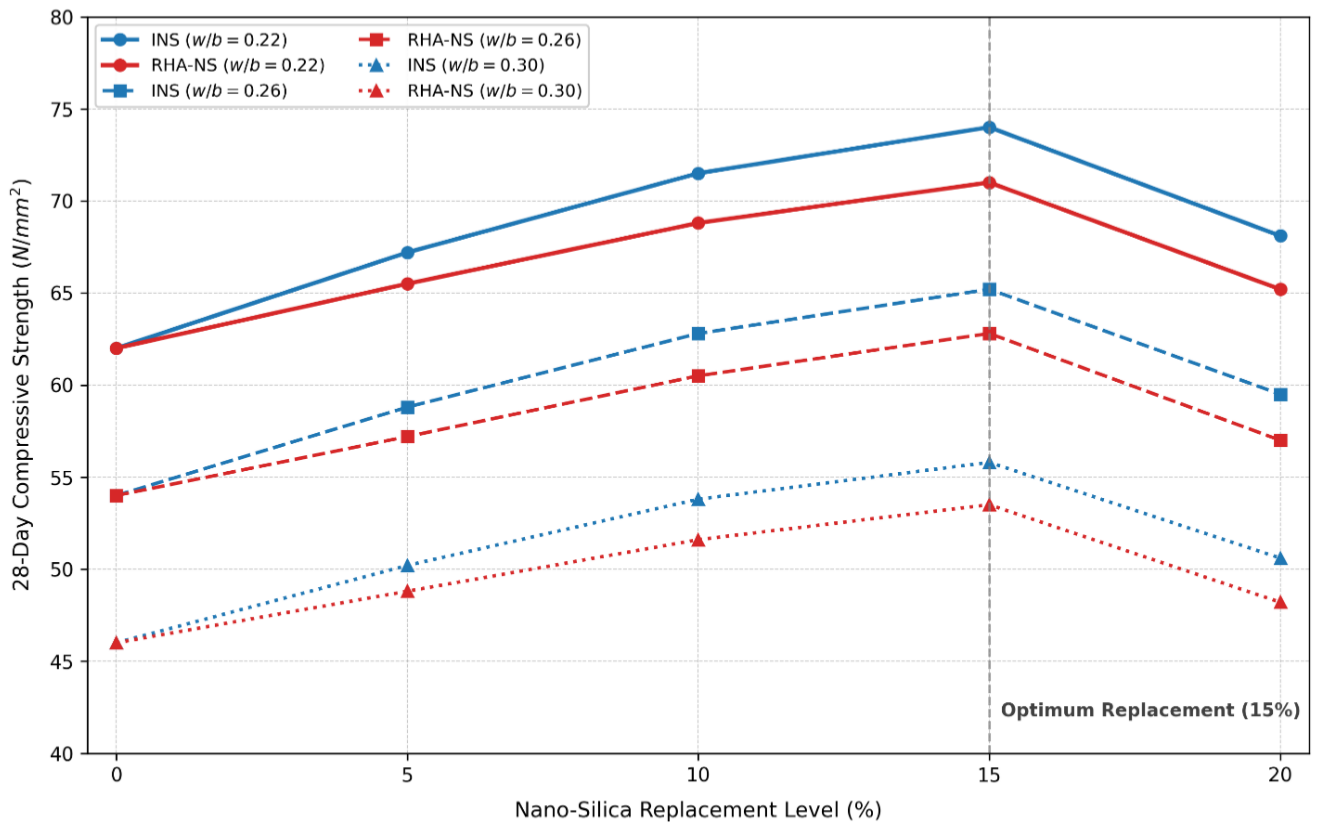

Table 1.
Physicochemical Characteristics of Rice Husk Ash Nano-Silica (RHA-NS) and Imported Nano-Silica (INS).
Table 1.
Physicochemical Characteristics of Rice Husk Ash Nano-Silica (RHA-NS) and Imported Nano-Silica (INS).
| Property | RHA-NS | INS |
|---|---|---|
| Silica (SiO₂) content (%) | 94.60 | 99.10 |
| Specific surface area (m²/g) | 178 | 205 |
| Specific gravity | 2.15 | 2.20 |
Table 2.
28-Day Compressive Strength of Concrete Mixes (N/mm²).
| Replacement (%) | Nano-Silica | w/b = 0.22 | w/b = 0.26 | w/b = 0.30 |
| 0 (Control) | — | 62.0 | 56.0 | 50.0 |
| 5 | RHA-NS | 64.0 | 58.0 | 52.0 |
| 10 | RHA-NS | 68.0 | 61.0 | 55.0 |
| 15 | RHA-NS | 71.0 | 64.0 | 57.0 |
| 20 | RHA-NS | 66.0 | 60.0 | 54.0 |
| 5 | INS | 66.0 | 60.0 | 53.0 |
| 10 | INS | 71.0 | 64.0 | 57.0 |
| 15 | INS | 74.0 | 67.0 | 60.0 |
| 20 | INS | 70.0 | 63.0 | 56.0 |
Table 3.
28-Day Splitting Tensile and Flexural Strength at 15 Percent Replacement (N/mm²).
| w/b | Property | Control | RHA-NS | INS |
| 0.22 | Splitting tensile | 4.65 | 5.48 | 5.76 |
| 0.22 | Flexural | 7.40 | 8.68 | 9.03 |
| 0.26 | Splitting tensile | 4.41 | 5.20 | 5.48 |
| 0.26 | Flexural | 7.03 | 8.24 | 8.59 |
| 0.30 | Splitting tensile | 4.17 | 4.91 | 5.19 |
| 0.30 | Flexural | 6.65 | 7.78 | 8.13 |
Table 4.
ANOVA Summary for 28-Day Compressive Strength.
| Source of Variation | df | F | p |
| Nano-silica source | 1 | 18.62 | .001 |
| Replacement level | 4 | 96.47 | <.001 |
| Water-binder ratio | 2 | 214.85 | <.001 |
| Source × Replacement interaction | 4 | 2.14 | .098 |
Table 5.
Regression Models for 28-Day Compressive Strength versus Replacement Level.
| Nano-Silica | w/b | R² | Derived Optimum (%) |
| RHA-NS | 0.22 | .986 | 15.3 |
| RHA-NS | 0.26 | .981 | 15.3 |
| RHA-NS | 0.30 | .979 | 15.5 |
| INS | 0.22 | .991 | 16.2 |
| INS | 0.26 | .989 | 16.2 |
| INS | 0.30 | .987 | 16.3 |
Disclaimer/Publisher’s Note: The statements, opinions and data contained in all publications are solely those of the individual author(s) and contributor(s) and not of MDPI and/or the editor(s). MDPI and/or the editor(s) disclaim responsibility for any injury to people or property resulting from any ideas, methods, instructions or products referred to in the content. |
© 2026 by the authors. Licensee MDPI, Basel, Switzerland. This article is an open access article distributed under the terms and conditions of the Creative Commons Attribution (CC BY) license.
Copyright: This open access article is published under a Creative Commons CC BY 4.0 license, which permit the free download, distribution, and reuse, provided that the author and preprint are cited in any reuse.