

Submitted:
06 November 2026
Posted:
09 November 2026
You are already at the latest version
Abstract
Museum lighting is specified for a standard observer, yet the retina of a 75-year-old receives less than half the light of a 25-year-old’s. This modelling study applies an age-dependent observer (CIE 170-1 fundamentals with the ageing lens, theWatson–Yellott pupil, two-stage chromatic adaptation and the CIE 146 glare factor) to public-domain reproductions of eight Louvre paintings under 50–500 lx. Three endpoints are kept apart: lens-corrected retinal illuminance, modelled colour appearance (CIEDE2000) and the fraction of picture area below 3, 10 or 30 td. Relative to a 25-year-old, retinal illuminance is 0.70 at 50 and 0.42 at 75 years, equivalent to dividing the illuminance by 2.4; the area below 10 td at 75 years ranges from 10% for the Wedding at Cana to 85% for Saint John the Baptist. Illuminance presets of 1.5 and 2 times within 250 lx recover most of the 50-year deficit for 11–22% more daily exposure in a two-hour slot, whereas a Duv −0.02 spectrum adds 30–41% damage-weighted exposure without benefit. Photographs of the 2024 cleaning of Liberty Leading the People cannot separate a varnish effect from white balance. Sensitivity to all uncertain inputs is reported, and the perceptual test needed is specified.
Keywords:
museum lighting
; ageing eye
; visual accessibility
; observer model
; retinal illuminance
; varnish
; light exposure
; Mona Lisa
1. Introduction
The light in a picture gallery is set by a curator, a lighting designer and a conservator, all of whom see with a standard observer in mind. The visitors do not. The crystalline lens yellows and thickens with age, the pupil shrinks and opens less in dim light, and intraocular scatter grows [1,2,3]; conservation guidance caps illuminance for sensitive materials at 50–250 lx [4], and the same guidance already notes that older viewers need more light and that short periods of enhanced illumination are one way to provide it [5,6]. What that guidance does not give is a per-painting quantity: how much of a given picture falls, for a visitor of a given age, below the retinal illuminance at which fine detail and colour are normally resolved, and how far a feasible change of lighting moves it.
This paper is a modelling study. It applies an age-dependent observer model to digital reproductions of eight paintings in the Louvre that differ widely in darkness, size and viewing distance, and it computes, for visitors aged 25, 50 and 75 and for illumination scenarios of 50–500 lx, three separate endpoints: lens-corrected retinal illuminance, modelled colour appearance, and the fraction of the picture area below a retinal-illuminance threshold. It then evaluates illuminance and spectral presets within the 100–250 lx range that the Louvre specified for its Mona Lisa installation [7], with their luminous and damage-weighted exposure cost, and tests the absorbing-filter model used elsewhere for virtual varnish removal [8] against the before-and-after photographs of the 2024 cleaning of Delacroix’s Liberty Leading the People [9]. Two companion papers develop the lamp model for the Mona Lisa luminaire [10] and compare the painter’s own eye with today’s visitors [8]; the code and the image manifest of the present paper are supplied with the submission.
The paper does not claim to measure what any visitor sees: its inputs are photographs, its illumination a set of scenarios of which only one value is documented, and its endpoints model quantities whose link to visual performance is untested here. What it can do is say which conclusions survive those uncertainties and which experiment would settle the rest.
The aims are as follows. (1) To compute, for eight paintings of different luminance distribution, how the lens-corrected retinal illuminance, the modelled appearance and the low-retinal-illuminance area fraction change with visitor age, and how they depend on illuminance. (2) To evaluate illuminance-only and spectral presets within 100–250 lx with their luminous and damage-weighted exposure. (3) To test whether a two-parameter absorbing filter accounts for the photographic change produced by the cleaning of Liberty better than photographic baselines. (4) To report the sensitivity of each endpoint to the model’s uncertain inputs and to state what would be needed to turn the scenarios into recommendations.
2. Materials and Methods
2.1. Images and Their Provenance
Table 1 lists the eight works, the public-domain photographs used (Wikimedia Commons file titles, downloaded on 25 October 2026 at 1200–1280 px width), and the assumed viewing distance with the resulting visual angle. Two are C2RMF images retouched for Commons and one is the Louvre’s 2024 photograph of the cleaned Liberty; the photographers’ credits are on the source pages, and the manifest records the source of each file. Pixel values were converted from sRGB to estimated metameric reflectances on 390–780 nm in 5-nm steps with the Mallett–Yuksel decomposition [11], which returns a smooth non-negative spectrum that reproduces the photographed colour under D65; it does not recover the pigment spectrum, and the photograph’s exposure, white balance and tone reproduction set the absolute scale. The inter-method difference against the Otsu reconstruction [12] was 1.8 [8]; it measures agreement between algorithms, not accuracy. The absolute scale is treated as an uncertain input and varied by %.
2.2. Illumination Scenarios
The only documented value is the Louvre’s 2013 luminaire for the Mona Lisa: 3200 K, close to zero, 108 lx on the painting from the spotlight alone, with a specification of 100–250 lx for spotlight plus ambient light [7]. The 108-lx value is therefore a lower bound for the painting’s total illuminance in 2013, not its present total, and the 100–250 lx range is the specification of one installation, not a conservation policy of the museum. Accordingly, every result is given as a function of illuminance from 50 to 500 lx (Figure 2), the single-value tables use 108 lx for the Mona Lisa and a 150-lx scenario for the seven other works, and the 250-lx value is used as the upper bound of a plausible range, not as a limit. The lamp spectrum is a Planckian-shaped LED at 3200 K; the spectral variant shifts to or with a Gaussian notch at 545 nm and is one physically plausible realisation of those chromaticities, not the spectrum of any installed lamp. CCT and follow Ohno [13].
2.3. Forward Model
For a pixel x with estimated reflectance under illuminance with relative spectrum , the luminance factor and luminance are
assuming a matte surface. The conventional retinal illuminance is , with the pupil area from the Watson–Yellott formula [2] for the visitor’s age and an adapting field of luminance (, field 1500 ). Because the conventional troland embodies the standard observer’s ocular media, the age-dependent transmission is applied as a separate factor,
where are the CIE 170-1 cone fundamentals of age A built from the Stockman–Sharpe absorbances with the age-dependent lens density of Pokorny, Smith and Lutze and the macular density, without renormalisation [1,14]. is the lens-corrected retinal illuminance used throughout; is 0.57 for the 3200-K spectrum. Cone excitations enter the appearance model through a two-stage von Kries transform in cone space [15]: the first stage maps the white as seen by age A onto the white seen by the 32-year-old reference with degree , the second maps the lamp white onto D65 with . Because the first stage normalises the age-A excitations by the age-A white, the luminance loss of the lens is removed from the chromatic appearance and enters the model only through and the brightness index , a Stevens-type scaling [16]; the two paths are therefore not double-counted. The veil of scattered light is a scenario value, 3% of the mean picture luminance for a 25-year-old, multiplied by the CIE 146 age factor [3]; it is not computed from the geometry of any room, and it is excluded from the threshold statistic because a veil raises retinal illuminance while lowering contrast. Table 2 classifies every parameter as measured, taken from the literature, fitted or assumed.
2.4. Endpoints
Three quantities are reported and kept apart. (i) The retinal-illuminance ratio and the brightness index B. (ii) The modelled appearance difference, CIEDE2000 [19] between the six dominant colours of a work (area-weighted k-means palette) as rendered for a visitor in a given condition and as rendered for the 25-year-old in the base scenario; it is a model prediction of supra-threshold appearance, not a measure of colour discrimination. (iii) The low-retinal-illuminance area fraction, the share of pixels below a threshold . The default td corresponds to about 1 cd/m2 through a 3.6-mm pupil, near the lower end of the photopic range; spatio-chromatic contrast sensitivity remains measurable below it and declines gradually [20], so is a descriptor of how much of a picture lies in the range where sensitivity is reduced, not a measure of invisible area, and it weights every pixel by area regardless of its importance. It is reported for = 3, 10 and 30 td.
2.5. Presets and Exposure
Two illuminance-only presets are evaluated at the present spectrum: 1.5 times the base illuminance for 50-year-olds and twice for 75-year-olds, both limited to 250 lx. A spectral variant adds (3200 K) and (3300 K), the latter at the limit of the documented lamp’s range, so that the effect of the spectrum can be separated from that of the illuminance. Parity illuminance is the setting at which of an older visitor equals that of the 25-year-old at the base. Exposure is reported both as luminous exposure (lux-hours) and as damage-weighted exposure with the CIE 157 function [4], for a daily two-hour slot and for all-day operation over a nine-hour day; the damage weighting is generic and is not a measured damage rate for any of these paintings.
2.6. The Liberty Photographs
The pre-cleaning photograph and the Louvre’s 2024 photograph were each divided into a 26 × 32 grid of cells (832 cells), assuming identical framing; no registration was performed. The appearance of each cell for the 25-year-old under D65 was computed and four corrections of the pre-cleaning cells were fitted by minimising the mean to the 2024 cells: a single exposure scale; a white-balance correction (three gains on the Mallett–Yuksel basis coefficients); the absorbing filter , with nm [8]; and the filter with an exposure scale. Generalisation was tested by fitting on the left half of the cells and testing on the right half, and vice versa. The C2RMF account describes the intervention as removal of varnish layers and earlier retouching followed by revarnishing and reintegration [9], so the change between the photographs is not that of a single absorbing layer.
2.7. Sensitivity
Each endpoint was recomputed with the reflectance scale at 0.8 and 1.25, the age-dependent part of the lens density at 0.7 and 1.3 of its value, the pupil diameter mm, the surround reflectance 0.05 and 0.40, the adaptation degree from 0 to 1, and the threshold 3, 10 and 30 td.
2.8. Use of Generative Artificial Intelligence
Claude (Anthropic), ChatGPT (OpenAI), Jenni AI and Grammarly were used to draft code for the calculations, to design figures and to improve the English language. All reported numbers were produced by the deterministic Python code supplied as Supplementary Material; the author reviewed the code and its outputs and takes full responsibility for them.
3. Results
3.1. The Age Factor on Retinal Illuminance
Under the 3200-K spectrum the lens-corrected retinal illuminance of a 50-year-old is 0.70 and of a 75-year-old 0.42 of a 25-year-old’s for the same painting and illuminance (brightness index 0.89 and 0.75); the veil factor is 1.24 and 2.28. These ratios are properties of the observer model, independent of the picture and almost independent of illuminance, and the age effect on every pixel is equivalent to dividing the illuminance by 1.4 at 50 and by 2.4 at 75 years. Parity, defined on , is reached at 1.6 and 2.9 times the base illuminance (173 and 318 lx on a 108-lx base; 237 and 428 lx on 150 lx), the pupil closing as the field brightens being the reason the factor exceeds .
3.2. Area Below Threshold as a Function of Illuminance
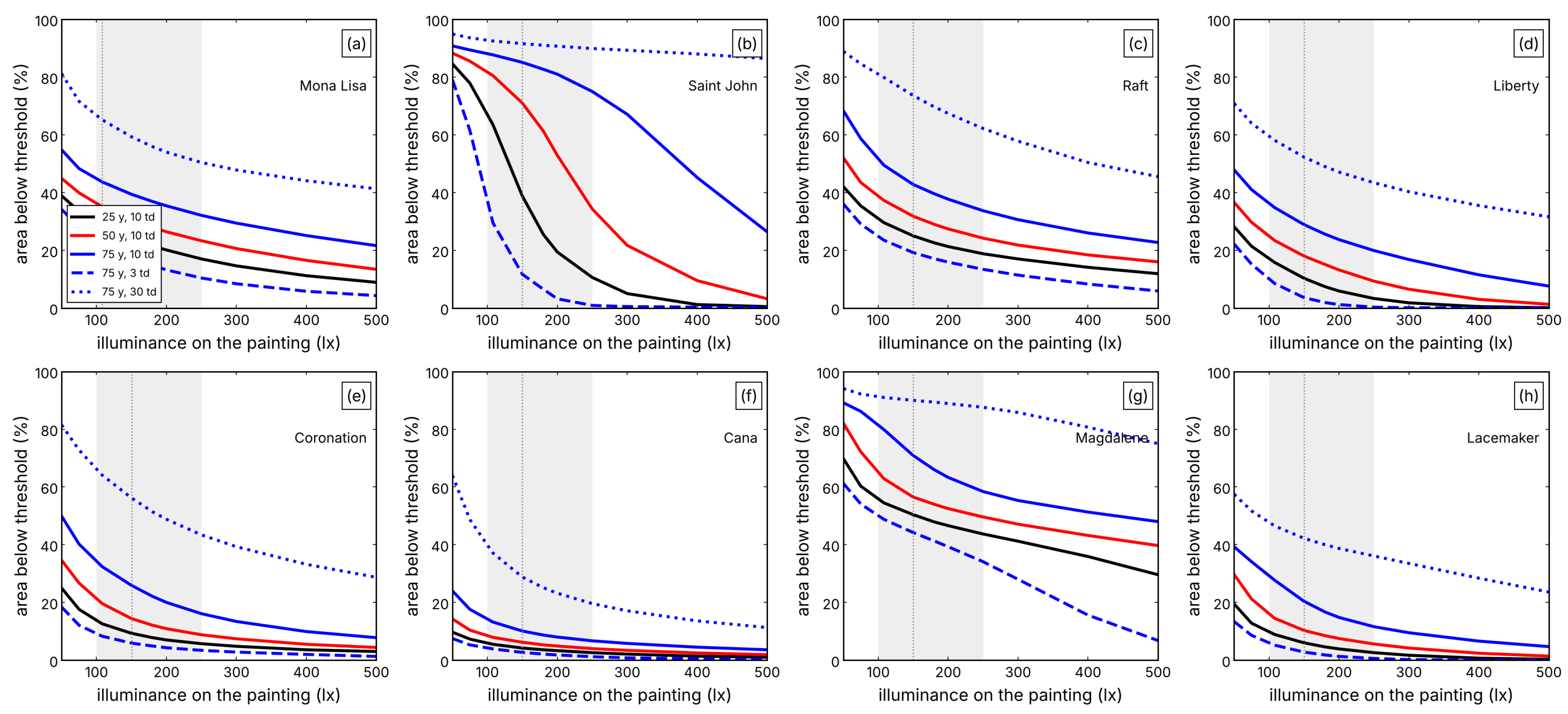
Figure 1 shows the model renderings for 25 and 75 years and Figure 2 the area fraction below threshold against illuminance for the three ages. Because the age effect is a shift along the illuminance axis, the curves for 50 and 75 years are the 25-year curve displaced by factors of 1.4 and 2.4; what differs between works is the shape of the curve, i.e. the luminance distribution of the picture (median luminance factor 0.013–0.163, Table 1). In the base scenarios (Table 3) the fraction below 10 td rises from 25 to 75 years from 4 to 10% for Cana, 6 to 20% for the Lacemaker, 9–10 to 26–29% for the Coronation and Liberty, 25–29 to 43–44% for the Raft and the Mona Lisa, 50 to 71% for the Magdalene and 39 to 85% for Saint John. At 3 td the 75-year fractions are 3–19% except for the Magdalene (44%); at 30 td they are 29–92%. For Saint John the 25-year value is on the steep part of its curve and moves between 19 and 62% when the reflectance scale is varied by %, whereas the 75-year value stays between 81 and 87%: the position of the darkest works relative to the threshold at young ages is not determined by a photograph, their position at old ages is.
Figure 1.
Model-generated renderings of the eight reproductions for a visitor aged 25 (upper row) and 75 (lower row, primed labels) in the base scenarios, after two-stage adaptation, brightness scaling and veil, for the 32-year-old reference observer under D65: (a) Mona Lisa, (b) Saint John the Baptist, (c) The Raft of the Medusa, (d) Liberty Leading the People (2024 state), (e) The Coronation of Napoleon, (f) The Wedding at Cana, (g) Magdalene with the Night Light, (h) The Lacemaker. The renderings illustrate the model’s assumptions and are not measurements of what any visitor sees.
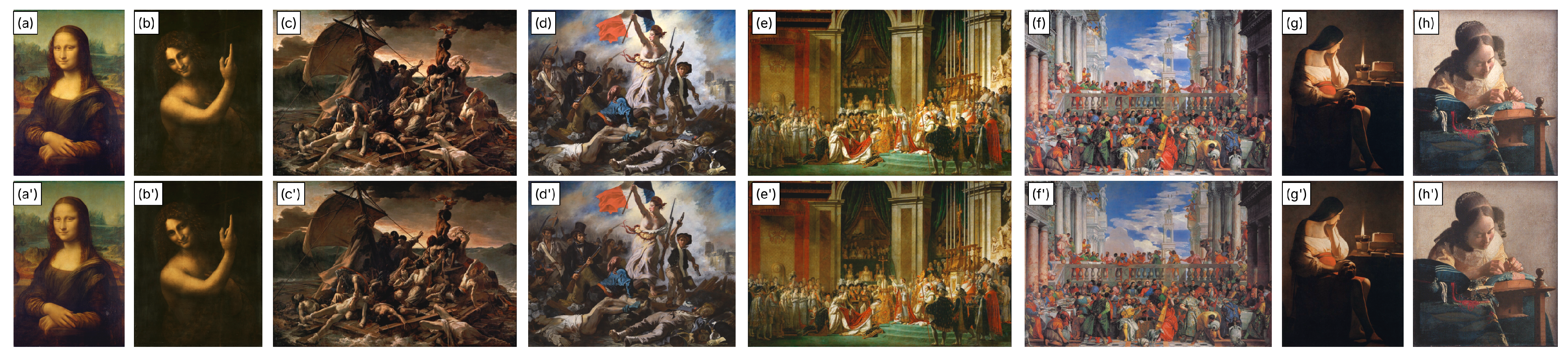
Figure 2.
Fraction of the picture area whose lens-corrected retinal illuminance falls below threshold, against illuminance on the painting, for visitors aged 25, 50 and 75 (10 td, solid) and for the 75-year-old at 3 and 30 td (dashed, dotted): (a) Mona Lisa, (b) Saint John, (c) Raft, (d) Liberty, (e) Coronation, (f) Cana, (g) Magdalene, (h) Lacemaker. The grey band is the 100–250 lx range of the Mona Lisa installation; the dotted vertical line is the base scenario.
3.3. Modelled Appearance
With the adaptation degrees used, the modelled palette difference between a 75- and a 25-year-old is 3.4–5.1 (1.4–2.2 at 50), largest for the colourful Liberty and Cana and smallest for the near-monochrome Saint John and Magdalene; it is dominated by lightness and chroma, not hue. The value depends on the adaptation assumed: for the Mona Lisa it is 6.7 with no lens adaptation, 4.8 at , 4.4 at 0.9 and 4.6 at 1.0, and 12.2 with no adaptation at all. Stable supra-threshold appearance with age is consistent with the literature on the achromatic locus and colour constancy [17,18], but the same literature reports declining discrimination of small colour differences [18], which this model does not contain; the values are predictions of appearance, not of what an older visitor can tell apart.
3.4. Presets and Their Exposure
The illuminance-only presets (Table 3, Figure 3) bring the 50-year-old’s retinal illuminance to 0.98 of the young visitor’s (B = 0.98–0.99), the modelled appearance difference to 0.3–0.7, and the area fraction to within 0.1–4.4 points of the 25-year value, at 162 lx for the Mona Lisa and 225 lx for the 150-lx scenario. For the 75-year-old the 250-lx bound limits the gain: B = 0.90 at 216 lx for the Mona Lisa and 0.86 at 250 lx for the others, 1.9–3.0, and an area fraction reduced by 8–12 points (3 for Cana), which for six works lies within 2 points of the 50-year value today but leaves 75% of Saint John and 58% of the Magdalene below 10 td. Parity on would require 318 lx for the Mona Lisa and 428 lx on a 150-lx base; whether parity on corresponds to parity in any visual task has not been tested.
The spectral variant does not improve any endpoint of this model: with at the same illuminance the brightness index is 0.015 lower, the area fraction 0.3–1.7 points higher and the appearance difference 0.3–0.8 higher than with the illuminance-only preset (Figure 3b), because the pinkish white moves the adapted appearance away from the young visitor’s. Its damage potential per lux is 1.42 times that of the 3200-K spectrum (1.19 for ). A two-hour daily slot at the illuminance-only presets raises daily exposure by 11% (50-year preset), 22% (Mona Lisa, 216 lx) and 15% (250 lx on 150), both luminous and damage-weighted; with the spectral variant the luminous figures are unchanged but the damage-weighted figures become 17, 41 and 30%. All-day operation would raise exposure by 50, 100 and 67% (illuminance only) or 78, 183 and 136% (damage-weighted, spectral variant). At equal damage-weighted exposure, 250 lx of the spectral variant buys the same budget as 177 lx of the present spectrum. The blue–yellow benefit attributed to negative in the companion paper rests on an S-cone contrast index that is not part of the present model and has not been tested with observers [10]; CCI guidance treats departures beyond about as requiring explicit colour-quality assessment [5].
3.5. The Liberty Photographs
The 2024 photograph differs from the pre-cleaning photograph by a mean of 10.3 over the 832 cells (median 9.5, 90th percentile 16.8), with mean moving from to and mean from 40.2 to 42.5. An exposure scale alone leaves the difference at 10.3. A three-gain white-balance correction reduces it to 6.4 (mean 1.6, 41.9); the two-parameter absorbing filter also reduces it to 6.4 ( = 0.76, = 485 nm; mean 1.4, 41.2), and adding an exposure scale to it changes nothing (6.35). In the split-half test the filter fitted on one half gives 6.1–7.1 on the other half (parameters 0.74/472 nm and 0.77/494 nm), the white-balance correction 7.7–8.4. The residual map (Figure 4e, median 5.7, 90th percentile 10.8) is largest where the restoration report describes local work. The absorbing filter therefore reproduces the mean chromatic shift between the two photographs with two parameters and generalises slightly better than a three-gain white balance, but the two cannot be told apart by this comparison, and a white-balance difference between the photographic campaigns would produce the same signature. The comparison is a photographic consistency test of the filter’s form; it is not a physical validation, which would require calibrated measurements of the same surface before and after cleaning or controlled varnished samples.
3.6. A Hypothetical Candlelight Scenario
La Tour’s Magdalene depicts a single flame; whether it was meant to be seen by such light is not documented, so the scenario is hypothetical. In the 150-lx scenario half of the reproduction is below 10 td for the 25-year-old and 71% for the 75-year-old; under a 1900-K light of 20 lx the fractions are 87 and 91% (B = 0.60 and 0.45) and at 50 lx 68 and 88%. The illuminance-only preset at 250 lx reduces the 75-year fraction to 58%, above the 25-year value in the base scenario (Figure 5).
3.7. Size, Distance and Sensitivity
The visual angles of the works span a factor of ten (Table 1). A 1-mm feature of the Lacemaker subtends 3.4 arcmin at 1 m and 1.7 arcmin at 2 m; this is a geometric observation, and whether the work is resolution-limited for an older visitor would require an age-dependent contrast-sensitivity model, which is not part of the present one. The sensitivity analysis (Table 3, last column) gives the 75-year area fraction a range of about points for the reflectance scale and for the pupil, for the lens variability and for the surround; the ranking of the works and the 2.4-fold age factor do not change, the absolute fractions do. The age at which parity on would exceed 250 lx is 67 years on a 108-lx base and about 53 years on a 150-lx base; it is a property of the chosen lens function and scenario, not an observed boundary.
4. Discussion
What the model supports is a set of ratios and shapes. The age factor on lens-corrected retinal illuminance (0.70 at 50, 0.42 at 75) is a property of the CIE lens function and the pupil formula; the luminance distribution of each reproduction then decides how much of the picture that factor pushes below any given threshold, and that distribution is what separates Saint John and the Magdalene (median luminance factor 0.013–0.014) from Cana and the Lacemaker (0.14–0.16). An illuminance increase of 1.5 to 2 times restores the retinal illuminance of visitors up to about 50 within 250 lx and leaves older visitors short, more so for the darkest works; a spectral shift to negative adds damage-weighted exposure without an appearance gain in this model. These statements are robust to the uncertain inputs tested. The absolute percentages are not: they move by 5–10 points with the photograph’s scale or the pupil, and for the darkest works the young-visitor value is poorly determined.
What the model does not support are statements about what visitors see or need. The area fraction is a descriptor of modelled retinal illuminance; detail visibility depends on contrast, spatial frequency, adaptation and retinal location [20], and the modelled describes appearance, not discrimination [18]. The link between the three endpoints and visual performance is the experiment that is missing: observers of known lens density and acuity, a dark, a bright and a detailed reproduction with calibrated spectra and luminances, and separate measurements of detail identification, contrast detection, colour discrimination and preference under illuminance-only and spectral changes at equal damage-weighted exposure. The guidance that older viewers need more light and that short periods of enhanced illumination are an acceptable way to give it already exists [5,6]; what a model of this kind can add is the per-painting curve of Figure 2 and the per-preset exposure of Figure 3, once its endpoints have been tied to measured performance.
The scenarios are not the museum’s present light: only the 2013 spotlight contribution to the Mona Lisa is documented; the ambient light, the other rooms, the glazing and the daylight of rooms with skylights are not modelled, and the channel spectra of the installed luminaires are not public. The Liberty comparison shows what photographs can and cannot do: a chromatic difference that an absorbing filter and a white balance describe equally well, so the physical content of the filter remains to be established on calibrated data.
For works whose base-scenario fraction at 75 years remains above half within 250 lx, a per-visitor display is the alternative to more light on the panel: for a D65-white LCD with an adapting field of 0.3 of its white, matching the lens-corrected retinal illuminance of the Mona Lisa’s white in the 108-lx scenario requires a display white of 44 for a 25-year-old and 135 for a 75-year-old [8]; where such a display would be placed, and how it would interact with the adaptation of visitors to the gallery, are design questions outside this model.
5. Conclusions
In an age-dependent observer model applied to digital reproductions, the retinal illuminance of a 75-year-old is 0.42 of a 25-year-old’s for the same painting and light, equivalent to dividing the illuminance by 2.4, and the share of a picture that falls below 10 td rises accordingly, from a few points for bright works to 39–85% for the darkest in a 150-lx scenario. Illuminance presets of 1.5 and 2 times within 250 lx restore the retinal illuminance of visitors up to about 50 and part of the loss at 75, for 11–22% more daily exposure in a two-hour slot; a spectrum adds 30–41% damage-weighted exposure without an appearance gain. The absorbing-filter model of varnish reproduces the chromatic difference between the photographs of Liberty before and after cleaning as well as a white-balance correction, which the photographs cannot separate. The model’s ratios and rankings are robust to its uncertain inputs; its absolute percentages and its relation to visual performance are not yet established, and the perceptual test that would establish them is specified.
Supplementary Materials
The following supporting information can be downloaded at the website of this paper posted on Preprints.org. Python code of the observer model, scenario, sensitivity and Liberty calculations and figures; result files (JSON); manifest of the image files with their Wikimedia Commons titles and download dates.
Funding
This research received no external funding.
Institutional Review Board Statement
Not applicable.
Informed Consent Statement
Not applicable.
Data Availability Statement
The images analysed are public-domain reproductions available on Wikimedia Commons (file titles in Table 1). The code and result files are provided as Supplementary Material and will be deposited in a public repository with a DOI on acceptance.
Acknowledgments
During the preparation of this study, the author used Claude (Anthropic), ChatGPT (OpenAI), Jenni AI and Grammarly for the purposes of drafting code for the calculations, figure design and English-language improvement. The author has reviewed and edited the output and takes full responsibility for the content of this publication.
Conflicts of Interest
The author declares no conflicts of interest.
Abbreviations
The following abbreviations are used in this manuscript:
| C2RMF | Centre de recherche et de restauration des musées de France |
| CCI | Canadian Conservation Institute |
| CCT | Correlated colour temperature |
| CIE | Commission Internationale de l’Éclairage |
| td | Troland (retinal illuminance) |
| Distance from the Planckian locus in the CIE 1960 diagram | |
| CIEDE2000 colour difference |
References
- Pokorny, J.; Smith, V.C.; Lutze, M. Aging of the human lens. Appl. Opt. 1987, 26, 1437–1440. [Google Scholar] [CrossRef] [PubMed]
- Watson, A.B.; Yellott, J.I. A unified formula for light-adapted pupil size. J. Vis. 2012, 12, 12. [Google Scholar] [CrossRef] [PubMed]
- CIE. CIE Collection on Glare 2002: CIE Equations for Disability Glare; CIE 146/147:2002; CIE: Vienna, Austria, 2002. [Google Scholar]
- CIE. Control of Damage to Museum Objects by Optical Radiation; CIE 157:2004; CIE: Vienna, Austria, 2004. [Google Scholar]
- Michalski, S.; Druzik, J. LED Lighting in Museums and Art Galleries; Technical Bulletin 36; Canadian Conservation Institute: Ottawa, ON, Canada, 2018. [Google Scholar]
- Michalski, S. Agent of Deterioration: Light, Ultraviolet and Infrared. Canadian Conservation Institute. Available online: https://www.canada.ca/en/conservation-institute/services/agents-deterioration/light.html (accessed on 30 October 2026).
- Fontoynont, M.; Miras, J.P.; Angelini, M.; et al. Lighting Mona Lisa with LEDs: Details Concerning Innovating Techniques; Technical Note; Ingélux: Lyon, France, 2013. [Google Scholar]
- Siddiki, A. How the painter saw it: The ageing eye, the yellowing varnish and the museum lamp in five famous paintings. 2026, manuscript in preparation.
- C2RMF. La Liberté guidant le peuple: Étude et Restauration; Centre de Recherche et de Restauration des Musées de France: Paris, France, 2024. [Google Scholar]
- Siddiki, A. How should the Mona Lisa be lit for older eyes? A spectral model of the painting, its varnish and the ageing observer. 2026, manuscript in preparation. [PubMed]
- Mallett, I.; Yuksel, C. Spectral primary decomposition for rendering with sRGB reflectance. In Proceedings of the Eurographics Symposium on Rendering—DL-only and Industry Track, Strasbourg, France, 10–12 July 2019; pp. 7–16. [Google Scholar] [CrossRef]
- Otsu, H.; Yamamoto, M.; Hachisuka, T. Reproducing spectral reflectances from tristimulus colours. Comput. Graph. Forum 2018, 37, 370–381. [Google Scholar] [CrossRef]
- Ohno, Y. Practical use and calculation of CCT and Duv. LEUKOS 2014, 10, 47–55. [Google Scholar] [CrossRef]
- CIE. Fundamental Chromaticity Diagram with Physiological Axes—Part 1; CIE 170-1:2006; CIE: Vienna, Austria, 2006. [Google Scholar]
- Fairchild, M.D. Color Appearance Models, 3rd ed.; Wiley: Chichester, UK, 2013. [Google Scholar]
- Stevens, S.S. To honor Fechner and repeal his law. Science 1961, 133, 80–86. [Google Scholar] [CrossRef] [PubMed]
- Werner, J.S.; Schefrin, B.E. Loci of achromatic points throughout the life span. J. Opt. Soc. Am. A 1993, 10, 1509–1516. [Google Scholar] [CrossRef] [PubMed]
- Wuerger, S. Colour constancy across the life span: Evidence for compensatory mechanisms. PLoS ONE 2013, 8, e63921. [Google Scholar] [CrossRef] [PubMed]
- Sharma, G.; Wu, W.; Dalal, E.N. The CIEDE2000 color-difference formula: Implementation notes, supplementary test data, and mathematical observations. Color Res. Appl. 2005, 30, 21–30. [Google Scholar] [CrossRef]
- Wuerger, S.; Ashraf, M.; Kim, M.; Martinovic, J.; Pérez-Ortiz, M.; Mantiuk, R.K. Spatio-chromatic contrast sensitivity under mesopic and photopic light levels. J. Vis. 2020, 20, 23. [Google Scholar] [CrossRef] [PubMed]
Figure 3.
(a) Reduction of the area fraction below 10 td produced by the presets, with the increase in daily exposure of a two-hour slot: 50-year preset (×1.5, present spectrum); 75-year preset (×2 within 250 lx, present spectrum); the same with at 3300 K, for which the damage-weighted exposure is given. (b) Modelled of the palette for the 75-year-old against the 25-year-old in the base scenario, under the present scenario and under the two 75-year presets.
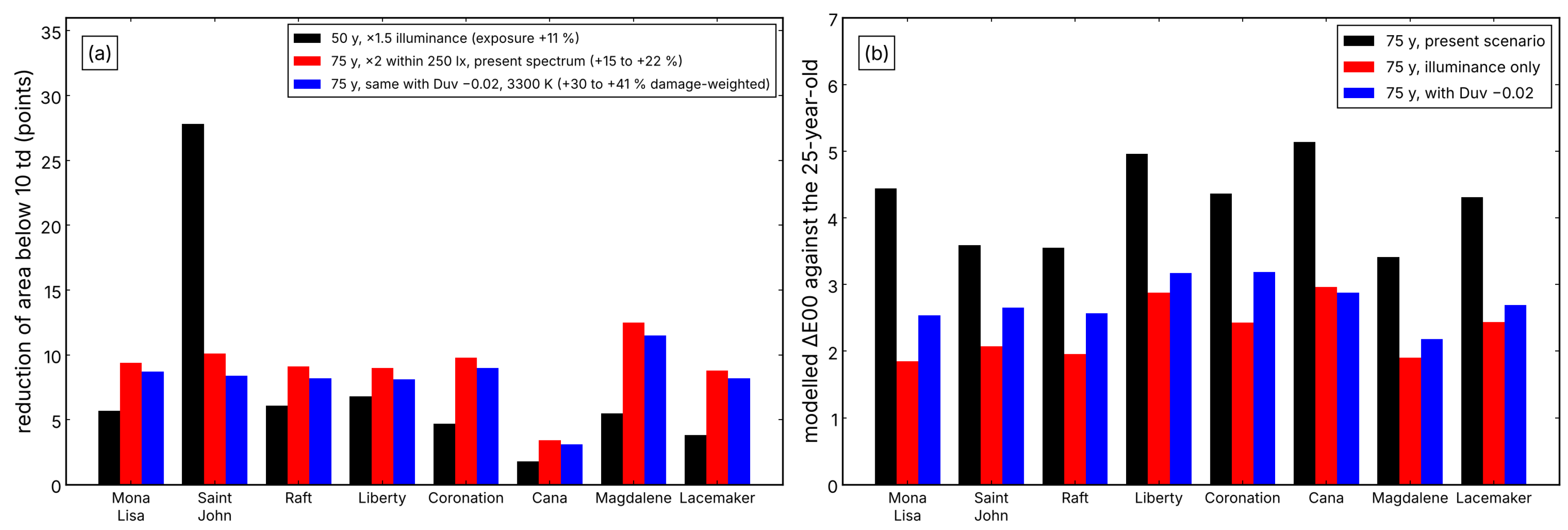
Figure 4.
Liberty Leading the People, model renderings for the 25-year-old in the 150-lx scenario: (a) pre-cleaning photograph, (b) the same with the fitted absorbing filter removed ( 0.76, 485 nm), (c) the 2024 photograph. (d) For 832 grid cells, of the pre-cleaning photograph (red), after the white-balance fit (blue) and after removal of the fitted filter (black), against of the 2024 photograph; dotted line, identity. (e) Residual per cell after the filter fit.
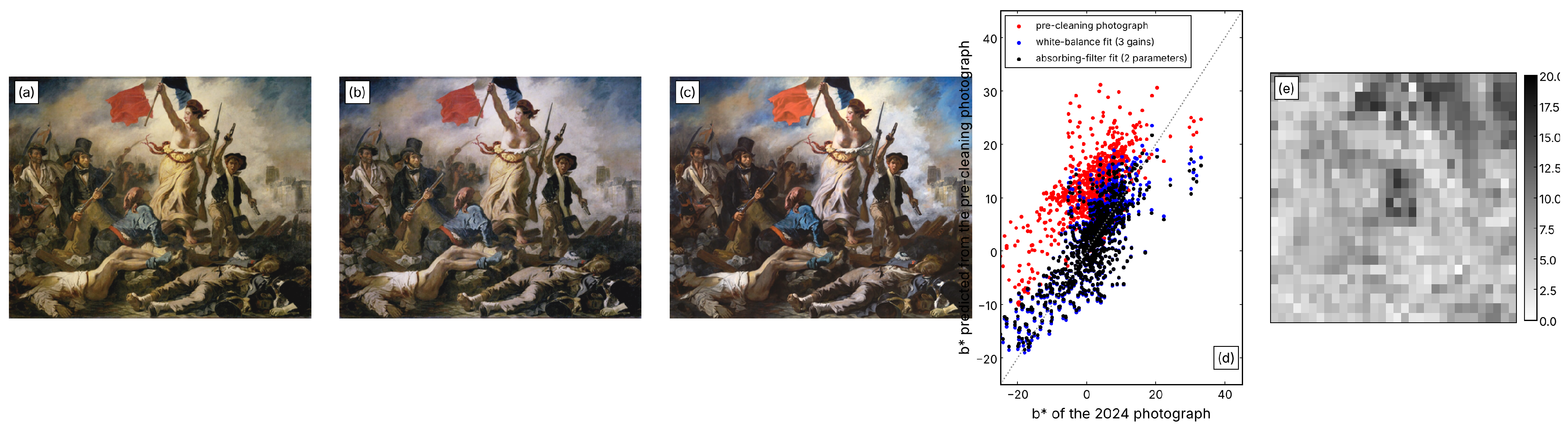
Figure 5.
Model renderings of La Tour’s Magdalene with the Night Light: (a) 3200 K, 150 lx, visitor aged 25; (b) the same, aged 75; (c) hypothetical 1900-K light at 20 lx, aged 25; (d) the same, aged 75.
Figure 5.
Model renderings of La Tour’s Magdalene with the Night Light: (a) 3200 K, 150 lx, visitor aged 25; (b) the same, aged 75; (c) hypothetical 1900-K light at 20 lx, aged 25; (d) the same, aged 75.
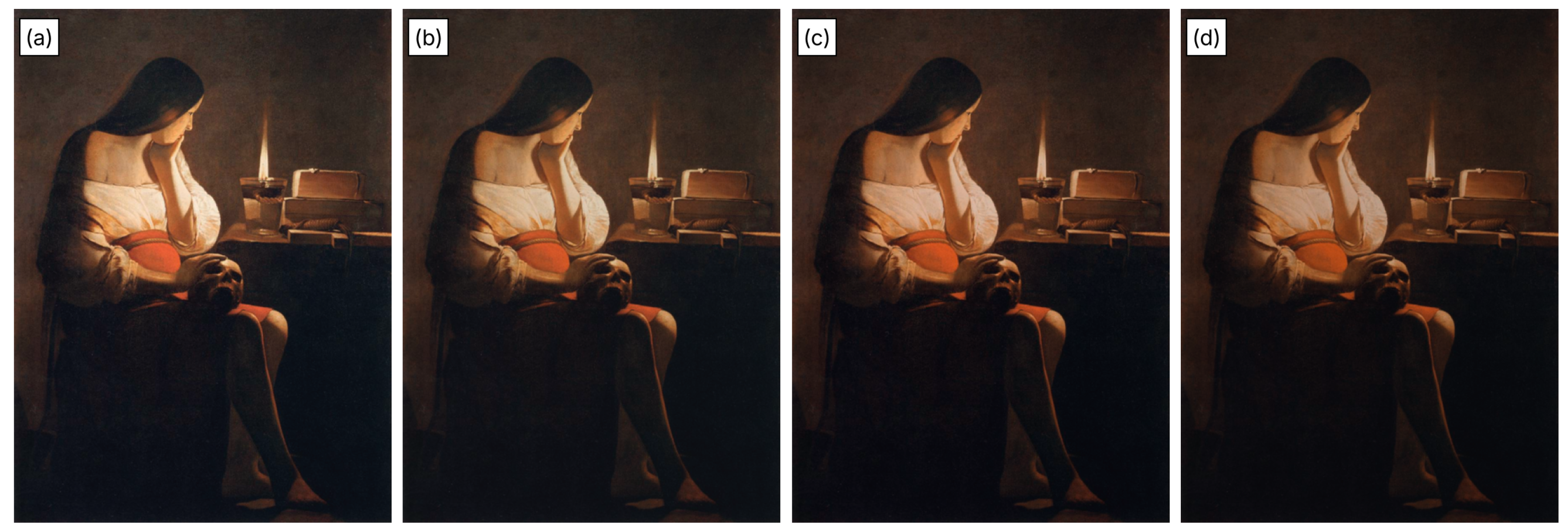

Table 1.
The eight works and their reproductions. Size, assumed viewing distance and visual angle (height × width); median luminance factor Y of the reproduction under the lamp spectrum; Wikimedia Commons file title of the photograph used (all public domain on Commons; C2RMF and Louvre photographs as noted).
| Work | Location | Size (cm) | Distance (m); angle (°) | Median Y | Source file (Wikimedia Commons title) |
|---|---|---|---|---|---|
| Leonardo, Mona Lisa, c. 1503–16 | Salle des États | 77 × 53 | 4.6; 9.6 × 6.6 | 0.055 | Mona Lisa, by Leonardo da Vinci, from C2RMF retouched |
| Leonardo, Saint John the Baptist, c. 1513–16 | Grande Galerie | 69 × 57 | 2.0; 19.6 × 16.2 | 0.014 | Leonardo da Vinci – Saint John the Baptist C2RMF retouched |
| Géricault, The Raft of the Medusa, 1819 | Salles Rouges | 491 × 716 | 6.0; 44.5 × 61.6 | 0.038 | Jean Louis Théodore Géricault – La Balsa de la Medusa (Museo del Louvre, 1818-19) |
| Delacroix, Liberty Leading the People, 1830 | Salles Rouges | 260 × 325 | 4.0; 36.0 × 44.2 | 0.082 | La Liberté guidant le peuple – Musée du Louvre RF 129 – après restauration 2024; pre-cleaning: Le 28 Juillet. La Liberté guidant le peuple |
| David, The Coronation of Napoleon, 1807 | Salles Rouges | 621 × 979 | 8.0; 42.4 × 62.9 | 0.069 | Jacques-Louis David – The Coronation of Napoleon (1805-1807) |
| Veronese, The Wedding at Cana, 1563 | Salle des États | 677 × 994 | 10.0; 37.4 × 52.9 | 0.163 | Paolo Veronese, The Wedding at Cana |
| La Tour, Magdalene with the Night Light, c. 1640 | Sully, room 912 | 128 × 94 | 2.0; 35.5 × 26.4 | 0.013 | Georges de La Tour – Magdalen of Night Light – WGA12337 |
| Vermeer, The Lacemaker, c. 1670 | Richelieu | 24 × 21 | 1.0; 13.7 × 12.0 | 0.139 | Johannes Vermeer – The lacemaker (c.1669-1671) |
Table 2.
Model parameters and their status.
| Parameter | Value | Status |
|---|---|---|
| Spotlight illuminance, Mona Lisa | 108 lx; CCT 3200 K | measured, 2013 commissioning [7]; spotlight only |
| Installation specification | 100–250 lx (spot + ambient) | documented [7]; used as a range, not a policy |
| Illuminance, other works | 150 lx (50–500 in curves) | assumed scenario |
| Lamp spectrum | Planckian-shaped LED; notch at 545 nm for | assumed realisation of the documented chromaticity |
| Lens density by age | CIE 170-1 / Pokorny et al. | literature; individual spread about a factor of two [1] |
| Pupil diameter | Watson–Yellott, , 1500 | literature formula; surround assumed |
| Adaptation degrees | , | assumed; motivated by the stable achromatic locus [17,18] |
| Brightness exponent | 1/3 | literature (Stevens) |
| Veil | 3 % of mean luminance | assumed baseline; CIE 146 age factor |
| Threshold | 10 td (3 and 30 td also) | assumed descriptor; see Section 3.4 |
| Reflectance scale | 1 ( % tested) | photographic; uncertain |
| Varnish filter, Liberty | , | fitted to the photographs |
| Damage weighting | CIE 157, | literature; generic, not material-specific |
Table 3.
Base-scenario results (108 lx for the Mona Lisa, 150 lx otherwise). Area fraction below 10 td for visitors aged 25, 50 and 75, with the 75-year value at 3 and 30 td; modelled of the palette at 75 against the 25-year-old; the two illuminance-only presets ( for 50, 2 within 250 lx for 75) with the area fraction and they give; and the range of the 75-year fraction when the reflectance scale is varied by % or the pupil by mm.
| Below 10 td (%) | 75 y (%) | 50 y, ×1.5 | 75 y, ×2 (≤ 250 lx) | 75 y range | |||||||
|---|---|---|---|---|---|---|---|---|---|---|---|
| Work | 25 | 50 | 75 | 3 td | 30 td | 75 y | lx;% | lx;% | (%) | ||
| Mona Lisa | 28.5 | 35.1 | 43.7 | 17.5 | 59.3 | 4.4 | 162; 29.4 | 0.3 | 216; 34.3 | 1.9 | 40–49 |
| Saint John the Baptist | 38.8 | 71.0 | 85.1 | 11.7 | 91.6 | 3.6 | 225; 43.2 | 0.3 | 250; 75.0 | 2.1 | 80–88 |
| The Raft of the Medusa | 25.0 | 31.8 | 42.8 | 19.2 | 73.6 | 3.6 | 225; 25.7 | 0.4 | 250; 33.7 | 2.0 | 37–51 |
| Liberty Leading the People | 10.3 | 18.0 | 28.9 | 3.6 | 52.3 | 5.0 | 225; 11.2 | 0.7 | 250; 19.9 | 2.9 | 23–36 |
| The Coronation of Napoleon | 9.3 | 14.4 | 25.9 | 5.9 | 56.2 | 4.4 | 225; 9.7 | 0.3 | 250; 16.1 | 2.4 | 19–34 |
| The Wedding at Cana | 4.2 | 6.2 | 10.1 | 2.7 | 28.8 | 5.1 | 225; 4.4 | 0.7 | 250; 6.7 | 3.0 | 8–14 |
| Magdalene with the Night Light | 50.4 | 56.5 | 70.9 | 44.2 | 90.0 | 3.4 | 225; 51.0 | 0.4 | 250; 58.4 | 1.9 | 62–81 |
| The Lacemaker | 6.0 | 10.3 | 20.4 | 2.8 | 42.2 | 4.3 | 225; 6.5 | 0.6 | 250; 11.6 | 2.4 | 14–29 |
Disclaimer/Publisher’s Note: The statements, opinions and data contained in all publications are solely those of the individual author(s) and contributor(s) and not of MDPI and/or the editor(s). MDPI and/or the editor(s) disclaim responsibility for any injury to people or property resulting from any ideas, methods, instructions or products referred to in the content. |
© 2026 by the authors. Licensee MDPI, Basel, Switzerland. This article is an open access article distributed under the terms and conditions of the Creative Commons Attribution (CC BY) license (http://creativecommons.org/licenses/by/4.0/).
Copyright: This open access article is published under a Creative Commons CC BY 4.0 license, which permit the free download, distribution, and reuse, provided that the author and preprint are cited in any reuse.