

Submitted:
06 November 2026
Posted:
09 November 2026
You are already at the latest version
Abstract
Complementary syntactic annotations may support learning in low-resource languages, but compatibility penalties require evaluation beyond parameter sharing. We study dependency parsing, constituency parsing, grammatical-role labeling and chunking in Uzbek using a shared XLM-R encoder, structured predictors and empirical implication penalties during training. UzSyn contains 1,123 sentences and 4,955 tokens, partitioned into 898 training, 112 development and 113 test sentences. Comparisons used five seeds, independent models and unconstrained multi-task learning. With all training sentences, the constrained model reached 85.53% labeled attachment score and 76.55% constituency F1. Differences from unconstrained multi-task learning were +0.52 and +0.06 percentage points; paired 97.5% confidence intervals of [−1.71, 2.93] and [−2.08, 2.52] included zero. At the exploratory 50% final-fitting fraction, constituency and chunk F1 increased by 4.04 and 2.97 points, with descriptive 95% intervals excluding zero. Fitting budgets excluded prior annotation access during rule-template design. Coherence changes varied by rule family. Constrained fitting required 3.66 times the mean elapsed fitting time of unconstrained multi-task learning. The findings identify intermediate-budget gains for replication while leaving full-data superiority unresolved. Independent linguistic validation and external evaluation are needed before broader accuracy or annotation-saving claims.
Keywords:
dependency parsing
; constituency parsing
; grammatical roles
; chunking
; multi-task learning
; consistency constraints
; low-resource NLP
; Uzbek
; UzSyn
1. Introduction
1.1. Motivation and Linguistic Context
Syntactic analysis provides several complementary descriptions of how words form a sentence. Dependency trees identify relations between heads and dependents, while constituency trees describe the grouping of words into hierarchical units. Universal Dependencies (UD) supplies a widely used framework for representing morphosyntactic relations across languages [1]. A multilayer account can additionally identify traditional grammatical functions and shallow phrase boundaries. In this study, grammatical roles refer to Uzbek sentence functions, such as subject, predicate, object, attribute and adverbial, while chunks denote the shallow units specified by the annotation scheme. These layers offer different evidence about the same sentence, creating an opportunity to share supervision across structured prediction tasks.
Uzbek makes the relationship between these descriptions particularly consequential. It is an agglutinative Turkic language with extensive suffixation, a basic subject–object–verb order and word-order variation associated with information structure [2]. Case marking, verbal morphology and constructional context can therefore contribute to the interpretation of grammatical functions alongside linear position. This motivates a context-sensitive account of compatibility: a dependency relation, a constituent category and a traditional sentence function may provide mutually informative evidence, but the relationship must be established for the relevant construction and annotation conventions. A globally fixed correspondence risks excluding analyses that the linguistic scheme permits.
The availability of Uzbek syntactic resources has improved. Uzbek-UT documents annotation for lemmas, part-of-speech tags, morphological features and dependency relations [2]. UzUDT adds a manually annotated resource and computational baselines for Uzbek morphosyntactic processing [3]. These resources provide important foundations for parsing and comparative research. Their documented annotation inventories also delimit what can be evaluated directly: assessing agreement with independently annotated constituency, grammatical-role and chunk layers requires additional aligned reference annotations. Cross-layer evaluation must therefore make the origin and independence of each annotation layer explicit.
The present study evaluates learning across these four syntactic layers on one fixed UzSyn snapshot containing 1,123 sentences and 4,955 tokens. Alignment over the same sentences allows the model to receive related forms of supervision, but does not establish that the layers were independently produced or linguistically adjudicated. We compare independent task models, unconstrained shared-encoder multi-task learning (MTL) and compatibility-regularized learning using the same frozen partitions and permitted fitting annotations. The available evidence supports formal annotation checks and prediction-based evaluation; independent constituency adjudication and external-corpus evaluation remain outside the completed experiment.
1.2. Research Gap and Study Scope
Sharing supervision across syntactic representations has established precedents. Strzyz et al. [4] formulate constituency and dependency parsing as sequence-labeling tasks and show that learning across the two representations can benefit parsing. Zhou and Zhao [5] integrate constituent and dependency information through simplified head-driven representations and joint decoding. Zhou et al. [6] extend joint structural prediction to syntax and semantics in both dependency and span formalisms. Their semantic-role tasks concern a different annotation target from the traditional Uzbek grammatical functions studied here. Together, these studies make an unconstrained shared-encoder model an essential comparison: complementary supervision can already produce gains before an explicit compatibility mechanism is added.
More directly, Gu et al. [7] investigate high-order joint constituency and dependency parsing, including joint modeling during training, explicit constituent–dependency interactions and evaluation in seven languages encompassing low-resource settings. Their work establishes a close methodological reference for the present study. The question we pursue concerns the conditions under which compatibility can be extended to traditional grammatical functions and chunks while preserving legitimate differences between annotation layers. Uzbek supplies a substantive setting for examining that question, especially where structural interpretations depend on constructional context.
Linguistic constraints also have a substantial methodological history. Posterior regularization incorporates indirect supervision through restrictions on posterior distributions [8]. Dual decomposition coordinates component inference procedures through agreement conditions, including applications to syntactic analysis [9]. These approaches motivate explicit interaction between linguistic knowledge and statistical prediction. Here, we instantiate a different training objective: expected violations of empirical cross-layer implications, estimated from permitted training annotations and activated by observable token or span conditions. Each task retains its own decoder, with no cross-layer inference solver.
Two distinctions guide the formulation. First, compatibility is conditional on the native annotation scheme and an explicitly defined applicability condition. Each candidate specifies its antecedent, allowed consequent alternatives and input-derived gate. The implemented contexts use surface word-versus-punctuation status, sentence-final position and span geometry; they do not use gold morphological features or construction labels. Second, agreement with empirical candidates is evaluated separately from accuracy against the released references. A model can reduce candidate violations without improving those reference scores, particularly when an implication is too narrow or the annotation admits alternatives.
Annotation dependence is equally important. If constituency structures are obtained through deterministic dependency conversion, agreement can reflect the assumptions of that conversion rather than independently supported linguistic correspondence. The supplied UzSyn snapshot does not document layer-production histories or independent constituency adjudication, so no conversion procedure is inferred and linguistic validation is not claimed. We evaluate the released aligned analyses and retain unresolved candidate–reference conflicts. Additional corpora with compatible, independently checked layers would be needed to assess broader cross-layer generalization.
The central research problem is whether empirical compatibility adds predictive value beyond shared supervision under limited final-fitting data, while accounting for annotation dependence and measured computational cost. We examine task tradeoffs, formal validity, candidate agreement and disagreements with released references. These outcomes can identify promising interactions and unresolved failure cases, but cannot by themselves establish that a particular constraint suppresses a linguistically defensible alternative.
1.3. Research Questions
The study is organized around five research questions:
RQ1. Predictive value. How does compatibility-regularized joint learning compare with independent task models and unconstrained shared-encoder learning on dependency, constituency, grammatical-role and chunk prediction, using the same partitions, permitted fitting annotations, pretrained encoder and explicit resource limits?
RQ2. Component effects. What changes in the measured outcomes accompany removal of each compatibility family, pooling of context bins, hiding of a direct label layer or deletion of a task head?
RQ3. Limited final fitting. How do the constrained-versus-MTL differences change across the five final-fitting fractions when development and test partitions remain fixed and the additional development and rule-design annotation access is reported?
RQ4. Accuracy and coherence. How do reference accuracy, task-specific structural validity and agreement with a common training-derived compatibility catalog differ across systems?
RQ5. Conflicts and tradeoffs. Where do empirical implications disagree with the released references, and which task or sentence-level improvements and deteriorations remain unresolved without linguistic adjudication?
We tested the hypothesis that explicitly scoped empirical compatibility can add useful inductive bias beyond shared supervision, with its value depending on the amount of fitting data and the applicability of the learned correspondences. The completed evaluation used fixed-hyperparameter baselines, family and layer controls, five final-fitting fractions and five seeds. Dependency attachment scores, labeled constituency span F1, grammatical-role F1 and chunk span F1 were assessed alongside structural validity, gate coverage, antecedent triggers and implication violations. Paired uncertainty estimates and measured computational costs were used to interpret differences rather than treating positive point estimates alone as evidence of improvement.
1.4. Contributions and Article Organization
The study provides three connected contributions:
A four-layer compatibility formulation. We specify a shared-encoder model linking dependency trees, constituency derivations, Uzbek token functions and functional chunks with beginning, inside and outside (BIO) tags through empirical set-valued implications. Exact task marginals supply differentiable expected-violation costs under input-derived gates. The formulation makes the events, applicability conditions and opportunity normalization explicit while retaining separate task-wise decoding.
An auditable compatibility specification. We document the native inventories, token and span alignment checks, candidate estimation procedure and reference conflicts. Training candidates are separated from the common descriptive audit catalog, and formal representability is distinguished from linguistic correctness. Independent expert validation and annotation adjudication are identified as missing evidence rather than represented as completed protocol outputs.
A controlled evaluation of accuracy, coherence and cost. We compare independent task models, unconstrained multitask learning and the compatibility-regularized model using frozen partitions, declared seeds and explicit fitting ceilings. Family removals, pooled candidate estimation, direct-label and head-removal controls, learning curves and paired uncertainty analyses examine the behavior and limits of the additional objective. The 215 completed fits and saved predictions provide the empirical record; external-corpus and published joint-parser comparisons remain unevaluated.
These contributions position the paper as a bounded methodological investigation on the supplied UzSyn snapshot. The study concerns how explicit empirical relationships among aligned annotation layers can be represented, optimized and evaluated; it does not establish their linguistic universality or independence of annotation production. Conclusions are limited to the recorded corpus, partitions, fixed settings and available reference evidence.
The remainder of the article is organized as follows. Section 2 reviews structured parsing, multitask learning and consistency mechanisms. Section 3 describes the data, formal annotation checks, implemented model and experimental protocol. Section 4 reports task accuracy, coherence, ablations and computational costs. Section 5 discusses interpretation, generalization and limitations. Section 6 presents the conclusions.
2. Related Work
Research on learning across syntactic representations provides several distinct foundations for this study: shared supervision, joint structural inference and explicit linguistic constraints. The following review distinguishes these mechanisms and examines the annotation evidence needed to extend them to Uzbek grammatical functions and chunks. It positions the implemented empirical compatibility objective relative to existing joint parsers and knowledge-guided learning methods; Section 4 evaluates its incremental value within the recorded experiment.
2.1. Dependency and Constituency Parsing
Dependency and constituency parsing describe related aspects of sentence structure through different prediction spaces. UD defines a framework for morphosyntactic annotation centered on labeled dependency relations [1]. Neural dependency parsing can score candidate head–dependent arcs and relation labels using biaffine attention, as demonstrated by Dozat and Manning [10]. For constituency parsing, Kitaev and Klein [11] combine a self-attentive encoder with span-based tree prediction. These approaches motivate strong task-specific baselines. In a comparison with joint learning, encoder capacity, pretrained representations and decoder design must be controlled because improvements in any of these components can affect parsing independently of cross-layer compatibility.
A shared use of spans does not make two structural representations equivalent. Yang and Tu [12] represent projective dependency subtrees as headed spans and develop structured training and inference for that representation. The spans encode dependency subtrees rather than independently annotated phrase-structure constituents. This distinction matters when constructing compatibility rules: a relation that follows from a dependency factorization does not establish an independent constituency correspondence. Moreover, rules based on contiguous subtree yields require explicit projectivity and contiguity assumptions. Their applicability to the target Uzbek annotation scheme must be checked before such rules constrain prediction.
Joint parsing already offers several ways to exploit the connection between the two tree formalisms. Strzyz et al. [4] formulate both parsing tasks through sequence labeling and investigate learning across their representations. Zhou and Zhao [5] integrate constituent and dependency information using simplified head-driven phrase-structure representations and joint decoding. Zhou et al. [6] extend joint modeling to syntactic and semantic tasks expressed through dependencies and spans. These studies establish that auxiliary supervision and hybrid representations can be useful without the particular compatibility mechanism proposed here. The semantic-role annotations in the latter work also differ from traditional Uzbek sentence functions: semantic arguments and adjuncts cannot be treated as interchangeable with the grammatical-role inventory of this study.
Gu et al. [7] provide a particularly close comparison through high-order joint constituency and dependency parsing. Their framework models interactions during training and decoding, and their evaluation covers seven languages, including low-resource settings. Consequently, joint tree prediction, low-resource evaluation and measurement of structural agreement are established research directions. Our experiment measures the incremental effect of an empirical compatibility objective beyond its implemented shared-encoder baseline when grammatical-function and chunk supervision are also available. It does not reproduce or establish superiority over this published joint parser; that remains an important comparison for further validation.
Recent work further narrows the methodological distinction. Hou and Li [13] learn constituent heads dynamically as latent variables in neural lexicalized constituency parsing, avoiding predefined head-finding rules. Adaptive constituent–head relationships therefore already have a concrete precedent. Their latent heads are not automatically equivalent to gold UD heads or traditional grammatical functions. For the present study, the relevant question is how relationships among independently defined annotation layers should be conditioned on linguistic context, and how their applicability and exceptions can be validated. The contribution depends on the resulting formulation and evidence rather than on a general claim that constituent–dependency correspondences can be learned.
2.2. Multitask Learning and Structural Consistency
Linguistic knowledge can enter structured prediction at different stages. Posterior regularization constrains posterior distributions through expectations of specified features, allowing indirect supervision to influence learning [8]. Dual decomposition coordinates component inference procedures through agreement conditions and has been applied to syntactic prediction [9]. These mechanisms operate on different objects: restricting a training distribution differs from coordinating discrete inference. A consistency method must therefore state which quantities are constrained, whether the restriction acts during learning or decoding, and what happens when the component predictions cannot satisfy the stipulated agreement conditions.
Neural approaches offer further alternatives. Hu et al. [14] use weighted logic rules to construct a regularized teacher and iteratively distill its predictions into a neural student. Xu et al. [15] define semantic loss through the probability mass assigned to outputs satisfying a logical specification. Teacher–student distillation and semantic-loss regularization provide precedents for combining symbolic knowledge with neural predictions, but neither mechanism establishes the linguistic validity of a particular specification. A simple expected violation penalty, posterior projection, logical semantic loss and constrained decoding should be described according to their actual formulations rather than grouped under a single unspecified consistency objective.
For cross-layer syntax, the specification itself is a central issue. A dependency label may correspond to different phrase configurations or grammatical functions under different constructions and annotation conventions. Hard restrictions remove candidate analyses, while soft restrictions can discourage them without excluding competing evidence. Their relevance therefore depends on justified applicability conditions and permitted alternatives. For constraints applied at inference, conditioning features must be available from the input or model predictions; additional annotated context used only during training has a different evidential role.
Shared supervision also creates optimization effects that are distinct from output consistency. Yu et al. [16] propose gradient surgery to address detrimental interference between task gradients under specified optimization conditions. Such interference concerns how tasks update shared parameters, whereas a compatibility violation concerns whether predicted structures meet a stated relationship. A model can experience either problem without the other. Evaluation must therefore report task-loss weighting and tuning budgets alongside constraint weights. Otherwise, apparent gains from a compatibility objective could reflect better optimization or additional tuning rather than improved use of linguistic relationships.
These approaches distinguish the source of supervision, the object being constrained and the stage at which constraints act. For multilayer syntax, their relevance depends on independently justified compatibility relations and an evaluation that separates predictive accuracy from agreement with those relations. Lower violation rates can reflect either improved disambiguation or stronger adherence to an overgeneralized specification; task-level reference evaluation is needed to distinguish these outcomes.
2.3. Uzbek Resources and Evidence from Turkic Languages
Existing Uzbek resources establish a basis for dependency learning while also defining the limits of directly available supervision. Akhundjanova and Talamo [2] describe Uzbek-UT and its UD annotation, including morphological and dependency information. Matlatipov and Aripov [3] present UzUDT with manually annotated morphosyntactic data and computational baselines. These contributions support research on Uzbek dependency parsing. However, their documented UD inventories do not by themselves supply the independently checked constituency, traditional grammatical-function and chunk references required for evaluating all four outputs of the present study. Corpus size, annotation agreement and preprocessing details must be reported for the actual versions used rather than inferred from the availability of a UD treebank.
Related-language resources provide useful but narrower transfer evidence. Akhundjanova et al. [17] introduce parallel, manually annotated UD treebanks for Azerbaijani, Kyrgyz, Turkish and Uzbek. Their sentence alignment supports comparison across languages under a common dependency framework. Alignment across languages, however, is different from alignment across dependency, constituency, grammatical-role and chunk annotations for one sentence. Such resources can support dependency transfer or a restricted cross-lingual evaluation. Claims about transfer of the complete compatibility mechanism require reference layers whose definitions match the relationships being tested.
Dependency-to-constituency conversion offers a complementary perspective on annotation provenance. Marşan et al. [18] develop a learning-based conversion algorithm for Turkish using linguistic rules and morphological information, and evaluate conversion against manually annotated constituency references. This is an important example of independent validation accompanying conversion. Their basic constituency labels deliberately omit functional extensions such as subject and object tags, illustrating that constituency categories need not encode the grammatical-function distinctions required here. The UzSyn layer-production histories were not supplied, so no conversion origin or subsequent expert correction is inferred. If layers share conversion assumptions, their agreement alone cannot independently validate those assumptions.
The target annotation inventory therefore needs operational definitions. Traditional Uzbek functions, including ega, kesim, to‘ldiruvchi, aniqlovchi and hol, refer to sentence functions in the adopted annotation scheme. They differ from part-of-speech tags, morphological features and semantic-role labels. Chunks provide shallow boundaries and labels rather than a complete constituent hierarchy. These distinctions determine both which annotations can be shared and which compatibility conditions are meaningful. External resources should be used only for the layers they document, with any mapping, conversion or additional annotation reported explicitly.
2.4. Synthesis and Positioning of the Present Study
Table 1 summarizes the methodological relationships most relevant to our study. It compares the kind of supervision and interaction supplied by each research line rather than combining performance scores obtained from different corpora and experimental budgets.
The reviewed work situates this study in the explicit formulation and empirical evaluation of compatibility across four aligned syntactic representations. Shared encoders, joint constituency–dependency inference, adaptive head selection and logical regularization have established precedents. The present implementation contributes specified events, allowed alternatives, observable gates and controls for a native Uzbek inventory. Four output heads or an additional loss term do not, by themselves, establish generic methodological novelty or independent linguistic validation.
Section 3 specifies the task distributions, candidate implications and fitting protocol. Section 4 compares the implemented objective with matched shared-supervision and independent baselines through repeated runs, family and layer controls, learning curves, accuracy, coherence and cost. Independent constituency adjudication, an adapted published joint-parser comparator and compatible external-corpus evaluation were not completed. They delimit the present evidence and remain priorities for validating the linguistic relationships and broader generalization.
3. Materials and Methods
We investigated whether a training objective that penalizes incompatibility between syntactic representations improves joint prediction on Uzbek. Four structured predictors shared a fine-tuned encoder and produced dependency trees (D), constituency analyses (C), token-level grammatical roles (R), and functional BIO chunks (H). We compared this model with independent task models and an unconstrained multitask model using the same corpus partitions, permitted fitting annotations, pretrained encoder, and evaluation code. Cross-layer coupling operated through a differentiable training penalty; each task retained its own structurally valid decoder. The experiment used one fixed UzSyn snapshot and empirical compatibility candidates estimated from training annotations. Linguistic validation, predictive accuracy, formal validity, and agreement with these candidates were treated as separate kinds of evidence.
3.1. Corpus and Snapshot Provenance
The material was the supplied local snapshot of UzSyn, associated with the repository uznlp-uz/uzsyn [19]. It contained 1,123 sentences and 4,955 tokens, including 1,225 tokens with XPOS=PUNCT and 3,730 other tokens. Sentence length, including punctuation, ranged from 2 to 27 tokens, with a mean of 4.41 and a median of 3. The structural metadata contained 1,098 SODDA sentences and 25 QOSHMA sentences. Communicative labels comprised 951 DARAK, 101 SOROQ, 57 BUYRUQ, and 14 ISTAK sentences. The material therefore primarily represented short, simple utterances.
Sentences.tsv provided sent_id, SentenceText, SentenceType, CommunicativeType, and ConstituencyTree. Tokens.tsv provided sent_id, TokenId, token, XPOS, GapBolagi, GapChunk, HEAD, and DEPREL. We joined records by sent_id and sorted tokens by TokenId within each sentence; identifiers were keys rather than row positions. TagSets.tsv defined the native annotation inventories. All sentences had populated records for the four target layers, and formal validation did not exclude any sentence. The dataset repository's technical train configuration exposed the complete tables and was not an experimental training split.
Snapshot identity was established by the raw-file SHA-256 checksums in Table S2 and the archived partition manifests. A remote dataset commit corresponding to these exact local bytes was not independently established. The dataset card declared CC BY 4.0. The tables contained no source-document identifiers, per-sentence source URLs, verified genre assignments, annotation-origin records, or inter-annotator agreement measurements. Consequently, complete parallel fields were not interpreted as proof of independently produced annotations. Table 2 summarizes the study-defined partitions.
3.2. Native Annotation Layers and Formal Validation
Dependency targets used integer heads, with 0 identifying the artificial root, and 24 observed relation labels. XPOS had 13 observed values. Although several dependency labels shared names with Universal Dependencies [1], the native TSV format and overlapping terminology did not establish full UD compliance. We checked token-index continuity, head ranges, absence of self-loops, a single root attachment, connectivity, acyclicity, and agreement between root attachments and the root relation. All 1,123 trees passed. Sentences 50 and 73 contained crossing non-root arcs; the dependency output space therefore allowed nonprojectivity, although neither development nor test contained a nonprojective reference.
GapBolagi comprised eight token labels: EGA, KESIM, ANIQLOVCHI, TOLDIRUVCHI, HOL, KIRISH, UNDALMA, and BOSHQA. These represented native grammatical functions, including a residual category, rather than semantic argument roles. GapChunk used seven functional chunk types: S, P, O, A, AdvC, KIR, and UND. The guide defined 15 states: B-X and I-X for each type, plus standalone O. Only 13 occurred in the snapshot because B-A and I-A were absent. Standalone O denoted an outside token and remained distinct from B-O and I-O, which denoted object or complement chunks. All sequences satisfied BIO transition rules and contained 2,566 chunks.
Constituency traversal identified 4,375 phrase nodes, including 1,123 outer roots, and 4,955 POS preterminals. Removing outer roots and preterminals left 3,252 reference phrase occurrences, with 37 observed literal phrase labels. The guide defined 10 base categories and eight optional functions; adding the unmarked function gave a fixed 10-by-9 label factorization. A label such as NP-SBJ thus combined category and function. Constituency functions and functional chunks provided information related to token roles, so the four layers were not assumed to be informationally independent.
Tree yields matched token strings exactly in 768 sentences. In the other 355, comparison became exact after mapping U+2018, U+2019, U+02BB, U+02BC, and U+0060 to the ASCII apostrophe. This alignment affected comparison only: no token was removed, reordered, or rewritten in the model input. All bracketed trees parsed successfully. These tests established representability and alignment, not linguistic correctness or independence of the constituency reference. No independent constituency adjudication or expert-review manifest was available for this experiment.
The released sentence 3 illustrates the distinction between roles and chunk membership. In “Men yozgan maktub sizni hayratda qoldirdi.”, the subject chunk covers Men, yozgan, and maktub, whose token roles are EGA, ANIQLOVCHI, and EGA. Consequently, subject-chunk membership does not require an EGA label at every position. Compatibility estimation retained sets of observed alternatives rather than imposing label identity.
3.3. Similarity Groups and Frozen Data Partitions
We reconstructed and froze an 80:10:10 split using text-similarity groups. Comparison keys applied Unicode NFKC normalization, case folding, apostrophe unification and removal, and Unicode alphanumeric tokenization. Normalization was confined to grouping keys. Identical token sequences were connected. For pairs containing at least six comparison tokens in each sentence, an edge was also added when token edit distance was at most one or token-bigram set Jaccard similarity was at least 0.8. The procedure did not transliterate between scripts.
Connected components yielded 1,116 groups: 1,109 singletons and seven pairs. All seven paired matches were exact after comparison normalization; the additional approximate criteria created no further edges. Integer sentence-ID lists within components were sorted, the component list was sorted lexicographically, and random.Random(1729) shuffled the list. Prefix boundaries nearest the target sentence counts, with ties resolved toward smaller counts, produced 898 training, 112 development, and 113 test sentences. All seven pairs belonged wholly to training. Independent reconstruction matched the archived group and split manifests, with no identified group crossing a partition.
Grouping reduced overlap under the stated comparison procedure; it could not establish document, author, or domain separation because those identifiers were absent. The split was not stratified by sentence structure: development contained no QOSHMA sentence, and test contained four. We preserved this frozen split throughout the comparisons and interpreted complex-sentence analyses according to their small support. Development references selected checkpoints; test references did not enter rule fitting, vocabulary fitting, or checkpoint selection.
3.4. Task Formulation and Shared Encoder
For a tokenized sentence x=(x₁,…,xₙ), the four targets belonged to task-specific valid structure spaces. The encoder was FacebookAI/xlm-roberta-base [20], using the same model and tokenizer snapshot, e73636d4f797dec63c3081bb6ed5c7b0bb3f2089. All encoder parameters were fine-tuned. Input consisted only of the supplied token strings; gold POS, sentence types, dependency labels, roles, chunks, and constituency labels were not encoder features. Each word vector was the mean of its contextual subword vectors:
Here Bᵢ is the set of subwords aligned to word i. Dropout of 0.1 was applied to the pooled vectors. The implementation preserved complete sentences. Its long-input fallback used 510 content subwords plus special tokens, a 64-subword overlap, averaging across overlapping contextual vectors, and subsequent word pooling. The short corpus did not require this fallback. Figure 1 summarizes the training architecture.
Each predictor assigned an additive score Sₜ(x,y) to a valid structure y. The corresponding normalized distribution and event marginal were defined as follows:
The partition function Zₜ summed exponentiated scores over the task's structure space. Shared encoding coupled supervised learning, and cross-layer penalties coupled event marginals from different tasks. Each task distribution was normalized, and their product defined a normalized factorized distribution over the Cartesian product of all four output spaces. The implementation introduced no coupled partition function with cross-layer interaction factors and performed no coordinated joint MAP inference.
3.5. Structured Predictors and Decoding
3.5.1. Dependency Trees
The dependency head used biaffine scoring [10]. Separate dependent and head projections had dimensions 500 for arcs and 100 for relations, with GELU activation and dropout 0.1. A learned root vector supplied the artificial head. The labeled attachment score and tree score were:
Normalization ranged over labeled directed spanning trees with exactly one artificial-root attachment. Self-loops were prohibited; the root relation was allowed only on artificial-root attachments and was prohibited elsewhere. Relation scores were marginalized by log-sum-exp before tree normalization. Following the Matrix-Tree framework [21], the implementation computed the single-root partition by root enumeration and subtraction-free log-space elimination in float64. This particular implementation required O(n⁴) arithmetic overall, rather than cubic total arithmetic. Labeled attachment marginals were obtained by differentiating the log partition, retaining the graph needed for derivatives of the consistency penalty.
MAP decoding used the maximum permitted relation score for each arc, enumerated the unique lexical root, and computed a maximum spanning arborescence for each candidate [22]. The highest-scoring labeled tree was returned. This enforced single-root connectivity and acyclicity while allowing nonprojective arcs. Label marginalization in training and label maximization in MAP decoding were kept distinct.
3.5.2. Constituency Analyses
For each half-open span [i,j), we concatenated its first-word, last-word, and mean-word vectors and applied a 256-dimensional GELU projection. Scoring of contiguous spans and chart normalization followed the general structured modeling approach in [11,23], without claiming reproduction of those parsers. Let gᵢⱼ denote the span projection and κ an ordered unary chain of literal phrase labels. Its local score was:
The functions b and f extracted the base category and optional function. The Cartesian product of the guide’s category and optional-function inventories provided 90 possible singleton states, including unattested combinations. A separate null score represented auxiliary empty nodes. Multi-label chain corrections were enabled only for chains observed in the annotations permitted for that run. Removing direct constituency supervision therefore also removed access to its data-derived chain vocabulary.
Gold phrase trees underwent unary collapse and deterministic right binarization. A binary chart CRF summed over all binary split points and permitted local states; the outer chain had to begin with S. Chart MAP decoding reversed unary collapse and removed empty auxiliary nodes. Genuine internal unary multiplicities were preserved. Normalization was over binary derivations: several derivations could reverse to the same original n-ary analysis. We therefore did not interpret the distribution as a uniquely normalized probability over unbinarized trees. The reference derivation used for supervised likelihood was the deterministic transformed tree; unseen reference chains remained in evaluation denominators.
3.5.3. Grammatical Roles and Chunks
Two separate 256-dimensional GELU projections supplied emissions to linear-chain CRFs [24]. The role CRF used all eight native labels with learned start, end, and transition scores. The chunk CRF used the full 15-state guide inventory. BIO masks disallowed I-X at the start and after any state other than B-X or I-X. Both heads used Viterbi MAP decoding.
Chunk compatibility required exact span events rather than products of token marginals. For chunk type k on [i,j), its probability included the beginning state, every interior continuation state, and the termination event:
Indices in span equations were zero-based, so zᵢ₊₁:ⱼ comprised positions i+1 through j−1 and was empty for a singleton. Constrained forward computation supplied this event probability. It accounted for sequence dependence and the end boundary explicitly.
3.6. Empirical Compatibility Catalogs
The four families linked events from different task distributions through binary implications A⇒B. For each fitting run, a frozen catalog was estimated exclusively from its permitted training annotations. A candidate needed at least five reference antecedent occurrences. Its allowed consequent set was the union of observed alternatives in the relevant context. C–H and D–C candidates additionally required a qualifying consequent in at least 90% of their reference antecedent occurrences. These were empirical candidate constraints, not expert-validated linguistic rules.
Contexts used observable surface and geometric information. Token contexts crossed alphanumeric-versus-punctuation status with sentence-final-versus-other position; a punctuation token was one containing no alphanumeric character. Span contexts used width and singleton-versus-multiple-token status. No gold POS, morphological feature, sentence class, or held-out annotation activated a rule. Table 3 states the actual directions: family identifiers named the linked tasks, and did not necessarily indicate antecedent order.
For D–R, antecedent probability summed labeled-arc marginals over possible heads. For R–H, membership probability summed B-k and I-k token marginals, or used the standalone O marginal. The consequent role probability summed over the allowed role labels. For C–H, the antecedent was the exact chunk event in Equation (5), while the consequent summed chart-state marginals for unary chains containing at least one allowed literal constituent label. For D–C, constituent-event probability selected chains containing the antecedent label, and the consequent summed the permitted internal-arc probabilities, marginalizing relation labels. The two opposite arcs on a two-token span were mutually exclusive in a valid tree.
This design did not enforce universal dependency-subtree equivalence, head percolation, or identical roles throughout a functional chunk. The D–C family covered only two-token constituents and C–H only chunks of width at most six. In the pooled ablation, context bins were merged before counts and admission thresholds were computed. Pooling could therefore change the catalog and its eligible opportunities; it was not an isolated context-only intervention with an identical catalog.
A separate catalog fitted to the complete training split was reused for descriptive coherence audits across systems and fractions. It did not enter reduced-data fitting or checkpoint selection. During method development, however, the full training annotations had informed the restricted two-token D–C template. The reduced fractions consequently measured final-fitting annotation budgets, rather than total annotation access across the entire development process.
3.7. Objective and Differentiable Training Procedure
At a frozen rule-site opportunity s, the realized implication cost was one only when the antecedent occurred and the consequent did not. Under the product of the two task distributions, its expected value was:
Both marginals retained their gradients. The expectation was evaluated under the factorized product of task distributions rather than a coupled cross-task posterior. The gates and empirical tables were not optimized jointly with the network. An implication penalty can decrease by suppressing its antecedent; we therefore measured triggers and coverage alongside violations and task accuracy.
Let W be an effective optimizer window, Wₜ its sentences with an observed whole-task target, and O the set of directly supervised tasks. The supervised loss used fixed task weights of one quarter:
Observation masks in this implementation removed entire task layers, so Wₜ equaled W for each retained supervised task. Arbitrary partially labeled spans or sequences were not supported. Empty denominators contributed zero. Losses were averaged by sentences, not by tokens or constituent counts. For retained family set F and its frozen rule-site opportunities A_f(W), the regularizer was:
The denominator aggregated all eligible rule-site opportunities within a family across the window. It was neither an individual-rule denominator nor the number of predicted antecedent triggers. Empty families contributed zero. Removing a task or family did not renormalize the surviving one-quarter weights.
For constrained training, compatibility was inactive in epochs 1–3, approximately 0.0333 and 0.0667 in epochs 4 and 5, and 0.1 from epoch 6. Unconstrained multitask training always used zero compatibility weight. Four-sentence microbatches accumulated into a 16-sentence optimizer window; all numerator contributions used denominators computed over that complete window. Incomplete windows used their actual size.
Algorithm 1. One optimizer window of compatibility-regularized training.
- Read token strings, permitted complete task targets, and the run-specific frozen catalog; enumerate input-defined rule opportunities for the whole window.
- Encode each microbatch and compute the active structured scores, partition functions, target scores, and event marginals.
- Accumulate the sentence negative log likelihoods in Equation (7) and the family-level expected costs in Equation (8), using the full-window denominators.
- Backpropagate Equation (9) through both task marginals and the shared encoder, retaining higher-order differentiation where marginals are derivatives of log partitions.
- Clip the accumulated gradient norm, apply AdamW, and advance the learning-rate scheduler once.
- After each epoch, evaluate only the permitted development tasks and retain the best checkpoint under Equation (10).
3.8. Comparison Systems and Ablations
The principal contrast was compatibility-regularized joint learning against unconstrained shared-encoder multitask learning. Independent learning used four separately fine-tuned encoder–head models and combined their outputs only after all four task fits completed. Across the three systems, data membership, native tokenization, guide inventories, encoder snapshot, maximum epochs, scoring rules, and aggregate time ceilings were matched. These were matched experimental conditions and ceilings, not a claim of identical parameter counts, FLOPs, or realized compute. Table 4 accounts for the completed fits.
Rule-family ablations retained all four directly supervised heads and removed D–R, D–C, C–H, or R–H individually. The pooled variant re-estimated its catalog after context merging. Direct-label removal omitted the selected task from training likelihoods, empirical rule fitting, data-derived vocabulary fitting, and development selection, while retaining its output head for evaluation. Because no external expert catalog was supplied, every incident rule was also removed. That retained head therefore received neither a direct task objective nor an incident compatibility objective; these runs were untrained-head controls, not evidence of learning a missing layer through constraints.
Task-head removal deleted the selected predictor and all incident rules. Surviving reference layers could still encode related information: removing role labels, for example, did not remove the functional information present in constituency and chunk annotations. Such ablations measured the contribution of direct supervision or a model component, not complete removal of all linguistic evidence about a function. No published joint dependency–constituency parser reproduction, cross-layer coordinate decoder, or external-corpus comparison was included in the completed design.
3.9. Optimization and Annotation Budgets
All final fits used the fixed settings in Table 5. There was no completed hyperparameter search. The archived seed-2026 sampling manifests and earlier search specifications were not used as tuning experiments and were not included in consumed fitting supervision. AdamW [25] used separate learning rates for the encoder and task parameters. Biases, normalization parameters, and other one-dimensional parameters were excluded from weight decay. Learning-rate warm-up covered the ceiling of 10% of the maximum scheduled optimizer updates, followed by linear decay; the scheduler advanced once per optimizer update.
All encoder parameters were trainable. Settings and ceilings were shared where applicable; parameter counts and measured runtime were reported separately.
After every epoch, checkpoint quality was the arithmetic mean of the directly observed task metrics, each on a 0–100 scale:
Coherence scores and hidden-task development labels did not enter selection. Ties retained the earlier checkpoint. Patience was five non-improving epochs, with the stopping check enabled from epoch 6; warm-up checkpoints remained eligible. Thus, a dev-selected constrained-system checkpoint could precede nonzero compatibility updates. In the archived 5% seed-13 run, epoch 3 was selected under this policy and was retained in the five-seed comparison rather than replaced after examining test performance. Test evaluation followed loading of the selected checkpoint.
For each final seed, training groups were independently shuffled and nearest-size prefixes formed nested subsets at nominal 5%, 10%, 25%, 50%, and 100%, containing 45, 90, 224, 449, and 898 sentences. The same seed-specific subset was used across systems. Token counts varied with subset composition (Table S1). Development remained 112 additionally annotated sentences and test remained 113. Because a seed determined both subset composition and initialization, variation in reduced-data scores reflected both factors. Full-training access during rule-template development was additional to these final-fitting budgets.
The shared and ablation fits had four elapsed wall hours each; independent models had one hour per task and four hours in aggregate. Ceilings were checked at epoch boundaries, permitting one-epoch and I/O overshoot. No archived fit stopped at the time ceiling. Runtime included initialization, validation, and checkpoint writing and was not active GPU-kernel time or energy. For independent models, parameter counts, fitting time, and inference time were summed across the four components; sequential peak allocated memory was their maximum.
3.10. Accuracy Validity and Coherence Metrics
Primary dependency scores were UAS and LAS over tokens whose reference XPOS was not PUNCT. UAS required the correct head and LAS additionally the correct native relation. All-token scores were secondary. Reference XPOS supplied only this evaluation mask. Constituent and chunk F1 used exact labeled span matches:
Constituency matching used labeled span multisets after reversing transformations. The outer root, POS preterminals, and empty binarization nodes were excluded; genuine repeated internal unary occurrences were retained. Unseen reference chains remained in the reference denominator. Endpoints were defined on the supplied token sequence, including punctuation positions; no EVALB punctuation deletion or label-equivalence mapping was applied. Chunk evaluation matched exact (start,end,type) spans, excluding standalone O. False positives for a type counted even when its reference support was zero. Native predictions respected BIO masks. The scorer's external-prediction fallback repaired an invalid I-X to B-X for span extraction while separately reporting invalidity.
Role micro F1 over all tokens equaled accuracy. Macro F1 averaged all eight fixed labels and assigned zero F1 to classes absent from both reference and prediction. Secondary views excluded reference punctuation or reference BOSHQA tokens. We summed corpus counts before computing each micro metric; sentence-level F1 values were not averaged. Length buckets were 1–3, 4–6, 7–10, and at least 11 tokens, with additional SODDA/QOSHMA views and their reference support.
Structural audits separately assessed dependency validity, noncrossing constituency spans, and BIO transition validity. These checks did not certify linguistic correctness. Cross-layer coherence used the same 58-rule full-training descriptive catalog for every comparable output set. For a family, let B be the base rule-site count before its input gate, G the gated opportunity count, T the number of realized antecedent triggers, and V the realized implication violations. We reported:
Undefined denominators were recorded as unavailable, not as perfect agreement. The same catalog and opportunities were applied to reference annotations to quantify reference conflicts. In head-removal conditions, only families whose required outputs remained could be audited; coherence comparisons required a common surviving inventory. A lower violation rate alone was insufficient evidence of better syntax because it could reflect reduced trigger frequency, narrow applicability, or suppression of valid analyses. Reference conflicts were not automatically classified as annotation errors.
3.11. Paired Comparisons and Uncertainty
We reported each run, the mean, and sample standard deviation across the five declared seeds. The primary condition used the complete training split, and the primary contrast was constrained joint learning minus unconstrained multitask learning. LAS and constituency F1 were co-primary endpoints. A paired run-and-group percentile bootstrap, extending the paired-output resampling principle [26], used 10,000 replicates and random seed 271828. Each replicate sampled run indices and test similarity-group indices with replacement, using the same selections for the two compared systems.
For each sampled run, corpus counts were summed over the sampled groups, the metric was recomputed, and paired differences were averaged across sampled runs. The procedure did not average sentence F1 or treat the five predictions for one sentence as independent test examples. All 113 test groups happened to be singletons in this split. The bootstrap reused predictions and did not retrain models. Score summaries used percentile 95% intervals. The two full-data co-primary differences used two-sided 97.5% intervals, providing a Bonferroni adjustment for those two endpoints; intervals for other tasks, fractions, and ablations were descriptive 95% intervals.
These intervals were approximate under the fixed split and the available five runs. They did not measure uncertainty over alternative corpus partitions or unseen domains. In reduced-data conditions, seed resampling incorporated the combined effects of sampling and initialization. The very small number of complex test sentences and the absence of nonprojective test examples limited construction-specific conclusions regardless of the model's permitted output structures.
3.12. Implementation Reproducibility and Evidence Scope
All 215 recorded fits used an NVIDIA B200 with Python 3.12.3, PyTorch 2.7.0a0+ecf3bae40a.nv25.02, CUDA 12.8, cuDNN 9.7.1, Transformers 4.51.3, NumPy 1.26.4, and NetworkX 3.4.2, with four PyTorch CPU threads. Python, NumPy, and PyTorch seeds were set; deterministic algorithms were enabled, cuDNN benchmarking and TF32 were disabled. Neural tensors used float32 and the dependency partition used float64 log-space arithmetic. The implementation logs recorded 11 checks covering tiny-tree partition and MAP calculations, marginals and second derivatives, exact chunk events, unary scoring, held-out rule-fit invariance, and bootstrap identity.
The supplied evidence archive contained source files, raw TSVs, tag definitions, frozen groups and split/subset identifiers, per-run configurations, environment and file hashes, training catalogs, optimizer-step logs, histories, selected-epoch metadata, predictions, and sentence-level sufficient counts. The inventory comprised 215 completed fits and 25 independent aggregate output sets. Checksums for all 4,819 manifest entries matched, and a separate scorer recomputed the primary metrics from the 240 saved output sets without discrepancies. These checks established internal integrity and metric reproducibility; they did not constitute rerunning the GPU training or independently adjudicating the annotations.
Model checkpoints and the pretrained cache were excluded from the supplied archive. Accordingly, it supported inspection of code, configurations, counts, and predictions, while fresh checkpoint-level inference required the original weights or a new training run. The exact local data snapshot was identified by checksums rather than an unverified dataset commit. The public repository identified the dataset; an archival public release of the experiment package and weights was not established by the supplied files. The dataset card's license declaration was retained without inferring sentence-level source permissions from the schema.
The empirical scope was this small, predominantly short/simple Uzbek corpus. No external-language evaluation, expert validation of the rule catalog, inter-annotator agreement study, or independent constituency adjudication was performed in the documented experiment. Thus, the method's ability to improve accuracy and coherence could be tested here, while claims about linguistically validated universal correspondences or cross-corpus generalization required additional evidence.
4. Results
The completed experiment comprised 215 fitted models and 25 independent-system aggregates, with five seeds per declared condition. Compatibility-regularized training produced small full-data point improvements over unconstrained multitask learning in dependency LAS and constituency F1, but neither co-primary paired interval excluded zero. Larger descriptive gains appeared for constituency and chunking at the 50% fitting fraction. Across tasks, rule families, and annotation budgets, the results showed tradeoffs rather than a uniform advantage. The following analyses report those outcomes together with validity, empirical rule agreement, and measured compute.
4.1. Full Data Performance and Primary Comparisons
All planned fits completed: 50 shared-model fits, 100 independent task fits, 25 rule-family or pooling ablations, and 40 direct-label or head-removal controls. The 100 independent fits yielded 25 aggregate output sets and were not counted again as additional training runs. A separate development-only smoke run was excluded. Every test comparison used the same 113 sentences, comprising 473 tokens, 347 nonpunctuation tokens, 307 scored constituency occurrences, and 255 functional chunks. Means and sample standard deviations used all five declared seeds.
Table 6 gives the full-data comparison. The constrained system had the highest point means for UAS (91.35%), LAS (85.53%), and role micro F1 (94.12%). Independent learning had the highest constituency F1 (77.17%), whereas unconstrained multitask learning had the highest chunk F1 (89.22%). Thus, no system had the highest mean on every task. Relative to independent models, the constrained model increased LAS by 1.84 percentage points and chunk F1 by 1.98 points, while its constituency F1 was 0.63 points lower; these are descriptive point differences.
The prespecified primary comparison was constrained training versus unconstrained MTL at the full fitting fraction. LAS increased by 0.52 percentage points, with a paired 97.5% interval of [−1.71, 2.93]; constituency F1 increased by 0.06 points, with a paired 97.5% interval of [−2.08, 2.52] (Table 7). Both intervals included zero. The experiment therefore did not establish a full-data accuracy advantage for compatibility regularization on either co-primary endpoint. This uncertainty also did not establish equivalence between the systems.
Secondary full-data differences were UAS +0.63 points, role micro F1 +0.30 points, and chunk F1 −0.18 points; all descriptive 95% intervals included zero. The mean LAS change corresponded to 1.8 additional correct labeled attachments per run among the 347 scored tokens. At the seed level, constrained LAS was higher in three runs, equal in one, and lower in one. Constituency F1 was higher in two seeds and lower in three, with paired differences ranging from −1.20 to +2.71 points. The almost unchanged aggregate constituency mean therefore concealed opposing run-level changes rather than a consistently replicated improvement.
Variability also depended on the task. LAS sample SD decreased from 1.34 to 0.87 points, but constituency SD increased from 1.42 to 1.69 and chunk SD from 0.32 to 1.38. The results did not support an all-task reduction in seed variability. Table S4 reports every full-data main-system seed score.
4.2. Learning Curves and Selected Checkpoint Stability
Performance generally increased with the final-fitting sample size. Figure 2 shows LAS and constituency F1, and Table S3 reports all five metrics at all fractions. For the constrained model, LAS increased from 49.45% at 45 sentences to 85.53% at 898 sentences, and constituency F1 increased from 30.99% to 76.55%. These are final-fitting budgets: development added 112 labeled sentences at every fraction, and rule-template development had accessed the complete training split, as described in Section 3.
At the 5%, 10%, and 25% fractions, every constrained-minus-MTL interval for the five reported metrics included zero. Constituency differences were +0.04, −0.09, and −0.22 points, respectively; LAS differences were −0.29, −0.12, and −0.06 points. These conditions did not show an increasing regularization advantage as fitting data became scarcer. The large constituency contrast at 5% was between shared and independent learning: MTL reached 30.95% and constrained learning 30.99%, compared with 0.12% for the independent constituency model.
The largest constrained-versus-MTL point gains occurred at 50%, or 449 fitting sentences. LAS was 81.96% versus 80.17%, constituency F1 74.06% versus 70.02%, and chunk F1 87.51% versus 84.54%. The corresponding differences were LAS +1.79 points, with a descriptive 95% interval of [−0.29, 4.31]; constituency F1 +4.04 points, [1.17, 7.58]; and chunk F1 +2.97 points, [0.94, 5.51]. All five matched seeds improved constituency and chunk F1 in this condition. These were exploratory comparisons across multiple fractions and tasks without an adjustment for that complete comparison family; they did not replace the full-data co-primary tests. Figure 3 displays the paired LAS and constituency intervals.
Checkpoint behavior explains an important part of the smallest-sample variability. At 5%, seed 13, MTL and the constrained system both selected epoch 3, before compatibility became active, and their saved predictions were identical. Constituency F1 was zero, role micro F1 51.16%, and chunk F1 19.20%. These outputs were retained under the declared development-selection policy. Their shared pre-penalty constituency collapse cannot be attributed to the compatibility penalty. At 10%, four independent constituency seeds selected epoch 1 with F1 no greater than 0.47%, whereas one selected epoch 25 and reached 49.53%, producing a mean of 10.08% with SD 22.06. These are outcomes of the fixed optimization and selection recipe, rather than a tuned estimate of the best attainable independent-parser performance.
4.3. Rule Family Ablations and Context Pooling
Table 8 reports the full-data family removals. Removing R–H produced the largest family-removal decrease in LAS, from 85.53% to 84.27% (−1.27 points), and reduced role micro F1 by 0.72 points. Removing D–C produced the largest constituency decline among the family removals, from 76.55% to 75.07% (−1.48 points). Removing D–R lowered the point means for LAS, constituency, roles, and chunking. These whole-system retraining comparisons preserved the weights of the surviving loss terms; their effects were not additive contributions that could be summed across families.
The C–H removal exposed a task tradeoff: constituency F1 decreased by 0.99 points, while chunk F1 increased by 0.49 points to 89.53%. Thus, retaining every compatibility term did not maximize every individual metric. Direct ablation-minus-full comparisons were additionally computed from saved sentence counts using the same paired run-and-group bootstrap. All exploratory, unadjusted 95% intervals for family removals included zero. For example, the R–H-removal LAS difference was −1.27 points [−4.12, 1.00], the D–C-removal constituency difference was −1.48 [−3.56, 0.60], and the C–H-removal chunk difference was +0.49 [−1.81, 2.71]. The point rankings therefore did not establish a statistically resolved hierarchy of family importance.
Pooling contexts yielded LAS 84.90%, constituency F1 75.28%, role micro F1 93.95%, and chunk F1 88.81%. Relative to the full contextual model, LAS and constituency F1 decreased by 0.63 and 1.27 points, with exploratory direct 95% intervals of [−2.71, 1.66] and [−4.44, 1.42]. Pooling changed the catalog from 58 to 51 candidates: D–R changed from 25 to 24, C–H from 9 to 5, and R–H from 9 to 7, while D–C remained at 15. Allowed alternatives and opportunities could change as well. This comparison consequently measured the combined pooling intervention rather than the isolated effect of contextual gates.
4.4. Direct Label and Task Head Removal Controls
Table 9 distinguishes hiding direct annotations from deleting a predictor. With a retained but unsupervised head, hiding dependency labels reduced LAS to 12.45%; hiding constituency labels reduced its F1 to 0.23%; hiding roles yielded role micro F1 of 13.36%; and hiding chunks yielded chunk F1 of 4.63%. These conditions also removed all fitted rules incident to the hidden task and excluded its labels from data-derived vocabularies and development selection. The low hidden-task scores therefore characterized untrained-head controls, not successful reconstruction of a missing annotation layer through consistency.
Surviving supervised tasks often remained close to the full model. For example, hiding role labels retained LAS 85.53%, constituency F1 76.64%, and chunk F1 89.14%. These small differences were descriptive; remaining constituency functions and functional chunks still carried information related to grammatical roles. The controls did not remove all indirect evidence about the hidden linguistic function.
Deleting heads generally lowered the surviving point means. Removing the chunk head gave the largest constituency decrease among head removals, from 76.55% to 74.57% (−1.98 points), and lowered LAS by 1.33 points. Removing the dependency head reduced constituency F1 by 1.44 points. However, every exploratory direct head-removal-minus-full 95% interval for a surviving metric included zero. Head deletion also changed parameters, active constraints, and the set of development-selection metrics, so it was a different intervention from hiding a task's likelihood.
4.5. Structural Validity and Cross Layer Coherence
All available native structural validity scores were 100%. Direct inspection of the 1,695 full-data sentence outputs from three systems and five seeds confirmed single-root acyclic dependency structures, in-bounds noncrossing constituency spans, and legal BIO transitions. These were expected consequences of the task decoders and did not certify linguistic correctness. In particular, the 5% seed-13 selected constituency output had no scored phrase after outer-root removal and F1 zero, while still satisfying the noncrossing check.
Table 10 uses one common 58-rule training catalog to compare decoded coherence. Both shared systems had lower violation rates than independent outputs in all four families. Adding compatibility to MTL lowered D–R violations per trigger from 1.142% to 0.973% and R–H from 0.296% to 0.211%. Mean D–R conflict counts decreased from 5.4 to 4.6 per run and R–H from 1.4 to 1.0. D–C conflict counts remained at 1.6, while its mean trigger count changed from 71.0 to 70.0, yielding rates of 2.197% and 2.284%. C–H conflicts increased slightly from 13.2 to 13.6, with trigger counts 175.4 and 176.2 and rates 7.536% and 7.739%. Coherence therefore did not improve uniformly.
The opportunity denominators were substantial relative to the realized triggers: D–R had 11,825 base and 8,107 gated sites, D–C 5,295 and 3,315, C–H 11,448 and 5,561, and R–H 4,257 and 2,555. For MTL versus constrained outputs, C–H violations per gated opportunity were 0.237% versus 0.245%; reporting only these small rates would obscure the much higher conflicts per triggered chunk event. The comparison retained gate coverage, trigger counts, and violations as separate quantities. No separate inferential test of coherence rates was performed.
Reference annotations themselves disagreed with six empirical implications across six test sentences: three D–R conflicts, two C–H conflicts, and one R–H conflict. In sentences 69, 656, and 1014, a reference ccomp token had role TOLDIRUVCHI, whereas the fitted nonfinal ccomp candidate permitted KESIM. In sentences 200 and 930, a predicate chunk lacked an allowed constituent on the same span. In sentence 242, Ey belonged to a vocative chunk but had role BOSHQA, outside the candidate's allowed alternatives. These unresolved rule–reference disagreements were retained. Their existence did not identify which linguistic analysis was correct and did not establish annotation errors.
4.6. Construction Label and Sentence Level Error Profiles
Tree accuracy differed markedly across test slices (Table 11). For the constrained model, LAS was 94.02% on the 62 sentences of length 1–3, 89.31% on the 34 sentences of length 4–6, 77.61% on the 15 sentences of length 7–10, and 53.64% on the two sentences of length at least 11. Constituency F1 in these slices was 88.41%, 76.85%, 66.36%, and 48.97%. Changes against MTL were mixed: the shortest slice lost 0.51 LAS points, whereas the 7–10-token slice lost 1.88 constituency points despite a small LAS gain.
For SODDA sentences, constrained LAS and constituency F1 were 89.39% and 79.45%; for QOSHMA they were 52.22% and 53.57%. The QOSHMA slice contained only four sentences, 36 scored dependency tokens, and 38 phrase references. Its chunk F1 decreased from 90.76% to 89.43%, despite the small tree-score increases. These sparse slices supported descriptive error localization only. There were no nonprojective test references, so no empirical result here demonstrated generalization to nonprojective constructions.
The high role micro score also concealed differences between labels. Full-data macro F1 was 81.79% ± 3.46 for MTL and 83.32% ± 4.30 for the constrained system, compared with 74.95% ± 7.30 for independent models. Excluding reference punctuation reduced constrained role micro F1 from 94.12% to 91.99%; excluding reference BOSHQA yielded 92.67%. Among native roles, constrained TOLDIRUVCHI F1 was 78.38% on 25 reference tokens, while KIRISH F1 was 55.33% on three and UNDALMA F1 66.76% on five. Such small supports prevented stable rare-label conclusions.
Frequent phrase labels were stronger than several internal or clausal categories. Constrained NP-SBJ F1 was 93.67% on 89 references and VP-PRD F1 86.49% on 87, whereas VP F1 declined from MTL's 23.46% to 15.25% on 17 references. Both systems had zero correct CP-OBL, NP-ADV, and SBAR-ADV spans, with supports one, two, and two. In dependency evaluation, reference ccomp had only 5.00% labeled-attachment accuracy in both systems on four tokens, and xcomp had 0% on three. The chunk type A had no reference or predicted examples in any full-data main-system seed; its reported zero F1 provided no test evidence about that type.
Across the 565 matched full-data sentence–seed pairs, LAS improved in 28, worsened in 19, and tied in 518; constituency F1 improved in 56, worsened in 50, and tied in 459. Chunk F1 improved in 13 and worsened in 15, with 537 ties. These counts described repeated outputs on the same 113 sentences and were not 565 independent test observations. They were used to inspect gains and losses, not as a separate significance test.
Two automatically identified cases illustrate the mixed behavior. For sentence 268, “Birdan o‘ngacha sana.”, seed 101, MTL incorrectly selected o‘ngacha as the root and sana as an auxiliary. The constrained system selected sana as root and attached o‘ngacha with advmod, matching those reference decisions, but the first token remained misattached and the chunk sequence was unchanged. For sentence 284, “U barini sanab chiqdi.”, seed 21, MTL matched the dependency reference; the constrained model instead selected chiqdi as root, attached sanab with advcl, changed its role from KESIM to HOL, and split the predicate chunk. These were post hoc comparisons against the released reference. They were not expert-adjudicated cases or causal evidence that a particular constraint produced either change.
4.7. Measured Compute and Accuracy Tradeoffs
Table 12 reports full-data compute. The constrained and MTL models each had 280.49 million trainable parameters, while the four-model independent aggregate had 1,114.62 million. Constrained fitting took 30.97 ± 8.94 minutes, compared with 8.45 ± 1.78 for MTL and 19.61 ± 1.96 for the independent aggregate. The ratio of mean fitting times was 3.66 relative to MTL and 1.58 relative to independent learning. Constrained runs also completed more epochs on average, 23.2 versus 19.4 for MTL; recorded totals therefore did not isolate the per-update cost of marginal differentiation from differences in stopping time.
Mean inference time for all 113 test sentences was 0.930 seconds for the constrained model, 0.951 for MTL, and 2.103 for the independent aggregate. The shared systems used the same task-wise inference procedures and neither invoked a cross-layer constraint solver. The small shared-system timing difference came from one measured test pass per seed on one hardware configuration and did not establish an inference speed advantage. Independent timings and parameter counts were summed over four components; its approximately 5.302 GiB peak allocated memory was a sequential maximum, not the memory needed to hold four encoders concurrently.
Across all 215 fitted jobs, summed elapsed fitting time was 33.35 wall-GPU hours. The 25 aggregate rows were excluded from this total to avoid double counting. No fit stopped at a time ceiling; 172 stopped by the patience rule and 43 reached the epoch limit. Elapsed time included initialization, validation, checkpoint and evaluation work and was not a measurement of GPU-kernel time or energy consumption. The measured outcome was therefore a higher training cost for small, uncertain full-data accuracy differences, alongside larger exploratory constituency and chunking gains at the intermediate 50% budget.
5. Discussion
This study tested the incremental value of explicit compatibility training when four syntactic predictors already share an encoder. The results support a conditional account of that value. The full-data co-primary comparisons remained inconclusive, while an intermediate fitting budget yielded larger exploratory constituency and chunking gains. Agreement, task accuracy, seed variability, and training cost also changed differently across representations. These findings locate the contribution in a specified four-layer formulation and an auditable evaluation of its behavior, with the conditions for a reliable accuracy advantage still requiring further evidence.
5.1. Interpretation of the Primary Findings
The appropriate test of the compatibility objective is its comparison with unconstrained shared-encoder MTL. At full data, LAS increased by 0.52 percentage points and constituency F1 by 0.06 points, with adjusted paired intervals spanning losses and improvements (Table 7). The results therefore leave the incremental accuracy benefit unresolved. An equivalence interpretation would also be unwarranted because the study specified no equivalence margin and the intervals remained compatible with effects in either direction. Reporting a positive mean alone would conceal this uncertainty.
The system rankings reinforce a multi-objective interpretation. Constrained training had the highest full-data UAS, LAS, and role micro F1 means; independent learning had the highest constituency mean, and MTL the highest chunk mean. The observed LAS increment amounted to an average of 1.8 additional correct labeled attachments among 347 scored tokens per run. This provides a concrete scale for the point estimate, while the paired uncertainty remains decisive for interpretation. Table 13 summarizes the scope of the principal claims without treating favorable point estimates as established superiority.
5.2. Shared Supervision and the Role of Fitting Data
A substantial part of the low-data constituency contrast was already present without compatibility penalties. At 5%, MTL and constrained training reached almost identical constituency F1 means, approximately 30.95% and 30.99%, whereas the independent model reached 0.12% (Table S3). This pattern is consistent with useful shared supervision, a mechanism already studied across parsing representations [4]. The comparison between the two shared systems isolates the additional objective more directly than the comparison with four independent encoders. Under this protocol, its smallest-budget increments were near zero and uncertain.
The 50% results identify a more promising setting for replication: constituency and chunk F1 improved in all five matched seeds, with mean gains of 4.04 and 2.97 points. A possible explanation is that an intermediate sample provides enough evidence to estimate useful compatibility candidates while the supervised predictors still benefit from their guidance. At a larger sample, overlapping task supervision might supply much of the same information. These are hypotheses. Catalog support, allowed alternatives, prediction quality, subset composition, and optimization progress vary together in the current curves, so the design does not identify which mechanism generated the pattern. The exploratory intervals also were not adjusted across every fraction and task. The results establish neither an optimal 50% threshold nor a general intermediate-data law.
Checkpoint selection matters especially at the smallest budgets. The identical epoch-3 outputs of MTL and constrained training for 5% seed 13 preceded active regularization, making that selected constituency failure uninformative about the penalty's effect. Retaining the run preserves the declared selection policy. The near-zero constituency F1 of several independent low-data checkpoints similarly describes the fixed optimization recipe, rather than the architecture's best attainable accuracy after tuning. A future factorial design that varies subset and initialization seeds separately could distinguish sampling variability from optimization variability. Any revised checkpoint policy would need development-only selection and fresh protected evaluation.
Annotation efficiency must be interpreted using all accessed supervision. The smallest fit used 45 sentences, but development supplied 112 additional annotated sentences, and full training annotations informed rule-template design. The learning curves consequently describe final-fitting budgets. A claim about total annotation savings would require accounting for rule development, development selection, expert review, and final fitting together.
5.3. Linguistic Compatibility and the Meaning of Coherence
The coherence results show why agreement with a candidate catalog is a separate outcome from reference accuracy. Both shared systems produced fewer conflicts than independently trained outputs, but adding the regularizer improved only some families descriptively. D–R and R–H conflict counts declined, D–C counts were unchanged, and C–H conflicts increased slightly (Table 10). These differences are compatible with selective changes in cross-task behavior. They do not support treating the catalog as a uniformly beneficial grammatical specification.
The asymmetry of an implication also matters. Its expected violation can decrease through a lower antecedent probability as well as a higher probability of the allowed consequent. Fixed input gates prevent the model from learning to disable applicability directly, but they do not prevent suppression of a predicted antecedent. This is a mathematical property of the objective in Equation (6), not an observed causal diagnosis of the current errors. Trigger counts, gate coverage, reference conflicts, and task accuracy are therefore necessary companions to a violation rate. In particular, a low cost per potential opportunity can largely reflect inactive antecedents.
The six reference conflicts indicate concrete representational questions. The fitted nonfinal ccomp implication permits KESIM, whereas three released references assign TOLDIRUVCHI. These labels may concern different functional levels, or the candidate may be too narrow; the available evidence cannot adjudicate the linguistic alternatives. Likewise, the predicate chunks in sentences 200 and 930 do not coincide with an allowed constituent span in their reference trees. Exact span equality can therefore be a questionable requirement when a shallow functional unit and a larger phrase represent different extents. Containment is a possible alternative relation to investigate after independent annotation review; it was not tested here.
The vocative example provides a related token-versus-unit distinction: Ey belongs to an UND chunk while receiving BOSHQA in the released role layer. The current set-valued rules already permit multiple observed roles within a chunk, but their training-derived alternatives can still be incomplete. These cases motivate explicit definitions of the level and span at which a grammatical function is assigned. They do not justify automatically changing the reference to agree with the model or the catalog. The current gates use surface punctuation and position or span geometry, so no result isolates the contribution of morphology, clause type, or predicate structure.
5.4. Relationship to Prior Structured Learning Methods
Learning across representations and joint dependency–constituency parsing have established precedents [4,7]. Gu et al. [7] explicitly model interactions during training and inference and evaluate compatible tree prediction across seven languages. The present implementation instead applies empirical implications across four task distributions, including native grammatical roles and chunks, and decodes each output separately. Its comparisons estimate changes beyond the implemented shared-supervision baseline. Because an adapted published joint parser was not evaluated, superiority over established joint parsing algorithms remains an open comparison.
The probability construction also defines the scope of the method. Each task distribution is normalized, and their product is a normalized distribution on the Cartesian product of output spaces. The implementation computes its compatibility expectation under that factorized product. It introduces no coupled four-layer partition function with cross-layer interaction factors and performs no coordinated joint MAP inference. Consequently, its valid component outputs may still disagree across representations. The dependency distribution permits nonprojectivity, while the constituency distribution operates over binary derivations over contiguous spans; the cross-layer candidates cover only selected relations between these structures.
Posterior regularization [8] supplies a conceptual precedent for using constraints on posterior expectations, but its auxiliary constrained posterior and projection procedure are absent from this implementation. Semantic loss [15] measures negative log probability mass satisfying a Boolean specification; the present objective averages individual expected implication violations. It does not compute the satisfaction probability of the conjunction of the entire catalog. Dual decomposition [9] coordinates component inference through agreement conditions, whereas the current method leaves inference task-wise. These distinctions limit the guarantees that follow from the objective and avoid conflating separate learning and inference mechanisms.
The methodological contribution is therefore the explicit specification and empirical examination of these four-layer interactions for the native Uzbek inventory: event definitions, allowed alternatives, observable gates, exact task marginals, opportunity normalization, and controls that separate several sources of improvement. The experiment does not establish mathematical novelty of the generic implication penalty or cross-language generality. Extending the formulation to a new resource requires validating the annotation relationships as well as implementing the same neural components.
5.5. What the Ablations Resolve
The family removals locate potentially useful interactions without identifying a uniquely important rule family. Removing R–H produced the largest LAS point decrease among family removals, and removing D–C the largest constituency decrease. Removing C–H improved chunk F1 while lowering constituency F1. Since the corresponding direct paired intervals included zero, these are descriptive tradeoff signals rather than a resolved importance ranking. Retraining, shared-parameter adaptation, and checkpoint selection jointly contribute to each row, so differences cannot be interpreted as additive causal effects of individual constraints.
Pooling is an even broader intervention: it changes admitted candidates, allowed alternatives, and opportunities together with context handling. Its 58-to-51 reduction in catalog size prevents an isolated estimate of the value of a contextual gate. Such an estimate would require fixed rule alternatives and opportunity definitions with only the proposed conditioning varied. Gradient alignment and event-probability trajectories could help distinguish optimization interference from a misspecified implication, but neither mechanism was measured directly in the present study.
Direct-label removal and head removal answer different questions. A retained hidden head loses both its likelihood and all incident fitted constraints, so its low scores cannot assess recovery through indirect compatibility supervision. Meanwhile, surviving constituency functions and functional chunks retain information related to grammatical roles. The controls therefore separate particular direct targets or components, not all evidence about a linguistic function. Testing genuinely incomplete annotation would require a supported partial-observation formulation or an independently justified cross-layer signal that remains available when the target layer is hidden.
5.6. Annotation and Generalization Limits
The main limitation is the independence and coverage of the reference evidence. Complete D/C/R/H records do not establish that the layers were independently annotated. Constituency functions, chunk types, and grammatical roles explicitly overlap in functional information, and annotation-production records, independent constituency adjudication, and inter-annotator agreement were unavailable. The experiment consequently measures prediction of the released analyses and agreement with empirical candidates. It cannot certify the unique linguistic correctness of those analyses. Undocumented provenance also provides no basis for asserting that any UzSyn layer was mechanically converted from another.
Conversion research illustrates the distinction between producing another representation and validating it. Marşan et al. [18] evaluated Turkish dependency-to-constituency conversion against separately annotated constituency references. For the present study, an analogous independent check would help determine whether cross-layer agreement reflects appropriate relationships, correlated annotation conventions, or excessive constraints. The six unresolved reference conflicts and a stratified sample of ordinary agreements and model disagreements are useful audit targets. Reviewing only cases selected as errors would give an incomplete view of annotation quality.
Corpus coverage further limits the scope of the findings. Development contains no QOSHMA sentence, test only four, and the longest test slice only two sentences. Both nonprojective references are in training. Thus, the implemented ability to decode nonprojective trees has no corresponding held-out generalization result, and the lower tree accuracy on longer or complex examples cannot be cleanly attributed to construction, length, or label rarity. High shallow-chunk accuracy on a complex sentence also need not imply correct clause attachment.
Similarity grouping controls detected text overlap under the specified procedure, but absent document and genre identifiers prevent verified document- or domain-held-out claims. One frozen split and five seeds provide only a limited sample of possible evaluation conditions. The paired bootstrap quantifies variation in the saved runs and test groups; it does not include new corpus partitions, unseen genres, or annotation uncertainty. There is no external-resource result, and a dependency-only transfer test would support only that layer rather than the complete four-layer mechanism.
5.7. Computational and Practical Implications
The measured cost is material to interpreting the uncertain primary gains. Full-data constrained fitting used 3.66 times the MTL mean elapsed time, with identical shared-model parameter counts (Table 12). The additional work included differentiating structured marginals, but constrained runs also completed more epochs on average. Total elapsed time therefore cannot isolate per-update regularization overhead. The implemented root-enumerated dependency normalization has O(n⁴) arithmetic, and the predominantly short corpus offers little evidence about practical scaling to long sentences.
The absence of an additional cross-layer solver at inference is a useful architectural property. The recorded 0.930-versus-0.951-second shared-system test passes, however, do not establish an inference speed difference. Training and inference efficiency should be separated from annotation efficiency: no downstream utility, annotator correction time, or human agreement study was conducted. Under the recorded recipe, MTL supplies the essential cost baseline, and the added objective needs a task-specific benefit to justify its extra fitting time.
For corpus development, the outputs and conflict reports could serve as candidates for human review. Their suitability for that use remains to be evaluated. A coherence score is not a calibrated probability that a parse is correct, and formal validity can coexist with missing useful structure, as the zero-F1 constituency output demonstrates. Any annotation-assistance study should therefore measure final linguistic quality and correction effort directly instead of inferring them from automatic agreement alone.
5.8. Priorities for Further Validation
The next step is to resolve the relationships being learned before increasing constraint complexity. Independent review should distinguish reference errors, acceptable alternatives, and overly narrow candidates while preserving original and adjudicated annotations separately. A source-documented evaluation collection can then provide broader natural coverage of length, clause structure, and nonprojectivity. Any rule revision informed by the current diagnostic cases should be evaluated on untouched data, with constructed challenge examples reported separately from natural text.
A subsequent controlled study should predeclare the intermediate-budget hypothesis, separate subset from initialization seeds, and compare tuned baselines under explicit resource limits. Fixed-opportunity gate contrasts would isolate conditioning more precisely than pooled re-estimation. Matched-update and matched-time profiling would determine whether any replicated accuracy gains survive a fairer cost comparison. Table 14 links these proposed studies to the specific uncertainties they would resolve; none is claimed as a completed experiment.
6. Conclusions
This study implemented and evaluated consistency-constrained learning of dependency trees, constituency spans, grammatical roles and functional chunks for Uzbek. A shared XLM-R encoder supported four structured predictors, and empirical compatibility candidates coupled their event probabilities during training. Decoding remained task-specific. The contribution is a documented formulation and controlled evaluation of this coupling on UzSyn, with separate measurements of reference accuracy, structural validity, cross-layer coherence and computational cost.
The primary full-data comparisons did not establish an accuracy advantage over unconstrained shared-encoder multi-task learning. Across five seeds, the constrained system achieved 85.53% LAS and 76.55% constituency F1. The paired differences were +0.52 percentage points for LAS, with a 97.5% confidence interval of [−1.71, 2.93], and +0.06 points for constituency F1, with an interval of [−2.08, 2.52]. These estimates leave the incremental effect uncertain; they do not demonstrate equivalence. No system led every full-data metric, and coherence changes differed across implication families.
At the 50% final-fitting fraction of 449 sentences, the exploratory constituency and chunk F1 gains were +4.04 and +2.97 points, with descriptive 95% intervals of [1.17, 7.58] and [0.94, 5.51], respectively. These gains warrant prospective replication across splits and independently protected test data. They do not establish an optimal training fraction or total annotation savings, because development supervision remained available and full-training annotations had informed rule-template design.
The observed tradeoff also included 3.66 times the mean elapsed fitting time of unconstrained multi-task learning. The evidence is limited to one small corpus and one frozen split, without independent constituency adjudication, expert validation of the empirical candidates or external evaluation. The next priorities are independent linguistic review of reference annotations and rule disagreements, replication under controlled annotation access, and comparisons that account for realized compute. These tests will determine when compatibility training adds sufficient value beyond shared supervision to justify its cost.
Supplementary Materials
The following supporting information can be downloaded at the website of this paper posted on Preprints.org, containing Table S1: Final-fitting annotation budgets across five seeds; Table S2: Exact local snapshot identifiers; Table S3: Complete learning-curve scores; and Table S4: Full-data main-system scores for every declared seed; and UzSyn_consistency_v3_final_20261025.zip, containing the reproducibility materials indexed in Appendix A. The archive contains 215 completed fits and 25 independent aggregate output sets; model checkpoints and the pretrained cache are excluded.
Author Contributions
Conceptualization, E.B.B., A.O.X.; methodology, E.B.B.; software, A.R.H.; validation, E.B.B.; formal analysis, E.B.B., A.O.X., N.S.A.; investigation, K.M.M., N.Sh.B.; resources, A.R.H., N.Sh.B.; data curation, E.B.B., N.S.A. and K.M.M.; writing—original draft preparation, E.B.B., N.Sh.B.; writing—review and editing, A.R.H. and K.M.M.; visualization, E.B.B., A.O.X.; supervision, A.R.H. and E.B.B.; project administration, A.R.H.; funding acquisition, E.B.B., K.M.M. and A.R.H. All authors have read and agreed to the submitted version of the manuscript.
Funding
This research did not receive any specific grant from funding agencies in the public, commercial, or not-for-profit sectors.
Institutional Review Board Statement
The reported model experiment used an existing released text corpus and involved no new participant recruitment or intervention.
Informed Consent Statement
No new human-participant study is reported in the evaluated experiment.
Data Availability Statement
UzSyn is available from https://huggingface.co/datasets/uznlp-uz/uzsyn and is identified by DOI https://doi.org/10.57967/hf/11185 [19]. The dataset card declares CC BY 4.0. The exact local experimental snapshot is identified by the raw-file SHA-256 checksums in Table S2; equivalence to a particular remote repository commit was not established. The accompanying supplementary file UzSyn_consistency_v3_final_20261025.zip contains the exact local snapshot, frozen split and subset identifiers, source code, fitted rule catalogs, configurations, environment records, prediction files and sufficient counts for recomputing the reported metrics. It excludes trained model checkpoints.
Acknowledgments
ChatGPT/Codex (OpenAI; used on 25 October 2026) assisted with substantive manuscript drafting and revision, inspection of the supplied code and logs, metric cross-checking, and document preparation. This manuscript-preparation work did not modify the supplied corpus annotations or rerun GPU training. The authors retain responsibility for the final manuscript, analyses and scientific interpretation.
Conflicts of Interest
The authors declare no conflicts of interest.
Abbreviations
The following abbreviations and task symbols are used in the manuscript.
| Abbreviation | Meaning |
| BIO | Beginning, inside and outside tagging scheme |
| C | Constituency prediction task |
| CH | Constituency–chunk compatibility family (H → C) |
| CI | Confidence interval |
| CRF | Conditional random field |
| D | Dependency prediction task |
| DC | Dependency–constituency compatibility family (C → D) |
| DR | Dependency–role compatibility family (D → R) |
| F1 | Harmonic mean of precision and recall |
| GPU | Graphics processing unit |
| H | Functional chunk prediction task |
| LAS | Labeled attachment score |
| MAP | Maximum a posteriori |
| MTL | Multi-task learning |
| NLL | Negative log-likelihood |
| NLP | Natural language processing |
| R | Grammatical-role prediction task |
| RH | Role–chunk compatibility family (H → R) |
| SD | Sample standard deviation across seeds |
| UAS | Unlabeled attachment score |
| UD | Universal Dependencies |
| XLM-R | XLM-RoBERTa multilingual pretrained encoder |
Appendix A. Annotation Interpretation and Reproducibility Files
The following paths are relative to the root of UzSyn_consistency_v3_final_20261025.zip. They identify the files used in the documented experiment; the public dataset identifier alone does not identify these exact local bytes. Tables S1–S4 accompany Section 3 and Section 4.

Table A1.
Index of the supplied experimental archive.
| Material | Archive path or record |
|---|---|
| Raw snapshot and label guide | datasets/Sentences.tsv; datasets/Tokens.tsv; datasets/TagSets.tsv; datasets/README.md |
| Integrity and provenance | MANIFEST_SHA256.json; outputs/server_environment.json; per-run provenance and hash records |
| Partitions and fitting subsets | outputs/data/groups.json; outputs/data/splits.json; outputs/data/subsets.json; outputs/data/partition_counts.csv; outputs/data/subset_counts.csv |
| Annotation inventories and common audit catalog | outputs/data/labels.json; outputs/data/audit.json; outputs/data/common_audit_rules.json |
| Protocol and implementation | PROTOCOL.md; EXPERIMENT_PLAN.md; uzsyn/; tests/; requirements.txt; requirements-gpu.txt |
| Declared jobs and run-specific settings | configs/experiment_plan.json; configs/jobs/*.json; outputs/runs/<run_id>/config.json |
| Training and audit catalogs | outputs/runs/<run_id>/training_rules.json; outputs/runs/<run_id>/audit_rules.json |
| Saved predictions and count records | outputs/runs/<run_id>/test_predictions.json; corresponding development predictions and sentence-level count files |
| Aggregate results and uncertainty | outputs/paper/per_run_metrics.csv; outputs/paper/summary.csv; outputs/paper/paired_differences.csv; outputs/paper/coherence.csv; outputs/paper/per_label_metrics.csv; outputs/paper/compute.csv; outputs/paper/run_status.csv |
Catalog filenames identify the authority for each fitted condition. The common full-training catalog serves only as a descriptive audit. It must not be substituted for the subset-fitted training catalogs in reduced-data conditions. Family names identify the linked tasks; the arrows in the abbreviation list specify the direction of the empirical implication.
The corpus retains dependency labels such as obj alongside Uzbek grammatical-role annotations. The UD object guideline distinguishes a morphosyntactic core object from some dependents traditionally called objects [1,27]. Accordingly, shared terminology does not establish a mandatory one-to-one mapping to a grammatical-role label. The rule candidates remain empirical and require independent linguistic validation.
The archived predictions and count records support recomputation of reported metrics. Reproducing checkpoint-level inference requires the original trained weights or new training. The archive index does not imply that all materials have already been deposited publicly.
References
- de Marneffe, M.-C.; Manning, C.D.; Nivre, J.; Zeman, D. Universal Dependencies. Computational Linguistics 2021, 47, 255–308. [CrossRef]
- Akhundjanova, A.; Talamo, L. Universal Dependencies Treebank for Uzbek. In Proceedings of the Third Workshop on Resources and Representations for Under-Resourced Languages and Domains (RESOURCEFUL-2025); Tallinn, Estonia, 2 March 2025; University of Tartu Library: Tartu, Estonia, 2025; pp. 1–6. https://aclanthology.org/2025.resourceful-1.1/.
- Matlatipov, S.G.; Aripov, M. UzUDT: Uzbek Universal Dependencies Treebank. In Proceedings of the Fifteenth Language Resources and Evaluation Conference; Palma de Mallorca, Spain, 11–16 May 2026; ELRA Language Resource Association, 2026; pp. 11642–11649. [CrossRef]
- Strzyz, M.; Vilares, D.; Gómez-Rodríguez, C. Sequence Labeling Parsing by Learning across Representations. In Proceedings of the 57th Annual Meeting of the Association for Computational Linguistics; 2019; pp. 5350–5357. [CrossRef]
- Zhou, J.; Zhao, H. Head-Driven Phrase Structure Grammar Parsing on Penn Treebank. In Proceedings of the 57th Annual Meeting of the Association for Computational Linguistics; Florence, Italy, 28 July–2 August 2019; Association for Computational Linguistics, 2019; pp. 2396–2408. [CrossRef]
- Zhou, J.; Li, Z.; Zhao, H. Parsing All: Syntax and Semantics, Dependencies and Spans. In Findings of the Association for Computational Linguistics: EMNLP 2020; Online, 16–20 November 2020; Association for Computational Linguistics, 2020; pp. 4438–4449. [CrossRef]
- Gu, Y.; Hou, Y.; Wang, Z.; Duan, X.; Li, Z. High-order Joint Constituency and Dependency Parsing. In Proceedings of the 2024 Joint International Conference on Computational Linguistics, Language Resources and Evaluation; ELRA and ICCL, 2024; pp. 8144–8154. https://aclanthology.org/2024.lrec-main.713/.
- Ganchev, K.; Graça, J.; Gillenwater, J.; Taskar, B. Posterior Regularization for Structured Latent Variable Models. Journal of Machine Learning Research 2010, 11, 2001–2049. https://jmlr.org/papers/v11/ganchev10a.html.
- Rush, A.M.; Sontag, D.; Collins, M.; Jaakkola, T. On Dual Decomposition and Linear Programming Relaxations for Natural Language Processing. In Proceedings of the 2010 Conference on Empirical Methods in Natural Language Processing; 2010; pp. 1–11. https://aclanthology.org/D10-1001/.
- Dozat, T.; Manning, C.D. Deep Biaffine Attention for Neural Dependency Parsing. In Proceedings of the 5th International Conference on Learning Representations; 2017. https://openreview.net/forum?id=Hk95PK9le.
- Kitaev, N.; Klein, D. Constituency Parsing with a Self-Attentive Encoder. In Proceedings of the 56th Annual Meeting of the Association for Computational Linguistics, Volume 1; 2018; pp. 2676–2686. [CrossRef]
- Yang, S.; Tu, K. Headed-Span-Based Projective Dependency Parsing. In Proceedings of the 60th Annual Meeting of the Association for Computational Linguistics (Volume 1: Long Papers); Dublin, Ireland, 22–27 May 2022; Association for Computational Linguistics, 2022; pp. 2188–2200. [CrossRef]
- Hou, Y.; Li, Z. Dynamic Head Selection for Neural Lexicalized Constituency Parsing. In Proceedings of the 63rd Annual Meeting of the Association for Computational Linguistics (Volume 1: Long Papers); Vienna, Austria, 27 July–1 August 2025; Association for Computational Linguistics, 2025; pp. 16141–16155. [CrossRef]
- Hu, Z.; Ma, X.; Liu, Z.; Hovy, E.; Xing, E.P. Harnessing Deep Neural Networks with Logic Rules. In Proceedings of the 54th Annual Meeting of the Association for Computational Linguistics (Volume 1: Long Papers); Berlin, Germany, 7–12 August 2016; Association for Computational Linguistics, 2016; pp. 2410–2420. [CrossRef]
- Xu, J.; Zhang, Z.; Friedman, T.; Liang, Y.; Van den Broeck, G. A Semantic Loss Function for Deep Learning with Symbolic Knowledge. In Proceedings of the 35th International Conference on Machine Learning; PMLR, 2018; Volume 80, pp. 5502–5511. https://proceedings.mlr.press/v80/xu18h.html.
- Yu, T.; Kumar, S.; Gupta, A.; Levine, S.; Hausman, K.; Finn, C. Gradient Surgery for Multi-Task Learning. In Advances in Neural Information Processing Systems; 2020; Volume 33, pp. 5824–5836. https://papers.neurips.cc/paper_files/paper/2020/hash/3fe78a8acf5fda99de95303940a2420c-Abstract.html.
- Akhundjanova, A.; Akkurt, F.; Chontaeva, B.; Eslami, S.; Çöltekin, Ç. Parallel Universal Dependencies Treebanks for Turkic Languages. In Proceedings of the Eighth Workshop on Universal Dependencies (UDW, SyntaxFest 2025); Ljubljana, Slovenia, 27–29 August 2025; Association for Computational Linguistics, 2025; pp. 129–136. https://aclanthology.org/2025.udw-1.14/.
- Marşan, B.; Yıldız, O.K.; Kuzgun, A.; Cesur, N.; Yenice, A.B.; Sanıyar, E.; Kuyrukçu, O.; Arıcan, B.N.; Yıldız, O.T. A Learning-Based Dependency to Constituency Conversion Algorithm for the Turkish Language. In Proceedings of the Thirteenth Language Resources and Evaluation Conference; European Language Resources Association, 2022; pp. 5054–5062. https://aclanthology.org/2022.lrec-1.540/.
- UzSyn Contributors. UzSyn—A Syntactically Annotated Uzbek Dataset. Dataset repository uznlp-uz/uzsyn. https://huggingface.co/datasets/uznlp-uz/uzsyn (accessed on 25 October 2026). The experimental local snapshot is identified in Table S2. [CrossRef]
- Conneau, A.; Khandelwal, K.; Goyal, N.; Chaudhary, V.; Wenzek, G.; Guzmán, F.; Grave, E.; Ott, M.; Zettlemoyer, L.; Stoyanov, V. Unsupervised Cross-lingual Representation Learning at Scale. In Proceedings of the 58th Annual Meeting of the Association for Computational Linguistics; 2020; pp. 8440–8451. [CrossRef]
- Koo, T.; Globerson, A.; Carreras, X.; Collins, M. Structured Prediction Models via the Matrix-Tree Theorem. In Proceedings of EMNLP-CoNLL; 2007; pp. 141–150. https://aclanthology.org/D07-1015/.
- McDonald, R.; Pereira, F.; Ribarov, K.; Hajič, J. Non-Projective Dependency Parsing using Spanning Tree Algorithms. In Proceedings of HLT-EMNLP; 2005; pp. 523–530. https://aclanthology.org/H05-1066/.
- Zhang, Y.; Zhou, H.; Li, Z. Fast and Accurate Neural CRF Constituency Parsing. In Proceedings of the Twenty-Ninth International Joint Conference on Artificial Intelligence; 2020; pp. 4046–4053. [CrossRef]
- Lafferty, J.; McCallum, A.; Pereira, F. Conditional Random Fields: Probabilistic Models for Segmenting and Labeling Sequence Data. In Proceedings of the Eighteenth International Conference on Machine Learning; Morgan Kaufmann, 2001; pp. 282–289.
- Loshchilov, I.; Hutter, F. Decoupled Weight Decay Regularization. In Proceedings of the International Conference on Learning Representations; 2019. https://arxiv.org/abs/1711.05101.
- Koehn, P. Statistical Significance Tests for Machine Translation Evaluation. In Proceedings of the 2004 Conference on Empirical Methods in Natural Language Processing; 2004; pp. 388–395. https://aclanthology.org/W04-3250/.
- Universal Dependencies Contributors. UD Version 2 Relation Guidelines: obj (Object). Available online: https://universaldependencies.org/u/dep/obj.html (accessed on 25 October 2026).
Figure 1.
Joint learning architecture. Four structured distributions share the fine-tuned XLM-R encoder. During training, observed references provide likelihood losses and a frozen, training-derived catalog supplies compatibility penalties from task marginals. At inference, each head uses its own valid MAP decoder; no cross-layer constraint solver is applied. The catalog and input-derived gates are not learned jointly with the encoder.
Figure 1.
Joint learning architecture. Four structured distributions share the fine-tuned XLM-R encoder. During training, observed references provide likelihood losses and a frozen, training-derived catalog supplies compatibility penalties from task marginals. At inference, each head uses its own valid MAP decoder; no cross-layer constraint solver is applied. The catalog and input-derived gates are not learned jointly with the encoder.
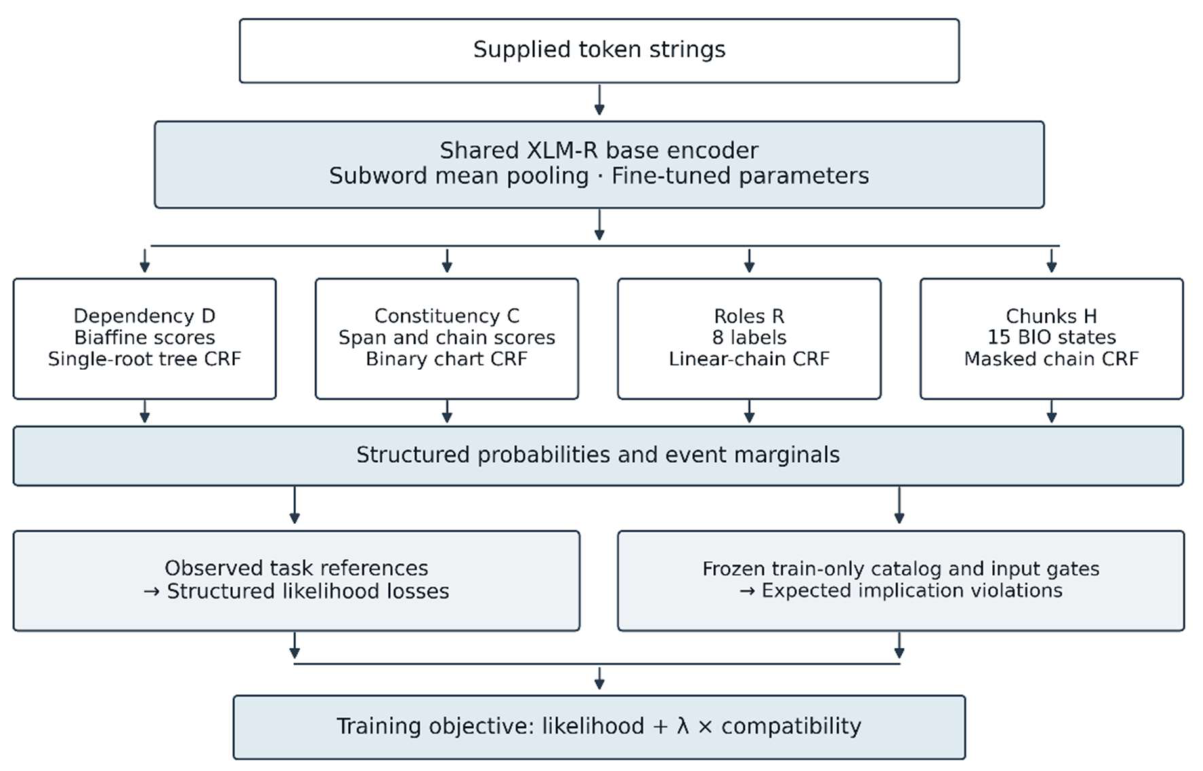
Figure 2.
Main-system learning curves for (a) dependency LAS and (b) constituency F1. Points show five-seed means; error bars show descriptive 95% run-and-group bootstrap intervals for each system score. These are score intervals, whereas Figure 3 reports paired differences. The horizontal axis is logarithmic in final-fitting sentence count. Development and test sets remain fixed. Reduced-data seeds vary both sample composition and initialization. The large low-data independent constituency variability reflects the fixed training and checkpoint-selection recipe.
Figure 2.
Main-system learning curves for (a) dependency LAS and (b) constituency F1. Points show five-seed means; error bars show descriptive 95% run-and-group bootstrap intervals for each system score. These are score intervals, whereas Figure 3 reports paired differences. The horizontal axis is logarithmic in final-fitting sentence count. Development and test sets remain fixed. Reduced-data seeds vary both sample composition and initialization. The large low-data independent constituency variability reflects the fixed training and checkpoint-selection recipe.
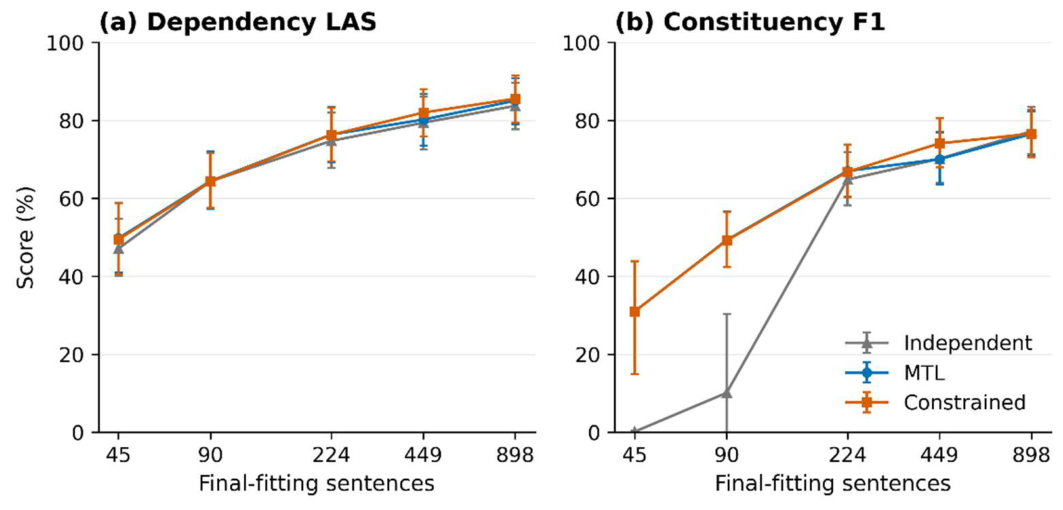
Figure 3.
Constrained minus MTL paired differences for (a) LAS and (b) constituency F1. Error bars are run-and-group percentile bootstrap intervals from 10,000 replicates. Full-data squares use the prespecified 97.5% co-primary intervals; other fractions use descriptive 95% intervals. The dashed vertical line denotes zero difference. The 50% constituency interval excludes zero, while both full-data co-primary intervals include it.
Figure 3.
Constrained minus MTL paired differences for (a) LAS and (b) constituency F1. Error bars are run-and-group percentile bootstrap intervals from 10,000 replicates. Full-data squares use the prespecified 97.5% co-primary intervals; other fractions use descriptive 95% intervals. The dashed vertical line denotes zero difference. The 50% constituency interval excludes zero, while both full-data co-primary intervals include it.
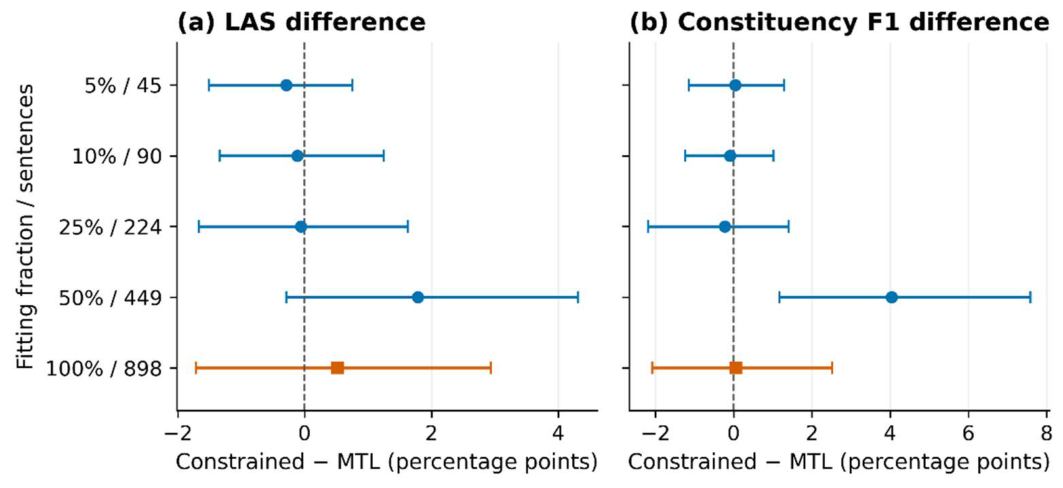
Table 1.
Representative research lines and their relationship to the present study.
| Research line | Supervision or representation | Interaction mechanism | Implication for this study |
|---|---|---|---|
| Separate parsers [10,11] | Dependency arcs; constituency spans | Task-specific structured prediction | Control encoder and decoder strength. |
| Joint tree parsing [4,5,6,7] | Dependency and constituency; additional semantics in [6] | Shared supervision, hybrid structures or joint inference | Published joint parsing remains an unevaluated comparator. |
| Dynamic heads [13] | Constituency with latent lexical heads | Learned head selection | Adaptive head relations already have precedent. |
| Posterior and inference constraints [8,9] | Structured outputs and specified expectations or agreement | Posterior regularization; dual decomposition | Identify the constrained object and stage. |
| Logic-guided learning [14,15] | Neural outputs with logical specifications | Rule distillation; semantic loss | Distinguish learning mechanism from rule validity. |
| Multitask optimization [16] | Several task losses over shared parameters | Projection of conflicting gradients | Separate optimization effects from output agreement. |
| Uzbek and parallel Turkic resources [2,3,17] | Documented UD annotation | Resource construction and cross-language alignment | Evaluate transfer only for supported layers. |
| Turkish conversion [18] | Dependencies and manual constituency references | Rules, morphology and learned conversion | Track provenance and independent validation. |
| Present study | Aligned dependency/constituency references, Uzbek token functions and functional chunks | Input-gated empirical implication penalties over task marginals | Measure accuracy, formal validity, candidate conflicts and cost. |
Table 2.
Corpus partitions and reference annotation units.
| Partition | Sentences | Tokens | Non-PUNCT | C spans | H chunks |
|---|---|---|---|---|---|
| Train | 898 | 4,037 | 3,059 | 2,662 | 2,070 |
| Development | 112 | 445 | 324 | 283 | 241 |
| Test | 113 | 473 | 347 | 307 | 255 |
| Total | 1,123 | 4,955 | 3,730 | 3,252 | 2,566 |
C spans count phrase nodes after excluding the outer root and POS preterminals, with genuine unary multiplicity retained. Train/development/test contain 891/112/113 similarity groups and 21/0/4 QOSHMA sentences, respectively. Both nonprojective reference sentences occur in training.
Table 3.
Implemented compatibility events and applicability conditions.
| Family | Antecedent A | Allowed consequent B | Input gate |
|---|---|---|---|
| D–R D → R |
Incoming relation at token i | Role at i belongs to the fitted allowed set | Surface status × final position |
| R–H H → R |
Membership in chunk type k, or outside O | Role at i belongs to the fitted allowed set | Surface status × final position |
| C–H H → C |
Exact chunk (i,j,k) | At least one allowed literal constituent label on [i,j) | Width ≤6; singleton or multi; exclude whole sentence |
| D–C C → D |
Literal constituent label on [i,i+2) | Allowed left or right internal dependency arc | Two surface words; exclude whole sentence |
The common full-training descriptive catalog contains 25 D–R, 9 R–H, 9 C–H, and 15 D–C rules. Fitting catalogs are re-estimated per run and can be smaller. Their opportunity sets, rather than this common catalog, determine training losses.
Table 4.
Completed experiment design.
| Configuration | Data fractions | Seeds | Fits | Purpose |
|---|---|---|---|---|
| Unconstrained MTL | 5, 10, 25, 50, 100% | 5 | 25 | Shared supervised baseline |
| Constrained joint model | 5, 10, 25, 50, 100% | 5 | 25 | Effect of compatibility training |
| Independent D/C/R/H | 5, 10, 25, 50, 100% | 5 | 100 | Four separate task fits per condition |
| Drop one rule family | 100% | 5 | 20 | Four family ablations |
| Pool contexts | 100% | 5 | 5 | Empirical pooling comparison |
| Hide one direct label layer | 100% | 5 | 20 | Retained untrained-head controls |
| Remove one task head | 100% | 5 | 20 | Task contribution and compute |
| Total | 215 |
Seeds were 13, 21, 42, 87, and 101. The 100 independent fits yielded 25 aggregate output sets; these were not 25 additional fits. A separate four-epoch development-only smoke run was excluded from comparisons.
Table 5.
Fixed model and optimization settings.
| Setting | Value |
|---|---|
| Encoder and tokenizer | XLM-R base; revision e73636d4f797dec63c3081bb6ed5c7b0bb3f2089 |
| Arc / relation projection | 500 / 100 dimensions |
| Constituency / role / chunk projection | 256 dimensions each; GELU |
| Encoder / head learning rate | 2 × 10⁻⁵ / 2 × 10⁻⁴ |
| AdamW β₁, β₂, ε | 0.9, 0.999, 10⁻⁸ |
| Weight decay / dropout | 0.01 / 0.1 |
| Microbatch / effective window | 4 / 16 sentences |
| Gradient clipping | Global norm 1.0 |
| Maximum epochs / patience | 30 / 5 non-improving epochs; stopping checked from epoch 6 |
| Compatibility weight | 0 in epochs 1–3; ramp to 0.1 by epoch 6 |
| Checkpoint criterion | Mean development LAS, C F1, R micro F1, H F1 over observed tasks |
| Elapsed fitting ceiling | 4 h per shared fit; 1 h per independent task, 4 h aggregate |
| Precision | Float32 neural computation; float64 log-space dependency partition |
Table 6.
Full-data test performance across five seeds.
| System | UAS | LAS | C F1 | R micro F1 | H F1 |
|---|---|---|---|---|---|
| Independent | 90.43 ± 0.47 |
83.69 ± 1.11 |
77.17 ± 1.87 |
93.91 ± 0.81 |
87.07 ± 1.43 |
| MTL | 90.72 ± 0.80 |
85.01 ± 1.34 |
76.49 ± 1.42 |
93.83 ± 0.46 |
89.22 ± 0.32 |
| Constrained | 91.35 ± 0.73 |
85.53 ± 0.87 |
76.55 ± 1.69 |
94.12 ± 0.35 |
89.05 ± 1.38 |
Values are mean ± sample SD in percent, using the same 113 test sentences. Dependency scores exclude 126 reference punctuation tokens and use 347 other tokens; C uses 307 phrase occurrences, R uses all 473 tokens, and H uses 255 chunks. Each Independent row aggregates four task-specific models. Highest point means do not establish statistical superiority.
Table 7.
Full-data Constrained minus MTL paired differences.
| Metric | Difference | Paired interval | Level | Includes zero |
|---|---|---|---|---|
| UAS | +0.63 | [-1.33, +2.86] | 95% | Yes |
| LAS | +0.52 | [-1.71, +2.93] | 97.5% | Yes |
| C F1 | +0.06 | [-2.08, +2.52] | 97.5% | Yes |
| R micro F1 | +0.30 | [-0.38, +1.01] | 95% | Yes |
| H F1 | -0.18 | [-1.95, +1.53] | 95% | Yes |
Differences are percentage points. Intervals use 10,000 paired run-and-group percentile bootstrap replicates. LAS and C F1 are the prespecified co-primary endpoints with 97.5% intervals; other intervals are descriptive 95%. An interval including zero does not demonstrate equivalence.
Table 8.
Full-data rule-family and pooling ablations.
| Configuration | LAS | C F1 | R micro F1 | H F1 |
|---|---|---|---|---|
| Full constrained | 85.53 ± 0.87 | 76.55 ± 1.69 | 94.12 ± 0.35 | 89.05 ± 1.38 |
| Without D–R | 85.13 ± 1.13 | 75.33 ± 2.04 | 93.91 ± 0.59 | 88.06 ± 1.01 |
| Without D–C | 85.30 ± 2.05 | 75.07 ± 2.12 | 93.95 ± 0.74 | 88.73 ± 1.50 |
| Without C–H | 85.07 ± 0.87 | 75.56 ± 1.52 | 94.12 ± 0.46 | 89.53 ± 1.13 |
| Without R–H | 84.27 ± 1.36 | 76.21 ± 2.13 | 93.40 ± 0.59 | 88.74 ± 0.40 |
| Pooled contexts | 84.90 ± 1.15 | 75.28 ± 2.36 | 93.95 ± 0.44 | 88.81 ± 1.23 |
Mean ± sample SD over five seeds. Each row is retrained and dev-selected. Removing one family preserves the weights of all surviving families. Pooling changes the fitted catalog from 58 to 51 candidates and also changes opportunities; it does not isolate context gating alone.
Table 9.
Direct-label and task-head removal controls at full data.
| Configuration | LAS | C F1 | R micro F1 | H F1 |
|---|---|---|---|---|
| Full constrained | 85.53 ± 0.87 | 76.55 ± 1.69 | 94.12 ± 0.35 | 89.05 ± 1.38 |
| Hide D labels | 12.45 ± 7.97 | 75.72 ± 1.60 | 93.70 ± 0.90 | 88.28 ± 1.59 |
| Hide C labels | 83.98 ± 0.92 | 0.23 ± 0.25 | 93.95 ± 0.35 | 88.16 ± 0.63 |
| Hide R labels | 85.53 ± 1.75 | 76.64 ± 1.28 | 13.36 ± 6.43 | 89.14 ± 0.78 |
| Hide H labels | 85.19 ± 0.60 | 75.93 ± 1.63 | 93.87 ± 0.30 | 4.63 ± 6.00 |
| Remove D head | — | 75.11 ± 2.24 | 93.45 ± 1.09 | 88.59 ± 1.13 |
| Remove C head | 84.67 ± 1.37 | — | 93.95 ± 0.81 | 88.17 ± 1.43 |
| Remove R head | 85.42 ± 0.44 | 75.83 ± 1.77 | — | 88.08 ± 0.63 |
| Remove H head | 84.21 ± 1.88 | 74.57 ± 1.29 | 93.45 ± 0.73 | — |
Mean ± sample SD over five seeds. “Hide” retains all heads but removes that layer from likelihoods, incident fitted constraints, vocabulary fitting and development selection. The hidden head is untrained for its task. “Remove” deletes the head and its incident constraints; — denotes an unavailable output, not a zero score.
Table 10.
Descriptive coherence under the common full-training catalog.
| Family | Gate coverage % | Reference V/T % | Independent V/T % | MTL V/T % | Constrained V/T % |
|---|---|---|---|---|---|
| D–R | 68.56 | 0.634 | 3.932 ± 0.609 | 1.142 ± 0.241 | 0.973 ± 0.241 |
| D–C | 62.61 | 0.000 | 2.855 ± 1.005 | 2.197 ± 1.836 | 2.284 ± 0.777 |
| C–H | 48.58 | 1.149 | 12.123 ± 2.210 | 7.536 ± 2.626 | 7.739 ± 2.126 |
| R–H | 60.02 | 0.211 | 1.099 ± 0.177 | 0.296 ± 0.241 | 0.211 ± 0.211 |
V/T is violations per realized antecedent trigger; model values are means ± sample SD over five runs. Gate coverage is G/B and is identical across the three systems. Reference counts are D–R 3/473, D–C 0/73, C–H 2/174, and R–H 1/473. Model trigger counts can differ. No inferential coherence test or linguistic adjudication is implied.
Table 11.
Descriptive test performance by length and sentence structure.
| Stratum (sentences) | Non-PUNCT | MTL LAS | Con. LAS | MTL C F1 | Con. C F1 |
|---|---|---|---|---|---|
| 1–3 tokens (62) | 117 | 94.53 | 94.02 | 87.24 | 88.41 |
| 4–6 tokens (34) | 116 | 87.76 | 89.31 | 76.58 | 76.85 |
| 7–10 tokens (15) | 92 | 77.17 | 77.61 | 68.24 | 66.36 |
| 11+ tokens (2) | 22 | 52.73 | 53.64 | 47.87 | 48.97 |
| SODDA (109) | 311 | 88.87 | 89.39 | 79.40 | 79.45 |
| QOSHMA (4) | 36 | 51.67 | 52.22 | 53.07 | 53.57 |
Values are means across five corpus-level stratum scores. Token length includes punctuation; Non-PUNCT is the single-test-set dependency denominator. Con. denotes Constrained. Length strata and sentence-type strata overlap and must not be added together. The 11+ and QOSHMA rows contain only two and four sentences, respectively; their differences are descriptive.
Table 12.
Measured full-data fitting and inference costs.
| System | Parameters M | Fitting min | Test pass s | Peak allocated GiB |
|---|---|---|---|---|
| Independent | 1114.62 | 19.61 ± 1.96 | 2.103 ± 0.090 | 5.302 |
| MTL | 280.49 | 8.45 ± 1.78 | 0.951 ± 0.056 | 5.321 |
| Constrained | 280.49 | 30.97 ± 8.94 | 0.930 ± 0.028 | 5.321 |
Fitting and test-pass times are mean ± sample SD over five runs on one NVIDIA B200; each test pass covers 113 sentences. Parameter counts are trainable totals. Peak allocated memory is the mean of per-run PyTorch allocator peaks. Independent time and parameters are sums over four components, while its sequential memory peak is their maximum. These measurements are not an energy or controlled latency benchmark.
Table 13.
Evidence and interpretation of the main comparisons.
| Question | Observed evidence | Supported interpretation |
|---|---|---|
| Full-data accuracy | LAS +0.52; C F1 +0.06; both primary intervals include zero | Incremental benefit remains unresolved |
| Intermediate budget | At 50%: C F1 +4.04; H F1 +2.97; descriptive intervals exclude zero | A condition-specific replication target |
| Cross-layer agreement | D–R and R–H improve; D–C counts unchanged; C–H slightly worsens | Family-dependent agreement changes |
| Missing direct labels | Hidden heads lose likelihood and incident-rule training | Untrained-head controls |
| Training cost | 3.66× MTL mean fitting time; equal shared-model parameters | Additional cost under the recorded recipe |
Differences are percentage points. Primary intervals are the full-data 97.5% paired intervals; intermediate-budget intervals are descriptive 95%. These statements concern the recorded corpus, split, seeds, and fixed settings.
Table 14.
Proposed validation studies and their evidential targets.
| Study | Controlled comparison or evidence | Question resolved |
|---|---|---|
| Annotation audit | Blind reference audit with agreement and adjudication | Are the cross-layer relations supported? |
| Prospective replication | Fresh all-layer tests; declared endpoints; separate seeds | Does the C/H budget pattern replicate? |
| Targeted mechanism test | Fixed rules and sites; vary gates or weights; log triggers | Which mechanism changes task behavior? |
| Compute and human effort | Matched compute; timed correction; final-quality assessment | Do gains justify training and review cost? |
These are future study designs. A complete cross-layer generalization claim requires compatible references for all claimed layers; total annotation-budget claims must include development, rule design, and review access.
Disclaimer/Publisher’s Note: The statements, opinions and data contained in all publications are solely those of the individual author(s) and contributor(s) and not of MDPI and/or the editor(s). MDPI and/or the editor(s) disclaim responsibility for any injury to people or property resulting from any ideas, methods, instructions or products referred to in the content. |
© 2026 by the authors. Licensee MDPI, Basel, Switzerland. This article is an open access article distributed under the terms and conditions of the Creative Commons Attribution (CC BY) license (http://creativecommons.org/licenses/by/4.0/).
Copyright: This open access article is published under a Creative Commons CC BY 4.0 license, which permit the free download, distribution, and reuse, provided that the author and preprint are cited in any reuse.