

Submitted:
31 October 2026
Posted:
09 November 2026
You are already at the latest version
Abstract
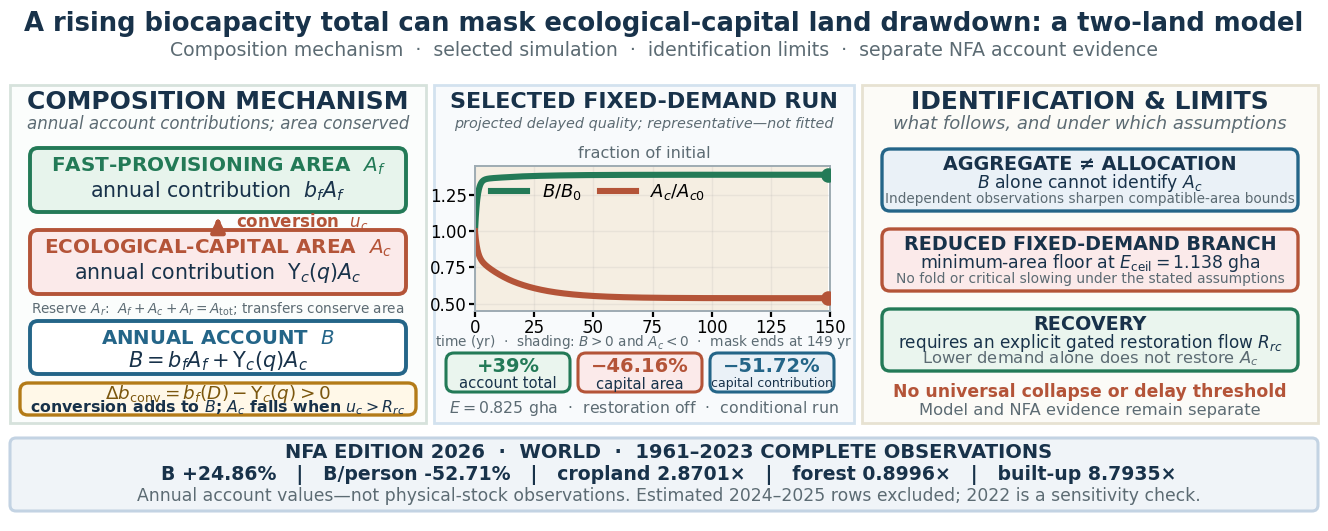
Biocapacity combines land area and productivity in an aggregate annual account. We examine the information retained by this total using a conserved-area two-land model with delayed ecological regeneration, demographic response and an imposed quality constraint. Conversion increases the model account when the receiving land class has the higher per-hectare contribution, even as ecological-capital land declines. In a representative simulation, biocapacity increases 39%, capital-land area decreases approximately 46%, and its modeled account contribution decreases 51.72%. Sharp static bounds quantify how independent land-area and quality observations restrict the compatible allocation set. Integrated contribution budgets distinguish conversion, maintenance and retirement, restoration, quality and fast-yield effects. In the 100-year fixed-demand simulation, conversion contributes 0.547925 gha, while the net account increase is 0.231310 gha; other contributions largely offset conversion. Budget closure improves under timestep refinement. The reduced fixed-demand equality relation reaches the minimum-area boundary without a fold or critical slowing; this result is specific to that comparison. Separately, National Footprint Accounts Edition 2026 values for 1961–2023 show world biocapacity increasing 24.86%, biocapacity per person decreasing 52.71%, and production footprint per person increasing 16.73%. Cropland, forest and built-up accounts contribute +24.06, -5.95 and +7.44 percentage points, respectively, to total biocapacity change. These are annual account changes rather than physical-stock observations. The results support reporting constituent accounts alongside independently measured ecological assets.
Keywords:
biocapacity
; ecological footprint
; land-use conversion
; aggregation
; identifiability
; critical slowing down
; delay differential equations
; carrying capacity
Copyright: This open access article is published under a Creative Commons CC BY 4.0 license, which permit the free download, distribution, and reuse, provided that the author and preprint are cited in any reuse.