
Submitted:
29 October 2026
Posted:
09 November 2026
You are already at the latest version
Abstract
An AI capability does not determine a responsible or resilient product. Between technical capability and deployment lies product definition: the specification of purpose, actors, information, authority, work, interaction, adaptation, safeguards, and lifecycle consequences. This paper develops a seven-domain structure and explains cross-domain tension propagation: how a locally defensible response in one domain can intensify, relocate, conceal, or create pressure in another. D1-D7 cover intervention rationale and alternatives; actors, authority, work, and responsibility; information and provenance; capability and failure; interaction and reliance; adaptation and authorization; and safeguards, monitoring, and lifecycle. The framework was derived from 57 human-AI and adjacent sources, consolidated from twelve concerns through a nine part structure, and challenged with 36 real cases, 12 synthetic cases, 18 adversarial tests, and six standards. Archival comparison of eight organizational episodes shows how responses reconfigure boundaries, roles, information flows, assurance, and residual work. Cross-case analysis identifies residualization, boundary displacement, and assurance localization as propagation configurations. Paradox knots are treated as a special case in which qualified persistent tensions become response linked, not as a label for every trade-off. A care-ethical trace follows consequences for actors with unequal dependency, voice, and recourse; resilience analysis examines anticipation, continuity and coping, recovery, adaptation, and learning. The contribution is a research-grounded route from AI capability to conditional product definition and an evidence-traceable explanation of how local choices redistribute responsibility and vulnerability while strengthening or weakening digital resilience.
Keywords:
human-AI interaction
; AI capability
; AI product definition
; cross-domain tension propagation
; responsible AI
; digital resilience
; organizational resilience
; responsibility
; care ethics
; sociotechnical systems
1. Introduction
A model can summarize a policy, write a paragraph, recommend an item, infer a preference, rank a risk, recognize a face, predict deterioration, or call a tool. None of those capabilities determines a product. An organization must decide whose problem matters, why AI is preferable to other means, whose information and identity are involved, which work remains human, what failures can be detected, how interaction changes judgment, what may be learned from behavior, and which safeguards and lifecycle actions govern the arrangement. Product definition is therefore not a narrow handoff between invention and implementation. It is the organizational boundary at which a technical possibility becomes a situated information system and a continuing human relationship.
These decisions are interdependent. A product team may increase automation to improve scale and consistency, then discover that verification, exception handling, proof, or blame has moved to frontline staff or affected people. It may add personalization to improve relevance while extending information flows beyond their original context. It may use explanation to support oversight while increasing workload or persuasion by fluent but incorrect evidence. It may centralize a model while localizing the burden of assurance. The important theoretical problem is not merely that AI systems contain multiple tensions. It is how a response in one product-definition domain changes conditions in another.
We call this process cross-domain tension propagation. Propagation occurs when a situated response changes a product boundary, role, information flow, interaction, state, control, or lifecycle obligation and thereby intensifies, relocates, conceals, or creates a countervailing pressure elsewhere. This definition is broader than organizational paradox: propagation can occur even when a second tension is temporary, correctable, legally bounded, or insufficiently documented as a paradox. A paradox knot is a narrower outcome in which separately qualified contradictory and interdependent demands persist and become connected through the response.
The process matters for responsible and resilient digital futures. Responsibility concerns who owes what to whom and whether that actor possesses the knowledge, authority, resources, and protection needed to act. Resilience concerns the capacity to anticipate disruption, sustain essential functions, cope and recover, adapt to changed conditions, and learn without reproducing the conditions that caused harm. A locally resilient response can be irresponsible when continuity is purchased through surveillance or displaced burden. A formally responsible arrangement can be fragile when the assigned actor lacks fallback, authority, or recovery capacity. Product definition shapes both before deployment.
The paper addresses one primary research question:
How do AI product-definition decisions across seven interconnected domains propagate tensions that redistribute responsibility and vulnerability and shape the resilience of AI-enabled information systems?
The analysis proceeds through two linked components. First, it reconstructs the derivation and use of D1-D7: seven nonexclusive decision domains developed from 57 human-AI and adjacent sources through a twelve-to-nine-to-seven consolidation, then challenged with 36 real examples, 12 synthetic edge cases, 18 adversarial tests, and six standards. Second, it uses a comparative archival study of eight documented organizational episodes to trace responses across domains, identify propagation configurations, and distinguish knot-forming from knot-bounding pathways.
The paper makes four contributions. First, it provides a documented, research-grounded architecture for moving from a situated AI capability to a conditional product definition. Second, it develops cross-domain tension propagation as a process explanation centered on observable boundary, role, information-flow, interaction, and lifecycle changes. Third, it identifies residualization, boundary displacement, and assurance localization as configurations through which local responses can redistribute work, responsibility, capacity, burden, and vulnerability. Fourth, it connects these processes to responsible and resilient information systems by specifying receiver conditions and resilience functions—anticipation, continuity and coping, recovery, adaptation, learning, and reopening—that product definitions must support rather than assume.
D1-D7 is the analytical map; cross-domain tension propagation is the principal theoretical contribution; paradox theory specifies one persistent configuration; care ethics follows the consequences to dependent and weakly represented actors; and resilience theory explains whether the arrangement can absorb disruption, recover, adapt, and learn. This hierarchy governs the remainder of the paper.
2. Theoretical Background and Research Gap
The framework stands on established human-AI design and governance work. Human-AI interaction guidelines organize recurring concerns across initial use, interaction, error, correction, and learning (Amershi et al., 2019). The writing-assistant design space connects task, user, technology, interaction, and ecosystem choices (Lee et al., 2024). Value Sensitive Design supplies conceptual, empirical, and technical methods for examining stakeholders, values, and value tensions (Friedman et al., 2017). Trust and reliance research distinguishes attitudes toward automation from the behavior of using it in context (Lee & See, 2004). Contextual integrity distinguishes access to information from the legitimacy of its flow (Nissenbaum, 2004). Goals-Signals-Metrics connects intended user goals to observable evidence without allowing one metric to define value (Rodden et al., 2010).
Practice and governance methods cover additional territory. The People + AI Guidebook and Human-AI Experience Toolkit provide questions and patterns for human-centered AI design (Google PAIR, 2021; Microsoft, n.d.). The NIST AI Risk Management Framework and its Generative AI Profile organize risk work across governance, mapping, measurement, and management (Tabassi, 2023; Autio et al., 2024). Model Cards and Datasheets structure reporting about models and datasets (Mitchell et al., 2019; Gebru et al., 2021). Requirements traceability, design-rationale methods, and assurance arguments connect needs, decisions, requirements, evidence, and change (Gotel & Finkelstein, 1994; MacLean et al., 1991; ACWG, 2021).
Responsibility scholarship shows why assigning a human or organization is insufficient. Many-hands accounts examine divided causation, knowledge, authority, and accountability; moral-crumple-zone analysis shows how proximate operators can absorb blame despite constrained control (Elish, 2019); and Responsibility Modelling connects duties to agents, resources, dependencies, and vulnerabilities (Lock, Sommerville, & Storer, n.d.). Digital-responsibility research locates responsibility across individual, organizational, and societal levels, while care-oriented IS work foregrounds dependency, attentiveness, competence, responsiveness, maintenance, repair, and continuing obligation (Trier et al., 2023; Zamani, Angelopoulos, & Conboy, 2026).
Resilience adds a distinct temporal question. Organizational resilience has been conceptualized as a meta-capability spanning anticipation, coping, and adaptation rather than a simple return to a prior state (Duchek, 2020). IS research defines digital resilience around capacities developed through digital technology to absorb shocks, adapt to disruption, and transform toward a more prepared state (Boh et al., 2023). Tim and Leidner (2023) position information systems as both conditions of vulnerability and resources for recovery, while work on AI-based information systems argues that resilience requires holistic design rather than isolated model monitoring (Schemmer et al., 2021). Together these literatures prevent resilience from being reduced to uptime, redundancy, or technical recovery.
Six standards provide a strong scope challenge. ISO 9241-210:2019 addresses human-centered design across the lifecycle. ISO/IEC 23894:2023 addresses AI risk management. ISO/IEC 5338:2023 places AI activities within lifecycle processes. ISO/IEC/IEEE 29148:2018 addresses requirements engineering and traceability. IEEE 7000-2021 gives a process for addressing ethical concerns during system design. ISO/IEC 42001:2023 specifies an AI management system (IEEE, 2021; ISO, 2019; ISO/IEC, 2023a, 2023b, 2023c; ISO/IEC/IEEE, 2018).
This study does not reproduce these methods. D1-D7 co-locates heterogeneous evidence and situated product choices before they fragment into requirements, risk registers, model documentation, controls, and operating procedures. The theoretical advance lies in tracing the consequence of a response across that architecture: which boundary or role changes, where the countervailing pressure lands, who must carry it, and whether the resulting arrangement preserves responsible action and resilience capacity.
3. Research Approach and Framework Provenance
The study combines two analytically separate components. The first is a critical integrative synthesis used to construct and challenge the D1-D7 product-definition architecture. The second is a comparative archival analysis used to elaborate cross-domain tension propagation in documented organizational episodes. The construction portfolio is not counted as empirical case evidence, and the archival cases do not retroactively validate the seven-domain architecture.
3.1. Framework Construction and Challenge
The construction corpus contains 57 distinct human-AI and adjacent sources. Interpretive comparison first produced twelve candidate concerns and then an intermediate nine-layer structure. Subsequent collision and preservation analysis yielded seven nonexclusive domains. The actor/authority and work-allocation/agency records were joined in D2, while interaction/workflow and explanation/reliance were joined in D5. These are organizational mergers: all original distinctions remain mandatory.
The architecture was then challenged against 36 real products or deployments, 12 synthetic edge cases, and 18 adversarial tests covering coverage, collision, ablation, merger, split, baselines, counterfactuals, inversion, convergence, gaming, scale, time, adversarial environments, sparse evidence, conflict resolution, noncompensatory constraints, implementation leakage, and tautology. A later comparison with six ISO/IEC/IEEE standards narrowed the originality claim. These activities were analytic stress tests, not participant research, reliability assessment, causal validation, or proof of completeness. The construction record comprises the complete 57-source inventory, 12-to-9-to-7 mapping, extended specifications, 36+12 portfolio, tests A-R, framework-change record, and standards crosswalk.
3.2. Archival Theory Elaboration
The documentary analysis uses a source-bounded product-definition response episode as its unit: a dated sequence comprising a focal tension, an organizational or institutional response, a boundary or role reconfiguration, a cross-domain consequence, and a later disposition or reopening. Purposeful theoretical sampling selected eight episodes varying in sector, public/private setting, vendor-client boundary, technological form, lifecycle phase, and knot-forming or knot-bounding potential. The selected cases are Robodebt, SyRI, Uber ATG, Clearview AI, Epic Sepsis Model, Apple Card, Air Canada, and iTutorGroup.
Evidence priority runs from regulatory decisions, official investigations, and court or government records through organizational and technical documents, audits, peer-reviewed studies, and carefully bounded secondary reporting. Every material statement is classified as documentary fact, attributed claim, scholarly interpretation, causal inference, normative judgment, or unresolved question. Allegations are not converted into findings; later inquiries are not projected backward as contemporaneous knowledge; documents from one proceeding are not treated as independent corroboration.
Analysis uses temporal bracketing, within-case process tracing, cross-case comparison, pattern matching, explanation building, negative-case analysis, and explicit rival explanations. A paradox knot is coded only when two tensions separately satisfy contradiction, interdependence, persistence, and organizational significance; a dated response exists; evidence links it to the second tension; and the sequence survives an ordinary defect, legal violation, function-allocation, or governance-failure explanation. Otherwise the episode remains a general propagation pathway, knot candidate, bounded tension, or non-knot. The analysis recorded full protocols, evidence hierarchies, coding fields, case timelines, negative evidence, and confidence judgments.
4. The D1-D7 Product-Definition Architecture
The domains are nonexclusive. They are not stages through which every project moves once, and they are not independent variables whose scores can be added. A single issue may require several domains because it changes several relationships. Each domain has one core question, distinct matters to protect, and a boundary that prevents it from swallowing adjacent work.

Table 1.
Seven-domain product-definition architecture
| Domain | Core question | What must remain distinct | Boundary |
|---|---|---|---|
| D1. Intervention rationale, value, and alternatives | What problem and stakeholder-relative value justify intervention, why AI rather than alternatives, and what must not be traded away? | stated purpose; operative objective; beneficiaries and affected interests; non-AI/rule-based/procedural/no-product alternatives; failure despite adoption | intended value is D1; deployed outcomes and lifecycle action are D7 |
| D2. Actors, representation, authority, work allocation, agency, and responsibility | Who is involved, represented, or affected; who may direct, decide, approve, act, bind, contest, and answer; and how is work allocated? | actor/representation; allocation, agency, contribution, and control; authority, responsibility, and contestability | present authority is D2; interface mechanics D5; persistent-state authorization D6 |
| D3. Information, evidence, provenance, and legitimate flow | What information is used or produced, what can it support, and is its collection, transformation, transmission, retention, and reuse legitimate? | epistemic fitness; contextual legitimacy; provenance versus truth; conflict and correction | information support and legitimacy are D3; actual capability is D4; interpretation is D5 |
| D4. Capability, uncertainty, detectability, and failure | What can the system or human–AI ensemble reliably do under named conditions, how can it fail, and can failures be detected and recovered from? | task/context/version; performance; failure classes; detectability; reversibility; fallback; change | actual performance is D4; beliefs and reliance are D5; deployed outcomes are D7 |
| D5. Human interaction, cognition, explanation, and reliance | How do interface and workflow shape attention, effort, access, understanding, verification, trust, reliance, and recovery? | workflow/cognition; interpretation/reliance; trust versus reliance; explanation versus evidence; access and recovery | structural allocation is D2; evidence/capability are D3/D4; lifecycle outcomes are D7 |
| D6. Adaptive state, feedback, learning, and authorization | What state changes from interaction, outcomes, retrieval, updates, or organizational decisions, at what scope and persistence, and with whose authority? | signal interpretation; human versus system learning; scope; persistence; inspectability; correction; reset; revocation; compatibility | immediate direction is D2; presentation/usability of state D5; rollback/retirement D7 |
| D7. Safeguards, outcomes, monitoring, and lifecycle | What counts as success or failure for named stakeholders over time, what remains a guardrail, and what triggers correction, restriction, rollback, redesign, or retirement? | outcomes by stakeholder; denominators and distributions; time horizon; guardrails; monitoring; contest/incident response; lifecycle action | intended value is D1; state-change semantics are D6; D7 evaluates deployed consequences |
4.1. D1 — Intervention Rationale, Value, and Alternatives
D1 begins before feature selection. It asks what human or organizational problem warrants intervention, whose interests define value, why AI is an appropriate means, what the system will actually optimize, and which alternatives remain viable. A capability is not a purpose. A system may automate an observable activity while weakening the outcome that stakeholders value.
Human–AI guidelines recommend grounding behavior in user need and making expected capability and failure legible (Amershi et al., 2019). The writing-assistant design space shows that task, user, technology, interaction, and ecosystem choices are interdependent, so a feature cannot be justified in isolation (Lee et al., 2024). Value Sensitive Design provides methods for distinguishing direct and indirect stakeholders, designer and stakeholder values, and conflicts among values (Friedman et al., 2017). Goals–Signals–Metrics warns against confusing an operational signal with the goal it approximates (Rodden et al., 2010). Self-determination theory further cautions that autonomy concerns the quality of regulation and endorsement rather than the amount of manual labor performed (Ryan & Deci, 2000).
D1 therefore requires comparison with non-AI, rule-based, procedural, narrower-scope, and no-product alternatives. It also asks how the intervention could fail even if it is adopted. Engagement, retention, speed, perceived usefulness, technical accuracy, and revenue can all be relevant; none alone determines stakeholder value. Interface practices that conceal costs or restrict choice can make favorable conversion or completion metrics especially misleading (Mathur et al., 2019).
4.2. D2 — Actors, Representation, Authority, Work Allocation, Agency, and Responsibility
“The user” is too coarse for many human–AI products. The operator may differ from the beneficiary, information subject, person or organization represented by the output, reviewer, approver, action owner, audience, vendor, regulator, or party who bears a failure. D2 first maps those relationships and then asks how goal-setting, judgment, generation, execution, checking, correction, approval, and action are allocated among them.
Organizational trust theory makes trust specific to a trustor, trustee, action, context, and vulnerability (Mayer et al., 1995). Value Sensitive Design brings affected non-users and power asymmetries into view (Friedman et al., 2017). Studies of CEO ghost posting and AI ghostwriting show that contribution, perceived ownership, voice, attribution, public author declaration, and represented identity can diverge (Kelleher et al., 2019; Draxler et al., 2024). Human–AI writing studies similarly show that professionals may welcome information gathering or optional feedback while resisting AI-led ideation, substantial drafting, or voice manipulation, and that assistance granularity can move quality, productivity, satisfaction, workload, ownership, and contribution in different directions (Nishal et al., 2026; Dhillon et al., 2024; Joshi & Vogel, 2025; Lou et al., 2025).
Agency is not equivalent to effort or a large number of clicks. External assistance can improve current performance while changing memory, strategy, self-assessment, and future dependence (Risko & Gilbert, 2016). Cost-sensitive control theory likewise treats control allocation as a relation among expected benefit and effort, not a command to maximize deliberation (Shenhav et al., 2013). In forecasting studies, limited modification rights increased willingness to use an imperfect algorithm, but edits did not inherently improve its predictions (Dietvorst et al., 2018). Research-through-design with service professionals further shows that source boundaries, escalation, organizational context, and responsibility appear together in practice (Zheng et al., 2023).
The operational test is consequential control: what decision, state, or external effect can an actor actually change, refuse, reverse, or contest? A generic human-in-the-loop claim is insufficient. Responsibility is plausible only when the named person has the information, competence, time, authority, and intervention path needed for the relevant failure.
4.3. D3 — Information, Evidence, Provenance, and Legitimate Flow
D3 contains two questions that act on the same information but cannot be collapsed. Epistemic fitness asks what the material is, where it came from, how it was transformed, whether it is current and relevant, and what conclusion it supports. Contextual legitimacy asks whose information it is, who sent and receives it, for what purpose, with what retention and reuse, and with what avenues for correction or revocation.
Retrieved text, policy, user context, preferences, examples, generated prose, model inference, and normative rules are not interchangeable. Provenance helps establish a chain of origin; it does not prove truth or entailment. Research on background information shows that material selected to help a person assess an answer can matter differently from information used by a model to produce it (Goyal et al., 2023). In fact verification, generated explanations and retrieved passages produced different time and error patterns, with especially poor outcomes when fluent explanations were wrong (Si et al., 2024). Personalized retrieval can improve offline generation proxies without establishing voice fidelity, human benefit, permission, or appropriate reuse (Mysore et al., 2024).
Contextual integrity treats privacy as appropriate information flow among actors, attributes, purposes, and transmission principles rather than secrecy alone (Nissenbaum, 2004). Studies of survey modality and perceived audience show that what people disclose changes with mode and framing, while greater disclosure does not establish truthfulness, welfare, or actual privacy (Schober et al., 2015; Lucas et al., 2014; Lenzner et al., 2024). These findings do not directly prescribe an AI interface, but they show why collecting “more context” is not a neutral improvement.
The D3 rule is concise: useful does not mean permitted, permitted does not mean evidentially sufficient, and cited does not mean entailed.
4.4. D4 — Capability, Uncertainty, Detectability, and Failure
Capability is always bounded by task, input, context, version, comparison, and outcome. Average benchmark performance does not establish that a system can support one actor in one workflow with one consequence. D4 asks which failures occur, whether they are visible or plausible, whether they are correlated, whether a human or control can detect them in time, and what recovery or fallback exists.
Model-generated critiques helped evaluators find more planted flaws in one study but left many flaws undetected and introduced invalid critiques (Saunders et al., 2022). LLM-based search reduced time for some consumer-choice tasks but propagated a selected model error (Spatharioti et al., 2023). Predicted edit likelihood improved where programmers looked in bounded code tasks without establishing correctness or improving every outcome (Vasconcelos et al., 2025). Chain-of-thought prompting improved some model benchmark scores, but the generated chains were not human-subject evidence and should not be treated as faithful explanations (Wei et al., 2022).
Repeated-interaction studies add two important boundaries. Human–AI performance depends not only on average accuracy but on whether people can learn where a system fails (Bansal et al., 2019a). A more accurate update can still reduce team performance when it introduces unfamiliar errors that violate learned expectations (Bansal et al., 2019b). Linguistic uncertainty cues may change reliance even when the cue is not calibrated to the model’s actual uncertainty (Kim et al., 2024b).
D4 prevents nominal oversight from laundering responsibility. A person cannot reasonably be assigned the task of catching failures that are not observable, diagnosable, or reversible within the available time and workload.
4.5. D5 — Human Interaction, Cognition, Explanation, and Reliance
D5 follows the human-facing chain from interface sequence and workflow burden to understanding, verification, trust, reliance, correction, and recovery. It preserves two panels: interaction/workflow and interpretation/reliance. Combining them is useful because the timing, modality, amount, and placement of information can determine what a person is able or willing to inspect. Treating them as identical would be a mistake.
Foundational cognitive and motor research provides mechanisms and boundary conditions, not universal interface laws. Working-memory research does not establish a fixed maximum number of visible choices (Cowan, 2001). Hick’s experiments concern simple, practiced choice-reaction tasks; later reviews and HCI analyses show that compatibility, practice, response structure, and task meaning materially change the relationship (Hick, 1952; Proctor & Schneider, 2018; Liu et al., 2020). Fitts’ experiments and their HCI reinterpretation concern aimed movement, not the semantic or ethical value of an interface action (Fitts, 1954; MacKenzie, 1992). Cognitive-load theory can distinguish effort spent on means–ends search from learning-relevant work without proving that less mental effort is always better (Sweller, 1988).
Workflow research adds temporal effects. Unfinished work can leave attention residue after switching, and a ready-to-resume plan can help under bounded conditions (Leroy, 2009; Leroy & Glomb, 2018). Regulatory framing and prior engagement change these effects (Leroy & Schmidt, 2016; Newton et al., 2020). Retrieval practice can improve delayed retention in studied learning tasks, while cognitive offloading can improve present performance and reshape later memory or strategy (Roediger & Karpicke, 2006; Risko & Gilbert, 2016). These are hypotheses for workflow design, not proof that an AI product should force recall or prohibit assistance.
Human–AI evidence is similarly conditional. Question-framed feedback improved logical discernment in a bounded experiment, but questioning was entangled with answer withholding and attention (Danry et al., 2023). Anchored comments increased reported contribution and control while increasing workload in a small revision study (Lou et al., 2025). Voice responses yielded more words among responders in one survey experiment but far higher nonresponse and differential breakoff (Lenzner et al., 2024). Open-ended survey questions likewise show associations between requested effort and nonresponse that cannot be converted into a universal rule against questions (Asare-Marfo, 2021).
Generative-AI work also places metacognitive demands on planning, prompting, monitoring, evaluation, and deciding when to rely, although proposed interface responses to those demands remain hypotheses rather than validated interventions (Tankelevitch et al., 2024).
Trust is an attitude; reliance is behavior; correctness is an outcome. Appropriate reliance therefore cannot be inferred from agreement, use, confidence, or satisfaction alone (Lee & See, 2004). Visible error can cause broad algorithm aversion even when a model remains superior (Dietvorst et al., 2015). Cognitive forcing can reduce some wrong-AI choices while adding effort and without guaranteeing an overall improvement (Buçinca et al., 2021). Across several tasks, explanation interfaces did not significantly improve team accuracy over a strong recommendation-and-confidence baseline, and explanations sometimes increased following of wrong AI advice (Bansal et al., 2021). Fluency can cue confidence and perceived truth without establishing accuracy (Alter & Oppenheimer, 2009).
The D5 question is therefore not whether an explanation, question, warning, or extra control exists. It is whether the complete workflow helps the relevant actor discriminate, decide, recover, and act appropriately across reliable and unreliable cases without creating unacceptable exclusion or burden.
4.6. D6 — Adaptive State, Feedback, Learning, and Authorization
An edit, click, acceptance, rejection, deletion, correction, silence, or outcome can mean many things: a stable preference, a one-time exception, a factual correction, curiosity, strategic experimentation, social pressure, or system failure. D6 asks how signals are interpreted, what human or system state changes, at what scope and duration, whether the change can be inspected and corrected, and who has authority to persist, generalize, export, or revoke it.
Computational work shows that context-sensitive preferences can be inferred from edit histories under constrained and substantially simulated conditions (Gao et al., 2024). It does not establish that real users hold stable preferences, that edit distance captures authentic voice, or that inferred rules may legitimately move from a person to a team or organization. Functional probes of editable writing profiles similarly surface steering and privacy concerns without demonstrating long-term profile fidelity or benefit (Yeh et al., 2025). Personalized workplace-writing systems suggest that history and profiles can reduce repeated input, but bundled short-term evaluations cannot identify which component produced an outcome (Lu et al., 2024).
Learning also includes people. Retrieval, practice, externalization, and repeated exposure can alter memory and strategy (Roediger & Karpicke, 2006; Risko & Gilbert, 2016). Model updates can change failure patterns and invalidate learned expectations (Bansal et al., 2019b). Prediction-error theory provides a narrow account of learning signals but does not justify gamification or automatic habit design in products (Schultz, 2016).
D6 therefore separates evidence of a pattern from authority to operationalize it. A product definition should state whether state is task-local, project-level, personal, role-level, or organizational; how it was derived; who can inspect, change, reset, delete, or export it; and which update or context change requires re-evaluation.
4.7. D7 — Safeguards, Outcomes, Monitoring, and Lifecycle
D7 asks what success and failure mean after use begins, for whom, over what time, and with which responses. It separates an ex ante statement of intended value from observed effects. It also prevents monitoring from becoming a substitute for valid outcome definitions.
Outcome evidence is plural even in low-consequence writing. Co-writing studies report different directions across quality, productivity, satisfaction, ownership, contribution, control, and workload (Dhillon et al., 2024; Joshi & Vogel, 2025; Lou et al., 2025; Draxler et al., 2024). Explanation and search studies show that time and accuracy can move differently, especially under wrong output (Si et al., 2024; Spatharioti et al., 2023). Adaptation and update research adds compatibility, correction, and longitudinal dependence (Gao et al., 2024; Bansal et al., 2019b).
Measurement frameworks help organize these choices but do not define success automatically. HEART and Goals–Signals–Metrics encourage goal-linked and plural measurement (Rodden et al., 2010). UMUX-LITE provides a short perceived-usability measure whose brevity does not make it a substitute for objective task success, access, evidence quality, or affected-stakeholder outcomes (Lewis et al., 2013). Engagement itself may complicate task transitions and should not be treated as unqualified benefit (Newton et al., 2020). Interface measurement can also miss strategic design: dark-pattern research shows why favorable completion metrics can coexist with asymmetry, concealment, or restricted choice (Mathur et al., 2019).
D7 therefore requires outcomes by stakeholder, denominators, distributions, time horizons, guardrails that cannot be traded away, and named actions when conditions change. Those actions include correction, restriction, rollback, redesign, and retirement—not only continued monitoring.
5. Cross-Domain Tension Propagation
The domains become analytically consequential when they are read together. A tension is a conditional relationship in which a move intended to improve one concern creates a possible cost, dependency, or transfer of responsibility elsewhere. Cross-domain tension propagation occurs when an organizational response changes a boundary, role, information flow, interaction, adaptive state, control, or lifecycle obligation and thereby intensifies, relocates, conceals, or creates a pressure in another domain. Propagation is a process claim requiring a traceable response and consequence; it is not established by listing two values or assigning one issue to several domains.
| Tension | Intended benefit | Countervailing concern | Domains most directly joined |
| Automation–contribution | reduce effort and increase speed | remove desired direction, learning, identity, or participation | D1, D2, D5, D7 |
| Assistance–ownership | improve output or completion | separate contribution, psychological ownership, attribution, and represented identity | D2, D5, D7 |
| Assistance–responsibility | improve judgment or execution | assign accountability without detection or intervention capacity | D2, D4, D5, D7 |
| Personalization–privacy | increase relevance and reduce repeated input | aggregate, repurpose, expose, or persist information beyond its context | D3, D6, D7 |
| Adaptation–authorization | improve automatically from use | turn ambiguous behavior into a durable rule without authority | D2, D3, D6 |
| Explanation–workload | support understanding and contest | increase reading, switching, avoidance, or abandonment | D4, D5, D7 |
| Explanation–persuasion | increase confidence or acceptance | increase agreement with coherent but incorrect support | D3, D4, D5 |
| Fluency–evidence | improve clarity and speed | make ease stand in for factual or normative support | D3, D4, D5 |
| Questions–burden | elicit direction and reflection | create nonresponse, interruption, pressure, or abandonment | D2, D5, D7 |
| Modality richness–access | enable expressive or longer input | exclude people or add privacy, noise, transcription, and review costs | D3, D5, D7 |
| Disclosure–actual privacy | obtain useful context | elicit oversharing under an inaccurate audience or retention model | D3, D5, D6 |
| Warning–autonomy/fatigue | prevent error | create blind compliance, habituation, overload, or illegitimate blocking | D2, D4, D5, D7 |
| Friction reduction–responsibility | speed completion | skip evidence, permission, approval, or consequence checks | D2, D3, D4, D5 |
| Individual control–organizational authority | preserve flexibility and adoption | conflict with policy, client, collective, or role-based authority | D2, D6, D7 |
| Update–compatibility | improve average capability | introduce regressions and invalidate learned workflows or expectations | D4, D5, D6, D7 |
| Adoption–appropriate reliance | sustain use | create global overuse or underuse unrelated to case reliability | D4, D5, D7 |
| Business outcome–integrity | improve growth or efficiency | hide unauthorized or harmful effects inside favorable aggregates | D1, D2, D3, D7 |
These tensions are conditional. Automation can remove unwanted execution in one stage and eliminate meaningful contribution in another. Explanations can support verification when they carry accurate, inspectable evidence and increase persuasion when they are fluent but wrong. Voice can improve expression for some participants while excluding others or changing what they disclose. Personalization can use an appropriate source for an inappropriate new recipient, purpose, or duration.
Some conflicts are noncompensatory. Legitimate authority, privacy, integrity, safety, and access may constrain a design rather than become terms in an overall benefit score. A product team must identify the source of that constraint—law, professional duty, contract, organizational mandate, stakeholder deliberation, or explicit ethical judgment—and who has standing to interpret or contest it. Cross-domain analysis does not resolve every normative conflict; it prevents the conflict from being hidden inside a usability or business metric.
5.1. Propagation Mechanisms
Five observable changes carry a tension across domains. Boundary change expands or contracts the people, data, tasks, organizations, or environments included in the product. Role reallocation moves judgment, execution, verification, exception handling, or blame among system, operator, adopter, vendor, regulator, and affected party. Information-flow change alters what can be known, by whom, for which purpose, and with which correction path. Interaction and state change modifies reliance, workload, learned expectations, personalization, or authorization. Lifecycle change relocates monitoring, fallback, recovery, maintenance, repair, redress, or retirement work.
Propagation has four possible directions. A pressure may be intensified when the response increases its severity; relocated when another actor or domain receives it; concealed when aggregate success or formal assignment makes it less visible; or generated when the response creates a new dependency or obligation. The mechanism must be supported by a sequence linking the initial response to the later condition. Co-occurrence, shared actors, or analyst intuition is insufficient.
The resilience question follows the same trace. Does the response improve the capacity to anticipate a disruption, maintain an essential function, recover, adapt, and learn? Which actor supplies that capacity? What dependency or single point of failure is created? Does recovery restore a harmful arrangement, or can affected-party feedback reopen the product definition? These questions keep technical continuity, organizational resilience, and responsible recovery analytically distinct.
6. Responsibility and Resilience Consequences
Cross-domain propagation matters because product-definition responses redistribute practical obligations. Responsibility is not exhausted by naming an accountable person or obtaining a managerial signature. It requires a relation among an obligation, an actor, a recipient or affected interest, knowledge of the relevant condition, authority to intervene, resources and time, and protection from organizational retaliation or impossible workload. A formally responsible actor without these capacities becomes a receiver of residual risk rather than an effective safeguard.
Care ethics sharpens the receiver analysis. It asks whose need was noticed, who interpreted it, who accepted responsibility, whether the response was competent, and whether the recipient could contest or reshape the arrangement. It is especially useful where people depend on an institution or system they cannot meaningfully refuse. Care does not replace rights, justice, safety, privacy, labor, or sector-specific standards; it follows how abstract allocations are experienced through dependency, voice, maintenance, repair, and continuing obligation.
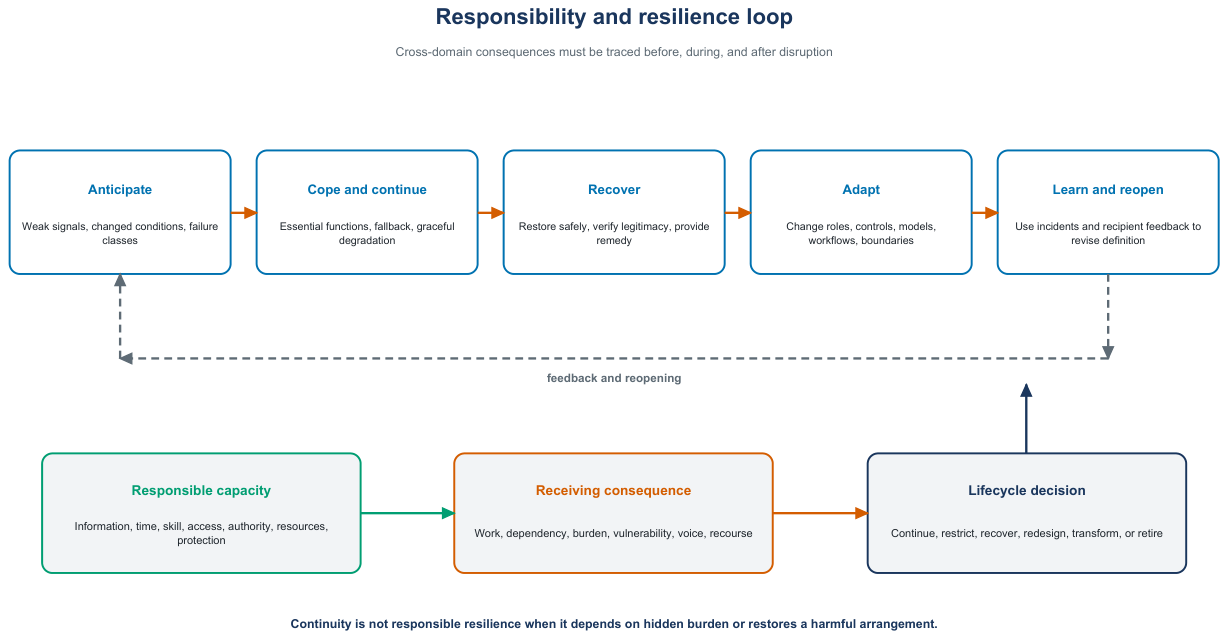
Resilience adds a temporal and transformational dimension. Anticipation concerns weak signals, changed conditions, and known failure classes. Continuity and coping concern usable fallback, graceful degradation, and decision authority during disruption. Recovery concerns what is restored and whether restoration is safe and legitimate. Adaptation concerns changes to roles, controls, models, workflows, and boundaries when assumptions fail. Learning concerns whether incidents and recipient experience modify later decisions. Transformation and reopening concern situations in which returning to the previous state would reproduce harm and the product definition must be restricted, redesigned, or retired.
These functions can conflict. Centralization may accelerate updating while creating correlated failure and vendor dependence. Human fallback may preserve continuity while transferring monitoring or proof work to actors without time or authority. Additional data may improve detection while expanding surveillance and breach consequences. Rapid restoration may resume service while bypassing investigation, contestability, repair, or redress. Responsible resilience therefore asks both whether the arrangement can continue and whose labor, exposure, and vulnerability make continuity possible.
The receiver test used throughout the analysis is: who supplies each resilience function; what information, skill, access, authority, resources, and protection that actor possesses; what new dependency is created; who bears failure during coping and recovery; and which affected-party signal can reopen the product definition. This connects D2 authority, D3 evidence, D4 detectability, D5 usable oversight, D6 state change, and D7 monitoring and lifecycle action.
7. Integrated Process Model and Propositions
The model begins with capability or organizational ambition. A situated product-definition decision turns that ambition into a boundary of functions, data, actors, interfaces, authority, and lifecycle obligations. Persistent interdependent demands become salient inside that arrangement. The organization responds through acceptance, integration, differentiation, temporal or spatial separation, redesign, restriction, withdrawal, or suppression.
The connective event is a boundary or role reconfiguration embedded in the response. A human monitor is added; recipients must supply evidence; a client performs due diligence; a hospital validates a vendor model; an appeal is created; a regulator becomes the practical route to deletion. These changes create effects in another product-definition locus. A second paradox exists only if the new demands also satisfy contradiction, interdependence, persistence, organizational significance, and non-elimination.
When they do, a paradox knot forms; when they do not, a consequential propagation pathway may still exist. The analysis traces authority, responsibility, knowledge, capacity, dependency, vulnerability, voice, maintenance, burden, and resilience functions before and after. The organization may navigate, suppress, or reproduce the knot; redesign the product boundary; restrict use; repair the organizational process; provide redress; retire the system; or reopen the decision after new evidence. In the present data, case-level classifications range from supported redistribution and knot candidates to bounded and non-knot outcomes; the model is a cross-case explanatory integration rather than a prevalence or universal-stage claim.
7.1. Propositions for Empirical Examination
Proposition 1 - response-mediated propagation. The probability of a consequential cross-domain effect increases when a locally defensible response changes the product boundary, role allocation, information flow, interaction, adaptive state, control, or lifecycle obligation rather than merely changing a local parameter.
Proposition 2 - residualization. When AI capability is preserved through a complementary human or organizational role, unresolved detection, verification, exception-handling, or correction work is likely to migrate toward that role; responsibility problems intensify when practical capacity does not migrate with the work.
Proposition 3 - boundary displacement. When product value depends on expanding data, capability, or organizational reach, legality, verification, contestability, deletion, repair, or redress duties are likely to become distributed across vendors, adopters, affected people, and oversight bodies.
Proposition 4 - assurance localization. The more a standardized or proprietary capability depends on local thresholds, workflow, populations, and infrastructure, the more assurance work will be localized to adopting organizations even when capability development remains centralized.
Proposition 5 - responsible resilience. A propagation response strengthens responsible resilience only when the receiving actor has usable information, authority, resources, fallback, protection, and a route to reopen the product definition; continuity without these conditions is likely to conceal or transfer vulnerability.
Proposition 6 - knot formation and bounding. Propagation is more likely to form a paradox knot when both demands remain necessary, the response preserves one pole by redistributing work or exposure, and no empowered actor can end the contradiction. Clear prohibition, direct accountability, effective remedy, restriction, redesign, withdrawal, or retirement can instead bound the sequence.
Figure 1.
Response-mediated process model with knot-forming, bounding, and feedback paths.
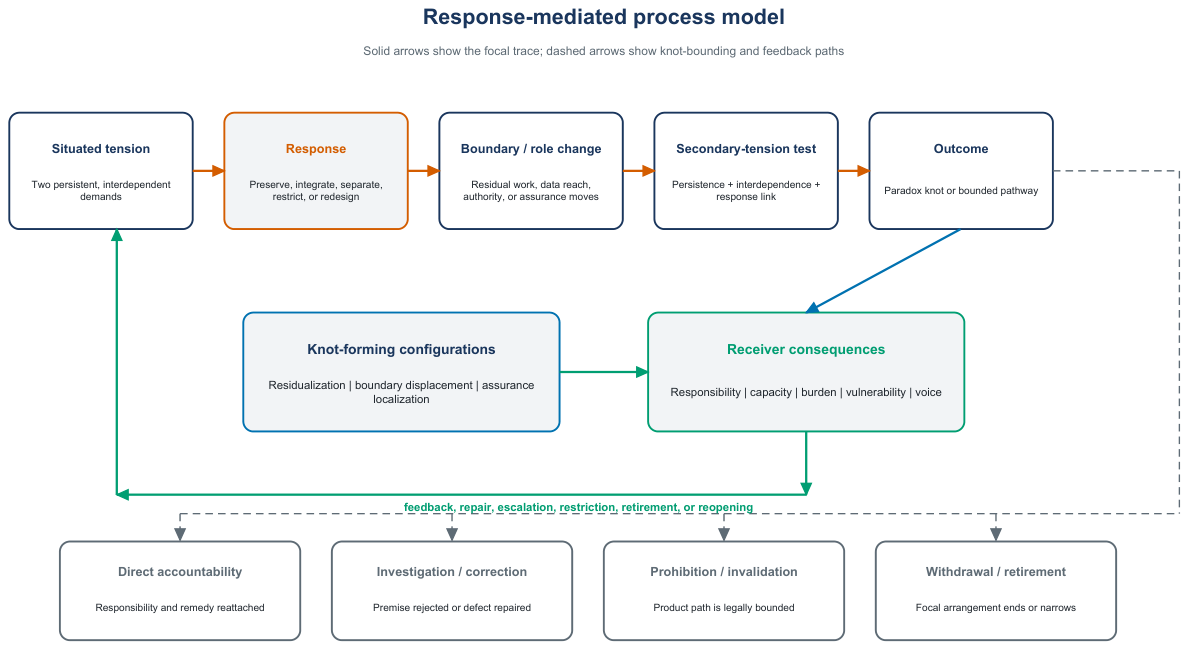
The model also contains stop paths. A direct rule can prohibit the design. An investigation can reject the premise of the alleged tension. A response can repair a defect. A court can assign responsibility. A product can be withdrawn. These outcomes do not remove the broad social conflict, but they can bound the organizational episode.
Several boundary conditions follow. Knotting is more plausible when capability value depends on distributed human complements, responsibility crosses organizational boundaries, critical evidence appears later than adoption, affected actors lack detectability or voice, and the organization preserves a pole by moving work. It is less plausible when one actor retains practical authority and resources, legal requirements are clear, the correction path is prompt, and the response ends the focal decision without reproducing both demands.
The model is evidence-grounded but deliberately testable. Future work can disconfirm a knot by showing that the secondary tension was absent, that the response did not cause the role or boundary change, that an ordinary defect or legal violation explains the sequence, or that effective authority-capacity alignment bounded the episode.
8. Archival Illustration and Cross-Case Evidence
The eight-case comparison is used for theory elaboration rather than prevalence estimation. The cases vary in the strength of their product-decision chronology and response linkage; the underlying case records preserve source registers, frozen boundaries, timelines, rival explanations, negative evidence, and unresolved gaps. The compact overview below identifies each case’s analytical role.
8.1. Selected Cases
Table 2.
Compact overview of selected cases.
| Case | System and context | Focal product-definition tension | Strongest evidence | Affected or receiving parties | Analytical role |
|---|---|---|---|---|---|
| Robodebt | Australian welfare compliance; rules-based data matching and debt calculation | Administrative scale and consistency vs. lawful individualized evidence and review | Royal Commission and Ombudsman records | Welfare recipients, frontline staff, reviewers, public institutions | Rich burden-transfer and repair case; non-ML comparison |
| SyRI | Dutch interagency data linkage and risk indication | Fraud detection and coordination vs. privacy, transparency, and contestability | District Court judgment and regulator advice | Residents of targeted areas, participating agencies, oversight bodies | Judicially bounded architecture and non-knot pathway |
| Uber ATG | Developmental automated-driving road testing | Real-world learning vs. controlled public-road safety | NTSB accident investigation and docket | Vehicle operator, road users, safety organization, state oversight | Strongest residualization and knot candidate |
| Clearview AI | Facial-recognition search using a mass image database and Canadian clients | Identification reach vs. consent, privacy, and contextual integrity | Joint privacy-commissioner findings | People depicted, vendor, client agencies, regulators | Cross-organizational boundary displacement |
| Epic Sepsis Model | Proprietary clinical prediction evaluated at Michigan Medicine | Early detection vs. alert and attention burden | Corrected peer-reviewed external validation | Patients, clinicians, local evaluators, vendor and hospital | Technical basis for assurance localization; process chronology limited |
| Apple Card | Credit underwriting investigation | Risk differentiation vs. equal access, explanation, and recourse | New York regulator investigation | Applicants, card issuer, platform partner, regulator | Negative case: allegation not supported as unlawful discrimination |
| Air Canada | Website chatbot and conflicting bereavement-fare information | Scalable self-service vs. accurate authoritative policy | Civil Resolution Tribunal decision | Customer and airline | Direct accountability and bounded remedy |
| iTutorGroup | Automated applicant screening | Screening scale and consistency vs. equal opportunity | EEOC complaint, decree, release, and testimony | Applicants, employer entities, regulator | Legal enforcement and AI-removal control |
8.2. Worked Case: Uber ATG
Uber ATG is the strongest current candidate. On 18 March 2018, a developmental automated-driving test vehicle struck and killed a pedestrian in Tempe, Arizona. The NTSB concluded that the vehicle operator’s failure to monitor while distracted was the probable cause. It also identified Uber ATG’s inadequate safety risk assessment, ineffective operator oversight, inadequate mechanisms for automation complacency, and inadequate safety culture as contributing factors, alongside pedestrian and state-oversight factors (NTSB 2019). The case therefore cannot be reduced to either “the algorithm failed” or “the operator failed.” Its official record explicitly connects technical, human, organizational, and institutional components.
The first candidate paradox is real-world learning versus controlled public-road safety. Developmental systems require evidence from realistic environments; safe experimentation requires limiting exposure to immature capability. Both demands persist during development. They are interdependent because learning is part of building safety, while the legitimacy and continuation of testing depend on safety. The second candidate is automation capability versus meaningful human supervision. The product definition used a human operator to monitor the driving environment and the ADS. Greater automation enabled testing but changed the content and attentional character of the human role. Effective supervision depended on the system and organization providing a monitorable task, timely cues, training, oversight, and intervention capacity.
The candidate knot is response mediated. To navigate learning and safety, the organization tested a developmental ADS with a human monitor as a safety control. That response may have altered the autonomy/control tension by residualizing detection in a human role vulnerable to automation complacency and distraction. Responsibility was not simply transferred from machine to human; it was distributed among engineering, safety assessment, operations, training, management, operator, and public oversight. The operator was proximate to the crash, but the NTSB’s contributing findings locate conditions in organizational design and culture.
The official record supports moderate confidence in the product-boundary and responsibility-capacity relation and lower confidence in the complete cross-paradox causal chain. It directly links the operator role to broader risk assessment, oversight, complacency controls, and safety culture, but it does not by itself establish that learning speed determined the supervision design. Inadequate safety management remains a powerful rival, and a single crash limits evidence of recurrence. Subsequent completion of a safety management system documents organizational response without establishing the effectiveness of every control.
Care is secondary but meaningful. Road users did not consent to dependency on the competence of an experimental system and its organizational controls. Attentiveness to situated vulnerability, competent risk response, and continuing learning after harm fit a care process. Safety engineering, public-road law, and institutional oversight remain the primary normative bases.
8.3. Cross-Case Mechanisms and Variation
8.3.1. Residualization
Residualization occurs when an organization responds to a capability-related tension by defining a human or organizational complement that preserves the valued capability. The complement receives detection, verification, exception handling, or correction work left outside the automated function. The response connects domains when the residual role makes a second organizing tension salient: formal responsibility must be sustained despite limits in knowledge, attention, authority, time, or resources.
Uber ATG provides the strongest instance: human monitoring was part of the safety arrangement that enabled developmental testing, but the monitoring role existed within conditions that the NTSB linked to automation complacency, oversight, risk assessment, and safety culture. Robodebt provides a non-AI analogue: standardized and online processes appear to have left recipients and staff with residual evidence and exception work. Epic supplies a technical candidate: alert thresholds and proprietary integration can place evaluation and validation work on clinicians and local organizations, but actual deployment evidence is missing.
Function-allocation and moral-crumple-zone research explain why residual work and blame can concentrate on human actors. The cross-case extension developed here places that concentration inside a longer sequence: residual work is created by a response intended to preserve both poles of a focal tension, and the resulting role arrangement changes how a second tension is experienced. Uber provides the strongest response-level evidence. Robodebt supplies a non-ML comparison in which administrative scale is sustained through recipient and staff proof work. Epic identifies the technical conditions for a similar receiver problem but does not document the full deployed workflow. The evidence therefore supports residualization as the principal elaborated configuration, with variation in the strength of the cross-paradox link.
8.3.2. Boundary Displacement
A second configuration begins with expansion of a data, capability, or organizational boundary. Identification, coordination, compliance, or detection is pursued through greater informational reach. The response makes legality, verification, contestability, deletion, or repair salient at another actor or lifecycle stage. Clearview best illustrates the vendor-client-regulator form: the product’s value depended on a mass image corpus and client search, while the duties of lawful collection, verification, downstream use, challenge, and deletion were distributed across parties. Robodebt and SyRI provide public-sector contrasts in which data linkage was embedded in different legal and institutional arrangements.
Boundary displacement integrates insights from contextual integrity, many-hands responsibility, and lifecycle governance. Its distinctive analytical value is temporal and receiver-specific: it asks which product response moved the obligation, where it became actionable, whether the receiving actor could perform it, and whether a second persistent tension emerged or the episode was bounded by enforcement, withdrawal, or redesign. The archival support for the redistribution is moderate; support for a fully qualified second paradox varies across cases.
8.3.3. Assurance Localization
Assurance localization occurs when a standardized or proprietary capability is made usable only through local validation, threshold selection, workflow design, monitoring, and repair. Epic provides the clearest technical basis. The corrected validation shows that the model’s local performance and hypothetical alert burden depended on threshold and evaluation choices (Wong et al. 2021); those findings make local assurance indispensable to any product definition. The archive does not establish the complete deployed workflow, allocation of authority, or organizational response sequence. We therefore treat assurance localization as an exploratory configuration grounded in the technical evidence and used to specify what further process records must show. Clearview’s client due-diligence problem provides an adjacent interorganizational instance rather than independent confirmation.
8.3.4. Knot-Bounding and Non-Knot Pathways
Negative cases reveal at least four ways the proposed sequence can stop.
First, a clear legal or organizational accountability rule can attach responsibility directly and provide remedy, as in Air Canada. Second, investigation can fail to support the allegation that made a tension appear paradoxical, while process improvements still occur, as in Apple Card. Third, a prohibited rule can be addressed through legal enforcement without an AI-specific explanation, as in iTutorGroup. Fourth, judicial review can invalidate an architecture, as in SyRI. These pathways matter because a theory of knotting that cannot represent bounded closure will overpredict its phenomenon.
8.3.5. Comparative Synthesis
Across the cases, interconnection is most visible where a response changes the product boundary or allocates a complementary human or organizational role. The response preserves learning, scale, identification reach, or early detection by moving necessary work into another domain. The receiving arrangement can make supervision, verification, data responsibility, or local assurance more salient.
Responsibility and burden move through residual monitoring, recipient proof work, client due diligence, local validation, appeal, deletion, and later institutional repair. The comparative analysis separates this observed redistribution from the stronger inference that a paradox response caused it. Table 4 therefore reports both the configuration and the evidentiary status of the response-mediated link.
Table 3.
Cross-case mechanisms, receivers, and outcomes
| Case | Configuration | Response and receiving actor | Responsibility-capacity relation | Care-ethical significance | Outcome and evidence strength |
|---|---|---|---|---|---|
| Uber ATG | Residualization | Developmental road testing used an operator as a monitoring control | Immediate monitoring responsibility sat within organizational limits on risk assessment, oversight, complacency controls, and safety culture | Road users faced involuntary dependency; competent response extended beyond the operator | Knot candidate; strongest response-level evidence, moderate coupling |
| Robodebt | Residualization and boundary displacement | Data matching and online compliance left recipients and staff with evidence and exception work | Proof obligations reached actors with unequal records, support, and practical ability; repair later expanded institutionally | Particular need, vulnerable dependency, frontline reception, and redress are central | Strong redistribution; lower AI specificity; knot inference low-to-moderate |
| Clearview AI | Boundary displacement | Mass collection and vendor-client service distributed legality, verification, and deletion duties | Affected people depended on vendor, clients, and regulators for notice, challenge, and deletion | Weak voice, non-voluntary data dependency, and continuing deletion obligations | Moderate redistribution evidence; full knot inference low |
| Epic Sepsis Model | Assurance localization | Threshold and validation choices imply clinician and local evaluator work | Practical capacity depends on local data, alert workflow, authority, and resources | Patient need and competent response matter, but reception evidence is absent | High confidence in corrected model results; organizational process exploratory |
| SyRI | Bounded architecture | Judicial review invalidated the legal architecture | Legal scrutiny bounded rather than redistributed a supported second paradox | Voice and ability to know or defend remain important legal-relational concerns | Non-knot/bounded pathway; high confidence in court disposition |
| Apple Card | Investigation and process repair | Regulatory investigation examined complaints and service/appeal processes | No supported material transfer in the available record | Explanation and recourse remain relevant without presuming discrimination | Negative case; regulator finding strong, internal process evidence limited |
| Air Canada | Direct accountability and remedy | Tribunal reattached chatbot information to the organization | Responsibility and remedy were legally assigned without a second persistent tension | Responsiveness appears as organizational correction rather than a care mechanism | Non-knot; strong decision evidence, shallow organizational process |
| iTutorGroup | Legal enforcement | Consent decree imposed policy, training, and monitoring duties | Prospective duties were specified; original design authority remains undocumented | Applicant vulnerability and redress are primarily grounded in employment law | Non-knot/AI-removal control; allegations and obligations kept distinct |
9. Discussion and Theoretical Contributions
9.1. Cross-Domain Tension Propagation as the Central Contribution
The central contribution is a process explanation of cross-domain tension propagation during AI product definition. The study specifies an observable connective event—a response-mediated change in boundary, role, information flow, interaction, adaptive state, control, or lifecycle obligation—and follows its consequences into another domain. This moves analysis beyond a catalogue of familiar AI trade-offs without claiming that the component concerns or the existence of interdependence are new.
This positioning preserves the paper’s original intent. The framework still follows the product from its rationale and users through information, capability, workflow, learning, outcomes, monitoring, and retirement. Standards do not make those questions irrelevant; they show that the paper should not claim to have invented lifecycle design or governance. The research contribution is a domain structure and tension mechanism that gives heterogeneous human–AI findings an inspectable place in product-definition reasoning.
9.2. Implications for Design Teams
The framework shifts discussion from feature nouns to situated behaviors. “Explanation,” “memory,” “copilot,” “warning,” “personalization,” and “human review” become prompts for analysis rather than design decisions. Teams must identify what the system does, who is involved or represented, which information and consequence are present, and what a proposed intervention requires or excludes.
It also changes how evidence is used. A source need not be accepted or rejected as a whole. One study may support a bounded observation about workload while not supporting a claim about agency, accuracy, or long-term use. An offline retrieval result can inform capability without establishing legitimate information use. A privacy framework can constrain a design without predicting an interface effect. This disciplined partial use of sources is central to the method.
Finally, the domains provide a common language across design, research, engineering, product, governance, and operations. D1–D7 can help locate a question and preserve its dependencies; they do not determine which role owns every answer. Formal ownership, signoff, and assurance remain organization- and domain-specific.
9.3. Implications for Human–AI Research
Research becomes easier to translate when reports specify the actor and represented party, task stage, desired participation, consequence and reversibility, information source and authority, correct and incorrect system cases, full-workflow effort and recovery, trust separately from reliance, objective separately from subjective outcomes, and repeated-use or update conditions. No study must measure every domain. The value lies in making the boundary of each measured claim visible.
The framework also produces testable research questions. Does a seven-domain analysis reduce consequential omissions relative to a strong human-centred baseline? Do different teams converge on materially similar constraints even when they label domains differently? Does a compact cross-domain record improve later recovery of why a decision was made? Does any improvement justify the time and duplication it adds? Which domain mergers help or harm novice and expert users? These are empirical questions, not results of the present work.
9.4. Implications for Governance and Standards Work
Standards provide lifecycle, risk, requirements, ethical-design, and management infrastructure. The domains can provide organized inputs to that infrastructure: a situated intervention rationale, actor and authority map, information-flow and evidence questions, bounded capability claim, workflow and reliance concerns, adaptive-state decision, and outcome/guardrail set. A conditional direction can then be decomposed into multiple formal requirements and controls rather than being treated as a single “primary constraint.”
The most important governance implication is that responsibility cannot be inferred from presence. A reviewer who lacks information, time, authority, or detection capacity does not become accountable merely by appearing in a workflow diagram. Similarly, behavioral evidence does not create authority: a user’s repeated edits may support a hypothesis about preference without authorizing persistent organizational learning.
9.5. Product Definition as the Connective Process
The primary theoretical contribution is an integrated process explanation of how locally defensible responses acquire cross-domain consequences. Paradox research establishes that persistent tensions coexist, interact, and respond dynamically. The present study locates the connective work of a response in product definition: the boundary, role, information-flow, interface, authority, and lifecycle choices through which an organization attempts to sustain valued demands. Those choices determine where residual work is performed, where assurance becomes local, and where responsibility crosses an organizational boundary.
This specification advances analysis beyond a catalogue of AI tensions. A paradox knot is traced as a dated relation between independently qualified tensions, mediated by a product-boundary or role reconfiguration. Residualization is the strongest observed configuration; boundary displacement extends the sequence across data and organizational boundaries; assurance localization specifies a vendor-adopter configuration for further testing. The negative cases make bounding part of the explanation: direct accountability, investigation, prohibition, repair, invalidation, or withdrawal can prevent the second tension from persisting.
The two-stage construct test is therefore not merely restrictive. It identifies the empirical difference between cross-domain consequence and paradox knot, while allowing both to remain theoretically relevant. The process model can explain why a response redistributes burdens even when the second tension does not meet the paradox threshold.
9.6. Integrative Value of D1-D7
D1-D7 provide the coverage architecture for this process explanation. They make it harder to omit information flows, represented identity, authority, contestability, maintenance, and repair when a source foregrounds technical performance, law, or a proximate actor. Their value is integration and cross-case comparability: the same response can be followed from capability and interaction into authority and lifecycle consequences without treating those domains as independent variables. The mechanism itself remains the response-mediated boundary or role reconfiguration.
9.7. Care-Ethical Extension: Reception and Continuing Obligation
Care ethics changes what is visible at the receiver and feedback stages. Responsibility research can map an assignment and its resources; care asks whether the organization noticed particular need, how dependency shaped the recipient’s ability to refuse or recover, whether the receiving actor could respond competently, whether feedback altered the arrangement, and which obligations continued after deployment or harm. This extension matters in Robodebt’s recipient proof work, Clearview’s non-voluntary data relationship, Uber’s public-road exposure, and the local competence implied by clinical validation.
Figure 2 expresses this distributional logic. Formal responsibility reaches a receiving actor or institution. Operational capacity depends on information and detectability, time and attention, skill and resources, technical access, authority, and organizational protection. When assignment and capacity diverge, burden and vulnerability increase. Voice, contestability, maintenance, repair, and redress can feed experience back into the product definition and realign the arrangement.
The care interpretation remains accountable to power and plurality. Organizational claims to care or safety are not evidence that needs were correctly interpreted. Affected-party voice and practical contestability are necessary checks against paternalism. Technical repair and organizational learning also remain distinct from redress for people who experienced material or relational harm.
9.8. Responsible Resilience as a Product-Definition Property
The analysis connects responsibility and resilience without collapsing them. A response is not responsible merely because it restores service, and it is not resilient merely because a formal owner has been named. Responsible resilience requires an actor with practical capacity; fallback that does not silently transfer intolerable burden; recovery criteria tied to stakeholder outcomes and guardrails; adaptation authority with legitimate information flows; and learning mechanisms through which incidents and recipient feedback can reopen the product definition.
This connection extends digital-resilience research upstream. Existing accounts explain capacities to absorb shocks, recover, adapt, and transform (Boh et al., 2023; Tim & Leidner, 2023). D1-D7 shows where those capacities are designed or weakened before deployment. D4 and D7 specify detectability, fallback, recovery, monitoring, and lifecycle action; D2 identifies who has authority and residual work; D3 addresses the information needed for detection and learning; D5 examines whether people can use fallback and oversight under real cognitive conditions; and D6 governs state change and adaptation. Cross-domain tension propagation explains why strengthening one resilience function can weaken another domain unless the receiving consequence is traced.
Figure 3.
Responsibility-and-resilience loop from anticipation through reopening.
9.9. Relationship to Neighbouring Theories and Governance Approaches
The process model is complementary to established governance. NIST’s AI Risk Management Framework, impact assessment, transparency records, Responsibility Modelling, contestable-AI practices (Alfrink et al. 2023), internal auditing, and model/system documentation can surface actors, risks, evidence, controls, and lifecycle obligations. The present model contributes an explanatory relation among those entries: it asks which response to a persistent tension created the assignment or control, which other tension changed as a result, and what happened to the receiving actor over time.
The distinction is explanatory rather than a claim of procedural superiority. A matched standards-aligned analysis in the development record often reached the same disposition as the expanded cross-domain trace. Practical value should therefore be judged by whether the trace changes a boundary, assignment, restriction, evidence requirement, remedy, or reopening signal—not by the presence of an additional checklist.
Table 4.
Direct-neighbour comparison.
| Neighbour | Primary focus and unit | Mechanism and temporal orientation | Cross-domain treatment | Distinctive value relative to this study |
|---|---|---|---|---|
| Paradox theory | Persistent contradictory and interdependent demands in organizing | Dynamic responses, reinforcing cycles, salience, and recurrence | Explicitly accommodates nested, knotted, and cross-level tensions | Foundational theory; this study specifies product-boundary and role reconfiguration as an observable connective event in AI product definition |
| Responsibility gaps and many hands | Distribution of causation, knowledge, control, culpability, accountability, and active responsibility | Explains why attribution and forward obligation are difficult in distributed systems | Cross-actor and often cross-institutional | Provides the responsibility foundation; this study embeds redistribution in a response-to-secondary-tension sequence |
| Moral crumple zones and function allocation | Proximate human roles, residual work, authority, workload, and blame | Examines allocation and post-failure attribution | Connects technical automation to human and organizational consequences | Strong rival and complement; this study asks when residualization changes another persistent tension |
| Responsibility Modelling | Duties, agents, resources, dependencies, hierarchy, vulnerability, and reassignment | Design-time and operational mapping of responsibility | Explicitly sociotechnical and interorganizational | Provides richer formal assignment analysis; this study adds paradox-response sequence and knot-bounding outcomes |
| Responsible-AI governance and auditing | Risk identification, documentation, accountability, monitoring, incidents, recourse, and lifecycle action | Prospective and continuous governance | Broad system and lifecycle coverage | Provides actionable governance infrastructure; this study explains how responses recorded in that infrastructure can displace or reconnect tensions |
| Care-ethical IS work | Dependency, power, attentiveness, competence, responsiveness, and continuing responsibility | Relational and ongoing | Follows consequences across relationships and time | Provides the relational lens; this study locates care questions at receiver and feedback stages of a cross-domain process |
| Digital and organizational resilience | Anticipation, absorption or coping, recovery, adaptation, learning, and transformation | Process before, during, and after disruption | Explicitly sociotechnical and temporal | Provides resilience functions; this study locates how product-definition choices distribute the capacity and burden needed to realize them |
10. Practical Implications
10.1. For Analysts and Governance Teams
Researchers and governance teams should begin with a bounded product decision, identify the locally intended benefit, and trace any boundary, role, information-flow, interaction, state, control, or lifecycle change that follows. Each claimed tension should pass the paradox test independently. The response-to-secondary-tension link should be coded with explicit evidence type and confidence. Negative cases should be able to end the sequence.
Archival studies should also separate AI capability from the organizational system. Model performance, interface behavior, procurement, human review, policy, and downstream decision are different evidence objects. A later inquiry can reveal consequences without establishing contemporaneous knowledge. A consent decree can establish obligations without proving allegations. A vendor system card can document intended use without proving local fitness.
10.2. For Managers and Designers
The practical question is not “Which paradox are we balancing?” It is “What work and authority does this response create elsewhere?” Before preserving capability through a human fallback, local validator, client check, recipient correction process, or appeal, managers should test whether the receiving actor has information, time, skill, access, authority, resources, and protection. They should identify affected people who cannot choose the dependency. They should distinguish organizational repair from redress.
A minimal response audit asks:
- 1.
- Which capability/value pole is the decision preserving?
- 2.
- Which product boundary or role changes make that possible?
- 3.
- Who now detects errors, verifies evidence, handles exceptions, and sustains the system?
- 4.
- Can that actor intervene before harm, and can affected people contest the result?
- 5.
- Which later evidence reopens the product definition?
This audit is a way to use existing governance methods more coherently, not a claimed replacement for them.
10.3. For Technical Architecture
Architectural choices participate in organizational tensions. Alert thresholds allocate attention. Model interfaces determine what a human can know. Data pipelines create purposes and dependencies across organizations. Logging and versioning determine whether later review can reconstruct a decision. Override and rollback mechanisms define practical authority. Vendor APIs and contracts can localize assurance while limiting inspectability. Retirement and deletion are technical as well as organizational capabilities.
The cases suggest that “human oversight” should be specified as an architecture of detectability and intervention: what state is visible, when, to whom, with which action, latency, authority, and fallback. Likewise, “contestability” requires data provenance, reason, correction, pause, escalation, and downstream propagation, not a contact form alone.
10.4. A Product-Definition Review Sequence
The analysis supports a practical sequence that is more modest than a new method. It can be embedded in existing risk, impact-assessment, architecture, assurance, or decision-record processes.
The first step is to freeze the product decision. Teams should identify the capability, population, environment, process version, data boundary, organizational participants, and intended disposition under review. A generic statement such as “use AI for fraud detection” is too broad to reveal responsibility or persistence. The relevant decision might be whether a specific public body may link specified datasets for one project; whether a hospital should deploy a particular model version at a particular threshold; or whether developmental road testing may continue with a specified supervision design.
The second step is to state demands without paradox language. Each pole should be described as an organizational requirement with evidence of who values it and why. Teams should distinguish an empirical performance relation from a normative requirement. A model threshold may create a measured sensitivity–positive-prediction relation. Whether early detection, clinician workload, and false-positive exposure are organizationally significant is a separate question. If a law prohibits one option, the episode may be a compliance decision rather than a paradox.
The third step is to identify the actual response and the product change it entails. “Keep a human in the loop” is not an actionable response description. The review should state which person receives what information at which point, what action is possible, what happens if the person does nothing, and which organization maintains the interface and policy. “Use a vendor model with local validation” similarly requires specifying what evidence the vendor provides, what the adopter can test, who selects thresholds, and who can suspend use.
The fourth step is the receiver test. Every response has practical complements. Someone must monitor, verify, supply evidence, handle exceptions, explain, investigate, repair, or absorb delay. The review names that actor and tests authority, knowledge, detectability, access, time, skill, resources, and organizational protection. It also identifies actors who depend on the system but cannot choose the dependency. This step translates an abstract both/and response into a falsifiable organizational arrangement.
The fifth step tests the secondary tension independently. A monitoring burden does not become a paradox merely because it is difficult. The new demands must meet the same five-part construct test as the primary tension. If they do not, the record should say “downstream burden,” “control gap,” or “implementation defect,” whichever is accurate. This discipline avoids making the process model self-confirming.
The final step assigns disposition and reopening. The organization can proceed, proceed conditionally, restrict scope, redesign, pause, reject, repair, provide redress, or retire. Reopening signals may include changed data, version drift, complaints, review outcomes, incidents, threshold performance, vendor changes, legal advice, workforce feedback, or affected-party reception. Repair of the product and redress for people remain separate. This sequence does not guarantee a better outcome; it makes the allocation and evidence contestable.
10.5. Responsible-and-Resilient Review Workflow
Figure 4 summarizes the practical sequence. The team begins with one situated capability and a named product behavior, inspects all seven domains, traces intended benefit and receiving pressure, identifies who gains or loses responsibility and capacity, tests anticipation through recovery and adaptation, and records the evidence or event that will reopen the decision. The output is a conditional product definition, not a one-time approval.
11. Limitations and Research Agenda
11.1. Framework Construction and Use
The construction corpus was curated and iteratively expanded rather than systematically searched. The paper does not claim representative or exhaustive coverage of human–AI research. A systematic review could broaden, update, or challenge the source base and test whether important traditions are missing.
The evidence is heterogeneous and uneven. Human–AI writing, interaction, reliance, and short bounded tasks are represented more directly than longitudinal organizational deployment, cross-cultural use, collective effects, authorized adaptation, or high-consequence assurance. Theoretical and adjacent cognitive sources contribute distinctions and possible mechanisms, not direct evidence that a generative-AI interface will produce the same effect.
The twelve-to-nine-to-seven derivation is a documented conceptual organization, not an empirical discovery of natural kinds or proof of minimality. The two final mergers may reduce usability burden, but they may also hide workflow or authority distinctions if applied carelessly. The separated questions inside D2, D3, and D5 are therefore essential.
The 48-case portfolio and 18 tests were post-construction analytic challenges. They were useful for finding collisions, omissions, and boundary cases, but they do not establish reliability, completeness, decision quality, usability, or causal benefit. The cases vary in available public detail, and synthetic cases demonstrate conceptual pressure rather than prevalence.
The standards comparison was interpretive and bounded to the inspected editions and materials. This paper does not claim conformity, certification, legal compliance, or that a standard lacks content simply because public access or this analysis did not locate it. Formal application requires the licensed standards, relevant expertise, organizational context, and current jurisdictional requirements.
The worked examples are design analyses, not deployments or participant findings. Future work should compare the framework with strong baselines on omission detection, decision quality, time, usability, inter-team convergence, later recoverability, and documentary duplication. Higher-risk studies should include specialists and affected stakeholders, use complete domain-specific assurance methods, and evaluate action sequences rather than isolated features.
11.2. Comparative Archival Extension
The study’s explanatory reach is bounded by its documentary design. Public controversies and official investigations overrepresent failure, legal conflict, and hindsight; ordinary product-definition work, successful prevention, internal resource debates, and maintenance routines are less visible. The cases also arise under different legal, professional, and institutional regimes. We therefore compare response-consequence configurations rather than harm severity, legal outcomes, or jurisdictional effectiveness, and we do not estimate how frequently any configuration occurs.
The technology set is deliberately heterogeneous. It includes rules-based automation, risk indication, developmental automated driving, facial recognition, proprietary clinical prediction, algorithmic underwriting, a website chatbot, and automated screening. That variation supports AI-removal tests and analysis of socio-technical boundaries, but it does not establish a mechanism unique to machine learning or to a single technical class. The strongest process evidence concerns Uber ATG and Robodebt; Clearview supports cross-boundary redistribution; Epic supplies strong technical but limited organizational evidence; the remaining cases primarily specify bounding conditions.
Source types also answer different questions. A court judgment, regulator investigation, accident report, inquiry, and model evaluation use different standards of proof and visibility. Internal motives are not inferred from outcomes, later findings are not projected backward as contemporaneous knowledge, and correction or withdrawal is not treated as evidence of effectiveness. AI-assisted coding was one analytical stream rather than independent human coding, so no inter-rater reliability is claimed. The literature synthesis was critical and integrative rather than systematic or exhaustive.
These limitations define an analytical generalization: the process model is most applicable to AI product-definition settings in which capability depends on distributed human or organizational complements, authority crosses boundaries, evidence emerges after adoption, and affected parties have limited detectability, voice, or exit. Prospective studies, internal decision records, and cross-industry comparisons should test the model in successful and mundane settings as well as public failures.
11.3. Research Agenda and Adjudication Tests
Three forms of evidence would most improve the theoretical adjudication. The first is contemporaneous product-decision material. Official inquiries are excellent at reconstructing failure but often weak at showing how actors framed demands before consequences were known. Design reviews, risk registers, safety cases, threshold decisions, procurement records, change requests, and incident escalations would make it possible to test whether a documented paradox response actually produced the later role or boundary change.
The second is longitudinal evidence of recurrence and adaptation. A paradox claim requires persistence; a knot claim requires more than one downstream consequence. Versioned technical records and dated organizational policies can show whether a response suppressed a tension temporarily, whether a second tension became salient, whether the organization changed course, and whether the original demand returned. Without such evidence, a process diagram can become a retrospective story imposed on a single incident.
The third is reception evidence from affected and responsible actors. Public archives often document institutional conclusions while obscuring the practical experience of operators, clinicians, recipients, applicants, and people whose data are used. Existing complaint records, hearing testimony, staff submissions, appeal files, union records, professional guidance, and public consultation may supply some of this evidence without collecting new interviews. Such material must still be sampled and interpreted carefully; visible complainants are not representative of all affected people.
Future comparison should prioritize a successful or mundane AI product episode. The current negative cases show bounded legal responses, but they do not show a product team navigating persistent tensions well before harm. A stronger divergent case would document a limited pilot, explicit scope restriction, effective human authority, monitored workload, and a decision not to expand until evidence improved. Such a case could distinguish knot prevention from mere absence of controversy.
Theoretical adjudication should use predeclared rival predictions. Function-allocation theory predicts residual human work when automation removes coherent task components. Moral-crumple-zone analysis predicts blame concentration on a proximate operator with constrained control. Many-hands theory predicts responsibility-distribution difficulty under divided causation, knowledge, capacity, and authority. Ordinary risk management predicts failure when hazards, controls, and escalation are inadequate. The proposed paradox account adds value only if evidence shows that the residual arrangement arose as a response to sustaining both poles of a qualified primary paradox and then altered a separately qualified secondary paradox. If the data support only the rival prediction, the paper should report that result.
The same logic governs care. Care adds value when the organizational account misses particular need, dependency, reception, or continuing obligation even after ordinary responsibility and governance are mapped. If care terminology merely redescribes harm, vulnerability, or fairness without changing interpretation, it should be removed. Conversely, a case in which formal controls exist but dependent actors cannot practically use them may justify a stronger care-based explanation of institutional competence and responsiveness.
Finally, the study should examine material decision equivalence. A process explanation can be theoretically illuminating even if it does not change a governance disposition. But managerial claims require more. Researchers should compare the boundary, assignments, restrictions, evidence requirements, remedies, and reopening triggers produced by ordinary governance methods with those produced after paradox analysis. If the outputs are equivalent, the contribution is explanatory rather than prescriptive. If they differ, the analysis must show why the difference is defensible and not simply extra bureaucracy.
12. Conclusion
The difficult question in human-AI product development is not only what a model can do. It is how a capability becomes a product: whose purpose it serves, what work and authority it redistributes, which information it depends on, what failures can be detected, how interaction shapes judgment, what may change through use, and which safeguards, fallback, recovery, adaptation, and lifecycle actions govern the arrangement.
D1-D7 provides a research-grounded architecture for that move. The domains connect intervention rationale and alternatives; actors, representation, work, authority, and responsibility; information and legitimate flow; bounded capability and failure; interaction and reliance; adaptive state and authorization; and outcomes, safeguards, monitoring, and lifecycle action. Reading them together makes locally attractive choices answerable to their cross-domain consequences.
The paper’s principal theoretical contribution is cross-domain tension propagation. A locally defensible response can reconfigure a product boundary, role, information flow, interaction, state, control, or lifecycle obligation and thereby intensify, relocate, conceal, or create a pressure elsewhere. The archival cases identify residualization, boundary displacement, and assurance localization as configurations of this process. Paradox knots are a narrower outcome requiring separately qualified persistent tensions and a supported response link; investigation, direct accountability, correction, prohibition, repair, withdrawal, or invalidation can instead bound the sequence.
Responsibility and resilience meet at the receiver of the propagated consequence. Formal responsibility is meaningful only when the receiving actor has information, detectability, time, skill, resources, access, authority, and organizational protection. Resilience is meaningful only when the sociotechnical arrangement can anticipate disruption, sustain essential functions, recover, adapt, and learn without hiding the burden or restoring a harmful condition. Care ethics adds attention to particular need, asymmetric dependency, voice, reception, continuing obligation, and redress.
The resulting proposition is straightforward: define AI products conditionally, trace every locally defensible response across all seven domains, and specify who supplies the capacity for responsible action and resilient adaptation when conditions change. The seven domains make the decision architecture visible; cross-domain tension propagation explains how consequences travel through it; and responsibility, care, and resilience show why the destination matters.
Funding
This research received no external funding.
Data Availability Statement
No new datasets were generated for this conceptual study. The documentary and scholarly sources used in the analysis are identified in the manuscript and reference list.
Conflicts of Interest
The author declares no known competing financial interests or personal relationships that could have appeared to influence the work reported in this paper.
Use of Artificial Intelligence
AI tools assisted with organizing literature and evidence, identifying duplicates and inconsistencies, language refinement, citation-consistency checking, and document formatting. The human author is responsible for the research question, inclusion and exclusion decisions, interpretation of evidence, theoretical claims, verification of sources, final wording, and the submitted manuscript.
References
- ACWG. Goal Structuring Notation Community Standard (Version 3); Safety-Critical Systems Club. [DOI, 4 May 2021. [Google Scholar]
- Alter, A. L.; Oppenheimer, D. M. Uniting the tribes of fluency to form a metacognitive nation. In Personality and Social Psychology Review; DOI, 2009; Volume 13, 3, pp. 219–235. [Google Scholar]
- Amershi, S.; Weld, D.; Vorvoreanu, M.; Fourney, A.; Nushi, B.; Collisson, P.; Suh, J.; Iqbal, S.; Bennett, P. N.; Inkpen, K.; Teevan, J.; Kikin-Gil, R.; Horvitz, E. Guidelines for human-AI interaction. In Proceedings of the 2019 CHI Conference on Human Factors in Computing Systems (Article 3; Association for Computing Machinery. [DOI, 2019; pp. 1–13. [Google Scholar]
- Asare-Marfo, D. 2021. Why do some open-ended survey questions result in higher item nonresponse rates than others? Pew Research Center. [Google Scholar]
- Autio, C.; Schwartz, R.; Dunietz, J.; Jain, S.; Stanley, M.; Tabassi, E.; Hall, P.; Roberts, K. Artificial Intelligence Risk Management Framework: Generative Artificial Intelligence Profile. NIST AI 600-1; National Institute of Standards and Technology. [DOI, 2024.
- Bansal, G.; Nushi, B.; Kamar, E.; Lasecki, W. S.; Weld, D. S.; Horvitz, E. Beyond accuracy: The role of mental models in human-AI team performance. Proceedings of the AAAI Conference on Human Computation and Crowdsourcing 2019a, 7(1), 2–11. [Google Scholar] [CrossRef]
- Bansal, G.; Nushi, B.; Kamar, E.; Weld, D. S.; Lasecki, W. S.; Horvitz, E. Updates in human-AI teams: Understanding and addressing the performance/compatibility tradeoff. In Proceedings of the AAAI Conference on Artificial Intelligence; DOI, 2019b; Volume 33, 01, pp. 2429–2437. [Google Scholar]
- Boh, W.; Constantinides, P.; Padmanabhan, B.; Viswanathan, S. Special issue introduction: Building digital resilience against major shocks. MIS Quarterly 2023, 47(1), 343–360. [Google Scholar]
- Bansal, G.; Wu, T.; Zhou, J.; Fok, R.; Nushi, B.; Kamar, E.; Ribeiro, M. T.; Weld, D. S. Does the whole exceed its parts? The effect of AI explanations on complementary team performance. In Proceedings of the 2021 CHI Conference on Human Factors in Computing Systems (Article 81, 16 pages; Association for Computing Machinery. [DOI, 2021. [Google Scholar]
- Buçinca, Z.; Malaya, M. B.; Gajos, K. Z. To trust or to think: Cognitive forcing functions can reduce overreliance on AI in AI-assisted decision-making. In Proceedings of the ACM on Human-Computer Interaction; DOI, 2021; Volume 5(CSCW1), Article 188, pp. 1–21. [Google Scholar]
- Cowan, N. The magical number 4 in short-term memory: A reconsideration of mental storage capacity. In Behavioral and Brain Sciences; DOI, 2001; Volume 24, 1, pp. 87–114. [Google Scholar]
- Danry, V.; Pataranutaporn, P.; Mao, Y.; Maes, P. Don’t just tell me, ask me: AI systems that intelligently frame explanations as questions improve human logical discernment accuracy over causal AI explanations. In Proceedings of the 2023 CHI Conference on Human Factors in Computing Systems (Article 352, 13 pages; Association for Computing Machinery. [DOI, 2023. [Google Scholar]
- Debenedetti, E.; Zhang, J.; Balunović, M.; Beurer-Kellner, L.; Fischer, M.; Tramèr, F. AgentDojo: A dynamic environment to evaluate prompt injection attacks and defenses for LLM agents. In Advances in Neural Information Processing Systems 37; Datasets and Benchmarks Track; DOI, 2024. [Google Scholar]
- Dhillon, P. S.; Molaei, S.; Li, J.; Golub, M.; Zheng, S.; Robert, L. P. Shaping human-AI collaboration: Varied scaffolding levels in co-writing with language models. In Proceedings of the 2024 CHI Conference on Human Factors in Computing Systems (Article 1044, 18 pages; Association for Computing Machinery. [DOI, 2024. [Google Scholar]
- Dietvorst, B. J.; Simmons, J. P.; Massey, C. Algorithm aversion: People erroneously avoid algorithms after seeing them err. In Journal of Experimental Psychology: General; DOI, 2015; Volume 144, 1, pp. 114–126. [Google Scholar]
- Dietvorst, B. J.; Simmons, J. P.; Massey, C. Overcoming algorithm aversion: People will use imperfect algorithms if they can (even slightly) modify them. In Management Science; DOI, 2018; Volume 64, 3, pp. 1155–1170. [Google Scholar]
- Draxler, F.; Werner, A.; Lehmann, F.; Hoppe, M.; Schmidt, A.; Buschek, D.; Welsch, R. The AI ghostwriter effect: When users do not perceive ownership of AI-generated text but self-declare as authors. In ACM Transactions on Computer-Human Interaction; DOI, 2024; Volume 31(2), Article 25, pp. 1–40. [Google Scholar]
- Duchek, S. Organizational resilience: A capability-based conceptualization. In Business Research 13; DOI, 2020; pp. 215–246. [Google Scholar]
- Fitts, P. M. The information capacity of the human motor system in controlling the amplitude of movement. In Journal of Experimental Psychology; DOI, 1954; Volume 47, 6, pp. 381–391. [Google Scholar]
- Friedman, B.; Hendry, D. G.; Borning, A. A survey of value sensitive design methods. In Foundations and Trends in Human–Computer Interaction; DOI, 2017; Volume 11, 2, pp. 63–125. [Google Scholar]
- Gao, G.; Taymanov, A.; Salinas, E.; Mineiro, P.; Misra, D. Aligning LLM agents by learning latent preference from user edits. In Advances in Neural Information Processing Systems 37; DOI, 2024. [Google Scholar]
- Gebru, T.; Morgenstern, J.; Vecchione, B.; Vaughan, J. W.; Wallach, H. M.; Daumé, H., III; Crawford, K. Datasheets for datasets. In Communications of the ACM; DOI, 2021; Volume 64, 12, pp. 86–92. [Google Scholar]
- Google PAIR. People + AI Guidebook, (original work published 2019; updated May 18, 2021). 2021.
- Gotel, O. C. Z.; Finkelstein, A. C. W. An analysis of the requirements traceability problem. In Proceedings of the First IEEE International Conference on Requirements Engineering; IEEE Computer Society Press. [DOI, 1994; pp. 94–101. [Google Scholar]
- Goyal, N.; Briakou, E.; Liu, A.; Baumler, C.; Bonial, C.; Micher, J.; Voss, C. R.; Carpuat, M.; Daumé, H., III. What else do I need to know? The effect of background information on users’ reliance on QA systems. In Proceedings of the 2023 Conference on Empirical Methods in Natural Language Processing; Association for Computational Linguistics, 2023; pp. 3313–3330. [Google Scholar]
- Hick, W. E. On the rate of gain of information. In Quarterly Journal of Experimental Psychology; DOI, 1952; Volume 4, 1, pp. 11–26. [Google Scholar]
- Institute of Electrical and Electronics Engineers. IEEE standard model process for addressing ethical concerns during system design. IEEE Std 7000-2021; DOI, 2021.
- International Organization for Standardization. ISO 9241-210:2019 Ergonomics of human-system interaction—Part 210: Human-centred design for interactive systems; 2019.
- International Organization for Standardization; International Electrotechnical Commission. ISO/IEC 23894:2023 Information technology—Artificial intelligence—Guidance on risk management; 2023a.
- International Organization for Standardization; International Electrotechnical Commission. ISO/IEC 42001:2023 Information technology—Artificial intelligence—Management system; 2023b.
- International Organization for Standardization; International Electrotechnical Commission. ISO/IEC 5338:2023 Information technology—Artificial intelligence—AI system life cycle processes; 2023c.
- International Organization for Standardization; International Electrotechnical Commission; Institute of Electrical and Electronics Engineers. ISO/IEC/IEEE 29148:2018 Systems and software engineering—Life cycle processes—Requirements engineering; 2018.
- Joshi, N.; Vogel, D. Writing with AI lowers psychological ownership, but longer prompts can help. In Proceedings of the 7th ACM Conference on Conversational User Interfaces (Article 72, 17 pages; Association for Computing Machinery. [DOI, 2025. [Google Scholar]
- Kelleher, T.; Men, L. R.; Thelen, P. Employee perceptions of CEO ghost posting and voice: Effects on perceived authentic leadership, organizational transparency, and employee–organization relationships. Public Relations Journal 2019, 12(4). [Google Scholar]
- Kim, J.; Flanagan, R. C.; Haviland, N. E.; Sun, Z.; Yakubu, S. N.; Maru, E. A.; Arnold, K. C. Towards full authorship with AI: Supporting revision with AI-generated views. In Joint Proceedings of the ACM IUI Workshops 2024 (CEUR Workshop Proceedings; 2024a; Vol. 3660. [Google Scholar]
- Kim, S. S. Y.; Liao, Q. V.; Vorvoreanu, M.; Ballard, S.; Vaughan, J. W. “I’m not sure, but…”: Examining the impact of large language models’ uncertainty expression on user reliance and trust. In Proceedings of the 2024 ACM Conference on Fairness, Accountability, and Transparency; Association for Computing Machinery. [DOI, 2024b; pp. 822–835. [Google Scholar]
- Lee, J. D.; See, K. A. Trust in automation: Designing for appropriate reliance. In Human Factors; DOI, 2004; Volume 46, 1, pp. 50–80. [Google Scholar]
- Lee, M.; Gero, K. I.; Chung, J. J. Y.; Shum, S. B.; Raheja, V.; Shen, H.; Venugopalan, S.; Wambsganss, T.; Zhou, D.; Alghamdi, E. A.; August, T.; Bhat, A.; Choksi, M. Z.; Dutta, S.; Guo, J. L. C.; Hoque, M. N.; Kim, Y.; Knight, S.; Neshaei, S. P.; Siangliulue, P. A design space for intelligent and interactive writing assistants. In Proceedings of the 2024 CHI Conference on Human Factors in Computing Systems (Article 1054; 35 pages, Association for Computing Machinery, 2024. [Google Scholar]
- Lenzner, T.; Hoehne, J. K.; Gavras, K. Innovating web probing: Comparing written and oral answers to open-ended probing questions in a smartphone survey. Journal of Survey Statistics and Methodology 2024, 12(5), 1295–1317. [Google Scholar] [CrossRef]
- Leroy, S. Why is it so hard to do my work? The challenge of attention residue when switching between work tasks. In Organizational Behavior and Human Decision Processes; DOI, 2009; Volume 109, 2, pp. 168–181. [Google Scholar]
- Leroy, S.; Glomb, T. M. Tasks interrupted: How anticipating time pressure on resumption of an interrupted task causes attention residue and low performance on interrupting tasks and how a “ready-to-resume” plan mitigates the effects. In Organization Science; DOI, 2018; Volume 29, 3, pp. 380–397. [Google Scholar]
- Leroy, S.; Schmidt, A. M. The effect of regulatory focus on attention residue and performance during interruptions. In Organizational Behavior and Human Decision Processes 137; DOI, 2016; pp. 218–235. [Google Scholar]
- Lewis, J. R.; Utesch, B. S.; Maher, D. E. UMUX-LITE: When there’s no time for the SUS. In Proceedings of the SIGCHI Conference on Human Factors in Computing Systems; Association for Computing Machinery. [DOI, 2013; pp. 2099–2102. [Google Scholar]
- Liu, W.; Gori, J.; Rioul, O.; Beaudouin-Lafon, M.; Guiard, Y. How relevant is Hick’s law for human–computer interaction? In Proceedings of the 2020 CHI Conference on Human Factors in Computing Systems; Association for Computing Machinery. [DOI, 2020; pp. 1–11. [Google Scholar]
- Lou, M.; Crowley, J.; Dodson, S.; Yoon, D. AnchoredAI: Contextual anchoring of AI comments improves writer agency and ownership [Preprint]. In arXiv; DOI, 2025. [Google Scholar]
- Lu, Z.; Mysore, S.; Safavi, T.; Neville, J.; Yang, L.; Wan, M. Corporate Communication Companion (CCC): An LLM-empowered writing assistant for workplace social media [Preprint]; arXiv, 2024. [Google Scholar]
- Lucas, G. M.; Gratch, J.; King, A.; Morency, L.-P. It’s only a computer: Virtual humans increase willingness to disclose. In Computers in Human Behavior 37; DOI, 2014; pp. 94–100. [Google Scholar]
- MacKenzie, I. S. Fitts’ law as a research and design tool in human–computer interaction. In Human–Computer Interaction; DOI, 1992; Volume 7, 1, pp. 91–139. [Google Scholar]
- MacLean, A.; Young, R. M.; Bellotti, V. M. E.; Moran, T. P. Questions, options, and criteria: Elements of design space analysis. In Human–Computer Interaction; DOI, 1991; Volume 6, 3–4, pp. 201–250. [Google Scholar]
- Mathur, A.; Acar, G.; Friedman, M. J.; Lucherini, E.; Mayer, J.; Chetty, M.; Narayanan, A. Dark patterns at scale: Findings from a crawl of 11K shopping websites. In Proceedings of the ACM on Human-Computer Interaction; DOI, 2019; Volume 3(CSCW), Article 81, pp. 1–32. [Google Scholar]
- Mayer, R. C.; Davis, J. H.; Schoorman, F. D. An integrative model of organizational trust. In Academy of Management Review; DOI, 1995; Volume 20, 3, pp. 709–734. [Google Scholar]
- Microsoft. Human-AI Experience Toolkit, n.d.
- Mitchell, M.; Wu, S.; Zaldivar, A.; Barnes, P.; Vasserman, L.; Hutchinson, B.; Spitzer, E.; Raji, I. D.; Gebru, T. Model cards for model reporting. In Proceedings of the Conference on Fairness, Accountability, and Transparency; Association for Computing Machinery. [DOI, 2019; pp. 220–229. [Google Scholar]
- Mysore, S.; Lu, Z.; Wan, M.; Yang, L.; Sarrafzadeh, B.; Menezes, S.; Baghaee, T.; Barajas Gonzalez, E.; Neville, J.; Safavi, T. PEARL: Personalizing large language model writing assistants with generation-calibrated retrievers. In Proceedings of the 1st Workshop on Customizable NLP; Association for Computational Linguistics. [DOI, 2024; pp. 198–219. [Google Scholar]
- Newton, D. W.; LePine, J. A.; Kim, J. K.; Wellman, N.; Bush, J. T. Taking engagement to task: The nature and functioning of task engagement across transitions. In Journal of Applied Psychology; DOI, 2020; Volume 105, 1, pp. 1–18. [Google Scholar]
- Nishal, S.; Lee, M.; Diakopoulos, N.; Vaughan, J. W. “Helping me versus doing it for me”: Designing for agency in LLM-infused writing tools for science journalism. In Proceedings of the 2026 CHI Conference on Human Factors in Computing Systems; Association for Computing Machinery. [DOI, 2026. [Google Scholar]
- Nissenbaum, H. Privacy as contextual integrity. Washington Law Review 2004, 79(1), 119–158. [Google Scholar]
- Proctor, R. W.; Schneider, D. W. Hick’s law for choice reaction time: A review. In Quarterly Journal of Experimental Psychology; DOI, 2018; Volume 71, 6, pp. 1281–1299. [Google Scholar]
- Risko, E. F.; Gilbert, S. J. Cognitive offloading. In Trends in Cognitive Sciences; DOI, 2016; Volume 20, 9, pp. 676–688. [Google Scholar]
- Rodden, K.; Hutchinson, H.; Fu, X. Measuring the user experience on a large scale: User-centered metrics for web applications. In Proceedings of the SIGCHI Conference on Human Factors in Computing Systems; Association for Computing Machinery. [DOI, 2010; pp. 2395–2398. [Google Scholar]
- Roediger, H. L., III; Karpicke, J. D. Test-enhanced learning: Taking memory tests improves long-term retention. In Psychological Science; DOI, 2006; Volume 17, 3, pp. 249–255. [Google Scholar]
- Ryan, R. M.; Deci, E. L. Self-determination theory and the facilitation of intrinsic motivation, social development, and well-being. In American Psychologist; DOI, 2000; Volume 55, 1, pp. 68–78. [Google Scholar]
- Saunders, W.; Yeh, C.; Wu, J.; Bills, S.; Ouyang, L.; Ward, J.; Leike, J. Self-critiquing models for assisting human evaluators [Preprint]. In arXiv; DOI, 2022. [Google Scholar]
- Schober, M. F.; Conrad, F. G.; Antoun, C.; Ehlen, P.; Fail, S.; Hupp, A. L.; Johnston, M.; Vickers, L.; Yan, H. Y.; Zhang, C. Precision and disclosure in text and voice interviews on smartphones. In PLOS ONE; DOI, 2015; Volume 10, 6. [Google Scholar]
- Schultz, W. Dopamine reward prediction error coding. In Dialogues in Clinical Neuroscience; DOI, 2016; Volume 18, 1, pp. 23–32. [Google Scholar]
- Schemmer, M.; Heinz, D.; Baier, L.; Vössing, M.; Kühl, N. Conceptualizing digital resilience for AI-based information systems. ECIS 2021 Research-in-Progress Papers (Paper 44); 2021. [Google Scholar]
- Shenhav, A.; Botvinick, M. M.; Cohen, J. D. The expected value of control: An integrative theory of anterior cingulate cortex function. In Neuron; DOI, 2013; Volume 79, 2, pp. 217–240. [Google Scholar]
- Si, C.; Goyal, N.; Wu, T.; Zhao, C.; Feng, S.; Daumé, H., III; Boyd-Graber, J. Large language models help humans verify truthfulness—except when they are convincingly wrong. In Proceedings of the 2024 Conference of the North American Chapter of the Association for Computational Linguistics: Human Language Technologies; Duh, K., Gomez, H., Bethard, S., Eds.; Association for Computational Linguistics, 2024; Volume 1, pp. 1459–1474. [Google Scholar]
- Spatharioti, S. E.; Rothschild, D. M.; Goldstein, D. G.; Hofman, J. M. Comparing traditional and LLM-based search for consumer choice: A randomized experiment [Preprint]; arXiv, 2023. [Google Scholar]
- Sweller, J. Cognitive load during problem solving: Effects on learning. In Cognitive Science; DOI, 1988; Volume 12, 2, pp. 257–285. [Google Scholar]
- Tabassi, E. Artificial Intelligence Risk Management Framework (AI RMF 1.0) (NIST AI 100-1); National Institute of Standards and Technology. [DOI, 2023. [Google Scholar]
- Tankelevitch, L.; Kewenig, V.; Simkute, A.; Scott, A. E.; Sarkar, A.; Sellen, A.; Rintel, S. The metacognitive demands and opportunities of generative AI. In Proceedings of the 2024 CHI Conference on Human Factors in Computing Systems (Article 680, 24 pages; Association for Computing Machinery. [DOI, 2024. [Google Scholar]
- Vasconcelos, H.; Bansal, G.; Fourney, A.; Liao, Q. V.; Vaughan, J. W. Generation probabilities are not enough: Uncertainty highlighting in AI code completions. In ACM Transactions on Computer-Human Interaction; DOI, 2025; Volume 32(1), Article 4, pp. 1–30. [Google Scholar]
- Vassilev, A.; Oprea, A.; Fordyce, A.; Anderson, H.; Davies, X.; Hamin, M. Adversarial Machine Learning: A Taxonomy and Terminology of Attacks and Mitigations. NIST AI 100-2e2025; National Institute of Standards and Technology. [DOI, 2025.
- Wei, J.; Wang, X.; Schuurmans, D.; Bosma, M.; Ichter, B.; Xia, F.; Chi, E. H.; Le, Q. V.; Zhou, D. Chain-of-thought prompting elicits reasoning in large language models. Advances in Neural Information Processing Systems 35 2022, 24824–24837. [Google Scholar] [CrossRef]
- Yeh, C.; Ramos, G.; Ng, R.; Huntington, A.; Banks, R. GhostWriter: Augmenting collaborative human-AI writing experiences through personalization and agency (Version 3) [Preprint]. In arXiv; DOI, 2025. [Google Scholar]
- Zheng, Q.; Xu, Z.; Choudhry, A.; Chen, Y.; Li, Y.; Huang, Y. Synergizing human-AI agency: A guide of 23 heuristics for service co-creation with LLM-based agents [Preprint]; arXiv, 2023. [Google Scholar]
- Alfrink, K.; Keller, I.; Kortuem, G.; Doorn, N. Contestable AI by Design: Towards a Framework. In Minds and Machines; DOI, 2023. [Google Scholar]
- Danneels, L.; Viaene, S. Identifying Digital Transformation Paradoxes. Business & Information Systems Engineering 2022, 64(4), 483–500. [Google Scholar] [CrossRef]
- Elish, M. C. Moral Crumple Zones: Cautionary Tales in Human–Robot Interaction. In Engaging Science, Technology, and Society; DOI, 2019; Volume 5, pp. 40–60. [Google Scholar]
- British Columbia Civil Resolution Tribunal. Moffatt v. Air Canada, 2024 BCCRT 149. 2024.
- District Court of The Hague. SyRI Legislation in Breach of European Convention on Human Rights, English judgment ECLI:NL:RBDHA:2020:1878; Dutch judgment ECLI:NL:RBDHA:2020:865, 2020.
- Jackson, S. J. “Rethinking Repair,” in Media Technologies: Essays on Communication, Materiality, and Society; Gillespie, T., Boczkowski, P. J., Foot, K. A., Eds.; 2014; pp. 221–239. [Google Scholar]
- Lock, R.; Sommerville, I.; Storer, T. “Responsibility Modelling,” STSE Handbook.
- National Transportation Safety Board. Collision Between Vehicle Controlled by Developmental Automated Driving System and Pedestrian, Tempe, Arizona, March 18, 2018, HAR-19/03, 2019.
- New York State Department of Financial Services. Report on Apple Card Investigation, 2021.
- Office of the Privacy Commissioner of Canada; Commission d’accès à l’information du Québec; Office of the Information and Privacy Commissioner for British Columbia; and Office of the Information and Privacy Commissioner of Alberta. “Joint Investigation of Clearview AI, Inc.,” PIPEDA Findings #2021-001, 2021.
- Raji, I. D.; Smart, A.; White, R. N.; Mitchell, M.; Gebru, T.; Hutchinson, B.; Smith-Loud, J.; Theron, D.; Barnes, P. Closing the AI Accountability Gap: Defining an End-to-End Framework for Internal Algorithmic Auditing. In in Proceedings of the 2020 Conference on Fairness, Accountability, and Transparency; 2020; pp. 33–44. [Google Scholar]
- Royal Commission into the Robodebt Scheme. In Report; 2023.
- Smith, W. K.; Lewis, M. W. Toward a Theory of Paradox: A Dynamic Equilibrium Model of Organizing. In Academy of Management Review; DOI, 2011; Volume 36, 2, pp. 381–403. [Google Scholar]
- Tim, Y.; Leidner, D. E. Digital resilience: A conceptual framework for information systems research. In Journal of the Association for Information Systems; DOI, 2023; Volume 24, 5, pp. 1184–1198. [Google Scholar]
- Toutaoui, J.; Benlian, A.; Hess, T. Managing Paradoxes in Bi-modal Information Technology Functions: A Multi-case Study. In Information Systems Journal; DOI, 2022; Volume 32, 6, pp. 1177–1202. [Google Scholar]
- Tronto, J. C. Creating Caring Institutions: Politics, Plurality, and Purpose. In Ethics and Social Welfare; DOI, 2010; Volume 4, 2, pp. 158–171. [Google Scholar]
- U.S. Equal Employment Opportunity Commission. iTutorGroup to Pay $365,000 to Settle EEOC Discriminatory Hiring Suit, Press release. 2023.
- Wong, A.; Otles, E.; Donnelly, J. P. External Validation of a Widely Implemented Proprietary Sepsis Prediction Model in Hospitalized Patients; Corrected 2 August 2021; JAMA Internal Medicine, 2021; Volume 181, 8, pp. 1065–1070. [Google Scholar]
- Zamani, E. D.; Angelopoulos, S.; Conboy, K. Being Responsibly Digital: A Care Ethics Lens for Digital Responsibility. In Information Systems Frontiers; [DOI, 2026. [Google Scholar]
Figure 2.
Responsibility-capacity-vulnerability trace at the receiver and feedback stages.
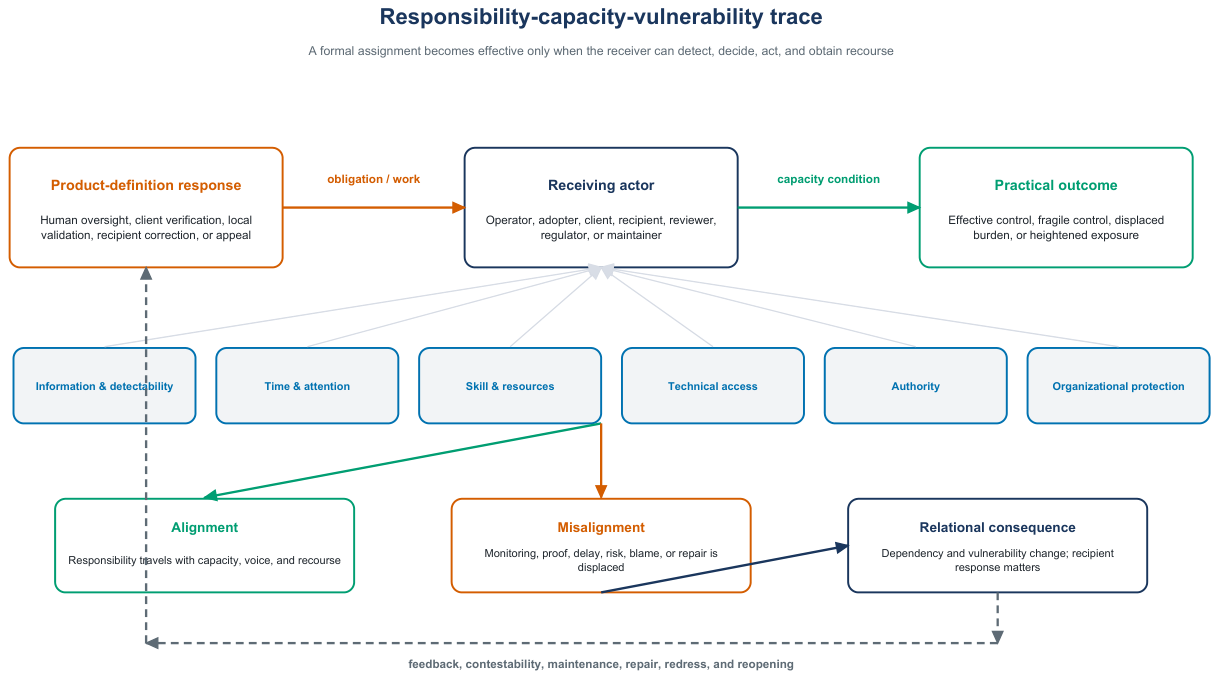
Figure 4.
Practical workflow for responsible and resilient AI product definition.
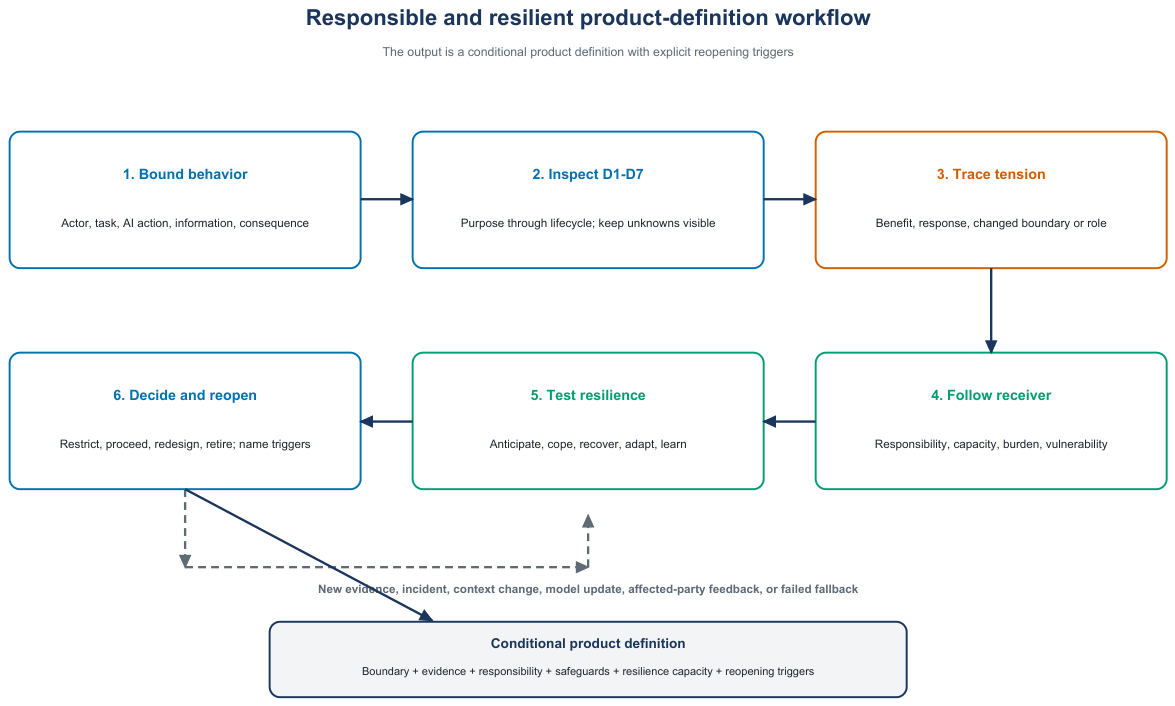
Disclaimer/Publisher’s Note: The statements, opinions and data contained in all publications are solely those of the individual author(s) and contributor(s) and not of MDPI and/or the editor(s). MDPI and/or the editor(s) disclaim responsibility for any injury to people or property resulting from any ideas, methods, instructions or products referred to in the content. |
© 2026 by the author. Licensee MDPI, Basel, Switzerland. This article is an open access article distributed under the terms and conditions of the Creative Commons Attribution (CC BY) license.
Copyright: This open access article is published under a Creative Commons CC BY 4.0 license, which permit the free download, distribution, and reuse, provided that the author and preprint are cited in any reuse.