

Submitted:
21 October 2026
Posted:
06 November 2026
You are already at the latest version
Abstract
Scholarship on Muslim family change is often divided between doctrinal studies of Islamic family law and social-scientific studies of demography, migration, gender, and welfare. This article brings these literatures together by asking how Islamic obligations of maintenance, caregiving, and intergenerational responsibility are translated when the institutional architecture of family life changes. Using a comparative socio-legal design centred on Belgium, Saudi Arabia, and Malaysia, the study triangulates Islamic legal sources, contemporary family-law frameworks, demographic and labour-market indicators, migration and care-economy data, and interdisciplinary scholarship on transnational families. The analysis finds neither simple continuity nor linear secularisation. Rather, care is redistributed across spouses, kin, states, markets, and cross-border networks. Low fertility, delayed family formation, women’s paid employment, migration, and the growth of paid domestic work alter who performs care, who finances it, and how religious obligations are experienced. To theorise this process, the article introduces the Transnational Muslim Care Regime (TMCR), a five-sphere framework linking normative, household, economic, institutional, and transnational domains. The framework clarifies why similar Islamic concepts can generate different practical arrangements across welfare-state, Gulf, and Southeast Asian settings. The article concludes that contemporary Muslim family analysis should move from a narrow focus on role preservation toward the preservation of core functions—care, maintenance, dignity, justice, and intergenerational solidarity—while remaining attentive to legal diversity and unequal distributions of time and labour.
Keywords:
Islamic family law
; care economy
; transnational families
; migration
; gender
; demographic transition
; nafaqah
; Muslim family
; welfare regimes
; domestic workers
; maqasid alshariah
1. Introduction
Family remains one of the most normatively dense institutions in Islamic legal and ethical thought. Marriage, financial maintenance, childcare, custody, kinship, inheritance, and duties toward ageing parents are treated not merely as private preferences but as relationships structured by rights, obligations, moral expectations, and social purposes. Yet the social world in which these norms are practised has changed rapidly. Across Muslim-majority and Muslim-minority settings, fertility has declined, first marriage is often later, women’s educational attainment and participation in paid work have increased, international migration has dispersed households across borders, and care once performed almost entirely within extended families is increasingly shared with states, markets, and paid workers. These changes do not make Islamic family norms irrelevant. They change the institutional pathways through which those norms are enacted.
The resulting transformation is frequently misdescribed through a binary opposition between a supposedly “traditional Muslim family” and a “modern” or “Western” family. Such a binary is analytically weak for at least three reasons. First, Islamic family law is internally diverse across schools of law, jurisdictions, and historical periods (Welchman 2007; Mir-Hosseini 1993). Second, contemporary Muslim families are embedded in sharply different welfare systems, labour markets, migration regimes, and legal orders. Third, family change is not a single-direction process: economic modernisation may expand women’s paid employment while leaving unpaid care highly gendered; migration may increase household income through remittances while separating financial provision from embodied care; and welfare-state support may reduce dependence on kin without eliminating religious understandings of filial responsibility.
This article therefore treats the “global Muslim family” not as a homogeneous sociological category but as an analytical problem. It asks how Muslim family obligations are reconfigured when care, income, authority, and kinship are distributed across institutions and borders. The central argument is that contemporary change is best understood as a redistribution of family functions rather than a replacement of an Islamic family by a modern one. The objects being redistributed include time, money, emotional labour, legal responsibility, physical presence, and decision-making authority. The recipients and providers of these resources include spouses, children, parents, extended kin, public welfare institutions, private markets, migrant domestic workers, and transnational networks.
The analysis compares three deliberately contrasting institutional contexts: Belgium as a European welfare-state and Muslim-minority setting; Saudi Arabia as a Muslim-majority Gulf setting with codified personal-status law and extensive reliance on migrant labour; and Malaysia as a Muslim-majority Southeast Asian setting characterised by a dual legal order, rapid demographic change, and a mixed configuration of kin, state, and market provision. These are not presented as representative of “Europe,” “the Gulf,” and “Southeast Asia” in a statistical sense. Rather, they are strategic cases through which to identify mechanisms that alter the relationship between normative obligations and actual care arrangements.
The article makes three contributions. Empirically, it brings together demographic, migration, labour, and care indicators that are usually examined separately from Islamic family law. Conceptually, it introduces the Transnational Muslim Care Regime (TMCR), a framework that explains family outcomes through interaction among normative, household, economic, institutional, and transnational spheres. Normatively, it proposes a distinction between role preservation and function preservation. The distinction does not presume that inherited legal roles are dispensable; instead, it asks whether the underlying functions of maintenance, care, dignity, protection of dependants, and intergenerational solidarity can be preserved under changed socioeconomic conditions through more than one institutional arrangement.
The research questions are: (1) How are demographic and migratory transformations changing the socioeconomic setting in which Islamic family obligations are practised? (2) How do Islamic concepts of maintenance, caregiving, and intergenerational responsibility interact with contemporary gender and labour-market arrangements? (3) How do different institutional environments redistribute care responsibilities among households, states, markets, and transnational networks? and (4) Can a comparative concept of the Transnational Muslim Care Regime explain both continuity and transformation in contemporary Muslim family life?
2. From “the Muslim Family” to Muslim Family-Care Regimes
2.1. the Limits of Doctrinal Isolation
A large literature has documented the evolution of Muslim family laws, especially the codification of marriage, divorce, maintenance, guardianship, custody, and inheritance in modern states (Welchman 2007; Larsen et al. 2013). This scholarship is indispensable because family law is a key arena in which Islamic jurisprudence, state authority, gender claims, and reform projects interact. Yet doctrinal analysis can become institutionally narrow when it assumes that the practical distribution of family responsibilities follows directly from legal rules. A rule assigning financial maintenance to a husband, for example, says little by itself about the amount of unpaid care performed by either spouse, the availability of public childcare, the use of paid domestic work, or the role of grandparents living in another country.
The opposite reduction is also problematic. Social-scientific accounts sometimes treat religious law as symbolic residue that will recede as education, urbanisation, or women’s employment expands. Research on Muslim family norms in Europe shows instead that Muslim actors navigate overlapping normative orders rather than simply choosing between “religion” and “state law” (Büchler 2012; Lecoyer 2017; Eidrup 2025). Religious discourse, civil law, family expectations, and individual aspirations may all be consequential at once. The analytical challenge is therefore to trace mediation: how does a norm travel through a household, a labour market, a welfare system, and a migration regime before becoming an observable practice?
2.2. Care Economy and Care Regimes
The political economy of care supplies a second body of theory. Razavi (2007) conceptualised care provision through a “care diamond” linking families and households, markets, states, and the non-profit or community sector. Later work by the International Labour Organization (ILO) has emphasised that both paid and unpaid care are foundational to economies even though unpaid care is poorly reflected in conventional measures of production and labour. Care includes direct activities such as childcare, eldercare, and support for persons with disabilities, as well as indirect domestic labour that sustains daily life. The concept is especially useful for family-law analysis because it reveals a distinction between financial provision and time-intensive care.
This distinction has major implications for Islamic family analysis. Juristic categories such as nafaqah are often framed in monetary or in-kind terms—food, clothing, housing, and other necessities—whereas many contemporary debates concern the allocation of time. A household may formally satisfy financial maintenance while placing a disproportionate unpaid-care burden on one member. Conversely, a spouse who performs extensive unpaid care may contribute substantially to household welfare without appearing as a financial provider. The care-economy perspective therefore shifts the question from “who has the formal duty?” to a second question: “who bears the actual costs in money, time, foregone employment, and bodily labour?”
2.3. Transnational Families and the Circulation of Care
Migration studies add a third dimension. Transnational-family scholarship rejects the assumption that family life requires co-residence. Care can circulate through visits, remittances, digital communication, delegated caregiving, sponsorship, and long-distance emotional support (Parreñas 2005; Baldassar and Merla 2014). Such circulation is rarely symmetrical. Legal status, citizenship, income, gender, and distance shape who can move, who must stay, and whose care needs are prioritised. The same migration process can generate care resources for one household and a care deficit for another.
For Muslim families, this perspective is particularly relevant because financial maintenance and kinship obligations can be discharged across borders, while physical caregiving may be delegated to relatives or paid workers. A migrant may finance parents’ living expenses in one country while being unable to provide daily eldercare. A household in a Gulf city may outsource childcare to a migrant domestic worker whose own children remain with relatives in a country of origin. The household receiving care and the household losing embodied care are thus connected through a global care chain. Treating these arrangements as external to family law misses how economic structures determine the practical meaning of family obligations.
Bringing these literatures together requires treating “care” as more than affection and “law” as more than adjudication. Care is an allocation problem involving scarce time, income, physical capacity, and emotional attention. Law defines some entitlements and liabilities, but households routinely solve care problems through arrangements that courts neither design nor observe. A comparative framework must therefore include both enforceable rules and the infrastructures—nurseries, schools, hospitals, pensions, domestic-work markets, migration channels, digital communication, and kin networks—that determine whether a legal entitlement can be realised in practice.
This integrated approach also helps avoid two normative shortcuts. One is to equate gender justice with sameness of roles without asking how households value different forms of contribution. The other is to treat complementarity as self-justifying without measuring whether one party bears disproportionate time poverty, career loss, or dependency. The empirical language of care costs provides a common analytical ground: different family models can be compared by asking who has enforceable claims, who controls resources, who performs indispensable labour, and how risks are shared across the life course.
3. Materials and Methods
The study uses a comparative interdisciplinary socio-legal design. It does not test a single causal hypothesis with individual-level survey data. Instead, it uses structured comparison to identify how similar normative concerns—maintenance, childcare, intergenerational support, and family solidarity—are mediated by different institutional settings. Evidence is triangulated from five source groups: (1) Qur’anic and Islamic legal concepts; (2) contemporary statutory and administrative family-law materials; (3) demographic and labour-market indicators from public statistical agencies and international organisations; (4) migration and care-economy data; and (5) peer-reviewed socio-legal, migration, gender, and family scholarship.
Belgium, Saudi Arabia, and Malaysia were selected for maximum institutional contrast rather than representativeness. Belgium combines a Muslim-minority population with a comparatively developed welfare infrastructure, civil family law, and significant migration. Saudi Arabia combines a codified personal-status framework grounded in Islamic legal categories with a labour market in which migrant workers, including domestic workers, play a major role in household service provision. Malaysia combines a federal civil order with state-administered Islamic family law for Muslims and displays rapid fertility decline alongside significant female employment and measurable gender differences in unpaid domestic and care work.
Country-level statistics are used as contextual indicators only. They are not treated as measures of “Muslim behaviour.” This distinction is crucial in Belgium, where national fertility or marriage data include populations of different religious backgrounds, but it is also important in Saudi Arabia and Malaysia, where citizenship, migration status, ethnicity, and religion do not map perfectly onto one another. The analysis therefore avoids attributing demographic patterns directly to Islam. Instead, it asks how demographic and labour-market conditions alter the environment within which Muslim family norms are interpreted and practised.
The comparative strategy proceeds in two stages. First, each case is examined across the same dimensions: family-law architecture, demographic pressure, migration, labour-market change, welfare provision, unpaid care, and paid domestic care. Second, the paper abstracts from the cases to formulate the TMCR framework. The purpose is theory-building: to explain why similar Islamic normative concepts can coexist with very different care arrangements.
The study follows a “most-different systems” logic at the institutional level. The cases differ in the relationship between religion and state family law, the scale of public welfare provision, and the role of migration in care production. What is held constant is the analytical question: how are maintenance and care functions allocated under conditions of demographic and economic change? The comparison is thus not intended to estimate average treatment effects or to infer individual religiosity from country characteristics. It seeks recurring mechanisms that can later be tested with household-level data.
The statistical figures are descriptive and are used to establish structural context. Figure 1 compares fertility trajectories; Figure 2 shows recent Malaysian time-use estimates for unpaid domestic and care work; Figure 3 situates the gendered labour-market consequences of care in a global frame. Figure 4 and Figure 5 are theory-building diagrams rather than empirical estimates. Their purpose is to make the causal architecture of the argument transparent and to distinguish measured indicators from the article’s conceptual synthesis.
During manuscript preparation, OpenAI ChatGPT (GPT-5.6 Sol; accessed 29 September 2026) was used as an assistive tool for literature synthesis, language refinement, structural organisation, and production of original visualisations from cited public data. All substantive claims, data values, references, and interpretations were reviewed by the author. No AI-generated data were treated as empirical evidence.

Table 1.
Comparative case logic.
| Case | Legal setting | Welfare / care infrastructure | Migration dimension | Analytical leverage |
|---|---|---|---|---|
| Belgium | Civil family law; Muslim norms operate mainly outside state religious family law | Extensive public/social provision relative to the other cases | Immigration, family reunification, transnational kinship | Shows how Islamic family norms are negotiated in a secular welfare-state minority context |
| Saudi Arabia | Codified Personal Status Law drawing on Islamic legal categories | Family-centred obligations with marketised household services | Large migrant workforce; migrant domestic and care labour | Shows separation of legal maintenance obligations from outsourced embodied care |
| Malaysia | Dual legal order; Islamic family law administered for Muslims | Mixed kin, state, and market provision | Internal and international migration; regional care chains | Shows hybrid legal and care arrangements amid rapid demographic transition |
Source: Author’s comparative design.
4. The Normative Architecture of Care in Islamic Family Law
Islamic family norms contain a layered architecture of care. At the marital level, marriage generates reciprocal ethical expectations as well as specific legal consequences. The Qur’an links household responsibility to financial expenditure in Q 4:34, while Q 65:6–7 addresses housing and expenditure according to means after marital breakdown. Q 2:233, in the context of breastfeeding, is especially important because it joins embodied care, financial responsibility, consultation between parents, and the possibility that care may be provided by another person. Duties toward parents are framed in strongly ethical terms in Q 17:23–24 and Q 31:14. Inheritance rules, kinship obligations, charity, and endowment institutions extend solidarity beyond the marital dyad.
Classical jurisprudence translated these sources into categories including nafaqah (maintenance), hadanah (custody and care), ridāʿah (breastfeeding), guardianship, inheritance, and varying forms of kinship support. The categories did not amount to a single uniform household blueprint. Their doctrinal details varied across legal schools and were embedded in historical conditions in which household production, market participation, kinship, and state welfare differed markedly from contemporary settings. Modern codification further altered the relationship between fiqh and family practice by selecting, reformulating, and administratively enforcing specific rules (Welchman 2007).
Three distinctions are necessary for a contemporary care analysis. The first is between legal duty and moral duty. Some forms of maintenance may be judicially enforceable, while filial kindness, emotional support, and kin solidarity can be morally weighty without being reducible to a court order. The second is between norm and custom. Gendered household practices may be defended as “Islamic” even when their precise allocation is more customary than doctrinal. The third is between financial responsibility and care labour. A legal duty to provide resources does not automatically specify who cooks, cleans, supervises children, accompanies an elderly parent to medical appointments, or interrupts paid employment when care is needed.
Saudi Arabia’s 2022 Personal Status Law illustrates contemporary codification. It defines spousal duties, provides for a wife’s maintenance even when she has independent wealth, specifies categories of maintenance such as food, clothing, housing, and basic needs, and regulates obligations toward children and needy parents (Saudi Arabia 2022). Malaysia likewise institutionalises maintenance, custody, and post-divorce claims through Islamic family-law mechanisms and Syariah courts (Government of Malaysia 2025). In Belgium, by contrast, Islamic family norms do not constitute a separate state family-law jurisdiction; Muslim families operate within civil law while also drawing on religious and transnational normative discourses (Lecoyer 2017). These differences make formal family law an important but incomplete predictor of actual care arrangements.
A care-economy approach therefore does not displace Islamic law; it makes visible a dimension that legal categories alone cannot measure. The key analytical question becomes: when the financial, temporal, and emotional components of family responsibility are separated across different actors, how is the integrity of the underlying obligation maintained?
Maintenance is especially revealing because it joins norm and political economy. In classical doctrine, nafaqah secures material support within a differentiated structure of marital rights and duties. In contemporary households, however, income may be pooled, both spouses may earn, housing may consume an unusually large share of earnings, and childcare may itself be purchased in the market. A rule about who is ultimately liable for maintenance can therefore coexist with many day-to-day financing arrangements. Analytical precision requires separating liability, contribution, ownership, and bargaining power rather than treating them as one variable.
The same is true of intergenerational care. Norms of birr al-walidayn and kin solidarity can motivate extensive support, yet the form of support depends on distance, health systems, housing, and employment. An adult child living abroad may pay medical expenses but be unable to attend appointments; a co-resident daughter may contribute more time but less money; siblings may negotiate responsibility according to income or proximity rather than formal inheritance shares. These patterns do not necessarily indicate normative decline. They demonstrate that the social technology of fulfilling an obligation changes as family members become geographically and economically differentiated.
Custody and childcare likewise show why a care lens is needed. Hadanah is typically analysed through entitlement and the best interests or welfare of the child, but the practical capacity to provide daily care depends on working hours, childcare availability, residence, transport, and extended-family support. Post-divorce maintenance disputes therefore intersect with the economics of care: inadequate or delayed financial support can convert legal custody into material hardship, while reliable transfers can make stable caregiving possible. Contemporary family law is most intelligible when these legal and economic dimensions are analysed together.
5. Demographic Transition and the Changing Architecture of the Household
Demography changes the practical conditions under which family obligations are fulfilled. Fertility decline reduces household size and eventually changes the ratio between older dependants and adult children. Longer lives can increase the duration of eldercare. Later marriage may extend the period in which young adults depend on parental housing or support while simultaneously delaying the formation of a new household. Urbanisation and housing costs can weaken co-residence across generations even where strong norms of filial responsibility remain.
Figure 1 shows the fertility trajectories of the three national contexts. The purpose is not to attribute fertility levels to religion, but to demonstrate the scale of demographic restructuring. World Bank indicators show Saudi Arabia declining from approximately 5.8 births per woman in 1990 to about 2.3 in 2024; Malaysia from about 3.3 to 1.5; and Belgium remaining at low fertility, moving from approximately 1.6 to 1.4 across the same endpoints (World Bank 2026). The convergence is analytically significant because family-support systems built around larger sibling groups face different pressures when fewer adult children share responsibility for ageing parents.
In Belgium, demographic change interacts with delayed marriage and migration. Statbel reported that the median age at first marriage rose to 31.65 years in 2024, while mixed-nationality marriages remained a visible part of the marriage landscape (Statbel 2026a). International migration continued to be a principal driver of population growth, producing households with dense cross-border ties (Statbel 2025). For Muslim families, these conditions can place religious expectations regarding marriage and kin support within a legal-economic setting shaped by housing markets, welfare entitlements, immigration status, and family-reunification rules.
Saudi Arabia presents a different configuration. Rapid fertility decline has occurred alongside major changes in education, employment, and household consumption. At the same time, care capacity has been partly expanded through paid migrant domestic labour. This means that demographic pressure does not translate straightforwardly into more unpaid care by citizens; some functions can be shifted to the market and to international labour migration. Malaysia occupies an intermediate position: fertility has fallen below replacement level, while households continue to combine kin support, women’s paid work, public services, and market provision.
The demographic point is therefore institutional rather than deterministic. Fewer children do not mechanically produce a care crisis, because states can provide services, markets can supply paid care, and technology can facilitate long-distance coordination. But each alternative redistributes costs. Public provision requires taxation and administrative capacity; paid care requires household income and may create labour-rights concerns; reliance on one daughter or daughter-in-law can intensify gender inequality; and remittance-based support can finance care without replacing physical presence.
6. Migration and the Transnational Muslim Household
Migration separates family membership from shared residence. This separation is now a normal feature of family life in many Muslim-majority and Muslim-minority settings. The transnational household may include a wage earner abroad, a spouse and children in an origin country, elderly parents supported through remittances, or children whose day-to-day care is performed by grandparents. These arrangements complicate simple mappings between legal duty and physical caregiving.
In Belgium, Muslim family life is often embedded in transnational social fields that connect European civil law to family expectations and religious discourses originating elsewhere. Lecoyer’s study of marriage conclusion among Belgian Muslim families shows that individuals navigate multiple normative spaces rather than acting within a single closed system (Lecoyer 2017). Family reunification law also gives the state a direct role in determining which relationships can become co-resident and under what material conditions. Thus, migration law can influence the feasibility of family practices even where it does not define the religious meaning of marriage or care.
Saudi Arabia highlights a different type of transnationality: the household may be territorially intact for citizen family members while depending on a migrant worker whose own family is dispersed elsewhere. The ILO estimates millions of domestic workers across the Arab States and notes the particular importance of migrant domestic labour in Gulf economies (ILO 2024a). Paid household work can reduce the time burden on employing families, but it can also relocate that burden across borders. A caregiver in Riyadh or Jeddah may send income to children or parents in Indonesia, the Philippines, Ethiopia, Kenya, or another origin country while delegating their care to relatives.
Malaysia participates in both sides of regional care circulation. It is a destination for migrant workers and also part of wider Southeast Asian mobility systems in which care responsibilities are reorganised across households. Research on Southeast Asian transnational families shows that migration can produce complex arrangements for children, with grandparents and other kin acting as substitute carers while migrant parents maintain financial and emotional connections from abroad (Hoang and Yeoh 2012).
These patterns suggest a crucial distinction between the circulation of resources and the circulation of presence. Money can move rapidly across borders; bodies cannot. A family may therefore satisfy an important element of maintenance while experiencing a deficit in daily companionship, supervision, or hands-on care. Conversely, a relative may provide intensive care without controlling the financial resources required to sustain it. The TMCR framework treats these mismatches as central rather than peripheral to contemporary family analysis.
Digital communication changes but does not dissolve the problem of absence. Messaging, video calls, online banking, and platform-based coordination permit what might be called “remote care management”: migrants can monitor school performance, transfer money instantly, arrange medical appointments, or participate in family decisions from another country. Yet these technologies reproduce inequalities in connectivity, literacy, legal status, and control over money. They can sustain intimacy, but they cannot perform physical tasks. The distinction between communicative presence and embodied presence is therefore essential to any account of transnational care.
Migration law also produces unequal temporalities. A worker may expect family reunification but face delays, income thresholds, housing requirements, or status insecurity. A domestic worker may be legally admitted precisely on terms that assume separation from dependants. These administrative rules shape family life as directly as many family-law provisions: they determine who may share a household, how long separation lasts, and whether care can be performed in person. A TMCR analysis therefore treats migration regulation as part of family governance even when legislators classify it as a separate legal field.
7. Gender, Paid Work, and the Economics of Unpaid Care
Gender is where the difference between formal obligation and lived care becomes most visible. Across the world, women perform a disproportionate share of unpaid care and domestic work. The persistence of this gap means that increasing women’s access to paid employment does not automatically equalise household labour. It can instead produce a “double burden” in which paid work is added to existing domestic responsibilities.
Malaysia provides unusually useful recent time-use evidence. The Department of Statistics Malaysia’s 2025 household indicators reported that women spent 25.5 percent of daily time on unpaid domestic and care work, compared with 18.1 percent for men (Department of Statistics Malaysia 2026a). These are national estimates rather than Muslim-specific measures, but they reveal the scale of care labour within the institutional environment in which Malaysian Muslim family law operates.
The global pattern is even more striking when care responsibilities are connected to labour-force participation. ILO estimates for 2023 indicate that approximately 708 million women and 40 million men were outside the labour force because of care responsibilities (ILO 2024b). The figures do not describe Muslim populations specifically, but they establish the macroeconomic importance of care and the gendered opportunity costs attached to it.
For Islamic family analysis, these data create a conceptual problem that cannot be resolved by citing maintenance rules alone. If one spouse has the primary legal obligation to finance the household while the other performs the majority of unpaid care, both are making economically consequential contributions of different types. If both spouses work for pay, the inherited distribution of financial duties may coexist with a newer distribution of income, yet domestic labour may remain unequal. The normative task is therefore not simply to ask whether women’s paid employment “changes” an Islamic family model, but to examine how the total bundle of household responsibilities is negotiated.
This is also where comparative institutional differences matter. In Belgium, public childcare, schooling, health services, and social protection can socialise part of the care burden. In Saudi Arabia, higher-income households may purchase domestic care, thereby moving some unpaid household work into a paid labour relationship. In Malaysia, families combine kin support, market services, and public provision in varying proportions. Similar religious concepts can consequently be lived through different time-allocation regimes.
A care perspective also complicates simplistic readings of qiwāmah or nafaqah. The relevant empirical question is not only who is assigned financial responsibility in doctrine, but whether the wider household arrangement secures reciprocal dignity, avoids exploitation, protects dependants, and distributes foreseeable care costs sustainably. That inquiry can be conducted without assuming that justice requires identical roles in every household; it requires, however, that invisible labour be made visible.
The distributive stakes extend beyond hours worked. Repeated interruptions for childcare or eldercare can affect promotion, pension accumulation, professional networks, and long-term earning capacity. The economic cost of care is therefore partly delayed and may become visible only after divorce, widowhood, unemployment, or retirement. Family-law rules concerning maintenance and post-divorce support interact with these life-course effects even when the legal texts do not explicitly use the language of human capital or opportunity cost.
Conversely, financial provision can carry its own risks. A household model that assigns primary financial liability to one spouse can expose that person to intense labour-market pressure or long working hours, reducing time available for relational care. The care-economy approach should therefore not replace one gender stereotype with another. Its analytical advantage is that it makes different burdens commensurable enough to discuss: money, hours, risk, dependency, and foregone opportunities can all be brought into the same distributive conversation without assuming that every family must choose an identical division of roles.
8. When Families Outsource Care: Domestic Workers and the Hidden Globalisation of the Household
The growth of paid domestic work makes the household itself a site of globalisation. Childcare, cleaning, cooking, elder support, and other domestic tasks may be purchased from workers whose migration status, labour rights, and family circumstances differ sharply from those of the employing household. In the Arab States, the ILO has estimated approximately 6.6 million domestic workers aged fifteen and above, with domestic work accounting for a substantial share of employment in several Gulf countries (ILO 2024a).
Outsourcing care can be rational from the perspective of an employing family. It may enable both spouses to participate in paid employment, reduce time pressure, improve supervision of children or older people, and allow adult children to meet work demands while ensuring that an elderly parent is not left alone. Yet from a care-economy perspective, outsourcing does not eliminate care; it changes who performs it and under what labour relationship.
This creates an ethical triangle: the care recipient, the employing family, and the care worker. Islamic family ethics is usually discussed in relation to the first two. A global care-chain perspective adds the third. If a family fulfils its duty toward an elderly parent by hiring a migrant caregiver, that decision also creates responsibilities toward the worker whose labour makes the fulfilment possible. Fair wages, humane working hours, freedom from abuse, rest, privacy, and the worker’s own family relationships are therefore not external labour-policy issues; they form part of the moral economy through which family care is actually produced.
The transnational dimension intensifies the paradox. A migrant worker can solve a care deficit in one household while generating or deepening a care deficit in another. Remittances may compensate partly by financing education, housing, health care, or substitute caregiving in the origin country. But monetary transfers cannot fully replicate embodied parental or filial presence. This is precisely why the concept of “care circulation” is more accurate than a one-way model: care moves in money, time, emotion, information, and physical labour, but these elements do not necessarily travel together (Baldassar and Merla 2014).
For Muslim family studies, the implication is significant. The moral evaluation of a household arrangement cannot stop at whether a husband has paid maintenance or whether adult children have financed their parents’ needs. It must also examine the labour architecture that makes those outcomes possible. In a global age, family ethics and labour ethics intersect inside the home.
9. Three Comparative Muslim Family-Care Regimes
9.1. Belgium: Welfare-State Interlegality
Belgium can be described as a welfare-state interlegality regime. Muslim families are subject to civil family law, but religious norms may shape marriage expectations, partner selection, divorce negotiations, kinship responsibilities, and everyday understandings of duty. The term “interlegality” is useful because the relevant normative environment is not a simple competition between two complete legal systems. Individuals may accept Belgian civil marriage as legally constitutive while also seeking religious solemnisation, or they may use Islamic moral reasoning in questions that state law leaves largely to private ordering.
Public services also alter the material significance of kinship. Childcare, schooling, health coverage, pensions, disability support, and social services can reduce the amount of care that must be financed or physically performed within the extended family. Yet welfare provision does not erase transnational responsibilities. Migrants and their descendants may continue to support parents or relatives abroad, maintain family property, organise visits, or participate in cross-border marriage and inheritance decisions. The result is a care regime in which the state carries a comparatively large institutional share while religious and kinship obligations remain socially meaningful.
9.2. Saudi Arabia: Codified Maintenance and Marketised Care
Saudi Arabia combines a more direct legal codification of Islamic family categories with extensive marketisation of household labour. The Personal Status Law codifies financial maintenance and kinship responsibilities, giving family obligations a state-enforceable form (Saudi Arabia 2022). At the same time, migrant domestic work enables many households to delegate substantial portions of daily care and domestic labour.
This produces a distinctive separation between normative responsibility and task performance. A legal duty-holder may finance care without personally performing it; a worker may perform intimate daily care without being a family member; and a migrant worker’s own family may depend on remittances generated by that labour. The Saudi case therefore demonstrates why the category of “provider” should not be treated as synonymous with “caregiver.” It also shows that strong formal family obligations can coexist with highly transnational care production.
9.3. Malaysia: Dual Legality and A Kin–State–Market Hybrid
Malaysia presents a third configuration. Islamic family law is institutionally administered for Muslims within a federal system in which state Islamic authorities and Syariah courts regulate matters such as marriage, divorce, maintenance, and custody. At the same time, the household economy is shaped by rapid fertility decline, women’s employment, urbanisation, public services, and paid care. Recent time-use data reveal that unpaid domestic and care work remains substantial and gendered even as labour-market participation expands.
The Malaysian regime is therefore hybrid in two senses. Legally, it combines Islamic and civil institutional orders; economically, it combines kin-based care with state and market provision. This hybridity provides a useful warning against assuming that codified Islamic family law automatically produces a traditional household division of labour. Law structures claims and obligations, but the practical allocation of care remains responsive to employment schedules, household income, access to services, and extended-family availability.
Table 2.
Comparative family-care regime synthesis.
| Dimension | Belgium | Saudi Arabia | Malaysia |
|---|---|---|---|
| Family-law location | Civil family law; Islamic norms mainly social/religious | Codified personal-status law using Islamic legal categories | Islamic family law for Muslims within dual/federal system |
| Care financing | Household + welfare state + social insurance | Household obligations + private/market services | Household + kin + public services + market |
| Migration effect | Diaspora/transnational kin and family reunification | Migrant labour supplies domestic/care work | Regional mobility; internal and international migration |
| Gendered time burden | Mediated partly by public services and dual-earner norms | Partly shifted to paid domestic labour in some households | Recent time-use data show substantial female unpaid-care burden |
| Central tension | Religious obligation within secular legal/welfare order | Formal family duty versus outsourced task performance | Legal hybridity versus changing household economy |
| Ideal-type label | Welfare-state interlegality regime | Codified-maintenance / migrant-care regime | Kin–state–market hybrid regime |
Source: Author’s synthesis. The labels are analytical ideal types, not claims that all households within a country share the same arrangement.
Across the three cases, the most important variation is not the presence or absence of family responsibility but the institutional location of that responsibility. Belgium socialises a comparatively large share through public institutions; Saudi Arabia combines codified intra-family duties with significant household purchase of migrant labour; Malaysia displays a more visibly mixed pattern. Each model can support family wellbeing, and each can generate blind spots. Welfare systems may be difficult to navigate for transnational families; marketised care can obscure worker vulnerability; kin-based care can conceal unequal unpaid labour.
These regimes also interact over time. A migrant family may begin in a kin-intensive arrangement, later rely on public childcare after settlement, and then re-enter transnational care when ageing parents remain abroad. A Saudi household may reduce domestic-worker reliance as children mature but increase paid eldercare later. A Malaysian household may shift between grandparents, private childcare, and state-supported services as employment and residence change. The correct unit of analysis is thus not a fixed “family type” but a dynamic care configuration.
10. The Transnational Muslim Care Regime (Tmcr)
The comparison suggests that neither “Islamic family law” nor “modernisation” is sufficient as a master variable. The same normative vocabulary can coexist with markedly different care outcomes because family practices are mediated by institutions. The Transnational Muslim Care Regime (TMCR) is proposed as a meso-level framework to capture this mediation.
The TMCR consists of five interacting spheres. The normative sphere includes Islamic law, ethics, religious interpretation, and moral discourse. The household sphere includes spouses, children, parents, and extended kin and captures actual negotiations over time, money, authority, and care. The economic sphere includes wages, unpaid household production, remittances, markets, and the opportunity costs of care. The institutional sphere includes family law, labour law, welfare provision, social insurance, schools, health systems, and administrative rules. The transnational sphere includes migration status, diaspora networks, migrant care workers, cross-border kinship, and the technologies through which families coordinate at distance.
The model deliberately avoids placing “religion” at the top of a causal hierarchy. Norms matter, but their effect is relational. A maintenance norm may generate one pattern where public childcare is widely available, another where care is purchased from migrant workers, and another where grandparents provide daily support. Likewise, the same economic pressure can be interpreted through different religious and ethical vocabularies. The model therefore treats family practice as the output of interactions rather than of one determining sphere.
Five propositions follow. First, normative obligations influence care outcomes through institutional mediation rather than direct translation. Second, migration can separate financing from embodied care, creating households in which the person who pays is not the person who provides daily care. Third, public welfare and private markets can externalise family functions without necessarily extinguishing moral responsibility. Fourth, gender inequality must be assessed in time as well as in money: formal financial rights can coexist with unequal unpaid labour. Fifth, transnational care can transfer deficits across borders, improving welfare in one household while creating absence or dependency in another.
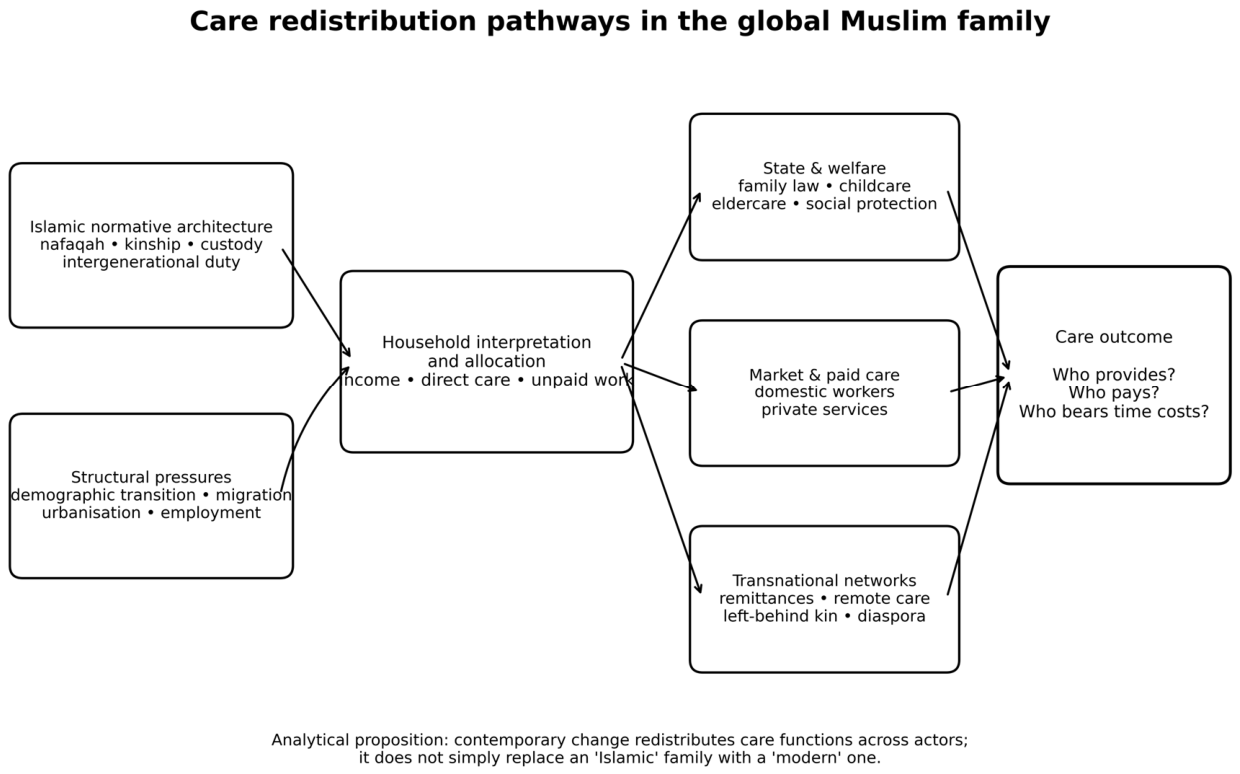
Figure 5 makes the mechanism explicit. Structural pressures—demographic transition, migration, urbanisation, and women’s employment—do not act directly on “Islam.” They alter the resources and constraints under which households interpret obligations. States may absorb some functions through welfare services; markets may supply paid care; transnational networks may provide remittances or remote support. The observed outcome is therefore a distributional settlement: who provides care, who pays, who bears time costs, and who retains decision-making authority.
The value of the TMCR is comparative. It permits researchers to ask the same questions across different Muslim settings without presuming that one is more authentically Islamic than another. It also makes visible actors often absent from family-law analysis, including childcare workers, domestic workers, welfare administrators, and relatives who provide unpaid care across generations.
11. Discussion: From Role Preservation to Function Preservation
The comparison raises a difficult normative question. When the socioeconomic conditions of family life change, should Islamic family reasoning seek to preserve historically familiar roles, or should it prioritise the functions those roles were designed to secure? The distinction must be handled carefully. “Function preservation” cannot become a rhetorical device for discarding clear legal obligations whenever they appear inconvenient. Nor can “role preservation” assume that every historical household arrangement is itself a permanent religious requirement.
A functional analysis begins by identifying protected goods: material maintenance, security, care for children, dignity of spouses, support for vulnerable dependants, continuity of kinship, and care for ageing parents. It then asks whether contemporary institutional arrangements secure or undermine those goods. A husband’s maintenance duty, for example, may remain legally and morally significant even where a wife earns income. But the household also faces questions about unpaid care that classical monetary categories do not exhaust. Likewise, adult children can fulfil part of filial responsibility through financing professional eldercare, but the ethical quality of the arrangement may still depend on attention, companionship, and protection from neglect.
Maqasid al-shariah provides one possible vocabulary for this inquiry because it directs attention to purposes, welfare, and systemic consequences (Auda 2008; Kamali 2008). However, maqasid should not be used as a free-standing licence to override doctrine. Its value here is analytical: it helps distinguish a protected function from one historically contingent means of performing that function. This approach is compatible with legal pluralism because different jurisdictions may protect similar family goods through different combinations of household obligation, public law, social insurance, and market provision.
The care-economy perspective adds a distributive test. An arrangement that preserves family stability by imposing severe unpaid-care costs on one member may be formally functional while substantively unequal. Conversely, an arrangement that relies heavily on paid migrant care may protect the employing family while exposing workers to labour vulnerabilities. Justice therefore requires attention to the full chain of care production, not only to the final household beneficiary.
This argument also cautions against universalising Western welfare-state solutions. Public childcare or eldercare can reduce household burdens, but it may be unavailable, culturally inappropriate, fiscally unsustainable, or unevenly accessible. Nor should kin-based care be romanticised. Extended families can provide solidarity and flexibility, but they can also shift obligations onto women or lower-income relatives. The comparative objective is not to rank regimes but to identify how each distributes benefits, risks, and costs.
The role/function distinction also clarifies disagreement within contemporary Islamic thought. Reform-oriented scholars may emphasise changed social facts and the purposes of family law, whereas more text-centred approaches may warn that functional reasoning can dissolve determinate rights. The TMCR does not resolve that jurisprudential disagreement. Its contribution is prior to it: it supplies a more accurate description of the institutional world to which either approach must respond. Juristic reasoning about maintenance or care is stronger when it knows whether childcare is publicly subsidised, whether one spouse faces substantial unpaid-care penalties, or whether household care is performed by a worker living thousands of kilometres from her own dependants.
A second implication concerns reciprocity. Modern care debates often frame dependence as exceptional, yet all family members move through periods of dependence across the life course. Children require intensive care; adults may experience illness, disability, or unemployment; older people may require assistance after decades of providing it. Islamic ethics of kinship is well positioned to articulate this interdependence, but contemporary policy must translate it into arrangements that do not presume unlimited unpaid availability. Reciprocity can be intertemporal rather than simultaneous, and it can involve institutions as well as individuals.
Finally, the framework distinguishes pluralism from relativism. Different societies may allocate care differently, but this does not make every allocation equally defensible. Cross-context evaluation remains possible through questions about basic maintenance, neglect, coercion, labour exploitation, access to care, distribution of time poverty, and protection of vulnerable dependants. These criteria allow serious comparative judgment about institutional effects without imposing a single household form as the only legitimate expression of family solidarity.
12. Policy and Research Implications
The first policy implication is that Muslim family policy cannot be confined to marriage and divorce law. Family wellbeing is jointly shaped by housing, employment, migration, childcare, eldercare, social protection, and labour regulation. A legal system may articulate strong maintenance duties while economic conditions make household formation prohibitively expensive. It may protect parental rights while work schedules leave little time for childcare. It may encourage filial care while failing to regulate the workers who provide that care in practice.
Second, care policy should recognise the interaction between household rights and migrant-worker rights. Gulf states in particular have an opportunity to connect family-policy reform with domestic-worker protection. The objective need not be to discourage paid care; paid care is an economically and socially valuable form of work. The aim should be to ensure that the family welfare of one household is not purchased through severe rights deficits in another.
Third, welfare states with Muslim-minority populations should treat religious family commitments as part of the social context without assuming that Muslims form a single normative community. Family mediation, social work, eldercare, and counselling benefit from literacy in religious concepts such as maintenance and filial duty, but public institutions should avoid assigning individuals fixed roles on the basis of presumed culture. The European research literature increasingly points toward negotiated and plural forms of Muslim family normativity rather than a uniform parallel legal order (Eidrup 2025).
Fourth, Muslim-majority jurisdictions need better time-use data. Family-law debates are often rich in doctrinal evidence but poor in measurements of who actually performs unpaid care. Malaysia’s recent time-use indicators show the value of such data. Comparable surveys by sex, age, household type, migration status, and employment would make it possible to evaluate whether legal reforms and labour-market changes redistribute care fairly.
Future research should test the TMCR at household level. Qualitative interviews could compare how couples interpret nafaqah when both spouses earn; how adult children negotiate eldercare across borders; how migrant domestic workers understand obligations to their own families; and how religious counsellors respond to conflicts between work and care. Longitudinal research would be especially valuable because the same household may move between regimes over the life course—for example, relying on grandparents during early childcare, paid services during peak employment years, and transnational support during eldercare.
13. Limitations and Directions for Empirical Testing
This study is deliberately synthetic and has four limitations. First, the three country cases are institutional contrasts, not representative samples of Muslim families. Significant variation exists within each case by class, ethnicity, migration status, region, school of law, household form, and degree of religious observance. Second, the statistical indicators are national-context measures. They establish demographic and labour conditions but cannot be used to infer the behaviour of Muslims as a religious group, especially in Belgium and in heterogeneous Malaysia.
Third, the comparison combines legal materials and secondary empirical research rather than original household interviews. This is appropriate for theory construction but limits claims about how individuals themselves interpret maintenance, care, qiwāmah, filial duty, or outsourcing. Fourth, comparable time-use and domestic-work data are uneven across jurisdictions. The absence of an indicator should not be read as the absence of a phenomenon.
These limitations define a clear empirical research agenda. The TMCR can be tested through matched household interviews in the three settings, time-use diaries linked to religious and socioeconomic variables, analysis of maintenance and custody case files, and interviews with migrant domestic workers and care recipients. A particularly valuable design would follow families longitudinally across childbirth, migration, divorce, and parental ageing to observe how normative claims and institutional resources are renegotiated at moments of care transition.
14. Conclusion
The contemporary Muslim family is not undergoing one transition but several interconnected transitions. Fertility decline changes the number of potential caregivers. Migration separates money from presence. Women’s paid employment changes the economic structure of marriage while unpaid care may remain unequal. Welfare states absorb some family functions, markets commodify others, and migrant workers connect households through global chains of care. Islamic family law continues to provide a normative language for maintenance, kinship, custody, and intergenerational responsibility, but the institutions through which these obligations are fulfilled are increasingly plural.
The three cases demonstrate different configurations rather than stages of a single modernisation path. Belgium illustrates welfare-state interlegality, in which Muslim norms operate within a secular civil and social-policy framework. Saudi Arabia illustrates a codified-maintenance and migrant-care regime in which Islamic family obligations coexist with extensive marketised household labour. Malaysia illustrates a kin–state–market hybrid in which Islamic family law operates alongside rapid demographic and labour-market transformation.
The Transnational Muslim Care Regime provides a framework for analysing these configurations without reducing family behaviour either to religious doctrine or to economics. Its central insight is simple: family obligations become social outcomes only through institutions. The normative, household, economic, institutional, and transnational spheres interact to determine who pays, who cares, who is absent, who receives support, and whose labour remains invisible.
For Islamic thought, the challenge is therefore not merely whether inherited family roles survive. It is whether the moral and legal functions associated with family—care, maintenance, dignity, protection, justice, and intergenerational solidarity—remain viable under changed conditions, and whether they are secured without transferring disproportionate costs to less powerful family members or workers. Reframing the question in this way allows Islamic family studies to engage more directly with demography, migration studies, gender analysis, labour economics, and welfare policy while retaining serious attention to Islamic normative reasoning.
Funding
This research received no external funding.
Institutional Review Board Statement
Not applicable. The study analyses published legal materials, public statistical data, and secondary literature and does not involve human participants.
Informed Consent Statement
Not applicable.
Data Availability Statement
All statistical data used in the figures are derived from publicly available sources identified in the figure captions and references. No original individual-level dataset was collected for this study.
Acknowledgments
The author acknowledges the use of OpenAI ChatGPT (GPT-5.6 Sol) as an assistive tool for literature synthesis, language refinement, structural organisation, and preparation of original visualisations from cited public data. The author independently verified the data, sources, legal claims, interpretations, and final text and accepts full responsibility for the manuscript.
Conflicts of Interest
The author declares no conflict of interest.
References
- Auda, Jasser. Maqasid al-Shariah as Philosophy of Islamic Law: A Systems Approach; International Institute of Islamic Thought, 2008. [Google Scholar]
- Baldassar, Loretta; Merla, Laura (Eds.) Transnational Families, Migration and the Circulation of Care: Understanding Mobility and Absence in Family Life; Routledge, 2014. [Google Scholar]
- Büchler, Andrea. Islamic Family Law in Europe? From Dichotomies to Discourse—or: Beyond Cultural and Religious Identity in Family Law. International Journal of Law in Context 2012, 8(2), 196–210. [Google Scholar] [CrossRef]
- Department of Statistics Malaysia. Special Release: Time Spent on Unpaid Domestic and Care Work in Malaysia 2025; DOSM, 2026a. [Google Scholar]
- Department of Statistics Malaysia. Labour Force Survey Report, Malaysia, 2025; DOSM, 2026b. [Google Scholar]
- Eidrup, Martin. The Study of Muslim Family Norms in Contemporary Europe: A Systematic Scoping Review. Oxford Journal of Law and Religion 2025, 14(1), 79–103. [Google Scholar] [CrossRef]
- Government of Malaysia. Islamic Family Law (Federal Territories) Act 1984 (Act 303), as amended; 1984. [Google Scholar]
- Government of Malaysia. Claims and Rights after Muslim Divorce: Maintenance and Child Custody; Malaysia.gov.my, Ed.; 2025. [Google Scholar]
- Hoang, Lan Anh; Yeoh, Brenda S. A. Transnational Labour Migration and the Politics of Care in the Southeast Asian Family. Geoforum 2012, 43(4), 733–740. [Google Scholar] [CrossRef]
- International Labour Organization (ILO). Migrant Workers in the Care Economy; International Labour Office, 2024a. [Google Scholar] [CrossRef]
- International Labour Organization (ILO). The Impact of Care Responsibilities on Women’s Labour Force Participation. In Statistical Brief; International Labour Office, 2024b. [Google Scholar]
- Kamali, Mohammad Hashim. Shari‘ah Law: An Introduction; Oneworld, 2008. [Google Scholar]
- Larsen, Lena; Mir-Hosseini, Ziba; Moe, Christian; Vogt, Kari (Eds.) Gender and Equality in Muslim Family Law: Justice and Ethics in the Islamic Legal Tradition; I.B. Tauris, 2013. [Google Scholar]
- Lecoyer, Kim. Marriage Conclusion in Belgian Muslim Families: Navigating Transnational Social Spaces of Normativity. Migration Letters 2017, 14(1), 11–24. [Google Scholar] [CrossRef]
- Merla, Laura. A Macro Perspective on Transnational Families and Care Circulation: Situating Capacity, Obligation and Family Commitments. In Transnational Families, Migration and the Circulation of Care; Baldassar, Loretta, Merla, Laura, Eds.; Routledge, 2014; pp. 115–129. [Google Scholar]
- Mir-Hosseini, Ziba. Marriage on Trial: A Study of Islamic Family Law: Iran and Morocco Compared; I.B. Tauris, 1993. [Google Scholar]
- Parreñas, Rhacel Salazar. Children of Global Migration: Transnational Families and Gendered Woes; Stanford University Press, 2005. [Google Scholar]
- Razavi, Shahra. The Political and Social Economy of Care in a Development Context: Conceptual Issues, Research Questions and Policy Options. In Gender and Development Programme Paper No. 3.; United Nations Research Institute for Social Development, 2007. [Google Scholar]
- Saudi Arabia. Personal Status Law. Royal Decree No. M/73, 6 Sha‘ban 1443 AH; Riyadh, 2022.
- Statbel. Population Growth in Belgium Driven by International Migration: 2024 Population Statistics; Belgian Statistical Office, 2025. [Google Scholar]
- Statbel. Marriages and Divorces in 2024; Belgian Statistical Office, 2026a. [Google Scholar]
- Welchman, Lynn. Women and Muslim Family Laws in Arab States: A Comparative Overview of Textual Development and Advocacy; Amsterdam University Press, 2007. [Google Scholar] [CrossRef]
- World Bank. World Development Indicators: Fertility Rate, Total (Births per Woman), Indicator SP.DYN.TFRT.IN; Accessed; World Bank, 2026; (accessed on 29 September 2026). [Google Scholar]
Figure 1.
Fertility transition across the three comparative contexts, 1990–2024. Source: World Bank, World Development Indicators, total fertility rate (SP.DYN.TFRT.IN), accessed via FRED. Values are national-context indicators and are not Muslim-specific estimates.
Figure 1.
Fertility transition across the three comparative contexts, 1990–2024. Source: World Bank, World Development Indicators, total fertility rate (SP.DYN.TFRT.IN), accessed via FRED. Values are national-context indicators and are not Muslim-specific estimates.
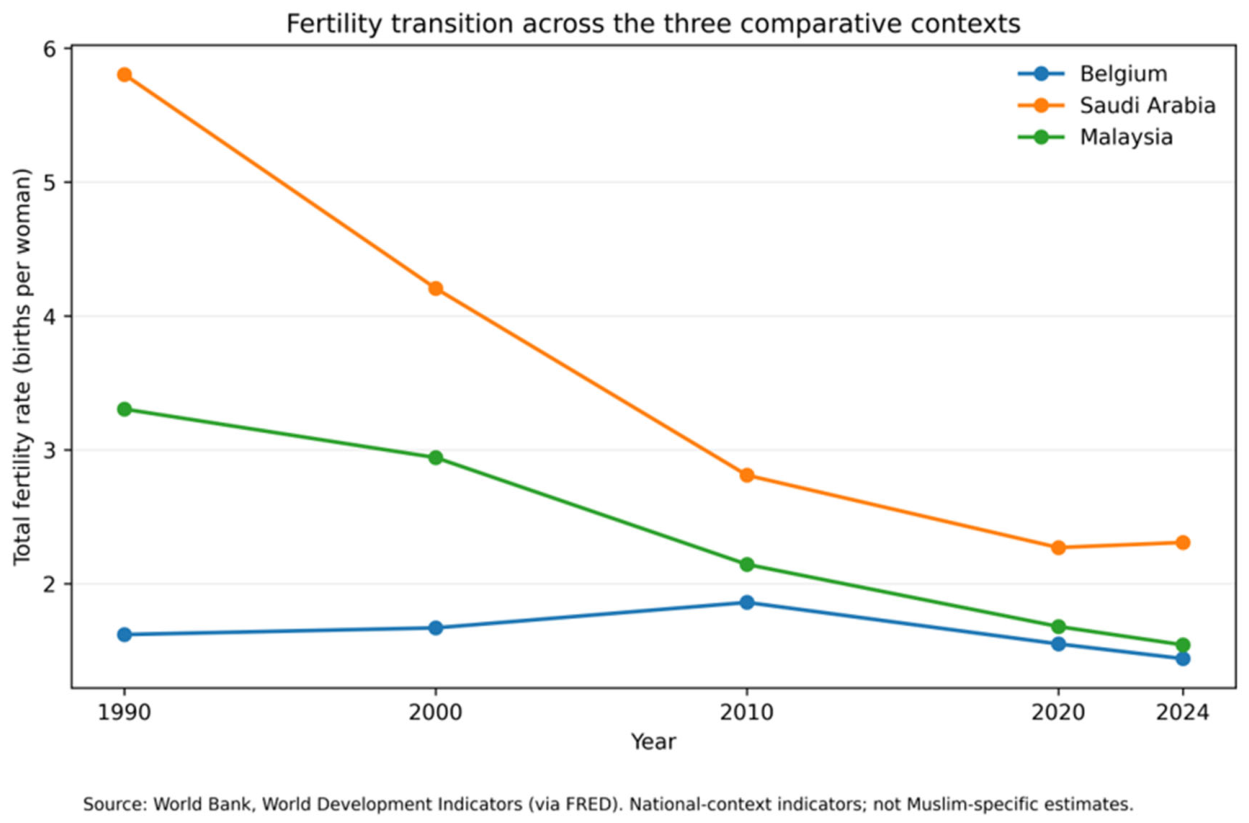
Figure 2.
Share of daily time spent on unpaid domestic and care work in Malaysia, 2025. Source: Department of Statistics Malaysia, Special Release: Time Spent on Unpaid Domestic and Care Work in Malaysia 2025.
Figure 2.
Share of daily time spent on unpaid domestic and care work in Malaysia, 2025. Source: Department of Statistics Malaysia, Special Release: Time Spent on Unpaid Domestic and Care Work in Malaysia 2025.
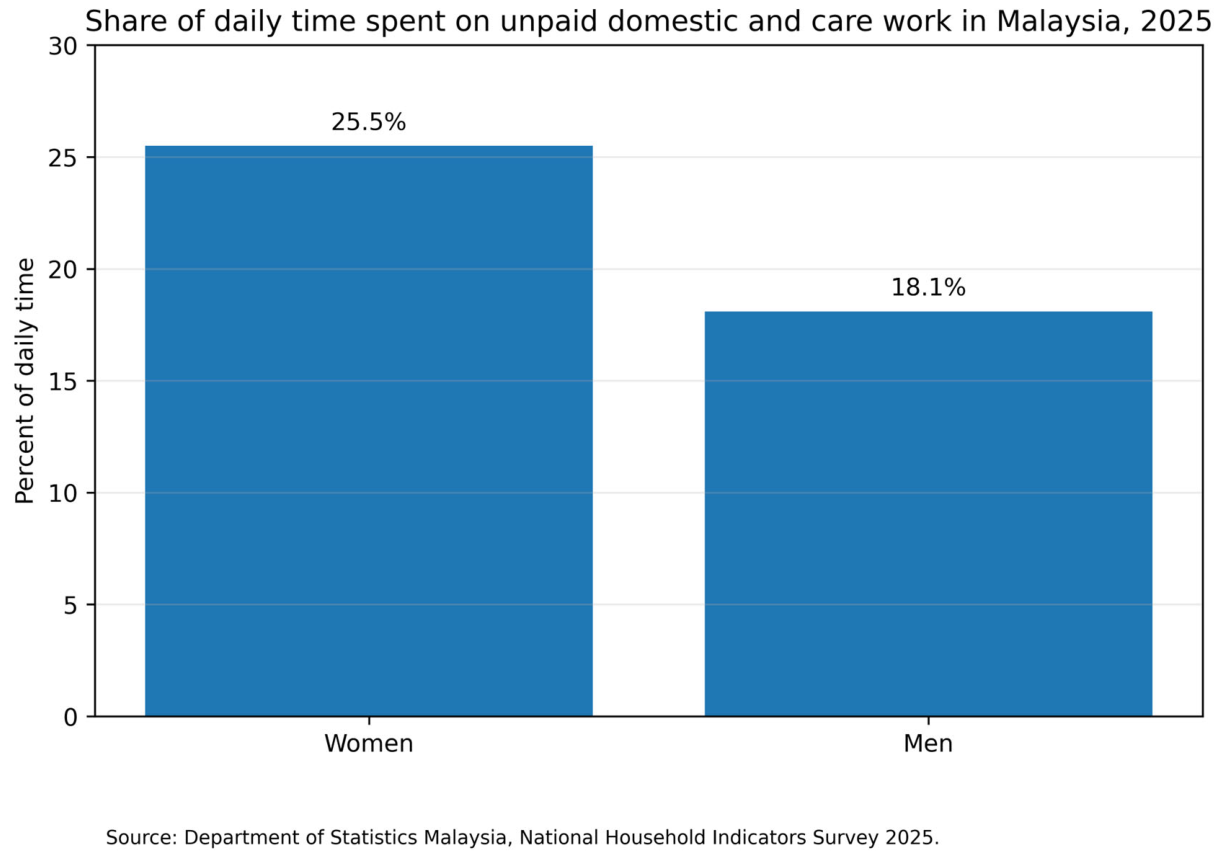
Figure 3.
People outside the labour force because of care responsibilities, 2023. Source: International Labour Organization, The Impact of Care Responsibilities on Women’s Labour Force Participation, Statistical Brief, October 2024. Global estimates for persons aged 15 and above.
Figure 3.
People outside the labour force because of care responsibilities, 2023. Source: International Labour Organization, The Impact of Care Responsibilities on Women’s Labour Force Participation, Statistical Brief, October 2024. Global estimates for persons aged 15 and above.
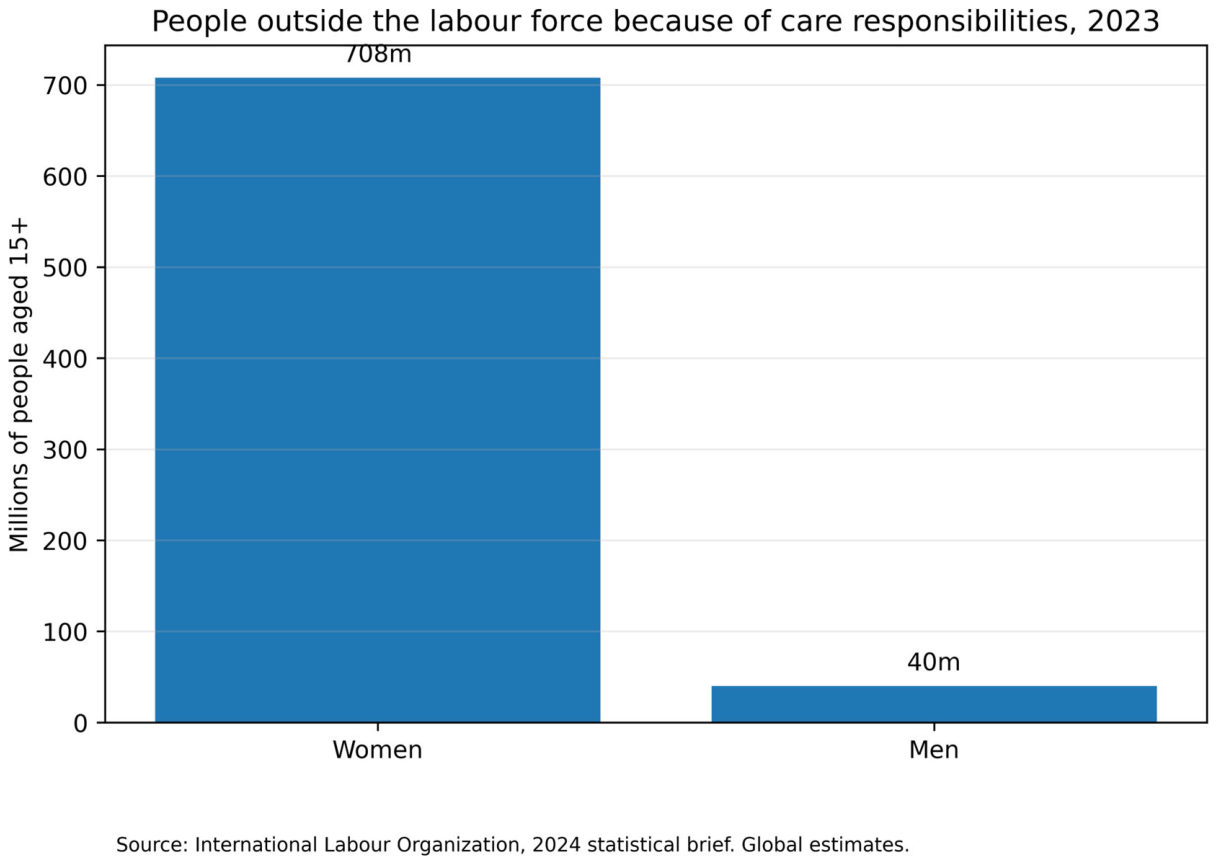
Figure 4.
The Transnational Muslim Care Regime (TMCR). Source: Author’s conceptualisation.
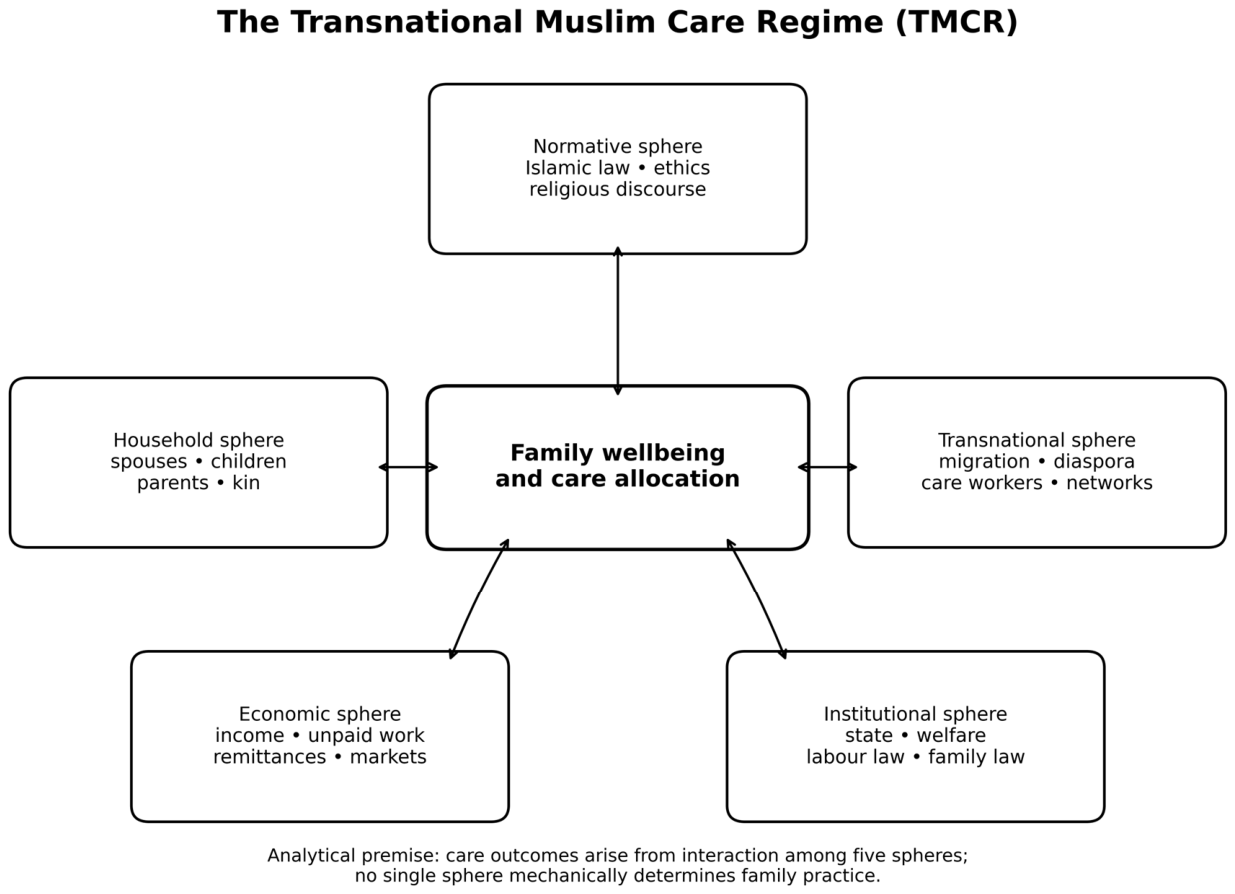
Figure 5.
Care redistribution pathways in the global Muslim family. Source: Author’s conceptualisation. The figure models the redistribution of care functions across household, state, market, and transnational actors under demographic and economic pressure.
Figure 5.
Care redistribution pathways in the global Muslim family. Source: Author’s conceptualisation. The figure models the redistribution of care functions across household, state, market, and transnational actors under demographic and economic pressure.
Disclaimer/Publisher’s Note: The statements, opinions and data contained in all publications are solely those of the individual author(s) and contributor(s) and not of MDPI and/or the editor(s). MDPI and/or the editor(s) disclaim responsibility for any injury to people or property resulting from any ideas, methods, instructions or products referred to in the content. |
© 2026 by the author. Licensee MDPI, Basel, Switzerland. This article is an open access article distributed under the terms and conditions of the Creative Commons Attribution (CC BY) license.
Copyright: This open access article is published under a Creative Commons CC BY 4.0 license, which permit the free download, distribution, and reuse, provided that the author and preprint are cited in any reuse.