

Submitted:
04 November 2026
Posted:
05 November 2026
You are already at the latest version
Abstract
Objectives: Functional capacity is frequently used to estimate the care needs of hospitalised patients, although it does not necessarily capture all components of nursing care intensity. This study aimed to analyse the association between functional capacity and the intensity of the basic and technical care delivered and to examine whether these associations varied during hospitalisation among adults admitted to general inpatient units. A secondary objective was to examine the gradient in basic and technical care needs across functional capacity categories. Methods: A prospective longitudinal observational study was conducted in seven adult inpatient units. The baseline Barthel Index assessment was performed within the first 24 h of hospitalisation, with daily assessments thereafter. CUDYR-D and CUDYR-R were first recorded on the second day and then daily, summarising the care delivered during the preceding 24 h. Analyses included cross-sectional correlations, correlations adjusted for age and comorbidity, differences between functional categories, and longitudinal associations assessed using linear mixed-effects models. Results: The analytical sample included 188 patients and 789 daily assessments. The Barthel Index was more strongly associated with CUDYR-D (ρ = −0.823; 95% CI: −0.868 to −0.762) than with CUDYR-R (ρ = −0.472; 95% CI: −0.580 to −0.346); this difference persisted after adjustment for age and comorbidity (Δ|ρ| = 0.360; 95% CI: 0.248 to 0.484). The gradient across functional categories was higher for CUDYR-D than for CUDYR-R. In the longitudinal models, the standardised coefficients for the Barthel Index were −0.838 for CUDYR-D and −0.508 for CUDYR-R. Interactions with time were small and not statistically significant. Conclusions: Functional capacity was strongly associated with the intensity of basic care delivered but was only moderately associated with technical care and clinical surveillance. The Barthel Index should not be used alone as a proxy for overall care intensity or nursing workload.
Keywords:
functional capacity
; nursing care intensity
; Barthel Index
; CUDYR
; patient classification
; hospitalisation
; longitudinal analysis
1. Introduction
Nursing workload is a broad construct that encompasses the time and physical, cognitive, emotional, and organisational effort required to deliver direct and indirect care [1,2,3]. In this context, nursing care intensity refers to the amount and type of care a person requires over a given period [4]. Although these concepts are related, they are not interchangeable: care intensity primarily describes patient care needs, whereas nursing workload also depends on the characteristics of the staff, inpatient unit, and organisation [1,2,3,4].
Accurately estimating patient care needs is important for planning care and informing resource allocation. However, the available methods vary considerably and have limitations in capturing the full complexity of nursing work [5]. The association between adequate nurse staffing and better outcomes for patients and staff is well documented [6,7,8], but evidence on the specific impact of patient classification systems remains limited [9]. Therefore, before using a clinical measure to inform nurse staffing decisions, it is necessary to understand which dimension of care it represents and which aspects it does not capture.
The CUDYR system (Categorización de Usuarios según Dependencia y Riesgo, or Patient Categorization According to Dependency and Risk) was developed in Chile as a patient classification system to support care management [10,11,12,13]. It distinguishes a dependency dimension, related to basic care needs, and a risk dimension, related to clinical instability and technical, therapeutic, and monitoring care. Combining three dependency levels with four risk levels yields 12 care categories associated with standardised direct care times for nurses and nursing assistants. These times are standardised estimates rather than direct measurements of the work performed. This structure allows the examination of whether the functional capacity reflects the two dimensions of care assessed by CUDYR to a similar extent.
Functional capacity is commonly assessed using the Barthel Index, which measures independence in ten basic activities of daily living and provides a score ranging from 0 to 100, with higher scores indicating more independence. In its original formulation, item weighting was based on the time and amount of physical assistance required to perform these activities [14]. This provided a conceptual basis for its relationship with basic care needs, but empirical evidence linking the Barthel Index to specific measures of care intensity or nursing workload was limited. Among patients with acute rehabilitation needs, the Barthel Index explained between 16% and 44% of the variability in nursing workload, depending on the clinical profile [15]. A recent cross-sectional study also proposed its use as a workload indicator, although it included only 62 patients from two inpatient units assessed during a single working day [16]. However, these studies do not establish whether the associations between functional capacity and basic and technical care differ in magnitude or whether these associations vary during hospitalisation. Therefore, the primary objective of this study was to examine the associations of functional capacity with basic and technical care intensity and to assess whether these associations varied during hospitalisation among adults admitted to general inpatient units. A secondary objective was to examine the gradient in basic and technical care needs across functional capacity categories.
2. Materials and Methods
2.1. Study Design and Setting
A prospective longitudinal observational study was conducted in adult hospitalised patients and is reported in accordance with the STROBE (Strengthening the Reporting of Observational Studies in Epidemiology) guidelines for observational studies [17]. The study was conducted in seven inpatients units at Hospital Universitari de La Plana in Vila-real, Spain. Participants were recruited over a four-month period from April to July 2023. Each participant was followed daily until hospital discharge.
2.2. Participants
The study population comprised patients admitted to seven adult inpatient units: traumatology, surgery–gynaecology, cardiology, neurology–pneumology, general surgery, otorhinolaryngology–urology, and internal medicine. Consecutive sampling was performed on two predefined recruitment days each week (Mondays and Thursdays) throughout the study period.
Patients aged 18 years or older with an expected length of stay exceeding 48 h who provided written informed consent, either personally or through their legal representative, were included. Individuals who were unable to understand the study information or provide consent due to physical, intellectual, or cognitive impairment and who had no legal representative were excluded, as were patients receiving advanced palliative or end-of-life care.
An a priori sample size calculation was not performed. A pragmatic sample comprising all eligible participants recruited during the predefined recruitment period was used. Initially, 219 participants were recruited.
For the present analysis, 18 patients without paired Barthel Index and CUDYR data at the first scheduled assessment and 13 patients with a length of stay ≥ 18 days (corresponding to the 95th percentile of the length of stay distribution) were excluded. This analytical restriction was applied due to the small number of participants remaining beyond this duration and the resulting instability of estimates over time. The final analytical sample comprised 188 participants.
2.3. Variables and Instruments
The functional capacity was assessed using the Barthel Index, which evaluates ten basic activities of daily living and yields a total score ranging from 0 to 100, with higher scores indicating more independence [14]. The total Barthel Index score was analysed as a continuous variable. For categorical analyses, the classification by Shah et al. [18] was applied: total dependence (0–20), severe dependence (21–60), moderate dependence (61–90), slight dependence (91–99), and independence (100).
Nursing care intensity was measured using the CUDYR system [10,11,12,13]. CUDYR-Dependency (CUDYR-D) comprises six items scored from 0 to 3: comfort related to clothing and bed; comfort related to mobility; feeding; elimination; psychosocial support; and supervision required because of altered consciousness, risk of injury, or limited mobility. Total scores range from 0 to 18, classifying patients into three levels: partial self-sufficiency (0–6), partial dependency (7–12), and total dependency (13–18). CUDYR-Risk (CUDYR-R) comprises eight items scored from 0 to 3: monitoring of vital signs, fluid balance, oxygen therapy, airway and secretion management and respiratory support, interprofessional interventions and invasive procedures, skin care and wound dressings, pharmacological treatment, and the presence of invasive devices. Total scores range from 0 to 24, differentiating low risk (0–5), medium risk (6–11), high risk (12–18), and maximum risk (19–24).
Combining the three dependency levels and four risk levels generates 12 care categories associated with standardised estimates of the direct care time for basic and technical care provided by nurses and nursing assistants. The continuous CUDYR-D and CUDYR-R scores were used in the main analyses; the derived time estimates were not used. In this study, the CUDYR scores were based on the care delivered during the preceding 24 h. Assessments were based on clinical records, direct observation, nursing judgement and, when necessary, consultation with the inpatient unit’s clinical team.
Before data collection, the CUDYR terminology was adapted to the local context, and evaluators were trained. The ordinal Cronbach’s alpha for the adapted version was 0.900 for CUDYR-D and 0.781 for CUDYR-R.
Sociodemographic and clinical covariates were also collected: age, sex, type of process (medical or surgical), admission type (scheduled or emergency), inpatient units, and length of stay (calculated from admission to discharge). Comorbidity was evaluated using the original Charlson Comorbidity Index score, without additional age-weighting [19].
2.4. Recruitment, Data Collection, and Follow-Up
A hospital-based principal investigator coordinated the recruitment, data collection, and follow-up. An Associated Clinical Group comprising at least four nurses was established in each inpatient unit. One nurse was responsible for coordinating documentation and resolving data collection incidents. Three additional researchers conducted the assessments when no member of the inpatient unit was available.
Data were recorded using Research Electronic Data Capture (REDCap) [20]. The nurses and researchers responsible for data collection received specific training. The electronic case report form was piloted during the first 15 days of the study.
After study information had been provided and written informed consent obtained, baseline covariates and the initial Barthel Index assessment were recorded within the first 24 h of hospitalisation. From the following day until discharge, the Barthel Index and both CUDYR dimensions were recorded daily. On each data-collection day, the same nurse completed both instruments for the same patient. The Barthel Index reflected functional capacity at the time of assessment, whereas each CUDYR assessment summarised the care delivered during the preceding 24 h.
Because the two instruments referred to different time windows, they were aligned prospectively for analysis. Each Barthel Index score recorded on day t was paired with the CUDYR score recorded on day t + 1, thereby linking functional capacity at the time of the Barthel assessment with the care delivered during the subsequent 24 h. Accordingly, the first analytical pair comprised the baseline Barthel Index and the first CUDYR assessment recorded on the following day.
Daily data collection continued through the day of discharge. The CUDYR assessment recorded on that day summarised the care delivered during the preceding 24 h and was therefore paired with the Barthel Index score from the previous day. The Barthel Index assessment performed on the day of discharge had no subsequent CUDYR assessment and was not included in the paired analyses..
2.5. Statistical Analysis
Statistical analyses were performed using IBM SPSS Statistics, version 27 (IBM Corp., Armonk, NY, USA). The significance level was set at 0.05, and all tests were two-sided. Categorical variables were summarised using absolute (n) and relative (%) frequencies. Quantitative variables were described using the mean and standard deviation (SD), except for the Barthel Index, which was reported using the median and interquartile range (IQR) because of its skewed distribution.
The cross-sectional analysis was based on the first paired Barthel Index and CUDYR assessment. The association between the Barthel Index and each CUDYR dimension was estimated using Spearman’s rank correlation coefficient. The corresponding 95% confidence intervals (95% CIs) were obtained using bias-corrected and accelerated (BCa) bootstrap procedures with 5000 resamples. Adjusted correlations were calculated as partial correlations based on rank-transformed scores, controlling for age and the Charlson Comorbidity Index.
To compare the magnitude of the two correlations sharing the Barthel Index, the difference between their absolute values (Δ|ρ|) was calculated. The confidence interval for this difference was obtained using Zou’s method [21], based on the bootstrap confidence intervals for each correlation. As a confirmatory analysis, Williams’s test for dependent correlations was applied [22], recognising its approximate nature when used with rank correlation coefficients.
Differences in CUDYR-D and CUDYR-R across the five functional capacity categories defined using the Barthel Index were analysed using the Kruskal–Wallis test. The effect size was expressed as eta squared based on the H statistic and calculated as (H − k + 1)/(n − k). The presence of an ordered trend was assessed using the Jonckheere–Terpstra test.
Longitudinal associations were evaluated using two linear mixed-effects models, one for CUDYR-D and another for CUDYR-R. Each model included the Barthel Index, the number of days elapsed since the first paired assessment, and the Barthel Index × time interaction as fixed effects. A random intercept for each patient was included to account for dependence among repeated observations. Barthel Index and CUDYR scores were transformed into z scores to facilitate comparison of the coefficients between models. Time was retained in days and centred at the first paired assessment, which was coded as time 0.
The primary model specification was established a priori, without data-driven variable-selection procedures, because the aim was to assess the temporal stability of the association rather than to identify predictors of care intensity. An additional specification incorporating inpatient unit was evaluated. As its inclusion did not improve the model fit according to the information criteria, the inpatient unit was not retained in the final models.
Models were estimated using the restricted maximum likelihood, and degrees of freedom were approximated using the Satterthwaite method. The intraclass correlation coefficient (ICC) was calculated as the proportion of total variance attributable to between-patient differences. The models included all available paired observations, and no imputation was performed.
2.6. Use of Generative Artificial Intelligence
During the preparation of this manuscript, the authors used ChatGPT (OpenAI, model GPT-5.6 Sol Pro) for linguistic revision, text organisation and editing, as well as to identify potential drafting inconsistencies and improve the structure of the discussion. The tool was not used to generate data or perform statistical analyses. All results, references, methodological decisions, and interpretations were verified, reviewed, and fully assumed by the authors.
2.7. Ethical Considerations
The study was conducted in accordance with the Declaration of Helsinki and was approved by the Clinical Research Committee of Hospital Universitari de La Plana (protocol code CORE SYSTEM [AP], 30 March 2023). Data processing complied with Regulation (EU) 2016/679 and Organic Law 3/2018 on the Protection of Personal Data and Guarantee of Digital Rights. All participants, or their legal representatives where applicable, received information regarding the study objectives, procedures, voluntary participation, the right to withdraw, and signed informed consent. The analytical dataset was pseudonymised and contained no direct identifiers.
3. Results
3.1. Participants and Sample Characteristics
Of the 219 participants recruited, 18 did not have an initial paired Barthel Index and CUDYR assessment, and 13 had a length of stay of 18 days or longer. The analytical sample comprised 188 patients (Figure 1). The mean age was 65.7 years (SD = 18.2), and 83 participants (44.1%) were women. Medical processes (72.9%) and emergency admissions (84.6%) predominated. The median Barthel Index score at the first paired assessment was 85 points (IQR: 55–100). The full sample characteristics are presented in Table 1.
3.2. Association Between Functional Capacity and Nursing Care Intensity
The Barthel Index showed a strong inverse correlation with the CUDYR-D (ρ = −0.823; 95% CI: −0.868 to −0.762) and a moderate inverse correlation with the CUDYR-R (ρ = −0.472; 95% CI: −0.580 to −0.346). The CUDYR-D and CUDYR-R were moderately and positively correlated (ρ = 0.522; 95% CI: 0.407 to 0.622). The difference between the absolute magnitudes of the correlations with the CUDYR-D and CUDYR-R was 0.351 (95% CI: 0.247 to 0.469), indicating a stronger association with the CUDYR-D.
After adjustment for age and the Charlson Comorbidity Index, the correlations of the Barthel Index with CUDYR-D and CUDYR-R were −0.788 and −0.428, respectively. The adjusted difference between their absolute magnitudes was 0.360 (95% CI: 0.248 to 0.484). Williams’s test indicated that the two correlations differed significantly in the unadjusted analysis, t(185) = 8.24, p < 0.001, and the adjusted analysis, t(183) = 7.50, p < 0.001 (Table 2).
3.3. Nursing Care Intensity by Functional Capacity Category
The most frequent category was functional independence (37.2%), followed by severe dependence (27.7%) and moderate dependence (21.3%). The CUDYR-D scores differed significantly across the five functional capacity categories, H(4) = 125.10, p < 0.001, η2_H = 0.66, and showed a significant ordered trend, z = −12.02, p < 0.001. The CUDYR-R scores also differed significantly across categories, H(4) = 43.48, p < 0.001, η2_H = 0.22, and showed a significant ordered trend, z = −6.61, p < 0.001.
Patients classified as independent had a median CUDYR-D score of 2 points (IQR: 1–2.25) and a median CUDYR-R score of 6 points (IQR: 4–7). The full distributions across functional capacity categories are presented in Table 3.
3.4. Longitudinal Association
A total of 789 paired daily observations from 188 patients were analysed, with a median of four observations per participant (IQR: 2–6; range: 1–16). No imputation was performed. At the first paired assessment (time 0), the Barthel Index was inversely associated with both CUDYR dimensions in the mixed-effects models. The standardised coefficient was −0.838 (95% CI: −0.890 to −0.787) for CUDYR-D and −0.508 (95% CI: −0.605 to −0.411) for CUDYR-R. These coefficients were obtained from separate models, and no direct longitudinal comparison between them was performed (Table 4).
The Barthel Index × time interaction was small and not statistically significant for either CUDYR-D (β = 0.005; 95% CI: −0.005 to 0.016; p = 0.341) or CUDYR-R (β = −0.001; 95% CI: −0.020 to 0.018; p = 0.922). In these models, the coefficient for time was positive for the CUDYR-D (β = 0.014; 95% CI: 0.001 to 0.026; p = 0.029) and negative for the CUDYR-R (β = −0.036; 95% CI: −0.058 to −0.014; p = 0.002). The ICC was 0.24 for the CUDYR-D and 0.36 for the CUDYR-R.
4. Discussion
This study yielded three main findings. The functional capacity showed a strong association with the intensity of basic care delivered and a more moderate association with technical and surveillance care. This difference remained after accounting for age and comorbidity and was also reflected in the gradient across functional categories. In addition, the interactions with time were small, providing little evidence that the relationship between the Barthel Index and either CUDYR dimension changed over the observed period. Overall, the findings indicate that functional capacity is closely related to the intensity of direct basic care but, on its own, does not characterise the overall care intensity.
The particularly strong association between the Barthel Index and CUDYR-D is consistent with the conceptual proximity of the two measures. The Barthel Index assesses independence in basic activities of daily living, whereas CUDYR-D quantifies the care delivered to compensate for or support needs related to comfort, mobility, feeding, elimination, psychosocial support, and specific surveillance requirements. The observed magnitude provides empirical evidence of the convergence between two related, but not identical, constructs. Part of this association is likely attributable to their overlapping content and should therefore not be interpreted as evidence that the Barthel Index itself measures care intensity. Previous studies have shown that functional status explains a relevant, but incomplete, proportion of the variability in nursing workload. Mueller et al. reported that the Barthel Index explained between 16% and 44% of this variability, depending on the clinical profile [15], while the cross-sectional study by Karavasileiadou et al. supported its usefulness as a rapid indicator of dependency, although it did not measure other components of nursing work [16].
Adjustment for age and comorbidity had little effect on the overall pattern. The correlation of the Barthel Index with the CUDYR-D changed from −0.823 to −0.788, while its association with the CUDYR-R changed from −0.472 to −0.428. The difference between the two associations was virtually unchanged. Thus, the stronger association of the Barthel Index with the CUDYR-D than with the CUDYR-R does not appear to be explained solely by age or comorbidity. Nevertheless, because the adjustment was limited to these two variables, the influence of other clinical or organisational factors cannot be ruled out.
The association with CUDYR-R was weaker but still relevant. A loss of functional capacity may coexist with greater clinical severity and increased use of devices, treatments, and monitoring; therefore, the two dimensions share some aspects of the patient’s complexity profile. However, technical care also depends on clinical instability, the frequency of observations, routes of treatment administration, wound care, procedures, and respiratory support. These elements do not follow directly from the ability to feed, dress, move, or control bladder and bowel function. The moderate correlation between CUDYR-D and CUDYR-R indicates that the two dimensions are related but not equivalent, which is consistent with models that conceptualise care complexity as a dynamic and multidimensional phenomenon [23].
The analysis by functional category supported this interpretation. The CUDYR-D showed a pronounced gradient with increasing independence, with an effect size considerably larger than that observed for the CUDYR-R. In contrast, patients with a Barthel Index score of 100 still had a median CUDYR-R score of 6 points. The concentration of scores at the upper limit of the Barthel Index may reduce its ability to discriminate among functionally independent patients, as previously described in hospital populations [24]. Nevertheless, the persistence of technical care in this group is consistent with the fact that the Barthel Index was not designed to assess surveillance, treatments, or devices. One plausible explanation is the presence of functionally independent patients admitted for scheduled surgery who require transient technical care, although this hypothesis was not specifically tested.
The longitudinal findings provided information that cannot be obtained from a single assessment. The standardised coefficients were numerically larger in absolute terms for CUDYR-D than for CUDYR-R, although this comparison should remain descriptive because the coefficients were obtained from separate models. The Barthel Index × time interactions were small, and their confidence intervals included the null value. This provides little evidence that the associations changed over time, but it does not demonstrate equivalence or absolute stability. The main effects of time were small and represent the estimated temporal associations for a Barthel Index score at the sample mean. At this reference value, time was negatively associated with the CUDYR-R and positively, although weakly, associated with the CUDYR-D. The negative temporal association estimated for CUDYR-R is partially consistent with a study based on estimated nursing hours, which described a rise–peak–decline trajectory during hospitalisation followed by a decline towards discharge [25]. Nevertheless, the temporal estimates in the present study may also have been influenced by the progressive discharge of patients and the changing composition of those who remained in hospital.
The ICCs of 0.24 for CUDYR-D and 0.36 for CUDYR-R indicate that a relevant proportion of the residual variability not explained by the fixed effects was attributable to persistent between-patient differences. This proportion was numerically higher for the CUDYR-R, which is consistent with the possibility that functional capacity and time do not capture all the determinants of technical care. At the same time, the Barthel Index coefficients in these models combine between-patient differences and changes within individual patients over the course of their hospitalisation. Therefore, they do not allow precise differentiation between the extent to which the longitudinal association arises from each patient’s mean functional profile and the extent to which it reflects daily changes.
From a clinical perspective, the Barthel Index may help estimate the intensity of basic care, but it should not be used as the sole proxy for overall care intensity or nursing workload. The nursing workload encompasses time, physical, cognitive, and emotional effort, indirect activities, and organisational conditions that were not measured in this study. CUDYR provides a structured classification of the direct care delivered and translates its categories into standardised care-time equivalents, but these equivalents do not constitute direct time measurement. An assessment combining the functional capacity with therapeutic and surveillance indicators could reduce the underrepresentation of functionally independent patients with technical or surveillance needs. However, these findings do not allow staffing ratios or staffing requirements to be established. Evidence regarding the effects of patient classification systems remains limited [9], and hospital staffing also depends on organisational, inpatient unit-level, and shift-related factors [26].
The findings should be interpreted considering several limitations. The study was conducted in a single hospital, and consecutive recruitment was restricted to two predefined days per week, without an a priori sample size calculation. Patients without an initial paired assessment were excluded. In addition, the analytical sample was restricted to stays shorter than 18 days, because longer stays were infrequent. This restriction should be considered when interpreting the findings in relation to longer hospitalisations. CUDYR terminology was adapted to the local context without modifying the assessment criteria or scoring system, and the preliminary internal consistency estimates differed between its two dimensions; its full measurement properties require evaluation in a dedicated methodological study. Administration of the Barthel Index and CUDYR by the same nurse may have increased common-method correlation, particularly between measures with overlapping content. Furthermore, CUDYR reflected care documented or identified during the preceding 24 h and may have been influenced by local practices, documentation, and available resources.
The CUDYR assessment completed at discharge described the preceding 24 h but did not distinguish activities specific to the day of discharge, such as patient and family education, device removal, or coordination of continuity of care. It also did not include the time spent completing the assessments themselves. The number of observations decreased over follow-up, and discharge may have represented an informative end to follow-up. Finally, the models did not separate between-patient and within-patient effects or formally compare the longitudinal coefficients for CUDYR-D and CUDYR-R.
Despite these limitations, the findings help clarify the information that the functional capacity contributes to the estimation of care intensity. The prospective design and daily data collection allowed the relationship to be examined throughout hospitalisation rather than at a single time point. In addition, the inclusion of seven inpatient units with diverse profiles and the separate analysis of basic and technical care provided a more specific perspective than aggregated measures. The convergence of the unadjusted and adjusted cross-sectional, categorical, and longitudinal findings supports the consistency of the main finding.
Future research should proceed in stages. First, the validation of the adapted CUDYR version should be completed, and the study should be replicated in multicentre cohorts incorporating different types of clinical process, inpatient units, and organisational models. Second, estimated care intensity should be compared with direct measurements of time and with activities not captured by the classification, including those related to discharge. Future longitudinal models could separate between-patient and within-patient effects and formally compare the two dimensions. Finally, once correspondence with direct measurements of the work performed has been assessed, it will be possible to evaluate whether combining functional and therapeutic information improves care planning, staffing adequacy, and patient and staff outcomes. Nurse staffing remains a clinical and organisational challenge, and these findings provide an empirical basis for developing approaches that are more sensitive to the diversity of care.
5. Conclusions
Functional capacity was strongly associated with the intensity of basic care delivered, whereas its association with technical care and clinical surveillance was more moderate. There was little evidence that these associations changed over the observation period. The Barthel Index provides relevant information about one dimension of care but should not be used alone as an indicator of overall care intensity or nursing workload. These findings support complementing functional assessment with specific measures of therapeutic care and clinical surveillance. The potential use of these measures to plan nurse staffing requires multicentre validation and comparison with direct measurements of nursing work.
Author Contributions
Conceptualisation, D.L.-A. and V.M.G.-C.; methodology, M.J.V.-C.; formal analysis, G.B.-P., V.M.G.-C., and M.J.V.-C.; investigation, G.B.-P., D.L.-A., I.L.-R., A.A.-M., and M.J.V.-C.; resources, D.L.-A.; data curation, G.B.-P. and M.J.V.-C.; writing—original draft preparation, G.B.-P., D.L.-A., A.A.-M., and V.M.G.-C.; writing—review and editing, I.L.-R., A.A.-M., V.M.G.-C., and M.J.V.-C.; supervision, V.M.G.-C.; funding acquisition, V.M.G.-C. All authors have read and agreed to the published version of the manuscript.
Funding
This research was funded through the UJISABIO (UJI–FISABIO) call for preparatory actions, as part of the UNISALUT programme, grant number UJISABIO22_AP06_CORE-SYSTEM. The funder had no role in the design of the study; in the collection, analysis, or interpretation of data; in the writing of the manuscript; or in the decision to publish the results.
Institutional Review Board Statement
The study was conducted in accordance with the Declaration of Helsinki and approved by the Clinical Research Committee of Hospital Universitari de La Plana (protocol code CORE SYSTEM [AP], 30 March 2023).
Informed Consent Statement
Informed consent was obtained from all participants involved in the study or from their legal representatives, where applicable.
Data Availability Statement
The data presented in this study are available on request from the corresponding author due to privacy reasons.
Acknowledgments
The authors acknowledge the participation of the patients and the collaboration of the nurses from the Associated Clinical Groups and the staff of the participating units. During the preparation of this manuscript, the authors used ChatGPT (OpenAI, GPT-5.6 Sol Pro) to support linguistic revision, text organisation, and the identification of potential drafting inconsistencies. All outputs were reviewed and edited by the authors, who take full responsibility for the final content.
Conflicts of Interest
The authors declare no conflicts of interest.
Abbreviations
The following abbreviations are used in this manuscript:
| BCa | Bias-corrected and accelerated bootstrap |
| CUDYR | Patient categorization according to dependency and risk |
| CUDYR-D | CUDYR dependency dimension |
| CUDYR-R | CUDYR risk dimension |
| SD | Standard deviation |
| ICC | Intraclass correlation coefficient |
| 95% IC | 95% confidence interval |
| M | Median |
| REDCap | Research electronic data capture |
| IQR | Interquartile range |
| STROBE | Strengthening the reporting of observational studies in epidemiology |
References
- Alghamdi, M.G. Nursing workload: A concept analysis. J. Nurs. Manag. 2016, 24, 449–457. [CrossRef]
- Swiger, P.A.; Vance, D.E.; Patrician, P.A. Nursing workload in the acute-care setting: A concept analysis of nursing workload. Nurs. Outlook 2016, 64, 244–254. [CrossRef]
- Jackson, J.; Anderson, J.E.; Maben, J. What is nursing work? A meta-narrative review and integrated framework. Int. J. Nurs. Stud. 2021, 122, 103944. [CrossRef]
- Brennan, C.W.; Daly, B.J. Patient acuity: A concept analysis. J. Adv. Nurs. 2009, 65, 1114–1126. [CrossRef]
- Griffiths, P.; Saville, C.; Ball, J.; Jones, J.; Pattison, N.; Monks, T.; Safer Nursing Care Study Group. Nursing workload, nurse staffing methodologies and tools: A systematic scoping review and discussion. Int. J. Nurs. Stud. 2020, 103, 103487. [CrossRef]
- Aiken, L.H.; Sloane, D.M.; Bruyneel, L.; Van den Heede, K.; Griffiths, P.; Busse, R.; Diomidous, M.; Kinnunen, J.; Kózka, M.; Lesaffre, E.; et al. Nurse staffing and education and hospital mortality in nine European countries: A retrospective observational study. Lancet 2014, 383, 1824–1830. [CrossRef]
- McHugh, M.D.; Aiken, L.H.; Sloane, D.M.; Windsor, C.; Douglas, C.; Yates, P. Effects of nurse-to-patient ratio legislation on nurse staffing and patient mortality, readmissions, and length of stay: A prospective study in a panel of hospitals. Lancet 2021, 397, 1905–1913. [CrossRef]
- Twigg, D.E.; Whitehead, L.; Doleman, G.; El-Zaemey, S. The impact of nurse staffing methodologies on nurse and patient outcomes: A systematic review. J. Adv. Nurs. 2021, 77, 4599–4611. [CrossRef]
- Artuso, I.; Da Rin Della Mora, R.; Dasso, N.; Rebuffi, C.; Ottonello, G.; Calza, S.; Minniti Caracciolo, G.; Rossi, S.; Scelsi, S. Do nursing patient classification systems to classify inpatients impact outcomes? A scoping review. West. J. Nurs. Res. 2025, 47, 1214–1224. [CrossRef]
- García, M.A.; Castillo, L. Categorización de usuarios: Una herramienta para evaluar las cargas de trabajo de enfermería. Rev. Med. Chile 2000, 128, 177–183. [CrossRef]
- García García, M.A. Categorización de los usuarios del Hospital Clínico de la Universidad Católica de Chile según dependencia y riesgo. Horiz. Enferm. 1995, 6, 56–64.
- García, M.A.; Soto, P.; Arqués, V. Aplicación de la categorización de usuarios en el desarrollo de un modelo de gestión del cuidado de un hospital del sector público. Horiz. Enferm. 2007, 18, 145–151.
- González, P.; Kappes, M.; Gallardo-Vargas, C. Cuidados segun dependencia y riesgo en hospitales de baja complejidad del servicio de salud Reloncavi, Chile. Cienc. Enferm. 2024, 30, 31. [CrossRef]
- Mahoney, F.I.; Barthel, D.W. Functional evaluation: The Barthel Index. Md. State Med. J. 1965, 14, 61–65.
- Mueller, M.; Lohmann, S.; Strobl, R.; Boldt, C.; Grill, E. Patients’ functioning as predictor of nursing workload in acute hospital units providing rehabilitation care: A multi-centre cohort study. BMC Health Serv. Res. 2010, 10, 295. [CrossRef]
- Karavasileiadou, S.; Fountouki, A.; Savopoulos, C.; Alyami, H.; HamdanAlshehri, H.; Theofanidis, D. The Barthel Index Scale as an indicator of nursing workload. Risk Manag. Healthc. Policy 2025, 18, 3843–3852. [CrossRef]
- von Elm, E.; Altman, D.G.; Egger, M.; Pocock, S.J.; Gøtzsche, P.C.; Vandenbroucke, J.P.; STROBE Initiative. The Strengthening the Reporting of Observational Studies in Epidemiology (STROBE) statement: Guidelines for reporting observational studies. PLoS Med. 2007, 4, e296. [CrossRef]
- Shah, S.; Vanclay, F.; Cooper, B. Improving the sensitivity of the Barthel Index for stroke rehabilitation. J. Clin. Epidemiol. 1989, 42, 703–709. [CrossRef]
- Charlson, M.E.; Pompei, P.; Ales, K.L.; MacKenzie, C.R. A new method of classifying prognostic comorbidity in longitudinal studies: Development and validation. J. Chronic Dis. 1987, 40, 373–383. [CrossRef]
- Harris, P.A.; Taylor, R.; Thielke, R.; Payne, J.; Gonzalez, N.; Conde, J.G. Research electronic data capture (REDCap): A metadata-driven methodology and workflow process for providing translational research informatics support. J. Biomed. Inform. 2009, 42, 377–381. [CrossRef]
- Zou, G.Y. Toward using confidence intervals to compare correlations. Psychol. Methods 2007, 12, 399–413. [CrossRef]
- Williams, E.J. The comparison of regression variables. J. R. Stat. Soc. Ser. B Methodol. 1959, 21, 396–399. [CrossRef]
- Huber, E.; Kleinknecht-Dolf, M.; Kugler, C.; Spirig, R. Patient-related complexity of nursing care in acute care hospitals—An updated concept. Scand. J. Caring Sci. 2021, 35, 178–195. [CrossRef]
- de Morton, N.A.; Keating, J.L.; Davidson, M. Rasch analysis of the Barthel Index in the assessment of hospitalized older patients after admission for an acute medical condition. Arch. Phys. Med. Rehabil. 2008, 89, 641–647. [CrossRef]
- Kim, S.; Cho, S. Trajectories of nursing hours over the course of hospitalization and estimated additional nurse staffing requirements to reduce the length of stay. J. Nurs. Scholarsh. 2024, 56, 694–704. [CrossRef]
- Porcel-Gálvez, A.M.; Fernández-García, E.; Rafferty, A.M.; Gil-García, E.; Romero-Sánchez, J.M.; Barrientos-Trigo, S. Factors that influence nurse staffing levels in acute care hospital settings. J. Nurs. Scholarsh. 2021, 53, 468–478. [CrossRef]
Figure 1.
Participant flow and composition of the analytical sample.
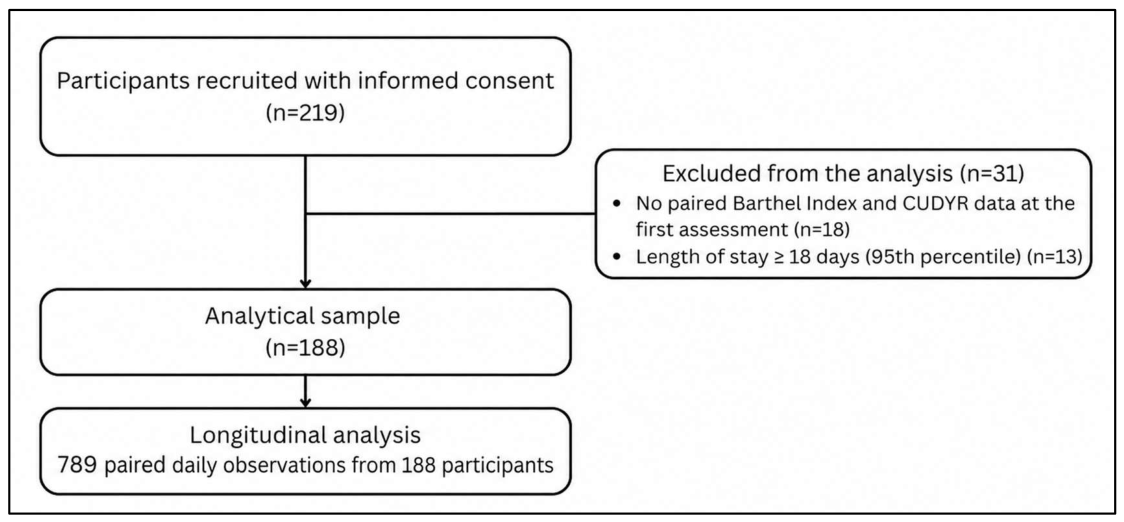

Table 1.
Characteristics of the analytical sample and instrument scores at the first paired assessment (n = 188).
Table 1.
Characteristics of the analytical sample and instrument scores at the first paired assessment (n = 188).
| Characteristic | Value |
| Age, mean (SD) | 65.7 (18.2) |
| Charlson Comorbidity Index, mean (SD) | 3.6 (2.5) |
| Length of stay, days, mean (SD) | 5.6 (3.1) |
| CUDYR-D, mean (SD) | 4.7 (3.8) |
| CUDYR-R, mean (SD) | 7.0 (2.4) |
| Barthel Index, median (IQR) | 85 (55–100) |
| Sex | |
| Women, n (%) | 83 (44.1) |
| Men, n (%) | 105 (55.9) |
| Type of process | |
| Medical, n (%) | 137 (72.9) |
| Surgical, n (%) | 51 (27.1) |
| Admission type | |
| Scheduled admission, n (%) | 28 (14.9) |
| Emergency admission, n (%) | 159 (84.6) |
| Missing, n (%) | 1 (0.5) |
| Inpatient Unit | |
| Traumatology—short stay, n (%) | 40 (21.3) |
| Surgery—gynaecology, n (%) | 38 (20.2) |
| Cardiology, n (%) | 9 (4.8) |
| Neurology–pneumology, n (%) | 20 (10.6) |
| General surgery, n (%) | 30 (16.0) |
| Otorhinolaryngology–urology, n (%) | 30 (16.0) |
| Internal medicine, n (%) | 21 (11.2) |
Data are presented as the mean (SD), median (IQR), or n (%). SD: standard deviation; IQR: interquartile range.
Table 2.
Correlations between functional capacity and care intensity, unadjusted and adjusted for age and comorbidity (n = 188).
Table 2.
Correlations between functional capacity and care intensity, unadjusted and adjusted for age and comorbidity (n = 188).
| Measure | Unadjusted Estimate | 95% CI | Adjusted Estimate | 95% CI |
| Barthel–CUDYR-D | −0.823 | −0.868 to −0.762 | −0.788 | −0.841 to −0.725 |
| Barthel–CUDYR-R | −0.472 | −0.580 to −0.346 | −0.428 | −0.543 to −0.297 |
| CUDYR-D–CUDYR-R | 0.522 | 0.407 to 0.622 | 0.484 | 0.362 to 0.587 |
| Δ|ρ| | 0.351 | 0.247 to 0.469 | 0.360 | 0.248 to 0.484 |
All correlation coefficients (unadjusted and adjusted) had p < 0.001. Adjusted estimates are partial Spearman correlations of rank-transformed scores, controlling for age and the Charlson Comorbidity Index. Correlation CIs were estimated by BCa bootstrap (5000 resamples); Δ|ρ| CIs were calculated using Zou’s method. Δ|ρ| = |ρBarthel, CUDYR-D| − |ρBarthel, CUDYR-R|. BCa: bias-corrected and accelerated; CI: confidence interval; CUDYR-D: CUDYR-Dependency; CUDYR-R: CUDYR-Risk; ρ: Spearman’s rank correlation coefficient.
Table 3.
Care intensity by Barthel Index functional category.
| Functional Category | n (%) | CUDYR-D Median (IQR) | CUDYR-R Median (IQR) |
| Total dependence (0–20) | 16 (8.5) | 12 (11–14) | 9 (8–10.75) |
| Severe dependence (21–60) | 52 (27.7) | 7 (5–9) | 8 (7–9) |
| Moderate dependence (61–90) | 40 (21.3) | 4 (2–5.75) | 7 (5.25–9) |
| Slight dependence (91–99) | 10 (5.3) | 2 (1–4.25) | 7 (6–9) |
| Independence (100) | 70 (37.2) | 2 (1–2.25) | 6 (4–7) |
IQR: interquartile range.
Table 4.
Linear mixed-effects models of the associations between the Barthel Index, time, and care intensity (188 patients; 789 observations).
Table 4.
Linear mixed-effects models of the associations between the Barthel Index, time, and care intensity (188 patients; 789 observations).
| Parameter | CUDYR-D Estimate | p | CUDYR-R Estimate | p |
| Intercept | −0.046 (−0.098 to 0.005) | 0.080 | 0.069 (−0.033 to 0.171) | 0.185 |
| Barthel Index | −0.838 (−0.890 to −0.787) | <0.001 | −0.508 (−0.605 to −0.411) | <0.001 |
| Time, days | 0.014 (0.001 to 0.026) | 0.029 | −0.036 (−0.058 to −0.014) | 0.002 |
| Barthel × time | 0.005 (−0.005 to 0.016) | 0.341 | −0.001 (−0.020 to 0.018) | 0.922 |
| Between-patient variance | 0.049 (0.034 to 0.072) | — | 0.261 (0.192 to 0.355) | — |
| Residual variance | 0.155 (0.139 to 0.174) | — | 0.464 (0.415 to 0.518) | — |
| ICC | 0.24 | — | 0.36 | — |
Fixed-effect estimates are standardised regression coefficients (β); variance components are variance estimates. Values in parentheses are 95% CIs. The Barthel Index and CUDYR scores were expressed in standardised units; time remained in days and was centred at the first paired assessment (time 0). The models included a random intercept for each patient and were estimated using restricted maximum likelihood with the Satterthwaite approximation for degrees of freedom. The ICC represents the proportion of total variance attributable to between-patient differences. CUDYR-D: CUDYR-Dependency; CUDYR-R: CUDYR-Risk; ICC: intraclass correlation coefficient.
Disclaimer/Publisher’s Note: The statements, opinions and data contained in all publications are solely those of the individual author(s) and contributor(s) and not of MDPI and/or the editor(s). MDPI and/or the editor(s) disclaim responsibility for any injury to people or property resulting from any ideas, methods, instructions or products referred to in the content. |
© 2026 by the authors. Licensee MDPI, Basel, Switzerland. This article is an open access article distributed under the terms and conditions of the Creative Commons Attribution (CC BY) license (http://creativecommons.org/licenses/by/4.0/).
Copyright: This open access article is published under a Creative Commons CC BY 4.0 license, which permit the free download, distribution, and reuse, provided that the author and preprint are cited in any reuse.