

Submitted:
03 November 2026
Posted:
05 November 2026
You are already at the latest version
Abstract
Introduction: Sample-size determination in qualitative research remains contested because adequacy is shaped by the research question, methodological purpose, participant specificity, data richness, analytical strategy and stopping rationale. The supplied literature reports numerical ranges, but does not establish universal minimums across qualitative methodologies. Methods: The researcher-selected databases and information sources were Google Scholar, ERIC. The eligibility protocol restricted publication years to 2025–2026. The exact calendar date of search execution was not recorded in the verified identification provenance; this is distinct from the publication-year eligibility range. A systematic review searched Google Scholar and ERIC using a prespecified Boolean strategy and publication eligibility range of 2025–2026. Results: Across the synthesis, sample adequacy was primarily treated as a design-sensitive judgement rather than a universal numerical threshold. Focused, homogeneous and information-rich samples generally supported smaller samples, whereas broad, comparative and heterogeneous designs required more data. Saturation was useful when operationalised as an ongoing evaluative process, but its meaning and applicability were contested. Grounded Theory provided the clearest method-specific stopping logic through theoretical sampling and theoretical saturation. Ethnographic guidance was comparatively underdeveloped, while numerical ranges for phenomenology and narrative inquiry remained illustrative rather than definitive. Discussion/Conclusion: While there was no generally accepted minimum sample size was established for any reviewed methodology, there seem to be a recommendation of 10 to 15 interviews. Furthermore, a defensible sample-size decision should be justified prospectively in relation to design, scope, sampling logic, information power, data quality, analytic aims and an explicitly documented stopping assessment.
Keywords:
data saturation
; information power
; qualitative methodologies
; qualitative sample size
; systematic review
1. Introduction
Sample-size decisions are central to the credibility, feasibility and interpretability of qualitative inquiry, yet they do not operate in the same way as statistical power calculations. The supplied literature portrays qualitative adequacy as connected to the depth and relevance of information, the specificity and heterogeneity of participants, the scope of the research question, the analytical strategy and the methodological assumptions of the chosen design. Focused and information-rich studies may reach sufficiency with relatively few participants, whereas broad or comparative studies may require greater contextual and experiential coverage (Madugu & Kodondo, 2026; Sharma, 2026; Mwilongo, 2026).
Existing literature provides several partially overlapping approaches. Information-power accounts emphasise the relationship between study aim, sample specificity, theoretical framing, analysis and data quality. Saturation accounts assess whether additional data contribute new codes, themes, information or theoretical development. Grounded Theory gives saturation a particularly specific meaning through concurrent analysis, theoretical sampling and theoretical development, whereas its transfer to phenomenology, narrative inquiry, ethnography and other approaches is disputed (Jennings & Yeager, 2025; Musonda & Daka, 2026; Jacobsen, 2026). The literature also reports numerical examples, including very small narrative samples, phenomenological ranges below 10 or between 10 and 30 interviews, and proposed general ranges such as 1–15 participants. These figures are heterogeneous and design-dependent rather than settled standards (Subedi, 2026; Bekmezci & Sürücü, 2025).
Important uncertainties remain. The supplied evidence does not provide directly comparable minimums for case study, ethnography, narrative inquiry, Grounded Theory or phenomenology. Ethnographic sample-size guidance is particularly thin, and studies frequently invoke saturation without explaining its meaning, timing or evidentiary basis (Mpofu & Sibanda, 2026; Jennings & Yeager, 2025). Methodological reporting is also uneven, with some reviews identifying limited prospective justification and incomplete reporting of participant numbers (Santos et al., 2026; Görgüt et al., 2025).
This systematic review was therefore conducted to integrate the supplied evidence across the specified methodologies and qualitative evidence synthesis. It examines not only reported numbers, but also the reasoning by which adequacy is determined and evaluated. The review is needed because a numerical answer alone risks obscuring the design-sensitive, iterative and contested nature of qualitative sample-size decisions.
2. Research Objectives
RO1: To determine the minimum sample size for case study research
RO2: To determine the minimum sample size for ethnographic research
RO3: To determine the minimum sample size for narrative research
RO4: To determine the minimum sample size for Grounded Theory research
RO5: To determine the minimum sample size forPhenomenology research
RO6: To critically synthesise literature regarding the generally accepted sample size in qualitative research strategies
3. Research Methods
3.1. Review Design
The selected review type was a Systematic Review. Furthermore, evidence synthesis was understood as the systematic or structured integration of findings from existing research (Costa &Costa,2024). This design was appropriate because the question required transparent identification, eligibility assessment, critical appraisal and cross-study synthesis of methodological literature spanning several qualitative traditions. The review was organised around searching, appraisal, synthesis and analysis, while PRISMA was used as a reporting framework rather than as a substitute for appraisal or synthesis (Grant & Booth, 2009; Page et al., 2021). COSTAQDA supported traceable movement from extracted findings to codes, categories and themes, but the software did not replace researcher judgement (Costa & Costa, 2024; Costa & Mfolo, 2024).
3.2. Search Strategy and Information Sources
The researcher-selected databases and information sources were Google Scholar and ERIC. The eligibility protocol restricted publication years to 2025–2026. The exact calendar date of search execution was not recorded in the verified identification provenance; this is distinct from the publication-year eligibility range.
Full Boolean search string (exactly as recorded)
("Qualitative Research Methodologies" OR "qualitative research" OR "case study" OR phenomenology OR "grounded theory" OR "narrative inquiry" OR ethnography OR "qualitative evidence synthesis" OR "qualitative systematic review" OR "qualitative meta-synthesis") AND ("Sample Size and Adequacy" OR "sample size" OR "sample adequacy" OR "sample size determination" OR "sampling strategy" OR "sample size estimation" OR "number of participants" OR "sample sufficiency" OR "sample size justification") AND ("Data Saturation and Sufficiency Principles" OR "data saturation" OR "theoretical saturation" OR "information power" OR "saturation point" OR "stopping rule" OR "code saturation" OR "thematic saturation") NOT ("quantitative power analysis" OR "statistical significance" OR "randomized controlled trial")
3.3. Inclusion and Exclusion Criteria
Inclusion
- Articles addressing methods, frameworks, or principles for sample size determination, sample adequacy, data saturation, or information power.
- Studies focusing on at least one specified qualitative methodology: case study, phenomenology, grounded theory, narrative inquiry, ethnography, or qualitative evidence synthesis.
- Methodological guidance providing explicit conceptual, empirical, or practical frameworks for evaluating sample size sufficiency.
- Peer-reviewed journal articles.
- Publications written in the English language.
Exclusion
- Studies focusing exclusively on quantitative power analysis, statistical sample size calculations, or clinical trial sample estimation.
- Non-peer-reviewed literature, including dissertations, book chapters, editorials, conference abstracts, and working papers.
- Articles published in languages other than English.
- Mixed-methods studies where qualitative sample size determination is not explicitly conceptualized or discussed.
- Empirical qualitative studies that report sample size incidentally without addressing the rationale, strategy, or criteria for sample determination or saturation.
3.4. Screening and Study Selection
The PRISMA selection counts are persisted, but the decision rule used during title/abstract screening is not available in the verified audit payload. COSTAQDA therefore reports the recorded workflow counts without reconstructing an unverified screening procedure.
The persisted PRISMA workflow records 474 identified records, 24 duplicates, 64 records screened, 60 reports sought for retrieval, 4 records excluded at the title/abstract stage, 49 full texts assessed, 0 full-text exclusions and 49 included records. These counts describe study selection and are not substantive review findings.
Figure 1.
PRISMA 2020 Flow Diagram — Identification, Screening, Eligibility and Included. Source: COSTAQDA PRISMA Workflow, navigation item 8: PRISMA Flow Diagram; four-stage structure showing Identification, Screening, Eligibility (including CASP critical appraisal) and Included; adapted from PRISMA 2020 (Page et al., 2021).
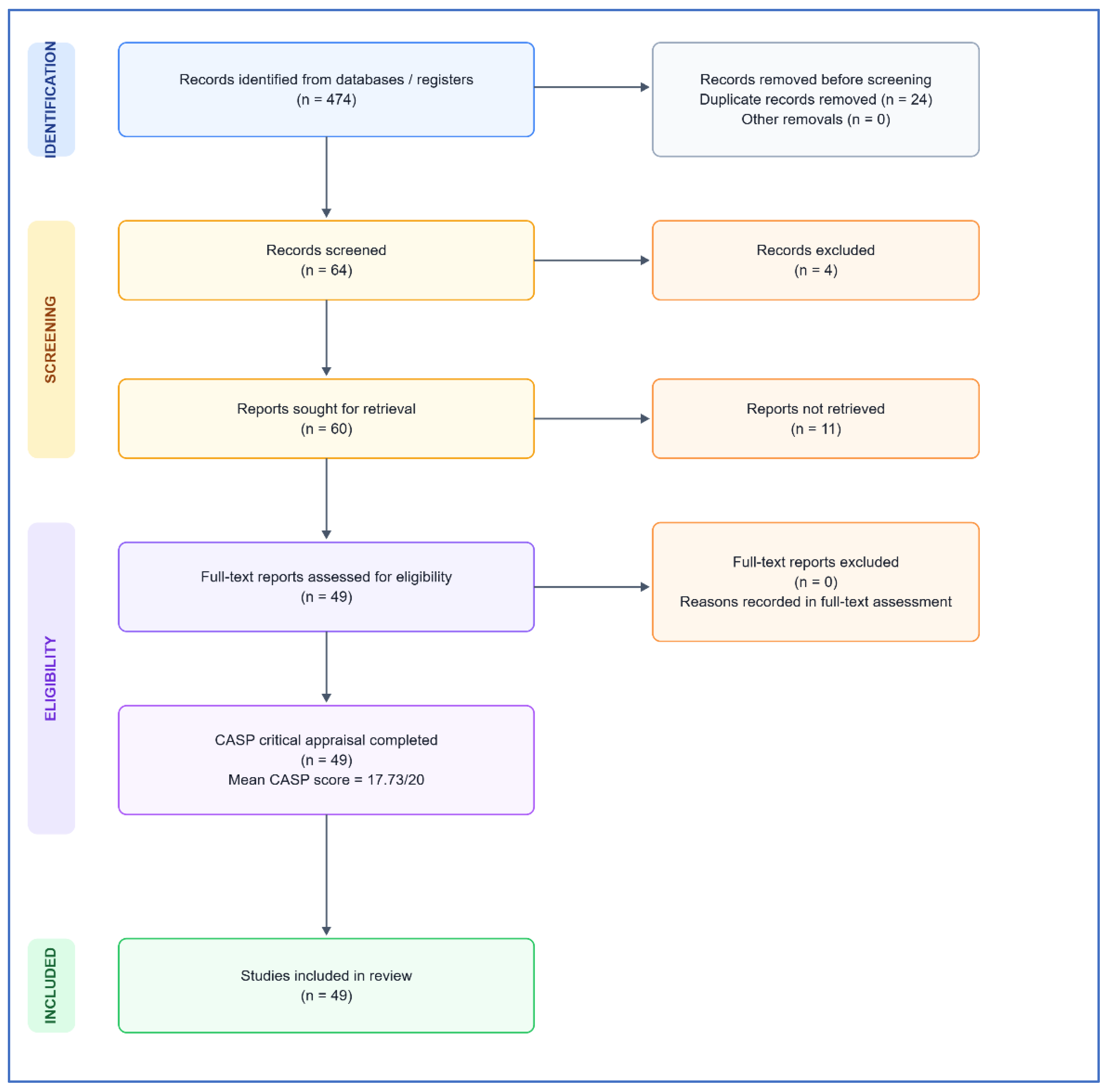
The PRISMA figure should be read as a report of the persisted selection workflow: 474 identified records, 24 duplicates, 64 screened records, 60 reports sought, 4 title/abstract exclusions, 49 full texts assessed, no recorded full-text exclusions and 49 included records. The figure does not establish substantive evidence about sample size. Because the identification values are internally discrepant, the displayed workflow should be treated as transparent but not fully reconciled.
3.5. Critical Appraisal
Critical Appraisal Skills Programme (CASP) was used in the PRISMA full-text workspace, and 49 of 49 currently included studies had completed appraisals. CASP provides a structured checklist-based assessment of methodological validity, findings and relevance; it is a study-level appraisal instrument rather than a universal quality score (Critical Appraisal Skills Programme, 2024). The workspace records scores ranging from 14 to 20, with a mean of 17.73. These values provide a summary of recorded judgements but should not be interpreted as a validated total-quality metric.
The appraisal record is methodologically constrained because the detailed criterion-level rationales are not available for the review narrative. Many study-linked decisions state that a conservative text-evidence appraisal was completed because the configured automated service was unavailable, and unsupported criteria were marked as requiring researcher verification. Consequently, a recorded score indicates completion of the configured appraisal workflow, not that every methodological criterion was definitively satisfied. Missing reporting must be distinguished from demonstrated weakness (Long et al., 2020).
Study-linked limitations were recorded for multiple included studies, including concerns associated with methodological reporting, sampling, analysis, reflexivity, ethics, justification and transferability. The supplied CASP workspace identifies concerns for studies such as Blalock et al(2025)., Bouncken et al(2025)., Malterud (2026), Santos et al(2026). and Görgüt et al(2025)., but does not preserve sufficient criterion-level rationale to support more specific judgements. The synthesis therefore used these appraisal results cautiously and did not exclude findings solely on the basis of a summary score.
The appraisal concerns matter directly to the review conclusions. Much of the evidence is methodological commentary, narrative review, conceptual analysis or secondary synthesis rather than directly comparable empirical evaluation. This limits confidence in numerical ranges and in claims that a particular number is a minimum. For example, numerical examples in phenomenology and narrative inquiry may illustrate practice, but they cannot establish universal thresholds without comparable designs and transparent adequacy criteria (Noyes et al., 2018).
CASP appraisal was distinct from the separately recorded absence of a finding-level confidence method. No CERQual assessment or other formal confidence assessment was recorded, and no CASP score was converted into confidence in a synthesised theme. The trustworthiness of the conclusions was instead considered through convergence and divergence across extracted findings, preservation of contradictory evidence, methodological limitations and traceability from findings to themes. COSTAQDA supported this traceability, but it did not eliminate uncertainty in the underlying evidence base (Costa & Costa, 2024; Lewin et al., 2018).
Figure 2.
CASP Critical Appraisal Intelligence — PRISMA Workflow, Step 6: Full-Text Screening. Source: COSTAQDA PRISMA Workflow, navigation item 6: Full-Text Screening (CASP critical appraisal outputs). The Word figure is generated from the same deterministic COSTAQDA CASP visual.
Figure 2.
CASP Critical Appraisal Intelligence — PRISMA Workflow, Step 6: Full-Text Screening. Source: COSTAQDA PRISMA Workflow, navigation item 6: Full-Text Screening (CASP critical appraisal outputs). The Word figure is generated from the same deterministic COSTAQDA CASP visual.
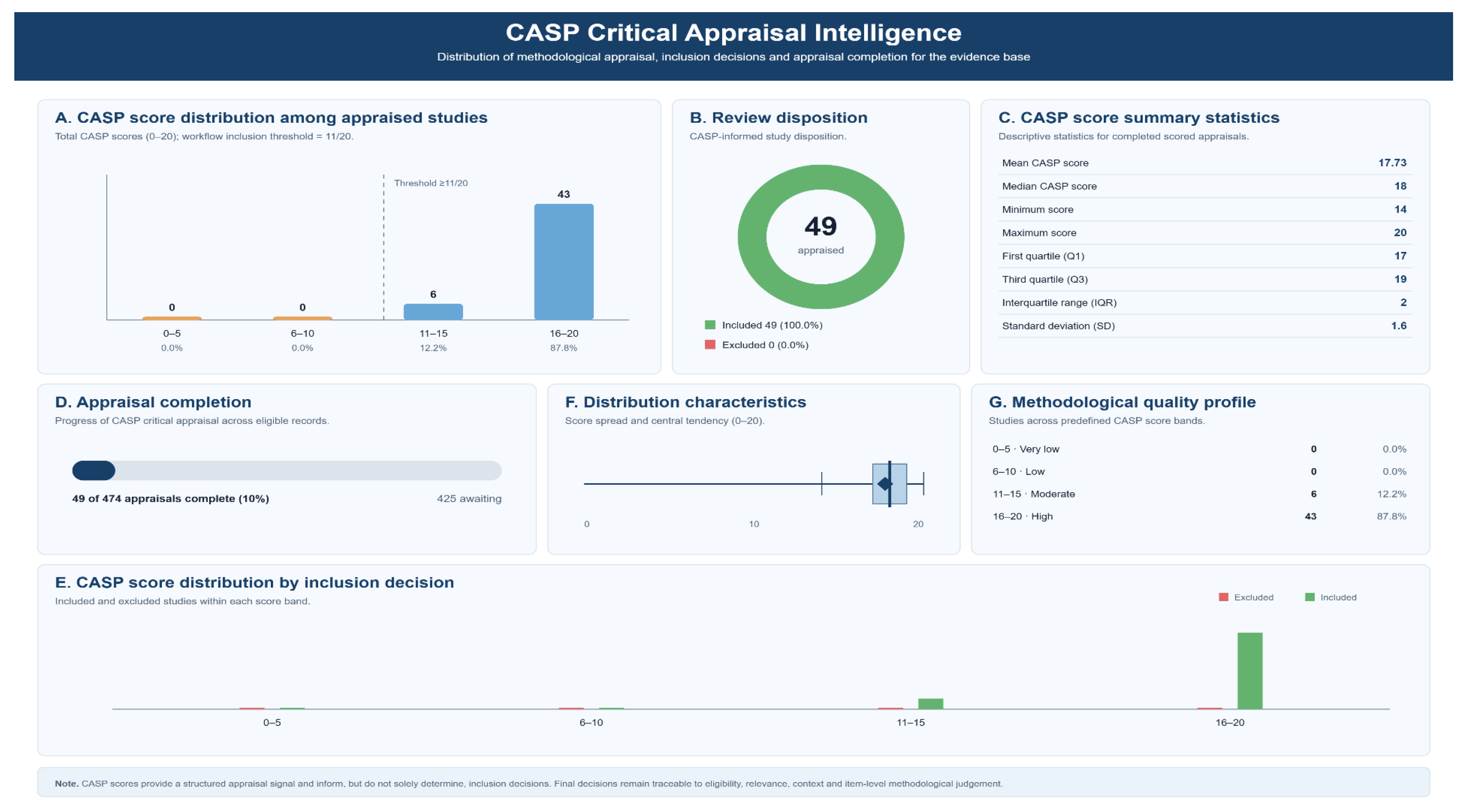
The CASP figure represents study-level appraisal records for 49 included studies, with a recorded mean score of 17.73 and individual scores ranging from 14 to 20. The appropriate interpretation is distributional and cautious: the workspace demonstrates that appraisals were completed, while the spread indicates variation in recorded appraisal outcomes. The mean must not be treated as a definitive quality ranking or as evidence that the synthesis has high confidence.
The figure cannot reveal criterion-level patterns that were not preserved in the supplied appraisal narrative. Several studies have recorded methodological concerns, while many decisions state that unsupported criteria require researcher verification. Thus, the CASP display is useful for documenting appraisal coverage and uncertainty, but it cannot independently establish which specific domains most constrain each theme. This limitation is consistent with recommendations to use CASP as a structured aid to judgement rather than as checklist arithmetic (Long et al., 2020).
The CASP results constrain interpretation of reported numerical ranges and stopping claims. Evidence based on conceptual or narrative discussion may be relevant to methodological reasoning but is not equivalent to a prospective empirical test of a minimum sample. Similarly, the presence of a high recorded score does not establish transferability across disciplines or methodologies. The appraisal therefore supports cautious synthesis rather than a ranked hierarchy of methods.
No finding-level CERQual assessment was recorded. The CASP figure must consequently not be interpreted as a confidence rating for the analytical themes. Trustworthiness was considered through study-linked appraisal, convergence and divergence, limitations in reporting and the traceability of extracted findings. This is distinct from any bibliometric representation, which maps prominence or relationships rather than methodological quality.
3.6. Data Extraction
A formal data-extraction procedure was not recorded. Nevertheless, the verified synthesis workspace documents 277 extracted findings contributed by 36 studies, each linked to finding identifiers and study identifiers. The available study records include bibliographic information, abstracts, appraisal information and extracted finding text, but many fields such as setting, population, sample size, methodology and data-collection details were incomplete. The synthesis therefore relied on the supplied finding-level evidence and did not infer findings from titles, abstracts or bibliometric prominence.
3.7. Data Synthesis and Analysis
Qualitative evidence synthesis was conducted on 277 extracted findings contributed by 36 studies. The COSTAQDA synthesis engine applied thematic synthesis, moving from traceable finding-level evidence to 11 initial codes, 3 categories, 2 descriptive themes and 5 analytical themes.
Theme development was constrained to the extracted finding-level evidence supplied by eligible studies. Each synthesised theme retained supporting study IDs and finding IDs, while contradictory evidence was preserved where identified. Titles, abstracts and bibliographic prominence were not treated as substitutes for extracted qualitative findings.
Recorded synthesis limitations included:
- The supplied evidence does not provide a systematic, directly comparable minimum sample size for case study, ethnographic, narrative, Grounded Theory, or phenomenological research.;
- Several findings are partial text extracts, methodological discussions, or secondary summaries rather than complete empirical evaluations; interpretations should therefore remain cautious.;
- Numerical ranges reported for phenomenology and narrative inquiry are illustrative and heterogeneous, and cannot be treated as validated universal thresholds.;
- Evidence on ethnographic sample-size determination is particularly thin;
- The supplied findings identify contextual breadth and a lack of guidance but do not establish an ethnographic minimum.;
- The evidence includes studies and reviews from different disciplines and designs, so reported sample-size distributions are not directly transferable across contexts.;
- Some supplied records contain claims about saturation that are explicitly contested by other findings, especially for phenomenology, reflexive or thematic approaches, conversation analysis, and qualitative research generally.;
- The synthesis is limited to the supplied finding IDs and does not independently verify the cited literature or the methodological quality of the source studies..
3.8. Bibliometric Intelligence and Confidence in the Evidence Base
Bibliometric intelligence provides a structural view of the evidence base that complements PRISMA selection, critical appraisal and qualitative synthesis. The following analyses examine citation relationships, scholarly influence, evidence connectivity and knowledge development within the included corpus. They provide contextual evidence about the intellectual structure and provenance of the literature and are not substitutes for methodological quality appraisal.
3.8.1. Local Citation Network
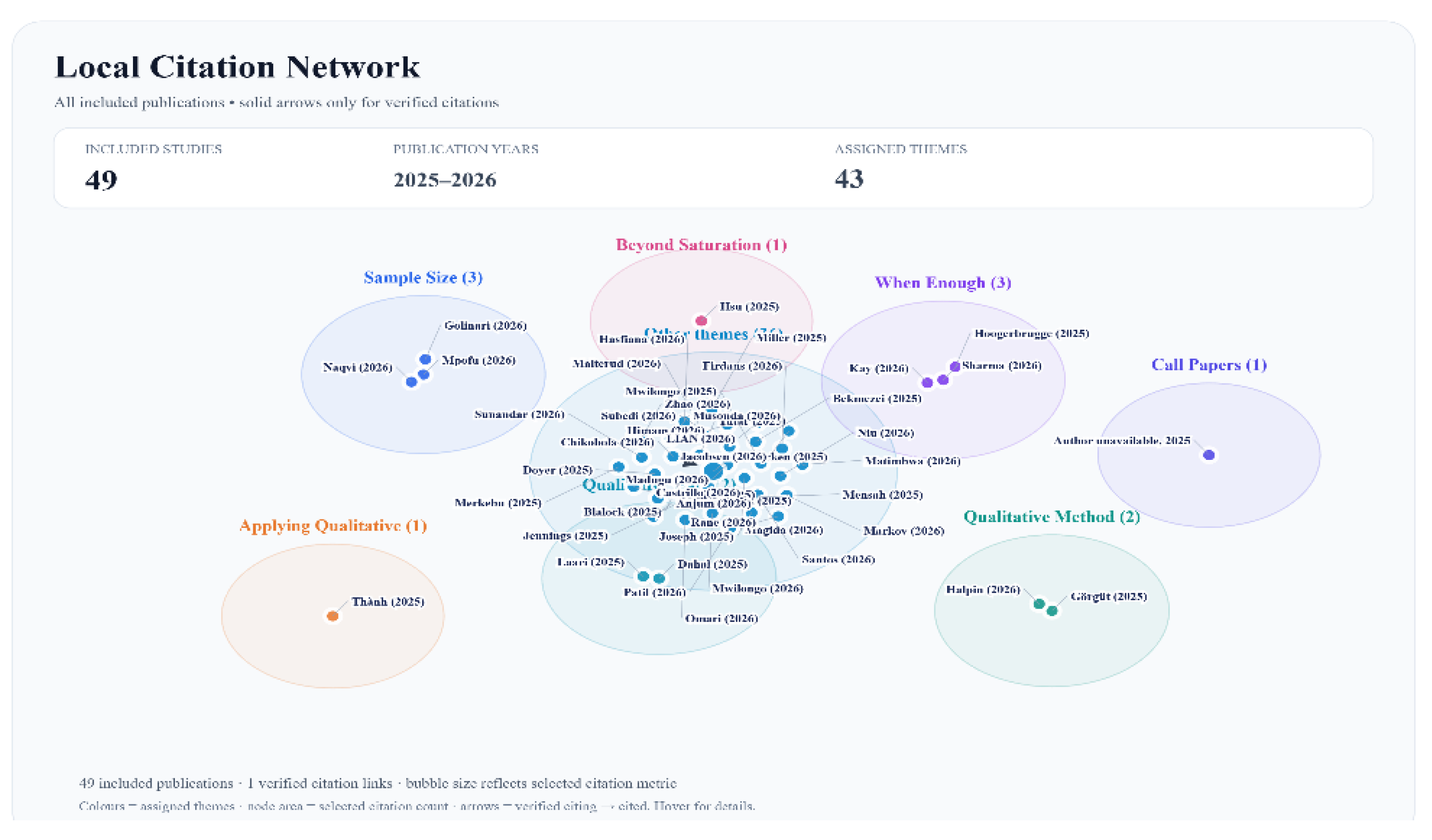
The Local Citation Network maps citation relationships within the included evidence base. It shows how studies are connected within the review corpus and supports examination of intellectual connectedness, centrality, bridging and isolation. These citation relationships describe the structure of the literature and do not, by themselves, establish methodological quality or validity.
Figure 3.
Local Citation Network. Source: COSTAQDA PRISMA Workflow, navigation item 12: Bibliometric Intelligence — Local Citation Network.
Figure 3.
Local Citation Network. Source: COSTAQDA PRISMA Workflow, navigation item 12: Bibliometric Intelligence — Local Citation Network.
3.8.2. Influence Pyramid
The Influence Pyramid represents the distribution of scholarly influence within the included evidence base. It helps identify how bibliometric prominence is distributed across the reviewed studies. Influence is interpreted separately from methodological quality, which is assessed through critical appraisal.
Figure 4.
Influence Pyramid 2. Source: COSTAQDA PRISMA Workflow, navigation item 12: Bibliometric Intelligence — Influence Pyramid.
Figure 4.
Influence Pyramid 2. Source: COSTAQDA PRISMA Workflow, navigation item 12: Bibliometric Intelligence — Influence Pyramid.
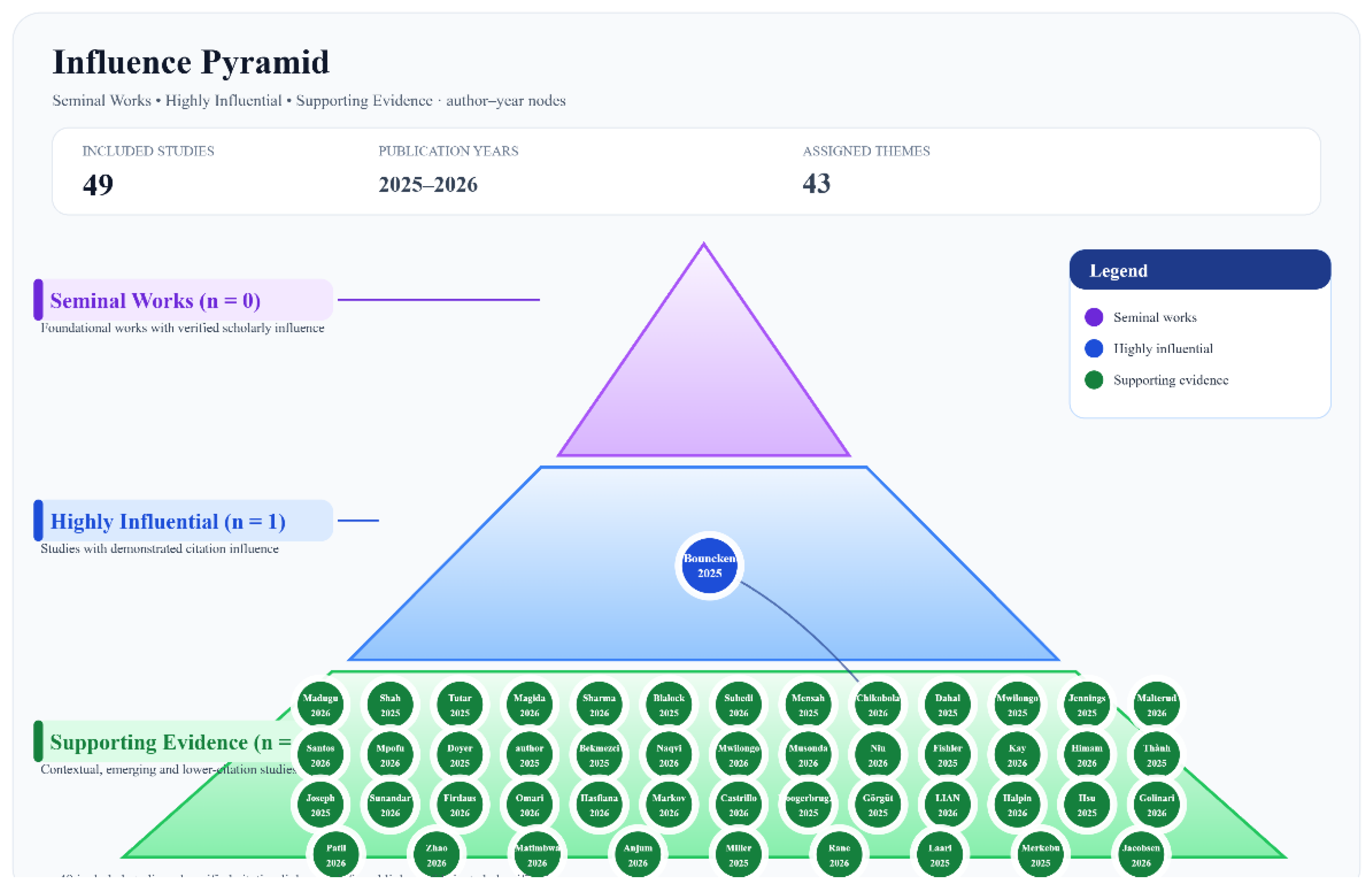
The supplied Influence Pyramid is appropriate as a descriptive bibliometric prominence map because its unit of analysis is the included-study publication node and its recorded variables include global citations, local citations and influenceScore. The coverage is 49 included studies, with 266 global citations, 1 local citation and 1 recorded network link. The strongest observable pattern is concentration of recorded global citations in a small number of publications, including Bouncken et al(2025)., Dahal (2025), Jennings and Yeager (2025), Bekmezci and Sürücü (2025), Merkebu et al(2025). and Blalock et al(2025).
The pyramid may help identify publications that are prominent within the supplied evidence ecosystem, but prominence does not demonstrate methodological quality, causal strength, empirical validity or consensus. The influenceScore formula and underlying citation-coverage procedures were not supplied, so construction and comparability of that metric cannot be independently established. The publication set is also restricted to the project’s included records and the provenance identifies OpenAlex as the bibliometric source, meaning that citation values should be interpreted as contextual rather than as a comprehensive appraisal of influence (Donthu et al., 2021; Zupic & Čater, 2015).
3.8.3. Evidence Strength
The Evidence Strength analysis examines the structure and strength of relationships within the evidence ecosystem assembled for the review. It complements, but does not replace, CASP methodological appraisal and must not be interpreted as a direct estimate of causal effect.
Figure 5.
Evidence Strength Network. Source: COSTAQDA PRISMA Workflow, navigation item 12: Bibliometric Intelligence — Evidence Strength Network.
Figure 5.
Evidence Strength Network. Source: COSTAQDA PRISMA Workflow, navigation item 12: Bibliometric Intelligence — Evidence Strength Network.
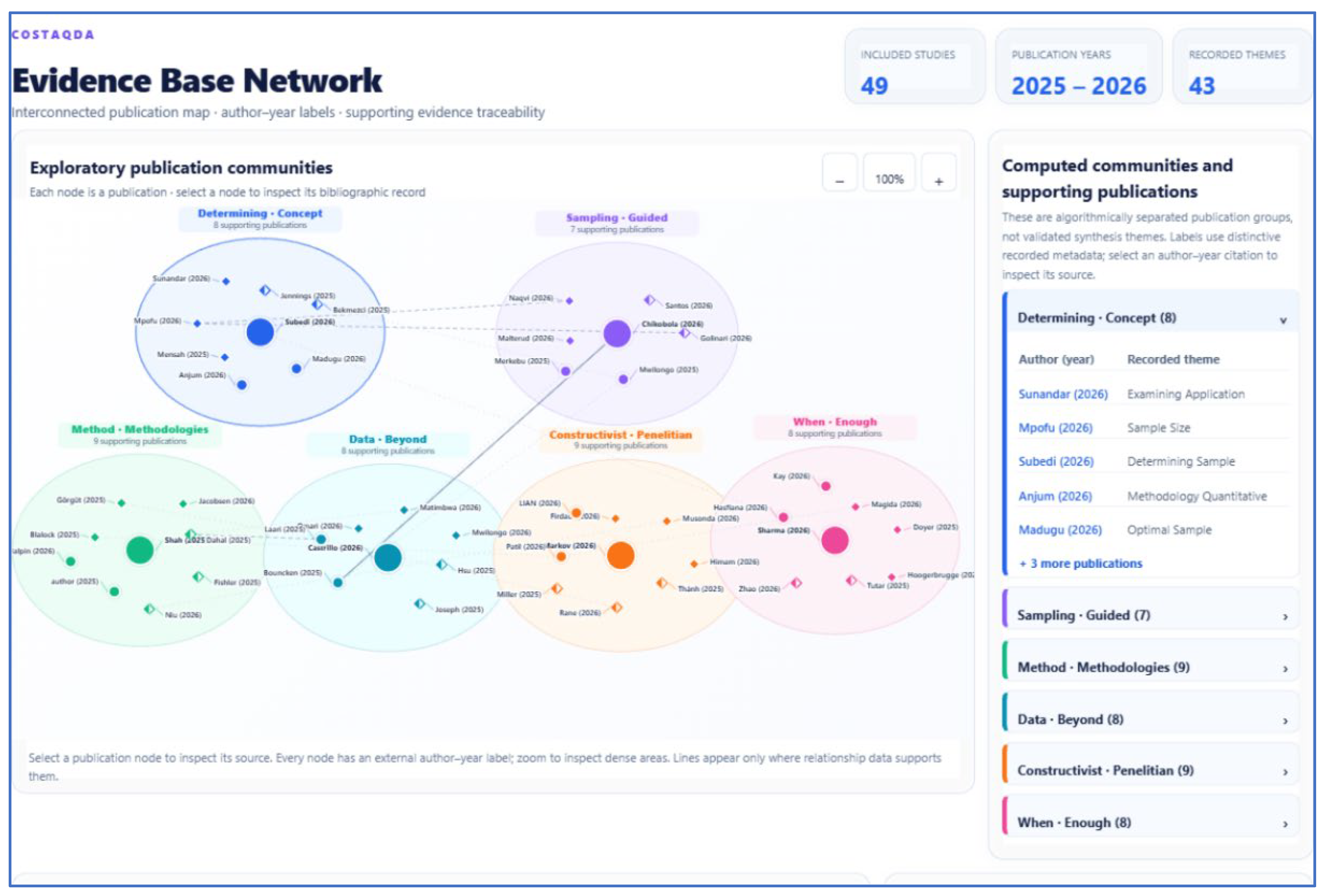
The Evidence Strength Network contains one recorded direct edge between Chikobola (2026) and Bouncken et al(2025)., with no supplied edge weight. Its unit of analysis is the relationship between included-study nodes, and its displayed structure represents the recorded relation type rather than an independently established evidentiary effect. The network is therefore appropriate for showing the limited documented connectivity in the supplied evidence ecosystem, but it cannot establish corroboration, study quality, causal strength, confidence or an observed sample-size effect.
The network should not replace CASP appraisal or qualitative synthesis. A direct edge may reflect a recorded bibliographic or evidentiary relation, but the supplied metadata do not explain whether the relationship represents citation, conceptual support or another linkage. Because the edge weight is null and no broader relation semantics are supplied, interpretation is limited to the existence of the displayed direct relationship. Its principal implication is methodological: the project’s evidence relationships were sparsely recorded, reinforcing the need to rely on finding-level synthesis rather than network structure alone (Aria & Cuccurullo, 2017; van Eck & Waltman, 2010).
3.8.4. Knowledge Evolution
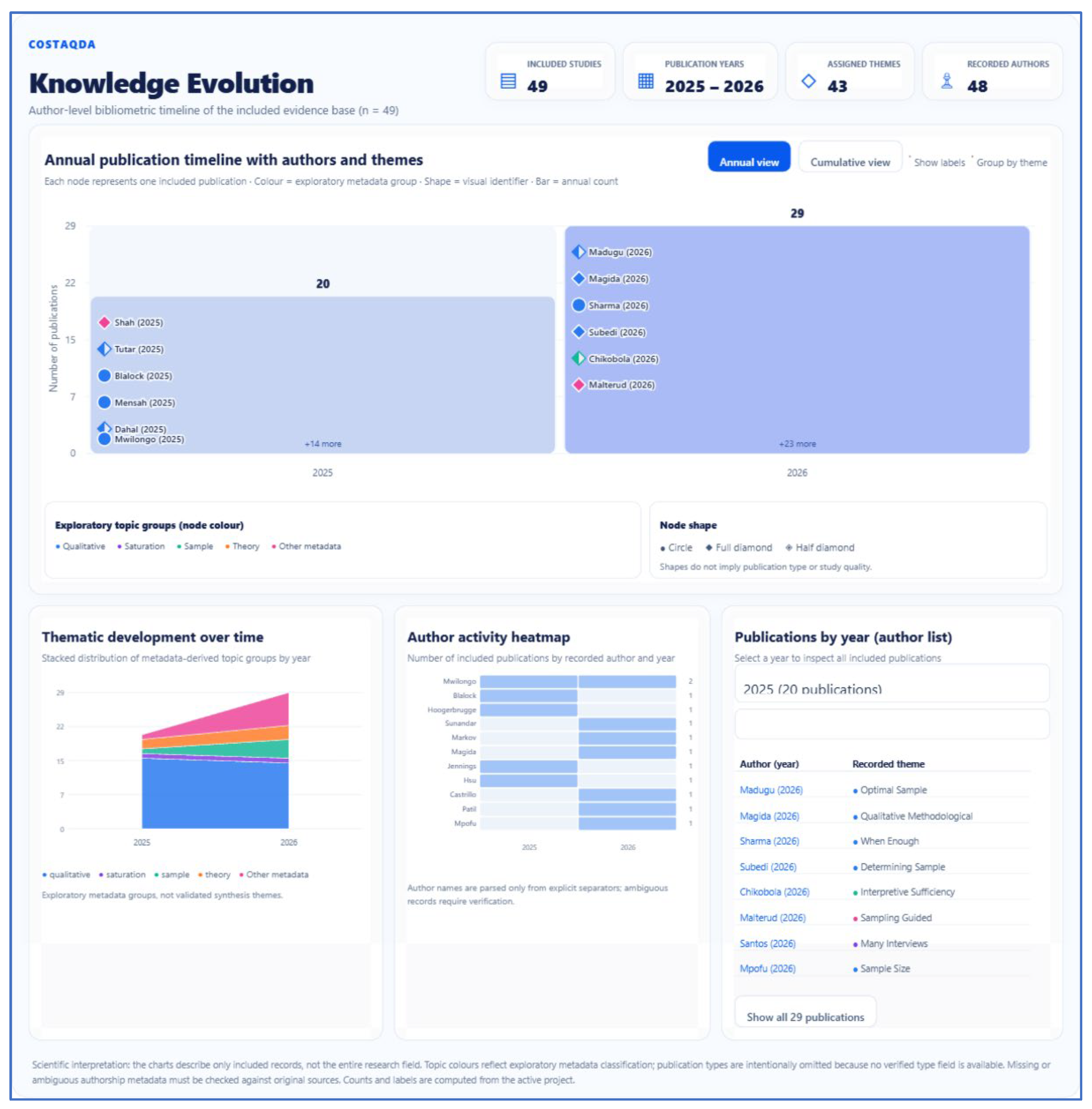
Knowledge Evolution examines the temporal and intellectual development of the included evidence base. It traces how research contributions develop over time and, where supported by the Step 12 data, how later studies extend, connect, challenge or consolidate earlier contributions.
Figure 6.
Knowledge Evolution. Source: COSTAQDA PRISMA Workflow, navigation item 12: Bibliometric Intelligence — Knowledge Evolution.
Figure 6.
Knowledge Evolution. Source: COSTAQDA PRISMA Workflow, navigation item 12: Bibliometric Intelligence — Knowledge Evolution.
3.8.5. Integrated Confidence in the Synthesised Evidence
No separate finding-level confidence method was recorded. The review therefore does not assign formal confidence ratings and does not claim that GRADE-CERQual was conducted. CASP was used for methodological appraisal, whereas the qualitative synthesis integrated extracted findings. Bibliometric outputs were treated only as contextual evidence maps and were not combined with CASP or synthesis judgements to form a confidence score (Lewin et al., 2018; Noyes et al., 2018).
4. Findings
4.1. Search and Selection Results
The persisted workflow recorded 474 identified records, 24 duplicates, 64 records screened, 60 reports sought for retrieval, 4 title/abstract exclusions, 49 full texts assessed, 0 full-text exclusions and 49 included records. These figures describe selection and are not substantive evidence about sample size. The identification discrepancy remains unresolved: the recorded identified, duplicate and screened values do not reconcile arithmetically with the separately persisted identification value. The screening audit also does not preserve the decision rule used for title/abstract screening.
4.2. Characteristics of Included Studies
The included evidence comprised 49 records, while the verified thematic synthesis used findings from 36 studies. The supplied records spanned methodological reviews, conceptual papers, narrative reviews, empirical or quasi-empirical analyses, educational guidance, Grounded Theory discussions, digital qualitative research and qualitative evidence synthesis. The evidence addressed case study, ethnography, narrative inquiry, Grounded Theory, phenomenology and broader qualitative sampling, but the distribution across methodologies was not supplied in a directly comparable form. Several records were not peer-reviewed journal articles or were identified as books, preprints, reports or other publication types despite the stated eligibility criteria; the review reports the persisted project record without reconstructing unverified exclusions.
4.3. Methodological Strengths and Limitations of Included Studies
The evidence base was strongest where authors articulated a clear relationship between research purpose, sampling logic, data richness and stopping decisions. It was weaker where sample-size claims were presented as general ranges without comparable methodological or empirical justification. The supplied CASP workspace documents completed appraisals for all 49 included studies, but detailed criterion-level rationales were incompletely available and several decisions required researcher verification. The findings should therefore be understood as a synthesis of heterogeneous methodological evidence rather than as a validated ranking of sample-size rules.
4.4. Thematic Synthesis
Methodological basis: The thematic synthesis approach follows Thomas and Harden (2008), https://doi.org/10.1186/1471-2288-8-45. The study-specific findings and support counts below derive from the included evidence, not from this methodological citation.
Thematic synthesis is a systematic qualitative evidence-synthesis method used to integrate findings across multiple studies while retaining a transparent connection to the underlying evidence (Thomas & Harden, 2008). The process moves iteratively from extracted study findings to coding, the grouping of related codes into descriptive categories or themes, and the development of higher-order analytical themes that answer the review question and research objectives. Its purpose is not merely to count how often an idea appears, but to identify patterned meaning across studies, examine convergence and divergence, preserve contextual differences, and develop an auditable interpretation that remains traceable to the contributing evidence.
In this review, thematic synthesis was applied to the verified extracted findings retained in the active COSTAQDA project. Findings were compared across eligible studies, coded and grouped according to conceptual similarity, and then developed into 6 analytical themes represented across 15 evidence-contributing studies. The active synthesis retained 24 verified theme-to-study support assignments, allowing the analytical interpretation to remain traceable to the underlying studies rather than being reconstructed from titles or bibliographic prominence. The resulting analytical themes include “Case study sample adequacy is determined by case depth, purpose and information richness”, “Ethnographic sample-size guidance remains comparatively underdeveloped”, “Narrative inquiry permits very small samples but does not support a universal minimum”, “Grounded Theory provides the clearest method-specific stopping logic”, with the widest cross-study support recorded for “Qualitative sample size is a design-sensitive judgement rather than a generally accepted minimum” (7 contributing studies). Table 1 therefore operationalises the synthesis as an auditable evidence map linking each analytical theme to the studies that supplied verified supporting findings.
Table 1 presents the thematic synthesis matrix linking the verified analytical themes only to studies with verified extracted evidence supporting at least one of the themes displayed in the matrix. Any study with no verified supporting contribution to any displayed theme is excluded, even if it was included elsewhere in the systematic review or qualitative evidence base. Rows represent analytical themes and columns represent theme-contributing studies. A check mark (✓) indicates that at least one verified extracted finding from that study was assigned to the theme; an em dash (—) indicates that the study contributed evidence to the synthesis overall but no supporting extracted finding from that study was assigned to that particular theme. The absence of a supporting assignment must not be interpreted as contradictory evidence. The totals report the number of evidence-contributing studies providing verified support to each theme. The matrix therefore functions as an audit trail between thematic interpretation and the underlying finding-level evidence rather than as a measure of methodological quality or effect size.
The most widely supported analytical theme was "Qualitative sample size is a design-sensitive judgement rather than a generally accepted minimum", with verified support from 7 of 15 studies. The least widely distributed theme was "Narrative inquiry permits very small samples but does not support a universal minimum", with verified support from 2 of 15 studies. Differences in the number of supporting studies indicate the distribution of traceable thematic evidence across the included literature, not the relative importance or quality of a theme. Themes supported by fewer studies may still be analytically important when the underlying findings are conceptually rich, contextually distinctive or directly relevant to the review question. Conversely, wider study support indicates cross-study recurrence but does not by itself establish stronger methodological quality. The thematic patterns shown in Table 1 should therefore be interpreted alongside critical appraisal, contextual variation, contradictory findings where verified, and the detailed theme-led discussion that follows.
4.5. RO1: Case Study Sample Adequacy Is Determined by Case Depth, Purpose and Information Richness
The supplied evidence does not establish a universal minimum for case study research. Instead, case-oriented analysis is repeatedly associated with purposive selection of information-rich cases, intensive analysis and a bounded research purpose. Focused questions, directly experienced participants and in-depth case analysis are presented as conditions under which fewer participants or cases may be defensible, whereas comparative designs involving multiple groups require broader data coverage (Madugu & Kodondo, 2026; Sharma, 2026; Bouncken et al., 2025).
The case-study evidence therefore supports a logic of adequacy rather than a fixed number. A single case or a small number of cases may be sufficient when the case is substantively bounded and information-rich, but the supplied literature does not permit a minimum to be specified independently of the unit of analysis, analytic purpose or intended transfer. This directly answers RO1 by showing why a numerical minimum cannot be responsibly extracted from the evidence.
4.6. RO2: Ethnographic Sample-Size Guidance Remains Comparatively Underdeveloped
The evidence identifies contextual breadth as central to ethnographic adequacy, because ethnography may seek to understand social practices, relationships, cultural meanings and field contexts rather than simply accumulate interviews. However, the supplied studies do not establish a stable ethnographic minimum. Guidance for complex ethnographic and digital-ethnographic designs is explicitly described as lacking (Mpofu & Sibanda, 2026; Thành et al., 2025).
The implication for RO2 is that ethnographic sample size cannot be reduced to a participant count. Adequacy depends on the breadth and duration of contextual engagement, the range of relevant actors and settings, and the analytic coverage required by the research question. The evidence is particularly thin here, so any numerical recommendation would exceed the supplied record.
4.7. RO3: Narrative Inquiry Permits Very Small Samples But Does Not Support a Universal Minimum
The supplied literature reports highly variable narrative sample sizes, including single-participant life-history work and examples involving seven, eight and ten participants. These examples demonstrate that narrative inquiry may legitimately centre on one or a few richly developed accounts when the unit of analysis is an individual life, story or experience (Subedi, 2026).
At the same time, these reported ranges are illustrative rather than prescriptive. A narrative project seeking multiple voices, comparison or variation would require a different evidentiary base from a single-life-history inquiry. Thus, RO3 is answered by identifying a defensible possibility of very small samples while rejecting the interpretation that one participant, seven participants or ten participants constitutes a general minimum.
4.8. RO4: Grounded Theory Provides the Clearest Method-Specific Stopping Logic
Across the supplied Grounded Theory literature, sample-size decisions are linked to concurrent data collection and analysis, theoretical sampling, constant comparison, memoing and theoretical saturation. Later sampling is guided by emerging categories and theoretical needs rather than by a fully predetermined participant count (Musonda & Daka, 2026; Jacobsen, 2026; Bouncken et al., 2025).
The evidence includes a study reporting theoretical saturation after five participants and a constructivist Grounded Theory synthesis reporting saturation after 14 articles. These examples illustrate iterative sufficiency but do not establish a general minimum, because the stopping point depends on the phenomenon, scope of the question, developing theory, researcher capability and methodological variant (Doyer & Ayomoh, 2025; Lian & Isa, 2026).
Grounded Theory also exposes a contradiction in the wider saturation literature. Theoretical saturation has a specific methodological meaning within Grounded Theory, while its broader use as a generic claim that no new themes appeared is contested. The clearest answer to RO4 is therefore a process-based one: Grounded Theory has a recognisable stopping logic, but not a portable numerical threshold.
4.9. RO5: Phenomenological Adequacy Is Linked to Meaning Density Rather Than a Settled Minimum
The supplied evidence differentiates phenomenological adequacy from generic saturation by emphasising semantic or interpretive density. Reported phenomenological ranges include fewer than 10 interviews, 6–10 participants and 10–30 interviews, but these figures arise from different methodological discussions and are not directly comparable (Subedi, 2026).
The evidence also contains a direct challenge to treating saturation as a universal phenomenological endpoint. Hermeneutic phenomenology is presented as requiring interpretive sufficiency of meaning, and other supplied findings question whether phenomenological meaning can ever be exhausted through a saturation point (Chikobola, 2026; Jennings & Yeager, 2025). RO5 is therefore answered by identifying small, methodologically plausible ranges while concluding that meaning density, philosophical coherence and interpretive sufficiency are more defensible criteria than a fixed minimum.
4.10. RO6: Qualitative Sample Size Is a Design-Sensitive Judgement Rather Than a Generally Accepted Minimum
The strongest cross-study convergence is that sample adequacy depends on information power rather than a universal numerical rule. Focused questions, homogeneous or directly experienced participants, rich interviews and skilled probing can reduce the amount of data required, while broad questions, heterogeneous samples, multiple groups and comparative analysis increase requirements (Madugu & Kodondo, 2026; Mwilongo, 2026; Mpofu & Sibanda, 2026).
Saturation is useful when operationalised during collection and analysis as an assessment of whether new data contribute new codes, themes, information or theoretical development. However, the evidence also shows that saturation has multiple meanings, is not equally appropriate across methodologies and is often reported retrospectively without sufficient justification (Sharma, 2026; Jennings & Yeager, 2025; Mwilongo, 2025).
Some studies propose numerical ranges, including 1–15 participants, phenomenological ranges below 10 or between 10 and 30 interviews, and software-engineering interview distributions in which 13–24 interviews were most common. These are reported examples, not validated standards. The synthesis therefore does not identify a generally accepted minimum for qualitative research as a whole (Bekmezci & Sürücü, 2025; Subedi, 2026; Santos et al., 2026).
Transparent prospective justification emerged as an adequacy criterion in its own right. A defensible report should connect the research question, methodology, sampling strategy, participant information, data quality, analytic aims and stopping decision, rather than simply state that saturation was reached. This finding is supported across methodological guidance and reviews, although the supplied evidence does not establish how consistently such reporting occurs across all included studies (Santos et al., 2026; Görgüt et al., 2025; Bekmezci & Sürücü, 2025).
5. Discussion
The review question asked how sample size is determined, justified and evaluated across qualitative methodologies and qualitative evidence synthesis. The answer is consistent across the strongest supplied findings: adequacy is principally determined through a design-sensitive judgement about the information needed to answer the question, not through a universal minimum. This finding directly addresses RO6 and explains why the methodology-specific objectives cannot be answered with a single number.
For RO1, case study evidence supports small, information-rich samples when the case is bounded and analysed intensively, but it does not establish a minimum independent of case definition or comparison. For RO2, ethnography presents the clearest knowledge deficit: contextual breadth is relevant, yet the evidence does not provide a stable stopping rule. For RO3, narrative inquiry permits very small samples, including single-participant work, but the narrative unit and analytic ambition determine adequacy. These conclusions are compatible rather than contradictory because they distinguish design purpose from numerical convention (Subedi, 2026; Bouncken et al., 2025).
RO4 and RO5 reveal greater divergence concerning saturation. Grounded Theory has a comparatively coherent logic because theoretical sampling and concurrent analysis make the stopping decision part of theory development. Phenomenology, particularly hermeneutic phenomenology, raises a different issue: interpretive meaning may not be exhausted in the same manner as Grounded Theory categories. Applying generic saturation language across these traditions risks methodological misalignment (Musonda & Daka, 2026; Chikobola, 2026; Jennings & Yeager, 2025).
The numerical findings require careful interpretation. Ranges reported for phenomenology and narrative inquiry, the proposed 1–15 range, the five-participant Grounded Theory example and the software-engineering distribution are informative descriptions of practice, but they arise from different designs, disciplines and evidentiary purposes. They cannot be pooled into a minimum or transferred automatically across contexts. The divergence is therefore not evidence that one number is correct; it demonstrates that numerical adequacy is conditional (Bekmezci & Sürücü, 2025; Doyer & Ayomoh, 2025; Santos et al., 2026).
The synthesis contributes a practical reframing of sample-size justification. Researchers should specify what the sample is intended to cover, why the selected participants are information-rich, how data quality and interviewer capability affect information yield, what analytic development is required, and what observable criteria will support stopping. This interpretation is especially important because the supplied evidence documents retrospective saturation claims and incomplete reporting. A sample count without a rationale is therefore insufficient evidence of adequacy (Sharma, 2026; Mwilongo, 2026; Görgüt et al., 2025).
The conclusions remain bounded by the evidence base. Formal extraction procedures were not recorded, only 36 of 49 included records contributed to the verified thematic synthesis, source-level retrieval counts were unavailable, and the PRISMA identification counts were discrepant. CASP appraisals were completed, but criterion-level rationales were incompletely available and no finding-level confidence assessment was recorded. These limitations mean that the review provides a transparent, traceable synthesis of the supplied evidence rather than a definitive validated standard.
6. Conclusion
The review found no generally accepted minimum sample size for case study, ethnography, narrative inquiry, Grounded Theory, phenomenology or qualitative research generally. Sample size is determined most defensibly through a prospective, design-sensitive argument involving research purpose, scope, participant specificity, information power, data richness, analytic strategy and an explicit stopping assessment. Case study and narrative inquiry may support very small samples when their units of analysis are bounded and information-rich; Grounded Theory provides the clearest iterative stopping logic; phenomenology is better aligned with interpretive or semantic sufficiency than generic saturation; and ethnographic guidance remains underdeveloped. The central answer to the review problem is therefore not a number, but a transparent justification of why the selected sample is sufficient for the particular design and question.
7. Recommendations
Practice: Researchers should justify sample size prospectively by linking the research question, methodology, sampling strategy, participant information, data richness, analytic purpose and stopping criteria. They should define the type of saturation or sufficiency being used and document how it was assessed during collection and analysis rather than relying on a retrospective statement that saturation was achieved.
Policy: Journals, funders and research institutions should require design-congruent sample-size reporting that distinguishes information power, theoretical saturation, thematic sufficiency, interpretive sufficiency and contextual coverage. Reporting guidance should not impose a universal participant number across qualitative methodologies.
Future research: Methodological research should develop and test transparent, design-specific guidance for ethnography and other underdeveloped areas, while examining how prospective adequacy criteria perform across contexts. Future reviews should use complete extraction protocols, directly comparable study designs, detailed criterion-level appraisal rationales and verified finding-level confidence assessments.
Funding
There was no funding sought for this paper.
Conflicts of Interest
The authors declare that there are no competing interests in this research project.
AI-Assisted Technology and COSTAQDA Declaration
COSTAQDA was used as an AI-assisted evidence-synthesis and manuscript-development environment. AI-assisted functions supported the organisation, synthesis and presentation of verified project evidence and manuscript preparation within the documented COSTAQDA workflow. AI did not replace researcher responsibility for study selection, eligibility decisions, critical appraisal, verification of extracted evidence, interpretation of findings or final scholarly judgement. The human authors reviewed and approved the final manuscript and remain responsible for its accuracy, integrity, interpretations, citations and conclusions.
References
- Aria, M., & Cuccurullo, C(2017). bibliometrix: An R-tool for comprehensive science mapping analysis. Journal of Informetrics, 11(4), 959–975. [CrossRef]
- Bekmezci, M., & Sürücü, L(2025). Determining validity, reliability, and sample size in qualitative research. PaperAsia. [CrossRef]
- Blalock, A. E., Phillips, J. P., Ledford, C. J. W., Wendling, A. L., Kovar-Gough, I., & Lee, A. L(2025). Qualitative methods for medical education research. PRiMER. [CrossRef]
- Bouncken, R. B., Czakon, W., & Schmitt, F(2025). Purposeful sampling and saturation in qualitative research methodologies: Recommendations and review. Review of Managerial Science. [CrossRef]
- Chikobola, M. M(2026). Interpretive sufficiency of meaning: A philosophically coherent criterion for sample adequacy in hermeneutic phenomenology. African Quarterly Social Science Review. [CrossRef]
- Costa, K., & Costa, A. P(2024). Qualitative evidence synthesis using COSTAQDA. In J. Ribeiro, C. Brandão, M. Ntsobi, J. Kasperiuniene, & A. P. Costa (Eds.), Computer supported qualitative research (Lecture Notes in Networks and Systems, Vol. 1061). Springer. [CrossRef]
- Costa, K., & Mfolo, L(2024). Qualitative evidence synthesis using the COSTAQDA online software [Preprint]. Research Square. [CrossRef]
- Critical Appraisal Skills Programme(2024). CASP checklist: For qualitative research. https://casp-uk.net/casp-checklists/CASP-checklist-qualitative-2024.pdf.
- Doyer, I., & Ayomoh, M. K(2025). Staying true to the data: A visual and quantitative approach to showcase coding rigour and theoretical saturation. The Grounded Theory Review.
- Görgüt, R. Ç., Öz, E., Yurdunkulu, A., Çolak, A., Demir, Y. Y., Varol, N. B., & Tiryaki, S(2025). Qualitative research method in Türkiye: A systematical overview of doctoral theses in educational sciences. DSpace-Sinop. [CrossRef]
- Grant, M. J., & Booth, A(2009). A typology of reviews: An analysis of 14 review types and associated methodologies. Health Information and Libraries Journal, 26(2), 91–108. [CrossRef]
- Halpin, S. N., Konet, A., & Bregstone, J(2026). The Qualitative Method Matchmaker: A Decision-Support Tool to Help Select What Qualitative Methods to Use. RTI International. [CrossRef]
- Jacobsen, M. H(2026). Five different approaches for doing qualitative research—from data-driven to theory-driven qualitative research designs. Journal of Contemporary Research in Social Sciences. [CrossRef]
- Jennings, B. M., & Yeager, K. A(2025). Re-viewing the concept of saturation in qualitative research. International Journal of Nursing Studies Advances, 8, 100298. [CrossRef]
- Laari, L(2025). Qualitative data saturation in health sciences research. Nurse Researcher. [CrossRef]
- Lewin, S., Booth, A., Glenton, C., et al(2018). Applying GRADE-CERQual to qualitative evidence synthesis findings: Introduction to the series. Implementation Science, 13(Suppl 1), Article 2. [CrossRef]
- Lian, J., & Isa, N. J. M(2026). Navigating challenges in implementing Constructivist Grounded Theory in educational research: A Constructivist Grounded Theory systematic review approach. International Journal of Academic Research in Progressive Education and Development. [CrossRef]
- Long, H. A., French, D. P., & Brooks, J. M(2020). Optimising the value of the critical appraisal skills programme (CASP) tool for quality appraisal in qualitative evidence synthesis. Research Methods in Medicine & Health Sciences, 1(1), 31–42. [CrossRef]
- Madugu, U., & Kodondo, M. G(2026). Optimal sample size in qualitative research: Balancing data richness, credibility, and transferability. International Journal of Research and Innovation in Social Science. [CrossRef]
- Malterud, K(2026). Sampling guided by Information Power—advancing transferability. Routledge eBooks. [CrossRef]
- Mensah, G(2025). Saturation formula for sample size determination in qualitative research. Interdisciplinary Journal for Social Sciences. [CrossRef]
- Merkebu, J., Geringer, J. L., & Samuel, A(2025). Sampling thoughtfully in qualitative research: Hallmarks of rigour in health professions education. The Clinical Teacher. [CrossRef]
- Mwilongo, N. H(2025). Understanding sampling techniques and determining sample size in qualitative research: A novice guide. Eminent Journal of Social Sciences. [CrossRef]
- Mwilongo, N. H(2026). Data saturation in digital qualitative interviews: A critical review of influencing factors and methodological rigor in educational research. International Journal of Educational Qualitative Quantitative Research, 5(1). [CrossRef]
- Mpofu, F. Y., & Sibanda, B(2026). The sample size adequacy-saturation conundrum in digital qualitative research. International Journal of Social Science Research and Review, 9(2). [CrossRef]
- Musonda, Z., & Daka, H(2026). Grounded theory methodology and practical application in environmental sustainability research: A methodological review. African Quarterly Social Science Review. [CrossRef]
- Noyes, J., Booth, A., Flemming, K., Garside, R., Harden, A., Lewin, S., Pantoja, T., Hannes, K., Cargo, M., & Thomas, J(2018). Cochrane Qualitative and Implementation Methods Group guidance series—paper 3: Methods for assessing methodological limitations, data extraction and synthesis, and confidence in synthesized qualitative findings. Journal of Clinical Epidemiology, 97, 49–58. [CrossRef]
- Page, M. J., et al(2021). The PRISMA 2020 statement: An updated guideline for reporting systematic reviews. BMJ, 372, n71. [CrossRef]
- Santos, R. D. S., Santos, I., Rodrigues, M., & Magalhaes, C(2026). How many interviews are enough in a software engineering study? Preliminary findings on sample size and saturation. arXiv. [CrossRef]
- Sharma, H(2026). When enough is enough: Understanding saturation in qualitative research. Journal of Postgraduate Medicine. [CrossRef]
- Subedi, K. R(2026). Determining the sample in qualitative research. KMC Journal. [CrossRef]
- Thành, T. V., The, H. D., Van, T. V., & Van, M. D(2025). Applying qualitative research in management studies—theory and practical experiences: Using NVivo 15. International Journal of Innovative Research and Scientific Studies, 8(2), 4617–4626. [CrossRef]
- van Eck, N. J., & Waltman, L(2010). Software survey: VOSviewer, a computer program for bibliometric mapping. Scientometrics, 84, 523–538. [CrossRef]
- Zupic, I., & Čater, T(2015). Bibliometric methods in management and organization. Organizational Research Methods, 18(3), 429–472. [CrossRef]
- Madugu, U., & Kodondo, M. G(2026). Optimal Sample Size in Qualitative Research: Balancing Data Richness, Credibility, and Transferability. International Journal of Research and Innovation in Social Science. [CrossRef]
- Blalock, A. E., Phillips, J. P., Ledford, C. J. W., Wendling, A. L., Kovar-Gough, I., & Lee, A. L(2025). Qualitative Methods for Medical Education Research. PRiMER. [CrossRef]
- Subedi, K. R(2026). Determining the Sample in Qualitative Research. KMC Journal. [CrossRef]
- Mensah, G(2025). Saturation Formula for Sample Size Determination in Qualitative Research. Interdisciplinary Journal For Social Sciences. [CrossRef]
- Mwilongo, N. H(2025). Understanding Sampling Techniques and Determining Sample Size in Qualitative Research. A Novice Guide. Eminent Journal of Social Sciences. [CrossRef]
- Jennings, B. M., & Yeager, K. A(2025). Re-viewing the concept of saturation in qualitative research. International Journal of Nursing Studies Advances. [CrossRef]
- Santos, R. D. S., Santos, I., Rodrigues, M., & Magalhaes, C(2026). How Many Interviews Are Enough in a Software Engineering Study? Preliminary Findings on Sample Size and Saturation. arXiv (Cornell University). [CrossRef]
- Mpofu, F. Y., & Sibanda, B(2026). The Sample Size Adequacy-Saturation Conundrum in Digital Qualitative Research. International Journal of Social Science Research and Review. [CrossRef]
- Doyer, I., & Ayomoh, M. K(2025). Staying True to the Data: A Visual and Quantitative Approach to Showcase Coding Rigour and Theoretical Saturation. The grounded theory review.
- Bekmezci, M., & Sürücü, L(2025). Determining Validity, Reliability, and Sample Size in Qualitative Research. PaperAsia. [CrossRef]
- Mwilongo, N. H(2026). Data Saturation in Digital Qualitative Interviews: A Critical Review of Influencing Factors and Methodological Rigor in Educational Research. International Journal of Educational Qualitative Quantitative Research. [CrossRef]
- Thành, T. V., The, H. D., Van, T. V., & Van, M. D(2025). Applying qualitative research in management studies - theory and practical experiences: Using NVivo 15. International Journal of Innovative Research and Scientific Studies. [CrossRef]
- Bouncken, R. B., Czakon, W., & Schmitt, F(2025). Purposeful sampling and saturation in qualitative research methodologies: recommendations and review. Review of Managerial Science. [CrossRef]
- Merkebu, J., Geringer, J. L., & Samuel, A(2025). Sampling Thoughtfully in Qualitative Research: Hallmarks of Rigour in Health Professions Education. The Clinical Teacher. [CrossRef]
- Jacobsen, M. H(2026). Five different approaches for doing qualitative research - from data-driven to theory-driven qualitative research designs. Journal of Contemporary Research in Social Sciences. [CrossRef]
- Donthu, N., Kumar, S., Mukherjee, D., Pandey, N., & Lim, W. M(2021). How to conduct a bibliometric analysis: An overview and guidelines. Journal of Business Research, 133, 285–296. [CrossRef]
- Thomas, J., & Harden, A. (2008). Methods for the thematic synthesis of qualitative research in systematic reviews. BMC Medical Research Methodology, 8, Article 45. [CrossRef]

Table 1.
Thematic Synthesis Matrix.
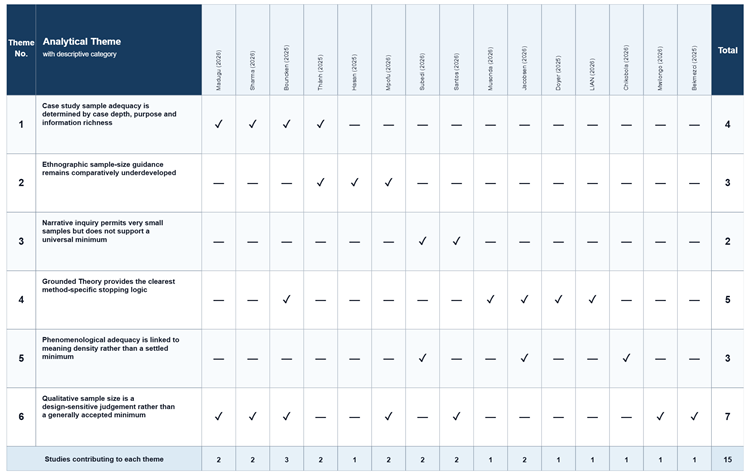 |
Table 1 legend: Only studies contributing verified extracted qualitative evidence are displayed. ✓ = verified extracted evidence from the study supports the theme; — = the study contributed to the synthesis but no supporting extracted finding from that study was assigned to this theme. An em dash does not indicate contradictory evidence.
Disclaimer/Publisher’s Note: The statements, opinions and data contained in all publications are solely those of the individual author(s) and contributor(s) and not of MDPI and/or the editor(s). MDPI and/or the editor(s) disclaim responsibility for any injury to people or property resulting from any ideas, methods, instructions or products referred to in the content. |
© 2026 by the authors. Licensee MDPI, Basel, Switzerland. This article is an open access article distributed under the terms and conditions of the Creative Commons Attribution (CC BY) license.
Copyright: This open access article is published under a Creative Commons CC BY 4.0 license, which permit the free download, distribution, and reuse, provided that the author and preprint are cited in any reuse.