
Submitted:
04 November 2026
Posted:
05 November 2026
You are already at the latest version
Abstract
Objective: This study aimed to evaluate the feasibility of producing suspension NPK fertilizers from wet-process phosphoric acid (WPA), sunflower ash, and ammonium nitrate, characterize the elemental composition of the starting materials, and estimate raw material requirements for formulations with different nutrient compositions. Methods: Wet-process phosphoric acid and two ash samples were characterized using X-ray fluorescence (XRF) spectroscopy. Five suspension NPK fertilizer samples were analyzed for their main nutrient components following sample mineralization, using photometric methods. Elemental phosphorus and potassium concentrations were converted into their corresponding P₂O₅ and K₂O equivalents. Theoretical raw material requirements were estimated using nutrient-based mass balance equations. Results: The potassium contents of the two sunflower ash samples were 29.30% and 26.10%, corresponding to K₂O equivalents of 35.29% and 31.44%, respectively. The elemental phosphorus content of WPA was 8.82%, equivalent to 20.21% P₂O₅. The five NPK suspension samples exhibited reported N–P₂O₅–K₂O compositions of 9–12–4, 11–11–11, 10–9–4, 8–7–5, and 7–7–6, respectively. Among the investigated formulations, NPK-2 had the highest reported combined nutrient content of 33%. For a target formulation of 100 g of NPK 11–11–11 fertilizer, theoretical nutrient-balance calculations indicated approximate requirements of 53.25 g of WPA, 34.91 g of sunflower ash, and 32.35 g of ammonium nitrate. However, the calculated total input mass exceeded the target product mass, indicating the need for experimental validation of the overall mass balance. Conclusions: The findings indicate the potential of sunflower ash as an alternative potassium source for suspension NPK fertilizer formulations in combination with wet-process phosphoric acid and ammonium nitrate. Nutrient-based calculations provide a preliminary basis for estimating raw material requirements. Further investigations are needed to verify the actual mass balance, confirm the total nitrogen content, and evaluate suspension stability and agrochemical properties before establishing a validated production formulation.
Keywords:
wet-process phosphoric acid
; sunflower ash
; ammonium nitrate
; suspension NPK fertilizer
; potassium
; phosphorus
; X-ray fluorescence spectroscopy
; photometric analysis
; nutrient balance
; biomass ash valorization
1. Introduction
The increasing global demand for agricultural products, the need to maintain soil fertility, improve nutrient use efficiency, and ensure the sustainable management of natural resources have become major priorities in modern agrochemistry and chemical technology. In particular, identifying alternative raw materials for the production of compound mineral fertilizers containing nitrogen, phosphorus, and potassium, integrating these resources into technological processes, and converting them into value-added products are of growing importance. Alongside the utilization of conventional mineral resources, the recovery and valorization of agro-industrial by-products for fertilizer production offer opportunities to develop resource-efficient technologies and promote the principles of a circular economy [1,4].
Nitrogen (N), phosphorus (P), and potassium (K) are essential plant macronutrients that play fundamental roles in physiological development, metabolism, and crop growth. Nitrogen is involved in the synthesis of proteins, nucleic acids, and chlorophyll, while phosphorus is essential for energy metabolism, root system development, and reproductive growth. Potassium contributes to enzyme activation, the maintenance of cellular osmotic balance, the regulation of water relations, and plant tolerance to abiotic stress. Consequently, compound NPK fertilizers are widely used to supply these essential nutrients and support balanced crop nutrition.
In modern fertilizer manufacturing, increasing attention has been directed toward liquid and suspension-based fertilizer formulations. Suspension fertilizers are multiphase systems containing dissolved nutrients and finely dispersed solid particles within a liquid medium. Their key technological characteristics include nutrient concentration, particle-size distribution, viscosity, sedimentation behavior, and physical stability during storage. By controlling the composition and rheological properties of these systems, fertilizer formulations can be developed to meet different agrochemical requirements. However, particle aggregation, crystallization, and sediment formation remain major challenges affecting product homogeneity, stability, and overall quality. He et al. [11] investigated the preparation of concentrated ammonium phosphate suspension fertilizers from wet-process phosphoric acid and demonstrated the importance of formulation conditions and rheological control in achieving stable suspension systems.
He et al. [11] investigated the production of highly concentrated ammonium phosphate suspension fertilizers using wet-process phosphoric acid (WPA), with particular attention to their rheological properties and stability under different conditions. The study examined the relationships among phosphoric acid composition, ammoniation conditions, suspending agents, and the structure of the dispersed system. The authors reported that the rheological behavior of the suspensions could be modified using xanthan gum and carboxymethylcellulose. These findings demonstrate the technological potential of wet-process phosphoric acid as a raw material for the production of suspension fertilizers.
Wet-process phosphoric acid is an important intermediate in the manufacture of phosphate and compound mineral fertilizers. It is produced through the acid treatment of phosphate-containing raw materials and may contain various inorganic impurities in addition to phosphoric acid. In particular, iron, aluminum, magnesium, and calcium compounds can influence phosphate solubility, dispersed-phase formation, and the physicochemical properties of the resulting products. These factors are especially important in suspension fertilizer production because the distribution of soluble and sparingly soluble phosphate species can affect both nutrient availability and the phase characteristics of the fertilizer system [19,21].
The identification of alternative potassium sources is an important consideration in the development of mineral fertilizer technologies. In this context, ash generated from the combustion of plant biomass represents a potentially valuable secondary mineral resource. Biomass ash may contain potassium-, calcium-, magnesium-, and phosphorus-bearing compounds, making it a promising raw material for fertilizer production. However, its chemical composition can vary considerably depending on the plant species, growing conditions, initial mineral composition, combustion temperature, and ash formation conditions. Therefore, comprehensive characterization of the chemical composition, nutrient forms, and reactivity of biomass ash is essential before its application in industrial fertilizer production [1,4].
Previous research on the combined processing of biomass residues and wet-process phosphoric acid (WPA) has demonstrated the technological potential of this approach. Zhou et al. [12] investigated the production of fertilizer products through the treatment of distiller’s grains waste with wet-process phosphoric acid. The authors demonstrated that chemical interactions between biomass-derived components and phosphoric acid could be utilized to produce nutrient-containing fertilizer formulations. Their study examined the composition, physicochemical characteristics, and formation mechanisms of the resulting fertilizer products, including suspension fertilizers and slow-release phosphorus fertilizers. These findings provide a scientific basis for further investigation of biomass-derived materials in phosphorus-containing fertilizer systems.
The selection of a nitrogen source is another important consideration in the development of fertilizers based on biomass ash and wet-process phosphoric acid. Ammonium nitrate (NH₄NO₃) provides nitrogen in both ammonium (NH₄⁺) and nitrate (NO₃⁻) forms. Its high water solubility facilitates the incorporation of nitrogen into fertilizer formulations. Nevertheless, the addition of ammonium nitrate may alter the ionic composition, physicochemical conditions, and equilibrium of dissolved species within a suspension system. Therefore, the development of multicomponent suspension fertilizers containing ammonium nitrate requires consideration not only of nitrogen concentration but also of the chemical behavior and availability of phosphorus- and potassium-containing components.
The combined utilization of wet-process phosphoric acid, sunflower ash, and ammonium nitrate offers a potential approach for developing suspension fertilizers containing nitrogen, phosphorus, and potassium. In this system, sunflower ash serves as an alternative potassium source, wet-process phosphoric acid supplies phosphorus, and ammonium nitrate provides nitrogen. Investigating the chemical composition of these raw materials and their interactions may help clarify the technological possibilities and limitations associated with controlling the N–P₂O₅–K₂O ratio in the final fertilizer product.
Previous studies have investigated the production of suspension phosphate fertilizers from wet-process phosphoric acid [11], the utilization of sunflower husk ash as a fertilizer raw material [1,46], and the conversion of biomass residues into fertilizer products through their interaction with wet-process phosphoric acid [12]. However, the literature reviewed provides limited direct information on the relationship between raw material proportions and nutrient composition in suspension NPK fertilizers prepared specifically from wet-process phosphoric acid, sunflower ash, and ammonium nitrate. This knowledge gap provides a rationale for investigating the three-component system, although it should not be interpreted as a claim of absolute scientific novelty.
Accordingly, the present study aimed to evaluate the feasibility of preparing suspension NPK fertilizers from wet-process phosphoric acid, sunflower ash, and ammonium nitrate; characterize the elemental composition of the starting materials; assess the nutrient composition of five experimental formulations; and estimate the theoretical raw material requirements using nutrient-based mass balance calculations. Particular attention was given to the potential utilization of sunflower ash as an alternative potassium source, the relationships among nutrient proportions, and the formulation constraints requiring further experimental validation
2. Materials and Methods
2.1. Research Materials and Their Physicochemical Characteristics
Wet-process phosphoric acid (WPA), sunflower ash, and ammonium nitrate (NH₄NO₃) were used as the primary raw materials for the preparation of suspension nitrogen–phosphorus–potassium (NPK) fertilizers. Wet-process phosphoric acid served as the phosphorus source, sunflower ash was utilized as a potassium-containing secondary mineral raw material, and ammonium nitrate was employed as the nitrogen source.
Potassium-, calcium-, magnesium-, and other mineral-containing compounds present in sunflower ash may undergo various chemical transformations under acidic conditions. These interactions can influence the nutrient composition and phase characteristics of the resulting fertilizer formulations [1,4].
Based on the results of X-ray fluorescence (XRF) analysis of two sunflower ash samples, the calculated K₂O equivalent ranged from 31.44% to 35.29%, while the P₂O₅ equivalent ranged from 0.683% to 1.125%. The second ash sample was used to prepare the NPK-2 suspension fertilizer. Therefore, the K₂O and P₂O₅ contents determined for this sample were used as the basis for calculating the theoretical raw material requirements of the NPK-2 formulation.

Table 1.
Physicochemical Characteristics of the Raw Materials Used in the Study.
| Parameter | WPA (Wet-Process Phosphoric Acid) | Sunflower Ash | Cotton Stalk Ash | Ammonium Nitrate (NH₄NO₃) |
| Total Nitrogen (N), % | - | - | - | 34,0 |
| P₂O₅, % | 20,21 | 0,683 | 1,125 | - |
| K₂O, % | - | 35,29 | 31,44 | - |
| CaO, % | 0,026 | 15,24 | 14,62 | - |
| MgO, % | 0,28 | 3,11 | 2,44 | - |
| SO₃, % | 2,34 | 1,06 | 2,78 | - |
| Moisture Content, % | 76,77 | 1,03 | 1,22 | 0,25 |
| Density, g/cm³ | 1,25 | 1,08 | 1,09 | 1,02 |
2.2. Preparation of Suspension NPK Fertilizers
Suspension nitrogen–phosphorus–potassium (NPK) fertilizers were prepared under laboratory conditions using wet-process phosphoric acid (WPA), sunflower ash, and ammonium nitrate (NH₄NO₃) as the main raw materials. The preparation process was carried out at room temperature without external heating. Initially, sunflower ash was added to liquid wet-process phosphoric acid, and the mixture was stirred to obtain a homogeneous dispersion. During this stage, chemical interactions may occur between the acidic medium and the mineral constituents of the ash. The total mixing time was 30 min. Ammonium nitrate was gradually introduced into the mixture in its original solid form, without prior dissolution in an additional solvent. This stepwise addition was intended to promote the uniform distribution of ammonium nitrate throughout the mixture and facilitate the mixing of the components.
After completion of the preparation process, the resulting suspension was maintained at room temperature and allowed to cool. Representative samples were subsequently collected for the determination of the nutrient composition of the prepared fertilizer formulations. Following sample mineralization, the concentrations of the main nutrient components, reported as nitrogen (N), phosphorus pentoxide (P₂O₅), and potassium oxide (K₂O), were determined using the laboratory analytical procedures described in Section 2.3.
2.3. Methods for Determining Nutrient Contents in Suspension NPK Fertilizers
The elemental compositions of wet-process phosphoric acid (WPA) and sunflower ash samples were investigated using X-ray fluorescence (XRF) spectroscopy.
To determine the total phosphorus content of the suspension NPK fertilizers, the samples were subjected to acid digestion using nitric acid (HNO₃). The phosphorus concentration in the resulting solutions was determined photometrically, and the results were expressed as phosphorus pentoxide (P₂O₅) equivalents.
Nitrogen content was determined using the conventional Kjeldahl method following digestion with sulfuric acid (H₂SO₄). This method primarily determines organic and ammonium nitrogen and does not fully account for nitrate nitrogen unless an appropriate nitrate reduction step is incorporated.
Therefore, the nitrogen values obtained using the Kjeldahl method were interpreted as Kjeldahl-determinable nitrogen rather than total nitrogen concentrations.
Potassium concentrations were expressed as potassium oxide (K₂O) equivalents based on laboratory analytical results. The specific analytical procedure and instrumentation used for potassium determination require clarification from the corresponding laboratory records.
3. Results
3.1. Evaluation of the Elemental Composition of Sunflower Ash
The chemical composition of the starting materials is a critical factor in evaluating the feasibility of producing suspension NPK fertilizers from wet-process phosphoric acid (WPA), sunflower ash, and ammonium nitrate. In particular, the characteristics of sunflower ash as a potassium-containing secondary mineral resource play an important role in determining the nutrient proportions of the resulting fertilizer formulations.
During the study, two separate sunflower ash samples were analyzed using X-ray fluorescence (XRF) spectroscopy. The analysis revealed the presence of potassium (K), calcium (Ca), magnesium (Mg), silicon (Si), sodium (Na), chlorine (Cl), phosphorus (P), sulfur (S), and other elements.
Figure 1.
(A) Sunflower ash sample; (B) Cotton stalk ash sample.
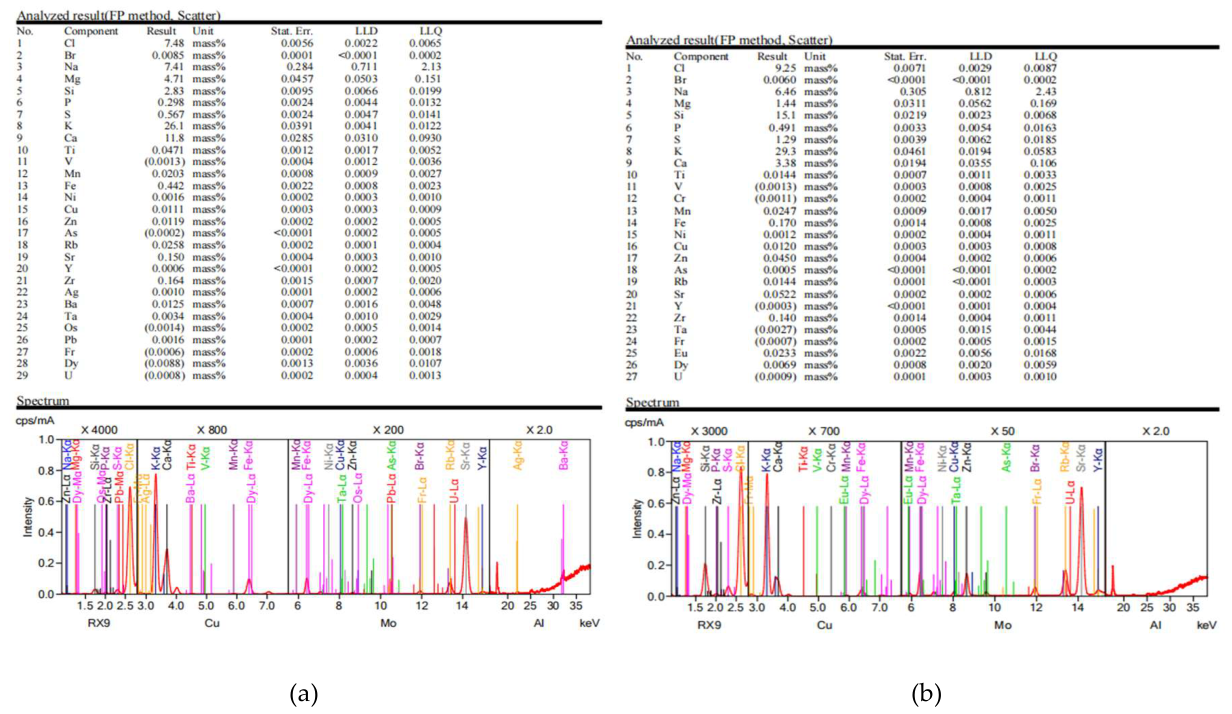
The graph compares the concentrations of nitrogen (N), phosphorus pentoxide (P₂O₅), and potassium oxide (K₂O) in five samples based on laboratory analysis results. The potassium mass fraction was 29.30% in the first ash sample and 26.10% in the second sample. When converted to K₂O equivalents, these values corresponded to 35.29% and 31.44%, respectively. These results indicate relatively high potassium contents in both samples.
While the first sample exhibited a higher potassium content, the second sample contained higher mass fractions of calcium and magnesium. Specifically, the calcium and magnesium contents in the second sample were 11.80% and 4.71%, respectively. These elements may influence the formation of phosphate compounds under acidic conditions.
The sodium and chlorine contents of the sunflower ash also warrant particular attention. In the second sample, their concentrations were 7.41% and 7.48%, respectively. Therefore, evaluating the soluble salt composition of the final fertilizer product represents an important objective for future investigations.
The total alkalinity of the ash, expressed as K₂CO₃ equivalent, was 29%. This value reflects the acid-neutralizing capacity of the ash but does not indicate that the sample contains exactly 29% potassium carbonate.
The second ash sample was used in the preparation of the NPK-2 formulation. To enable a consistent theoretical comparison of the five fertilizer formulations, the elemental composition of the second ash sample was also adopted as a common calculation basis for the subsequent material balance calculations. However, this assumption does not confirm that the same ash sample was experimentally used in the preparation of NPK-1, NPK-3, NPK-4, and NPK-5.
3.2. Elemental Composition of Wet-Process Phosphoric Acid and Its Characteristics as a Phosphorus Source
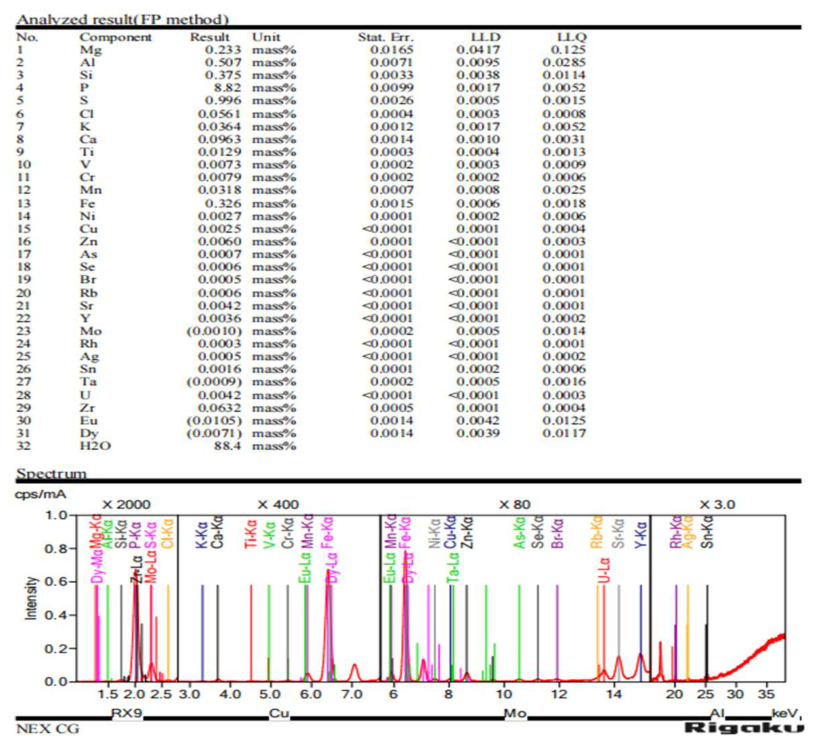
Wet-process phosphoric acid (WPA) was used as the phosphorus source in the preparation of suspension NPK fertilizers. The elemental composition of the acid was analyzed in its liquid state using X-ray fluorescence (XRF) spectroscopy.
According to the XRF analysis, the mass fraction of elemental phosphorus was 8.82%, corresponding to a calculated phosphorus pentoxide (P₂O₅) equivalent of 20.21%. In addition, sulfur (S), aluminum (Al), silicon (Si), iron (Fe), magnesium (Mg), and calcium (Ca) were detected in the acid sample.
The elemental phosphorus content was converted to its P₂O₅ equivalent using the following equation:
[w(\mathrmP2O5)=2.29134\timesw(\mathrmP)]
Based on this calculation, the P₂O₅ equivalent content of wet-process phosphoric acid (WPA) was determined to be 20.21%.
Additional mineral constituents present in WPA may influence the composition of the phosphate system through their interactions with sunflower ash. These interactions may result in the formation of soluble and sparingly soluble phosphate compounds.
However, the phosphorus concentration obtained by X-ray fluorescence (XRF) spectroscopy was not independently verified using a conventional chemical analytical method. Therefore, this value was used as preliminary analytical input data for subsequent theoretical calculations.
Figure 2.
Main Elemental Composition of Wet-Process Phosphoric Acid (WPA).
3.3. Experimental Nutrient Composition of Suspension NPK Fertilizers
The nutrient compositions of five suspension NPK fertilizer samples were investigated. Following complete sample mineralization, the nutrient components were analyzed using photometric methods.
The results revealed differences in the mass fractions of nitrogen (N), phosphorus (P), and potassium (K) among the five fertilizer formulations.
Table 2.
Nutrient Composition of Suspension NPK Fertilizer Samples.
| Samples | N, % | P₂O₅, % | K₂O, % | Total Nutrient Content, % |
| NPK-1 | 9 | 12 | 4 | 25 |
| NPK-2 | 11 | 11 | 11 | 33 |
| NPK-3 | 10 | 9 | 4 | 23 |
| NPK-4 | 8 | 7 | 5 | 20 |
| NPK-5 | 7 | 7 | 6 | 20 |
1 Tables may have a footer.
According to the experimental results, the NPK-1 formulation exhibited a phosphorus pentoxide (P₂O₅) content of 12%, representing the highest value among the five investigated formulations. The nitrogen (N) and potassium oxide (K₂O) contents of this sample were 9% and 4%, respectively.
In the NPK-2 formulation, each of the three primary nutrient components accounted for 11%, resulting in a combined nutrient content of 33%. This was the highest reported total nutrient content among the five formulations.
The NPK-3, NPK-4, and NPK-5 formulations were characterized by N–P₂O₅–K₂O compositions of 10–9–4, 8–7–5, and 7–7–6, respectively. Although NPK-4 and NPK-5 exhibited the same combined nutrient content of 20%, they differed in their relative nitrogen and potassium proportions.
Based on these results, theoretical raw material requirements were calculated for each fertilizer formulation.
3.4. Theoretical Calculation of Raw Material Requirements for NPK Fertilizer Formulations
The primary objective of the calculations was to estimate the quantities of wet-process phosphoric acid (WPA), sunflower ash, and ammonium nitrate required to achieve the experimentally reported N–P₂O₅–K₂O concentrations.
A target final product mass of 100 g was adopted as a common calculation basis for all formulations. This approach allowed the theoretical raw material requirements of fertilizer samples with different nutrient compositions to be compared on a consistent basis. The masses of wet-process phosphoric acid, sunflower ash, and ammonium nitrate were denoted by x, y, and z, respectively.
The nutrient-based mass balance equations were formulated as follows.
Phosphorus balance (expressed as P₂O₅):
[0.202099x+0.006828y=P2O5]
Potassium balance (expressed as K₂O):
[0.0004385x+0.314402y=K2O]
Nitrogen balance:
[0.34z=N]
In these equations, the terms N, P₂O₅, and K₂O on the right-hand side represent the masses, in grams, of the corresponding nutrient components in 100 g of the target fertilizer product.
The calculations were based on the assumptions that all nutrient elements were retained in the final product, ammonium nitrate was the sole nitrogen source, and the phosphorus and potassium contributions from wet-process phosphoric acid and sunflower ash were fully accounted for in the nutrient balances.
The NPK-2 formulation, with a target N–P₂O₅–K₂O composition of 11–11–11, was selected for detailed theoretical evaluation.
Nitrogen requirement:
[z=\frac{11}{0.34}=32.35\\mathrm{g}]
Simultaneous phosphorus and potassium balance equations:
[\begin{cases}0.202099x+0.006828y=11\0.0004385x+0.314402y=11
\end{cases}]
The calculated theoretical raw material requirements were as follows:
- Wet-process phosphoric acid (WPA): 53.25 g;
- Sunflower ash: 34.91 g;
- Ammonium nitrate (NH₄NO₃): 32.35 g.
The total theoretical mass of the required raw materials was 120.52 g.
These values represent nutrient-based theoretical requirements rather than an experimentally validated formulation for producing 100 g of suspension NPK fertilizer.
Figure 3.
Theoretical Raw Material Requirements for Five Suspension NPK Fertilizer Formulations.
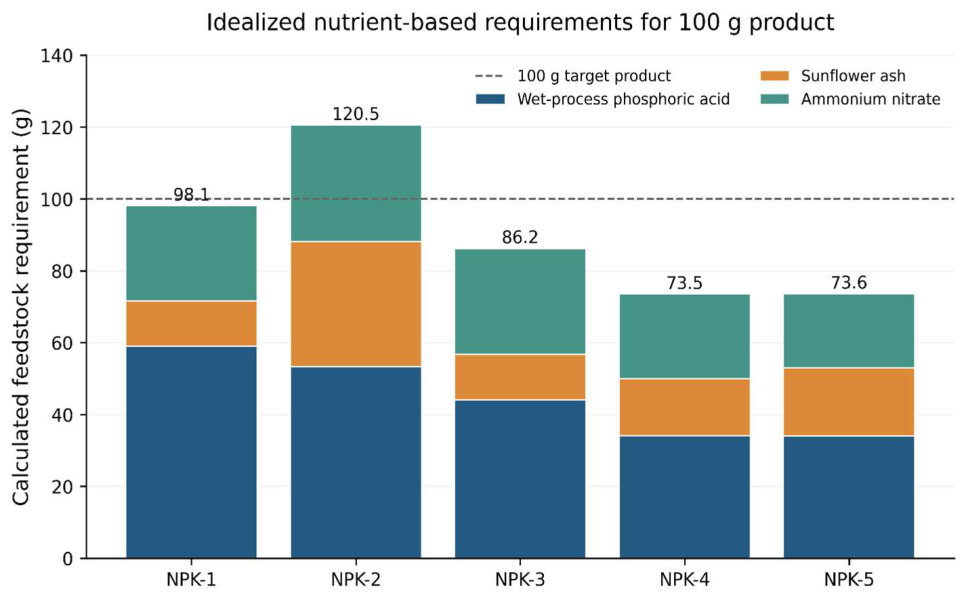
The calculated masses of wet-process phosphoric acid (WPA), sunflower ash, and ammonium nitrate were compared for each of the five fertilizer formulations.
The results indicate that variations in nutrient concentrations and N–P₂O₅–K₂O ratios directly affect the theoretical raw material requirements.
The NPK-1 formulation required the highest calculated amount of WPA due to its relatively high P₂O₅ content. In contrast, the NPK-2 formulation exhibited the highest theoretical sunflower ash requirement among the investigated formulations, corresponding to its K₂O concentration of 11%.
Similarly, the calculated sunflower ash requirement was higher for NPK-5 than for NPK-4 because of the higher potassium content in the NPK-5 formulation.
3.5. Theoretical Raw Material Requirements and Technological Considerations for Suspension NPK Fertilizer Production
The theoretical calculations were designed to meet the target nutrient requirements; however, the total calculated mass of the raw materials did not always correspond to the assumed final product mass of 100 g.
These discrepancies are important when evaluating the actual material balance of the production process.
Table 5.
This is a table. Tables should be placed in the main text near the first time they are cited.
Table 5.
This is a table. Tables should be placed in the main text near the first time they are cited.
| Samples | Input Mass, g | Output Mass, g | Input–Output Mass Difference, g |
| NPK-1 | 98,06 | 100,00 | −1,94 |
| NPK-2 | 120,52 | 100,00 | +20,52 |
| NPK-3 | 86,18 | 100,00 | −13,82 |
| NPK-4 | 73,49 | 100,00 | −26,51 |
| NPK-5 | 73,62 | 100,00 | −26,38 |
A positive mass difference indicates that the calculated total mass of the raw materials exceeds the target product mass, whereas a negative difference indicates that the calculated raw material mass is lower than the target product mass.
For the NPK-2 formulation, the total theoretical raw material requirement was 120.52 g, exceeding the assumed final product mass of 100 g by 20.52 g. Such a discrepancy would require identifiable physical or chemical processes resulting in a reduction in the final product mass.
In contrast, the calculated raw material requirements for the NPK-1, NPK-3, NPK-4, and NPK-5 formulations were below 100 g. Under these conditions, the production of 100 g of final product from only the three specified raw materials cannot be explained without accounting for additional material inputs or differences in the analytical and calculation bases.
Therefore, the values presented in Table 4 should be interpreted as theoretical raw material requirements calculated from nutrient balances rather than experimentally validated production formulations.
The proposed schematic framework illustrates an integrated approach to the production of suspension nitrogen–phosphorus–potassium (NPK) fertilizers from wet-process phosphoric acid (WPA), sunflower ash, and ammonium nitrate. It also outlines the assessment of nutrient composition, potential agricultural applications, and possible effects on soil, water, the atmosphere, plants, and living organisms. The framework is based on the principles of resource efficiency, agrochemical safety, and environmental sustainability.
The first stage of the proposed technological framework involves evaluating the physicochemical characteristics of the starting raw materials. In this system, liquid wet-process phosphoric acid serves as the phosphorus source, solid sunflower ash is considered a potassium-containing secondary mineral raw material, and ammonium nitrate provides nitrogen. Characterization of the elemental composition using X-ray fluorescence (XRF) spectroscopy, together with the determination of moisture content, acidity, and other relevant technological parameters, provides a basis for assessing the suitability of these materials for suspension fertilizer production.
The second stage involves preparing suspension NPK formulations through the controlled dosing and mixing of the raw materials in predetermined proportions. Chemical interactions may occur between wet-process phosphoric acid and the mineral constituents of sunflower ash. The addition of ammonium nitrate introduces the nitrogen component into the formulation. During mixing, achieving a uniform distribution of solid and liquid phases, controlling particle dispersion, and maintaining the desired nutrient ratios are important technological considerations.
The third stage involves evaluating the nutrient composition and physicochemical properties of the prepared suspension NPK fertilizers. The five formulations obtained in this study were characterized by N–P₂O₅–K₂O compositions of 9–12–4, 11–11–11, 10–9–4, 8–7–5, and 7–7–6, respectively. Among these formulations, NPK-2 exhibited the highest reported combined nutrient content, reaching 33%.
The fourth stage focuses on the potential agricultural applications of suspension NPK fertilizers. This stage considers the transformations of nitrogen, phosphorus, and potassium in soil, their uptake by plants, and their potential effects on plant growth and development. Nutrient availability and uptake depend on soil physicochemical properties, moisture conditions, soil pH, fertilizer application rates, and the solubility of the nutrient-containing compounds.
The fifth stage addresses the potential environmental transport pathways of fertilizer components and relevant environmental monitoring considerations. Important processes include the possible leaching of nitrogen and phosphorus compounds into surface water and groundwater, changes in soil salt balance, emissions of gaseous compounds into the atmosphere, and the accumulation of certain mineral impurities. Although these processes can be assessed by determining nutrient concentrations, pH, electrical conductivity, and potentially harmful impurities in soil and water samples, such analyses were not included in the present study, as related environmental aspects of suspension fertilizers have been investigated in previous research.
Figure 4.
Schematic framework for the production and application of suspension NPK fertilizers based on wet-process phosphoric acid, sunflower ash, and ammonium nitrate, and for the integrated assessment of their impacts on the environment and human health within the One Health concept.
Figure 4.
Schematic framework for the production and application of suspension NPK fertilizers based on wet-process phosphoric acid, sunflower ash, and ammonium nitrate, and for the integrated assessment of their impacts on the environment and human health within the One Health concept.
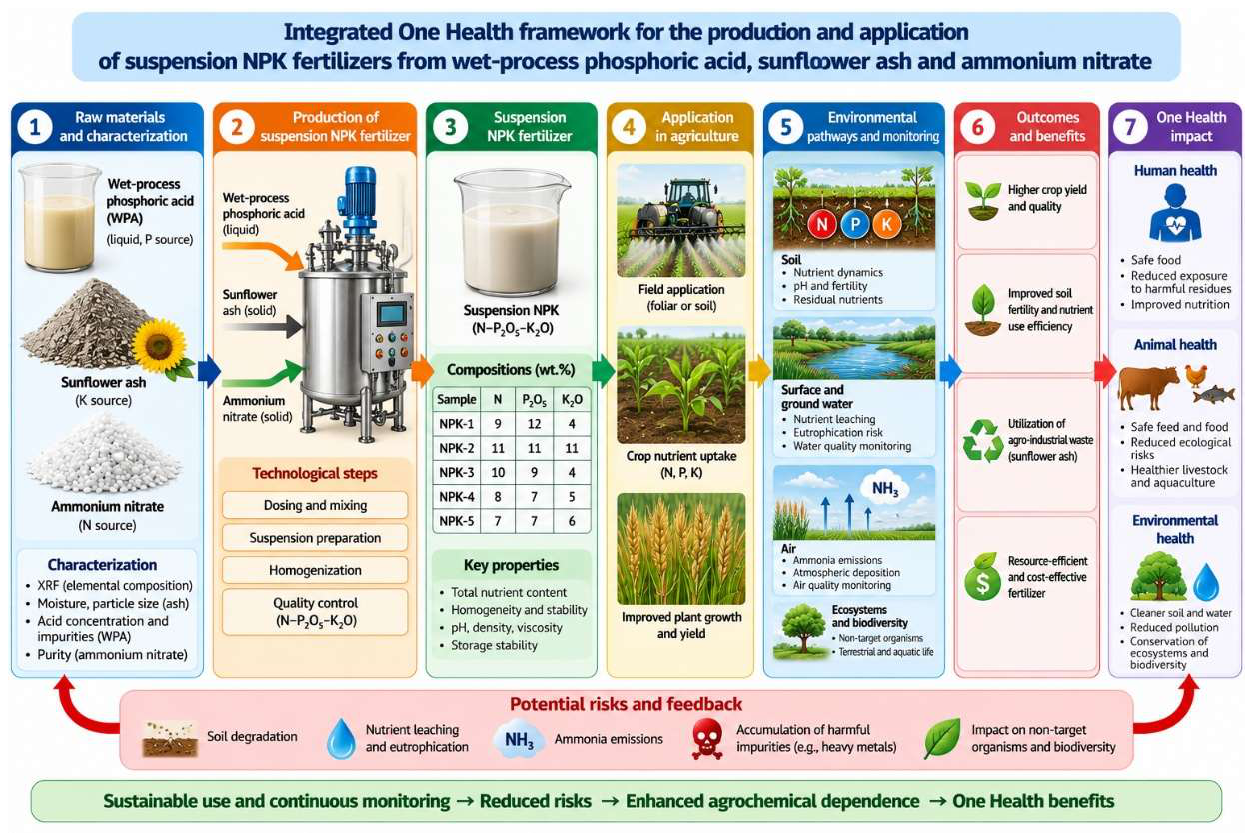
The sixth stage summarizes the anticipated agrochemical, economic, and environmental implications of using suspension NPK fertilizers. The incorporation of sunflower ash as an alternative potassium source may expand opportunities for the valorization of secondary raw materials. Furthermore, the identification of suitable fertilizer formulations and application rates could potentially improve plant mineral nutrition, crop quality, and yield. However, confirmation of these potential benefits requires further plant growth trials, agrochemical investigations, and economic assessments.
The seventh stage illustrates the interconnections among human, animal, and environmental health within the One Health framework. According to this approach, fertilizer chemical composition and agricultural application practices should be evaluated not only in terms of crop productivity but also in relation to soil and water quality, food safety, and potential effects on living organisms. Such an integrated assessment is proposed as a direction for future research rather than an experimentally completed component of the present study.
The lower section of the schematic framework identifies potential risk factors associated with fertilizer application, including nutrient leaching, soil degradation, ammonia emissions, accumulation of harmful impurities, and possible adverse effects on biodiversity.
3.6. Discussion of the Chemical Interactions of Sunflower Ash in an Acidic Medium
The total alkalinity of sunflower ash, expressed as K₂CO₃ equivalent, was determined to be 29%, indicating its potential to participate in neutralization reactions with phosphoric acid.
If carbonates are present in the ash, their reactions with phosphoric acid may result in the formation of phosphate compounds, carbon dioxide, and water.
For example, the idealized reaction between potassium carbonate and phosphoric acid can be represented as follows:
[mathrm{K2CO3+2H3PO4 \rightarrow 2KH2PO4+CO2\uparrow+H2O]
Similarly, in the presence of calcium carbonate, the following reaction may occur:
[mathrm{CaCO3+2H3PO4\rightarrowCa(H2PO4)2+CO2\uparrow+H2O]
These reactions illustrate plausible chemical pathways. However, because X-ray fluorescence (XRF) spectroscopy provides elemental composition data, it cannot independently confirm the presence of specific carbonate species in the ash or identify the phosphate compounds formed in the final fertilizer product.
The alkalinity of sunflower ash may contribute to the partial neutralization of phosphoric acid. In addition, calcium- and magnesium-containing constituents may increase the chemical complexity of the resulting phosphate system.
The final physicochemical properties of the suspension fertilizer may depend not only on its nutrient concentrations but also on the solid-phase fraction, particle size distribution, pH, viscosity, and storage stability.
3.7. Effects of Suspension NPK Fertilizer on Cotton Seed Germination and Early Seedling Growth
To evaluate the agrobiological properties of NPK fertilizers produced from wet-process phosphoric acid (WPA), sunflower ash, and ammonium nitrate, laboratory experiments were conducted to investigate their effects on cotton seed germination and early seedling growth.
The agrochemical experiments were carried out in 2025 at the Agrochemistry Laboratory of the Institute of General and Inorganic Chemistry, Academy of Sciences of the Republic of Uzbekistan. Distilled water was used as the control treatment, while mineral fertilizer solutions at different concentrations were applied in the experimental treatments.
Cotton seeds were germinated in Petri dishes lined with filter paper at a temperature of 25 °C. All experiments were conducted in triplicate.
The liquid NPK fertilizer sample used in the agrochemical experiments had an N–P₂O₅–K₂O composition of 10.20–10.21–10.19%.
According to the experimental results, cotton seed germination on day 3 reached 93.33% in the control treatment. Germination increased to 100% at a liquid NPK fertilizer concentration of 0.1% and to 96.66% at a concentration of 0.01%.
On day 6, the germination percentage in the control treatment was 96.66%, whereas 100% germination was recorded at both tested concentrations of the liquid NPK fertilizer.
Analysis of seedling morphometric characteristics showed that the mean seedling length was 11.55 cm in the control treatment, compared with 11.35 cm and 11.01 cm at fertilizer concentrations of 0.1% and 0.01%, respectively.
The mean seedling mass was 0.192 g in the control treatment, 0.190 g at a fertilizer concentration of 0.1%, and 0.193 g at a concentration of 0.01%.
Overall, the results indicate that no adverse effect on cotton seed germination was observed at the tested concentrations of the liquid NPK fertilizer, and higher germination percentages were recorded in certain fertilizer treatments compared with the control. However, no consistent improvement in seedling length or mass was observed.
4. Discussion
he present study investigated the feasibility of combining wet-process phosphoric acid (WPA), sunflower ash, and ammonium nitrate as raw materials for the development of suspension NPK fertilizers. The results demonstrated that the investigated materials could provide different reported N–P₂O₅–K₂O nutrient ratios, while also revealing important challenges related to raw material variability, chemical interactions, analytical reliability, and overall material balance. These findings are relevant to the growing interest in recovering valuable nutrients from agricultural and industrial residues for fertilizer production [1,2,3].
The elemental characterization of sunflower ash indicated considerable potential for its utilization as an alternative potassium source. The investigated ash samples contained substantial amounts of potassium, together with calcium, magnesium, sodium, silicon, and other mineral constituents. These observations are consistent with those of Ninkov et al. [1], who identified sunflower hull ash as a potassium-rich secondary raw material suitable for fertilizer production. Their study reported water-soluble potassium contents corresponding to approximately 40–50% K₂O in the investigated ash samples. In comparison, the sunflower ash samples examined in the present study contained potassium equivalent to approximately 31.44–35.29% K₂O. The difference suggests that the fertilizer value of sunflower ash depends on its origin and chemical composition. Biomass ash composition can also vary with feedstock characteristics and combustion conditions, as discussed in recent reviews and studies of sunflower-derived residues [2,3].
An important characteristic of the investigated sunflower ash was its total alkalinity, which reached approximately 29% when expressed as K₂CO₃ equivalent. This result suggests that alkaline ash constituents may participate in neutralization reactions with phosphoric acid during fertilizer preparation. Such interactions could influence phosphate formation, solution acidity, and the distribution of dissolved and suspended mineral components. However, the identification of specific reaction products cannot be established from elemental analysis alone. Additional characterization using X-ray diffraction, infrared spectroscopy, and related techniques would be required to determine the mineral phases present before and after acid treatment. The importance of mineralogical characterization is supported by studies demonstrating that sunflower combustion residues may contain several potassium- and calcium-bearing crystalline phases [3].
The investigated wet-process phosphoric acid contained approximately 20.21% P₂O₅ equivalent, calculated from the phosphorus concentration determined by X-ray fluorescence spectroscopy. Its use as a phosphorus source is consistent with previous research on phosphate fertilizers produced from wet-process phosphoric acid. Zhou et al. [4] investigated the combination of wet-process phosphoric acid with distiller’s grains waste and demonstrated its potential for developing nutrient-containing fertilizer products. Similarly, He et al. [5] developed concentrated ammonium phosphate suspension fertilizers using wet-process phosphoric acid and demonstrated the importance of formulation conditions, rheological behavior, and suspension stability. Although the raw material systems differ, these investigations support the broader technological relevance of wet-process phosphoric acid in suspension fertilizer development.
The five formulations investigated in the present study exhibited reported N–P₂O₅–K₂O compositions of 9–12–4, 11–11–11, 10–9–4, 8–7–5, and 7–7–6. Among them, NPK-2 showed the highest combined nutrient content, reaching 33%, whereas NPK-1 exhibited the highest phosphorus concentration, expressed as 12% P₂O₅. These differences indicate that variations in the relative contributions of the three raw materials may be used to target different nutrient ratios. Nevertheless, nutrient concentration alone does not establish the technological suitability of a suspension fertilizer. As demonstrated by He et al. [5], rheological characteristics, particle dispersion, and stability under different physicochemical conditions are also critical factors. Therefore, the formulations developed in the present study require further evaluation of viscosity, particle size distribution, sedimentation behavior, and storage stability.
The theoretical nutrient balance calculations revealed a further limitation. For the NPK-2 formulation, achieving the target 11–11–11 nutrient composition required calculated masses of 53.25 g WPA, 34.91 g sunflower ash, and 32.35 g ammonium nitrate. The combined theoretical raw material mass was 120.52 g, exceeding the assumed product mass of 100 g by 20.52 g. Conversely, the calculated total raw material masses for the other formulations were below 100 g. These discrepancies demonstrate that satisfying individual nutrient balances does not necessarily satisfy the overall mass balance. Although chemical reactions and gas evolution may occur during acid–ash interactions, the extent of any associated mass loss was not experimentally quantified. Consequently, the calculated quantities should be considered preliminary nutrient-based requirements rather than validated manufacturing recipes.
The interpretation of the nitrogen results also requires attention. Because ammonium nitrate contains both ammonium and nitrate nitrogen, analytical procedures must account for both forms to establish total nitrogen content reliably. Conventional Kjeldahl digestion does not quantitatively determine nitrate and nitrite nitrogen without appropriate methodological modifications [6,7]. Accordingly, the reported nitrogen concentrations should be regarded as provisional until the nitrate contribution has been independently verified or an appropriate total nitrogen determination method has been applied. This distinction is particularly important when evaluating the accuracy of the nominal N–P₂O₅–K₂O fertilizer grades and the associated raw material balance calculations.
The laboratory assessment of cotton seed germination provided preliminary information on the biological response to liquid NPK fertilizer treatment. The fertilizer sample used for these tests had a reported N–P₂O₅–K₂O composition of 10.20–10.21–10.19%, which differed from the five formulations evaluated in the main compositional study. On the third day, germination reached 100% and 96.66% at fertilizer concentrations of 0.1% and 0.01%, respectively, compared with 93.33% in the control treatment. On the sixth day, both fertilizer treatments reached 100% germination, compared with 96.66% in the control. However, mean seedling length was slightly lower in both fertilizer treatments, while seedling mass remained close to the control value. These findings suggest that the tested fertilizer concentrations did not visibly inhibit seed germination under the investigated laboratory conditions. Nevertheless, the results do not provide sufficient evidence of enhanced seedling growth, and further experiments with appropriate statistical analysis are necessary to establish biological significance.
From a resource-efficiency perspective, the incorporation of sunflower ash into NPK fertilizer formulations may offer opportunities to recover potassium from secondary biomass residues and reduce dependence on conventional potassium-bearing raw materials. This approach is consistent with recent research on circular management of biomass ash and the valorization of sunflower agricultural residues [2,3]. However, the agricultural suitability of such fertilizers cannot be established solely from their major nutrient contents. Potentially harmful impurities, nutrient solubility, soil interactions, and environmental transport pathways must also be considered. These aspects are particularly relevant when evaluating fertilizer products derived from variable industrial or agricultural by-products.
Overall, the present findings provide a preliminary experimental and theoretical basis for developing suspension NPK fertilizers from wet-process phosphoric acid, sunflower ash, and ammonium nitrate. The principal contribution of the study lies in the combined characterization of the raw materials, comparison of five reported nutrient formulations, and identification of discrepancies between nutrient-based calculations and overall material requirements. Future research should prioritize the verification of total nitrogen content, experimental determination of complete material balances, characterization of reaction products, assessment of suspension stability, and evaluation of fertilizer performance under controlled plant-growth and field conditions. These investigations would also support a more comprehensive assessment of potential environmental and health implications within the One Health framework.
5. Conclusions
This study evaluated the potential of wet-process phosphoric acid (WPA), sunflower ash, and ammonium nitrate as a three-component raw material system for the preparation of suspension NPK fertilizers. Based on the experimental results and theoretical calculations, the following conclusions were drawn:
- The elemental characterization of sunflower ash demonstrated its potential as an alternative potassium-containing raw material for fertilizer production. The investigated ash samples differed in their potassium, calcium, magnesium, silicon, sodium, and chlorine contents. The total alkalinity of the ash, expressed as K₂CO₃ equivalent, was approximately 29%, indicating its potential to participate in acid-neutralization reactions.
- The investigated wet-process phosphoric acid contained 20.21% P₂O₅ equivalent, as calculated from its phosphorus content determined by X-ray fluorescence spectroscopy. The combined use of phosphoric acid and sunflower ash provides a basis for introducing phosphorus and potassium into suspension fertilizer formulations, while ammonium nitrate serves as the nitrogen source.
- Five suspension NPK fertilizer formulations were investigated, with reported N–P₂O₅–K₂O compositions of 9–12–4, 11–11–11, 10–9–4, 8–7–5, and 7–7–6. Among these formulations, NPK-2 exhibited the highest combined nutrient content of 33%, whereas NPK-1 had the highest P₂O₅ concentration of 12%.
- A theoretical nutrient balance model was applied to estimate the raw material requirements of the investigated formulations. For the NPK-2 formulation, the calculated requirements were 53.25 g of wet-process phosphoric acid, 34.91 g of sunflower ash, and 32.35 g of ammonium nitrate. Their combined mass of 120.52 g exceeded the assumed final product mass of 100 g by 20.52 g. This discrepancy demonstrates that nutrient balance calculations alone are insufficient to establish a complete production formulation and that experimental verification of the overall material balance is necessary.
- Laboratory germination experiments conducted with a liquid NPK fertilizer containing 10.20% N, 10.21% P₂O₅, and 10.19% K₂O showed cotton seed germination rates of 100% on day 6 at both tested concentrations (0.1% and 0.01%), compared with 96.66% in the control treatment. However, no consistent improvement in seedling length or mass was observed, indicating that additional experiments are needed to establish the fertilizer’s effects on early plant growth.
- The possible interactions between phosphoric acid and alkaline components of sunflower ash suggest the formation of phosphate-containing compounds through neutralization reactions. However, the proposed reaction pathways and the resulting solid-phase composition require further confirmation using appropriate phase-identification and physicochemical characterization methods.
Overall, the findings demonstrate the potential of combining wet-process phosphoric acid, sunflower ash, and ammonium nitrate to develop suspension NPK fertilizers with different nutrient ratios. The study also highlights the importance of integrating nutrient balance calculations with experimentally verified material balances and fertilizer quality assessments.
Future research should focus on validating the analytical determination of total nitrogen, optimizing raw material ratios, investigating suspension stability and rheological properties, and evaluating fertilizer performance under greenhouse and field conditions. Environmental and safety assessments, including potential effects on soil, water, plants, animals, and human health, should also be considered within the One Health framework.
Supplementary Materials
The following supporting information can be downloaded at the website of this paper posted on Preprints.org.
Author Contributions
Conceptualization, M.V.; methodology, M.V. and Z.K.D.; investigation, M.V.; formal analysis, M.V.; validation, M.V.; data curation, M.V.; theoretical calculations and material balance analysis, M.V. and Z.K.D.; writing—original draft preparation, Z.K.D.; writing—review and editing, Z.K.D.; supervision, Z.A.Kh. All authors have read and agreed to the published version of the manuscript.
Funding
Please add: This research was conducted within the framework of the applied research project No. AL-692205622, entitled “Development of a Technology for Producing Liquid Nitrogen–Calcium Fertilizer for Application to Saline Soils through the Processing of Technogenic Waste Generated during the Beneficiation of Central Kyzylkum Phosphorites” (2023–2025), implemented at the Department of Chemical Technology, Namangan State Technical University, Uzbekistan.
Institutional Review Board Statement
Not applicable. This study did not involve human participants or animals requiring ethical approval.
Data Availability Statement
The data presented in this study are available within the article. Additional supporting data are available from the corresponding author upon reasonable request.
Acknowledgments
The authors would like to express their sincere gratitude to the laboratory specialists and technical personnel who provided valuable assistance in organizing laboratory analyses, determining the elemental composition of the raw materials, analyzing experimental fertilizer samples, and processing the obtained results. The official names of the contributing laboratories and institutions will be included following confirmation of their involvement.
Conflicts of Interest
The authors declare no conflicts of interest.
References
- Ninkov J. et al. Waste Ashes from Burned Sunflower Hulls as New Fertilising Materials. Environmental Engineering – Inženjerstvo okoliša. 2023. Vol. 10, No. 1–2. P. 19–23. [CrossRef]
- Agricultural Waste Valorization in the Circular Economy Using Sunflower Husk Ash as a Secondary Resource. Discover Sustainability. 2026. [CrossRef]
- Moslehi E., Mastantuoni G., Larsson E. et al. Recovery of Potassium and Phosphorus from Biomass-Derived Ash. Cleaner Waste Systems. 2025. Vol. 12. Article 100428. [CrossRef]
- Maj I., Niesporek K., Płaza P., Maier J., Łój P. Biomass Ash: A Review of Chemical Compositions and Management Trends. Sustainability. 2025. Vol. 17, No. 11. Article 4925. [CrossRef]
- Gahane D., Mandavgane S. A. Biomass Ash: A Neglected Source of Phosphorus Recovery. Reviews in Chemical Engineering. 2026. [CrossRef]
- Biogenic Potassium: Sources, Method of Recovery, and Sustainable Utilization. Reviews in Chemical Engineering. 2024. [CrossRef]
- A Critical Review on Potassium Release, Transformation, and Fixation during Biomass Combustion. Journal of the Energy Institute. 2026. Vol. 125. Article 102468. [CrossRef]
- Recycling Fly Ash from Coal or Biomass Combustion for Nutrient Recovery and Enhanced Food Production in Acidic Agroecosystems: A Multi-Level Meta-Analysis. Renewable and Sustainable Energy Reviews. 2025. Vol. 221. Article 115925. [CrossRef]
- Enhanced Phosphorus Bioavailability of Biochar Derived from Sewage Sludge Co-Pyrolyzed with K, Ca-Rich Biomass Ash. Water Research. 2025. Vol. 271. Article 122901. [CrossRef]
- Turp G. A., Ozdemir S., Yetilmezsoy K., Oz N., Elkamel A. Role of Vermicomposting Microorganisms in the Conversion of Biomass Ash to Bio-Based Fertilizers. Sustainability. 2023. Vol. 15, No. 11. Article 8984. [CrossRef]
- Study on the Preparation of High-Concentration Ammonium Phosphate Suspension Fertilizer from Wet-Process Phosphoric Acid and Its Rheological Properties. Journal of the Taiwan Institute of Chemical Engineers. 2024. Vol. 161. Article 105497. [CrossRef]
- Zhou X., Xu D., Yan Z., Zhang Z., Wang X. Production of New Fertilizers by Combining Distiller’s Grains Waste and Wet-Process Phosphoric Acid: Synthesis, Characterization, Mechanisms and Application. Journal of Cleaner Production. 2022. Vol. 367. Article 133081. [CrossRef]
- Bogusz P., Brodowska M. S., Rusek P. The Impact of Suspension Fertilizers Based on Waste Phosphorus Salts from Polyol Production on the Yield of Maize Intended for Green Fodder. Agronomy. 2024. Vol. 14, No. 5. Article 1054. [CrossRef]
- Aspen Plus® Process Simulation Model of the Biomass Ash-Based Treatment of Anaerobic Digestate for Production of Fertilizer and Upgradation of Biogas. Energies. 2023. Vol. 16, No. 7. Article 3039. [CrossRef]
- Technological and Environmental Assessment of Multi-Crop Biomass Ash Application in Agriculture. Agriculture. 2026. Vol. 16, No. 5. Article 549. [CrossRef]
- Jastrzębska M., Kostrzewska M. K., Saeid A. Phosphorus Fertilizers from Sewage Sludge Ash and Animal Blood as an Example of Biobased Environment-Friendly Agrochemicals: Findings from Field Experiments. Molecules. 2022. Vol. 27, No. 9. Article 2769. [CrossRef]
- Improving Chernozem Fertility and Barley Yield Through Combined Application of Phosphorus Fertilizer and Ash–Carbon Amendment. Soil Systems. 2025. Vol. 9, No. 4. Article 114. [CrossRef]
- Kizilkaya R. B., Akca H. et al. Recovery of Water-Soluble Fertilizers from Biomass Boiler Ash via Acid Leaching: Evaluation of Primary and Residual Effects on Maize Growth and Nutrient Uptake. Journal of Soil Science and Plant Nutrition. 2026. Vol. 26. P. 2843–2857. [CrossRef]
- Zhou Y., Zheng G., Long Y., Liu Z., Tao C., Liu R. Advanced Oxidation Processes for Wet-Process Phosphoric Acid: Enhanced Phosphorus Recovery and Removal of Organic Matters. Hydrometallurgy. 2022. Vol. 210. Article 105842. [CrossRef]
- The Mass Transfer and Mechanism of H₃PO₄ from Low Concentration HCl-Route Wet-Process Phosphoric Acid by the Mixture of n-Butanol and Isopropyl Ether. Separation and Purification Technology. 2022. Vol. 281. Article 119851. [CrossRef]
- Kouzbour S., Gourich B., Gros F., Vial C., Stiriba Y. Purification of Industrial Wet Phosphoric Acid Solution by Sulfide Precipitation in Batch and Continuous Modes: Performance Analysis, Kinetic Modeling, and Precipitate Characterization. Journal of Cleaner Production. 2022. Vol. 380. Article 135072. [CrossRef]
- One-Step Wet-Process Phosphoric Acid By-Product CaSO₄ and Its Purification. Separation and Purification Technology. 2023. Vol. 309. Article 123048. [CrossRef]
- Designing an Efficient Fluorine Recovery Strategy for Wet-Process Phosphoric Acid Purification by Disclosing Competitive Complexation Behavior between Fluorine Species and Metal Cations. Separation and Purification Technology. 2023. Vol. 320. Article 124219. [CrossRef]
- Efficient and Cost-Effective Fluorine Recovery from Liquid-Phase Wet-Process Phosphoric Acid via Two-Step Precipitation Method. Separation and Purification Technology. 2023. Vol. 325. Article 124687. [CrossRef]
- Gong X., Hu C., Jin Y., Liu H., Bai J., Niu L., Yang L. Preparation of Refined Phosphoric Acid with Recycling of Raffinate Acid by the Extraction of Metal Impurities. Journal of Cleaner Production. 2024. Vol. 434. Article 140158. [CrossRef]
- Removal of Iron, Aluminum and Magnesium Ions from the Wet-Process Phosphoric Acid Solutions via Donnan Dialysis. Journal of Membrane Science. 2024. Vol. 697. Article 122451. [CrossRef]
- Merroune A., Ait Brahim J., Achiou B., Kada C., Mazouz H., Beniazza R. Closed-Loop Purification Process of Industrial Phosphoric Acid: Selective Recovery of Heavy Metals and Rare Earth Elements via Solvent Extraction. Desalination. 2024. Vol. 580. Article 117515. [CrossRef]
- Simultaneous Removal of Al³⁺, Mg²⁺ and F⁻ from Wet-Process Phosphoric Acid Achieved by a Co-Precipitation Strategy. Separation and Purification Technology. 2024. Vol. 341. Article 126855. [CrossRef]
- Efficient Recovery of Fluorine from Wet-Process Phosphoric Acid Using Silicon Powder as a New and Eco-Friendly Reagent. Separation and Purification Technology. 2024. Vol. 337. Article 126435. [CrossRef]
- The Ultramicropore Biochar Derived from Waste Distiller’s Grains for Wet-Process Phosphoric Acid Purification: Removal Performance and Mechanisms of Cr(VI). Chemosphere. 2024. Vol. 349. Article 140877. [CrossRef]
- Ding W., Bao S., Xin C., Wang Z., Zhang H., Kuang B. Research Progress on Preparation and Purification Technology of Wet-Process Phosphoric Acid from Middle-Low-Grade Phosphorus Ore. Chemical Industry and Engineering Progress. 2025. Vol. 44, No. 4. P. 2274–2284. [CrossRef]
- Migration and Transformation Behaviors of Phosphorus and Associated Elements in Wet-Process Phosphoric Acid: Acidolysis Process and Mechanism Study. Journal of Environmental Chemical Engineering. 2025. Vol. 13, No. 3. Article 116327. [CrossRef]
- Closed-Loop Purification Process for Wet-Process Phosphoric Acid Raffinate: Separation of P₂O₅ and Recovery of Metal Ions via Solvent Extraction. Chemical Engineering Research and Design. 2025. Vol. 221. P. 354–367. [CrossRef]
- Fluoride Species Conversion-Enhanced Selective Extraction: A Green and Safe Strategy for Fluorine Recovery in Wet-Process Phosphoric Acid Production. Journal of Environmental Chemical Engineering. 2025. Vol. 13, No. 6. Article 119345. [CrossRef]
- Xu C., Liu Y., Zhang M. et al. Cyclic Solvent Extraction with OIDMDPPA and Oxalate Stripping to Recover Purified H₃PO₄, Al(OH)₃ and Battery Grade FeC₂O₄·2H₂O from Wet-Process Phosphoric Acid. Hydrometallurgy. 2026. Vol. 241. Article 106663. [CrossRef]
- Jama-Rodzeńska A., Sowiński J., Koziel J. A., Białowiec A. Phosphorus Recovery from Sewage Sludge Ash Based on Cradle-to-Cradle Approach—Mini-Review. Minerals. 2021. Vol. 11, No. 9. Article 985. [CrossRef]
- Bogdan A., Robles-Aguilar A. A., Liang Q., Pap S., Michels E., Meers E. Substrate-Driven Phosphorus Bioavailability Dynamics of Novel Inorganic and Organic Fertilizing Products Recovered from Municipal Wastewater—Tests with Ryegrass. Agronomy. 2022. Vol. 12, No. 2. Article 292. [CrossRef]
- Tominc S., Ducman V., Wisniewski W., Luukkonen T., Kirkelund G. M., Ottosen L. M. Recovery of Phosphorus and Metals from the Ash of Sewage Sludge, Municipal Solid Waste, or Wood Biomass: A Review and Proposals for Further Use. Materials. 2023. Vol. 16, No. 21. Article 6948. [CrossRef]
- Singla Just B., Martín Binder P., Guerra-Gorostegi N. et al. Phosphorus Release Dynamics from Ashes during a Soil Incubation Study: Effect of Feedstock Characteristics and Combustion Conditions. Agronomy. 2024. Vol. 14, No. 5. Article 935. [CrossRef]
- Koal P., Putzenlechner B., Eichler-Löbermann B. Recycled Phosphorus from Biomass Ash: Fertilizer Performance Across Crops. Agronomy. 2026. Vol. 16, No. 2. Article 224. [CrossRef]
- Sultonov B. E., Xolmatov D. S. Study of the Production of Wet-Processing Phosphoric Acid by Clinker Method on Base of Mineralized Mass. Chemical Science International Journal. 2024. Vol. 33, No. 5. P. 1–10. [CrossRef]
- Khoshimov I. E., Turdialieva S. I., Seytnazarov A. R., Namazov S. S. Feed Monocalcium Phosphate Derived from Wet-Process Phosphoric Acid and Calcium-Based Raw Materials. Chemical Science International Journal. 2024. Vol. 33, No. 6. P. 60–73. [CrossRef]
- Study on the Purification Process of Phosphoric Acid Using Organic Solvents: A Case of Wet-Process Phosphoric Acid Based on Karatau Phosphorites. The Open Chemical Engineering Journal. 2025. Vol. 19. [CrossRef]
- Characterization of Phosphorus Recovered from Sewage Sludge Ash: A Brazil Case Study. Resources. 2026. Vol. 15, No. 2. Article 22. [CrossRef]
- From Waste to Resource: Phosphorus Adsorption on Posidonia oceanica Ash and Its Application as a Soil Fertilizer. AgriEngineering. 2025. Vol. 7, No. 10. Article 333. [CrossRef]
Disclaimer/Publisher’s Note: The statements, opinions and data contained in all publications are solely those of the individual author(s) and contributor(s) and not of MDPI and/or the editor(s). MDPI and/or the editor(s) disclaim responsibility for any injury to people or property resulting from any ideas, methods, instructions or products referred to in the content. |
© 2026 by the authors. Licensee MDPI, Basel, Switzerland. This article is an open access article distributed under the terms and conditions of the Creative Commons Attribution (CC BY) license (http://creativecommons.org/licenses/by/4.0/).
Copyright: This open access article is published under a Creative Commons CC BY 4.0 license, which permit the free download, distribution, and reuse, provided that the author and preprint are cited in any reuse.