

Submitted:
04 November 2026
Posted:
05 November 2026
Read the latest preprint version here
Abstract
The satisfying inputs of a Boolean circuit with \(s\) inputs and wires in all can be counted in time \(2^{O(s/\sqrt{\log s})}\) when every gate is either an arbitrary function of at most \(s^{4/5}\) inputs or a threshold, exact, modular or symmetric gate of any fan-in with weights of at most \(s^{2/3}\) bits. Consequently a language in \(\mathrm{ENP}\) needs more than \(cN\sqrt{\log N}\) wires in circuits on \(N\) inputs built from such gates, with arbitrary gates of at most \(N^{3/4}\) inputs and weights of at most \(N^{1/2}\) bits. The \(\mathrm{P}\) versus \(\mathrm{NP}\) problem remains open; we survey where these bounds stand within it.
Keywords:
P versus NP
; circuit lower bounds
; tensor networks
MSC: 68Q17; 68Q15; 68Q25; 68W40; 03D15
1. Introduction
1.1. The Problem
The class consists of the languages decided by a deterministic Turing machine in time polynomial in the input length, and of those decided by a nondeterministic one in polynomial time, equivalently those whose members have certificates of polynomial length that can be checked in polynomial time. The question whether was isolated by Cook [26] and Levin [72], who showed that satisfiability of propositional formulas is -complete; Karp [64] then showed that twenty-one combinatorial problems share this property. The question had been anticipated by Edmonds [32], who proposed polynomial running time as the mark of an efficient algorithm, and by Gödel in a letter of 1956 to von Neumann, discussed by Sipser [100]. It is one of the seven Millennium Prize Problems of the Clay Mathematics Institute [25], and the surveys of Sipser [100], Fortnow [35], Aaronson [1] and Wigderson [110] describe its place in mathematics.1
No proof that , or that , is known, and this paper does not give one. Its subject is the strongest kind of statement that is currently within reach: lower bounds for explicit languages against restricted models of computation. The most direct route to is to show that some language in has no Boolean circuits of polynomial size. Shannon [99] showed that almost every Boolean function of n inputs needs at least gates of fan-in two, yet for languages in , and even in , the best lower bound known is [75], linear in the input length n.2 Climbing to , the class of languages decided in time with an oracle for , does not help by itself: before the preprint [81] discussed below, no superlinear lower bound was known for even for circuits of fan-in-two gates, and against circuits of larger gates and unbounded depth nothing superlinear in the number of wires was known for any language in .
1.2. What Is Proved
In October 2026 OpenAI released a preprint [81] with a deterministic algorithm that counts the satisfying assignments of a k-CNF with n variables in time , refuting the exponential time hypothesis of Impagliazzo and Paturi [55]. The algorithm rests on a contraction theorem for Boolean tensor networks [81], stated here as Theorem 8.3, and [81] combines it with Williams’ argument [112] to show that a language in has no circuits of fan-in-two gates. The results below extend both from fan-in two to gates of large fan-in. Write for the number of wires of a circuit C, the sum of the fan-ins of its gates, and when C has m inputs.
For integers let be the circuits whose gates are of two kinds (Definition 8.1):
- table gates computing an arbitrary Boolean function of at most F inputs, given by its truth table;
- weighted gates of any fan-in f, computing for integer weights , where is a threshold , an exact test , a congruence with , or, when every weight is one, an arbitrary function of given by its table.
Gates of fan-in two, unbounded fan-in AND, OR and parity gates, majority and threshold gates with weights below , and gates are all of these kinds, in any combination and at any depth.
Theorem A
(Counting, Theorem 9.1). There is a deterministic algorithm that, given a circuit with , described by L bits, computes the number of inputs on which C outputs one in time and space . Since , the time is .
Theorem B
(Lower bound, Theorem 11.6). There are a language and a constant such that, for infinitely many N, every circuit in with N inputs that decides on inputs of length N has more than wires.
A fan-in-two circuit with g gates has at most wires, so Theorem B contains [81]. Table gates of fan-in cannot be replaced by fan-in-two gates at linear cost: most functions of inputs need at least such gates [99]. A threshold gate of fan-in f with weights of bits is computed by the usual adder circuits with fan-in-two gates, which for is far from linear in its f wires. Theorem A therefore works with the gates themselves rather than through a simulation.
The counting theorem also applies to integer programs. For a matrix A write for its number of nonzero entries.
Theorem C
(Zero-one programs, Corollary 10.1). Let and , and put . If every entry of A has absolute value at most , the number of with can be computed in time , and a linear objective with coefficients of the same size can be maximised over these points within the same bound.
For sparse programs, with , this is . Before [81], the best algorithm for zero-one programs with constraints ran in time for a constant depending on the ratio of constraints to variables [51]; a subexponential algorithm for sparse zero-one programs would already have refuted the exponential time hypothesis, since 3-SAT with clauses is such a program.
The argument that turns Theorem A into Theorem B works for any exponent. Its general form is Theorem 11.5:
Theorem D
(Transfer). Let be rational. If satisfiability of circuits in with s wires and inputs can be decided in time , then some language in needs more than wires in for infinitely many N.
Theorem A supplies , and a algorithm would give . Superpolynomial lower bounds are a different matter. In Williams’ theorem [112] what has to be beaten is exhaustive search over the n inputs: deciding satisfiability of circuits of polynomial size with n inputs in time would show . The bound of Theorem A is measured in the size s, and it is below only while . Section 12 explains why the method stops at and what each further step would require; none of these steps would separate from .
1.3. Plan
Part I surveys the problem. Section 2 gives definitions, history and equivalent forms; Section 3 the three barriers that every proof must pass; Section 4 the circuit lower bounds known today; Section 5 the algorithmic method, the exponential time hypothesis and its refutation; Section 6 the other programmes; and Section 7 the repositories and the catalogue of 6,480 arXiv papers assembled for this survey. Part II contains the new results: circuits and tensor networks in Section 8, Theorem A in Section 9, zero-one programs in Section 10, Theorems B and D in Section 11, and the limits of the method in Section 12. Appendix A reproduces the proof of the contraction theorem of OpenAI [81] on which Theorem A rests, so that the paper is complete, and Appendix B describes the programs that check its finite identities.
Conventions
Logarithms are to base two unless written ln. . For a proposition P, is 1 if P holds and 0 otherwise. For an integer or rational number , is its two-adic valuation. Running times count bit operations on a random-access machine unless a Turing machine is named.
I. The Problem and the State of Knowledge
2. Definitions, History and Equivalent Forms
2.1. Time, Nondeterminism and Reductions
Hartmanis and Stearns [49] measured the difficulty of a problem by the running time of the best Turing machine that decides it and proved the first hierarchy theorem: for time-constructible t, more time decides more languages. A nondeterministic machine may branch at each step and accepts when some branch accepts. The class is the set of languages for which there are a polynomial p and a polynomial-time relation R with
The string y is a certificate. A polynomial-time reduction from to is a polynomial-time map g with , and is -complete if it lies in and every language in reduces to it.
Cook [26] and, independently, Levin [72] proved that the satisfiability of propositional formulas is -complete.3 The proof writes the computation of a nondeterministic machine on x as a table of cells and expresses its correctness by clauses that each read a bounded window of the table. Karp [64] reduced satisfiability to twenty-one problems of combinatorics and optimisation, including clique, vertex cover, Hamiltonian cycle, three-dimensional matching, knapsack and zero-one integer programming, and Garey and Johnson [39] catalogued several hundred more. Consequently if and only if any one of these problems has a polynomial-time algorithm.
Edmonds [32] had argued, in his paper on matchings, that polynomial time is the right notion of a “good” algorithm. Gödel asked von Neumann in 1956 whether the existence of proofs of length n for a given formula can be decided in time linear or quadratic in n, which is the bounded form of the same question; the letter is translated and discussed by Sipser [100].
2.2. What Is Known to Separate
Diagonalisation separates classes defined by the same resource at different amounts. The deterministic hierarchy of Hartmanis and Stearns, and the nondeterministic hierarchies of Cook [27], Seiferas, Fischer and Meyer [98] and Žák [121], show for instance ; Žák’s form, which separates unary languages, is the one used in Section 11. Between different resources very little is separated. Paul, Pippenger, Szemerédi and Trotter [83] proved for multitape machines, a statement that does not extend to . Hopcroft, Paul and Valiant [48] showed that time t can be simulated in space , and Williams [117] improved this to space . Fortnow, Lipton, van Melkebeek and Viglas [34] proved that satisfiability cannot be decided simultaneously in time and space for any c below the golden ratio.
For space, nondeterminism costs at most a square: Savitch [95] proved that nondeterministic space s is contained in deterministic space , so . No analogue is known for time; the best deterministic simulation of takes time .
2.3. Structure Inside
If , Ladner [71] showed that contains problems that are neither in nor -complete. Some natural problems were long thought to be of this kind; primality was placed in by Agrawal, Kayal and Saxena [6]. Counting is much stronger than deciding: Valiant [108] proved the permanent of a zero-one matrix -complete although the corresponding decision problem, existence of a perfect matching, is in , and Toda [105] showed that the whole polynomial hierarchy reduces to . The PCP theorem of Arora and Safra [8] and of Arora, Lund, Motwani, Sudan and Szegedy [7], with Dinur’s combinatorial proof [30], shows that every language in has certificates that a randomised verifier checks by reading a constant number of bits; equivalently, approximating the maximum fraction of satisfiable clauses of a 3-CNF within some constant factor is already -hard. Impagliazzo [54] described five possible worlds, from to the existence of public-key cryptography, that are consistent with present knowledge.
2.4. Circuits
A Boolean circuit with n inputs is a directed acyclic graph whose sources are the inputs and whose other vertices, the gates, compute Boolean functions of their predecessors. The size of a circuit over the binary basis is its number of gates; for gates of larger fan-in the right measure is the number of wires, the sum of the fan-ins. A language has circuits of size if for each n some circuit of that size decides on inputs of length n; the class consists of the languages with circuits of polynomial size. Since , a proof that some language in lies outside would prove . The circuit form is attractive because it removes uniformity, so that only combinatorics remains, and because is believed to be true for satisfiability itself. Kannan [63] proved that is not contained in for any fixed k, and Santhanam [93] proved the same for Merlin–Arthur languages with one bit of advice.
2.5. The Millennium Problem
The Clay Mathematics Institute listed the question among its seven Millennium Prize Problems in 2000 [25]; the official problem description is by Cook. Fortnow [35] and Aaronson [1] survey the evidence, Wigderson [110] places it within mathematics as a whole, and the textbooks of Arora and Barak [2] and of Jukna [62] give the technical background used below. Gasarch’s polls [37] record a steadily growing majority of researchers who expect .
3. Three Barriers
Three theorems show that the methods that settle other questions cannot settle this one by themselves. Each barrier is a statement about proofs, and each has been circumvented in some restricted setting.
3.1. Relativization
Baker, Gill and Solovay [10] constructed oracles A and B with and . Any argument that treats machines as black boxes, such as diagonalisation and simulation, gives the same answer relative to every oracle and therefore cannot decide the question. The hierarchy theorems relativize; the Cook–Levin theorem, which uses the local structure of computations, does not relativize in its strong forms, and the arguments of Section 5 use it through local reductions.
3.2. Natural Proofs
Razborov and Rudich [90] observed that the known circuit lower bounds proceed by a property of truth tables that is useful (no function with the property has small circuits), large (a fraction of all functions has it) and constructive (it can be decided in time polynomial in from the truth table). They proved that a natural property useful against would break pseudorandom functions that are secure against circuits of size , whose existence follows from standard cryptographic assumptions. Arguments by diagonalisation are not natural, since they single out one function; Williams [116] showed that is in fact equivalent to the existence of a property useful against that is constructive in a weak, nondeterministic sense, which locates the barrier exactly.
3.3. Algebrization
Aaronson and Wigderson [9] extended relativization to algebraic oracles, which also capture the arithmetisation used in interactive proofs. They proved that every known non-relativizing technique of that kind algebrizes, and that resolving versus needs non-algebrizing methods.
3.4. Locality
A fourth, newer observation concerns hardness magnification. Oliveira and Santhanam [82], and earlier Allender and Koucký [5], found problems for which a slightly superlinear lower bound would imply a superpolynomial one. Chen, Hirahara, Oliveira, Pich, Rajgopal and Santhanam [20] proved that the known slightly superlinear lower bounds hold also for circuits with small oracle gates of unbounded function, while the magnified statements fail for such circuits; so the methods that prove the weak bounds cannot prove the magnified ones. This is the locality barrier.
Remark 3.1
The lower bound of Theorem B is proved by diagonalisation against a nondeterministic class combined with a satisfiability algorithm. It names a single language, so it is not natural, and it uses the local structure of computations through the reduction of Lemma 11.2. Section 12 discusses its relation to the locality barrier.
4. Circuit Lower Bounds Known Today
Figure 1 arranges the results of this section by model and strength.
4.1. General Circuits
Shannon’s counting [99] shows that almost every function needs about gates, and Lupanov’s construction (see [62]) matches this. For explicit functions the only method for unbounded depth has been gate elimination: fixing an input variable removes a few gates, and repeating the step n times gives a linear bound. Schnorr [96] and Blum [16] pushed the constant to three (Schnorr announced , and Blum, noting a gap in one lemma, proved for a modification of Paul’s function), Find, Golovnev, Hirsch and Kulikov [33] to , and Li and Yang [75] to for a function in .4 Golovnev, Hirsch, Knop and Kulikov [38] showed that natural forms of gate elimination cannot prove much more than linear bounds, and Golovnev, Kulikov, Smal and Tamaki [40] turned gate elimination into satisfiability algorithms for linear-size circuits.
4.2. Formulas
A formula is a circuit whose gates have fan-out one. Random restrictions shrink de Morgan formulas: Håstad [43] proved shrinkage exponent two, so Andreev’s function requires formulas of size , and Tal [103] sharpened the lower-order terms to a polylogarithmic factor. Karchmer and Wigderson [70] identified formula depth with the communication complexity of a game; with it they proved that monotone formulas for connectivity need depth , and Raz and McKenzie [88] separated the levels of the monotone hierarchy.
4.3. Bounded Depth
Ajtai [4] and Furst, Saxe and Sipser [36] proved that parity is not in , the class of polynomial-size circuits of constant depth with unbounded fan-in AND and OR gates. Yao [120] and Håstad [42] made the bound exponential: depth d requires size . Rossman [89] proved that detecting a k-clique needs size at every constant depth. With parity gates added, Razborov [87] and Smolensky [101] proved exponential lower bounds for majority, and for counting modulo q in circuits with gates modulo a prime .
4.4. Monotone Circuits
4.5. and the Algorithmic Method
For circuits of constant depth with gates counting modulo arbitrary m, the class , no lower bound followed from the methods above. Williams [113] proved by a satisfiability algorithm for circuits that beats exhaustive search, combined with the argument of [112] described in Section 5. Murray and Williams [79] extended it to nondeterministic quasi-polynomial time, and Williams [114] to circuits with a layer of threshold gates at the bottom.
4.6. High Classes
Exponential classes with alternation reach maximum circuit size. Chen, Hirahara and Ren [21] proved that a language in symmetric exponential time with one bit of advice requires circuits of size about , and Li [73] removed the advice; this class lies between and by Cai’s theorem [18]. For itself, whether every language has circuits of linear size was open until [81].
4.7. Threshold Circuits
A threshold gate outputs . Polynomial-size threshold circuits of constant depth form , a class that contains all of the arithmetic of integers and for which no superpolynomial lower bound is known even at depth two for functions in . The known results concern size near linear. Hajnal, Maass, Pudlák and Szegedy [47] separated depth two from depth three for majority circuits. Impagliazzo, Paturi and Saks [57] proved that parity needs wires in threshold circuits of depth d, for constants and . Kane and Williams [69] proved superlinear gate and superquadratic wire bounds for depth two. Chen, Santhanam and Srinivasan [29] proved average-case lower bounds and satisfiability algorithms for threshold circuits of depth d with wires, and Impagliazzo, Paturi and Schneider [56] gave a satisfiability algorithm for sparse depth-two threshold circuits. Every one of these bounds degrades with the depth and gives nothing at unbounded depth.
4.8. Arbitrary Gates
When gates may compute any function, a single gate of fan-in n computes every Boolean function, so lower bounds concern either many outputs or bounded fan-in. For operators with n outputs, Valiant’s graph-theoretic method [106], Pudlák’s analysis of communication in bounded depth [85], the bounds of Radhakrishnan and Ta-Shma for depth-two superconcentrators [92], and the explicit operators of Cherukhin [19] and Jukna [61] give superlinear wire bounds that hold only at bounded depth. Theorem B is a bound of the second kind: its table gates have fan-in at most and its depth is unrestricted.
4.9. Algebraic Circuits
Valiant [107] introduced the algebraic classes and and showed that the permanent is complete for ; the conjecture is the algebraic analogue of . Limaye, Srinivasan and Tavenas [74] proved the first superpolynomial lower bounds against algebraic circuits of every constant depth. Kabanets and Impagliazzo [66] showed that derandomising polynomial identity testing implies lower bounds of this kind, which ties the algebraic question to pseudorandomness.
4.10. Range Avoidance
Given a circuit , find a string outside its range. Korten [67] showed that this search problem captures explicit constructions, among them hard truth tables; Ren, Santhanam and Wang [91] studied its complexity, and Ilango, Li and Williams [52] connected it to indistinguishability obfuscation. The lower bounds of [21,73] come from an algorithm for range avoidance with an oracle.
5. Algorithms, the Exponential Time Hypothesis and Its Refutation
5.1. Exponential Algorithms for Satisfiability
Exhaustive search decides satisfiability of a formula with n variables in time times a polynomial. For k-CNF formulas much better is known. Schöning’s random walk [97] runs in time ; the algorithm of Paturi, Pudlák, Saks and Zane [84] improves this, and Hertli [44] proved that its bounds for formulas with a unique solution hold in general, about for 3-SAT. Williams [111] solved maximum two-constraint satisfaction in time by fast matrix multiplication, where is the exponent of matrix multiplication.
5.2. The Hypotheses
Impagliazzo and Paturi [55] formulated the exponential time hypothesis (ETH): there is such that 3-SAT cannot be decided in time . The strong hypothesis (SETH) asserts that for every some k makes k-SAT require time . Impagliazzo, Paturi and Zane [58] proved the sparsification lemma, by which ETH is equivalent to the same statement for formulas with clauses, and Calabro, Impagliazzo and Paturi [22,23] related clause width to clause density and extended the hypotheses to circuits of small depth. A large part of fine-grained complexity derives conditional lower bounds from these hypotheses.
5.3. Williams’ Algorithmic Method
Williams [112] proved that a satisfiability algorithm for a circuit class that is only slightly faster than exhaustive search yields a lower bound for that class. The argument runs as follows (Figure 2). Suppose that every language in has small circuits in the class. By the easy-witness lemma of Impagliazzo, Kabanets and Wigderson [50], every satisfiable instance then has a witness whose bits are computed by a small circuit. A nondeterministic machine guesses such a circuit, composes it with a succinct description of the instance, and verifies the witness by running the fast satisfiability algorithm on the composed circuit. This solves every language of in nondeterministic time below , contradicting the nondeterministic hierarchy theorem. The survey [115] describes the many variants. The succinct description is a local reduction: Jahanjou, Miles and Viola [60] showed that the clauses of the Cook–Levin formula for a computation of length T can be indexed by bits in such a way that each clause is computed from its index by a circuit of quasi-linear size whose output bits each depend on few index bits.
5.4. The Refutation of ETH
In October 2026 OpenAI released the preprint [81], whose main theorem counts the satisfying assignments of a k-CNF with n variables and m clauses in time
and in time when . This contradicts ETH, and with the sparsification lemma it removes the basis of many conditional lower bounds. The fixed-density bound rests on a theorem about tensor networks, [81], restated below as Theorem 8.3: a bipartite Boolean tensor network with edges and degrees at most can be contracted in time . Its proof deforms the identification of the wires by a Cauchy matrix, expands the interactions between groups of vertices in variables whose two-adic valuations grow with their weight, and recovers the value at the undeformed point by Hermite interpolation with tapered multiplicities; Appendix A gives the full argument. Contraction of tensor networks had been used for the simulation of quantum circuits by Markov and Shi [77], with running time exponential in the treewidth; the theorem of OpenAI needs no bound on the treewidth.
Combining the fixed-density algorithm with Williams’ method, [81] proves that some language in needs more than gates of fan-in two for infinitely many n. This was the first superlinear lower bound of any kind for . Weighted counting, Max-Cut profiles and exact optimisation follow from the same algorithm [12,14].
5.5. What the Refutation Does Not Give
A subexponential algorithm for 3-SAT does not place in : the time is still superpolynomial. Nor does it give a superpolynomial circuit lower bound, since Williams’ method needs an algorithm whose saving over is measured against the number n of inputs of circuits of polynomial size, and the algorithms of [81] are fast only when the circuit has wires.
6. Other Programmes
6.1. Geometric Complexity Theory
Mulmuley and Sohoni [76] proposed to separate the permanent from the determinant, and so from , by representation theory: the orbit closure of the padded permanent would not be contained in that of the determinant, and an obstruction, an irreducible representation occurring in the coordinate ring of one closure and not of the other, would witness this. Mulmuley [78] describes the programme. Bürgisser, Ikenmeyer and Panova [15] proved that occurrence obstructions, those detected by the mere presence of a representation, do not exist in the required range; obstructions by multiplicities remain possible.
6.2. Proof Complexity
Cook and Reckhow [28] showed that if and only if no propositional proof system has polynomial-size proofs of all tautologies; since implies , superpolynomial lower bounds for every proof system would separate from . Haken [41] proved that resolution needs exponential size for the pigeonhole principle, and Ben-Sasson and Wigderson [17] related resolution size to width. Krajíček’s monograph [68] surveys the field; for Frege systems no superpolynomial bound is known.
6.3. Meta-Complexity
The minimum circuit size problem MCSP asks, given a truth table and a number s, whether the function has a circuit of size s. Kabanets and Cai [65] began its modern study; it is in , and its -hardness is open. Hirahara [45] gave a non-black-box reduction from worst case to average case for approximating it, and [46] proved -hardness of a partial version. These questions concern the complexity of complexity itself and are closely tied to natural proofs and to magnification.
6.4. Hardness Versus Randomness
Nisan and Wigderson [80] built pseudorandom generators from hard functions, and Impagliazzo and Wigderson [59] proved if some language in requires circuits of size . Conversely, derandomization implies lower bounds [66,116]. A lower bound of the strength of Theorem B is far too weak for derandomization.
6.5. Magnification
7. Repositories and the Literature Catalogue
7.1. Collections of Claims
Woeginger’s page [118], maintained until 2016, lists the announced solutions that came to his attention, with entries dated from 1986 to 2016. Parsing the page gives 114 entries with a stated verdict: 62 claim , 49 claim , two claim that the question is unprovable and one that it is undecidable (Figure 3). None has been accepted. The first entry already illustrates a lesson that became a theorem: polynomial linear programs for the travelling salesman problem were refuted by Yannakakis [119], who proved that every symmetric linear program expressing the problem has exponential size.
7.2. Archives
The Electronic Colloquium on Computational Complexity [31] and the Complexity Zoo [122], a catalogue of several hundred complexity classes and their known inclusions, are the standard reference points. The preprint [81] and its Lean formalisation are in the public repository of OpenAI. Archived code accompanies the author’s related papers on counting [12], on Weil classes [13] and on Tate–Shafarevich groups [11]; the programs that check the finite identities of this paper are archived in the same way (Declarations).
7.3. A Catalogue of arXiv Papers
To measure the field, nineteen keyword queries were run against the arXiv interface, one for each topic of Section 2 to Section 6: versus , circuit lower bounds, natural proofs, relativization, algebrization, geometric complexity theory, hardness magnification, MCSP, meta-complexity, proof complexity, the exponential time hypotheses, threshold circuits, satisfiability algorithms for circuits, formula lower bounds, , versus , range avoidance, PCPs and tensor network contraction. The union contains 6,480 papers, from 1993 to the end of October 2026.5 Figure 4 shows the number of papers in the core categories by year and topic. The exponential time hypotheses (657 papers), the versus question itself (436), circuit lower bounds (407) and proof complexity (332) are the largest topics; the yearly number of papers grew from about thirty in 2003 to more than three hundred in each of 2025 and 2026 in the core set.
7.4. Where the Problem Stands
No proof that is known, and no known method is expected to give one without new ideas, since each of the three barriers excludes a family of techniques. The strongest explicit lower bounds for unrestricted circuits are linear for functions in and, since [81], of order for a function in . Part II extends the latter bound to circuits of threshold, modular, symmetric and large table gates.
II. New Results
8. Circuits and Tensor Networks
8.1. The Circuit Classes
Definition 8.1
A circuit C with m inputs consists of input variables and gates . Each gate g has an ordered list of predecessors, each an input or an earlier gate, and one gate is the output. The wires of C are the pairs (predecessor, gate), counted with multiplicity, so their number is , and . For integers the class consists of the circuits in which every gate g, with inputs , is of one of the following kinds.
- (a)
- Table gate: , and for a function given by its truth table of bits.
- (b)
- Weighted gate: integers with are given, , and , where is one offor a given integer , or, when , an arbitrary function given by its table of bits.
The description of C lists m, the gates in order with their kinds, predecessor lists, tables, weights, thresholds and moduli in binary, and the output gate; L denotes its length.
A threshold outside can be replaced by the nearest end of this interval without changing the gate, and in a congruence can be reduced modulo , so we may and do assume that all numbers in a description have bits. A table gate of fan-in zero is a constant.
Example 8.2
Every gate of fan-in at most two is a table gate. An AND or OR of any fan-in is the exact gate or the threshold ; a negation is ; parity and gates are congruences; majority and every symmetric function are unit-weight gates with a table on . A linear threshold function whose minimal integer weights exceed is not a weighted gate of , but it is a table gate when .
8.2. Tensor Networks
We use the definitions of [81]. A Boolean tensor network over a commutative ring R is a finite multigraph in which every edge carries one bit. Each vertex v has an ordered list of incident edges, its ports, and a tensor . Parallel edges occupy distinct ports. The contraction of the network is
The size of the network is its number of edges, and the network is bipartite if is. For integers put .
Theorem 8.3
(OpenAI, [81]). Fix positive constants . Let be an integer and let L be the total length of the graph and tensor descriptions of a bipartite tensor network with at most edges, maximum degree at most , and a number of vertices bounded by a fixed polynomial in s, whose entries lie in with . Suppose that every entry can be computed from the description in time and space . Then the contraction can be computed deterministically in time and space , with constants depending only on .
The proof is reproduced in Appendix A. We use only the case , in which .
9. Counting Satisfying Inputs
Theorem 9.1
There are absolute constants and a deterministic algorithm that, given the description of length L of a circuit with , computes in time and space .
Here and below and stand for their integer parts. Since a table gate has at most inputs, , and the time is . The proof occupies the rest of this section.
9.1. Normalisation
A gate from which the output cannot be reached may be deleted; this removes its wires and does not change the function. Constant gates of the same value may be merged, which leaves the wires unchanged. We therefore assume that every gate reaches the output and that there are at most two constant gates. Every other gate has a wire, so
Let u be the number of inputs that are predecessors of no gate and that are not the output. Then , where is C with those inputs removed, and . We assume from now on, restoring the factor at the end.
9.2. The Network
Put , and . A gate is small if it is a table gate or a weighted gate of fan-in at most K, and big otherwise. A signal is an input or a gate. For a signal let be its number of occurrences: one for its own value if is a gate, one for each wire leaving it, and one more if it is the output.
Gate vertices. A small gate g with inputs becomes a vertex with ports and tensor .
Blocks. A big weighted gate g of fan-in has its inputs split, in order, into blocks of at most K inputs each. For each block there is a vertex with ports and b further ports , and tensor
where . Since , the integer lies in and has a unique binary expansion with b bits. A root vertex has the ports and one port z, with tensor
The ports of and of are joined by b edges, bit by bit. For a big gate, the occurrence of a wire into g is the corresponding input port of a block vertex, and the occurrence of the value of g is the port z of the root.
Equality trees and the pin. Every occurrence of a signal is a port of some vertex: an input port for a wire, the port z for the value of a gate, and, for the output, the single port of a pin vertex with tensor . The occurrences of are joined by an equality tree : for one edge to a vertex with unary tensor ; for two edges to a vertex with tensor ; for a tree with leaf edges and internal vertices of degree three, each with tensor . In every case each common value on the leaf edges extends to exactly one assignment of the internal edges with all tensors equal to one, and every other assignment has product zero.
Subdivision. Finally every edge is subdivided once by a vertex of degree two with tensor . The vertices present before subdivision form one side and the subdivision vertices the other, so is bipartite. All entries are 0 or 1, read in .
Lemma 9.2
(Correctness). The contraction of equals as an integer, and hence modulo .
Proof.
Fix an assignment of the edges whose product of tensors is nonzero. The subdivision vertices force both halves of each original edge to carry the same bit. Each equality tree forces all occurrences of a signal to carry a common bit . At a small gate, . At a big gate the block tensors force , so the sum read by the root is and . The pin forces . Conversely, an input x with determines the values of all gates, hence all bits on all edges, and the product of the tensors at that assignment is one. Distinct inputs give distinct assignments, and an input with gives none, because the pin would read zero. Since , every input occurs somewhere, so the nonzero terms are in bijection with the satisfying inputs, and each is one. □
Lemma 9.3
(Size). For all s larger than an absolute constant, has at most edges, maximum degree at most , and vertices, and every entry can be computed from the description of C in time .
Proof.
Let . The equality tree of has at most edges, and
since each gate value, each wire and the output contribute one occurrence. A big gate of fan-in f has blocks and so edges between its blocks and its root, and for large s. Before subdivision the number of edges is therefore at most , using (9.1) and , ; subdivision doubles it. The number of vertices is at most the number of edges plus the number of pins and unary vertices, so it is .
Subdivision vertices have degree two and equality vertices degree at most three. A small gate has degree , a block vertex at most , and a root
All of these are below for large s. An entry is a comparison of a gate value with a table entry, a weighted sum of at most s terms of bits, a binary expansion or a test of ; each takes time polynomial in . □
Proof of Theorem 9.1
If s is below the constant of Lemma 9.3, enumerate the inputs. Otherwise normalise C, build with its description of length , and apply Theorem 8.3 with , , , any and the polynomial of Lemma 9.3. By Lemma 9.2 the result is . Multiply by modulo ; since , the least nonnegative residue is . The bounds are those of Theorem 8.3. □
Remark 9.4
The algorithm uses space . A multitape Turing machine therefore simulates it with a factor in time, by scanning its workspace at each access; this is the form used in Section 11.
Corollary 9.5
For circuits whose gates are any mixture of gates of fan-in two, AND, OR and parity gates of any fan-in, gates with , symmetric gates, and threshold gates with weights below , the number of satisfying inputs can be computed in time , where s is the number of inputs plus wires.
Proof.
These circuits lie in by Example 8.2, and here up to the bits of the weights, which are counted in L. □
10. Zero-One Programs
Corollary 10.1
(Theorem C). Let , and , and put , where is the number of nonzero entries of A. Suppose that every entry of A and c has absolute value at most , and let L be the length of the input. Then, deterministically in time and polynomial space, one can
- (i)
- compute the number of with ;
- (ii)
- decide whether such x exists and, if so, compute and a point attaining it.
Proof.
A row with no nonzero entry is the constant condition ; if one fails, the answer is zero, and otherwise drop it. So every row has a nonzero entry and . Row j becomes the weighted gate , with wires, and their conjunction is the exact gate with r wires. The circuit has and weights at most , so it lies in and Theorem 9.1 gives (i).
For (ii) add the gate , with n wires, to the conjunction; the circuit now has , and its weights are still at most . The value lies in , so binary search over t finds it with counting calls. A maximiser is found by fixing in turn, replacing b by and keeping a value for which the count with stays positive; this uses n further calls, each on a smaller program. The calls are made one after another, so the space stays polynomial. □
When the bound is . Problems with constraints of bounded support, such as exact cover by sets of bounded size or knapsack with conflict constraints along the edges of a sparse graph, are of this form, with weights of up to bits in the knapsack row.
11. The Lower Bound
The argument is that of [81], itself an instance of Williams’ method [112]; what changes is the circuit class, which is handled by Theorem 9.1 in place of the 3-CNF algorithm.
11.1. Ingredients
All machines are multitape Turing machines. We use three known results.
Lemma 11.2
(Local reduction, [60]). Let M be the machine deciding H in time . There are , , a fixed integer w, and a deterministic polynomial-time algorithm that, given n, outputs a map
with the following properties. Let be the 3-CNF on the variables whose clauses are, for with , the clauses , where and . Then is satisfiable if and only if , and each output bit of depends on at most w bits of i.
The reduction of [60] applies to any nondeterministic computation of length T, here including the overhead of the simulation, and gives index bits and clause bits computable by decision trees of constant depth.
Lemma 11.3
(Decoder circuits). There is a circuit that computes , consists of table gates of fan-in at most w, and is constructed in time polynomial in n.
Proof.
This is the argument of [81]. For an output bit o of , evaluate at the zero string and at all strings of Hamming weight at most w; this is polynomially many evaluations since w is fixed. If o depends on coordinate c, there are two strings that differ only in c and give different values of o; setting to zero all coordinates outside the support of o keeps the values, so two such strings of weight at most w exist and are among those evaluated. Hence the evaluations recover the support of o and its truth table on it. Each output bit is then one table gate of fan-in at most w, and has output bits. □
11.2. The Language
Fix an integer with for all large n; will do. For a label write for followed by zeros, and regard as a formula on all variables , most of which do not occur. For , define as bit i of the lexicographically first satisfying assignment of , with variables ordered by their labels, when is satisfiable, and otherwise; for lengths not divisible by d put .
Lemma 11.4
.
Proof.
On an input of length , write out the clauses of by evaluating , in time . Ask the oracle whether is satisfiable. If it is, determine the first assignment bit by bit: having fixed a prefix, ask whether with the prefix followed by zero has a satisfying extension, and append zero or one accordingly. The queries have length , and at most of them determine bit i. The time is . □
11.3. From Counting to Wires
Theorem 11.5
(Transfer; Theorem D). Let be rational, let , and suppose that a deterministic multitape Turing machine decides, for every circuit with given by a description of length L, whether C is satisfiable, in time . Then there is such that for infinitely many N, every circuit in with N inputs deciding on has more than wires.
Proof.
Fix a rational with and put , which is computable in time polynomial in . Suppose, for contradiction, that for all large n some circuit with inputs and at most wires decides on . We decide H as follows. Reject inputs that are not unary. On , guess a circuit E in this class with at most wires; its description has length , since it has at most gates, each with a table of at most bits or numbers of bits. Build the test circuit with inputs :
- (1)
- the decoder of Lemma 11.3 computes ;
- (2)
- three copies of E read , the padding zeros coming from one constant gate;
- (3)
- one table gate of fan-in six outputs one if and only if every literal is false, that is, if the clause of index i is violated by the assignment .
Accept if and only if is unsatisfiable.
If , then is satisfiable and the guess computes a satisfying assignment, so no clause is violated and the machine accepts. If , then every E defines an assignment that violates some clause of , so is satisfiable and the machine rejects. Thus the machine decides H.
The circuit has inputs and at most wires, so for a constant B. Its table gates have fan-in at most and its weights at most . For we have , and for we have ; since , the circuit lies in with for all large n. By hypothesis its satisfiability is decided in time
and . Guessing E and building take steps. Hence after hardwiring finitely many lengths, which contradicts Lemma 11.1.
Therefore, for infinitely many n, every circuit in deciding on length has more than wires. Since , we have , and works. □
Theorem 11.6
(Theorem B). There are a language and a constant such that for infinitely many N every circuit in with N inputs that decides on has more than wires.
Proof.
Theorem 9.1 with Remark 9.4 decides satisfiability by testing whether on a multitape machine in time . Apply Theorem 11.5 with , and Lemma 11.4. □
Corollary 11.7
For infinitely many N, the language on is not decided by any circuit with fewer than wires whose gates are gates of fan-in two, AND, OR, parity, and symmetric gates of any fan-in, and threshold gates with weights below , in any combination and at any depth.
Proof.
Such circuits lie in by Example 8.2. □
11.4. Comparison
For fan-in-two circuits, Theorem B is [81], since g such gates use at most wires. For threshold circuits, the bounds of [29,57,69] hold for functions in and are stronger at each fixed depth, but they tend to linear as the depth grows; Theorem B is weaker at small depth and holds at every depth. To the author’s knowledge no superlinear lower bound for a language in against unbounded-depth circuits of threshold or gates, or of arbitrary gates of fan-in , was known before.
12. Limits of the Method
12.1. The Exponent
Theorem 11.5 converts a saving of in the exponent of a satisfiability algorithm into a factor in the lower bound, and conversely the method can give no more: the test circuit has wires and must be checked in time . In the proof of Theorem 8.3 the factor has a definite source (Appendix A.5). At a call with M wires, an interpolation node of two-adic level i has about mode variables of each weight, , and works at a precision of order , where u is the number of retained levels; the number of admissible mode monomials is then . The number of levels is at most , and the packet length L must stay below a small power of s, because a packet tensor costs to evaluate. So , and the recursion, which divides M by eight at each depth, sums these exponents to . A bound would need a contraction algorithm whose exponent is , and the present design does not give one.
12.2. Fan-in and Weights
Some restriction on the table gates is unavoidable, since one gate of fan-in N decides any language. In the proof, a table gate of fan-in F costs in the guess and in the entries of the network, and Theorem 8.3 tolerates entry costs of ; the exponents , and , were chosen for simplicity and are not optimal. Weights enter through the number b of bits per block, which must keep the root degree below .
12.3. Superpolynomial Bounds
Williams’ theorem [112] converts an algorithm for circuits of polynomial size with n inputs into a lower bound only if it beats by a superpolynomial factor. Theorem 9.3 is measured in the size: for a circuit with n inputs and wires it gives time , which is far above . Superpolynomial lower bounds for , and a fortiori for , need algorithms whose running time depends on the number of inputs; nothing in the tensor method provides this.
12.4. From to
The language is defined by the first satisfying assignment of an exponentially long formula and is computed with an oracle in exponential time; it is not known to lie in . The lower bound for therefore says nothing about versus directly, and even a superpolynomial lower bound for would leave the question open, since is not implied by lower bounds for exponential-time classes.
12.5. The Barriers
The proof diagonalises against through a single language, so it is not a natural proof in the sense of [90]. Because the table gates may compute arbitrary functions of inputs, Theorem B holds for circuits with small gates of arbitrary function. The locality barrier [20] shows that the magnified statements of [82] are false for circuits with small oracle gates, so an argument that applies equally to such gates, as this one does, is not expected to reach them. The barrier concerns techniques and does not formally exclude any extension, but it indicates that the route from Theorem B to superpolynomial bounds does not pass through magnification.
Funding
No funding was received for this work.
Data and Code Availability
The sources of this paper, the catalogue of arXiv papers of Section 7 with the program that produced it, the list of claims taken from Woeginger’s page, and the program of Appendix B with its recorded output are archived at Zenodo, doi:10.5281/zenodo.23934035.
Ethics Approval
Not applicable. The work involves no human participants, animals or personal data.
Use of Artificial Intelligence
During the preparation of this work the author used Claude (Anthropic) to write and run the programs of Appendix B and of the literature catalogue and to draft text. The author reviewed and edited the content and takes full responsibility for the publication.
Acknowledgments
The contraction theorem on which Theorem A rests, and the proof reproduced in Appendix A, are due to OpenAI [81].
Conflicts of Interest
The author has no competing interests to declare.
Appendix A Proof of the Contraction Theorem
This appendix gives the proof of Theorem 8.3. The argument and its parameters are those of OpenAI [81]; the presentation follows theirs step by step, with some computations written out in more detail. Throughout, log is to base two and ln is natural. A call of the recursion receives a bipartite network with M edges and a working precision p, and returns its contraction modulo . One side of the network is called the row side and the other the column side; the ports of row vertices are row ports and those of column vertices column ports.
Appendix A.1. The Coefficient Ring
Put and . Choose a monic of degree e with coefficients in whose reduction modulo two is irreducible; such f exists because exists, and it is found in time polynomial in s by testing the candidates for divisibility by every monic polynomial of degree at most over [109]. Put
where is the ring of rationals with odd denominator. Since f is irreducible modulo two it is irreducible over , so K is a field. For let be the least two-adic valuation of its coordinates in the basis . Then , and factoring out the least coordinate valuation shows . An element of that is nonzero modulo two is a unit, since the determinant of its multiplication matrix is odd. Arithmetic in , with coordinates in the bases and stored as residues in , takes time and space polynomial in ; units are inverted by inversion modulo two and Newton lifting. Divisibility in is coordinatewise.
The lifts to of the elements of , taken with coordinates in , have pairwise differences that are units; Lagrange interpolation at fewer than of them is therefore valid over every . The original entries lie in , and the contraction, a polynomial in the entries, is computed in and read off in .
When the precision grows, each tensor entry is lifted separately: an entry specified modulo is replaced by the element of whose coordinates are its integer representatives in . This lift is not additive, but it is fixed: every tensor carries the precision at which it was created, and every later evaluation uses the same representatives. Precisions strictly increase along a recursive path, so the representatives are canonical at every later precision.
Appendix A.2. Parameters and Packing
All inequalities below hold for s larger than a constant depending on ; smaller sizes are handled by direct summation. Put
A call with edges is a leaf and is evaluated by summing over all edge assignments. At an active call at depth d (the root has depth zero) put
It will be shown that every child of a call with M edges has at most edges and maximum degree at most . Hence on every active path , so and . Consequently, on every active call,
since , and . In particular
because while the right sides are .
Lemma A1
(Packing). Assume (A3). One can label the vertices on each side by elements of and place the edges intopacketsof L slots so that:
- (1)
- there are at most packets, every edge occupies the same slot at its row end and at its column end, and unused slots carry no ports;
- (2)
- in every packet and every coordinate the unordered pair of row and column symbols is fixed, and when the two symbols differ, bit c of the slot number records which of them is the row symbol;
- (3)
- for every coordinate and every symbol, at most real ports on each side belong to vertices with that symbol in that coordinate.
The construction takes time and space polynomial in .
Proof.
The pair label of an edge is the pair (row label, column label), one of values; let be the number of edges with pair label . For independent uniform labels,
the sum running over ordered pairs of edges. If e and have disjoint endpoints their labels are independent and the term vanishes. At most ordered pairs share an endpoint, and each term is at most one, so the expectation is at most . Labelling the vertices one at a time and choosing, among the labels of the next vertex, one that does not increase the conditional expectation [86] gives a deterministic labelling with the same bound; each conditional expectation is a sum over pairs of edges of probabilities involving at most four vertices, so it is computed exactly in polynomial time. Every load is then at most . Pad every pair-label class to slots, the largest load rounded up to a multiple of L; by (A3),
Group the pair labels by the unordered pair of symbols in each coordinate. If coordinates of a group have unequal symbols, the group consists of pair labels, which differ in orientation. Form packets of L slots by taking slots of each of these labels; this is possible since is divisible by L. Number the positions of a packet from 0 to so that bit c gives the orientation when the pair in coordinate c is unequal and indexes copies otherwise, with one convention throughout a packet. There are packets. In a fixed coordinate a fixed symbol is the row symbol of exactly of the padded pair labels, so it has at most real row ports, and likewise for columns. □
Appendix A.3. A Cauchy Deformation
Fix an active call, its packets and its lifted tensors. Put
For a row slot x and a column slot y of the same packet put
a polynomial of degree over , since ; entries between different packets are zero, and W is restricted to real ports. At the diagonal entries are one and the others vanish, because and every other quotient keeps the factor T; so is the identification of row and column ports given by the edges. Let be the product of the lifted row tensors on a row assignment and the product of the lifted column tensors on a column assignment X. With and put
Its coefficients lie in , its degree is at most , and, since , is the contraction of the lifted tensors.
Lemma A2
(Integrality). For every the entries of lie in and . Given the coordinates of ζ modulo , each is computed in time polynomial in .
Proof.
S is a complete residue system modulo . For in S one has , and the number of q with does not depend on t; hence . In
each factor is divisible coefficientwise by , so after cancelling these powers against the denominator the polynomial is divisible by . Formula (A4) omits the factor indexed by . If the omitted factor is and the rest is integral; otherwise remains, the omitted factor has content with , and the quotient is still integral. Substituting in (A5) gives the claim for F. To evaluate, divide each factor by , cancel the remaining powers of two against , invert its odd part modulo , and multiply the factors at . □
Appendix A.4. Tapered Hermite Recovery
Lemma A3
(Recovery). Let and , and put . For let
Let have degree at most , with and for all . Then is determined by, and computable in polynomial time from, the first coefficients of
for the t with .
Proof.
There are L odd points in S, each with , so ; also . For t with put
We claim
where truncates a power series in z below degree q. Replace 0 by an indeterminate T and by on the right. The summand of t agrees with F to order at and vanishes to order at every other node , and its degree is below . So the difference with F is divisible by and has smaller degree, hence vanishes; this is Hermite interpolation by the Chinese remainder theorem [109].
Each factor of is a power of , which is integral with constant term one, so the reciprocal truncated below is integral and the quotient in (A6) loses no precision.
Fix and . Points q with have and contribute nothing to . For there are points with , for which , and points with , for which ; these exhaust the points of valuation at least i other than t, since the nonzero differences have valuation at most a. Therefore
because and . Evaluating a polynomial of degree below at , whose valuation is at least , loses at most powers of two. Hence replacing each quotient coefficient by any lift of its residue modulo changes the summand by an element of , since . The multipliers are rationals of polynomial bit length, so the combination is carried out exactly with a common denominator, after which the powers of two are cancelled and the result reduced modulo . □
The tapering of the multiplicities is what makes the precision affordable. If every level below u received the same multiplicity , the level would lose powers of two in (A7); with multiplicities decreasing by per level the loss is . Figure 7 compares the two choices.
Figure 7.
Multiplicities of the Hermite nodes by two-adic level, for and . The tapered choice of Lemma A3 (front) against a flat choice on every level below u (back). Both give the odd points the multiplicity that the degree count needs; only the tapered one keeps the loss (A7) at .
Figure 7.
Multiplicities of the Hermite nodes by two-adic level, for and . The tapered choice of Lemma A3 (front) against a flat choice on every level below u (back). Both give the odd points the multiplicity that the degree count needs; only the tapered one keeps the loss (A7) at .

At a call of precision p apply Lemma A3 with the parameters (A1). For each t with obtain the whole polynomial by evaluating it at of the interpolation points of Appendix A.1 and interpolating; the values are computed in Appendix A.5 by child calls of precision . The precisions satisfy
The first bound holds at the root, where , and the increments along a path are at most at depth d, with depths. For the second, forces , so ; since , the factor exceeds every fixed power of , and both p and are , as is . All precisions are polynomial in s because .
Appendix A.5. Modes for Interactions Between Groups
Fix t with , put , fix an interpolation point , and work modulo with . Group the vertices on both sides by their symbol in coordinate i; there are r groups. Entries of whose two ports lie in the same group are local.
The matrix is local. Indeed unless , and adding t, whose lowest set bit is bit i, flips bit i of the slot number. When the pair of symbols of the packet in coordinate i is unequal, bit i of a slot records the orientation, so a row slot and a column slot lie in the same group exactly when their bits i differ; when the pair is equal, the whole packet is one group.
In a packet with unequal pair, write the column slots as with ; the group of y depends only on , so these tiles are monochromatic. If a row x and the tile of lie in different groups, then , for otherwise and their bits i would differ. The same holds with T in place of t, since . Expanding geometrically,
The first factor has valuation at least by the proof of Lemma A2, and the ratio has valuation at least one, so the term of index b is divisible by and the remainder of the geometric series by . For each packet, tile and b introduce a modeZ of weight , standing for
Its source is the group of the tile and its target the other group of the packet’s pair. By (A9), each row form is its local part plus a combination of the modes targeted at the group of x, with coefficients divisible by . A packet has tiles, so there are at most
modes of each weight.
Expand the product in (A5) as a polynomial in the modes. The coefficient of a monomial is divisible by , so modulo only the exponent vectors with
contribute. Their number is . Indeed, for the generating function bounds the number by
and gives ; then (A8) gives . The vectors are enumerated with polynomial delay by choosing exponents one variable at a time within the remaining budget.
Appendix A.6. The Child Networks
For one vector satisfying (A11) and one group , the child network is built as follows. On one side put all current vertices of group g, from both sides, with their ports and their lifted entries reduced modulo . On the other side put one vertex for each packet, joined to every port of group g in that packet; its ports are the row bits Y and column bits X of group g in the packet. Its tensor is the coefficient of , over the modes Z of the packet targeted at g, in the product of the row factors of group g in the packet, written in the local column bits and the formal modes, multiplied by over the modes of the packet whose source is g. Empty products are one; a positive exponent on a mode with no target rows, or on a mode whose tile has no real column, gives zero.
Every mode has one source and one target, the coefficient extraction factors over the groups of the rows, and the substitution of each mode uses only bits of its source group. Distributing the product in (A5) and summing the bits of each group independently therefore gives
the sum over the vectors satisfying (A11); the omitted monomials vanish modulo .
By Lemma A1(3) a child has at most edges. Old vertices keep their degrees, and a packet vertex has at most ports, so the invariants of Appendix A.2 hold inductively. A packet entry is computed by expanding a product of at most L affine factors, each with polynomially many terms, in time and polynomial space; powers are computed by repeated squaring. A new tensor is described by its packet data, , and its creation precision, and old tensors keep their descriptions, shared by reference, so entry routines do not compose along the recursion.
Appendix A.7. Proof of Theorem 8.3
Embed the entries in and run the recursion. At an active call, for every t with and every interpolation point, compute (A12) from the child contractions, interpolate , and apply Lemma A3; at a leaf sum directly. Correctness follows by induction from Lemmas A2 and A3 and (A12).
A call has polynomially many nodes, points and groups, so by (A11) an active call at depth d has at most
children, using and . Over the depths the number of calls is at most . A leaf costs assignments with polynomially many entry evaluations each, that is . All other work is polynomial per generated term, which proves the time bound. For space, traverse the recursion depth first, keeping at each of the levels the Taylor data of the current call, its indices and its new tensor descriptions, all of polynomial size by (A8). Finally read off the coordinates of the result in . □
Appendix B Programs that Check the Finite Identities
The archive contains a program written in Python with exact integer and rational arithmetic. It builds the network of Section 9 for random circuits in with all gate kinds of Definition 8.1, including big weighted gates split into blocks, and compares its contraction with exhaustive counting; it checks the bounds of Lemma 9.3 on the edges and degrees, the reduction of Corollary 10.1 on random zero-one programs, the identity (A7) and the bound for all admissible small parameters, the integrality of Lemma 9.3, the Hermite formula (A6) on random polynomials, and the properties (1) to (3) of Lemma A1 on random bipartite graphs with small parameters. For the degree bound of Lemma 9.3 it evaluates the largest possible degree for every s up to : the bound and the inequality hold for every , which is the constant of that lemma in this range. The program runs in about twenty seconds and reports 27 checks passed and none failed. These checks confirm the finite statements; the proofs in the text do not depend on them.
References
- S. Aaronson, P=?NP. In Open Problems in Mathematics; Nash, J. F., Jr., Rassias, M. Th., Eds.; Springer: Cham, 2016; pp. 1–122. [Google Scholar] [CrossRef]
- Arora, S.; Barak, B. Computational Complexity; Cambridge University Press: Cambridge, 2009. [Google Scholar] [CrossRef]
- Alon, N.; Boppana, R. B. The monotone circuit complexity of boolean functions . Combinatorica 1987, 7(no. 1), 1–22. [Google Scholar] [CrossRef]
- Ajtai, M. Σ11-formulae on finite structures . Ann. Pure Appl. Log. 1983, 24(no. 1), 1–48. [Google Scholar] [CrossRef]
- Allender, E.; Koucký, M. Amplifying lower bounds by means of self-reducibility . J. ACM 2010, 57(no. 3), 1–36. [Google Scholar] [CrossRef]
- Agrawal, M.; Kayal, N.; Saxena, N. PRIMES is in P . Ann. Math. (2) 2004, 160(no. 2), 781–793. [Google Scholar] [CrossRef]
- Arora, S.; Lund, C.; Motwani, R.; Sudan, M.; Szegedy, M. Proof verification and the hardness of approximation problems . J. ACM 1998, 45(no. 3), 501–555. [Google Scholar] [CrossRef]
- Arora, S.; Safra, S. Probabilistic checking of proofs . J. ACM 1998, 45(no. 1), 70–122. [Google Scholar] [CrossRef]
- Aaronson, S.; Wigderson, A. Algebrization . ACM Trans. Comput. Theory 2009, 1(no. 1), 1–54. [Google Scholar] [CrossRef]
- Baker, T.; Gill, J.; Solovay, R. Relativizations of the P=?NP question . SIAM J. Comput. 1975, 4(no. 4), 431–442. [Google Scholar] [CrossRef]
- Bhattacharjee, D. The p-primary part of the Tate–Shafarevich group in ranks three to six: paper, data and certificates . Zenodo 2026, release v1.0.2. [Google Scholar] [CrossRef]
- Bhattacharjee, D. Source and verification code for the paper Subexponential Weighted Counting and Exact Optimisation . Zenodo 2026, release v1.4.0. [Google Scholar] [CrossRef]
- Bhattacharjee, D. LaTeX source and verification code for the paper Algebraic Loci of Weil Classes on Abelian Varieties . Zenodo 2026, release v5.1.0. [Google Scholar] [CrossRef]
- Bhattacharjee, D. Subexponential weighted counting and exact optimisation . HexagonMath 2026, 2610.00594v1. Available online: https://hexagonmath.org/2610.00594v1.
- Bürgisser, P.; Ikenmeyer, C.; Panova, G. No occurrence obstructions in geometric complexity theory . J. Amer. Math. Soc. 2019, 32(no. 1), 163–193. [Google Scholar] [CrossRef]
- Blum, N. A Boolean function requiring 3n network size . Theor. Comput. Sci. 1984, 28(no. 3), 337–345. [Google Scholar] [CrossRef]
- Ben-Sasson, E.; Wigderson, A. Short proofs are narrow—resolution made simple . J. ACM 2001, 48(no. 2), 149–169. [Google Scholar] [CrossRef]
- Cai, J.-Y. S2p⊆ZPPNP. J. Comput. Syst. Sci. 2007, 73(no. 1), 25–35. [Google Scholar] [CrossRef]
- Cherukhin, D. Yu. Lower bounds for complexity of Boolean circuits of finite depth with arbitrary elements . Discret. Math. Appl. 2011, 21(no. 4). [Google Scholar] [CrossRef]
- Chen, L.; Hirahara, S.; Oliveira, I. C.; Pich, J.; Rajgopal, N.; Santhanam, R. Beyond Natural Proofs: Hardness Magnification and Locality . J. ACM 2022, 69(no. 4), 1–49. [Google Scholar] [CrossRef]
- Chen, L.; Hirahara, S.; Ren, H. Symmetric Exponential Time Requires Near-Maximum Circuit Size . Proc. 56th Annu. ACM Symp. Theory Comput. (STOC. 2024, 2024, 1990–1999. [Google Scholar] [CrossRef]
- Calabro, C.; Impagliazzo, R.; Paturi, R. A duality between clause width and clause density for SAT . 21st Annual IEEE Conference on Computational Complexity (CCC 2006), 2006; pp. 252–260. [Google Scholar] [CrossRef]
- Calabro, C.; Impagliazzo, R.; Paturi, R. The Complexity of Satisfiability of Small Depth Circuits, in: Parameterized and Exact Computation (IWPEC 2009). In Lecture Notes in Comput. Sci. 5917; Springer: Berlin, 2009; pp. 75–85. [Google Scholar] [CrossRef]
- Chen, R.; Kabanets, V.; Kolokolova, A.; Shaltiel, R.; Zuckerman, D. Mining Circuit Lower Bound Proofs for Meta-Algorithms . Comput. Complex. 2015, 24(no. 2), 333–392. [Google Scholar] [CrossRef]
- Clay Mathematics Institute, P vs NP. Millennium Prize Problems, official problem description by S. Cook. Available online: https://www.claymath.org/millennium/p-vs-np/.
- Cook, S. A. The complexity of theorem-proving procedures . In Proceedings of the Third Annual ACM Symposium on Theory of Computing (STOC 1971), 1971; pp. 151–158. [Google Scholar] [CrossRef]
- Cook, S. A. A hierarchy for nondeterministic time complexity . J. Comput. Syst. Sci. 1973, 7(no. 4), 343–353. [Google Scholar] [CrossRef]
- Cook, S. A.; Reckhow, R. A. The relative efficiency of propositional proof systems . J. Symb. Log. 1979, 44(no. 1), 36–50. [Google Scholar] [CrossRef]
- Chen, R.; Santhanam, R.; Srinivasan, S. Average-case lower bounds and satisfiability algorithms for small threshold circuits . Theory Comput. 2018, 14(no. 1), 1–55. [Google Scholar] [CrossRef]
- Dinur, I. The PCP theorem by gap amplification . J. ACM 2007, 54(no. 3), Art. 12. [Google Scholar] [CrossRef]
- Electronic Colloquium on Computational Complexity. Available online: https://eccc.weizmann.ac.il/.
- J. Edmonds, Paths, Trees, and Flowers. Canad. J. Math. 1965, 17, 449–467. [CrossRef]
- Find, M. G.; Golovnev, A.; Hirsch, E. A.; Kulikov, A. S. A better-than-3n lower bound for the circuit complexity of an explicit function . 57th Annual IEEE Symposium on Foundations of Computer Science (FOCS 2016), 2016; pp. 89–98. [Google Scholar] [CrossRef]
- Fortnow, L.; Lipton, R.; van Melkebeek, D.; Viglas, A. Time-space lower bounds for satisfiability . J. ACM 2005, 52(no. 6), 835–865. [Google Scholar] [CrossRef]
- L. Fortnow, The status of the P versus NP problem. Commun. ACM 2009, 52(no. 9), 78–86. [CrossRef]
- Furst, M.; Saxe, J. B.; Sipser, M. Parity, circuits, and the polynomial-time hierarchy . Math. Syst. Theory 1984, 17(no. 1), 13–27. [Google Scholar] [CrossRef]
- Gasarch, W. I. Guest column: the third P =? NP poll . ACM SIGACT News 2019, 50(no. 1), 38–59. [Google Scholar] [CrossRef]
- Golovnev, A.; Hirsch, E. A.; Knop, A.; Kulikov, A. S. On the limits of gate elimination . J. Comput. Syst. Sci. 2018, 96, 107–119. [Google Scholar] [CrossRef]
- Garey, M. R.; Johnson, D. S. Computers and Intractability: A Guide to the Theory of NP-Completeness; W. H. Freeman: San Francisco, 1979. [Google Scholar]
- Golovnev, A.; Kulikov, A. S.; Smal, A. V.; Tamaki, S. Gate elimination: circuit size lower bounds and #SAT upper bounds . Theor. Comput. Sci. 2018, 719, 46–63. [Google Scholar] [CrossRef]
- A. Haken, The intractability of resolution. Theor. Comput. Sci. 1985, 39, 297–308. [CrossRef]
- Håstad, J. Almost optimal lower bounds for small depth circuits . In Proceedings of the 18th Annual ACM Symposium on Theory of Computing (STOC 1986), 1986; pp. 6–20. [Google Scholar] [CrossRef]
- J. Håstad, The shrinkage exponent of de Morgan formulas is 2. SIAM J. Comput. 1998, 27(no. 1), 48–64. [CrossRef]
- T. Hertli, 3-SAT faster and simpler—Unique-SAT bounds for PPSZ hold in general. SIAM J. Comput. 2014, 43(no. 2), 718–729. [CrossRef]
- Hirahara, S. Non-Black-Box Worst-Case to Average-Case Reductions within NP . 59th Annual IEEE Symposium on Foundations of Computer Science (FOCS 2018), 2018; pp. 247–258. [Google Scholar] [CrossRef]
- Hirahara, S. NP-hardness of learning programs and partial MCSP . 63rd Annual IEEE Symposium on Foundations of Computer Science (FOCS 2022), 2022; pp. 968–979. [Google Scholar] [CrossRef]
- Hajnal, A.; Maass, W.; Pudlák, P.; Szegedy, M.; Turán, G. Threshold circuits of bounded depth . J. Comput. Syst. Sci. 1993, 46(no. 2), 129–154. [Google Scholar] [CrossRef]
- Hopcroft, J.; Paul, W.; Valiant, L. On Time Versus Space . J. ACM 1977, 24(no. 2), 332–337. [Google Scholar] [CrossRef]
- Hartmanis, J.; Stearns, R. E. On the computational complexity of algorithms . Trans. Amer. Math. Soc. 1965, 117, 285–306. [Google Scholar] [CrossRef]
- Impagliazzo, R.; Kabanets, V.; Wigderson, A. In search of an easy witness: exponential time vs. probabilistic polynomial time . J. Comput. Syst. Sci. 2002, 65(no. 4), 672–694. [Google Scholar] [CrossRef]
- Impagliazzo, R.; Lovett, S.; Paturi, R.; Schneider, S. 0-1 integer linear programming with a linear number of constraints . arXiv 2014, arXiv:1401.5512. [Google Scholar]
- Ilango, R.; Li, J.; Williams, R. R. Indistinguishability obfuscation, range avoidance, and bounded arithmetic . In Proceedings of the 55th Annual ACM Symposium on Theory of Computing (STOC 2023), 2023; pp. 1076–1089. [Google Scholar] [CrossRef]
- Iwama, K.; Morizumi, H. An explicit lower bound of 5n-o(n) for Boolean circuits . In Mathematical Foundations of Computer Science 2002, Lecture Notes in Comput. Sci. 2420; Springer: Berlin, 2002; pp. 353–364. [Google Scholar] [CrossRef]
- Impagliazzo, R. A personal view of average-case complexity . In Proceedings of the Tenth Annual Structure in Complexity Theory Conference; IEEE, 1995; pp. 134–147. [Google Scholar] [CrossRef]
- Impagliazzo, R.; Paturi, R. On the complexity of k-SAT . J. Comput. Syst. Sci. 2001, 62(no. 2), 367–375. [Google Scholar] [CrossRef]
- Impagliazzo, R.; Paturi, R.; Schneider, S. A Satisfiability Algorithm for Sparse Depth Two Threshold Circuits . 54th Annual IEEE Symposium on Foundations of Computer Science (FOCS 2013), 2013; pp. 479–488. [Google Scholar] [CrossRef]
- Impagliazzo, R.; Paturi, R.; Saks, M. E. Size–Depth Tradeoffs for Threshold Circuits . SIAM J. Comput. 1997, 26(no. 3), 693–707. [Google Scholar] [CrossRef]
- Impagliazzo, R.; Paturi, R.; Zane, F. Which Problems Have Strongly Exponential Complexity? J. Comput. Syst. Sci. 2001, 63(no. 4), 512–530. [Google Scholar] [CrossRef]
- Impagliazzo, R.; Wigderson, A. P=BPP if E requires exponential circuits: derandomizing the XOR lemma . In Proceedings of the 29th Annual ACM Symposium on Theory of Computing (STOC 1997), 1997; pp. 220–229. [Google Scholar] [CrossRef]
- Jahanjou, H.; Miles, E.; Viola, E. Local Reductions, in: Automata, Languages, and Programming (ICALP 2015), Part I. In Lecture Notes in Comput. Sci. 9134; Springer: Berlin, 2015; pp. 749–760. [Google Scholar] [CrossRef]
- Jukna, S. Representing (0, 1)-matrices by boolean circuits . Discret. Math. 2010, 310(no. 1), 184–187. [Google Scholar] [CrossRef]
- Jukna, S. Boolean Function Complexity . In Algorithms Combin. 27; Springer: Heidelberg, 2012. [Google Scholar] [CrossRef]
- Kannan, R. Circuit-size lower bounds and non-reducibility to sparse sets . Inform. Control 1982, 55(no. 1-3), 40–56. [Google Scholar] [CrossRef]
- Karp, R. M. Reducibility among Combinatorial Problems . In Complexity of Computer Computations; Miller, R. E., Thatcher, J. W., Eds.; Plenum Press: New York, 1972; pp. 85–103. [Google Scholar] [CrossRef]
- Kabanets, V.; Cai, J.-Y. Circuit minimization problem . In Proceedings of the 32nd Annual ACM Symposium on Theory of Computing (STOC 2000), 2000; pp. 73–79. [Google Scholar] [CrossRef]
- Kabanets, V.; Impagliazzo, R. Derandomizing Polynomial Identity Tests Means Proving Circuit Lower Bounds . Comput. Complex. 2004, 13(no. 1-2), 1–46. [Google Scholar] [CrossRef]
- Korten, O. The hardest explicit construction . 62nd Annual IEEE Symposium on Foundations of Computer Science (FOCS 2021), 2021; pp. 433–444. [Google Scholar] [CrossRef]
- J. Krajíček, Proof Complexity. In Encyclopedia Math. Appl. 170; Cambridge University Press: Cambridge, 2019. [CrossRef]
- Kane, D. M.; Williams, R. Super-linear gate and super-quadratic wire lower bounds for depth-two and depth-three threshold circuits . In Proceedings of the 48th Annual ACM Symposium on Theory of Computing (STOC 2016), 2016; pp. 633–643. [Google Scholar] [CrossRef]
- Karchmer, M.; Wigderson, A. Monotone Circuits for Connectivity Require Super-Logarithmic Depth . SIAM J. Discret. Math. 1990, 3(no. 2), 255–265. [Google Scholar] [CrossRef]
- Ladner, R. E. On the Structure of Polynomial Time Reducibility . J. ACM 1975, 22(no. 1), 155–171. [Google Scholar] [CrossRef]
- Levin, L. A. Universal sequential search problems . Probl. Peredachi Informatsii in Russian); English translation in Problems Inform. Transmission. 1973, 9(no. 3 9 (1973)), 115–116 265–266. [Google Scholar]
- Li, Z. Symmetric Exponential Time Requires Near-Maximum Circuit Size: Simplified, Truly Uniform . Proc. 56th Annu. ACM Symp. Theory Comput. (STOC. 2024, 2024, 2000–2007. [Google Scholar] [CrossRef]
- Limaye, N.; Srinivasan, S.; Tavenas, S. Superpolynomial Lower Bounds Against Low-Depth Algebraic Circuits . 62nd Annual IEEE Symposium on Foundations of Computer Science (FOCS 2021), 2021; pp. 804–814. [Google Scholar] [CrossRef]
- Li, J.; Yang, T. 3.1n-o(n) circuit lower bounds for explicit functions . In Proceedings of the 54th Annual ACM Symposium on Theory of Computing (STOC 2022), 2022; pp. 1180–1193. [Google Scholar] [CrossRef]
- Mulmuley, K. D.; Sohoni, M. Geometric complexity theory I: an approach to the P vs. NP and related problems . SIAM J. Comput. 2001, 31(no. 2), 496–526. [Google Scholar] [CrossRef]
- Markov, I. L.; Shi, Y. Simulating Quantum Computation by Contracting Tensor Networks . SIAM J. Comput. 2008, 38(no. 3), 963–981. [Google Scholar] [CrossRef]
- Mulmuley, K. D. The GCT program toward the P vs. NP problem . Commun. ACM 2012, 55(no. 6), 98–107. [Google Scholar] [CrossRef]
- Murray, C. D.; Williams, R. R. Circuit lower bounds for nondeterministic quasi-polytime from a new easy witness lemma . SIAM J. Comput. 2020, 49(no. 5), STOC18-300–STOC18-322. [Google Scholar] [CrossRef]
- Nisan, N.; Wigderson, A. Hardness vs randomness . J. Comput. Syst. Sci. 1994, 49(no. 2), 149–167. [Google Scholar] [CrossRef]
- OpenAI. The exponential time hypothesis is false . preprint. 25 October 2026. Available online: https://github.com/openai/math/blob/main/preprints/The-Exponential-Time-Hypothesis-is-False-October-25-2026/paper.pdf.
- Oliveira, I. C.; Santhanam, R. Hardness Magnification for Natural Problems . 59th Annual IEEE Symposium on Foundations of Computer Science (FOCS 2018), 2018; pp. 65–76. [Google Scholar] [CrossRef]
- Paul, W. J.; Pippenger, N.; Szemeredi, E.; Trotter, W. T. On determinism versus non-determinism and related problems . In 24th Annual Symposium on Foundations of Computer Science (FOCS 1983); IEEE, 1983; pp. 429–438. [Google Scholar] [CrossRef]
- Paturi, R.; Pudlák, P.; Saks, M. E.; Zane, F. An improved exponential-time algorithm for k-SAT . J. ACM 2005, 52(no. 3), 337–364. [Google Scholar] [CrossRef]
- Pudlák, P. Communication in bounded depth circuits . Combinatorica 1994, 14(no. 2), 203–216. [Google Scholar] [CrossRef]
- Raghavan, P. Probabilistic construction of deterministic algorithms: Approximating packing integer programs . J. Comput. Syst. Sci. 1988, 37(no. 2), 130–143. [Google Scholar] [CrossRef]
- Razborov, A. A. Lower bounds on the size of bounded depth circuits over a complete basis with logical addition . Math. Notes Acad. Sci. USSR 1987, 41(no. 4), 333–338. [Google Scholar] [CrossRef]
- Raz, R.; McKenzie, P. Separation of the Monotone NC Hierarchy . Combinatorica 1999, 19(no. 3), 403–435. [Google Scholar] [CrossRef]
- Rossman, B. On the constant-depth complexity of k-clique . In Proceedings of the 40th Annual ACM Symposium on Theory of Computing (STOC 2008), 2008; pp. 721–730. [Google Scholar] [CrossRef]
- Razborov, A. A.; Rudich, S. Natural Proofs . J. Comput. Syst. Sci. 1997, 55(no. 1), 24–35. [Google Scholar] [CrossRef]
- Ren, H.; Santhanam, R.; Wang, Z. On the range avoidance problem for circuits . 63rd Annual IEEE Symposium on Foundations of Computer Science (FOCS 2022), 2022; pp. 640–650. [Google Scholar] [CrossRef]
- Radhakrishnan, J.; Ta-Shma, A. Bounds for Dispersers, Extractors, and Depth-Two Superconcentrators . SIAM J. Discret. Math. 2000, 13(no. 1), 2–24. [Google Scholar] [CrossRef]
- Santhanam, R. Circuit Lower Bounds for Merlin–Arthur Classes . SIAM J. Comput. 2009, 39(no. 3), 1038–1061. [Google Scholar] [CrossRef]
- Santhanam, R. Fighting Perebor: New and Improved Algorithms for Formula and QBF Satisfiability . 51st Annual IEEE Symposium on Foundations of Computer Science (FOCS 2010), 2010; pp. 183–192. [Google Scholar] [CrossRef]
- Savitch, W. J. Relationships between nondeterministic and deterministic tape complexities . J. Comput. Syst. Sci. 1970, 4(no. 2), 177–192. [Google Scholar] [CrossRef]
- C. Schnorr, A 3n-lower bound on the network complexity of Boolean functions. Theor. Comput. Sci. 1980, 10(no. 1), 83–92. [CrossRef]
- Schöning, U. A probabilistic algorithm for k-SAT and constraint satisfaction problems . In 40th Annual Symposium on Foundations of Computer Science (FOCS 1999); IEEE, 1999; pp. 410–414. [Google Scholar] [CrossRef]
- Seiferas, J. I.; Fischer, M. J.; Meyer, A. R. Separating Nondeterministic Time Complexity Classes . J. ACM 1978, 25(no. 1), 146–167. [Google Scholar] [CrossRef]
- Shannon, C. E. The Synthesis of Two-Terminal Switching Circuits . Bell Syst. Tech. J. 1949, 28(no. 1), 59–98. [Google Scholar] [CrossRef]
- M. Sipser, The history and status of the P versus NP question. In Proceedings of the 24th Annual ACM Symposium on Theory of Computing (STOC 1992), 1992; pp. 603–618. [CrossRef]
- Smolensky, R. Algebraic methods in the theory of lower bounds for Boolean circuit complexity . In Proceedings of the 19th Annual ACM Symposium on Theory of Computing (STOC 1987), 1987; pp. 77–82. [Google Scholar] [CrossRef]
- Seto, K.; Tamaki, S. A satisfiability algorithm and average-case hardness for formulas over the full binary basis . Comput. Complex. 2013, 22(no. 2), 245–274. [Google Scholar] [CrossRef]
- A. Tal, Shrinkage of de Morgan formulae by spectral techniques. 55th Annual IEEE Symposium on Foundations of Computer Science (FOCS 2014), 2014; pp. 551–560. [CrossRef]
- Tardos, É. The gap between monotone and non-monotone circuit complexity is exponential . Combinatorica 1988, 8(no. 1), 141–142. [Google Scholar] [CrossRef]
- S. Toda, PP is as hard as the polynomial-time hierarchy. SIAM J. Comput. 1991, 20(no. 5), 865–877. [CrossRef]
- Valiant, L. G. Graph-theoretic arguments in low-level complexity . In Mathematical Foundations of Computer Science 1977, Lecture Notes in Comput. Sci. 53; Springer: Berlin, 1977; pp. 162–176. [Google Scholar] [CrossRef]
- Valiant, L. G. Completeness classes in algebra . In Proceedings of the 11th Annual ACM Symposium on Theory of Computing (STOC 1979), 1979; pp. 249–261. [Google Scholar] [CrossRef]
- L. Valiant, The complexity of computing the permanent. Theor. Comput. Sci. 1979, 8(no. 2), 189–201. [CrossRef]
- von zur Gathen, J.; Gerhard, J. Modern Computer Algebra, third edition; Cambridge University Press: Cambridge, 2013. [Google Scholar] [CrossRef]
- A. Wigderson, Mathematics and Computation: A Theory Revolutionizing Technology and Science; Princeton University Press: Princeton, 2019.
- Williams, R. A new algorithm for optimal 2-constraint satisfaction and its implications . Theor. Comput. Sci. 2005, 348(no. 2-3), 357–365. [Google Scholar] [CrossRef]
- Williams, R. Improving exhaustive search implies superpolynomial lower bounds . SIAM J. Comput. 2013, 42(no. 3), 1218–1244. [Google Scholar] [CrossRef]
- Williams, R. Nonuniform ACC circuit lower bounds . J. ACM 2014, 61(no. 1), 1–32. [Google Scholar] [CrossRef]
- Williams, R. New algorithms and lower bounds for circuits with linear threshold gates . In Proceedings of the 46th Annual ACM Symposium on Theory of Computing (STOC 2014), 2014; pp. 194–202. [Google Scholar] [CrossRef]
- Williams, R. Algorithms for Circuits and Circuits for Algorithms . 29th IEEE Conference on Computational Complexity (CCC 2014), 2014; pp. 248–261. [Google Scholar] [CrossRef]
- Williams, R. R. Natural Proofs versus Derandomization . SIAM J. Comput. 2016, 45(no. 2), 497–529. [Google Scholar] [CrossRef]
- Williams, R. R. Simulating Time with Square-Root Space . In Proceedings of the 57th Annual ACM Symposium on Theory of Computing (STOC 2025), 2025; pp. 13–23. [Google Scholar] [CrossRef]
- Woeginger, G. J. The P-versus-NP page . 2016. Available online: https://wscor.win.tue.nl/woeginger/P-versus-NP.htm.
- Yannakakis, M. Expressing combinatorial optimization problems by linear programs . J. Comput. Syst. Sci. 1991, 43(no. 3), 441–466. [Google Scholar] [CrossRef]
- Yao, A. C.-C. Separating the polynomial-time hierarchy by oracles . In 26th Annual Symposium on Foundations of Computer Science (FOCS 1985); IEEE, 1985; pp. 1–10. [Google Scholar] [CrossRef]
- S. Žák, A Turing machine time hierarchy. Theor. Comput. Sci. 1983, 26(no. 3), 327–333. [CrossRef]
- Aaronson, S.; et al. The Complexity Zoo . Available online: https://complexityzoo.net/Complexity_Zoo.
| 1 | Gasarch’s third poll of researchers [37], taken in 2019, found that 88% of those who answered expected , against 83% in 2012 and 61% in 2002. |
| 2 | Throughout, an explicit function is one computed in polynomial time, or at least in exponential time with an oracle; a lower bound for a function defined by counting, as in Shannon’s argument, does not name the function. |
| 3 | Levin’s note treats search problems (“universal sequential search problems”) and gives six complete ones, among them tiling and set cover; Cook works with decision problems and Turing reductions. Karp’s reductions are the many-one reductions used today. |
| 4 | Over the de Morgan basis, where negations are free and the gates are AND and OR, Iwama and Morizumi [53] proved . |
| 5 | The queries combine words in the abstract with category filters, and some are broad: the words “meta” and “complexity” also match papers in machine learning. Of the 6,480 records, 1,452 have primary category cs.CC and 2,617 lie in the core categories of theoretical computer science and discrete mathematics; the figure and the counts below use the core set. The catalogue, the queries and the program that produced them are in the archive. |
Figure 1.
Explicit circuit lower bounds by model. The height of a bar is the order of growth of the best bound, on a scale from linear () to exponential (); “barely superlinear” means but . For circuits of unbounded depth over a complete basis (orange), only linear bounds were known for explicit languages before [81]; [81] and Theorem B give . The bounds for arbitrary gates of bounded depth are for operators with n outputs.
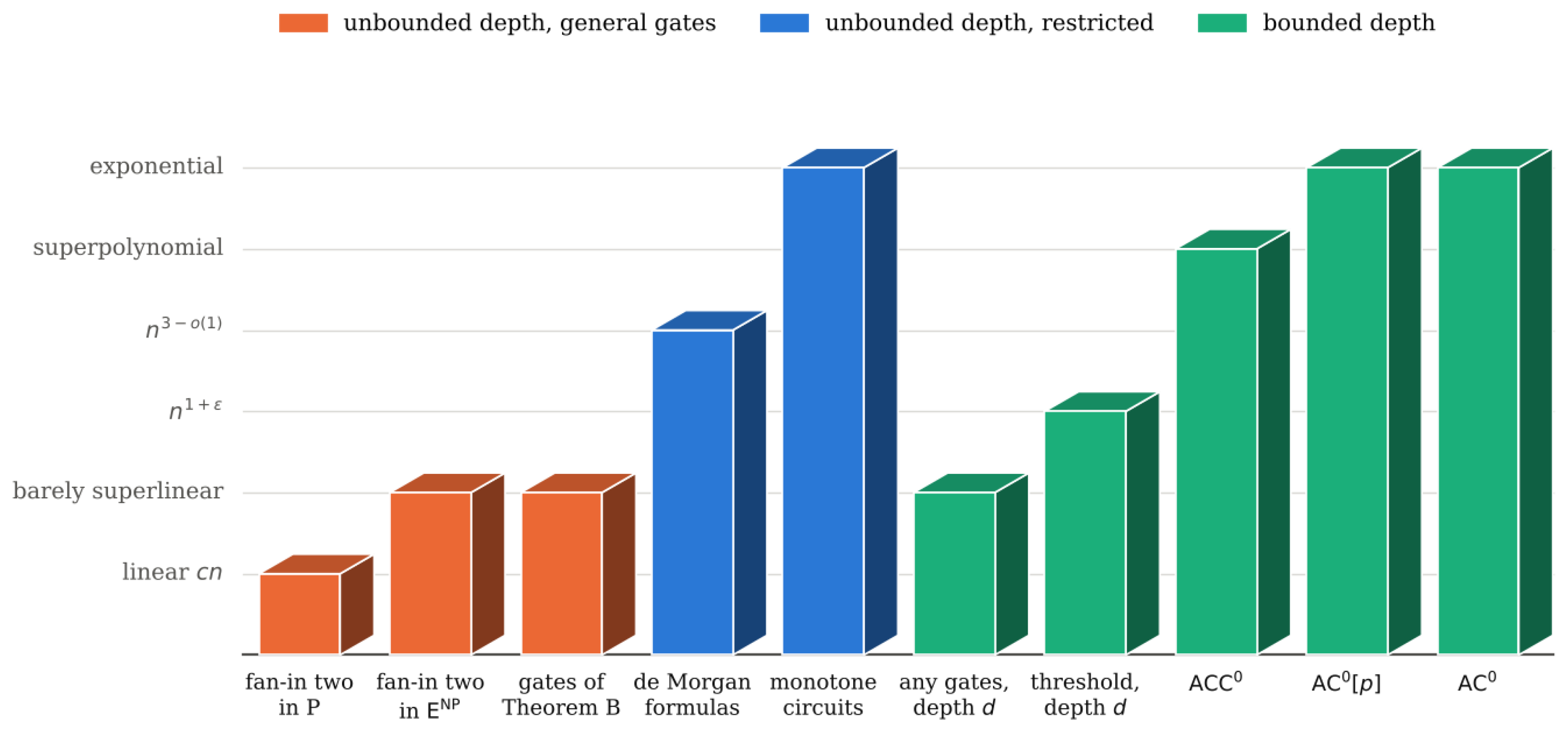
Figure 2.
Williams’ argument as used in Section 11. A unary language that is hard for nondeterministic time is reduced locally to a succinct 3-CNF; a small circuit for the witness language is guessed, three copies of it read the variables of an indexed clause, and the test circuit is checked by the counting algorithm of Theorem A.

Figure 3.
Announced solutions of the versus problem listed by Woeginger [118], by year and verdict (114 dated entries). None of them is accepted.
Figure 3.
Announced solutions of the versus problem listed by Woeginger [118], by year and verdict (114 dated entries). None of them is accepted.
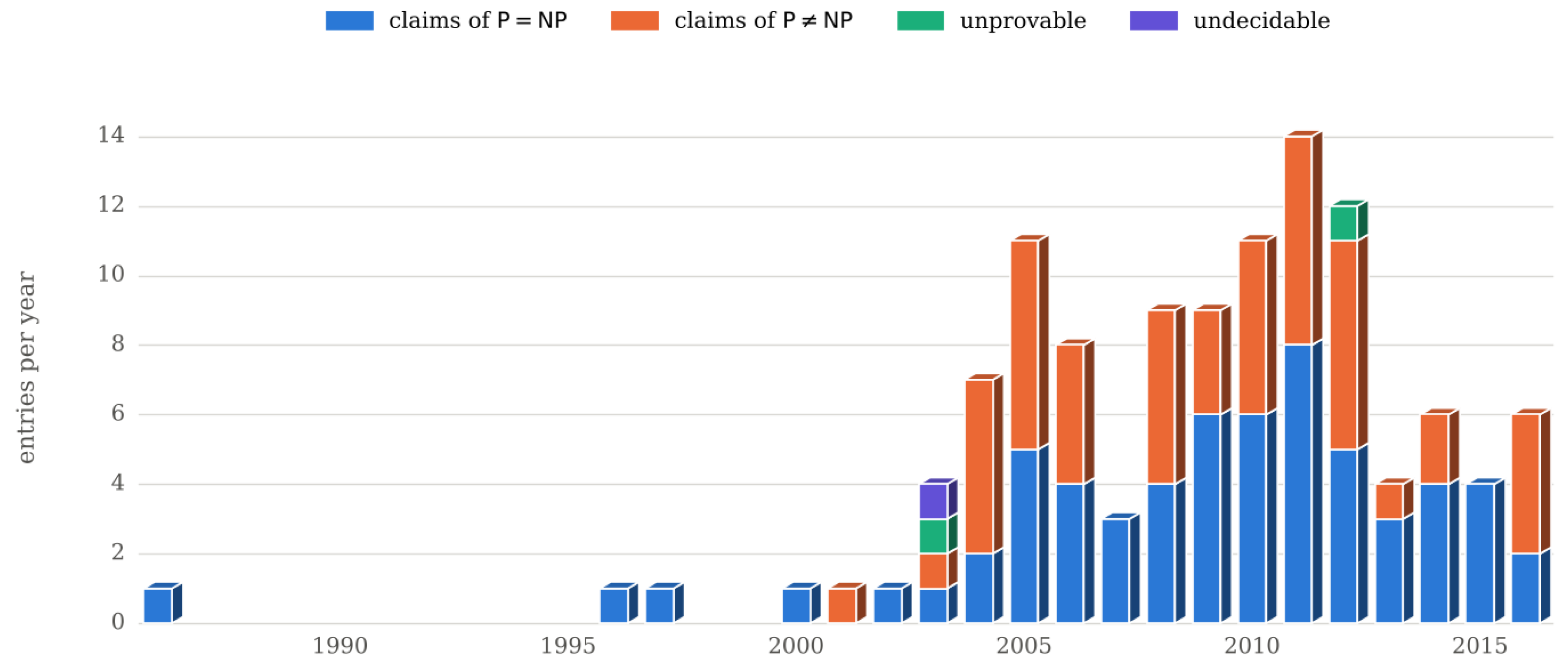
Figure 4.
Papers of the arXiv catalogue in the core categories, by year of first version and by topic (2,617 papers; a paper matching several topics is counted once for each).
Figure 4.
Papers of the arXiv catalogue in the core categories, by year of first version and by topic (2,617 papers; a paper matching several topics is counted once for each).
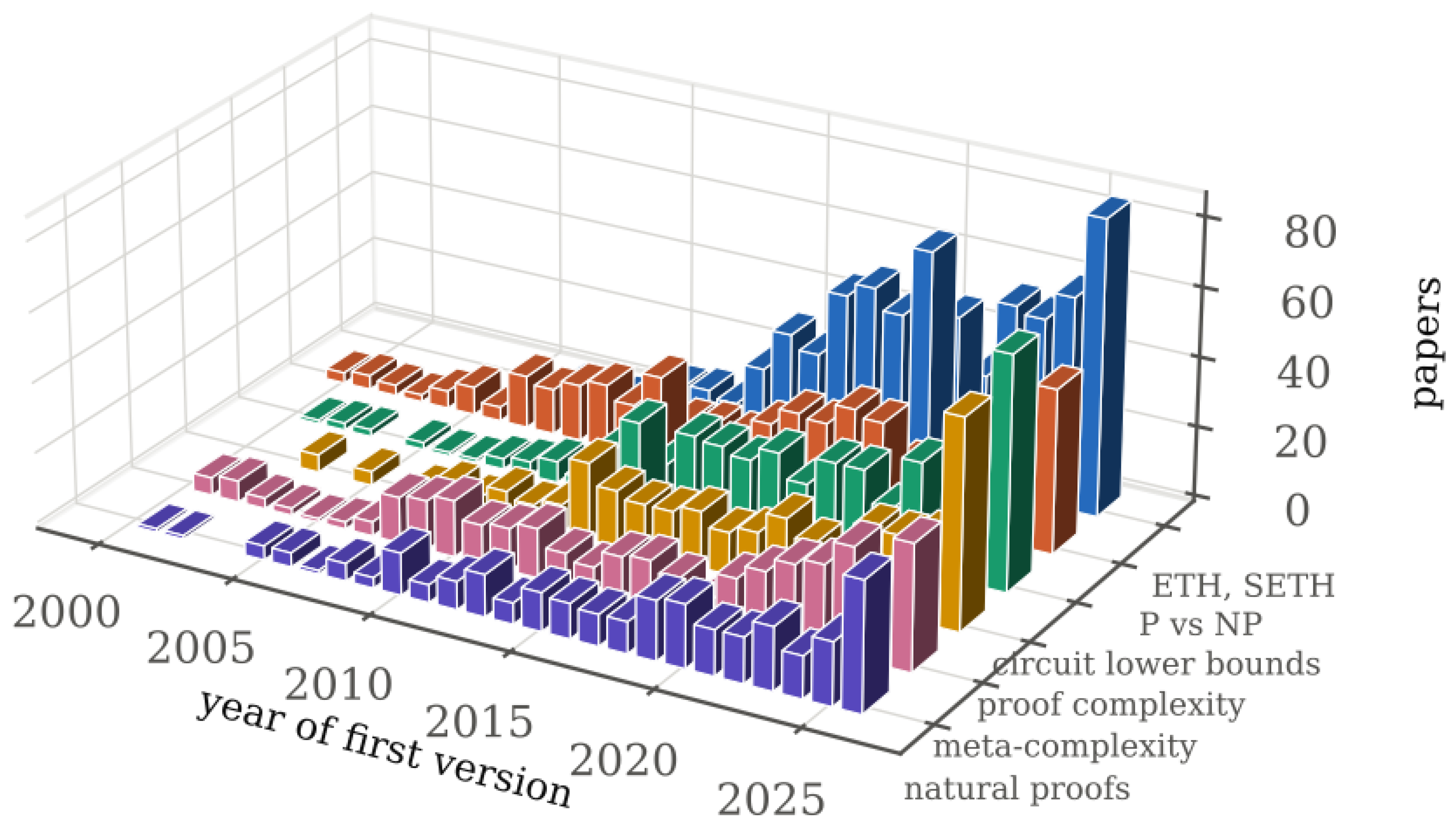
Figure 5.
The network of a small circuit (Section 9). Gate vertices (blue) carry the tables ; each signal is distributed to its ports by a tree of equality vertices (green), here a single vertex; a pin sits on the output; every edge is then subdivided by a binary equality vertex (white), which makes the network bipartite.
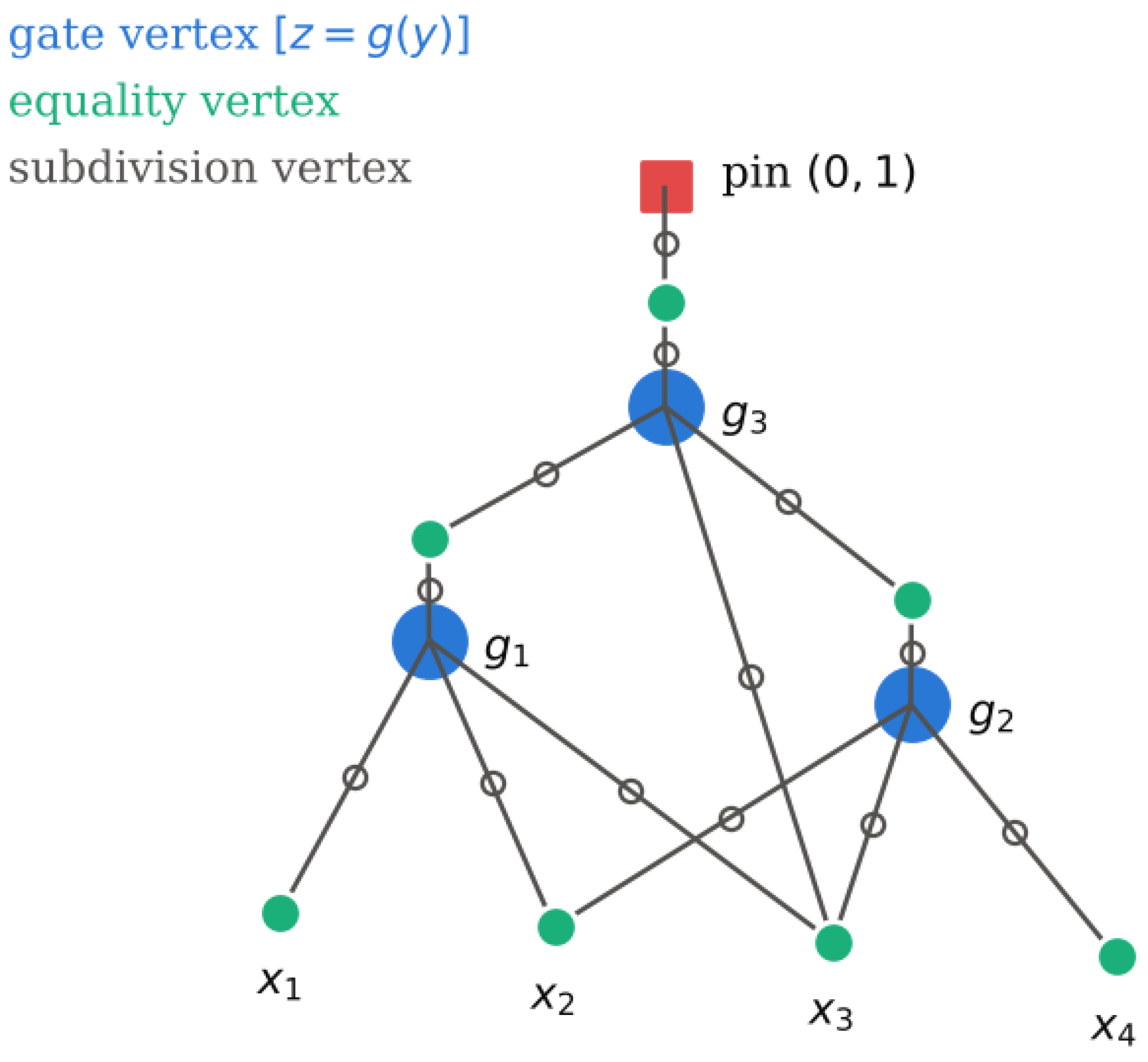
Figure 6.
A big weighted gate. Its f inputs are cut into blocks of at most K inputs; the block vertex writes the shifted partial sum on b edges, and the root adds the decoded values and applies . Every vertex then has degree .
Figure 6.
A big weighted gate. Its f inputs are cut into blocks of at most K inputs; the block vertex writes the shifted partial sum on b edges, and the root adds the decoded values and applies . Every vertex then has degree .
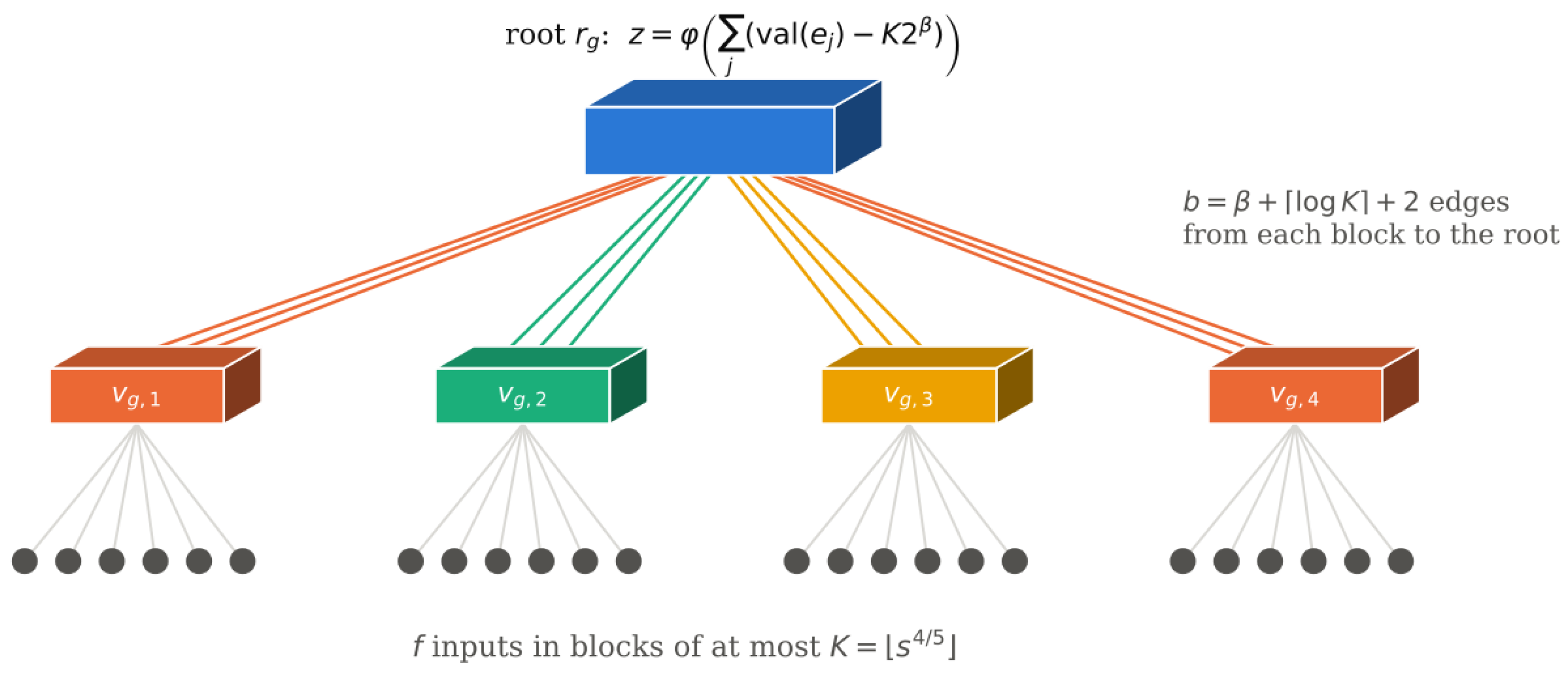
Disclaimer/Publisher’s Note: The statements, opinions and data contained in all publications are solely those of the individual author(s) and contributor(s) and not of MDPI and/or the editor(s). MDPI and/or the editor(s) disclaim responsibility for any injury to people or property resulting from any ideas, methods, instructions or products referred to in the content. |
© 2026 by the authors. Licensee MDPI, Basel, Switzerland. This article is an open access article distributed under the terms and conditions of the Creative Commons Attribution (CC BY) license (http://creativecommons.org/licenses/by/4.0/).
Copyright: This open access article is published under a Creative Commons CC BY 4.0 license, which permit the free download, distribution, and reuse, provided that the author and preprint are cited in any reuse.