
Submitted:
04 November 2026
Posted:
05 November 2026
You are already at the latest version
Abstract
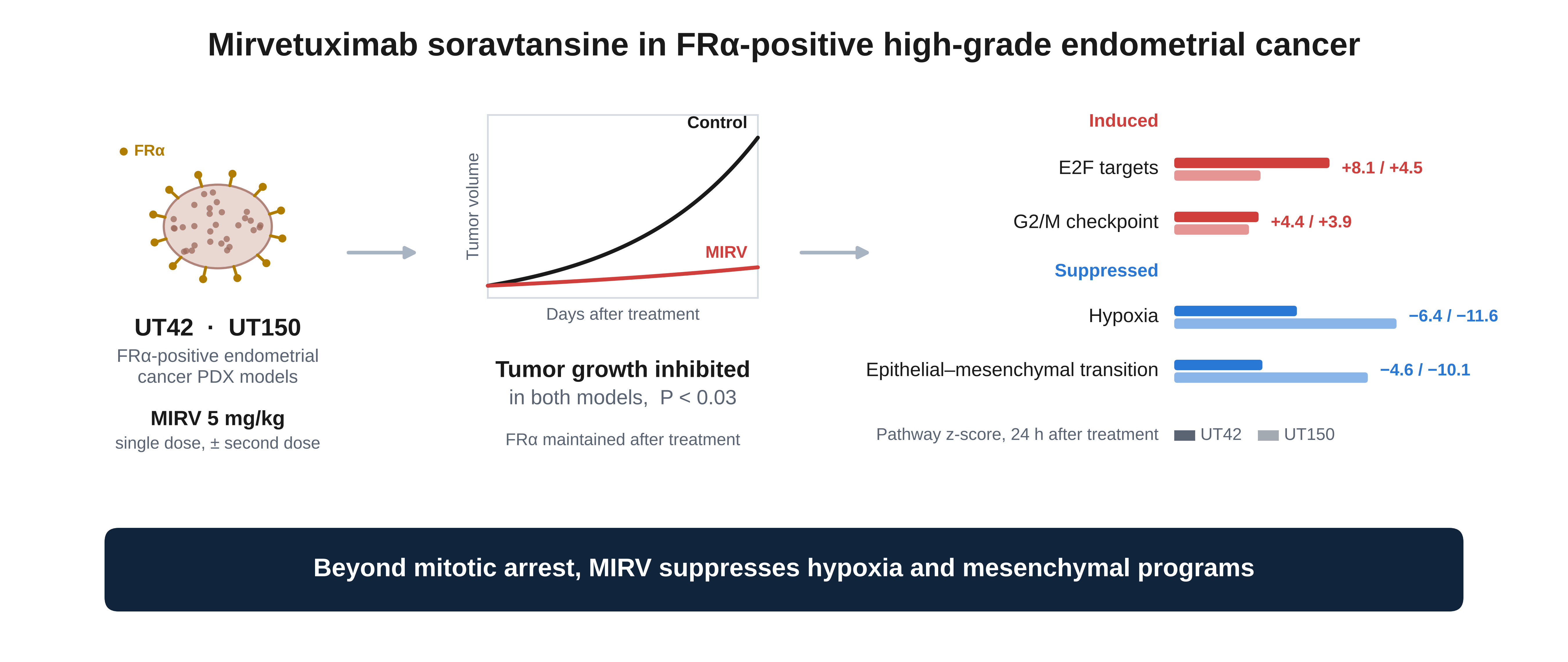
Folate receptor-α (FRα) is overexpressed in a subset of high-grade endometrial cancers, but the activity and molecular effects of the FRα-targeting antibody–drug conjugate mirvetuximab soravtansine (MIRV) in this disease are undefined. Mice bearing two FRα-positive high-grade recurrent high-grade endometrial cancer patient-derived xenografts (PDXs; UT42, UT150) were randomized to a single tail vein injection of MIRV (5 mg/kg) or phosphate-buffered saline (control); a separate UT150 cohort received a second dose on Day 9. Tumors harvested 24 hours after treatment underwent microarray profiling and Hallmark, KEGG, and Gene Ontology pathway scoring. MIRV significantly inhibited tumor growth in both models, and a second dose produced more durable suppression (P<0.03). FRα protein expression was maintained after MIRV treatment. In both models, MIRV induced E2F target (z = 8.1 and 4.5) and G2/M checkpoint (z = 4.4 and 3.9) programs, consistent with DM4-induced mitotic arrest. MIRV also suppressed hypoxia (z = −6.4 and −11.6), epithelial–mesenchymal transition (EMT; z = −4.6 and −10.1), glycolysis and interferon-γ response programs. Genes reduced in both models (n = 117; 66 expected by chance) were enriched for TNFα/NF-κB, IL2–STAT5, EMT, and hypoxia signaling (FDR ≤ 0.002). These exploratory findings support evaluating MIRV-based combinations, including with anti-angiogenic agents, in endometrial cancer.
Keywords:
recurrent endometrial cancer
; folate receptor alpha (FRα)
; patient-derived xenografts
; mirvetuximab soravtansine
; antibody-drug conjugates
Copyright: This open access article is published under a Creative Commons CC BY 4.0 license, which permit the free download, distribution, and reuse, provided that the author and preprint are cited in any reuse.