

Submitted:
04 November 2026
Posted:
05 November 2026
You are already at the latest version
Abstract
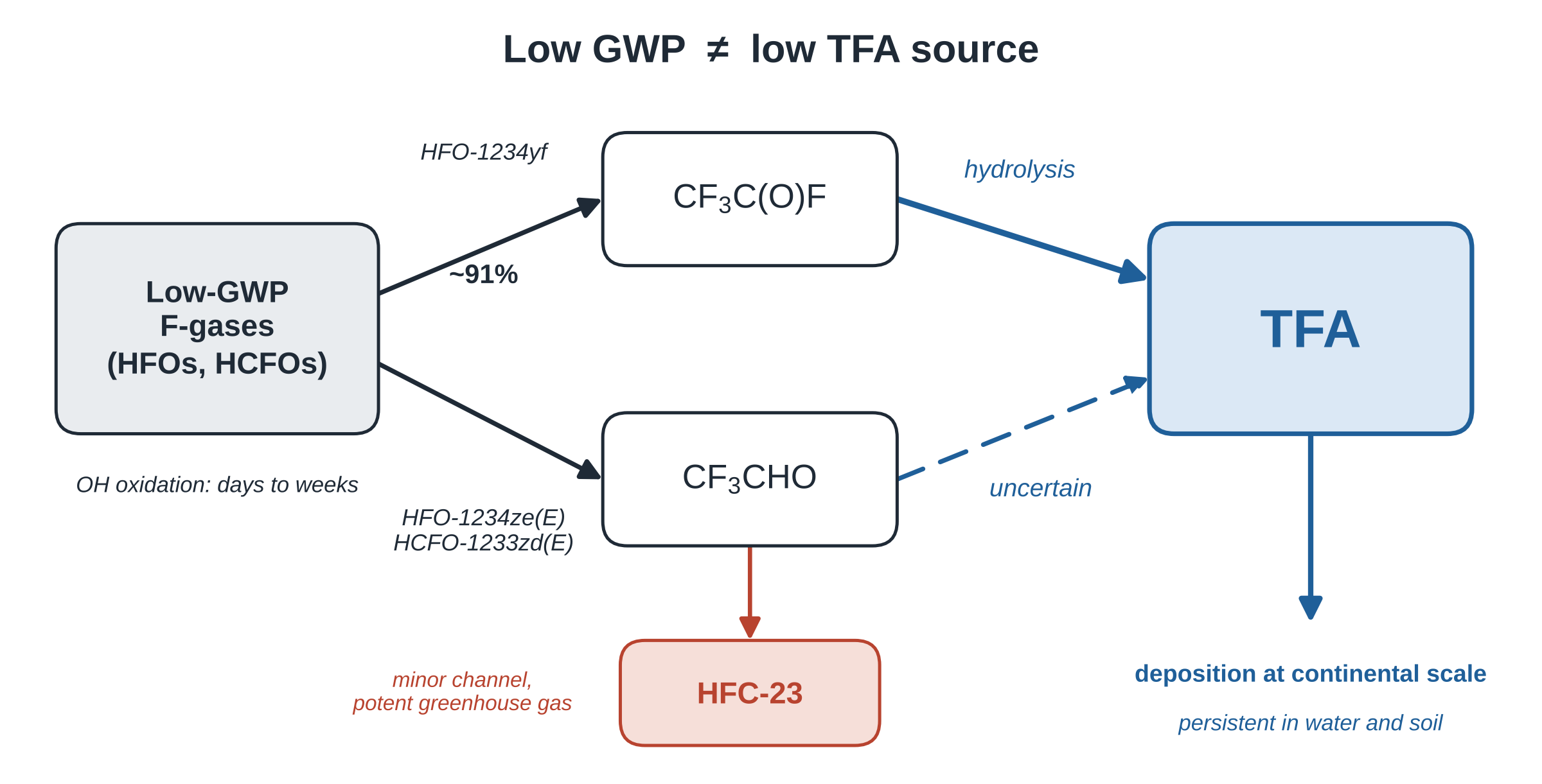
The phase-down of hydrofluorocarbons (HFCs) is driving a shift to hydrofluoroolefins (HFOs), hydrochlorofluoroolefins (HCFOs) and their blends. HFOs and HCFOs have a low global warming potential (GWP) and are short-lived, but several of them are oxidised in the atmosphere to trifluoroacetic acid (TFA), which is removed by wet and dry deposition and persists in water and soil. This short review examines these fluorinated gases as atmospheric precursors of TFA and the implications for their use. Their conversion to TFA depends on the carbonyl formed: HFO-1234yf, the main refrigerant in mobile air conditioning, gives trifluoroacetyl fluoride and hence TFA almost quantitatively, whereas HFO-1234ze(E) and HCFO-1233zd(E) form trifluoroacetaldehyde, whose uncertain fate leads to lower conversion and to some formation of the potent greenhouse gas HFC-23. Because these precursors react within days to weeks, TFA formation shifts from a global to a continental scale, with deposition concentrated in and downwind of emission regions. Recent modelling suggests that HFO-1234yf may already exceed HFC-134a as a source of TFA over Europe. Open questions concern the fate of trifluoroacetaldehyde, source attribution and the monitoring of TFA in air.
Keywords:
trifluoroacetic acid
; TFA
; F-gases
; hydrofluoroolefins
; HFO-1234yf
; atmospheric deposition
; refrigerants
; hydrochlorofluoroolefins
1. Introduction
The Kigali Amendment (2016), the EU Mobile Air Conditioning (MAC) Directive 2006/40/EC (global warming potential, GWP, < 150 in new vehicles) and the revised F-gas Regulation (EU) 2024/573 are phasing down hydrofluorocarbons (HFCs) such as HFC-134a in refrigeration and air conditioning. Their main replacements are hydrofluoroolefins (HFOs), hydrochlorofluoroolefins (HCFOs) and HFO/HFC blends, whose atmospheric lifetimes are days to weeks rather than years.
Many of these fluorinated gases (F-gases) carry a carbon-bound trifluoromethyl group (C–CF3). Since the strong C–F bonds make the CF₃ group resistant to further oxidation, their atmospheric degradation can end in trifluoroacetic acid (TFA, CF3C(O)OH) (Section 3, Figure 1), which is removed from the air within days by wet and dry deposition and is highly persistent and mobile in water and soil [1,2,3]. Climate metrics such as the GWP describe the radiative effect of the emitted gas, but not the fate of its fluorine, which for several of these molecules ends up as TFA deposited at the surface. TFA is now also on the regulatory agenda: the 2023 proposal to restrict per- and polyfluoroalkyl substances (PFAS) as a class under the Registration, Evaluation, Authorisation and Restriction of Chemicals (REACH) Regulation includes F-gases [4,5], and in June 2026 the Risk Assessment Committee (RAC) of the European Chemicals Agency (ECHA) recommended a harmonised classification for TFA as toxic for reproduction, persistent, mobile and toxic (PMT), and very persistent and very mobile (vPvM) [6].
Recent reviews and assessments have examined TFA mainly from the perspective of its environmental persistence, exposure and risk [1,2,3,7]. This short review takes an atmospheric perspective, focusing on the low-GWP F-gases that are replacing HFCs: how their chemistry determines whether TFA is formed (Section 3), how their emissions translate into TFA formation and deposition (Section 4), and what this implies for refrigerant choices, regulation and assessment metrics (Section 5). It closes with the questions that current evidence leaves open (Section 6).
2. Methodology
This review is a critical narrative synthesis rather than a systematic review. The evidence on TFA formation from F-gases spans laboratory kinetic and product studies, chemical transport modelling and field measurements, which differ too much in design and metrics for a systematic protocol such as PRISMA (Preferred Reporting Items for Systematic Reviews and Meta-Analyses) to be applied meaningfully. The literature was identified through searches of Scopus and through backward citation tracking and was complemented by regulatory documents and technical reports. Sources that have not been peer-reviewed are identified as such in the text.
3. F-Gases as TFA Precursors
The fraction of an F-gas converted to TFA depends on which carbonyl compound its oxidation produces, not on its fluorine content alone. When this carbonyl is CF₃C(O)F, the yield is essentially a property of the molecule; when it is CF₃CHO, it also depends on the atmospheric fate of the carbonyl. All the refrigerants considered here are removed mainly by reaction with the hydroxyl radical OH; for HFO-1234ze(E), for example, OH accounts for about 99.6% of the atmospheric loss [8]. In practice, the precursors fall into two groups, depending on whether oxidation yields trifluoroacetyl fluoride, CF3C(O)F, or trifluoroacetaldehyde, CF3CHO (Table 1, Figure 1).
Precursors forming CF3C(O)F. HFC-134a is oxidised by H-atom abstraction to the CF3CHFO radical, which either reacts with O2 to give CF3C(O)F or breaks apart; this branching, still uncertain, limits its conversion to TFA to about 7–20% [10,11]. In HFO-1234yf, OH adds to the double bond and the resulting radicals lead almost entirely to CF3C(O)F [12]. CF3C(O)F is not significantly photolysed in the troposphere; it is taken up by cloud water and hydrolysed to TFA within days [12,15,16]. A recent theoretical study questioned whether the previously proposed gas-phase mechanism can form CF3C(O)F and TFA from HFC-134a under atmospheric conditions [17]; a subsequent comment attributed this result to the omission of key reaction steps, including the hydrolysis of CF3C(O)F, and reaffirmed a conversion to TFA of about 7–20% [18].
Precursors forming CF3CHO. HFO-1234ze(E), HCFO-1233zd(E) and HFO-1336mzz(Z) are oxidised to CF3CHO with near-unit yield [8,14,19]. The fate of CF3CHO then determines how much TFA is formed. Photolysis does not give TFA, whereas reaction with OH leads, through the trifluoroacetylperoxy radical (CF₃C(O)O₂), to TFA [20]; degradation of trifluoroacetyl peroxynitrate (CF₃C(O)O₂NO₂) in the presence of water may add a further minor route [21]. Model studies that treat CF3CHO as removed mainly by photolysis obtain a low conversion to TFA, for example about 2% for HCFO-1233zd(E) despite a lifetime of about one month [14]. A recent global model study of HFO-1234ze(E) that includes wet and dry deposition of CF3CHO finds instead that, under upper-bound assumptions for its solubility, deposition may account for about half of its loss, photolysis for one third and reaction with OH for about 15%; if the wet-deposited CF3CHO were fully converted, current emissions of about 15 Gg/yr could form up to 4.5 Gg/yr of TFA, depending on the assumed solubility [8], corresponding to a conversion of up to about 30% (upper bound rather than a central estimate). The conversion to TFA of CF₃CHO-forming precursors is therefore uncertain and depends on aqueous-phase processes that remain poorly constrained. Figure 1 summarises these pathways, including CF₃CHO photolysis, hydration, uptake and deposition, HFC-23 formation and the deposition of TFA; ozonolysis, a minor sink of these olefins [8], is not shown.
By-products. Photolysis of CF₃CHO produces small amounts of fluoroform (CHF₃, HFC-23), a very potent and long-lived greenhouse gas [22], and ozonolysis of HFOs and HCFOs can yield HFC-23, PFC-14 and CFC-13 [23]. In a box-model study, the HFC-23 channel accounted for 1.3–4.4% of CF₃CHO removal, depending on the assumed photolysis quantum yield [24]; quantum yields since measured at atmospheric pressure are lower [22]. Because HFC-23 has a 100-year GWP (GWP₁₀₀) of 14,600 [9], even such small conversions raise the climate impact of CF₃CHO-forming precursors well above their direct GWP [25]: a global model study puts the total (direct plus indirect) GWP₁₀₀ of HFO-1234ze(E) at about 11, compared with a direct value of 1.37 [9], of which about 8 is due to HFC-23 formed from CF₃CHO [8].
Blends. In stationary refrigeration and air conditioning, HFOs are mostly used in blends with HFCs. The amount of TFA a blend can form depends on the mass fraction of each component and on its conversion to TFA (Table 1). Assuming that the whole charge is eventually emitted and oxidised, and because HFO-1234yf and TFA have almost the same molar mass, the mass of TFA that a blend based on HFO-1234yf can form is roughly proportional to its HFO-1234yf mass fraction. Blends with the same components can therefore differ markedly: HFO-1234yf makes up 78.5% of R-454C but 31.1% of R-454B [26], while HFC-32, the other component of both, contains no CF₃ group and is not a TFA precursor. Servicing extends the use of these blends to existing equipment. Under Article 13 of Regulation (EU) 2024/573, F-gases with a GWP of 2500 or more may no longer be used to service refrigeration equipment from 2025, except for reclaimed or recycled gases until 2030, and the threshold falls to 750 for stationary refrigeration other than chillers from 2032. Existing systems can be retrofitted with HFC/HFO blends such as R-448A and R-449A, which combine 20–25% HFO-1234yf with 21–26% HFC-134a by mass [26]; leakage during operation and servicing of the installed bank therefore remains a diffuse and continuing source of TFA precursors.
4. From Emission to Deposition
For a given precursor, TFA formation scales with the mass emitted, while where it is deposited depends on the spatial distribution of emissions, OH levels, cloud and precipitation regimes; emissions, and hence how F-gases are used, are as important as their chemistry. Charge size, leakage, servicing and end-of-life recovery determine emissions. Mobile air conditioning is the main source of HFO-1234yf in Europe; stationary systems use HFOs mainly in blends; and HFO-1234ze(E) has been proposed as a propellant for pressurised metered-dose inhalers (pMDIs) [27]. Atmospheric observations show that emissions are already significant: in north-western Europe they reached about 1.50 Gg/yr for HFO-1234yf, 0.96 Gg/yr for HFO-1234ze(E) and 1.04 Gg/yr for HCFO-1233zd(E) in 2023 [28].
Chemical transport models translate emissions into TFA formation and deposition at global and regional scales; Table 2 summarises selected studies, their scenarios and main results.
These results depend on assumptions that differ between studies: emission inventories and scenarios, the conversion of each precursor to TFA, the treatment of CF₃CHO, the representation of clouds, aerosols and dry and wet deposition, and the meteorological year. Direct measurements of TFA in air, which could validate them, remain scarce (Section 6). Despite variations among studies, they collectively indicate that the deposition of TFA from HFO-1234yf corresponds to emitted mass, with about 60–70% deposited outside the emitting region in Europe and 86–89% in East Asia, while areas with low rainfall exhibit the highest concentrations in rainwater. [36,37]. In the European study (full conversion of the 2020 car fleet, single meteorological year), the higher-resolution model placed the deposition maximum over the Po Valley, where emission hot spots coincide with high dry deposition; the two models gave European maxima of 1.9–2.5 kg/km²/yr [30]. Although based on a single scenario, this result makes Northern Italy a priority region for national emission estimates and deposition measurements.
A projection of the European passenger-car fleet, published as a white paper by a supplier of CO2 and propane air-conditioning systems and not peer-reviewed, estimates that annual TFA formation will keep rising until about 2036 without further restrictions, and notes that larger refrigerant charges in heat pumps of battery electric vehicles may make this an underestimate [32]. The direction of this trend is consistent with peer-reviewed studies showing that HFO-1234yf may already exceed HFC-134a as a source of TFA over Europe [31] and that emissions will increase substantially once the fleet has fully converted [30]. The installed bank of HFC-134a will also keep producing TFA for years after its phase-down.
Substituting HFC-134a with HFO-1234yf alters the formation and deposition patterns of TFA, as the former disperses globally before degradation while the latter is transformed within days, resulting in TFA being generated closer to its sources and concentrated in deposition areas at a continental scale rather than hemispheric, especially near emission hotspots and their downwind regions. [30,33,36]. Once formed, TFA has a tropospheric lifetime of only a few days [29]; how it partitions between the gas phase, cloud water and particles controls how far it travels and whether it is removed by rain or by dry deposition [38,39].
The overall monitoring of emissions from precursors to TFA deposition remains sparse. The Advanced Global Atmospheric Gases Experiment (AGAGE) network now measures precursor levels in ambient air [28,40], and between 2021 and 2023, TFA concentrations in Swiss precipitation have surged four to six times since 1996/1997, reaching mean values of 0.30–0.96 µg/L across 14 monitoring sites [41]. At the sites of Swiss Plateau, modelled degradation of known precursors explains about 63% of the observed deposition, 48% from HFOs alone, and leaves more than one third unexplained, with summertime deposition underestimated about five-fold [41]. This gap may reflect unaccounted sources, underestimated emissions, or uncertainties in atmospheric processing and deposition, and cannot be attributed to F-gases without further evidence. Where the atmospheric sources of TFA have been examined, the picture varies: HFC-134a alone could explain 56–90% of rainwater TFA in Guangzhou [42], whereas in Beijing it accounted for only 14% (6–33%) of TFA deposition [43], a share later revised to about 6% (2–13%) with an updated TFA yield [44]. Other sources, such contr4ibute to atmospheric TFA, such as inhalation anaesthetics [45] and fluoropolymer thermolysis, as found to contribute little to rainwater TFA [46], and early studies already found TFA levels difficult to explain with the degradation of HFCs and hydrochlorofluorocarbons (HCFCs) alone [47]. Direct measurements of TFA in air, in the gas and particulate phases, remain scarce [39,43].
5. Implications for Use
5.1. Refrigerant Choices
Non-fluorinated refrigerants do not form TFA, but they involve other trade-offs. In mobile air conditioning, CO₂ heat-pump systems are already in series production, while propane systems are under development [32]; alternatives for hybrid and combustion-engine vehicles are less mature. In stationary applications, CO₂, ammonia and hydrocarbons are established options; a recent review concludes that only slight technical barriers remain for most new systems, with possible trade-offs in initial cost, operating pressure or capacity, but not in energy efficiency [48]. Where F-gases remain in use, TFA formation and by-products are relevant alongside GWP when comparing them (Section 3).
5.2. Regulation
Regulation of TFA-forming F-gases has so far been driven by ozone and climate objectives rather than by TFA. The Montreal Protocol, the MAC Directive and the F-gas Regulation select refrigerants on the basis of their ozone depletion potential and GWP, and the GWP limit of the MAC Directive was the main driver of the shift to HFO-1234yf in Europe. Only recently have instruments begun to address TFA directly: the proposed REACH restriction covers F-gases as PFAS, and the harmonised classification of TFA would formally recognise its hazards, although classification does not by itself limit emissions (Table 3).
In the same industry projection, cumulative atmospheric TFA formation over 2028–2058 ranges from about 102 Gg with a full restriction to 143 Gg with time-limited derogations and 240 Gg without restriction [32]; these figures illustrate the effect of timing rather than providing quantitative estimates. Because TFA from HFO-1234yf is formed within days of emission, reductions in emissions would lower TFA formation almost immediately, although part of the benefit would be felt downwind of the regions that reduce emissions. Outside the EU, approaches diverge. The structural definition of PFAS adopted by the US EPA for reporting under the Toxic Substances Control Act does not appear to capture TFA or most F-gases used as refrigerants, which lack the required fluorinated substructures [51]. By contrast, Maine and Minnesota define PFAS as fluorinated organic chemicals containing at least one fully fluorinated carbon atom, a definition that includes TFA and its precursors; Maine will prohibit the sale of refrigerants containing intentionally added PFAS from 2040 [52], and Minnesota prohibits products with intentionally added PFAS from 2032 unless their use is deemed currently unavoidable [53].
5.3. Assessment Metrics
Refrigerant selection is influenced by the GWP of the parent molecule, while life-cycle metrics like total equivalent warming impact (TEWI) and life-cycle climate performance (LCCP) account for leakage and energy use. reflect the atmospheric behaviour of refrigerants only in part: the degradation-product term is small for HFO-1234yf and is set to zero when data are lacking [54], and it could at most capture climatically active by-products such as HFC-23. The widely used LCCP analysis of HFO-1234yf dates back to 2009 [55], and more recent assessments, for instance of heat pumps in electric vehicles, still consider climate impacts only [54]. Non-climatic consequences, such as the formation and deposition of persistent TFA, therefore remain outside these metrics.
6. Open Questions
For HFO-1234yf the picture is fairly clear, but for CF₃CHO-forming precursors, and for the TFA already observed in the environment, several questions remain open. The first concerns the fate of CF3CHO. For the short-lived HFOs and HCFOs that form it, the conversion to TFA depends on how CF3CHO partitions between photolysis, reaction with OH, and uptake into cloud water, aerosol and surfaces followed by deposition, and on how much HFC-23 it forms. These branchings remain poorly constrained.
A second set of questions concerns the TFA already observed. Refrigerants, anaesthetics and other fluorinated sources overlap in time and space, and attribution to F-gases rests on few studies: in Switzerland, known precursors explain about 63% of the observed deposition, leaving more than one third unexplained [41]. Where TFA is deposited, and by which route, is also uncertain, since modelled deposition patterns differ between studies and the dry deposition and gas/particle partitioning of TFA are poorly constrained. Measurements of TFA in air are sparse and not harmonised, and national emission estimates are lacking; harmonised methods for gas- and particle-phase TFA, deposition networks and inverse modelling of precursor emissions would allow model results to be tested against observations.
7. Conclusions
Low-GWP F-gases reduce the direct climate impact of refrigerants, but several of them are efficient atmospheric precursors of TFA. For HFO-1234yf, whose OH-initiated oxidation leads near-quantitatively to CF₃C(O)F and hence to TFA, the atmospheric consequence is a rapid formation of TFA within days of emission, deposited at continental rather than global scale and concentrated in and downwind of emission regions. For CF3CHO-forming molecules, the conversion to TFA is lower but uncertain, and a substantial part of their climate impact may come from by-products such as HFC-23. In both cases, the metrics currently used to select refrigerants do not account for their atmospheric fate, and the open questions above would need to be addressed to include it. These findings support closer monitoring and the prevention of emissions of TFA-forming F-gases, both in view of the progressively stricter requirements of Regulation (EU) 2024/573 and in line with the precautionary and polluter-pays principles on which EU environmental policy is based (Article 191(2) TFEU). In Italy, the same principles underpin a joint call by water utilities and environmental and consumer associations for a rapid and complete restriction of PFAS, with strictly time-limited exemptions [56].
Author Contributions
Conceptualization, S.M. and M.M.; methodology, S.M. and M.M.; visualization, S.M., M.C. and M.M.; writing—original draft preparation, S.M.; writing— review and editing, S.M., M.C. and M.M.; supervision, S.M. All authors have read and agreed to the published version of the manuscript
Funding
This research received no external funding
Institutional Review Board Statement
Not applicable.
Informed Consent Statement
Not applicable.
Data Availability Statement
No new data were created or analyzed in this study. Data sharing is not applicable to this article.
Use of Artificial Intelligence
AI-assisted tools were used during the preparation of this manuscript. Claude (Anthropic) was used to assist with structuring the manuscript and language editing. The authors reviewed and edited all AI-assisted content and take full responsibility for the content of this publication.
Conflicts of Interest
The authors declare no conflicts of interest.
Abbreviations
The following abbreviations are used in this manuscript:
| AGAGE | Advanced Global Atmospheric Gases Experiment |
| CLP | Classification, Labelling and Packaging Regulation |
| ECHA | European Chemicals Agency |
| EFTA | European Free Trade Association |
| EPA | Environmental Protection Agency (United States) |
| F-gases | Fluorinated gases |
| GWP | Global warming potential |
| HCFC | Hydrochlorofluorocarbon |
| HCFO | Hydrochlorofluoroolefin |
| HFC | Hydrofluorocarbon |
| HFO | Hydrofluoroolefin |
| LCCP | Life-cycle climate performance |
| MAC | Mobile air conditioning |
| PFAS | Per- and polyfluoroalkyl substances |
| pMDI | Pressurised metered-dose inhaler |
| PMT | Persistent, mobile and toxic |
| RAC | Committee for Risk Assessment (ECHA) |
| REACH | Registration, Evaluation, Authorisation and Restriction of Chemicals |
| SEAC | Committee for Socio-Economic Analysis (ECHA) |
| TEWI | Total equivalent warming impact |
| TFA | Trifluoroacetic acid |
| vPvM | Very persistent and very mobile |
References
- Arp, H.P.H.; et al. The Global Threat from the Irreversible Accumulation of Trifluoroacetic Acid (TFA). Environ. Sci. Technol. 2024, 58, 19925–19935. [Google Scholar] [CrossRef] [PubMed]
- Moscato, A.; Longo, M.V.; Ferrante, M.; Fiore, M. Trifluoroacetic Acid: A Narrative Review on Physico-Chemical Properties, Exposure Pathways, and Toxicological Concerns. Environments 2025, 12, 277. [Google Scholar] [CrossRef]
- Hanson, M.L.; Madronich, S.; Solomon, K.R.; Sulbaek Andersen, M.P.; Wallington, T.J. Trifluoroacetic Acid in the Environment: Consensus, Gaps, and Next Steps. Environ. Toxicol. Chem. 2024, 43, 2091–2093. [Google Scholar] [CrossRef] [PubMed]
- European Chemicals Agency (ECHA). Annex XV Restriction Report. Proposal for a Restriction: Per- and Polyfluoroalkyl Substances (PFASs), Version 2; ECHA: Helsinki, Finland, 2023; Available online: https://echa.europa.eu/registry-of-restriction-intentions/-/dislist/details/0b0236e18663449b (accessed on 29 September 2026).
- Yu, R.-S.; Yu, H.-C.; Yang, Y.-F. A Global Overview of Per- and Polyfluoroalkyl Substance Regulatory Strategies and Their Environmental Impact. Toxics 2025, 13, 251. [Google Scholar] [CrossRef] [PubMed]
- European Chemicals Agency (ECHA). Minutes of the 77th Meeting of the Committee for Risk Assessment (RAC-77), 1–5 June 2026; ECHA: Helsinki, Finland, 2026; Available online: https://echa.europa.eu/documents/d/guest/rac77_final_minutes_en (accessed on 29 September 2026).
- Madronich, S.; Sulzberger, B.; Longstreth, J.D.; Schikowski, T.; Sulbæk Andersen, M.P.; Solomon, K.R.; Wilson, S.R. Changes in Tropospheric Air Quality Related to the Protection of Stratospheric Ozone in a Changing Climate. Photochem. Photobiol. Sci. 2023, 22, 1129–1176. [Google Scholar] [CrossRef] [PubMed]
- Killen, B.; Fisher, J.A.; Hansen, C.S.; et al. Atmospheric Fates and Global Warming Potential of HFO-1234ze(E) and Its Degradation Product Trifluoroacetaldehyde (CF3CHO). Environ. Sci. Atmos. 2026, 6, 913–932. [Google Scholar] [CrossRef]
- Smith, C.; Nicholls, Z.R.J.; Armour, K.; et al. The Earth’s Energy Budget, Climate Feedbacks, and Climate Sensitivity Supplementary Material. In Climate Change 2021: The Physical Science Basis. Contribution of Working Group I to the Sixth Assessment Report of the Intergovernmental Panel on Climate Change; Masson-Delmotte, V., et al., Eds.; IPCC: Geneva, Switzerland, 2021; Available online: https://www.ipcc.ch/report/ar6/wg1/ (accessed on 21 September 2026).
- Wallington, T.J.; Hurley, M.D.; Ball, J.C.; Kaiser, E.W. Atmospheric Chemistry of Hydrofluorocarbon 134a: Fate of the Alkoxy Radical 1,2,2,2-Tetrafluoroethoxy. Environ. Sci. Technol. 1992, 26, 1318–1324. [Google Scholar] [CrossRef]
- Wallington, T.J.; Hurley, M.D.; Fracheboud, J.M.; et al. Role of Excited CF3CFHO Radicals in the Atmospheric Chemistry of HFC-134a. J. Phys. Chem. 1996, 100, 18116–18122. [Google Scholar] [CrossRef]
- Hurley, M.D.; Wallington, T.J.; Javadi, M.S.; Nielsen, O.J. Atmospheric Chemistry of CF3CF=CH2: Products and Mechanisms of Cl Atom and OH Radical Initiated Oxidation. Chem. Phys. Lett. 2008, 450, 263–267. [Google Scholar] [CrossRef]
- Hulse, R.J.; Basu, R.S.; Singh, R.R.; Thomas, R.H.P. Physical Properties of HCFO-1233zd(E). J. Chem. Eng. Data 2012, 57, 3581–3586. [Google Scholar] [CrossRef]
- Sulbaek Andersen, M.P.; Schmidt, J.A.; Volkova, A.; Wuebbles, D.J. A Three-Dimensional Model of the Atmospheric Chemistry of E and Z-CF3CH=CHCl (HCFO-1233(zd) (E/Z)). Atmos. Environ. 2018, 179, 250–259. [Google Scholar] [CrossRef]
- Kotamarthi, V.R.; Rodríguez, J.M.; Ko, M.K.W.; et al. Trifluoroacetic Acid from Degradation of HCFCs and HFCs: A Three-Dimensional Modeling Study. J. Geophys. Res. Atmos. 1998, 103, 5747–5758. [Google Scholar] [CrossRef]
- Holland, R.; Khan, M.A.H.; Driscoll, I.; et al. Investigation of the Production of Trifluoroacetic Acid from Two Halocarbons, HFC-134a and HFO-1234yf and Its Fates Using a Global Three-Dimensional Chemical Transport Model. ACS Earth Space Chem. 2021, 5, 849–857. [Google Scholar] [CrossRef]
- Vincent, A.; Fujioka, K.; Luo, Y.; Kaiser, R.I.; Sun, R. Trifluoroacetic Acid Formation from HFC-134a under Atmospheric Conditions. Phys. Chem. Chem. Phys. 2026, 28, 4433–4444. [Google Scholar] [CrossRef] [PubMed]
- Wallington, T.J.; Barker, J.R.; Sulbaek Andersen, M.P.; Nielsen, O.J. Comment on “Trifluoroacetic Acid Formation from HFC-134a under Atmospheric Conditions”. Phys. Chem. Chem. Phys. 2026, 28, 8992. [Google Scholar] [CrossRef] [PubMed]
- Javadi, M.S.; Søndergaard, R.; Nielsen, O.J.; Hurley, M.D.; Wallington, T.J. Atmospheric Chemistry of trans-CF3CH=CHF: Products and Mechanisms of Hydroxyl Radical and Chlorine Atom Initiated Oxidation. Atmos. Chem. Phys. 2008, 8, 3141–3147. [Google Scholar] [CrossRef]
- Baumann, F.; Fernholz, C.; Lelieveld, J.; Crowley, J.N. Kinetics of the Reaction of CF3CHO with OH between 204 K and 361 K. Phys. Chem. Chem. Phys. 2025, 27, 18907–18916. [Google Scholar] [CrossRef] [PubMed]
- Nielsen, O.J.; Sulbaek Andersen, M.P. Trifluoroacetic Acid Production from Trifluoroacetyl Peroxynitrate Degradation in the Presence of Water. Atmos. Pollut. Res. 2026, 17, 102828. [Google Scholar] [CrossRef]
- Thomson, J.D.; Campbell, J.S.; Edwards, E.B.; et al. Fluoroform (CHF3) Production from CF3CHO Photolysis and Implications for the Decomposition of Hydrofluoroolefins and Hydrochlorofluoroolefins in the Atmosphere. J. Am. Chem. Soc. 2025, 147, 33–38. [Google Scholar] [CrossRef] [PubMed]
- Garavagno, M.L.A.; Wenger, A.; Holland, R.E.T.; et al. Atmospheric Oxidation of Hydrofluoroolefins and Hydrochlorofluoroolefins by Ozone Produces HFC-23, PFC-14, and CFC-13. Environ. Sci. Technol. 2025, 59, 26031–26040. [Google Scholar] [CrossRef] [PubMed]
- Pérez-Peña, M.P.; Fisher, J.A.; Hansen, C.S.; Kable, S.H. Assessing the Atmospheric Fate of Trifluoroacetaldehyde (CF3CHO) and Its Potential as a New Source of Fluoroform (HFC-23) Using the AtChem2 Box Model. Environ. Sci. Atmos. 2023, 3, 1767–1777. [Google Scholar] [CrossRef]
- Salierno, G. On the Chemical Pathways Influencing the Effective Global Warming Potential of Commercial Hydrofluoroolefin Gases. ChemSusChem 2024, 17, e202400280. [Google Scholar] [CrossRef] [PubMed]
- ASHRAE. Refrigerant Designations. Available online: https://www.ashrae.org/technical-resources/standards-and-guidelines/ashrae-refrigerant-designations (accessed on 13 October 2026).
- Tewari, S.G.; Vijayaraghavan, K.; Zhao, K.; et al. Atmospheric and Watershed Modelling of Trifluoroacetic Acid from Oxidation of HFO-1234ze(E) Released by Prospective Pressurised Metered-Dose Inhaler Use in Three Major River Basins. Atmos. Chem. Phys. 2025, 25, 15469–15486. [Google Scholar] [CrossRef]
- Vollmer, M.K.; Pitt, J.R.; Young, D.; et al. Global Observations and European Emissions of the Halogenated Olefins HFO-1234yf, HFO-1234ze(E), and HCFO-1233zd(E) from the AGAGE (Advanced Global Atmospheric Gases Experiment) Network. Atmos. Chem. Phys. 2026, 26, 6993–7012. [Google Scholar] [CrossRef]
- Khan, M.A.H.; Mendes, D.C.; Holland, R.E.T.; et al. Global Modeling of Trifluoroacetic Acid Surface Concentration and Deposition from the Gas-Phase Oxidation of a Wide Range of Precursor Hydrofluoroolefins. Environ. Sci. Atmos. 2026, 6, 195–212. [Google Scholar] [CrossRef]
- Henne, S.; Shallcross, D.E.; Reimann, S.; et al. Future Emissions and Atmospheric Fate of HFC-1234yf from Mobile Air Conditioners in Europe. Environ. Sci. Technol. 2012, 46, 1650–1658. [Google Scholar] [CrossRef] [PubMed]
- Holland, R.; Adam, B.; Khan, M.A.H.; et al. TFA Generation and Deposition over Europe May Currently See a Greater Influence from HFO-1234yf than HFC-134a. Environ. Sci. Technol. Lett. 2026, 13, 938–945. [Google Scholar] [CrossRef] [PubMed]
- Heckt, R.; Freitag, H. TFA contamination from fluorinated gases used in mobile air-conditioning systems and already available PFAS-free alternatives.; White Paper; Hanon Systems, May 2026; Available online: https://webinar.atmosphere.cool/hanon/assets/hanon-tfa-white-paper.pdf.
- Wang, Y.; Liu, L.; Qiao, X.; et al. Atmospheric Fate and Impacts of HFO-1234yf from Mobile Air Conditioners in East Asia. Sci. Total Environ. 2024, 916, 170137. [Google Scholar] [CrossRef] [PubMed]
- Kazil, J.; McKeen, S.; Kim, S.-W.; et al. Deposition and Rainwater Concentrations of Trifluoroacetic Acid in the United States from the Use of HFO-1234yf. J. Geophys. Res. Atmos. 2014, 119, 14059–14079. [Google Scholar] [CrossRef]
- Luecken, D.J.; Waterland, R.L.; Papasavva, S.; et al. Ozone and TFA Impacts in North America from Degradation of 2,3,3,3-Tetrafluoropropene (HFO-1234yf), a Potential Greenhouse Gas Replacement. Environ. Sci. Technol. 2010, 44, 343–348. [Google Scholar] [CrossRef] [PubMed]
- David, L.M.; Barth, M.; Höglund-Isaksson, L.; et al. Trifluoroacetic Acid Deposition from Emissions of HFO-1234yf in India, China, and the Middle East. Atmos. Chem. Phys. 2021, 21, 14833–14849. [Google Scholar] [CrossRef]
- Wujcik, C.E.; Cahill, T.M.; Seiber, J.N. Determination of Trifluoroacetic Acid in 1996–1997 Precipitation and Surface Waters in California and Nevada. Environ. Sci. Technol. 1999, 33, 1747–1751. [Google Scholar] [CrossRef]
- Guo, J.; Zhai, Z.; Wang, L.; et al. Dynamic and Thermodynamic Mechanisms of TFA Adsorption by Particulate Matter. Environ. Pollut. 2017, 225, 175–183. [Google Scholar] [CrossRef] [PubMed]
- Zhang, B.; Zhai, Z.; Zhang, J. Distribution of Trifluoroacetic Acid in Gas and Particulate Phases in Beijing from 2013 to 2016. Sci. Total Environ. 2018, 634, 471–477. [Google Scholar] [CrossRef] [PubMed]
- Vollmer, M.K.; Reimann, S.; Hill, M.; Brunner, D. First Observations of the Fourth Generation Synthetic Halocarbons HFC-1234yf, HFC-1234ze(E), and HCFC-1233zd(E) in the Atmosphere. Environ. Sci. Technol. 2015, 49, 2703–2708. [Google Scholar] [CrossRef] [PubMed]
- Henne, S.; Storck, F.R.; Wöhrnschimmel, H.; et al. Trifluoroacetate (TFA) in Precipitation and Surface Waters in Switzerland: Trends, Source Attribution, and Budget. Atmos. Chem. Phys. 2025, 25, 18157–18186. [Google Scholar] [CrossRef]
- Wang, Q.; Wang, X.; Ding, X. Rainwater Trifluoroacetic Acid (TFA) in Guangzhou, South China: Levels, Wet Deposition Fluxes and Source Implication. Sci. Total Environ. 2014, 468–469, 272–279. [Google Scholar] [CrossRef] [PubMed]
- Wu, J.; Martin, J.W.; Zhai, Z.; et al. Airborne Trifluoroacetic Acid and Its Fraction from the Degradation of HFC-134a in Beijing, China. Environ. Sci. Technol. 2014, 48, 3675–3681. [Google Scholar] [CrossRef] [PubMed]
- Wallington, T.J.; Orlando, J.J.; Tyndall, G.S.; Nielsen, O.J. Comment on “Airborne Trifluoroacetic Acid and Its Fraction from the Degradation of HFC-134a in Beijing, China”. Environ. Sci. Technol. 2014, 48, 9948. [Google Scholar] [CrossRef] [PubMed]
- Hart, L.; Hossaini, R.; Wild, O.; et al. Growth in Production and Environmental Deposition of Trifluoroacetic Acid Due to Long-Lived CFC Replacements and Anesthetics. Geophys. Res. Lett. 2026, 53, e2025GL119216. [Google Scholar] [CrossRef]
- Cui, J.; Guo, J.; Zhai, Z.; Zhang, J. The Contribution of Fluoropolymer Thermolysis to Trifluoroacetic Acid (TFA) in Environmental Media. Chemosphere 2019, 222, 637–644. [Google Scholar] [CrossRef] [PubMed]
- Jordan, A.; Frank, H. Trifluoroacetate in the Environment. Evidence for Sources Other than HFC/HCFCs. Environ. Sci. Technol. 1999, 33, 522–527. [Google Scholar] [CrossRef]
- Glüge, J.; Breuer, K.; Hafner, A.; Vering, C.; Müller, D.; Cousins, I.T.; Lohmann, R.; Goldenman, G.; Scheringer, M. Finding Non-Fluorinated Alternatives to Fluorinated Gases Used as Refrigerants. Environ. Sci. Process. Impacts 2024, 26, 1955–1974. [Google Scholar] [CrossRef] [PubMed]
- United Nations Environment Programme (UNEP). Decision XXVIII/1: Further Amendment of the Montreal Protocol. In Report of the Twenty-Eighth Meeting of the Parties to the Montreal Protocol on Substances that Deplete the Ozone Layer; UNEP/OzL.Pro.28/12; UNEP: Kigali, Rwanda, 2016. [Google Scholar]
- European Chemicals Agency (ECHA). PFAS Restriction: ECHA Committees’ Opinions and Next Steps; ECHA: Helsinki, Finland, 2026; Available online: https://www.echa.europa.eu/-/pfas-2026-echa-committees-opinions (accessed on 15 October 2026).
- U.S. Environmental Protection Agency. Toxic Substances Control Act Reporting and Recordkeeping Requirements for Perfluoroalkyl and Polyfluoroalkyl Substances. Fed. Regist. 2023, 88, 70516–70560. Available online: https://www.govinfo.gov/content/pkg/FR-2023-10-11/pdf/2023-22094.pdf.
- Maine Department of Environmental Protection. PFAS in Products. Available online: https://www.maine.gov/dep/spills/topics/pfas/PFAS-products/index.html (accessed on 23 October 2026). See also 38 M.R.S. §1614, as amended by P.L. 2023, c. 630.
- Minnesota Statutes, Section 116.943. Office of the Revisor of Statutes: Saint Paul, MN, USA. 2025. Available online: https://www.revisor.mn.gov/statutes/?id=116.943 (accessed on 07 October 2026).
- Yu, B.; Long, J.; Zhang, Y.; Ouyang, H.; Wang, D.; Shi, J.; Chen, J. Life Cycle Climate Performance Evaluation (LCCP) of Electric Vehicle Heat Pumps Using Low-GWP Refrigerants towards China’s Carbon Neutrality. Appl. Energy 2024, 353, 122061. [Google Scholar] [CrossRef]
- Koban, M. HFO-1234yf Low GWP Refrigerant LCCP Analysis. SAE Tech. Pap. 2009, 2009-01-0179. [Google Scholar] [CrossRef]
- Utilitalia; Legambiente; Consumers’ Forum. Manifesto “Verso l’eliminazione dei PFAS”: Un impegno condiviso per la tutela della salute e dell’ambiente; Rome, Italy, 2026. Available online: https://www.legambiente.it/wp-content/uploads/2026/03/Manifesto-PFAS.pdf (accessed on 30 October 2026). (In Italian)
Figure 1.
Simplified atmospheric pathways from HFC-134a, hydrofluoroolefins (HFOs) and hydrochlorofluoroolefins (HCFOs) to trifluoroacetic acid (TFA). Solid arrows: main channels; dashed arrows: minor or uncertain channels. The relative importance of CF₃CHO photolysis, reaction with the hydroxyl radical (OH), uptake into the aqueous phase and deposition is poorly constrained and largely determines the conversion of CF₃CHO-forming precursors to TFA; HFC-23 formation is a minor channel with a large climate impact.
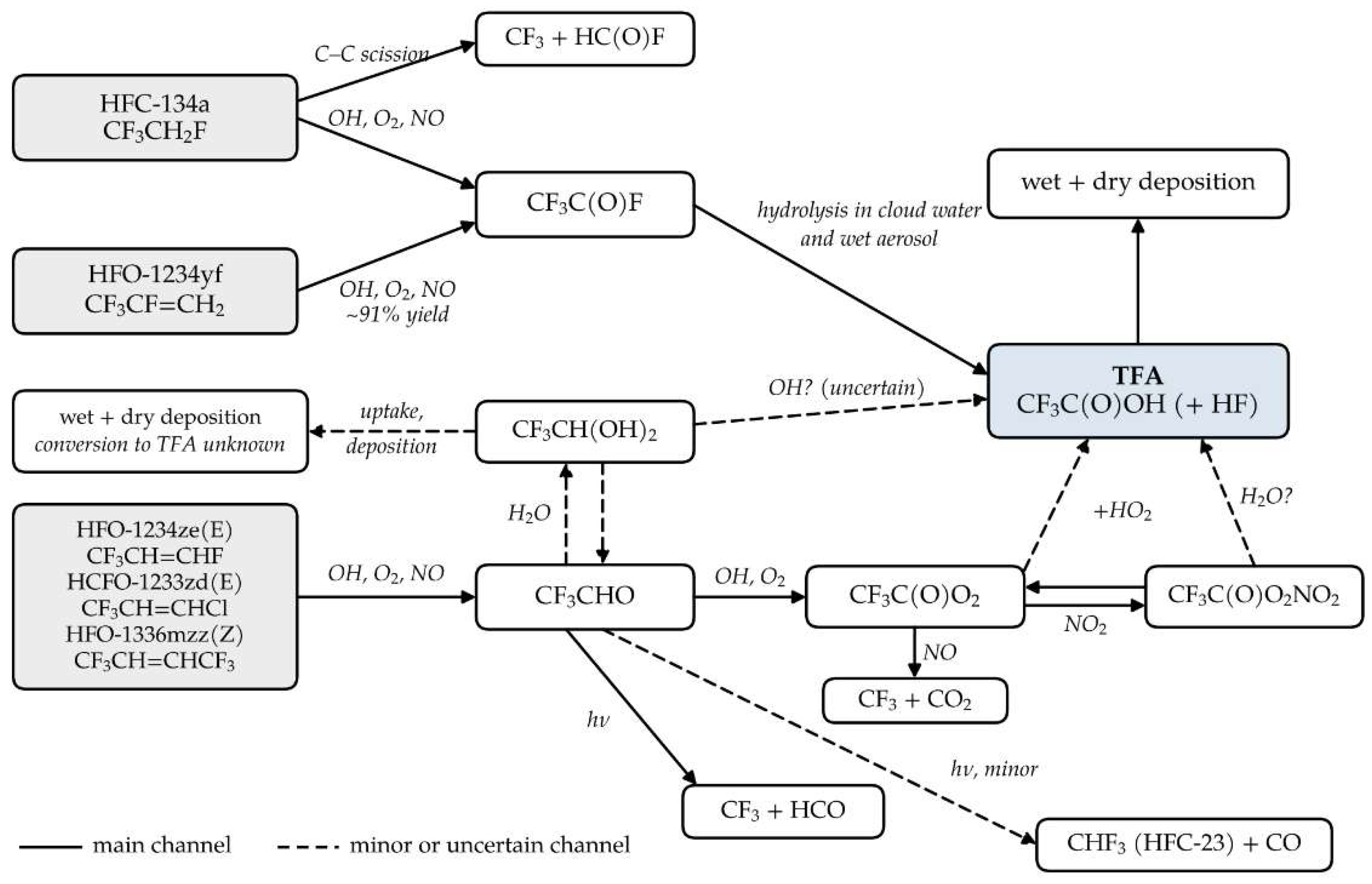

Table 1.
Atmospheric lifetimes, primary carbonyl products and conversion to trifluoroacetic acid (TFA) of selected refrigerants. Lifetimes are global-mean total atmospheric lifetimes from [9] unless otherwise indicated; for the short-lived hydrofluoroolefins (HFOs) and hydrochlorofluoroolefins (HCFOs), actual lifetimes vary with hydroxyl radical (OH) concentrations, and hence with location and season. The primary carbonyl is formed with near-unit yield, except for HFC-134a; for HFO-1234yf the measured yield is 91 ± 6%. Conversion to TFA refers to the overall atmospheric fate of the emitted precursor (mol TFA per mol precursor).
| Precursor | Atmospheric lifetime | Primary carbonyl | Conversion to TFA | Basis |
| HFC-134a (CF3CH2F) |
14 years | CF3C(O)F, via the CF3CHFO alkoxy radical | ~7–20% | Laboratory studies; range reflects uncertain branching of CF₃CHFO [10,11] |
| HFO-1234yf (CF3CF=CH2) | 12 days | CF3C(O)F | near-quantitative (91 ± 6%) |
Laboratory product study, OH-initiated oxidation [12] |
| HFO-1234ze(E) (CF3CH=CHF) | 19 days | CF3CHO | ≤30% (upper bound) | Global model; upper bound assumes full conversion of wet-deposited CF₃CHO [8] |
| HCFO-1233zd(E) (CF3CH=CHCl) | 42 days (26–36 days in [13,14]) | CF3CHO | ~2% | Global model, CF₃CHO removed by photolysis and OH [14] |
| HFO-1336mzz(Z) (CF3CH=CHCF3) | 27 days | CF3CHO (up to 2 per molecule) | Not quantified | - |
Table 2.
Selected studies linking F-gas emissions to TFA formation and deposition. EFTA, European Free Trade Association; MAC, mobile air conditioning; pMDI, pressurised metered-dose inhaler.
Table 2.
Selected studies linking F-gas emissions to TFA formation and deposition. EFTA, European Free Trade Association; MAC, mobile air conditioning; pMDI, pressurised metered-dose inhaler.
| Region/study | Precursor and scenario | Main result |
| Global [16] | HFO-1234yf replacing HFC-134a | About 33-fold increase in global TFA burden for equivalent emissions |
| Global [29] | Oxidation of a wide range of HFOs | 54–78 Gg/yr TFA; tropospheric TFA lifetime ~3.8 days |
| Europe [30] | HFO-1234yf from MAC, 11.0–19.2 Gg/yr | Mean deposition 0.65–0.76 kg/km²/yr; 30–40% deposited within Europe; maximum 1.9–2.5 kg/km²/yr (Po Valley) |
| Europe [31] | HFO-1234yf and HFC-134a, 2023 emission estimates | HFO-1234yf may already exceed HFC-134a as a source of TFA over Europe |
| Europe, passenger cars [32] | MAC fleet, EU-27 + EFTA + UK ((industry white paper) | ~6 Gg/yr TFA in 2025, >80% from HFO-1234yf; baseline peak >9 Gg/yr around 2036 |
| East Asia [33] | HFO-1234yf from MAC, 30.3 Gg/yr | Deposition 0.35–0.53 kg/km²/yr; only 11–14% deposited in the emitting countries |
| United States [34,35] | HFO-1234yf replacing HFC-134a in MAC | Mean rainwater TFA 0.89 µg/L, peaks 7.8 µg/L in dry western areas [34]; 1.3 µg/L in a 2.5-month summer simulation [35] |
| India, China, Middle East [36] | HFO-1234yf projections | Substantial deposition outside source regions; highest concentrations in low-rainfall regions |
| Three river basins [27] | HFO-1234ze(E) from prospective pMDI use | Highest deposition in the tropics, away from northern mid-latitude emission regions |
Table 3.
Regulatory instruments relevant to TFA-forming F-gases. CLP, Classification, Labelling and Packaging Regulation; GWP, global warming potential; HCFCs, hydrochlorofluorocarbons; HCFOs, hydrochlorofluoroolefins; HFCs, hydrofluorocarbons; HFOs, hydrofluoroolefins; MAC, mobile air conditioning; PFAS, per- and polyfluoroalkyl substances; PMT, persistent, mobile and toxic; RAC, Committee for Risk Assessment; REACH, Registration, Evaluation, Authorisation and Restriction of Chemicals; Repr. 1B, toxic for reproduction, Category 1B; SEAC, Committee for Socio-Economic Analysis; vPvM, very persistent and very mobile.
| Instrument | Target | Relevance for TFA |
| Montreal Protocol and Kigali Amendment | HCFCs, HFCs | Phase-down of HFC-134a [49] |
| Directive 2006/40/EC (MAC) | Refrigerants in new vehicles, GWP < 150 | Main driver of HFO-1234yf adoption in Europe |
| Regulation (EU) 2024/573 (F-gas) |
Fluorinated greenhouse gases | Further phase-down and bans; does not address TFA directly |
| REACH PFAS restriction proposal (2023) | PFAS as a group, including HFCs, HFOs, HCFOs | RAC final opinion (March 2026) and SEAC draft opinion support a restriction with targeted derogations; SEAC final opinion pending [50] |
| CLP harmonised classification of TFA | TFA and its inorganic salts | RAC opinion (June 2026): Repr. 1B, PMT, vPvM; not adopted into CLP Annex VI [6] |
Disclaimer/Publisher’s Note: The statements, opinions and data contained in all publications are solely those of the individual author(s) and contributor(s) and not of MDPI and/or the editor(s). MDPI and/or the editor(s) disclaim responsibility for any injury to people or property resulting from any ideas, methods, instructions or products referred to in the content. |
© 2026 by the authors. Licensee MDPI, Basel, Switzerland. This article is an open access article distributed under the terms and conditions of the Creative Commons Attribution (CC BY) license (http://creativecommons.org/licenses/by/4.0/).
Copyright: This open access article is published under a Creative Commons CC BY 4.0 license, which permit the free download, distribution, and reuse, provided that the author and preprint are cited in any reuse.