

Submitted:
03 November 2026
Posted:
05 November 2026
You are already at the latest version
Abstract
HIV immunotherapy encompasses antiviral maintenance, immune restoration, treatment of inflammatory morbidity and attempts to achieve remission or eradication. Broadly neutralizing antibodies have prolonged control after antiretroviral therapy withdrawal in randomized trials, although residual antibody activity complicates interpretation of remission. Therapeutic vaccines, checkpoint inhibitors and engineered effectors offer complementary mechanisms, with variable clinical activity and toxicity. These findings, together with reservoir and (multi-)omic studies, support matching interventions to viral susceptibility, immune competence and treatment exposure. The evidence for using host profiles to assign immunotherapy remains limited, however. This review examines the transition from biological stratification to clinically validated personalization. Natural controllers illustrate how virological containment can coexist with inflammation, while phenotyping studies reveal heterogeneity within conventional clinical groups. Longitudinal mathematical models can connect these observations with changing drug exposure and viral escape. Prospective randomized studies are needed to establish whether immunogenetic, immunophenotypic or model-guided treatment assignment improves outcomes beyond conventional selection. Durable virological control, immune health, safety and treatment burden together determine the clinical value of this approach.
Keywords:
HIV-1
; immunotherapy
; personalized medicine
; remission
; viral reservoir
; broadly neutralizing antibodies
; immunophenotype
; mathematical modelling
1. Introduction
While antiretroviral therapy (ART) has transformed the clinical course of human immunodeficiency virus (HIV) infection, markedly improving survival [1] and preventing sexual transmission during sustained viral suppression [2], it does not cure the infection. Viral reservoirs persist despite treatment [3-5], and immune recovery can remain incomplete. Adverse effects and continuing adherence demands add to the burden of lifelong therapy [6].
Concern about long-term toxicity helped motivate SMART (Strategies for Management of Antiretroviral Therapy), which tested whether episodic, CD4-guided treatment could reduce drug exposure without compromising clinical outcomes. Interruption instead increased opportunistic disease or death and major cardiovascular, renal or hepatic disease, without reducing the adverse events associated with ART [6].
Immunotherapy offers a way to address these limitations: sustaining antiviral activity with less frequent treatment, improving immune recovery, or enabling lasting control after ART withdrawal. Trials pursuing the latter use analytical treatment interruption (ATI), with close virological monitoring and prespecified restart criteria [7]. The aim is sustained remission, in which control continues after ART stops despite potentially persistent replication-competent virus, or ultimately eradication of all infection capable of restarting systemic replication [8]. Long-acting antibodies and persistent cellular products may themselves sustain suppression after ART withdrawal, making their duration of activity important to the interpretation of control [7,9]. The durability of control depends on both the reservoir that remains and the host response capable of containing it.
2. Viral persistence and immune control
The difficulty of clearing HIV-1 is rooted in its biology as a member of the genus Lentivirus within Retroviridae. Integration into the host genome, CD4-cell tropism, mucosal injury and immune dysregulation link viral persistence to the progressive impairment of host defense [10,11]. ART suppresses productive infection while leaving a latent reservoir [3,4]; inducible, infectious virus remains recoverable even after decades of treatment, sustained partly by infected-cell proliferation [5].
Proviral integrity, inducibility, integration context, antigen expression and tissue distribution influence both viral rebound and the response to immunotherapy. Profiling studies reveal persistent cells with distinct inhibitory and survival characteristics [12,13]. Blood DNA captures only part of this biology. Clearance depends on whether persistent infection can resume transcription and whether immune effectors can reach, recognize and kill the infected cells [14].
Despite these obstacles, natural controllers demonstrate that prolonged containment is biologically possible. Elite controllers maintain very low or undetectable viraemia without ART, whereas viremic controllers sustain low but measurable virus [15,16]. Post-treatment controllers maintain control after stopping previous ART [17]. Controller-associated natural killer (NK) phenotypes and epigenetic states, together with cellular and humoral findings in post-treatment controllers, suggest multiple protective mechanisms [18-20]. Transient viral exposure can strengthen antibody responses, linking humoral immunity to the course of rebound.
Yet some elite controllers retain immune activation and vascular abnormalities despite low viraemia, with inconsistent hospitalization findings across cohorts [21-23]. Reproducing their viral control alone may leave inflammation and morbidity unresolved [24], strengthening the rationale for interventions that improve immune health as well as suppress replication.
3. Clinical Evidence
Antibody-based approaches have brought this therapeutic ambition closest to clinical application. Broadly neutralizing antibodies (bNAbs) act directly against susceptible virus when exposure remains sufficient. Antibody-based salvage is already clinically relevant: ibalizumab, a CD4-directed post-attachment inhibitor, demonstrated activity against multidrug-resistant HIV alongside optimized background treatment [25]. Leronlimab, also called PRO 140, has shown short-term antiviral activity through blockade of C–C chemokine receptor type 5 (CCR5) [26].
The potential to extend antibody-mediated control beyond conventional ART was tested in RIO, where 68 early-treated men received 3BNC117-LS plus 10-1074-LS or placebo before ATI. At week 20, estimated freedom from protocol-defined rebound was 75% versus 11%, with a hazard ratio of 0.09 (95% confidence interval 0.04–0.21) [27]. The endpoint—six consecutive HIV RNA measurements above 1,000 copies/mL or two above 100,000 copies/mL—allowed periods of detectable viraemia. Residual antibody activity overlapped the period of control, while subsequent kinetics bear on the possibility of longer-lasting remission. A companion analysis associated outcomes with viral sensitivity and autologous antibody activity [28].
Long-acting maintenance regimens offer a more immediate route to reducing treatment burden. Lenacapavir with teropavimab and zinlirvimab, and cabotegravir with VRC07-523LS, have been evaluated for sustained antiviral suppression [29,30]. In Botswana, Tatelo achieved antibody-supported suppression in selected early-treated children with favorable reservoir characteristics [31]. These pediatric findings also highlight the importance of age-dependent pharmacokinetics and early reservoir establishment.
Therapeutic vaccines seek to strengthen endogenous immunity and make control less dependent on passive antibody administration. Their strong immune responses have translated less consistently into virological benefit. AELIX-002 enrolled 44 men and one woman; all participants entering ATI rebounded despite broad responses to HIVACAT T-cell immunogen (HTI) vaccines. In AELIX-003, HTI vaccination plus vesatolimod, a Toll-like receptor 7 agonist, did not significantly improve the principal interruption outcomes, and all 47 participants entering ATI rebounded [32,33]. RIVER (Research in Viral Eradication of HIV Reservoirs) found no reservoir benefit from vaccination and latency reversal over ART alone in recently infected men [34]. Improving recognition remains biologically attractive, but antigen availability and effector function may limit the benefit of vaccination alone.
Tat vaccination has also been evaluated for immune recovery during continued ART. A South African randomized phase II trial, conducted predominantly in women with clade C infection, reported anti-Tat responses and CD4 increases [35]. Its 12-year follow-up described earlier immune and blood-DNA changes, although attrition, ART changes and generally nonsignificant overall between-group comparisons weaken the evidence for a durable vaccine effect [36].
The clinical value of immune recovery remains central to interpreting these findings. In ESPRIT (Evaluation of Subcutaneous Proleukin in a Randomized International Trial) and SILCAAT (Subcutaneous Recombinant Human Interleukin-2 in HIV-Infected Patients with Low CD4 Counts under Active Antiretroviral Therapy), interleukin-2 increased CD4 counts without reducing opportunistic disease or death [37].
4. Combination Immunotherapy
For cure-directed treatment, combining interventions could address the barriers left unresolved by individual approaches, improving antigen expression, recognition, killing or tissue access while restricting viral escape (Figure 1; Table 1). TITAN (Combining a TLR9 Agonist with Broadly Neutralizing Antibodies for Reservoir Reduction and Immunological Control of HIV Infection) tested this rationale in a four-arm randomized study of lefitolimod, a Toll-like receptor 9 agonist, and 3BNC117 plus 10-1074. Antibodies prolonged control, but lefitolimod added no clear benefit [38]. Additional immune stimulation may therefore be useful only when it addresses a limiting mechanism.
Peluso and colleagues tested a broader regimen combining conserved-element vaccination, interleukin-12-supported priming, lefitolimod and dual antibodies in ten participants [39]. Seven showed partial or complete post-intervention control, including six who first rebounded. Activated CD8 responses near rebound correlated with a lower subsequent set point, consistent with a contribution from recall immunity after initial viral restraint. Without a randomized comparator, the contribution of each component and the influence of favorable baseline biology remain uncertain.
Other regimens seek to restore the function of existing effector cells through checkpoint modulation, which has produced control signals alongside concerns about toxicity. In a randomized phase 1b study of budigalimab, an antibody against programmed cell death protein 1 (PD-1), six of eleven recipients in the four-dose 10-mg cohort met an exploratory composite involving delayed rebound, lower peak or subsequent control; two maintained control through study end [40]. A larger 2026 phase II conference report did not establish a significant advantage for its week-24 control endpoint and reported treatment-related serious adverse events [41,42]. Persistent immune-related toxicity is especially consequential in otherwise stable people receiving effective ART, whose risk–benefit balance differs from that of patients treated for other diseases, including cancer.
Effector activity can also be redirected toward infected cells using engineered cellular products or bispecific molecules. In the VRC01-derived chimeric antigen receptor T-cell (CAR-T) study, all six participants undergoing ATI rebounded despite reservoir-associated changes [43]. A first-in-human Gag-directed T-cell receptor bispecific study enrolled people with compatible human leukocyte antigen (HLA)-A*02:01 and peptide recognition; it demonstrated pharmacodynamic activity without reservoir depletion at the studied doses [44]. Both approaches still depend on antigen accessibility, tissue penetration and functional effectors.
Strategies to improve effector activity and reservoir access are being explored in preclinical studies. A scaffold combining interleukin-15 superagonism with neutralization of transforming growth factor-β enhanced HIV-specific CAR-T activity in human-cell experiments [45]. Venetoclax reduced intact reservoirs during continued ART in macaques infected with barcoded simian immunodeficiency virus (SIV) strain SIVmac239M [46]. Studies in infant simian–human immunodeficiency virus (SHIV)-SF162P3 infection combined antibodies, ART and CCR5 blockade, whereas neonatal SIVmac251 experiments depleted CCR5-expressing cells transiently [47,48]. Together, these experiments suggest that intervening during reservoir establishment can amplify the effect of immune and entry-directed treatment; whether similar gains are achievable in chronic human infection remains uncertain.
In humans, prolonged remission after allogeneic transplantation shows how profound alteration of the reservoir and host environment can prevent rebound. Patients undergoing hematopoietic stem cell transplantation, including the Berlin patient, the Geneva patient who received donor cells with wild-type CCR5, the recipient of CCR5Δ32 heterozygous donor cells, and the Oslo patient, provide insights into the varying contributions of reservoir depletion, immune system replacement, and resistance to viral entry in achieving sustained HIV remission or cure [49,50,51,52]. Successful-case analyses and the prospective IciStem cohort support this multifactorial interpretation [53,54]. However, transplant toxicity restricts the procedure to patients with an independent indication, leaving the challenge of reproducing useful mechanisms through less hazardous interventions.
5. Immune Phenotypes and Treatment Response
Immune profiling offers a way to investigate the host biology underlying variable treatment responses, revealing substantial heterogeneity within conventional clinical groups. Ramirez and colleagues identified five immunological clusters, including separate controller-enriched and nonresponder-enriched groups [55]. A 164-person reservoir study found five profiles driven mainly by monocyte HIV-DNA patterns; a separate 154-person CD4 transcriptomic study identified three groups with different inflammatory signatures [56,57]. In a small proteomic study, two inflammatory biotypes crossed treatment and controller categories [58]. Together, these studies relate reservoir heterogeneity to inflammatory and cellular variation (Table 2).
Single-cell studies connect these broader profiles to infected cells with particular survival and immune-evasion properties [12,13]. The emerging therapeutic question is whether such features identify a vulnerability—for example, insufficient antigen expression or resistance to cytotoxic killing—that a selected intervention can overcome.
Tissue and developmental context add further variation. Paired samples from ART-treated women show differences in transcription and persistence across blood, gut, genital tract and liver [59]. Young adults with perinatally acquired HIV have immune and proviral features shaped by developmental exposure and prolonged treatment [60]. These findings make tissue history, age and sex relevant to the interpretation of circulating markers and to the populations in which a proposed treatment match is tested.
Repeated sampling can show how an immune profile changes with viral exposure and treatment. Receptor measurements also require care when the therapeutic antibody itself alters staining [61].
6. Clinical Validation of Personalization
Translating these profiles into treatment choices requires linking the observed biology to a mechanism that can be targeted. Viral susceptibility, CCR5 tropism and HLA–peptide compatibility already provide a basis for matching products to patients. Extending it to immune phenotypes will require evidence that a profile identifies greater benefit from a particular intervention. A small reservoir, for example, may predict slower rebound across several regimens without favoring one treatment over another.
HIV pharmacogenetics provides a precedent. PREDICT-1 (Prospective Randomized Evaluation of DNA Screening in a Clinical Trial) randomized HLA-B*57:01 screening before abacavir and eliminated immunologically confirmed hypersensitivity in the screening arm, compared with 2.7% in controls [62]. CYP2B6-guided efavirenz dosing has also undergone prospective randomized pilot testing, although the small sample limited clinical inference [63].
Immunogenetics already influences eligibility for HLA-restricted interventions such as the Gag-directed bispecific [44]. Host repertoire diversity also influences vaccine responses. In adults without HIV, International AIDS Vaccine Initiative (IAVI) G001 used the eOD-GT8 60mer immunogen to prime B cells with the potential to develop into VRC01-class bNAbs [64]. Follow-up analysis showed that variation in the immunoglobulin heavy-chain variable gene IGHV1-2 explained apparent differences between vaccine-dose groups better than dose itself, largely through differences in the baseline frequency of compatible B-cell precursors. The only vaccine recipient without a detectable VRC01-class response lacked the required IGHV1-2*02 or *04 alleles [65]. These findings suggest that immunoglobulin genotyping and precursor measurements could inform immunogen selection and the interpretation of dose responses across populations. However, therapeutic application of such information remains less developed. Comparable randomized evidence that host immunogenetic or immunophenotypic profiling improves HIV immunotherapy selection is still lacking.
Randomizing treatments within prespecified biomarker groups would reveal whether their effects vary with the profile. Comparing guided treatment with conventional selection would then test the clinical value of using that information. Reproducible assays and adequately powered comparisons are essential, particularly when a favorable profile already predicts a good outcome.
7. Mathematical Modelling and Longitudinal Treatment Decisions
Longitudinal profiling can extend this approach by tracking declining antibody concentrations, expanding resistant lineages and evolving immune responses during treatment. ART timing also changes the relationship between reservoir measurements and rebound [66]. These dynamics make a single pretreatment profile an incomplete basis for personalization [67]. Mathematical models can integrate repeated measurements and could inform treatment choices as exposure and susceptibility change (Figure 2; Table 3).
Stochastic models connect successful reservoir reactivation with the distribution of rebound times. Hill and colleagues examined how a small residual reservoir produces variable waiting times and subsequently used continuing aviraemia to update estimates of residual infection [68,69]. Deterministic virus–immune models describe conditions under which replication-competent virus persists under immune control [70]. The models connect the timing and course of rebound to reservoir reactivation, viral expansion and immune containment (Figure 3).
Models incorporating cell-associated RNA and treatment history have estimated individual rebound distributions; evolutionary models have compared antibody combinations using baseline diversity, escape opportunities and resistance costs [71,72]. Clinical translation remains limited by unmeasured tissue reservoirs and by different parameter combinations that reproduce similar viral trajectories. Validation in independent cohorts is needed before these predictions can reliably guide care.
Cassidy and colleagues modelled PGT121-sensitive and resistant viral populations using clinical data [73]. Baseline resistance and the relative fitness of competing variants helped explain rebound. In two recipients with prolonged suppression, potent neutralization and latent-cell dynamics could reproduce the observations without assuming eradication. Simulated dose escalation had participant-dependent effects, suggesting that dose, epitope coverage and alternative mechanisms merit comparison. Susceptibility, sequence and exposure measurements helped constrain explanations that viral-load trajectories alone could not resolve.
Pharmacokinetics creates an immediate application for such work. Unequal decay can leave one antibody effectively acting alone against the individual's virus. Joint models of component-specific exposure and resistance could compare products or dosing intervals more meaningfully than total antibody concentration alone. Cellular interventions add expansion, functional persistence and tissue access to this problem. Immune endotypes might help explain variation in these processes, once their relationships have been established independently.
ATI studies allow models to be tested against the onset of rebound and subsequent containment within protocol-defined monitoring and restart rules [7,9]. Early kinetics may predict later control [74]. Whether these predictions can improve intervention timing or selection requires prospective evaluation within closely monitored trials.
8. Discussion
Across these studies, the clearest clinical gains have come from antibody-mediated antiviral activity and delayed rebound. RIO demonstrated substantial benefit, while TITAN found no further improvement from adding an innate agonist [27,38]. Future combinations will need to address the mechanisms limiting control in the individual, whether resistance, inadequate antigen recognition, impaired killing or poor tissue access.
Virological suppression can coexist with immune activation and vascular abnormalities in elite controllers, while the interleukin-2 trials demonstrate that improved CD4 counts can occur without fewer serious clinical events [21-23,37]. The clinical value of remission will depend on whether sustained control also restores immune health and reduces morbidity [24].
Reservoir and immune profiling can help explain this dissociation. Rebound potential depends on proviral integrity, inducibility, integration context, clonal expansion and tissue distribution, as well as the ability of immune effectors to reach and kill infected cells [12-14]. Published clusters link this biology to measurable immune variation [55-58]. They offer candidate treatment targets, although a reproducible profile that selects the most effective immunotherapy has yet to emerge.
The decisive evidence will come from randomized comparisons that test whether biological differences modify treatment benefit. Prespecified treatment–biomarker interactions can identify promising matches, and trials of guided selection can establish whether acting on them improves care. HIV pharmacogenetics shows that this progression is feasible [62].
Personalization is also a longitudinal problem. Antibody exposure, viral escape, reservoir composition and effector competence change during intervention and ATI. Modeling offers ways to integrate serial observations and compare dosing, combinations, sequencing or monitoring [69-73]. Serial data could therefore refine dosing and intervention choice as the biological conditions change. Testing these decisions prospectively would give modelling a direct clinical role alongside the interpretation of rebound [7,9].
The practical comparator remains effective, accessible ART. Persistent autoimmunity, conditioning toxicity or intensive monitoring may outweigh reduced treatment exposure for some people; others may place substantial value on less frequent suppressive treatment. Quality of life, preferences, cardiovascular and other morbidity, and equitable access belong alongside virological efficacy in assessing benefit. Women, children, older adults and people treated during chronic infection require appropriate validation, since developmental history, tissue compartment and viral subtype can alter both the mechanism and the clinical value of an intervention.
9. Conclusions
HIV immunotherapy is increasingly guided by the compatibility of the virus, reservoir and immune response with a particular intervention. Antibodies have established antiviral activity and prolonged control after ART withdrawal, while durable intervention-free remission remains investigational outside exceptional settings. Rational combinations and immune profiling may extend these gains when they address the mechanisms limiting control in the individual.
Personalization will become clinically useful when a reproducible biological profile identifies the treatment offering the greatest benefit. Randomized biomarker studies and trials of guided selection can establish that value. Longitudinal modelling may refine decisions as exposure, resistance and immunity evolve. The goal is durable virological control accompanied by immune health, acceptable toxicity, better quality of life and accessible care.
Author Contributions
Nicola Luigi Bragazzi and Jianhong Wu conceived, drafted, wrote, and approved the present manuscript.
Funding
No external funding was received.
Institutional Review Board Statement
Not applicable. This review synthesizes published literature and does not report newly recruited human participants or newly conducted animal experiments.
Informed Consent Statement
Not applicable to this review of published literature.
Data Availability Statement
This perspective draws on published literature and public study reports. No new participant-level dataset was generated.
Acknowledgments
In memoriam: Robert Rayford (3 February 1953–15 May 1969), widely recognized as the first known person with HIV/AIDS in the United States, and all those who have died from HIV/AIDS.
Conflicts of Interest
The authors declare no conflicts of interest.
References
- Trickey, A.; Sabin, C.A.; Burkholder, G.; Crane, H.; d'Arminio Monforte, A.; Egger, M.; Gill, M.J.; Grabar, S.; Guest, J.L.; Jarrin, I.; et al. Life expectancy after 2015 of adults with HIV on long-term antiretroviral therapy in Europe and North America: a collaborative analysis of cohort studies. Lancet HIV. 2023, 10, e295–e307. [Google Scholar] [CrossRef] [PubMed]
- Rodger, A.J.; Cambiano, V.; Bruun, T.; Vernazza, P.; Collins, S.; Degen, O.; Corbelli, G.M.; Estrada, V.; Geretti, A.M.; Beloukas, A.; et al. Risk of HIV transmission through condomless sex in serodifferent gay couples with the HIV-positive partner taking suppressive antiretroviral therapy (PARTNER): final results of a multicentre, prospective, observational study. Lancet 2019, 393, 2428–2438. [Google Scholar] [CrossRef] [PubMed]
- Silvestri, G.; Lichterfeld, M. (Eds.) HIV-1 Latency; urrent Topics in Microbiology and Immunology, Volume 417; Springer: Cham, Switzerland, 2018. [Google Scholar] [CrossRef]
- Finzi, D.; Hermankova, M.; Pierson, T.; Carruth, L.M.; Buck, C.; Chaisson, R.E.; Quinn, T.C.; Chadwick, K.; Margolick, J.; Brookmeyer, R.; et al. Identification of a reservoir for HIV-1 in patients on highly active antiretroviral therapy. Science 1997, 278, 1295–300. [Google Scholar] [CrossRef] [PubMed]
- McMyn, N.F.; Varriale, J.; Fray, E.J.; Zitzmann, C.; MacLeod, H.; Lai, J.; Singhal, A.; Moskovljevic, M.; Garcia, M.A.; Lopez, B.M.; et al. The latent reservoir of inducible, infectious HIV-1 does not decrease despite decades of antiretroviral therapy. J. Clin. Invest. 2023, 133, e171554. [Google Scholar] [CrossRef] [PubMed]
- Strategies for Management of Antiretroviral Therapy (SMART) Study Group; El-Sadr, W.M.; Lundgren, J.D.; Neaton, J.D.; Gordin, F.; Abrams, D.; Arduino, R.C.; Babiker, A.; Burman, W.; Clumeck, N.; Cohen, C.J.; et al. CD4+ count-guided interruption of antiretroviral treatment. N. Engl. J. Med. 2006, 355, 2283–2296. [Google Scholar] [CrossRef] [PubMed]
- Ndung'u, T.; Dong, K.L.; Colby, D.J.; Deeks, S.G.; Cotton, M.F.; Dubé, K.; Goulder, P.J.; Julg, B.; Nsubuga, M.; Ajibola, G.; et al. Recommendations from the 2nd Consensus Workshop on Analytical Treatment Interruption in HIV Research Trials. Lancet HIV. 2026, 13, e271–e281. [Google Scholar] [CrossRef] [PubMed]
- Deeks, S.G.; Archin, N.; Cannon, P.; Collins, S.; Jones, R.B.; de Jong, M.A.W.P.; Lambotte, O.; Lamplough, R.; Ndung'u, T.; Sugarman, J.; et al. Research priorities for an HIV cure: International AIDS Society Global Scientific Strategy 2021. Nat. Med. 2021, 27, 2085–2098. [Google Scholar] [CrossRef] [PubMed]
- Zheng, L.; Tierney, C.; Bosch, R.J. Analytical Treatment Interruption in HIV Trials: Statistical and Study Design Considerations. Curr. HIV/AIDS Rep. 2021, 18, 475–482. [Google Scholar] [CrossRef] [PubMed]
- Fauci, A.S.; Pantaleo, G. (Eds.) Immunopathogenesis of HIV Infection; Springer: Berlin/Heidelberg, Germany, 1997. [Google Scholar] [CrossRef]
- Levy, J.A. HIV and the Pathogenesis of AIDS, 3rd ed.; ASM Press: Washington, DC, USA, 2007. [Google Scholar] [CrossRef]
- Sun, W.; Gao, C.; Hartana, C.A.; Osborn, M.R.; Einkauf, K.B.; Lian, X.; Bone, B.; Bonheur, N.; Chun, T.-W.; Rosenberg, E.S.; et al. Phenotypic signatures of immune selection in HIV-1 reservoir cells. Nature 2023, 614, 309–317. [Google Scholar] [CrossRef] [PubMed]
- Delley, C.L.; Shah, S.; Joslin, K.M.; Park, Y.P.; Demaree, B.; Busch, M.P.; Stone, M.; Deeks, S.G.; Boritz, E.A.; Abate, A.R.; et al. The immunophenotype and proviral landscape of HIV-infected CD4 T cells during antiretroviral therapy. Proc. Natl. Acad. Sci. USA 2026, 123, e2600891123. [Google Scholar] [CrossRef] [PubMed]
- Kulpa, D.A.; Paiardini, M.; Silvestri, G. Immune-mediated strategies to solving the HIV reservoir problem. Nat. Rev. Immunol. 2025, 25, 542–553. [Google Scholar] [CrossRef] [PubMed]
- Okulicz, J.F.; Marconi, V.C.; Landrum, M.L.; Wegner, S.; Weintrob, A.; Ganesan, A.; Hale, B.; Crum-Cianflone, N.; Delmar, J.; Barthel, V.; et al. Clinical outcomes of elite controllers, viremic controllers, and long-term nonprogressors in the US Department of Defense HIV natural history study. J. Infect. Dis. 2009, 200, 1714–1723. [Google Scholar] [CrossRef] [PubMed]
- Olson, A.D.; Meyer, L.; Prins, M.; Thiebaut, R.; Gurdasani, D.; Guiguet, M.; Chaix, M.L.; Amornkul, P.; Babiker, A.; Sandhu, M.S.; et al. An evaluation of HIV elite controller definitions within a large seroconverter cohort collaboration. PLoS ONE 2014, 9, e86719. [Google Scholar] [CrossRef] [PubMed]
- Sáez-Cirión, A.; Bacchus, C.; Hocqueloux, L.; Avettand-Fenoel, V.; Girault, I.; Lecuroux, C.; Potard, V.; Versmisse, P.; Melard, A.; Prazuck, T.; et al. Post-Treatment HIV-1 Controllers with a Long-Term Virological Remission after the Interruption of Early Initiated Antiretroviral Therapy ANRS VISCONTI Study. PLoS Pathog. 2013, 9, e1003211. [Google Scholar] [CrossRef] [PubMed]
- Huber, A.; Groenendijk, A.L.; Navas, A.; Vadaq, N.; Ruijten, S.D.E.; Matzaraki, V.; Fok, E.T.; Gurbanova, A.; Vos, W.A.J.W.; Blaauw, M.J.T.; et al. Phenotypic and epigenetic profiles of circulating NK cells in spontaneous HIV-1 controllers. EBioMedicine 2025, 120, 105948. [Google Scholar] [CrossRef] [PubMed]
- Etemad, B.; Sun, X.; Li, Y.; Melberg, M.; Moisi, D.; Gottlieb, R.; Ahmed, H.; Aga, E.; Bosch, R.J.; Acosta, E.P.; et al. HIV post-treatment controllers have distinct immunological and virological features. Proc. Natl. Acad. Sci. USA 2023, 120, e2218960120. [Google Scholar] [CrossRef] [PubMed]
- Molinos-Albert, L.M.; Lorin, V.; Monceaux, V.; Orr, S.; Essat, A.; Dufloo, J.; Schwartz, O.; Rouzioux, C.; Meyer, L.; Hocqueloux, L.; et al. Transient viral exposure drives functionally-coordinated humoral immune responses in HIV-1 post-treatment controllers. Nat. Commun. 2022, 13, 1944. [Google Scholar] [CrossRef] [PubMed]
- Pereyra, F.; Lo, J.; Triant, V.A.; Wei, J.; Buzon, M.J.; Fitch, K.V.; Hwang, J.; Campbell, J.H.; Burdo, T.H.; Williams, K.C.; et al. Increased coronary atherosclerosis and immune activation in HIV-1 elite controllers. AIDS 2012, 26, 2409–2412. [Google Scholar] [CrossRef] [PubMed]
- Crowell, T.A.; Gebo, K.A.; Blankson, J.N.; Korthuis, P.T.; Yehia, B.R.; Rutstein, R.M.; Moore, R.D.; Sharp, V.; Nijhawan, A.E.; Mathews, W.C.; et al. Hospitalization Rates and Reasons Among HIV Elite Controllers and Persons With Medically Controlled HIV Infection. J. Infect. Dis. 2015, 211, 1692–1702. [Google Scholar] [CrossRef] [PubMed]
- Crowell, T.A.; Ganesan, A.; Berry, S.A.; Deiss, R.G.; Agan, B.K.; Okulicz, J.F. Hospitalizations among HIV controllers and persons with medically controlled HIV in the U.S. Military HIV Natural History Study. J. Int. AIDS Soc. 2016, 19, 20524. [Google Scholar] [CrossRef] [PubMed]
- Enitan, S.S.; Ofodile, C.A.; Akele, R.Y.; Olayanju, A.O.; Edafetanure-Ibeh, O.M.; Itodo, G.E.; Ugochi, C.-M.J.; Chima, N.J.; Okafor, C.J.; Enitan, C.B.; et al. Toward a Unified Multidimensional HIV Cure: Integrating Virologic, Clinical, and Immunologic Perspectives. Crit. Rev. Immunol. 2026, 46, 57–78. [Google Scholar] [CrossRef] [PubMed]
- Emu, B.; Fessel, J.; Schrader, S.; Kumar, P.; Richmond, G.; Win, S.; Weinheimer, S.; Marsolais, C.; Lewis, S. Phase 3 Study of Ibalizumab for Multidrug-Resistant HIV-1. N Engl. J. Med. 2018, 379, 645–654. [Google Scholar] [CrossRef] [PubMed]
- Gathe, J.C.; Dejesus, E.; Ramgopal, M.N.; Rolle, C.P.; Yang, O.O.; Sanchez, W.E.; Lalezari, J.P.; Krishen, A.; Sacha, J.B.; Hansen, S.G.; et al. Leronlimab Treatment for Multidrug-Resistant HIV-1 (OPTIMIZE): A Randomized, Double-Blind, Placebo-Controlled Trial. J. Acquir Immune Defic. Syndr. 2025, 99, 185–194. [Google Scholar] [CrossRef] [PubMed]
- Lee, M.J.; Cherrill, L.R.; Zacharopoulou, P.; Collins, S.; Fumagalli, M.; Falaschetti, E.; Altaf, M.; Tipoe, T.; Godakandaarachi, P.; Fox, J.; et al. Time to HIV rebound after infusion of long-acting broadly neutralising antibodies 3BNC117-LS and 10-1074-LS and analytical treatment interruption (the RIO trial): a double-blind, randomised, placebo-controlled trial. Lancet HIV. 2026, 13, e527–e537. [Google Scholar] [CrossRef] [PubMed]
- Fumagalli, M.J.; Kaczynska, A.; Allombert, M.; Lopes-Ribeiro, Á.; de Oliveira Silva, M.; Hernandez, B.J.; Lavine, C.; Espinosa, S.M.; Brown, H.; Box, H.; et al. Broadly neutralizing antibodies in adult males living with HIV undergoing analytical treatment interruption: secondary and exploratory outcomes of the phase II randomized controlled RIO trial. Nat. Med. Published online. 2026. [Google Scholar] [CrossRef] [PubMed]
- Ogbuagu, O.; Gaur, A.; McMahon, J.H.; Gorgos, L.; Morales-Ramirez, J.O.; Workowski, K.; Brunetta, J.; Mponponsuo, K.; Collins, S.E.; VanderVeen, L.A.; et al. Efficacy and safety of lenacapavir, teropavimab, and zinlirvimab: week-26 primary outcome results from a multicentre, open-label, randomised, active-controlled, phase 2 study. Lancet Microbe 2026, 7, 101283. [Google Scholar] [CrossRef] [PubMed]
- Taiwo, B.O.; Zheng, Y.; Rodriguez, K.; Burke, L.; Reeves, J.D.; Scarsi, K.K.; Gama, L.; Petropoulos, C.J.; Belaunzaran-Zamudio, P.F.; Wannamaker, P.; et al. Phase 2 Trial of Long-Acting Cabotegravir and VRC07-523LS for Viral Suppression in Adults With HIV-1: ACTG A5357. Clin. Infect. Dis. 2026, 82, 100–108. [Google Scholar] [CrossRef] [PubMed]
- Shapiro, R.L.; Ajibola, G.; Maswabi, K.; Hughes, M.; Nelson, B.S.; Niesar, A.; Pretorius Holme, M.; Powis, K.M.; Sakoi, M.; Batlang, O.; et al. Broadly neutralizing antibody treatment maintained HIV suppression in children with favorable reservoir characteristics in Botswana. Sci. Transl. Med. 2023, 15, eadh0004. [Google Scholar] [CrossRef] [PubMed]
- Bailón, L.; Llano, A.; Cedeño, S.; Escribà, T.; Rosás-Umbert, M.; Parera, M.; Casadellà, M.; Lopez, M.; Pérez, F.; Oriol-Tordera, B.; et al. Safety, immunogenicity and effect on viral rebound of HTI vaccines in early treated HIV-1 infection: a randomized, placebo-controlled phase 1 trial. Nat. Med. 2022, 28, 2611–2621. [Google Scholar] [CrossRef] [PubMed]
- Bailón, L.; Moltó, J.; Curran, A.; Cadiñanos, J.; Carlos Lopez Bernaldo de Quirós, J.; de Los Santos, I.; Ambrosioni, J.; Imaz, A.; Benet, S.; Suanzes, P.; et al. Safety, immunogenicity and effect on viral rebound of HTI vaccines combined with a TLR7 agonist in early-treated HIV-1 infection: a randomized, placebo-controlled phase 2a trial. Nat. Commun. 2025, 16, 2146. [Google Scholar] [CrossRef] [PubMed]
- Fidler, S.; Stöhr, W.; Pace, M.; Dorrell, L.; Lever, A.; Pett, S.; Kinloch-de Loes, S.; Fox, J.; Clarke, A.; Nelson, M.; et al. Antiretroviral therapy alone versus antiretroviral therapy with a kick and kill approach, on measures of the HIV reservoir in participants with recent HIV infection (the RIVER trial): a phase 2, randomised trial. Lancet 2020, 395, 888–898. [Google Scholar] [CrossRef] [PubMed]
- Ensoli, B.; Nchabeleng, M.; Ensoli, F.; Tripiciano, A.; Bellino, S.; Picconi, O.; Sgadari, C.; Longo, O.; Tavoschi, L.; Joffe, D.; et al. HIV-Tat immunization induces cross-clade neutralizing antibodies and CD4(+) T cell increases in antiretroviral-treated South African volunteers: a randomized phase II clinical trial. Retrovirology 2016, 13, 34. [Google Scholar] [CrossRef] [PubMed]
- Picconi, O.; Sgadari, C.; Tripiciano, A.; Moretti, S.; Maggiorella, M.T.; Francavilla, V.; Casabianca, A.; Orlandi, C.; Belli, R.; Palladino, C.; et al. Therapeutic HIV-1 Tat vaccination promotes durable immune reconstitution and reservoir reduction in ART-treated adults with clade C infection: a 12-year follow-up study. Front Immunol. 2026, 17, 1769223. [Google Scholar] [CrossRef] [PubMed]
- INSIGHT-ESPRIT Study Group; SILCAAT Scientific Committee; Abrams, D.; Lévy, Y.; Losso, M.H.; Babiker, A.; Collins, G.; Cooper, D.A.; Darbyshire, J.; Emery, S.; et al. Interleukin-2 therapy in patients with HIV infection. N Engl. J. Med. 2009, 361, 1548–59. [Google Scholar] [CrossRef] [PubMed]
- Gunst, J.D.; Højen, J.F.; Pahus, M.H.; Rosás-Umbert, M.; Stiksrud, B.; McMahon, J.H.; Denton, P.W.; Nielsen, H.; Johansen, I.S.; Benfield, T.; et al. Impact of a TLR9 agonist and broadly neutralizing antibodies on HIV-1 persistence: the randomized phase 2a TITAN trial. Nat. Med. 2023, 29, 2547–2558. [Google Scholar] [CrossRef] [PubMed]
- Peluso, M.J.; Sandel, D.A.; Deitchman, A.N.; Kim, S.J.; Dalhuisen, T.; Tummala, H.P.; Tibúrcio, R.; Zemelko, L.; Borgo, G.M.; Singh, S.S.; et al. Correlates of HIV-1 control after combination immunotherapy. Nature Published online. 2026, 650, 187–195. [Google Scholar] [CrossRef] [PubMed]
- Ramgopal, M.N.; Lalezari, J.P.; Pires Dos Santos, A.G.; Krishnan, P.; Vaidya, T.R.; Zhou, F.; Betman, H.; Dorr, P.; Mostafa, N.M.; Alcaide, M.L.; et al. Budigalimab, an anti-PD-1 inhibitor, for people living with HIV-1: a randomized, placebo-controlled phase 1b study. Nat. Med. 2025, 31, 3879–3888. [Google Scholar] [CrossRef] [PubMed]
- Mothe, B.; Pires Dos Santos, A.G.; Lalezari, J.; et al. Immune-Mediated Viral Control With Budigalimab ± Trosunilimab: First Results of Phase II Global RCT. CROI 2026. Abstract 140. Available online: https://www.iasusa.org/wp-content/uploads/2026/03/34-1-3.pdf (accessed on 28 October 2026).
- Bar, K.; Abunimeh, M.; Martorell, C.; et al. Immune-Related AEs After Low-Dose, Finite-Duration Budigalimab ± Trosunilimab in People With HIV. CROI 2026. Poster 390. Conference report. Available online: https://www.croiconference.org/wp-content/uploads/sites/2/posters/2026/390-2026.pdf (accessed on 28 October 2026).
- Liu, B.; Zhang, W.; Xia, B.; Jing, S.; Du, Y.; Zou, F.; Li, R.; Lu, L.; Chen, S.; Li, Y.; et al. Broadly neutralizing antibody–derived CAR T cells reduce viral reservoir in individuals infected with HIV-1. J. Clin. Invest. 2021, 131, e150211. [Google Scholar] [CrossRef] [PubMed]
- Vandekerckhove, L.; Fox, J.; Mora-Peris, B.; Navarro, J.; Allard, S.D.; Uriel, A.J.; Moreno Guillén, S.; Boffito, M.; Post, F.A.; Estrada, V.; et al. Safety and biologic activity of a bispecific T cell receptor targeting HIV Gag in males living with HIV: a first-in-human trial. Nat. Commun. 2026, 17, 2207. [Google Scholar] [CrossRef] [PubMed]
- Lamcaj, S.; Cole, E.; Hiner, C.; Santos Bravo, M.; Zheng, J.H.; Shrestha, N.; Sowd, G.; Xiong, Y.; Zhu, Z.; Dropulic, B.; et al. Enhancing HIV-1-specific CAR-T cell functional activity by treatment with a novel cytokine-based scaffold with IL-15 superagonist and TGF-β-neutralizing activity. J. Virol. 2026, 100, e00051-26. [Google Scholar] [CrossRef] [PubMed]
- Wiche Salinas, T.R.; Harper, J.; Deleage, C.; Nguyen, K.; Auger, J.; Flores, H.R.; Kaushik, S.R.; Wilkes, A.C.; Stammen, R.L.; Wood, J.S.; et al. BCL-2 inhibition at antiretroviral therapy initiation reduces the intact SIV reservoir in macaques. Nat. Microbiol. 2026, 11, 2707–2722. [Google Scholar] [CrossRef] [PubMed]
- Sacha, J.B.; Ordonez, T.; Pandey, S.; Webb, G.; Barnette, P.; Pessoa, C.; Humkey, M.C.; Reed, J.; Morehead, A.; Watanabe, J.K.; et al. Combination therapy with broadly neutralizing antibodies, antiretroviral therapy and CCR5 blockade limits viral reservoir seeding in infant macaque model of HIV. Nat. Microbiol. 2026. [Google Scholar] [CrossRef] [PubMed]
- Deere, J.D.; Merriam, D.; Machmach, K.; Chang, W.L.W.; Nekorchuk, M.; Méndez-Lagares, G.; Kieu, H.; Dutra, J.; Fontaine, J.; Andal, D.R.; et al. SIV reservoir depletion and clearance from neonatal macaques following transient CCR5 depletion. Nat. Microbiol. 2026. [Google Scholar] [CrossRef] [PubMed]
- Hütter, G.; Nowak, D.; Mossner, M.; Ganepola, S.; Müssig, A.; Allers, K.; Schneider, T.; Hofmann, J.; Kücherer, C.; Blau, O.; et al. Long-term control of HIV by CCR5 Delta32/Delta32 stem-cell transplantation. N Engl. J. Med. 2009, 360, 692–698. [Google Scholar] [CrossRef] [PubMed]
- Sáez-Cirión, A.; Mamez, A.C.; Avettand-Fenoel, V.; Nabergoj, M.; Passaes, C.; Thoueille, P.; Decosterd, L.; Hentzien, M.; Perdomo-Celis, F.; Salgado, M.; et al. Sustained HIV remission after allogeneic hematopoietic stem cell transplantation with wild-type CCR5 donor cells. Nat. Med. 2024, 30, 3544–3554. [Google Scholar] [CrossRef] [PubMed]
- Gaebler, C.; Kor, S.; Allers, K.; Perotti, M.; Mwangi, D.; Meixenberger, K.; Hanke, K.; Trenkner, T.; Kraus, T.; Sha, Y.; et al. Sustained HIV-1 remission after heterozygous CCR5Δ32 stem cell transplantation. Nature 2026, 650, 701–709. [Google Scholar] [CrossRef] [PubMed]
- Myhre, A.E.; Meyer-Myklestad, M.H.; Gullaksen, H.H.; Søgaard, O.S.; Tolstrup, M.; Salgado, M.; Martinez-Picado, J.; Holberg-Petersen, M.; Juhl, A.K.; Schleimann, M.H.; et al. Long-term HIV-1 remission achieved through allogeneic haematopoietic stem cell transplant from a CCR5Δ32/Δ32 sibling donor. Nat. Microbiol. 2026, 11, 1374–1386. [Google Scholar] [CrossRef] [PubMed]
- Allers, K.; Gaebler, C.; Schneider, T. HIV Remission After Allogeneic Stem Cell Transplantation: Conclusions From 10 Successful Cases. Dtsch. Arztebl. Int. 2026, 123. [Google Scholar] [CrossRef] [PubMed]
- Salgado, M.; Gálvez, C.; Nijhuis, M.; Kwon, M.; Cardozo-Ojeda, E.F.; Badiola, J.; Gorman, M.J.; Huyveneers, L.E.P.; Urrea, V.; Bandera, A.; et al. Dynamics of virological and immunological markers of HIV persistence after allogeneic haematopoietic stem-cell transplantation in the IciStem cohort: a prospective observational cohort study. Lancet HIV 2024, 11, e389–e405. [Google Scholar] [CrossRef] [PubMed]
- Ramirez, C.M.; Sinclair, E.; Epling, L.; Lee, S.A.; Jain, V.; Hsue, P.Y.; Hatano, H.; Conn, D.; Hecht, F.M.; Martin, J.N.; et al. Immunologic profiles distinguish aviremic HIV-infected adults. AIDS 2016, 30, 1553–1562. [Google Scholar] [CrossRef] [PubMed]
- Wang, R.; Bhattacharyya, A.; Pohlenz, L.; Shirk, E.N.; Romero, H.S.; Haas, K.; Coughlin, J.; Dastgheyb, R.; Rubin, L.; Veenhuis, R.T. Identification of distinct HIV reservoir phenotypes and associated immune landscapes. JCI Insight 2026, 11, e203765. [Google Scholar] [CrossRef] [PubMed]
- Wang, Y.; Gornalusse, G.G.; Bhatt, U.; Siegel, D.A.; Barbehenn, A.; Hoh, R.; Martin, J.; Hecht, F.; Pilcher, C.; Semenova, L.; et al. Distinct Transcriptomic Profiles in ART-Treated People With HIV Are Associated With NF-κB-Regulated Gene Expression and Inflammatory Cytokine Signatures. J. Acquir. Immune Defic. Syndr. 2026, 101, 1292–1302. [Google Scholar] [CrossRef] [PubMed]
- Rallón, N.; Restrepo, C.; Manquillo, A.; Pérez-Sánchez, C.; Mahillo, I.; Nistal, S.; Al-Hayani, A.; Cabello, A.; Carrillo, I.; Prieto, L.; et al. Unsupervised proteomic stratification of people living with HIV reveals inflammatory biotypes beyond conventional clinical classifications. Front. Immunol. 2026, 17, 1947773. [Google Scholar] [CrossRef] [PubMed]
- Moron-Lopez, S.; Xie, G.; Kim, P.; Siegel, D.A.; Lee, S.; Wong, J.K.; Price, J.C.; Elnachef, N.; Greenblatt, R.M.; Tien, P.C.; et al. Tissue-specific differences in HIV DNA levels and mechanisms that govern HIV transcription in blood, gut, genital tract and liver in ART-treated women. J. Int. AIDS Soc. 2021, 24, e25738. [Google Scholar] [CrossRef] [PubMed]
- Baquero, L.; Stover, S.; Armani-Tourret, M.; Perbeils, A.D.; Urioste, A.; Osegueda Peña, A.A.; Cruces, L.H.; Coll Cardenas, P.; Lattner, J.; Sisto, A.; et al. Differential immunophenotype and proviral composition in young adults with perinatally acquired HIV. AIDS Published online. 2025, 39, 344–355. [Google Scholar] [CrossRef] [PubMed]
- Kuruppu, J.; Purdy, J.B.; Pauls, C.; Rogan, D.C.; Blazkova, J.; Kardava, L.; Sewack, A.B.; Proschan, M.A.; Migueles, S.A.; Connors, M.; et al. A Single Dose Study of Pembrolizumab in People With HIV Infection Who are Immunologic Nonresponders. Open Forum Infect. Dis. 2026, 13, ofag203. [Google Scholar] [CrossRef] [PubMed]
- Mallal, S.; Phillips, E.; Carosi, G.; Molina, J.-M.; Workman, C.; Tomazic, J.; Jägel-Guedes, E.; Rugina, S.; Kozyrev, O.; Cid, J.F.; et al. HLA-B*5701 Screening for Hypersensitivity to Abacavir. N. Engl. J. Med. 2008, 358, 568–579. [Google Scholar] [CrossRef] [PubMed]
- Damronglerd, P.; Sukasem, C.; Thipmontree, W.; Puangpetch, A.; Kiertiburanakul, S. A pharmacogenomic prospective randomized controlled trial of CYP2B6 polymorphisms and efavirenz dose adjustment among HIV-infected Thai patients: a pilot study. Pharmgenomics Pers. Med. 2015, 8, 155–162. [Google Scholar] [CrossRef] [PubMed]
- Leggat, D.J.; Cohen, K.W.; Willis, J.R.; Fulp, W.J.; deCamp, A.C.; Kalyuzhniy, O.; Cottrell, C.A.; Menis, S.; Finak, G.; Ballweber-Fleming, L.; et al. Vaccination induces HIV broadly neutralizing antibody precursors in humans. Science 2022, 378, eadd6502. [Google Scholar] [CrossRef] [PubMed]
- deCamp, A.C.; Corcoran, M.M.; Fulp, W.J.; Willis, J.R.; Cottrell, C.A.; Bader, D.L.V.; Kalyuzhniy, O.; Leggat, D.J.; Cohen, K.W.; Hyrien, O.; et al. Human immunoglobulin gene allelic variation impacts germline-targeting vaccine priming. npj Vaccines 2024, 9, 58. [Google Scholar] [CrossRef] [PubMed]
- Li, J.Z.; Melberg, M.; Kittilson, A.; Abdel-Mohsen, M.; Li, Y.; Aga, E.; Bosch, R.J.; Wonderlich, E.R.; Kinslow, J.; Giron, L.B.; et al. Predictors of HIV rebound differ by timing of antiretroviral therapy initiation. JCI Insight 2024, 9, e173864. [Google Scholar] [CrossRef] [PubMed]
- Kumbale, C.M.; Voit, E.O. Toward Personalized Medicine for HIV/AIDS. J. AIDS HIV Treat. 2021, 3, 37–41. [Google Scholar] [CrossRef] [PubMed]
- Hill, A.L.; Rosenbloom, D.I.; Fu, F.; Nowak, M.A.; Siliciano, R.F. Predicting the outcomes of treatment to eradicate the latent reservoir for HIV-1. Proc. Natl. Acad. Sci. U S A Published correction. 2014, 111, 13475–80. [Google Scholar] [CrossRef] [PubMed]
- Hill, A.L.; Rosenbloom, D.I.; Goldstein, E.; Hanhauser, E.; Kuritzkes, D.R.; Siliciano, R.F.; Henrich, T.J. Real-Time Predictions of Reservoir Size and Rebound Time during Antiretroviral Therapy Interruption Trials for HIV. PLoS Pathog. 2016, 12, e1005535. [Google Scholar] [CrossRef] [PubMed]
- Conway, J.M.; Perelson, A.S. Post-treatment control of HIV infection. Proc. Natl. Acad. Sci. U S A 2015, 112, 5467–72. [Google Scholar] [CrossRef] [PubMed]
- Conway, J.M.; Perelson, A.S.; Li, J.Z. Predictions of time to HIV viral rebound following ART suspension that incorporate personal biomarkers. PLoS Comput Biol. 2019, 15, e1007229. [Google Scholar] [CrossRef] [PubMed]
- LaMont, C.; Otwinowski, J.; Vanshylla, K.; Gruell, H.; Klein, F.; Nourmohammad, A. Design of an optimal combination therapy with broadly neutralizing antibodies to suppress HIV-1. Elife 2022, 11, e76004. [Google Scholar] [CrossRef] [PubMed]
- Cassidy, T.; Stephenson, K.E.; Barouch, D.H.; Perelson, A.S. Modeling resistance to the broadly neutralizing antibody PGT121 in people living with HIV-1. PLoS Comput Biol. 2024, 20, e1011518. [Google Scholar] [CrossRef] [PubMed]
- Magombedze, G.; Vendrame, E.; SenGupta, D.; Geleziunas, R.; Little, S.; Smith, D.; Walker, B.; Routy, J.P.; Hecht, F.M.; Chun, T.W.; et al. Early Viral Dynamics Predict Human Immunodeficiency Virus Posttreatment Control After Analytic Treatment Interruption. J. Infect. Dis. 2025, 231, e419–e428. [Google Scholar] [CrossRef] [PubMed]
Figure 1.
Immunotherapy targeting HIV persistence. Antibody, vaccine, cellular and immune-modulating strategies act on complementary mechanisms of HIV persistence. Latency-directed approaches seek either to expose infected cells to immune recognition or to reinforce viral silencing. The schematic links these mechanisms to reservoir barriers and therapeutic objectives. bNAbs, broadly neutralizing antibodies; ADCC, antibody-dependent cellular cytotoxicity; ADCP, antibody-dependent cellular phagocytosis; NK, natural killer; LRAs, latency-reversing agents; CAR-T, chimeric antigen receptor T cells; BiTE, bispecific T-cell engager; IL-15, interleukin-15; PD-1, programmed cell death protein 1; PD-L1, programmed death-ligand 1. Created with BioRender (https://app.biorender.com/).
Figure 1.
Immunotherapy targeting HIV persistence. Antibody, vaccine, cellular and immune-modulating strategies act on complementary mechanisms of HIV persistence. Latency-directed approaches seek either to expose infected cells to immune recognition or to reinforce viral silencing. The schematic links these mechanisms to reservoir barriers and therapeutic objectives. bNAbs, broadly neutralizing antibodies; ADCC, antibody-dependent cellular cytotoxicity; ADCP, antibody-dependent cellular phagocytosis; NK, natural killer; LRAs, latency-reversing agents; CAR-T, chimeric antigen receptor T cells; BiTE, bispecific T-cell engager; IL-15, interleukin-15; PD-1, programmed cell death protein 1; PD-L1, programmed death-ligand 1. Created with BioRender (https://app.biorender.com/).
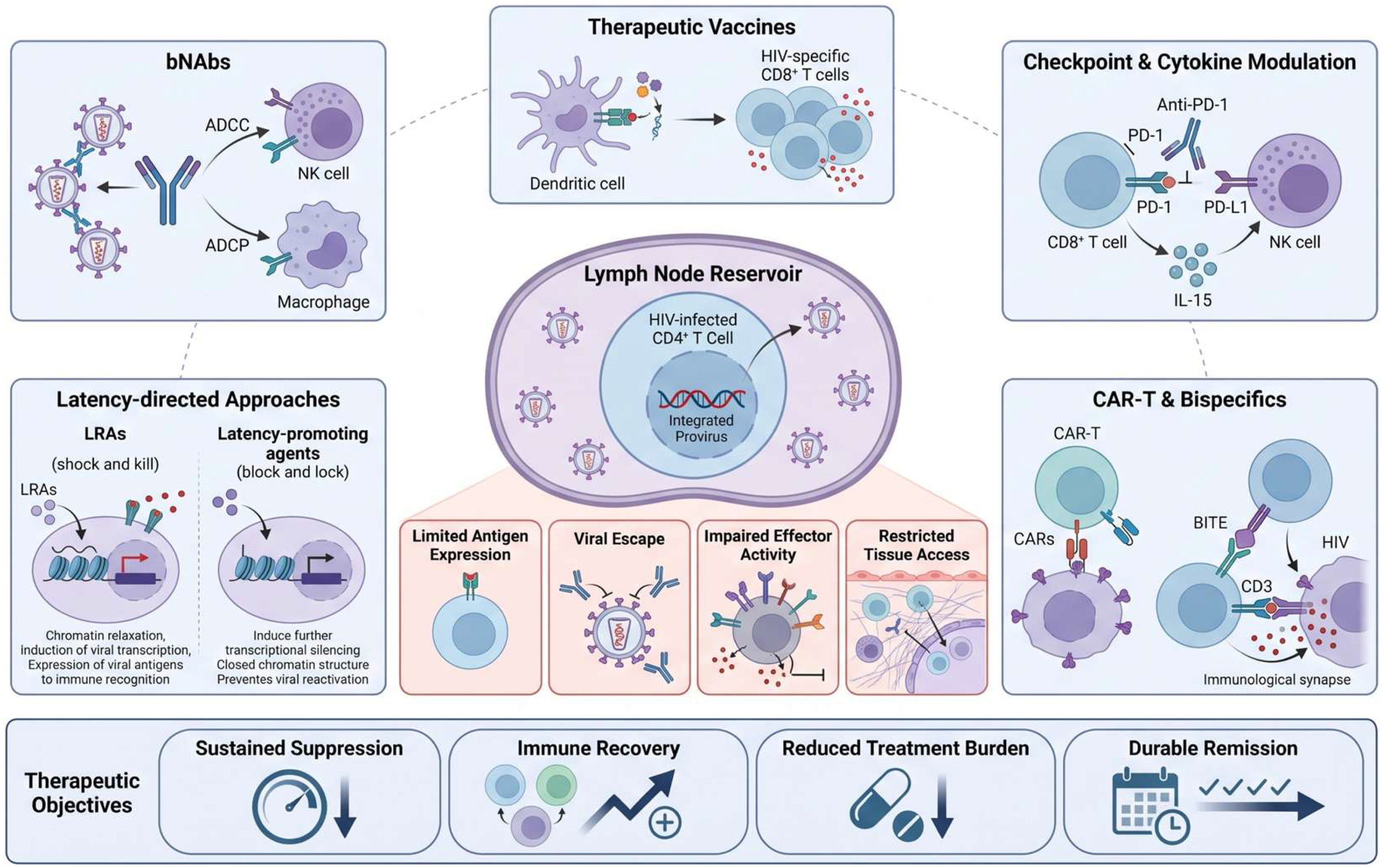
Figure 2.
Personalizing HIV immunotherapy over time. Biological profiling informs initial treatment selection, while serial virological, pharmacological and immunological measurements can support reassessment through mathematical modelling. The proposed feedback loop allows product, dose, interval and combination to be reconsidered as exposure, resistance and immune function evolve. The dashed pathway requires prospective validation. Randomized controlled trials (RCTs) would test whether guided selection improves viral control, immune health, quality of life and treatment burden. Created with BioRender (https://app.biorender.com/).
Figure 2.
Personalizing HIV immunotherapy over time. Biological profiling informs initial treatment selection, while serial virological, pharmacological and immunological measurements can support reassessment through mathematical modelling. The proposed feedback loop allows product, dose, interval and combination to be reconsidered as exposure, resistance and immune function evolve. The dashed pathway requires prospective validation. Randomized controlled trials (RCTs) would test whether guided selection improves viral control, immune health, quality of life and treatment burden. Created with BioRender (https://app.biorender.com/).
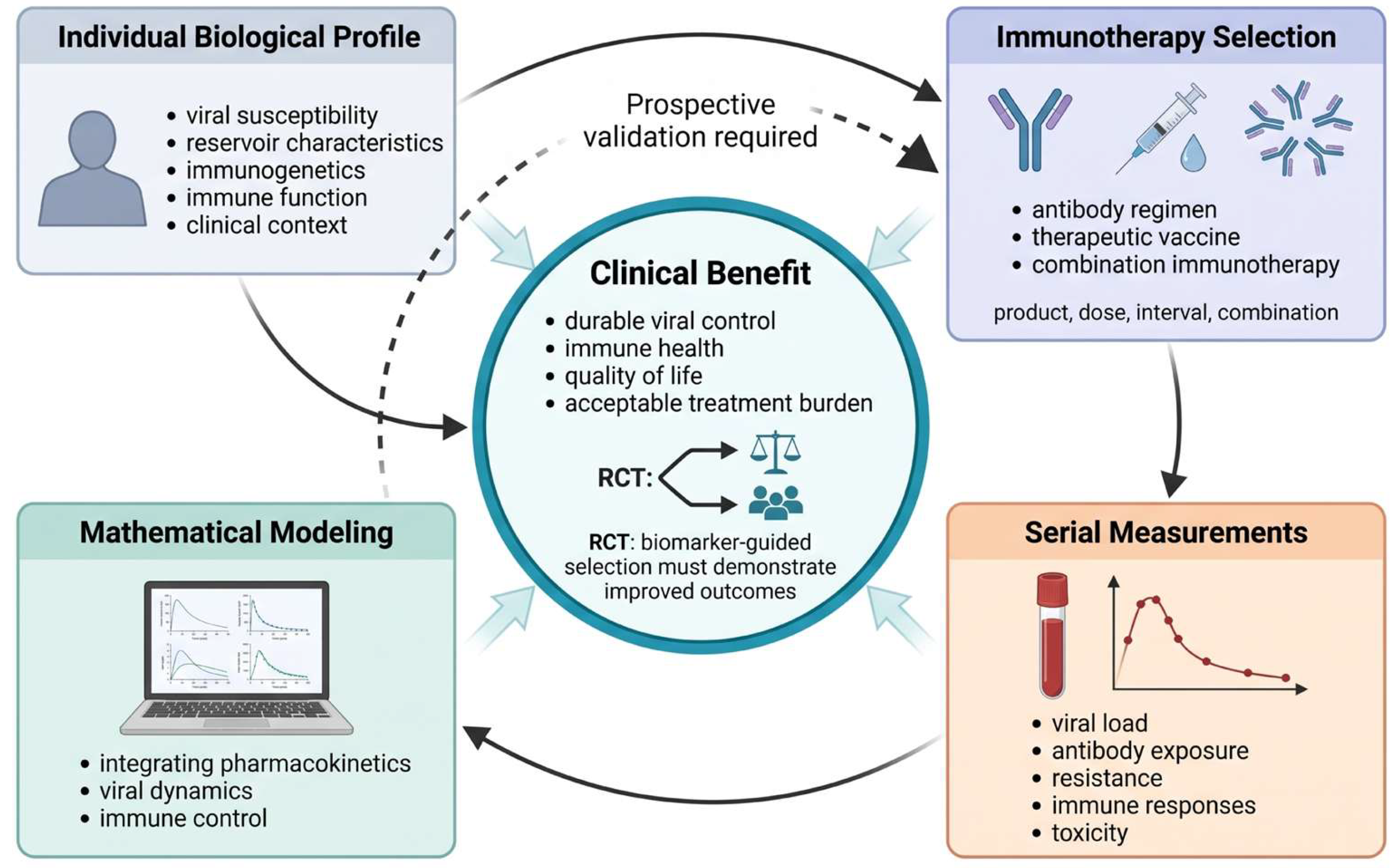
Figure 3.
Viral rebound and sustained control after ART withdrawal. Illustrative HIV RNA trajectories show (A) delayed rebound, (B) suppression during effective antibody exposure followed by rebound as activity wanes, and (C) rebound followed by sustained low-level control. Bands and shading indicate intervention activity, while the dashed line represents an illustrative assay detection limit. Reservoir reactivation, viral expansion, immune containment and resistance contribute to these patterns. ART, antiretroviral therapy; ATI, analytical treatment interruption. Created with BioRender (https://app.biorender.com/).
Figure 3.
Viral rebound and sustained control after ART withdrawal. Illustrative HIV RNA trajectories show (A) delayed rebound, (B) suppression during effective antibody exposure followed by rebound as activity wanes, and (C) rebound followed by sustained low-level control. Bands and shading indicate intervention activity, while the dashed line represents an illustrative assay detection limit. Reservoir reactivation, viral expansion, immune containment and resistance contribute to these patterns. ART, antiretroviral therapy; ATI, analytical treatment interruption. Created with BioRender (https://app.biorender.com/).
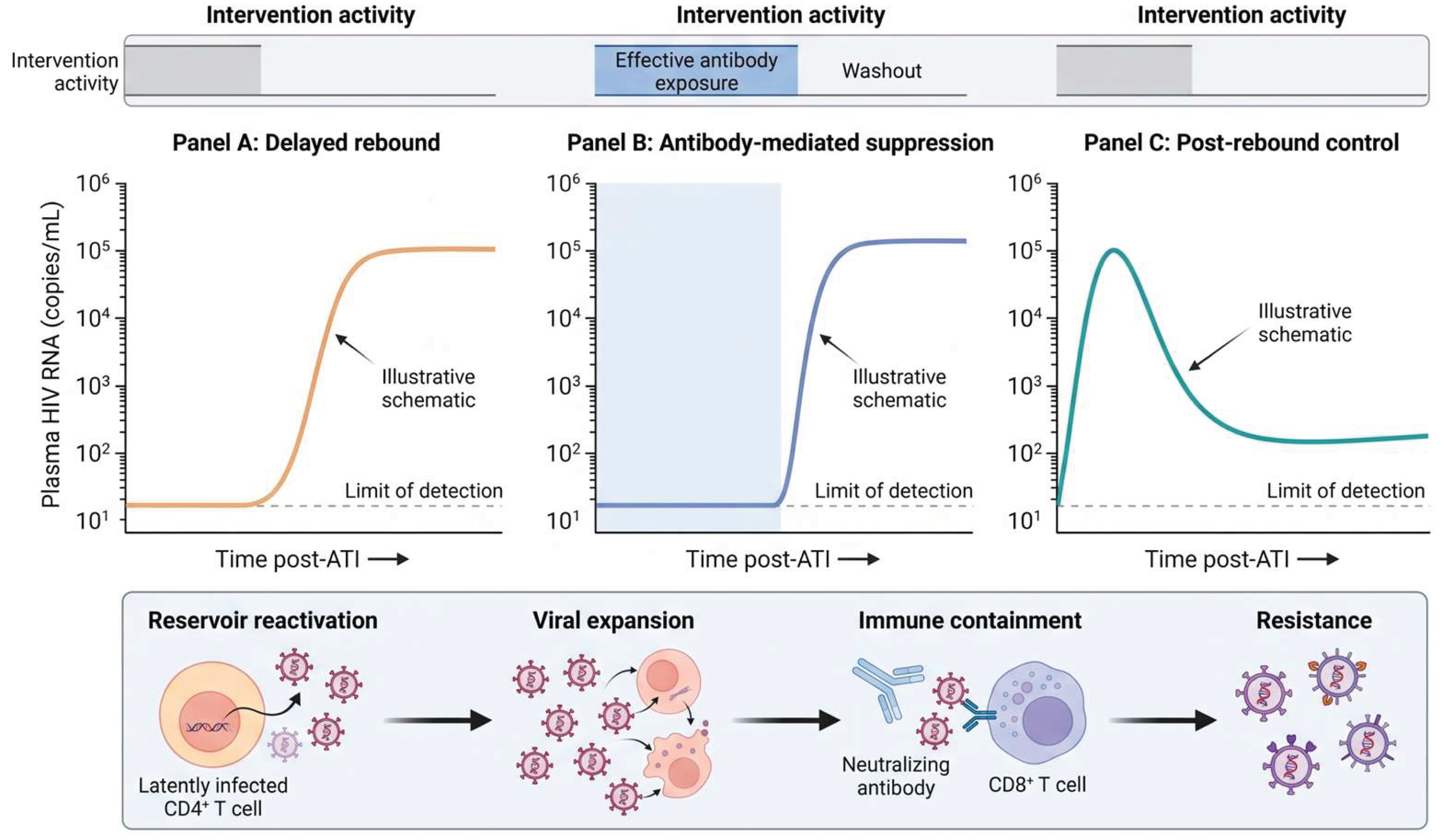

Table 1.
Selected clinical regimens and outcomes.
| Study | Regimen and participants | Principal findings |
| Lee et al., 2026 [27] — RIO | 3BNC117-LS plus 10-1074-LS versus placebo; 68 early-treated men; randomized ATI trial | Week-20 freedom from protocol-defined rebound, 75% versus 11%; hazard ratio 0.09 (95% CI 0.04–0.21). Long-acting antibody exposure overlapped the period of control |
| Ogbuagu et al., 2026 [29]; Taiwo et al., 2026 [30] | Lenacapavir plus teropavimab and zinlirvimab; cabotegravir plus VRC07-523LS; adults on suppressive ART | Antibody–antiretroviral combinations evaluated for sustained suppression with less frequent administration. Susceptibility and component-specific exposure influence maintenance |
| Shapiro et al., 2023 [31] — Tatelo | Dual bNAbs after early ART in selected children in Botswana | Antibody-supported suppression was achieved in children with favorable reservoir features, extending maintenance approaches to pediatric infection |
| Bailón et al., 2025 [33] — AELIX-003 | HTI vaccines plus vesatolimod; 50 early-treated men; randomized trial | All 47 participants entering ATI rebounded; the regimen did not significantly improve the principal interruption outcomes |
| Fidler et al., 2020 [34] — RIVER | Therapeutic vaccination and latency reversal plus ART versus ART alone; recently infected men; randomized trial | No improvement in the reservoir endpoint despite the combined antigen-directed and latency-directed approach |
| Ensoli et al., 2016 [35]; Picconi et al., 2026 [36] | Tat vaccination during ART; South African adults, predominantly women with clade C infection; randomized phase II trial and 12-year follow-up | Anti-Tat responses and CD4 increases in the trial; longitudinal immune and blood-DNA changes. Attrition, ART changes and generally nonsignificant overall between-group comparisons limit the long-term inference |
| Abrams et al., 2009 [37] — ESPRIT and SILCAAT | Interleukin-2 plus ART versus ART alone; randomized trials | CD4 counts increased without a reduction in opportunistic disease or death |
| Gunst et al., 2023 [38] — TITAN | 3BNC117 plus 10-1074 with or without lefitolimod; 43 adults, 85% male; four randomized arms | Antibodies prolonged control; adding the TLR9 agonist produced no clear further benefit |
| Peluso et al., 2026 [39] | Conserved-element vaccination, IL-12-supported priming, lefitolimod and dual bNAbs; 10 adults; single-arm study | Seven showed partial or complete post-intervention control, including six after initial rebound. CD8 activation near rebound correlated with the subsequent viral set point |
| Ramgopal et al., 2025 [40]; Mothe et al., 2026 [41]; Bar et al., 2026 [42] | Budigalimab in a randomized phase 1b trial; budigalimab with or without trosunilimab in a phase II trial | Six of 11 recipients in one phase 1b dosing cohort met an exploratory control composite; two remained controlled through study end. Phase II reports did not establish a week-24 advantage and described treatment-related serious adverse events |
ATI, analytical treatment interruption; bNAb, broadly neutralizing antibody; CI, confidence interval; HTI, HIVACAT T-cell immunogen; IL, interleukin; TLR, Toll-like receptor.
Table 2.
Immune and reservoir profiles relevant to personalized intervention.
| Study | Population and measurements | Profiles and therapeutic relevance |
| Ramirez et al., 2016 [55] | Aviremic adults; multiparameter immunological profiling | Five clusters, including distinct controller-enriched and nonresponder-enriched groups; clinical categories conceal immune heterogeneity |
| Wang et al., 2026 [56] | 164 participants; cellular HIV-DNA measurements and unsupervised clustering | Five reservoir profiles driven mainly by monocyte HIV-DNA patterns, associated with different immune landscapes |
| Wang et al., 2026 [57] | 154 ART-treated participants; CD4-cell RNA sequencing and dimensionality reduction | Three transcriptomic groups with different inflammatory signatures; candidate pathways for immune-directed combinations |
| Rollón et al., 2026 [58] | 30 people with HIV; 87-protein panel and hierarchical clustering | Two inflammatory biotypes extending across treatment and controller categories |
| Sun et al., 2023 [12]; Delley et al., 2026 [13] | Reservoir-cell phenotyping with proviral characterization during ART | Persistent infected-cell states with distinct survival, inhibitory and proviral features; potential vulnerabilities for immune recognition and killing |
| Huber et al., 2025 [18] | Spontaneous HIV-1 controllers; circulating NK-cell phenotyping and epigenetic analysis | Controller-associated innate-cell states complement cellular and humoral mechanisms of viral containment |
| Moron-Lopez et al., 2021 [59]; Baquero et al., 2025 [60] | Paired blood and tissue samples from ART-treated women; a separate study of young adults with perinatally acquired HIV | Tissue-specific transcription and persistence in women, and developmental differences in immune and proviral features, inform evaluation of circulating markers |
ART, antiretroviral therapy; NK, natural killer.
Table 3.
Mathematical studies informing longitudinal personalization.
| Study | Model and data | Contribution to treatment development |
| Hill et al., 2014 [68]; Hill et al., 2016 [69] | Stochastic reservoir reactivation and viral rebound after treatment interruption | Relates residual infection to the distribution of rebound times and updates reservoir estimates as aviraemia continues |
| Conway et al., 2015 [70] | Virus–immune dynamics of post-treatment control | Examines conditions under which replication-competent infection remains contained; links effector strength and reservoir burden to durable control |
| Conway et al., 2019 [71] | Individual rebound predictions incorporating personal biomarkers and treatment history | Produces participant-specific distributions of rebound time, providing a basis for testing individualized monitoring in ATI studies |
| LaMont et al., 2022 [72] | Evolutionary modelling of bNAb combinations using viral diversity, escape and resistance costs | Compares combinations by coverage of the individual viral population and opportunities for resistant expansion |
| Cassidy et al., 2024 [73] | Clinical PGT121 data fitted to sensitive and resistant viral populations with treatment exposure and latent-cell dynamics | Baseline resistance and relative viral fitness help explain rebound; simulated dose changes have participant-dependent effects. Prolonged suppression can arise without reservoir eradication |
ATI, analytical treatment interruption; bNAb, broadly neutralizing antibody.
Disclaimer/Publisher’s Note: The statements, opinions and data contained in all publications are solely those of the individual author(s) and contributor(s) and not of MDPI and/or the editor(s). MDPI and/or the editor(s) disclaim responsibility for any injury to people or property resulting from any ideas, methods, instructions or products referred to in the content. |
© 2026 by the authors. Licensee MDPI, Basel, Switzerland. This article is an open access article distributed under the terms and conditions of the Creative Commons Attribution (CC BY) license (http://creativecommons.org/licenses/by/4.0/).
Copyright: This open access article is published under a Creative Commons CC BY 4.0 license, which permit the free download, distribution, and reuse, provided that the author and preprint are cited in any reuse.