

Submitted:
03 November 2026
Posted:
05 November 2026
You are already at the latest version
Abstract
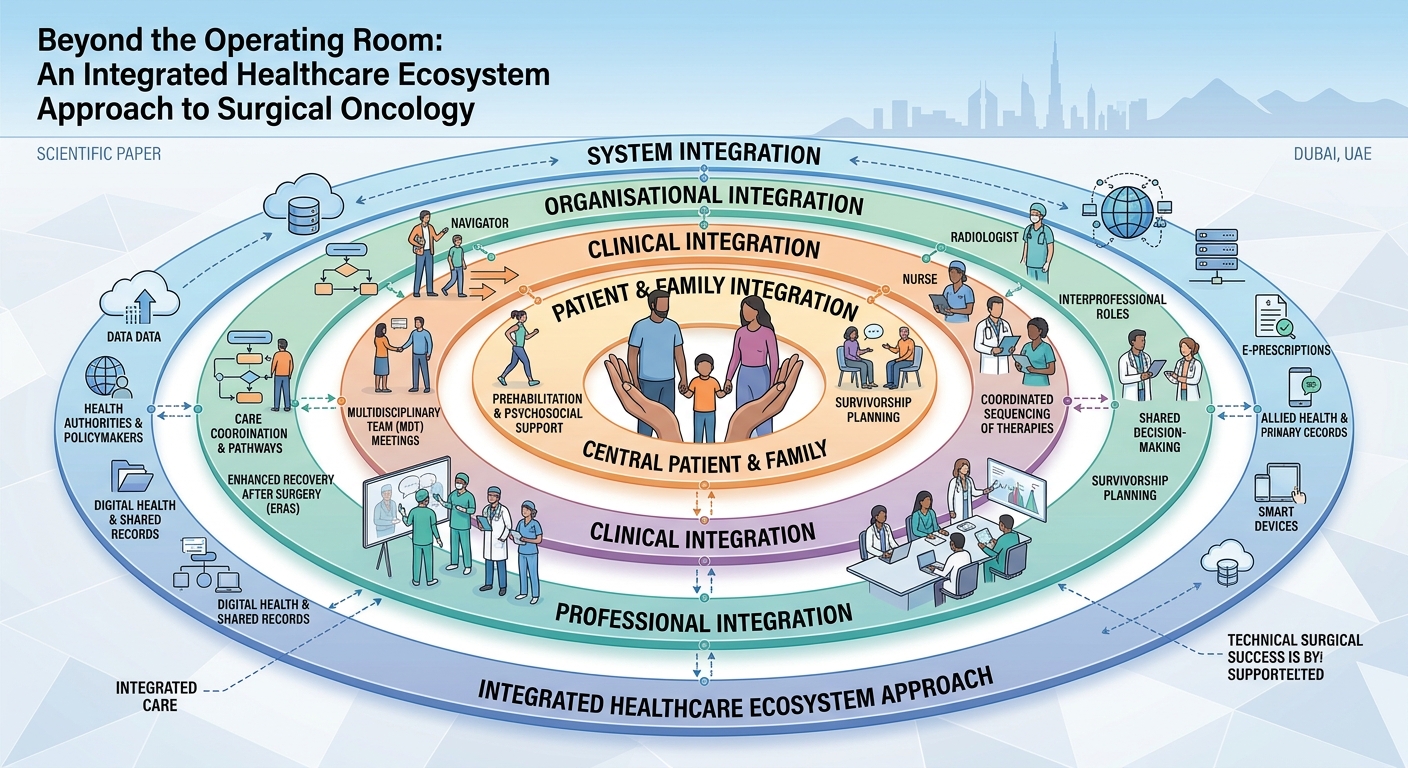
Background: Surgery remains the cornerstone of curative treatment for most solid tumors. Yet outcomes for surgical oncology patients depend on far more than the operation itself. Diagnosis, multidisciplinary planning, perioperative optimization, adjuvant therapy, psychosocial support and survivorship care are delivered by many professionals across many settings, and gaps between them can undo technical surgical success. Objective: To propose and describe an integrated healthcare ecosystem framework for surgical oncology, and to synthesize evidence on the components that connect surgical care to the wider cancer care system. Methods: A narrative review of literature on integrated care, multidisciplinary cancer care, care coordination, perioperative pathways, digital health and patient-centered support in surgical oncology. Findings were organized using the Rainbow Model of Integrated Care and the World Health Organization framework on integrated, people-centered health services. Results: The ecosystem was described across five interacting layers: clinical integration (multidisciplinary team meetings and shared treatment planning), professional integration (interprofessional roles, including specialist oncology nurses), organizational integration (patient navigation, defined care pathways and enhanced recovery programmes), system integration (digital health, shared records and remote symptom monitoring), and patient and family integration (prehabilitation, psychosocial care and survivorship planning). Evidence supports each layer individually, but studies rarely evaluate how the layers function together around the surgical patient. Conclusion: Framing surgical oncology as an integrated healthcare ecosystem shifts attention from the operation alone to the system that surrounds it. This framing has implications for service design, quality measurement and the education of future surgeons, particularly in rapidly developing health systems such as the United Arab Emirates.
Keywords:
surgical oncology
; integrated care
; multidisciplinary care
; patient navigation
; enhanced recovery after surgery
; survivorship
; health professions education
Copyright: This open access article is published under a Creative Commons CC BY 4.0 license, which permit the free download, distribution, and reuse, provided that the author and preprint are cited in any reuse.