
Submitted:
03 November 2026
Posted:
05 November 2026
You are already at the latest version
Abstract
Distributed quantum computing (DQC) connects quantum processing units (QPUs) to execute programs beyond the capacity of a single processor. Understanding its scalability requires examining the interactions between hardware, communication, software, and security. This structured review synthesizes 126 studies, mainly published between 2020 and 2026 with foundational earlier work, retrieved from eight sources and selected using documented inclusion and exclusion criteria. We organize the literature into five pillars: infrastructure, protocols, applications, compilation, and security. A common scoping rule distinguishes work enabling distributed computation from broader quantum communication research. The synthesis identifies interconnect rate and fidelity, classical control latency, remote-operation overhead, and coherence constraints as coupled limits on distributed execution. Infrastructure and protocol research includes experimental demonstrations, whereas application and compiler evaluations remain predominantly simulation-based. Security requires both protected interconnects and confidential, verifiable delegated computation. Comparisons across the pillars reveal tradeoffs between local computation, communication resources, sampling overhead, and trust assumptions. The review highlights unresolved challenges in distributed fault tolerance, transduction, interoperable software, benchmarking, and integrated security. Its central conclusion is that scalable DQC requires coordinated hardware–software–network design and evaluation of complete systems rather than isolated improvements within individual layers.
Keywords:
blind quantum computation
; circuit partitioning
; distributed quantum computing
; entanglement distribution
; quantum compilation
; quantum interconnects
; quantum networks
; remote gate scheduling
; structured literature review
; verifiable delegated computation
1. Introduction
Quantum computing targets problems in optimization, cryptography, computational chemistry, and machine learning that lie beyond the practical reach of classical computers. Superconducting, trapped-ion, photonic, and neutral-atom processors have all been demonstrated, and all of them are bounded by the same four constraints: qubit count, coherence time, gate infidelity, and environmental noise [1,2].
The physical limitations of a single quantum processor have motivated Distributed Quantum Computing (DQC) as a scalable computing paradigm. In DQC, multiple Quantum Processing Units (QPUs) are connected through quantum communication networks to jointly execute a quantum circuit. The circuit is divided among several interconnected QPUs, which coordinate their operations using quantum teleportation, entanglement, and classical communication. This makes it possible to execute circuits wider than any single processor while improving use of the available quantum resources [2,3,4].
DQC introduces problems that do not arise in monolithic machines. Circuit partitioning, entanglement generation, qubit routing, resource allocation, communication latency, and distributed compilation are all open. The performance of distributed execution depends on network topology, inter-QPU communication, and scheduling strategy [1,3,5,6].
Recent research has proposed modular quantum architectures, resource management frameworks, distributed quantum compilers, and analytical models for quantum repeater networks. Work on quantum networking, entanglement purification, and quantum interconnects supplies the enabling components for these systems. Circuit knitting and communication-efficient execution techniques have reduced the communication overhead between distributed processors [1,2,5,6,7,8,9].
Studies of distributed quantum computing are typically organized around one topic: hardware architectures, communication protocols, compiler optimization, resource management, or security. This review synthesizes those directions within a single framework and a single scoping rule.
The primary motivation adopted throughout this review is scaling: interconnecting QPUs to run larger programs, rather than running algorithms designed specifically for distributed hardware, such as quantum federated learning. This lens keeps the scope of the review coherent.
This paper reviews recent developments in distributed quantum computing across the five pillars shown in Figure 1: infrastructure, communication protocols, applications, compilation, and security. It compares current approaches, identifies open research problems, and sets out future directions toward scalable distributed quantum computing systems.
Distributing a computation across interconnected QPUs enlarges the attack surface along with the machine. A monolithic processor defends a single physical perimeter. A distributed system exposes photonic interconnects, entanglement-distribution services, classical synchronization channels, routing and repeater nodes, and, in the cloud setting that motivates DQC commercially, the relationship between resource-limited clients and untrusted remote servers. Security in DQC therefore divides into two complementary problems: protecting the infrastructure, meaning the channels, devices, and network services that carry distributed computation, and protecting the computation itself, meaning that a delegated program stays confidential and its results stay checkable when the executing hardware is untrusted. Quantum mechanics supplies two defenses with no classical equivalent: the impossibility of copying quantum states makes eavesdropping detectable, and the same principle lets a client hide an entire computation from the server executing it, with security that rests on no computational assumption. These two problems form the fifth pillar of this review (Section 5.5), whose halves are interconnect security (Section 5.5.1) and computation security (Section 5.5.2), summarized in Figure 2.
This review makes four contributions.
- 1.
- We define a scoping rule that separates distributed quantum computation from the broader quantum communication literature, and we apply it uniformly across all five pillars (Section 4.2).
- 2.
- We organize 126 studies into five pillars, reporting the corpus composition, evidence type, and publication window of each (Section 6).
- 3.
- We extract per-pillar findings together with the quantitative results that support them, and we consolidate the design tradeoffs that recur across pillars into four tradeoff groups (Section 6).
- 4.
- We identify the open problems that follow from the corpus, including distributed fault tolerance, benchmarking, standardization, and classical-client verification (Section 7).
The remainder of this paper is organized as follows. Section 2 provides background. Section 3 positions the review against existing surveys. Section 4 describes the review methodology, research questions, and scope. Section 5 presents the review of the literature across the five pillars. Section 6 analyzes the findings. Section 7 discusses open challenges and future directions, and Section 8 concludes. Figure 3 gives the same structure in outline form, including the appendix that carries the extended per-pillar study summaries.
2. Background
Quantum computing rests on the principles of quantum mechanics, the branch of physics that describes matter and light at atomic and subatomic scales. Classical computers process information in binary states 0 and 1. Quantum computers process information in quantum bits, or qubits, which exhibit superposition, entanglement, and interference. These three properties give certain computations a resource advantage over their classical counterparts.
A circuit-level introduction is provided by Al Abdul Wahid et al. [16], who explain quantum gates and demonstrate circuit construction in Qiskit.
2.1. Qubits
A qubit is the basic unit of quantum information. A classical bit takes one of two values, 0 or 1. A qubit’s state is a normalized complex linear combination of the basis states and . Reading a classical bit leaves its value undisturbed, whereas measuring a qubit in the computational basis collapses the superposition and returns one basis state.
A qubit can be described by a linear combination of and :
where and are the probability amplitudes and are both complex numbers [17].
2.2. Superposition
Superposition means that the state vector of a qubit is a linear combination of the basis states and with complex amplitudes and satisfying . The qubit takes a definite basis value only on measurement.
The qubit collapses to one of or according to the probabilities and , where corresponds to the classical bit value 0 and corresponds to the classical bit value 1.
2.3. Entanglement
Entanglement is a non-classical correlation: a state of two or more particles that cannot be written as a product of independent single-particle states. A measurement on one subsystem fixes the measurement statistics of its entangled partner at any separation. The correlation is revealed only when the two outcomes are compared over a classical channel, so the measurement itself transmits no information. Entanglement is the resource behind quantum gate teleportation and fault-tolerant error correction in quantum computation, and behind quantum key distribution and remote state preparation in quantum communication.
2.4. Model and Pipeline Parallelism
In classical DNN accelerators, memory organization and data movement constrain performance alongside arithmetic throughput, as reviewed by Asad et al. [18]. This provides useful context for the communication costs of distributing classical inference across devices.
The applications pillar borrows two terms from large-scale classical inference. Under model parallelism one model is split across devices, so the devices exchange activations at every layer boundary and the interconnect carries traffic proportional to the size of the cut. Under pipeline parallelism the devices hold different stages and independent inputs flow through them, so the interconnect carries one activation per stage boundary per input. The quantum analogue of model parallelism maps the qubits of one circuit across QPUs and consumes entanglement at every cut gate. The analogue of pipeline parallelism maps shots, Hamiltonian terms, or subproblems across QPUs and consumes classical orchestration only. Section 5.3 uses this distinction to explain which workloads tolerate an immature interconnect.
2.5. Security Concepts for Distributed Computation
Three concepts from the security literature are needed to follow Section 5.5.1 and Section 5.5.2. Blindness means a delegated protocol reveals nothing about the client’s input, algorithm, or output beyond an allowed leakage, typically only the size of the computation; formally, everything the server receives is statistically independent of the client’s choices given that leakage [11]. Verifiability means the client accepts a wrong result only with a failure probability that can be made exponentially small; the standard mechanism hides “trap” measurements with predetermined outcomes among the real ones, so a tampering server cannot avoid disturbing checks it cannot identify [12]. Composable security means these guarantees are proven by comparison with an ideal functionality, so they survive when the protocol runs inside a larger system, the realistic situation for DQC, where delegation is one service among many on a shared network [13,14]. On the infrastructure side, the relevant background is the confidentiality–integrity–availability (CIA) framing of network security, applied per layer of the quantum-internet stack [10], and quantum key distribution (QKD) as the mechanism that turns the detectability of eavesdropping into shared secret keys [19].
For the classical data-handling layer, Kaur et al. [20] review IoT privacy mechanisms and their computational and scalability costs. These concerns complement the quantum security requirements above; they do not establish blindness or verifiability for delegated quantum computation.
3. Related Surveys
DQC has become an active research area because current quantum computers still have a limited number of noisy qubits, which are not sufficient to solve large practical problems. Several survey papers have been published on the field. Among them, the surveys by Caleffi et al. [21] and Barral et al. [22] provide overviews of distributed quantum computing from different perspectives.
Caleffi et al. [21] explain that building one giant quantum computer with thousands of fault-tolerant qubits is among the most difficult tasks in the field, and discuss connecting multiple small quantum computers through a quantum network so that they work together as one large virtual quantum computer. The survey introduces DQC as an approach to building scalable quantum computing systems and discusses the challenges and open problems from the perspectives of computer engineering and communication engineering. It combines research from physics, communication engineering, computer science, networking, and software engineering into a single engineering-focused overview, and classifies DQC into four pillars: quantum networking, quantum algorithms, quantum compiling, and simulation, with quantum networking as the enabling technology.
Barral et al. [22] likewise explain that current quantum computers cannot become extremely large because of several technical difficulties, and treat DQC as the practical way to increase computational power by connecting multiple small quantum computers. Compared with Caleffi et al. [21], this survey is more up-to-date and covers the foundations of DQC, communication technologies, software tools, distributed algorithms, challenges, and future directions. It places particular emphasis on the integration of DQC with High Performance Computing (HPC), where CPUs, GPUs, and quantum processors work together in a quantum-centric HPC environment. It also discusses physical communication technologies, including quantum teleportation, gate teleportation, entanglement swapping, quantum transducers, quantum memories, quantum repeaters, routers, and switches, and covers distributed software development, circuit partitioning, distributed compilation, circuit cutting, and distributed quantum applications using a layered architecture.
The primary objective of both surveys is to introduce the overall DQC ecosystem. Caleffi et al. [21] focus on quantum networking, quantum algorithms, quantum compiling, and simulation from an engineering perspective, whereas Barral et al. [22] extend the discussion toward HPC integration, physical communication technologies, distributed software development, distributed compilation, circuit cutting, and distributed applications. Several research areas receive less emphasis in both: modular quantum hardware architectures, quantum repeater infrastructure as an independent infrastructure component, distributed quantum applications, communication-aware compiler frameworks as a separate classification, and circuit knitting techniques.
Complementary classical surveys examine GPU scheduling, resource utilization, and memory-latency tolerance [23], and processing-in-memory architectures, dataflow, and communication costs in DNN acceleration [24]. They inform the classical accelerator side of hybrid systems, while the present review focuses on interconnected QPUs.
No existing survey treats modular hardware architectures, repeater infrastructure, communication-aware compiler frameworks, circuit knitting, and the security of distributed execution within one scoping rule and one corpus. This review does so.
4. Survey Methodology
This review follows an explicit, pre-specified protocol so that the selection of studies is reproducible and the boundaries of the review are auditable. The protocol adapts the guidelines for structured literature reviews in software and computing research to a hardware-and-systems topic. It was fixed before screening began and comprises five steps: (i) formulation of research questions mapped onto the five pillars, (ii) definition of a scoping rule that separates distributed quantum computation from the broader quantum communication literature, (iii) specification of inclusion and exclusion criteria, (iv) construction and execution of per-pillar search strings against eight sources, and (v) multi-stage screening with duplicate resolution and snowballing.
4.1. Research Questions
The review is driven by six research questions. RQ1–RQ5 map one-to-one onto the five pillars; RQ6 is cross-cutting and feeds Section 7.
- RQ1 (Infrastructure). What hardware technologies and interconnection approaches currently enable distributed quantum computing, and how do they compare across architectural regimes?
- RQ2 (Protocols). What communication protocols and entanglement-management techniques support remote operations between QPUs, and what performance and fidelity tradeoffs do they present?
- RQ3 (Applications). Which classes of quantum applications are amenable to distribution, how are they partitioned onto distributed hardware, and what does the model/pipeline-parallelism analogy reveal about the limits of distributability?
- RQ4 (Compilation). What compilation techniques, intermediate representations, partitioning and cutting, qubit mapping and routing, and remote gate scheduling, are used to realize distributed execution under hardware and network constraints?
- RQ5 (Security). What mechanisms protect the interconnect and the delegated computation in a distributed quantum system, what trust and hardware assumptions does each require, and which of them have been demonstrated on networked hardware?
- RQ6 (Open challenges, cross-cutting). What are the principal open problems across the five pillars, including distributed fault tolerance, benchmarking, and standardization?
4.2. Scope and Boundary
Distributed quantum computing shares much of its physical substrate with quantum communication, and an unbounded search on terms such as “entanglement distribution” returns a large body of work whose objective is not computation at all. To keep the infrastructure and protocol pillars focused, we adopt the following scoping rule.
Scoping rule. A quantum-networking study is included only when it builds or evaluates foundational infrastructure on which distributed quantum computation depends, for example, entanglement distribution between processing nodes, entanglement purification for remote-gate fidelity, or quantum repeaters used to extend inter-QPU links. Studies whose primary objective is a different application of the same underlying technology, quantum key distribution as a communication service, distributed quantum sensing, or quantum-network metrology, are excluded, even when the enabling hardware is identical.
Two consequences of this rule are worth stating explicitly. First, the rule bounds the Security pillar (Section 5.5) to work that serves secure distributed computation: authenticated interconnects, key infrastructure protecting inter-module traffic, and blind or verified delegated computation. Secure communication as an end in itself falls outside the pillar and is excluded under EC1. Second, the review adopts scaling as its organizing motivation: interconnecting QPUs so that larger programs can run. Natively distributed algorithms that presuppose separated data owners, such as quantum federated learning, fall outside this lens and are excluded.
Background tutorials, classical-computing comparisons, and illustrative hybrid accelerator references are contextual sources outside the screened five-pillar corpus. They are not included in the reported total of 126 studies or in its per-pillar counts and quantitative synthesis.
4.3. Inclusion and Exclusion Criteria
Table 1 lists the criteria applied at every screening stage. A study is retained only if it satisfies all inclusion criteria and triggers none of the exclusion criteria. The publication window opens in 2020, the year in which multi-node experimental quantum networks and the first dedicated DQC compilers began to appear together in the literature, and closes with the search execution date.
Security studies were screened under the shared scoping rule: QKD and quantum-networking security papers are included only where they secure distributed computation through interconnects, control planes, or delegated execution. Standalone secure-communication and quantum-sensing work is excluded. The Security corpus comprises 14 peer-reviewed or credible-preprint studies published between 2009 and 2025, two of which are shared with the Infrastructure corpus and are listed in Table 4. Four predate the 2020 window and are retained as foundational anchors: the founding blind-computation protocol [11], the reference verification protocol [12], an early multiparty delegation protocol [25], and the field review. They are documented here as an exception to IC2, mirroring the practice used for the 13 foundational Protocols studies. The Infrastructure corpus likewise retains 11 studies published before the 2020 window as foundational anchors, covering modular architecture blueprints, repeater generations, satellite key distribution, and the quantum-internet roadmap. These are documented here as an exception to IC2 on the same basis. Two studies are cited in their preprint form because the archival version is a two-page extended abstract that would trigger EC4; the preprint carries the methodological detail required by IC3. Two Canadian industry efforts (QEYnet; QEYSSat) are cited as industry context and not as peer-reviewed evidence, consistent with the treatment of Micius in the Infrastructure pillar.
4.4. Search Strategy
Searches were executed against eight sources, listed in Table 2: six publisher libraries reached through the Algoma University institutional subscription, one abstract-and-citation index used for cross-database coverage, and one preprint server. arXiv is included deliberately: several of the field’s landmark experimental and compiler results circulated as preprints well before journal publication, and excluding it would have distorted the coverage of 2024–2026. Preprints are admitted only under IC3 and are assessed against the same inclusion criteria as peer-reviewed work.
A single generic query proved to be a poor instrument: it over-returned quantum-communication work while missing compiler papers that never use the phrase “distributed quantum computing.” We therefore built one search string per pillar, each pairing a common DQC anchor block with pillar-specific terms. Table 3 gives the canonical form; the strings were adapted mechanically to each library’s syntax (field prefixes, wildcard characters, proximity operators), and the adaptations did not change the term sets.
4.5. Study Selection and Screening
Records retrieved from the eight sources were exported to BibTeX and loaded into Rayyan, which performed automated duplicate detection; residual duplicates across preprint and journal versions of the same work were resolved manually under EC5, retaining the archival version and recording the preprint identifier for traceability.
Screening proceeded in three stages. In the first, titles and abstracts were assessed against the criteria of Table 1. Because the review team is large, each record was independently screened by two reviewers drawn from the pillar team that owns the corresponding topic; disagreements were resolved by discussion, and records that remained contested after discussion were promoted to full-text review instead of being discarded, so that the screening error is biased toward over-inclusion. In the second stage, full texts were retrieved and assessed; every exclusion at this stage was recorded with a reason. In the third stage, backward snowballing over the reference lists of the retained studies and forward snowballing over their citing articles recovered a further set of studies that the keyword searches had missed, principally hardware papers that describe multi-node experiments without using distributed-computing vocabulary.
Screening was administered in Rayyan across the three stages described above, ending with the 126 studies analyzed in Section 6. This review reports no stage-by-stage record count and makes no claim of PRISMA conformance. The auditable elements of the protocol are the pre-specified criteria of Table 1, the per-pillar search strings of Table 3, the sources of Table 2, and the documented IC2 exceptions of Section 4.3, which together allow the selection to be reconstructed from the published protocol.
5. Literature Review
This section presents the reviewed literature organized into the five pillars of the review. Each pillar answers a distinct question about the distributed quantum computing stack. For Infrastructure, Protocols, Applications, and Compilation, the main text treats the studies that define the current state of each pillar, and the Appendix carries the remaining corpus entries together with their per-study analysis tables. The Security corpus is small enough to be presented in full here.
5.1. Infrastructure
The infrastructure pillar concerns the physical building blocks that make distribution possible: QPU implementations (for example, superconducting and trapped-ion platforms), hardware interconnection technologies linking QPUs, quantum repeaters (ground- and satellite-based), and transduction technology for converting between the physical carriers of quantum information.
5.1.1. Modular Architectures and Interconnects
DQC addresses the scalability limitations of monolithic quantum processors by interconnecting multiple smaller QPUs. Modular architectures distribute quantum computation across several QPUs connected through quantum and classical communication links, so that larger quantum circuits can be executed collaboratively. This architecture addresses the hardware constraints of current noisy intermediate-scale quantum (NISQ) devices, including limited qubit counts, restricted connectivity, and decoherence, while providing a scalable path toward large-scale quantum computing [26].
The motivation for modular quantum architectures is consistent across the literature. Current quantum processors contain only a limited number of reliable qubits, making it difficult to execute algorithms that require hundreds or thousands of qubits. Researchers therefore connect multiple smaller QPUs through quantum networking technologies. This increases the overall computational capability while allowing individual QPUs to remain small and easier to manufacture and control [26].
A fundamental requirement of modular architectures is the ability to perform quantum operations between qubits located on different QPUs [22,26]. These remote operations are typically enabled through remote entanglement generation, local quantum operations within each processor, and classical communication for exchanging measurement outcomes [22]. Communication qubits establish shared entangled pairs (e-bits) between modules, allowing nonlocal quantum gates to be executed without physically moving quantum data between processors [22,26]. This integration of quantum networking and distributed computation forms the foundation of modern DQC architectures.
Several studies investigate architectural mechanisms that reduce the communication overhead of distributed execution. Cambiucci et al. [3] propose a hypergraph-based circuit partitioning framework that first performs logical gate grouping, then converts the quantum circuit into a hypergraph representation before applying a modified Fiduccia–Mattheyses partitioning algorithm. Their objective is to minimize the number of communication qubits required between partitions while supporting both balanced and heterogeneous distributed environments. The reported reduction in communication cost is discussed with the partitioning literature in Section 5.4.
Wu et al. [4] improve communication efficiency during distributed execution by reducing entanglement consumption, leaving the circuit partition unchanged. They extend the entanglement-assisted local operations and classical communication (LOCC) protocol through packing techniques that allow multiple nonlocal controlled-unitary gates to share entanglement resources. By introducing distributing and embedding processes together with packing and conflict graphs, their framework reduces the number of entangled pairs required during bipartite distributed quantum computation while preserving the functionality of distributed circuits [4].
Scalable modular systems also require management of heterogeneous computing resources. Bahrani et al. [5] consider DQC networks in which QPUs differ in capacity, connectivity, and communication quality. Their work models distributed quantum data centers where circuit scheduling jointly considers QPU allocation, partition count, network topology, communication fidelity, and inter-QPU communication overhead. By incorporating these architectural characteristics into scheduling decisions, the proposed framework improves execution efficiency while reducing communication costs in heterogeneous DQC environments [5].
The literature shows an evolution of modular quantum computing from conceptual distributed architectures toward practical infrastructure designs [26], integrating circuit partitioning [3], communication-aware execution, entanglement-efficient protocols [4], and heterogeneous resource management [5]. These studies approach the problem from different angles, from circuit-level partitioning to entanglement packing to resource scheduling, and together they establish modular architectures and quantum interconnects as the infrastructure layer that enables scalable DQC [26]. What the corpus does not yet supply is a quantitative account of how communication overhead and resource coordination scale past a handful of modules [3,4,5,26].
5.1.2. Quantum Repeater Infrastructure
While modular architectures enable distributed quantum computation by interconnecting multiple QPUs, communication between geographically separated nodes requires reliable long-distance entanglement distribution. Direct transmission of quantum states through optical fibers experiences exponential photon loss as transmission distance increases, making long-distance quantum communication impractical. Quantum repeaters have therefore become a fundamental infrastructure component for scalable quantum networks by enabling entanglement distribution through intermediate repeater nodes [7].
Quantum repeaters mitigate photon loss by dividing a long communication channel into shorter elementary links connected through intermediate nodes equipped with quantum memories. Neighboring nodes establish entanglement locally and connect these elementary links by entanglement swapping. Entanglement purification improves the quality of shared entangled states, allowing higher-fidelity quantum communication across extended distances. This repeater-based architecture improves long-distance entanglement distribution over direct transmission and is a prerequisite for scalable quantum networks [7].
Despite progress toward realizing quantum repeaters, the literature identifies a practical obstacle. Remote memory–memory entanglement often decoheres faster than new entanglement can be established and purified, preventing reliable multi-stage entanglement swapping. Liu et al. [7] address this with a repeater building block based on long-lived trapped-ion quantum memories, an efficient telecom interface, and a high-visibility single-photon entanglement protocol. Their experimental implementation established memory–memory entanglement over a 10 km spooled fiber link while maintaining a coherence time that exceeded the average entanglement generation time, satisfying an essential requirement for practical quantum repeater operation [7]. The same platform supports device-independent key distribution, which the scoping rule of Section 4.2 places outside this review under EC1; only the memory–memory entanglement result enters the Infrastructure corpus.
Liu et al. [7] establish that quantum repeaters overcome the distance limitations of direct quantum communication through the integration of long-lived quantum memories, efficient entanglement generation, and repeater-assisted communication. What the corpus does not supply is a validated method for evaluating communication performance and network behavior under varying operating conditions, which motivates the simulation and evaluation frameworks reviewed next [2].
5.1.3. Simulation and Evaluation Frameworks
Simulation is an essential tool for evaluating distributed quantum computing systems before deployment on physical hardware. Since existing quantum hardware is limited in scale and availability, experimental evaluation of distributed quantum systems remains difficult. Simulation frameworks therefore provide an environment for exploring architectural designs, communication strategies, scheduling algorithms, and network configurations under varied operating scenarios [2].
Existing simulation tools typically focus on specific aspects of quantum computing and do not provide an integrated environment for distributed quantum computing and quantum networking. Ferrari and Amoretti [2] observe that no previous framework places equal emphasis on both distributed quantum computation and quantum networking, and propose a design framework for DQC simulation that integrates computational and communication components within a unified environment, so that the interaction between distributed execution and quantum network behavior can be evaluated [2].
The proposed framework is organized around four components: an Execution Manager, a Simulated Quantum Network, Simulated Quantum Nodes, and an Analytics module. The Execution Manager schedules distributed quantum jobs, while the Simulated Quantum Network models communication among interconnected QPUs. Simulated Quantum Nodes reproduce the behavior of quantum processors using detailed qubit and gate descriptions, whereas the Analytics component evaluates system performance using information collected during execution. This modular organization allows computational execution and network communication to be analyzed together [2].
A contribution of the framework is its treatment of execution management and performance evaluation. The Execution Manager schedules distributed quantum circuits that have been partitioned into interacting subprograms connected through remote gates requiring shared entanglement and classical communication. Because DQC jobs have characteristics such as circuit width, circuit depth, and computation-to-communication ratio, scheduling decisions can exploit these properties to improve resource utilization. To evaluate scheduling strategies, the authors introduce two performance metrics, QPU utilization and quantum network utilization, which complement the traditional makespan metric [2].
The framework also models heterogeneous DQC environments. It distinguishes between simulations of multi-chip quantum processors, where neighboring QPUs communicate through direct quantum links, and geographically distributed DQC systems, where quantum repeaters enable long-distance entanglement distribution. Realistic simulation requires modeling physical devices and quantum network behavior while supporting performance analysis through metrics such as makespan, QPU utilization, and quantum network utilization. These capabilities enable comparison of scheduling algorithms and network configurations under realistic operating conditions [2].
Ferrari and Amoretti [2] establish that jointly modeling computational execution, quantum networking, and resource management supports systematic evaluation of distributed architectures before deployment on physical hardware. Their framework also shows that infrastructure alone is insufficient for efficient distributed execution: scalable DQC depends on communication protocols that establish, maintain, and evaluate high-quality entanglement between distributed quantum processors. The following section reviews those protocols.
5.2. Protocols
The protocols pillar concerns how connected QPUs exchange quantum and classical information: network protocols, entanglement distribution, entanglement purification for cleaning up noisy entangled states, and classical synchronization for coordinating timing and control signals across nodes.
5.2.1. Link Management
Reliable communication in distributed quantum computing depends not only on the underlying network infrastructure but also on protocols that establish, maintain, and manage entanglement between distributed quantum nodes. Since entanglement generation in near-term quantum networks is probabilistic and quantum memories have limited coherence times, communication protocols must continuously balance successful link establishment against the preservation of quantum state fidelity. Effective link management is therefore a requirement for reliable quantum communication across distributed quantum networks [27].
Khatri [27] approaches link management by treating the elementary link as the fundamental communication unit within a quantum network. A quantum network is represented as a graph in which vertices correspond to network nodes and edges represent quantum communication channels, referred to as elementary links. The objective of the communication protocol is to establish active elementary links through successful entanglement generation and then combine them using operations such as entanglement swapping to create virtual links between nodes that are not directly connected. This framework provides a systematic foundation for developing and optimizing entanglement distribution protocols in quantum networks [27].
A contribution of the paper is the formulation of elementary link management as a quantum decision process. The author models each elementary link as an independent decision-making process in which an agent repeatedly selects between two actions: wait, which preserves the currently stored entangled state in quantum memory, and request, which discards the existing state and initiates a new entanglement generation attempt. The sequence of these decisions defines a policy that influences both communication reliability and quantum state quality over time [27].
The framework introduces quantitative measures for evaluating link management policies: the probability that an elementary link remains active and the fidelity of the stored quantum state with respect to a target state. These two objectives compete. Waiting increases the likelihood of retaining an active communication link but exposes the stored quantum state to memory decoherence, reducing fidelity. Repeatedly requesting new entanglement maintains high fidelity but decreases the probability of maintaining an active link. Policy optimization is therefore a trade-off between link availability and stored-state fidelity [27].
To determine optimal communication strategies, the author develops optimization algorithms based on quantum decision processes. Optimal policies can be obtained using dynamic programming, and the same decision-process framework is compatible with reinforcement learning techniques for discovering communication protocols. The framework also provides a basis for extending elementary-link policies to larger quantum network protocols involving multiple interacting agents [27].
Khatri [27] establishes that link management extends beyond entanglement generation to adaptive decision-making that balances link availability against degradation of the stored quantum state. What the corpus does not yet supply is a policy framework validated on hardware rather than in the decision-process model.
Effective link management improves the establishment and maintenance of entanglement, but the quality of the distributed quantum states remains affected by noise and decoherence. The next subsection reviews entanglement purification protocols that improve the fidelity of shared entangled states.
5.2.2. Entanglement Purification
Entangled states generated in practical quantum networks degrade because of probabilistic entanglement generation, quantum memory decoherence, and other imperfections. The fidelity of shared entanglement decreases over time, reducing the quality of entanglement available to distributed quantum communication and distributed quantum computing applications. Integrating and optimizing entanglement purification protocols is therefore central to improving the quality of shared entangled states before they are used by quantum network applications [8].
Zang et al. [8] investigate entanglement purification from the perspective of practical quantum network operation without introducing a new purification protocol. They argue that integrating entanglement purification protocols (EPPs) into realistic quantum networks requires careful performance evaluation because practical systems must simultaneously consider probabilistic entanglement generation, quantum memory decoherence, and the timing of purification operations. The study focuses on two questions: whether purification can guarantee improvement for arbitrary input states, and when purification should be executed [8].
The paper analyzes the CNOT-based recurrence entanglement purification protocol (BBPSSW/DEJMPS) under realistic network conditions. The authors evaluate purification against several figures of merit, including fidelity, concurrence, logarithmic negativity, and distillable entanglement. Their theoretical analysis shows that successful purification provides guaranteed improvement for several entanglement quality measures under appropriate input conditions, and it characterizes how the purification outcome varies across classes of input states [8].
A contribution of the study is its investigation of the optimal timing of purification. Because quantum networks generate entangled pairs probabilistically and stored quantum states decohere while waiting in quantum memories, purification can be performed at different times between entanglement generation and final consumption. The authors formulate this timing problem within a realistic network model and show that the optimal purification time depends on both the selected performance metric and the memory decoherence process. Changes in the decoherence model can produce transitions in the optimal purification time, so network dynamics and protocol execution must be considered together [8].
Zang et al. [8] establish that the interaction among probabilistic entanglement generation, quantum memory decoherence, and purification scheduling determines purification performance under realistic network conditions. While link management establishes and maintains entangled connections, entanglement purification improves the fidelity of those shared states by mitigating the effects of decoherence and other network imperfections [8].
High-fidelity entanglement is necessary but not sufficient: the effectiveness of distributed quantum networks must also be evaluated using network-level performance metrics. The next subsection reviews those approaches.
5.2.3. Performance Analysis
To assess the effectiveness of quantum repeater networks, their communication performance must be evaluated using quantitative metrics. Since distributed quantum computing relies on quantum repeater networks for long-distance entanglement distribution, understanding the communication performance of these networks is necessary for designing scalable and reliable distributed quantum systems. Performance analysis has therefore become a research direction for characterizing the behavior of quantum repeater networks under different communication protocols and system configurations [9].
Zang et al. [9] investigate quantum repeater network performance through analytical modeling. They observe that although quantum network simulators can evaluate complex networking scenarios, analytical models give explicit insight into how system parameters influence communication behavior while also serving as reference benchmarks for validating simulation frameworks. The study develops a Markov chain–based analytical framework that estimates the performance of quantum repeater network scenarios using derived formulae for throughput and latency [9].
A contribution of the paper is the identification of throughput and latency as two fundamental performance metrics for entanglement distribution. Throughput measures the long-run rate at which entangled pairs are successfully distributed across the network, whereas latency represents the time required to establish an entangled pair after a communication request is initiated. The authors formulate both metrics within a Markov chain framework, enabling analytical estimation of continuous entanglement distribution alongside simulation-based evaluation [9].
The analytical framework is applied to representative quantum repeater scenarios involving single-link entanglement generation, two-link entanglement distribution, entanglement swapping, and nested repeater chains. The study examines both single-heralded and multiheralded entanglement generation protocols and derives analytical expressions for throughput and latency under these strategies. By extending the analysis from simple communication links to multi-link repeater networks, the authors show how network performance depends on protocol characteristics and repeater configurations, and that analytical results for simpler scenarios give quantitative insight into more complex networks [9].
The derived formulae give quantitative intuition about the relationship between communication protocols and network behavior, and they serve as ground truths for validating quantum network simulators. The analytical framework complements simulation-based evaluation by offering mathematically grounded performance estimates [9].
Zang et al. [9] establish throughput and latency as indicators for evaluating entanglement distribution and show how analytical models and simulation frameworks complement one another. Reliable distributed quantum communication therefore depends on scalable infrastructure, robust communication protocols, and rigorous methods for evaluating both. Having established the networking foundations, the next section turns to distributed quantum applications, beginning with the Distributed Variational Quantum Eigensolver.
5.3. Applications
The applications pillar concerns why distribution matters and which programs benefit. It characterizes application and algorithm classes by how they partition onto distributed hardware, framed through the analogy to model parallelism and pipeline parallelism in large-scale classical inference. Representative domains include the Variational Quantum Eigensolver (VQE), the Quantum Approximate Optimization Algorithm (QAOA), quantum chemistry, and distributed quantum search. Natively distributed algorithms such as quantum federated learning are outside the scope of this review.
5.3.1. Distributed Variational Quantum Eigensolver (Distributed VQE)
VQE is one of the leading applications for near-term quantum computers because it combines parameterized quantum circuits with classical optimization to solve computationally challenging problems using hybrid quantum–classical execution [28,29]. The limited number of reliable qubits available on current quantum processors restricts the size of problems that can be executed on a single device [29]. Distributed quantum computing addresses this limitation by executing variational quantum circuits across multiple interconnected QPUs, extending the capability of near-term quantum hardware while preserving the hybrid optimization workflow [28,29].
The literature shows two complementary directions for distributed VQE. DiAdamo et al. [28] investigate how accelerated VQE (-VQE) can be executed over distributed quantum computers by mapping monolithic variational circuits onto arbitrary multi-QPU systems and introducing network control mechanisms for coordinating distributed execution. Their framework considers strategies for assigning qubits across distributed processors, generating distributed quantum circuits, and coordinating quantum gate execution through centralized and decentralized control architectures. Although the methodology targets -VQE, the same mapping, qubit distribution, and scheduling strategies can be adapted to conventional VQE and other distributed quantum algorithms [28].
A central aspect of the framework is the management of quantum operations across physically separated QPUs. The approach distributes the Ansatz state and parallelizes the Hamiltonian expectation estimation phase across multiple QPUs while coordinating nonlocal control gates through shared entanglement and classical communication. To support this execution model, the authors propose network control architectures that coordinate quantum gate instructions and combine the execution results [28].
While DiAdamo et al. [28] concentrate on distributed execution and network control, Hasanzadeh and Kargarian [29] extend distributed VQE toward practical optimization software. They propose a Distributed Variational Quantum Eigensolver (DVQE) framework for solving Quadratic Unconstrained Binary Optimization (QUBO) problems that supports both monolithic and distributed quantum-circuit execution. Logical qubits are allocated across multiple QPUs, local gates execute within individual processors, and gates acting on qubits assigned to different QPUs are replaced by communication-compatible distributed operations based on shared entanglement, communication qubits, measurements, classical messages, and conditional local operations. This execution model realizes distributed VQE while accounting for the additional circuit and communication overhead of cross-QPU gates [29].
Hasanzadeh and Kargarian [29] also address the practical challenges of variational optimization. VQE-based optimization remains dependent on a classical outer-loop optimizer and can suffer from nonconvex objective landscapes, measurement noise, and poor parameter initialization. To improve training, the proposed DVQE adopts a two-stage optimization strategy that combines a metaheuristic warm-start initialization phase with a sampling-based variational refinement stage. The framework also introduces a sequential QP-to-QUBO (QQP) reformulation procedure that transforms bounded constrained quadratic programming problems into a sequence of QUBO subproblems compatible with the distributed VQE execution model [29].
DiAdamo et al. [28] establish methods for distributing variational circuits and coordinating their execution through network control architectures, and Hasanzadeh and Kargarian [29] extend these into an end-to-end optimization framework covering distributed circuit execution, variational training, and QUBO-based problem solving. What the corpus does not yet supply is an entanglement-linked distributed VQE demonstration on networked hardware.
Efficient application execution depends on circuit partitioning, compilation, and scheduling across distributed processors. Those challenges motivate the next pillar.
5.4. Compilation
The compilation pillar concerns how a hardware-agnostic program is distributed and executed on real hardware. It covers intermediate representations used to analyze and transform circuits, circuit partitioning and cutting, qubit mapping and routing, remote gate scheduling (the ordering of operations within an already-partitioned circuit), and the programming tools and models (for example, MPI-like and PGAS-like models) and libraries that support distributed execution.
5.4.1. Circuit Partitioning and Distribution
Efficient execution of distributed quantum circuits requires compilation techniques that distribute quantum circuits across multiple QPUs. Since current quantum processors provide limited qubit capacity, large quantum circuits must be decomposed into smaller subcircuits that can be executed collaboratively while minimizing inter-QPU communication. Circuit partitioning is therefore one of the fundamental compilation challenges in distributed quantum computing [3].
Communication cost is one of the primary objectives of circuit partitioning. When a quantum circuit is divided among multiple QPUs, operations acting on qubits located in different partitions require quantum teleportation and dedicated communication qubits. These non-local operations consume entanglement resources and increase communication overhead. Effective partitioning strategies therefore seek to reduce the number of communication qubits while generating balanced partitions that use the available qubits across distributed QPUs [3].
Cambiucci et al. [3] propose a hypergraph-based partitioning methodology for distributed quantum computing. Their approach consists of three stages. First, the input quantum circuit undergoes logical segmentation and gate grouping to identify reusable communication patterns while considering circuit width, size, and depth. Second, the segmented circuit is translated into a hypergraph representation in which vertices represent qubits and hyperedges represent multi-qubit gates. Finally, a variation of the Fiduccia–Mattheyses (FM) algorithm heuristic generates balanced and unbalanced partitions suitable for heterogeneous distributed quantum systems [3].
The framework also accounts for heterogeneous execution environments. The partitioning algorithm supports balanced scenarios, where QPUs provide similar qubit capacities, and unbalanced scenarios, where QPUs have different numbers of available qubits. The generated sub-hypergraphs are translated back into executable quantum circuit partitions suitable for execution on distributed quantum systems [3].
For bipartite benchmark circuits, the authors report partial results showing a reduction of more than in communication cost against a random partitioning baseline. The comparison covers the bipartite case only and no multi-partition result is reported. These results show that preprocessing through logical segmentation and gate grouping, combined with hypergraph-based partitioning, reduces communication cost before distributed execution [3].
Hypergraph representations, logical gate grouping, and heuristic partitioning algorithms together reduce inter-QPU communication while supporting execution across balanced and heterogeneous architectures. What the corpus does not supply is a partitioning result validated beyond the bipartite case [3].
Circuit partitioning is only one stage of the distributed quantum compilation process. Once circuits have been partitioned, additional compiler support is needed to translate, optimize, and coordinate execution across multiple QPUs. The next subsection reviews compiler frameworks.
5.4.2. Compiler Frameworks
After circuit partitioning, distributed quantum computing requires compiler frameworks that translate hardware-independent quantum circuits into executable programs satisfying both quantum processor constraints and quantum network requirements. Unlike compilation for single quantum processors, distributed quantum compilation must simultaneously consider circuit partitioning, remote quantum operations, communication overhead, processor connectivity, and network topology. Compiler frameworks therefore bridge the gap between high-level quantum algorithms and heterogeneous distributed execution environments [30,31].
A primary challenge in distributed quantum compilation is the communication overhead introduced by circuit distribution. Executing a quantum circuit across multiple QPUs introduces additional communication through remote quantum operations, and the resulting overhead depends on processor connectivity, available qubits, and network architecture. Ferrari et al. [30] therefore investigate compiler design from the perspective of distributed execution cost, arguing that a compiler must minimize the overhead introduced by circuit distribution while remaining practical for medium- and large-scale quantum circuits. They propose a compiler designed around three characteristics: general-purpose, efficient, and effective. The framework accepts hardware-independent quantum circuits without restrictive assumptions, employs polynomial-time compilation suitable for practical circuit sizes, and bounds the additional circuit-depth overhead introduced during distributed compilation [30].
Building on those design principles, Ferrari et al. [31] propose a modular quantum compilation framework that integrates device-level and network-level constraints. The framework organizes compilation as a sequence of cooperating stages. The compiler jointly considers quantum algorithm partitioning, remote operation scheduling, and local circuit transformation while accounting for network topology and device characteristics. This organization allows different optimization components to be combined within a unified compilation workflow while allowing arbitrary quantum circuits to be compiled for suitable distributed quantum computing architectures [31].
A distinguishing contribution of the modular framework is its explicit treatment of remote communication during compilation. In addition to local compilation stages, the compiler schedules remote operations to reduce Einstein–Podolsky–Rosen (EPR) pair consumption during distributed execution. The framework evaluates remote communication strategies based on TeleGate and TeleData operations and studies their impact on compiled circuits executed over multiple network topologies. Incorporating TeleData operations reduces EPR-pair consumption for certain compiled circuits, while increased network connectivity decreases the number of layers dedicated to remote operations [31].
Ferrari et al. [30] establish the design principles required for scalable distributed quantum compilation and analyze the compilation overhead introduced by distributed execution, and Ferrari et al. [31] extend these through a modular framework covering partitioning, remote scheduling, local mapping, routing, and network-aware decision making within a unified workflow.
Distributed quantum compilation must optimize both local circuit transformations and the communication required among distributed processors [31,32]. While the modular compiler architecture of Ferrari et al. [31] improves distributed execution by integrating network-aware compilation stages, communication overhead remains one of the dominant performance bottlenecks. The next subsection reviews communication-aware compilation techniques [32].
5.4.3. Communication-Aware Compilation
Although compiler frameworks enable the execution of distributed quantum circuits, inter-QPU communication remains a key factor affecting overall performance. Remote quantum operations require entanglement resources, classical message exchange, and additional execution time, making communication more expensive than local quantum computation [32]. Communication-aware compilation techniques therefore optimize communication cost alongside circuit execution during compilation [32,33].
Optimizing distributed quantum programs requires more than minimizing the number of remote quantum gates. Communication-aware approaches identify communication patterns within distributed quantum programs and transform them into more efficient execution strategies. Wu et al. [33] observe that existing distributed compilers optimize individual remote quantum gates without considering the higher-level communication behavior of complete distributed programs. They introduce AutoComm, an automatic compiler framework that identifies burst communication patterns, where multiple continuous remote controlled-X (CX) operations between a qubit and a remote computing node can be aggregated and executed more efficiently. The framework incorporates communication aggregation, hybrid communication assignment, and communication scheduling within the compilation pipeline to reduce communication overhead while preserving local parallelism [33].
A contribution of AutoComm is its optimization of remote communication through burst communication. The compiler groups related remote interactions into communication blocks that can be implemented using Cat-Comm or TP-Comm with at most two EPR pairs. To support different communication scenarios, the framework combines Cat-Comm and TP-Comm strategies, selecting the implementation that suits the communication pattern being optimized. Experimental evaluation shows that this optimization reduces communication cost and program latency compared with conventional distributed compilation approaches [33].
Wu et al. [32] extend communication-aware compilation beyond pairwise communication by introducing collective communication optimization. While AutoComm optimizes communication between pairs of compute nodes, the CollComm framework introduces communication buffers and communication-fusion techniques that support communication involving multiple distributed nodes. The framework incorporates communication transformation and communication routing passes that reduce EPR-pair consumption, optimize inter-cluster communication, and improve communication parallelism during distributed execution. By jointly optimizing communication transformation and communication routing, CollComm addresses collective communication scenarios that pairwise burst communication cannot handle efficiently [32].
Both frameworks report measurable improvements in distributed program execution. AutoComm decreases communication cost and execution latency by exploiting burst communication patterns [33], whereas CollComm reduces EPR-pair consumption, minimizes inter-cluster communication, lowers execution latency, and increases the estimated fidelity of compiled programs through communication buffering and routing optimizations [32]. The quantitative figures are given in Table 12.
Efficient distributed execution also requires coordination of computational resources and execution order across multiple quantum processors. The next subsection covers resource management and scheduling.
5.4.4. Resource Management and Scheduling
While communication-aware compilation reduces the overhead of remote quantum operations, efficient execution of distributed quantum programs also requires resource management and scheduling across multiple QPUs [5,33]. Resource management techniques allocate computational tasks and coordinate their execution to improve resource utilization while reducing communication overhead [5].
Related classical work includes a heterogeneous scheduling approach targeting memory management in IoT systems [34]. This is a systems-level comparison: inter-QPU execution additionally requires scheduling entanglement availability and operations within coherence constraints.
Beyond processor allocation, Bahrani et al. [5] address circuit scheduling to coordinate the execution of distributed quantum workloads. Since scheduling decisions are influenced by inter-QPU communication overhead, network topology, and QPU characteristics, execution cannot rely on circuit structure alone. The proposed scheduling framework incorporates communication-aware scheduling policies that jointly consider computation and communication to improve scheduling efficiency while reducing inter-QPU communication overhead. By integrating resource allocation and communication-aware scheduling, the proposed strategies improve execution efficiency, throughput, and utilization in heterogeneous distributed quantum computing environments [5].
Wu et al. [33] reduce communication overhead through communication-aware compilation, and Bahrani et al. [5] extend distributed execution by coordinating processor allocation, communication resources, and execution scheduling in heterogeneous environments. Additional techniques are required for circuits that remain difficult to distribute across multiple QPUs; those are covered next.
5.4.5. Circuit Knitting and Circuit Decomposition
The limited number of available qubits on near-term quantum processors remains an obstacle to executing large quantum circuits directly. Circuit knitting techniques partition large quantum circuits into smaller subcircuits that can be executed locally on smaller quantum devices. The outcomes of these local executions are combined through quasiprobability-based classical post-processing to reconstruct the results of the original circuit [6].
Piveteau and Sutter [6] approach circuit knitting through quasiprobability simulation of nonlocal gates. The method partitions the circuit into local regions connected by a small number of nonlocal gates. These nonlocal gates are probabilistically replaced with constructed local operations, allowing the resulting subcircuits to be executed locally on smaller quantum computers. The expectation value of the original circuit is then reconstructed by combining the local execution results through quasiprobability-based post-processing, enabling the simulation of larger quantum circuits than the available hardware would otherwise permit [6].
A contribution of the study is its investigation of the role of classical communication during circuit knitting. Previous quasiprobability-based methods considered local operations without exploiting classical communication between participating quantum computers. The authors examine whether allowing classical information exchange between local quantum computers reduces the sampling overhead associated with quasiprobability simulation. Their analysis considers three execution settings, Local Operations (LO), Local Operations with One-Way Classical Communication (LO→CC), and Local Operations with Two-Way Classical Communication (LOCC), and evaluates how these communication capabilities affect the sampling overhead of circuit knitting [6].
The theoretical analysis shows that classical communication provides an advantage when multiple nonlocal gates are present. Using gate teleportation together with shared Bell pairs, the framework jointly simulates repeated nonlocal interactions instead of treating each gate independently. For circuits containing multiple nonlocal CNOT gates, the sampling overhead is reduced from to under the LOCC setting, while the LO→CC setting achieves an intermediate overhead of [6].
The paper also discusses the practical applicability and remaining challenges of circuit knitting. The technique is most effective when circuits exhibit an almost local structure with only a few nonlocal gates connecting different subcircuits. The authors identify open research directions, including extending the approach to a broader class of non-Clifford gates, further reducing the sampling overhead for additional gate types, and identifying practical applications where the framework is most effective [6].
Circuit knitting extends the capability of near-term quantum hardware by decomposing large quantum circuits into executable subcircuits and reconstructing the original computation through classical post-processing. What the corpus does not supply is a cost model that places knitting and entanglement consumption on one scale, which Section 6.8 takes up.
5.5. Security
The security pillar concerns the two assets that distribution exposes. The interconnect carries entanglement and control traffic between QPUs and can be tapped, spoofed, or jammed. The computation is delegated to hardware the client does not own, so the client may require both confidentiality of the program and a check on the returned result. Interconnect security covers per-layer attacks and defenses on the physical, link, and network machinery, together with the key infrastructure that protects inter-module and orchestration traffic. Computation security covers blindness, verifiability, noise-robust verification, and multi-client delegation. Under the scoping rule of Section 4.2, quantum key distribution enters this pillar only where it keys a distributed deployment.
5.5.1. Interconnect Security
Yang et al. [10] provide the most systematic security analysis of the network fabric that DQC runs on, organizing the quantum internet into a four-layer stack (physical, link, network, application) and cataloging attacks and defenses per layer for both qubit-forwarding and entanglement-distribution architectures. At the physical layer they analyze photon-number-splitting attacks, in which an eavesdropper skims surplus photons from imperfect laser pulses, and Trojan-horse attacks, in which bright probe light is injected into a device to read its internal settings from the reflections, with decoy states, measurement-device-independent configurations, and optical isolation as countermeasures. At the link layer they describe entangling-probe infiltration, in which an attacker secretly entangles an ancilla with a legitimately shared pair, man-in-the-middle impersonation, and adversarial exploitation of quantum error correction by injecting errors calibrated just below the correction threshold. At the network layer they cover routing hijacks and “shadow nodes,” quantum-memory monopolization, denial of service, and, distinctively for quantum networks, attacks on time synchronization that break entanglement-swapping schedules. The authors support the taxonomy with attack simulations and grade each attack’s real-world feasibility, concluding that quantum-internet security requires adaptive, hybrid quantum–classical defenses. The framework matters to this review because the same photonic links attacked in QKD deployments are the interconnects of modular QPU systems, so the entire taxonomy transfers to DQC. It is summarized in Figure 4.
Afzal et al. [26] demonstrate the DQC-relevant end of the interconnect story on silicon T centers: heralded entanglement distributed between separate cryostat modules over telecom fiber and consumed in a teleported gate sequence, with platform results summarized in the Infrastructure tables. Two properties of this paper anchor the secure-interconnect discussion. First, because T centers emit directly at telecom wavelengths, inter-module entanglement travels over standard deployed fiber, so the physical- and link-layer attack surface cataloged in [10] (fiber taps, probe injection, entangling probes) applies verbatim to the computation-carrying links of a modular quantum computer. Equally, the standard defensive toolbox, decoy-state-style monitoring and Bell-test spot checks on sampled pairs, is deployable on the same links without exotic hardware. Second, the authors explicitly name blind quantum computing among the target networking applications of the platform, connecting this pillar to the security protocols of Section 5.5.2: a telecom-band spin–photon interface is the server-side hardware a remote client needs to run delegated computation securely over fiber.
For the long-haul segment, Canadian satellite programs supply industry context, cited as context and not as peer-reviewed DQC performance claims, consistent with our treatment of Micius. QEYnet, based in Maple, Ontario, is building toward a global QKD service delivered by low-cost microsatellites. Its architectural idea is to replace static terrestrial trusted nodes with a dynamic trusted node in low Earth orbit, so a single satellite passing over ground stations many times per day can distribute keys globally and the constellation grows with demand instead of geography. In January 2025 the Canadian Space Agency awarded QEYnet over CAD 1.4 million to develop and demonstrate Earth-to-space QKD, including loading encryption keys into satellites already in orbit, which closes the concrete vulnerability that conventional satellites launch with fixed keys that cannot be rotated if compromised. The public-sector counterpart is the CSA-led QEYSSat mission with the Institute for Quantum Computing, University of Waterloo, a microsatellite QKD demonstration platform [35]. In a DQC deployment, such services are the natural mechanism for keying geographically separated quantum data centers and protecting classical orchestration traffic of wide-area distributed computation. They complement, and are distinct from, the quantum-payload module-to-module links of [26,36].
5.5.2. Computation Security
Channel-level attacks and defenses are reviewed in Section 5.5.1; this subsection covers the protocols that protect the delegated computation itself. Consistent with the scope of the review, standalone QKD-for-communication work is excluded.
Fitzsimons reviews the field of private (blind) quantum computation and supplies the conceptual map this subsection follows. The author organizes protocols by the quantum capability the client retains (preparing single qubits, measuring single qubits, or none at all with multiple servers), traces the evolution of security definitions from stand-alone blindness to composable definitions that survive inside larger systems, catalogs the three verification families (hidden traps, stabilizer self-testing, and multi-server device-independent tests), and surveys the early photonic proof-of-principle experiments. The review also states the field’s central open problem, blind or verifiable computation with a purely classical client and a single server, which frames the hardware-assisted and multi-server work reviewed below.
Broadbent, Fitzsimons and Kashefi [11] introduce Universal Blind Quantum Computation (UBQC), the founding protocol of the area: a client whose only quantum ability is preparing single qubits in randomly rotated states delegates an arbitrary computation to an untrusted server such that the input, output, and algorithm remain private with information-theoretic security, the server learning at most the dimensions of the computation. The protocol expresses the computation in the measurement-based model on a brickwork state, a universal resource state introduced in the same paper, and hides everything by one-time-padding each measurement instruction with the client’s secret preparation angles and random bit-flips, so every message the server sees is uniformly random. The authors further contribute a trap-based authentication technique that detects a cheating server with probability exponentially close to one, a fault-tolerant construction, and a two-server variant with a purely classical client that yields an entangled two-prover interactive proof for every problem in BQP. Figure 5 walks through the protocol; virtually every paper below builds on this construction.
Fitzsimons and Kashefi [12] make blindness verifiable with rigorous security. Their FK protocol extends the client’s preparation alphabet with “dummy” qubits ( or ) that disconnect chosen vertices from the entangled resource, letting the client blindly plant isolated trap qubits whose outcomes are deterministic and known in advance, so any deviation touching a trap is caught. The server cannot distinguish computation, dummy, and trap positions, so it cannot cheat selectively. The authors prove the probability of accepting a wrong output exponentially small in a security parameter at polynomial overhead, and introduce new resource states (cylinder brickwork and dotted-complete graphs) that allow entangling operations between arbitrary logical qubits at constant overhead, with consequences for fault-tolerance thresholds in the blind setting.
Broadbent [37] gives a conceptually different verification route: instead of encoding the computation, the client quantum-one-time-pads the input and randomly interleaves genuine computation runs with two types of test runs whose correct outcomes the client knows. Soundness is unconditional, holding against computationally unbounded servers, overhead per run is only linear in circuit size, and the entanglement-based proof technique introduced there became a standard analytical tool. The paper’s computation-versus-test randomization is the direct ancestor of the round structure used in the noise-robust protocol below.
Leichtle, Music, Kashefi and Ollivier [13] solve the problem that made earlier verification unusable in practice: on real hardware, honest noise triggers the same alarms as malicious tampering, so perfect-device protocols abort forever. For BQP decision problems, the authors interleave blind computation rounds with blind test rounds, each testing one color class of trap qubits so every physical qubit is covered by some test, accept if the failed-test fraction stays under a threshold, and recover the answer by majority vote over computation rounds. Because blindness makes rounds indistinguishable, an attacker must corrupt many rounds and therefore fail many tests. The protocol achieves composable security with exponentially small error while tolerating a constant amount of global hardware noise, with repetition as its only overhead, each round no larger than the unprotected computation. That is what finally made verification experimentally realizable.
Drmota et al. [38] deliver that experimental realization on exactly the hardware the Infrastructure pillar studies: a trapped-ion network node acting as server, linked by optical fiber to a client that is nothing more than a photon polarization detector, so the client’s hardware is independent of the computation’s size. Using a memory qubit and deterministic entangling gates, they run the interactive protocol without postselection, closing loss-related loopholes of earlier all-photonic demonstrations, bound the classical information leaked to the server at bits per qubit, and implement the test rounds of [13], measuring error rates below the test-failure threshold for two-node cluster computations. They project that repetitions would push both the probability of accepting a wrong result and of rejecting a good one to . The remaining gap to larger verified computations is gate fidelity, not protocol.
Kashefi and Pappa [25] open the multiparty setting, where several clients jointly delegate one computation to an untrusted server. Each client remotely prepares its share of the resource state so no client’s secret is exposed to the others, and the protocol is proven secure both against a dishonest server and against coalitions of dishonest clients, using standard classical primitives for the classical subroutines. This is the baseline multiparty-delegation protocol that later verifiable versions upgrade.
Li et al. [15] add verifiability to that baseline. They insert FK-style dummy and trap qubits into the multiparty protocol, contribute a trap-coloring construction over an extended graph encoding that keeps trap positions hidden, add a mechanism forcing clients to send honestly prepared states, analyze security and verifiability, and validate a three-client example by simulation on IBM’s quantum platform.
Polacchi et al. [39] bring multi-client blind computation to a distributed photonic architecture for the first time. In the Qline configuration, an untrusted source node emits qubits that pass sequentially through each client, whose only trusted hardware is a single-qubit rotation device, before an untrusted measurement node terminates the line, so every client’s secret rotation jointly one-time-pads the state. The protocol removes the per-client trusted sources and detectors that dominated hardware requirements in earlier proposals, optimizes classical orchestration for loss, and is proven blind against any strict subset of colluding adversaries including both server nodes. The two-client experiment verifies blindness tomographically, with the server-side state maximally mixed to fidelity .
Polacchi et al. [40] then close the integrity gap in that architecture, which is nontrivial because standard trap verification fails with an untrusted source: a malicious source can correlate its tampering before and after the clients’ rotations. Building on the dishonest-majority theory of Kapourniotis et al. [41] and the test-round machinery of [13], the clients add secret bit-flip encodings and interleave computation rounds with test rounds targeting a stabilizer measurement with a known outcome, obtaining the first experimental verifiable multi-client blind computation on a distributed architecture. The security threshold on tolerated test failures () is independent of the number of clients, and the experiment operates in the required regime where hardware noise sits below the chosen threshold. The architecture is shown in Figure 6.
Ma et al. [14] attack the practical case the above protocols exclude: a client with no quantum channel at all. Importing the trusted-execution-environment idea from classical cloud security, they specify a QEnclave, a minimal tamper-resistant module attached to the server that performs only single-qubit rotations under classically encrypted control, formalized as a “remote state rotation” functionality, and prove composably that this suffices to run UBQC with perfect blindness for a classical-communication-only client, even when the qubit source is adversarial. The paper also delimits the approach: trap-based verification does not directly transfer, because a server controlling the source can correlate attacks around the enclave call, leaving verification in this model open. The trust assumptions, tamper resistance and post-quantum remote attestation, are stated in the style of classical hardware-security certification, which is what makes the proposal a plausible near-term bridge for commercial quantum clouds whose clients will overwhelmingly be classical.
Kapourniotis et al. [41] supply the general theory behind the verifiable multi-client experiment: composable multi-party delegated computation secure against a dishonest majority of participants with only weak (single-qubit) clients, establishing the security proofs that [40] instantiates photonically.
6. Results and Analysis
This section synthesizes the reviewed literature. We report the characteristics of each screened corpus, the principal findings per pillar, the design tradeoffs that recur across the stack, and consolidated answers to the research questions of Section 4.1. The analysis covers all five pillars: Infrastructure (34 studies), Protocols (32), Applications (30), Compilation (30), and Security (14), giving 140 pillar entries. Table 4 lists the studies that appear in more than one pillar corpus. Counting each of them once gives a deduplicated corpus of 126 studies.
6.1. Characteristics of the Infrastructure Corpus
The Infrastructure corpus comprises 34 open-access studies spanning 2011–2025, including Monroe et al.’s 2014 modular blueprint as a foundational architecture paper. Table 5 gives the thematic distribution. By evidence type, nine studies are surveys or roadmaps, eleven are architecture/theory designs, eight are hardware experiments, and six are facility- or network-simulation studies. Relative to Protocols, Infrastructure is richer in hardware demonstrations and facility-scale analysis, but microwave–optical transduction and fault-tolerant multi-QPU fabrics remain pre-deployment.
6.2. Findings: Infrastructure (RQ1)
6.2.1. Modular Multi-Core Is the Dominant Scaling Path
The reviewed surveys frame DQC as staged interconnection of QPUs, from intra-machine modules to racks and geo-distributed farms [21,22]. Monroe et al.’s MUSIQC architecture couples ion-trap elementary logic units through photonic crossconnects and remains a canonical modular blueprint [43]. Silicon multicore studies show that shuttling or cavity-mediated links, with purification to Bell fidelity, can support NISQ multicore execution [44]. Photonic fusion-based computing multiplies logical capacity per resource-state generator via fiber delay “interleaving” [45]. Traffic and mapping studies on -qubit modular targets show that inter-core teleportation demand is strongly application-dependent: structured circuits (e.g., Cuccaro adders) parallelize better than QFT-like workloads, and all-to-all core connectivity is an optimistic upper bound [1,46]. Finding I1: practical DQC hardware is a networked multi-module system; interconnect topology and qubits-per-core packing dominate communication cost as much as raw qubit count.
6.2.2. Platform Diversity, Shared Interconnect Requirements
Table 6 summarizes experimental platform anchors. Silicon T-center modules demonstrated heralded entanglement and a post-selected teleported CNOT over m of telecom fiber [26]. Trapped-ion modules performed deterministic gate teleportation (CZ fidelity on remote Bell pairs) and a distributed Grover search [36]. NV-center nodes realized the first three-node entanglement network [47] and deterministic delivery of remote entanglement above every clock cycle [48]. Neutral-atom arrays add intra-processor reconfigurable connectivity via coherent transport [49]. Microwave trapped-ion blueprints scale by surface-code-compatible shuttling without millions of individually aligned lasers [50]. Finding I2: no single QPU technology owns DQC; every viable path requires a high-rate, high-fidelity matter–photon or module–module interconnect whose rate exceeds decoherence.
6.2.3. Interconnects Are the Imminent Bottleneck
Awschalom et al. identify quantum interconnects (QuICs) as a national research priority: modular links must eventually reach entanglement rates (then ) the decoherence rate and a non-negligible fraction of the local gate rate [54]. Wehner et al.’s six-stage roadmap maps infrastructure capability (trusted repeaters → entanglement distribution → memories → few-qubit FT nodes → full DQC) to application classes [55]. Concrete interconnects already exist at laboratory scale: cryogenic microwave waveguides between dilution refrigerators five meters apart achieve transfer process fidelity [51]; silicon photonic chips perform chip-to-chip teleportation at telecom wavelengths [52]. Finding I3: interconnect performance, and not only qubit count, gates when modular systems become useful DQC platforms.
6.2.4. Microwave–Optical Transduction Remains Immature
Linking superconducting QPUs over fiber requires microwave–optical conversion. Perspectives and recent reviews show leading platforms (optomechanics, electro-optics, atomic ensembles) with best reported efficiencies approaching in specialized settings, but the joint regime and needed for direct one-way quantum capacity has not been reached [56,57]. The first transmon-to-telecom-photon conversion demonstrated optically readable Rabi oscillations with but total efficiency only [53]. Finding I4: transduction is the missing Infrastructure link for optically networked superconducting processors; heralded entanglement can relax efficiency until the one-way threshold is met.
6.2.5. Repeater Generations Guide Long-Haul Design
Azuma et al. and Sangouard et al. review memory-based and all-photonic repeater families [58,59]. Muralidharan et al.’s cost comparison shows which of the three generations wins as a function of coupling efficiency, gate speed, and gate error. Third generation needs and fast, high-fidelity local operations; otherwise first and second generation with heralded generation remain preferable [60]. All-photonic designs remove long-lived matter memories at the cost of demanding cluster-state sources [61]. Experimentally, a SiV nanophotonic memory node achieved memory-assisted MDI-QKD rates above the loss-equivalent direct-transmission limit [62]. Finding I5: long-haul DQC links should select repeater generation from device parameters; near-term deployments will be 1G/2G or memory-assisted links, not full 3G fabrics.
6.2.6. Secure Interconnects: Satellite Links as Near-Term Long Haul
Fiber attenuation ( dB/km) makes continental quantum links impractical without repeaters. LEO satellites as trusted nodes enable global key distribution; Micius demonstrated decoy-state BB84 downlink QKD to 1200 km (∼kbit/s final keys) and entanglement distribution over 1203 km between ground stations [63,64,65]. Practical security still depends on device imperfections [66]. These results underwrite citing Canadian LEO trusted-node efforts (QEYSSat heritage; commercial QEYnet) as industry context for secure interconnect, and not as peer-reviewed DQC performance claims. Finding I6: satellite trusted-node and entanglement links are the near-term long-haul secure-interconnect option while terrestrial repeaters mature.
6.2.7. Quantum Data Centers Bound Facility-Scale Deployment
Energy models show that cryogenic cooling, and not IT load, dominates QDC power at millikelvin temperatures, reversing classical PUE intuition [67]. Architectural proposals introduce switch-centric Clos/fat-tree fabrics with shared Bell-state analyzers and network-aware orchestrators for multi-QPU jobs [68], and spine–leaf designs that centralize e-bit generation and buffering in switches under decoherence constraints [69]. Finding I7: housing many small QPUs in a data center couples quantum network design to cryogenics, classical control power, and entanglement scheduling; facility energy can dominate before algorithmic limits do.
6.3. Characteristics of the Protocols Corpus
The Protocols corpus comprises 32 open-access studies published between 2016 and 2025, concentrated in 2019–2022 (20 studies, 62.5%), with the largest annual contribution in 2020 (seven studies). Thirteen studies (40.6%) predate 2020 and were retained as foundational anchors for entanglement routing, purification, protocol-stack design, and security. Table 7 shows the thematic distribution. By evidence type, ten studies are surveys or conceptual frameworks, nine are theoretical or algorithmic models, eight are protocol systems evaluated in simulation, and five are hardware experiments. Protocol research is therefore no longer purely conceptual, but reviews and simulations still outnumber experiments, indicating a pre-standardization, early-integration phase. Six studies in this corpus concern security at the protocol level: the device imperfections that govern practical QKD security and their countermeasures [66], the repeaterless rate–loss limit [70], advances in quantum cryptography [71], device-independent QKD [72], verification of remote computation [73], and blind computation. They are analyzed under the Security pillar (Section 6.10).
6.4. Findings: Protocols (RQ2)
6.4.1. Entanglement Is the Principal Communication Resource
Distributed quantum communication cannot be treated as packet transmission: the network must create, store, route, purify, and consume entanglement, which teleportation and remote-gate protocols then spend together with classical control messages. Link-level analyses show that memory-cutoff and retention decisions are protocol choices that jointly set fidelity and success probability [27], and that buffering trades link availability against the fidelity of the state eventually consumed [74]. At the network level, multipath routing improves rate scaling over single shortest-path repeater chains [75], while continuous (background) and on-demand entanglement generation each win under different traffic concurrency [76]. Finding P1: entanglement distribution is a resource-allocation and scheduling problem; protocols must jointly optimize fidelity, rate, memory occupancy, route length, and latency.
6.4.2. Purification Buys Fidelity at Resource and Timing Cost
Optimized purification circuits obtained by evolutionary search reach infidelity at success probability versus and for the hand-crafted STRINGENT scheme, with fewer operations and raw pairs [77]; semidefinite-programming bounds prove DEJMPS optimal for low-rank Bell-diagonal states [78]. Multipartite (GHZ) distillation gains require four to five qubits per node instead of three [79], and memory decoherence creates an optimal time at which to purify [8]. At the link level, six purification rounds raise fidelity from to but cut throughput to pairs/s, whereas four rounds give at pairs/s [80]. Finding P2: purification must be selected and scheduled per requested service quality; fidelity alone is an insufficient objective.
6.4.3. A Layered but Unstandardized Protocol Stack
A quantum network stack is emerging but cannot map one-to-one onto OSI/TCP-IP because of no-cloning, destructive measurement, and entanglement-defined connectivity [81]. Its demonstrated elements are a link-layer entanglement-generation service with fidelity, purpose, and priority requests, where weighted fair queueing cuts scaled latency from s to s versus FCFS [82]; RuleSet-based pre-distributed condition–action coordination [80]; a connection-oriented network-layer protocol whose decoherence cutoffs outperform even oracle-informed end-to-end discarding [83]; and NetQASM, a platform-independent instruction set exposing network services to programs [42]. Finding P3: the field converges on layered functionality, namely physical generation, link services, network swapping and routing, and execution interfaces. It has not converged on one standardized stack.
6.4.4. Classical Control Is Part of the Quantum Protocol
A 145 s midpoint classical delay measurably reduces link throughput [82]; reducing control delay from milliseconds to microseconds improves per-flow throughput more than tenfold for 20 kHz memories [84]; and deterministic inter-module gate teleportation requires real-time classical exchange and feed-forward [36]. Finding P4: classical-control latency, scheduling, and synchronization are end-to-end performance constraints and belong in protocol benchmarks.
6.4.5. Experiments Show Feasibility, Not Yet Scalability
Table 8 summarizes the experimental progression. A three-node NV-center network achieved heralded GHZ distribution () and entanglement swapping () [47]; teleportation between non-neighboring nodes reached , above the classical bound of [85]; silicon T-center modules distributed heralded entanglement over m of telecom fiber (, mHz rates) with a post-selected teleported CNOT [26]; and two trapped-ion modules performed deterministic gate teleportation (teleported CZ fidelity on remote Bell pairs) and executed distributed Grover search with success [36]. All demonstrations use two or three nodes, few circuit qubits, and low or probabilistic entanglement rates. Finding P5: small-scale feasibility is established; scalable throughput, fault tolerance, and sustained multi-application operation are not.
6.4.6. Simulation Dominates System-Scale Evaluation
Because experiments remain small, stack and repeater studies rely on three complementary simulators: QuNetSim for rapid protocol prototyping, practical to –10 hosts [86]; SeQUeNCe, whose metropolitan-network study showed that load-aware redistribution of a fixed 450-memory budget raises completed requests by and aggregate throughput by [84]; and NetSquid, whose detailed noise models reveal that conclusions hinge on photon-detection probability and memory technology [87]. Markov-chain analysis supplies exact throughput and latency formulas for one- and two-link chains but loses accuracy with repeater nesting depth [9]. Finding P6: no single evaluation method suffices; analytical models, discrete-event simulation, and hardware validation are complementary.
6.4.7. Protocol–Compiler Co-Design Pays
Hardware-aware instruction-set flavors improve teleportation fidelity and blind-computation trap rates over hardware-agnostic compilation [42]. Communication-aware compilation with EPR buffering (CollComm) reduces inter-cluster EPR consumption by and latency by on average versus AutoComm, with latency reductions up to on 300-qubit programs [32]. Finding P7: exposing network topology, entanglement availability, and communication cost to the compiler reduces EPR consumption and execution latency; this finding links RQ2 directly to RQ4.
6.5. Characteristics of the Applications Corpus
The Applications corpus comprises 30 open-access studies spanning 2020–2026, plus shared survey anchors. Table 9 gives the thematic distribution. By evidence type, two studies are surveys, fourteen are algorithm or variational designs evaluated in simulation, seven are partitioning and mapping studies with quantitative communication metrics, five are distributed-oracle or search algorithms, and two are programming or orchestration frameworks; one experimental anchor (distributed Grover) is shared with Protocols and Infrastructure. Relative to Infrastructure and Protocols, Applications is richer in algorithmic evidence and thinner in hardware demonstrations: nearly all workload results remain simulation- or emulator-based.
6.6. Findings: Applications (RQ3)
6.6.1. Variational Workloads Dominate Near-Term DQC Applications
Surveys place hybrid variational algorithms at the center of near-term multi-QPU demand [21,22]. Three distribution modes recur. (i) Entanglement-linked Ansätze schedule Hamiltonian and Ansatz pieces across QPUs with cat-entangler primitives and centralized or decentralized control [28]. (ii) Classical divide-and-conquer and embedding enlarge chemistry beyond device width without remote gates: Deep VQE reports – energy error on Heisenberg chains and sketches paths to sites on -qubit devices [88]; MBE/DMET-VQE keeps H deviations at a few mHa on qubits [89]. (iii) Term and shot parallelism shards Hamiltonians across workers; Shuffle-QUDIO improves trainability over fixed QUDIO partitions and yields near-linear wall-clock speedup to workers before saturation [90]. Open-source DVQE for QUBO and QP raises success from with random initialization to with metaheuristic warm starts [29]; product-state distributed VQE and multi-agent VQLS extend the pattern to MaxCut and linear systems [91,92]. Finding A1: near-term DQC applications are predominantly variational and hybrid; most published scaling uses classical aggregation or fragmentation, not dense entanglement-linked Ansätze.
6.6.2. Two Partitioning Layers: Problem Versus Circuit
Problem partitioning rewrites the algorithm (community cuts, overlapping sub-QUBOs, fragment Hamiltonians). QDCA codesigns graph partitioning with a tunable inter-partition gate budget and reports solving instances larger than the device qubit count [93]. Local-to-global DQAOA shows that naive local merges underperform recursive global updates [94]. Adaptive qubit freezing raises full-coverage partitioning from to on high-connectivity graphs and recovers approximation ratios – where separator-only D&C fails [95]. Datacenter orchestration batches independent QAOA subjobs without assuming quantum links [96]. Circuit partitioning preserves semantics under an e-bit budget: joint gate and state teleportation (GCP-E) cuts mean e-bits per two-qubit gate to versus for state-teleport-only baselines [97]; hypergraphic methods report communication-cost reductions versus random cuts [3]; transmission-cost and window-based mappers further reduce teleport load [98,99]; DRL timeslice assignment cuts non-local communications by on four-core targets [100]; heterogeneous modular networks need Steiner routing and topology-specific workflows (pytket-dqc) [101]. Finding A2: distributability is not binary. It depends on whether the problem may be rewritten (D&C) or the circuit must be preserved (e-bit minimization), and on whether separators exist.
6.6.3. QCSC-Style QAOA Scales in Simulation; Noise Awareness Matters
Overlapping-sub-QUBO DQAOA on quantum-centric supercomputers reaches with in s, faster than serial divide-and-conquer baselines on mid-size instances [102]. Noise-aware allocation using device H-Scores and Balanced MinCut places subproblems on heterogeneous IBM backends [103]. Table 10 summarizes selected application results. Finding A3: variational distribution can preserve solution quality when classical aggregation, warm starts, and noise-aware placement are codesigned; headline large-n ratios remain almost entirely simulation- or HPC-orchestrated.
6.6.4. Search and Oracle Algorithms Admit Exact Distributed Forms
Bernstein–Vazirani, Simon, generalized Grover, and approximate counting have exact or asymptotically characterized distributed forms [104,105,106,107]. Distributed Simon improves prior distributed quantum query complexity from to , and exact distributed Grover reports gate and depth cuts after elementary-gate decomposition versus a monolithic exact baseline. The Oxford optical-link experiment closes the loop with distributed Grover at success after deterministic teleported CZ gates at fidelity [36]. Finding A4: structured oracle and search workloads are algorithmically distributable and have a small experimental existence proof; they remain far from utility scale.
6.6.5. Model Versus Data and Shot Parallelism
QMPI and Interlin-q make the HPC analogy explicit [108,109]: mapping qubits across QPUs (model parallelism) is entanglement-heavy, whereas mapping shots, Hamiltonian terms, or ADMM/QUBO blocks (data and shot parallelism) leans on classical orchestration, as in distributed unit-commitment pipelines [110]. Surveys further distinguish type-I (entangled) from type-II (classical-only) multi-QPU execution [22]. Finding A5: applications that expose shot-, term-, or subproblem-level parallelism tolerate immature interconnects better than those that require deep sequential remote gates.
6.6.6. Application Cost Is Dominated by Remote Communication
Across partitioning studies the binding metric is remote communication (e-bits, state and gate teleportations, or knitting sampling overhead), not local gate count; e-bit preparation is commonly cited as slower than local two-qubit gates [97,101]. Hardware-aware cutting plus distributed mapping improves fidelity by up to and cuts SWAP overhead by up to [111]. Finding A6: for a fixed algorithm, the compiler and network stack determine whether distribution helps or hurts; Applications and Compilation share one cost model.
6.7. Characteristics of the Compilation Corpus
The Compilation corpus comprises 30 open-access studies (2020–2026), including shared Protocols and Applications anchors (CollComm, NetQASM, partitioning). Table 11 summarizes themes. Evidence is almost entirely compiler and algorithm evaluation in simulation; a few works report noise-aware fidelity improvements under modeled device parameters. No production multi-QPU compiler standard yet exists.
6.8. Findings: Compilation (RQ4)
6.8.1. A Canonical DQC Compilation Pipeline
Ferrari et al. establish the reference stack: circuit partitioning, qubit assignment, and insertion and scheduling of remote operations via telegate and teledata, with analytical worst-case depth overhead linear in logical qubit count [30,31]. Cuomo et al. cast remote scheduling as a dynamic multi-commodity flow minimizing E-depth under quasi-parallel telegates [112]. Later optimizers share EPRs across packed remote gates (e.g., QFT-320 on three 128-qubit QPUs: 102 EPR pairs), apply clustering and annealing on heterogeneous maps (objective reductions up to ), and study global-versus-local optimization order relative to partitioning [113,114,115]. Finding C1: DQC compilation is constrained optimization over partitions and remote primitives; local NISQ mapping is insufficient once e-bit cost and E-depth enter the objective.
6.8.2. Communication-Aware Passes Yield Large Constant-Factor Gains
AutoComm extracts burst remote-CX patterns and cuts EPR consumption and latency by and on average ( fewer remote communications) versus per-gate baselines [33]. CollComm buffers EPR pairs to decouple generation from remote gates, reducing communication cost metrics by and on average [32]. Bipartite entanglement packing saves tens of e-bits on UCC instances; domain compilers such as COSMA cut fermionic inter-core transfers by up to (median ) [4,116]. InterQ schedules across classical LOCC, photonic, and neutral-atom link models [117]. Table 12 summarizes selected compiler results. Finding C2: exposing entanglement availability and collective communication patterns to the compiler is among the highest-leverage optimizations in the DQC stack; it links to Protocols Finding P7.
6.8.3. Circuit Cutting and Knitting Complement Entanglement
Piveteau and Sutter show that classical communication reduces knitting sampling overhead: for n nonlocal CNOTs, from under LO to under joint LOCC [6]. Hardware-aware gate cutting co-optimizes cuts with chip layout, cutting total subcircuit depth by up to ( average) and raising relative fidelity by up to versus cut-minimizing baselines [118]. Direct simulations of noisy teleported CNOTs versus gate-cuts identify break-even transducer noise regimes: cutting wins when microwave–optical links are noisy or scarce; telegates win for multipartite states once added noise drops by [122]. Spatial and temporal hypergraphic cutting and QuMod multi-job scheduling treat LO versus LOCC cutting as cloud resource-allocation choices [123,124]. Finding C3: compilers should treat knitting and telegate/teledata as complementary: knit when cuts are few or links are bad; consume e-bits when cut count would explode sampling.
6.8.4. Intermediate Representations Are Emerging but Fragmented
Three layers coexist without a dominant standard: InQuIR provides process-calculus semantics and deadlock and exhaustion reasoning [125]; NetQIR extends QIR/LLVM with teledata, telegate, and MPI-like collectives [126]; NetQASM exposes entanglement services as an ISA with hardware-aware flavors [42]. Asynchronous classical corrections and gate-teleportation-assisted routing (depth reductions –) further refine the remote-operation layer [127,128]. Finding C4: the IR/ISA layer is active but fragmented; portability and performance still conflict (cf. Protocols Finding P3).
6.8.5. Scheduling Couples Latency, Noise, Topology, and Jobs
Noise- and time-aware assignment of cut fragments improves average fidelity by without measurement-error mitigation and with it on IBM-class backends [119]. Data-center MILP schedulers jointly manage makespan, e-bits, and partitioning [5]; latency-optimal distribution under stochastic entanglement improves wall-clock time by up to [120]. Inter-chip coupler placement raises fidelity by up to and cuts SWAP and inter-chip operations by up to [129]; DisMap’s noise-aware virtual topologies improve fidelity by up to with SWAP reductions up to [111]. Finding C5: DQC scheduling is multi-objective: classical latency, e-bit readiness, decoherence, topology noise, and multi-job queueing share one design space.
6.8.6. MBQC Compilation Extends the Design Space
DC-MBQC adaptively partitions graph states and schedules inter-QPU layers, reporting up to lower required photon lifetime and speedup on eight photonic QPUs [121]. Finding C6: compilation research is broadening beyond circuit-model telegate insertion; MBQC lifetime constraints and knitting sampling join e-bit count as first-class objectives.
6.9. Characteristics of the Security Corpus
The Security corpus comprises 14 studies published between 2009 and 2025, plus two Canadian industry anchors (QEYnet; QEYSSat) cited as context and not as peer-reviewed evidence. Four studies predate the 2020 search window and were retained as foundational anchors [11,12,25], documented as an exception in Section 4.3, mirroring the practice used for the Protocols corpus. By evidence type, one study is a survey, six are theoretical protocol constructions with security proofs [11,12,14,25,37,41], two are protocol-plus-simulation studies [13,15], three are delegation hardware experiments [38,39,40], and two are infrastructure-side studies shared with the Infrastructure corpus, namely a layer-wise attack taxonomy [10] and a telecom-band module-link platform [26]. Table 13 gives the thematic distribution. All three delegation experiments date from 2023–2025, indicating that security protocols crossed from theory to networked hardware only within the last three years, the same composition-of-primitives shift observed for the Protocols corpus. Table 14 compares the protocols and Table 15 the layer-wise attack surface.
6.10. Findings: Security (RQ5)
6.10.1. Security Splits Along the Pillar Boundary
The pillar divides into interconnect security (channel attacks and defenses, key infrastructure [10]) and computation security (blindness, verifiability [11,12,13]). Finding S1: neither half alone secures a DQC deployment, and the two are proved under different assumptions, so a deployment must state both.
6.10.2. Trust Migrates to the Network Edge
Across the corpus, the hardware a client must trust shrinks monotonically: quantum memory with Pauli gates, with precursors discussed. single-qubit preparation [11], single-qubit measurement [38], a rotation-only device on an untrusted line [39,40], and finally a rotation-only enclave with classical-only communication [14]. Finding S2: each reduction enlarges the set of realistic DQC tenants able to obtain information-theoretic or hardware-anchored security.
6.10.3. Verification Became a Statistics Problem
The decisive practical turn was replacing encoding overhead with repetition plus hypothesis testing over blind, indistinguishable rounds [13,37]. Finding S3: this mechanism, implemented in the trapped-ion [38] and multi-client photonic [40] experiments, both operating below the test-failure threshold, is why verification now runs on real hardware.
6.10.4. Untrusted Sources Are the Hard Case
Standard trap verification breaks when the qubit source is adversarial. The Qline line of work restores verification via client-side encodings and stabilizer test rounds [40,41], while the QEnclave model leaves it open [14]. Finding S4: untrusted-source verification is solved for multi-client lines but remains a precise, citable open problem for hardware enclaves.
6.10.5. Both Halves Converge on One Photonic Substrate
The telecom-band module links of [26,36], the client–server fiber link of [38], and the satellite QKD segments belong to one technology family. Finding S5: the attack taxonomy of [10] and the delegation protocols of Section 5.5.2 form the lower and upper halves of a single security stack for the distributed quantum data center.
6.10.6. Classical-Client Security Still Carries a Cost
Information-theoretic delegation with a purely classical client and one server is ruled out under standard assumptions; the practical alternatives are two non-communicating servers [11], computational-assumption protocols with large server overheads, or hardware anchors [14]. Finding S6: this tempers near-term expectations for classical-only cloud users.
6.11. Cross-Pillar Design Tradeoffs
Tradeoffs recur across the protocol, infrastructure, application, compilation, and security layers.
6.11.1. Protocol-layer tradeoffs
- 1.
- 2.
- 3.
- 4.
- Hardware independence versus efficiency. Generic interfaces aid portability, while hardware-specific flavors and scheduling recover fidelity and throughput [42].
6.11.2. Infrastructure-Layer Tradeoffs
- 1.
- Local gates versus remote links. Intra-module operations are faster and higher fidelity than photonic or cryogenic links; modular designs must minimize inter-module traffic [1].
- 2.
- 3.
- 4.
- 5.
- Qubit count versus facility power. Adding physical qubits increases cryostat heat load and control electronics; cooling efficiency at the operating temperature is a first-order scaling lever [67].
6.11.3. Application- and Compilation-Layer Tradeoffs
- 1.
- 2.
- 3.
- 4.
- 5.
6.11.4. Security-Layer Tradeoffs
- 1.
- Client capability versus trust assumption. Reducing the client to a rotation-only device or to a classical channel moves the guarantee from information-theoretic to hardware-anchored [14].
- 2.
- 3.
- Blindness versus compiler freedom. Partitioning and scheduling that reorder or merge operations can disturb trap statistics, so blind execution constrains the optimizations available to the compiler.
6.12. Maturity Assessment
The evidence indicates uneven maturity across pillars. Protocols: teleportation, swapping, and recurrence purification are conceptually mature; routing, buffering, and scheduling are algorithmically active; link and network stacks and NetQASM remain pre-standard. Infrastructure: modular blueprints and laboratory interconnects exist; transduction and fault-tolerant multi-QPU fabrics do not. Applications: classical D&C, QCSC-style DQAOA, and product-state distributed VQE are mature in simulation and HPC orchestration; entanglement-linked multi-QPU variational demonstrations are scarce, while small distributed search (Grover) has an optical-link existence proof [36]. Compilation: telegate and teledata pipelines and communication-aware passes show large simulated gains, from tens of percent to multi-fold; knitting and e-bit distribution are complementary but lack a unified cost function; IRs (InQuIR/NetQIR/NetQASM) remain fragmented and no interoperable multi-QPU toolchain is deployed. Security: blindness and trap-based verification are theoretically mature and, since 2023, experimentally realized on networked hardware; classical-client verification with a single server, security-aware compilation, and end-to-end composition of key infrastructure with verifiable delegation are not. Cross-cutting gaps remain fault-tolerant multi-QPU execution, heterogeneous networks, multi-user operation, and standardized metrics.
6.13. Answer to RQ1
RQ1. Distributed quantum computing is enabled today by modular QPU architectures (ion, silicon spin/T-center, NV, neutral atom, photonic FBQC) interconnected by photonic or cryogenic microwave links, with satellite trusted-node and entanglement channels as the near-term long-haul secure option and quantum data centers as the facility model for multi-QPU clusters. Technologies compare along fidelity, entanglement rate versus decoherence, transduction maturity, repeater generation, and facility energy, and not along qubit count alone (Findings I1–I7). The binding gaps are interconnect rate and fidelity, microwave–optical transduction, and standardized multi-QPU networking inside and between cryogenic modules.
6.14. Answer to RQ2
RQ2. Remote operations between QPUs are supported by an emerging layered entanglement-service architecture: heralded link generation, purification and buffering, swapping-based routing, and execution interfaces. Its performance is governed by the fidelity–rate, pre-generation–on-demand, and local-versus-communication tradeoffs above, and by classical-control latency (Findings P1–P6). Finding P7 establishes the protocol–compiler coupling. Security is treated in its own pillar (Section 5.5) and answered under RQ5.
6.15. Answer to RQ3
RQ3. Classes amenable to distribution are (i) variational hybrids via classical fragmentation, term and shot parallelism, or QCSC-style sub-QUBO orchestration; (ii) circuits whose interaction graphs admit low e-bit cuts, especially with joint telegate and teledata; and (iii) structured oracle and search algorithms with exact distributed forms. Partitioning is two-level, rewriting the problem or mapping the circuit, and fails on dense graphs unless freezing or overlapping sub-QUBOs are used. The type-I/type-II (model versus data-parallel) analogy predicts that shot- and subproblem-parallel applications will outpace dense entanglement-linked Ansätze until interconnect rates exceed decoherence (Findings A1–A6).
6.16. Answer to RQ4
RQ4. DQC compilers combine fragmented IRs (InQuIR/NetQIR/NetQASM), partition–map–schedule pipelines with telegate and teledata packing, communication-aware EPR buffering with gains from tens of percent to multi-fold, and circuit knitting as a classical complement ( CNOT sampling under LOCC). Scheduling is multi-objective across latency, noise, topology, and jobs; MBQC adds photon lifetime. Choosing entanglement versus classical sampling, and co-designing coupler topology, remains workload-dependent (Findings C1–C6).
6.17. Answer to RQ5
RQ5. Distributed quantum computing is protected at two levels. The interconnect is defended per layer of the quantum-internet stack, with decoy-state and measurement-device-independent configurations at the physical layer, Bell-test spot checks and authentication at the link layer, authenticated routing and redundant time sources at the network layer, and satellite or terrestrial key infrastructure supplying keys to geographically separated quantum data centers. The computation is protected by blind delegation, whose client-side trust requirement has fallen from a quantum memory with Pauli gates to a rotation-only device and, with a hardware enclave, to a classical client, and by verification, which became practical once encoding overhead was replaced by repetition and hypothesis testing over blind, indistinguishable rounds. Three experiments between 2023 and 2025 run verified delegation on networked hardware below the test-failure threshold. Information-theoretic verification for a purely classical client with a single server remains ruled out under standard assumptions (Findings S1–S6). RQ6 is answered in Section 7.8.
6.18. Threats to Validity
Five limitations qualify this analysis. (i) All five pillar corpora (Infrastructure 34, Protocols 32, Applications 30, Compilation 30, Security 14) are targeted collections that include deliberately selected foundational papers, so thematic proportions should not be read as field-wide prevalence. (ii) Foundational studies predating the 2020 search window were retained in three corpora, thirteen in Protocols, eleven in Infrastructure, and four in Security; Section 4.3 documents each exception. (iii) Quantitative results arise from heterogeneous hardware, topology, and noise assumptions and illustrate tradeoffs without ranking systems on a common benchmark. The absence of such a benchmark is itself a finding. (iv) Applications and Compilation evidence is still predominantly simulation; cross-pillar claims that assume deployed multi-QPU toolchains remain provisional. (v) Per-stage screening counts, namely records retrieved, duplicates removed, and exclusions at title-abstract and full-text review, were not retained during screening. The selection is therefore reproducible from the criteria, sources, and search strings published in Section 4, and it cannot be re-derived numerically from this article.
7. Open Challenges and Future Directions
DQC extends quantum computation beyond the limits of a single QPU, and several technical problems stand between the current state and large-scale deployment [21,22].
The principal future research directions and open challenges identified in this review are summarized in Figure 7. Table 16 pairs each challenge with the current limitation that produces it, the research direction it implies, and the contribution expected from that direction.
Existing systems are limited by constrained qubit counts, unreliable entanglement distribution, communication overhead, noisy quantum hardware, and the absence of mature distributed software infrastructures [1,2,21]. Addressing these constraints requires coordinated improvements in quantum hardware, system design, algorithm design, and networking.
7.1. Scalable and Fault-Tolerant Quantum Architectures
Future work should develop modular architectures that interconnect multiple QPUs while sustaining computational fidelity. Current experimental platforms comprise only a small number of connected processors and cannot yet support large-scale applications [1,7,26]. Research is needed on modular hardware, distributed quantum error correction, and fault-tolerant communication protocols that support long-running quantum computations.
7.2. Compilation and Resource Management
Resource management remains an open problem in DQC. Future systems should integrate schedulers that jointly optimize processor allocation, execution time, communication latency, and entanglement distribution. Research on resource management and circuit scheduling shows the importance of jointly considering QPU allocation, network topology, communication fidelity, and execution overhead [5]. Distributed quantum compilers should also adapt to changing hardware conditions, partition circuits adaptively, and reduce remote quantum operations [30,31,112]. Graph-partitioning techniques and machine learning can further improve compiler scalability and efficiency [3].
For GPU-based classical processing, scheduling research identifies memory-latency tolerance and resource utilization as coupled optimization targets [23]. A future hybrid runtime could combine these host-side objectives with the quantum-specific constraints reviewed here.
7.3. Secure Communication, Networking, and Delegation
Trustworthy quantum communication is essential to distributed computation. Future work should study the generation of high-fidelity entanglement, routing protocols, long-lived quantum memories, and quantum repeaters to minimize communication errors [7,9,76].
Security should be a design-time property of DQC architectures. The reviewed corpus motivates making secure delegated computation, verification mechanisms, and authenticated communication first-class services of cloud-based quantum platforms; treating verification thresholds, for example tolerated test-failure rates, as hardware benchmarks alongside fidelity and rate, since they determine when a platform can provably serve untrusting users [13,38,40]; co-designing compilers with blind protocols so that partitioning and scheduling preserve trap statistics; and pursuing the end-to-end milestone in which secure quantum-key infrastructure protects the orchestration plane while blind, verifiable execution protects the workload on networked QPUs [12,26,38]. A companion direction is standardizing security metrics, including leakage per qubit, verification thresholds, and tolerated collusion structures, so that distributed systems can be compared on protection as well as performance.
Four security challenges follow directly from the reviewed corpus. First, classical-client verification without hardware trust: verifiability in the QEnclave model is explicitly open [14], and information-theoretic classical-client delegation with a single server is ruled out under standard assumptions, so the field lacks a fully satisfying answer for the most common cloud user. Second, verification beyond decision problems: the noise-robust machinery of [13] covers BQP decisions, whereas extending repetition-plus-testing verification to sampling tasks and variational workloads remains unresolved. Third, security-aware fault tolerance and compilation: fault-tolerance thresholds under blindness constraints [12] and compiler awareness of blind-protocol structure are barely explored, linking this challenge to the broader compilation problem. Fourth, end-to-end integration: no demonstration yet composes secure key infrastructure with verifiable delegation over a multi-module QPU network [26,38], which is a natural integration milestone and a concrete instance of the end-to-end security gap identified in this review.
7.4. Open Research Platforms and Standardized Benchmarks
The shortage of standardized benchmarks makes it difficult to compare current DQC approaches. Future research must establish open-source software platforms, common datasets, evaluation metrics, and benchmark circuits to support reproducibility and fair performance comparison [21,22]. Existing simulation and evaluation frameworks should continue to improve alongside publicly available distributed quantum testbeds. The literature also identifies simulation and benchmarking as enabling infrastructure for evaluating distributed quantum systems before large-scale hardware becomes available.
Classical CPU–GPU studies evaluate power efficiency under different processor configurations and workloads [131]. Analogously, a DQC benchmark should disclose its classical host configuration and workload partition alongside the QPU and network settings.
For hybrid deployments, we also propose reporting classical-host energy separately from QPU, networking, and cooling energy. CPU–GPU power-estimation work provides a relevant classical comparison [132]; its processor-level results cannot substitute for facility-level quantum energy accounting.
7.5. Hybrid Computing and Emerging Applications
As quantum hardware matures, DQC is expected to support applications in quantum chemistry, artificial intelligence, optimization, financial modeling, cybersecurity, scientific simulation, and healthcare. Future systems are expected to operate as hybrid quantum–classical platforms in which QPUs, GPUs, and CPUs collaborate on computationally intensive problems [22,28,29]. Distributed VQE and related hybrid approaches show how distributed execution can be integrated with classical optimization workflows [28,29].
CPU–GPU–QPU integration is also explored in the heterogeneous accelerator of Al Abdul Wahid et al. [133]. Such host–accelerator coordination is relevant to hybrid execution, while scaling one quantum computation across entangled QPUs additionally requires the interconnect and remote-operation mechanisms surveyed here.
The survey of IoT applications of large language models by Shahraeeni et al. [134] supplies complementary application context for resource-constrained intelligent systems. Evaluating quantum subroutines within such workflows remains a prospective direction and requires workload-specific evidence of benefit.
7.6. Future Research Projects
Three research directions follow from the constraints identified in this review.
- Entanglement-aware quantum scheduler. A scheduling framework that jointly manages entanglement distribution and computational resources to improve execution efficiency while reducing communication overhead. This direction is motivated by recent work on resource management and circuit scheduling for DQC interconnect networks [5].
- Open distributed quantum benchmark platform. A standardized benchmarking environment comprising realistic network models, reference circuits, reproducible evaluation metrics, and open datasets for comparing distributed quantum systems. Existing work on DQC simulation and benchmarking provides a foundation [2,21].
7.7. Open Research Challenges
Several research questions remain unanswered:
- Which classes of algorithms benefit most from distributed execution?
- Which metrics should be used to demonstrate practical distributed quantum advantage over both monolithic quantum computers and classical systems?
- Which architectures provide the best trade-off between reliability, scalability, and cost?
- How can heterogeneous quantum processors be integrated into a unified computing platform [101]?
Addressing these challenges requires collaboration among computer scientists, quantum physicists, system architects, and networking researchers. As quantum hardware and networking technologies advance, distributed quantum computing is expected to become a building block for next-generation high-performance computing and future quantum cloud infrastructures [21,22].
7.8. Answer to RQ6
RQ6. The open problems that follow from the corpus fall into five groups. (i) Distributed fault tolerance: no reviewed study demonstrates error correction spanning two or more QPUs, and fault-tolerance thresholds under blindness constraints are unexplored (Findings I2 and S4). (ii) Interconnect physics: microwave–optical transduction has not reached the joint efficiency and added-noise regime required for direct one-way quantum capacity, which gates optically networked superconducting processors (Finding I4). (iii) Standardization: the protocol stack, the IR/ISA layer, and the benchmark suite are each active and each fragmented, so results across studies are not comparable on a common scale (Findings P3 and C4, and the absence of a shared benchmark recorded in Section 6.18). (iv) Evidence type: Applications and Compilation results are almost entirely simulation, so the reported gains are projections onto hardware that does not yet exist at the assumed scale (Findings A3 and C2). (v) Classical-client verification: information-theoretic verification with one server and a purely classical client remains ruled out under standard assumptions (Finding S6). The subsections above expand each group into a research direction, and Table 16 records the expected contribution of each.
8. Conclusions
This structured review organized recent Distributed Quantum Computing (DQC) research around five interdependent pillars: infrastructure, protocols, applications, compilation, and security. Across a corpus of 126 studies screened under a pre-specified protocol and focused mainly on work from 2020 to 2026, the evidence converges on a single systems picture. DQC is developing as a modular architecture that offers entanglement as a network service. Its performance is governed by interconnect rate and fidelity, classical control latency, and the cost of remote gates relative to local decoherence, with raw qubit count a secondary constraint.
Maturity is uneven across the stack. Infrastructure and protocols already offer multi-platform interconnect demos, layered entanglement services, and early networked security experiments. Microwave-to-optical transduction, practical repeaters, and facility-scale fabrics that host many QPUs remain undeployed. Applications and compilation are still dominated by simulation. Variational and search workloads can be partitioned profitably when interaction graphs or shot and term structure admit low communication, and communication-aware compilers report large simulated gains, but interoperable intermediate representations and deployed toolchains spanning multiple QPUs are not yet standard. Security follows the same split between protecting the interconnect and protecting delegated computation. Blindness and verification are now demonstrated on networked hardware, while classical-client settings and full-stack integration stay open.
The survey’s central implication is compositional: progress at any layer is bounded by the others. Closing the remaining gaps will determine whether DQC becomes a practical scaling path for quantum computation or a set of separately optimized components. Those gaps include distributed fault tolerance, transduction, standardization of intermediate representations and benchmarks, and moving application and compiler results from simulation onto real systems with multiple QPUs.
Author Contributions
Conceptualization, A.A.; investigation and literature review, M.M. and K.T.; writing—original draft preparation, M.M. and K.T.; writing—review and editing, A.G. and R.K.; manuscript formatting and submission preparation, A.G. and R.K.; supervision, A.A. All authors have read and agreed to the published version of the manuscript.
Funding
This research received no external funding.
Institutional Review Board Statement
Not applicable.
Informed Consent Statement
Not applicable.
Data Availability Statement
The literature sources analyzed in this review are cited in the article. The comparative summaries and synthesis are provided in the manuscript. No new experimental data were generated.
Acknowledgments
During the preparation of this manuscript, the authors used ChatGPT (OpenAI; accessed 2 November 2026) for language editing, formatting, reference organization, and drafting supporting contextual text. The authors have reviewed and edited the output and take full responsibility for the content of this publication.
Conflicts of Interest
The authors declare no conflicts of interest.
Appendix A. Extended Per-Pillar Study Summaries
Appendix A.1. Additional Infrastructure Studies
Appendix A.1.1. Summary of Results
These papers establish modular and multi-core architectures, advanced interconnects, and hybrid microwave–optical interfaces as routes to scale superconducting quantum processors beyond monolithic limits. Architectural analyses [46,54,135] show that inter-chip quantum links (teleportation, shuttling, or photonic routing) are required to overcome control-wiring, crosstalk, and yield bottlenecks; design-space exploration indicates that multi-core systems unlock scalability where single-chip designs saturate. Chiplet-based multi-chip modules for fixed-frequency transmons improve collision-free yields by 9.6–92.6× for systems up to 500 qubits and reduce two-qubit gate infidelity relative to monolithic counterparts [136]. Experimental multi-chip devices realize high-fidelity CZ gates (up to 99.13%) across indium-bump or vacuum-gap interconnects while preserving coherence [137], and microwave quantum-state routers enable all-to-all coupling among four detachable modules with average exchange fidelity [138].
Reconfigurable on-chip routers and couplers further relax nearest-neighbor constraints. A modular four-node processor with a reconfigurable router achieves average CZ fidelities of 96% and generates GHZ states with fidelities 88% (3 qubits) and 75% (4 qubits) across separate substrates [139]. Double-transmon couplers provide an internally defined zero-coupling state independent of data-qubit frequencies, supporting fast parametric gates and flexible bus interfacing [140]. These results show that modular designs can match or exceed single-chip performance while easing fabrication and packaging constraints.
Hybrid microwave–optical transduction addresses long-distance networking. Deterministic continuous-variable entanglement between propagating microwave and optical fields is generated via pulsed electro-optic SPDC in a millikelvin device (cooperativity ), violating the Duan–Simon criterion [141]. An optically heralded protocol for superconducting systems projects entanglement rates >100 kHz and fidelities >0.99 per channel, purifiable to 0.999, outperforming cascaded transduction by absorbing low coupling efficiency into the heralding step [142]. Complementary perspective and review articles survey transduction platforms (atomic ensembles, optomechanics, electro-optics) and the metrics required for quantum interconnects [56,57]. Together the works show that modularity, tunable coupling, and optical heralding form a pathway toward scalable, high-fidelity quantum networks. Further interconnect, packaging, and hybrid-interface results support the same theme [143,144,145,146,147,148,149,150,151,152,153,154].
Appendix A.1.2. Analysis Table
The papers in Table A1 concern the physical machinery that lets separate quantum chips behave as one computer: modular multi-chip designs, on-chip routers and couplers, and the microwave–optical converters needed to carry quantum information over fiber. Together they show that linking modules can match or exceed a single large chip when the interconnect is fast and high-fidelity enough. Each row gives the component a paper contributes, its headline performance figure, and why it matters for scaling.

Table A1.
Analysis of additional infrastructure studies.
| Study | Main Result / Contribution | Key Metric / Performance | Benefit / Analysis |
|---|---|---|---|
| Awschalom et al. [54] | QuIC roadmap for modular scaling and the quantum internet | Identifies interconnects as the grand challenge | Vision spanning superconducting, atomic, and photonic platforms |
| Ovide et al. [46] | Mapping and compilation for multi-core architectures | Partitioning-over-time graph methods | Quantifies inter-core communication overhead |
| Rodrigo et al. [135] | Double full-stack (compute and communications) architecture | Design-space exploration shows multi-core unlocks scalability | Shows inter-chip links are essential; identifies the sweet-spot design region |
| Smith et al. [136] | Chiplet MCMs for fixed-frequency transmons | Yield 9.6–92.6×; gate infidelity monolithic | Mitigates frequency collisions and fabrication variation |
| Zhou et al. [138] | Microwave quantum-state router for 4 modules | Avg. iSWAP 764 ns; exchange fidelity 0.969 | Enables detachable all-to-all coupling with low router occupation |
| Field et al. [137] | Multi-chip floating tunable coupler | CZ fidelity 99.13%; coherence preserved | Validates indium-bump and vacuum-gap interconnects |
| Wu et al. [139] | All-to-all reconfigurable router processor | CZ fidelity 96%; GHZ-3 88%, GHZ-4 75% | Demonstrates modular entanglement across substrates |
| Campbell et al. [140] | Double-transmon coupler (DTC) | Internally defined zero-coupling; parametric compatibility | Modular element for gates, readout, and bus interfacing |
| Sahu et al. [141] | Microwave–optical CV entanglement via EO SPDC | Duan–Simon violation; | First millikelvin continuous-variable microwave–optical entanglement |
| Krastanov et al. [142] | Optically heralded M–M entanglement and teleportation | >100 kHz rate, >0.99 fidelity (purifiable to 0.999) | Outperforms cascaded transduction; unifies networking modalities |
| Lauk et al. [56] | Perspectives on quantum transduction | Survey of atomic, optomechanical, and electro-optic platforms | Metrics and challenges for microwave–optical interconnects |
| Sekine et al. [57] | Microwave-to-optical transduction for interconnects | Review of photon transduction techniques | Focus on practical quantum interconnect requirements |
Appendix A.2. Additional Protocols Studies
Appendix A.2.1. Summary of Results
These papers advance practical quantum networks through long-distance entanglement distribution, robust memory nodes, and network protocols that bridge laboratory demonstrations toward scalable quantum internet architectures. Experimental highlights include entanglement of trapped-ion qubits separated by 230 m (520 m fiber) with fidelities up to and success probability [155]; continuous polarization-entanglement distribution over a 248 km transnational fiber link (79 dB loss) with stable pair rates of 9 s, visibility 86%, and asymptotic secure-key rate 1.4 bits/s [156]; and passively stable polarization entanglement over 192 km deployed submarine fiber with fidelity [157]. Complementary urban-fiber and telecom-network demonstrations realize ion–photon and photon–photon entanglement, quantum teleportation, and nuclear-spin memory entanglement over 14–40 km links with second-scale storage [158,159,160].
Robust multi-qubit network nodes and memory integration further enable practical repeaters. Mixed-species trapped-ion nodes transfer ion–photon entanglement to a long-lived memory qubit with fidelity 0.977(7); the memory fidelity decays more slowly and remains 0.81(4) after 10 s of dynamical decoupling [160]. Silicon-vacancy centers in nanophotonic cavities provide multi-qubit registers with heralded spin–photon gates, nuclear-spin storage lasting 1 s, and telecom-wavelength conversion, achieving remote entanglement over 40 km spools and a 35 km urban fiber loop [159]. Neutral-atom arrays and link-layer protocols abstract probabilistic entanglement generation into platform-independent services, supporting full-state tomography, remote state preparation, and scheduling strategies that improve throughput versus fidelity trade-offs [82,161,162,163].
Theoretical and architectural results quantify capacity limits, multipartite-state distribution, and verification. Highly connected networks exhibit a sharp capacity transition: below a critical node density the end-to-end rate is essentially zero; above it the rate grows linearly with density and becomes distance-independent thanks to multi-path routing [164]. GHZ-swap protocols on grid networks lose distance independence once imperfect link fidelities are included, while optimized distillation and stabilizer-measurement protocols improve multipartite GHZ creation from noisy Bell pairs [79,165]. Scalable verification of genuine multipartite entanglement in untrusted star networks requires only measurement settings and detects false positives of conventional fidelity witnesses [166]. Complementary theory, protocols, and reviews cover indistinguishability-based distribution, Dicke-state protocols, capacity bounds, and hybrid-technology roadmaps [167,168,169,170,171,172,173,174,175]. Together the works establish that hybrid photonic–matter interfaces, active polarization stabilization, long-lived memories, and layered network protocols can deliver high-fidelity entanglement over metropolitan-to-continental distances while remaining compatible with existing fiber infrastructure.
Appendix A.2.2. Analysis Table
Table A2 covers the networking side: how entanglement is distributed, stored, and managed between nodes over real fiber. The entries span record-distance experiments, long-lived memory nodes, and the protocol layers and capacity limits that turn one-off physics demonstrations into a repeatable network service. Each row lists the contribution, its key metric (distance, fidelity, rate, or storage time), and the practical benefit it offers.
Table A2.
Analysis of additional protocol (quantum-network) studies.
| Study | Main Result / Contribution | Key Metric / Performance | Benefit / Analysis |
|---|---|---|---|
| Krutyanskiy et al. [155] | Trapped-ion entanglement over 230 m | Fidelity up to ; success prob. | First ion–ion entanglement beyond a few meters; cavity-mediated photons |
| Wengerowsky et al. [157] | Passive polarization entanglement over 192 km deployed fiber | Fidelity ; 48 dB loss; hours of stability | No active stabilization or dispersion compensation needed |
| Neumann et al. [156] | Continuous entanglement over 248 km transnational fiber | Pair rate 9 s; visibility 86%; key rate 1.4 bit/s | Longest real-world fiber entanglement link; 110 h continuous operation |
| Kucera et al. [158] | Quantum network protocols over 14.4 km urban fiber | Photon–photon and ion–photon entanglement plus teleportation | Active polarization stabilization on a mixed overhead and underground link |
| Knaut et al. [159] | SiV nanophotonic memory nodes in a telecom network | Remote entanglement over 40 km spool plus 35 km urban loop; 1 s nuclear storage | Multi-qubit registers, heralded gates, bidirectional frequency conversion |
| Drmota et al. [160] | Robust mixed-species ion memory node | Transfer fidelity 0.977(7); memory fidelity 0.81(4) after 10 s | slower decoherence; concurrent network activity does not disturb memory |
| Covey et al. [161] | Neutral-atom processing nodes for quantum networks | Review of remote-entanglement and multi-qubit capabilities | Roadmap for high-fidelity, error-corrected multi-qubit nodes |
| Pompili et al. [162] | Experimental quantum-network stack (link and physical layer) | Full-state tomography and remote state preparation on solid-state nodes | Platform-independent entanglement delivery service |
| Dahlberg et al. [82] | Link-layer protocol for quantum networks | Robust heralded entanglement service; 169 simulated scenarios | Turns ad-hoc physics experiments into a well-defined network service |
| Kolar et al. [163] | Adaptive continuous entanglement generation | Up to 75–95% performance gain over non-adaptive schemes | Uses request history to pre-generate useful links |
| Zhuang and Zhang [164] | Capacity transition in complex quantum networks | Critical density threshold; distance-independent rate above threshold | Fundamental limit independent of specific protocols |
| Kaur and Guha [165] | Entanglement distribution on a 2-D grid with GHZ swaps | Distance independence fails for imperfect Werner states | Analytical formulas for multi-Werner GHZ swaps |
| Kao et al. [166] | Scalable multipartite-entanglement verification | Only settings for genuine N-node entanglement | Detects false positives of conventional fidelity witnesses |
| de Bone et al. [79] | Optimized GHZ creation and distillation from Bell pairs | Heuristic dynamic-programming protocols outperform prior work | Useful for distributed error-correction architectures |
Appendix A.3. Additional Applications Studies
Appendix A.3.1. Summary of Results
These papers develop distributed quantum algorithms that partition classic problems (search, hidden-subgroup, order-finding, phase estimation) across multiple smaller quantum nodes connected by classical or limited quantum links. This reduces per-node qubit count and circuit depth, improving noise resilience in the NISQ regime while preserving exactness or high success probability. For unstructured search, distributed exact Grover variants (DEGGA, DEGA) decompose an n-qubit database into t or subproblems; they achieve 100% theoretical success probability, require only n qubits total with no auxiliaries, and yield circuit depths independent of n, or linear in the partition size, instead of . Concrete savings reach 90.7% fewer gates and 91.3% shallower depth versus Long’s modified Grover algorithm; simulations on MindSpore Quantum and MindQuantum and depolarizing-channel studies confirm both correctness and noise tolerance [104,106,176,177,178].
Analogous exact distributed algorithms are given for Deutsch–Jozsa, Bernstein–Vazirani, the generalized Simon problem, and the dihedral hidden-subgroup problem. Each exploits structural equivalences among subfunctions, lowers the number of qubits needed for a single oracle call, and retains exponential quantum advantage over distributed classical algorithms while using fewer qubits than the corresponding centralized quantum algorithm [179,180,181]. A distributed Shor order-finding routine splits the phase estimation of across two nodes linked by quantum teleportation, cutting the controlling-qubit register by nearly and reducing per-node depth [182]. Experimental distributed phase estimation with entangled photons reaches Heisenberg-limited sensitivity, recording 1.4–4.7 dB error reduction below the shot-noise limit for both individual and average phase shifts [183]. Complementary resource analyses, experimental confirmations, and circuit-cutting applications extend the same theme [184,185,186,187,188,189].
Together the results demonstrate that problem decomposition, exact amplitude amplification, and modest inter-node communication, classical or teleported, convert the resource overhead of distribution into a net gain: shallower, narrower circuits that are more robust to noise and still deliver the original quantum speed-ups. The advantage is most pronounced when the original circuit depth scales with or worse; for weakly interacting or highly structured instances the distributed versions become essentially depth-constant.
Appendix A.3.2. Comparison of Key Results
Table A3 collects familiar quantum algorithms, namely Grover search, Deutsch–Jozsa, Bernstein–Vazirani, Simon, Shor, and phase estimation, rewritten to run across several small QPUs instead of one large one. The shared goal is to cut the qubits and circuit depth each node needs while keeping the original quantum speed-up, typically by splitting the task into near-independent sub-problems joined by a little classical or teleported communication. Each row names the algorithm, the concrete savings reported (qubits, depth, or success probability), and how the claim was checked.
Table A3.
Comparison of additional application (distributed-algorithm) studies.
| Study | Algorithm / Problem | Key Quantitative Results | Notes |
|---|---|---|---|
| Zhou et al. [106] | Distributed Exact Generalized Grover (DEGGA) | 100% success; depth independent of n (depends on partition); 90.7% fewer gates, 91.3% shallower than Long’s Grover; no auxiliaries | Multi-target; MindSpore Quantum validation |
| Xiao et al. [190] | Distributed quantum–classical hybrid Shor | Splits modular exponentiation and order-finding across nodes; lowers per-node qubit count vs. monolithic Shor | Hybrid factoring variant |
| Li et al. [179] | Distributed exact Deutsch–Jozsa | Exact; fewer qubits and lower oracle depth than centralized DJ; exponential classical speedup | Structural sub-function equivalences |
| Zhou et al. [104] | Distributed BV plus exact Grover (DEGA) | BV depth (vs. ); Grover depth (vs. ); noise resilience shown | MindQuantum and depolarizing-channel simulations |
| Li et al. [180] | Exact distributed generalized Simon | Exact via amplitude amplification; fewer oracle qubits; exponential classical speedup; more general than prior Simon distributed algorithms | Hidden-subgroup rank-k |
| Tan et al. [105] | Distributed Simon problem | Exact distributed Simon; fewer qubits per node; retains exponential separation over classical | Earlier Simon (cf. generalized version above) |
| Xiao et al. [182] | Distributed Shor order-finding | fewer controlling qubits; reduced per-node depth; high-precision phase estimation via teleportation plus classical post-processing | Two-node split of |
| Qiu et al. [176] | Distributed Grover | Query complexity ; for only queries | Arbitrary k-partition; CNF oracle construction |
| Zhou et al. [177] | Distributed exact Grover (DEGA) | 100% success; depth (independent of n); shallower and more noise-resistant than original and Long Grover | parts; MindQuantum validation |
| Qu and Wang [191] | Secure multi-party QC via blind QC | Three-party and multi-party protocols; single encryption of inputs; privacy via blindness | Cryptographic rather than algorithmic focus |
| Hua and Qiu [178] | Distributed amplitude amplification | Correctness simulated in Qiskit; fewer qubits than related works | Generalization of distributed Grover |
| Yang et al. [181] | Distributed dihedral HSP (Kuperberg-style) | Time (vs. ); lower circuit depth and higher success probability under noise | Function decomposition across t nodes; Qiskit validation |
| Liu et al. [183] | Distributed quantum phase estimation | Heisenberg limit; 1.4–2.7 dB (individual/average) and up to 4.7 dB ( photon-passes) below shot-noise | Entangled-photon experiment |
| Avron et al. [192] | Noise reduction and advantage in distributed QC | Shallower circuits yield exponential noise reduction; distributed Simon retains exponential advantage (complexity ); DJ becomes probabilistic but still superior to classical sampling | Conceptual plus Grover experiment |
Appendix A.4. Additional Compilation Studies
Appendix A.4.1. Summary of Results
These papers advance quantum circuit cutting, or knitting, techniques that partition large circuits into smaller subcircuits executable on limited-qubit NISQ devices, reconstructing expectation values via classical post-processing at the cost of a sampling overhead that typically scales exponentially with the number of cuts. Core theoretical advances include closed-form optimal sampling overheads (-factors) for cutting arbitrary numbers of two-qubit unitaries, showing that joint or parallel cutting is strictly cheaper than independent cuts and that classical communication provides no advantage for gate cuts [193]. Product-extent entanglement measures and Hadamard-test-based quasiprobability decompositions yield minimal 1-norm costs for space-like cuts, enabling improved clustered Hamiltonian simulation whose overhead is exponential only in the sum of interaction strengths times evolution time and vanishes for weak interactions; matching information-theoretic lower bounds are proven for time-like (wire) cuts when estimating output probabilities [194]. Joint wire cutting with non-maximally entangled (NME) states further reduces overhead relative to product states, approaching ideal teleportation, while optimal joint decompositions of two-qubit rotations and multi-controlled-Z gates achieve overheads or , independent of control count and improvable to for CCZ, without requiring classical communication or ancillas in parallel cases [195,196,197].
Experimental and algorithmic results demonstrate practical benefits on NISQ hardware and for variational algorithms. Circuit cutting applied to QAOA for MaxCut reduces noise effects on superconducting devices, yielding higher-quality solutions than uncut circuits despite the sampling overhead [198]. Randomized-measurement wire-cutting methods achieve sample overhead , with matching lower bound , and enable simulation of p-layer QAOA circuits on a fraction of the original qubits at cost roughly , where is the balanced vertex-separator size, with numerical evidence of practical speed-ups, successful evaluation of a 129-qubit variational energy on a 30-qubit simulator, and a 62-qubit optimization [199]. Additional works refine automatic cut selection, noise resilience via reduced CNOT counts, compilation integration, and resource allocation [200,201,202,203,204,205,206,207,208,209,210].
Together the results establish that optimal joint cutting, non-maximally-entangled resources, and randomized quasiprobability techniques can lower the exponential sampling barrier, making circuit cutting a viable near-term route to scale variational algorithms (QAOA, Hamiltonian simulation) beyond single-device qubit counts. Overhead remains exponential in the number or strength of cuts, so practical utility is highest for sparsely connected or weakly interacting circuits; classical communication helps primarily for wire cuts, while pure gate cuts admit optimal LO-only solutions.
Appendix A.4.2. Comparison of Key Results
The works compared in Table A4 all address one practical problem: a circuit is too large for a single QPU, so it is cut into smaller pieces that run separately and are recombined in classical post-processing. The catch is a sampling overhead that grows sharply with the number of cuts, so most of these papers are about shrinking that overhead, through better gate decompositions, cutting several gates jointly, or exploiting classical communication. Reading across a row shows the cut each paper targets, the overhead it achieves, and whether the result is theoretical or hardware-tested.
Table A4.
Comparison of additional compilation (circuit-cutting) studies.
| Study | Focus | Key Quantitative / Qualitative Results | Notes / Limitations |
|---|---|---|---|
| Bechtold et al. [195] | Joint wire cuts with NME states | Minimal sampling overhead derived; composite NME states analyzed; optimal pure-NME technique approaching teleportation | Theoretical; advances toward arbitrary NME states |
| Bechtold et al. [198] | Circuit cutting plus QAOA MaxCut on NISQ | Cutting reduces noise impact; higher-quality MaxCut solutions on superconducting hardware | Experimental; two designed experiments on objective and full algorithm |
| Ufrecht et al. [196] | Optimal joint cutting of 2-qubit rotations | Optimal ancilla-free decomposition; overhead for parallel CNOTs (vs. independent); no classical communication needed | Proves optimality; includes CNOT special case |
| Ufrecht et al. [197] | Cutting multi-control Z gates (ZX calculus) | Sampling overhead independent of # controls; for CCZ; noise resilience shown on IBM hardware via CNOT reduction | Experimental validation on hardware |
| Schmitt et al. [193] | Multiple 2-qubit unitaries | Closed formula for optimal -factor; joint cutting cheaper than individual; classical communication gives no advantage | Answers open questions on sub-multiplicativity and LO vs. LOCC |
| Harrow and Lowe [194] | Optimal space- and time-like cuts plus clustered Hamiltonian simulation | Product-extent measure; minimal-1-norm QPD; interaction-removal cost for weak interactions; matching lower bound for wire cuts | Addresses an open question of Piveteau and Sutter |
| Lowe and Medvidović [199] | Fast cutting via randomized measurements | Overhead , lower bound ; QAOA p-layers on fraction of qubits at ; 129-qubit energy on 30-qubit simulator; 62-qubit optimization | Numerical evidence of speed-ups vs. prior art |
References
- Rached, S.B.; Agudo, I.L.; Rodrigo, S.; Bandic, M.; Garcia-Saez, A.; Feld, S.; Someren, H.v.; Alarcón, E.; Almudéver, C.G.; Abadal, S. Characterizing the Inter-Core Qubit Traffic in Large-Scale Quantum Modular Architectures. IEEE Access 2025, 13, 113236–113257. [Google Scholar] [CrossRef]
- Ferrari, D.; Amoretti, M. A Design Framework for the Simulation of Distributed Quantum Computing. Proc. 2024 Workshop High Perform. Quantum Comput. Integr. 2024, HPQCI ’24, 4–10. [Google Scholar] [CrossRef]
- Cambiucci, W.; Silveira, R.M.; Ruggiero, W.V. Hypergraphic partitioning of quantum circuits for distributed quantum computing. arXiv 2023, arXiv:2301.05759. [Google Scholar]
- Wu, J.Y.; Matsui, K.; Forrer, T.; Soeda, A.; Andrés-Martínez, P.; Mills, D.; Henaut, L.; Murao, M. Entanglement-efficient bipartite-distributed quantum computing. Quantum 2023, 7, 1196. [Google Scholar] [CrossRef]
- Bahrani, S.; Oliveira, R.D.; Parra-Ullauri, J.M.; Wang, R.; Simeonidou, D. Resource Management and Circuit Scheduling for Distributed Quantum Computing Interconnect Networks. IEEE J. Sel. Areas Commun. 2026, 44, 5175–5189. [Google Scholar] [CrossRef]
- Piveteau, C.; Sutter, D. Circuit Knitting With Classical Communication. IEEE Trans. Inf. Theory 2024, 70, 2734–2745. [Google Scholar] [CrossRef]
- Liu, W.Z.; Zhou, Y.B.; Chen, J.P.; Wang, B.; Teng, A.; Han, X.W.; Liu, G.C.; Zhang, Z.J.; Yang, Y.; Liu, F.G.; et al. Long-lived remote ion–ion entanglement for scalable quantum repeaters. Nature 2026, 652, 51–57. [Google Scholar] [CrossRef]
- Zang, A.; Chen, X.A.; Chitambar, E.; Suchara, M.; Zhong, T. Entanglement Purification in Quantum Networks: Guaranteed Improvement and Optimal Time. arXiv 2025, [2505.02286. arXiv:2505.02286.
- Zang, A.; Chung, J.; Kettimuthu, R.; Suchara, M.; Zhong, T. Analytical Performance Estimations for Quantum Repeater Network Scenarios. Proc. 2024 IEEE Int. Conf. Quantum Comput. Eng. (QCE) 2024, Vol. 01, 1960–1966. [Google Scholar] [CrossRef]
- Yang, Z.; Ghubaish, A.; Jain, R.; Al-Fuqaha, A.; Erbad, A.; Kompella, R.; Shapourian, H.; Nejabati, R. Layer-wise security framework and analysis for the quantum internet. IEEE J. Sel. Areas Commun. 2025, 43, 2825–2840. [Google Scholar] [CrossRef]
- Broadbent, A.; Fitzsimons, J.; Kashefi, E. Universal Blind Quantum Computation. In Proceedings of the 50th Annu. IEEE Symp. Found. Comput. Sci. (FOCS), 2009; pp. 517–526. [Google Scholar] [CrossRef]
- Fitzsimons, J.F.; Kashefi, E. Unconditionally verifiable blind quantum computation. Phys. Rev. A 2017, 96, 012303. [Google Scholar] [CrossRef]
- Leichtle, D.; Music, L.; Kashefi, E.; Ollivier, H. Verifying BQP computations on noisy devices with minimal overhead. PRX Quantum 2021, 2, 040302. [Google Scholar] [CrossRef]
- Ma, Y.; Kashefi, E.; Arapinis, M.; Chakraborty, K.; Kaplan, M. QEnclave-A practical solution for secure quantum cloud computing. npj Quantum Inf. 2022, 8, 128. [Google Scholar] [CrossRef]
- Li, Q.; Wang, C.; Zhu, J.; Xu, L.; Sun, Z. Verifiable multiparty delegated quantum computation. Int. J. Intell. Syst. 2023, 2023, 2662685. [Google Scholar] [CrossRef]
- Al Abdul Wahid, S.; Asad, A.; Kaur, R.; Mohammadi, F. Quantum Computing Circuit Design: A Tutorial. In Proceedings of the 2024 International Conference on Advanced Scientific Computing (ICASC); IEEE, 2024; pp. 1–6. [Google Scholar] [CrossRef]
- Schumacher, B. Quantum coding. Phys. Rev. A 1995, 51, 2738. [Google Scholar] [CrossRef]
- Asad, A.; Kaur, R.; Mohammadi, F. A Survey on Memory Subsystems for Deep Neural Network Accelerators. Future Internet 2022, 14, 146. [Google Scholar] [CrossRef]
- Bennett, C.H.; Brassard, G. Quantum cryptography: Public key distribution and coin tossing. Theor. Comput. Sci. 2014, 560, 7–11. [Google Scholar] [CrossRef]
- Kaur, R.; Rodrigues, T.; Kadir, N.; Kashef, R. A Survey on Privacy Preservation Techniques in IoT Systems. Sensors 2025, 25, 6967. [Google Scholar] [CrossRef]
- Caleffi, M.; Amoretti, M.; Ferrari, D.; Illiano, J.; Manzalini, A.; Cacciapuoti, A.S. Distributed quantum computing: a survey. Comput. Netw. 2024, 254, 110672. [Google Scholar] [CrossRef]
- Barral, D.; Cardama, F.J.; Díaz-Camacho, G.; Faílde, D.; Llovo, I.F.; Mussa-Juane, M.; Vázquez-Pérez, J.; Villasuso, J.; Piñeiro, C.; Costas, N.; et al. Review of distributed quantum computing: From single qpu to high performance quantum computing. Comput. Sci. Rev. 2025, 57, 100747. [Google Scholar] [CrossRef]
- Kaur, R.; Asad, A.; Al Abdul Wahid, S.; Mohammadi, F. A Survey of Advancements in Scheduling Techniques for Efficient Deep Learning Computations on GPUs. Electronics 2025, 14, 1048. [Google Scholar] [CrossRef]
- Kaur, R.; Asad, A.; Mohammadi, F. A Comprehensive Review of Processing-in-Memory Architectures for Deep Neural Networks. Computers 2024, 13, 174. [Google Scholar] [CrossRef]
- Kashefi, E.; Pappa, A. Multiparty delegated quantum computing. arXiv 2016, arXiv:1606.09200. [Google Scholar]
- Afzal, F.; Akhlaghi, M.; Beale, S.J.; Bedroya, O.; Bell, K.; Bergeron, L.; Bonsma-Fisher, K.; Bychkova, P.; Chaisson, Z.M.; Chartrand, C.; et al. Distributed quantum computing in silicon. arXiv 2024, arXiv:2406.01704. [Google Scholar]
- Khatri, S. Policies for elementary links in a quantum network. Quantum 2021, 5, 537. [Google Scholar] [CrossRef]
- DiAdamo, S.; Ghibaudi, M.; Cruise, J. Distributed quantum computing and network control for accelerated vqe. IEEE Trans. Quantum Eng. 2021, 2, 1–21. [Google Scholar] [CrossRef]
- Hasanzadeh, M.; Kargarian, A. Two-stage Distributed Variational Quantum Eigensolver Software for QUBO and Quadratic Programming. arXiv 2025, arXiv:2508.17471. [Google Scholar]
- Ferrari, D.; Cacciapuoti, A.S.; Amoretti, M.; Caleffi, M. Compiler Design for Distributed Quantum Computing. IEEE Trans. Quantum Eng. 2021, 2, 1–20. [Google Scholar] [CrossRef]
- Ferrari, D.; Carretta, S.; Amoretti, M. A modular quantum compilation framework for distributed quantum computing. IEEE Trans. Quantum Eng. 2023, 4, 1–13. [Google Scholar] [CrossRef]
- Wu, A.; Ding, Y.; Li, A. Collcomm: Enabling efficient collective quantum communication based on epr buffering. arXiv 2022, arXiv:2208.06724. [Google Scholar]
- Wu, A.; Zhang, H.; Li, G.; Shabani, A.; Xie, Y.; Ding, Y. Autocomm: A framework for enabling efficient communication in distributed quantum programs. In Proceedings of the 2022 55th IEEE/ACM International Symposium on Microarchitecture (MICRO); IEEE, 2022; pp. 1027–1041. [Google Scholar] [CrossRef]
- Kaur, R.; Asad, A.; Mohammadi, F. A Heterogeneous Scheduling Approach for Efficient Memory Management in IoT Systems. Presented at the 32nd IEEE/ACIS International Summer Conference on Software Engineering, Artificial Intelligence, Networking and Parallel/Distributed Computing (SNPD), Conference presentation; listed in the official conference program. Brampton, ON, Canada, 23–25 July 2025, 2025. [Google Scholar]
- Canadian Space Agency. Quantum Encryption and Science Satellite (QEYSSat). 2017. Available online: https://www.asc-csa.gc.ca/eng/satellites/qeyssat.asp (accessed on 2026-07-25).
- Main, D.; Drmota, P.; Nadlinger, D.P.; Ainley, E.M.; Agrawal, A.; Nichol, B.C.; Srinivas, R.; Araneda, G.; Lucas, D.M. Distributed quantum computing across an optical network link. Nature 2025, 638, 383–388. [Google Scholar] [CrossRef]
- Broadbent, A. How to verify a quantum computation. Theor. Comp. 2018, 14, 1–37. [Google Scholar] [CrossRef]
- Drmota, P.; Nadlinger, D.; Main, D.; Nichol, B.; Ainley, E.; Leichtle, D.; Mantri, A.; Kashefi, E.; Srinivas, R.; Araneda, G.; et al. Verifiable blind quantum computing with trapped ions and single photons. Phys. Rev. Lett. 2024, 132, 150604. [Google Scholar] [CrossRef]
- Polacchi, B.; Leichtle, D.; Limongi, L.; Carvacho, G.; Milani, G.; Spagnolo, N.; Kaplan, M.; Sciarrino, F.; Kashefi, E. Multi-client distributed blind quantum computation with the Qline architecture. Nat. Commun. 2023, 14, 7743. [Google Scholar] [CrossRef]
- Polacchi, B.; Leichtle, D.; Carvacho, G.; Milani, G.; Spagnolo, N.; Kaplan, M.; Kashefi, E.; Sciarrino, F. Experimental verifiable multiclient blind quantum computing on a qline architecture. Phys. Rev. Lett. 2025, 134, 200603. [Google Scholar] [CrossRef]
- Kapourniotis, T.; Kashefi, E.; Leichtle, D.; Music, L.; Ollivier, H. Asymmetric Secure Multi-Party Quantum Computation with Weak Clients Against Dishonest Majority. Quantum Sci. Technol. 2025, 10, 025015. [Google Scholar] [CrossRef]
- Dahlberg, A.; et al. NetQASM—A low-level instruction set architecture for hybrid quantum-classical programs in a quantum internet. Quantum Sci. Technol. 2022, 7, 035023, [2111.09823. [Google Scholar] [CrossRef]
- Monroe, C.; et al. Large-scale modular quantum-computer architecture with atomic memory and photonic interconnects. Phys. Rev. A 2014, 89, 022317, [1208.0391. [Google Scholar] [CrossRef]
- Jnane, H.; Undseth, B.; Cai, Z.; Benjamin, S.C.; Koczor, B. Multicore Quantum Computing. Phys. Rev. Appl. 2022, 18, 044064, [2201.08861. [Google Scholar] [CrossRef]
- Bomb’in, H.; et al. Interleaving: Modular architectures for fault-tolerant photonic quantum computing. arXiv 2021, [2103.08612]. arXiv:2103.08612.
- Ovide, A.; Rodrigo, S.; Bandic, M.; Van Someren, H.; Feld, S.; Abadal, S.; Alarcon, E.; Almudever, C.G. Mapping quantum algorithms to multi-core quantum computing architectures. In Proceedings of the 2023 IEEE International Symposium on Circuits and Systems (ISCAS); IEEE, 2023; pp. 1–5. [Google Scholar] [CrossRef]
- Pompili, M.; Hermans, S.L.N.; Baier, S.; Beukers, H.K.C.; Humphreys, P.C.; Schouten, R.N.; Vermeulen, R.F.L.; Tiggelman, M.J.; dos Santos Martins, L.; Dirkse, B.; et al. Realization of a multi-node quantum network of remote solid-state qubits. Science 2021, 372, 259–264, [2102.04471. [Google Scholar] [CrossRef]
- Humphreys, P.C.; et al. Deterministic delivery of remote entanglement on a quantum network. Nature 2018, 558, 268–273, [1712.07567. [Google Scholar] [CrossRef]
- Bluvstein, D.; et al. A quantum processor based on coherent transport of entangled atom arrays. Nature 2022, 604, 451–456, [2112.03923. [Google Scholar] [CrossRef]
- Lekitsch, B.; et al. Blueprint for a microwave trapped ion quantum computer. Sci. Adv. 2017, 3, e1601540, [1508.00420. [Google Scholar] [CrossRef]
- Magnard, P.; et al. Microwave quantum link between superconducting circuits housed in spatially separated cryogenic systems. Phys. Rev. Lett. 2020, 125, 260502. [Google Scholar] [CrossRef]
- Llewellyn, D.; et al. Chip-to-chip quantum teleportation and multi-photon entanglement in silicon. Nat. Phys. 2020, 16, 148–153, [1911.07839. [Google Scholar] [CrossRef]
- Mirhosseini, M.; Sipahigil, A.; Kalaee, M.; Painter, O. Superconducting qubit to optical photon transduction. Nature 2020, 588, 599–603. [Google Scholar] [CrossRef]
- Awschalom, D.; Berggren, K.K.; Bernien, H.; Bhave, S.; Carr, L.D.; Davids, P.; Economou, S.E.; Englund, D.; Faraon, A.; Fejer, M.; et al. Development of quantum interconnects (quics) for next-generation information technologies. Prx Quantum 2021, 2, 017002. [Google Scholar] [CrossRef]
- Wehner, S.; Elkouss, D.; Hanson, R. Quantum internet: A vision for the road ahead. Science 2018, 362, eaam9288. [Google Scholar] [CrossRef]
- Lauk, N.; Sinclair, N.; Barzanjeh, S.; Covey, J.P.; Saffman, M.; Spiropulu, M.; Simon, C. Perspectives on quantum transduction. Quantum Sci. Technol. 2020, 5, 020501. [Google Scholar] [CrossRef]
- Sekine, A.; Murakami, R.; Doi, Y. Microwave-to-optical quantum transduction of photons for quantum interconnects. npj Nanophotonics 2026. [Google Scholar] [CrossRef]
- Azuma, K.; Economou, S.E.; Elkouss, D.; Hilaire, P.; Jiang, L.; Lo, H.K.; Tzitrin, I. Quantum repeaters: From quantum networks to the quantum internet. Rev. Mod. Phys. 2023, 95, 045006, [2212.10820. [Google Scholar] [CrossRef]
- Sangouard, N.; et al. Quantum repeaters based on atomic ensembles and linear optics. Rev. Mod. Phys. 2011, 83, 33–80, [0906.2699. [Google Scholar] [CrossRef]
- Muralidharan, S.; et al. Optimal architectures for long distance quantum communication. Sci. Rep. 2016, 6, 20463. [Google Scholar] [CrossRef]
- Azuma, K.; Tamaki, K.; Lo, H.K. All-photonic quantum repeaters. Nat. Commun. 2015, 6, 6787, [1309.7207. [Google Scholar] [CrossRef]
- Bhaskar, M.K.; et al. Experimental demonstration of memory-enhanced quantum communication. Nature 2020, 580, 60–64, [1909.01323. [Google Scholar] [CrossRef]
- Bedington, R.; Arrazola, J.M.; Ling, A. Progress in satellite quantum key distribution. npj Quantum Inf. 2017, 3, 1707.03613. [Google Scholar] [CrossRef]
- Liao, S.K.; et al. Satellite-to-ground quantum key distribution. Nature 2017, 549, 43–47, [1707.00542. [Google Scholar] [CrossRef]
- Yin, J.; et al. Satellite-based entanglement distribution over 1200 kilometers. Science 2017, 356, 1140–1144, [1707.01339. [Google Scholar] [CrossRef]
- Xu, F.; et al. Secure quantum key distribution with realistic devices. Rev. Mod. Phys. 2020, 92, 025002, [1903.09051. [Google Scholar] [CrossRef]
- Martin, M.J.; et al. Energy use in quantum data centers: Scaling the impact of computer architecture, qubit performance, size, and thermal parameters. arXiv 2021, [2103.16726]. arXiv:2103.16726.
- Shapourian, H.; et al. Quantum data center infrastructures: A scalable architectural design perspective. arXiv 2025, arXiv:2501.05598. [Google Scholar]
- Xin, Y.; Zhang, Y. Towards a high-performance quantum data center network architecture. arXiv 2025, arXiv:2509.09653. [Google Scholar]
- Pirandola, S.; Laurenza, R.; Ottaviani, C.; Banchi, L. Fundamental Limits of Repeaterless Quantum Communications. Nat. Commun. 2017, 8, 15043. [Google Scholar] [CrossRef]
- Pirandola, S.; et al. Advances in quantum cryptography. Adv. Opt. Photon. 2020, 12, 1012–1236, [1906.01645. [Google Scholar] [CrossRef]
- Zapatero, V.; van Leent, T.; Arnon, R.; Liu, W.Z.; Zhang, Q.; Weinfurter, H.; Curty, M. Advances in device-independent quantum key distribution. npj Quantum Inf. 2023, 9, 2208.12842. [Google Scholar] [CrossRef]
- Gheorghiu, A.; Kapourniotis, T.; Kashefi, E. Verification of quantum computation: An overview of existing approaches. Theory Comput. Syst. 2019, 63, 715–808. [Google Scholar] [CrossRef]
- Davies, B.; Iñesta, Álvaro G.; Wehner, S. Entanglement buffering with two quantum memories. Quantum 2024, 8(1458), 2311.10052. [Google Scholar] [CrossRef]
- Pant, M.; et al. Routing entanglement in the quantum internet. npj Quantum Inf. 2019, 5, 1708.07142. [Google Scholar] [CrossRef]
- Chakraborty, K.; Rozpedek, F.; Dahlberg, A.; Wehner, S. Distributed routing in a quantum internet. arXiv 2019, arXiv:1907.11630. [Google Scholar]
- Krastanov, S.; Albert, V.V.; Jiang, L. Optimized entanglement purification. Quantum 2019, 3, 123. [Google Scholar] [CrossRef]
- Rozpedek, F.; et al. Optimizing practical entanglement distillation. Phys. Rev. A 2018, 97, 062333, [1803.10111. [Google Scholar] [CrossRef]
- de Bone, S.; Ouyang, R.; Goodenough, K.; Elkouss, D. Protocols for creating and distilling multipartite GHZ states with Bell pairs. IEEE Trans. Quantum Eng. 2020, 1, 1–10. [Google Scholar] [CrossRef]
- Matsuo, T.; Durand, C.; Meter, R.V. Quantum link bootstrapping using a RuleSet-based communication protocol. Phys. Rev. A 2019, 100, 052320, [1904.08605. [Google Scholar] [CrossRef]
- Illiano, J.; et al. Quantum Internet protocol stack: A comprehensive survey. Comput. Netw. 2022, 213, 109092, [2202.10894. [Google Scholar] [CrossRef]
- Dahlberg, A.; Skrzypczyk, M.; Coopmans, T.; Wubben, L.; Rozpędek, F.; Pompili, M.; Stolk, A.; Pawełczak, P.; Knegjens, R.; de Oliveira Filho, J.; et al. A link layer protocol for quantum networks. In Proceedings of the ACM special interest group on data communication, 2019; ACM; pp. 159–173. [Google Scholar] [CrossRef]
- Kozlowski, W.; Dahlberg, A.; Wehner, S. Designing a Quantum Network Protocol. In Proceedings of the ACM CoNEXT. ACM, 2020; pp. 1–16. [Google Scholar] [CrossRef]
- Wu, X.; et al. SeQUeNCe: A customizable discrete-event simulator of quantum networks. Quantum Sci. Technol. 2021, 6, 045027. [Google Scholar] [CrossRef]
- Hermans, S.L.N.; et al. Qubit teleportation between non-neighbouring nodes in a quantum network. Nature 2022, 605, 663–668, [2110.11373. [Google Scholar] [CrossRef]
- DiAdamo, S.; Nötzel, J.; Zanger, B.; Beşe, M.M. QuNetSim: A Software Framework for Quantum Networks. IEEE Trans. Quantum Eng. 2021, 2, 2003.06397. [Google Scholar] [CrossRef]
- Coopmans, T.; Knegjens, R.; Dahlberg, A.; Maier, D.; Nijsten, L.; de Oliveira Filho, J.; Papendrecht, M.; Rabbie, J.; Rozpędek, F.; Skrzypczyk, M.; et al. NetSquid, a NETwork Simulator for QUantum Information using Discrete events. Commun. Phys. 2021, 4, 2010.12535. [Google Scholar] [CrossRef]
- Fujii, K.; Mizuta, K.; Ueda, H.; Mitarai, K.; Mizukami, W.; Nakagawa, Y.O. Deep Variational Quantum Eigensolver: a divide-and-conquer method for solving a larger problem with smaller size quantum computers. arXiv 2020, [2007.10917. arXiv:2007.10917.
- Ma, H.; Fan, Y.; Liu, J.; Shang, H.; Li, Z.; Yang, J. Divide-and-conquer variational quantum algorithms for large-scale electronic structure simulations. arXiv 2022, arXiv:2208.14789. [Google Scholar]
- Qian, Y.; Du, Y.; Tao, D. Shuffle-QUDIO: accelerate distributed VQE with trainability enhancement and measurement reduction. arXiv 2022, arXiv:2209.12454. [Google Scholar]
- Lin, Y.; Wang, K.; Zheng, Q.; Zhang, R.; Fang, J.K.; Meng, T.; Xiang, J.; Guo, C.; Huang, J.H. Enhanced Distributed Variational Quantum Eigensolver for Large-Scale MaxCut Problem. arXiv 2025, arXiv:2512.22056. [Google Scholar]
- Shen, T.; Zhu, Z.; Liu, J. Distributed Variational Quantum Linear Solver. arXiv 2026, arXiv:2604.01426. [Google Scholar]
- Tomesh, T.; Saleem, Z.H.; Perlin, M.A.; Gokhale, P.; Suchara, M.; Martonosi, M. Divide and Conquer for Combinatorial Optimization and Distributed Quantum Computation. arXiv 2021, arXiv:2107.07532. [Google Scholar]
- Yue, B.; Xue, S.; Pan, Y.; Jiang, M.; Dong, D. Local to Global: A Distributed Quantum Approximate Optimization Algorithm for Pseudo-Boolean Optimization Problems. arXiv 2023, arXiv:2310.05062. [Google Scholar]
- Sang, S.; Hour, L.; Kim, D.; Han, Y. Adaptive Qubit Freezing Enables Robust Graph Partitioning for Divide-and-Conquer QAOA. arXiv 2026, [2607.08138]. arXiv:2607.08138.
- Liaqat, A.; et al. QAOA in Quantum Datacenters: Parallelization, Simulation, and Orchestration. arXiv 2025, arXiv:2503.06233. [Google Scholar]
- Burt, F.; Chen, K.C.; Leung, K.K. Generalised Circuit Partitioning for Distributed Quantum Computing. Proc. 2024 IEEE Int. Conf. Quantum Comput. Eng. (QCE) 2024, Vol. 2, 173–178. [Google Scholar] [CrossRef]
- Chen, X.; Chen, Z.; Zhu, P.; Cheng, X.; Guan, Z. Circuit Partitioning and Transmission Cost Optimization in Distributed Quantum Circuits. arXiv 2024, arXiv:2407.05953. [Google Scholar]
- Kaur, E.; Shapourian, H.; Zhao, J.; Kilzer, M.; Kompella, R.; Nejabati, R. Optimized Quantum Circuit Partitioning Across Multiple Quantum Processors. arXiv 2025, [2501.14947]. arXiv:2501.14947.
- Pastor, A.; Escofet, P.; Rached, S.B.; Alarcón, E.; Barlet-Ros, P.; Abadal, S. Circuit Partitioning for Multi-Core Quantum Architectures with Deep Reinforcement Learning. arXiv 2024, arXiv:2401.17976. [Google Scholar]
- Andres-Martinez, P.; Forrer, T.; Mills, D.; Wu, J.Y.; Henaut, L.; Yamamoto, K.; Murao, M.; Duncan, R. Distributing circuits over heterogeneous, modular quantum computing network architectures. Quantum Sci. Technol. 2024, 9, 045021. [Google Scholar] [CrossRef]
- Kim, S.; Pascuzzi, V.R.; Xu, Z.; Luo, T.; Lee, E.; Suh, I.S. Distributed Quantum Approximate Optimization Algorithm on a Quantum-Centric Supercomputing Architecture. arXiv 2024, [2407.20212. arXiv:2407.20212.
- Chen, K.C.; Xu, X.; Burt, F.; Liu, C.Y.; Yu, S.; Leung, K.K. Noise-Aware Distributed Quantum Approximate Optimization Algorithm on Near-term Quantum Hardware. arXiv 2024, arXiv:2407.17325. [Google Scholar]
- Zhou, X.; Qiu, D.; Lou, L. Distributed exact quantum algorithms for Bernstein-Vazirani and search problems. arXiv 2023, arXiv:2303.10670. [Google Scholar]
- Tan, J.; Xiao, L.; Qiu, D.; Luo, L.; Mateus, P. Distributed quantum algorithm for Simon’s problem. Phys. Rev. A 2022, 106, 032417. [Google Scholar] [CrossRef]
- Zhou, X.; Xu, X.; Zheng, S.; Luo, L. Distributed exact generalized Grover’s algorithm. Front. Comput. Sci. 2026, 20, 2007905. [Google Scholar] [CrossRef]
- Huang, H.; Qiu, D. Distributed quantum approximate counting algorithm. arXiv 2025, arXiv:2511.04945. [Google Scholar]
- Häner, T.; Steiger, D.S.; Hoefler, T.; Troyer, M. Distributed Quantum Computing with QMPI. arXiv 2021, arXiv:2105.01109. [Google Scholar]
- Parekh, R.; Ricciardi, A.; Darwish, A.; DiAdamo, S. Quantum Algorithms and Simulation for Parallel and Distributed Quantum Computing. arXiv 2021, arXiv:2106.06841. [Google Scholar]
- Hasanzadeh, M.; Kargarian, A. D2-UC: A Distributed-Distributed Quantum-Classical Framework for Unit Commitment. arXiv 2025, [2511.03104]. arXiv:2511.03104.
- Du, Z.; Li, Y.; Mo, Z.; Wei, W.; Chen, J.; Buyya, R.; Mao, Y. Hardware-aware Circuit Cutting and Distributed Qubit Mapping for Connected Quantum Systems. arXiv 2024, [2412.18458. arXiv:2412.18458.
- Cuomo, D.; Caleffi, M.; Krsulich, K.; Tramonto, F.; Agliardi, G.; Prati, E.; Cacciapuoti, A.S. Optimized Compiler for Distributed Quantum Computing. ACM Trans. Quantum Comput. 2023, 4, 1–29, [2112.14139. [Google Scholar] [CrossRef]
- Bandini, M.; Ferrari, D.; Carretta, S.; Amoretti, M. Optimized Compilation for Distributed Quantum Computing. arXiv 2026, [2602.24062. arXiv:2602.24062.
- Zhou, R.; Cheng, J.; Gan, Y.; Liu, J.; Qian, C. Optimizing Compilation for Distributed Quantum Computing via Clustering and Annealing. arXiv 2025, [2508.15267]. arXiv:2508.15267.
- Garces, M.G.; Haghparast, M. Distributed Quantum Circuit Optimisation: Evaluating Global and Local encodings. arXiv 2026, arXiv:2605.02727. [Google Scholar]
- Russo, E.; Blanco, F.G.; Vinciguerra, E.; Patti, D.; Ascia, G.; Palesi, M. COSMA: Communication-aware Optimization of Fermionic Simulation Kernels for Modular Quantum Architectures. arXiv 2026, [2607.09381. arXiv:2607.09381.
- Kulkarni, V.; Lee, J.; Li, L.; Orenstein, A.; Li, X.; Xu, S.; Blankenberg, D.; Chaudhary, V. InterQ: Communication-Aware Scheduling Across Modular QPUs with Classical and Quantum Links. arXiv 2026, [2605.17769. arXiv:2605.17769.
- Ren, X.; Zhang, M.; Barbalace, A. A Hardware-Aware Gate Cutting Framework for Practical Quantum Circuit Knitting. arXiv 2024, arXiv:2409.03870. [Google Scholar]
- Bhoumik, D.; Majumdar, R.; Saha, A.; Sur-Kolay, S. Distributed Scheduling of Quantum Circuits with Noise and Time Optimization. arXiv 2023, arXiv:2309.06005. [Google Scholar]
- Sundaram, R.; Gupta, H.; Ramakrishnan, C. DQC-QR: Distributing and routing quantum circuits with minimum execution time. ACM Trans. Quantum Comput. 2025, 6, 1–26. [Google Scholar] [CrossRef]
- Xue, Y.; Yang, R.; Liang, Z.; Li, T. DC-MBQC: A Distributed Compilation Framework for Measurement-Based Quantum Computing. arXiv 2026, arXiv:2601.00214. [Google Scholar]
- Gupta, S.; Sheshko, N.; Dilley, D.J.; Gonzales, A.; Singh, M.K.; Saleem, Z.H. Gate Teleportation vs Circuit Cutting in Distributed Quantum Computing. arXiv 2025, [2510.08894]. arXiv:2510.08894.
- Cambiucci, W.; Silveira, R.M.; Ruggiero, W.V. Spatial and temporal circuit cutting with hypergraphic partitioning. arXiv 2025, [2504.09334]. arXiv:2504.09334.
- Kulkarni, V.; Orenstein, A.; Li, X.; Xu, S.; Blankenberg, D.; Chaudhary, V. QuMod: Parallel Quantum Job Scheduling on Modular QPUs using Circuit Cutting. arXiv 2026, [2604.11013. arXiv:2604.11013.
- Nishio, S.; Wakizaka, R. InQuIR: Intermediate Representation for Interconnected Quantum Computers. arXiv 2023, arXiv:2302.00267. [Google Scholar]
- Cardama, F.J.; Vázquez-Pérez, J.; Piñeiro, C.; Pena, T.F.; Pichel, J.C.; Gómez, A. NetQIR: An Extension of QIR for Distributed Quantum Computing. arXiv 2024, arXiv:2408.03712. [Google Scholar]
- Peckham, J.; Makaroff, D.; Rayan, S. Asynchronous Telegate and Teledata Protocols for Distributed Quantum Computing. arXiv 2024, arXiv:2407.14987. [Google Scholar]
- Babu, A.P.; Kerppo, O.; Moller, A.M.; Haghparast, M.; Silveri, M. Gate teleportation-assisted routing for quantum algorithms. arXiv 2025, arXiv:2502.04138. [Google Scholar]
- Du, Z.; Flores, P.C.; Wei, W.; Chen, J.; Hua, K.; Mao, Y. Optimizing Inter-chip Coupler Link Placement for Modular and Chiplet Quantum Systems. arXiv 2025, [2509.10409]. arXiv:2509.10409.
- Aharonov, D.; Ben-Or, M.; Eban, E. Interactive Proofs for Quantum Computations. In Proceedings of the Innovations in Computer Science (ICS), 2010; pp. 453–469. [Google Scholar]
- Kaur, R.; Mohammadi, F. Comparative Analysis of Power Efficiency in Heterogeneous CPU-GPU Processors. In Proceedings of the 2023 Congress in Computer Science, Computer Engineering, & Applied Computing (CSCE); IEEE, 2023; pp. 756–758. [Google Scholar] [CrossRef]
- Kaur, R.; Mohammadi, F. Power Estimation and Comparison of Heterogenous CPU-GPU Processors. In Proceedings of the 2023 IEEE 25th Electronics Packaging Technology Conference (EPTC); IEEE, 2023; pp. 948–951. [Google Scholar] [CrossRef]
- Al Abdul Wahid, S.; Asad, A.; Kaur, R.; Nguyen, J.; Kalra, D.; Mohammadi, F. Heterogeneous CPU-GPU-Quantum Accelerator. In Proceedings of the 2025 10th International Conference on Computer Science and Engineering (UBMK); IEEE, 2025; pp. 1333–1338. [Google Scholar] [CrossRef]
- Shahraeeni, A.; Kaur, R.; Kochari, A.; Mohammadi, F.; Asad, A. Empowering IoT with Large Language Models: A Survey of Applications, Challenges, and Future Directions. In Proceedings of the 2025 IEEE/ACIS 29th International Conference on Software Engineering, Artificial Intelligence, Networking and Parallel/Distributed Computing (SNPD); IEEE, 2025; pp. 734–739. [Google Scholar] [CrossRef]
- Rodrigo, S.; Abadal, S.; Alarcón, E.; Almudever, C.G. Will quantum computers scale without inter-chip comms? a structured design exploration to the monolithic vs distributed architectures quest. In Proceedings of the 2020 XXXV Conference on Design of Circuits and Integrated Systems (DCIS); IEEE, 2020; pp. 1–6. [Google Scholar] [CrossRef]
- Smith, K.N.; Ravi, G.S.; Baker, J.M.; Chong, F.T. Scaling superconducting quantum computers with chiplet architectures. In Proceedings of the 2022 55th IEEE/ACM International Symposium on Microarchitecture (MICRO); IEEE, 2022; pp. 1092–1109. [Google Scholar] [CrossRef]
- Field, M.; Chen, A.Q.; Scharmann, B.; Sete, E.A.; Oruc, F.; Vu, K.; Kosenko, V.; Mutus, J.Y.; Poletto, S.; Bestwick, A. Modular superconducting-qubit architecture with a multichip tunable coupler. Phys. Rev. Appl. 2024, 21, 054063. [Google Scholar] [CrossRef]
- Zhou, C.; Lu, P.; Praquin, M.; Chien, T.C.; Kaufman, R.; Cao, X.; Xia, M.; Mong, R.S.; Pfaff, W.; Pekker, D.; et al. Realizing all-to-all couplings among detachable quantum modules using a microwave quantum state router. npj Quantum Inf. 2023, 9, 54. [Google Scholar] [CrossRef]
- Wu, X.; Yan, H.; Andersson, G.; Anferov, A.; Chou, M.H.; Conner, C.R.; Grebel, J.; Joshi, Y.J.; Li, S.; Miller, J.M.; et al. Modular quantum processor with an all-to-all reconfigurable router. Phys. Rev. X 2024, 14, 041030. [Google Scholar] [CrossRef]
- Campbell, D.L.; Kamal, A.; Ranzani, L.; Senatore, M.; LaHaye, M.D. Modular tunable coupler for superconducting circuits. Phys. Rev. Appl. 2023, 19, 064043. [Google Scholar] [CrossRef]
- Sahu, R.; Qiu, L.; Hease, W.; Arnold, G.; Minoguchi, Y.; Rabl, P.; Fink, J.M. Entangling microwaves with light. Science 2023, 380, 718–721. [Google Scholar] [CrossRef]
- Krastanov, S.; Raniwala, H.; Holzgrafe, J.; Jacobs, K.; Lončar, M.; Reagor, M.J.; Englund, D.R. Optically heralded entanglement of superconducting systems in quantum networks. Phys. Rev. Lett. 2021, 127, 040503. [Google Scholar] [CrossRef]
- Niu, J.; Zhang, L.; Liu, Y.; Qiu, J.; Huang, W.; Huang, J.; Jia, H.; Liu, J.; Tao, Z.; Wei, W.; et al. Low-loss interconnects for modular superconducting quantum processors. Nat. Electron. 2023, 6, 235–241. [Google Scholar] [CrossRef]
- Stein, S.; Sussman, S.; Tomesh, T.; Guinn, C.; Tureci, E.; Lin, S.F.; Tang, W.; Ang, J.; Chakram, S.; Li, A.; et al. Hetarch: Heterogeneous microarchitectures for superconducting quantum systems. In Proceedings of the 56th Annual IEEE/ACM International Symposium on Microarchitecture, 2023; pp. 539–554. [Google Scholar] [CrossRef]
- Zhang, H.; Yin, K.; Wu, A.; Shapourian, H.; Shabani, A.; Ding, Y. Mech: Multi-entry communication highway for superconducting quantum chiplets. Proceedings of the 29th ACM International Conference on Architectural Support for Programming Languages and Operating Systems 2024, Volume 2, 699–714. [Google Scholar] [CrossRef]
- Sekine, A.; Ohfuchi, M.; Doi, Y. Microwave-to-optical quantum transduction utilizing the topological Faraday effect of topological-insulator heterostructures. Phys. Rev. Appl. 2024, 22, 024071. [Google Scholar] [CrossRef]
- Wang, C.; Gonin, I.; Grassellino, A.; Kazakov, S.; Romanenko, A.; Yakovlev, V.P.; Zorzetti, S. High-efficiency microwave-optical quantum transduction based on a cavity electro-optic superconducting system with long coherence time. npj Quantum Inf. 2022, 8, 149. [Google Scholar] [CrossRef]
- Han, X.; Fu, W.; Zou, C.L.; Jiang, L.; Tang, H.X. Microwave-optical quantum frequency conversion. Optica 2021, 8, 1050–1064. [Google Scholar] [CrossRef]
- Delaney, R.D.; Urmey, M.; Mittal, S.; Brubaker, B.; Kindem, J.; Burns, P.; Regal, C.; Lehnert, K. Superconducting-qubit readout via low-backaction electro-optic transduction. Nature 2022, 606, 489–493. [Google Scholar] [CrossRef]
- Meesala, S.; Wood, S.; Lake, D.; Chiappina, P.; Zhong, C.; Beyer, A.D.; Shaw, M.D.; Jiang, L.; Painter, O. Non-classical microwave–optical photon pair generation with a chip-scale transducer. Nat. Phys. 2024, 20, 871–877. [Google Scholar] [CrossRef]
- Meesala, S.; Lake, D.; Wood, S.; Chiappina, P.; Zhong, C.; Beyer, A.D.; Shaw, M.D.; Jiang, L.; Painter, O. Quantum entanglement between optical and microwave photonic qubits. Phys. Rev. X 2024, 14, 031055. [Google Scholar] [CrossRef]
- Akhtar, M.; Bonus, F.; Lebrun-Gallagher, F.; Johnson, N.; Siegele-Brown, M.; Hong, S.; Hile, S.; Kulmiya, S.; Weidt, S.; Hensinger, W. A high-fidelity quantum matter-link between ion-trap microchip modules. Nat. Commun. 2023, 14, 531. [Google Scholar] [CrossRef]
- Zhao, H.; Chen, W.D.; Kejriwal, A.; Mirhosseini, M. Quantum-enabled microwave-to-optical transduction via silicon nanomechanics. Nat. Nanotechnol. 2025, 20, 602–608. [Google Scholar] [CrossRef]
- Chen, I.T.; Yama, N.S.; Deng, H.; Lin, Q.; Yu, Y.; Saxena, A.; Majumdar, A.; Fu, K.M.C.; Li, M. Intermodal microwave-to-optical transduction using silicon-on-sapphire optomechanical ring resonator. Sci. Adv. 2025, 11, eadx6485. [Google Scholar] [CrossRef]
- Krutyanskiy, V.; Galli, M.; Krcmarsky, V.; Baier, S.; Fioretto, D.; Pu, Y.; Mazloom, A.; Sekatski, P.; Canteri, M.; Teller, M.; et al. Entanglement of trapped-ion qubits separated by 230 meters. Phys. Rev. Lett. 2023, 130, 050803. [Google Scholar] [CrossRef]
- Neumann, S.P.; Buchner, A.; Bulla, L.; Bohmann, M.; Ursin, R. Continuous entanglement distribution over a transnational 248 km fiber link. Nat. Commun. 2022, 13, 6134. [Google Scholar] [CrossRef]
- Wengerowsky, S.; Joshi, S.K.; Steinlechner, F.; Zichi, J.R.; Liu, B.; Scheidl, T.; Dobrovolskiy, S.M.; Molen, R.; Los, J.W.; Zwiller, V.; et al. Passively stable distribution of polarisation entanglement over 192 km of deployed optical fibre. npj Quantum Inf. 2020, 6, 5. [Google Scholar] [CrossRef]
- Kucera, S.; Haen, C.; Arenskötter, E.; Bauer, T.; Meiers, J.; Schäfer, M.; Boland, R.; Yahyapour, M.; Lessing, M.; Holzwarth, R.; et al. Demonstration of quantum network protocols over a 14-km urban fiber link. npj Quantum Inf. 2024, 10, 88. [Google Scholar] [CrossRef]
- Knaut, C.M.; Suleymanzade, A.; Wei, Y.C.; Assumpcao, D.R.; Stas, P.J.; Huan, Y.Q.; Machielse, B.; Knall, E.N.; Sutula, M.; Baranes, G.; et al. Entanglement of nanophotonic quantum memory nodes in a telecom network. Nature 2024, 629, 573–578. [Google Scholar] [CrossRef]
- Drmota, P.; Main, D.; Nadlinger, D.P.; Nichol, B.C.; Weber, M.A.; Ainley, E.M.; Agrawal, A.; Srinivas, R.; Araneda, G.; Ballance, C.J.; et al. Robust quantum memory in a trapped-ion quantum network node. Phys. Rev. Lett. 2023, 130, 090803. [Google Scholar] [CrossRef]
- Covey, J.P.; Weinfurter, H.; Bernien, H. Quantum networks with neutral atom processing nodes. npj Quantum Inf. 2023, 9, 90. [Google Scholar] [CrossRef]
- Pompili, M.; Delle Donne, C.; te Raa, I.; van der Vecht, B.; Skrzypczyk, M.; Ferreira, G.; de Kluijver, L.; Stolk, A.J.; Hermans, S.L.; Pawełczak, P.; et al. Experimental demonstration of entanglement delivery using a quantum network stack. npj Quantum Inf. 2022, 8, 121. [Google Scholar] [CrossRef]
- Kolar, A.; Zang, A.; Chung, J.; Suchara, M.; Kettimuthu, R. Adaptive, continuous entanglement generation for quantum networks. In Proceedings of the IEEE INFOCOM 2022-IEEE Conference on Computer Communications Workshops (INFOCOM WKSHPS); IEEE, 2022; pp. 1–6. [Google Scholar] [CrossRef]
- Zhuang, Q.; Zhang, B. Quantum communication capacity transition of complex quantum networks. Phys. Rev. A 2021, 104, 022608. [Google Scholar] [CrossRef]
- Kaur, E.; Guha, S. Distribution of Entanglement in Two-Dimensional Square Grid Network. Proc. 2023 IEEE Int. Conf. Quantum Comput. Eng. (QCE) 2023, Vol. 1, 1154–1164. [Google Scholar] [CrossRef]
- Kao, W.T.; Huang, C.Y.; Tsai, T.J.; Chen, S.H.; Sun, S.Y.; Li, Y.C.; Liao, T.L.; Chuu, C.S.; Lu, H.; Li, C.M. Scalable determination of multipartite entanglement in quantum networks. npj Quantum Inf. 2024, 10, 73. [Google Scholar] [CrossRef]
- Wang, Y.; Hao, Z.Y.; Liu, Z.H.; Sun, K.; Xu, J.S.; Li, C.F.; Guo, G.C.; Castellini, A.; Bellomo, B.; Compagno, G.; et al. Remote entanglement distribution in a quantum network via multinode indistinguishability of photons. Phys. Rev. A 2022, 106, 032609. [Google Scholar] [CrossRef]
- Pirandola, S.; Braunstein, S.L. Physics: Unite to build a quantum internet. Nature 2016, 532, 169–171. [Google Scholar] [CrossRef]
- Bugalho, L.; Coutinho, B.C.; Monteiro, F.A.; Omar, Y. Distributing multipartite entanglement over noisy quantum networks. quantum 2023, 7, 920. [Google Scholar] [CrossRef]
- Roga, W.; Ikuta, R.; Horikiri, T.; Takeoka, M. Efficient Dicke-state distribution in a network of lossy channels. Phys. Rev. A 2023, 108, 012612. [Google Scholar] [CrossRef]
- Brito, S.; Canabarro, A.; Chaves, R.; Cavalcanti, D. Statistical properties of the quantum internet. Phys. Rev. Lett. 2020, 124, 210501. [Google Scholar] [CrossRef]
- Chakraborty, K.; Elkouss, D.; Rijsman, B.; Wehner, S. Entanglement distribution in a quantum network: A multicommodity flow-based approach. IEEE Trans. Quantum Eng. 2020, 1, 1–21. [Google Scholar] [CrossRef]
- Shi, S.; Qian, C. Concurrent entanglement routing for quantum networks: Model and designs. In Proceedings of the Annual conference of the ACM Special Interest Group on Data Communication on the applications, technologies, architectures, and protocols for computer communication, 2020; pp. 62–75. [Google Scholar]
- Rakonjac, J.V.; Grandi, S.; Wengerowsky, S.; Lago-Rivera, D.; Appas, F.; de Riedmatten, H. Transmission of light–matter entanglement over a metropolitan network. Opt. Quantum 2023, 1, 94–102. [Google Scholar] [CrossRef]
- Monga, I.; Saglamyurek, E.; Kissel, E.; Haffner, H.; Wu, W. QUANT-NET: A testbed for quantum networking research over deployed fiber. In Proceedings of the 1st Workshop on Quantum Networks and Distributed Quantum Computing; 2023; pp. 31–37. [Google Scholar] [CrossRef]
- Qiu, D.; Luo, L.; Xiao, L. Distributed Grover’s algorithm. Theor. Comput. Sci. 2024, 993, 114461. [Google Scholar] [CrossRef]
- Zhou, X.; Qiu, D.; Luo, L. Distributed exact Grover’s algorithm. Front. Phys. 2023, 18, 51305. [Google Scholar] [CrossRef]
- Hua, X.; Qiu, D. Distributed Quantum Amplitude Amplification. arXiv 2025, arXiv:2510.16498. [Google Scholar]
- Li, H.; Qiu, D.; Luo, L. Distributed exact quantum algorithms for Deutsch-Jozsa problem. arXiv 2023, arXiv:2303.10663. [Google Scholar]
- Li, H.; Qiu, D.; Luo, L.; Mateus, P. Exact distributed quantum algorithm for generalized Simon’s problem. Acta Inform. 2024, 61, 131–159. [Google Scholar] [CrossRef]
- Yang, P.; Zhang, X.; Lin, S. Distributed quantum algorithm for the dihedral hidden subgroup problem. arXiv 2025, arXiv:2503.06478. [Google Scholar]
- Xiao, L.; Qiu, D.; Luo, L.; Mateus, P. Distributed Shor’s algorithm. arXiv 2022, arXiv:2207.05976. [Google Scholar]
- Liu, L.Z.; Zhang, Y.Z.; Li, Z.D.; Zhang, R.; Yin, X.F.; Fei, Y.Y.; Li, L.; Liu, N.L.; Xu, F.; Chen, Y.A.; et al. Distributed quantum phase estimation with entangled photons. Nat. Photonics 2021, 15, 137–142. [Google Scholar] [CrossRef]
- Ying, C.; Cheng, B.; Zhao, Y.; Huang, H.L.; Zhang, Y.N.; Gong, M.; Wu, Y.; Wang, S.; Liang, F.; Lin, J.; et al. Experimental simulation of larger quantum circuits with fewer superconducting qubits. Phys. Rev. Lett. 2023, 130, 110601. [Google Scholar] [CrossRef]
- Caleffi, M.; Cacciapuoti, A.S.; Bianchi, G. Quantum internet: From communication to distributed computing! In Proceedings of the 5th ACM international conference on nanoscale computing and communication, 2018; pp. 1–4. [Google Scholar] [CrossRef]
- Peng, T.; Harrow, A.W.; Ozols, M.; Wu, X. Simulating large quantum circuits on a small quantum computer. Phys. Rev. Lett. 2020, 125, 150504. [Google Scholar] [CrossRef]
- Bravyi, S.; Smith, G.; Smolin, J.A. Trading classical and quantum computational resources. Phys. Rev. X 2016, 6, 021043. [Google Scholar] [CrossRef]
- Eddins, A.; Motta, M.; Gujarati, T.P.; Bravyi, S.; Mezzacapo, A.; Hadfield, C.; Sheldon, S. Doubling the size of quantum simulators by entanglement forging. PRX Quantum 2022, 3, 010309. [Google Scholar] [CrossRef]
- Wang, T.; Wu, Z.; Chen, Y.; Hou, Y.; Li, Z.; Peng, X. Experimental demonstration of entanglement forging for solving Max-Cut problem. Phys. Rev. Res. 2026, 8, 013277. [Google Scholar] [CrossRef]
- Xiao, L.; Qiu, D.; Luo, L.; Mateus, P. Distributed Phase Estimation Algorithm and Distributed Shor’s Algorithm, 2023. arXiv arXiv:quant. [CrossRef]
- Qu, G.J.; Wang, M.M. Secure multi-party quantum computation based on blind quantum computation. Int. J. Theor. Phys. 2021, 60, 3003–3012. [Google Scholar] [CrossRef]
- Avron, J.; Casper, O.; Rozen, I. Quantum advantage and noise reduction in distributed quantum computing. arXiv 2021, arXiv:2104.07817. [Google Scholar]
- Schmitt, L.; Piveteau, C.; Sutter, D. Cutting circuits with multiple two-qubit unitaries. Quantum 2025, 9, 1634. [Google Scholar] [CrossRef]
- Harrow, A.W.; Lowe, A. Optimal quantum circuit cuts with application to clustered Hamiltonian simulation. arXiv 2024, arXiv:2403.01018. [Google Scholar]
- Bechtold, M.; Barzen, J.; Leymann, F.; Mandl, A.; Truger, F. Joint wire cutting with non-maximally entangled states. Adv. Quantum Technol. 2025, 8, 2400555. [Google Scholar] [CrossRef]
- Ufrecht, C.; Herzog, L.S.; Scherer, D.D.; Periyasamy, M.; Rietsch, S.; Plinge, A.; Mutschler, C. Optimal joint cutting of two-qubit rotation gates. Phys. Rev. A 2024, 109, 052440. [Google Scholar] [CrossRef]
- Ufrecht, C.; Periyasamy, M.; Rietsch, S.; Scherer, D.D.; Plinge, A.; Mutschler, C. Cutting multi-control quantum gates with ZX calculus. Quantum 2023, 7, 1147. [Google Scholar] [CrossRef]
- Bechtold, M.; Barzen, J.; Leymann, F.; Mandl, A.; Obst, J.; Truger, F.; Weder, B. Investigating the effect of circuit cutting in QAOA for the MaxCut problem on NISQ devices. Quantum Sci. Technol. 2023, 8, 045022. [Google Scholar] [CrossRef]
- Lowe, A.; Medvidović, M.; Hayes, A.; O’Riordan, L.J.; Bromley, T.R.; Arrazola, J.M.; Killoran, N. Fast quantum circuit cutting with randomized measurements. Quantum 2023, 7, 934. [Google Scholar] [CrossRef]
- Harada, H.; Wada, K.; Yamamoto, N. Doubly optimal parallel wire cutting without ancilla qubits. PRX Quantum 2024, 5, 040308. [Google Scholar] [CrossRef]
- Brenner, L.; Piveteau, C.; Sutter, D. Optimal wire cutting with classical communication. IEEE Trans. Inf. Theory 2025. [Google Scholar] [CrossRef]
- Tang, W.; Tomesh, T.; Suchara, M.; Larson, J.; Martonosi, M. Cutqc: using small quantum computers for large quantum circuit evaluations. In Proceedings of the 26th ACM International conference on architectural support for programming languages and operating systems, 2021; pp. 473–486. [Google Scholar] [CrossRef]
- Mao, Y.; Liu, Y.; Yang, Y. Qubit allocation for distributed quantum computing. In Proceedings of the IEEE INFOCOM 2023-IEEE Conference on Computer Communications; IEEE, 2023; pp. 1–10. [Google Scholar] [CrossRef]
- Escofet, P.; Ovide, A.; Bandic, M.; Prielinger, L.; Van Someren, H.; Feld, S.; Alarcon, E.; Abadal, S.; Almudever, C. Revisiting the mapping of quantum circuits: Entering the multi-core era. ACM Trans. Quantum Comput. 2025, 6, 1–26. [Google Scholar] [CrossRef]
- Bandic, M.; Prielinger, L.; Nüßlein, J.; Ovide, A.; Rodrigo, S.; Abadal, S.; Van Someren, H.; Vardoyan, G.; Alarcon, E.; Almudever, C.G.; et al. Mapping quantum circuits to modular architectures with qubo. In Proceedings of the 2023 IEEE international conference on quantum computing and engineering (QCE); IEEE, 2023; Vol. 1, pp. 790–801. [Google Scholar] [CrossRef]
- Sünkel, L.; Stein, J.; Stenzel, G.; Kölle, M.; Gabor, T.; Linnhoff-Popien, C. Evolutionary-Based Circuit Optimization for Distributed Quantum Computing. In Proceedings of the 2025 IEEE International Conference on Quantum Artificial Intelligence (QAI); IEEE, 2025; pp. 261–268. [Google Scholar] [CrossRef]
- Sünkel, L.; Stein, J.; Zorn, M.; Gabor, T.; Linnhoff-Popien, C. Time-Aware Qubit Assignment and Circuit Optimization for Distributed Quantum Computing. In Proc. 2025 IEEE Int. Conf. Quantum Comput. Eng. (QCE) 2025, Vol. 01, 937–947. [Google Scholar] [CrossRef]
- Liu, J.; Zang, A.; Suchara, M.; Zhong, T.; Hovland, P.D. Hardware-Software Co-design for Distributed Quantum Computing. In In Proceedings of the 2025 62nd ACM/IEEE Design Automation Conference (DAC), 2025; pp. 1–6. [Google Scholar] [CrossRef]
- Ovide, A.; Cuomo, D.; Almudever, C.G. Scaling and Assigning Resources on ION Trap QCCD Architectures. Proc. 2024 IEEE Int. Conf. Quantum Comput. Eng. (QCE) 2024, Vol. 01, 959–970. [Google Scholar] [CrossRef]
- Schumann, M.; Stollenwerk, T.; Ciani, A. Bridging wire and gate cutting with ZX-calculus, 2025. arXiv arXiv:quant.
Figure 1.
Five pillars of the distributed quantum computing review: infrastructure, protocols, applications, compilation, and security, together with their main topics.
Figure 1.
Five pillars of the distributed quantum computing review: infrastructure, protocols, applications, compilation, and security, together with their main topics.
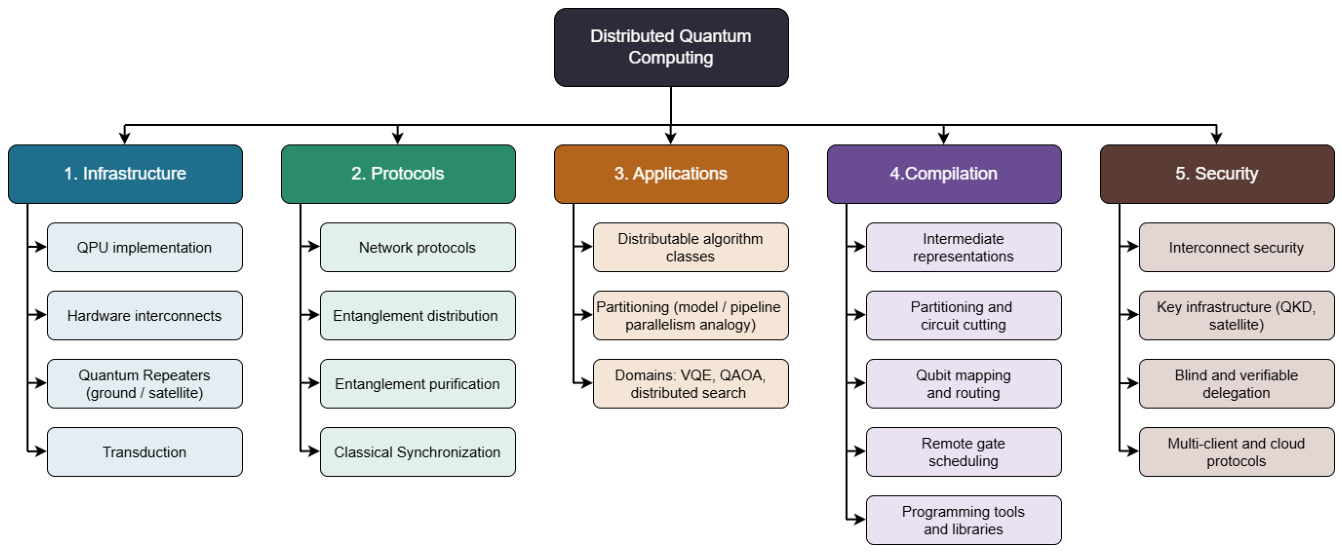
Figure 2.
The two halves of the security pillar. Left (blue): interconnect security, covering attacks and defenses on the physical, link, and network machinery, together with secure-interconnect work on QKD over fiber and satellite and on telecom-band QPU links. Right (green): computation security, covering blindness, verifiability, noise-robust verification, and multi-user cloud protocols. Organized after [10,11,12,13,14,15].
Figure 2.
The two halves of the security pillar. Left (blue): interconnect security, covering attacks and defenses on the physical, link, and network machinery, together with secure-interconnect work on QKD over fiber and satellite and on telecom-band QPU links. Right (green): computation security, covering blindness, verifiability, noise-robust verification, and multi-user cloud protocols. Organized after [10,11,12,13,14,15].
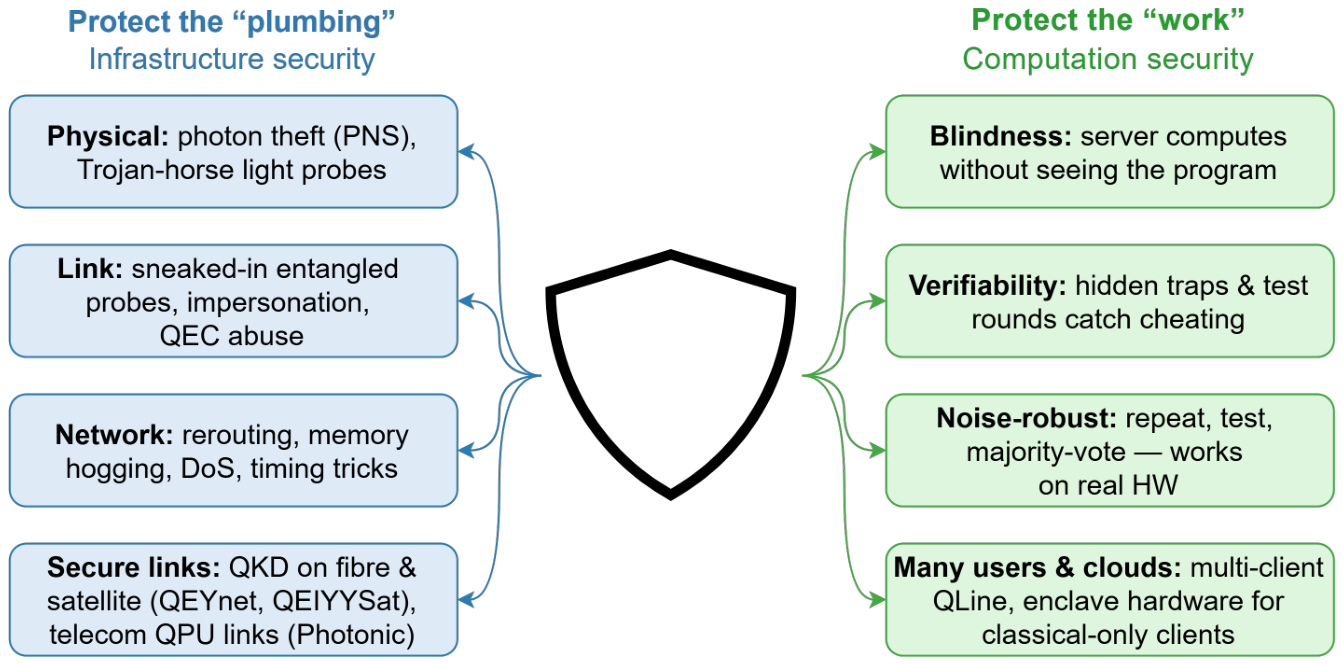
Figure 3.
Organization of this review.
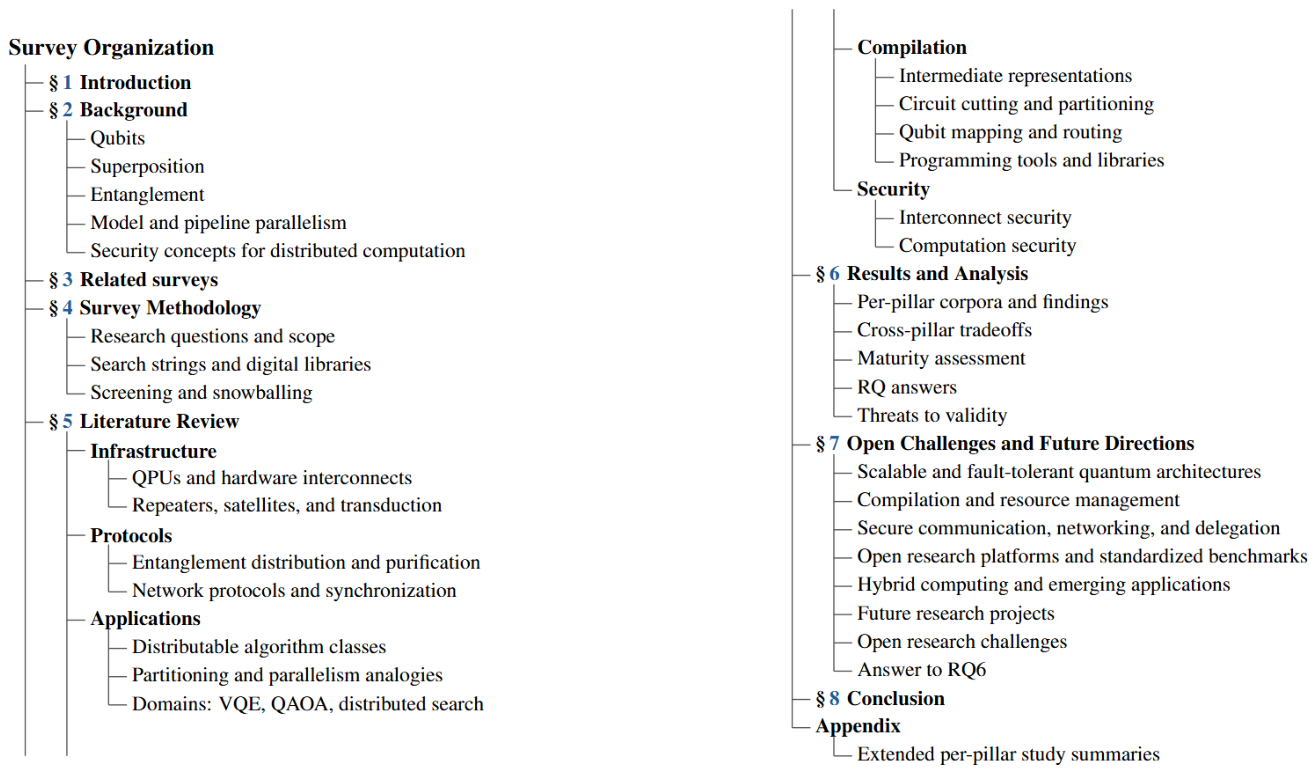
Figure 4.
Layer-wise attacks (left, red) and defenses (right, blue shields) across the four-layer quantum-internet stack, after Yang et al. [10]. The application-layer defense, blind and verifiable computing, is the subject of Section 5.5.2.
Figure 4.
Layer-wise attacks (left, red) and defenses (right, blue shields) across the four-layer quantum-internet stack, after Yang et al. [10]. The application-layer defense, blind and verifiable computing, is the subject of Section 5.5.2.
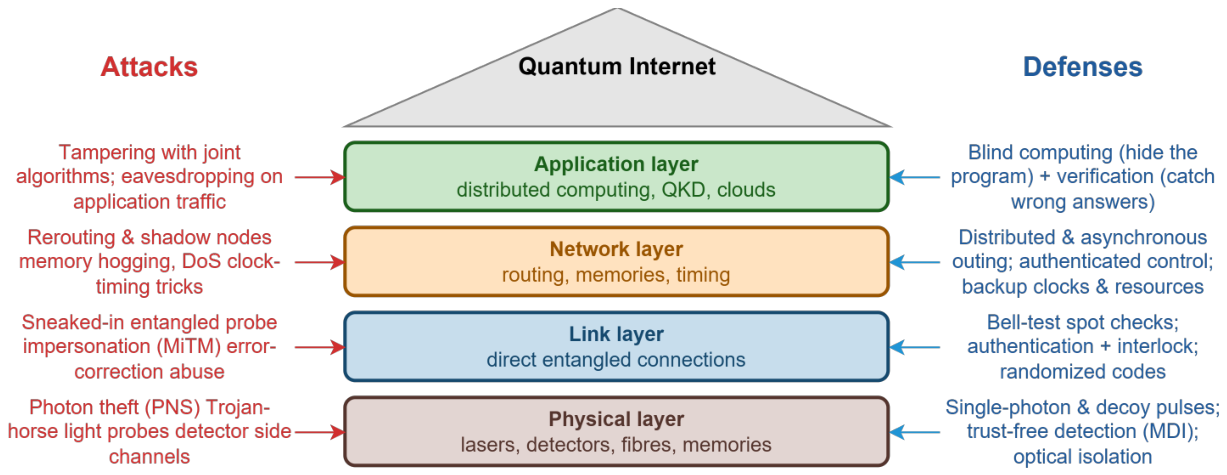
Figure 5.
Blind delegated computation in four steps [11,12,13]. (1) The client (left, blue) holds a secret key of random angles and sends locked qubits (padlocked golden circles) over the quantum channel. (2) The untrusted server (right, purple) links them into a mesh and (3) measures them following a scrambled order sent over the classical channel, (4) returning outcomes the client unlocks. One mesh site is a hidden trap (red ring) whose correct answer only the client knows. The two lower panels state the resulting privacy and integrity guarantees.
Figure 5.
Blind delegated computation in four steps [11,12,13]. (1) The client (left, blue) holds a secret key of random angles and sends locked qubits (padlocked golden circles) over the quantum channel. (2) The untrusted server (right, purple) links them into a mesh and (3) measures them following a scrambled order sent over the classical channel, (4) returning outcomes the client unlocks. One mesh site is a hidden trap (red ring) whose correct answer only the client knows. The two lower panels state the resulting privacy and integrity guarantees.
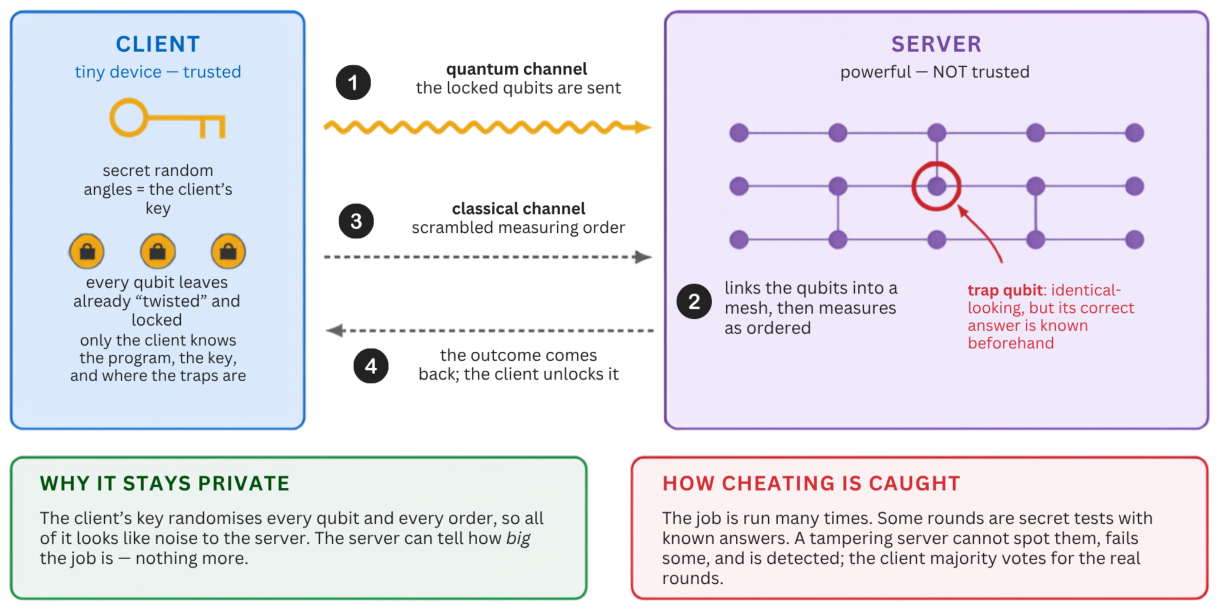
Figure 6.
Verifiable multi-client blind computation on a Qline [39,40]. A qubit (gold) from the untrusted source passes through each client’s rotation device, gaining one colored layer of secrecy per client, before reaching the untrusted detector. A classical orchestrator blends all client secrets into one scrambled measuring order. Bottom panel: interleaved secret test rounds (green = pass, red = fail); the clients accept only if the failed-test fraction stays below the threshold (formally , shown in the figure as “fewer than 1 in 4”), a bound independent of the number of clients.
Figure 6.
Verifiable multi-client blind computation on a Qline [39,40]. A qubit (gold) from the untrusted source passes through each client’s rotation device, gaining one colored layer of secrecy per client, before reaching the untrusted detector. A classical orchestrator blends all client secrets into one scrambled measuring order. Bottom panel: interleaved secret test rounds (green = pass, red = fail); the clients accept only if the failed-test fraction stays below the threshold (formally , shown in the figure as “fewer than 1 in 4”), a bound independent of the number of clients.
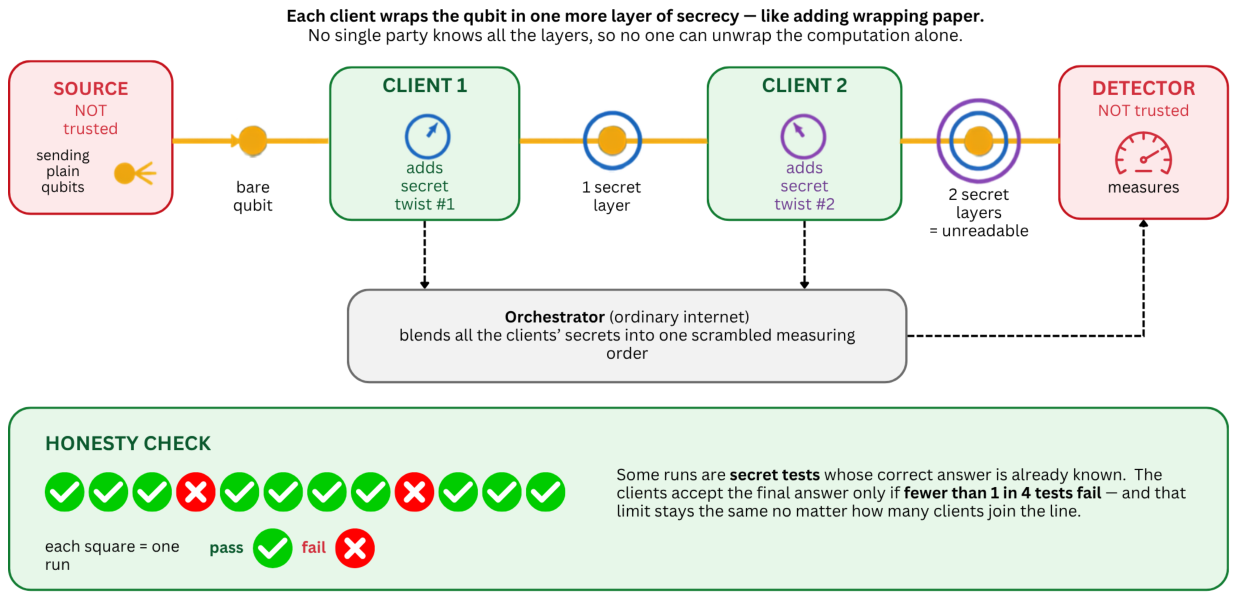
Figure 7.
Future research roadmap for distributed quantum computing, highlighting scalable architectures, quantum networking, resource management, standardized benchmarks, security, hybrid applications, experimental testbeds, and open research challenges.
Figure 7.
Future research roadmap for distributed quantum computing, highlighting scalable architectures, quantum networking, resource management, standardized benchmarks, security, hybrid applications, experimental testbeds, and open research challenges.
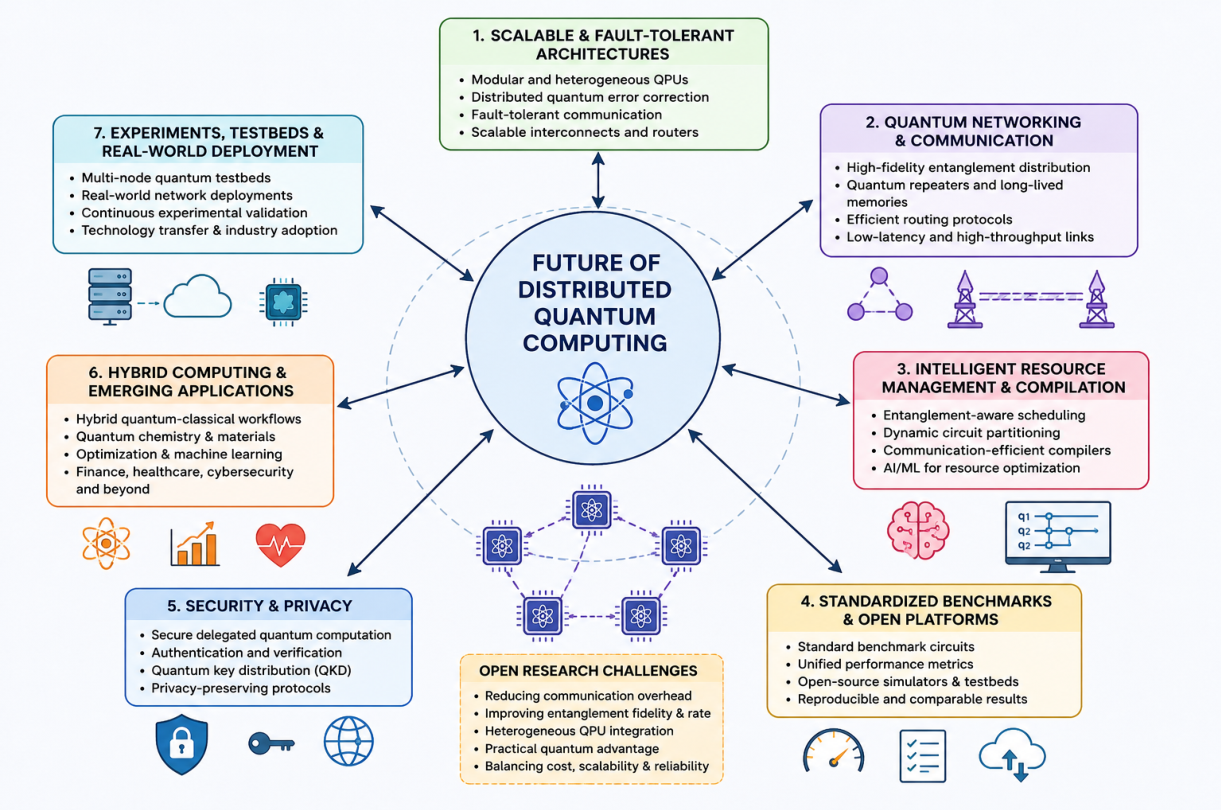
Table 1.
Inclusion and exclusion criteria.
| ID | Criterion |
|---|---|
| Inclusion | |
| IC1 | Addresses one or more of the five pillars, infrastructure, protocols, applications, compilation, or security, in the explicit context of distributing computation across two or more QPUs. |
| IC2 | Published between 2020 and 2026 inclusive. |
| IC3 | Peer-reviewed journal article, conference or workshop paper, or a preprint with a verifiable archival identifier and sufficient methodological detail to be appraised. |
| IC4 | Written in English and available in full text through institutional access or open access. |
| IC5 | Reports an original contribution: an architecture, protocol, algorithm, compiler technique, experimental result, or a systematic evaluation of existing ones. |
| Exclusion | |
| EC1 | Out of scope under the rule of Section 4.2: the primary objective is quantum key distribution as a communication service, distributed quantum sensing, or quantum-network metrology. |
| EC2 | Concerns only monolithic single-QPU execution, with no inter-processor communication or partitioning component. |
| EC3 | Natively distributed algorithms premised on separated data owners (for example, quantum federated learning) instead of on scaling a single computation. |
| EC4 | Non-archival material: editorials, abstracts, posters, tutorials, patents, white papers, and vendor marketing documents. |
| EC5 | Superseded by a later version by the same authors; only the most recent version is retained. |
| EC6 | Full text not retrievable, or insufficient detail to assess the study’s contribution against IC5. |
Table 2.
Sources searched.
| Source | Fields searched |
|---|---|
| IEEE Xplore | Title, abstract, keywords |
| ACM Digital Library | Title, abstract |
| SpringerLink | Title, abstract |
| ScienceDirect | Title, abstract, keywords |
| Scopus | Title, abstract, keywords |
| arXiv (quant-ph, cs.ET, cs.DC) | Title, abstract |
| APS Journals (PRL, PRA, PRX, PRApplied) | Title, abstract |
| Nature Portfolio (Nature, Nat. Commun., npj QI) | Title, abstract |
Table 3.
Per-pillar search strings (canonical form).
| Pillar | String |
|---|---|
| Anchor | ("distributed quantum computing" OR "distributed quantum computation" OR "multi-core quantum" OR "multi-QPU" OR "modular quantum architecture") |
| Infrastructure | Anchor AND ("quantum processing unit" OR "quantum interconnect" OR "quantum repeater" OR transduction OR transducer OR "photonic link" OR "chip-to-chip") |
| Protocols | Anchor AND ("entanglement distribution" OR "entanglement purification" OR "entanglement distillation" OR "link layer" OR "network protocol" OR "quantum network stack" OR synchronization) |
| Applications | Anchor AND ("variational quantum eigensolver" OR VQE OR QAOA OR "quantum chemistry" OR "distributed quantum search" OR "quantum simulation" OR workload) |
| Compilation | Anchor AND (compiler OR compilation OR "qubit mapping" OR "qubit routing" OR "circuit partitioning" OR "circuit cutting" OR "circuit knitting" OR "gate scheduling" OR "intermediate representation") |
| Security | Anchor AND ("blind quantum computation" OR "delegated quantum computation" OR verification OR authentication OR "quantum key distribution" OR eavesdropping) |
Table 4.
Studies counted in more than one pillar corpus.
| Study | Pillars | |
|---|---|---|
| Caleffi et al. [21] | Inf., Pro., App., Com. | 4 |
| Barral et al. [22] | Inf., Pro., App., Com. | 4 |
| Main et al. [36] | Inf., Pro., App. | 3 |
| Afzal et al. [26] | Inf., Sec. | 2 |
| Yang et al. [10] | Inf., Sec. | 2 |
| Wu et al. (CollComm) [32] | Pro., Com. | 2 |
| Dahlberg et al. (NetQASM) [42] | Pro., Com. | 2 |
| Cambiucci et al. [3] | App., Com. | 2 |
| Bahrani et al. [5] | Inf., Com. | 2 |
| is the number of pillar corpora the study appears in. The deduplicated corpus is . | ||
Table 5.
Thematic distribution of the Infrastructure-pillar corpus.
| Theme | n | % |
|---|---|---|
| Modular / multi-core architectures | 7 | 20.6 |
| QPU platforms / hardware demonstrations | 6 | 17.6 |
| Quantum interconnects | 5 | 14.7 |
| Quantum repeaters | 5 | 14.7 |
| Secure interconnect / satellite | 4 | 11.8 |
| Quantum data centers | 3 | 8.8 |
| Surveys / DQC framing | 2 | 5.9 |
| Transduction (microwave–optical) | 2 | 5.9 |
| Total | 34 | 100 |
Table 6.
Selected Infrastructure platform and interconnect demonstrations.
| Work | Platform | Key results |
|---|---|---|
| Afzal et al. [26] | Si T centers, m fiber | Heralded Bell ; post-selected tCNOT; projected at kHz |
| Main et al. [36] | 2 ion modules, m | Remote Bell ; deterministic teleported CZ ; Grover success |
| Pompili et al. [47] | 3-node NV centers | Link ; GHZ ; swapped Bell |
| Humphreys et al. [48] | 2 NV nodes | Up to 39 Hz entanglement; deterministic delivery Hz |
| Magnard et al. [51] | SC qubits, 5 m cryo link | Transfer process fidelity ; entangled |
| Llewellyn et al. [52] | Si photonic chips | Intra-chip teleportation ; chip-to-chip F up to |
| Mirhosseini et al. [53] | Transmon→telecom | First qubit→optical conversion; , |
Table 7.
Thematic distribution of the Protocols-pillar corpus.
| Theme | n | % |
|---|---|---|
| Security (QKD, verification of remote computation) | 6 | 18.8 |
| Network protocols and protocol-stack design | 5 | 15.6 |
| Entanglement purification and distillation | 4 | 12.5 |
| Entanglement distribution, routing, buffering | 4 | 12.5 |
| DQC networking and inter-QPU communication | 4 | 12.5 |
| Experimental protocol demonstrations | 4 | 12.5 |
| Protocol simulators and evaluation tools | 3 | 9.4 |
| Quantum repeater protocols and performance | 2 | 6.3 |
| Total | 32 | 100 |
| Percentages do not sum to 100 because of rounding. | ||
Table 8.
Experimental protocol demonstrations in the reviewed corpus.
| Work | Platform | Key results |
|---|---|---|
| Pompili et al. [47] | 3-node NV centers | Link – at 7–9 Hz; GHZ ; swapped Bell pair |
| Hermans et al. [85] | 3-node NV centers | Non-neighbor teleportation (); memory lifetime improved ; readout infidelity |
| Afzal et al. [26] | Si T centers, m fiber | Heralded Bell pair (40 ns bin, mHz rates); post-selected teleported CNOT; projected at kHz |
| Main et al. [36] | 2 ion-trap modules, m fiber | Remote Bell ; deterministic teleported CZ ; iSWAP ; SWAP ; distributed Grover success |
Table 9.
Thematic distribution of the Applications-pillar corpus.
| Theme | n | % |
|---|---|---|
| Distributed VQE / variational chemistry | 7 | 23.3 |
| Application-facing circuit partitioning | 7 | 23.3 |
| Distributed QAOA / combinatorial optimization | 6 | 20.0 |
| Distributed search / oracle algorithms | 5 | 16.7 |
| Programming / orchestration | 3 | 10.0 |
| Surveys / DQC framing | 2 | 6.7 |
| Total | 30 | 100 |
Table 10.
Selected Applications-pillar quantitative highlights.
| Work | Class | Key results |
|---|---|---|
| Kim et al. [102] | DQAOA / QCSC | : in s; : s vs s tuned serial dq-QAOA |
| Fujii et al. [88] | Deep VQE | Heisenberg: – above Lanczos; 12-qubit Kagome fidelity |
| Hasanzadeh and Kargarian [29] | DVQE / QUBO | Warm-start success vs random; QQP -quality rates on tested LP/QP suites |
| Sang et al. [95] | D&C QAOA | Coverage ; AR () vs failure-inclusive baseline |
| Burt et al. [97] | Circuit partition | Mean e-bits/2Q: GCP-E vs FGP-rOEE / AESD |
| Main et al. [36] | Distributed Grover | Teleported CZ ; Grover success on m link |
Table 11.
Thematic distribution of the Compilation-pillar corpus.
| Theme | n | % |
|---|---|---|
| Circuit cutting / knitting | 6 | 20.0 |
| Compiler frameworks | 5 | 16.7 |
| Communication-aware compilation | 5 | 16.7 |
| Partitioning / mapping (shared) | 5 | 16.7 |
| IRs / program interfaces | 3 | 10.0 |
| Scheduling / resource management | 3 | 10.0 |
| Telegate / teledata routing | 2 | 6.7 |
| MBQC compilation | 1 | 3.3 |
| Total | 30 | 100 |
| Percentages do not sum to 100 because of rounding. | ||
Table 12.
Selected Compilation-pillar quantitative highlights. The AutoComm percentages are measured against a per-gate baseline and the CollComm percentages against AutoComm, so the two sets are not directly comparable.
Table 12.
Selected Compilation-pillar quantitative highlights. The AutoComm percentages are measured against a per-gate baseline and the CollComm percentages against AutoComm, so the two sets are not directly comparable.
| Work | Focus | Key results |
|---|---|---|
| Wu et al. [33] | AutoComm | Avg. EPR, latency; fewer remote communications (up to ) |
| Wu et al. [32] | CollComm / EPR buffer | Avg. / communication-cost metrics vs. AutoComm |
| Piveteau and Sutter [6] | Knitting + LOCC | n nonlocal CNOTs: sampling : LO → joint LOCC |
| Ren et al. [118] | Hardware-aware cuts | Subcircuit depth sum (avg. ); fidelity up to vs. CutQC |
| Bhoumik et al. [119] | Noise and time schedule | 10-qubit avg. fidelity (no MEM), (with MEM) |
| Sundaram et al. [120] | Min. execution time | Up to wall-clock vs. prior distribution scheme (NetSquid) |
| Xue et al. [121] | DC-MBQC | Up to lower required photon lifetime; speedup on 8 QPUs |
Table 13.
Thematic distribution of the Security-pillar corpus.
| Theme | n | % |
|---|---|---|
| Single-client blind and verifiable delegation | 6 | 42.9 |
| Multi-client and distributed delegation | 5 | 35.7 |
| Hardware-anchored delegation (enclave) | 1 | 7.1 |
| Secure-interconnect platforms | 1 | 7.1 |
| Infrastructure-security frameworks | 1 | 7.1 |
| Total | 14 | 100 |
| Percentages do not sum to 100 because of rounding. | ||
Table 14.
Comparison of secure delegation protocols for distributed quantum computing. IT = information-theoretic; comp. = composable.
Table 14.
Comparison of secure delegation protocols for distributed quantum computing. IT = information-theoretic; comp. = composable.
| Protocol (year) | Client requirement | Server model | Blind | Verif. | Noise-rob. | Security | Experiment |
|---|---|---|---|---|---|---|---|
| Childs (2005) | Q. memory + Pauli | 1 untrusted | yes | — | — | IT | — |
| ABE [130] (2010) | Const.-size QC | 1 untrusted | yes | yes | — | IT | — |
| UBQC/BFK [11] (2009) | 1-qubit prep. | 1 untrusted | yes | auth. ext. | — | IT | photonic |
| BFK 2-server [11] (2009) | classical | 2 entangled, non-communicating | yes | yes | — | IT | — |
| FK [12] (2017) | prep. + dummies | 1 untrusted | yes | yes | — | IT, comp. | basis of [38] |
| Broadbent [37] (2018) | 1-qubit prep. | 1 untrusted | yes | yes | partial | IT | — |
| Leichtle et al. [13] (2021) | 1-qubit prep. | 1 untrusted | yes | yes | yes | IT, comp. | [38,40] |
| Drmota et al. [38] (2024) | photon meas. | trapped-ion node | yes | 2-node demo | yes | IT | matter–photon |
| KP MDQC [25] (2016) | prep. per client | untrusted; dishonest clients | yes | — | — | IT + class. | — |
| Li et al. [15] (2023) | prep. + traps | untrusted; dishonest clients | yes | yes | — | IT | IBM sim. |
| Qline MC-BQC [39] (2023) | 1-qubit rotation | 2 untrusted nodes | yes | — | — | IT | 2-client photonic |
| Verif. Qline [40] (2025) | 1-qubit rotation | untrusted source and detector | yes | yes | yes | IT | 2-client photonic |
| KKLMO [41] (2025) | 1-qubit prep. | untrusted; dishonest majority | yes | yes | yes | IT, comp. | theory for [40] |
| QEnclave [14] (2022) | classical only | untrusted + enclave | yes | open | — | IT + HW | — |
| Childs (2005) and ABE (2010) are included as historical reference points for the client-capability axis. They fall outside the search window and are not counted in the 14-study Security corpus. | |||||||
Table 15.
Layer-wise attacks and countermeasures for DQC infrastructure, after Yang et al. [10]. C, I, A denote confidentiality, integrity, and availability.
Table 15.
Layer-wise attacks and countermeasures for DQC infrastructure, after Yang et al. [10]. C, I, A denote confidentiality, integrity, and availability.
| Layer | Representative attacks | CIA | Primary countermeasures | DQC-specific consequence |
|---|---|---|---|---|
| Physical | Photon-number splitting; Trojan-horse probing; detector side channels | C | Single-photon and decoy-state sources; MDI and entanglement-based protocols; isolation and filtering | Taps on inter-module fiber threaten teleported data qubits, not only key material [26] |
| Link | Entangling probes; man-in-the-middle; QEC exploitation | C, I, A | Bell-inequality spot checks; authentication and interlock protocols; randomized codes, QEC monitoring | Corrupted Bell pairs silently corrupt remote gates |
| Network | Routing hijack and shadow nodes; memory monopolization; DoS; timing attacks | I, A | Distributed and asynchronous routing; authenticated control traffic; redundant time sources | Broken entanglement timetables cause failed or corrupted distributed circuits |
| Application | Manipulation of jointly executed algorithms; individual, collective, and coherent eavesdropping | C, I | Blind and verifiable delegation [11,12,13] | Multi-tenant clouds require multi-client blindness and verifiability [39,40] |
Table 16.
Open challenges and future research directions in distributed quantum computing.
| Research Challenge | Current Limitation | Future Research Direction | Expected Contribution |
|---|---|---|---|
| Scalable and fault-tolerant architectures | Restricted number of interconnected QPUs, hardware noise, and the complexity of maintaining computational fidelity across distributed nodes. | Develop flexible QPU architectures, distributed error correction, scalable interconnects, and fault-tolerant communication. | Reliable and scalable DQC systems [1,21,26]. |
| Resource management and compilation | QPU allocation, circuit partitioning, communication overhead, and changing network conditions complicate distributed execution. | Develop adaptive compilers, schedulers, communication-aware circuit partitioning, and machine-learning-assisted optimization. | Lower execution and communication overhead [5,30,31,112]. |
| Secure communication and quantum networking | Routing, memory lifetime, entanglement generation, and secure delegation remain difficult across distributed nodes. | Improve quantum routing, quantum memories, verification, entanglement distribution, and secure delegated computation. | Secure and reliable quantum networking [9,13,38,76]. |
| Standardized benchmarking | Different platforms use different evaluation procedures, circuits, metrics, and network models, making comparisons difficult. | Develop open benchmark suites, common metrics, reproducible experiments, and publicly accessible testbeds. | Reproducible and fair DQC evaluation [2,21,22]. |
| Hybrid quantum–classical computing | Distributed quantum workloads must coordinate QPUs with classical computational resources and standard optimization. | Develop hybrid architectures integrating QPUs, CPUs, GPUs, and distributed classical control systems. | Improved practical application performance [28,29]. |
| Verification and security | Cloud users may not trust the quantum hardware or the service provider, while verification and blindness introduce overhead. | Develop verification-aware architectures, standardized security metrics, secure delegated computation, and blind protocols. | Trustworthy quantum cloud computing [12,14,40]. |
| Heterogeneous quantum processors | Different QPUs may have different hardware capabilities, native gate sets, connectivity, and error characteristics. | Develop adaptive compilation strategies and hardware-independent abstractions for heterogeneous QPU networks. | Interoperable distributed quantum infrastructure [31,101]. |
Disclaimer/Publisher’s Note: The statements, opinions and data contained in all publications are solely those of the individual author(s) and contributor(s) and not of MDPI and/or the editor(s). MDPI and/or the editor(s) disclaim responsibility for any injury to people or property resulting from any ideas, methods, instructions or products referred to in the content. |
© 2026 by the authors. Licensee MDPI, Basel, Switzerland. This article is an open access article distributed under the terms and conditions of the Creative Commons Attribution (CC BY) license.
Copyright: This open access article is published under a Creative Commons CC BY 4.0 license, which permit the free download, distribution, and reuse, provided that the author and preprint are cited in any reuse.