
Submitted:
03 November 2026
Posted:
05 November 2026
You are already at the latest version
Abstract
Laser and electron beam powder bed fusion of metals (PBF-LB/M and PBF-EB/M) processes are among the most widely used metal Additive Manufacturing (AM) technologies, offering unprecedented design freedom by enabling the fabrication of complex geometries that are impossible or prohibitively expensive to produce using conventional manufacturing methods. However, ensuring consistent part quality remains a significant challenge, as defects such as lack of fusion and keyhole porosity, cracks, surface irregularities, and dimensional inaccuracies can arise from suboptimal process parameters. Traditional parameter optimization aimed at minimizing such defects relies on extensive experimental campaigns, which are costly, time-consuming, and often material-specific. Moreover, the optimized process parameters must not only suppress defect formation but also maintain high productivity and cost-efficient processing to meet industrial manufacturing requirements. Recently, machine learning (ML) approaches have emerged as powerful tools to model relationships between PBF-LB/EB process parameters and resulting defects. However, ML models typically require large datasets that are not available for newly developed alloys. Transfer learning (TL) provides a pathway to address this limitation. In essence, transfer learning refers to the reuse of knowledge gained from one domain (e.g., a well-characterized alloy with extensive process data) to improve learning performance in a related but data-scarce domain (e.g., a newly developed alloy). Instead of training a model from scratch, TL adapts pre-trained models by fine-tuning them using a limited amount of new data. This review summarizes recent advances in ML and TL approaches for PBF-LB/EB process optimization, with a particular focus on their role in improving part quality and enabling efficient parameter development for emerging alloy systems.
Keywords:
additive manufacturing (AM)
; transfer learning (TL)
; machine learning (ML)
; process optimization
; laser/electron beam powder bed fusion (PBF-LB/EB)
1. Introduction
1.1. Development and Classification of Additive Manufacturing Technologies
Under the current ISO/ASTM 52900:2021(en) Additive manufacturing — General principles — Fundamentals and vocabulary (Edition 2, 2021) terminology standard [1], powder bed fusion (PBF) is one of seven Additive Manufacturing (AM) process categories, alongside Binder Jetting (BJT) [2], Directed Energy Deposition (DED) [3], Material Extrusion (MEX) [4], Material Jetting (MJT)[5], Sheet Lamination (SHL), and Vat Photopolymerization (VPP) . In PBF, thermal energy selectively consolidates defined regions of a powder bed; in laser beam powder bed fusion (PBF-LB), the energy source is a laser, whereas electron beam powder bed fusion (PBF-EB) uses an electron beam. [6]. In accordance with ISO/ASTM 52900, PBF-LB, or more specifically PBF-LB/M for metallic materials, is the standardised designation for the laser beam powder bed fusion process. Nevertheless, even in reputable scientific journals, this process is still frequently referred to as laser powder bed fusion (LPBF or L-PBF), DMLS® (Direct Metal Laser Sintering, an EOS GmbH trademark), or SLM® (Selective Laser Melting, a trademark associated with Nikon/SLM Solutions). Similarly, electron beam powder bed fusion of metals is designated PBF-EB/M [1], although the legacy abbreviation EBM (Electron Beam Melting), historically associated with Arcam (subsequently acquired by GE Additive, now Colibrium Additive), remains widely used. Although alternative terms for PBF-LB/EB, remain widespread in the literature, the standardised terminology is adopted consistently throughout this review.
An early conceptual precursor of metal powder-based additive manufacturing was proposed by Pierre Ciraud, whose invention claimed priority from 28 December 1971. His approach involved the selective consolidation of fusible materials using a concentrated energy source, enabling the fabrication of complex objects without conventional moulds [7]. This early conceptual foundation was followed by Ross Housholder’s 1979 Molding Process. Unlike Ciraud’s laser-assisted proposal, Housholder described a layer-wise powder-based manufacturing system, whose architecture anticipated several essential features of modern AM machines. Although it did not yet provide a commercially mature solution, the patent demonstrated how controlled, sequential deposition and consolidation of material layers could be used to build complex three-dimensional objects [8].
The transition from such early powder-based concepts to a practical operating AM machine was achieved by Charles (“Chuck”) Charles W. Hull made a major contribution to the commercial development of additive manufacturing by introducing stereolithography (Vat Photopolymerization according to current ISO/ASTM standard), for which he filed a patent application in 1984 (granted in 1986) [9]. His subsequent work with 3D Systems contributed to the development of digital manufacturing workflows, including the STL (Stereolithography) file format, which became widely adopted for representing three-dimensional geometries in AM. In parallel, Carl Deckard, working with Joe Beaman at the University of Texas at Austin, developed selective laser sintering (SLS) and filed a patent application in 1986 [10]. Although the process became particularly established for polymer powders (currently classified as PBF-LB/P), the original patent also contemplated the processing of metallic and ceramic powders. The widespread availability of affordable desktop 3D printers, particularly those based on MEX, commonly referred to as Fused Deposition Modeling (FDM) or Fused Filament Fabrication (FFF), has substantially increased public awareness and accessibility of additive manufacturing technologies [4].
An important milestone in the commercial development of metal powder bed fusion was the introduction of the EOSINT M 250 system in 1995, building on cooperation between EOS and Electrolux Rapid Development. Early DMLS systems primarily processed specially developed metallic powder mixtures, including bronze–nickel based materials. Subsequent collaborative research involving EOS, Fraunhofer institutes, and Fockele & Schwarze contributed to the development of processes capable of producing highly dense metallic components through complete melting [11]. Over the following decades, metal additive manufacturing evolved from specialised rapid prototyping and tooling applications into an increasingly established industrial manufacturing technology, supported by advances in beam sources, machine control, computing capabilities, process monitoring, and material development [3,12]. The increasing availability of process-monitoring data, combined with advances in computational methods, has enabled the growing application of artificial intelligence (AI) and machine learning (ML) to metal PBF. These approaches provide opportunities for data-driven process optimisation, defect detection, quality prediction, and the development of adaptive process-control strategies [13,14].
1.2. Machine Learning and Artificial Intelligence in Additive Manufacturing
AI and ML are increasingly used across AM to learn relationships between processing conditions and quality-related outcomes, thereby reducing the number of experimental iterations required for process development. Applications include prediction of dimensional accuracy, surface quality, mechanical properties, and process stability, as well as image- and signal-based monitoring and, increasingly, closed-loop control [14,15,16]. The specific input variables and quality metrics differ among AM process categories, but the common objective is to extract useful process–quality relationships from heterogeneous experimental and monitoring data.
Metal PBF is particularly suitable for data-driven modelling because it combines a high-dimensional process space with rich layer-wise information. In PBF-LB/M, optical, thermal, photodiode, acoustic, powder-bed, and machine-log data can be linked to porosity, microstructure, dimensional accuracy, and mechanical properties [13,14]. PBF-EB/M offers analogous opportunities through beam-control signals, electron-optical or layer-wise imaging, preheating records, and machine-status data, although published ML studies and openly available datasets remain less numerous [17,18]. These characteristics make PBF an important testbed for ML and, where target data are scarce, for transfer learning.
1.3. Optimisation of Laser and Electron Beam Powder Bed Fusion
Both PBF-LB/M and PBF-EB/M are governed by complex interactions among beam characteristics, scanning parameters, powder properties, component geometry, and processing conditions. These interactions influence melt-pool behaviour, thermal history, defect formation, and ultimately the microstructure and mechanical performance of manufactured components [3,6,19]. The resulting optimisation problem is therefore multidimensional and strongly dependent on the material, machine, geometry, and processing environment.
Conventional trial-and-error and design-of-experiments (DoE) approaches remain important for process development and qualification but can require considerable machine time, feedstock, and post-process characterisation for each new set of conditions [19,20]. Although ML methods can capture nonlinear relationships between processing conditions and quality-related outcomes, their predictive reliability depends on the representativeness and quality of training data. When only a limited number of observations are available for a new alloy, machine, or processing condition, developing reliable models from scratch may be challenging [13,21].
In metal PBF, a domain can be understood as the specific manufacturing and measurement conditions under which experimental data are collected. These include the alloy, powder characteristics, machine configuration, process parameters, component geometry, and sensing conditions (in ML terminology, a domain is defined by an input feature space and its associated probability distribution). A learning task describes what the model is expected to predict, such as relative density, porosity, surface roughness, or crack occurrence (formally, a label space and a predictive function) [22].
When a model developed using data from one material or manufacturing configuration (source domain) is applied to another (target domain), differences between their processing conditions and material properties may cause a domain shift. Importantly, the prediction task may remain unchanged. For example, a model trained to predict relative density in one tool steel may be adapted to another tool steel, while retaining relative density as the output variable. Although both materials share similar melting and defect-formation mechanisms, differences in absorptivity, thermal conductivity, solidification behaviour, or powder characteristics may alter the relationships between process parameters and resulting part quality.
Transfer learning (TL) aims to reuse knowledge acquired from the source domain, such as learned relationships between process parameters and material quality, to improve predictions in the target domain. This may reduce the number of new experiments required to develop an accurate model for a different alloy or manufacturing configuration [21,22]. However, successful transfer depends on the extent to which the underlying physical relationships remain valid across domains. If these relationships differ substantially, transferred knowledge may reduce rather than improve prediction accuracy, a phenomenon known as negative transfer [23].
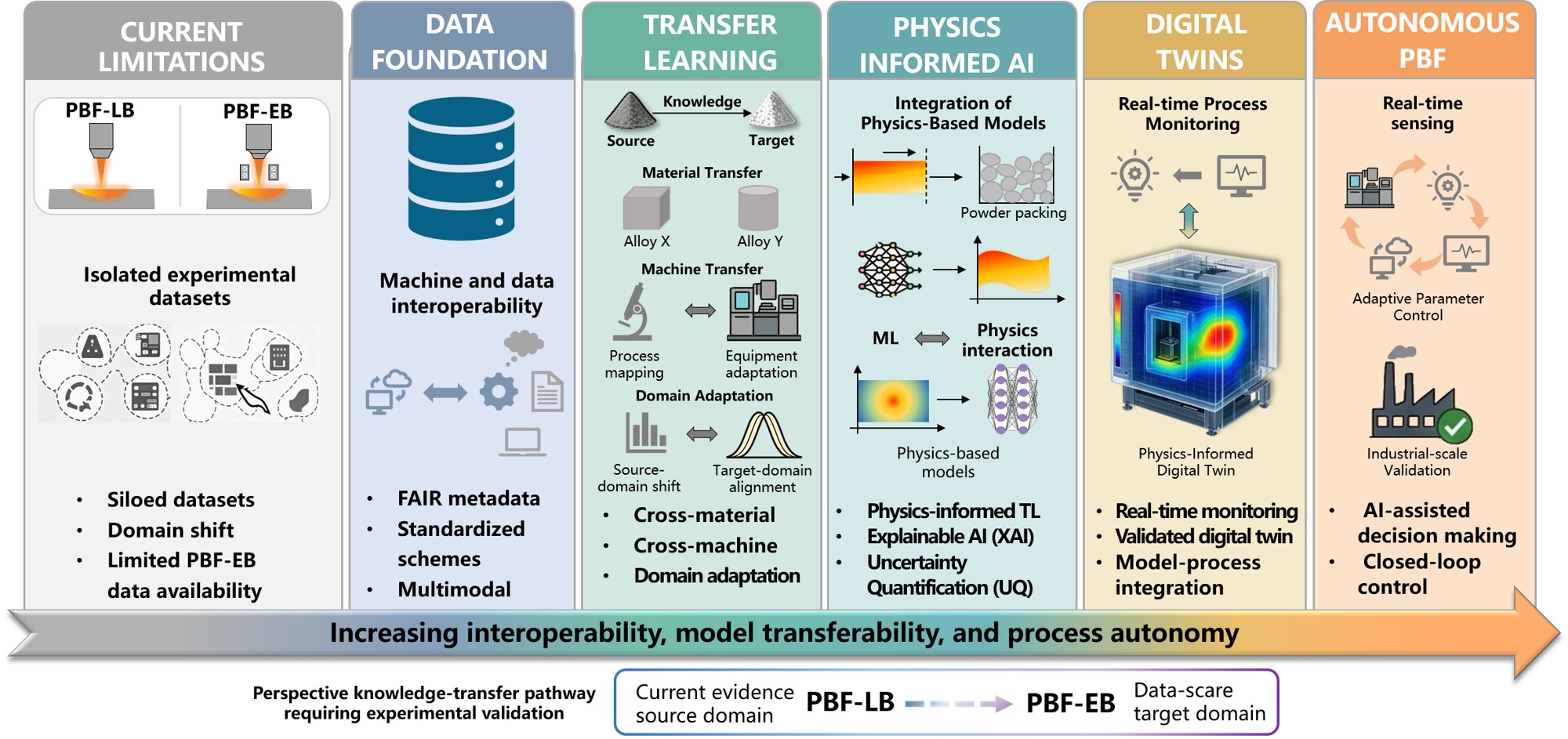
Accordingly, this review compares conventional and data-driven optimisation approaches for metal PBF, with particular emphasis on empirical TL in PBF-LB/M. It examines transfer across materials, powder conditions, machines, process settings, tasks, and geometries; evaluates the data infrastructure needed for reliable transfer; and discusses the present evidence gap for PBF-EB/M. No eligible empirical TL study directly addressing PBF-EB/M was identified in the final literature set, so its use in that process is treated as a future research opportunity rather than an established capability.
2. Fundamentals of PBF-LB/EB Processes
2.1. Physical Mechanisms in PBF-LB and PBF-EB
In both PBF-LB/M and PBF-EB/M, a thin layer of metallic powder is selectively exposed to a scanning energy beam. During consolidation, the absorbed energy locally melts the powder and remelts part of the previously solidified material. The resulting liquid metal wets the underlying surface, while initially separate molten regions merge through coalescence, forming a continuous melt pool and subsequently a solidified scan track. Overlapping melt tracks and partial remelting of previously deposited layers enable metallurgical bonding and the formation of a continuous solid structure. Solidification and repeated heating and cooling subsequently determine microstructure, phase evolution, residual stresses, and ultimately the properties of the manufactured component [3,24,25].
In PBF-LB/M, energy is delivered by laser radiation, most commonly from near-infrared fibre lasers, although other wavelengths are also used for specific materials [26]. A laser beam is electromagnetic radiation carried by photons, whose energy is given by , where h is Planck’s constant, is frequency, c is the speed of light, and is wavelength. Photons carry energy and momentum but have neither electric charge nor rest mass. In metals, the incident optical field interacts primarily with conduction electrons; part of the radiation is reflected and part is absorbed, with the absorbed energy subsequently transferred to the lattice and converted into heat. In a dense metallic surface, optical absorption occurs within a very shallow near-surface region. This optical absorption depth should not, however, be confused with the effective penetration of laser radiation into a loose powder bed: multiple reflections and scattering between particles can redistribute the incident radiation into deeper regions of the powder layer. The effective absorptivity consequently depends on wavelength, alloy composition, surface condition, temperature, powder morphology, and the evolving melt-pool geometry, and it can change markedly as a continuous melt track or keyhole develops [27,28,29].
The energy absorbed during PBF-LB/M generates a molten pool whose temperature and shape are governed not only by heat conduction but also by liquid-metal flow, surface tension, Marangoni convection, and, at sufficiently high temperatures, evaporation-induced recoil pressure and capillary effects [27,28]. Consequently, the melt-pool depth may greatly exceed the optical absorption depth. Evaporation creates a metal-vapour plume and can eject droplets or particles as spatter, whereas the shielding-gas flow primarily influences the removal and transport of vapour, condensate, and spatter from the beam interaction region [30]. These coupled processes influence the local thermal history and provide the physical basis for the defect mechanisms discussed in Section 2.3.
In PBF-EB/M, the energy carriers are electrons accelerated through an electric potential difference. Their kinetic energy is approximately , where e is the elementary charge and U is the accelerating voltage; for example, an electron accelerated through gains of kinetic energy. Unlike photons, electrons have both rest mass and electric charge. Although they also exhibit wave–particle duality and possess a de Broglie wavelength, their associated matter waves are not electromagnetic radiation. Accelerated electrons interact with the material through Coulomb forces: inelastic interactions transfer energy to atomic electrons through excitation and ionisation, while elastic scattering primarily changes electron trajectories and contributes to backscattering. Secondary-electron emission, backscattered electrons, and X-ray generation are additional consequences of the beam–matter interaction. Unlike the shallow optical absorption characteristic of dense metals, electron energy is deposited within a subsurface interaction volume whose dimensions depend on accelerating voltage and material composition, particularly density and atomic number [6,31,32]. The large difference between the energy of an individual near-infrared photon (approximately ) and that of an accelerated electron (often tens of ) should not be interpreted as a direct comparison of heating capability: the relevant process quantities are the delivered beam power, the fraction of energy deposited in the material, and its spatial and temporal distribution.
Stable PBF-EB/M processing normally requires a vacuum or a controlled low-pressure environment, sometimes with a small helium partial pressure, to limit collisions between accelerated electrons and gas molecules and to reduce contamination [6,31]. The process also requires adequate electrical connectivity within the powder bed. Although the feedstock is metallic, individual particles may be poorly connected electrically, particularly when separated by surface oxide films, and may accumulate charge during irradiation. Electrostatic repulsion can then eject powder particles in an instability known as smoking. In conventional PBF-EB/M processing, the powder layer is therefore preheated and partially sintered, commonly by repeated scanning with a defocused electron beam. The resulting particle contacts and sintering necks improve electrical connectivity, heat transfer, and mechanical stability, thereby reducing the likelihood of powder ejection [32,33,34,35]. This elevated-temperature processing also changes thermal gradients and the time–temperature history relative to conventional PBF-LB/M, although the actual preheating temperatures in both processes depend on the machine and alloy [6,31].
Thus, the fundamental difference between the two processes is not simply the source of heat but the mechanism and environment of energy transfer: wavelength-dependent optical absorption, melt-pool dynamics, and shielding-gas transport in PBF-LB/M versus electron penetration and scattering, powder-bed charging, vacuum operation, and pre-sintering in PBF-EB/M. In both technologies, deposited energy is ultimately converted into heat and drives melting and solidification, but it reaches the material through different physical pathways. From the perspective of machine learning and transfer learning, this distinction is important because similar nominal settings, thermal signatures, or defect indicators cannot be assumed to have equivalent physical meaning across the two processes, even when the alloy is the same [6,24,31].
Figure 1.
Comparison of PBF-LB and PBF-EB process physics and main process parameters. *Laboratory-scale PBF-LB/M systems can achieve build-platform preheating temperatures of up to 1200 °C, whereas most industrial systems are limited to approximately 200 °C.
Figure 1.
Comparison of PBF-LB and PBF-EB process physics and main process parameters. *Laboratory-scale PBF-LB/M systems can achieve build-platform preheating temperatures of up to 1200 °C, whereas most industrial systems are limited to approximately 200 °C.
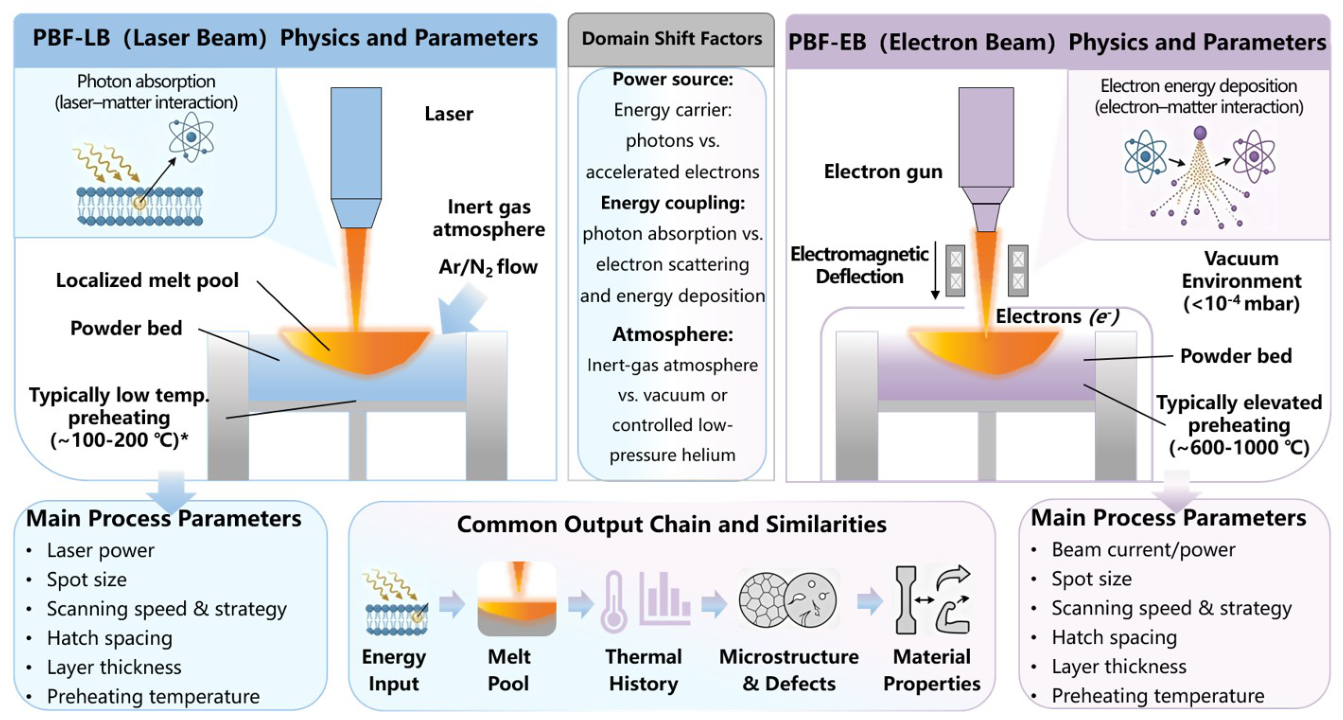

Table 1.
Comparison of beam–material interactions in PBF-LB and PBF-EB.
| Aspect | PBF-LB | PBF-EB |
|---|---|---|
| Energy carrier | Photons (electromagnetic radiation) | Accelerated electrons |
| Typical energy per photon/electron | ∼1 eV per photon for near-infrared lasers | ∼60 keV per electron |
| Primary interaction | Optical absorption | Electron–matter collisions |
| Main energy conversion | Photon absorption → electronic excitation → heat | Inelastic electron scattering → electronic excitation → heat |
| Penetration | Optical absorption near the surface; strongly dependent on material and wavelength | Electrons penetrate below the surface; penetration depth depends on electron energy, material density, and atomic number |
| Reflection | Can be substantial, particularly for highly reflective metals | Electron backscattering occurs, but the interaction differs fundamentally from optical reflectivity |
| Vacuum required | No; typically processed in an inert-gas atmosphere | Yes; technical vacuum, sometimes with low-pressure helium |
| Importance of electrical conductivity | Not fundamentally required | Important; Adequate electrical connectivity of powder particles is required to minimise charging and smoking |
| Beam steering | Optical elements and galvanometer mirrors | Electromagnetic deflection |
| Additional radiation | Reflected and scattered laser radiation | Backscattered and secondary electrons, and bremsstrahlung/X-rays |
2.2. Key Process Parameters
The process parameters of PBF-LB/M and PBF-EB/M control how energy is delivered to the powder bed in space and time. Their combined effects determine melt-pool geometry and stability, thermal history, defect formation, microstructure, and residual stresses. For engineering purposes, it is useful to distinguish between beam and exposure settings (which control energy delivery), layer and powder characteristics (which determine the state of the material being processed), and environmental or thermal boundary conditions (which influence energy losses and process stability). These groups are coupled rather than independent: for example, changing powder particle-size distribution or packing density can alter powder spreading and energy absorption even when the nominal beam settings remain unchanged [3,6,25].
In PBF-LB/M, the main exposure parameters include laser power, scanning speed, hatch spacing (the distance between adjacent scan tracks), layer thickness, focal-spot diameter, beam intensity distribution, and scanning strategy. The latter includes, among other variables, scan-vector length, scanning order, contour parameters, and rotation of the scanning direction between layers. Laser wavelength and the beam profile influence optical coupling with the material. Furthermore, shielding-gas composition and flow affects residual oxygen concentration, and build-platform or chamber temperature affects oxidation, removal of spatter and condensate, and the thermal conditions during solidification [26,27,28,30].
A commonly used simplified descriptor of the nominal energy input is the volumetric energy density (VED):
where is the nominal laser power, v is scan speed, h is hatch spacing, and t is nominal layer thickness. When power is expressed in watts and the geometric parameters in millimetres and seconds, is expressed in . This quantity describes nominal beam energy per geometrically scanned volume; it does not represent the energy actually absorbed by the material and does not explicitly account for beam diameter, intensity distribution, absorptivity, or the initial temperature of the powder bed [36,37].
The limitation is not merely theoretical. For example, the parameter combinations and , or and , both give for and . Nevertheless, they differ in instantaneous power and beam–material interaction time, and may therefore produce different melt-pool dimensions, thermal histories, and defects. VED is consequently useful for preliminary screening within a well-defined process and material domain, but it should not be used as a universal measure of process equivalence or as the sole input variable for quality prediction [27,36,37].
In PBF-EB/M, the nominal power of the incident electron beam is determined by the accelerating voltage U and beam current I, approximately as . The accelerating voltage also influences electron penetration and scattering, while beam focus and spot size, scanning speed, line offset (the separation between neighbouring scan lines), scan sequence, and the interval between successive beam passes control the spatial and temporal distribution of energy. Electromagnetic beam deflection permits rapid changes of beam position and scanning patterns [6,31,34]. For the melting step, the nominal line energy and volumetric energy density can be expressed as:
where is the nominal line energy (), is the nominal volumetric energy density (), U is the electron accelerating voltage (), I is the beam current (), v is the scanning speed (), ℓ is the line offset, i.e., the distance between adjacent scan lines (), and t is the nominal powder-layer thickness (). The represents the nominal electron beam power (, in watts). These simplified descriptors characterise the nominal energy supplied during beam scanning, but do not directly represent the energy absorbed by the material. It is worth mentioning that experiments demonstrate that different beam currents, scanning speeds, and line offsets can yield different surface conditions and microstructures even when the calculated VED is held constant [6,38].
An additional distinction is that conventional PBF-EB/M processing involves powder-bed preheating and partial sintering before melting. Preheating parameters, including beam current, focus, scan speed, scan spacing, scanning sequence, and number of passes, influence powder-bed temperature, electrical connectivity, thermal conductivity, and resistance to powder charging and smoking. The energy supplied during preheating or intermediate heating is not represented by a VED calculated solely from the melting parameters. Pre-sintering is a characteristic feature of conventional PBF-EB/M, although alternative charge-neutralisation solutions can reduce or remove this requirement in certain machine architectures [32,33,34,35]. The local thermal state also depends on part geometry, the previously consolidated material beneath the powder, and heat extraction through the surrounding powder cake [6,34].
For both technologies, productivity must be considered alongside quality. Although the nominal scanned-volume rate scales with (or in PBF-EB/M), actual build time additionally depends on scan-vector scheduling, contours, recoating, preheating, and other machine operations. Consequently, increasing scan speed or layer thickness cannot be evaluated independently of track overlap, defect formation, and thermal history. This distinction is also important for machine learning and transfer learning: identical nominal VED values or machine settings do not necessarily define physically equivalent observations across materials, machines, or energy sources. More informative model inputs may include individual process parameters together with beam dimensions, powder properties, preheating conditions, and other physically meaningful descriptors [3,36,37,38].
Table 2 summarises the main parameter groups, simplified energy descriptors, and process-specific constraints.
2.3. Defect Formation Mechanisms
Defect formation in PBF-LB/M and PBF-EB/M is governed by the combined effects of beam–material interaction, powder-layer quality, melt-pool stability, and the thermal history of previously consolidated material. Both processes can produce internal imperfections, such as porosity, lack of fusion, and cracks, as well as dimensional and surface deviations. However, it is important to distinguish imperfections remaining in the manufactured part from process anomalies (such as spatter or powder-bed disturbances) and material states (such as residual stress) that may contribute to their formation. This distinction is consistent with the classification of imperfections in ISO/ASTM 52948:2026, which covers both laser- and electron-beam PBF [3,6,39].
In PBF-LB/M, lack-of-fusion (LOF) defects form when the melt pool does not provide sufficient penetration into the underlying solidified material or sufficient overlap between neighbouring tracks or layers. Such conditions may arise from inadequate laser power, excessive scanning speed or hatch spacing, excessive layer thickness, or local variations in powder deposition. Irregular powder spreading and spatter particles can also produce locally insufficient or non-uniform material supply. LOF regions often contain elongated or irregular voids, sometimes with partially unmelted particles, and tend to follow inter-track or inter-layer boundaries. Their unfavourable geometry and orientation make them effective stress concentrators, especially under cyclic loading. Importantly, LOF is determined by local melt-pool geometry and track overlap rather than by a single nominal energy-density threshold [28,40,41].
A different porosity mechanism occurs when PBF-LB/M enters the keyhole melting regime. At sufficiently high local energy input, metal evaporation generates recoil pressure that depresses the liquid surface, producing a deep vapour-filled cavity. Multiple reflections inside the depression can increase local laser absorption. If the cavity fluctuates or collapses, a bubble containing metal vapour and potentially entrained shielding gas may become trapped by the advancing solidification front. The resulting keyhole pores are often approximately rounded, but their final size and shape depend on bubble motion, coalescence, shrinkage, and solidification; pore morphology alone is therefore not an unambiguous indication of origin. Keyhole porosity should also be distinguished from gas porosity associated, for example, with gas already trapped inside feedstock particles or released from the melt during solidification [28,42,43,44].
Balling and humping are two further examples of melt-track instability, but they should not be treated as interchangeable. Balling refers to the break-up of an elongated liquid track into separated or partially connected beads under the combined influence of capillary instability, inadequate wetting, melt-pool geometry, and solidification. A long, narrow melt pool produced at excessive scanning speed may be particularly susceptible to a Plateau–Rayleigh-type instability. By contrast, humping is characterised by periodic elevations or ridges along an otherwise continuous or partially continuous track and can be promoted by unstable melt flow and momentum transfer. Both phenomena can increase surface roughness, disturb subsequent powder spreading, and locally contribute to insufficient bonding [25,28,45].
Vaporisation during laser exposure also produces a metal-vapour plume, recoil forces, powder denudation, and spatter. Denudation is the depletion or redistribution of loose powder in the vicinity of a scan track: it results from the competition between outward vapour flow and the entrainment of particles by the surrounding gas flow. Spatter includes particles or molten droplets ejected from the interaction region; some may redeposit on the powder bed and interfere with later spreading or laser exposure. The shielding-gas flow affects the removal and redistribution of these by-products. Accordingly, denudation and spatter are primarily process phenomena, whereas porosity and surface irregularities produced as a consequence may remain as imperfections in the component [28,30,46].
Thermally induced stresses and cracking require a further distinction. Repeated local heating and cooling, thermal gradients, and constrained contraction can generate residual stresses, distortion, delamination, and, in susceptible conditions, solid-state cracking. However, solidification cracking is a hot-cracking mechanism that occurs when the last remaining liquid films between solidifying grains cannot accommodate imposed strain; liquation cracking occurs when grain boundaries or local regions in previously solidified material partially melt during reheating and then fail under tensile strain. These mechanisms therefore depend not only on the magnitude of stress, but also on alloy chemistry, solidification range, grain-boundary constitution, and high-temperature ductility. Build-platform preheating, suitable support design, and scan-strategy optimisation can mitigate thermal gradients and restraint. Post-process heat treatment can reduce residual stresses and alter microstructure, but should not be presented as a general method for eliminating cracks already formed during processing [3,25,47].
Figure 2 summarises representative PBF-LB/M defects and powder-bed anomalies, the physical processes associated with their formation, and the types of sensor data that may be used for monitoring or model development. Powder-bed streaks, agglomerates, local height variations, and recoater disturbances deserve particular attention because they change the initial conditions for the next exposure and can propagate into defects over several layers. Optical and thermal images, photodiode signals, and acoustic measurements provide direct observations of process conditions or surface signatures; they generally do not image internal pores or cracks directly. Relationships between these signatures and subsurface imperfections therefore require validation against post-process characterisation, for example metallography or X-ray computed tomography (XCT). In the figure, XCT should consequently be interpreted as an ex situ reference or validation method, not a routine in situ sensor [14,44,48].
In PBF-EB/M, lack-of-fusion defects similarly result from inadequate melting or track overlap, which may be caused by insufficient beam current, excessive scanning speed or line offset, inappropriate focus, or non-uniform powder deposition. The physical conditions differ, however, because conventional PBF-EB/M typically uses high-temperature preheating and partial sintering of the powder bed before the melting scan. Pre-sintering modifies particle contacts, the effective electrical and thermal conductivity, mechanical stability, and the response of the layer to subsequent beam exposure. A process window therefore has to account for the combined effects of preheating and melting parameters rather than treating them as independent steps [6,31,33,49].
A particularly important instability in PBF-EB/M is powder-bed charging and the resulting smoking phenomenon. Even though the particles are metallic, oxide films and weak inter-particle contacts may prevent sufficiently rapid dissipation of electrical charge deposited by the electron beam. Electrostatic repulsion can then overcome the forces retaining the particles in the bed, causing abrupt powder ejection and, in severe cases, interruption of the build. Conventional preheating promotes the formation of sintering necks, improving electrical connectivity and mechanical cohesion and thereby reducing smoking. The process must nevertheless be balanced: insufficient sintering leaves the bed unstable, whereas excessive sintering can produce a strongly bonded powder cake, hinder removal of surrounding powder, and reduce powder recoverability. The required balance depends on alloy composition, particle-size distribution, oxide condition, preheating strategy, and beam settings [32,33,34,35].
The elevated powder-bed temperature typical of conventional PBF-EB/M can reduce thermal gradients and residual stresses compared with many conventional PBF-LB/M conditions, but it does not eliminate thermal or metallurgical defects. Local overheating, non-uniform preheating, excessive evaporation of volatile alloying elements, inadequate melting, and alloy-dependent solidification behaviour may still affect composition, microstructure, defect distribution, surface condition, and dimensional accuracy. Moreover, not all pores formed in PBF-EB/M should be attributed to lack of fusion: gas originating in the feedstock or other melt-pool instabilities may also contribute. The final properties thus depend jointly on powder properties, beam exposure, thermal history, and post-processing treatment [6,34,49,50].
From the viewpoint of machine learning and transfer learning, a further implication follows: a visible anomaly or unusual sensor signal is not equivalent to a uniquely identified physical defect. The same signal can arise from several mechanisms, and the same imperfection can be produced by different combinations of parameters or powder conditions. Reliable models therefore benefit from linking process signatures to physically defined defect classes and independently measured quality outcomes. This distinction becomes particularly important when transferring models between machines, alloys, or potentially between PBF-LB/M and PBF-EB/M, where the mechanisms generating sensor signals may differ [14,39,48].
2.4. Process–Structure–Property Relationships
The process–structure–property relationship provides a physical framework for understanding why the mechanical performance of PBF components cannot be predicted from nominal machine settings alone. Beam characteristics, scan strategy, powder composition and condition, component geometry, and thermal boundary conditions determine local melting, solidification, and subsequent thermal cycling. These processes, in turn influence defect formation, grain size and morphology (e.g., columnar or equiaxed grains), crystallographic texture, cellular or dendritic solidification substructures, solute segregation, phase evolution, and residual stresses. Consequently, even components produced from nominally identical alloys can exhibit different properties because they have experienced different thermal histories and solidification conditions [3,6,27].
Ti–6Al–4V provides a useful example of how the same alloy can develop different microstructures in PBF-LB/M and PBF-EB/M. During solidification in both processes, the alloy initially forms high-temperature -phase grains. Their frequently elongated, columnar morphology results primarily from directional solidification governed by melt-pool geometry and local thermal gradients. Partial remelting of previously solidified layers promotes epitaxial grain growth, allowing prior- grains to extend across multiple deposited layers [6,24,27]. The subsequent solid-state transformation of the phase depends on the cooling rate and thermal history. In PBF-LB/M, sufficiently rapid cooling promotes the diffusionless formation of fine, acicular martensite within the prior- grains. In contrast, the generally higher build temperature and prolonged thermal exposure in conventional PBF-EB/M favour diffusional transformation into lamellar microstructures [24,31,51]. Repeated thermal cycles during layer-by-layer manufacturing may also promote partial or extensive decomposition of previously formed martensite into an microstructure. Consequently, the phase composition and morphology can vary within a single component, even though its prior- grain structure reflects the earlier solidification conditions [52].
The relationship between structure and properties also depends on imperfections and surface condition, not only on the phase composition or average relative density. The size, shape, location, and orientation of lack-of-fusion and keyhole pores influence their ability to initiate cracks, while surface roughness and tensile residual stresses can further reduce fatigue resistance. Defects located at or near a highly stressed surface may be particularly critical. Thus, two specimens with similar relative densities or acceptable static tensile strengths may still exhibit very different fatigue lives [53,54,55]. Moreover, high density does not guarantee identical tensile behaviour: Liu et al. reported that PBF-LB/M AlSi10Mg specimens with relative densities of at least 99% exhibited ultimate tensile strengths ranging from 297 to 389 MPa, with differences associated with microstructural characteristics that were not captured by density alone [56].
Post-processing introduces an additional link between manufacturing conditions and service performance. Heat treatments can relieve residual stresses and change phase fractions and morphology; in Ti–6Al–4V, for example, they can promote decomposition of martensite into an microstructure. Hot isostatic pressing (HIP) can reduce the size and harmfulness of internal pores while also modifying the surrounding microstructure. However, HIP does not reliably eliminate surface-connected imperfections or as-built surface roughness, so a suitable surface-finishing step may still be necessary for fatigue-critical applications [51,53,57]. Accordingly, the properties measured after heat treatment or HIP cannot always be inferred directly from as-built process signals without accounting for those subsequent operations.
For ML and TL, the practical implication is that the relationship between process inputs and final quality is mediated by material-specific physical phenomena. In addition to nominal laser or electron-beam settings, useful model inputs may include powder descriptors, local thermal-history indicators, melt-pool geometry, monitoring signatures, and—where available—microstructural or defect descriptors. Such physically interpretable information can help explain why a model trained under one set of conditions succeeds or fails when applied to another, although its usefulness must be established through appropriate target-domain validation [56,58,59,60]. In particular, similar relative densities or nominal energy-density values do not imply equivalent microstructures, mechanical properties, or transferable process–property relationships across alloys, machines, and component geometries.
3. Conventional Parameter Optimization Approaches
Before the widespread application of ML, parameter development in metal powder bed fusion relied primarily on experimental screening, statistically designed experiments, analytical process maps, and numerical simulations. These approaches remain fundamental because they either establish experimentally supported relationships between manufacturing conditions and part quality or explain those relationships through physical models. They differ, however, in the number of experiments required, the phenomena that can be resolved, computational cost, and the extent to which the resulting knowledge can be transferred to another alloy, machine, or component geometry [3,6,27].
3.1. Experimental Parameter Screening and Design of Experiments
A practical parameter-development programme typically begins by identifying a feasible processing window and then examining the influence of selected variables on measurable quality characteristics. Single scan tracks and small test specimens can be used to assess track continuity, melt penetration, relative density, hardness, and surface condition before more complex geometries are considered. Unlike an unstructured trial-and-error approach, DoE selects parameter combinations systematically so that the effects of individual variables, and where supported by the design, their interactions can be estimated with fewer experiments than a full factorial investigation [25,61].
For example, Fotovvati et al. investigated PBF-LB/M processing of Ti–6Al–4V using five factors—laser power, scanning speed, hatch spacing, layer thickness, and stripe width—and evaluated relative density, microhardness, and several surface-roughness responses. They combined Taguchi orthogonal arrays with response surface methodology (RSM) and an artificial neural network, thereby illustrating how the same experimental programme can support both statistical optimisation and subsequent data-driven modelling [61]. Taguchi designs are useful for screening main effects efficiently, whereas RSM fits an approximate response function over a selected parameter region and can capture interactions and curvature when an appropriate design is used. Common RSM designs include central-composite and Box–Behnken designs.
For H13 tool steel, Oliveira et al. used a Box–Behnken design with laser power, scanning speed, and hatch spacing as input factors and density or porosity as the measured response. In addition to the effects of individual parameters, the authors identified relevant interactions between laser power and scanning speed and between laser power and hatch spacing [62]. Such results demonstrate why optimising each machine setting independently can be misleading. Nevertheless, the fitted relationships are reliable primarily within the experimentally investigated parameter space; changing the alloy, powder condition, machine optics, or thermal boundary conditions may require additional measurements and model recalibration.
3.2. Analytical and Semi-Empirical Models
Analytical and semi-empirical models offer a faster means of screening parameter combinations by representing the process with simplified relationships. The nominal VED, introduced in Section 2.2, is a familiar example: it combines beam power, scanning speed, hatch spacing, and layer thickness into a single descriptor, but does not uniquely determine melt-pool dimensions or defect formation. More informative formulations also consider beam dimensions, local exposure conditions, material properties, or the energy required to heat and melt the feedstock [3,36].
An example of engineering-oriented correction is provided by Dowling et al., who modified an energy-density description to account for position-dependent variations in beam delivery and used local scan-speed adjustments in PBF-LB/M of a Co–Cr alloy. They reported a 40% reduction in the standard deviation of the measured mechanical properties, with additional validation using 316L stainless steel [63]. This example shows that even a relatively simple model can be useful when it describes a known source of process variability and leads to an experimentally testable parameter correction.
A more explicitly physics-based approach is the Rosenthal solution for heat conduction around a moving heat source. With suitable assumptions about heat-source geometry, thermal properties, and boundary conditions, it can provide approximate temperature fields and support estimates of melt-pool dimensions or insufficient-fusion limits. In a study of copper processed with near-infrared and green lasers, Ho et al. obtained agreement for 43 of 46 literature-derived processing conditions when assessing a lack-of-fusion boundary using reported density and defect-related criteria [64]. The result illustrates the screening potential of a simplified thermal model, not an ability to predict every defect mechanism. Other process maps use dimensionless measures, such as normalised enthalpy, to combine beam input and material response and to compare processing regimes [42,65].
The main advantage of these approaches is their low computational cost and physical interpretability. Their limitations follow from assumptions such as idealised heat sources, simplified material properties, and the omission of powder-scale effects, evaporation, fluid flow, or repeated thermal cycling. Consequently, analytical process maps are best used to identify promising regions for experiments and higher-fidelity modelling rather than as substitutes for validation [27,36].
3.3. Numerical Simulations
Numerical simulation can represent coupled phenomena that are difficult to measure directly or describe with closed-form analytical solutions. Different modelling methods operate at different spatial and temporal scales, and the selected method should correspond to the engineering question. Thermo-mechanical finite-element models (FEM) are commonly used to calculate temperature histories, residual stresses, and part distortion over multiple scan tracks or layers. Because explicitly resolving every scan track throughout a complete component is computationally expensive, such models may employ simplified heat inputs, layer activation, or adaptive mesh refinement; Marques et al. provide an example of the latter strategy [47,66].
At the melt-pool scale, computational fluid dynamics (CFD) and other coupled thermo-fluid models can account for heat transfer, liquid-metal flow, surface tension, Marangoni convection, recoil pressure, and free-surface motion. They can therefore help explain the formation of keyholes, spatter, and irregular melt tracks. Their accuracy depends strongly on the description of the beam–material interaction and interfacial phenomena. For example, Much et al. demonstrated that the numerical treatment of surface heat fluxes can substantially influence predicted interface temperatures and the accuracy of melt-pool simulations [28,67]. Discrete-element methods (DEM), in contrast, represent individual powder particles and their contacts, making them useful for studying powder spreading, packing density, and layer non-uniformity [68].
The same modelling principles can be applied to PBF-EB/M, but its high-temperature powder bed, electron-beam energy deposition, and preheating or partial-sintering stages require process-specific assumptions and material data [6,31]. Simulations can generate temperature fields, melt-pool descriptors, and other physically interpretable quantities that are difficult to obtain experimentally and may subsequently serve as inputs or training data for ML. However, predictions outside the experimentally validated range remain uncertain; more detailed simulations do not automatically provide more reliable results if absorptivity, thermophysical properties, boundary conditions, or the underlying physical assumptions are inaccurate.
3.4. Limitations of Conventional Approaches
The limitations of conventional parameter optimisation are best understood as a set of trade-offs rather than as evidence that any single method is inadequate. First, experiments require machine time, powder, and post-process characterisation, whereas high-fidelity numerical simulations demand substantial computational resources. Second, process windows and fitted response surfaces are generally valid only within specified combinations of material, machine, geometry, and processing conditions. Third, analytical and numerical models necessarily introduce approximations and depend on experimental calibration and validation. These limitations are particularly important when the objective is to develop parameters for a new alloy or to reuse results obtained on another manufacturing system [3,6,27].
Finally, industrial parameter optimisation is often multi-objective. Maximising relative density may conflict with build rate, surface quality, dimensional accuracy, or the need to avoid excessive evaporation and cracking. Conventional DoE and RSM methods are not restricted to single-response optimisation. Multi-response approaches have already been demonstrated for Ti–6Al–4V, although the resulting compromises depend on the selected quality criteria, their relative importance, and the investigated process window [61,69].
Therefore, experimental methods and physics-based models should not be regarded as alternatives to ML. Instead, they provide structured experimental data, mechanistic understanding, and physical constraints that support the development of reliable data-driven models. TL further extends these capabilities by enabling the reuse of previously acquired knowledge, potentially reducing the need for extensive experimental campaigns when developing models for new materials or processing conditions.
4. Machine Learning in PBF Process Optimisation
ML complements experimental investigation and physics-based simulation by identifying relationships between processing conditions, monitoring signals, material structure, and component quality. Instead of specifying these relationships entirely through analytical equations, ML models learn them from experimental or simulated examples. In PBF-LB/M and PBF-EB/M, this approach is attractive because the interactions among beam parameters, powder condition, thermal history, and defect formation are complex and often nonlinear. The choice of an ML method should nevertheless follow the engineering question, the type and amount of available data, and the quality characteristic being predicted [13,14,59].
4.1. Machine Learning Tasks
In supervised regression, a model predicts a continuous quantity. Examples in metal PBF include relative density, porosity fraction, melt-pool width or depth, surface roughness, hardness, and tensile properties. The inputs may be machine settings, material descriptors, monitoring-derived features, or combinations of these variables. Common approaches include linear and polynomial regression, support-vector regression, random forests, gradient-boosted trees, Gaussian-process regression (GPR), and artificial neural networks. GPR can be useful when experimental data are limited because it provides a predictive mean and an uncertainty estimate, although the quality of that estimate depends on the selected covariance model and its assumptions [13,56,70].
Classification is used when the required output is a discrete category, such as an acceptable or unacceptable scan track, a stable or unstable process state, the presence or absence of cracks, or a particular class of powder-bed anomaly. Image segmentation addresses a related but more spatially detailed problem: instead of assigning one label to an entire image, it assigns a class to individual pixels or regions, for example to localise a recoating streak or a region of disturbed powder deposition. For example, Ledwaba et al. [71] employed a four-class 2.5D U-Net to segment X-ray computed tomography (XCT) images of PBF-LB/M NiTi parts, distinguishing cracks from pores and enabling their three-dimensional quantification. Classification and segmentation therefore differ in the spatial resolution of their outputs, even when both rely on convolutional neural networks (CNNs) or related architectures [14,72].
Anomaly detection aims to identify observations that differ from a learned or specified reference state. It can be performed with labelled examples, but methods such as autoencoders can also learn the characteristics of normal process behaviour without requiring an extensive catalogue of defective cases. A high anomaly score indicates unusual data, not necessarily a confirmed defect in the manufactured material. Establishing that relationship requires comparison with reliable quality measurements, such as metallography or X-ray computed tomography. For signals recorded over time, sequence models and temporal architectures can represent relationships between successive measurements rather than processing each observation independently [14,17,48].
A surrogate model serves a different purpose and should not be treated as a separate learning task. It is a computationally inexpensive approximation of a measured response or a more expensive physical simulation. For example, a regression model predicting relative density or melt-pool depth can act as a surrogate when searching for promising parameter combinations. Its usefulness depends on the accuracy of its predictions within the relevant processing window; extrapolation outside that window requires particular caution [56,73].
4.2. Machine Learning in PBF-LB/M
PBF-LB/M is a particularly well-investigated application of ML because extensive experimental data can be combined with layer-wise optical images, thermal measurements, photodiode signals, acoustic emissions, and machine logs. For parameter optimisation, regression models are commonly trained to associate laser power, scanning speed, hatch spacing, layer thickness, and selected material or environmental variables with experimentally determined responses. These responses are often obtained after manufacturing and may include relative density, porosity, roughness, or mechanical properties [13,48].
Specific studies illustrate the different roles of such models. Liu et al. used GPR to identify a wider processing window for dense AlSi10Mg and combined process optimisation with quantitative microstructural descriptors to investigate mechanical properties [56]. In our previous study on H13 tool steel processed on a build platform preheated to , we compared eight regression methods for predicting relative density from laser power, scanning speed, and hatch spacing. Futhermore, we also included experimental verification using newly manufactured specimens, demonstrating how ML predictions can guide parameter selection rather than remaining solely a statistical exercise [74].
In process monitoring, the engineering task is different. CNN-based methods can identify or localise visible anomalies in layer images, while models analysing time-dependent signals can identify changes in melt-pool behaviour or machine conditions. Combining complementary sensor signals can provide information that is unavailable from a single measurement channel. However, an optical indication of an abnormal layer and a porosity measurement obtained after manufacturing are different types of observation. Reliable quality prediction requires that monitoring data and reference measurements are correctly associated with the same location, layer, specimen, or build, as appropriate [14,72,75].
Model performance must also be assessed beyond the data used for training. Closely related images or signal segments from one build are not necessarily independent observations. Distributing them randomly between training and test sets can lead to an overly optimistic evaluation of generalisation. Where the intended application concerns new manufacturing runs, materials, or machines, validation should reflect those conditions and should report suitable metrics for the prediction task. Examples include mean absolute error and for regression, precision and recall for classification, and intersection over union for segmentation [76,77].
4.3. Machine Learning in PBF-EB/M
ML applications in PBF-EB/M are less extensively documented than those in PBF-LB/M, but they extend beyond a purely conceptual stage. Available information includes beam current and control signals, machine-status records, preheating data, electron-emission measurements, and images acquired during or between layers. The vacuum environment, high processing temperatures, electron scattering, powder charging, and partially sintered powder bed influence both the available measurement techniques and the interpretation of the resulting signals [6,18].
A practical example was reported by Cannizzaro et al., who developed an autoencoder-based method for anomaly detection using multivariate machine data from a PBF-EB/M system. The model identified abnormal process behaviour with a reported F1 score of approximately and anticipated unsuccessful builds by about six hours on average in the investigated experiments. These results concern process anomalies and build failure prediction, rather than direct identification of the size or position of individual internal pores [17]. More recently, Gbadamosi-Adeniyi et al. investigated deep-learning analysis of electron-emission signals for identifying abnormal processing conditions and defect-related signatures in PBF-EB/M [78].
The smaller body of PBF-EB/M training data makes knowledge reuse attractive, but similarities between the processes should not be overstated. A signal feature learned from laser-based optical monitoring may not have the same physical interpretation as a feature derived from electron emission. Moreover, the literature search described in Section 5 did not identify an eligible empirical transfer-learning study directly targeting PBF-EB/M. This conclusion is limited to the studies retrieved and assessed in that search. Huang et al. investigated transfer learning for thermal modelling of Ti–6Al–4V in electron beam additive manufacturing (EBAM). Their multi-fidelity point-cloud neural network was first trained using low-fidelity analytical temperature fields and then fine-tuned with a smaller set of high-fidelity finite-element simulation results [79]. This study demonstrates knowledge reuse between numerical models for an electron-beam process. However, it does not explicitly establish an experimental PBF-EB/M implementation or validate transfer between PBF-LB/M and PBF-EB/M. Transfer between PBF-LB/M and PBF-EB/M therefore remains a promising research direction that requires experimental validation, rather than an established capability demonstrated by the studies reviewed here.
4.4. Toward Physics-Aware and Transferable ML Models
A major challenge for ML in PBF is that correlations learned under one set of processing conditions may change when the alloy, powder condition, machine, sensor, or component geometry changes. One way to address this problem is to include features with a clear physical interpretation. Examples include material absorptivity and thermal properties, melt-pool dimensions, cooling-rate estimates, powder-size descriptors, and calibrated thermal or optical measurements. Such features may provide a more meaningful basis for comparison across manufacturing conditions than nominal machine settings alone, although their measurement quality and transferability must still be evaluated [58,73,75].
Physical knowledge can be introduced at different stages of modelling. It can guide the choice of input features, constrain the range of physically plausible predictions, support the generation of simulation-based training data, or contribute directly to a model’s training objective. These strategies can improve interpretability and, in suitable cases, reduce dependence on target-domain experiments. They do not eliminate the need to establish whether the same physical mechanisms and feature relationships remain relevant in a new domain [23,75,80].
The comparison between conventional experiments, ML trained from scratch, and TL, illustrated in Figure 3, should therefore be interpreted qualitatively. Experimental design supplies structured data and physical evidence; conventional ML reuses patterns within an available dataset; and TL additionally seeks to reuse information from a related source domain. The relative data requirements of these approaches are not universal, and transfer does not necessarily outperform a model trained only on target data. Source–target differences may cause negative transfer, making independent target-domain validation essential [21,23,81].
For practical implementation, the model, training data, sensor configuration, processing parameters, material condition, and reference measurements should be documented in a traceable manner. Such documentation supports reproducibility, comparison between manufacturing systems, and the development of interoperable datasets. These requirements provide the connection to the data-management considerations discussed in Section 6 [76,77,82].
5. Transfer Learning for PBF-LB Parameter Optimization
5.1. Literature Search Methodology
The literature examined in this review was identified in two search rounds conducted on 20 August 2026, followed by full-text verification and supplementary citation and update searches. The initial search strategy employed 45 query strings combining terms related to transfer learning, domain adaptation, federated learning, meta-learning, and multi-task learning with expressions referring to laser and electron beam powder bed fusion. The search covered studies of model transfer in metal additive manufacturing, including applications involving process parameters, in situ monitoring, defect identification, and quality prediction.
The initial documented retrieval comprised 466 records from Scilit (69), ScienceDirect (304), SciSpace (28), and Consensus (65). Google Scholar was also consulted during literature identification, but its contribution was not reported separately in these initial counts. After removal of 42 duplicates, 424 records were screened. A total of 380 records were excluded at this stage because no abstract was available or because the publication did not meet the topical scope of additive manufacturing, powder bed fusion, and transfer learning. The remaining 44 reports were assessed in full text. Fifteen reviews or conceptual papers and five papers concerned exclusively with processes outside metal PBF, including polymer-based AM or directed energy deposition, were excluded. The initial qualitative synthesis therefore included 24 studies.
A further check of the full texts and their reported experiments led to the removal of two papers that did not demonstrate an empirical transfer-learning implementation. Seven additional eligible PBF-LB studies were then identified through citation checking and an update supported by AI-assisted academic search (Perplexity AI). This produced a final set of 29 empirical studies summarized in Table 3. Papers using non-PBF source data were eligible when knowledge transfer was actually evaluated for a metal PBF-LB target application. In contrast, studies confined to directed energy deposition (DED) or wire arc additive manufacturing (WAAM) without a metal PBF target application were excluded. The selection steps and record counts are summarised in Figure 4.
All studies retained in this final set concerned PBF-LB as the target or principal application process. No eligible empirical implementation directly evaluating TL in PBF-EB/M was identified within the literature examined. A related study by Huang et al. applied TL to a simulated EBAM process, transferring information from an analytical thermal model to a higher-fidelity finite-element model [79]. Although relevant to future PBF-EB/M modelling, it was not included in Table 3 because the final synthesis requires a PBF-LB/M target application and the study does not demonstrate experimental validation in PBF-EB/M. This finding describes the coverage of the present search and should not be interpreted as proof that such studies do not exist. The initial search protocol did not include Scopus or the Web of Science Core Collection, and the search and subsequent update were not fully exhaustive. In particular, the use of academic discovery services and an AI-assisted supplementary search may affect the reproducibility and completeness of study identification. These limitations must be considered when interpreting the scope of the evidence and the conclusions drawn from the final study set.
5.2. Theoretical Foundations of Transfer Learning
TL reuses knowledge acquired in a source domain to improve learning in a related target domain. In the context of metal PBF, a domain can represent a particular combination of alloy, powder condition, machine, processing-parameter range, component geometry, and measurement configuration. From the ML perspective, the domain is described by the available input features and their statistical distribution, whereas the learning task specifies the quantity or class to be predicted. For example, a density-prediction model trained on one steel may be adapted to another steel without changing the prediction task. By contrast, transferring a model from relative-density regression to crack classification also changes the learning task [21,22,83].
Knowledge may be reused in different forms, including pretrained model parameters, learned feature representations, selected source observations, statistical priors, or shared physical descriptors. The objective is to obtain more reliable predictions for the target conditions or to reduce the amount of new experimental data required. The advantage is not automatic, because the relationships learned from the source data may be only partly applicable to the new process conditions [23,83,84].
In metal PBF, a domain shift occurs when a model is applied under manufacturing or measurement conditions that differ from those represented in its training data, for example due to changes in alloy composition, powder characteristics, machine configuration, process parameters, or monitoring systems. Such differences may change the statistical distribution of input data and, in some cases, the relationships between process parameters and resulting part quality, potentially reducing the predictive accuracy of the original model [22].For cross-material transfer, both the source and target alloys may exhibit similar melting regimes and defect-formation mechanisms, but their absorptivity, thermal conductivity, melting range, viscosity, or solidification behaviour may differ. For instance, acoustic signatures associated with conduction-mode melting, lack of fusion, or keyhole formation can contain transferable information even when the alloy changes. However, the mapping between such signatures and the underlying melt-pool state may also change [85,86]. In cross-machine transfer, differences in beam characteristics, optical calibration, shielding-gas flow, recoating systems, and sensor placement can influence both process behaviour and the recorded data [81,87].
Other transfer directions must be distinguished from these examples. Moving between two processing-parameter ranges or two component geometries can change the input-data distribution while leaving the predicted output, such as porosity or tensile strength, unchanged. Cross-task transfer instead changes the prediction objective, for example from melt-pool-state classification to a quantitative quality prediction. Changes in sensing modality introduce another difficulty because optical images, acoustic signals, photodiode traces, and thermal fields have different data structures and may contain different information about the same physical event. These shifts are not equivalent and cannot be addressed by assuming that an identical adaptation strategy will work in every case [88,89].
A change of domain may also correspond to a real displacement of the physical process window, rather than merely a difference between two statistical datasets. Changes in the material, powder condition, beam delivery, or thermal boundary conditions can shift the boundaries between lack-of-fusion, stable-conduction, keyhole, and unstable-track regimes. Consequently, the same nominal laser power and scanning speed can produce different melt-pool behaviour in the source and target conditions. The corresponding distributions of measurable features, such as melt-pool size, temperature, or acoustic emissions, may therefore change as well. In this context, a feature is a measurable or calculated process descriptor used as an input variable by an ML model, such as melt-pool width, temperature, or photodiode signal intensity. Figure 5 illustrates how changes in manufacturing conditions can shift the physical process window and alter the statistical distribution of such features. These differences may reduce the predictive accuracy of a model trained in the source domain and require its adaptation to the target domain [3,83,85].
For this reason, evaluating whether a model can be transferred requires more than comparing nominal process parameters or observing similar sensor signals. The source and target domains should be compared in terms of physically meaningful descriptors, measurement consistency, and the availability and quality of target-domain reference data. Adapted models should also be validated on independent target-domain observations and compared with models trained from scratch using an equivalent amount of target data. Otherwise, an apparent improvement may reflect data leakage or an unsuitable baseline rather than successful knowledge transfer. Poor source–target compatibility may even reduce predictive performance, a problem known as negative transfer [23,81]. Figure 6 summarises the potential directions of knowledge transfer within the process–structure–property framework.
5.3. Transfer Learning Strategies
Transfer learning in metal PBF can be described from two complementary perspectives. The transfer direction identifies what changes between the source and target conditions, such as the alloy, powder condition, machine, process-parameter range, geometry, or sensing system. The adaptation mechanism describes how previously acquired information is reused to address that change. These are separate choices: for example, transferring a model between machines does not imply that a particular ML adaptation method must be used.
One relatively simple strategy is feature reuse. A model is first trained using data from the source domain, and the part responsible for extracting informative patterns is retained when the target model is developed. In a CNN, for example, the retained layers may recognise characteristic patterns in acoustic-emission spectrograms or layer images. The final classification layers can then be trained using data from the target alloy. This approach reduces the number of model parameters that need to be learned again, but assumes that at least some of the source features remain informative under the new processing conditions. Pandiyan et al. demonstrated this strategy for acoustic monitoring transferred from 316L stainless steel to CuSn8 bronze, while Li et al. examined cross-material monitoring using layer images, photodiode signals, and acoustic data [85,86].
Fine-tuning allows part or all of the pretrained model to change during training on target-domain data. It is therefore more flexible than using a completely frozen feature extractor, although the greater number of adjustable parameters can increase the risk of overfitting when only a few target observations are available. The appropriate degree of fine-tuning depends on the available target data and the similarity of the two domains. For example, a model developed for one PBF-LB/M machine may be adapted using a limited set of specimens produced on another machine, even if the hardware and process responses differ. Funcke et al. investigated this approach for predicting mechanical properties when transferring models between a Nikon SLM 500 and a Trumpf TruPrint 5000 [81]. The terms feature reuse and fine-tuning are not mutually exclusive, because a practical workflow may freeze some layers while updating others.
A third group of methods, referred to as domain adaptation, explicitly addresses differences between the source and target data distributions. The aim is to obtain a representation or prediction rule that remains useful after the manufacturing or measurement conditions have changed. For instance, changing powder particle-size distribution and laser processing parameters can alter acoustic-emission signals even when the model is still intended to distinguish lack-of-fusion, conduction, and keyhole regimes. Pandiyan et al. used unsupervised domain adaptation to align information from such different PBF-LB/M conditions without requiring labelled target observations for the adaptation stage [90]. Domain adaptation may also be applied to machine-dependent monitoring images [88]. Its use does not eliminate the need for independent target-domain validation against known process or material states.
Instance-based transfer assigns different importance to source observations, for example by favouring experiments whose process conditions are more relevant to the target. Statistical or Bayesian approaches may instead transfer information through a predictive prior, a shared parameter distribution, or correlations between related parts and processes. Active transfer learning can additionally select informative target experiments rather than relying on a fixed experimental dataset. These approaches are particularly relevant when obtaining new PBF measurements is expensive and the number of available target specimens is small [91,92,93].
The adaptation cost also depends on the model architecture. Parameter-efficient approaches such as low-rank adaptation (LoRA) retain the original pretrained weights and learn a comparatively small set of additional parameters. Cheng et al. applied this principle to multi-label recognition of PBF-LB/M powder-bed defects [94]. Graph neural networks and learnable wavelet representations offer different ways of describing thermal fields or acoustic signals and can also support transfer between conditions [95,96]. These representation methods should not, however, be treated as synonymous with parameter-efficient fine-tuning, since they address different aspects of model design.
Federated learning must be distinguished from these source-to-target adaptation mechanisms. In federated learning, separate machines, laboratories, or manufacturers contribute to a shared model by exchanging model-related information rather than pooling their complete raw datasets. This can help maintain data locality when experimental and production records are commercially sensitive, but it does not automatically guarantee confidentiality or demonstrate transfer learning. A federated study provides evidence of TL only when it also evaluates how knowledge learned under one client or domain improves a different target condition [97,98,99].
The taxonomy in Figure 7 illustrates these two levels of description. Its upper part presents feature reuse, fine-tuning, and domain adaptation as possible mechanisms, while the lower part illustrates material, machine, process-condition, geometry, and cross-process transfer directions. The links shown are examples rather than exclusive pairings. In particular, transferring knowledge from PBF-LB/M to PBF-EB/M remains a prospective research direction in the reviewed study set because of the substantial differences in beam–material interactions, thermal conditions, and measurement signals.
Table 3 compares the empirical studies by separating the source-to-target change from the method used to reuse knowledge. This distinction is important because some studies transfer between closely related PBF-LB/M conditions, whereas others begin with simulated data, generic image datasets, or even another manufacturing process. A transfer from polymer material extrusion to metal PBF-LB/M, for example, may reuse a statistical representation, but it should not be interpreted as direct transfer of the underlying melting physics [100]. The numerical EBAM study by Huang et al. [79] is discussed separately because it demonstrates transfer between models of different fidelity levels, using analytical and finite-element thermal simulations. However, the study does not establish an experimentally validated PBF-EB/M application and therefore was not included in Table 3.
The practical value of a transfer strategy should be evaluated against an appropriate baseline using independent target-domain data. Reported benefits may include higher predictive accuracy, reduced target-data requirements, less retraining effort, or useful predictions when target labels are unavailable during adaptation. High target accuracy alone is not sufficient to demonstrate successful transfer, especially if no comparable model trained from scratch was evaluated. Conversely, transfer may remain useful when it reduces experimental or computational effort without improving the final prediction metric. For example, Pandiyan et al. reported approximately two- to threefold shorter training times for transfer from 316L to CuSn8, although the resulting classification accuracy was lower than that of the corresponding models trained from scratch [85,91].
To provide an overview of the 29 empirical studies included in Table 3, Figure 8 groups them by the principal source–target domain, ML/TL approach, prediction objective, and direction of knowledge transfer. Machine-related transfers form the largest domain category (9 studies), followed by transfers between material or alloy systems (6 studies). Defect or anomaly detection and classification are the most frequently investigated target objectives (12 studies), whereas fewer studies address mechanical properties, melt-pool behaviour, density, or process-parameter prediction.
The categories provide a descriptive overview rather than a strict taxonomy of mutually exclusive methods. Many studies combine several model architectures or adaptation mechanisms, and a single experiment may involve more than one domain shift. For consistency, each study was assigned to one dominant category in panels A, B, and D according to its primary source–target comparison. Panel C summarises the principal prediction objective. Thus, the distributions describe the composition of the reviewed study set and should not be interpreted as a ranking of the effectiveness of particular transfer-learning approaches.
5.4. Limitations and Open Challenges
The central technical limitation of TL in PBF is domain shift: source and target data can differ simultaneously in alloy, powder condition, machine calibration, parameter range, sensor response, geometry, and environmental conditions. A model that is accurate in the source domain may therefore lose performance after transfer even when the nominal prediction task is unchanged [81,84,113].
If the transferred information is insufficiently related to the target, negative transfer can make performance worse than training on the limited target data alone [23]. The reviewed evidence supports this concern: Tang et al. showed that source-domain similarity and the target/source data ratio materially influence the benefit of transfer, and some preprocessing choices can themselves induce negative transfer [91]. Consequently, the important question is not simply whether more source data are available, but which source data are physically and statistically relevant to the target. Furthermore, the actual benefit of TL should be evaluated against a model trained from scratch using the same target data, rather than inferred from the final prediction accuracy alone.
This leads to a third challenge: quantifying transferability before expensive target experiments are performed. Metal PBF lacks a universally accepted metric for source–target similarity. Physics-based process descriptors, prior model information derived from alloy and machine metadata, uncertainty quantification, and active selection of target experiments are promising approaches to assessing source–target similarity [91,92,93]. Data standardisation, reproducibility, proprietary-data constraints, and benchmark infrastructure are related but distinct issues and are discussed together in Section 6 rather than repeated here.
6. Data Acquisition and Management
6.1. Sources of Data
TL in PBF can draw on four complementary data classes. 1. Pre-process and metadata describe the alloy and powder (composition, particle-size distribution, morphology, reuse state), machine, geometry, build orientation, layer thickness, beam and scan settings, atmosphere, and calibration state. 2. In-situ data capture the evolving process through layer-wise optical or electron-optical images, thermal cameras, pyrometers, photodiodes, acoustic emission, recoater images, beam or laser signals, and machine logs. 3. Post-process characterisation supplies labels or prediction targets such as density and porosity, XCT, scanning electron microscopy (SEM), and electron backscatter diffraction (EBSD) descriptors descriptors, surface roughness, dimensional deviation, residual stress, hardness, tensile properties, and fatigue performance [13,48,75]. 4. Simulation and literature data can enlarge the source domain when experimental datasets are small, especially for thermal fields, melt-pool behaviour, or process–property relationships [79,103].
For TL, provenance is as important as volume. Source and target records should preserve machine identity and calibration state, powder lot and reuse history, sensor configuration, processing environment, and the definition of each output metric. Without this information, an apparent material or machine shift may be confounded by undocumented acquisition differences. PBF-EB/M would additionally require consistent metadata for acceleration voltage, current, focus, preheat strategy, vacuum/helium conditions, and powder-bed pre-sintering; however, openly available datasets of this type remain scarce [6,17].
6.2. Data Preprocessing and Quality
The benefit of TL can be lost through inappropriate preprocessing because transformations that are harmless within one dataset may change source–target relationships. Tang et al., for example, showed that scaling choices could reduce transfer performance for some decision-tree-based models rather than improve it [91]. Preprocessing should therefore be selected for the learning method, fitted using training data only, and applied without leaking information from the target test set.
The main requirements are concise. Numerical variables may require standardisation or normalisation when scales differ substantially, but physical meaning and domain-specific ranges should be preserved [70,74,84]. Outliers should be distinguished from genuine extreme process states using robust statistics and, where possible, physical plausibility constraints [114,115]. Missing values are particularly common in literature-compiled process–structure–property datasets; statistical, neighbourhood-based, iterative, tree-based, or physics-constrained imputation can be used, but the selected method should not create artificial source–target similarity [116,117].
Feature engineering is especially important for transfer. Thermal-history indicators, melt-pool descriptors, material thermophysical properties, and other physics-informed variables may remain meaningful across domains more reliably than raw machine settings alone [84,111]. For images and signals, pretrained deep networks can provide transferable latent features, while controlled augmentation can improve robustness when target data are limited [88,89]. A remaining challenge is target-aware feature selection: input variables should remain predictive and physically meaningful in the target domain, not only in the source domain [83,91].
6.3. Data Standardization, FAIR Principles, and Sharing
Reliable transfer requires source and target data to be interpretable in the same semantic framework. The FAIR principles—Findable, Accessible, Interoperable, and Reusable—provide a useful basis for persistent identifiers, searchable metadata, controlled access, shared vocabularies, licensing, and provenance [82,118]. AM-specific ontologies, persistent identifiers for datasets, traceable identifiers for builds, layers, and specimens, and common data dictionaries can connect process parameters, in-situ signals, and post-process characterisation [119,120]. For TL, harmonised definitions of machine, powder, sensor, parameter, and quality fields are necessary to determine whether two domains are truly comparable.
Data availability is also an organisational problem. Parameter sets, scan strategies, monitoring records, and defect maps often contain proprietary manufacturing knowledge and may enable reverse engineering, which limits the size and diversity of open datasets [98,121]. Federated learning provides one mitigation by exchanging model updates rather than raw records, but it does not eliminate the need for common metadata and evaluation protocols. Reproducibility further requires reporting machine calibration, powder lot/history, environmental conditions, data splits, and preprocessing choices. Public benchmark initiatives such as NIST AM datasets illustrate how curated data and agreed evaluation metrics can support model comparison [122]. For this review, an important gap is the limited availability of paired, well-documented PBF-LB/M and PBF-EB/M datasets suitable for evaluating cross-process transfer.
7. Future Perspectives and Emerging Trends
The reviewed literature suggests that the next stage of data-driven PBF will depend less on isolated increases in model complexity and more on integration: models must combine physical knowledge, heterogeneous sensing, uncertainty, and transferable representations within workflows that can be validated across machines and materials.
- 1.
- Autonomous process optimisation. Digital twins and model-predictive control can connect simulation, in-situ measurements, and online parameter adjustment, moving ML from offline prediction toward closed-loop quality control [123,124,125]. TL is relevant because each new alloy or machine cannot realistically require a completely new model and experimental campaign.
- 2.
- Generative and inverse-design models. Generative models can support the inverse design of microstructures, lattices, and component geometries [126,127,128]. Joint optimisation of such designs and feasible PBF process parameters remains a research direction, particularly when models are transferred between alloys or machines.
- 3.
- In-situ quality assurance. Sensor-based anomaly detection has been demonstrated, but reliable real-time predictions across machines, builds, and sensor configurations remain challenging. Shared annotated benchmarks and cross-machine validation are therefore needed to evaluate domain adaptation methods [129,130].
- 4.
- Explainable and uncertainty-aware AI. In safety-critical applications, model predictions should be supported by interpretable explanations and calibrated uncertainty estimates. SHapley Additive exPlanations (SHAP) has been applied in AM, but systematic evaluation of explanation quality remains limited [131,132]. Bayesian and physics-aware models may help identify uncertain predictions, although reliability in a new domain still requires independent validation.
- 5.
- Industry 4.0 deployment. Transferred models will need to move between machines and sites through interoperable machine controllers, manufacturing execution system infrastructure, and model repositories. Standard communication protocols such as Open Platform Communications Unified Architecture (OPC UA) can support this deployment, but model versioning, provenance, and target-domain validation must accompany the software transfer [133,134].
- 6.
- Benchmarking and PBF-EB validation. One important gap identified within the reviewed literature is the lack of experimentally validated TL applications in PBF-EB/M. Future benchmarks should therefore include comparable metadata, sensing, and quality measurements from multiple PBF-LB/M and PBF-EB/M systems so that cross-process transfer can be tested rather than assumed [122]. Numerical work on electron-beam AM, including the multi-fidelity TL approach of Huang et al. [79], offers a useful starting point for physics-aware model development. The next step for PBF-EB/M is to connect these approaches to clearly documented process data and independent experimental measurements.
8. Discussion
The 29 empirical studies in Table 3 show that TL in metal PBF is not a single modelling recipe but a family of strategies addressing different forms of data scarcity and domain shift. The clearest evidence of benefit comes from studies that compare a transferred model with a model trained without transfer or with less adaptation. Examples include unsupervised domain adaptation improving target classification accuracy from 77.4% to 94.8% between different powder and process-parameter conditions [90], multi-source acoustic transfer achieving 98.2% target classification accuracy compared with approximately 80–85% for the tested reference models [104], LoRA adaptation increasing the exact-match ratio from 80.72% for full fine-tuning to 93.28% while reducing the number of trainable parameters from 82.11 million to 1.70 million [94], and graph convolutional network (GCN) transfer reducing thermal-field RMSE from 22.67 to 14.05 °C for a larger simulated domain using only 14 target training points [95]. These results demonstrate that TL can provide a measurable benefit, but the form of that benefit varies, including higher classification accuracy, lower prediction error, fewer target experiments, or reduced retraining effort.
A second conclusion is that source-domain relevance, rather than source-data volume alone, is important for successful transfer. Tang et al. found that a more similar source domain generally transferred better and that both the target/source data ratio and preprocessing affected whether transfer was positive [91]. Bayesian transfer informed by part and process metadata and active TL extend the same idea by controlling how information is shared or which target experiments should be acquired [92,93]. This argues against treating large heterogeneous AM databases as automatically beneficial. Without appropriate domain selection or adaptation, irrelevant source data may contribute to negative transfer.
Third, the literature is methodologically heterogeneous. CNNs are widely used for image and spectrogram classification, while feed-forward neural networks and probabilistic regression models are used for process–property prediction. LSTM networks are used for temporal signals, LoRA enables parameter-efficient adaptation of vision transformers (ViTs), graph neural networks (GNNs) transfer predictions of thermal fields between simulated domains of different sizes, and Bayesian or GP formulations support structured information sharing and uncertainty estimation. Consequently, headline accuracy values should not be compared directly across papers. Moreover, classification of process signals is not equivalent to experimental verification of internal defects or mechanical properties [14]. More informative evidence is the within-study change from baseline to TL and the amount of target data required to obtain it, which is why Table 3 reports the TL benefit explicitly where the source permits.
Finally, the evidence base remains asymmetric between the two metal PBF technologies. The 29 studies in Table 3 concern PBF-LB/M as the target or application process, and none provides direct experimental validation of TL in PBF-EB/M. Huang et al. demonstrated TL between analytical and finite-element thermal models for Ti–6Al–4V in an electron-beam AM process described as EBAM [79]. This is relevant numerical evidence but does not establish an experimentally verified PBF-EB/M application, nor does it demonstrate transfer between PBF-LB/M and PBF-EB/M. Differences in beam–matter interactions, preheating, charge transport, and sensing must therefore be addressed using well-characterised source and target datasets and independent experimental validation before cross-process transferability can be claimed.
9. Conclusions
The development of metal powder bed fusion, from early additive manufacturing concepts to modern PBF-LB/M and PBF-EB/M systems, has been accompanied by continuous progress in process optimisation methods. Experimental parameter screening and DoE have been complemented by analytical models and numerical simulations describing beam–material interactions, melt-pool behaviour, and process–structure–property relationships. More recently, ML, including artificial neural networks, has enabled the identification of complex, nonlinear relationships between process parameters, monitoring signals, defect formation, and material properties. However, developing reliable models for new alloys or manufacturing conditions remains challenging due to the limited availability of representative experimental data.
The 29 empirical studies reviewed here demonstrate that TL can facilitate the reuse of previously acquired knowledge across materials, machines, and processing conditions, potentially improving prediction accuracy while reducing experimental and computational effort. Nevertheless, successful transfer depends on source–target similarity, the physical relevance of learned relationships, and appropriate experimental validation. Future progress should therefore focus on integrating process physics, experimental data, and transferable ML models, supported by uncertainty quantification and standardised data management. In particular, experimentally validated TL in PBF-EB/M and knowledge transfer between PBF-LB/M and PBF-EB/M remain important directions for future research.
Declaration of Generative AI and AI-Assisted Technologies in the Manuscript Preparation Process: During the preparation of this work, the authors used Grammarly to improve the readability and language of the manuscript. Perplexity AI was used to support supplementary literature searches and the verification of bibliographic information and study details, as described in the literature search and screening methodology. The authors checked the retrieved information against the original sources and retained responsibility for study selection, interpretation, and synthesis. After using these tools, the authors reviewed and edited the content as needed and take full responsibility for the content of the published article.
Author Contributions
Conceptualization, K.K. and B.A.W.; investigation, K.K. and B.A.W.; visualization, X.P. and B.A.W.; writing—original draft preparation, K.K. and B.A.W.; writing—review and editing, K.K., J.C. and B.A.W. All authors have read and agreed to the published version of the manuscript.
Data Availability Statement
No new experimental data were generated in this study. All information supporting the findings of this review is included in the article or available in the cited publications.
Acknowledgments
Bartłomiej Adam Wysocki would like to thank the National Science Centre, Poland (NCN), for financial support under grant number 2024/55/D/ST11/02177.
Conflicts of Interest
The authors declare no conflict of interest.
References
- International Organization for Standardization; ASTM International. ISO/ASTM 52900:2021—Additive Manufacturing—General Principles—Fundamentals and Vocabulary. In International Standard, 2nd ed.; ISO: Geneva, Switzerland, 2021. [Google Scholar]
- Mostafaei, A.; Elliott, A.M.; Barnes, J.E.; Li, F.; Tan, W.; Cramer, C.L.; Nandwana, P.; Chmielus, M. Binder Jet 3D Printing—Process Parameters, Materials, Properties, Modeling, and Challenges. Prog. Mater. Sci. 2021, 119, 100707. [Google Scholar] [CrossRef]
- DebRoy, T.; Wei, H.L.; Zuback, J.S.; Mukherjee, T.; Elmer, J.W.; Milewski, J.O.; Beese, A.M.; Wilson-Heid, A.; De, A.; Zhang, W. Additive Manufacturing of Metallic Components—Process, Structure and Properties. Prog. Mater. Sci. 2018, 92, 112–224. [Google Scholar] [CrossRef]
- Turner, B.N.; Strong, R.; Gold, S.A. A Review of Melt Extrusion Additive Manufacturing Processes: I. Process Design and Modeling. Rapid Prototyp. J. 2014, 20, 192–204. [Google Scholar] [CrossRef]
- Gülcan, O.; Günaydın, K.; Tamer, A. The State of the Art of Material Jetting—A Critical Review. Polymers 2021, 13, 2829. [Google Scholar] [CrossRef] [PubMed]
- Fu, Z.; Körner, C. Actual State-of-the-Art of Electron Beam Powder Bed Fusion. Eur. J. Mater. 2022, 2, 54–116. [Google Scholar] [CrossRef]
- Ciraud, P.A.L. Verfahren und Vorrichtung zur Herstellung beliebiger Gegenstände aus beliebigem schmelzbarem Material. Published. German Patent Application DE 2263777 A1, 1973. [Google Scholar]
- Housholder, R.F. Molding Process. U.S. Patent Issued. 4,247,508, 1981. [Google Scholar]
- Hull, C.W. Apparatus for Production of Three-Dimensional Objects by Stereolithography. U.S. Patent 4,575,330, 1986. Issued 11 March 1986; filed 8 August 1984. [Google Scholar]
- Deckard, C.R. Method and Apparatus for Producing Parts by Selective Sintering. U.S. Patent 4,863,538, 1989. Issued 5 September 1989; filed 17 October 1986. [Google Scholar]
- Asnafi, N. Application of Laser-Based Powder Bed Fusion for Direct Metal Tooling. Metals 2021, 11, 458. [Google Scholar] [CrossRef]
- Herzog, D.; Seyda, V.; Wycisk, E.; Emmelmann, C. Additive Manufacturing of Metals. Acta Mater. 2016, 117, 371–392. [Google Scholar] [CrossRef]
- Liu, J.; Ye, J.; Silva Izquierdo, D.; Vinel, A.; Shamsaei, N.; Shao, S. A Review of Machine Learning Techniques for Process and Performance Optimization in Laser Beam Powder Bed Fusion Additive Manufacturing. J. Intell. Manuf. 2023, 34, 3249–3275. [Google Scholar] [CrossRef]
- Zhang, Y.; Yan, W. Applications of Machine Learning in Metal Powder-Bed Fusion In-Process Monitoring and Control: Status and Challenges. J. Intell. Manuf. 2023, 34, 2557–2580. [Google Scholar] [CrossRef]
- Goh, G.D.; Sing, S.L.; Yeong, W.Y. A Review on Machine Learning in 3D Printing: Applications, Potential, and Challenges. Artif. Intell. Rev. 2021, 54, 63–94. [Google Scholar] [CrossRef]
- Mahmood, M.A.; Visan, A.I.; Ristoscu, C.; Mihailescu, I.N. Artificial Neural Network Algorithms for 3D Printing. Materials 2021, 14, 163. [Google Scholar] [CrossRef] [PubMed]
- Cannizzaro, D.; Antonioni, P.; Ponzio, F.; Galati, M.; Patti, E.; Di Cataldo, S. Machine Learning-Enabled Real-Time Anomaly Detection for Electron Beam Powder Bed Fusion Additive Manufacturing. J. Intell. Manuf. 2025, 36, 2105–2119. [Google Scholar] [CrossRef]
- Grasso, M.; Colosimo, B.M. A Review of the Current State-of-the-Art on In Situ Monitoring in Electron Beam Powder Bed Fusion. Prog. Addit. Manuf. 2024, 9, 1449–1466. [Google Scholar] [CrossRef]
- Soundararajan, B.; Sofia, D.; Barletta, D.; Poletto, M. Review on modeling techniques for powder bed fusion processes based on physical principles. Addit. Manuf. 2021, 47, 102336. [Google Scholar] [CrossRef]
- Drégelyi-Kiss, Á. Application of Experimental Design-Based Predictive Models and Optimization in Additive Manufacturing—A Review. Hung. J. Ind. Chem. 2024, 52, 55–70. [Google Scholar] [CrossRef]
- Zhuang, F.; Qi, Z.; Duan, K.; Xi, D.; Zhu, Y.; Zhu, H.; et al. A comprehensive survey on transfer learning. Proc. IEEE 2021, 109, 43–76. [Google Scholar] [CrossRef]
- Pan, S.J.; Yang, Q. A Survey on Transfer Learning. IEEE Trans. Knowl. Data Eng. 2010, 22, 1345–1359. [Google Scholar] [CrossRef]
- Wang, Z.; Dai, Z.; Poczos, B.; Carbonell, J. Characterizing and Avoiding Negative Transfer. In Proceedings of the Proceedings of the IEEE/CVF Conference on Computer Vision and Pattern Recognition, 06 2019; pp. 11285–11294. [Google Scholar] [CrossRef]
- Wysocki, B.; Maj, P.; Sitek, R.; Buhagiar, J.; Kurzydłowski, K.J.; Święszkowski, W. Laser and Electron Beam Additive Manufacturing Methods of Fabricating Titanium Bone Implants. Appl. Sci. 2017, 7, 657. [Google Scholar] [CrossRef]
- Yadroitsev, I.; Yadroitsava, I.; Du Plessis, A.; MacDonald, E. (Eds.) Fundamentals of Laser Powder Bed Fusion of Metals; Elsevier, 2021. [Google Scholar] [CrossRef]
- Nordet, G.; Gorny, C.; Mayi, Y.; Daligault, J.; Dal, M.; Effernelli, A.; Blanchet, E.; Coste, F.; Peyre, P. Absorptivity Measurements during Laser Powder Bed Fusion of Pure Copper with a 1 kW CW Green Laser. Opt. Laser Technol. 2022, 147, 107612. [Google Scholar] [CrossRef]
- Meier, C.; Penny, R.W.; Zou, Y.; Gibbs, J.; Hart, A.J. Thermophysical Phenomena in Metal Additive Manufacturing by Selective Laser Melting: Fundamentals, Modeling, Simulation, and Experimentation. Annu. Rev. Heat Transf. 2018, 20. [Google Scholar] [CrossRef]
- Khairallah, S.A.; Anderson, A.T.; Rubenchik, A.; King, W.E. Laser Powder-Bed Fusion Additive Manufacturing: Physics of Complex Melt Flow and Formation Mechanisms of Pores, Spatter, and Denudation Zones. Acta Mater. 2016, 108, 36–45. [Google Scholar] [CrossRef]
- Trapp, J.; Rubenchik, A.M.; Guss, G.; Matthews, M.J. In situ absorptivity measurements of metallic powders during laser powder-bed fusion additive manufacturing. Appl. Mater. Today 2017, 9, 341–349. [Google Scholar] [CrossRef]
- Ladewig, A.; Schlick, G.; Fisser, M.; Schulze, V.; Glatzel, U. Influence of the Shielding Gas Flow on the Removal of Process By-Products in the Selective Laser Melting Process. Addit. Manuf. 2016, 10, 1–9. [Google Scholar] [CrossRef]
- Körner, C. Additive Manufacturing of Metallic Components by Selective Electron Beam Melting—A Review. Int. Mater. Rev. 2016, 61, 361–377. [Google Scholar] [CrossRef]
- Cordero, Z.C.; Meyer, H.M.; Nandwana, P.; Dehoff, R.R. Powder Bed Charging during Electron-Beam Additive Manufacturing. Acta Mater. 2017, 124, 437–445. [Google Scholar] [CrossRef]
- Yan, W.; Ma, W.; Shen, Y. Powder Sintering Mechanisms during the Pre-Heating Procedure of Electron Beam Additive Manufacturing. Mater. Today Commun. 2020, 25, 101579. [Google Scholar] [CrossRef]
- Böhm, J.; Breuning, C.; Markl, M.; et al. A New Approach of Preheating and Powder Sintering in Electron Beam Powder Bed Fusion. Int. J. Adv. Manuf. Technol. 2024, 133, 3769–3784. [Google Scholar] [CrossRef]
- Mehta, A.K.; Gote, G.; Mittal, Y.G.; Patil, Y.; Karunakaran, K.P. Powder Smoking Phenomenon in Electron Beam Powder Bed Fusion: A Comprehensive Review of Prediction, Monitoring and Mitigation Methods. J. Manuf. Process. 2024, 127, 314–327. [Google Scholar] [CrossRef]
- Scipioni Bertoli, U.; Wolfer, A.J.; Matthews, M.J.; Delplanque, J.P.R.; Schoenung, J.M. On the limitations of volumetric energy density as a design parameter for selective laser melting. Mater. Des. 2017, 113, 331–340. [Google Scholar] [CrossRef]
- Dobson, S.D.; Paz y Puente, A.E.; Steiner, M.A. Modifying the laser powder bed fusion volumetric energy density formula to normalize across materials and parameter set designs. Rapid Prototyp. J. 2026, 1–11. [Google Scholar] [CrossRef]
- Moritz, J.; Teschke, M.; Marquardt, A.; Stepien, L.; López, E.; Brueckner, F.; Walther, F.; Leyens, C. Influence of Electron Beam Powder Bed Fusion Process Parameters at Constant Volumetric Energy Density on Surface Topography and Microstructural Homogeneity of a Titanium Aluminide Alloy. Adv. Eng. Mater. 2023, 25, 2201871. [Google Scholar] [CrossRef]
- International Organization for Standardization; ASTM International. ISO/ASTM 52948:2026—Additive Manufacturing of Metals—Powder Bed Fusion—Classification of ImperfectionsInternational Standard, 1st ed.; ISO: Geneva, Switzerland, 2026. [Google Scholar]
- Cacace, S.; Semeraro, Q. On the Lack of Fusion Porosity in L-PBF Processes. Procedia CIRP 2022, 112, 352–357. [Google Scholar] [CrossRef]
- Beygi Nasrabadi, H.; Klotz, U.; Tiberto, D.; Vafaeenezhad, H.; Mishurova, T.; et al. Effect of keyhole and lack-of-fusion pores on the anisotropic microstructure and mechanical properties of PBF-LB/M-produced CuCrZr alloy. Prog. Addit. Manuf. 2025, 10, 6295–6309. [Google Scholar] [CrossRef]
- King, W.E.; Barth, H.D.; Castillo, V.M.; Gallegos, G.F.; Gibbs, J.W.; Hahn, D.E.; Kamath, C.; Rubenchik, A.M. Observation of Keyhole-Mode Laser Melting in Laser Powder-Bed Fusion Additive Manufacturing. J. Mater. Process. Technol. 2014, 214, 2915–2925. [Google Scholar] [CrossRef]
- Zhao, C.; Parab, N.D.; Li, X.; Fezzaa, K.; Tan, W.; Rollett, A.D.; Sun, T. Critical instability at moving keyhole tip generates porosity in laser melting. Science 2020, 370, 1080–1086. [Google Scholar] [CrossRef] [PubMed]
- ASTM International. ASTM E3353-22—Standard Guide for In-Process Monitoring Using Optical and Thermal Methods for Laser Powder Bed Fusion; ASTM International Standard Guide. ASTM International: West Conshohocken, PA, USA, 2022. [CrossRef]
- Gusarov, A.V.; Yadroitsev, I.; Bertrand, P.; Smurov, I. Heat Transfer Modelling and Stability Analysis of Selective Laser Melting. Appl. Surf. Sci. 2007, 254, 975–979. [Google Scholar] [CrossRef]
- Matthews, M.J.; Guss, G.; Khairallah, S.A.; Rubenchik, A.M.; Depond, P.J.; King, W.E. Denudation of Metal Powder Layers in Laser Powder Bed Fusion Processes. Acta Mater. 2016, 114, 33–42. [Google Scholar] [CrossRef]
- Goetz, D.; Panzer, H.; Wolf, D.; Bayerlein, F.; Spachtholz, J.; Zaeh, M.F. AscentAM: A Software Tool for the Thermo-Mechanical Process Simulation of Form Deviations and Residual Stresses in Powder Bed Fusion of Metals Using a Laser Beam. Modelling 2024, 5, 841–860. [Google Scholar] [CrossRef]
- Grasso, M.; Remani, A.; Dickins, A.; Colosimo, B.M.; Leach, R.K. In-Situ Measurement and Monitoring Methods for Metal Powder Bed Fusion: An Updated Review. Meas. Sci. Technol. 2021, 32, 112001. [Google Scholar] [CrossRef]
- Galati, M.; Defanti, S.; Saboori, A.; Rizza, G.; Tognoli, E.; Vincenzi, N.; Gatto, A.; Iuliano, L. An Investigation on the Processing Conditions of Ti-6Al-2Sn-4Zr-2Mo by Electron Beam Powder Bed Fusion: Microstructure, Defect Distribution, Mechanical Properties and Dimensional Accuracy. Addit. Manuf. 2022, 50, 102564. [Google Scholar] [CrossRef]
- Deng, D.; Moverare, J.; Peng, R.L.; Söderberg, H. Microstructure and Anisotropic Mechanical Properties of EBM Manufactured Inconel 718 and Effects of Post Heat Treatments. Mater. Sci. Eng. A 2017, 693, 151–163. [Google Scholar] [CrossRef]
- Liu, S.; Shin, Y.C. Additive manufacturing of Ti6Al4V alloy: A review. Mater. Des. 2019, 164, 107552. [Google Scholar] [CrossRef]
- Zhang, J.; Liu, Y.; Sha, G.; Jin, S.; Hou, Z.; Bayat, M.; Yang, N.; Tan, Q.; Yin, Y.; Liu, S.; et al. Designing against phase and property heterogeneities in additively manufactured titanium alloys. Nat. Commun. 2022, 13, 4660. [Google Scholar] [CrossRef] [PubMed]
- Moon, S.; Ma, R.; Attardo, R.; et al. Impact of Surface and Pore Characteristics on Fatigue Life of Laser Powder Bed Fusion Ti-6Al-4V Alloy Described by Neural Network Models. Sci. Rep. 2021, 11, 20424. [Google Scholar] [CrossRef] [PubMed]
- Afroz, L.; Inverarity, S.; Qian, M.; Easton, M.; Das, R. Analysing the effect of defects on stress concentration and fatigue life of L-PBF AlSi10Mg alloy using finite element modelling. Prog. Addit. Manuf. 2023, 9, 341–359. [Google Scholar] [CrossRef]
- Zou, J.; Xia, X.; Feng, Z.; Luo, P. Defect-based fatigue life prediction and critical defect identification for selective laser melted Ti-6Al-4V alloy. Int. J. Fatigue 2026, 109686. [Google Scholar] [CrossRef]
- Liu, Q.; Wu, H.; Paul, M.J.; He, P.; Peng, Z.; Gludovatz, B.; Kruzic, J.J.; Wang, C.H.; Li, X. Machine-learning assisted laser powder bed fusion process optimization for AlSi10Mg: New microstructure description indices and fracture mechanisms. Acta Mater. 2020, 201, 316–328. [Google Scholar] [CrossRef]
- Li, P.; Warner, D.H.; Pegues, J.W.; Roach, M.D.; Shamsaei, N.; Phan, N. Investigation of the mechanisms by which hot isostatic pressing improves the fatigue performance of powder bed fused Ti-6Al-4V. Int. J. Fatigue 2019, 120, 342–352. [Google Scholar] [CrossRef] [PubMed]
- Wang, H.; Li, B.; Zhang, W.; Xuan, F. Microstructural Feature-Driven Machine Learning for Predicting Mechanical Tensile Strength of Laser Powder Bed Fusion Additively Manufactured Ti-6Al-4V Alloy. Eng. Fract. Mech. 2024, 295, 109788. [Google Scholar] [CrossRef]
- Wang, P.; Yang, Y.; Moghaddam, N. Process modeling in laser powder bed fusion towards defect detection and quality control via machine learning: The state-of-the-art and research challenges. J. Manuf. Process. 2022, 73, 961–984. [Google Scholar] [CrossRef]
- Safdar, M.; Xie, J.; Ko, H.; Lu, Y.; Lamouche, G.; Zhao, Y.F. Transferability Analysis of Data-Driven Additive Manufacturing Knowledge: A Case Study Between Powder Bed Fusion and Directed Energy Deposition. J. Comput. Inf. Sci. Eng. 2024, 24, 051010. [Google Scholar] [CrossRef]
- Fotovvati, B.; Balasubramanian, M.; Asadi, E. Modeling and Optimization Approaches of Laser-Based Powder-Bed Fusion Process for Ti-6Al-4V Alloy. Coatings 2020, 10. [Google Scholar] [CrossRef]
- Oliveira, A.P.; Figueira, G.; Coelho, R.T.; Bolfarini, C.; Gargarella, P. Application of the Box-Behnken Design in the Optimization of Laser Powder Bed Fusion of H13 Tool Steel. Mater. Res. 2023, 26. [Google Scholar] [CrossRef]
- Dowling, L.; Kennedy, J.; Trimble, D. Effect of a modified energy density equation to achieve a more uniform energy input during LPBF for improved repeatability. J. Manuf. Process. 2022, 77, 607–615. [Google Scholar] [CrossRef]
- Ho, V.; Ladani, L.; Razmi, J. Theoretical Analysis of the Process Window for Laser Powder-Bed Fusion for Infrared and Green Lasers Using Rosenthal Approximation. Materials 2026, 19, 2487. [Google Scholar] [CrossRef] [PubMed]
- Mezghani, A.; Nassar, A.R.; Simpson, T.W. Laser-based powder bed fusion additive manufacturing of thinner walls through re-melting. Int. J. Adv. Manuf. Technol. 2025, 139, 1863–1879. [Google Scholar] [CrossRef]
- Marques, B.; Neto, D.M.; Alves, J.L. Tree-based adaptive mesh refinement for numerical analysis of powder bed fusion additive manufacturing processes. Model. Simul. Mater. Sci. Eng. 2026, 34, 055014. [Google Scholar] [CrossRef]
- Much, N.; Schreter-Fleischhacker, M.; Munch, P.; Kronbichler, M.; Wall, W.A.; Meier, C. Improved accuracy of continuum surface flux models for metal additive manufacturing melt pool simulations. Adv. Model. Simul. Eng. Sci. 2024, 11, 16. [Google Scholar] [CrossRef] [PubMed]
- Chen, H.; Sun, Y.; Yuan, W.; Pang, S.; Yan, W.; Shi, Y. A Review on Discrete Element Method Simulation in Laser Powder Bed Fusion Additive Manufacturing. Chin. J. Mech. Eng. Addit. Manuf. Front. 2022, 1, 100017. [Google Scholar] [CrossRef]
- Ding, C.; Kennedy, A.; Huang, Y. Multi-objective optimization of the laser powder-bed fusion process of 17-4 PH stainless steel: Balancing quality and processing rate. Opt. Laser Technol. 2025, 189, 113073. [Google Scholar] [CrossRef]
- Hastie, T.; Tibshirani, R.; Friedman, J. The Elements of Statistical Learning: Data Mining, Inference, and Prediction. In Springer series in statistics; Springer, 2009. [Google Scholar]
- Ledwaba, T.; Wysocki, B.; Chmielewska-Wysocka, A.; Steenkamp, C.; du Plessis, A. Porosity Evolution and Crack Formation in NiTi Under Varying Laser Powder Bed Fusion Parameters. Mater. Des. Process. Commun. 2026, 2026, 5678273. [Google Scholar] [CrossRef]
- Jiang, H.; Zhao, Z.; Zhang, Z.; Zhang, X.; Wang, C.; Chen, X. Qualitative and quantitative characterization of powder bed quality in laser powder-bed fusion additive manufacturing by multi-task learning. J. Intell. Manuf. 2024. [Google Scholar] [CrossRef]
- Mosallanejad, M.; Gashmard, H.; Javanbakht, M.; Niroumand, B.; Saboori, A. A novel feature engineering approach for predicting melt pool depth during LPBF by machine learning models. Addit. Manuf. Lett. 2024, 10, 100214. [Google Scholar] [CrossRef]
- Kosarava, K.; Widomski, P.; Ziętala, M.; Dobras, D.; Muzyk, M.; Wysocki, B.A. Machine Learning-Assisted Optimisation of the Laser Beam Powder Bed Fusion (PBF-LB) Process Parameters of H13 Tool Steel Fabricated on a Preheated to 350 °C Building Platform. Materials 2026, 19, 210. [Google Scholar] [CrossRef] [PubMed]
- Gaikwad, A.; Giera, B.; Guss, G.M.; Forien, J.B.; Matthews, M.J.; Rao, P. Heterogeneous Sensing and Scientific Machine Learning for Quality Assurance in Laser Powder Bed Fusion—A Single-Track Study. Addit. Manuf. 2020, 36, 101659. [Google Scholar] [CrossRef]
- Xie, J.; Safdar, M.; Mircea, A.; Zhao, B.C.; Lu, Y.; Ko, H.; Yang, Z.; Zhao, Y.F. Towards reproducible machine learning-based process monitoring and quality prediction research for additive manufacturing. Eng. Appl. Artif. Intell. 2025, 161, 112223. [Google Scholar] [CrossRef]
- Liu, X.; Mileo, A.; Smeaton, A.F. A Systematic Review of Available Datasets in Additive Manufacturing. arXiv 2024, arXiv:cs. [Google Scholar]
- Gbadamosi-Adeniyi, T.; Ferguson, S.; Horn, T. Deep learning-based real-time monitoring of electron beam powder bed fusion (EB-PBF) via electron emission. J. Intell. Manuf. 2026, 37, 1297–1325. [Google Scholar] [CrossRef]
- Huang, X.; Xie, T.; Wang, Z.; Chen, L.; Zhou, Q.; Hu, Z. A transfer learning-based multi-fidelity point-cloud neural network approach for melt pool modeling in additive manufacturing. ASCE-ASME J. Risk Uncertain. Eng. Syst. B Mech. Eng. 2022, 8, 011104. [Google Scholar] [CrossRef]
- Probabilistic Physics-Guided Machine Learning With Missing Data: Applications in Additive Manufacturing, Vol. ASME 2025 Aerospace Structures, Structural Dynamics, and Materials Conference. Aerospace Structures, Structural Dynamics, and Materials Conference, 2025. [CrossRef]
- Funcke, F.; Brummer, S.; Kolbinger, M.; Mayr, P. Knowledge Transfer Between Machines in Laser Powder Bed Fusion—Transfer Learning with Small Training Datasets. Metals 2026, 16, 438. [Google Scholar] [CrossRef]
- Li, S.; Aggour, K.S.; Lu, Y.; Coutts, P.; Harris, B.; Kitt, A.; Lupulescu, A.; McNair, M.; Mohr, L.; Vasquez, M. Enabling FAIR Data in Additive Manufacturing to Accelerate Industrialization; Technical Report NIST AMS 500-1; National Institute of Standards and Technology, 2023. [Google Scholar] [CrossRef]
- Tang, Y.; Rahmani Dehaghani, M.; Wang, G. Review of transfer learning in modeling additive manufacturing processes. Addit. Manuf. 2023, 61, 103357. [Google Scholar] [CrossRef]
- Liu, Q.; Senanayaka, A.; Lee, N.; Mun, S.; Amirlatifi, A.; Jabour, J.; Arnold, T.; Seale, M. Applications, challenges, recommendations, and future directions of additive manufacturing with transfer learning. Adv. Eng. Inform. 2026, 76, 104962. [Google Scholar] [CrossRef]
- Pandiyan, V.; Drissi-Daoudi, R.; Shevchik, S.; Masinelli, G.; Le-Quang, T.; Logé, R.; Wasmer, K. Deep transfer learning of additive manufacturing mechanisms across materials in metal-based laser powder bed fusion process. J. Mater. Process. Technol. 2022, 303, 117531. [Google Scholar] [CrossRef]
- Li, J.; Hu, J.; Zhou, Q.; Zhang, Y. Transfer learning-based quality monitoring of laser powder bed fusion across materials. Expert Syst. Appl. 2024, 252, 124150. [Google Scholar] [CrossRef]
- Liu, S.; Stebner, A.; Kappes, B.; Zhang, X. Machine learning for knowledge transfer across multiple metals additive manufacturing printers. Addit. Manuf. 2021, 39, 101877. [Google Scholar] [CrossRef]
- Xie, J.; Yang, Z.; Hu, C.C.; Yang, H.C.; Lu, Y.; Zhao, Y.F. Investigation on domain adaptation of additive manufacturing monitoring systems to enhance digital twin reusability. arXiv 2024, arXiv:2409.12785, 2409.12785. [Google Scholar] [CrossRef]
- Fischer, F.; Zimmermann, M.; Praetzsch, N.; Knaak, C. Monitoring of the powder bed quality in metal additive manufacturing using deep transfer learning. Mater. Des. 2022, 222, 111029. [Google Scholar] [CrossRef]
- Pandiyan, V.; Wróbel, R.; Richter, R.; Leparoux, M.; Leinenbach, C.; Shevchik, S. Monitoring of Laser Powder Bed Fusion process by bridging dissimilar process maps using deep learning-based domain adaptation on acoustic emissions. Addit. Manuf. 2024, 80, 103974. [Google Scholar] [CrossRef]
- Tang, Y.; Rahmani Dehaghani, M.; Wang, G.G. Comparison of Transfer Learning based Additive Manufacturing Models via A Case Study, 2023. arXiv arXiv:2305.11181, 2305.11181. [CrossRef]
- Zheng, Q.; Wakin, M.B.; Gockel, J.; Brice, C.; Zhang, X. Cross-platform laser powder bed fusion process-property modeling with active transfer learning. J. Manuf. Process. 2025, 149, 955–963. [Google Scholar] [CrossRef]
- Li, Z.; Fu, K.; Bevans, B.; Rao, P.; Wang, R.; Carrington, A.; Riensche, A.; Barrett, C.; Halliday, S.; Kim, M. Scalable and Robust Bayesian Transfer Learning for In-Situ Qualification in Laser Powder Bed Fusion Additive Manufacturing. J. Qual. Technol. 2026. [Google Scholar] [CrossRef]
- Cheng, L.; Jiang, Z.; Wang, H.; Ma, C.; Zhang, A.; Du, H.; Fang, C.; Wu, K.; Zhang, Y. Low-rank adaptive transfer learning based for multi-label defect detection in laser powder bed fusion. Opt. Lasers Eng. 2025, 184, 108683. [Google Scholar] [CrossRef]
- Raut, R.; Ball, A.K.; Basak, A. Scalable and transferable graph neural networks for predicting temperature evolution in laser powder bed fusion. Eng. Appl. Artif. Intell. 2025, 153, 110898. [Google Scholar] [CrossRef]
- Pandiyan, V.; Wróbel, R.; Shevchik, S.; Leinenbach, C. Explainable zero-shot transfer learning for cross-domain in-situ acoustic monitoring in laser powder bed fusion process using learnable wavelet scattering. Mater. Des. 2026, 265, 115888. [Google Scholar] [CrossRef]
- Lei, R.; Guo, Y.B.; Yan, J.; Guo, W. Bridging Data Gaps: A Federated Learning Approach to Heat Emission Prediction in Laser Powder Bed Fusion. J. Manuf. Sci. Eng. 2024, 146, 101002. [Google Scholar] [CrossRef]
- Tang, J.; Zhao, Z.; Guo, Y.; Wang, C.; Zhang, X.; Yan, R.; Chen, X. Privacy-preserving federated transfer learning for defect identification from highly imbalanced image data in additive manufacturing. Robot. Comput.-Integr. Manuf. 2024, 89, 102779. [Google Scholar] [CrossRef]
- Mehta, M.; Shao, C. Federated learning-based semantic segmentation for pixel-wise defect detection in additive manufacturing. J. Manuf. Syst. 2022, 64, 197–210. [Google Scholar] [CrossRef]
- Zhu, J.; Su, Z.; Wang, Q.; Hao, R.; Lan, Z.; Chan, F.S.f.; Li, J.; Wong, S.W.f. Process parameter effects estimation and surface quality prediction for selective laser melting empowered by Bayes optimized soft attention mechanism-enhanced transfer learning. Comput. Ind. 2024, 156, 104066. [Google Scholar] [CrossRef]
- Pashmforoush, F.; Seyedzavvar, M. A transfer learning-based machine learning approach to predict mechanical properties of different material types fabricated by selective laser melting process. Proceedings of the Institution of Mechanical Engineers, Part E: Journal of Process Mechanical Engineering 2025, 239, 1400–1414. [Google Scholar] [CrossRef]
- Tang, J.; Tan, K.; Jiang, L.; Jiang, H.; Zhao, Z.; Yan, T.; Wang, C.; Zhang, X.; Chen, X. A cross-material and trustworthy meltpool state identification method with direct transfer in laser powder bed fusion. J. Manuf. Process. 2026, 170, 319–344. [Google Scholar] [CrossRef]
- Pandita, P.; Ghosh, S.; Gupta, V.; Meshkov, A.; Wang, L. Application of deep transfer learning and uncertainty quantification for process identification in powder bed fusion. ASCE-ASME J. Risk Uncertain. Eng. Syst. B Mech. Eng. 2022, 8. [Google Scholar] [CrossRef]
- Li, Z.; Zhang, Z.; Zhang, S.; Bai, Z.; Qin, R.; Huang, J.; Wang, J.; Huang, K.; Zhang, Q.; Wen, G. A novel approach of online monitoring for laser powder bed fusion defects: Air-borne Acoustic Emission and Deep Transfer Learning. J. Manuf. Process. 2023, 102, 579–592. [Google Scholar] [CrossRef]
- Wang, Y.; Tang, J.; Zhao, Z.; Wang, C.; Zhang, X.; Chen, X. A privacy-enhancing federated learning framework for cross-manufacturer LPBF powder bed defect identification. J. Intell. Manuf. 2026. [Google Scholar] [CrossRef]
- Ansari, M.; Crampton, A. Enhanced detection of surface deformations in LPBF using deep convolutional neural networks and transfer learning from a porosity model. Sci. Rep. 2024, 14, 26920. [Google Scholar] [CrossRef] [PubMed]
- Yin, X.; Akmal, J.S.; Salmi, M. Artificial intelligence-driven defect detection and localization in metal 3D printing using convolutional neural networks. Mater. Sci. Addit. Manuf. 2025, 4, 025150022. [Google Scholar] [CrossRef]
- Luo, Q.; Shimanek, J.; Simpson, T.; Beese, A. An image-based transfer learning approach for using in situ processing data to predict laser powder bed fusion additively manufactured Ti-6Al-4V mechanical properties. 3D Print. Addit. Manuf. 2025, 12, 48–60. [Google Scholar] [CrossRef] [PubMed]
- Ren, Y.; Zhang, Y.; Ding, Y.; Wang, Y.; Christofides, P. Computational fluid dynamics-based in-situ sensor analytics of direct metal laser solidification process using machine learning. Comput. Chem. Eng. 2020, 143, 107069. [Google Scholar] [CrossRef]
- Li, J.; Zhou, Q.; Huang, X.; Li, M.; Cao, L. In situ quality inspection with layer-wise visual images based on deep transfer learning during selective laser melting. J. Intell. Manuf. 2023, 34, 853–867. [Google Scholar] [CrossRef]
- Kumar, A.; Shukla, M. Process-structure linkage for laser powder bed fusion using simulated microstructure images and deep learning. J. Braz. Soc. Mech. Sci. Eng. 2026, 48. [Google Scholar] [CrossRef]
- Bahari-Sambran, F.; Orozco-Caballero, A.; Carreño, F.; Cepeda-Jiménez, C.M. Predictive processing maps for laser-powder bed fusion using transfer learning and melt pool geometry. Adv. Ind. Manuf. Eng. 2025, 11, 100168. [Google Scholar] [CrossRef]
- Zhang, H.; Zhao, Z.; Wang, C.; Zhang, X.; Chen, X. Mitigating domain shift in online process monitoring for material extrusion additive manufacturing via transfer learning. Addit. Manuf. 2024, 94, 104467. [Google Scholar] [CrossRef]
- Vozza, M.; Polden, J.; Mattera, G.; Piscopo, G.; Vespoli, S.; Nele, L. Explaining the Anomaly Detection in Additive Manufacturing via Boosting Models and Frequency Analysis. Mathematics 2024, 12, 1–17. [Google Scholar] [PubMed]
- Uhrich, B.; Pfeifer, N.; Schäfer, M.; et al. Physics-informed deep learning to quantify anomalies for real-time fault mitigation in 3D printing. Appl. Intell. 2024, 54, 4736–4755. [Google Scholar] [CrossRef]
- Mojumder, S.; Iqbal, N.; Halder, P. Mitigating data incompleteness in additive manufacturing using imputation techniques. Mach. Learn. Eng. 2025, 1, 015011. [Google Scholar] [CrossRef]
- Goh, G.D.; Huang, X.; Huang, S.; Thong, J.L.J.; Seah, J.J.; Yeong, W.Y. Data imputation strategies for process optimization of laser powder bed fusion of Ti6Al4V using machine learning. Mater. Sci. Addit. Manuf. 2023, 2, 50. [Google Scholar] [CrossRef]
- Wilkinson, M.D.; Dumontier, M.; Aalbersberg, I.J.; Appleton, G.; Axton, M.; Baak, A.; Blomberg, N.; Boiten, J.W.; da Silva Santos, L.B.; Bourne, P.E.; et al. The FAIR Guiding Principles for Scientific Data Management and Stewardship. Sci. Data 2016, 3, 160018. [Google Scholar] [CrossRef] [PubMed]
- Bjarsch, T.; Drechsler, K.; Schilp, J. Ontologies for FAIR Data in Additive Manufacturing: A Use Case-Based Evaluation. Adv. Eng. Mater. 2025, 27, 2401528. [Google Scholar] [CrossRef]
- Kuan, A.; Aggour, K.S.; Li, S.; Lu, Y.; Mohr, L.; Kitt, A.; Macdonald, H. A Common Data Dictionary and Common Data Model for Additive Manufacturing. Integr. Mater. Manuf. Innov. 2024, 13, 105–119. [Google Scholar] [CrossRef]
- Bappy, M.M.; Fullington, D.; Bian, L.; Tian, W. Adaptive Thermal History De-Identification for Privacy-Preserving Data Sharing of Directed Energy Deposition Processes. J. Comput. Inf. Sci. Eng. 25. [CrossRef]
- Levine, L.; Lane, B.; Heigel, J.; Migler, K.; Stoudt, M.; Phan, T.; Ricker, R.; Strantza, M.; Hill, M.; Zhang, F.; et al. Outcomes and Conclusions from the 2018 AM-Bench Measurements, Challenge Problems, Modeling Submissions, and Conference. In Integrating Materials and Manufacturing Innovation; 2020. [Google Scholar] [CrossRef]
- Kolate, V.D.; Chaudhary, M.K.; Mane, S.; Devadhe, M. Digital twin–enabled model predictive control in additive manufacturing: critical review, research challenges, and future directions. Mater. Manuf. Process. 2026, 41, 1–17. [Google Scholar] [CrossRef]
- Malik, A.W.; Mahmood, M.A.; Liou, F. Digital twin–driven optimization of laser powder bed fusion processes: a focus on lack-of-fusion defects. Rapid Prototyp. J. 2024, 30, 1977–1988. [Google Scholar] [CrossRef]
- Liu, N.; Li, X.; Rajanna, M.R.; Reutzel, E.W.; Sawyer, B.; Rao, P.; Lua, J.; Phan, N.; Yu, Y. Deep Neural Operator Enabled Digital Twin Modeling for Additive Manufacturing. arXiv 2024, 2405.09572. [Google Scholar] [CrossRef]
- Xue, T.; Liu, L.; Lu, L.; Henderson, P.; Tang, P.; Li, H.; Liu, J.; Zhao, H.; Peng, H.; Bickel, B. MIND: Microstructure INverse Design with Generative Hybrid Neural Representation. In Proceedings of the Proceedings of the Special Interest Group on Computer Graphics and Interactive Techniques Conference Conference Papers, New York, NY, USA, 2025; SIGGRAPH Conference Papers ’25. [Google Scholar] [CrossRef]
- Yang, Y.; Wang, L.; Zhai, X.; Chen, K.; Wu, W.; Zhao, Y.; Chen, F.; Liu, L.; Fu, X.M. Guided diffusion for fast inverse design of voxel-based mechanical metamaterials. Smart Mater. Manuf. 2026, 4, 100129. [Google Scholar] [CrossRef]
- Stepashkina, A.; Zhang, L.; Wu, C.; Hu, J.; Ding, C.; Tang, H.; Chen, L. A latent diffusion model based generative AI framework for the inverse design of additive manufactured lattice structures. Eng. Struct. 2026, 365, 123227. [Google Scholar] [CrossRef]
- Zhang, J.; Yin, C.; Farbiz, F.; Jafary-Zadeh, M.; Sing, S.L. Advancing machine learning applications for in-situ monitoring and control in laser-based metal additive manufacturing: a state-of-the-art review. Virtual Phys. Prototyp. 2025, 20. [Google Scholar] [CrossRef]
- Jude, D.; Ekengwu, I.; Ilechukwu, A.; Anyaora, S.C.; Mmadumere, A.U. Machine Learning for Process Optimization and Defect Detection in Metal Additive Manufacturing: A Critical Review of Algorithms, In-Situ Monitoring Strategies, and Quality Assurance Frameworks. J. Mech. Eng. Manuf. 2026. [Google Scholar] [CrossRef]
- Abate, R.; Guizzi, G.; Mattera, G.; Nele, L.; Santillo, L.C. Explainable AI for Sustainable Process Planning in Wire Arc Additive Manufacturing. In New Trends in Intelligent Software Methodologies, Tools and Techniques; SAGE Publications, 2025; pp. 256–269. [Google Scholar] [CrossRef]
- Nguyen, Q.T.; Truong, T.C.; Nguyen, T.P.; Tran, T.N.; Mesicek, J.; Pagac, M. Explainable Artificial Intelligence in Additive Manufacturing: A Systematic Review on Method Convergence and Assessment of Standardization Gaps. MM Sci. J. 2025, 2025, 8638–8647. [Google Scholar] [CrossRef]
- Khorasani, M.; Loy, J.; Ghasemi, A.H.; Sharabian, E.; Leary, M.; Mirafzal, H.; Cochrane, P.; Rolfe, B.; Gibson, I. A review of Industry 4.0 and additive manufacturing synergy. Rapid Prototyp. J. 2022, 28, 1462–1475. [Google Scholar] [CrossRef]
- Mehrpouya, M.; Dehghanghadikolaei, A.; Fotovvati, B.; Vosooghnia, A.; Emamian, S.S.; Gisario, A. The Potential of Additive Manufacturing in the Smart Factory Industrial 4.0: A Review. Appl. Sci. 2019, 9, 3865. [Google Scholar] [CrossRef]
Figure 2.
Representative PBF-LB defects and anomalies, their dominant formation mechanisms, relevant sensing and characterization modalities, and typical machine-learning tasks.
Figure 2.
Representative PBF-LB defects and anomalies, their dominant formation mechanisms, relevant sensing and characterization modalities, and typical machine-learning tasks.
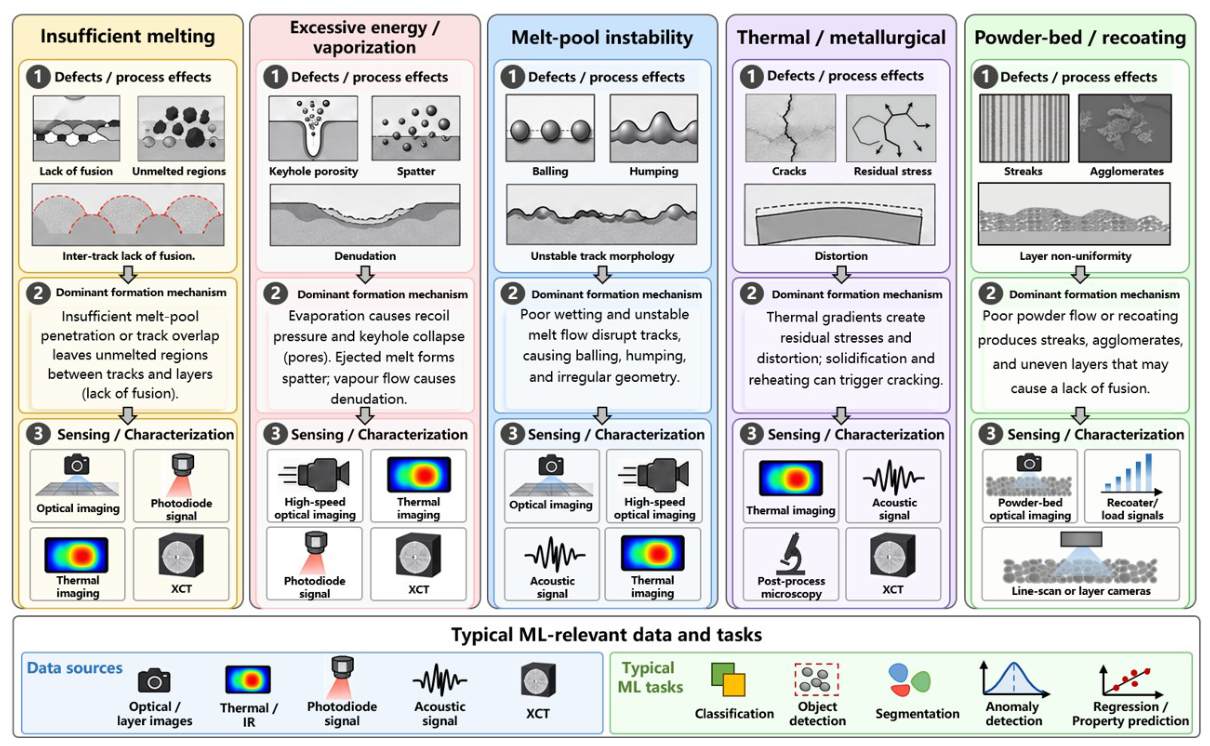
Figure 3.
Qualitative comparison of conventional experimental optimisation, machine learning trained from scratch, and transfer learning for PBF process optimisation. DoE provides structured experimental data, which can also support the training of ML models. ML trained from scratch uses a representative dataset from the target domain, whereas TL additionally reuses knowledge acquired from a related source domain. The bars on the right are schematic and indicate possible tendencies rather than measured or universal differences in data requirements, cross-domain adaptability, or knowledge reuse. The effectiveness of TL depends on source–target similarity and must be verified using independent target-domain data.
Figure 3.
Qualitative comparison of conventional experimental optimisation, machine learning trained from scratch, and transfer learning for PBF process optimisation. DoE provides structured experimental data, which can also support the training of ML models. ML trained from scratch uses a representative dataset from the target domain, whereas TL additionally reuses knowledge acquired from a related source domain. The bars on the right are schematic and indicate possible tendencies rather than measured or universal differences in data requirements, cross-domain adaptability, or knowledge reuse. The effectiveness of TL depends on source–target similarity and must be verified using independent target-domain data.
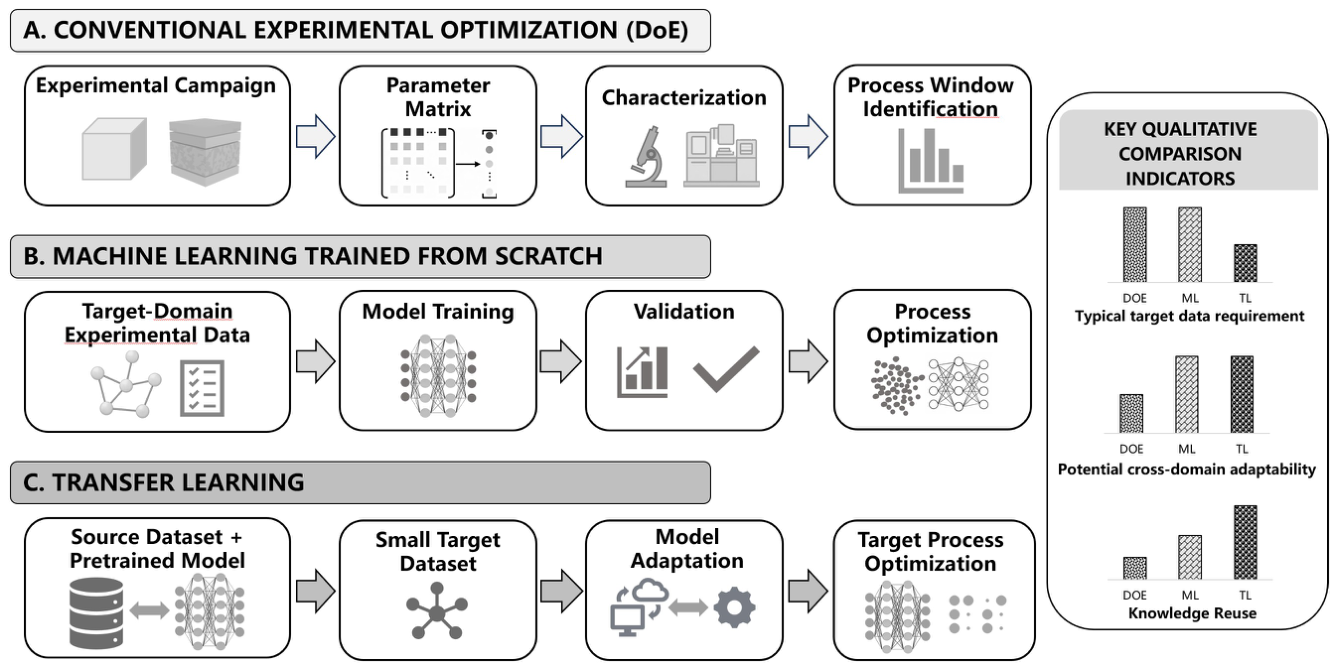
Figure 4.
Literature search, screening, full-text verification, and update procedure for empirical transfer learning in metal powder bed fusion.
Figure 4.
Literature search, screening, full-text verification, and update procedure for empirical transfer learning in metal powder bed fusion.
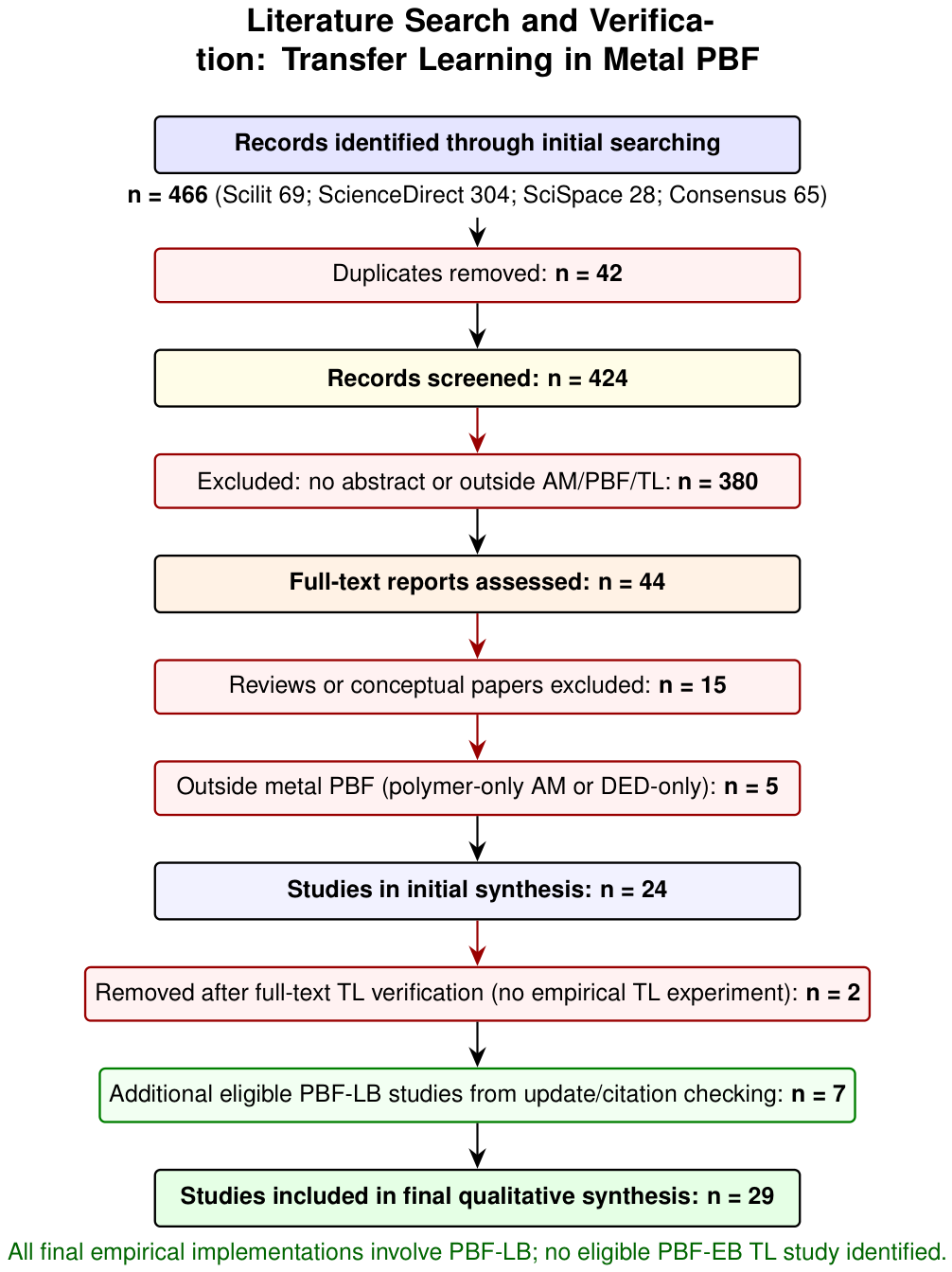
Figure 5.
Schematic illustration of physical and data-distribution shifts between source and target PBF-LB domains and their role in transfer learning.The figure is schematic and does not represent measured process boundaries or feature distributions for specific alloys or machines
Figure 5.
Schematic illustration of physical and data-distribution shifts between source and target PBF-LB domains and their role in transfer learning.The figure is schematic and does not represent measured process boundaries or feature distributions for specific alloys or machines
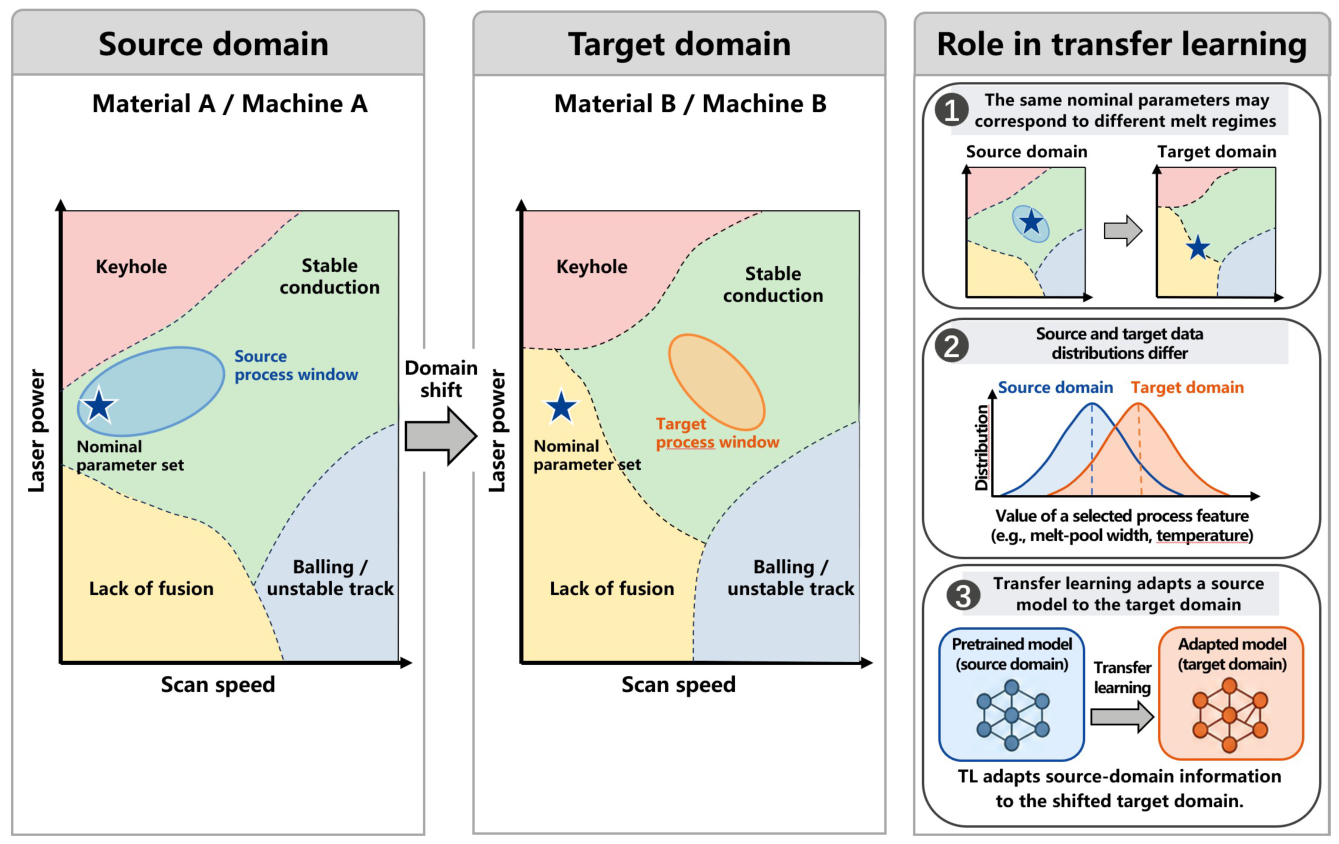
Figure 6.
Potential directions of knowledge transfer within the process–structure–property framework. Transfer between PBF-LB/M and PBF-EB/M is presented as a prospective research direction, since no experimental validation of this approach was identified in the reviewed literature.
Figure 6.
Potential directions of knowledge transfer within the process–structure–property framework. Transfer between PBF-LB/M and PBF-EB/M is presented as a prospective research direction, since no experimental validation of this approach was identified in the reviewed literature.
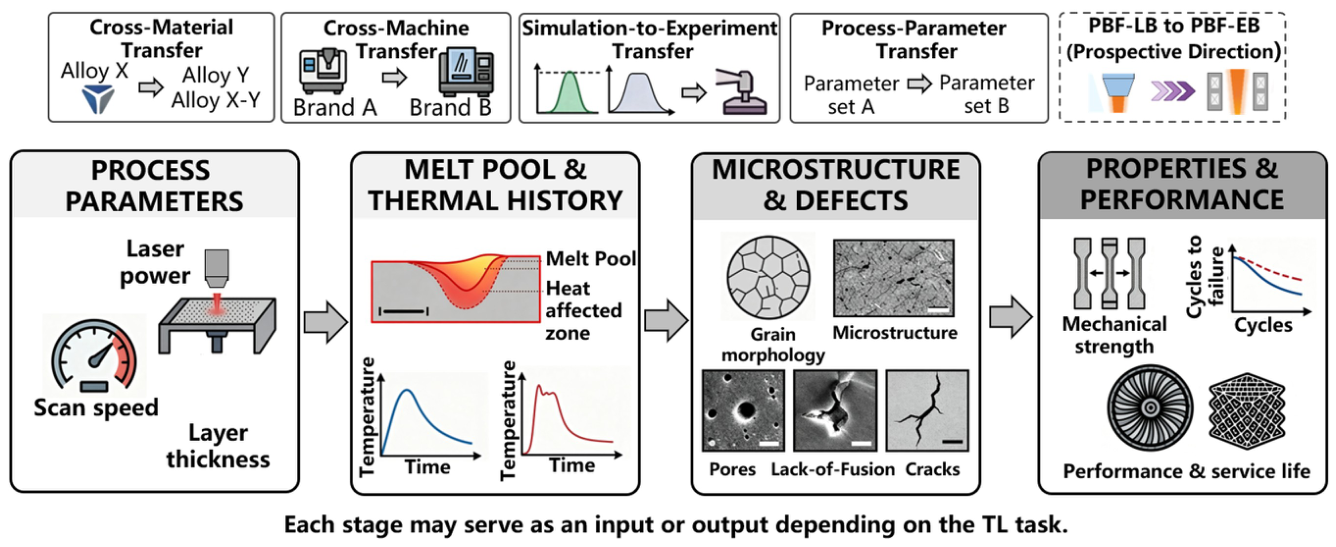
Figure 7.
Taxonomy of transfer learning in metal powder bed fusion based on adaptation mechanisms and transfer directions. Feature reuse, fine-tuning, and domain adaptation describe how knowledge is transferred between source and target domains, whereas the lower part of the figure classifies the physical direction of transfer. Examples on the left represent transfer directions demonstrated in the reviewed PBF literature; examples on the right indicate prospective directions and plausible adaptation mechanisms. The adaptation mechanisms are not mutually exclusive and may be combined within a single transfer-learning workflow.
Figure 7.
Taxonomy of transfer learning in metal powder bed fusion based on adaptation mechanisms and transfer directions. Feature reuse, fine-tuning, and domain adaptation describe how knowledge is transferred between source and target domains, whereas the lower part of the figure classifies the physical direction of transfer. Examples on the left represent transfer directions demonstrated in the reviewed PBF literature; examples on the right indicate prospective directions and plausible adaptation mechanisms. The adaptation mechanisms are not mutually exclusive and may be combined within a single transfer-learning workflow.
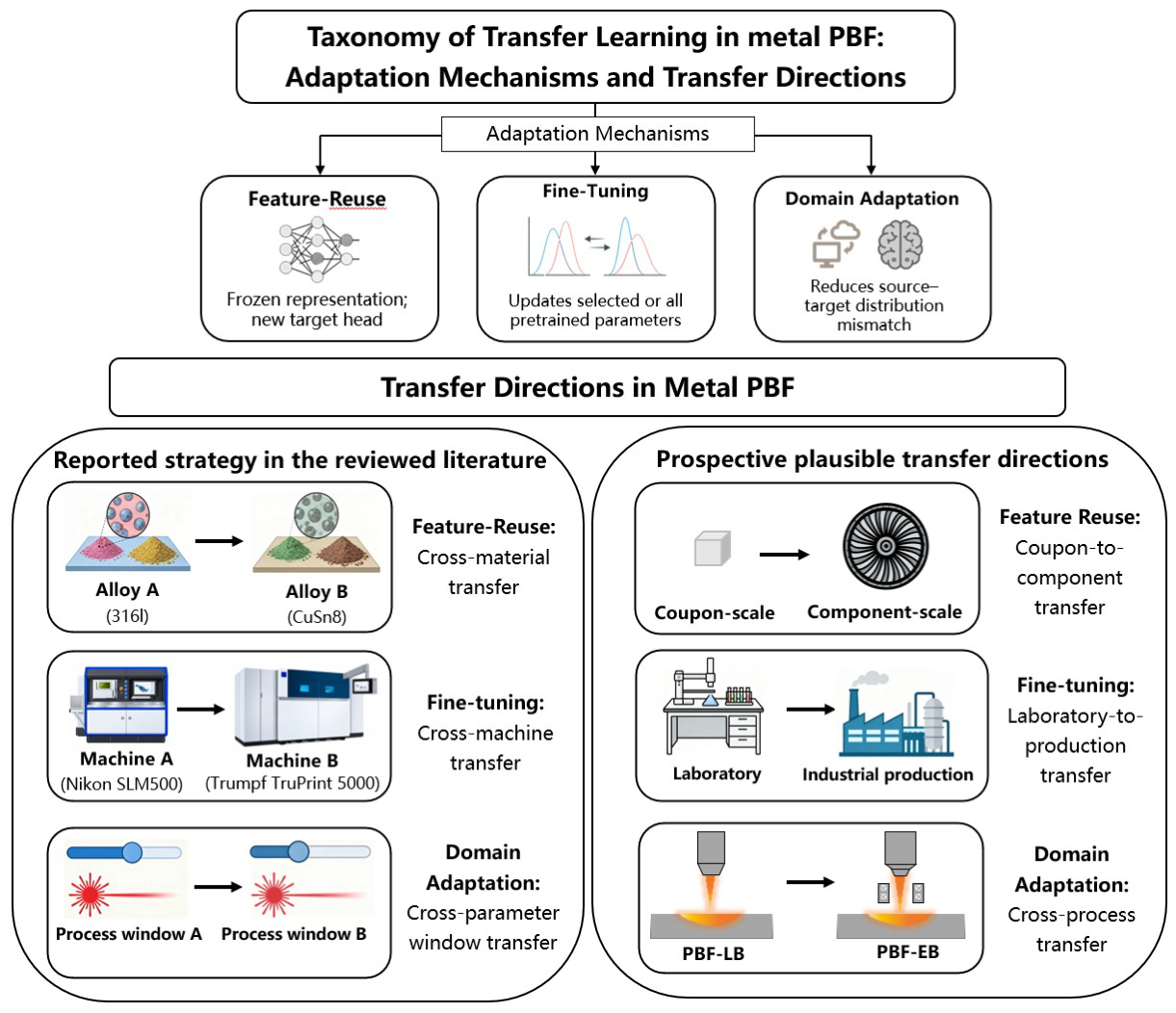
Figure 8.
Distribution of the 29 empirical transfer-learning studies included in Table 3 according to (A) the dominant source–target domain, (B) the dominant ML/TL approach, (C) the primary target property or application objective, and (D) the dominant direction of knowledge transfer. Each study was assigned to one dominant category in panels A, B, and D; classification of studies involving multiple domain shifts followed the principal transfer setting evaluated by the original authors. PBF-LB, laser beam powder bed fusion; ML, machine learning; TL, transfer learning.
Figure 8.
Distribution of the 29 empirical transfer-learning studies included in Table 3 according to (A) the dominant source–target domain, (B) the dominant ML/TL approach, (C) the primary target property or application objective, and (D) the dominant direction of knowledge transfer. Each study was assigned to one dominant category in panels A, B, and D; classification of studies involving multiple domain shifts followed the principal transfer setting evaluated by the original authors. PBF-LB, laser beam powder bed fusion; ML, machine learning; TL, transfer learning.
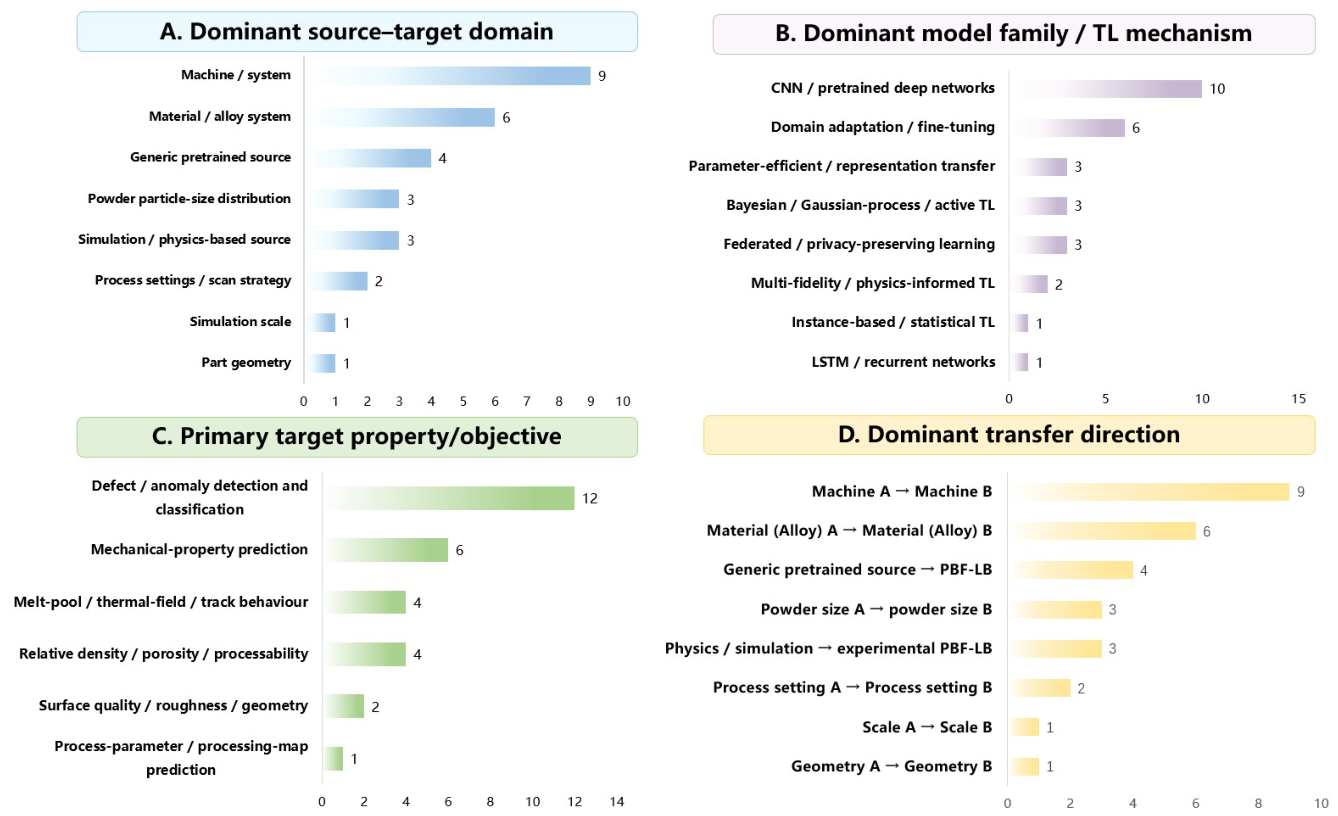
Table 2.
Comparison of the main process parameters and physical considerations in PBF-LB/M and PBF-EB/M.
Table 2.
Comparison of the main process parameters and physical considerations in PBF-LB/M and PBF-EB/M.
| Parameter group | PBF-LB/M | PBF-EB/M |
|---|---|---|
| Energy carrier and coupling | Laser photons; wavelength-dependent optical absorption, reflection, and scattering in the powder bed. | Accelerated electrons; energy deposition through electron–matter interactions within a subsurface interaction volume. |
| Beam settings | Nominal laser power, wavelength, spot diameter, focal position, and spatial intensity profile; continuous-wave or pulsed emission where available. | Accelerating voltage, beam current, focus setting, beam diameter, and electromagnetic deflection. |
| Nominal beam power | ; absorbed power also depends on optics and material absorptivity. | ; absorbed power is affected by backscattering and beam–material interactions. |
| Scanning and exposure | Scan speed, hatch spacing, contours, vector length and order, layer-to-layer rotation, and rescanning. | Scan speed, line offset, contour and hatch sequences, return interval between beam passes, and separate preheat/melting scans. |
| Layer and powder | Nominal layer thickness; particle size and morphology, packing, flowability, chemistry, surface condition, and reuse history. | Similar powder descriptors, with additional importance of electrical connectivity, charging behaviour, and powder-cake sintering. |
| Environment | Usually argon, or nitrogen where compatible with the alloy; gas purity, oxygen content, and flow uniformity matter. | Technical vacuum, sometimes with a controlled low helium partial pressure; electron transport and residual gas conditions matter. |
| Preheating | Optional or material-dependent build-platform/chamber heating; affects gradients, stress, and cracking. | Conventional systems use preheating and partial sintering to stabilise the powder bed and limit smoking; alternative charge-control approaches exist. |
| Simplified energy metrics | ; a nominal screening descriptor, not an absorbed-energy measure. | and ; melting descriptors do not include separate preheat energy. |
| Main instabilities and risks | Lack of fusion, keyholing, balling, humping, spatter, denudation, powder-spreading defects, residual-stress-related cracking. | Charging/smoking, unsuitable pre-sintering, lack of fusion, swelling, excessive evaporation, and thermal or geometric distortion. |
| Quality-related outputs | Melt-track geometry, porosity, roughness, microstructure, residual stresses, dimensional accuracy, and mechanical properties. | Melt-track geometry, powder-cake condition, porosity, roughness, microstructure, residual stresses, dimensional accuracy, and mechanical properties. |
Table 3.
Comparison of empirical knowledge-transfer approaches relevant to metal laser beam powder bed fusion (PBF-LB), grouped by the dominant source–target relationship. The table includes transfer learning, domain adaptation, multi-fidelity transfer, and federated-learning studies when a cross-domain or cross-client knowledge-sharing component was evaluated. All included studies evaluate the method in PBF-LB; no eligible PBF-EB transfer-learning study was identified. Directed energy deposition (DED) studies are excluded. Generic or non-PBF source domains are retained only when transfer is explicitly evaluated for a PBF-LB target/application.
Table 3.
Comparison of empirical knowledge-transfer approaches relevant to metal laser beam powder bed fusion (PBF-LB), grouped by the dominant source–target relationship. The table includes transfer learning, domain adaptation, multi-fidelity transfer, and federated-learning studies when a cross-domain or cross-client knowledge-sharing component was evaluated. All included studies evaluate the method in PBF-LB; no eligible PBF-EB transfer-learning study was identified. Directed energy deposition (DED) studies are excluded. Generic or non-PBF source domains are retained only when transfer is explicitly evaluated for a PBF-LB target/application.
| Study | Transfer direction / input / output | Model & TL mechanism | Data | TL benefit / outcome |
|---|---|---|---|---|
| A. Cross-material and powder-domain transfer | ||||
| Pandiyan et al., 2022 [85] | 316L → CuSn8; airborne AE spectrograms were used to classify LoF, conduction, keyhole, and balling regimes | CNNs (VGG16/ResNet18); feature reuse: pretrained convolutional features were frozen and target classification layers were retrained on CuSn8 | 8,000 spectrograms per alloy; 5,200 train + 2,800 test | TL reduced training time by approximately 2–3×, but did not improve accuracy: 82–87% with TL versus approximately 89–91% from scratch. |
| Li et al., 2024 [86] | 316L → TC4; layer images, photodiode, and AE data were used separately to classify poor, medium, and high part quality | CNN; feature reuse (paper: fine-tuning): the 316L feature-extraction layers were frozen and TC4 classification layers were trained | TC4: 7,406 layer images and 75,000 photodiode/AE samples; 0.5–5% of the target training pool used for adaptation | With 5% target training data, accuracy reached 96.8/92.1/96.1% (images/photodiode/AE); the largest gain over no TL was +9.6 p.p. for photodiode data. |
| Pandiyan et al., 2024 [90] | 316L (m powder) → 316L (m powder); airborne AE from the PBF-LB process zone was used to classify LoF, conduction, and keyhole regimes | CNN; unsupervised domain adaptation: labelled source and unlabelled target AE distributions were aligned using an associative loss | AE windows for LoF, conduction and keyhole from two powder/parameter conditions. | Target accuracy increased from 77.4 to 94.8% without target labels; source accuracy remained essentially unchanged (98.1 to 98.3%). |
| Pashmforoush and Seyedzavvar, 2025 [101] | Pure/alloyed Cu, steel, Ti, and Ni data → pure/alloyed Al; process parameters were used to predict UTS, relative density, and YS | ANN; parameter transfer: a Bayesian-optimized source network was used to initialize the target network for Al specimens | Multi-material source dataset; limited Al target dataset | Test-set R increased from 0.787/0.742/0.817 to 0.966/0.903/0.971 for UTS/density/YS, corresponding to an average predictive improvement of approximately 21%. |
| Pandiyan et al., 2026 [96] | 316L (m powder) → 316L (m powder) domain; airborne AE was used to classify LoF, conduction, and keyhole regimes | Learnable Morlet-wavelet scattering; zero-shot transfer: a source-trained learnable Morlet-wavelet representation was applied to cross-domain transfer without target-domain training. | AE windows from two particle-size conditions; 12.5 ms signal segments. | Approximately 97–99% accuracy was maintained across the domain shift without retraining. |
| B. Cross-machine/platform and process-setting transfer | ||||
| Tang et al., 2026 [102] | Ti–6Al–4V → 316L and GH4099; 316L → Ti–6Al–4V; GH4099 → 316L; airborne AE was used to identify melt-pool states under material, process-parameter, and geometry shifts | CNN (1D-ResNet18; MATMSI); domain adaptation: test-time adaptation (TTA) of batch-normalization parameters using unlabelled target AE data, followed by adaptive temperature scaling (ATS) with a small labelled target datasets | 3 materials, 108 process-parameter combinations, 2 geometries; full-process AE monitoring | Conventional pretrained models lost 13–64% performance under domain shifts; MATMSI maintained high identification performance without target retraining. |
| Liu et al., 2021 [87] | EOS M270/M280 → EOS M290 and 3D Systems ProX DMP 320; Ti–6Al–4V process parameters were used to classify relative density and microhardness levels across machines | Naive Bayes classifiers: process–property relationships learned from pooled historical data were applied to new printers | 132 density + 49 microhardness cases; validation: 25 ProX DMP 320 + 8 EOS M290 conditions | Cross-printer accuracy reached 85.6% for density and 88% for microhardness; no direct no-transfer baseline was reported. |
| Funcke et al., 2026 [81] | Nikon SLM 500 → Trumpf TruPrint 5000; AlSi10Mg0.5 process parameters were used to predict YS, UTS, and elongation | DNN; fine-tuning: pretrained Nikon models were further trained on Trumpf data using different trainable-layer configurations | Source: 50 parameter combinations; target: 25 combinations, 3 specimens per condition | With only 25 target combinations, reached 0.755/0.821/0.920 for YS/UTS/elongation. |
| Tang et al., 2023 [91] | EOS M270/SLM 250 HL → SLM 125 HL; Ti–6Al–4V process parameters were used to predict relative density | DTR + ANN: TrAdaBoost.R2, subspace alignment, model transformation, fine-tuning, and multi-task learning were compared | Source datasets: 49 and 32 observations; target: 24. | Transfer improved performance for sufficiently similar source domains; unsuitable source selection or preprocessing could cause negative transfer. |
| Pandiyan et al., 2026 [96] | 316L (m powder) → 316L (m powder) domain; airborne AE was used to classify LoF, conduction, and keyhole regimes | Learnable Morlet-wavelet scattering; zero-shot transfer: a source-trained learnable Morlet-wavelet representation was applied to cross-domain transfer without target-domain training. | AE windows from two particle-size conditions; 12.5 ms signal segments. | Approximately 97–99% accuracy was maintained across the domain shift without retraining. |
| Xie et al., 2024 [88] | Custom PBF-LB system (IN625) → Tongtai AMP-160 (SUS420 steel); melt-pool images were used to detect process anomalies acros different machines, materials, monitoring systems, and process parameters. | CNN + adversarial domain adaptation: unsupervised feature alignment was followed by optional labelled-target fine-tuning | Source: 646 train + 100 validation + 100 test; target: 5,819 unlabelled + 100 validation + 100 test | Target accuracy reached 81% without target labels and 93.5% with only 20 labelled target images. |
| Pandita et al., 2022 [103] | Solid IN625 substrate (without powder) → IN625 powder layer on an IN625 substrate; melt-pool depth and width prediction | ANN (probabilistic DNN); fine tuning: a source model trained using experimental and simulation-based data was adapted to powder-layer processing by retraining its final layers. | Source: 28 experimental + 28 simulation points; repeated target 80/20 splits | Normalized RMSE decreased from 11 to 9% for depth and from 17 to 15% for width; improvement was modest. |
| Li et al., 2023 [104] | Ring-shaped laser scanning → strip-based scanning strategy (both 316L); airborne AE spectrograms were used for cross-strategy defect classification. | CNN (ResNet50); multi-source DTL: ImageNet pretraining and ring-scan training were combined before transfer to strip scanning | 9,960 ring-scan and 12,450 strip-scan spectrograms | Multi-source TL reached 98.2% target accuracy versus ∼80% for ImageNet-only and for ring-source-only transfer. |
| Zheng et al., 2025 [92] | EOS M290 → Renishaw AM250 and 3D Systems DMP Flex 350; 316L process parameters were used to predict UTS; | Gaussian Process Regression + active TL: target prediction errors were learned and active sampling selected informative tensile tests | Three platforms; two cross-platform transfers | Fewer target tensile tests were required, with better accuracy and reliability than from-scratch and random-sample transfer. |
| C. Federated and privacy-preserving learning | ||||
| Lei et al., 2024 [97] | Eight local 316L datasets (simulated clients) → global LSTM model trained via federated learning; heat-emission time series were used to predict section-wise heat emission. | LSTM + federated learning: FedAvg, FedProx, and FedAvgM aggregated client-model weights without sharing raw data | 16 blocks, 166 layers per block; 8 simulated clients | Federation reduced RMSE from 17.12 for local models to 12.19; centralized training reached 6.96. |
| Tang et al., 2024 [98] | ConceptLaser M2 (316L) and EOS M290 (IN718) datasets → heterogeneous federated clients; images were used for pixel-wise defect segmentation | Federated CNN + client-oriented TL: a shared feature extractor, local task-specific layers, and multi-loss optimization were combined | ConceptLaser M2: 20 images; EOS M290: 14 images; split across federated 6 clients | Cross-domain clients reached Dice/mIoU of 0.770/0.688 and 0.685/0.574, outperforming federated learning without TL. |
| Mehta and Shao, 2022 [99] | Eight local PBF-LB image datasets → a federated segmentation model; layer images were used for pixel-wise powder/part/defect segmentation | CNN (U-Net) + federated learning: client models were aggregated while raw images remained local | 20 ConceptLaser M2 images split across 8 simulated clients | Federation improved mIoU to 0.775–0.846 versus 0.655–0.727 for individual models; centralized training remained comparable or better. |
| Wang et al., 2026 [105] | Four AlSi10Mg client datasets → federated model, with additional TC4 evaluation; powder-bed images were used for defect segmentation | CNN (Attention U-Net) + adaptive DP-FL: adaptive gradient clipping and noise were used for privacy-preserving federation | 406 AlSi10Mg images across 4 clients; additional 250 TC4 layers | Adaptive DP-FL improved mIoU from 0.6832 to 0.7105 and mDice from 0.7982 to 0.8184. |
| D. Cross-task, geometry and scale transfer | ||||
| Ansari and Crampton, 2024 [106] | SLM 500HL (A20X) → EOS M290 (AlSi10Mg); powder-bed images were used to transfer porosity detection to surface-deformation classification. | Custom CNN; feature reuse: the convolutional extractor was transferred and frozen and a new target classifier was trained | Source: 5,135 balanced images; target: 336 images | Target surface-deformation accuracy reached 94% using only 336 target images. |
| Li et al., 2026 [93] | Open Additive Panda (IN718): 17 source parts → one previously unused test part (six geometries, varied process settings); layer-wise optical tomography and LWIR thermal data were used to predict PDAS. | Bayesian neural/linear model + prior GP: part metadata controlled information sharing between source and target parts | 18 parts from 6 geometries; leave-one-part-out validation | Model achieved lower PDAS prediction error than reported baselines; source-data relevance was controlled statistically. |
| Cheng et al., 2025 [94] | Dimetal-300 PBF-LB/M system → multi-label classification of 10 powder-bed defect types; layer-wise optical images were used, with additional transfer evaluated on SLS images. | Vision Transformer + LoRA: pretrained PBF weights were frozen and low-rank adapters learned the target task | 3,713 images; 2,745 train / 662 validation / 306 test | Exact-match classification reached 93.28% with about 1.70 million trainable parameters. |
| Raut et al., 2025 [95] | 2 × 2 mm simulated square region → 3 × 3 and 4 × 4 mm regions; FEA-generated temperature data were used to predict transient thermal fields | Graph Convolutional Network: pretrained models were partially retrained while two layers remained frozen | Source: 20 cases × 1,477 timesteps; target B: 14 points; target C: 4 points | Transferred graph models reduced temperature-prediction errors for larger simulated domains. |
| E. Generic, simulation or literature pretraining applied to PBF-LB | ||||
| Fischer et al., 2022 [89] | ImageNet-pretrained CNN → PBF-LB/M powder-bed images; images were used to classify balling, spatter, ridges, and other anomalies | CNN (Xception): the ImageNet-pretrained backbone was adapted by training classifier layers and fine-tuning the final convolutional block | More than 45,000 annotated anomaly images | Seven–class accuracy reached 99.15% and class-wise F1 97.85–99.71%; matched scratch gain not established. |
| Yin et al., 2025 [107] | ImageNet-pretrained CNNs → EOS M290 powder-bed images; classification and localisation of powder-bed defects. | CNN (ResNet50, EfficientNetV2B0); YOLOv5 and Faster R-CNN; pretrained models fine-tuned on PBF images. | 2,638 EOS M290 images (1,108 normal; 1,530 defective). | ResNet50: 100% test accuracy; YOLOv5: 81.5% detection AP versus 46.25% for Faster R-CNN. No matched TL-versus-scratch gain reported. |
| Luo et al., 2025 [108] | ImageNet-pretrained CNNs → ProX DMP 320 (Ti–6Al–4V); photodiode-derived images were used to predict UTS and elongation. | CNN feature extractors (VGG16, ResNet50/101/152): transferred image features were used for mechanical-property regression | 126 specimens from 42 parameter sets; 120 tensile-tested | Best cross-validated R2 was 0.89 for UTS and 0.96 for elongation; better than a non-transfer PCA baseline. |
| Ren et al., 2020 [109] | Pretrained AlexNet → FEM-simulated melt-pool and optical-tomography images; sensor images were used to classify process disturbances. | CNN (AlexNet): pretrained features were transferred separately to two sensor classifiers and their decisions were fused | Two in-situ image modalities; 169 regions of interest in the reported cross-check | Individual classifiers reached 73.4 and 82.8%; sensor fusion increased accuracy to 90.4%. |
| Li et al., 2023 [110] | Pretrained VGG16 → PBF-LB/M layer-wise optical images; images were used to classify porosity-based part quality (poor, medium, and high). | CNN (VGG16) + deep TL: pretrained visual features were fine-tuned for three-class quality classification | Layer-wise images; 3 classes defined from porosity measurements | Classification accuracy reached 99.89%; no direct no-TL baseline was reported. |
| Kumar and Shukla, 2026 [111] | Pretrained VGG16 → simulated IN718 microstructure images; images were used to classify three energy-density-dependent microstructure classes. | CNN (VGG16): scratch training was compared directly with VGG16-assisted transfer learning | 405 augmented/simulated images; 3 classes | TL increased accuracy from 68% to approximately 94%; micro-F1 reached 0.92. |
| Bahari-Sambran et al., 2025 [112] | Literature-based PBF-LB/M data → new AlSi10Mg and 316L experimental data; process parameters were used to predict density and melt-pool width/depth. | ANN: literature-trained base models were transferred and refined with new experimental data | Literature source data + experimental AlSi10Mg/316L target data | Transferred models predicted processing maps and LoF limits; no single matched numerical TL gain reporte |
| Zhu et al., 2024 [100] | MEX (PLA) → PBF-LB/M (Ti–6Al–4V); process parameters were used to classify surface roughness. | Attention-enhanced 1D CNN: Bayesian hyperparameter optimization was followed by target fine-tuning | Source: 625 samples / 8 classes; target: 79 samples / 5 classes | The transferred model outperformed the compared conventional ML methods; no reliable single numerical TL gain was reported. |
Notes: Federated learning does not necessarily constitute source-to-target TL. ImageNet - a large-scale labelled image dataset used for pretraining visual models; Abbreviations, algorithm names, and metrics first used in this table: AE - Acoustic Emission; AMMT - Additive Manufacturing Metrology Testbed; ANN - Artificial Neural Network; AP - Average Precision; Dice - Dice Similarity Coefficient; DNN - Deep Neural Network; DP-FL - Differentially Private Federated Learning; DTL - Deep Transfer Learning; DTR - Decision-Tree Regressor; FEA - Finite Element Analysis; FedAvg - Federated Averaging; FedAvgM - Federated Averaging with Server Momentum; FedProx - Federated Proximal Optimisation; GP - Gaussian Process; LSTM - Long Short-Term Memory; LWIR - Long-Wave Infrared; mDice - Mean Dice Coefficient; mIoU - Mean Intersection over Union; NCKU - National Cheng Kung University; NIST - National Institute of Standards and Technology; PCA - Principal Component Analysis; PDAS - Primary Dendrite Arm Spacing; PLA - Poly(lactic acid); RMSE - Root Mean Squared Error; UTS - Ultimate Tensile Strength; YS - Yield Strength.
Disclaimer/Publisher’s Note: The statements, opinions and data contained in all publications are solely those of the individual author(s) and contributor(s) and not of MDPI and/or the editor(s). MDPI and/or the editor(s) disclaim responsibility for any injury to people or property resulting from any ideas, methods, instructions or products referred to in the content. |
© 2025 by the authors. Licensee MDPI, Basel, Switzerland. This article is an open access article distributed under the terms and conditions of the Creative Commons Attribution (CC BY) license.
Copyright: This open access article is published under a Creative Commons CC BY 4.0 license, which permit the free download, distribution, and reuse, provided that the author and preprint are cited in any reuse.