
Submitted:
03 November 2026
Posted:
04 November 2026
You are already at the latest version
Abstract
Smart city technologies are widely promoted as a route to efficiency, sustainability, and a better quality of life. Across global contexts, however, they increasingly expose governance failures that weaken democratic accountability and social equity. This paper examines digital governance failure in smart cities, defined as the intersection of algorithmic opacity, accountability vacuums, and socio-spatial inequities in technology deployment. Drawing on a systematic integrative review of 76 peer-reviewed and foundational works published between 2008 and 2026, the study synthesises evidence from urban studies, public administration, and critical data studies. The analysis shows that opaque algorithmic systems erode legitimacy, public-private partnerships dilute accountability, and digital infrastructures reproduce existing inequalities, with harms concentrated in communities that were already underserved. The article reframes smart city research from techno-optimism towards a governance-critical perspective that treats failure as an analytical category, and proposes an agenda built on anticipatory governance, algorithmic auditing, and equity-by-design. By deliberately including African and other Global South cities, it offers a framework for understanding and reducing the risk of digital governance breakdown in cities worldwide.
Keywords:
smart cities
; digital governance
; algorithmic opacity
; accountability
; equity
; urban technology failure
; anticipatory governance
1. Introduction
Since the early 2000s, municipal governments worldwide have increasingly incorporated digital and networked technologies into their governance toolkits (Hollands, 2008). Scholars have extensively studied smart city adoption across transport, energy, public safety, and social services, projecting substantial efficiency and sustainability gains (Bibri & Krogstie, 2017). However, Kitchin (2014) cautioned that real-time urban analytics rest on the technocratic assumption that cities can be known and steered through continuous data capture and computation, an assumption that carries significant, and largely unexamined, governance risks. The popularity of smart urbanism in both wealthy and developing-country contexts relies on its expected contribution to democratic performance, yet this is often where the process breaks down (Jiang et al., 2022; Kougias & Papadakaki, 2025).
Reviews report service and efficiency gains from smart city investments in mobility, energy management, and data-driven public services (Esfandi et al., 2024; Tomor et al., 2019). However, these effects are contingent on the governance arrangements within which technologies are deployed (Jiang, 2020; Meijer & Bolivar, 2016). Political context (Cowley et al., 2018) and innovation-management capacity (José & Rodrigues, 2024; Mora et al., 2023) also shape implementation outcomes. Yet little research has examined what it means for smart city systems to fail: to produce unfair and discriminatory results, to concentrate decisions in private platforms that are not audited, and to systematically exclude marginalised populations from the benefits of digital transformation (Cao, 2026; Yang et al., 2026).
Several high-profile governance failures illustrate the urgency of this gap. The Sidewalk Toronto Quayside project was cancelled in 2020 after sustained controversy over data sovereignty, revealing structural tensions between private platform governance and public democratic accountability (Goodman & Powles, 2019). American and European cities deployed predictive policing algorithms that reproduced, rather than predicted, racially discriminatory enforcement patterns (Lum & Isaac, 2016; Richardson et al., 2019). Automated welfare eligibility systems generated what Eubanks (2018) documented as a “digital poorhouse”, an automated infrastructure of exclusion falling disproportionately on the poor. Commercial facial-analysis systems misclassified darker-skinned women at error rates of up to 34.7%, compared with 0.8% for lighter-skinned men (Buolamwini & Gebru, 2018).
This article addresses these failures through a systematic integrative review. Evidence of breakdowns in accountability, transparency, and equity is dispersed across disciplines (Meijer & Bolivar, 2016; Tomor et al., 2019) and has not been synthesised into a coherent framework. Without a consolidated understanding of the patterns, causes, and mechanisms of digital governance failure, policymakers, practitioners, and civil society actors lack the conceptual vocabulary to anticipate, detect, and redress such failures (Cao, 2026; Yang et al., 2026).
This paper makes four contributions to the literature on urban governance and public administration. First, it synthesises dispersed evidence into a coherent analytical account of digital governance failure. Second, it advances a threefold typology of failure domains (algorithmic opacity, accountability vacuums, and socio-spatial equity deficits) that enables comparative analysis across contexts. Third, it integrates emerging normative frameworks into a reform agenda centred on anticipatory governance, participatory algorithmic auditing, and equity-by-design principles. Fourth, it identifies five priority research gaps and outlines methodological approaches to address them.
2. Literature Review
2.1. From Smart Urbanism to Governance Crisis: the Rise and Limits of the Techno-Optimist Paradigm
The concept of a ‘smart city’ was originally based on the idea of using an innovative approach to city governance and the integration of urban technologies as a management tool for urbanisation, which was based on the marketing initiatives of IBM, Cisco and Siemens in the middle of the 2000s (Soderstrom et al., 2014). According to Luque-Ayala and Marvin (2015), smart urbanism should not simply be regarded as a technical upgrade; rather, it involves processes of negotiation and conflict. Hollands (2015) argues that the concept has been ideologically captured by neoliberal urban entrepreneurialism, while Vanolo (2014) demonstrates that the smart city operates as a disciplinary technology that normalises certain forms of urban behaviour. The mainstream smart city literature has been and still is techno-optimistic as it focuses on technical features, energy efficiency and also technical efficiency rather than governing issues (Bibri & Krogstie, 2017). The recent reviews concede that some governance issues are negative, but it is unclear how they alter currently innovative and resilient practices and solutions to harm democracy (José & Rodrigues, 2024; Varzeshi et al., 2025).
2.2. the Democratic Deficit: Why Governance Arrangements Routinely Fail in Smart City Programmes
By the 2020s, several studies began to examine various aspects of smart city implementation and identified governance as a key topic within the field, although this has rarely been studied in detail (Cowley et al., 2018; Dencik et al., 2019; Tomor et al., 2019). There is a clear divide between smart city literature in technology fields and public administration literature, with topics such as democracy (value), participation and accountability having a large impact on how smart city initiatives are implemented, but have not been adequately studied (Meijer & Bolivar, 2016). Research into smart city governance in developing countries also highlights that issues around accessibility, decision making and appealing data, and automated outputs often aren’t addressed until later stages of urban planning (Jiang et al., 2022; Tan & Taeihagh, 2020). Anticipatory governance in various governance settings shows that most municipal governments still have poor development within their anticipatory governance frameworks due to structural issues rather than technical ones, which can be seen at a local, national and global scale (Guston, 2014; Yang et al., 2026).
There are three types of analytical gaps that cause governance issues in the smart city domain. Firstly, regulatory systems are often outdated in relation to the technologies that are being used, causing an institutional gap (Cowley et al., 2018; Yang et al., 2026). Secondly, there are specific design issues with technologies that create participatory gaps, caused by citizens not being meaningfully involved in the design and implementation of technologies, or being superficially involved (Cardullo & Kitchin, 2019; Kougias & Papadakaki, 2025). Lastly, an accountability issue arises with multiple entities including vendors of algorithms, platform owners, purchasers of the system and elected officials, which causes ambiguity to occur around who should be held accountable, with many complex decisions needing to be made (Coglianese & Lehr, 2017). These weaknesses all overlap to create a weak, blurry and exclusive governance system that causes governance issues in the smart city domain as explained in this paper.
2.3. Algorithmic Power and the New Infrastructure of Urban Discrimination
Since the mid-2010s, there has been an increase in research into algorithmic accountability within urban environments, and this research shows that there are many common findings. Pasquale (2015) proposed the concept of a black box society, where decisions of significance are now being made using complex algorithmic processes that are not transparent. Ananny and Crawford (2018) show that transparency is not enough. Even if citizens or officials have access to the code, they lack the resources and legal backing to hold those making complex machine learning algorithms accountable. Benjamin (2019) offers the synthesis most relevant to urban settings, showing how the ideology of algorithmic objectivity conceals historical discrimination within decision systems that are more efficient, more pervasive, and less legally contestable than the intentionally discriminatory ones they are meant to replace. For Benjamin, this is the “New Jim Code”, in which the apparent neutrality of computation lends legitimacy to structural racism.
This theoretical position is supported by empirical evidence from several fields of urban governance. Predictive policing has been found to reproduce racially biased enforcement practices (Lum & Isaac, 2016), and subsequent studies have shown that these systems are trained on biased police records and fall into runaway feedback loops that escalate policing in areas already policed excessively (Ensign et al., 2018; Richardson et al., 2019). In healthcare, a widely used risk algorithm systematically under-identified Black patients in need of high-priority care because it used past expenditure as a proxy for health need (Obermeyer et al., 2019), and comparable risks are amplified in low-resource public health systems where training data are thin and oversight capacity is weak (Joseph, 2025). In urban planning, AI increasingly informs decisions on land use, zoning, and investment but raises concerns about bias, transparency, and the displacement of professional and public judgement (Sanchez et al., 2024; Son et al., 2023).
Similar parallels are seen in urban credit markets as the introduction of Machine Learning credit models to lending has increased racial inequality through the use of proxies (such as postcode and behaviour) (Fuster et al., 2022). Evidence suggests that algorithmic discrimination is becoming an issue which affects multiple areas including policing, health, planning and finance.
2.4. Platform Capitalism and the Privatisation of Urban Governance
The political economy of smart city infrastructures is a relatively new area of study and lacks strong theoretical foundations. As such, Sadowski (2020), when examining digital capitalism and extractive practices within digital capitalist platforms, focuses on data-driven platforms. In public-private partnerships (PPP) the private sector partners usually leads to data becoming a cost and risk to the private sector and often lacks clear data governance (Leszczynski, 2016; Paskaleva et al., 2017). Within surveillance capitalism, the governing of data is part of the economy, leading to “governing the physical in smart cities in ways that are not well governed” (Zuboff, 2019). The deconstruction of the EU AI act of law also illustrates the disparity between the quick evolution of new platform technologies and how far behind the legal frameworks are (Veale & Borgesius, 2021).
Platform urbanism also raises questions of environmental equity. Smart energy and sustainability interventions promise efficiency gains but raise challenges of affordability, access, and data governance (Esfandi et al., 2024), and the claimed sustainability dividends of smart cities frequently fail to materialise (Yigitcanlar et al., 2019), a concern sharpened as AI-driven infrastructure becomes increasingly energy-intensive (Yigitcanlar et al., 2021).
3. the Research Gap: Toward A Unified Framework for Digital Governance Failure
Despite this evidence, the literature on digital governance failures in smart cities is still at an early stage and dispersed across disciplines that do not fully engage with each other. Critical geography, science and technology studies, public administration, and critical legal scholarship have each offered important lessons, but no conceptual integration explains how governance failures come about, how they are reproduced, and how institutional responses can overcome them. Although governance-critical innovations have been developed separately (Cao, 2026; Dencik et al., 2019; Green, 2019; Raji et al., 2020), they have not been combined across causal mechanisms, empirical evidence, and normative prescriptions. Recent reviews either catalogue governance barriers without theorising failure (Almulhim & Yigitcanlar, 2025; Yang et al., 2026) or examine single sectors in isolation (Rezaei et al., 2026). This paper addresses that gap by treating failure as the unit of analysis.
4. Theoretical Framework
4.1. Conceptualising Digital Governance Failure
This paper defines digital governance failure as the systematic failure of data-intensive, AI-enabled urban management systems to produce outcomes that are publicly legitimate, formally democratic, and equitably distributed. This definition draws on three traditions. It is rooted in public administration scholarship on smart urban governance, which holds that legitimate and equitable outcomes depend on the institutional context in which technologies are embedded (Jiang, 2020; Meijer & Bolivar, 2016). It builds on science and technology studies, which show that technologies embody the value systems, power dynamics, and institutional investments of those who design and install them (Kitchin, 2014). There is also an underlying critical spatial justice approach that focuses on ensuring that governance is equitably distributed across society and the city (Fainstein, 2010). The two approaches therefore view the failure of digital governance as a failure of the institutional and political process of designing, deploying and holding systems to account.
Building upon these traditions, the paper introduces a three-part typology of digital governance failure domains. Algorithmic opacity describes the condition in which an automated decision system’s output cannot be understood well enough to permit oversight of, challenge to, or accountability for the system (Ananny & Crawford, 2018; Pasquale, 2015). Accountability vacuums occur when democratic accountability and legal remedy are absent because contractual arrangements fragment responsibility across actors on multi-actor, public-private platforms (Coglianese & Lehr, 2017; Goodman & Powles, 2019; Sadowski, 2020). Socio-spatial equity deficits are the reproduction and exacerbation of pre-existing urban inequalities through the deployment of digital infrastructures, as observed in digital divides (Caragliu & Del Bo, 2023; Van Dijk, 2020), algorithmic bias (Benjamin, 2019; Eubanks, 2018), surveillance regimes (Browne, 2015; Zuboff, 2019) and the uneven distribution of smart-sustainability benefits (Shahraki, 2026; Yigitcanlar et al., 2019). This typology treats digital governance failure as a syndrome in which opacity, accountability, and equity deficits jointly erode the legitimacy and resilience of urban governance systems (Table 1).
4.2. The Self-Reinforcing Structure of Governance Failure
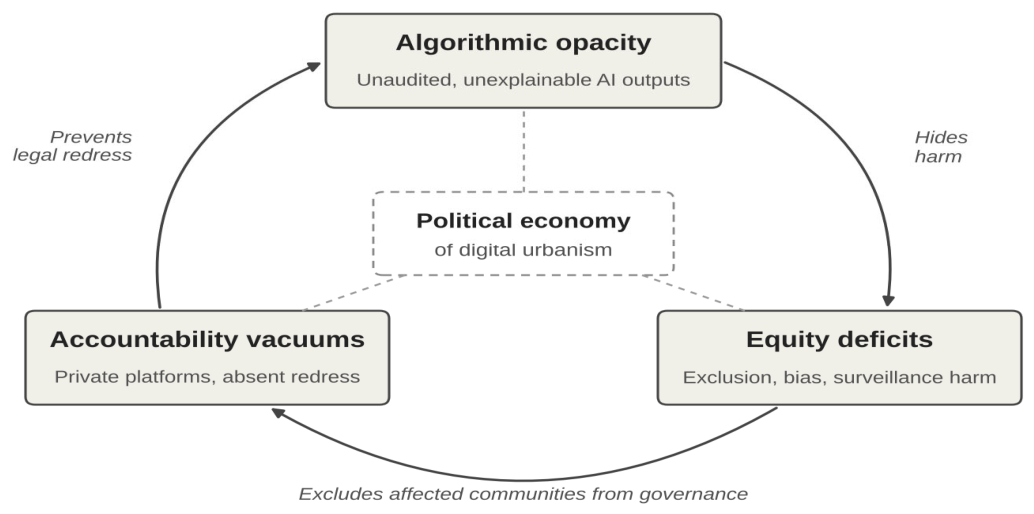
A central theoretical claim of this paper is that the three failure domains are not mutually exclusive but mutually reinforcing, forming a self-perpetuating cycle. Algorithmic opacity makes the discriminatory and exclusionary effects of smart city systems difficult to identify, which compounds equity harms. Even when these harms are recognized, the absence of accountability means there is no institutional mechanism to address them. Consequently, affected communities are effectively excluded from processes of governance and the state rarely acknowledges or responds to their grievances, which deepens opacity and unaccountability (Robinson & Franklin, 2020; Toch & Donio, 2026). Due to the self-reinforcing nature of the loop, a piecemeal reform that focuses on one domain stands little chance of success; reforms must seek to address rectifying opacity, accountability and fairness as one package.
Figure 1.
The self-reinforcing cycle of digital governance failure, sustained by the political economy of digital urbanism. Source: Authors’ construction, adapted from Robinson and Franklin (2020) and Yang et al. (2026).
Figure 1.
The self-reinforcing cycle of digital governance failure, sustained by the political economy of digital urbanism. Source: Authors’ construction, adapted from Robinson and Franklin (2020) and Yang et al. (2026).
5. Research Methods
This article adopts a systematic literature review using the PRISMA method (Page et al., 2021; Snyder, 2019; Torraco, 2016). This involves transparent and repeatable search, screening and synthesis processes to enable a systematic review to be undertaken while also including the conceptual synthesis processes that occur within an integrative review. A systematic review process was undertaken following the PRISMA 2020 Statement guidance (Page et al., 2021) where relevant studies were found systematically. This is particularly suitable to the key focus of this research, which is to analyse why digital governance fails in smart cities, how and who it fails. The review does not involve any statistical analysis; instead, common themes, causality and governance issues are analysed. The review has included different perspectives from various disciplines to provide understanding of how accountability, exclusion and governance issues occur in data driven cities due to structural, institutional and technological factors.
A systematic database search was conducted across Web of Science, Scopus and Google Scholar, and a specific search was also conducted across ProQuest and JSTOR databases. Key search terms were ‘urban technologies’ (such as ‘algorithmic bias’), ‘governance’ (such as ‘accountability’ and ‘opacity’) and a combination of both terms (such as ‘urban AI’, ‘governance’, ‘surveillance’, ‘public-private partnership’). The search time-frame was set between 2008-2026, as critical smart city scholarship began to take shape with Hollands (2008). The first search gave 400 results; however, 184 were found to be irrelevant or needed to be removed. In total, 110 titles/abstracts were excluded.
Of the 216 articles, 106 were assessed in detail using full text screening. Of these, 30 articles were excluded (28.6%) because they did not meet the inclusion criteria (Figure 2). This resulted in 76 peer reviewed, English, academic journal articles, academic books and peer reviewed conference articles being included within the final corpus. These articles focus on the governance, accountability and distribution aspects of cities and digital technologies. Articles including vendor reported information, grey literature and purely technical articles with no governance aspect were not included. Thematic coding was then completed on the study, and key themes were identified within the governance failure scale of the article, focussing on causation, evidence and recommendations to overcome governance failure within smart city contexts.
6. Findings
The findings emerged from a systematic thematic synthesis of the selected literature, and the evidence was coded using the theoretical framework of the paper. Three main themes were developed: algorithmic opacity, accountability issues and spatial inequities. Sub-themes were established based around identifying the patterns present, the dynamics within the issue and how it relates to governance. Algorithmic opacity identified themes relating to the lack of transparency, intelligibility and auditability of algorithms. Accountability issues identified themes relating to the lack of coordination and clear accountability. Spatial inequities identified themes relating to the lack of equal access to digital infrastructure, service provision and how existing urban inequalities are replicated. This helped in producing a logical and rigorous approach to transforming the evidence into an analytical framework.
6.1. the Anatomy of Algorithmic Opacity: How Urban Ai Systems Evade Democratic Scrutiny
Algorithmic opacity operates in urban governance through three interrelated dimensions. Firstly, mathematical black-boxes refer to the complexity of the machine learning models meaning they can be difficult to understand even for those who designed those (Wachter et al., 2017). Secondly, legal or commercial black-boxes are created by using proprietary software or contractual terms to make it impossible for citizens to know how the algorithm works. A study on open-records laws for algorithms in the United States found that often public bodies couldn’t even give basic information about how the algorithm was working due to commercial contracts and trade secrets (Brauneis & Goodman, 2018). Finally, practical black-boxes occur due to a lack of documentation regarding the training data, parameter selection and validation, which is usually not deliberate concealment but an institutionalised opacity built into procurement and supervision routines (Richardson et al., 2019), and the governance of emerging tools such as urban digital twins remains similarly immature (Haraguchi et al., 2024). Table 2 summarises the most frequently documented cases across all three domains.
The clearest illustration of opacity in action is predictive policing. Lum and Isaac (2016) showed that predictive policing algorithms predict enforcement patterns, not crime, thereby encoding and amplifying the racial and spatial biases of historical policing. Dressel and Farid (2018) further demonstrated that COMPAS, a widely used recidivism scoring tool, performed no better than untrained lay judgements. Similar patterns of opacity-enabled harm have been documented in automated homelessness services allocation (Eubanks, 2018) and AI-assisted urban planning (Sanchez et al., 2024). Cao (2026) describes this as a metrics trap, in which technical sophistication and favourable performance indicators mask social harm: ShotSpotter’s 97% acoustic accuracy yielded only 9.1% effectiveness in addressing crime. In each of these domains, opacity is a routine feature of governance rather than an exception.
The institutional response has so far relied on disclosure measures, which are insufficient to produce genuine transparency. Demand for transparency, without infrastructure of accountability, can create a façade of accountability, rather than accountability (Ananny & Crawford, 2018). There are more substantive approaches which incorporate algorithms into mandatory algorithmic impact assessment in procurement contracts, incorporating evaluation of equities, continuous algorithmic monitoring, including rights to independent audit and the power to challenge decisions taken as a result of the algorithm execution (Metcalf et al., 2021). The EU Artificial Intelligence Act of 2024 implements some of these requirements, specifying some types of urban AI as high-risk systems with increased requirements, while commentators suggest that conformity-based compliance hides trustworthiness requirements and allows some spaces for public service uses (Floridi et al., 2020; Laux et al., 2024; Veale & Borgesius, 2021).
6.2. Accountability Without Accountability: How Public-Private Architectures Dissolve Democratic Control
Underpinning the modern smart city environment are largely private sector owned, managed and used systems, and this is a design choice rather than a poorly planned neglect by public agencies and creates immediate security, data and ethical issues (Ahmad et al., 2022; Sadowski, 2020). For example, in the Sidewalk Toronto project, it has been shown that the citizen data trust created by Sidewalk Labs does not actually provide democratic processes, isn’t a real trust legally and the issue of data sovereignty within cities is being overlooked by using the term stewardship (Goodman & Powles, 2019).
Corporate interests become entangled in the ‘technical networks’ within the urban system through these problems, which can be further exacerbated through technology focused procurement procedures. By focusing too much attention on the technological aspects of a service instead of the social goals, vendors have more control in how services are created that impact the lives of the residents (Green, 2019). However, there have not been any satisfactory solutions to this problem through citizen engagement activities; in Dublin, for example, there have been very few collaborative activities in place that involve citizens being decision makers (Cardullo & Kitchin, 2019).
However, such democratic issues are not evenly distributed across locations. ‘Smart city’ initiatives in post-colonial states such as India have modernised geographical understandings of informality and excluded residential inhabitants (Datta, 2015). The concept of a ‘smart city’ has been re-evaluated to identify whether smart city strategies are being implemented for the majority of a city’s population or to create enclave urbanism for investors (Bandauko, 2022). Institutional and infrastructure conditions in Nigeria have also been examined to identify how AI can help transform public services (Egba et al., 2026). Overall, it shows that inequity can be seen in urban governance throughout the design process and public-private partnerships.
Furthermore, current redress systems are unhelpful for the complex nature of smart cities. The problem lies in the fact that there currently exists a fundamental mismatch between the accountability processes and the automation systems making thousands of significant decisions without any deliberation (Coglianese & Lehr, 2017). Big data allows for “hyper nudging” to occur whereby personalised and dynamic choice architectures guide behaviours (Yeung, 2017), which no individual can now monitor or contest as they are beyond their ability to do so. Therefore, responsibility is ultimately diffused in a formalised and complex way between multiple actors. However, no individuals will have any legal or institutional liability for causing harm to urban areas using AI. This reflects the diffusion of accountability within the platform urbanism organisational structure, being a political structure (Yang et al., 2026).
6.3. Equity Deficits and Uneven Sustainability Gains in Digital Urbanism
Over the years, there has been previous discussion around the digital divide and access to devices and the internet, which has led to additional research around digital skills and participation inequality, referring to the ability to turn participation into social opportunity (Van Dijk, 2020). This is applicable to smart cities as many of the core public infrastructure systems including transport, social services, health care and housing are now mediated through smart technologies (Eubanks, 2018). An example of this can be seen with Caragliu and Del Bo (2023) showing a strong link between the urban digital divide and the design of smart city policies. Toch and Donio (2026) also show that adoption of smart city services varies between different neighbourhoods, which means that social inclusion must be an explicit goal within smart city governance. Therefore, it has been proven that there is a strong link between urban digital divide and designing smart city policies (Caragliu & Del Bo, 2023). According to Toch and Donio (2026), the adoption of smart city services varies between different neighbourhoods and social inclusion must be an explicit goal in smart city governance. More recently, Robinson and Franklin (2020) affirmatively exposed the idea of sensor deserts in Chicago showing how certain communities within the city aren’t captured in the same data.
Lahat and Nathansohn (2023) show that digital applications in multicultural smart cities can either advance or undermine equity in public management, depending on whether cultural and linguistic diversity is designed into them. Obermeyer et al. (2019) indicated that a healthcare algorithm underestimated black patients’ health needs due to their historical spending being used as a proxy for need, which was due to decades of under provision causing low spending. According to Fuster et al. (2022), although machine learning lending algorithms were generally more precise, they increased disparities between racial groups because they used behavioural and geographical data as proxies. Browne (2015) situates facial-analysis disparities within a longer history of racialised surveillance in cities.
Inequity in digital urbanism also extends to environmental concerns, where the distributional consequences of smart sustainability infrastructure have not been fully studied. In Chengdu, Shahraki (2026) finds that despite environmental gains from digital governance, higher-income and younger residents participate 75% more than low-income residents and seniors.
7. Discussion
7.1. Structural Patterns Across Failure Domains: Toward A Unified Analytical Account
Data gathered in this paper highlights the fact that there are systemic challenges related to digital governance within smart cities. There are three key findings in relation to each of the failure domain areas highlighted. Firstly, the challenges identified are not technologically driven but focussed on what control there is over the data, who gains or loses out in the procurement process and who are assumed to be using the technology. This review draws on existing literature around smart urban governance which has highlighted the influence of institutional contexts on technological outcomes (Jiang, 2020; Meijer & Bolivar, 2016) and expands this by offering a pathway towards institutional reform being a necessary precursor to technological improvements (Navarra, 2026).
Second, this finding is backed up by empirical evidence. Opaqueness, accountability, and equity issues are not separate issues but are part of a governance syndrome. As such, it would be unlikely that any single element can have this effect. Third, governance failures are not randomly distributed, as digital transformation governance failures appear to be concentrated within communities who were already vulnerable pre-digital transformation. This can be seen through theories of political economy which suggest that capital, access and institutional resources will be concentrated within existing urban vulnerabilities (Eubanks, 2018; Robinson & Franklin, 2020). Overall, this suggests that the smart city failure debate should now move towards thinking about the failures in terms of a political and institutional design issue.
Smart city governance scholarship increasingly recognises that outcomes depend on the capacities and dispositions of the officials who procure, manage, and oversee technology, and on whether governance is citizen-centred rather than technology-led (Kougias & Papadakaki, 2025; Mora et al., 2023). This is supported by the evidence showing that systems which fail to address accountability and fairness concerns during their design are likely to suffer from ongoing accountability and fairness issues, whilst systems which do address these issues show improvements (Cowley et al., 2018; Meijer & Bolivar, 2016). Therefore, the dedication of officials to democratic accountability in urban AI is as important as the decisions made during the technical design process.
7.2. an Integrated Governance Framework: From Diagnosis to Institutional Reform
An integrated governance architecture for digital urbanism combines four complementary normative frames drawn from the literature (Table 3). In addition, data justice ensures that digital rights are associated with visibility, engagement with technology and non-discrimination (Dencik et al., 2019; Taylor, 2017). Like EIA, anticipatory governance requires the analysis of equity and accountability throughout the development phase of technology (Guston, 2014). An algorithmic auditing approach (internal, regulatory and independent) can be implemented to ensure that algorithmic accountability is achieved beyond the bending the arc (Metcalf et al., 2021; Raji et al., 2020).
Equity-by-design can be achieved by redesigning procurement requirements to ensure the procured systems are not allowed to be inequitable (Eubanks, 2018; Floridi et al., 2020; Kruhlov & Dvorak, 2025). Examples are already being implemented through institutions like Amsterdam and Helsinki algorithm registers. New York City have also developed their Local Law 49 of 2018, creating an automated decision systems taskforce, and in Barcelona the DECODE project has been implemented. However, there is missing elements due to a lack of political commitment to provide inter-institutional cooperation to create these elements into an operational governance system (Almulhim & Yigitcanlar, 2025; Yang et al., 2026).
As seen in Figure 3 below, all three mechanisms aim to address one aspect of failure. Anticipatory governance seeks to address issues of opacity before deployment. Algorithmic auditing seeks to close the accountability gap by providing clear duties. Equity-by-design aims to address socio-spatial justice issues by questioning default assumptions about users. The mechanisms are in fact intertwined and depend on the principles of data justice.
8. From Governance Failure to Scholarly Redress: A Research Agenda for Accountable, Equitable Digital Urbanism
Addressing the governance gaps identified within this review requires more than technical solutions and involves changing the ways in which knowledge is created around digital urbanism. This has resulted in five areas of future research that intersect (Table 4), the first being an understanding of different political economies through comparative institutional analysis. Despite being leading investors in new forms of smart city infrastructure, and facing some of the highest levels of climate risk, Global South cities are poorly represented in existing literature, with much of the work focussed around Anglophone and Northern European examples (Bandauko, 2022; Datta, 2015; Tan & Taeihagh, 2020). Research in these settings should move beyond adoption metrics to ask whose interests smart city programmes serve and how local institutions mediate their effects (Egba et al., 2026).
The second priority is longitudinal analysis. Because the field relies heavily on single-site, single-time-point studies, it remains unclear whether inequities diminish, persist, or widen as AI systems become institutionalised (Meijer & Bolivar, 2016; Varzeshi et al., 2025). Panel designs spanning five to ten years, combining administrative outcome data with community-based qualitative research, should become the minimum evidentiary standard. The third priority is the governance of generative AI. Municipal use of foundation models is outpacing governance frameworks designed before such models appeared (Sanchez et al., 2024). Accountability, explainability, and equity requirements will need to be reconfigured for systems whose probabilistic, context-sensitive outputs cannot be tested against a standard benchmark (Cao, 2026; Son et al., 2023).
The fourth priority is the legal-urban governance nexus: the under-theorised intersection of administrative law, data protection, civil rights, and AI regulation that governs urban AI, often inconsistently (Coglianese & Lehr, 2017; Laux et al., 2024). Without such work, urban AI will continue to be governed by a patchwork of rules designed for a city without AI. The fifth, and most fundamental, priority is community-based participatory research. Existing evidence is overwhelmingly generated from institutional perspectives, while the communities hit hardest by algorithmic governance failures remain marginalised in the scholarly record (Cardullo & Kitchin, 2019; Shelton & Lodato, 2019). Centring the experiences of these communities is a precondition for scholarship that matches the scale of the governance challenge documented here.
9. Recommendations for Policy and Practice
The findings need to be embedded within policy, and three changes to policy will help implement this. At a local government level, cities should incorporate algorithmic impact assessments into their procurement process, ensure vendors are held to equity criteria when selecting them, and create an algorithm register, which should give independent third parties the right to audit algorithms (Metcalf et al., 2021). The national government should create a classification system for high risk AI systems that is very similar to that in the EU Artificial Intelligence Act. However, there should be stricter, enforceable requirements on how well these AI systems perform. They should also have an accountability framework spanning multiple departments to avoid the issue of responsibility delegation within public private delivery chains (Veale & Borgesius, 2021).
There is a gap in regulatory arbitrage that needs sustained multi-lateral collaboration at an international level. Cities in Global South locations are often resource-poor; therefore, there should not be any burden placed on these cities for meeting compliance requirements. They should also be included in the standardisation process that ensures their standards are developed with data justice principles (Egba et al., 2026; Tan & Taeihagh, 2020; Taylor, 2017). This would mean investment in developing local expertise in South Africa and other African municipalities. The technologically complex governance processes will result in democratic decision-making across all levels as they are co-designed with the communities they will impact (Kougias & Papadakaki, 2025).
10. Conclusion
This article set out to interrogate why smart city initiatives routinely falter, moving beyond technocratic explanations to demonstrate that governance failures are structural outcomes deeply embedded in the institutional political economy of digital urbanism. Drawing on a systematic integrative review of 76 works, the study established that algorithmic opacity, accountability vacuums, and socio-spatial equity deficits do not operate as isolated malfunctions. Instead, they constitute a self-reinforcing governance syndrome wherein technical opacity conceals discrimination, public-private partnerships dilute democratic oversight, and digital infrastructures systematically reproduce pre-existing urban inequalities, disproportionately harming communities that were already underserved prior to digitalisation.
This article provides two key contributions to public administration and urban studies. Firstly, it integrates failure into the core theoretical framework, providing a robust 3-domain typology with a shared language of analysis to understand and compare various types of governance failures across different municipal contexts. Secondly, it proposes an integrated methodological approach grounded in data justice, anticipatory governance, algorithmic auditing and equity by design concepts to provide tangible tools to city administrators to integrate democratic safeguards into city purchasing, monitoring and engagement processes prior to system deployment. The implications of this study are normative, representing a ‘white-light’ moment for cities in the Global South (such as South African municipalities) dealing with high levels of urbanisation but low institutional efficiency. Digital transformation cannot be simply a ‘quick-fix’ and must include institutional design to ensure public accountability from early stages of implementation.
Moreover, there is a need to ensure that existing regulatory mechanisms can be resilient in light of generative AI impacting the transparency, accountability and fairness of commitments. These should be explored further in future studies using different institutional contexts, particularly in the Global South. Ultimately, this work moves away from the notion of uncritical techno-optimism to creating existing and new models of governance to create politically accountable, fair and sustainable smart cities.
References
- Ahmad, K.; Maabreh, M.; Ghaly, M.; Khan, K.; Qadir, J.; Al-Fuqaha, A. Developing future human-centered smart cities: critical analysis of smart city security, data management, and ethical challenges. Comput. Sci. Rev. 2022, 43, art. 100452. [Google Scholar] [CrossRef]
- Almulhim, A.I.; Yigitcanlar, T. Understanding smart governance of sustainable cities: a review and multidimensional framework. Smart Cities 2025, 8(4), art. 113. [Google Scholar] [CrossRef]
- Ananny, M.; Crawford, K. Seeing without knowing: limitations of the transparency ideal and its application to algorithmic accountability. New Media Soc. 2018, 20(3), 973–989. [Google Scholar] [CrossRef]
- Bandauko, E. A critical analysis of ‘smart cities’ as an urban development strategy in Africa. Int. Plan. Stud. 2022, 28, 69–86. [Google Scholar]
- Benjamin, R. Race after technology: abolitionist tools for the New Jim Code; Polity Press: Cambridge, 2019. [Google Scholar]
- Bibri, S.E.; Krogstie, J. Smart sustainable cities of the future: an extensive interdisciplinary literature review. Sustain. Cities Soc. 2017, 31, 183–212. [Google Scholar] [CrossRef]
- Brauneis, R.; Goodman, E.P. Algorithmic transparency for the smart city. Yale J. Law Technol. 2018, 20(1), 103–176. [Google Scholar]
- Browne, S. Dark matters: on the surveillance of blackness; Duke University Press: Durham, NC, 2015. [Google Scholar]
- Buolamwini, J.; Gebru, T. Gender shades: intersectional accuracy disparities in commercial gender classification. Proc. Mach. Learn. Res. 2018, 81, 77–91. [Google Scholar]
- Cao, H. The metrics trap: how technical sophistication masks social harm in urban AI systems. npj Urban Sustain. 2026, 6. [Google Scholar] [CrossRef]
- Caragliu, A.; Del Bo, C.F. Smart cities and the urban digital divide. npj Urban Sustain. 2023, 3, 1–11. [Google Scholar] [CrossRef]
- Cardullo, P.; Kitchin, R. Being a ‘citizen’ in the smart city: up and down the scaffold of smart citizen participation in Dublin, Ireland. GeoJournal 2019, 84(1), 1–13. [Google Scholar] [CrossRef]
- Coglianese, C.; Lehr, D. Regulating by robot: administrative decision making in the machine-learning era. Georget. Law J. 2017, 105(5), 1147–1223. [Google Scholar]
- Cowley, R.; Joss, S.; Dayot, Y. The smart city and its publics: insights from across six UK cities. Urban Res. Pract. 2018, 11(1), 53–77. [Google Scholar] [CrossRef]
- Datta, A. New urban utopias of postcolonial India: ‘entrepreneurial urbanization’ in Dholera smart city, Gujarat. Dialogues Hum. Geogr. 2015, 5(1), 3–22. [Google Scholar]
- Dencik, L.; Hintz, A.; Redden, J.; Treré, E. Exploring data justice: conceptions, applications and directions. Inf. Commun. Soc. 2019, 22(7), 873–881. [Google Scholar] [CrossRef]
- Dressel, J.; Farid, H. The accuracy, fairness, and limits of predicting recidivism. Sci. Adv. 2018, 4(1), art. eaao5580. [Google Scholar] [CrossRef] [PubMed]
- Egba, V.; Ukeje, I.; Ayanwale, M.A.; Robinson, D.; Ojogbane, R.; Akonye, J.E. Smart urban governance for sustainable cities: integrating artificial intelligence, digitalization, and renewable energy technologies in Nigeria’s public service transformation. Front. Sustain. Cities 2026. [Google Scholar] [CrossRef]
- Ensign, D.; Friedler, S.A.; Neville, S.; Scheidegger, C.; Venkatasubramanian, S. Runaway feedback loops in predictive policing. Proc. Mach. Learn. Res. 2018, 81, 160–171. [Google Scholar]
- Esfandi, S.; Tayebi, S.; Byrne, J.; Taminiau, J.; Giyahchi, G.; Alavi, S.A. Smart cities and urban energy planning: an advanced review of promises and challenges. Smart Cities 2024, 7(1). [Google Scholar] [CrossRef]
- Eubanks, V. Automating inequality: how high-tech tools profile, police, and punish the poor; St. Martin’s Press: New York, NY, 2018. [Google Scholar]
- Fainstein, S.S. The just city; Cornell University Press: Ithaca, NY, 2010. [Google Scholar]
- Floridi, L.; Cowls, J.; King, T.C.; Taddeo, M. How to design AI for social good: seven essential factors. Sci. Eng. Ethics 2020, 26(3), 1771–1796. [Google Scholar] [CrossRef] [PubMed]
- Fuster, A.; Goldsmith-Pinkham, P.; Ramadorai, T.; Walther, A. Predictably unequal? The effects of machine learning on credit markets. J. Financ. 2022, 77(1), 5–47. [Google Scholar] [CrossRef]
- Goodman, E.; Powles, J. Urbanism under Google: lessons from Sidewalk Toronto. Fordham Law Rev. 2019, 88(2), 457–498. [Google Scholar]
- Green, B. The smart enough city: putting technology in its place to reclaim our urban future; MIT Press: Cambridge, MA, 2019. [Google Scholar]
- Guston, D.H. Understanding ‘anticipatory governance’. Soc. Stud. Sci. 2014, 44(2), 218–242. [Google Scholar] [CrossRef] [PubMed]
- Haraguchi, M.; Funahashi, T.; Biljecki, F. Assessing governance implications of city digital twin technology: a maturity model approach. Technol. Forecast. Soc. Change 2024, art. 123409. [Google Scholar] [CrossRef]
- Hollands, R.G. Will the real smart city please stand up? City 2008, 12(3), 303–320. [Google Scholar] [CrossRef]
- Hollands, R.G. Critical interventions into the corporate smart city. Camb. J. Reg. Econ. Soc. 2015, 8(1), 61–77. [Google Scholar] [CrossRef]
- Jiang, H. Smart urban governance in the ‘smart’ era: why is it urgently needed? Cities 2020, 103004. [Google Scholar] [CrossRef]
- Jiang, H.; Geertman, S.; Witte, P. Smart urban governance: an alternative to technocratic “smartness”. GeoJournal 2022, 87, 1639–1655. [Google Scholar] [CrossRef] [PubMed]
- José, R.; Rodrigues, H. A review on key innovation challenges for smart city initiatives. Smart Cities 2024, 7(1). [Google Scholar] [CrossRef]
- Joseph, J. Algorithmic bias in public health AI: a silent threat to equity in low-resource settings. Front. Public Health 2025, 13, art. 1643180. [Google Scholar] [CrossRef] [PubMed]
- Kitchin, R. The real-time city? Big data and smart urbanism. GeoJournal 2014, 79(1), 1–14. [Google Scholar] [CrossRef]
- Kougias, C.; Papadakaki, M. Rethinking the ‘smart city’: from technology-led visions to citizen-centered governance—barriers and pathways in digital urban initiatives. J. Urban Aff. 2025, 48, 1581–1604. [Google Scholar] [CrossRef]
- Kruhlov, V.; Dvorak, J. Social inclusivity in the smart city governance: overcoming the digital divide. Sustainability 2025, 17(13), art. 5735. [Google Scholar] [CrossRef]
- Lahat, L.; Nathansohn, R. Challenges and opportunities for equity in public management: digital applications in multicultural smart cities. Public Manag. Rev. 2023, 27, 520–543. [Google Scholar] [CrossRef]
- Laux, J.; Wachter, S.; Mittelstadt, B. Trustworthy artificial intelligence and the European Union AI Act: on the conflation of trustworthiness and acceptability of risk. Regul. Gov. 2024, 18(1), 3–32. [Google Scholar] [CrossRef] [PubMed]
- Leszczynski, A. Speculative futures: cities, data, and governance beyond smart urbanism. Environ. Plan. A 2016, 48, 1691–1708. [Google Scholar] [CrossRef]
- Lum, K.; Isaac, W. To predict and serve? Significance 2016, 13(5), 14–19. [Google Scholar] [CrossRef]
- Luque-Ayala, A.; Marvin, S. Developing a critical understanding of smart urbanism? Urban Stud. 2015, 52(12), 2105–2116. [Google Scholar] [CrossRef]
- Meijer, A.; Bolivar, M.P.R. Governing the smart city: a review of the literature on smart urban governance. Int. Rev. Adm. Sci. 2016, 82(2), 392–408. [Google Scholar] [CrossRef]
- Metcalf, J.; Moss, E.; Watkins, E.A.; Singh, R.; Elish, M.C. Algorithmic impact assessments and accountability: the co-construction of impacts. In Proceedings of the 2021 ACM Conference on Fairness, Accountability, and Transparency (FAccT ’21); ACM: New York, NY, 2021; pp. 735–746. [Google Scholar]
- Mora, L.; Gerli, P.; Ardito, L.; Petruzzelli, A.M. Smart city governance from an innovation management perspective: theoretical framing, review of current practices, and future research agenda. Technovation 2023, art. 102717. [Google Scholar] [CrossRef]
- Navarra, D. AI governance, urban sustainability transitions, and the institutional determinants of smart city transformation: a comparative cross-city framework. Sustainability 2026, 18(15), art. 7882. [Google Scholar] [CrossRef]
- Obermeyer, Z.; Powers, B.; Vogeli, C.; Mullainathan, S. Dissecting racial bias in an algorithm used to manage the health of populations. Science 2019, 366(6464), 447–453. [Google Scholar] [CrossRef] [PubMed]
- Page, M.J.; McKenzie, J.E.; Bossuyt, P.M.; Boutron, I.; Hoffmann, T.C.; Mulrow, C.D.; ...; Moher, D. The PRISMA 2020 statement: an updated guideline for reporting systematic reviews. BMJ 2021, 372, art. n71. [Google Scholar] [CrossRef] [PubMed]
- Paskaleva, K.; Evans, J.; Martin, C.; Linjordet, T.; Yang, D.; Karvonen, A. Data governance in the sustainable smart city. Informatics 2017, 4(4), art. 41. [Google Scholar] [CrossRef]
- Pasquale, F. The black box society: the secret algorithms that control money and information; Harvard University Press: Cambridge, MA, 2015. [Google Scholar]
- Raji, I.D.; Smart, A.; White, R.N.; Mitchell, M.; Gebru, T.; Hutchinson, B.; Barnes, P. Closing the AI accountability gap: defining an end-to-end framework for internal algorithmic auditing. In Proceedings of the 2020 Conference on Fairness, Accountability, and Transparency; ACM: New York, NY, 2020; pp. 33–44. [Google Scholar]
- Rezaei, M.; An, S.; Heidarzadeh, E.; Rokni, L. Smart city technologies and health equity: a review of urban health outcomes and sustainable development (2019-2026). Sustainability 2026, 18(17), art. 8864. [Google Scholar] [CrossRef]
- Richardson, R.; Schultz, J.M.; Crawford, K. Dirty data, bad predictions: how civil rights violations impact police data, predictive policing systems, and justice. N. Y. Univ. Law Rev. Online 2019, 94, 15–55. [Google Scholar]
- Robinson, C.; Franklin, R.S. The sensor desert quandary: what does it mean (not) to count in the smart city? Trans. Inst. Br. Geogr. 2020. [Google Scholar] [CrossRef]
- Sadowski, J. Too smart: how digital capitalism is extracting data, controlling our lives, and taking over the world; MIT Press: Cambridge, MA, 2020. [Google Scholar]
- Sanchez, T.W.; Brenman, M.; Ye, X. The ethical concerns of artificial intelligence in urban planning. J. Am. Plan. Assoc. 2024, 91, 294–307. [Google Scholar] [CrossRef]
- Shahraki, A. Smart cities for all? Assessing the equity-sustainability nexus in Chengdu’s digital governance. J. Urban Manag. 2026. [Google Scholar] [CrossRef]
- Shelton, T.; Lodato, T. Actually existing smart citizens: expertise and (non)participation in the making of the smart city. City 2019, 23(1), 35–52. [Google Scholar]
- Snyder, H. Literature review as a research methodology: an overview and guidelines. J. Bus. Res. 2019, 104, 333–339. [Google Scholar] [CrossRef]
- Soderstrom, O.; Paasche, T.; Klauser, F. Smart cities as corporate storytelling. City 2014, 18(3), 307–320. [Google Scholar] [CrossRef]
- Son, T.H.; Weedon, Z.; Yigitcanlar, T.; Sanchez, T.; Corchado, J.M.; Mehmood, R. Algorithmic urban planning for smart and sustainable development: systematic review of the literature. Sustain. Cities Soc. 2023, art. 104562. [Google Scholar] [CrossRef]
- Tan, S.Y.; Taeihagh, A. Smart city governance in developing countries: a systematic literature review. Sustainability 2020, 12(3), art. 899. [Google Scholar] [CrossRef]
- Taylor, L. What is data justice? The case for connecting digital rights and freedoms globally. Big Data Soc. 2017, 4(2). [Google Scholar] [CrossRef]
- Toch, E.; Donio, S. Place matters: the role of neighborhoods in adopting smart city services. J. Urban Technol. 2026, 33, 149–179. [Google Scholar] [CrossRef]
- Tomor, Z.; Meijer, A.; Michels, A.; Geertman, S. Smart governance for sustainable cities: findings from a systematic literature review. J. Urban Technol. 2019, 26(4), 3–27. [Google Scholar] [CrossRef]
- Torraco, R.J. Writing integrative literature reviews: using the past and present to explore the future. Hum. Resour. Dev. Rev. 2016, 15(4), 404–428. [Google Scholar]
- Van Dijk, J. The digital divide; Polity Press: Cambridge, 2020. [Google Scholar]
- Vanolo, A. Smartmentality: the smart city as disciplinary strategy. Urban Stud. 2014, 51(5), 883–898. [Google Scholar] [CrossRef]
- Varzeshi, S.; Fien, J.; Irajifar, L. Integrating smart city technologies and urban resilience: a systematic review and research agenda for urban planning and design. Smart Cities 2025, 9(1), art. 2. [Google Scholar] [CrossRef]
- Veale, M.; Borgesius, F.Z. Demystifying the draft EU Artificial Intelligence Act. Comput. Law Rev. Int. 2021, 22(4), 97–112. [Google Scholar] [CrossRef]
- Wachter, S.; Mittelstadt, B.; Russell, C. Counterfactual explanations without opening the black box: automated decisions and the GDPR. Harv. J. Law Technol. 2017, 31(2), 841–887. [Google Scholar]
- Yang, C.; Wong, K.U.; Cai, J.; Wang, C.; Hu, H.; Ho, W.-I.; Yin, Y. Bridging the socio-technical lag: a systematic literature review of regulation, collaboration, and inclusive governance in smart city infrastructure. Front. Sustain. Cities 2026. [Google Scholar] [CrossRef]
- Yeung, K. ‘Hypernudge’: big data as a mode of regulation by design. Inf. Commun. Soc. 2017, 20(1), 118–136. [Google Scholar] [CrossRef]
- Yigitcanlar, T.; Kamruzzaman, M.; Foth, M.; Sabatini-Marques, J.; Da Costa, E.; Ioppolo, G. Can cities become smart without being sustainable? A systematic review of the literature. Sustain. Cities Soc. 2019, 45, 348–365. [Google Scholar] [CrossRef]
- Yigitcanlar, T.; Mehmood, R.; Corchado, J.M. Green artificial intelligence: towards an efficient, sustainable and equitable technology for smart cities and futures. Sustainability 2021, 13(16), art. 8952. [Google Scholar] [CrossRef]
- Zuboff, S. The age of surveillance capitalism: the fight for a human future at the new frontier of power; PublicAffairs: New York, NY, 2019. [Google Scholar]
Figure 2.
PRISMA-style literature review flow diagram.Source: Authors’ construction, adapted from Page et al. (2021) PRISMA 2020 guidelines.
Figure 2.
PRISMA-style literature review flow diagram.Source: Authors’ construction, adapted from Page et al. (2021) PRISMA 2020 guidelines.
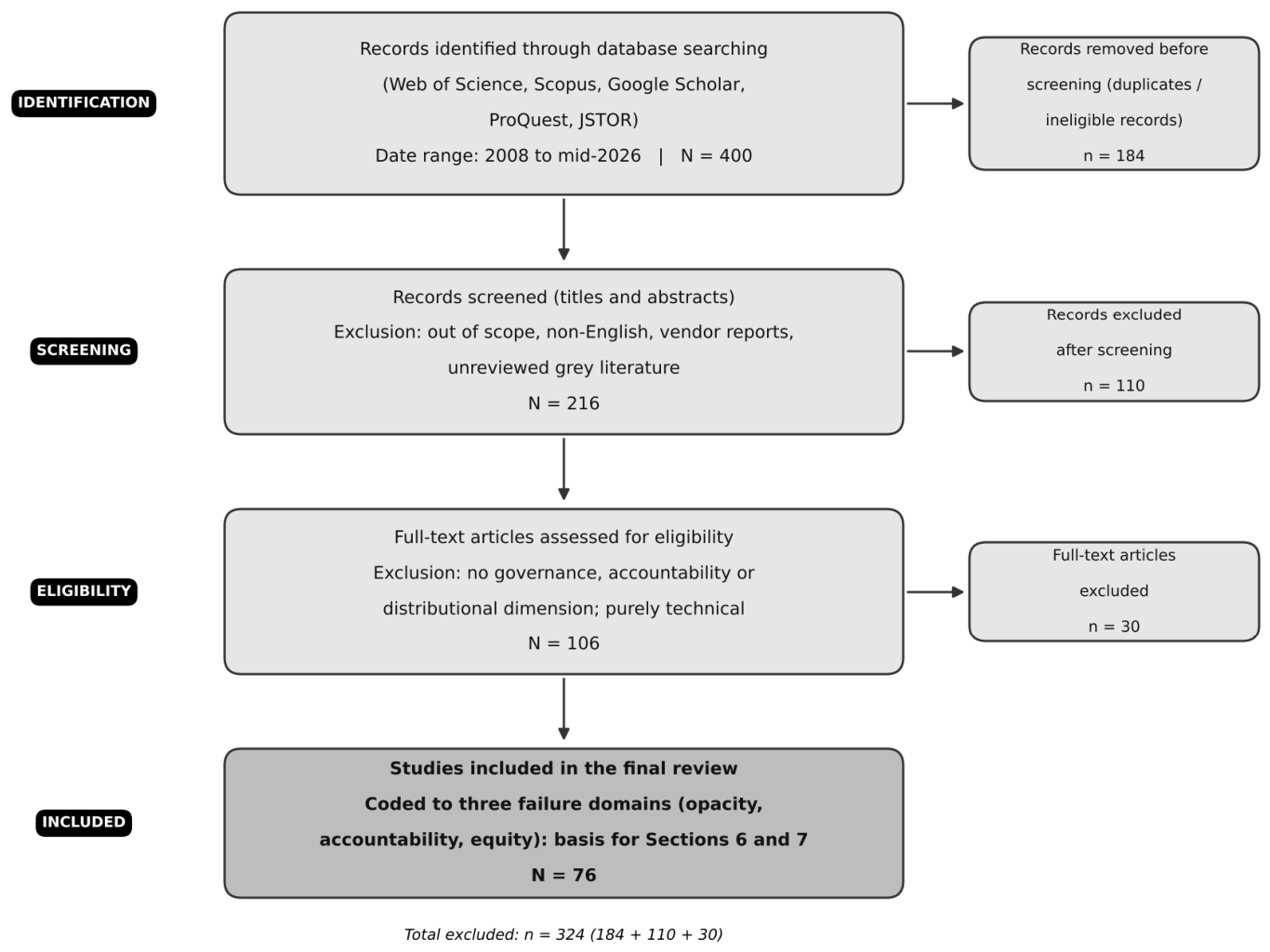
Figure 3.
Integrated governance framework for digital urbanism: failure domains (top) are addressed by governance instruments (middle) grounded in data justice (bottom). Source: Authors’ construction, adapted from Taylor (2017) and Raji et al. (2020).
Figure 3.
Integrated governance framework for digital urbanism: failure domains (top) are addressed by governance instruments (middle) grounded in data justice (bottom). Source: Authors’ construction, adapted from Taylor (2017) and Raji et al. (2020).
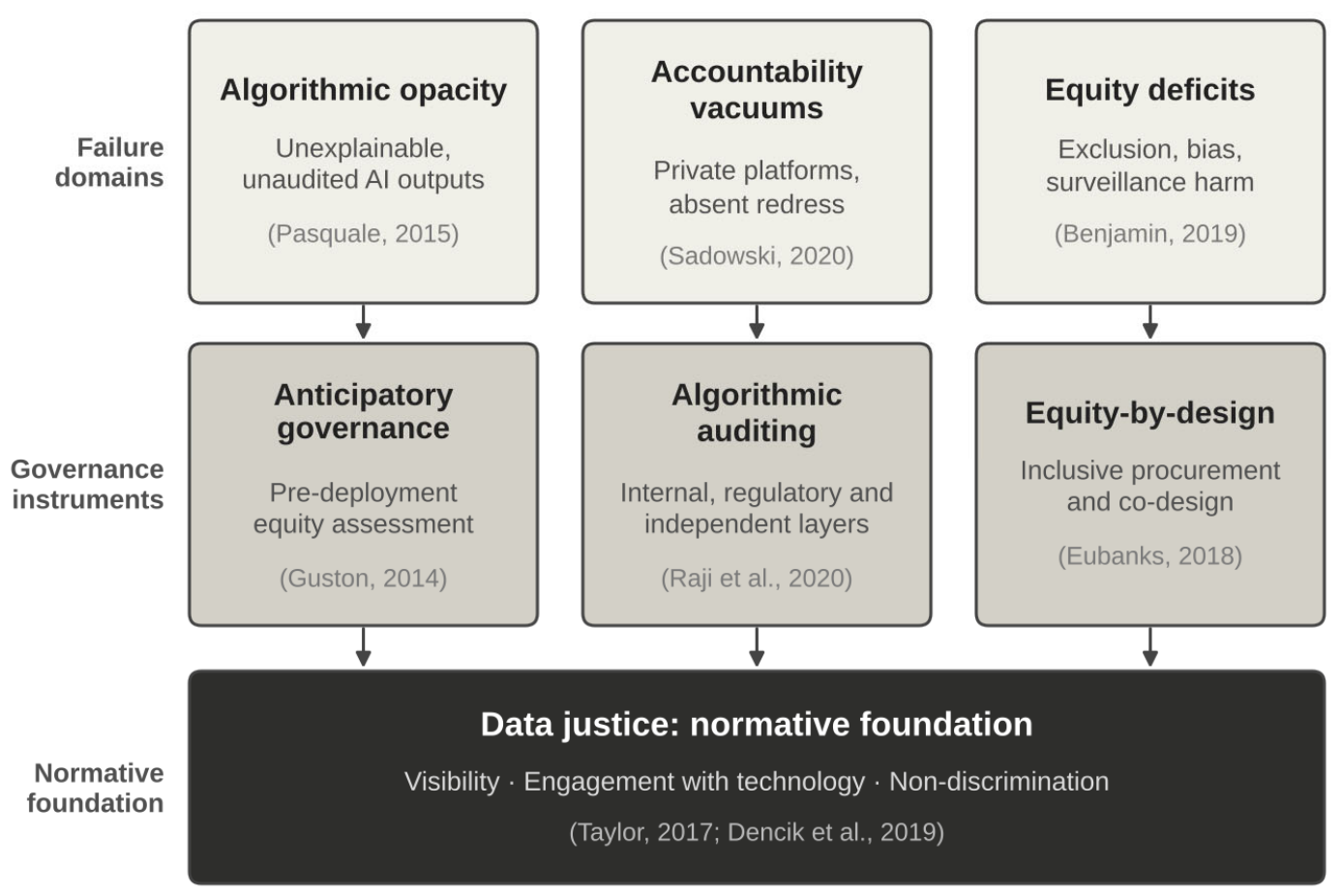

Table 1.
Typology of Digital Governance Failure Domains in Smart Cities.
| Failure Domain | Core Mechanism | Governance Manifestation | Illustrative Cases |
|---|---|---|---|
| Algorithmic Opacity | Mathematical, legal-commercial, and operational opaqueness of AI outputs (Ananny & Crawford, 2018; Pasquale, 2015) | Absent explainability in procurement; no citizen challenge mechanisms | PredPol/Geolitica (USA); Chicago Strategic Subject List; COMPAS recidivism scoring |
| Accountability Vacuum | Privatisation of urban intelligence; fragmented responsibility in PPP delivery chains (Coglianese & Lehr, 2017; Sadowski, 2020) | Black-box procurement clauses; unaudited data-sharing agreements; absent legal redress | Sidewalk Toronto/Quayside; coordinated-entry housing allocation (Los Angeles); fintech credit scoring |
| Socio-Spatial Equity Deficit | Layered digital divides; algorithmic reproduction of racial and class geographies (Benjamin, 2019; Van Dijk, 2020) | Default-user design excluding marginalised populations; uneven smart-sustainability benefits | Chicago sensor deserts; Dholera smart city (India); Chengdu digital governance (China) |
| Surveillance & Privacy Erosion | Commodification of behavioural data; racially differentiated biometric error rates (Browne, 2015; Zuboff, 2019) | Data monetisation by private operators; discriminatory misidentification harms | Buolamwini and Gebru (2018) Gender Shades; Clearview AI; ShotSpotter deployments |
Note. The domains reinforce one another (Section 4.2). Cases are illustrative.
Table 2.
Documented Cases of Smart City Governance Failure.
| Case and Location | Failure Domain | What Failed | Source |
|---|---|---|---|
| Predictive policing, US cities | Algorithmic opacity | Forecasts reproduced historical enforcement patterns through feedback loops | Lum and Isaac (2016); Ensign et al. (2018) |
| COMPAS risk scoring (USA) | Algorithmic opacity | Proprietary tool no more accurate than untrained lay judgements | Dressel and Farid (2018) |
| ShotSpotter gunshot detection, US cities | Algorithmic opacity | 97% acoustic accuracy but only 9.1% effectiveness in addressing crime | Cao (2026) |
| Sidewalk Toronto, Quayside (Canada) | Accountability vacuum | Proposed private “civic data trust” lacked democratic legitimacy; project cancelled in 2020 | Goodman and Powles (2019) |
| Coordinated entry housing allocation, Los Angeles (USA) | Accountability vacuum | Automated vulnerability scoring rationed housing with little transparency or recourse | Eubanks (2018) |
| Dholera smart city, Gujarat (India) | Equity deficit | Entrepreneurial master-planning marginalised existing residents | Datta (2015) |
| Health risk algorithm (USA) | Equity deficit | Cost used as a proxy for need under-identified Black patients | Obermeyer et al. (2019) |
| Sensor network, Chicago (USA) | Equity deficit | Uneven sensor placement left “sensor deserts” in some neighbourhoods | Robinson and Franklin (2020) |
| Digital governance platforms, Chengdu (China) | Equity deficit | Higher-income and younger residents participated 75% more than low-income residents and seniors | Shahraki (2026) |
Note. Cases are illustrative; several involve more than one failure domain.
Table 3.
Integrated Governance Framework for Urban Digital Accountability.
| Framework | Theoretical Basis | Key Prescriptions | Empirical Applications |
|---|---|---|---|
| Data Justice | Visibility, engagement, non-discrimination; data justice as social justice (Dencik et al., 2019; Taylor, 2017) | Participatory data governance; equitable value distribution; enforceable data rights | Amsterdam data commons; Barcelona DECODE; Māori data sovereignty (NZ) |
| Anticipatory Governance | Prospective social impact assessment embedded in technology development (Guston, 2014) | Mandatory pre-deployment equity and accountability assessment; iterative stakeholder co-design | EU AI Act high-risk classification; digital twin governance maturity assessment (Haraguchi et al., 2024) |
| Algorithmic Auditing | Internal, regulatory, and independent audit layers (Metcalf et al., 2021; Raji et al., 2020) | Public algorithm registers; mandatory audit clauses in AI procurement contracts | Amsterdam Algorithm Register (2020-present); NYC Local Law 49 (2018); NYC Local Law 144 (2021) bias audits |
| Equity-by-Design | Structural embedding of equity in technology design and procurement (Eubanks, 2018; Floridi et al., 2020; Green, 2019) | Equity criteria in AI procurement scoring; participatory co-design with affected communities | Seattle Surveillance Ordinance (2017); citizen-centred co-design initiatives (Kougias & Papadakaki, 2025) |
Note. Data justice provides the normative foundation; the other three frameworks are operational instruments.
Table 4.
Research Gap Matrix: Priority Areas and Methodological Needs.
| Research Gap | Current State of Evidence | Methodological Need | Priority |
|---|---|---|---|
| Comparative Institutional Analysis (Global South) | Heavy Anglophone bias; limited cross-political-system comparison (Bandauko, 2022; Datta, 2015) | Multi-site comparative institutional ethnography; mixed-methods governance mapping | Critical |
| Longitudinal Governance Outcome Studies | Field dominated by single-site, single-time-point deployment studies; no longitudinal tracking | Panel designs tracking governance evolution and distributional outcomes over 5-10 years | High |
| Generative AI in Urban Governance | Nascent; governance frameworks pre-date LLMs and foundation models (Sanchez et al., 2024) | Rapid-cycle sociotechnical assessment; legal analysis of emerging regulatory interfaces | Critical |
| Legal-Urban Governance Interface | Fragmented across administrative law, data protection, civil rights, and AI regulation (Coglianese & Lehr, 2017) | Interdisciplinary legal-urban scholarship; systematic regulatory gap mapping | High |
| Community-Centred Participatory Research | Most evidence generated from institutional perspectives; affected-community experience understudied | Participatory action research; community-based qualitative longitudinal studies | High |
Note. ‘Critical’ marks gaps that directly limit governance reform capacity.
Disclaimer/Publisher’s Note: The statements, opinions and data contained in all publications are solely those of the individual author(s) and contributor(s) and not of MDPI and/or the editor(s). MDPI and/or the editor(s) disclaim responsibility for any injury to people or property resulting from any ideas, methods, instructions or products referred to in the content. |
© 2026 by the authors. Licensee MDPI, Basel, Switzerland. This article is an open access article distributed under the terms and conditions of the Creative Commons Attribution (CC BY) license (http://creativecommons.org/licenses/by/4.0/).
Copyright: This open access article is published under a Creative Commons CC BY 4.0 license, which permit the free download, distribution, and reuse, provided that the author and preprint are cited in any reuse.