
Submitted:
03 November 2026
Posted:
04 November 2026
You are already at the latest version
Abstract
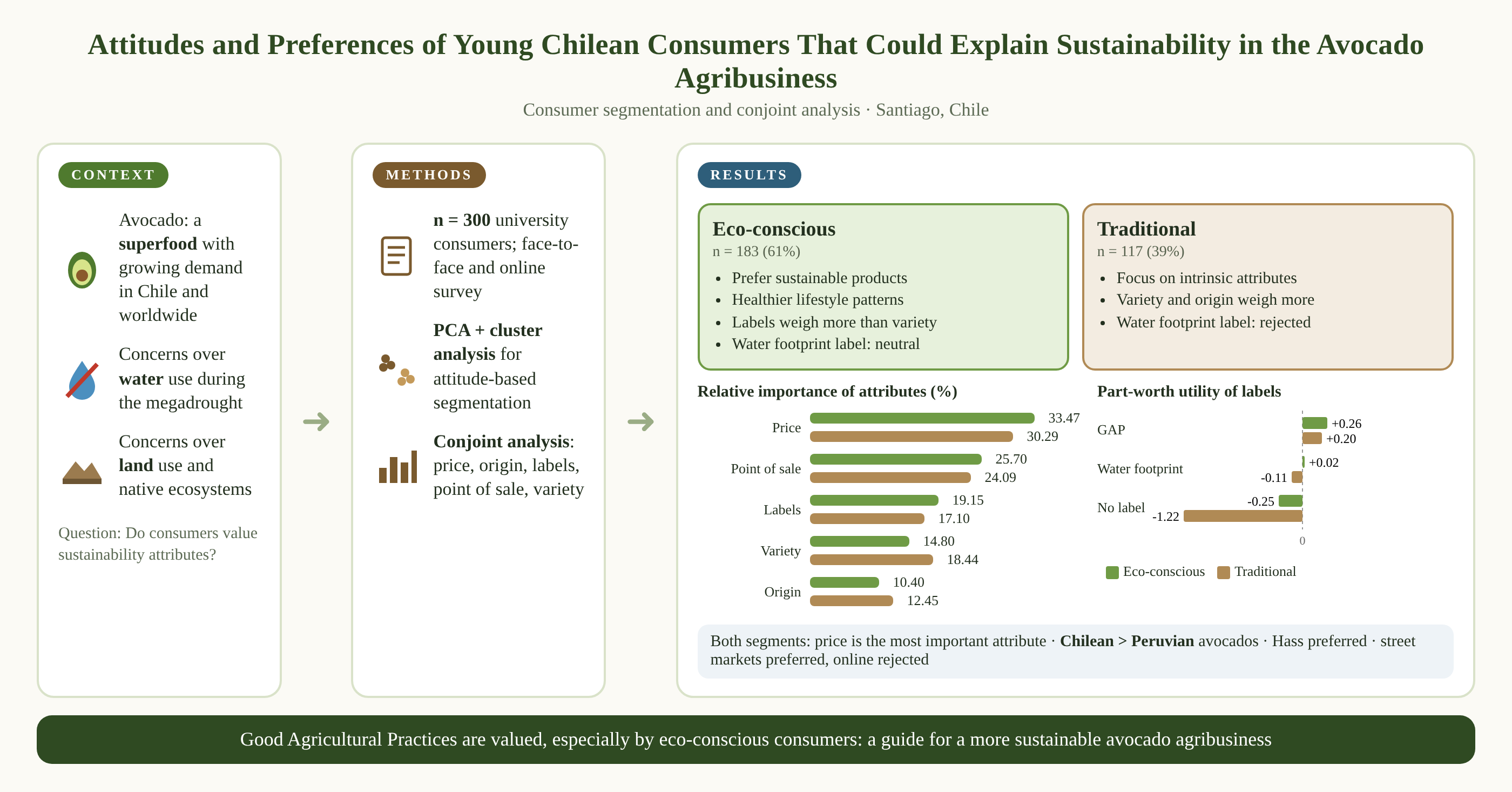
Avocado, a fruit recognized as a superfood, is experiencing growing demand in Chile and worldwide; however, concerns have been raised about the use of water and land in av-ocado production, which could affect the development of this agribusiness. Accordingly, the objective of this research was to analyze consumer preferences and attitudes towards the sustainability attributes of this agribusiness. Data were collected in Santiago, Chile. A total of 300 surveys were administered to university consumers through a non-probabilistic convenience sample, using a mixed face-to-face and online mode. The main statistical treatment for segmentation was a combination of principal component analysis and cluster analysis, while conjoint analysis was used to identify preferences. Two consumer segments were identified: one, labeled “eco-conscious”, characterized by a preference for sustainable products, and the other, “traditional”, with preferences more focused on intrinsic attributes. In addition, both segments showed a preference for Chilean over Peruvian avocados. Finally, there were significant differences, with a stronger preference for Good Agricultural Practices in the eco-conscious segment. These results offer valuable insights for the development of this agribusiness, particularly for targeting consumers who seek products that are more sustainably produced.
Keywords:
avocado
; segmentation
; consumer preferences
; sustainability
; conjoint analysis
1. Introduction
Avocado (Persea americana Miller) is a subtropical fruit that has gained great prominence in international markets, with global consumption increasing by 50.5% over the last 10 years [1]. The Hass variety stands out for its exceptional gastronomic value and for being considered a superfood. This variety is distinguished by its characteristic flavor and texture, its versatility in food preparation, and its nutritional contribution. Avocado offers cardiovascular health benefits owing to its high content of monounsaturated fats, as well as phytochemicals with antioxidant properties that help reduce the risk of cardiovascular disease [2]. Between 2001 and 2022, world avocado imports grew by 874%: 479% in the European Union and 1185% in a bloc of six high-income economies (the United States, Japan, Canada, South Korea, Australia and New Zealand) [3]. Mexico, described by Rodríguez Machorro [4] as the world’s leading consumer, producer and exporter, increased its planted area from 94.000 to 235.000 hectares (+149%) over that period, raised its production by 169% and expanded its exports from about 72.000 to more than one million tonnes. Mexico leads global production of the Hass variety, while Chile, Peru and Colombia stand out as producers in South America [5]. In Chile, the planted area is 27.040 ha, which has decreased year after year because of the drought affecting the country since 2010. The Hass variety accounts for 90% of the area, concentrated mainly in the Valparaíso, Metropolitan and Coquimbo regions [6]. Avocado consumption is deeply rooted in Chilean food culture, with a per capita consumption of 8 kg per year [7], which reached around 9 kg per capita per year in 2025. Finally, the main objective of this study is to explore sustainability requirements on the demand side, in order to generate information for the development of this agribusiness.
2. Theoretical Framework, Hypotheses, and Research Question
This section presents the components of the theoretical framework underpinning this research, which seeks to answer the following questions: How does the young consumer understand the perceived quality of avocados? How does their attitude towards avocados develop within a sustainability context? And what is the existing discussion regarding sustainability in the avocado agribusiness?
2.1. Perceived Quality of Fresh Fruit and Sustainability
The perceived quality of fresh fruit can be assessed objectively or subjectively. Objective quality corresponds to technical standards, such as fruit size, soluble solids content, texture and dry matter at harvest, among others, and is therefore measurable and verifiable. In contrast, subjective quality is based on consumer perception and is essential from a marketing perspective. In this regard, the multi-attribute model analyzes perceived quality through cues, divided into intrinsic and extrinsic attributes [8]. Applications of this model are reported in [9,10]. Intrinsic attributes, such as color, flavor and texture, are essential to the identity of the product; they are the essence of the product. In contrast, extrinsic attributes, such as brand, packaging or price, add value to the product without being an essential part of it [11]. For fresh fruit, there is scientific evidence supporting a greater preference for intrinsic over extrinsic attributes, as reported by Chiang et al. [12] for Chinese consumers of Chilean cherries, Lado et al. [13] for Uruguayan consumers of mandarins (ease of peeling and absence of seeds) and Mora et al. [9] for Spanish consumers of peaches. Regarding extrinsic attributes, studies have considered country of origin for olive oil [14] and price for grapes in Sri Lanka [15]. Finally, among extrinsic attributes linked to sustainability, notable examples include water-use efficiency certifications for avocados in the USA [16], organic labels for apples among German consumers [17] and claims that products are environmentally friendly [18].
H1.The configuration of perceived quality includes sustainability attributes that are valued by Chilean avocado consumers.
2.2. Consumer Attitudes and Behavior
Consumer attitudes towards different agricultural products are among the variables most extensively studied in recent years [19,20,21,22]. Attitudes are defined as beliefs and knowledge associated with product attributes and are based on the consumer’s profile in terms of values and goals [23]; they have been applied to segment markets and to develop explanatory models [24]. Attitude is defined as a learned and consistent predisposition to respond positively or negatively to a product, brand or service, or to aspects of them. The importance of attitudes lies in the fact that they are good predictors of purchase intention [25]. In Chile, for example, consumers’ positive attitude towards online shopping influences their intention to continue buying online [26]. However, scientific evidence on attitudes towards avocado in Chile and Latin America is scarce.
H2.In an exploratory context, attitudes towards avocados can be explained by sustainability aspects.
2.3. Climate, Water Resources and Territory in the Supply of Chilean Avocados
Chilean avocado production is concentrated in semi-arid areas with a Mediterranean climate that require irrigation [27]. Jódar et al. [28] estimated that, in five basins of central Chile, groundwater withdrawals (which increased by 383% between 1997 and 2022) explained 65% of the water-table decline during the megadrought (2010–2022), while recharge variability explained 35%. Along the same lines, Salazar et al. [29] projected robust precipitation reductions for central Chile by the end of this century (from 10% to 20% under the SSP245 scenario and from 20% to 40% under SSP585) and warming of up to about 5 °C. In the province of Petorca, Fragkou et al. [30] analyzed 1753 water purchase orders (2012–2018) and described a water-truck market based on the surpluses of certain actors, even in areas of extreme drought; Madariaga et al. [31] argued that the political influence of growers has enabled the expansion of the crop despite the demands of local communities. However, the evidence is not unanimous: CAZALAC [32] maintains that the sector uses water responsibly, which contrasts with the scientific studies analyzed by Ortiz et al. [27], who reported that land use for avocado in the main municipalities of Valparaíso has increased and that most of the new plantings replaced native ecosystems. In the Aconcagua basin, Lavín et al. [33] found that native bee abundance, pollination services and avocado yield increase with the proportion of surrounding native vegetation, suggesting that expansion of the crop would threaten pollinators and production itself. Beyá-Marshall et al. [34] evaluated five irrigation treatments over two seasons in a Hass orchard in central Chile: with 29% less water than the control, there were no significant effects on fruit size, yield or ripening, and this treatment had the highest water productivity; compared with a baseline from the literature, water savings of close to 30% were achieved. Rodríguez Leiva et al. [35], in turn, observed that municipal planning instruments emphasize technological innovation, economic opportunity and sustainability, and argued that this narrative tends to make environmental damage invisible and to attribute water scarcity solely to external factors.
In response to the expansion of the planted area, several studies have explored ways of producing more with less territorial pressure. Rodríguez Machorro [4] evaluated 24 Mexican municipalities between 2020 and 2024 and found a mean technical efficiency of 0.90, with only nine fully efficient municipalities (five of them in Michoacán) and slack mainly in labor and machinery; he estimated that national production could increase by up to 83.740 tonnes without expanding the cultivated area. This “land-sparing” logic is relevant for sustainability, but the model does not include water or emissions, so technical efficiency is not equivalent to environmental sustainability.
Furthermore, Yangaza and Andrew [36] estimated, for 270 local avocado trees in smallholder agroforestry systems in northern Tanzania, between 0.35 and 1.09 Mg of carbon per tree in total living biomass (up to 4.04 Mg CO₂ equivalent per tree in the Moshi district), and proposed integrating perennial fruit trees, such as avocado, into carbon policies.
In view of the above, the following hypothesis is proposed:
H3.Attributes related to water resources or more efficient agronomic management are valued by young consumers.
In light of the above, the following research question arises: Is it possible to identify, in an exploratory manner, dimensions that explain the attitudes and preferences of Chilean consumers towards sustainability aspects of the avocado agribusiness?
3. Materials and Methods
3.1. Data Sources
The main source of information was a survey conducted between July and October 2023. A non-probabilistic convenience sample was used, considering only consumers over 18 years of age who were university students and residents of the Metropolitan Region. This type of sampling is commonly used in market research because of its efficiency in collecting information at low cost [37,38]. A total of 300 surveys were considered valid. The survey addressed the following topics: sociodemographic background, characterization of the purchase and consumption of Hass avocados, and attitudes towards the sustainability of the Hass avocado industry. The survey consisted entirely of closed questions, mainly multiple-choice items and 5-point Likert scales to measure attitudes. To characterize consumer attitudes, 13 statements based on the sustainability of the avocado agribusiness were presented. In addition, a conjoint analysis question was included to assess attributes such as price, labels and point of sale.
3.2. Statistical Analysis
Principal component analysis was used to reduce the dimensionality of the initial variables and obtain components. The goodness of fit of this analysis was assessed using the Kaiser–Meyer–Olkin (KMO) index, the percentage of variance explained by the components (above 60%) and component loadings above 0.5 [39]. The components obtained were then used in a cluster analysis to characterize market segments according to attitudes towards the sustainability of the avocado industry. Conjoint analysis (CA) was also used, as it allows consumer preferences for product or service attributes to be evaluated [40]. To reduce the number of stimuli (3 × 2 × 3 × 3 × 3), an orthogonal design was used, generating 18 stimuli (Table 1). The attributes and levels used were price (CLP 3500, 4500 and 5500); origin (Chile and Peru); point of sale (street market, supermarket and online); labels (no label, Good Agricultural Practices and water footprint); and variety (Hass and Edranol). There is previous evidence supporting the attributes used in this study. Price has been widely used in conjoint studies [41,42,43], as have certifications and environmental aspects [41], country of origin [43,44], CO₂ emissions [45], traceability [46] and fruit varieties [47].
Responses were measured on a scale from 1 to 7, where 7 meant “would definitely buy it” and 1 meant “would never buy it”. The method also allows the relative importance of the attributes of a product to be estimated [48,49,50]. CA is currently widely used in market research [51,52,53,54]. The main reason is its high degree of flexibility to study a wide range of purchasing decisions involving many attributes [50]. The method allows part-worth utilities to be estimated for each level of an attribute; in other words, this technique provides a utility function for each level of each attribute [55]. The estimated part-worth utilities indicate how influential each attribute level is in the formation of consumer preferences for a particular combination; that is, they represent the degree of consumer preference for each level of each attribute [56]. To be valid in an analysis of preferences, the total utilities of each combination (product profile) should be highly correlated with the observed preferences [55,57].
4. Results
The main sociodemographic characteristics of the sample are as follows: 83% of respondents were aged 18–24 years (51.3%) or 25–34 years (31.7%), and the remaining 17% were aged 35–40 years; university students and young professionals predominated, accounting for 85.3% of the sample. This respondent profile was chosen, first, to analyze the millennial generation and the following cohort, born between 1982–1984 and 2002–2004 [58,59], that is, people who are now between just over 20 and under 44 years of age. Second, by the age of 18, some food consumption habits have already stabilized and are likely to remain so for a long period.
4.1. Dimensions Explaining Attitudes Towards Sustainability in the Avocado Industry
Consumer attitudes towards the sustainability of the avocado industry could be explained by two components, whose statements had factor loadings above 0.5 [60]. These components explained 60.1% of the variance. Bartlett’s test of sphericity was significant, and the Kaiser–Meyer–Olkin (KMO) measure of sampling adequacy was 0.88, in line with the criteria reported by Field [61]. The components were named “Sustainable valuation” and “Environmental sensitivity” (Table 2).
Component 1, “Sustainable valuation”, is associated with statements on the valuation of environmental certifications in the industry, water use, good treatment of workers, transparency of the production process and the importance of this type of information on product labels. It also includes consumer sensitivity, including the choice to stop consuming products for ecological reasons. In addition, an intention to pay more for environmentally sustainable products and a willingness not to buy avocados from areas questioned for their water use were observed.
Component 2, “Environmental sensitivity”, is explained by affective statements about consumers’ concern for the environment and the environmental impact of the products they consume. It is also explained by statements that are negatively correlated with the component and that relate to sustainability and water use.
4.2. Characterization of Chilean University Avocado Consumers According to Their Attitudes Towards Sustainability
Segment 1 showed a slight rejection of the “Sustainable valuation” factor and a negative relationship with the “Environmental sensitivity” factor, with no significant differences between the two segments regarding Component 1 (Table 3). These are everyday consumers who base their choices mainly on the intrinsic attributes of avocado, show no particular interest in environmental certifications and would not refrain from consuming avocado for environmental reasons. In contrast, Segment 2 showed a positive valuation of both components. These consumers have taken concrete action by ceasing to consume products for environmental reasons and expressed a preference for avocados certified as environmentally responsible. Significant differences were found only in educational level: “Traditional consumers” showed a lower percentage of individuals with secondary education and a lower percentage with university education than “Eco-conscious consumers”, who showed a higher percentage of consumers with university education.
To complement the description of each segment, cross-tabulations were performed to explore differences between segments in the valuation of avocado attributes (Table 4) and in lifestyle (Table 5).
Table 5 shows that the eco-conscious segment generally has a greater inclination towards healthy eating patterns. In this regard, Tallontire et al. [64] state that consumers identified as environmentally conscious not only consider their responsibility for environmental problems but also tend to feel responsible for social problems, as they are aware of the consequences of consuming products that affect health and society. This phenomenon was also observed by De Pelsmacker et al. [65], who identified “idealist” segments willing to pay more for coffee with the fair trade label, with their purchase decisions influenced by their ethical convictions.
4.3. Avocado Preferences of Chilean Consumers
Regarding preferences, the conjoint model showed a good fit for both the “Eco-conscious consumers” segment (sig. < 0.001, Pearson’s R = 0.992 and Kendall’s tau = 0.933) and the “Traditional consumers” segment (sig. < 0.001, Pearson’s R = 0.987 and Kendall’s tau = 0.933). The internal validity of the model was estimated by means of Kendall’s tau-b statistic [48,66]. The values obtained (0.992 and 0.987, with a significance level of p = 0.001) show a strong correlation between the observed preferences and those estimated by the conjoint model. The predictive validity of the model was estimated by calculating Kendall’s tau-b between the observed rankings and those estimated for the holdout cards. These results suggest the high predictive validity of the model.
The traditional segment assigned greater relative importance to variety and origin than the eco-conscious segment, which showed greater relative importance for price, point of sale and environmental labels (Table 6). Regarding preferences, both segments valued positively the lowest price (CLP 3500 per kg), GAP labels, Chilean origin, the Hass variety, street markets and supermarkets. However, the eco-conscious segment showed a stronger preference than the traditional segment for the lowest price, the GAP label and street markets. The valuation of country of origin could be interpreted as ethnocentric behavior [67]; the GAP label, which is part of a public policy, was valued positively, similar to the label described by Padilla et al. [68]; and, regarding varieties, preferences for peach varieties have been reported in Chile [69].
Table 6 shows the relative importance values assigned to each attribute, with price being the most important attribute in both segments, followed by point of sale. There were differences between segments regarding variety and labels, with eco-conscious consumers valuing labels more than variety.
In both segments, regarding attribute levels, the highest acceptance was for the lowest price (CLP 3500), whereas a clear rejection was observed for the highest price (CLP 5500). Second, point of sale had a significant influence, with street markets being the most accepted channel, followed by in-store supermarket purchases, which showed a lower degree of acceptance, and a marked rejection of buying avocados online (online supermarket).
Although both segments agreed in their valuation of price and point of sale, they differed in the next most highly rated attribute. Traditional consumers, who focus more on intrinsic attributes, valued avocado variety more, whereas eco-conscious consumers, characterized by choosing sustainable products, gave more importance to labels. Regarding the other attributes, both segments shared the same preferences for each level: the Hass variety was widely accepted, whereas the Edranol variety was rejected. Labels received different valuations: Good Agricultural Practices labels were well received, the water footprint label had a neutral relationship and avocados without labels were rejected, which could be explained by the low level of knowledge about footprint-related attributes. In this regard, García-González et al. [70] reported that most respondents in their study (>70%) did not properly understand the concepts of ecological and carbon footprint, or of green and blue water. Finally, the least valued attribute was origin, with acceptance of Chilean avocados and rejection of Peruvian avocados in both segments.

Table 7.
Part-worth utilities of the Traditional and Eco-conscious consumer segments.
| Segments | Traditional | Eco-conscious | ||||||
| Utility | Std. error | Utility | Std. error | |||||
| Labels | Water footprint label* | -0.11 | 0.07 | 0.02 | 0.06 | |||
| Good Agricultural Practices label* | 0.20 | 0.05 | 0.26 | 0.04 | ||||
| No label | -1.22 | 0.08 | -0.25 | 0.07 | ||||
| Origin | Peru | -0.24 | 0.05 | -0.18 | 0.05 | |||
| Chile | 0.24 | 0.05 | 0.18 | 0.05 | ||||
| Price (CLP) | $3,500 | 0.73 | 0.07 | 0.84 | 0.06 | |||
| $4,500 | -0.08 | 0.08 | -0.04 | 0.07 | ||||
| $5,500 | -0.65 | 0.08 | -0.80 | 0.07 | ||||
| Variety | Hass | 0.40 | 0.05 | 0.37 | 0.05 | |||
| Edranol | -0.40 | 0.05 | -0.37 | 0.05 | ||||
| Point of sale | Online supermarket | -0.44 | 0.07 | -0.56 | 0.06 | |||
| Supermarket | 0.12 | 0.08 | 0.16 | 0.07 | ||||
| Street markets | 0.33 | 0.08 | 0.40 | 0.07 | ||||
| Constant | 3.86 | 0.06 | 3.87 | 0.05 | ||||
*Significant differences at p < 0.05, Tukey and Dunnett’s T3 tests, depending on homogeneity of variances.
5. Discussion
Moving towards sustainable food systems and food consumption has been proposed as a strategy to reduce environmental impact. However, these strategies require joint action by different actors, including the knowledge and perception of the general population as final consumers [70]. Hence the importance of the present study, which provides evidence on consumer requirements regarding sustainability, in the expectation that this knowledge will feed back into supply, in this case of avocados.
Sustainability is a global issue that affects all productive and human systems and involves social, environmental and economic aspects. In this sense, fruit production is shifting from a model driven mainly by economic results to systems whose value chains require not only the economic component but also social components (working conditions and relations with the community) and environmental components (land and water use). This situation has triggered an ongoing debate in which there are negative concerns about the sustainability of the avocado agribusiness, especially regarding land and water use [27], while progress is also evident that could become remedial actions to make avocado cultivation sustainable in the future [32,34].
Furthermore, the results show a positive valuation of the Good Agricultural Practices attribute in both segments, although preference for this attribute is higher in the eco-conscious segment. This could be attributed to it being an attribute that is better known by consumers. Attributes that have been on the market for longer, such as organic or ecological labels, appear to have a differentiated positioning. New sustainability attributes are not yet sufficiently positioned in the market, hence their low valuation, as in the case of the water footprint attribute tested in this study, which received a neutral valuation from Eco-conscious consumers and a negative valuation from Traditional consumers. In this regard, García-González et al. [70] reported that, although consumers show a positive attitude towards sustainability, important misconceptions remain, and thus require intervention through education, information and motivation. Along the same lines of informing and educating, Amorim et al. [71] evaluated the impact of carbon footprint information on consumer perceptions of food production using the text highlighting (TH) technique, in order to guide effective awareness, communication and marketing strategies for more sustainable products. They showed that providing carbon footprint information improved consumer awareness; however, willingness to pay a premium for products with a carbon footprint label was variable, suggesting that awareness alone may not be sufficient to drive purchasing behavior.
6. Conclusions
Sustainability is a condition that is increasingly gaining ground in global agribusinesses. In the case of Chilean avocados, Good Agricultural Practices (GAP) are valued positively, whereas the water footprint attribute receives a neutral valuation.
Final consumers play a key role in the development of sustainability, since knowledge of their requirements is essential information to feed back into supply.
In an exploratory context, the results suggest that a majority of the Chilean university students analyzed (Eco-conscious, n = 183) have a more favorable attitude towards attributes linked to environmental aspects, as well as towards healthy eating patterns.
Intrinsic attributes and price are also relevant for these consumers. There is a clear preference for Chilean Hass avocados, which could be interpreted as an ethnocentric characteristic of the consumers analyzed.
Regarding labels, the water efficiency label is valued neutrally by eco-conscious consumers, while traditional consumers reject it, which may be explained by the absence of this type of label for avocados in the Chilean market.
Numerous studies report a positive valuation of organic or ecological labels; however, to further examine the valuation of other environmental labels, such as those evaluated in this study, it is necessary for the Chilean market to add value to these new labels (water, fair trade, among others), making it a priority to develop such labels and promote them through well-designed communication strategies.
The public policy implications relate to a communication strategy that enables the public to know these attributes in detail and thereby become aware of their existence, which is the starting point for developing favorable attitudes and for the materialization of purchase and repurchase of the product.
Supplementary Materials
The following supporting information can be downloaded at the website of this paper posted on Preprints.org.
Author Contributions
Conceptualization, M.M., A.S., C.M. and T.F.; methodology, M.M.; software, A.S.; validation, A.S., M.M. and T.F.; formal analysis, A.S.; investigation, A.S.; resources, M.M. and F.C.; data curation, A.S.; writing—original draft preparation, A.S.; writing—review and editing, M.M.; visualization, A.S.; supervision, M.M. and A.S.; project administration, M.M.; funding acquisition, F.C. All authors have read and agreed to the published version of the manuscript.:.
Funding
This research was co-funded by the Chilean Avocado Committee (Comité Chileno de Paltas A.G.), within the framework of a collaboration agreement signed between the Faculty of Agricultural Sciences of the University of Chile and the Chilean Avocado Committee. The article processing charge (APC) was funded by the Faculty of Agricultural Sciences of the University of Chile.
Institutional Review Board Statement
Ethical review and approval were not required for this study, as the consumer survey collected information through voluntary and anonymous participation, without gathering any personal or sensitive data that would require a full ethical review.
Informed Consent Statement
Informed consent was obtained from all subjects involved in the study. Participation was voluntary, and respondents were informed of the purpose of the survey before the interview.
Data Availability Statement
The survey data underlying this study are available from the corresponding author upon reasonable request.
Acknowledgments
The authors thank the Chilean Avocado Committee (Comité de Paltas de Chile A.G.) for co-funding this research and for the guidance provided by the professionals and growers affiliated with the organization.
Conflicts of Interest
The authors declare no conflicts of interest.
Abbreviations
The following abbreviations are used in this manuscript:
CA Conjoint analysis
GAP Good Agricultural Practices
KMO Kaiser–Meyer–Olkin
PCA Principal component analysis
SSP Shared Socioeconomic Pathways (climate scenarios SSP245 and SSP585)
TH Text highlighting
References
- Nyakang’i, C.O.; Ebere, R.; Marete, E.; Arimi, J.M. Avocado production in Kenya in relation to the world, avocado by-products (seeds and peels) functionality and utilization in food products. Appl. Food Res. 2023, 3, 100275. [Google Scholar] [CrossRef]
- Vivero, A.; Valenzuela, R.; Valenzuela, A.; Morales, G. Palta: Compuestos bioactivos y sus potenciales beneficios en salud. Rev. Chil. Nutr. 2019, 46, 491–498. [Google Scholar] [CrossRef]
- Díaz Castellanos, R. El aguacate mexicano, la soja brasileña y las plantaciones de palma del sureste asiático: Rompimiento de los modelos agro-sustentables en las cadenas globales de valor. Portes 2025, 3, 161–204. [Google Scholar] [CrossRef]
- Rodríguez Machorro, J.M. Eficiencia territorial del sector aguacatero mexicano: Evidencia DEA 2020–2024. Portes 2026, 3, 260–289. [Google Scholar] [CrossRef]
- Cruz-López, D.F.; Caamal-Cauich, I.; Pat-Fernández, V.G.; Reza Salgado, J. Competitividad de las exportaciones de aguacate Hass de México en el mercado mundial. Rev. Mex. Cienc. Agríc. 2022, 13, 355–362. [Google Scholar] [CrossRef]
- iQonsulting. Anuario de Paltas 2022; iQonsulting: Santiago, Chile, 2022; Available online: https://iqonsulting.com/files/221230-Anuario-2022-Rev.pdf.
- Food and Agriculture Organization of the United Nations. Major Tropical Fruits: Statistical Compendium 2019; FAO: Rome, Italy, 2020. [Google Scholar]
- Olson, J.C.; Jacoby, J. Cue utilization in the quality perception process. In Proceedings of the Third Annual Conference of the Association for Consumer Research; Venkatesan, M., Ed.; Association for Consumer Research: Chicago, IL, USA, 1972; pp. 167–179. [Google Scholar]
- Mora, M.; Espinoza, J.; Schnettler, B.; Echeverría, G.; Predieri, S.; Infante, R. Perceived quality in fresh peaches: An approach through structural equation modeling. Cienc. Investig. Agrar. 2011, 38, 179–190. [Google Scholar] [CrossRef]
- Acebrón, L.B.; Dopico, D.C. The importance of intrinsic and extrinsic cues to expected and experienced quality: An empirical application for beef. Food Qual. Prefer. 2000, 11, 229–238. [Google Scholar] [CrossRef]
- Enneking, U.; Neumann, C.; Henneberg, S. How important intrinsic and extrinsic product attributes affect purchase decision. Food Qual. Prefer. 2007, 18, 133–138. [Google Scholar] [CrossRef]
- Chiang, A.; Aguilera, M.; Cabana, R.; Mora, M. Chinese consumers’ purchase intention of fresh cherries: Modeling of relations between satisfaction and perceived quality. Rev. Fac. Cienc. Agrar. UNCuyo 2021, 53, 204–213. [Google Scholar] [CrossRef]
- Lado, J.; Rivas, F.; Moltini, A.I.; Alcaire, F.; Ares, G. Uruguayan consumers’ perception of mandarins: Insights for selection and marketing of new cultivars. Agrocienc. Urug. 2021, 25, e530. [Google Scholar] [CrossRef]
- Finco, A.; Padella, M.; Sargentoni, T. Disponibilità a pagare per la qualità di un olio extravergine locale. Econ. Agro-Aliment. 2010, 12, 77–98. [Google Scholar] [CrossRef]
- Ranasingha, R.G.S.M.; Edirisinghe, J.C.; Ratnayake, R.H.M.K. Willingness to pay for fruit attributes: A conjoint analysis. J. Agric. Sci. Sri Lanka 2019, 14, 102–110. [Google Scholar] [CrossRef]
- Krovetz, H. The Effect of Water-Use Labeling and Information on Consumer Valuation for Water-Sustainable Food Choices in California. Senior Research Project (ES 196), University of California, Berkeley, CA, USA. 2016. Available online: https://nature.berkeley.edu/classes/es196/projects/2016final/KrovetzH_2016.pdf.
- Meyerding, S.G.H.; Merz, N. Consumer preferences for organic labels in Germany using the example of apples—Combining choice-based conjoint analysis and eye-tracking measurements. J. Clean. Prod. 2018, 181, 772–783. [Google Scholar] [CrossRef]
- Hoek, A.C.; Pearson, D.; James, S.W.; Lawrence, M.A.; Friel, S. Shrinking the food-print: A qualitative study into consumer perceptions, experiences and attitudes towards healthy and environmentally friendly food behaviours. Appetite 2017, 108, 117–131. [Google Scholar] [CrossRef] [PubMed]
- Chamorro-Mera, A.; Garcia-Gallego, J.M.; Martinez-Jimenez, M.; Rubio-Lacoba, S. Fresh food consumers and e-marketplaces for smallholders: An analysis of perceptions and attitudes. Agric. Food Econ. 2026, 14, 66. [Google Scholar] [CrossRef]
- Nowak-Marchewka, K.; Stoma, W.; Osmólska, E.; Stoma, M. Consumer attitudes and knowledge regarding functional food as an element of the circular economy. Sustainability 2026, 18, 881. [Google Scholar] [CrossRef]
- Lin, L.; Ortega, D.L.; Sun, J. The effectiveness of misinformation corrective strategies and implications for consumers’ food preferences and policy attitudes. Appl. Econ. Perspect. Policy 2025, 47, 217–240. [Google Scholar] [CrossRef]
- Solano-Hermosilla, G.; Barreiro-Hurle, J. Are consumers’ attitudes regarding sustainability reflected on food choices? Evidence from a discrete choice experiment in 10 European countries. Econ. Agrar. Recur. Nat. 2025, 25, 157–191. [Google Scholar] [CrossRef]
- Solomon, M.R. Comportamiento del Consumidor, 7th ed.; Pearson Educación: Mexico City, Mexico, 2008. [Google Scholar]
- Mora, M. Estudio de las Actitudes y Percepciones de los Consumidores hacia los Vinos de las Denominaciones. Ph.D. Thesis, Universidad Miguel Hernández de Elche, Elche, Spain, 2005. [Google Scholar]
- Molla, A.; Berenguer, G.; Gómez, M.; Quintanilla, I. Comportamiento del Consumidor; Editorial UOC: Barcelona, Spain, 2006. [Google Scholar]
- Salazar Concha, C.; Mondaca Marino, C.; Cea Rodríguez, J. Comercio electrónico en Chile: ¿Qué factores inciden en la decisión de compra? Rev. Acad. Negoc. 2018, 4, 1–14. Available online: https://www.redalyc.org/articulo.oa?id=560863073001.
- Ortiz, A.M.D.; Baeza-González, S.; Jensen, M.; Huaico-Malhue, A.; Lavín-Oviedo, U.; Celis-Diez, J.L. Telecoupled social-ecological systems: The case of avocado in Chile. Glob. Sustain. 2025, 8, e23. [Google Scholar] [CrossRef]
- Jódar, J.; Urrutia, J.; Herrera, C.; Custodio, E.; Martos-Rosillo, S.; Lambán, L.J. The catastrophic effects of groundwater intensive exploitation and megadrought on aquifers in Central Chile: Global change impact projections in water resources based on groundwater balance modeling. Sci. Total Environ. 2024, 914, 169651. [Google Scholar] [CrossRef] [PubMed]
- Salazar, Á.; Thatcher, M.; Goubanova, K.; Bernal, P.; Gutiérrez, J.; Squeo, F. CMIP6 precipitation and temperature projections for Chile. Clim. Dyn. 2024, 62, 2475–2498. [Google Scholar] [CrossRef]
- Fragkou, M.C.; Monsalve-Tapia, T.; Pereira-Roa, V.; Bolados-Arratia, M. Abastecimiento de agua potable por camiones aljibe durante la megasequía: Un análisis hidrosocial de la provincia de Petorca, Chile. EURE 2022, 48, 1–22. [Google Scholar] [CrossRef]
- Madariaga, A.; Maillet, A.; Rozas, J. Multilevel business power in environmental politics: The avocado boom and water scarcity in Chile. Environ. Polit. 2021, 30, 1174–1195. [Google Scholar] [CrossRef]
- Centro del Agua para Zonas Áridas y Semiáridas de América Latina y el Caribe (CAZALAC). Estado del Arte Ambiental de Plantaciones de Persea americana Mill en Chile; CAZALAC: La Serena, Chile, 2020; Available online: https://www.cazalac.org/wp-content/uploads/2023/06/Cazalac_Estudio_12-09.pdf.
- Lavín, U.; Martínez-Harms, M.J.; Celis-Diez, J.L.; Francois, J.P.; Aguirre, Y.; Martínez-Harms, J. Modelling pollination maps in agroecosystems of a Chilean biodiversity hotspot. Ecosyst. People 2024, 20, 2358471. [Google Scholar] [CrossRef]
- Beyá-Marshall, V.; Arcos, E.; Seguel, Ó.; Galleguillos, M.; Kremer, C. Optimal irrigation management for avocado (cv. ‘Hass’) trees by monitoring soil water content and plant water status. Agric. Water Manag. 2022, 271, 107794. [Google Scholar] [CrossRef]
- Rodríguez Leiva, S.; Hidalgo Dattwyler, R.; Rodríguez Valladares, N.A. Frontera de recursos y transiciones capitalistas: La expansión y contracción del cultivo de palta en la Región de Valparaíso, Chile. Ateliê Geogr. 2025, 19, 75–104. [Google Scholar] [CrossRef]
- Yangaza, I.S.; Andrew, S.M. Carbon stocks and sequestration potential of local avocado trees (Persea americana Mill.) in agroforestry systems of Tanzania. Discov. Agric. 2026, 4, 89. [Google Scholar] [CrossRef]
- Diagourtas, G.; Kounetas, K.E.; Simaki, V. Consumer attitudes and sociodemographic profiles in purchasing organic food products: Evidence from a Greek and Swedish survey. Br. Food J. 2023, 125, 2407–2423. [Google Scholar] [CrossRef]
- Palmieri, N.; Nervo, C.; Torri, L. Consumers’ attitudes towards sustainable alternative protein sources: Comparing seaweed, insects and jellyfish in Italy. Food Qual. Prefer. 2023, 104, 104735. [Google Scholar] [CrossRef]
- Hair, J.F.; Black, W.C.; Babin, B.J.; Anderson, R.E. Multivariate Data Analysis, 7th ed.; Pearson Education: Upper Saddle River, NJ, USA, 2014. [Google Scholar]
- Eggers, F.; Sattler, H. Preference measurement with conjoint analysis: Overview of state-of-the-art approaches and recent developments. GfK Mark. Intell. Rev. 2011, 3, 36–47. [Google Scholar] [CrossRef]
- Baker, G.A. Consumer preferences for food safety attributes in fresh apples: Market segments, consumer characteristics, and marketing opportunities. J. Agric. Resour. Econ. 1999, 24, 80–97. [Google Scholar] [CrossRef]
- Schnettler, B.; Miranda, H.; Sepúlveda, J.; Denegri, M.; Mora, M.; Lobos, G. Preferences for berries among consumers in southern Chile: Blueberries are produced but are they consumed? J. Food Sci. 2011, 76, S458–S464. [Google Scholar] [CrossRef] [PubMed]
- Fuentes, A.; Tormo, E.; Barat, J.M.; Fernández-Segovia, I. Importance of the origin, organic production and other extrinsic parameters in fruit and vegetable choices. Food Sci. Technol. Int. 2025, 31, 275–286. [Google Scholar] [CrossRef] [PubMed]
- Adasme-Berríos, C.; Valdes, R.; Roco, L.; Gómez, D.; Carvajal, E.; Herrera, C.; Espinoza, J.; Rivera, K. Segmentation of consumer preferences for vegetables produced in areas depressed by drought. Sustainability 2022, 14, 6190. [Google Scholar] [CrossRef]
- Núñez Alfaro, V.; Chankov, S. The perceived value of environmental sustainability for consumers in the air travel industry: A choice-based conjoint analysis. J. Clean. Prod. 2022, 380, 134936. [Google Scholar] [CrossRef]
- Mennecke, B.E.; Townsend, A.M.; Hayes, D.J.; Lonergan, S.M. A study of the factors that influence consumer attitudes toward beef products using the conjoint market analysis tool. J. Anim. Sci. 2007, 85, 2639–2659. [Google Scholar] [CrossRef] [PubMed]
- Endrizzi, I.; Torri, L.; Corollaro, M.L.; Demattè, M.L.; Aprea, E.; Charles, M.; Biasioli, F.; Gasperi, F. A conjoint study on apple acceptability: Sensory characteristics and nutritional information. Food Qual. Prefer. 2015, 40, 39–48. [Google Scholar] [CrossRef]
- Green, P.E.; Srinivasan, V. Conjoint analysis in consumer research: Issues and outlook. J. Consum. Res. 1978, 5, 103–123. [Google Scholar] [CrossRef] [PubMed]
- Harrison, R.W.; Özayan, A.; Meyers, S.P. A conjoint analysis of new food products processed from underutilized small crawfish. J. Agric. Appl. Econ. 1998, 30, 257–265. [Google Scholar] [CrossRef]
- Harrison, R.W.; Gillespie, J.M.; Fields, D. Theoretical and empirical considerations of eliciting preferences and model estimation in conjoint analysis. In Proceedings of the American Agricultural Economics Association Annual Meeting, Chicago, IL, USA, 5–8 August 2001. [Google Scholar] [CrossRef]
- Cattin, P.; Wittink, D.R. Commercial use of conjoint analysis: A survey. J. Mark. 1982, 46, 44–53. [Google Scholar] [CrossRef]
- Wittink, D.R.; Cattin, P. Commercial use of conjoint analysis: An update. J. Mark. 1989, 53, 91–96. [Google Scholar] [CrossRef]
- Wittink, D.R.; Vriens, M.; Burhenne, W. Commercial use of conjoint analysis in Europe: Results and critical reflections. Int. J. Res. Mark. 1994, 11, 41–52. [Google Scholar] [CrossRef]
- Green, P.E.; Krieger, A.M.; Wind, Y. Thirty years of conjoint analysis: Reflections and prospects. Interfaces 2001, 31, S56–S73. [Google Scholar] [CrossRef]
- Green, P.E.; Wind, Y. New way to measure consumers’ judgments. Harv. Bus. Rev. 1975, 53, 107–117. [Google Scholar]
- Wang, Q.; Sun, J. Consumer preference and demand for organic food: Evidence from a Vermont survey. In Proceedings of the American Agricultural Economics Association Annual Meeting, Montreal, QC, Canada, 27–30 July 2003. [Google Scholar] [CrossRef]
- Aaker, D.A.; Kumar, V.; Day, G.S. Marketing Research, 7th ed.; John Wiley & Sons: New York, NY, USA, 2003. [Google Scholar]
- Goldring, D.; Azab, C. New rules of social media shopping: Personality differences of U.S. Gen Z versus Gen X market mavens. J. Consum. Behav. 2021, 20, 884–897. [Google Scholar] [CrossRef]
- Taylor, S.L.; Cosenza, R.M. Profiling later aged female teens: Mall shopping behavior and clothing choice. J. Consum. Mark. 2002, 19, 393–408. [Google Scholar] [CrossRef]
- Vale-Nieves, O.; Rivera-Maldonado, M.M. Creación y validación del cuestionario sobre uso de mensajes de texto en el aula. Rev. Puertorriq. Psicol. 2015, 26, 40–54. [Google Scholar]
- Field, A. Discovering Statistics Using SPSS, 3rd ed.; Sage Publications: London, UK, 2009. [Google Scholar]
- Salgado Beltrán, L. Segmentación de los consumidores de alimentos orgánicos según sus actitudes, valores y creencias ambientales. Contad. Adm. 2019, 64, 98. [Google Scholar] [CrossRef]
- Pérez Flores, A.M.; Muñoz Sánchez, V.M.; Leal Saragoça, J.M.; Rodríguez Baltazar, M.S.; Ramos, I.J. Análisis comparativo de consumidores de verduras y frutas ecológicas en España y Portugal. Agric. Soc. Desarro. 2020, 17, 277–299. [Google Scholar] [CrossRef]
- Tallontire, A.; Rentsendorj, E.; Blowfield, M. Ethical Consumers and Ethical Trade: A Review of Current Literature. In NRI Policy Series; Natural Resources Institute, University of Greenwich: Chatham, UK, 2001; p. 12. [Google Scholar]
- De Pelsmacker, P.; Driesen, L.; Rayp, G. Are Fair Trade Labels Good Business? Ethics and Coffee Buying Intentions; Working Paper 03/165; Faculty of Economics and Business Administration; Ghent University: Ghent, Belgium, 2003. [Google Scholar]
- Hair, J.; Anderson, R.; Tatham, R.; Black, W. Análisis Multivariante, 5th ed.; Prentice Hall Iberia: Madrid, Spain, 1999. [Google Scholar]
- Schnettler, B.; Sánchez, M.; Miranda, H.; Orellana, L.; Sepúlveda, J.; Mora, M.; Lobos, G.; Hueche, C. “Country of origin” effect and ethnocentrism in food purchase in Southern Chile. Rev. FCA UNCuyo 2017, 49, 243–267. [Google Scholar]
- Padilla, C.; Villalobos, P.; Spiller, A.; Henry, G. Consumer preferences and willingness to pay for an officially certified quality label: Implications for traditional food producers. Agric. Téc. 2007, 67, 300–308. [Google Scholar] [CrossRef]
- Mora, M.; Espinoza, J.; Miño, R. Segments determination of fresh peaches consumers through the conjoint analysis: An approximation to the Chilean market. Acta Hortic. 2006, 713, 521–526. [Google Scholar] [CrossRef]
- García-González, Á.; Achón, M.; Carretero Krug, A.; Varela-Moreiras, G.; Alonso-Aperte, E. Food sustainability knowledge and attitudes in the Spanish adult population: A cross-sectional study. Nutrients 2020, 12, 3154. [Google Scholar] [CrossRef] [PubMed]
- Amorim, K.A.; Passos, L.P.; Galdino, M.L.S.; Souza, A.H.S.; Ribeiro, F.B.; de Oliveira Ferreira, T.; Bresciani, L.F.V.; Rodrigues, J.F. Impact of carbon footprint of food production on consumer perceptions and attitudes: Insights from text highlighting. Food Qual. Prefer. 2025, 129, 105498. [Google Scholar] [CrossRef]
Table 1.
Attributes and levels proposed for the avocado purchase decision experiment among consumers in the Metropolitan Region of Chile.
Table 1.
Attributes and levels proposed for the avocado purchase decision experiment among consumers in the Metropolitan Region of Chile.
| Card | Variety | Label | Country of origin | Price (CLP)* | Point of sale |
| 1 | Hass | No label | Chile | $3,500 | Online |
| 2 | Hass | Water footprint | Peru | $5,500 | Online |
| 3 | Edranol | Water footprint | Chile | $3,500 | Online |
| 4 | Edranol | No label | Peru | $4,500 | Street market |
| 5 | Hass | GAP | Chile | $4,500 | Online |
| 6 | Hass | Water footprint | Peru | $3,500 | Street market |
| 7 | Hass | Water footprint | Peru | $3,500 | Online |
| 8 | Edranol | Water footprint | Chile | $5,500 | Street market |
| 9 | Edranol | Water footprint | Chile | $4,500 | Online |
| 10 | Edranol | No label | Peru | $3,500 | Online |
| 11 | Hass | GAP | Chile | $3,500 | Street market |
| 12 | Edranol | GAP | Peru | $5,500 | Online |
| 13 | Edranol | GAP | Peru | $3,500 | Supermarket |
| 14 | Hass | Water footprint | Peru | $4,500 | Supermarket |
| 15 | Hass | No label | Chile | $5,500 | Supermarket |
| 16 | Edranol | Water footprint | Chile | $3,500 | Supermarket |
| 17 | Edranol | Water footprint | Peru | $3,500 | Supermarket |
| 18 | Hass | Water footprint | Chile | $5,500 | Online |
Table 2.
Dimensions explaining consumer perception of the sustainability of the Hass avocado industry in the Metropolitan Region.
Table 2.
Dimensions explaining consumer perception of the sustainability of the Hass avocado industry in the Metropolitan Region.
| Statement | Comp. 1 | Comp. 2 |
| If avocados are produced in a way that protects the soil (GAP), I am willing to buy them | 0.78 | 0.16 |
| A sustainability certification in avocado production increases the likelihood of purchase | 0.77 | 0.21 |
| I value positively that the label can state that the avocado was produced under a sustainable system | 0.64 | 0.39 |
| I consider it important that companies in the avocado industry show how avocados are produced (e.g., a QR code linking to a video) | 0.63 | 0.11 |
| I would pay a little more for avocados from growers committed to efficient water use | 0.63 | 0.25 |
| I am inclined to support avocado growers who are committed to treating their workers well | 0.62 | 0.09 |
| I am willing not to consume avocados from areas that have been questioned for their water use | 0.56 | 0.13 |
| I prefer to buy avocados if I know they have been produced using systems that use little water | 0.53 | 0.48 |
| I do not care about sustainability in avocado production | -0.03 | -0.77 |
| I do not care that avocado production uses a lot of water | -0.13 | -0.73 |
| I care about the environment | 0.31 | 0.63 |
| I have changed the products I consume for ecological reasons | 0.34 | 0.59 |
| Explained variance (%) | 35.40 | 25.70 |
| Cronbach’s alpha | 0.82 | 0.79 |
Extraction method: principal component analysis. Rotation method: Varimax with Kaiser normalization.
Table 3.
Final cluster centers of the segmentation according to attitudes towards avocado.
| Components | Segment 1 (n = 117; 39.0%) “Traditional consumers” |
Segment 2 (n = 183; 61.0%) “Eco-conscious consumers” |
| Component 1. Sustainable valuation (p = 0.288) |
-0.09 |
0.08 |
| Component 2. Environmental sensitivity (p < 0.001) |
-1.45 | 0.62 |
Significant differences at p ≤ 0.05.
Table 4.
Characterization of market segments and Hass avocado attributes in the Metropolitan Region.
Table 4.
Characterization of market segments and Hass avocado attributes in the Metropolitan Region.
| Traditional consumers | Eco-conscious consumers | ||||
| n | % | n | % | ||
| Nutritional value (p = 0.037) | Very important | 87 | 74.4% | 154 | 84.2% |
| Slightly important | 30 | 25.6% | 29 | 15.8% | |
| Brand (p = 0.004) |
Very important | 73 | 62.4% | 142 | 77.6% |
| Slightly important | 44 | 37.6% | 41 | 22.4% | |
| Small size (p = 0.033) |
Very important | 53 | 45.3% | 106 | 57.9% |
| Slightly important | 64 | 54.7% | 77 | 42.1% | |
| Organic label (p = 0.024) |
Very important | 74 | 63.2% | 138 | 75.4% |
| Slightly important | 43 | 36.8% | 45 | 24.6% | |
p < 0.05 indicates significant differences in Pearson’s chi-square test.
Table 5.
Lifestyle characterization of the segments according to their attitudes towards Hass avocado and its sustainability in the Metropolitan Region.
Table 5.
Lifestyle characterization of the segments according to their attitudes towards Hass avocado and its sustainability in the Metropolitan Region.
| Statements | Traditional consumers | Eco-conscious consumers | |||
| n | % | n | % | ||
| I try to maintain a balanced diet (p = 0.005) |
Yes | 51 | 43.6% | 110 | 60.1% |
| No | 66 | 56.4% | 73 | 39.9% | |
| I follow a vegetarian or vegan diet (p = 0.001) |
Yes | 15 | 12.8% | 57 | 31.1% |
| No | 102 | 87.2% | 126 | 68.9% | |
| I prefer natural or organic food (p = 0.001) |
Yes | 21 | 17.9% | 75 | 41.3% |
| No | 96 | 82.1% | 108 | 58.7% | |
| I try to lead a healthy life (p = 0.001) |
Yes | 67 | 57.3% | 151 | 82.5% |
| No | 50 | 42.7% | 32 | 17.5% | |
| I go to the cinema, museums or parks at least a couple of times a month (p = 0.014) |
Yes | 34 | 29.1% | 79 | 42.2% |
| No | 83 | 70.9% | 104 | 56.8% | |
| I like trying new things (p = 0.002) |
Yes | 71 | 60.7% | 141 | 77.0% |
| No | 46 | 39.3% | 41 | 23.0% | |
| I enjoy cooking (p = 0.042) |
Yes | 63 | 53.8% | 120 | 65.6% |
| No | 54 | 46.2% | 63 | 34.4% | |
p < 0.05 indicates significant differences in Pearson’s chi-square test.
Table 6.
Relative importance values (%) for the identified segments.
| Traditional consumers | Eco-conscious consumers | |
| Price | 30.29 | 33.47 |
| Point of sale | 24.09 | 25.70 |
| Variety | 18.44 | 14.80 |
| Labels | 17.10 | 19.15 |
| Origin | 12.45 | 10.4 |
Disclaimer/Publisher’s Note: The statements, opinions and data contained in all publications are solely those of the individual author(s) and contributor(s) and not of MDPI and/or the editor(s). MDPI and/or the editor(s) disclaim responsibility for any injury to people or property resulting from any ideas, methods, instructions or products referred to in the content. |
© 2026 by the authors. Licensee MDPI, Basel, Switzerland. This article is an open access article distributed under the terms and conditions of the Creative Commons Attribution (CC BY) license.
Copyright: This open access article is published under a Creative Commons CC BY 4.0 license, which permit the free download, distribution, and reuse, provided that the author and preprint are cited in any reuse.