

Submitted:
31 October 2026
Posted:
04 November 2026
You are already at the latest version
Abstract
Background: Mental strength is defined as the behavioral capacity to persist through obstacles and challenges, and to recover from failures, adversities, and setbacks. Building on previous scale developments, Studies 1 and 2 aimed to develop, refine, and validate a brief, psychometrically robust measure of mental strength for combat sports practitioners. Methods: In Study 1, an exploratory factor analysis (EFA) was conducted on a sample of Brazilian jiu-jitsu practitioners (N = 328) to evaluate the factor structure of the 9-item Mental Strength Scale and to propose a brief version of the Mental Strength Scale. In Study 2, a confirmatory factor analysis (CFA) was performed on a separate sample of combat sports practitioners (N = 300) to test the factor structure of the newly derived Brief Mental Strength Scale (BMSS). Additionally, Study 2 assessed internal consistency and predictive validity against measures of self-efficacy, self-control, self-esteem, and symptoms of anxiety and depression. Results: In Study 1, EFA results championed a two-factor structure, leading to the removal of 3 items. In Study 2, CFA confirmed good fit for the two-factor, 6-item model (subscales “Dealing with Failure” and “Facing Obstacles”), showing excellent fit indices: CFI = .985, TLI = .972, SRMR = .037, RMSEA = .090. The scale demonstrated strong internal consistency (α = .89). Moreover, the BMSS exhibited significant (p < .001) and robust predictive validity, positively predicting self-efficacy (β = .66), self-control (β = .51), and self-esteem (β = .45), while negatively predicting symptoms of anxiety (β = -.39) and depression (β = -.38). Conclusion: The Brief Mental Strength Scale is a valid, reliable, and structurally sound bidimensional instrument for assessing mental strength among combat sports practitioners, offering coaches and sport psychology professionals a practical tool for monitoring and enhancing well-being and performance.
Keywords:
resilience
; perseverance
; grit
; Brazilian jiu-jitsu
; mental toughness
; judo
Brief Mental Strength Scale: Development, Factorial Validity, and Psychometric Properties in Combat Sports
Mental strength remains a relevant topic, considering that the ability to persevere despite setbacks and barriers is a quality highly admired in others (Csikszentmihalyi et al., 2005). Mental strength was initially proposed as a two-factor construct, subdivided into perseverance and resilience. Perseverance is defined as the ability to persist when pursuing a task despite difficulty (Dagnall et al., 2019). Resilience is defined as the ability to recover from hardships and misfortunes (Smith et al., 2008). Stemming from these two ideas, mental strength is defined as the behavioral capacity to persist through obstacles and challenges, and to recover from failures, adversities, and setbacks (Lorenco-Lima, 2024; Lorenco-Lima et al., 2025).
The Mental Strength Theory explains that the development of mental strength follows biological training principles such as overload, adaptation, progression, and individuality (Lorenco-Lima, 2026). First, to expand its functionality, the brain must undergo a psychological stimulus that surpasses its current capacity. This idea is congruent with the biological principle of overload (Steinhaus, 1933; Kasper, 2019; Malm et al., 2019). Thus, psychological overload explains the stimuli necessary to trigger acute responses and chronic adaptations in the brain (Lorenco-Lima et al., 2025). Second, positive chronic adaptations (Fountaine, 2024) represent the adaptive process resulting from adequate psychological overload. The principle of psychological adaptation explains that extraneous psychological overloads become less taxing with time due to enhanced psychological processing (Lorenco-Lima et al., 2025). Third, incremental and timely overloads are necessary to sustain continued adaptation (Kasper, 2019). The principle of psychological progression explains that task increments must be adequately managed through psychological overload intensity, volume, and frequency (Lorenco-Lima et al., 2025). Fourth, individuality represents one’s unique ability to adapt to overloads (Schwellnus et al., 2016). The principle of psychological individuality explains that individuals may present unique initial mental strength thresholds that must be closely assessed prior to the prescription of mental strength training to prevent burnout and mental health disorders. In addition to mental strength training, adequate rest and nutrition are critical to maximize mental strength (Lorenco-Lima et al., 2025).
To a certain degree, mental strength overlaps with established constructs such as resilience, grit, and mental toughness. However, while grit addresses consistency of interest and perseverance of effort (Duckworth & Quinn, 2009), and mental toughness addresses control, commitment, challenge, and confidence (Dagnall et al., 2019), mental strength avoids the inclusion of confounding variables and emphasizes the behavioral responses to challenges, obstacles, adversities, setbacks, and failures (Lorenco-Lima et al., 2025).
Congruent with Vealey’s (1986) presentation of dispositional and situational self-confidence, mental strength also encompasses a general and a situational component (Lorenco-Lima et al., 2025). The situational aspect of mental strength describes the person’s behavior in a particular domain (e.g., athletics or academics), while general mental strength explains the person’s behavior across multiple domains (i.e., sum of situational mental strength).
This Research
This study was conducted to develop an efficient and brief measure of mental strength in combat sports based on its initial theoretical development (Lorenco-Lima, 2024). In Study 1, the underlying factor structure of the MSS-9 was identified and the items were selected for the Brief Mental Strength Scale (BMSS). In Study 2, a confirmatory factor analysis (CFA) was conducted to test the two-factor structure of the Brief Mental Strength Scale in a new sample of combat sports practitioners.
Study 1
In Study 1, an exploratory factor analysis (EFA) was conducted to identify the underlying factor structure of the Mental Strength Scale-9 (MSS-9). The items selected to compose the Brief Mental Strength Scale were identified based on factor loadings and item content.
Methods
Participants
The sample included 328 Brazilian jiu-jitsu practitioners, representing 214 males (65.2%) and 114 females (34.8%), aged 18 to 60 (M = 37.7, SD = 9.4), with a mean of 7.3 years of training experience (SD = 6.7). Participants included 74 white belts (22.6%), 101 blue belts (30.8%), 53 purple belts (16.2%), 36 brown belts (11.0%), and 64 black belts (19.5%). Of the total sample, 142 participants (43.3%) engaged in one or more Brazilian jiu-jitsu competitions over the previous 12 months, and 186 participants (56.7%) did not compete during the same period.
Procedures
In Study 1, data were collected via Google Forms from December 4, 2025, to February 24, 2026. Recruitment was conducted online via social media. Inclusion criteria: male and female, aged 18 to 60 years, training Brazilian jiu-jitsu at least once a week, and English proficiency. Participants replied to demographic (age and biological sex) and training-related questions (belt rank, training experience, and competitions completed over the previous 12 months) followed by the Mental Strength Scale-9.
The study was conducted anonymously with no compensation offered for participation. All participants received an information sheet with the details of the study. Prior to data collection, the study was exempted by Liberty University’s Institutional Review Board under 45 CFR 46.104(d) Category 2(i), as data were collected anonymously (Electronic Code of Federal Regulations, 2026).
Materials
For Study 1, the latest version of the Mental Strength Scale (MSS-9) was used. The scale is composed of 9 items in a 5-point Likert, with internal consistency of 0.81 (Lorenco-Lima et al., 2025). The participants were requested to choose the option that best represented their general behaviors over the previous month. Total scores were determined by the average of the nine items with higher scores representing higher mental strength. The Cronbach’s alpha for the MSS-9 in this sample was 0.86.
Statistical Analysis
An exploratory factor analysis (EFA) using principal axis factoring with direct oblimin rotation, suppressing small coefficients below 0.3, was conducted to examine the underlying factor structure of the nine-item Mental Strength Scale (MSS-9). The number of factors was determined based on the variance explained by the extracted factors, scree plot, factor loadings, and the item content of the factors identified. Item selection was based on factor loadings and construct validity of the items. For the retained items, internal consistency was assessed via Cronbach’s alpha.
Results
Exploratory factor analysis
Data suitability was confirmed via Kaiser-Meyer-Olkin measure (KMO = .85) and Bartlett’s test of sphericity (χ²(36) = 1397.07; p < 0.001). An EFA was conducted to examine the underlying structure of the MSS-9. Empirical evaluation of the eigenvalues and a visual inspection of the scree plot indicated that a two-factor solution was the most optimal structure (Table 1 and Figure 1). Together, these two extracted factors accounted for 67.12% of the total variance, with Factor 1 explaining 47.57% of the variance (eigenvalue = 4.28) and Factor 2 explaining 18.55% of the variance (eigenvalue = 1.67).
This two-factor structure was further supported by the factor pattern matrix, which revealed clean, distinct cluster loadings for the items across the two dimensions (Table 2).
Brief Mental Strength Scale Development
After examining the item contents and factor loadings, three items were excluded. On Factor 1, despite being within an acceptable range, items 1 and 8 were removed as they exhibited the two lowest factor loadings. On Factor 2, despite presenting an excellent factor loading, item 5 was removed due to the temporal implication present in “I tend to complete tasks regardless of how long they take.” This temporal characteristic exceeds the intended temporal boundaries of the scale. The item’s content validity requires conceptual alignment with the “past month” behavioral window, making the open-ended temporal phrasing psychometrically misaligned with the target timeframe.
Following these modifications, the proposed Brief Mental Strength Scale is composed of two factors and six items. Factor 1 (Dealing with Failure) is represented by items 2, 3, and 4, and Factor 2 (Facing Obstacles) by items 6, 7, and 9. In this sample, Cronbach's alpha for the retained six items was 0.81. Cronbach's alpha for the subscales “Dealing with Failure” and “Facing Obstacles” was 0.88 and 0.74, respectively.
Lastly, a change is proposed from the original 5-point response format to a 7-point Likert format (1 = strongly disagree, 7 = strongly agree). This adjustment aims to optimize the scale’s psychometric properties following item reduction, as previous literature indicates that moving from fewer categories to a 7-point format may significantly enhance internal consistency, validity, and discriminating power (Lozano et al., 2008; Preston & Colman, 2000).
Study 2
In Study 2, after establishing the initial items of the brief version of the Mental Strength Scale, we conducted a confirmatory factor analysis (CFA) to test whether the theoretical framework of the Brief Mental Strength Scale proposed in Study 1 could be confirmed in a new sample of combat sports practitioners. Additionally, predictive validity data were provided for self-efficacy, self-esteem, self-control, symptoms of anxiety, and symptoms of depression.
Methods
Participants
The Study 2 sample included 300 combat sports practitioners, representing 234 males (78.0%) and 66 females (22.0%), aged 18 to 60 years (M = 37.6, SD = 10.8), with a mean of 12.2 years of experience (SD = 11.7). Of the total sample, 146 practiced Brazilian jiu-jitsu (48.7%), 90 Judo (30.0%), 19 Muay Thai (6.4%), 8 Mixed Martial Arts (2.7%), 7 Boxing (2.3%), 6 Armored Combat (2.0%), 6 Karate (2.0%), 5 Taekwondo (1.7%), 4 Wrestling (1.3%), 2 Japanese Jujitsu (0.7%), 2 Kickboxing (0.7%), 1 Sambo (0.3%), 1 Sanda (0.3%), 1 Historical European Martial Arts (0.3%), 1 Soo Bahk Do (0.3%), and 1 Kung Fu (0.3%). Additionally, 143 participants (47.7%) engaged in one or more competitions over the previous 12 months, and 157 participants (52.3%) did not compete during the same period.
Procedures
In Study 2, data were collected via Google Forms from August 8, 2026, to October 14, 2026. Recruitment was conducted online via social media. Inclusion criteria: male and female, aged 18 to 60 years, training combat sports at least once a week, and English proficiency. Participants replied to demographic (age and biological sex) and training-related questions (training experience and competitions completed over the previous 12 months) followed by the Brief Mental Strength Scale (BMSS), General Self-Efficacy Scale, Brief Self Control Scale, Brief Rosenberg Self-Esteem Scale (BRSES), Short State-Trait Anxiety Inventory - T5 (STAI-T5), and Patient Health Questionnaire-9 (PHQ-9).
This study was conducted anonymously with no compensation offered for participation. Participants received an information sheet with the details of the study. Prior to data collection, the study was exempted by Liberty University’s Institutional Review Board under 45 CFR 46.104(d) Category 2(i), as data were collected anonymously (Electronic Code of Federal Regulations, 2026).
Materials
For Study 2, the Brief Mental Strength Scale (Brief Mental Strength Scale) was used to assess the participants’ mental strength. The Brief Mental Strength Scale is composed of 6 items in a 7-point Likert format (Appendix A). The six items retained from Study 1 were renumbered sequentially as items 1 through 6 for the Brief Mental Strength Scale administration. The participants were requested to choose the option that best represented their general behaviors over the previous month. Items 1, 2, and 3 composed the subscale “Dealing with Failure” and items 4, 5, and 6 composed the subscale “Facing Obstacles.” Responses vary from 1 for "strongly disagree" to 7 for "strongly agree." Total scores were determined by the average of the six items with higher scores representing higher mental strength. The Cronbach’s alpha for the Brief Mental Strength Scale in the current sample was .89.
The General Self-Efficacy Scale (GSES) was used to assess the participants' self-efficacy. The GSES is a 10-item, 4-point scale with Cronbach's alpha ranging from .76 to .90 (Schwarzer & Jerusalem, 1995). Responses vary from 1 for "not at all true" to 4 for "exactly true." Total scores were determined by the sum of the 10 items, with higher scores indicating greater self-efficacy. The Cronbach’s alpha for the GSES in the current sample was .87.
The Brief Self-Control Scale (BSCS) was used to assess the participants’ self-control. The BSCS is a 13-item, 5-point scale with a Cronbach's alpha ranging from .83 to .85 (Tangney et al., 2004). Participants indicated how they typically are, with responses varying from 1 for "not at all like me" to 5 for "very much like me." Items 1, 6, 8, and 11 were positively phrased, and items 2, 3, 4, 5, 7, 9, 10, 12, and 13 were negatively phrased and reverse-coded. Total scores were calculated by the sum of the 13 items, with higher scores indicating greater self-control. The Cronbach’s alpha for the BSCS in the current sample was .88.
The Brief Rosenberg Self-Esteem Scale (BRSES) was used to assess the participants' self-esteem. The BRSES is a 5-item, 4-point scale with a Cronbach's alpha ranging from .87 to .89 (Monteiro et al., 2022). Participants were asked to indicate how much they agree with the sentences, with answers varying from 0 for "strongly disagree" to 3 for "strongly agree". Items 3, 4 and 5 were positively phrased and items 1 and 2 were negatively phrased and reverse-coded. Total scores were calculated by the sum of the 5 items, with higher scores indicating higher self-esteem. The Cronbach’s alpha for the BRSES in the current sample was .84.
The Short State-Trait Anxiety Inventory - T5 (STAI-T5) was used to assess symptoms of anxiety. The STAI-T5 is a 5-item, 4-point scale with Cronbach's alpha of .86 (Zsido et al., 2020). Participants indicated how they generally felt, with responses varying from 1 for "almost never" to 4 for "almost always." Total scores were calculated by the sum of the items, with higher scores indicating higher symptoms of anxiety. The Cronbach’s alpha for the STAI-T5 in the current sample was .87.
The Patient Health Questionnaire-9 (PHQ-9) was used to assess the participants’ symptoms of depression. The PHQ-9 is a 9-item, 4-point scale with a Cronbach's alpha ranging from .86 to .89 (Kroenke et al., 2001). Participants were asked to indicate how often they deal with different scenarios, with responses ranging from 0 for "not at all" to 3 for "nearly every day." Total scores were calculated by the sum of the nine items, with higher scores indicating higher symptoms of depression. The Cronbach’s alpha for the PHQ-9 in the current sample was .85.
Statistical Analysis
A Confirmatory Factor Analysis (CFA) was conducted to test the Brief Mental Strength Scale. Maximum likelihood estimation was used due to its good performance (Finney & DiStefano, 2013; Olsson et al., 1999). The Brief Mental Strength Scale was tested as a two-factor model based on the theoretical structure proposed in Lorenco-Lima (2024) and Study 1 findings. Items 1, 2, and 3 were loaded onto the Dealing with Failure (DF) factor, and items 4, 5, and 6 loaded onto the Facing Obstacles (FO) factor.
Several statistics were examined to explore the absolute fit of the two-factor model. Chi-square: to test the significance of the difference between the observed and model-implied covariance matrices. The sample size in this study made it likely to result in increased power, resulting in a statistically significant result even under negligible differences between the covariance matrices. Standardized root mean square residual (SRMR): to assess the standardized summary of the covariance residuals. Good fit is indicated by SRMR values of .08 and below (Hu & Bentler, 1999). Root mean square error of approximation (RMSEA): to assess model misfit per degrees of freedom. RMSEA values of .06 are considered good, while values greater than .10 are considered poor (Browne & Cudeck, 1993; Hu & Bentler, 1999). Comparative fit index (CFI): compares the model of interest to an independence null model. A cutoff value of .95 is recommended with higher values suggesting better fit (Hu & Bentler, 1998; 1999). Tucker-Lewis Index (TLI): compares the model quality with a baseline model. Values greater than .90 are considered a good fit and values greater than .95 are considered excellent (Montoya & Edwards, 2020). The aforementioned statistical analyses were performed using the software R (Version 4.4.1). Structural equation modeling (SEM) was conducted using the lavaan package (Rosseel, 2012).
To provide additional evidence for the Brief Mental Strength Scale, Cronbach’s alpha was calculated to determine internal consistency. Linear regressions were performed to establish predictive validity for self-efficacy, self-esteem, self-control, and symptoms of anxiety and depression. These analyses were conducted via IBM SPSS Statistics (Version 30) with an alpha level of .05.
Results
Confirmatory Factor Analysis
All item factor loadings were statistically significant (p < .001) and robust (λ ≥ .776). Standardized loadings for subscale “Dealing with Failure” (Factor 1) were .898 (item 1), .914 (item 2), and .897 (item 3). Standardized loadings for subscale “Facing Obstacles” (Factor 2) were .776 (item 4), .897 (item 5), and .806 (item 6). The two latent factors share a significant, moderate-to-strong positive correlation (r = .638, z = 7.847, p < .001), confirming that while the subscales are related components of mental strength, they measure distinct dimensions.
As anticipated, the chi-square value was statistically significant (χ2(8) = 27.644, p = .001), due to the current large sample size. The SRMR value showed an excellent fit (.037). Although the RMSEA value was .090, this slight elevation is a well-documented phenomenon in models with low degrees of freedom and does not necessarily indicate poor fit (Kenny et al., 2015). Crucially, both the CFI (.985) and TLI (.972) values demonstrated an excellent overall model fit.
Internal Consistency and Validity
In Study 2, the Brief Mental Strength Scale’s Cronbach’s alpha was .89, showing good internal consistency. Moreover, Cronbach’s alpha was .93 for the subscale “Dealing with Failure” and .84 for “Facing Obstacles.”
Predictive validity was established between the Brief Mental Strength Scale and markers of mental well-being. Mental strength positively predicted the participants’ self-efficacy, R2 = .440, F(1, 298) = 234.25, B = 3.08, β = .66, p < .001, 95% CI [2.68, 3.47], self-control, R2 = .263, F(1, 298) = 106.30, B = 5.22, β = .51, p < .001, 95% CI [4.23, 6.22], and self-esteem, R2 = .202, F(1, 298) = 75.42, B = 1.67, β = .45, p < .001, 95% CI [1.29, 2.05].
Additionally, predictive validity was established between the Brief Mental Strength Scale and markers of mental health. Mental strength negatively predicted symptoms of anxiety, R2 = .153, F(1, 298) = 53.93, B = -1.65, β = -.39, p < .001, 95% CI [-2.08, -1.20], and symptoms of depression, R2 = .141, F(1, 298) = 48.86, B = -2.00, β = -.38, p < .001, 95% CI [-2.61, -1.46].
Discussion
Initially, Lorenco-Lima (2024) proposed a two-factor structure to assess mental strength in combat sports athletes. However, a follow-up study encountered diverging findings and proposed an updated unifactor model to assess the construct (Lorenco-Lima et al., 2025). Therefore, Studies 1 and 2 aimed to develop, provide factorial validity for, and evaluate the psychometric properties of, the Brief Mental Strength Scale.
In Study 1, EFA results indicated a two-factor structure. Based on factor loadings and item content analysis, three items were excluded to develop the Brief Mental Strength Scale. In Study 2, CFA results indicated that the two-factor structure was a good fit for the data (CFI = .985, TLI = .972, SRMR = .037, RMSEA = .090). Although the RMSEA value was slightly elevated as per conservative standards, it has been well documented and accepted in models with low degrees of freedom (Kenny et al., 2015).
Despite the similarity between perseverance and resilience (Turbeville, 2021), the bidimensional characteristic of the Brief Mental Strength Scale reflects a detectable distinction between the constructs, which are relevant for a practical mobilization of external and internal resources to overcome adversities (Tsai & Morissette, 2022). As previously seen by Lorenco-Lima (2024), these conceptual differences can indeed be detected when assessed via self-reported questions, generating two distinct variables.
Despite the robust psychometric properties of the Brief Mental Strength Scale, limitations should be noted. First, the voluntary and self-reported characteristics of the study may have introduced self-selection and social desirability bias. Future studies are encouraged to adopt alternative sampling and recruitment methods to encourage diverse participation. Moreover, data triangulation is recommended to mitigate social desirability bias and subjective recall inaccuracies. Second, the samples in both studies were predominantly male and skewed towards grappling disciplines. Future research may investigate the potential measurement invariance across sexes, combat sport styles (i.e., grappling versus striking), and competitive statuses. Third, the cross-sectional nature of the data prevents causal inferences. Longitudinal studies are strongly encouraged to assess mental strength changes over time in response to stressors, such as training overloads and competition.
In conclusion, Study 1 and Study 2 successfully developed, refined, and validated the bidimensional Brief Mental Strength Scale across two distinct samples of combat sports practitioners. The Brief Mental Strength Scale is composed of 6 items in a 7-point Likert format. It is grounded in the theoretical framework of mental strength, and demonstrates robust psychometric properties, including a clean factor structure, excellent internal consistency, and strong predictive validity with key markers of mental well-being and distress. Ultimately, this brief scale offers a practical and time-efficient instrument for coaches and sport psychology professionals to monitor athletes’ mental strength and the effectiveness of behavioral interventions.
Author Contributions
Conceptualization, L.d.L.L.; methodology, L.d.L.L.; software, L.d.L.L.; validation, L.d.L.L.; formal analysis, L.d.L.L.; investigation, L.d.L.L.; resources, L.d.L.L.; data curation, L.d.L.L.; writing—original draft preparation, L.d.L.L.; writing—review and editing, L.d.L.L.; visualization, L.d.L.L.; project administration, L.d.L.L. The author has read and agreed to the published version of the manuscript.
Funding
This research received no external funding.
Institutional Review Board Statement
Prior to data collection, the study was exempted by Liberty University’s Institutional Review Board under 45 CFR 46.104(d) Category 2(i), as data were collected anonymously (Electronic Code of Federal Regulations, 2026).
Informed Consent Statement
Participants received an information sheet with the details of the study.
Data Availability Statement
The raw data supporting the conclusions of this article will be made available by the author on request.
Acknowledgments
Not applicable.
Conflicts of Interest
The authors declare no conflicts of interest.
Appendix A. Brief Mental Strength Scale (BMSS)
Mark the box that best represents your behaviors over the past month.
| Brief Mental Strength Scale (BMSS) |
Strongly Disagree |
Disagree | Somewhat Disagree | Neutral | Somewhat Agree | Agree |
Strongly Agree |
|
| BMSS1 | I recover quickly from adversity. | 1 | 2 | 3 | 4 | 5 | 6 | 7 |
| BMSS2 | I have a strong capacity for bouncing back from adversity. | 1 | 2 | 3 | 4 | 5 | 6 | 7 |
| BMSS3 | I am resilient and able to recover quickly from setbacks. | 1 | 2 | 3 | 4 | 5 | 6 | 7 |
| BMSS4 | I am persistent in completing tasks, even when I lack motivation. | 1 | 2 | 3 | 4 | 5 | 6 | 7 |
| BMSS5 | I am determined to achieve my goals and will not give up easily. | 1 | 2 | 3 | 4 | 5 | 6 | 7 |
| BMSS6 | When I face obstacles, I work hard to overcome them. | 1 | 2 | 3 | 4 | 5 | 6 | 7 |
Scoring
For each question, assign the points below:
7 = Strongly agree
6 = Agree
5 = Somewhat agree
4 = Neutral
3 = Somewhat Disagree
2 = Disagree
1 = Strongly disagree
- Add the points attributed for each question and divide by 6.
- “Dealing with Failure” score can be obtained by the average of items 1, 2, and 3.
- “Facing Obstacles” score can be obtained by the average of items 4, 5, and 6.
- Higher scores represent higher mental strength.
References
- Browne, M.W.; Cudeck, R. Alternative ways of assessing model fit. In Testing structural equation models; Bollen, K.A., Long, J.S., Eds.; Sage: Newbury Park, CA, 1993; pp. 136–161. [Google Scholar]
- Csikszentmihalyi, M.; Abuhamdeh, S.; Nakamura, J. Flow. In Handbook of competence and motivation; Elliot, A. J., Dweck, C. S., Eds.; Guilford Publications, 2005; pp. 598–608. [Google Scholar]
- Dagnall, N.; Denovan, A.; Papageorgiou, K. A.; Clough, P. J.; Parker, A.; Drinkwater, K. G. Psychometric assessment of shortened Mental Toughness Questionnaires (MTQ): Factor structure of the MTQ-18 and the MTQ-10. Front. Psychol. 2019, 10, 1933. [Google Scholar] [CrossRef] [PubMed]
- Duckworth, A. L.; Quinn, P. D. Development and validation of the short grit scale (Grit-S). J. Personal. Assess. 2009, 91(2), 166–174. [Google Scholar] [CrossRef]
- Electronic Code of Federal Regulations. Electronic Code of Federal Regulations (eCFR). 2026. [Google Scholar] [PubMed]
- Finney, S. J.; DiStefano, C. Nonnormal and categorical data in structural equation modeling. In Structural equation modeling: A second course, 2nd ed.; Hancock, G.R., Mueller, R.O., Eds.; Information Age Publishing Inc: Charlotte, NC, 2013; pp. 439–492. [Google Scholar]
- Fountaine, C. J. SHAREABLE RESOURCE: Ten training principles to guide exercise prescription. ACSM's Health Fit. J. 2024, 28(5), 88. [Google Scholar] [CrossRef]
- Hu, L.; Bentler, P. M. Fit indices in covariance structure modeling: Sensitivity to underparameterized model misspecification. Psychol. Methods 1998, 3(4), 424–453. [Google Scholar] [CrossRef]
- Hu, L.T.; Bentler, P. M. Cutoff criteria for fit indexes in covariance structure analysis: Conventional criteria versus new alternatives. Struct. Equ. Model. 1999, 6(1), 1–55. [Google Scholar] [CrossRef]
- Kasper, K. Sports training principles. Curr. Sports Med. Rep. 2019, 18(4), 95–96. [Google Scholar] [CrossRef] [PubMed]
- Kenny, D. A.; Kaniskan, B.; McCoach, D. B. The performance of RMSEA in models with small degrees of freedom. Sociol. Methods Res. 2015, 44(3), 486–507. [Google Scholar] [CrossRef]
- Kroenke, K.; Spitzer, R. L.; Williams, J. B. The PHQ-9: validity of a brief depression severity measure. J. General. Intern. Med. 2001, 16(9), 606–613. [Google Scholar] [CrossRef] [PubMed]
- Lorenco-Lima, L. Mental strength assessment in combat sports practitioners and non-practitioners. J. Hum. Sport Exerc. 2024, 19(2). [Google Scholar] [CrossRef]
- Lorenco-Lima, L.; Waterbury, E. M.; Gaines, S. A. Mental Strength Scale (MSS-9): Factor structure and reliability. J. Hum. Sport Exerc. 2025, 20(4), 1413–1426. [Google Scholar] [CrossRef]
- Lorenco-Lima, L. Psychological Foundations in Brazilian jiu-jitsu. In Science and Methodology of Brazilian Jiu-Jitsu: From theory to the mat, 1st ed.; Silva, R. M., Ed.; Routledge, 2026; pp. 76–100. [Google Scholar] [CrossRef]
- Lozano, L. M.; García-Cueto, E.; Muñiz, J. Effect of the number of response categories on the reliability and validity of rating scales. Methodol. Eur. J. Res. Methods Behav. Soc. Sci. 2008, 4(2), 73–79. [Google Scholar] [CrossRef]
- Malm, C.; Jakobsson, J.; Isaksson, A. Physical activity and sports—real health benefits: A review with insight into the public health of Sweden. Sports 2019, 7(5), 127. [Google Scholar] [CrossRef] [PubMed]
- Monteiro, R. P.; Coelho, G. L. D. H.; Hanel, P. H.; de Medeiros, E. D.; da Silva, P. D. G. The Efficient Assessment of Self-Esteem: Proposing the Brief Rosenberg Self-Esteem Scale: RP Monteiro et al. Appl. Res. Qual. Life 2022, 17(2), 931–947. [Google Scholar] [CrossRef]
- Montoya, A. K.; Edwards, M. C. The Poor Fit of Model Fit for Selecting Number of Factors in Exploratory Factor Analysis for Scale Evaluation. Educ. Psychol. Meas. 2020, 81(3), 413–440. [Google Scholar] [CrossRef] [PubMed]
- Olsson, U. H.; Troye, S. V.; Howell, R. D. Theoretic fit and empiric fit: The performance of maximum likelihood versus generalized least squares estimation in structural equation models. Multivar. Behav. Res. 1999, 34(1), 31–58. [Google Scholar] [CrossRef] [PubMed]
- Preston, C. C.; Colman, A. M. Optimal number of response categories in rating scales: reliability, validity, discriminating power, and respondent preferences. Acta Psychol. 2000, 104(1), 1–15. [Google Scholar] [CrossRef] [PubMed]
- Rosseel, Y. lavaan: An R package for structural equation modeling. J. Stat. Softw. 2012, 48(2), 1–36. [Google Scholar] [CrossRef]
- Schwarzer, R.; Jerusalem, M. Generalized self-efficacy scale. In Measures in health psychology: A user's portfolio; Weinman, J., Wright, S., Johnston, M., Eds.; NFER-Nelson, 1995. [Google Scholar]
- Smith, B. W.; Dalen, J.; Wiggins, K.; Tooley, E.; Christopher, P.; Bernard, J. The brief Resilience scale: assessing the ability to bounce back. Int. J. Behav. Med. 2008, 15(3), 194–200. [Google Scholar] [CrossRef] [PubMed]
- Steinhaus, A. H. Chronic effects of exercise. Physiol. Rev. 1933, 13(1), 103–147. [Google Scholar] [CrossRef]
- Schwellnus, M.; Soligard, T.; Alonso, J. M.; Bahr, R.; Clarsen, B.; Dijkstra, H. P.; ...; Engebretsen, L. How much is too much?(Part 2) International Olympic Committee consensus statement on load in sport and risk of illness. Br. J. Sports Med. 2016, 50(17), 1043–1052. [Google Scholar] [CrossRef] [PubMed]
- Tangney, J. P.; Baumeister, R. F.; Boone, A. L. High self-control predicts good adjustment, less pathology, better grades, and interpersonal success. J. Personal. 72 2004, 271–322. [Google Scholar] [CrossRef] [PubMed]
- Tsai, J.; Morissette, S. B. Introduction to the special issue: Resilience and perseverance for human flourishing. Psychol. Trauma Theory Res. Pract. Policy 2022, 14(S1), S1–S3. [Google Scholar] [CrossRef] [PubMed]
- Turbeville, H. R. Exchanging resilience for persistence: perspective for a new era in training. J. Clin. Investig. 2021, 131(18), e150828. [Google Scholar] [CrossRef] [PubMed]
- Vealey, R. S. Conceptualization of sport-confidence and competitive orientation: Preliminary investigation and instrument development. J. Sport Psychol. 1986, 8(3), 221–246. [Google Scholar] [CrossRef]
- Zsido, A. N.; Teleki, S. A.; Csokasi, K.; Rozsa, S.; Bandi, S. A. Development of the short version of the spielberger state-trait anxiety inventory. Psychiatry Res. 2020, 291, 113223. [Google Scholar] [CrossRef] [PubMed]
Figure 1.
Scree Plot for Maximum Number of Extracted Factors.
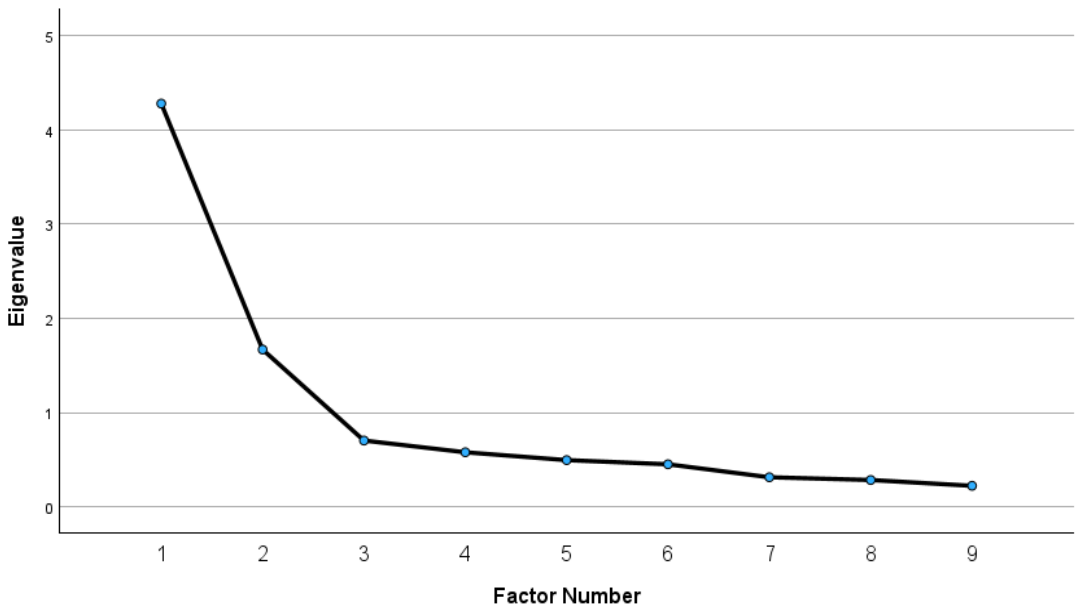

Table 1.
Variance Explained by the First Four Extracted Factors.
| Factor | Variance Explained | Eigenvalue % of Variance |
| 1 | 4.28 | 47.57% |
| 2 | 1.67 | 18.55% |
| 3 | 0.70 | 7.82% |
| 4 | 0.58 | 6.43% |
Table 2.
Factor Pattern Matrix.
| Item | Factor | |
| 1 | 2 | |
| 1 | 0.465 | - |
| 2 | 0.838 | - |
| 3 | 0.816 | - |
| 4 | 0.904 | - |
| 5 | - | 0.801 |
| 6 | - | 0.888 |
| 7 | - | 0.635 |
| 8 | 0.698 | - |
| 9 | - | 0.488 |
Disclaimer/Publisher’s Note: The statements, opinions and data contained in all publications are solely those of the individual author(s) and contributor(s) and not of MDPI and/or the editor(s). MDPI and/or the editor(s) disclaim responsibility for any injury to people or property resulting from any ideas, methods, instructions or products referred to in the content. |
© 2026 by the author. Licensee MDPI, Basel, Switzerland. This article is an open access article distributed under the terms and conditions of the Creative Commons Attribution (CC BY) license.
Copyright: This open access article is published under a Creative Commons CC BY 4.0 license, which permit the free download, distribution, and reuse, provided that the author and preprint are cited in any reuse.