

Submitted:
03 November 2026
Posted:
04 November 2026
You are already at the latest version
Abstract
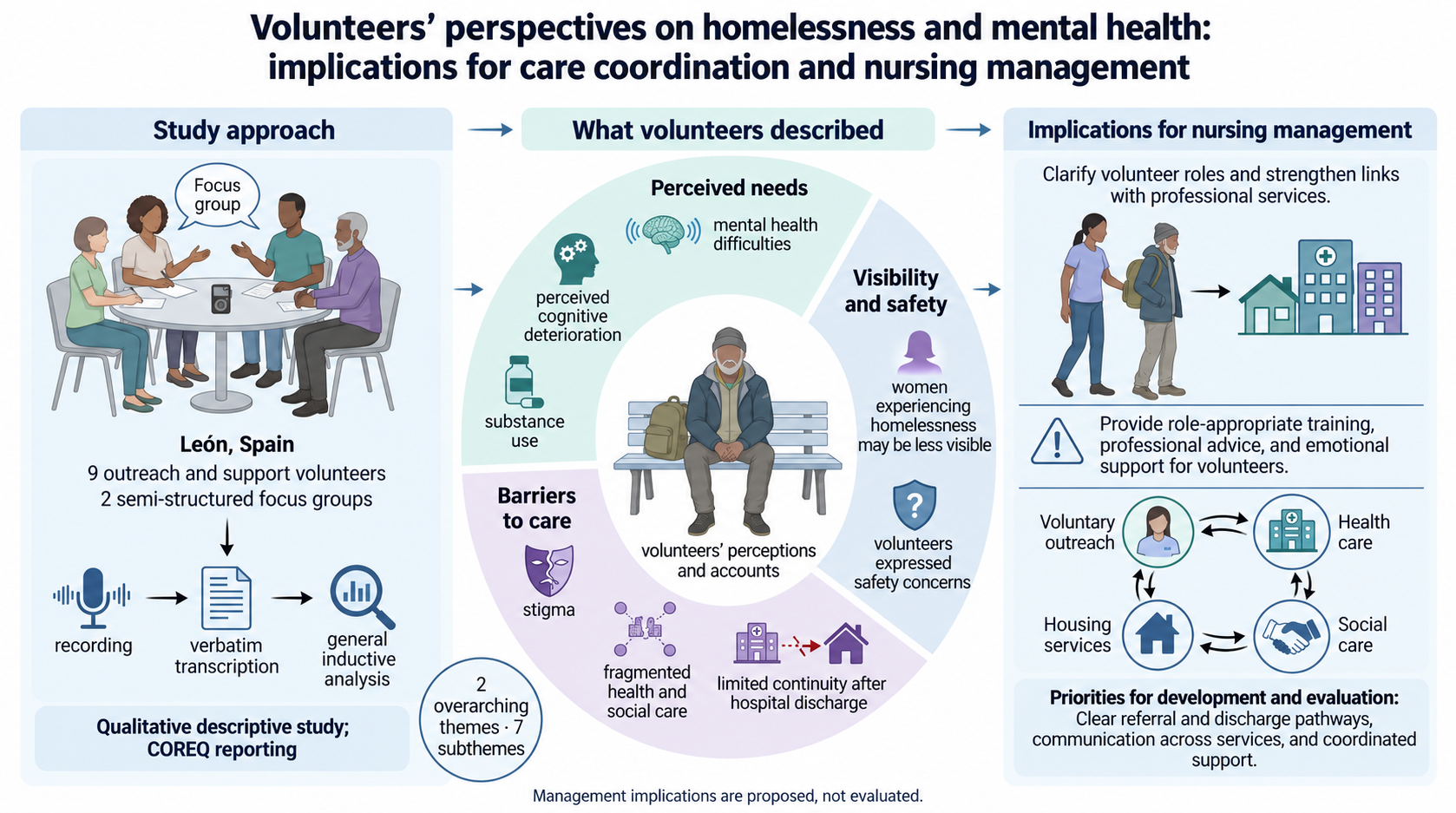
Background/Objectives: Coordinating voluntary outreach with formal services requires understanding volunteers’ accounts of role boundaries, unmet support needs, and barriers to continuity of care. This study explored volunteers’ perceptions of mental health needs, barriers to health and social care, and support resources in León, Spain. Methods: A qualitative descriptive study used two semi-structured focus groups with nine volunteers from a humanitarian nongovernmental organisation. Sessions were audio- and video-recorded, transcribed verbatim, and analysed using a general inductive approach. Reporting was guided by COREQ. Results: Two themes and seven subthemes were identified. Volunteers described perceived mental health difficulties, deterioration, substance use, stigma, fragmented access to services, and limited continuity after hospital discharge. They highlighted the reduced visibility of women experiencing homelessness and concerns about their safety. Sustained accompaniment and informal relationships were valued, but participants reported uncertainty about role boundaries, gaps in training, and limited access to professional support. Their accounts described volunteering as both meaningful and emotionally demanding and revealed a tension between requests for training and participation in available sessions. Conclusions: The findings identify context-specific priorities for coordinating voluntary outreach with health, social care, and housing services. For nursing management, they suggest areas for collaborative service development: clear referral and discharge pathways, defined responsibilities, accessible training, and support for emotionally demanding outreach. These proposals require evaluation; the study did not measure quality of life, burnout, or service effectiveness.
Keywords:
homelessness
; mental health
; volunteers
; qualitative research
; care coordination
; nursing man-agement
; organisational support
; community health services
1. Introduction
Homelessness is a complex form of social exclusion involving not only the absence of stable accommodation but also disrupted social relationships, economic insecurity, discrimination, and restricted access to essential services. The European Typology of Homelessness and Housing Exclusion (ETHOS) recognises different forms of homelessness, including rooflessness, houselessness, and living in insecure or inadequate accommodation [1,2]. Although these situations differ, they are consistently associated with profound health and social inequalities.
People experiencing homelessness face significant disparities in both physical and mental health. Mental health needs frequently coexist with physical illness, trauma, and substance use, while access to appropriate support remains constrained [3,4,5]. The relationship between homelessness and mental ill-health is complex and potentially bidirectional, shaped by poverty, housing instability, violence, and social isolation [6]. Research also documents a substantial burden of frailty among people experiencing homelessness, highlighting the need to consider functional needs alongside chronological age [7].
Research with people experiencing homelessness and mental disorders illustrates the complex relationship between substance use, psychological distress, and life on the streets [8]. Evidence on selected harm-reduction interventions suggests that they can reduce substance-related harms, although effects vary across interventions and outcomes [9]. Support with prescribed medication should also address practical barriers to obtaining, safely storing, and taking medication, as inequalities in access to medicines remain an important concern for this population [10].
People experiencing homelessness encounter practical, relational, and organisational barriers to healthcare, including stigma, inflexible services, and discontinuity of care [5,11,12]. Research in Barcelona has also identified healthcare inequities and barriers to access within the Spanish context [13]. The management of healthcare services for this population has received growing attention, including evaluation of a mobile health clinic designed to improve equitable access to primary healthcare [14].
Community and outreach services seek to address some of these barriers by meeting people in familiar environments, developing relationships, and facilitating contact with formal services. Qualitative studies describe the contribution of nursing to assessment, referral, advocacy, and continuity of care in this context [15,16,17]. Housing and health responses also need to be considered together: Housing First research provides evidence of improved housing stability, while effects on health outcomes are less consistent [18,19].
Volunteers in community organisations provide material assistance, emotional support, and accompaniment through repeated outreach encounters. Their position may offer insight into difficulties encountered between street-based support and formal services. Research on peer and lay health work highlights the importance of relationships, role definition, and organisational support, although these roles are not interchangeable with general volunteering [20,21]. This study focuses specifically on volunteers from a humanitarian, volunteer-based nongovernmental organisation providing social and healthcare-related support to vulnerable populations in Spain, operating in León, to examine how they interpret mental health needs and barriers to care, understand their own role, and identify preparation and support needs. Their perspectives provide a situated viewpoint on community support, rather than a substitute for the experiences of people experiencing homelessness or assessments by healthcare professionals.
Evidence on peer and lay health work provides relevant context, but those roles are not interchangeable with general volunteering [20,21]. The question addressed here is how volunteers in this local programme experience the interface with formal services and what preparation and support they perceive as necessary. Understanding these accounts can inform context-specific priorities for training, organisational support, and service coordination. These perspectives are relevant to nursing management where nurses contribute to outreach, discharge planning, and communication across services.
This study therefore aimed to explore volunteers’ perceptions of the mental health needs, health and social care barriers, and available support resources for people experiencing homelessness in León, Spain. Specific objectives were: (1) to explore volunteers’ perceptions of the mental health needs of people experiencing homelessness; (2) to identify perceived barriers to accessing health and social care services; (3) to examine volunteers’ views on the availability of institutional resources and the role of volunteer support; and (4) to identify perceived training needs and opportunities to improve multidisciplinary collaboration and continuity of care.
2. Materials and Methods
2.1. Design
A qualitative descriptive study using semi-structured focus groups and a general inductive approach to analysis [22] was conducted to explore volunteers’ perceptions of mental health needs, access to health and social care, and community support for people experiencing homelessness. This design was selected to provide a detailed account of participants’ experiences and interpretations [23]. Reporting was guided by the Consolidated Criteria for Reporting Qualitative Research (COREQ; [24]). A COREQ reporting checklist, including items not reported in the manuscript, is provided in Table S1.
2.2. Setting
The study was conducted in León (north-west Spain), where this humanitarian nongovernmental organisation operates a community-based programme providing outreach and social support for people experiencing homelessness. The programme includes street outreach, a hygiene centre, accompaniment to health and social services, referral to specialised resources, and coordination with other community organisations. During the data collection period, the programme primarily served people sleeping rough and users of the hygiene centre, alongside individuals in unstable accommodation who attended periodically. Volunteers regularly engage with people experiencing homelessness through both daytime and night-time outreach activities, providing food, clothing, hygiene resources, emotional support, and guidance towards available health and social care services.
2.3. Participants and Recruitment
A purposive sampling strategy was used to recruit volunteers actively involved in the organisation’s homelessness programme. Participants were eligible if they were over 18 years of age, had experience providing direct support to people experiencing homelessness, had participated in outreach or hygiene centre activities, and agreed voluntarily to participate. Volunteers with no direct experience working with people experiencing homelessness were excluded. All volunteers meeting the eligibility criteria in the programme were invited to participate through the programme coordinators, who informed eligible volunteers about the study. To minimise the potential influence of the coordinators on recruitment, volunteers were informed that participation was entirely voluntary, that the research team was independent of the organisation’s programme, and that their decision whether to participate would have no consequences for their involvement in the association. Those willing to participate contacted the research team directly and provided written informed consent before data collection.
Fifteen volunteers were invited in total. Nine volunteers participated across two focus groups: six in FG1 and three in FG2. Six volunteers had confirmed attendance at the second group, but three were unable to attend at short notice for reasons not known to the research team. The material was considered sufficient for a contextual exploration of the study objectives, given the coverage of the key themes across both groups, the diversity of accounts, and the complementarity of the two discussions; however, the smaller size of the second group limited the range of perspectives and interactional dynamics, and this is acknowledged as a limitation. No claim of exhaustive coverage of volunteers’ experiences is made.
Table 1 summarises participants’ gender, volunteering experience, and background.
2.4. Data Collection
Sociodemographic data were collected systematically through a brief questionnaire administered before each session, not during the focus groups themselves. Data were collected through two semi-structured focus groups conducted in May 2025 at the organisation’s facilities in León. The discussion guide was developed following a review of the literature on homelessness, mental health, and access to healthcare [3,5,9]. Topics covered included volunteers’ perceptions of people experiencing homelessness; mental health and cognitive deterioration; substance use; barriers to healthcare; social relationships and exclusion; institutional resources; volunteer experiences and training; and emotional impact of outreach work. The guide was piloted informally with a research colleague before use and minor adjustments were made to phrasing and ordering.
The focus groups lasted approximately 120 minutes (FG1) and 69 minutes (FG2), respectively. Both sessions were audio and videorecorded with participants’ permission. Video recordings were reviewed alongside the transcripts to contextualise verbal contributions and follow the interaction between participants. They served as a contextual aid rather than a separate source of systematically coded nonverbal data. Two researchers moderated both focus groups (B.S.F and E.V.G), with a third researcher acting as observer (E.A.D). Both moderators had training and experience in qualitative methods and had no prior relationship with the participants. The observer had prior contact with the programme coordinators, but had no prior relationship with any participant. All recordings were transcribed verbatim and anonymised before analysis. Participants are identified in this article using numerical coding (P001–P009) followed by the focus group number (FG1 or FG2). Names appearing in quotations are fictitious pseudonyms.
2.5. Data Analysis
Data were analysed using a general inductive approach informed by Thomas [22]. The anonymised transcripts were read to gain familiarity with participants’ accounts and identify relevant segments of text. The study objectives and discussion guide provided an initial focus for the analysis without imposing a predetermined coding framework. Two researchers independently (B.S.F and E.V.G) coded both focus group transcripts in full, working in parallel. Microsoft Word and Excel were used to manage the coding process. Initial codes were grouped into subthemes and broader themes according to their conceptual similarities and relationships. Codes, subthemes, and overarching themes were developed from participants’ accounts rather than assigned using a predetermined coding framework. Disagreements were discussed until consensus was reached. Representative quotations were selected to show the relationship between the data and the interpretation. Quotations were translated from Spanish into English for publication.
After the analysis was completed, the findings were returned to the volunteers’ organisation and those responsible for the programme for review and approval. No changes were proposed or made following this review. This organisational review was separate from participant validation and did not contribute to the development of the analytical categories.
2.6. Rigour
Trustworthiness was addressed with reference to credibility, dependability, confirmability, and transferability [25]. The reported procedures included comparison of coding between researchers, discussion of emerging interpretations, and the use of verbatim quotations. An audit trail of coding decisions, analytical memos, and team discussions supported transparency. Description of the setting, sample, and data collection procedures enables readers to assess the relevance of the findings to other contexts. COREQ guided reporting rather than serving as a measure of study quality [24].
Reflexivity was maintained throughout the research process. The research team included nurses with experience in community and mental health nursing, and the study emerged from doctoral research informed by an interest in health equity and the social determinants of health. The team initially expected volunteers to play an important but underrecognised bridging role between people experiencing homelessness and formal services. During analytic meetings, the researchers discussed how this positive view of volunteering could influence their interpretations. This assumption was made explicit from the outset and documented in analytical memos to ensure it was examined critically throughout the process.
2.7. Ethical Considerations
Ethical approval was granted by the Research Ethics Committee of the University of León (Reference ETICA-ULE-024-2025, approved in 26 February 2025). The study was conducted in accordance with the Declaration of Helsinki. Participation was voluntary. All participants received written and verbal information about the study objectives and procedures and provided written informed consent before data collection. Both focus groups were audio and video recorded with participants’ permission. Participants were informed that they could withdraw at any time without consequences. Access to the audio and video recordings was restricted to the research team. Confidentiality was protected through restricted access to study materials and removal of direct identifiers. Anonymity within the focus groups could not be guaranteed because participants met face to face and sessions were audio- and video-recorded. Personal identifiers were removed from the transcripts, and participants were assigned numerical codes for identification.
3. Results
Nine volunteers participated across two focus groups. Participants described perceived relationships between homelessness, mental health, and access to support. Findings are presented as volunteers’ interpretations, not as clinical assessments or direct accounts from people experiencing homelessness. Two overarching themes and seven subthemes were identified (Table 2).
3.1. Theme 1. Mental Health Within Cumulative Conditions of Social Exclusion
3.1.1. Subtheme 1.1. Perceived Mental Health Difficulties and Deterioration
Participants described homelessness and mental health difficulties as interrelated. They perceived that psychological distress could precede housing loss and that prolonged homelessness could intensify difficulties through insecurity, loneliness, and limited access to support. References to mental illness and cognitive deterioration reflect participants’ interpretations rather than diagnoses established by this study.
One volunteer conveyed the perceived severity of deterioration through a numerical comparison attributed to a physician. This comparison illustrates the participant’s understanding and should not be interpreted as a clinically established estimate:
“One year on the street produces a cognitive and organic deterioration comparable to ten years for the rest of us.” (P004, FG1)
Another extract described the perceived day-to-day visibility of deterioration:
“What Emilia says, you can see the deterioration, day by day, day by day.” (P004, FG1)
Some participants interpreted difficulties engaging with services as related to limited recognition of mental health problems:
“It is very complicated with people who have mental health problems. First, because they are not aware of the problem they have. So in some sense you have no room to manoeuvre. Either they want to engage, or you can do nothing.” (P003, FG1)
A volunteer recounted concerns about the use of prescribed sedative medication and subsequently mentioned the person’s death. The account raised concerns about medication support, but the study did not verify the medication, dose, circumstances, or cause of death:
“He had two boxes of tranquillisers and had consumed one box in two days. Where is the box? Oh, I was bored one day, he told me. He died.” (P004, FG1)
3.1.2. Subtheme 1.2. Social Exclusion and Gendered Vulnerability
Participants described homelessness in relation to poverty, family breakdown, unemployment, and social isolation. Accounts referred both to circumstances beyond individual control and to decisions made within restricted options. One participant cautioned against assuming that the reasons for homelessness were known:
“We do not know the circumstances that brought them to the street. There are cases where those assumptions are true, but in other cases life brought them there.” (P008, FG2)
Participants also reflected on the profound loss of identity and social recognition that accompanied prolonged homelessness. One volunteer described visiting a man he had known from the streets who had been admitted to a care facility. Having only ever seen him in a deteriorated state, he did not recognise him when he appeared clean and shaved:
“I walked into the room and said, sorry, I have the wrong room. When I left, he called out: Paco, it’s me. I said: Paco? Yes, Paco–it’s me, shaved.” (P005, FG1)
Volunteers perceived women experiencing homelessness as less visible to outreach services. They described concealed sleeping locations and temporary arrangements with others, which they believed made it more difficult to identify and respond to women’s needs. These are volunteers’ interpretations, and future research should engage directly with women experiencing homelessness to understand their own priorities:
“Women on the street hide. There are more women than we are able to reach; we mainly attend to men in the service, but women hide.” (P001, FG1)
The gravity of the situation was underscored by one participant’s account of finding a woman and her children on the street with no available shelter:
“The problem is going out the next day and finding a woman with two children. Pardon my language, but you are terrified, because there is nowhere to take them. We had to bring them to our base and stay overnight with them, because no one would open their doors.” (P005, FG1)
Participants also discussed the relationship between service rules and decisions about accommodation. The following account, relayed by a volunteer, illustrates how institutional requirements could be perceived as a barrier:
“Why don’t you go to the shelter when there are places? Because at the shelter I have to arrive at a certain time, leave at a certain time, I cannot smoke.” (P008, FG2, recounting a service user’s words)
3.1.3. Subtheme 1.3. Barriers to Healthcare and Stigma in Services
Participants described barriers to accessing healthcare, particularly emergency and mental health services and its coordination. Their accounts linked perceived stigma in healthcare settings with reluctance to seek care. One volunteer with a professional background linked to healthcare described these concerns from both professional and voluntary perspectives:
“You arrive at the hospital, you leave the person at triage, and the triage nurse is like: put in a maintenance drip, let him go, and let’s get back to what we were doing. And in the end, patients pick up on that: if I go there, they will ignore me, they will try to discharge me, so I would rather not go to hospital. And I have seen it from both sides.” (P005, FG1)
This participant explicitly acknowledged observing stigmatising attitudes from emergency colleagues before recognising the same dynamic from the volunteer perspective:
“Sometimes I have worked with colleagues who say: not this one, this is such and such. I have seen it from both sides, from the emergency healthcare side and from the organisation’s side.” (P005, FG1)
Another volunteer described a discharge to the street that they perceived as lacking adequate follow-up, and its emotional impact:
“The hospital social worker tried to keep him admitted, and the doctor said discharge, discharge. He went back to the street and had nothing. In the end, in this work you end up with wounds in your heart.” (P007, FG2)
3.2. Theme 2. Relational Outreach as a Bridge Within a Fragmented Care System
Volunteers described material assistance as a means of establishing contact and building supportive relationships. Their accounts also highlighted limits to this role: difficulties communicating with services and maintaining continuity of support, perceived gaps in preparation, and the emotional demands of repeated involvement. Together, these accounts portray accompaniment as relational work whose scope depends on available resources, connections with professionals, and support for volunteers themselves.
3.2.1. Subtheme 2.1. Material Resources and Continuity of Support
Participants recognised that several essential services were available locally, including meals, temporary accommodation, hygiene facilities, and emergency material support. However, they considered that these resources alone were insufficient to respond to the complexity of homelessness. Material assistance provided during outreach was perceived primarily as a means of establishing contact rather than an end in itself:
“Our main role is accompaniment–to make people feel heard and visible, beyond meeting their immediate needs. The main objective is to get them to come to the office, because that is where they can really be helped.” (P003, FG1)
“The soup and the coffee are our calling card. Hello, we are from the organisation [..], would you like a coffee? And that is how we get in.” (P005, FG1)
In FG2, a participant described the challenge of transitioning individuals into supported accommodation, noting that even when placements were secured, they did not always lead to lasting change:
“I know someone who was placed in a residential home on a Friday, and by Monday was back here.” (P008, FG2)
3.2.2. Subtheme 2.2. Human Resources, Communication, and Multidisciplinary Collaboration
Participants highlighted the importance of collaboration between volunteers, technical staff, healthcare professionals, and social services. Although they valued existing multidisciplinary work, they perceived communication between services as fragmented and sometimes insufficient for ensuring continuity of care:
“Now we go more blindly because, without the social worker alongside us, she no longer knows what is happening to them.” (P007, FG2)
“I do not know whether they have an addiction problem, a mental health problem, whether they are on the street because they have no family support. I know nothing about their history.” (P003, FG1)
One participant contrasted the support they perceived as available locally with services in another city:
“Madrid has SAMU Social, it has money, it has resources. Here we have two volunteers. One works in whatever she works in, one is a cook, and they have been given a forty-hour course from here: protect yourself, be friendly. But you are not able to assess the mental health problems they have.” (P005, FG1)
Participants suggested that additional clinical input during outreach activities would be valuable:
“I have been out with María. Maybe a doctor should come with us, to examine them. There are significant health needs.” (P001, FG1)
3.2.3. Subtheme 2.3. Volunteer Training Needs
Participants described gaps in their preparation for responding to mental health concerns:
“Our training is not prepared for that. We go out mainly with our social skills.” (P005, FG1)
“I would have liked to have received more [training]–to be better prepared to handle situations.” (P009, FG2)
One volunteer candidly reflected on a collective inconsistency–the gap between expressed need and actual behaviour:
“The problem is that if we do not attend, we complain here, but afterwards we do not sign up.” (P001, FG1)
In FG2, participants described having to improvise in situations for which they had received no structured guidance:
“We are not specialists, we are not experts, we are volunteers. I would like to have tools to handle those situations–because sometimes you do it with good intentions and it goes wrong.” (P009, FG2)
3.2.4. Subtheme 2.4. Emotional Impact of Volunteering
Volunteers described outreach work as personally meaningful but emotionally demanding. Many reported developing close relationships with people they met regularly, making it difficult to remain emotionally detached when witnessing progressive deterioration, relapse, or death. Volunteering generated a complex mixture of satisfaction, gratitude, frustration, and helplessness:
“It is a huge accumulation–one moment you feel enormously satisfied, the next enormously anxious, you start going over everything that happened, and if you can help them settle a little, you feel grateful and good–but with some ups and downs.” (P002, FG1)
Participants who had been volunteering for many years described developing emotional protective strategies:
“I know how to detach. I leave very angry because this has a solution. But when I finish my shift, the street users, that’s it. I have built up a kind of shell.” (P005, FG1)
“Volunteering is for enjoying. If it harms you, do not do it. If I cannot cope with this programme, I will not do it. You need to be able to close the computer and go home.” (P008, FG2)
The reciprocal nature of relationships with service users was highlighted as a key source of meaning. One account illustrated how a brief interaction with a service user could acquire personal meaning:
“The last time I was there as a volunteer, the first thing he said to me was: Alfredo, I heard about your father-in-law. And I am sorry for your loss.” (P005, FG1)
4. Discussion
This study explored how nine volunteers from a humanitarian, volunteer-based nongovernmental organisation in León interpreted mental health needs, barriers to care, and their role in community support. The findings suggest that repeated accompaniment can create opportunities for contact and referral while exposing volunteers to situations that exceed their preparation. The findings also highlight the need to interpret decisions about service use in context, as well as a tension between requests for training and reported participation in it.
Participants’ descriptions of progressive physical and psychological deterioration reflect the concept of inclusion health, which focuses on populations exposed to extreme social exclusion, multimorbidity, and markedly increased premature mortality. People experiencing homelessness frequently live with overlapping mental illness, substance dependence, chronic disease, infectious conditions, and unmet social needs. Such health inequalities cannot be adequately explained through individual behaviour alone, but must be understood in relation to poverty, unstable housing, fragmented services, and repeated exclusion from mainstream institutions [6,26].
The study also highlighted the marked discontinuity between emergency services, primary care, mental health care, social services, and street-based programmes. Volunteers described instances in which they accompanied people to healthcare services but were unable to ensure subsequent follow-up. This perceived fragmentation supports previous research indicating that people experiencing homelessness benefit from coordinated approaches integrating health, housing, and social support [5,15,27].
Accounts of accommodation refusal warrant careful interpretation. Describing a decision to decline a service is not inherently stigmatising; however, explanations that attribute homelessness solely to individual choice may obscure service restrictions, previous negative experiences, and constrained alternatives [28]. The material suggests a need to examine how volunteers interpret such decisions, without assuming that every reference to choice reflects blame.
4.1. Mental Health, Substance Use, and Trauma
Participants discussed substance use alongside mental health difficulties and adverse living circumstances. These accounts can be considered in relation to trauma-informed approaches, which emphasise safety, trust, collaboration, and empowerment [29]. However, this study did not evaluate whether volunteers’ practices met the criteria for trauma-informed care.
Volunteers described uncertainty about responding to complex mental health situations. These narratives suggest a need for preparation in recognising distress, communicating safely, and activating professional support, with clear limits on their responsibilities. Literature on peer and lay health work similarly highlights the importance of role definition, training, and organisational support, although these roles differ from the volunteering examined here [20,21].
The medication-related account raises a concern about continuity of support but does not establish the cause of death or show that safe medication use is impossible without supervised dispensing. Rather, it suggests the value of assessing practical barriers and tailoring medication support to individual circumstances [10]. The volunteer’s numerical comparison should be understood as an expression of perceived deterioration rather than a verified rate of decline. Research on frailty and on morbidity and mortality provides context for understanding the health disadvantages associated with homelessness but does not substantiate the specific comparison reported by the participant [7,26].
4.2. Stigma and Barriers to Healthcare
One of the most significant findings concerned perceived stigma within healthcare settings. Volunteers described situations in which people experiencing homelessness were labelled according to their housing status, alcohol use, hygiene, or repeated attendance before their clinical needs had been fully assessed, and they believed these experiences contributed to distrust, avoidance of services, and delayed help-seeking. This finding is consistent with qualitative evidence showing that people experiencing homelessness frequently experience shame, stereotyping, and discriminatory treatment when accessing healthcare. Stigma may become particularly pronounced when homelessness intersects with substance use, mental illness, or poor hygiene, sometimes overshadowing the presenting health complaint [11]. A systematic review has likewise identified healthcare-related stigma as an important determinant of health service avoidance, reduced engagement, and poorer outcomes among people experiencing homelessness [12].
Accounts from volunteers with emergency-care backgrounds illustrate how professional and voluntary roles may shape perceptions of care. They do not establish why clinicians acted as reported or distinguish the contribution of workload, clinical judgement, and stigma. Interpretation should therefore remain focused on perceived encounters and their implications for trust, rather than attributing motives to professionals whose perspectives were not examined [30].
Research with people experiencing homelessness describes how negative care experiences can discourage subsequent contact with services [28,31]. Evidence from Spain also identifies barriers to healthcare access, providing a relevant comparison while recognising differences between Barcelona and León [13]. Together, these studies support further development of education and service responses addressing stigma, accessibility, and continuity, informed by people with lived experience.
4.3. Trust, Relationships, and the Bridging Role of Volunteers
Participants described repeated contact and material assistance as ways of initiating and sustaining relationships. These perspectives can be compared with research on peer and lay health work, but general volunteering should not be equated with peer support, which draws on shared lived experience [20,21]. Research on improving general-practice access with people experiencing severe and multiple disadvantage also provides a relevant context for considering relationships and collaborative service development [32]. This study did not directly assess whether volunteer accompaniment improved access or health outcomes.
Nevertheless, the volunteers’ accounts reveal the risks of relying excessively on unpaid community actors to compensate for gaps in statutory services. Participants described themselves as an initial point of contact in a chain of support, but they also encountered physical illness, psychiatric symptoms, medication-related risks, and safeguarding concerns that clearly exceeded their role and preparation. The findings support the development of formal pathways connecting volunteer outreach services with primary care, mental health services, addiction services, social work, and hospital teams. Community-based outreach nursing can bring care to individuals who do not engage with conventional services, permit assessment within familiar environments, and support gradual connection with mainstream healthcare [15,16].
Volunteers’ accounts also reflect individual interpretations of behaviour rather than clinical assessments. Healthcare experience may influence how some participants describe distress, while other volunteers may draw primarily on everyday encounters. Future work should explore how these perspectives differ and how observations can be communicated to services without converting unverified interpretations into clinical labels.
4.4. Fragmentation, Continuity, and Integrated Care
Participants’ accounts suggest a need for clearer communication between outreach teams and formal services, consistent with broader discussion of health interventions for people experiencing homelessness [33]. For future service development, we propose that any information-sharing pathway specify appropriate consent or another applicable basis, role-specific access, and safeguards for confidentiality. Volunteers’ wish for more information should not be interpreted as a need for unrestricted access to clinical records. The content and governance of shared information should be developed with service users and relevant professionals.
Housing First research supports improved housing stability, while mental health effects are less consistent [18,19]. The systematic review by Andina-Díaz et al. [34] similarly examines community-based health and social interventions and variation in mental health outcomes. Attention to functional needs may also remain relevant after housing is secured, as illustrated by research on the CAPABLE intervention in permanent supportive housing [35]. A process evaluation of a mobile health clinic in England identified important implementation lessons for improving equitable access to primary healthcare for people with substance use disorders and/or homelessness [14]. A single-arm evaluation of a health navigation programme reported improvements in housing status among those who completed the intervention, although interpretation is limited by the study design and participant attrition [36]. The management of integrated care pathways across health, social, and voluntary sectors remains a central challenge; both studies provide relevant context for considering how community-based models might be developed.
4.5. Gendered and Hidden Experiences of Homelessness
Volunteers perceived women experiencing homelessness as difficult to reach and vulnerable to violence and exploitation. These interpretations should not be taken as direct evidence of women’s experiences or of the prevalence of hidden homelessness in León. ETHOS provides a framework for considering forms of housing exclusion beyond rough sleeping [1,2]. Qualitative research conducted directly with women experiencing homelessness describes exclusion and loss of dignity in healthcare encounters [37]. Future local research and service development should involve women themselves to understand their priorities for safety, housing, and care.
4.6. Emotional Impact and Support Needs of Volunteers
Volunteering was described as rewarding and emotionally demanding. Accounts of an emotional protective barrier may represent attempts to sustain involvement, but the study did not assess compassion fatigue, burnout, or the effectiveness of these strategies [38,39,40]. Opportunities for reflective discussion and organisational support may help volunteers consider boundaries, grief, and responsibility. The reported gap between wanting more training and attending available sessions also suggests that training provision alone may be insufficient; its accessibility, relevance, and uptake require further exploration.
4.7. Implications for Nursing Management and Collaborative Service Development
The findings identify perceived needs for clearer referral routes, professional support, and continuity of care at the interface between voluntary outreach and formal services. For nursing managers involved in community care or hospital discharge planning, these accounts suggest priorities to develop jointly with voluntary organisations: agreed points of contact, explicit escalation routes when volunteers are concerned about a person’s health, and discharge arrangements that consider accommodation and follow-up. Within this proposed division of responsibilities, volunteers could sustain contact and communicate concerns, while clinical assessment and treatment would remain with qualified professionals.
A second priority is support for the people undertaking outreach. Participants’ accounts suggest a need to consider accessible, role-appropriate training, opportunities for reflective discussion, and access to professional advice. The gap between expressed training needs and attendance warrants exploration with volunteers before introducing further sessions. Nursing managers and programme coordinators could jointly examine these arrangements, while recognising the different responsibilities and employment conditions of paid staff and volunteers. The potential relevance to quality of life is a question for future evaluation, not an outcome demonstrated here. This proposed service-development agenda requires assessment of feasibility, acceptability, and effects with people with lived experience and the services involved.
4.8. Strengths and Limitations
The study offers a contextual account of volunteers’ perspectives in a medium-sized Spanish city. Participants varied in volunteering experience and background, providing different points of reference for interpreting community support. The focus group format enabled discussion of shared experiences, although the extent and effects of interaction should be considered alongside the possibility of conformity and unequal participation.
Several limitations should nevertheless be acknowledged. The study used only two focus groups with nine participants recruited from a single humanitarian organisation in León, which limits the transferability of findings to other cities, rural areas, different types of voluntary organisations, or different national healthcare contexts. The involvement of programme coordinators in recruitment may have introduced selection bias; measures were taken to mitigate this by emphasising the independence of the research team. Group dynamics may have encouraged socially desirable responses or inhibited minority views. Additionally, some volunteers had professional backgrounds linked to the health system, which may have substantially shaped their interpretations compared to those without such training. The second focus group included three participants, compared with six in the first. This imbalance should be considered when interpreting the range of perspectives represented and the interactional dynamics within each group. The smaller size of the second group does not establish that individual accounts were less detailed or that the discussion lacked depth. Most importantly, the study examined volunteers’ perceptions and interpretations rather than the direct experiences of people experiencing homelessness themselves. Statements about motivations, service refusal, mental health status, or substance use should therefore be understood as volunteer interpretations, not as clinical assessments or direct accounts of lived experience. Accounts of events involving service users or professionals were not independently verified. Translation may also have affected nuances of meaning. The study did not assess nursing management practices, quality of life, burnout, service effectiveness, or clinical outcomes, and recommendations should therefore be understood as priorities for further development and evaluation. Future studies should incorporate the voices of people experiencing homelessness directly, alongside those of mental health professionals, emergency staff, social workers, and service planners.
5. Conclusions
Nine volunteers from a humanitarian nongovernmental organisation in León described perceived mental health difficulties, barriers to healthcare, and gaps in continuity of support for people experiencing homelessness. Their accounts suggest that sustained accompaniment may facilitate contact and trust, while highlighting volunteers’ training and professional support needs. Informal accompaniment should be understood as complementary to a coordinated response involving health, social care, and housing services, rather than as a substitute for it.
For nursing management, the findings suggest opportunities to strengthen communication and continuity at the interface between voluntary outreach and formal services, while clarifying responsibilities and supporting those involved in emotionally demanding work. These priorities should be developed with people experiencing homelessness, volunteers, and relevant professionals and evaluated locally. The accounts provide one perspective on service needs and do not establish the effectiveness of a management intervention.
Supplementary Materials
The following supporting information can be downloaded at the website of this paper posted on Preprints.org, Table S1: COREQ reporting checklist.
Author Contributions
Conceptualization, B.S.-F., E.A.-D. and E.F.-M.; methodology, B.S.-F., E.A.-D. and E.F.-M.; investigation, B.S.-F. and E.V.G.; formal analysis, B.S.-F., E.A.-D. and E.F.-M.; writing of original draft preparation, E.V.G. and B.S.-F.; revising the writing, review and editing, E.A.-D., E.F.-M.; supervision, E.A.-D. and E.F.-M. All authors have read and agreed to the published version of the manuscript.
Funding
This research received no external funding. The research was conducted as part of a doctoral research project at the University of León.
Institutional Review Board Statement
The study was conducted in accordance with the Declaration of Helsinki, and approved by the Research Ethics Committee of the University of León prior to interviews (protocol code ETICA-ULE-024-2025, approved in 26 February 2025).
Informed Consent Statement
Informed consent was obtained from all subjects involved in the study.
Data Availability Statement
The focus group recordings and transcripts are not publicly available because they contain potentially identifying information about participants and third parties. These data form part of a broader doctoral research project at the University of León. Audio and video recordings and transcripts will be destroyed after the retention period specified in the approved study documentation has elapsed, in accordance with the ethical approval and informed consent. Requests for further information about the data may be directed to the corresponding author.
Acknowledgments
During preparation of this manuscript, the authors used ChatGPT Astra (OpenAI) to assist with English language revision and document formatting. The authors are responsible for checking the accuracy and appropriateness of the resulting text.
Conflicts of Interest
The authors declare no conflicts of interest.
References
- European Federation of National Organisations Working with the Homeless (FEANTSA). ETHOS—European Typology of Homelessness and Housing Exclusion. 2005. Available online: https://www.feantsa.org/ethos.
- Amore, K.; Baker, M.; Howden-Chapman, P. The ETHOS definition and classification of homelessness: An analysis. Eur. J. Homelessness 2011, 5, 19–37. [Google Scholar]
- Fazel, S.; Geddes, J.R.; Kushel, M. The health of homeless people in high-income countries: descriptive epidemiology, health consequences, and clinical and policy recommendations. Lancet 2014, 384, 1529–1540. [Google Scholar] [CrossRef] [PubMed]
- Diduck, B.; Rawleigh, M.; Pilapil, A.; Geeraert, E.; Mah, A.; Chen, S.P. Mental health needs of homeless and recently housed individuals in Canada: A meta-ethnography. Health Soc. Care Community 2022, 30, e3579–e3592. [Google Scholar] [CrossRef] [PubMed]
- Omerov, P.; Craftman, Å.G.; Mattsson, E.; Klarare, A. Homeless persons’ experiences of health- and social care: A systematic integrative review. Health Soc. Care Community 2020, 28, 1–11. [Google Scholar] [CrossRef] [PubMed]
- Schreiter, S.; Speerforck, S.; Schomerus, G.; Gutwinski, S. Homelessness: care for the most vulnerable–a narrative review of risk factors, health needs, stigma, and intervention strategies. Curr. Opin. Psychiatry 2021, 34, 400–404. [Google Scholar] [CrossRef] [PubMed]
- Cronin, T.; Healy, D.; McCarthy, N.; Smith, S.M.; Travers, J. Prevalence and risk factors of frailty in people experiencing homelessness: A systematic review and meta-analysis. J. Frailty Aging 2025, 14, 100029. [Google Scholar] [CrossRef] [PubMed]
- Elmquist, L.; Henriksen, M.G.; Handest, R.; Nordgaard, J. Characterization of substance use in homeless patients with mental disorders. Nord. J. Psychiatry 2024, 78, 477–481. [Google Scholar] [CrossRef] [PubMed]
- Magwood, O.; Salvalaggio, G.; Beder, M.; Kendall, C.; Kpade, V.; Daghmach, W.; Habonimana, G.; Marshall, Z.; Snyder, E.; O’Shea, T.; Lennox, R.; Hsu, H.; Tugwell, P.; Pottie, K. The effectiveness of substance use interventions for homeless and vulnerably housed persons: A systematic review of systematic reviews on supervised consumption facilities, managed alcohol programs, and pharmacological agents for opioid use disorder. PLoS ONE 2020, 15, e0227298. [Google Scholar] [CrossRef] [PubMed]
- Begum, T.; Murrell, K.; Robinson-Barella, A. Tackling Inequalities in Access to Medicines for People Experiencing Homelessness: A Meta-Ethnography and Qualitative Systematic Review. Health Expect. 2024, 27, e70076. [Google Scholar] [CrossRef] [PubMed]
- Purkey, E.; MacKenzie, M. Experience of healthcare among the homeless and vulnerably housed a qualitative study: opportunities for equity-oriented health care. Int. J. Equity Health 2019, 18, 101. [Google Scholar] [CrossRef] [PubMed]
- Reilly, J.; Ho, I.; Williamson, A. A systematic review of the effect of stigma on the health of people experiencing homelessness. Health Soc. Care Community 2022, 30, 2128–2141. [Google Scholar] [CrossRef] [PubMed]
- Cernadas, A.; Fernández, Á. Healthcare inequities and barriers to access for homeless individuals: a qualitative study in Barcelona (Spain). Int. J. Equity Health 2021, 20, 84. [Google Scholar] [CrossRef] [PubMed]
- Holland, E.-J.; Ash, E.; Titchener, E.; Schonewald, S.; O’Donnell, A.; Hosseini-Jebeli, S.; Adams, E.A.; Lonbay, S.; Christie-de Jong, F.; Norman, S.; Jackson, K. Findings from the Process Evaluation of a Mobile Health Clinic Designed to Improve Equity of Access to Primary Healthcare for People with Substance Use Disorders and/or Homelessness in One Region in the North East of England, UK. Healthcare 2026, 14, 670. [Google Scholar] [CrossRef] [PubMed]
- Bell, L.; Whelan, M.; Fernandez, E.; Lycett, D. Nurse-led mental and physical healthcare for the homeless community: A qualitative evaluation. Health Soc. Care Community 2022, 30, 2282–2291. [Google Scholar] [CrossRef] [PubMed]
- Paradis-Gagné, E.; Jacques, M.C.; Pariseau-Legault, P.; Ben Ahmed, H.E.; Stroe, I.R. The perspectives of homeless people using the services of a mobile health clinic in relation to their health needs: a qualitative study on community-based outreach nursing. J. Res. Nurs. 2023, 28, 154–167. [Google Scholar] [CrossRef] [PubMed]
- Currie, J.; McWilliams, L.; Venkataraman, V.; Paisi, M.; Shawe, J.; Thornton, A.; Larkin, M.; Taylor, J.; Middleton, S. Nurses’ perceptions on the skills, knowledge, and attributes required to provide healthcare to people experiencing homelessness in Australia: A qualitative study. Collegian 2023, 30, 539–547. [Google Scholar] [CrossRef]
- Aubry, T.; Nelson, G.; Tsemberis, S. Housing First for People with Severe Mental Illness Who are Homeless: A Review of the Research and Findings from the at Home—Chez soi Demonstration Project. Can. J. Psychiatry 2015, 60, 467–474. [Google Scholar] [CrossRef] [PubMed]
- Baxter, A.J.; Tweed, E.J.; Katikireddi, S.V.; Thomson, H. Effects of Housing First approaches on health and well-being of adults who are homeless or at risk of homelessness: systematic review and meta-analysis of randomised controlled trials. J. Epidemiol. Community Health 2019, 73, 379–387. [Google Scholar] [CrossRef] [PubMed]
- Miler, J.A.; Carver, H.; Foster, R.; Parkes, T. Provision of peer support at the intersection of homelessness and problem substance use services: A systematic “state of the art” review. BMC Public Health 2020, 20, 641. [Google Scholar] [CrossRef] [PubMed]
- Mangan, J.; Del Cid Nunez, P.; Daou, S.; El-Khechen Richandi, G.; Siddiqui, A.; Wong, J.; Birk-Urovitz, L.; Bond, A.; Orkin, A.M. Peer and lay health work for people experiencing homelessness: A scoping review. PLoS Glob. Public Health 2024, 4, e0003332. [Google Scholar] [CrossRef] [PubMed]
- Thomas, D.R. A General Inductive Approach for Analyzing Qualitative Evaluation Data. Am. J. Eval. 2006, 27, 237–246. [Google Scholar] [CrossRef]
- Polit, D.F.; Beck, C.T. Nursing Research: Generating and Assessing Evidence for Nursing Practice, 11th ed.; Wolters Kluwer: Philadelphia, PA, USA, 2021. [Google Scholar]
- Tong, A.; Sainsbury, P.; Craig, J. Consolidated criteria for reporting qualitative research (COREQ): a 32-item checklist for interviews and focus groups. Int. J. Qual. Health Care 2007, 19, 349–357. [Google Scholar] [CrossRef] [PubMed]
- Lincoln, Y.S.; Guba, E.G. Naturalistic Inquiry; SAGE: Beverly Hills, CA, USA, 1985. [Google Scholar]
- Aldridge, R.W.; Story, A.; Hwang, S.W.; Nordentoft, M.; Luchenski, S.A.; Hartwell, G.; Tweed, E.J.; Lewer, D.; Vittal Katikireddi, S.; Hayward, A.C. Morbidity and mortality in homeless individuals, prisoners, sex workers, and individuals with substance use disorders in high-income countries: a systematic review and meta-analysis. Lancet 2018, 391, 241–250. [Google Scholar] [CrossRef] [PubMed]
- Schneiderman, J.U.; Nedjat-Haiem, F.; Rivera, D.; Pérez Jolles, M. Nurse and case manager views on improving access and use of healthcare for adults living in permanent supportive housing. Res. Nurs. Health 2022, 45, 218–229. [Google Scholar] [CrossRef] [PubMed]
- O’Carroll, A.; Wainwright, D. Making sense of street chaos: an ethnographic exploration of homeless people’s health service utilization. Int. J. Equity Health 2019, 18, 113. [Google Scholar] [CrossRef] [PubMed]
- Hopper, E.K.; Bassuk, E.L.; Olivet, J. Shelter from the Storm: Trauma-Informed Care in Homelessness Services Settings. Open Health Serv. Policy J. 2010, 3, 80–100. [Google Scholar] [CrossRef]
- Grech, E.; Raeburn, T. Perceptions of hospital-based Registered Nurses of care and discharge planning for people who are homeless: A qualitative study. Collegian 2021, 28, 1–9. [Google Scholar] [CrossRef]
- Rae, B.E.; Rees, S. The perceptions of homeless people regarding their healthcare needs and experiences of receiving health care. J. Adv. Nurs. 2015, 71, 2096–2107. [Google Scholar] [CrossRef] [PubMed]
- Potter, L.C.; Stone, T.; Swede, J.; Connell, F.; Cramer, H.; McGeown, H.; Carvalho, M.; Horwood, J.; Feder, G.; Farr, M. Bridging Gaps. Improving access to general practice for and with people with severe and multiple disadvantage: a qualitative study. Br. J. Gen. Pract. 2024, 74, e330–e338. [Google Scholar] [CrossRef] [PubMed]
- Hwang, S.W.; Burns, T. Health interventions for people who are homeless. Lancet 2014, 384, 1541–1547. [Google Scholar] [CrossRef] [PubMed]
- Andina-Díaz, E.; Santamarta-Fernández, B.; Fernández-Martínez, E. Effects of Community-Based Health and Social Interventions on Mental Health Outcomes Among People Experiencing Homelessness: A Systematic Review. Nurs. Rep. 2026, 16, 202. [Google Scholar] [CrossRef] [PubMed]
- Henwood, B.F.; Semborski, S.; Pitts, D.B.; Schepens Niemiec, S.; Yay, O.; Paone, D.L.; Szanton, S.L. A pilot randomized controlled trial of CAPABLE in permanent supportive housing for formerly homeless adults. J. Am. Geriatr. Soc. 2023, 71, 1587–1594. [Google Scholar] [CrossRef] [PubMed]
- Guzman-Benitez, J.E.; Fragner, T.; Alhambra-Borrás, T.; Doñate-Martínez, A.; Blanes-Selva, V.; García-Gómez, J.M.; Barbu, S.; Gawronska, J.; Moudatsou, M.; Tabaki, I.; Belogianni, K.; Karnaki, P.; Varadé, M.R.; Gómez-Trenado, R.; Barrio-Cortes, J.; Smith, L.; Gil-Salmerón, A.; Grabovac, I. Evaluating the Impact of the Health Navigator Model on Housing Status Among People Experiencing Homelessness in Four European Countries. Healthcare 2025, 13, 2805. [Google Scholar] [CrossRef] [PubMed]
- Kneck, Å.; Mattsson, E.; Salzmann-Erikson, M.; Klarare, A. Women Advisory Board for Inclusion Health. “Stripped of dignity”–Women in homelessness and their perspectives of healthcare services: A qualitative study. Int. J. Nurs. Stud. 2021, 120, 103974. [Google Scholar] [CrossRef] [PubMed]
- Figley, C.R. (Ed.) Compassion Fatigue: Coping with Secondary Traumatic Stress Disorder in Those Who Treat the Traumatized; Brunner/Mazel: New York, NY, USA, 1995. [Google Scholar]
- Lemieux-Cumberlege, A.; Taylor, E.P. An exploratory study on the factors affecting the mental health and well-being of frontline workers in homeless services. Health Soc. Care Community 2019, 27, e367–e378. [Google Scholar] [CrossRef] [PubMed]
- Waegemakers Schiff, J.; Lane, A.M. PTSD Symptoms, Vicarious Traumatization, and Burnout in Front Line Workers in the Homeless Sector. Community Ment. Health J. 2019, 55, 454–462. [Google Scholar] [CrossRef] [PubMed]

Table 1.
Participant characteristics.
| ID | Gender | Years volunteering | Professional or volunteering background | Focus group |
| P001 | M | ~5 | Not specified | FG1 |
| P002 | M | 9 | Professional link with health system | FG1 |
| P003 | F | ~9 | Not specified | FG1 |
| P004 | M | ~4 | Experience in several voluntary services | FG1 |
| P005 | M | ~12 | Professional link with health system | FG1 |
| P006 | F | <1 | Professional link with health system | FG1 |
| P007 | M | ~10 | Not specified | FG2 |
| P008 | F | ~10 | Experience in several voluntary services | FG2 |
| P009 | F | <1 | Previous volunteering experience | FG2 |
FG = focus group; M = male; F = female. Approximate values are indicated by ~; <1 denotes less than one year of volunteering. “Not specified” indicates that this information was not recorded for these participants. “Professional link with health system” indicates a reported connection to the health sector without further specification, to avoid indirect identification.
Table 2.
Thematic structure.
| Theme | Subtheme |
| Theme 1. Mental health within cumulative conditions of social exclusion | 1.1 Perceived mental health difficulties and deterioration 1.2 Social exclusion and gendered vulnerability 1.3 Barriers to healthcare and stigma in services |
| Theme 2. Relational outreach as a bridge within a fragmented care system | 2.1 Material resources and continuity of support 2.2 Human resources, communication, and multidisciplinary collaboration 2.3 Volunteer training needs 2.4 Emotional impact of volunteering |
Source: developed by authors.
Disclaimer/Publisher’s Note: The statements, opinions and data contained in all publications are solely those of the individual author(s) and contributor(s) and not of MDPI and/or the editor(s). MDPI and/or the editor(s) disclaim responsibility for any injury to people or property resulting from any ideas, methods, instructions or products referred to in the content. |
© 2026 by the authors. Licensee MDPI, Basel, Switzerland. This article is an open access article distributed under the terms and conditions of the Creative Commons Attribution (CC BY) license (http://creativecommons.org/licenses/by/4.0/).
Copyright: This open access article is published under a Creative Commons CC BY 4.0 license, which permit the free download, distribution, and reuse, provided that the author and preprint are cited in any reuse.