

Submitted:
01 November 2026
Posted:
04 November 2026
You are already at the latest version
Abstract
Artificial intelligence in cities is usually judged as a tool by asking whether it improves prediction, coordination and service delivery. This conceptual review argues that such judgements miss a more consequential change: the redistribution of authority to define urban problems, organise knowledge and initiate interventions. Drawing on research on smart cities, algorithmic governance, platform urbanism, urban AI and agentic systems, it treats these as overlapping configurations rather than successive technological stages. In each, governing authority becomes embedded in measurement categories, administrative thresholds, proprietary infrastructures, simulation assumptions and permissions to act. The review develops the concept of the urban delegation chain to explain how small, apparently technical transfers of analytical and operational work accumulate into substantial shifts in public control. It distinguishes representational, decisional, infrastructural, epistemic and operational delegation, and argues that legitimacy depends on the relationship between delegated capability and an institution's effective capacity to challenge and revise it. Technical accuracy, nominal human oversight and transaction logs are each insufficient; what matters is whether authorisation, situated validation, contestability, interruptibility and remedy hold together across the chain. Five propositions translate the framework into a research agenda. Urban AI, the review concludes, should be judged by whether it strengthens a city's capacity to govern collective priorities, including its capacity to refuse, suspend or redesign automation.
Keywords:
urban artificial intelligence
; algorithmic governance
; platform urbanism
; planning discretion
; digital twins
; agentic AI
; public accountability
1. Introduction
The political significance of artificial intelligence in cities cannot be read off the sophistication of its predictions. A system can forecast congestion accurately while distributing delay unfairly, classify land uses consistently while obscuring informal livelihoods, or speed up a workflow while making an adverse decision harder to challenge. Urban AI therefore raises a question prior to performance: how does computational capability acquire the authority to define what a city should notice, prioritise and do? Foundational smart-city accounts already placed technology within institutional and social arrangements, and later scholarship has traced the links between algorithmic regulation, infrastructural dependence and administrative discretion (Batty et al., 2012; Chourabi et al., 2012; Schuilenburg & Peeters, 2026; Yeung, 2018). Treating AI as one more planning instrument loses sight of these links.
This review follows the movement from smart cities through algorithmic governance, platform urbanism and urban AI to agentic AI by way of five linked questions:
- How can cities be sensed and optimised?
- How do algorithms shape public decisions?
- How do digital platforms reorganise urban life?
- How does AI produce and manage urban knowledge?
- What happens when AI systems initiate actions rather than merely recommend them?
These questions trace an analytical trajectory, not an evolutionary ladder. Sensors, administrative rules, platform businesses and human judgement coexist, and many operate without AI. What changes is how their relationships make particular interventions possible and apparently reasonable (Nochta et al., 2021; Plantin et al., 2018; Stehlin et al., 2020).
Each field explains a good deal within its own domain. Engineering studies develop interoperable sensing and control architectures; administrative scholarship examines discretion and accountability; platform research analyses infrastructural power; digital-twin scholarship addresses representation and simulation; and emerging agentic research explores orchestration and tool execution (Bovens & Zouridis, 2002; Bovens, 2007; Fernandes et al., 2026; Ketzler et al., 2020; Smets & Ballon, 2025; Xu et al., 2026). The gap lies in how they relate. Read separately, they present data collection, organisational judgement, ownership, knowledge production and execution as distinct problems, yet a single intervention may depend on all of them. A formally accountable decision can rest on a representation no one can challenge; an explainable model can operate inside an institution unable to question its vendor; a technically reversible transaction can cause an irreversible social loss. The problem is not a shortage of critical or governance research but conceptual fragmentation: the field lacks an account of how authority travels across an integrated urban system.
The review asks: how does the integration of sensing, algorithmic decision support, digital platforms, AI-generated urban knowledge and agentic execution redistribute urban governing authority, and under what institutional conditions can that redistribution remain publicly contestable? Its answer is that authority moves through an urban delegation chain: the linked transfers by which observations become classifications, classifications become priorities, priorities become authorised workflows and workflows become interventions. ‘Delegation’ denotes a functional transfer of influence or capacity, including de facto dependence; it does not imply that legal authority has been validly transferred to a machine or a private firm.
The review makes three contributions. First, it integrates the five literatures through a common account of delegation, showing why choices about representation and infrastructure belong in any analysis of public authority. Second, it distinguishes five forms of delegation and develops a relational account of legitimacy: what a delegated capability means depends on the institution's capacity to interrogate, redirect and remedy its use. Third, it derives propositions and evaluation questions linking technical performance to distributional consequences and practical rights of challenge. It thereby moves beyond generic calls for human oversight by specifying what that oversight must be able to change (Agbabiaka et al., 2025; Alfrink et al., 2024; Wang et al., 2025; Yigitcanlar et al., 2026).
The central claim is deliberately demanding. A city does not govern better simply because more of its operations can be computed. Where integration extends automated intervention while weakening public capacity to revise its premises, greater operational intelligence can coexist with diminished collective agency. Conversely, well-designed automation can strengthen public capacity by making administrative reasons, alternative courses of action and effective remedies easier to reach. The task is to explain what separates these outcomes.
2. Review Approach and Evidentiary Boundaries
This article is a critical conceptual review. It does not report a new systematic search, PRISMA screening or meta-analysis. Its method is interpretive integration: identifying each literature's principal object, locating the authority relations bound up with it, and examining how those relations change when systems are connected. The resulting framework and propositions are analytical contributions, not effects demonstrated statistically across the corpus.
The corpus of 150 works spans engineering architectures, simulations, datasets, empirical social research, legal analysis, conceptual studies, reviews and book chapters, which answer different questions. A traffic-control experiment may show an operational gain under specified conditions without showing citywide fairness. A workplace ethnography can reveal how algorithmic control is experienced without estimating a general labour-market effect. A legal framework can identify required safeguards without showing that they are implemented. The review therefore keeps capability claims, organisational observations and normative arguments apart rather than treating all publications as equivalent evidence (Aarab et al., 2025; Lazaros et al., 2026; Selten & Klievink, 2024; Sharif & Pokharel, 2022).
Some works concern adjacent domains and are used with restraint. The survey of IoT and financial growth, the financial-services chatbot study and the clinical-AI article serve only to mark the limits of cross-sector inference (Allioui & Mourdi, 2023; Okot & Jiménez, 2026; Pavlik et al., 2025). An editorial review is a caution about disciplinary indicators, not evidence of housing displacement (Rosenthal & Strange, 2024). Earlier inter-organisational automation is a precursor to workflow coordination, not proof of contemporary municipal AI deployment (Röder et al., 2014). These distinctions retain the full reference base without mistaking thematic proximity for empirical support.
3. The Smart City and the Authority to Make Urban Life Measurable
The smart-city question looks operational: how can a city be sensed and optimised? Yet sensing is already selective. A traffic detector registers vehicle flows more readily than the discomfort of waiting in unshaded space; a service portal records submitted applications more readily than the needs of residents unable to submit them. A measurable event is neither a complete urban condition nor a straightforward proxy for public need. Early integrated frameworks remain valuable precisely because they connect technology with organisation, governance and people rather than reducing urban development to equipment (Batty et al., 2012; Chourabi et al., 2012).
Comprehensive reviews organise smart-city applications across several pillars, but a broad inventory of applications is not evidence of comparable institutional maturity (John et al., 2025). Contemporary architectures extend sensing through IoT, edge computing, heterogeneous data integration and digital twins (Alourani et al., 2026; Nozari, 2025; Santos et al., 2025; William et al., 2025). Interoperability research shows that combining information requires agreement on formats, meanings and interfaces, and sensor-fusion studies highlight the difficulty of merging observations collected under different conditions (Blasch et al., 2025; Chaturvedi & Kolbe, 2019; Liu et al., 2025; Silvestri et al., 2024). These are not mere preliminaries. A common data model decides which distinctions survive integration. When an informal activity has no recognised category, interoperability can make it consistently invisible across agencies.
Standardisation does not inevitably suppress difference. Shared standards can expose inconsistencies, improve coordination and enable independent scrutiny. But because gains in consistency come with losses of context, standardisation needs explicit justification. Data engineering that links cloud services, analytical platforms and visualisation tools can speed the circulation of information, and dashboards can make patterns legible to officials (Gogineni et al., 2025; Karampakakis et al., 2025). Neither shows that the categories in circulation match the questions a community needs answered.
Federated and edge approaches offer an instructive qualification. Traffic-forecasting benchmarks, semantic offloading and thematic reviews of federated learning explore alternatives to centralising every dataset (Alterkawi & Dib, 2025; Raha et al., 2025; Silva et al., 2025). They can change where information is processed and ease some disclosure pressures. They do not determine whose objectives govern a model, whether a neighbourhood can contest a classification or who owns the resulting service. Distributing computation is not distributing authority; the latter must be built through decision rights, resources and accountability arrangements.
Operational AI nonetheless deserves to be taken seriously. Traffic-signal intelligence, traffic-optimisation reviews and connected-vehicle energy management address real problems of delay and resource use (Di Pace et al., 2022; Jain & Pandey, 2025; Medvei et al., 2025). Predictive infrastructure management and the MetroPT maintenance dataset support the anticipation of failures (Almulhim, 2025; Veloso et al., 2022). Waste-collection optimisation, municipal waste-system architectures and electrified-fleet research concern services where better coordination can cut unnecessary journeys and improve reliability (Ahmed et al., 2024; Bragatto et al., 2025; Li et al., 2025). Routing and real-time sensing make information available as conditions change (Miranda et al., 2024; Pimpinella et al., 2019). Dismissing these functions as surveillance would erase their potential public value.
The error lies in treating an operational objective as a sufficient account of public value. An efficient waste route may still serve some settlements poorly. Lower average delay may mean greater risk or longer waits for pedestrians. A maintenance predictor can be accurate on instrumented assets while overlooking poorly documented infrastructure. Judgement requires examining the service boundary, the populations affected and alternative uses of resources. The critique of the urban AI ‘metrics trap’ is apt: technical success and policy success must be assessed separately (Mashhadi Moghaddam & Cao, 2026).
Closed-loop architectures and integrated frameworks such as SmartScape make the move from observation to action explicit (Fernandes et al., 2026; Ruddarraju, 2025). Once a representation feeds a controller, its omissions have practical effects: a variable missing from a dashboard becomes a variable missing from an allocation rule. This is representational delegation, whereby institutions let a measurement system determine what counts as actionable urban reality. Its significance grows with the number of services relying on the same categories and the difficulty of introducing evidence from outside them.
4. Algorithmic Governance and the Relocation of Discretion
Algorithmic governance asks how classification, ranking and prediction shape public decisions. The issue is not whether officials disappear. An account of system-level bureaucracy showed how information systems relocate discretion into the design and maintenance of administrative processes (Bovens & Zouridis, 2002). In urban AI, a frontline official may keep formal authority while categories, thresholds and interfaces make some decisions far easier to reach than others. Responsibility can stay with an individual even as their room for judgement shrinks.
This relocation begins before any recommendation. A model may determine which inspection enters a queue, which application needs further evidence or which district looks unusually risky. Once prioritisation shapes the evidence officials see, the line between advice and decision blurs. An analysis of risk construction , and examination of fairness in child-welfare classification address precisely this relationship between prediction, institutional purpose and the population assessed (Purdy & Glass, 2023; Ratner & Elmholdt, 2023). A fairness adjustment can improve a measure without settling whether the classification is an appropriate basis for intervention at all.
The same caution applies to broader frameworks. Lifecycle indicators and requirements for trustworthy public-sector AI organise governance questions across design, implementation and use (Agbabiaka et al., 2025; He et al., 2026). They help most when they reveal where judgement is exercised, and least when they imply that completing a checklist resolves conflict. Discussion of labour peripheralization asks whose human contribution remains recognised as valuable in AI systems (Raychev, 2026); this bears on the distribution of agency but is not direct evidence about municipal discretion.
Predictive policing makes the spatial consequences of relocated discretion especially visible. Research on race, crime mapping and feedback loops examines how past records and deployment practices interact with model outputs (Chapman et al., 2022; DaViera et al., 2024; Ensign et al., 2018; Jefferson, 2018). The key mechanism is that an intervention can help produce the evidence used to justify its repetition: areas under greater scrutiny generate more recorded encounters, which then appear to confirm the need for scrutiny. A learning system may thus grow more confident about a geography its own deployment helped to create.
This does not mean every study shows the same effect. A randomised trial addresses a bounded question about predictive policing and arrests (Brantingham et al., 2018), and it deserves engagement rather than omission simply because it complicates a critical narrative. Yet one arrest measure cannot settle wider questions of unequal exposure, surveillance, legitimacy or the geographical distribution of state attention. Rights-focused work on biometric and predictive policing and on European fundamental-rights control helps to specify these questions (Bacalu, 2022; Söderholm, 2023).
Transparency is necessary but insufficient, because disclosure does not create the capacity to challenge. An important work distinguishes sources of algorithmic opacity, while another examines what meaningful transparency in governance can involve (Burrell, 2016; Coglianese & Lehr, 2019). A resident given a technically accurate explanation may still lack the evidence, time or institutional access to dispute it. Accountability is a relationship between an actor obliged to give reasons and a forum able to question, judge and attach consequences to them (Bovens, 2007). A published model description is only one contribution to that relationship.
Contestability loops and judicial-review scholarship carry scrutiny beyond the moment of explanation (Alfrink et al., 2024; Ameen et al., 2026). For planning, the point is that an objection may target the problem definition rather than an inaccurate prediction. A household may dispute why a proxy was used; a neighbourhood may question the purpose of enforcement; an applicant may challenge an institution's authority to rely on a model at all. More accurate scoring cannot resolve such objections.
Human participation must therefore be assessed institutionally. Experimental research on assurances of human involvement concerns public trust; research on ensembling AI with public managers examines decision processes; systematic human-in-the-loop scholarship maps forms of interaction (Aoki, 2021; Keppeler et al., 2025; Lazaros et al., 2026). These are related but distinct objects. A visible human can increase reassurance without exercising real discretion. Meaningful decisional delegation requires time to investigate, access to competing evidence, protection for justified disagreement and authority to change the workflow. Oversight fails when the person answerable for a decision cannot alter the conditions that produced it.
5. Platform Urbanism and Authority Through Dependence
Platform urbanism shifts attention from the administrative use of algorithms to the organisation of urban activity through privately governed infrastructures. Infrastructure and platform studies show why these systems are more than marketplaces (Barns, 2019; Plantin et al., 2018; Smets & Ballon, 2025): they coordinate access, organise visibility and set the terms on which others transact. Their governing influence can be considerable even where no municipality has formally delegated a public function to them.
Platform dependence is produced through relationships. Workers need customers, property owners need visibility, passengers need integrated information and public agencies need operational data. As users and complementary services attach to an interface, its terms of access acquire practical authority. Account of digital rentier mechanisms, and trajectories of platform mobilisation link these relationships to control over urban resources and space (Sadowski, 2020; Stehlin et al., 2020). The resulting authority is infrastructural: it rests partly on the cost of going elsewhere.
Platform labour shows why computational coordination must be distinguished from worker autonomy. Studies of food delivery, ride-hailing management and perceived algorithmic risk examine how allocation, ratings and incentives shape labour processes (Griesbach et al., 2019; Huang, 2023; Li et al., 2024; Prasetyo & Belgiawan, 2025). Simulation research on ride-hailing inequality adds a further angle, and Indian ride-hailing research connects platform organisation to decent-work concerns (Bokányi & Hannák, 2020; Jha et al., 2025). These studies do not describe one universal experience; they show that efficient matching cannot stand in for an assessment of working conditions.
Migration and informality further unsettle the idea of a uniform digital labour market. In London, an important investigation connects Uber with racialised histories of migration, also a work examines informality within platform labour processes, and another analyse platforms as institutional actors in India's informal sector (Elias & Gómez, 2025; Gebrial, 2024; Peterlongo, 2024). Urban AI governance must ask how existing vulnerabilities are absorbed into algorithmic systems. A nominal freedom to refuse a task offers little autonomy to workers with few alternatives or little sense of what refusal will cost.
Workers also contest platform arrangements. Research on Foodpanda strikes and cooperative delivery alternatives shows that architecture influences mobilisation without determining its outcome (Aliaga et al., 2026; Chan, 2025). These cases move agency from an individual's acceptance of terms to collective efforts to change them. The governance question is whether city institutions support such collective influence or treat platform coordination as an external market fact to which planning must adapt.
Housing platforms reveal a similar relationship between access, ownership and regulation. Studies of Amsterdam and Barcelona, Berlin, London, Corsica and capital concentration across European cities examine different aspects of short-term rental markets (Anselmi et al., 2021; Brunstein et al., 2025; Duso et al., 2024; Kim & Yeon, 2025; Valente et al., 2023). Their geographical specificity matters: where tourism intensity, housing supply, enforcement and commercial ownership differ, effects will differ too. The defensible conclusion is that platform effects are institutionally mediated, not that every listing produces the same housing outcome.
Reviews of financialisation and PropTech research extend the analysis to the infrastructures through which property becomes operationally manageable as an asset (Bei & Iacovone, 2025; Cocola-Gant & Janoschka, 2026). Narrative of regulated deregulation, and work on enforcement shows that platform power is not simply the absence of government (Colomb & Moreira de Souza, 2024; Ferreri & Sanyal, 2018). It can grow through selective permissions, fragmented responsibilities or rules without enforceable access to information. Planning is implicated in the conditions of platform expansion, even when a platform presents itself as a mere facilitator of transactions.
Mobility-as-a-Service raises a similar ambiguity. Integration can ease journeys, but product diversification and digital transport platforms can also reshape the relationship between public transport and private intermediaries (Gaponenko & Hvoevskaya, 2022; Verma, 2026; Zhu, 2025). Field-theoretical work on passenger-transport platforms and the public-interest digital mobility paradigm frame this as an institutional question, not a narrow matter of interface design (Pernicka & Schüßler, 2022; Tafidis, 2026). Earlier research on inter-organisational process automation shows that cross-organisational coordination is not new to agentic AI (Röder et al., 2014). The question is who sets the terms of coordination and who can revise them.
Traffic congestion control, ride-hailing capacity reallocation and IoT-based transport optimisation illustrate the many routes by which mobility becomes computationally managed (Fu et al., 2025; Reshma & Gokila, 2025; Rimoldi et al., 2024). Research on responsive kerb management makes the allocation question explicit, while work on routing and signals and on public oversight of algorithmically governed territory links technical coordination to competing claims over space (Balasubramani et al., 2026; Heydari-Gharaei & Roorda, 2026; Lisanti, 2025). A kerb can be optimised for deliveries, public transport or pedestrians; choosing among them requires an account of whose claim should prevail. Traffic observations alone cannot give the optimiser that mandate.
Public space is likewise shaped by navigation, geolocation and differential visibility. Navigation research and geolocation scholarship show why wayfinding interfaces belong in any account of spatial experience (Leszczynski, 2019; Lohmeier et al., 2026). Studies of commercial gentrification, public sociality and socio-demographic differences in digital public life extend that account to urban encounters and access (Altanlar et al., 2025; Song et al., 2026; Viloria, 2026). Civic platforms can facilitate participation while defining its formats, a tension that work on provincialising platform citizenship brings out (Cardullo & Kitchin, 2025). Being visible to a platform is not the same as having authority over its classifications.
Infrastructural delegation occurs when public and everyday urban activities come to depend on systems whose operating terms cannot readily be challenged. Dependence is not absolute control; its significance lies in how it shifts bargaining positions and narrows the feasible range of public choices. A municipality may be formally free to terminate a contract yet lack the data, technical staff or alternative services needed to exercise that freedom.
Neither local deployment nor wider digital participation necessarily resolves this dependence. SLM Urbanism proposes linking computational locality with governance and citizen-centred layers, while urban-metaverse scholarship examines how participation remains mediated by platform ownership and unequal access (Tiwari, 2026a, 2026b). Collectively, these perspectives suggest that public control should be judged by enforceable rights and practical capacities to inspect, modify and replace systems. Processing data locally, or inviting residents into an interface, is no substitute for authority over the rules governing either.
6. Urban AI and the Authority to Construct Urban Knowledge
Urban AI differs analytically from sensing because it helps build the representations through which planners reason about alternatives. Reviews of AI-enabled planning and work on the shift from planning support towards plan-making foreground prediction, classification and scenario production (Abbas et al., 2024; Peng, 2025). The critical issue is not whether planners still make the final choice, but whether the range of plausible choices has already been shaped by systems whose assumptions have not been adequately examined.
Land-use classification, metropolitan simulation and scenario-based coastal land-use modelling turn observations into structured accounts of urban change (Lu et al., 2022; Satpute & Malgave, 2025; Zhao & Miao, 2022). Reviews of land-use mix and of intelligent agents in urban simulation show the breadth of modelling possibilities (Drici & Carpio-Pinedo, 2025; Solomou & Sengupta, 2025). However, a classification is not a transparent copy of the city. Categories group differences for a purpose, and scenarios embed assumptions about causal relations, actor behaviour and what can change. Epistemic delegation occurs when these constructions become authoritative grounds for judgement without a matching institutional capacity to interrogate them.
Digital twins intensify the problem by joining different representations within an apparently coherent environment. Foundational work, state-of-the-art reviews and research agendas map the development of city-scale virtual counterparts (Ketzler et al., 2020; Mohammadi & Taylor, 2017; Shahat et al., 2021). Terrain models, three-dimensional representations, BIM–GIS workflows and geodetic techniques each contribute (Blišťan et al., 2026; Shirowzhan et al., 2024; Syed Abdul Rahman et al., 2024). Integration can improve analysis while making it harder to tell observed attributes from inferred, simulated or outdated ones.
Studies from Zurich and from municipal perspectives show that twins depend on organisational upkeep as much as representational sophistication (Channi et al., 2025; Richter et al., 2024; Schrotter & Hürzeler, 2020; Swathi Mirthika et al., 2026). A detailed model can still miss an emerging use, a changed social relationship or a group absent from the records. Nochta and colleagues' socio-technical perspective is central: the value of urban analytics depends on how analytical systems are embedded in the institutions that produce and use them (Nochta et al., 2021). Geometric fidelity is not social completeness.
Travel-behaviour and climate-responsive applications illustrate both the appeal and the limits of simulation (Aghaabbasi & Sabri, 2025; Omar, 2025). Models allow exploration of interactions that are hard to observe directly. But validation against past conditions or selected physical measures does not validate assumptions about behaviour, preferences or institutional response. A model can reproduce a familiar pattern for incomplete reasons, and a plausible scenario can prove infeasible because the organisations meant to implement it lack resources or authority.
Generative systems add another layer of mediation. Natural-language interaction can lower barriers to model use, and mobility architectures and graph-based twins connect language interfaces with structured analytical environments (Pan et al., 2026; Vicente-Martínez et al., 2026). Survey work on generated driving scenarios stresses constraints and validation when synthetic content is used in technical testing (Jing et al., 2026). The conceptual shift is considerable: AI may help configure the experiment through which a policy is evaluated, not merely calculate within one a specialist has already defined.
Conversational accessibility is not epistemic accessibility. A system may translate an ambiguous request into precise parameters while hiding the choices made along the way. Asked to ‘improve accessibility’, it must decide which destinations, travel modes, time budgets and populations count. A fluent answer can make those choices feel settled before anyone has discussed them. The record must therefore show how the question became a model, including rejected interpretations and uncertainties that could materially change the result.
Citizen-feedback twins offer an important counterpoint by making representation itself an object of public interrogation (White et al., 2021). Participation becomes consequential when people can challenge assumptions, add missing relationships and force reconsideration of a model's boundary; viewing a finished scenario or choosing among predetermined options is a far narrower role. Linking of discretion, justification and legitimation explains why planning cannot be reduced to selecting an optimal output from a solution space specified elsewhere (Signoroni, 2024).
Strategic and computational thinking address different kinds of uncertainty (Nyenno, 2026). Better calculation can improve how an objective is pursued without deciding whether it remains the right one. Planning's contribution is to keep apart uncertainty that information can reduce and disagreement that requires public judgement. Where the two are conflated, a failure to agree is easily recast as a failure to gather enough data.
7. Agentic AI and the Threshold Between Recommendation and Action
Agentic AI makes the delegation problem operational. Such systems compose workflows, select tools and execute steps towards a goal. A recent study presents agentic urban digital twins as a conceptual and architectural development, and their work should be read at that level, not as proof of mature citywide autonomy (Xu et al., 2026). Proposals for semi-autonomous state oversight likewise extend a design space without settling the institutional consequences of deployment (Chauca-Claros et al., 2026). The crucial distinction is between showing that a system can execute tasks and showing that it holds a legitimate public mandate to do so.
The threshold between recommendation and action is not a binary line between humans and machines. A conventional signal controller already changes physical conditions, whereas an agent might only assemble an internal report. What matters is the scope of discretion exercised across goals, tools, affected domains and time. A tightly constrained controller following a stable protocol differs sharply from a system that interprets a request, seeks new evidence, chooses among services and alters an administrative record. Operational delegation grows when the system chooses the pathway as well as performing the steps.
A further distinction separates delegation over means from delegation over ends. Conceptual accounts of Agentic Urban AI distinguish adapting actions towards human-defined objectives from formulating or reprioritising those objectives (Tiwari, 2025a, 2025b). This exposes a limit of action-based oversight: a system may perform every operation correctly while pursuing a priority no public body has authorised. Permissions must therefore specify whether an agent may adjust implementation, rebalance competing objectives or only propose changes requiring renewed political authorisation.
Integrating data and authorising action must likewise be kept apart: connecting information and tools does not confer a legitimate mandate for autonomous intervention (Adreani et al., 2024). Governance-first architectures separate planning, execution and governance functions and enforce limits on tool use under specified infrastructural assumptions (Calboreanu, 2026). Such mechanisms show how permissions can constrain execution, but not whether the permitted objectives are publicly justified. Technical enforcement secures compliance with a mandate; municipal legitimacy also requires that the mandate itself remain open to public scrutiny, contestation and revision.
Permission must also be distinguished from confidence. A model may be highly confident about an action it has no authority to take; conversely, a legally permitted action may still warrant escalation because relevant information is missing. Stage-gate municipal governance and lifecycle-based approaches help tie these distinctions to institutional review (He et al., 2026; Yigitcanlar et al., 2026). Permitted action should be specified by service, affected persons, resources, duration and the conditions that trigger reconsideration.
Regulation imposes further constraints. Work on AI rules in cyber-physical systems and critical analysis of the AI Act address the relationship between legal requirements and technical implementation (Jørgensen & Ma, 2026; Sousa e Silva, 2025). Finch and Butt's review highlights the structural difficulty of compliance for low-capacity actors (Finch & Butt, 2025). A procurement requirement for continuous oversight is not self-executing: it needs trained staff, access to records, resources for testing and the power to act on findings. Elaborate safeguards can even deepen dependence if only the supplier can operate or interpret them.
Studies of municipal adoption make this constraint concrete. Organisational integration, public managers' competencies, municipal innovation roles, preparatory data practices and decentralised readiness all shape what local governments can implement (Elbehairy et al., 2025; Kadarla et al., 2025; Kalliontzi et al., 2024; Sandoval-Almazan et al., 2024; Selten & Klievink, 2024), and reviews of public-governance AI confirm how varied these conditions are (Aarab et al., 2025). A city may be technically connected yet unable to maintain the very controls meant to make autonomous action acceptable. Readiness should mean the ability to govern a system's consequences as much as the ability to deploy it.
Chatbot studies offer useful but bounded evidence. Research on adoption by public organisations and on smart-city service chatbots concerns interfaces and workflows that may improve access to information (Chen et al., 2024; V et al., 2025). A financial-services chatbot study offers adjacent-sector comparison, not evidence that the same outcomes will follow in municipal services (Okot & Jiménez, 2026). A clinical discussion of confident AI error can sharpen awareness of epistemic risk but cannot establish its urban incidence (Pavlik et al., 2025). Fast responses and user satisfaction matter; they do not demonstrate correct eligibility decisions, fair inspections or safe autonomous intervention.
Interruptibility must also be understood socially. By the time a process is stopped, it may already have changed appointments, set off an enforcement sequence or cost someone a time-sensitive opportunity, which reversing a database entry will not restore. Operational controls should therefore link suspension to reconstruction of the action sequence, human review of affected cases and a route to repair. Accountability scholarship on legitimate account-givers and account-holders asks who can demand these steps, while work on reciprocal trust and distrust warns against equating governance with building confidence (Maggetti, 2026; Wang et al., 2025).
An institution can thus retain nominal human control while losing effective control over time. Automated actions may propagate faster than officials can grasp their cumulative effects, especially when individually bounded systems interact: an optimisation in one service alters demand in another, generating evidence that triggers further adjustments. The relevant unit of governance then becomes the connected workflow and its downstream consequences, not any single model's output.
Figure 1 illustrates the divergence between technical interruption and social recovery: suspending execution or restoring a record does not necessarily restore lost opportunities or reverse consequences that have spread across services and territories.
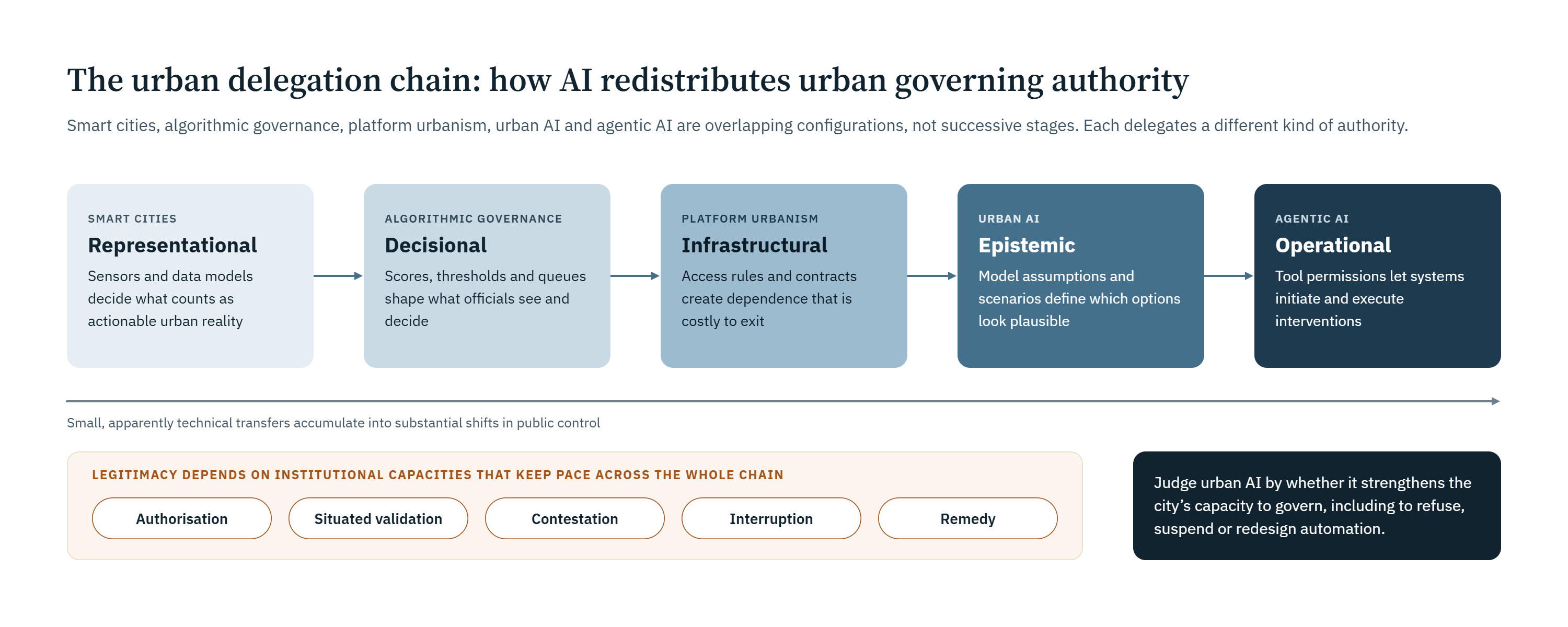
Table 1 summarises these configurations by the forms of authority each makes consequential. They overlap rather than succeed one another: a single municipal service may depend at once on sensor classifications, algorithmic priorities, proprietary platforms, simulated scenarios and automated execution. Each brings a different question of public control to the fore, from whose needs become visible to who authorises intervention.
8. The Urban Delegation Chain as an Integrative Framework
The preceding sections identify five analytically distinct forms of delegation. Representational delegation concerns what the city makes visible and measurable; decisional delegation, how classifications shape attention, priorities and reasons for action; infrastructural delegation, dependence on systems that organise access and coordination; epistemic delegation, the authority of analytical representations to define plausible explanations and alternatives; and operational delegation, permissions to execute and adapt interventions. Each can occur alone, and none requires an institution formally to surrender its statutory powers.
The urban delegation chain is the set of connections through which one form of delegation enables or constrains another. Its value lies in following an intervention across technical and organisational boundaries. The chain need not be linear: data can be revised after a decision, platforms can shape what is observable, and an intervention can generate evidence that changes the next model. It therefore describes a relationship to investigate, not a universal architecture, synthesising accounts of system-level bureaucracy, infrastructural power, socio-technical modelling and agentic orchestration (Bovens & Zouridis, 2002; Nochta et al., 2021; Plantin et al., 2018; Xu et al., 2026).
Consider a hypothetical AI-assisted inspection workflow. Complaints and sensor records flag a district, a classifier assigns risk, a proprietary platform assembles case files, a digital twin estimates intervention scenarios and an agent schedules inspections. Each component might work correctly against its specification, yet residents could still be unable to challenge the district boundary, the interpretation of missing records or the priority given to different harms. No single faulty model explains this deficit. It arises from the combination of delegated functions and the gaps between the organisations responsible for them.
Figure 2 sets out the chain, linking the production of urban representations to prioritisation and intervention. Infrastructural dependencies shape these links, and public governing capacities must remain effective across the whole chain. Arrows indicate possible relationships, not a fixed implementation sequence.
The chain also has a geography that organisational diagrams can hide. Work on closed-loop urban automation conceptualises interventions as spatially propagating, with feedback partly mediated by institutions (Tiwari & Qaffas, 2026). Accountability must therefore follow consequences beyond the point of actuation, since an intervention authorised in one service or territory may shift burdens elsewhere. Complaints, appeals and regulatory responses belong within the feedback architecture; treating their delay or disagreement as operational noise would remove the mechanisms through which public purposes are corrected.
The framework distinguishes formal authority, practical influence and effective control. Formal authority identifies who is legally empowered to decide. Practical influence identifies which actors and technical arrangements shape a decision's premises and pathway. Effective control concerns whether an authorised institution can obtain relevant information, modify the pathway, stop execution and secure remedy. The three may coincide, but there is no reason to assume they do. A public agency can remain legally accountable while practical influence lies with a vendor and effective control is split across several contracts.
Figure 3 uses the inspection workflow to show how formal responsibility, practical influence and effective control can come apart across an integrated urban AI system.
Legitimacy is therefore relational. Assessing it means asking whether capacities for public authorisation, situated validation, contestation, interruption and remedy remain proportionate to the scope and consequences of delegation. These capacities are not interchangeable: excellent logs cannot compensate for an absent right of appeal, and a responsive appeals process cannot justify deploying a system for an unlawful purpose. The framework thus identifies necessary areas of scrutiny rather than a numerical score in which weakness in one area is offset by strength in another (Agbabiaka et al., 2025; Alfrink et al., 2024; Bovens, 2007).
Authorisation concerns the legitimacy and revisability of the mandate. Situated validation concerns whether measures and models remain adequate for the population, place and decision at issue. Contestation concerns whether affected people and public forums can challenge reasons and premises. Interruption concerns the practical ability to suspend an action or workflow. Remedy concerns the capacity to identify affected persons and repair consequences. The connection matters because an intervention can pass a technical validation test and fail every institutional test that follows.
Table 2 turns the relational account of legitimacy into questions for examining institutional capacity. It separates the existence of a safeguard from its practical effect: an explanation may leave a decision unchallengeable, a suspension mechanism may fail to contain downstream effects, and a restored record may leave a lost opportunity unrecovered.
This account also clarifies what the five-part trajectory can and cannot explain. The move towards agentic AI does not make earlier political problems obsolete; it can bind them more tightly. An inherited measurement bias can become an administrative priority, a platform dependency can restrict access to models, and an authoritative simulation can supply the rationale for automated execution. The novelty is partly compositional: existing delegations gain new practical force when connected with fewer opportunities for reconsideration.
9. Propositions and a Research Agenda
Proposition 1 (representational lock-in). Integration magnifies the consequences of representational exclusion when the same categories travel across several services without independent review. The claim is conditional, not a charge that integration is inherently harmful. It predicts that omissions become harder to correct once a shared classification is reused for analysis, prioritisation and intervention. Comparative research could follow one contested category across agencies to see whether integration helps correct it or merely replicates it, evaluating interoperability studies alongside evidence of institutional responsiveness (Chaturvedi & Kolbe, 2019; Silvestri et al., 2024).
Proposition 2 (hollow oversight). Formal human involvement protects less where the authority to question a system is separated from the resources to do so: time, expertise, access to evidence and protection for disagreement. Research could compare organisations using similar tools but differing in override authority and investigative capacity. The outcome of interest is whether objections change decisions and rules, not how often a human clicks ‘approve’. Research on trust, ensemble decision-making and public management offers distinct starting points (Aoki, 2021; Keppeler et al., 2025; Sandoval-Almazan et al., 2024; Selten & Klievink, 2024).
Proposition 3 (dependence and discretion). Platform dependence constrains public discretion most strongly where technical integration combines with high switching costs and weak collective bargaining power. This connects infrastructure studies with labour, housing and transport regulation, and points to actual termination options, data portability, enforcement access and the capacity of affected groups to negotiate terms. Comparative research should ask how institutional arrangements alter these options, rather than treating the mere presence of regulation as a sufficient explanation (Aliaga et al., 2026; Colomb & Moreira de Souza, 2024; Ferreri & Sanyal, 2018; Pernicka & Schüßler, 2022; Plantin et al., 2018).
Proposition 4 (fluency without scrutiny). More accessible AI-generated representations can reduce epistemic contestability when ease of use conceals consequential modelling choices. The effect is not inevitable; accessibility can also widen scrutiny. A useful study would compare interfaces that display provenance, uncertainty and alternative parameterisations with those returning a single conversational answer, asking whether non-specialists recognise disagreements over assumptions and can materially change the model, not merely whether they finish faster (Nochta et al., 2021; Pan et al., 2026; Vicente-Martínez et al., 2026; White et al., 2021).
Proposition 5 (outpaced accountability). Operational delegation creates an accountability deficit when interventions propagate faster or further than institutions can identify, interrupt and remedy their consequences. This directs attention to temporal and cross-service interactions. Longitudinal pilots could trace action sequences, escalation performance, cases affected before suspension and whether lost entitlements or opportunities were actually recovered. Architectural assurances would need testing alongside institutional exercises involving officials, independent reviewers and affected users (Calboreanu, 2026; Wang et al., 2025; Xu et al., 2026; Yigitcanlar et al., 2026).
Testing these propositions requires combining methods. Technical experiments establish system behaviour; administrative process tracing locates where discretion moves; spatial analysis reveals how benefits and burdens are distributed; qualitative research surfaces excluded knowledge; and legal analysis sets the limits of authorised action. No single method suffices, because the mechanisms cross the boundaries between technical operation, institutional practice and lived consequence. The object of research is the intervention as a whole.
Evaluation should also include credible alternatives. A system may outperform an under-resourced baseline yet remain inferior to a simpler procedural reform or better staffing. Assessing public value requires comparison with plausible organisational choices, including partial automation and non-deployment, and the cost of sustaining meaningful oversight belongs in that comparison. A saving achieved by shifting the work of investigation onto affected residents is a redistribution of labour, not necessarily a gain in efficiency (Finch & Butt, 2025; Kadarla et al., 2025; Mashhadi Moghaddam & Cao, 2026).
10. Discussion and Conclusion
The framework challenges the assumption that a city gains governing capacity whenever it gains analytical or operational capability. Governing capacity includes the ability to set priorities, recognise competing claims, revise institutions and give reasons that can be challenged. Computational systems can support these functions; they can also leave institutions dependent on objectives, categories and infrastructures they struggle to revise. Which way the balance tips cannot be read from technical performance.
The argument has limits. The corpus is heterogeneous, and its uneven coverage cannot establish how prevalent each delegation mechanism is. Several relationships are conceptual inferences rather than consistently measured effects. Platform businesses differ, local legal powers vary, and operational automation includes long-established systems as well as emerging agents. The framework should guide differentiated investigation, not cast every urban technology as the same concentration of power. Its value lies in specifying relationships that narrower evaluations miss.
Contestability can itself reproduce inequality. A formally open appeals process may favour those with time, technical knowledge or organisational support, so institutional design must address collective representation and the distribution of resources needed to mount a challenge. Nor should every routine change require individual approval; where the boundary falls depends on consequence, uncertainty and legal mandate. What is required is that efficient routine action remain nested within revisable public purposes, with effective arrangements for exceptional cases.
In answer to its research question, the review finds that urban AI redistributes governing authority through linked transfers over representation, prioritisation, infrastructure, knowledge and action. The passage from smart cities to agentic systems matters because these transfers become more tightly connected and more operationally immediate. That connection does not dictate a single political outcome. Public institutions can use integration to expose assumptions, coordinate remedies and broaden participation, or allow it to consolidate dependencies that are hard to contest.
Urban planning's contribution is therefore wider than supplying domain knowledge to a better optimiser. Planning must ask who defines the objective, which realities enter the model, whose alternatives remain visible and who can change the course of an intervention. Its responsibility extends to the conditions under which computational systems become authoritative in the first place. An AI-assisted city deserves confidence when it strengthens the institutions through which people govern shared urban conditions, including their practical power to demand a different system.
References
- Aarab, A.; El Marzouki, A.; Boubker, O.; El Moutaqi, B. Integrating AI in public governance: A systematic review. Digital 2025, 5(4), 59. [Google Scholar] [CrossRef]
- Abbas, M.; Akhai, S.; Abbas, U.; Jafri, R.; Arif, S. M. AI-enabled sustainable urban planning and management. Adv. Comput. Intell. Robot. 2024, 233–260. [Google Scholar] [CrossRef]
- Adreani, L.; Bellini, P.; Colombo, C.; Fanfani, M.; Nesi, P.; Pantaleo, G.; Pisanu, R. Implementing integrated digital twin modelling and representation into the Snap4City platform for smart city solutions. Multimed. Tools Appl. 2024, 83(12), 37121–37146. [Google Scholar] [CrossRef]
- Agbabiaka, O.; Ojo, A.; Connolly, N. Requirements for trustworthy ai-enabled automated decision-making in the public sector: A systematic review. Technol. Forecast. Soc. Change 2025, 215, 124076. [Google Scholar] [CrossRef]
- Aghaabbasi, M.; Sabri, S. Potentials of digital twin system for analyzing travel behavior decisions. Travel Behav. Soc. 2025, 38, 100902. [Google Scholar] [CrossRef]
- Ahmed, K.; Kumar Dubey, M.; Kumar, A.; Dubey, S. Artificial intelligence and IoT driven system architecture for municipality waste management in smart cities: A review. Meas. Sens. 2024, 36, 101395. [Google Scholar] [CrossRef]
- Alfrink, K.; Keller, I.; Yurrita Semperena, M.; Bulygin, D.; Kortuem, G.; Doorn, N. Envisioning contestability loops: Evaluating the agonistic arena as a generative metaphor for public AI. She Ji J. Des. Econ. Innov. 2024, 10(1), 53–93. [Google Scholar] [CrossRef]
- Aliaga, N. S.; Milano, C.; Jubany, O. Beyond the algorithm: Cooperative alternatives to platform capitalism in urban delivery workforces. Digit. Geogr. Soc. 2026, 10, 100157. [Google Scholar] [CrossRef]
- Allioui, H.; Mourdi, Y. Exploring the full potentials of IoT for better financial growth and stability: A comprehensive survey. Sensors 2023, 23(19), 8015. [Google Scholar] [CrossRef] [PubMed]
- Almulhim, A. I. Integrating artificial intelligence into smart infrastructure management for sustainable urban planning. Technologies 2025, 13(11), 481. [Google Scholar] [CrossRef]
- Alourani, A.; Alam, M.; Ali, A.; Khan, I. R.; Samal, C. K. Hybrid AI-IoT framework with digital twin integration for predictive urban infrastructure management in smart cities. Comput. Mater. Contin. 2026, 86(1), 1–32. [Google Scholar] [CrossRef]
- Altanlar, A.; Eren, İ.; Aktuğlu Aktan, E. Ö. Digital technologies and public life in Istanbul: Socio-demographic patterns and urban implications. Cities 2025, 165, 106179. [Google Scholar] [CrossRef]
- Alterkawi, L.; Dib, F. K. Federated learning for smart cities: A thematic review of challenges and approaches. Future Internet 2025, 17(12), 545. [Google Scholar] [CrossRef]
- Ameen, K. S.; Towfiq, T. A.; Mousa, K. M.; Pooyanmehr, M. Judicial review of algorithmic administrative systems legality evidence and remedies in the smart city state. Front. Artif. Intell. 2026, 9, 1802986. [Google Scholar] [CrossRef] [PubMed]
- Anselmi, G.; Chiappini, L.; Prestileo, F. The greedy unicorn: Airbnb and capital concentration in 12 European cities. City Cult. Soc. 2021, 27, 100412. [Google Scholar] [CrossRef]
- Aoki, N. The importance of the assurance that “humans are still in the decision loop” for public trust in artificial intelligence: Evidence from an online experiment. Comput. Hum. Behav. 2021, 114, 106572. [Google Scholar] [CrossRef]
- Bacalu, F. Biometric facial recognition technology, law enforcement algorithmic automation, and data-driven predictive policing systems in human rights protections and abuses. Rev. Contemp. Philos. 2022, 21(0), 38. [Google Scholar] [CrossRef]
- Balasubramani, M.; Anitha, V.; Sriram, K.P.; Balamurugan, R.; Tharun, J.; Robinson, J. M. Reconfiguring urban movement. Transform. Cities By Control. Pollut. Traffic Congest. 2026, 229–264. [Google Scholar] [CrossRef]
- Barns, S. Negotiating the platform pivot: From participatory digital ecosystems to infrastructures of everyday life. Geogr. Compass 2019, 13(9), e12464. [Google Scholar] [CrossRef]
- Batty, M.; Axhausen, K.W.; Giannotti, F.; Pozdnoukhov, A.; Bazzani, A.; Wachowicz, M.; Ouzounis, G.; Portugali, Y. Smart cities of the future. Eur. Phys. J. Spec. Top. 2012, 214(1), 481–518. [Google Scholar] [CrossRef]
- Bei, G.; Iacovone, C. La finanziarizzazione nel mercato degli affitti brevi mediati da piattaforma: Una revisione critica della letteratura. Riv. Geogr. Ital. 2025, 68–83. [Google Scholar] [CrossRef]
- Blasch, E. P.; Chen, G.; Chen, Y.; Savakis, A.; Daum, F.; Grewe, L. Edge-based computing challenges and opportunities for sensor fusion: Panel review. Signal Process. Sensor/Information Fusion Target Recognit. XXXIV 2025, 16. [Google Scholar] [CrossRef]
- Blišťan, P.; Kovanič, Ľ.; Topitzer, B.; Peťovský, P.; Tokarčík, O.; Radinger, F.; Marcin, J. Advanced geodetic techniques for urban digital twin creation. GIS Odyssey J. 2026, 6(2), 141–163. [Google Scholar] [CrossRef]
- Bokányi, E.; Hannák, A. Understanding inequalities in ride-hailing services through simulations. Sci. Rep. 2020, 10(1), 6500. [Google Scholar] [CrossRef] [PubMed]
- Bovens, M. Analysing and assessing accountability: A conceptual framework. Eur. Law J. 2007, 13(4), 447–468. [Google Scholar] [CrossRef]
- Bovens, M.; Zouridis, S. From street-level to system-level bureaucracies: How information and communication technology is transforming administrative discretion and constitutional control. Public Adm. Rev. 2002, 62(2), 174–184. [Google Scholar] [CrossRef]
- Bragatto, T.; Ghoreishi, M.; Santori, F.; Geri, A.; Maccioni, M.; Jabari, M.; Almughary, H. M. Moving towards electrified waste management fleet: State of the art and future trends. Energies 2025, 18(8), 1992. [Google Scholar] [CrossRef]
- Brantingham, P. J.; Valasik, M.; Mohler, G. O. Does predictive policing lead to biased arrests? Results from a randomized controlled trial. Stat. Public Policy 2018, 5(1), 1–6. [Google Scholar] [CrossRef]
- Brunstein, D.; Casamatta, G.; Giannoni, S. Using machine learning to estimate the heterogeneous impact of Airbnb on house prices: Evidence from Corsica. J. Hous. Econ. 2025, 67, 102044. [Google Scholar] [CrossRef]
- Burrell, J. How the machine ‘thinks’: Understanding opacity in machine learning algorithms. Big Data Soc. 2016, 3(1), 2053951715622512. [Google Scholar] [CrossRef]
- Calboreanu, E. LATTICE: A governance-first architecture for authorized autonomous AI operations. Front. Artif. Intell. 2026, 9, 1800407. [Google Scholar] [CrossRef] [PubMed]
- Calboreanu, E. LATTICE: A governance-first architecture for authorized autonomous AI operations. Front. Artif. Intell. 2026, 9, 1800407. [Google Scholar] [CrossRef] [PubMed]
- Cardullo, P.; Kitchin, R. Provincialising platform citizenship: Citizen participation in and through civic platforms. Digit. Geogr. Soc. 2025, 8, 100123. [Google Scholar] [CrossRef]
- Chan, N. K. Dynamics of platform architecture and labor unrest: Mobilizing and contesting solidarity in the 2021–2022 Foodpanda delivery rider strikes in Hong Kong. Soc. Media Soc. 2025, 11(1), 20563051251319578. [Google Scholar] [CrossRef]
- Channi, H. K.; Kumar, P.; Safdarian, F. Planning and building digital twins for smart cities. Digit. Twins Smart Cities Villages 2025, 205–225. [Google Scholar] [CrossRef]
- Chapman, A.; Grylls, P.; Ugwudike, P.; Gammack, D.; Ayling, J. A data-driven analysis of the interplay between criminological theory and predictive policing algorithms. 2022 ACM Conference on Fairness Accountability and Transparency, 2022; pp. 36–45. [Google Scholar] [CrossRef]
- Chaturvedi, K.; Kolbe, T. H. Towards establishing cross-platform interoperability for sensors in smart cities. Sensors 2019, 19(3), 562. [Google Scholar] [CrossRef] [PubMed]
- Chauca-Claros, M.; Peña-Cáceres, O.; Garay-Silupu, E.; Silva-Marchan, H.; Ramírez-Ordinola, V. H. Agentic ai-assisted governance: Towards semi-autonomous state oversight. Emerg. Sci. J. 2026, 10(5), 2611–2634. [Google Scholar] [CrossRef]
- Chen, T.; Gascó-Hernandez, M.; Esteve, M. The adoption and implementation of artificial intelligence chatbots in public organizations: Evidence from U.S. state governments. Am. Rev. Public Adm. 2024, 54(3), 255–270. [Google Scholar] [CrossRef]
- Chourabi, H.; Nam, T.; Walker, S.; Gil-Garcia, J. R.; Mellouli, S.; Nahon, K.; Pardo, T. A.; Scholl, H. J. Understanding smart cities: An integrative framework. 2012 45th Hawaii International Conference on System Sciences, 2012; pp. 2289–2297. [Google Scholar] [CrossRef]
- Cocola-Gant, A.; Janoschka, M. PropTech in the short-term rental industry. the digital infrastructure behind Airbnb. Int. J. Hous. Policy 2026, 1–28. [Google Scholar] [CrossRef]
- Coglianese, C.; Lehr, D. Transparency and algorithmic governance. In Administrative Law Review; 2019; Available online: https://www.scopus.com/pages/publications/85076189742.
- Colomb, C.; Moreira de Souza, T. Illegal short-term rentals, regulatory enforcement and informal practices in the age of digital platforms. Eur. Urban Reg. Stud. 2024, 31(4), 328–345. [Google Scholar] [CrossRef]
- DaViera, A. L.; Uriostegui, M.; Gottlieb, A.; Onyeka, O. (. Risk, race, and predictive policing: A critical race theory analysis of the strategic subject list. Am. J. Community Psychol. 2024, 73(1-2), 91–103. [Google Scholar] [CrossRef] [PubMed]
- Di Pace, R.; Fiori, C.; Storani, F.; de Luca, S.; Liberto, C.; Valenti, G. Unified network tRaffic management frAmework for fully conNected and electric vehicles energy cOnsumption optimization (URANO). Transp. Res. Part C Emerg. Technol. 2022, 144, 103860. [Google Scholar] [CrossRef]
- Drici, H.; Carpio-Pinedo, J. Urban land use mix and AI: A systematic review. Cities 2025, 165, 106102. [Google Scholar] [CrossRef]
- Duso, T.; Michelsen, C.; Schaefer, M.; Tran, K. D. Airbnb and rental markets: Evidence from Berlin. Reg. Sci. Urban Econ. 2024, 106, 104007. [Google Scholar] [CrossRef]
- Elbehairy, F.; Mora, L.; Soe, R.-M. Who are you? Examining the multifaceted innovation roles of municipal governments in AI governance. Technovation 2025, 147, 103303. [Google Scholar] [CrossRef]
- Elias, A.; Gómez, G. M. Digital platforms as institutional actors in the Global South – evidence from india's informal sector. Digit. Geogr. Soc. 2025, 9, 100146. [Google Scholar] [CrossRef]
- Ensign, D.; Friedler, S. A.; Neville, S.; Scheidegger, C.; Venkatasubramanian, S. Runaway feedback loops in predictive policing. Proc. Mach. Learn. Res. 2018, 81, 160–171. Available online: https://proceedings.mlr.press/v81/ensign18a.html.
- Fernandes, J.; Guimarães, J.; S. de Carvalho, A.; Rosa, L.; Mendon, A.; Portugal, D.; Viegas, C.; Cordeiro, L. Closed-loop intelligence architectures for data-driven smart cities. Companion Proc. ACM Web Conf. 2026 2026, 1478–1486. [Google Scholar] [CrossRef]
- Ferreri, M.; Sanyal, R. Platform economies and urban planning: Airbnb and regulated deregulation in London. Urban Stud. 2018, 55(15), 3353–3368. [Google Scholar] [CrossRef]
- Finch, W. W.; Butt, M. Gaps in ai-compliant complementary governance frameworks’ suitability (for low-capacity actors), and structural asymmetries (in the compliance ecosystem)—a systematic review. J. Cybersecur. Priv. 2025, 5(4), 101. [Google Scholar] [CrossRef]
- Fu, X.; Kou, C.; Meng, Q. Ride-hailing trajectories for urban hotspot detection and capacity reallocation: A predict–sense–optimize framework (city a). In Proceedings of the 2025 2nd International Conference on Digital Economy and Computer Science, 2025; pp. 526–532. [Google Scholar] [CrossRef]
- Gaponenko, T.; Hvoevskaya, L. Digital transport platforms: Reality and prospects. Transp. Res. Procedia 2022, 63, 1185–1191. [Google Scholar] [CrossRef]
- Gebrial, D. Racial platform capitalism: Empire, migration and the making of Uber in London. Environ. Plan. A Econ. Space 2024, 56(4), 1170–1194. [Google Scholar] [CrossRef]
- Gogineni, S.; Suryanarayana, G.; K, L. P.; Swapna, N. Modern data engineering: Integrating Databricks, Azure, and Power BI for real-time analytics. 2025 IEEE 7th International Conference on Cybernetics, Cognition and Machine Learning Applications (ICCCMLA), 2025; pp. 1–6. [Google Scholar] [CrossRef]
- Griesbach, K.; Reich, A.; Elliott-Negri, L.; Milkman, R. Algorithmic control in platform food delivery work. Socius Sociol. Res. A Dyn. World 2019, 5, 2378023119870041. [Google Scholar] [CrossRef]
- He, C.-P.; Pan, Y.-R.; Chu, K.-C. Aidlc–governance indicator framework: A lifecycle-based approach to institutional AI governance. AI Soc. 2026, 41(10), 9439–9451. [Google Scholar] [CrossRef]
- Heydari-Gharaei, E.; Roorda, M. Who gets the curb? A systematic review of responsive curb management research. Transp. Rev. 2026, 1–25. [Google Scholar] [CrossRef]
- Huang, H. Algorithmic management in food-delivery platform economy in China. New Technol. Work Employ. 2023, 38(2), 185–205. [Google Scholar] [CrossRef]
- Jain, Y.; Pandey, K. Transforming urban mobility: A systematic review of ai-based traffic optimization techniques. Arch. Comput. Methods Eng. 2025, 32(8), 5381–5417. [Google Scholar] [CrossRef]
- Jefferson, B. J. Predictable policing: Predictive crime mapping and geographies of policing and race. Ann. Am. Assoc. Geogr. 2018, 108(1), 1–16. [Google Scholar] [CrossRef]
- Jha, D.; Jha, S. K.; Guha, A. A critical evaluation of the Indian ride-hailing ecosystem and its impact on decent work standards. Indian J. Labour Econ. 2025, 68(1), 263–285. [Google Scholar] [CrossRef]
- Jing, S.; Deng, Y.; Wang, M.; Yang, L.; Zhao, X. A survey on driving scenario video generation for autonomous vehicle testing: Methodology, datasets, and future prospects. In Journal of Traffic and Transportation Engineering (English Edition); 2026. [Google Scholar] [CrossRef]
- John, J.; David Amar Raj, R.; Karimi, M.; Nazari, R.; Yanamala, R. M. R.; Pallakonda, A. Artificial intelligence for smart cities: A comprehensive review across six pillars and Global case studies. Urban Sci. 2025, 9(7), 249. [Google Scholar] [CrossRef]
- Jørgensen, B. N.; Ma, Z. G. Impact of EU laws and regulations on the adoption of artificial intelligence in cyber–physical systems: A review of regulatory barriers, technological challenges, and cross-sector implications. Electronics 2026, 15(10), 2184. [Google Scholar] [CrossRef]
- Kadarla, L.; Jonathan, G.M.; Perjons, E. From readiness to public value: Modelling AI adoption in Sweden’s decentralised municipal system. CEUR Workshop Proceedings, 2025; Available online: https://www.scopus.com/pages/publications/105040240134.
- Kalliontzi, V.; Voulgarakis, V.; Delinavelli, G. Data-driven policy development of municipalities preparation steps for integrating AI tools in the policymaking process. Int. Arch. Photogramm. Remote Sens. Spat. Inf. Sci. 2024, XLVIII-4/W10-2024, 85–91. [Google Scholar] [CrossRef]
- Karampakakis, P.; Ioakeimidou, D.; Chatzimisios, P.; Tsintotas, K. A. A web-based application for smart city data analysis and visualization. Future Internet 2025, 17(5), 217. [Google Scholar] [CrossRef]
- Keppeler, F.; Borchert, J.; Pedersen, M. J.; Lehmann Nielsen, V. How ensembling AI and public managers improves decision-making. J. Public Adm. Res. Theory 2025, 35(3), 261–276. [Google Scholar] [CrossRef]
- Ketzler, B.; Naserentin, V.; Latino, F.; Zangelidis, C.; Thuvander, L.; Logg, A. Digital twins for cities: A state of the art review. Built Environ. 2020, 46(4), 547–573. [Google Scholar] [CrossRef]
- Kim, Y. R.; Yeon, J. Do short-term rental platforms affect housing markets? Evidence from Airbnb in London. Tour. Manag. 2025, 111, 105204. [Google Scholar] [CrossRef]
- Lazaros, K.; Vrahatis, A. G.; Kotsiantis, S. Human-in-the-loop artificial intelligence: A systematic review of concepts, methods, and applications. Entropy 2026, 28(4), 377. [Google Scholar] [CrossRef] [PubMed]
- Leszczynski, A. Platform affects of geolocation. Geoforum 2019, 107, 207–215. [Google Scholar] [CrossRef]
- Li, W.; Lu, Y.; Hu, P.; Gupta, S. Work engagement of online car-hailing drivers: The effects of platforms' algorithmic management. Inf. Technol. People 2024, 37(3), 1423–1448. [Google Scholar] [CrossRef]
- Li, W.; Wang, P.; Xu, Y.; Pan, L.; Nie, C.; Yang, B. Multi-objective optimization of municipal solid waste collection based on adaptive large neighborhood search. Electronics 2025, 14(1), 103. [Google Scholar] [CrossRef]
- Lisanti, M. Algorithmic governance of territory and market dominion: The role of public oversight. Rem. To Digit. Vulnerability Eur. Priv. Law 2025, 467–479. [Google Scholar] [CrossRef]
- Liu, B.; Li, Q.; Zheng, Z.; Huang, Y.; Deng, S.; Huang, Q.; Liu, W. A review of multi-source data fusion and analysis algorithms in smart city construction: Facilitating real estate management and urban optimization. Algorithms 2025, 18(1), 30. [Google Scholar] [CrossRef]
- Lohmeier, C.; Schulze, L.; Schöning, J.; Savino, G.-L. Navigating beyond places: The significance of navigation tools in everyday media use. New Media Soc. 2026, 28(8), 4201–4220. [Google Scholar] [CrossRef]
- Lu, L.; Qureshi, S.; Li, Q.; Chen, F.; Shu, L. Monitoring and projecting sustainable transitions in urban land use using remote sensing and scenario-based modelling in a coastal megacity. Ocean Coast. Manag. 2022, 224, 106201. [Google Scholar] [CrossRef]
- Maggetti, M. Reciprocal trust and distrust in artificial intelligence systems: The hard problem of regulation. AI Soc. 2026, 41(5), 5009–5026. [Google Scholar] [CrossRef] [PubMed]
- Mashhadi Moghaddam, S. N.; Cao, H. The metrics trap: How technical sophistication masks social harm in urban AI systems. npj Urban Sustain. 2026, 6(1), 94. [Google Scholar] [CrossRef]
- Medvei, M. M.; Bordei, A.-V.; Niță, Ș. L.; Țăpuș, N. DeepSIGNAL-ITS—Deep learning signal intelligence for adaptive traffic signal control in intelligent transportation systems. Appl. Sci. 2025, 15(17), 9396. [Google Scholar] [CrossRef]
- Miranda, R.; Alves, C.; Sousa, R.; Chaves, A.; Montenegro, L.; Peixoto, H.; Durães, D.; Machado, R.; Abelha, A.; Novais, P.; Machado, J. Revolutionising the quality of life: The role of real-time sensing in smart cities. Electronics 2024, 13(3), 550. [Google Scholar] [CrossRef]
- Mohammadi, N.; Taylor, J. E. Smart city digital twins. 2017 IEEE Symp. Ser. Comput. Intell. (SSCI) 2017, 1–5. [Google Scholar] [CrossRef]
- Nochta, T.; Wan, L.; Schooling, J.M.; Parlikad, A.K. A socio-technical perspective on urban analytics: The case of city-scale digital twins. J. Urban Technol. 2021, 28(1-2), 263–287. [Google Scholar] [CrossRef]
- Nozari, H. Urban digital twins and data-centric architectures for the emergent economy 5.0. Ind. 5.0's Impact Econ. Innov. 2025, 51–70. [Google Scholar] [CrossRef]
- Nyenno, I. Comparative analysis of strategic vs. computational thinking in management. Front. Artif. Intell. 2026, 9, 1729797. [Google Scholar] [CrossRef] [PubMed]
- Okot, T.; Jiménez, Y. M. S. Sustainable automation in financial services: Evaluating chatbot efficiency, equity, and experience in Costa rica’s digital transformation. Stud. Univ. „Vasile Goldis” Arad. – Econ. Ser. 2026, 36(3), 92–127. [Google Scholar] [CrossRef]
- Omar, O. Digital twins for climate-responsive urban development: Integrating zero-energy buildings into smart city strategies. Sustainability 2025, 17(15), 6670. [Google Scholar] [CrossRef]
- Pan, Y.; Wang, M.; Lu, L.; Lamsal, R.; Pärn, E.; Zlatanova, S.; Brilakis, I. Llm-enabled multi-agent framework for natural language interaction with graph-based digital twins. Autom. Constr. 2026, 183, 106791. [Google Scholar] [CrossRef]
- Pavlik, E. J.; Land Woodward, J.; Lawton, F.; Swiecki-Sikora, A. L.; Ramaiah, D. D.; Rives, T. A. Artificial intelligence in relation to accurate information and tasks in gynecologic oncology and clinical medicine—dunning–kruger effects and ultracrepidarianism. Diagnostics 2025, 15(6), 735. [Google Scholar] [CrossRef] [PubMed]
- Peng, Z.R. AI driven urban planning: From planning support to plan making (2024). In The City Reader, Eighth Edition; 2025. [Google Scholar] [CrossRef] [PubMed]
- Pernicka, S.; Schüßler, E. Zwischen disruption und integration: Governance von digitalen plattformen im personentransportsektor aus feldtheoretischer perspektive. KZfSS Kölner Z. Für Soziol. Und Sozialpsychologie 2022, 74(S1), 355–381. [Google Scholar] [CrossRef]
- Peterlongo, G. Unpacking informality in the gig-economy: Ethnographic insights into platform capitalism and its baroque labour process. Sociol. DEL Lav. 2024, 121–140. [Google Scholar] [CrossRef]
- Pimpinella, A.; Redondi, A. E.; Cesana, M. Walk this way! an IoT-based urban routing system for smart cities. Comput. Netw. 2019, 162, 106857. [Google Scholar] [CrossRef]
- Plantin, J.-C.; Lagoze, C.; Edwards, P. N.; Sandvig, C. Infrastructure studies meet platform studies in the age of Google and Facebook. New Media Soc. 2018, 20(1), 293–310. [Google Scholar] [CrossRef]
- Prasetyo, E.H.; Belgiawan, P.F. Perceived risks and algorithmic control: A study of ride-hailing platform workers in indonesia. 2025 IEEE International Conference on Industrial Engineering and Engineering Management (IEEM), 2025; pp. 0798–0802. [Google Scholar] [CrossRef]
- Purdy, J.; Glass, B. The pursuit of algorithmic fairness: On “correcting” algorithmic unfairness in a child welfare reunification success classifier. Child. Youth Serv. Rev. 2023, 145, 106777. [Google Scholar] [CrossRef]
- Raha, A. D.; Adhikary, A.; Gain, M.; Hong, C. S. A federated learning framework for optimizing edge computing with semantic offloading. 2025 27th International Conference on Advanced Communications Technology (ICACT), 2025; pp. 142–149. [Google Scholar] [CrossRef]
- Ratner, H. F.; Elmholdt, K. Algorithmic constructions of risk: Anticipating uncertain futures in child protection services. Big Data Soc. 2023, 10(2), 20539517231186120. [Google Scholar] [CrossRef]
- Raychev, S. The last labour frontier: Contesting the peripheralisation of human labour in uneven AI societies. AI Soc. 2026, 41(10), 9557–9571. [Google Scholar] [CrossRef]
- Reshma, N.R.; Gokila, S. An intelligent framework for dynamic transportation optimization using IoT and crowd mobility patterns. Int. J. Electr. Electron. Eng. 2025, 12(8). [Google Scholar] [CrossRef]
- Richter, R.; Knospe, F.; Trapp, M.; Döllner, J. Dynamic digital twins: Challenges, perspectives and practical implementation from a city’s perspective. Lect. Notes Geoinf. Cartogr. 2024, 671–691. [Google Scholar] [CrossRef]
- Rimoldi, A.; Cenedese, C.; Padoan, A.; Dörfler, F.; Lygeros, J. Urban traffic congestion control: A DeePC change. 2024 Eur. Control Conf. (ECC) 2024, 2909–2914. [Google Scholar] [CrossRef]
- Röder, A.; Weger, H.; Benesch, M.; Kabitzsch, K. Decentralized inter-organizational business process automation. In Smart Systems Integration 2014; 2014; pp. 431–438. Available online: https://www.scopus.com/pages/publications/85064628801.
- Rosenthal, S. S.; Strange, W. C. JUE 2007–2023: Rising impact. J. Urban Econ. 2024, 144, 103713. [Google Scholar] [CrossRef]
- Ruddarraju, A. SmartScape: An ai-powered IoT framework for sustainable city infrastructure optimization. 2025 3rd International Conference on Artificial Intelligence, Blockchain, and Internet of Things (AIBThings), 2025; pp. 1–5. [Google Scholar] [CrossRef]
- Sadowski, J. The internet of landlords: Digital platforms and new mechanisms of rentier capitalism. Antipode 2020, 52(2), 562–580. [Google Scholar] [CrossRef]
- Sandoval-Almazan, R.; Millan-Vargas, A. O.; Garcia-Contreras, R. Examining public managers' competencies of artificial intelligence implementation in local government: A quantitative study. Gov. Inf. Q. 2024, 41(4), 101986. [Google Scholar] [CrossRef]
- Santos, L. P.; Feitais, B.; Viegas, J.; Pereira, A. Multi-rat enhanced edge node for smart city applications. 2025 IEEE Conf. Stand. Commun. Netw. (CSCN) 2025, 1–1. [Google Scholar] [CrossRef]
- Satpute, T. S.; Malgave, S. S. Urban land use classification and spatial pattern analysis for sustainable development. 2025 International Conference on Future Technologies (ICFT), 2025; pp. 1–7. [Google Scholar] [CrossRef]
- Schrotter, G.; Hürzeler, C. The digital twin of the city of Zurich for urban planning. PFG – J. Photogramm. Remote Sens. Geoinf. Sci. 2020, 88(1), 99–112. [Google Scholar] [CrossRef]
- Schuilenburg, M.; Peeters, R. The algorithmic society; 2026. [Google Scholar] [CrossRef]
- Selten, F.; Klievink, B. Organizing public sector AI adoption: Navigating between separation and integration. Gov. Inf. Q. 2024, 41(1), 101885. [Google Scholar] [CrossRef]
- Shahat, E.; Hyun, C. T.; Yeom, C. City digital twin potentials: A review and research agenda. Sustainability 2021, 13(6), 3386. [Google Scholar] [CrossRef]
- Sharif, R. A.; Pokharel, S. Smart city dimensions and associated risks: Review of literature. Sustain. Cities Soc. 2022, 77, 103542. [Google Scholar] [CrossRef]
- Shirowzhan, S.; Binoy, S. M.; Sepasgozar, S. M. E. Web-based BIM-GIS integration workflows for making cities' digital twin 3D models. Digit. Twin Adopt. BIM-GIS Implement. 2024, 145–176. [Google Scholar] [CrossRef]
- Signoroni, R. Discretion, justification, and legitimation in contemporary urban decision making. a reflection on the role (and risks) of urban AI. Lect. Notes Netw. Syst. 2024, 276–285. [Google Scholar] [CrossRef]
- Silva, M. V. S.; Astudillo, C. A.; Bittencourt, L. F. Federated urban flow: A model-centric benchmark for reproducible evaluation of deep learning in federated traffic forecasting. 2025 3rd Int. Conf. Fed. Learn. Technol. Appl. (FLTA) 2025, 499–505. [Google Scholar] [CrossRef]
- Silvestri, S.; Tricomi, G.; Bassolillo, S. R.; De Benedictis, R.; Ciampi, M. An urban intelligence architecture for heterogeneous data and application integration, deployment and orchestration. Sensors 2024, 24(7), 2376. [Google Scholar] [CrossRef] [PubMed]
- Smets, A.; Ballon, P. Handbook of platform urbanism; 2025. [Google Scholar] [CrossRef]
- Söderholm, S. Fundamental rights control when implementing predictive policing – a European perspective. Peking. Univ. Law J. 2023, 11(1), 91–104. [Google Scholar] [CrossRef]
- Solomou, S.; Sengupta, U. Simulating complex urban behaviours with AI: Incorporating improved intelligent agents in urban simulation models. Urban Plan. 2025, 10, 8561. [Google Scholar] [CrossRef]
- Song, G.; Zhu, X.; Hong, C. Commercial gentrification in the platform era: Differentiated effects of virtual and physical factors. Land 2026, 15(6), 1005. [Google Scholar] [CrossRef]
- Sousa e Silva, N.S.E. The artificial intelligence act: Critical overview. Journal of Intellectual Property, Information Technology and E-Commerce Law. 2025. Available online: https://www.scopus.com/pages/publications/105001930435.
- Stehlin, J.; Hodson, M.; McMeekin, A. Platform mobilities and the production of urban space: Toward a typology of platformization trajectories. Environ. Plan. A Econ. Space 2020, 52(7), 1250–1268. [Google Scholar] [CrossRef]
- Swathi Mirthika, G.L.; Sivakumar, B.; Rajendiran, G.; Joshi, S. Connecting the virtual and real worlds. Adv. Comput. Intell. Robot. 2026, 93–120. [Google Scholar] [CrossRef]
- Syed Abdul Rahman, S. A. F.; Abdul Maulud, K. N.; Ujang, U.; Wan Mohd Jaafar, W. S.; Shaharuddin, S.; Ab Rahman, A. A. The digital landscape of smart cities and digital twins: A systematic literature review of digital terrain and 3D city models in enhancing decision-making. Sage Open 2024, 14(1), 21582440231220768. [Google Scholar] [CrossRef]
- Tafidis, P. The public-interest digital mobility paradigm. Transp. Policy 2026, 185, 104207. [Google Scholar] [CrossRef]
- Tiwari, A. Beyond automation: The emergence of Agentic Urban AI. Automation 2025a, 6(3), 29. [Google Scholar] [CrossRef]
- Tiwari, A. Conceptualising the emergence of Agentic Urban AI: From automation to agency. Urban Inform. 2025b, 4, Article 13. [Google Scholar] [CrossRef]
- Tiwari, A. A proposal to localising urban AI: A conceptual shift from generalist LLMs to task-specific SLMs. In Computational Urban Science 6; 2026a; p. 11. [Google Scholar] [CrossRef]
- Tiwari, A. A review of the metaverse and its implications for urban environments: Ethical, social, and economic considerations. Int. J. Urban Sci. Advance online publication. 2026b. [Google Scholar] [CrossRef]
- Tiwari, A.; Qaffas, Y. From optimisation to closed-loop urban automation: A conceptual framework for spatial intelligence and physical AI in AI–IoT-enabled smart cities. Automation 2026, 7(4), 122. [Google Scholar] [CrossRef]
- V, S.; Albeez, S. F.; Ramallngam, V.; Nagappan, G.; Manikandan, G.; R, S. NLP and reinforcement learning-based chatbots for efficient public service delivery in smart cities. 2025 2nd International Conference on Artificial Intelligence and Knowledge Discovery in Concurrent Engineering (ICECONF), 2025; pp. 1–8. [Google Scholar] [CrossRef]
- Valente, R.; Bornioli, A.; Vermeulen, S.; Russo, A. P. Short-term rentals and long-term residence in Amsterdam and Barcelona: A comparative outlook. Cities 2023, 136, 104252. [Google Scholar] [CrossRef]
- Veloso, B.; Ribeiro, R. P.; Gama, J.; Pereira, P. M. The MetroPT dataset for predictive maintenance. Sci. Data 2022, 9(1), 764. [Google Scholar] [CrossRef] [PubMed]
- Verma, A. Mobility-as-a-service and its Global deployment with policy perspectives. Policy Resil. Syst. Innov. Sustain. Urban Mobil. 2026, 117–144. [Google Scholar] [CrossRef]
- Vicente-Martínez, P.; Soria-Olivas, E.; Chust-Ros, A.; García-Escrivà, M. Á.; William-Secin, E.; Sánchez-Montañés, M. Generative ai-driven digital twin architecture for urban mobility simulation and decision support. Smart Cities 2026, 9(7), 109. [Google Scholar] [CrossRef]
- Viloria, J. C. Fleeting encounters: Digital labour mobility and the loss of public sociality in blaha lujza square, Budapest. Geogr. Helv. 2026, 81(3), 375–391. [Google Scholar] [CrossRef]
- Wang, S.; Zhang, Y.; Xiao, Y.; Liang, Z. When artificial intelligence meets accountability: Who holds legitimacy as account givers and holders? Big Data Soc. 2025, 12(4), 20539517251392100. [Google Scholar] [CrossRef]
- White, G.; Zink, A.; Codecá, L.; Clarke, S. A digital twin smart city for citizen feedback. Cities 2021, 110, 103064. [Google Scholar] [CrossRef]
- William, P.; Jaiswal, V. K.; Shrivastava, A.; Kumar, Y.; Shakir, A. M.; Gupta, M. IOT based smart cities evolution of applications, architectures & technologies. 2025 Int. Conf. Eng. Technol. Amp Manag. (ICETM) 2025, 1–6. [Google Scholar] [CrossRef]
- Xu, H.; Zlatanova, S.; Li, X.; Wachowicz, M.; Batty, M. Towards fully automated city operations: Integrating agentic AI with urban digital twins. Comput. Environ. Urban Syst. 2026, 128, 102449. [Google Scholar] [CrossRef]
- Yeung, K. Algorithmic regulation: A critical interrogation. Regul. Gov. 2018, 12(4), 505–523. [Google Scholar] [CrossRef]
- Yigitcanlar, T.; David, A.; Marasinghe, R.; Senadheera, S.; Hossain, T.; Ye, X.; Taeihagh, A. Governing urban AI from the frontline: A stage-gate framework for municipal algorithmic decision-making. Smart Cities 2026, 9(5), 81. [Google Scholar] [CrossRef]
- Zhao, X.; Miao, C. Spatial-temporal changes and simulation of land use in metropolitan areas: A case of the Zhengzhou metropolitan area, China. Int. J. Environ. Res. Public Health 2022, 19(21), 14089. [Google Scholar] [CrossRef] [PubMed]
- Zhu, D. Digital mobility platform product diversification strategies: Becoming MaaS operators. Chall. Transp. Regul. Eur. Beyond 2025, 179–200. [Google Scholar] [CrossRef]
Figure 1.
Why stopping an automated action may not repair its consequences.
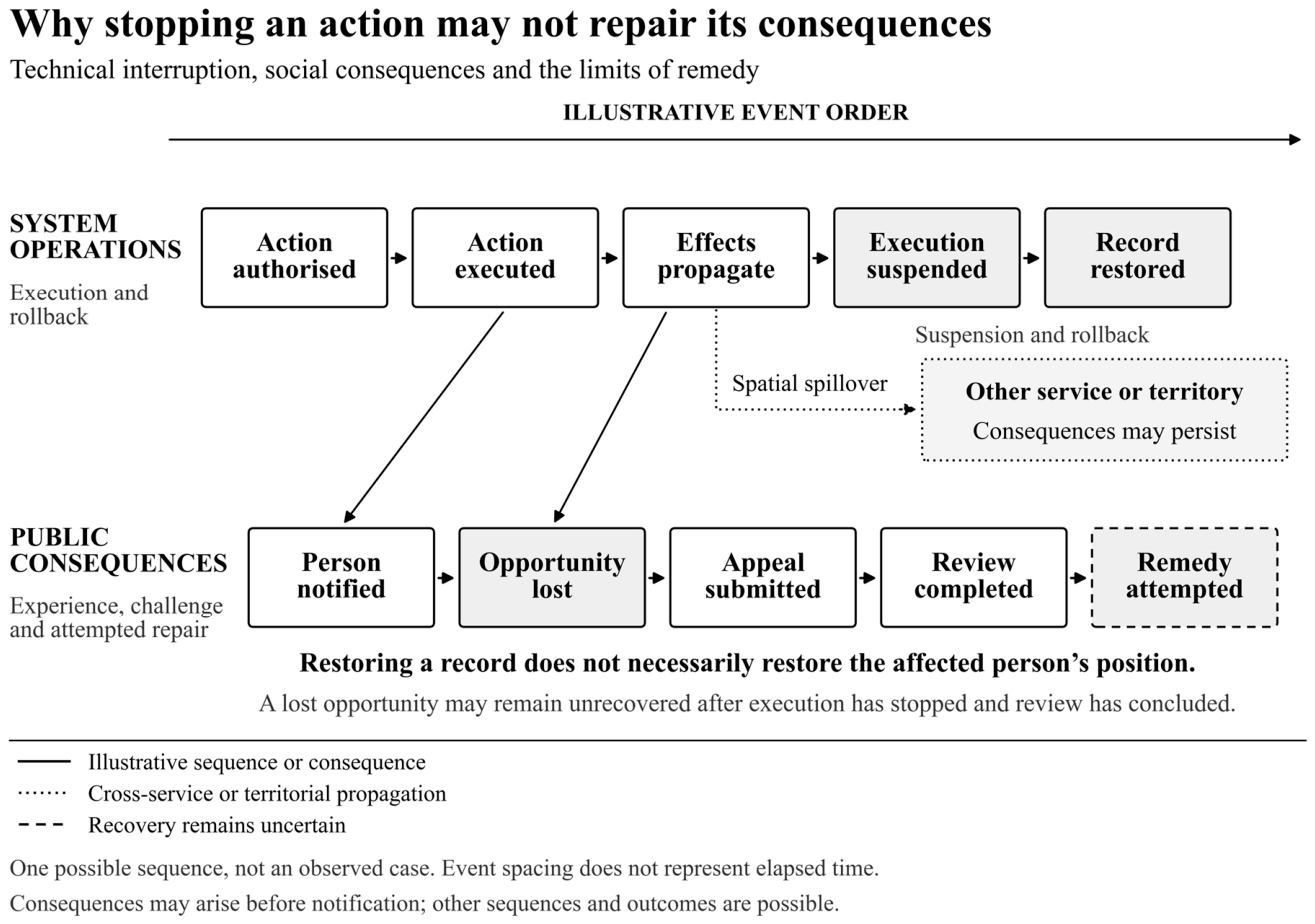
Figure 2.
The urban delegation chain and the conditions of public control.
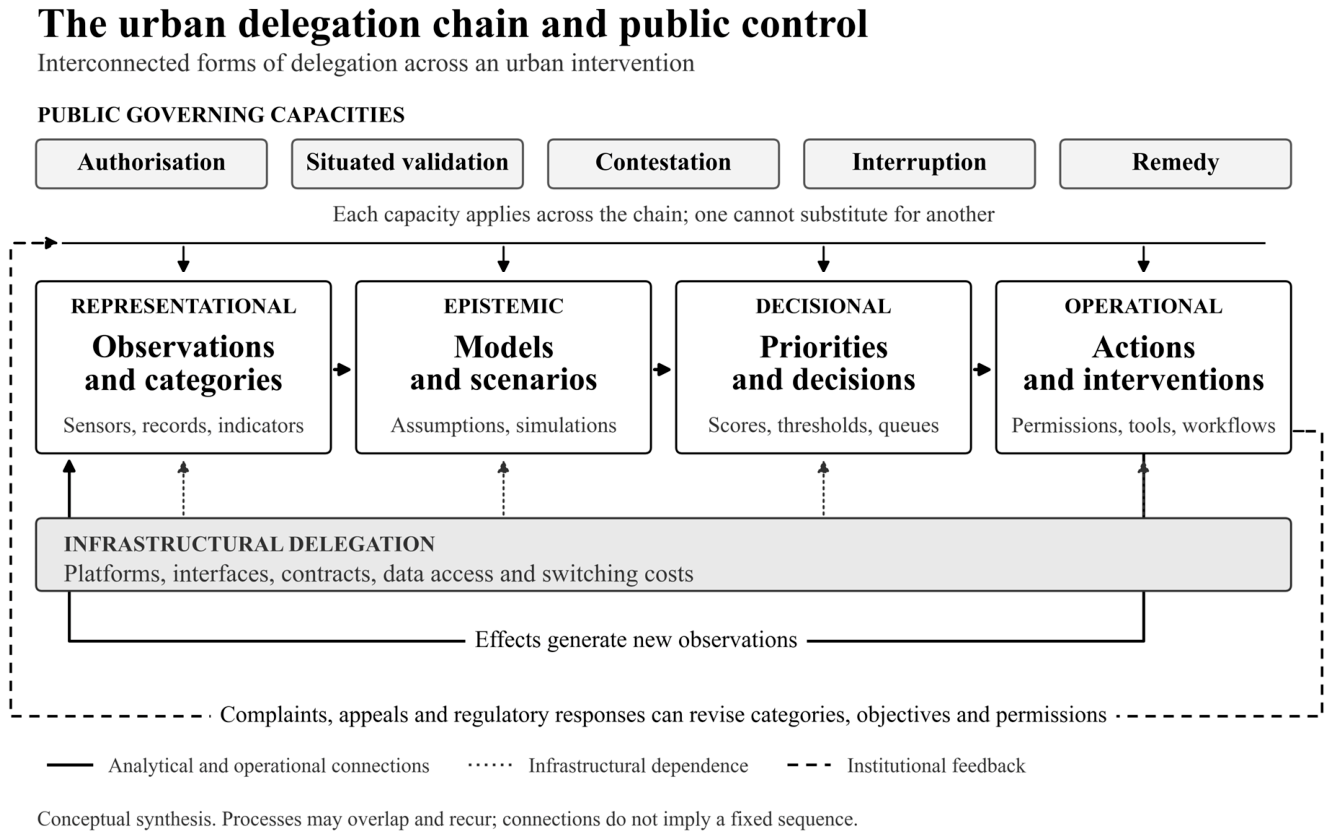
Figure 3.
Formal authority, practical influence and effective control in an AI-assisted inspection workflow.
Figure 3.
Formal authority, practical influence and effective control in an AI-assisted inspection workflow.
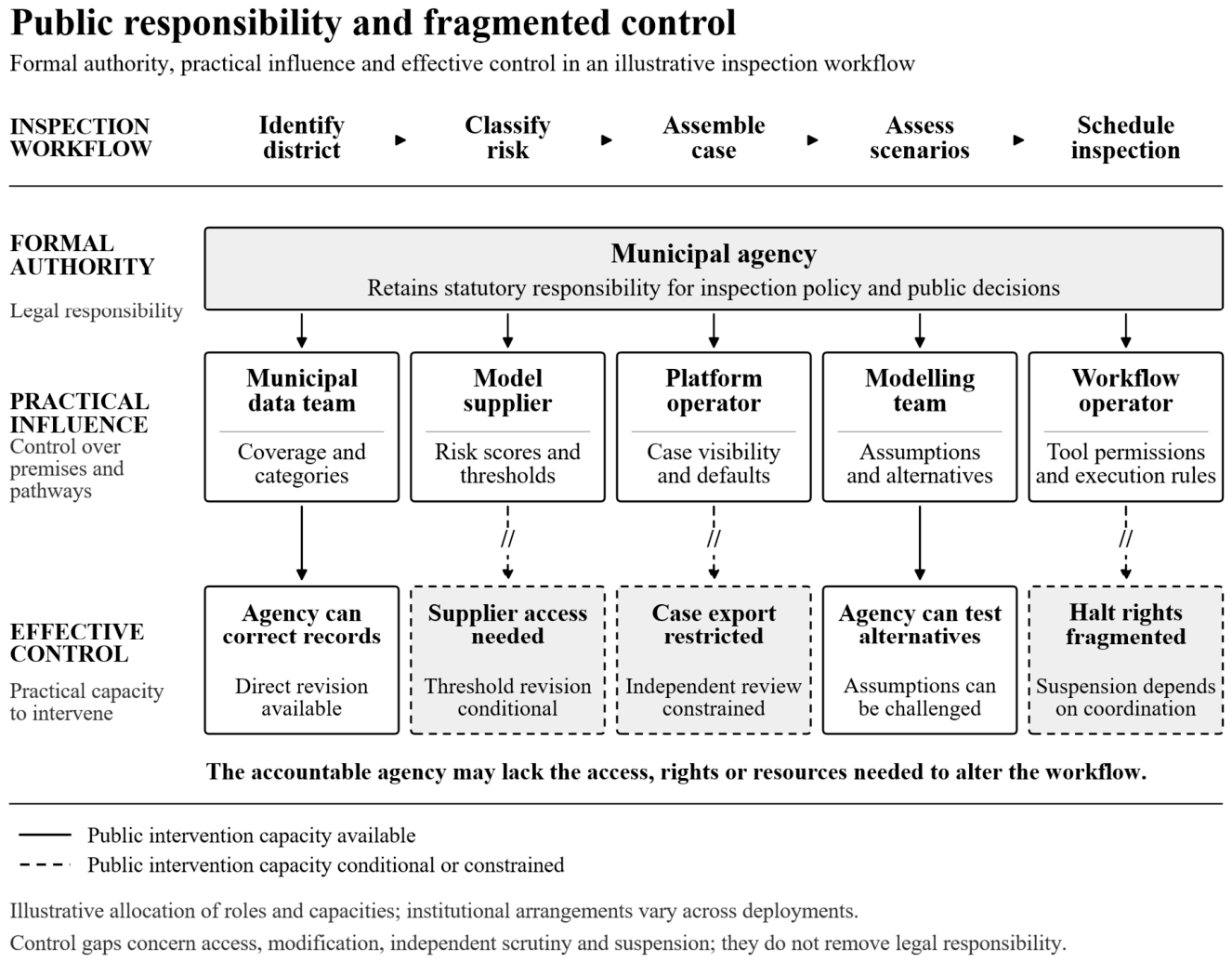

Table 1.
Configurations of urban computation and their associated delegations of authority.
| Configuration | Central question | Principal delegation examined | What becomes authoritative | Central governance concern |
| Smart cities | What can be sensed and optimised? | Representational | Categories, indicators and data coverage | Which needs remain invisible? |
| Algorithmic governance | How are public decisions structured? | Decisional | Scores, thresholds and priorities | Who can challenge the basis of a decision? |
| Platform urbanism | How is urban activity coordinated? | Infrastructural | Access rules, interfaces and contractual terms | Can institutions and users change or exit the arrangement? |
| Urban AI | How is urban knowledge constructed? | Epistemic | Model assumptions, classifications and scenarios | Can alternative interpretations enter the analysis? |
| Agentic AI | What may systems initiate or execute? | Operational | Tool permissions, workflows and adaptive choices | Who authorises objectives and controls consequences? |
Table 2.
Institutional capacities required to govern the urban delegation chain.
| Capacity | Core question | Safeguard on paper | Evidence that it works | Characteristic failure |
| Authorisation | Who approved this objective and scope, and can the mandate be revisited? | Procurement approval; scheme of delegated powers | Mandate names the service, affected persons, duration and review triggers; an accountable body can amend it | Objectives drift beyond what was approved |
| Situated validation | Do measures and models hold for this population, place and decision? | Benchmark accuracy; vendor test report | Local validation by group and area; coverage gaps documented and acted upon | Accurate on instrumented assets, blind to undocumented ones |
| Contestation | Can affected people and public forums challenge reasons and premises? | Published explanation; complaints channel | Objections change decisions, rules or problem definitions; collective challenge is supported | Explanation given, decision still unchallengeable |
| Interruption | Can an authorised official suspend an action or workflow in time? | Override control; suspension switch | Suspension contains downstream and cross-service effects; staff have the authority and time to use it | Process stopped after consequences have spread |
| Remedy | Can affected persons be identified and consequences repaired? | Audit log; record rollback | Affected cases traced and reviewed; lost opportunities restored or compensated | Record restored, opportunity lost |
Disclaimer/Publisher’s Note: The statements, opinions and data contained in all publications are solely those of the individual author(s) and contributor(s) and not of MDPI and/or the editor(s). MDPI and/or the editor(s) disclaim responsibility for any injury to people or property resulting from any ideas, methods, instructions or products referred to in the content. |
© 2026 by the authors. Licensee MDPI, Basel, Switzerland. This article is an open access article distributed under the terms and conditions of the Creative Commons Attribution (CC BY) license (http://creativecommons.org/licenses/by/4.0/).
Copyright: This open access article is published under a Creative Commons CC BY 4.0 license, which permit the free download, distribution, and reuse, provided that the author and preprint are cited in any reuse.