

Submitted:
03 November 2026
Posted:
04 November 2026
You are already at the latest version
Abstract
Background/Objectives: Evidence on telerehabilitation combined with transcranial direct current stimulation (tDCS) in older stroke survivors with cognitive impairment remains limited. This study compared Brunnstrom-based telerehabilitation (TRB), TRB plus tDCS, and a conventional physiotherapy intervention (CON). Methods: In this single-centre, assessor-blinded randomised trial, 87 participants were allocated equally to three eight-week programmes. Pain, motor recovery, balance, mobility and cognition were assessed at baseline and weeks 4 and 8. Repeated-measures analyses included 83 participants and adjusted for education, hypertension and diabetes. Results: Group-by-time effects were significant for Timed Up and Go (TUG; p < 0.001), Brunnstrom hand stage (p = 0.008) and lower-limb stage (p = 0.027). Only the TUG effect remained significant after accounting for the nine outcomes assessed. TUG improvement was greater with TRB plus tDCS than with TRB by 2.74 seconds (95% CI 1.32-4.17) and CON by 2.51 seconds (1.19-3.83). At week 8, hand-stage scores favoured the combined intervention over both comparators. Pain scores were lower than with TRB at weeks 4 and 8, but pain trajectories did not differ significantly. The Mini-Mental State Examination (MMSE) group-by-time effect was not significant (p = 0.880). Conclusions: Adding tDCS to telerehabilitation produced greater improvements in TUG performance than telerehabilitation alone or the conventional physiotherapy intervention over eight weeks. This mobility benefit remained statistically significant after accounting for the nine outcomes assessed. Telerehabilitation alone and conventional physiotherapy showed improvements in hand recovery, mobility and cognitive scores, without significant differences in their changes. No additional cognitive benefit from tDCS was demonstrated.
Keywords:
stroke
; telerehabilitation
; transcranial direct current stimulation
; motor recovery
; cognitive impairment
; pain
1. Introduction
Stroke is a major cause of long-term disability worldwide [1]. Many survivors experience a combination of pain, limited movement and cognitive difficulties. These problems can affect the person’s ability to practise exercises, manage daily activities and continue rehabilitation after leaving hospital. Cognitive impairment also increases the risk of later dementia [2]. Effective rehabilitation must therefore address the needs of people who have cognitive difficulties as well as physical limitations [3,4].
Telerehabilitation allows patients to receive rehabilitation support outside the clinic. It may involve live contact with a therapist, recorded exercise demonstrations or a combination of both. Cramer et al. found that a structured home-based arm-training programme was not inferior to matched in-clinic therapy after stroke [5]. However, systematic reviews show that telerehabilitation programmes differ in their exercises, technology, treatment dose and level of supervision [6,7]. The available evidence also varies across low- and middle-income settings, where access to equipment and clinical support may differ [8]. Findings from one programme cannot therefore be applied to all forms of telerehabilitation.
Cognitive impairment creates an additional challenge for remote exercise. A participant must understand the demonstration, remember the instructions and recognise when a movement needs to change. VanGilder et al. described how cognitive difficulties can affect motor learning and the response to rehabilitation [4]. The Stroke Recovery and Rehabilitation Roundtable also recommended that cognition should receive greater attention in stroke recovery research [3]. Evidence on cognitive telerehabilitation covers a wide range of clinical conditions and treatment methods [9]. More recently, Aghamoosa et al. showed that a programme combining cognitive strategies with occupational therapy could engage stroke survivors with different cognitive abilities [10]. That pilot study examined feasibility in a single group and did not establish comparative treatment effects.
This study used a recorded Brunnstrom-based exercise programme to support repeated movement practice. Repetition and practice are central to motor learning after stroke [11]. The programme was developed in an earlier feasibility study involving older adults with post-stroke cognitive impairment [12]. That work examined whether the programme could be delivered and used by the intended participants. The current trial tested whether the programme improved clinical outcomes and whether adding tDCS provided a further benefit. The conventional physiotherapy intervention provided a comparison with the same exercise approach delivered in person.
tDCS delivers a weak electrical current through scalp electrodes and can change cortical excitability [13]. This provides a reason to study it alongside movement practice. Reviews have examined repeated tDCS sessions and its combination with upper-limb rehabilitation, including constraint-induced movement therapy [14,15,16]. Nevertheless, an additional clinical benefit has not been consistent. The NETS trial found no added upper-limb motor benefit from its stimulation protocol, and TRANSPORT2 found no added benefit when stimulation was combined with modified constraint-induced movement therapy [17,18]. These findings show why tDCS should be tested within a clearly described exercise programme and patient group.
Evidence was therefore needed on whether recorded Brunnstrom-based exercises could improve recovery in older stroke survivors with cognitive impairment and whether adding tDCS provided a further benefit. Our earlier scoping review identified limited evidence on this combination in older adults [19]. Studies of live therapist-led training, virtual reality or cognitive exercises do not directly answer the question for this programme. The present trial therefore compared TRB, TRB plus tDCS and a conventional physiotherapy intervention over eight weeks. The objectives were to compare changes in pain, motor recovery, balance, mobility and cognition, as described in the published trial protocol [20]. The three-arm design also allowed the effect of adding stimulation to be considered separately from the effect of exercise delivery.
2. Materials and Methods
2.1. Study Design and Setting
This study was a single-centre, three-arm, parallel-group, assessor-blinded randomised controlled trial with a 1:1:1 allocation ratio. Participants were recruited through the General Outpatient and Neurology clinics serving the Physiotherapy Department at Osun State University Teaching Hospital, Osogbo, Nigeria. Data collection took place between September 2022 and June 2023. The trial was registered in the Pan African Clinical Trial Registry on 5 August 2022, before the first participant was enrolled on 29 September 2022. The protocol was published by Adeniji et al. [20]. The report follows the structure of CONSORT 2025 and the extension for multi-arm trials [21,22].
2.2. Participants
This study recruited stroke survivors aged 55 years and older. Participants were eligible if they had a first unilateral stroke three to six months previously, post-stroke pain, stable vital signs and the ability to take part in telerehabilitation. Brunnstrom stage 3 formed part of the motor eligibility criteria. The protocol defined the cognitive screening range as an MMSE score from 18 to 23 [20]. The MMSE was used as a screening measure, rather than a full neuropsychological diagnosis of mild cognitive impairment [23,24].
The exclusion criteria were a history of seizures, substantial visual or hearing loss, angina and uncontrolled hypertension. Patients referred for physiotherapy were invited to participate and screened for eligibility. Eligible participants received information about the study and provided written informed consent before enrolment.
2.3. Sample Size
The sample-size calculation required 78 participants. It used an effect size of 0.80, a statistical power of 80%, three repeated assessments and an assumed correlation of 0.50 between assessments, as described in the trial protocol [20]. Allowing for approximately 10% attrition increased the recruitment target to 87 participants, with 29 in each group. The trial was designed to compare the three interventions. It did not specify a margin for a non-inferiority or equivalence analysis.
2.4. Randomisation and Blinding
A computer-generated sequence assigned participants to the three groups in equal proportions. Group allocations were concealed in sealed envelopes and implemented by a trained research assistant who was independent of outcome assessment. Participants and treating clinicians were not blinded because the delivery methods differed and there was no sham-stimulation group. Two outcome assessors were blinded to allocation at baseline and weeks 4 and 8. Participants were instructed not to discuss their group allocation during assessment.
2.5. Interventions
Each intervention was scheduled three times weekly for eight weeks, giving 24 sessions, with sessions scheduled to last 45 minutes. The programmes used Brunnstrom-based exercises. The TRB and CON groups differed in how the exercises were delivered, whereas the combined group received tDCS before its exercise programme.
The TRB group followed recorded exercise demonstrations. The programme included chop and lift patterns, auto-assisted finger extension and seated lower-limb exercises. The number of repetitions increased from four to ten over eight weeks, with a target perceived exertion of 12 to 14. Participants used the videos asynchronously, so a therapist did not supervise every exercise in real time. The development of the exercise programme is described in the feasibility study and trial protocol [12,20].
The TRB plus tDCS group received the same recorded exercise programme and 20 minutes of anodal stimulation before exercise. A current of 2 mA was applied through saline-soaked sponge electrodes measuring 5 × 7 cm. The anode was placed over the ipsilesional motor cortex at C3 or C4, according to the affected hemisphere, and the cathode was placed over the contralateral supraorbital region. This montage differs from the dorsolateral prefrontal target specified in the published protocol [20].
The CON group received a conventional physiotherapy intervention consisting of Brunnstrom-based exercises delivered in person by a physiotherapist. Treatment followed the same intended frequency and duration as the telerehabilitation programme.
2.6. Outcome Measures
The two blinded assessors measured outcomes at baseline, week 4 and week 8. Pain intensity was assessed with the faces/numerical rating approach on a scale from 0 to 10; higher scores indicated greater pain. Motor recovery was assessed separately for the upper limb, hand and lower limb using Brunnstrom stages 1 to 6. Higher stages indicated more advanced motor recovery. These stages are ordered categories and do not represent equal units of movement ability [25].
Functional mobility was measured with the Timed Up and Go test (TUG), recorded in seconds [26]. A shorter time indicated better performance. Balance was assessed with a seven-item short-form Berg Balance Scale (sfBBS), scored from 0 to 28, with a higher score indicating better balance [27].
Global cognitive performance was assessed with the MMSE, scored from 0 to 30 [23]. Total scores were calculated by summing the recorded item scores for orientation, registration, attention and calculation, recall, language and copying. Higher scores indicated better performance. Functional dependence was assessed with the 10-item Functional Activities Questionnaire (FAQ), scored from 0 to 30; higher scores indicated greater dependence [28]. Informant-rated cognitive change was assessed with the 16-item Informant Questionnaire on Cognitive Decline in the Elderly (IQCODE), calculated as the mean item score; higher scores indicated greater perceived decline [29]. FAQ and IQCODE were treated as supportive informant measures.
2.7. Statistical Analysis
Data were analysed in R version 4.3.3 using the afex and emmeans packages [30]. Numerical variables were summarised as means and standard deviations, and categorical variables as frequencies and percentages. Baseline group comparisons used one-way analysis of variance for numerical variables and Pearson’s chi-square test for categorical variables. Monte Carlo p-values, based on 99,999 replicates, were used when an expected cell count was below five.
Adjusted Type III repeated-measures analysis of variance examined the effects of treatment group, time and the group-by-time interaction. Group was the between-participant factor, and time comprised baseline, week 4 and week 8. The interaction tested whether changes differed between the three interventions. Education level, hypertension and diabetes were included as categorical adjustment factors, with interactions between each factor and time. All four recorded education categories were retained in the models; the two higher education categories were combined as tertiary education in Table 1. Greenhouse–Geisser corrections were applied to the within-participant tests.
Estimated marginal means were averaged equally over the levels of the adjustment factors. Pairwise comparisons examined differences between groups at each assessment and between assessments within each group. Tukey adjustment was applied to each family of three comparisons. Supplementary analyses compared baseline-to-week-8 changes between groups using Tukey-adjusted p values and simultaneous 95% confidence intervals. A supplementary Holm correction across the nine group-by-time tests assessed the effect of testing multiple outcomes.
The analyses included 83 participants with complete assessments at all three time points. No missing values were imputed. All tests were two-sided, with statistical significance set at p < 0.05.
2.8. Ethical Approval
The study was approved by the Research Ethics Committee of UNIOSUN Teaching Hospital, Nigeria (UTH/REC/2022/08/602), and the Biomedical Research Ethics Committee of the University of KwaZulu-Natal, South Africa (BREC/00004363/2022). Written informed consent was obtained from participants.
3. Results
3.1. Participant Flow and Baseline Characteristics
Of the 261 people assessed for eligibility, 87 were randomised, with 29 assigned to each group. Four participants were lost to follow-up: one in TRB, two in TRB plus tDCS and one in CON. One participant from each group relocated, and one additional participant in the combined group changed physiotherapy provider. The analysis included 83 participants: 28 in TRB, 27 in TRB plus tDCS and 28 in CON (Figure 1).
Table 1 presents the baseline demographic and clinical characteristics. Mean age ranged from 67.14 to 68.96 years, and mean time since stroke ranged from 126.71 to 135.50 days. Baseline MMSE totals ranged from 15 to 24, and Brunnstrom stages ranged from 2 to 3. Hypertension was most frequent in CON, whereas diabetes was most frequent in the combined group. Their distributions differed across groups (p = 0.036 and p = 0.005, respectively). Table 2 presents the outcome scores at the three assessments.
3.2. Group-by-Time Interaction Effects
Significant group-by-time effects were found for hand stage (F(3.82, 143.08) = 3.70, p = 0.008), lower-limb stage (F(3.63, 136.24) = 2.93, p = 0.027) and TUG (F(3.22, 120.75) = 9.29, p < 0.001; Table 3). No significant interaction was found for pain, upper-limb stage, sfBBS or any cognitive measure. The MMSE interaction was not significant (p = 0.880). Figure 2, Figure 3 and Figure 4 show the adjusted mean scores for hand stage, TUG and MMSE.
After Holm correction across the nine outcomes, the TUG interaction remained significant (p < 0.001). The adjusted p values were 0.061 for hand stage and 0.190 for lower-limb stage. The full group, time and interaction tests are presented in Supplementary Table S1.
3.3. Between-Group Comparisons
At week 8, the combined group had a higher hand-stage score than TRB by 0.61 stages (95% CI 0.14 to 1.09; p = 0.008) and CON by 0.63 stages (0.19 to 1.07; p = 0.003). Selected assessment-specific group comparisons are presented in Table 4. The direct comparison of change also favoured the combined group: hand-stage improvement was 0.64 stages greater than TRB and 0.66 stages greater than CON (Supplementary Table S2).
Comparisons with Tukey-adjusted p < 0.05 are shown. Confidence intervals are simultaneous Tukey 95% intervals for the three group comparisons within each outcome and assessment. *p < 0.05.
TUG improvement from baseline to week 8 was 2.74 seconds greater with the combined intervention than with TRB (95% CI 1.32 to 4.17; p < 0.001), and 2.51 seconds greater than with CON (1.19 to 3.83; p < 0.001). The corresponding week-8 score comparisons were not significant. Thus, the difference in improvement was present even though a difference in final TUG scores was not established.
Pain scores were lower in the combined group than in TRB at week 4 (mean difference -1.95; 95% CI -3.66 to -0.25; p = 0.020) and week 8 (-1.60; -2.73 to -0.48; p = 0.003). These differences concern pain levels at the stated assessments. The nonsignificant pain interaction did not establish a greater reduction over time. No significant assessment-specific group differences were found for MMSE, FAQ or IQCODE.
3.4. Changes Within Groups
Hand-stage scores and MMSE scores increased, and TUG times decreased, from baseline to week 8 in all three groups (all p < 0.001). Pain scores also decreased over eight weeks. Table 5 presents the changes between assessments for pain, hand stage, TUG and MMSE.
4. Discussion
This study compared recorded Brunnstrom-based exercises, the same exercises preceded by tDCS, and a conventional physiotherapy intervention in older stroke survivors with cognitive impairment. The clearest finding was a greater improvement in TUG performance with the combined intervention. Hand and lower-limb stages also showed differences over time, but these findings did not remain significant after correction across all nine outcomes. Cognitive scores improved in each group without evidence of an added cognitive benefit from tDCS. The results therefore support an outcome-specific interpretation of the combined treatment.
The hand findings agree in direction with the trial by Kashoo et al., who found better upper-limb outcomes when active tDCS was combined with motor imagery and functional training than when sham stimulation was used with the same training [31]. Both studies paired stimulation with movement practice. However, Kashoo et al. studied chronic stroke and measured impairment and activity with the Fugl–Meyer Assessment and Action Research Arm Test. The present trial involved older survivors three to six months after stroke and used Brunnstrom stages. This study adds evidence from a different patient group and a recorded exercise programme, but the different outcomes prevent a direct comparison of effect sizes.
The hand results contrast with the larger NETS and TRANSPORT2 trials [17,18]. NETS found no additional upper-limb motor benefit from ten days of 1 mA ipsilesional stimulation with rehabilitation. TRANSPORT2 found no additional benefit from 2 mA or 4 mA stimulation combined with modified constraint-induced movement therapy. The present programme lasted eight weeks and used different exercises, treatment frequency and cognitive eligibility criteria. These differences may help explain the findings. They do not establish why the trials disagree, especially because the present trial did not include sham stimulation. Reviews of repeated tDCS also show that results depend on the treatment and outcome being examined [14,15,16].
The estimated additional improvement in hand recovery was approximately 0.64 stages compared with TRB and 0.66 stages compared with CON. Brunnstrom stages represent ordered levels of recovery, so a fractional group mean does not mean that each participant advanced by the same fraction of a stage [25]. The trial did not measure fine dexterity or everyday hand use directly. The hand result is therefore a signal of greater stage progression that needs confirmation with functional hand measures and a defined primary outcome.
The TUG result provides stronger evidence of a difference during treatment. The combined group achieved an additional reduction of 2.74 seconds compared with TRB and 2.51 seconds compared with CON. This effect remained after correction across the nine outcomes. It contrasts with the trial by da Cunha et al., in which adding tDCS to a footdrop stimulator and gait training did not improve TUG outcomes more than sham stimulation [32]. Toktas et al. also found no clear additional benefit on TUG or balance when tDCS was added to a task-oriented programme, despite improvement in both groups [33]. The longer treatment period, different exercises and selected older population in this study are possible explanations. Expectations and additional contact during stimulation are also possible contributors because there was no sham procedure.
The greater reduction in TUG time was not accompanied by a significant difference in week-8 scores. The combined group therefore made greater progress from baseline, but the evidence did not establish a lower final TUG time than in the other groups. The study did not establish a clinically important TUG threshold for this population or demonstrate fewer falls, so those benefits cannot be inferred from the time difference alone.
The balance results did not show an added group effect over time. This agrees with the lack of an additional balance benefit reported by Toktas et al. [33]. The sfBBS scores were already relatively high at baseline and reached approximately 26 out of 28 points after treatment. Limited room for further improvement may have reduced the scale’s ability to distinguish the groups. The short-form balance literature also shows why the scoring method and scale range matter when interpreting change [27]. TUG requires a sequence of rising, walking, turning and sitting, which may respond differently from the activities sampled by the balance scale.
The pain findings were more limited than the motor findings. The combined group had lower pain scores than TRB at weeks 4 and 8, but the trajectories and direct comparisons of change did not show an added pain reduction. Bae et al. reported reduced pain during motor-cortex stimulation in a small trial of central post-stroke pain [34]. That study assessed a defined pain syndrome and sensory responses. The present trial included post-stroke pain without separating the underlying pain types. The different pain populations and the lack of a significant interaction prevent a firm conclusion that tDCS produced an additional analgesic effect here.
The cognitive results did not support an added benefit from tDCS. This contrasts with the subgroup signal in the trial by Ko et al., which combined remotely supervised stimulation with computerised cognitive training in people with chronic stroke [35]. Their between-group cognitive results were not consistent across the full set of tests. The present programme focused on movement and did not include a separate cognitive-training component. Its stimulation target and cognitive screening method also differed. These features provide possible reasons why the motor findings were not accompanied by a cognitive advantage.
The MMSE findings should be interpreted as changes in a global screening score. The test does not measure all cognitive domains equally and may miss executive difficulties after stroke [24]. Repeated testing, education and recovery during the post-stroke period may also influence performance. FAQ dependence can reflect motor limitations as well as cognition, while IQCODE captures an informant’s view of cognitive change over a longer period [28,29]. Neither measure showed a significant interaction. Together, the cognitive findings provide no evidence that adding stimulation improved cognition more than the exercise programmes alone.
This study also adds evidence on a simple recorded exercise programme in a Nigerian rehabilitation service. Cramer et al. demonstrated non-inferiority for a structured home-based training system, while Miclăuș et al. found favourable upper-limb outcomes with a dedicated non-immersive virtual-reality programme in a small stroke trial [5,36]. Those programmes differed from recorded Brunnstrom exercises in their feedback, technology and patient selection. The present findings extend the comparison to older survivors selected for cognitive impairment. They do not establish equivalence to conventional physiotherapy because the trial did not define or test a non-inferiority margin.
The cognitive needs of this population also help explain why the programme required a separate evaluation. Aghamoosa et al. showed that stroke survivors could engage in telerehabilitation that explicitly combined cognitive strategies with task practice [10]. The present trial examined a movement programme in a cognitively screened population. Its results support further testing of how recorded exercises, therapist contact and cognitive support can be combined. This is a more specific contribution than a general claim that telerehabilitation works for every stroke survivor.
4.1. Clinical Implications
The findings support further evaluation of tDCS as an adjunct to a defined exercise programme when mobility is the treatment goal. The TUG result was the most consistent finding, whereas the hand and lower-limb results require confirmation. Treatment decisions should also consider the patient’s ability to follow demonstrations and the support available during home practice. The trial did not measure treatment costs, digital access or long-term adherence, so it cannot establish affordability or readiness for wider implementation.
Further trials should compare active and sham stimulation with the same exercise programme, define a primary functional outcome and record the treatment actually received. Detailed reporting of exercise dose, therapist contact and caregiver support would improve replication [37]. Harms and device performance also need direct monitoring; general tDCS safety evidence cannot replace observations from the treated participants [38].
4.2. Strengths and Limitations
The three-arm design allowed the effect of stimulation to be examined separately from the comparison of recorded and in-person exercise. Blinded outcome assessment reduced the risk that knowledge of allocation would affect scoring. The trial also included an older population with cognitive impairment, a group for whom the demands of remote rehabilitation are clinically important.
The study was limited to one centre and an eight-week treatment period. The complete-case analysis excluded four randomised participants and did not estimate an intention-to-treat effect for all 87 participants. Participants and treating clinicians were not blinded, and the absence of sham stimulation leaves room for expectation and contact effects. Baseline differences in hypertension and diabetes were addressed in the models, but adjustment does not remove every possible source of bias.
The MMSE provided a screening definition of cognitive impairment rather than a full cognitive diagnosis. Recorded baseline motor and cognitive scores extended beyond the screening ranges specified in the protocol. This limits conclusions for a population defined strictly by those criteria. Brunnstrom stages are ordinal, which limits the interpretation of mean differences as equal units of recovery.
5. Conclusions
Adding tDCS to Brunnstrom-based telerehabilitation produced greater improvement in TUG performance than telerehabilitation alone or the conventional physiotherapy intervention over eight weeks. The TUG interaction remained significant after accounting for the nine outcomes assessed. Telerehabilitation alone and conventional physiotherapy were associated with improvements in hand recovery, mobility and cognitive scores, without significant differences in their changes. No additional cognitive benefit or greater pain reduction over time was demonstrated with tDCS. Larger sham-controlled trials with a prespecified primary functional outcome and longer follow-up are needed to determine whether the mobility benefit persists.
Supplementary Materials
The following supporting information can be downloaded at the website of this paper posted on Preprints.org. Table S1 presents the group and time effects and Holm-adjusted group-by-time interaction p values. Table S2 presents the between-group differences in baseline-to-week-8 change.
Author Contributions
Tolulope Adeniji conceived the study, organised data collection and prepared the initial manuscript. Oladapo M. Olagbegi contributed to the methodology and statistical analysis planning. Olumide Dada, Oladapo M. Olagbegi and Thayananthee Nadasan contributed to methodological development and manuscript revision.
Funding
Tolulope Adeniji received University of KwaZulu-Natal doctoral support through tuition remission and financed data-collection instruments and research-assistant stipends. Thayananthee Nadasan contributed to equipment costs. The University of KwaZulu-Natal provided access to research software.
Institutional Review Board Statement
The study was approved by the Research Ethics Committee of UNIOSUN Teaching Hospital (UTH/REC/2022/08/602) and the University of KwaZulu-Natal Biomedical Research Ethics Committee (BREC/00004363/2022).
Informed Consent Statement
Written informed consent was obtained from participants.
Data Availability Statement
De-identified participant data and statistical code are available from the corresponding author on reasonable request.
Prior Dissemination
The trial protocol was published in Brain Hemorrhages [20]. Findings were presented at the 24th European Congress of Physical and Rehabilitation Medicine in 2024 and the Chartered Society of Physiotherapy Annual Conference in Newport, Wales, in 2025. An abstract of the CSP presentation was subsequently published in Physiotherapy in 2026 [39]. The present manuscript provides the full trial report.
Acknowledgments
The authors thank Osun State University Teaching Hospital and the University of KwaZulu-Natal for institutional support. Adekola Ademoyegun assisted with data collection. Blessing Popo-Ola, Jemima Ajayi, Goodness Adefiwitan, Goodness Okunoye and Jadesola Adeoti served as student research assistants from Redeemer’s University, Ede.
Conflicts of Interest
The authors declare no conflicts of interest.
References
- GBD 2021 Stroke Risk Factor Collaborators. Global, regional, and national burden of stroke and its risk factors, 1990–2021: a systematic analysis for the Global Burden of Disease Study 2021. Lancet Neurol. 2024, 23, 973–1003. [CrossRef] [PubMed]
- Filler, J.; Georgakis, M.K.; Dichgans, M. Risk Factors for Cognitive Impairment and Dementia After Stroke: A Systematic Review and Meta-Analysis. Lancet Healthy Longev. 2024, 5, e31–e44. [Google Scholar] [CrossRef] [PubMed]
- McDonald, M.W.; Black, S.E.; Copland, D.A.; Corbett, D.; Dijkhuizen, R.M.; Farr, T.D.; Jeffers, M.S.; Kalaria, R.N.; Karayanidis, F.; Leff, A.P.; et al. Cognition in Stroke Rehabilitation and Recovery Research: Consensus-Based Core Recommendations From the Second Stroke Recovery and Rehabilitation Roundtable. Neurorehabilit. Neural Repair 2019, 33, 943–950. [Google Scholar] [CrossRef]
- Lingo VanGilder, J.; Hooyman, A.; Peterson, D.S.; Schaefer, S.Y. Post-Stroke Cognitive Impairments and Responsiveness to Motor Rehabilitation: A Review. Curr. Phys. Med. Rehabil. Rep. 2020, 8, 461–468. [Google Scholar] [CrossRef]
- Cramer, S.C.; Dodakian, L.; Le, V.; See, J.; Augsburger, R.; McKenzie, A.L.; Zhou, R.J.; Chiu, N.L.; Heckhausen, J.; Cassidy, J.M.; et al. Efficacy of Home-Based Telerehabilitation vs in-Clinic Therapy for Adults After Stroke. JAMA Neurol. 2019, 76, 1079–1087. [Google Scholar] [CrossRef]
- Laver, K.E.; Adey-Wakeling, Z.; Crotty, M.; Lannin, N.A.; George, S.; Sherrington, C. Telerehabilitation services for stroke. Cochrane Database Syst. Rev. 2020, 1, CD010255. [Google Scholar] [CrossRef]
- Pitliya, A.; Siddiq, A.B.; Oli, D.; Wijaya, J.H.; Batra, V.; Vasudevan, S.S.; Choudhari, J.; Singla, R.; Pitliya, A. Telerehabilitation in Post-Stroke Care: A Systematic Review and Meta-Analysis of Randomized Controlled Trials. Top. Stroke Rehabil. 2025, 32, 323–335. [Google Scholar] [CrossRef]
- Opoku, E.N.; Paul, L.; Antwi, D.; Thomson, K.; Asibey, S.O.; Brady, M.; van Wijck, F.; Sarfo, F.S. Effectiveness of Telerehabilitation for Adults With Neurological Conditions in Low and Middle Income Countries: A Systematic Review. PLoS Digit. Health 2025, 4, e0000911. [Google Scholar] [CrossRef]
- Jeon, H.; Kim, D.Y.; Park, S.W.; Lee, B.S.; Han, H.W.; Jeon, N.; Kang, M.G.; Kim, S. A Systematic Review of Cognitive Telerehabilitation in Patients With Cognitive Dysfunction. Front. Neurol. 2025, 15, 1450977. [Google Scholar] [CrossRef]
- Aghamoosa, S.; Rishe, K.C.; Laura, J.; Finetto, P.; Garner, S.; McTeague, L.M.; Schwen Blackett, D.; Woodbury, M.L. Functional Cognitive Rehabilitation as a Primer to Activity-Based Stroke Telerehabilitation: Feasibility, Acceptability, and Engagement. Brain Sci. 2025, 15, 1298. [Google Scholar] [CrossRef]
- Maier, M.; Ballester, B.R.; Verschure, P.F.M.J. Principles of Neurorehabilitation After Stroke Based on Motor Learning and Brain Plasticity Mechanisms. Front. Syst. Neurosci. 2019, 13, 74. [Google Scholar] [CrossRef] [PubMed]
- Adeniji, T.; Nadasan, T.; Olagbegi, O.M.; Dada, O. Development and feasibility of a telerehabilitation programme combined with or without transcranial direct current stimulation tDCS among older adults with post-stroke mild cognitive impairment. Babcock Univ. Med. J. 2024, 7, 74–87. Available online: https://www.ajol.info/index.php/bumj/article/view/266490 (accessed on 25 October 2026). [CrossRef]
- Nitsche, M.A.; Paulus, W. Excitability Changes Induced in the Human Motor Cortex by Weak Transcranial Direct Current Stimulation. J. Physiol. 2000, 527, 633–639. [Google Scholar] [CrossRef]
- Van Hoornweder, S.; Vanderzande, L.; Bloemers, E.; Verstraelen, S.; Depestele, S.; Cuypers, K.; Dun, K.v.; Strouwen, C.; Meesen, R. The Effects of Transcranial Direct Current Stimulation on Upper-Limb Function Post-Stroke: A Meta-Analysis of Multiple-Session Studies. Clin. Neurophysiol. 2021, 132, 1897–1918. [Google Scholar] [CrossRef]
- Jiang, T.; Yan, J.; Li, X.; Yang, M.; Zhuang, Y.; Ding, Z.; Li, R.; Wang, W.; Chen, F.; Xie, X.S.; et al. tDCS Combined With CIMT for Post-Stroke Upper Extremity Rehabilitation: A Systematic Review and Meta-Analysis. Neurorehabilitation 2025, 56, 97–112. [Google Scholar] [CrossRef]
- Elsner, B.; Kwakkel, G.; Kügler, J.; Mehrholz, J. Transcranial Direct Current Stimulation (tDCS) for Improving Capacity in Activities and Arm Function After Stroke: A Network Meta-Analysis of Randomised Controlled Trials. J. Neuroeng. Rehabil. 2017, 14, 95. [Google Scholar] [CrossRef]
- NETS Trial Collaboration Group. Efficacy and safety of transcranial direct current stimulation to the ipsilesional motor cortex in subacute stroke (NETS): a multicenter, randomized, double-blind, placebo-controlled trial. Lancet Reg. Health Eur. 2024, 38, 100825. [Google Scholar] [CrossRef]
- Schlaug, G.; Cassarly, C.; Feld, J.A.; Wolf, S.L.; Rowe, V.T.; Fritz, S.L.; Chhatbar, P.Y.; Shinde, A.; Su, Z.; Broderick, J.P.; et al. Safety and Efficacy of Transcranial Direct Current Stimulation in Addition to Constraint-Induced Movement Therapy for Post-Stroke Motor Recovery (TRANSPORT2): A Phase 2, Multicentre, Randomised, Sham-Controlled Triple-Blind Trial. Lancet Neurol. 2025, 24, 400–412. [Google Scholar] [CrossRef]
- Adeniji, T.; Olagbegi, O.M.; Nadasan, T.; Dada, O.O. Effectiveness of Telerehabilitation-Based Exercises Plus Transcranial Direct Current Stimulation for Stroke Rehabilitation Among Older Adults: A Scoping Review. Brain Hemorrhages 2023, 4, 136–146. [Google Scholar] [CrossRef]
- Adeniji, T.; Nadasan, T.; Olagbegi, O.M.; Dada, O.O. Telerehabilitation-Based Exercises With or Without Transcranial Direct Current Stimulation for Pain, Motor and Cognitive Function in Older Adults With Mild Cognitive Impairments Post-Stroke: A Multi-Arm Parallel-Group Randomized Controlled Trial Study Protocol. Brain Hemorrhages 2023, 4, 122–128. [Google Scholar] [CrossRef]
- Hopewell, S.; Chan, A.W.; Collins, G.S.; Hróbjartsson, A.; Moher, D.; Schulz, K.F.; Tunn, R.; Aggarwal, R.; Berkwits, M.; Berlin, J.A.; et al. CONSORT 2025 Statement: Updated Guideline for Reporting Randomised Trials. BMJ 2025, 389, e081123. [Google Scholar] [CrossRef] [PubMed]
- Juszczak, E.; Altman, D.G.; Hopewell, S.; Schulz, K.F. Reporting of Multi-Arm Parallel-Group Randomized Trials. JAMA 2019, 321, 1610–1620. [Google Scholar] [CrossRef] [PubMed]
- Folstein, M.F.; Folstein, S.E.; McHugh, P.R. “Mini-Mental State”. J. Psychiatr. Res. 1975, 12, 189–198. [Google Scholar] [CrossRef] [PubMed]
- Pendlebury, S.T.; Cuthbertson, F.C.; Welch, S.J.V.; Mehta, Z.; Rothwell, P.M. Underestimation of Cognitive Impairment by Mini-Mental State Examination Versus the Montreal Cognitive Assessment in Patients With Transient Ischemic Attack and Stroke. Stroke 2010, 41, 1290–1293. [Google Scholar] [CrossRef]
- Huang, C.Y.; Lin, G.H.; Huang, Y.J.; Song, C.Y.; Lee, Y.C.; How, M.J.; Chen, Y.M.; Hsueh, I.P.; Chen, M.H.; Hsieh, C.L. Improving the Utility of the Brunnstrom Recovery Stages in Patients With Stroke. Medicine 2016, 95, e4508. [Google Scholar] [CrossRef]
- Podsiadlo, D.; Richardson, S.K. The Timed “Up & Go”: A Test of Basic Functional Mobility for Frail Elderly Persons. J. Am. Geriatr. Soc. 1991, 39, 142–148. [Google Scholar] [CrossRef] [PubMed]
- Chou, C.Y.; Chien, C.W.; Hsueh, I.P.; Sheu, C.F.; Wang, C.H.; Hsieh, C.L. Developing a Short Form of the Berg Balance Scale for People With Stroke. Phys. Ther. 2006, 86, 195–204. [Google Scholar] [CrossRef]
- Pfeffer, R.I.; Kurosaki, T.T.; Harrah, C.H.; Chance, J.M.; Filos, S. Measurement of Functional Activities in Older Adults in the Community. J. Gerontol. 1982, 37, 323–329. [Google Scholar] [CrossRef] [PubMed]
- Jorm, A.F. A Short Form of the Informant Questionnaire on Cognitive Decline in the Elderly (IQCODE): Development and Cross-Validation. Psychol. Med. 1994, 24, 145–153. [Google Scholar] [CrossRef]
- R Core Team. R: A Language and Environment for Statistical Computing; R Foundation for Statistical Computing: Vienna, Austria, 2024; Available online: https://www.R-project.org/ (accessed on 25 October 2026).
- Kashoo, F.Z.; Al-Baradie, R.S.; AlZahrani, M.; Alanazi, A.; Manzar, M.D.; Gugnani, A.; Sidiq, M.; Shaphe, M.A.; Sirajudeen, M.S.; Ahmad, M.; et al. Effect of Transcranial Direct Current Stimulation Augmented With Motor Imagery and Upper-Limb Functional Training for Upper-Limb Stroke Rehabilitation: A Prospective Randomized Controlled Trial. Int. J. Environ. Res. Public Health 2022, 19, 15199. [Google Scholar] [CrossRef]
- da Cunha, M.J.; Pinto, C.; Schifino, G.P.; Sant’Anna Py, I.; Cimolin, V.; Pagnussat, A.S. Bicephalic Transcranial Direct-Current Stimulation Does Not Add Benefits to a Footdrop Stimulator for Improving Functional Mobility in People With Chronic Hemiparesis After Stroke: A Double-Blind, Randomized Controlled Trial. Phys. Ther. 2022, 102, pzac079. [Google Scholar] [CrossRef]
- Toktas, N.; Durutürk, N.; Güzel, Ş.; Yürük, Z.Ö.; Özen, S. The Effect of Transcranial Direct Current Stimulation on Balance, Gait Function and Quality of Life in Patients With Stroke. Neurol. Res. 2024, 46, 868–875. [Google Scholar] [CrossRef]
- Bae, S.H.; Kim, G.D.; Kim, K.Y. Analgesic effect of transcranial direct current stimulation on central post-stroke pain. Tohoku J. Exp. Med. 2014, 234, 189–195. [Google Scholar] [CrossRef]
- Ko, M.H.; Yoon, J.Y.; Jo, Y.J.; Son, M.N.; Kim, D.S.; Kim, G.W.; Won, Y.H.; Park, S.H.; Seo, J.H.; Kim, Y.H. Home-Based Transcranial Direct Current Stimulation to Enhance Cognition in Stroke: Randomized Controlled Trial. Stroke 2022, 53, 2992–3001. [Google Scholar] [CrossRef]
- Miclăuș, R.S.; Roman, N.A.; Caloian, S.; Mitoiu, B.I.; Suciu, O.; Onofrei, R.R.; Pavel, E.; Neculau, A.E. Non-Immersive Virtual Reality for Post-Stroke Upper Extremity Rehabilitation: A Small Cohort Randomized Trial. Brain Sci. 2020, 10, 655. [Google Scholar] [CrossRef]
- Signal, N.; Olsen, S.; Gomes, E.; McGeorge, C.; Taylor, D.; Alder, G. Developing the TIDieR-Rehab Checklist: A Modified Delphi Process to Extend the Template for Intervention Description and Replication (TIDieR) for Rehabilitation Intervention Reporting. BMJ Open 2024, 14, e084319. [Google Scholar] [CrossRef]
- Bikson, M.; Grossman, P.; Thomas, C.; Zannou, A.L.; Jiang, J.; Adnan, T.; Mourdoukoutas, A.P.; Kronberg, G.; Truong, D.Q.; Boggio, P.S.; et al. Safety of Transcranial Direct Current Stimulation: Evidence Based Update 2016. Brain Stimul. 2016, 9, 641–661. [Google Scholar] [CrossRef]
Figure 1.
CONSORT flow diagram.
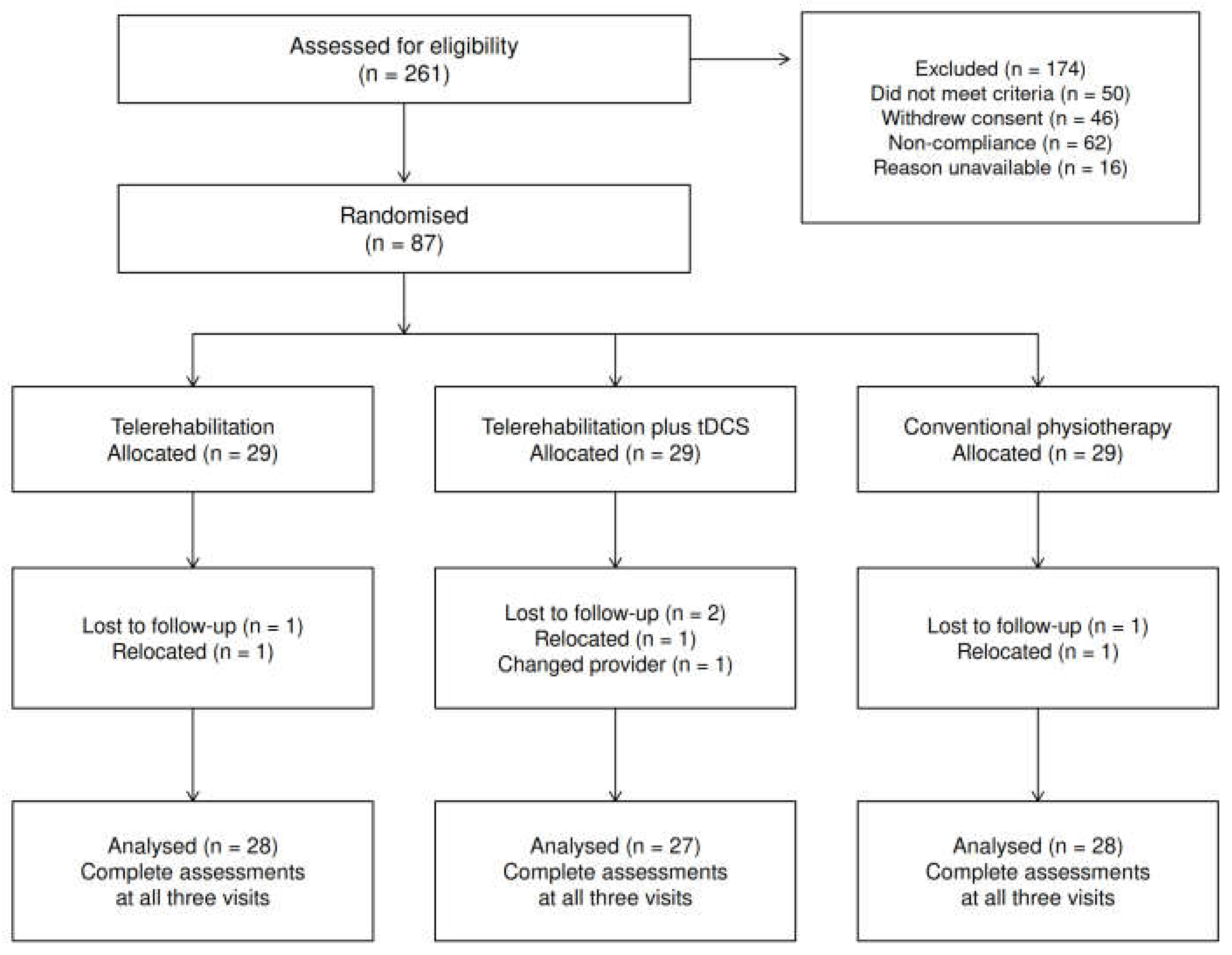
Figure 2.
Brunnstrom hand-stage scores over eight weeks.
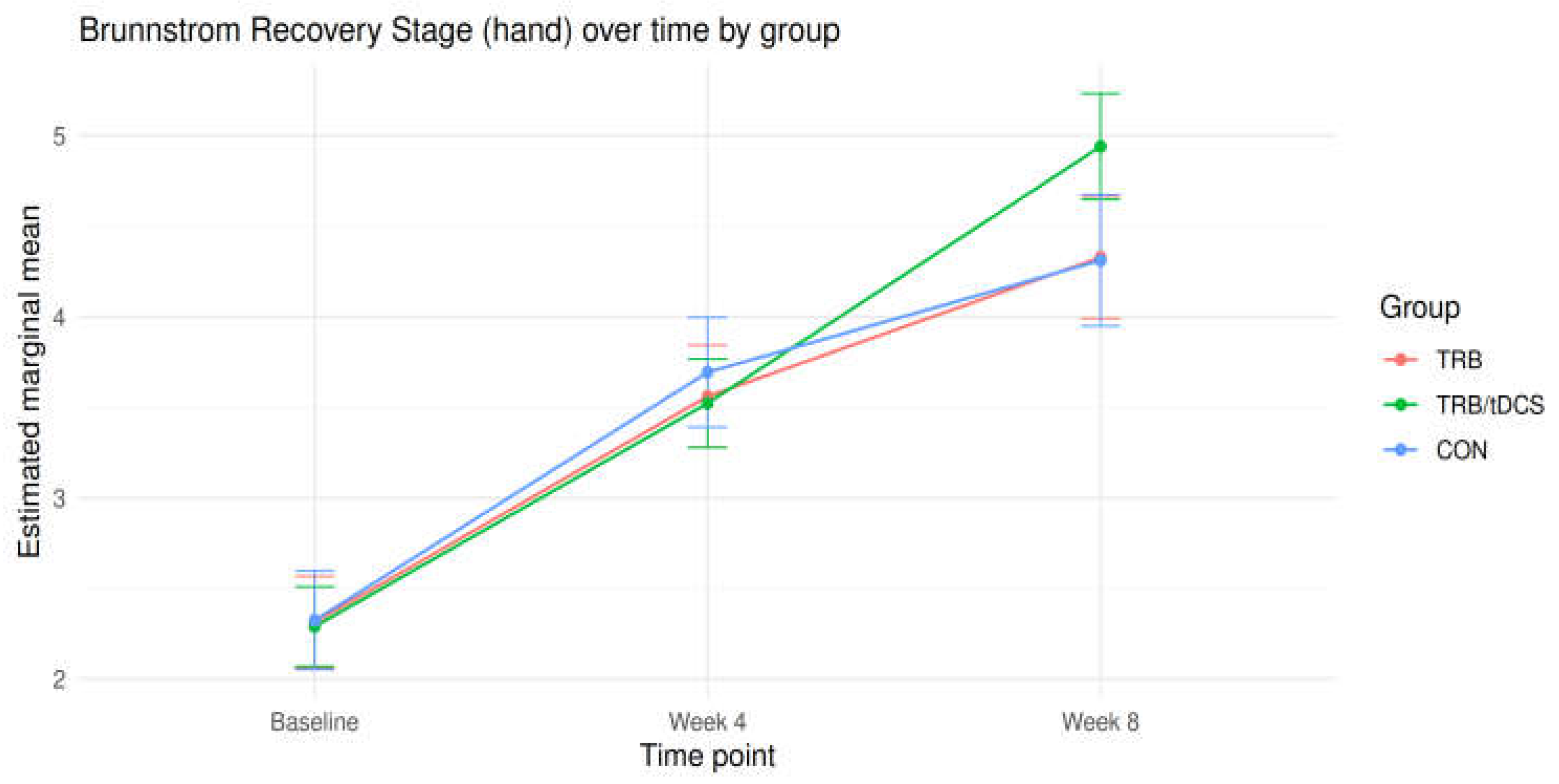
Figure 3.
Timed Up and Go performance over eight weeks.
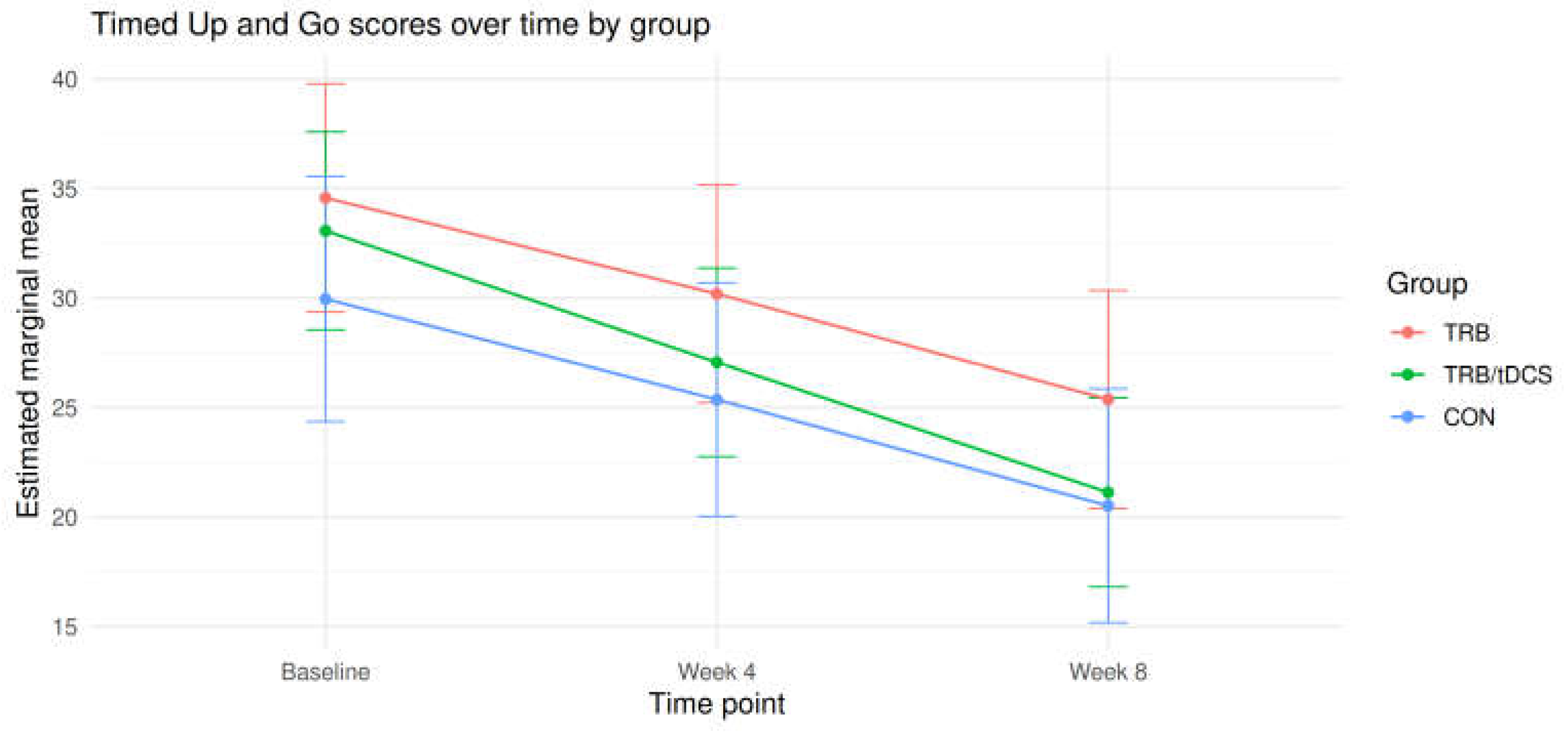
Figure 4.
Mini-Mental State Examination scores over eight weeks.
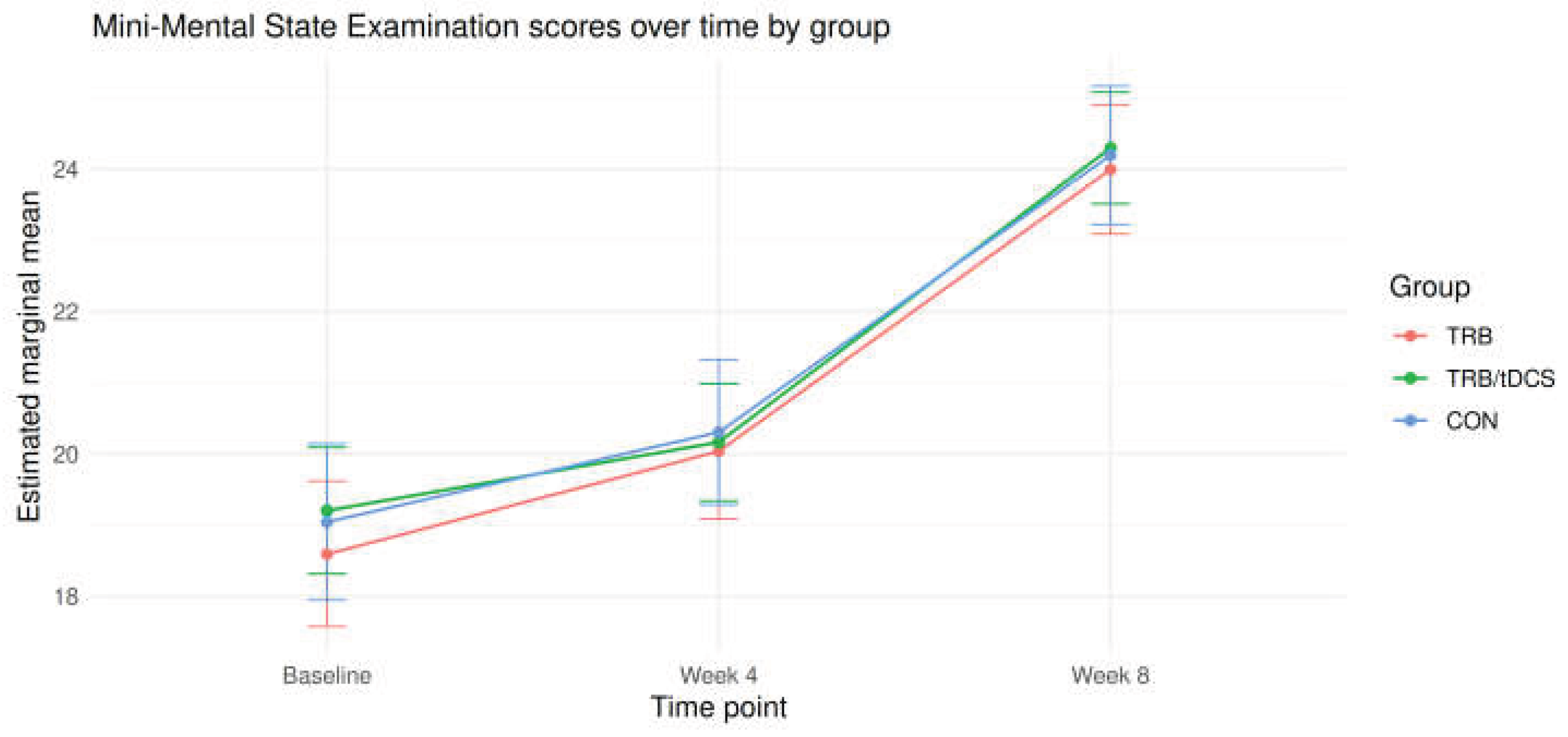

Table 1.
shows baseline demographics and disease-related variables by group.
| Variable | Telerehab | Telerehab + tDCS | Conventional | Test statistic | P-value |
|---|---|---|---|---|---|
| Age (years) | 67.14 ± 7.56 | 68.96 ± 6.95 | 68.43 ± 6.87 | F = 0.48 | 0.623 |
| Time since stroke (days) | 135.50 ± 31.34 | 133.00 ± 29.29 | 126.71 ± 25.22 | F = 0.69 | 0.502 |
| Gender | χ² = 2.26 | 0.324 | |||
| Male | 19 (67.86%) | 13 (48.15%) | 17 (60.71%) | ||
| Female | 9 (32.14%) | 14 (51.85%) | 11 (39.29%) | ||
| Ethnicity | χ² = 3.60 | 0.529 | |||
| Yoruba | 24 (85.71%) | 23 (85.19%) | 27 (96.43%) | ||
| Igbo | 1 (3.57%) | 2 (7.41%) | 1 (3.57%) | ||
| Hausa | 3 (10.71%) | 2 (7.41%) | 0 (0.00%) | ||
| Affected hemisphere | χ² = 0.07 | 0.963 | |||
| Right | 12 (42.86%) | 11 (40.74%) | 11 (39.29%) | ||
| Left | 16 (57.14%) | 16 (59.26%) | 17 (60.71%) | ||
| Stroke type | χ² = 0.83 | 0.660 | |||
| Haemorrhagic | 6 (21.43%) | 7 (25.93%) | 9 (32.14%) | ||
| Ischaemic | 22 (78.57%) | 20 (74.07%) | 19 (67.86%) | ||
| Education level | χ² = 7.50 | 0.116 | |||
| Primary | 8 (28.57%) | 9 (33.33%) | 14 (50.00%) | ||
| Secondary | 14 (50.00%) | 14 (51.85%) | 14 (50.00%) | ||
| Tertiary | 6 (21.43%) | 4 (14.81%) | 0 (0.00%) | ||
| Tobacco use | χ² = 3.18 | 0.204 | |||
| Never | 18 (64.29%) | 23 (85.19%) | 21 (75.00%) | ||
| Past | 10 (35.71%) | 4 (14.81%) | 7 (25.00%) | ||
| Alcohol use | χ² = 5.21 | 0.074 | |||
| Yes | 10 (35.71%) | 9 (33.33%) | 17 (60.71%) | ||
| No | 18 (64.29%) | 18 (66.67%) | 11 (39.29%) | ||
| Hypertension | χ² = 6.38 | 0.036* | |||
| Yes | 20 (71.43%) | 21 (77.78%) | 27 (96.43%) | ||
| No | 8 (28.57%) | 6 (22.22%) | 1 (3.57%) | ||
| Diabetes mellitus | χ² = 10.52 | 0.005* | |||
| Yes | 2 (7.14%) | 11 (40.74%) | 4 (14.29%) | ||
| No | 26 (92.86%) | 16 (59.26%) | 24 (85.71%) |
Values are mean ± SD or n (%). Telerehab, n = 28; Telerehab + tDCS, n = 27; Conventional, n = 28. F, one-way ANOVA; χ², Pearson’s chi-square statistic; SD, standard deviation. Monte Carlo p values were used for sparse categorical tables. *p < 0.05.
Table 2.
Clinical metrics by group at baseline, week 4 and week 8.
| Measure (time) | Telerehab | Telerehab + tDCS | Conventional |
|---|---|---|---|
| Pain intensity (NRS) Baseline | 4.50 ± 2.92 | 3.85 ± 2.94 | 4.86 ± 3.00 |
| Pain intensity (NRS) Week 4 | 3.89 ± 2.41 | 2.59 ± 1.97 | 3.64 ± 2.25 |
| Pain intensity (NRS) Week 8 | 2.68 ± 1.63 | 1.52 ± 1.28 | 2.25 ± 1.51 |
| Balance (sfBBS) Baseline | 22.54 ± 1.79 | 23.11 ± 2.15 | 23.07 ± 1.80 |
| Balance (sfBBS) Week 4 | 23.61 ± 1.31 | 23.85 ± 1.75 | 23.96 ± 1.10 |
| Balance (sfBBS) Week 8 | 26.14 ± 1.24 | 25.89 ± 1.05 | 26.07 ± 1.09 |
| Mobility (TUG), s Baseline | 35.50 ± 9.75 | 35.44 ± 8.76 | 33.07 ± 10.23 |
| Mobility (TUG), s Week 4 | 31.04 ± 9.13 | 29.48 ± 8.54 | 28.36 ± 9.74 |
| Mobility (TUG), s Week 8 | 26.32 ± 9.08 | 23.48 ± 8.69 | 23.57 ± 9.68 |
| Global cognition (MMSE) Baseline | 18.75 ± 1.84 | 19.19 ± 1.98 | 19.11 ± 1.77 |
| Global cognition (MMSE) Week 4 | 20.29 ± 1.72 | 20.11 ± 1.53 | 20.39 ± 1.85 |
| Global cognition (MMSE) Week 8 | 23.86 ± 1.72 | 24.37 ± 1.50 | 24.11 ± 1.73 |
| Functional activities (FAQ) Baseline | 13.79 ± 2.25 | 14.07 ± 2.25 | 14.25 ± 2.25 |
| Functional activities (FAQ) Week 4 | 12.57 ± 2.23 | 12.85 ± 2.25 | 13.04 ± 2.24 |
| Functional activities (FAQ) Week 8 | 7.64 ± 1.06 | 7.78 ± 1.05 | 7.89 ± 0.92 |
| Informant cognition (IQCODE) Baseline | 3.97 ± 0.17 | 4.04 ± 0.18 | 3.97 ± 0.18 |
| Informant cognition (IQCODE) Week 4 | 3.44 ± 0.24 | 3.54 ± 0.23 | 3.45 ± 0.24 |
| Informant cognition (IQCODE) Week 8 | 2.95 ± 0.18 | 3.01 ± 0.17 | 2.95 ± 0.17 |
Values are mean ± SD. NRS, Numerical Rating Scale; sfBBS, short-form Berg Balance Scale; TUG, Timed Up and Go; MMSE, Mini-Mental State Examination; FAQ, Functional Activities Questionnaire; IQCODE, Informant Questionnaire on Cognitive Decline in the Elderly; SD, standard deviation; tDCS, transcranial direct current stimulation.
Table 3.
Group-by-time interaction effects for the clinical outcomes.
| Outcome | Numerator df | Denominator df | F | P-value |
|---|---|---|---|---|
| Pain intensity (NRS) | 2.92 | 109.66 | 0.80 | 0.496 |
| BRS upper limb | 3.78 | 141.67 | 2.47 | 0.051 |
| BRS hand | 3.82 | 143.08 | 3.70 | 0.008* |
| BRS lower limb | 3.63 | 136.24 | 2.93 | 0.027* |
| Balance (sfBBS) | 2.97 | 111.53 | 1.04 | 0.377 |
| Mobility (TUG), s | 3.22 | 120.75 | 9.29 | <0.001* |
| Global cognition (MMSE) | 3.76 | 140.83 | 0.28 | 0.880 |
| Functional activities (FAQ) | 2.55 | 95.64 | 0.43 | 0.698 |
| Informant cognition (IQCODE) | 2.84 | 106.39 | 1.53 | 0.213 |
Models were adjusted for education level, hypertension and diabetes. Degrees of freedom and p values use the Greenhouse–Geisser correction. df, degrees of freedom; BRS, Brunnstrom Recovery Stages. Other abbreviations are defined in Table 2. *p < 0.05. Holm-adjusted interaction p values across the nine outcomes are presented in Supplementary Table S1.
Table 4.
Between-group differences in outcome measures at weeks 4 and 8.
| Outcome | Time point | Comparison | Mean difference (SE) | 95% CI | Adjusted P-value |
|---|---|---|---|---|---|
| Pain intensity (NRS) | Week 4 | TRB/tDCS vs TRB | -1.95 (0.71) | -3.66, -0.25 | 0.020* |
| Week 8 | TRB/tDCS vs TRB | -1.60 (0.47) | -2.73, -0.48 | 0.003* | |
| BRS upper limb | Week 8 | TRB/tDCS vs CON | 0.55 (0.20) | 0.08, 1.02 | 0.017* |
| BRS hand | Week 8 | TRB/tDCS vs TRB | 0.61 (0.20) | 0.14, 1.09 | 0.008* |
| Week 8 | TRB/tDCS vs CON | 0.63 (0.18) | 0.19, 1.07 | 0.003* | |
| BRS lower limb | Week 8 | TRB/tDCS vs TRB | 0.65 (0.21) | 0.15, 1.15 | 0.007* |
| Week 8 | TRB/tDCS vs CON | 0.56 (0.19) | 0.10, 1.03 | 0.013* |
TRB, telerehabilitation; TRB/tDCS, telerehabilitation plus tDCS; CON, conventional physiotherapy intervention; BRS, Brunnstrom Recovery Stages; NRS, Numerical Rating Scale; SE, standard error; CI, confidence interval.
Table 5.
Changes in outcome measures within each group.
| Outcome | Group | Baseline–Week 4 | Week 4–Week 8 | Baseline–Week 8 |
|---|---|---|---|---|
| Pain intensity (NRS) | TRB | 0.97 (0.36) p = 0.024* |
1.36 (0.33) p < 0.001* |
2.32 (0.52) p < 0.001* |
| TRB/tDCS | 1.34 (0.31) p < 0.001* |
1.01 (0.29) p = 0.002* |
2.34 (0.45) p < 0.001* |
|
| CON | 1.44 (0.39) p = 0.001* |
1.48 (0.35) p < 0.001* |
2.92 (0.56) p < 0.001* |
|
| BRS hand | TRB | 1.25 (0.19) p < 0.001* |
0.77 (0.24) p = 0.005* |
2.01 (0.21) p < 0.001* |
| TRB/tDCS | 1.23 (0.17) p < 0.001* |
1.42 (0.20) p < 0.001* |
2.65 (0.18) p < 0.001* |
|
| CON | 1.37 (0.21) p < 0.001* |
0.62 (0.25) p = 0.044* |
1.99 (0.23) p < 0.001* |
|
| Mobility (TUG), s | TRB | 4.38 (0.46) p < 0.001* |
4.82 (0.32) p < 0.001* |
9.20 (0.51) p < 0.001* |
| TRB/tDCS | 6.01 (0.40) p < 0.001* |
5.94 (0.27) p < 0.001* |
11.94 (0.44) p < 0.001* |
|
| CON | 4.59 (0.49) p < 0.001* |
4.85 (0.34) p < 0.001* |
9.43 (0.55) p < 0.001* |
|
| Global cognition (MMSE) | TRB | 1.44 (0.44) p = 0.004* |
3.95 (0.47) p < 0.001* |
5.40 (0.37) p < 0.001* |
| TRB/tDCS | 0.96 (0.38) p = 0.036* |
4.13 (0.40) p < 0.001* |
5.09 (0.32) p < 0.001* |
|
| CON | 1.26 (0.47) p = 0.024* |
3.88 (0.50) p < 0.001* |
5.15 (0.40) p < 0.001* |
Values are adjusted mean difference (SE) and Tukey-adjusted p value. Positive estimates denote improvement: baseline minus follow-up for NRS and TUG, and follow-up minus baseline for hand stage and MMSE. BRS, Brunnstrom Recovery Stages; TUG, Timed Up and Go; MMSE, Mini-Mental State Examination; NRS, Numerical Rating Scale; SE, standard error. The three time comparisons within each outcome and group form each Tukey family. *p < 0.05.
Disclaimer/Publisher’s Note: The statements, opinions and data contained in all publications are solely those of the individual author(s) and contributor(s) and not of MDPI and/or the editor(s). MDPI and/or the editor(s) disclaim responsibility for any injury to people or property resulting from any ideas, methods, instructions or products referred to in the content. |
© 2026 by the authors. Licensee MDPI, Basel, Switzerland. This article is an open access article distributed under the terms and conditions of the Creative Commons Attribution (CC BY) license (http://creativecommons.org/licenses/by/4.0/).
Copyright: This open access article is published under a Creative Commons CC BY 4.0 license, which permit the free download, distribution, and reuse, provided that the author and preprint are cited in any reuse.