

Submitted:
02 November 2026
Posted:
04 November 2026
You are already at the latest version
Abstract
The software industry is confronting a critical crisis driven by systemic vulnerabilities within the software supply chain and the ubiquitous reliance on third-party dependencies. While individual exploits and localized compliance frameworks have been heavily studied, this highly fragmented academic discourse creates a critical barrier to organizational readiness and proactive incident preparedness. To address this gap and enhance digital resilience, this study maps the conceptual, knowlegde and structural landscape of software supply chain literature using Synthetic Knowledge Synthesis. Analyzing publications from 2021 to 2026, the research reveals an exponential growth in output, heavily dominated by conference proceedings and driven primarily by institutional and state-funded efforts in the United States and China. Thematic mapping identifies five core clusters defining the current ecosystem: Software Composition Analysis, Advanced Vulnerability Detection, AI-Driven Threat Intelligence, Deep Learning, and DevSecOps. The study highlights critical unresolved gaps, notably the prevalence of false positives in static Software Bill of Materials tools due to a lack of execution context, and a pronounced disconnect between theoretical models and practical enterprise application. Future research directions emphasize the integration of Large Language Models for automated patch generation, the development of execution-aware vulnerability triage, and the evolution of dynamic, AI-driven artifacts to secure complex dependency networks.
Keywords:
software supply chain security
; digital resilience
; synthetic knowledge synthesis (SKS)
; incident preparedness
; software bill of materials (SBOM)
; cyberattack mitigation
; DevSecOps
; large language models (LLMs)
1. Introduction
The discipline of software engineering was born out of the first "software crisis" in the late 1960s, a period when the demand for complex systems vastly exceeded the manual, artisanal methods available to build them [1]. Today, the industry is confronting a second, inverted crisis [2]. the sheer volume of code being produced . Driven by the normalization of AI coding assistants and a ubiquitous reliance on open-source ecosystems, modern applications are no longer built from scratch—they are assembled. The bottleneck is no longer the ability to write code; rather, it is the ability to comprehend, review, and secure it [3].
This expansive, interconnected web of third-party commercial components, open-source libraries, and automated deployment pipelines constitutes the software supply chain . While this modular approach exponentially accelerates development and solves the productivity challenges of the past, it introduces severe, systemic, and often invisible risks [4]. Because modern development practices inherently trust deeply nested external dependencies, an organization's attack surface now extends far beyond its own proprietary code [5].
High-profile emergencies, such as the SolarWinds breach [6] and the ubiquitous Log4j vulnerability [7], are direct symptoms of this modern software crisis [8]. They starkly illustrate how a single compromised dependency or malicious injection can cascade through global networks, compromising thousands of downstream systems. As threat actors increasingly target these foundational layers, securing the software supply chain has evolved from a theoretical IT concern to an urgent imperative. To meaningfully mitigate these threats, organizations are attempting to transition from reactive patching to proactive, continuous management. This requires establishing deep visibility into the codebase through mechanisms like the Software Bill of Materials (SBOM) [9], enforcing rigorous monitoring during the ingestion of third-party software, and deploying automated remediation strategies to address vulnerabilities at scale [10].
However, despite the escalating severity of these threats and a rapid proliferation of localized studies, the broader academic and technical discourse remains highly fragmented. Current literature tends to isolate specific dimensions of the software supply chain—focusing narrowly on individual exploits, siloed compliance frameworks, or the standalone utility of specific inventory tools. Crucially, a comprehensive, holistic review that synthesizes these disparate technical, procedural, and organizational elements into a unified landscape has yet to be analysed. This critical research gap limits the development of cohesive, end-to-end security architectures. Consequently, security teams struggle to translate siloed academic findings into actionable digital technology strategies, severely hindering organizational readiness and cyberattack mitigation efforts.
To address this absence of macro-level synthesis, this study maps the conceptual, intellectual, and structural landscape of software supply chain literature through the application of Synthetic Knowledge Synthesis (SKS) [11]. By leveraging this advanced methodological framework to structurally evaluate the existing corpus, this article aims to answer the following core research questions:
- RQ1 (Productivity Dynamics): How have research productivity and publication trajectories evolved over time concerning software supply chains, and who are the most influential contributors and core publication sources driving this domain?
- RQ2 (Spatial Distribution): What is the geographic footprint of this research, and how do international collaboration networks and institutional partnerships shape the spatial distribution of the literature?
- RQ3 (Research Themes): What are the most important thematic clusters and conceptual structures currently defining the software supply chain ecosystem?
- RQ4 (Future Directions): Based on cluster identified in RQ3 and the structural analysis of the existing literature, what are the critical unresolved challenges, emerging trends, and high-priority future research directions required to advance the field?
2. Methodology
2.1. Research Design and the Methodological Advantages of SKS
To systematically map the rapidly expanding and highly fragmented literature on software supply chains, this study employs SKS. Traditional systematic literature reviews, while rigorous, are often constrained by the manual labor required to process data, rendering them vulnerable to the rapid obsolescence of findings in fast-paced technological domains. The phenomenon of the "knowledge explosion", particularly in software engineering and cybersecurity, demands scalable, semi-automated approaches to literature synthesis.
SKS addresses this challenge through a methodological triangulation of three analytical pillars: macroscopic bibliometrics, bibliometric mapping, and qualitative content analysis. By analyzing the full corpus of all relevant publications, SKS functions not just as a review technique, but as a strategic threat intelligence tool. It translates overwhelming academic data into actionable insights for incident preparedness. For a complex, socio-technical domain like the software supply chain, SKS provides distinct methodological advantages [12]:
- Scalability and High Recall: It allows for the rapid processing of massive textual datasets without sacrificing the granularity required to identify niche vulnerabilities (e.g., specific dependency exploits).
- Mitigation of Human Bias: By relying on algorithmic clustering and co-occurrence algorithms to define thematic boundaries, SKS reduces the subjective bias inherent in manual qualitative coding.
- Temporal and Spatial Dynamism: It natively captures the longitudinal evolution of the field, enabling the identification of "bursts" in research productivity triggered by real-world events (such as the SolarWinds or Log4j crises) and mapping the institutional networks driving these advancements.
The SKS is executed by the following pipeline, formalized as a five-step transformation of unstructured literature into structured thematic graphs.
1. Corpus Harvesting Let
represent the universal set of records within selected bibliographic databases. A specific search string, , is formulated based on the targeted research question. Applying this search string harvests the targeted literature corpus :
This step extracts the research publications concerning the topic of interest.
2. Meaningful Unit Extraction: The model isolates author keywords as the primary units of analysis. Author keywords are selected because they semi-formally and accurately convey the content the authors intend to communicate to the scientific community. A feature extraction function isolates the set of all author keywords, , from the corpus .
3. Bibliometric Graph Mapping: The extracted keywords are mapped into a bibliometric network graph using clustering algorithms and co-word analysis.
- The nodes (
) represent the specific units of analysis, which in this model are the author keywords.
- The links (
) between the nodes represent the relationships or associations between pairs of keywords.
- The proximity of the nodes within the visual space is an indicator of their similarity.
- The size of each individual node indicates the popularity or frequency of that unit.
- The nodes are partitioned into clusters, visually indicated by different colors, which represent sets of units that possess strong associations.
4. Category Formation via Link Analysis: The bibliometric network graph and intra-cluster links and nodes proximity and size are anlaysed to form categories.
- The formation of categories is mathematically modeled as the partitioning of an individual cluster based on edge weights and spatial distance. Let
represent a specific cluster subgraph identified in the previous step, where is the set of author keywords in that cluster.
- The analysis evaluates the links and proximity between the author keywords within this individual cluster. Let
represent the link strength (co-occurrence frequency) between any two keywords , and let represent their spatial proximity in the mapped visual space.
- A
- category
is formed by grouping a subset of nodes that maximize internal link strength and minimize spatial distance. This process partitions the cluster into a set of distinct categories, : where and each represents a cohesive sub-network of closely related and associated terms.
5. Thematic Condensation: The final step models the abstraction of these structural subsets into broader semantic concepts. Let represent the universal set of all categories formed across all clusters:
- These categories are then condensed into themes through content analysis. Formaly, a theme
is defined as the union of a specific subset of categories that share broader conceptual equivalence:
2.2. Search Strategy and Corpus Extraction
To ensure a comprehensive capture of the relevant literature, the primary corpus was extracted from the Scopus bibliographic database. Scopus was selected due to its extensive coverage of peer-reviewed literature in computer science, software engineering, and information systems, large batch export of metadara, and effective buil in functionality.
The search strategy was iteratively developed to capture both the overarching concept of the software supply chain and its foundational technical elements (such as inventory management and dependency tracking). To validate the search strategy’s sensitivity objectively, we applied a relative recall framework [23] using a "benchmarking set" of known, highly relevant studies established a priori. After confirming these seed studies were indexed in the target database (Scopus), we calculated the proportion successfully retrieved by the search string. Sensitivity is estimated as:
The string was iteratively refined on 100 seed publications, and after reaching the RI > 0.95 the following high-recall Boolean search string was employed:
TITLE-ABS-KEY ( ( "software" OR "open source" OR "open-source" ) W/2( "supply chain*" OR "supply network*" ) ) OR TITLE-ABS-KEY ( "software bill of material*" OR "SBOM" ) OR TITLE-ABS-KEY ( "software dependenc*" W/2 ( "security" OR "vulnerabilit*" OR "attack*" ) ) AND PUBYEAR > 2017 AND PUBYEAR < 2028 AND PUBYEAR > 2020 AND PUBYEAR < 2028
The search was performed on August, 29th, 2026.
2.3. Implementation of SKS Pipeline in the Context of Research Questions
Following the extraction, the metadata (including bibliographical information, abstracts, and author keywords) was exported in a standardized format. The analytical phase of the SKS framework was executed in three sequential steps:
- 1. Descriptive Bibliometrics: Initial quantitative analysis using Scpus build in functions was conducted to establish research literature production dynamics, publication type and spatial distribution (answering RQ1 and RQ2). This step identified the most prolific countries, institutions, funding agencies and information sources.
- 2. Bibliometric Mapping: To uncover the conceptual structure of the field (answering RQ3), VOSviewer 1.6.21 software was utilized [24]. According to Zipf’s law [25] keywords occurring more than 5 times (56 author keywords) were included into the analysis. VOSViewer parameters Attraction and Repulsion were set to 5 and 0 respectively. Resolution was set to 0.8. Author keyword co-occurrence network was generated to visually cluster the literature into distinct thematic clusters. Parameters such as node weight (total link strength) and spatial proximity were used to determine the conceptual distance between research topics as basis for content analysis and cluster and categories labelling.
- 3. Qualitative Synthesis: Finally, the clusters were analysed and to qualitative content analysis as outlined above [26]. This final synthesis bridged the gap between quantitative metrics and semantic meaning, allowing also for the formulation of concrete future research directions using bibliographic based trend analysis [27] (answering RQ4).
3. Results
3.1. Initial Bibliometric Results
To establish the macro-level landscape of software supply chain research, an initial quantitative assessment was conducted using the extracted metadata. Corpus consisting of 861 publications was retrieved. To enable a full corpus analysis no inclusion or exclusion criteria were applied (Figure 1),
The following sections address the productivity dynamics (RQ1) and spatial distribution (RQ2) of the current literature.
3.1.1. Productivity Dynamics and Publication Types (RQ1)
The temporal analysis of the literature reveals a highly dynamic and rapidly accelerating research domain. As illustrated in Figure 2, research output concerning software supply chain security has experienced a sharp, continuous upward trajectory. The data shows a massive surge in publications, growing from 43 documents in 2021 to a peak of 252 documents in 2025. This exponential growth perfectly aligns with the real-world timeline of the modern software crisis discussed in the introduction—specifically, the immediate academic reaction to the late-2020 SolarWinds breach and the late-2021 Log4j vulnerability. (Note: The slight dip in 2026 reflects the partial-year indexing at the time of data extraction). Furthermore, the document type distribution highlights the fast-paced nature of this field. Over 61% of the published literature consists of Conference Papers (527 documents), significantly outpacing traditional Journal Articles (27.6%, 238 documents). In computer science and cybersecurity, an overwhelming dominance of conference proceedings is indicative of an emerging, highly volatile research area where rapid dissemination of exploit vectors and mitigation strategies is prioritized over longer publication cycles.
This emphasis on rapid dissemination is further confirmed by the top publication venues (Figure 3). The literature is heavily anchored in leading computer science proceedings, with Lecture Notes in Computer Science (31 publications) and the Proceedings of the International Conference on Software Engineering (ICSE) (19 publications) serving as the primary structural pillars of the discourse.
3.1.2. Spatial Distribution (RQ2)
The geographic and institutional distribution of software supply chain research reveals a a geographical concentration of research, heavily driven by strategic national interests. As shown in Figure 4, the United States (253 publications) and China (188 publications) dominate the global discourse, outputting substantially more research than European counterparts like Germany (55 publications) and the United Kingdom (41 publications). At the institutional level, American technical universities lead the structural network, with NC State University (26 publications) and Purdue University (25 publications) emerging as the most prolific hubs. However, this is closely mirrored by a massive, centralized output from the Chinese Academy of Sciences (21 publications).
The institutional output is directly correlated with the financial agencies driving the research. Figure 5 demonstrates that software supply chain security is not merely an academic pursuit, but a matter of state-level cybersecurity infrastructure. The field is overwhelmingly sustained by major national bodies, specifically the National Natural Science Foundation of China (66 funded publications) and the United States' National Science Foundation (65 funded publications). The presence of the European Commission (28 publications) and corporate entities like Google LLC further confirms that securing the software supply chain is recognized globally as a critical socio-technical and economic priority.
3.2. Content Analysis
3.2.1. Knowledge Structure and Thematic Clusters (RQ3)
To uncover the conceptual structure of the field, a keyword co-occurrence network was generated, clustering the literature into five distinct thematic streams (Figure 6). This structural mapping highlights the technological and procedural boundaries currently defining the software supply chain ecosystem (Table 1):
Red Cluster (Software Composition Analysis & Standardization): This foundational cluster focuses on the structural analysis of open-source software using mechanisms like blockchain. It is heavily anchored in the operationalization of the Software Bill of Materials (SBOM) for supply chain security and organizational readiness, highlighting standards such as CycloneDX and reproducibility in Java environments to ensure foundational digital resilience.
Green Cluster (Advanced Vulnerability Detection): This stream centers on empirical software engineering and the deployment of Large Language Models (LLMs). Research here predominantly explores proactive vulnerability detection and supply chain management using advanced computational models, alongside securing ecosystems built in Rust to enhance incident preparedness.
Blue Cluster (AI-Driven Threat Intelligence): This cluster emphasizes the broader application of artificial intelligence and machine learning in cybersecurity. Core topics include utilizing the Internet of Things (IoT) and AI to detect active vulnerabilities, mitigate cyberattacks, and prevent supply chain breaches within open-source platforms like GitHub.
Purple Cluster (Deep Learning & Static Analysis): A highly specialized niche concentrating on malicious package detection. It leverages static deep learning-supported analysis to identify malware and compromised dependencies within package managers such as npm and PyPI, which is critical for securing underlying digital technologies.
Yellow Cluster (DevSecOps & Compliance): This procedural cluster details vulnerability management through empirical studies of compliance within continuous integration and continuous deployment (CI/CD) pipelines and GitHub Actions to ensure continuous digital resilience.
3.3. Gap Analysis and Future Research
3.3.1. Methodological and Tooling Gaps
- Execution-Context Deficits: Current Software Bill of Materials (SBOM) tools frequently fail to detect complex attack vectors like hidden transitive dependencies, and they generate significant triage fatigue by reporting vulnerabilities without verifying if the dependent application actually invokes the vulnerable code path [28].
- Mitigation Metadata Disconnects: Standard SBOMs and vulnerability scanners lack machine-readable mitigation metadata, which restricts automated policy-driven risk assessments, artifact comparison, and downstream system hardening [29].
- Cryptographic Vulnerabilities: Existing software supply chain encryption is increasingly susceptible to "harvest now, decrypt later" strategies, exposing a critical gap in quantum-resistant data protection and cryptographic agility [30].
3.3.2. Socio-Technical and Structural Challenges
- Enterprise Applicability: Current literature disproportionately focuses on theoretical attack vectors in isolated open-source contexts, creating a pronounced empirical gap regarding how developers navigate and mitigate supply chain security challenges in complex enterprise ecosystems [31].
- Patch Localization and Interoperability: Translating unstructured security advisories into localized, actionable patches remains a heavily manual bottleneck, as static tools lack the contextual awareness needed to avoid system degradation. Furthermore, the seamless operationalization of SBOM frameworks (e.g., SPDX, CycloneDX) into DevSecOps pipelines is obstructed by interoperability friction [32].
- Infrastructure Propagation and Cyber-Physical Hardening: Vulnerabilities in foundational tools, such as compiler parsing routines, silently propagate to downstream projects. Extending standardized supply chain security to specialized, embedded cyber-physical systems faces significant harmonization hurdles [33].
3.4. Emerging Trends and High-Priority Future Research
- AI-Driven Remediation and Triage: Researchers are increasingly pairing Large Language Models (LLMs) with external knowledge retrieval to automate semantic patch localization. Future research must prioritize execution-aware frameworks that map function-level call graphs to verify vulnerability reachability, ensuring developers only remediate actively executed components [34].
- Next-Generation Dynamic Artifacts: The discourse is shifting from static SBOMs toward enriched artifacts like the "MitSBOM" (embedding mitigation metadata) and the AI Bill of Materials (AIBOM) to establish verifiable trust. Establishing and harmonizing universal standards for these dynamic artifacts is a critical future objective [35].
- Advanced Computational Mapping and Multi-Agent Systems: Knowledge Graphs and Graph Neural Networks (GNNs) have emerged as premier methods for mapping obscure vulnerability pathways in multi-tiered supply chains. Future frameworks should deploy multi-agent reinforcement learning to simulate attacker-defender dynamics and automate threat response within DevSecOps [36].
- Holistic Socio-Technical Models: Future security paradigms must transcend isolated technical defenses by integrating algorithmic risk profiling, continuous developer education, and human behavioral metrics to secure the entire lifecycle of software components [37].
4. Discussion
This study applied Synthetic Knowledge Synthesis (SKS) to systematically map the rapidly expanding and highly fragmented literature concerning software supply chain security between 2021 and 2026. Driven by the ubiquitous reliance on open-source ecosystems and deeply nested third-party dependencies, the software industry is confronting a systemic crisis that extends far beyond individual exploits. While prior research has frequently isolated specific technical vulnerabilities or siloed compliance frameworks [38], this research provides a holistic evaluation of the domain's intellectual, conceptual, and structural landscape. By triangulating macroscopic bibliometrics, structural mapping, and qualitative content analysis, this study effectively answered the core research questions to reveal the underlying dynamics of the field. The following sections contextualize these findings, analyzing the explosive productivity and spatial concentration of the literature, evaluating the prominent thematic shifts toward Artificial Intelligence and DevSecOps, and critically examining the socio-technical gaps and tooling deficits that must be resolved to secure modern development ecosystems.
Productivity and Spatial Dynamics The temporal analysis confirms that software supply chain security is a highly volatile and rapidly accelerating domain, with a massive surge in publications peaking in 2025. This exponential growth directly correlates with academic and industry reactions to high-profile crises, such as the Log4j and SolarWinds breaches. The overwhelming dominance of conference papers (over 61%) underscores the necessity for rapid dissemination of exploit vectors and mitigation strategies over traditional, longer-cycle journal publications. Furthermore, the geographic concentration of research in the US and China, heavily sustained by national funding agencies like the National Science Foundation and the National Natural Science Foundation of China, illustrates that securing the software supply chain has escalated from an IT concern to a critical matter of state-level cybersecurity infrastructure.
Thematic Structures and Unresolved Challenges The structural mapping of the literature reveals a clear technological evolution from standard software composition analysis toward advanced, AI-driven vulnerability detection. However, a significant socio-technical gap persists: current research disproportionately focuses on open-source environments and theoretical attack vectors, leaving a substantial empirical void regarding how industry practitioners navigate these issues in complex enterprise ecosystems. This disconnect directly undermines digital resilience; without empirical models tailored to enterprise applications, organizations lack the robust threat intelligence required to formulate effective incident response and cyberattack mitigation strategies.
A primary tooling deficit identified in the literature is the "reachability" problem inherent in current SBOMs. Traditional vulnerability scanners frequently flag components that are never actively executed by the software, resulting in overwhelming false positives and triage fatigue. This is compounded by a lack of machine-readable mitigation metadata, which obstructs automated, policy-driven risk assessments and seamless integration into DevSecOps pipelines.
Emerging Trends and Future Directions To overcome these limitations, the literature is undergoing a conceptual shift. The integration of Artificial Intelligence, specifically Large Language Models paired with external knowledge retrieval, is rapidly expanding as a method to automate semantic patch localization and guide intelligent remediation. Additionally, standard static SBOMs are evolving into enriched, dynamic artifacts—such as the MitSBOM for embedding mitigation data and the AIBOM for verifiable trust in AI-generated code. Moving forward, the field must prioritize the development of execution-aware vulnerability triage systems and multi-agent reinforcement models that can autonomously simulate, validate, and deploy security patches across global supply chains.
4.1. Study Limitations
While this study leverages Synthetic Knowledge Synthesis (SKS) to provide a comprehensive structural map of the software supply chain landscape, several methodological limitations must be acknowledged:
Database Exclusivity: The primary corpus for this study was extracted exclusively from the Scopus bibliographic database. Although Scopus was selected for its extensive coverage of peer-reviewed literature in computer science and software engineering, relying on a single repository may inherently exclude relevant research indexed solely in other major databases, such as Web of Science, IEEE Xplore, or the ACM Digital Library.
Temporal Truncation: The longitudinal analysis of publication trajectories includes data spanning up to 2026; however, the extraction was conducted before the year concluded. As noted in the productivity dynamics, the metrics for 2026 reflect partial-year indexing at the time of data extraction. This temporal truncation limits the ability to draw definitive conclusions regarding the complete annual output for that specific year.
Algorithmic and Keyword Thresholds: To manage the "knowledge explosion" and map the conceptual structure, the VOSviewer analysis applied specific quantitative thresholds, such as strictly including keywords with a minimum of five occurrences. While this algorithmic approach effectively mitigates human bias and isolates the most dominant thematic clusters, such rigid frequency thresholds may inadvertently filter out highly relevant but terminologically novel, emerging, or niche research that has not yet reached a high co-occurrence volume.
5. Conclusion
This study successfully applied Synthetic Knowledge Synthesis to structure and evaluate the rapidly expanding literature on software supply chain security, bridging a critical gap in macro-level analysis. The findings demonstrate that while research output has exponentially increased in response to global cybersecurity crises, the current reliance on static tracking tools and siloed defenses is insufficient to protect modern, deeply nested development ecosystems. High rates of false positives, a lack of execution context in vulnerability scanning, and manual patching bottlenecks remain severe vulnerabilities. To secure the next generation of software and achieve true digital resilience, the industry must transition from reactive monitoring to proactive, automated remediation and comprehensive incident preparedness. Advancing execution-aware AI agents, harmonizing standards for dynamic artifacts like the AIBOM, and adopting holistic socio-technical models are no longer optional—they are foundational imperatives for any robust digital technology strategy and organizational cybersecurity posture.
References
- Gibbs, W. Software’s Chronic Crisis. Sci. Am. 1994, 271, 86–95. [Google Scholar] [CrossRef]
- Fitzgerald, B. Information Systems and Software Engineering: The Case for Convergence [Internet]. arXiv. 2024. Available online: http://arxiv.org/abs/2402.04200. [CrossRef]
- Han, H. Rethinking Software Engineering Foundations in the Large Language Model Era [SSRN Scholarly Paper] [Internet]; Social Science Research Network: Rochester, NY, 2026; Available online: https://papers.ssrn.com/abstract=6780358.
- Okafor, C.; Schorlemmer, T.R.; Torres-Arias, S.; Davis, J.C. SoK: Analysis of Software Supply Chain Security by Establishing Secure Design Properties. In Proceedings of the 2022 ACM Workshop on Software Supply Chain Offensive Research and Ecosystem Defenses [Internet]; Association for Computing Machinery: New York, NY, USA, 2022; pp. 15–24. Available online: https://dl.acm.org/doi/10.1145/3560835.3564556. [CrossRef]
- Shen, Y.; Gao, X.; Sun, H.; Guo, Y. Understanding vulnerabilities in software supply chains. Empir. Softw. Eng. 2024, 30(1), 20. [Google Scholar] [CrossRef]
- Willett, M. Lessons of the SolarWinds Hack. In Survival April–May 2021: Facing Russia; Routledge, 2021. [Google Scholar]
- Hiesgen, R.; Nawrocki, M.; Schmidt, T.C.; Wählisch, M. The Race to the Vulnerable: Measuring the Log4j Shell Incident [Internet]. arXiv. 2022. Available online: http://arxiv.org/abs/2205.02544. [CrossRef]
- Enck, W.; Williams, L. Top Five Challenges in Software Supply Chain Security: Observations From 30 Industry and Government Organizations. IEEE Secur. Priv. 2022, 20, 96–100. [Google Scholar] [CrossRef]
- O’Donoghue, E.; Boles, B.; Izurieta, C.; Reinhold, A.M. Impacts of Software Bill of Materials (SBOM) Generation on Vulnerability Detection. In Proceedings of the 2024 Workshop on Software Supply Chain Offensive Research and Ecosystem Defenses [Internet]; Association for Computing Machinery: New York, NY, USA, 2024; pp. 67–76. Available online: https://dl.acm.org/doi/10.1145/3689944.3696164.
- Garcia, D.; Mirakorhli, M.T.; Dillon, S.; Laporte, K.; Morrison, M.; Lu, H.; Koscinski, V.; Enoch, C.; Fazelnia, M.; Chen, R. A Landscape Study of Open-Source Tools for Software Bill of Materials (SBOM) and Supply Chain Security; IEEE Computer Society, 2025; pp. 37–45. Available online: https://www.computer.org/csdl/proceedings-article/svm/2025/146800a037/27HvBe8gLCg. [CrossRef]
- Kokol, P. Synthetic Knowledge Synthesis in Hospital Libraries. J. Hosp. Librariansh. 2024, 24(1), 10–7. [Google Scholar] [CrossRef]
- Kokol, P. The Use of AI in Software Engineering: A Synthetic Knowledge Synthesis of the Recent Research Literature. Information 2024, 15(6), 6. [Google Scholar] [CrossRef]
- Güngör, D.C.; Soybaş, M.; Orgun, F.; Özkütük, N. Educational games in nursing education: A bibliometric and content analysis. Nurse Educ. Pract. 2025, 82, 104231. [Google Scholar] [CrossRef] [PubMed]
- Yalcinkaya, T.; Cinar Yucel, S. Mobile learning in nursing education: A bibliometric analysis and visualization. Nurse Educ. Pract. 2023, 71, 103714. [Google Scholar] [CrossRef] [PubMed]
- Shu, X.; Liu, Y.; He, F.; Gong, Y.; Li, J. A bibliometric and visualized analysis of the pathogenesis of cataracts from 1999 to 2023. Heliyon;PubMed 2024, 10(4). [Google Scholar] [CrossRef] [PubMed]
- Torres-Loyola, A.; Rojas-Arana, C.; Munive-Degregori, A.; Guerrero, M.E.; Mauricio, F.; Pacheco-Mendoza, J.; Mayta-Tovalino, F. Bibliometric Analysis of the Current Landscape of Global Scientific Production on the Development of Vaccines against Dental Caries. In International Journal of Dentistry; Farronato, M., Ed.; Jan 2022; Volume 2022, 1, p. 7678891. [Google Scholar] [CrossRef] [PubMed]
- Li, S.; Li, Z.; Chen, C.; Chen, W.; Du, W.; Yao, X. Structural biases in digital health intervention and health equity research: a bibliometric knowledge graph analysis (2015–2025). Front Digit Health 2026, 8. [Google Scholar] [CrossRef] [PubMed]
- Horvath, I.; Ábrahám, G. Transdisciplinary Shifts in System Paradigm-Driven Disciplines: Mechatronics as an Example. Transdiscipl. J. Eng. Sci. 2025, 16. [Google Scholar] [CrossRef]
- Santosh, K.; Mishra2, B.K.; *; Sahu3, A.K. Artificial Intelligence in Software Engineering: A Holistic Review of Models, Tools, and Future Directions. J. Artif. Intell. Syst. 2026, 8(1), 18–43. [Google Scholar] [CrossRef]
- Li, J.; Gong, Y.; Li, H. Looking Back to Move Forward: Bibliometric and Visual Analysis of Knowledge Transfer in University-Industry Collaboration. IEEE Access 2024, 12, 32278–97. [Google Scholar] [CrossRef]
- Marković, I.; Jemović, M. ARTIFICIAL INTELLIGENCE, BIG DATA AND IoT IN CIRCULAR ECONOMY: RESEARCH TRENDS AND PERSPECTIVES. Facta Univ. Ser. Econ. Organ. 2024, (0), 285–93. [Google Scholar] [CrossRef]
- Fekete, A.; Subramanian, S. Multi-risks attributed to climate change and urbanization in East Africa: a bibliometric analysis of a science gap. Afr. Geogr. Rev. 2024, 43(6), 735–57. [Google Scholar] [CrossRef]
- Lagisz, M.; Yang, Y.; Young, S.; Nakagawa, S. A practical guide to evaluating sensitivity of literature search strings for systematic reviews using relative recall. Res. Synth. Methods 2025, 16(1), 1–14. [Google Scholar] [CrossRef]
- van Eck, N.J.; Waltman, L. Software survey: VOSviewer, a computer program for bibliometric mapping. In Scientometrics;PubMed; PubMed Central, Aug 2010; Volume 84, 2, pp. 523–38. [Google Scholar] [CrossRef] [PubMed] [PubMed Central]
- Gupta, S.; Singh, V.K. Distributional characteristics of Dimensions concepts: An Empirical Analysis using Zipf’s law. Scientometrics 2024, 129(2), 1037–53. [Google Scholar] [CrossRef]
- Qualitative Evidence Synthesis: Where Are We at? - Kate Flemming, Jane Noyes, 2021. 14 Oct 2026. Available online: https://journals.sagepub.com/doi/10.1177/1609406921993276.
- Kokol, P.; Završnik, J.; Vošner, H.B. Bibliographic-Based Identification of Hot Future Research Topics: An Opportunity for Hospital Librarianship. J. Hosp. Librariansh. 2018, 18(4), 315–22. [Google Scholar] [CrossRef]
- Tan, Z.; Guo, W.; Luo, J.; Brierley, T.; Singer, J.; Anagnostopoulos, C. An Empirical Study of Observability Limits in Advanced Software Supply Chain Attacks [Internet]. 2026. Available online: http://arxiv.org/abs/2603.16694. [CrossRef]
- Mujeye, S. Severity Impact Discrepancy in Supply Chain Vulnerabilities: An Empirical Analysis Using the CISA Known Exploited Vulnerabilities (KEV) Database. In Proceedings of the 2026 9th International Conference on Software Engineering and Information Management [Internet], New York, NY, USA, 2026; Association for Computing Machinery; pp. 247–52. Available online: https://dl.acm.org/doi/10.1145/3796315.3796349. [CrossRef]
- Tiwari, S. Supply Chain Attacks in Software Development: Advanced Prevention Techniques and Detection Mechanisms [SSRN Scholarly Paper] [Internet]; Social Science Research Network: Rochester, NY, 2022; Available online: https://papers.ssrn.com/abstract=5259387.
- Tan, Z.; Parambath, S.P.; Anagnostopoulos, C.; Singer, J.; Marnerides, A.K. Advanced Persistent Threats Based on Supply Chain Vulnerabilities: Challenges, Solutions, and Future Directions. IEEE Internet Things J. 2025, 12(6), 6371–95. [Google Scholar] [CrossRef]
- Understanding vulnerabilities in software supply chains | Empirical Software Engineering | Springer Nature Link [Internet]. 31 Oct 2026. Available online: https://link.springer.com/article/10.1007/s10664-024-10581-2.
- Ruan, B.; Lin, Z.; Liu, J.; Zhang, C.; Ji, K.; Liang, Z. Propagation-Based Vulnerability Impact Assessment for Software Supply Chains. 2025 40th IEEE/ACM International Conference on Automated Software Engineering (ASE) [Internet], 2025; pp. 65–77. Available online: https://ieeexplore.ieee.org/abstract/document/11334530. [CrossRef]
- Ahmad, A.A.A. An Ai-Driven Devsecops Framework for Enhancing Software Security and Reducing Vulnerabilities Throughout the Software Development Life Cycle. Int. J. Artif. Intell. Mach. Learn. 2026, 6(11s), 1290–312. [Google Scholar] [CrossRef]
- Software Security Analysis in 2030 and Beyond: A Research Roadmap | ACM Transactions on Software Engineering and Methodology [Internet]. 2026 Oct 31; Available online: https://dl.acm.org/doi/full/10.1145/3708533.
- Syed, T.A.; Riyaz Belgaum, M.; Jan, S.; Khan, A.A.; Alqahtani, S.S. Agentic AI for Autonomous Defense in Software Supply Chain Security: Beyond Provenance to Vulnerability Mitigation. 2025 International Conference on Computer and Applications (ICCA) [Internet], 2025; pp. 1–6. Available online: https://ieeexplore.ieee.org/abstract/document/11430751. [CrossRef]
- Ani, U.D.; Al-Mhiqani, M.; Tuptuk, N.; Hailes, S.; McKendrick Watson, J.D. Socio-Technical Security Modelling and Simulations in Cyber-Physical Systems: Outlook on Knowledge, Perceptions, Practices, Enablers, and Barriers. IET Cyber-Phys. Syst. Theory Appl. 2025, 10(1), e70017. [Google Scholar] [CrossRef]
- Software supply chain security: a systematic literature review: International Journal of Computers and Applications. No 10 [Internet] 2026, Vol 46. Available online: https://www.tandfonline.com/doi/abs/10.1080/1206212X.2024.2390978?casa_token=B_eN_J7-cgEAAAAA:0fCJoVC1Vo0XYQL3qevFGqznY9qJ7knMWYZXSOGAsACUbv2XYcL3gA3_uM2QAUaDKauaZTgPKI6xGA.
Figure 1.
PRISMA flow diagram detailing the systematic record retrieval and screening process for the software supply chain corpus.
Figure 1.
PRISMA flow diagram detailing the systematic record retrieval and screening process for the software supply chain corpus.
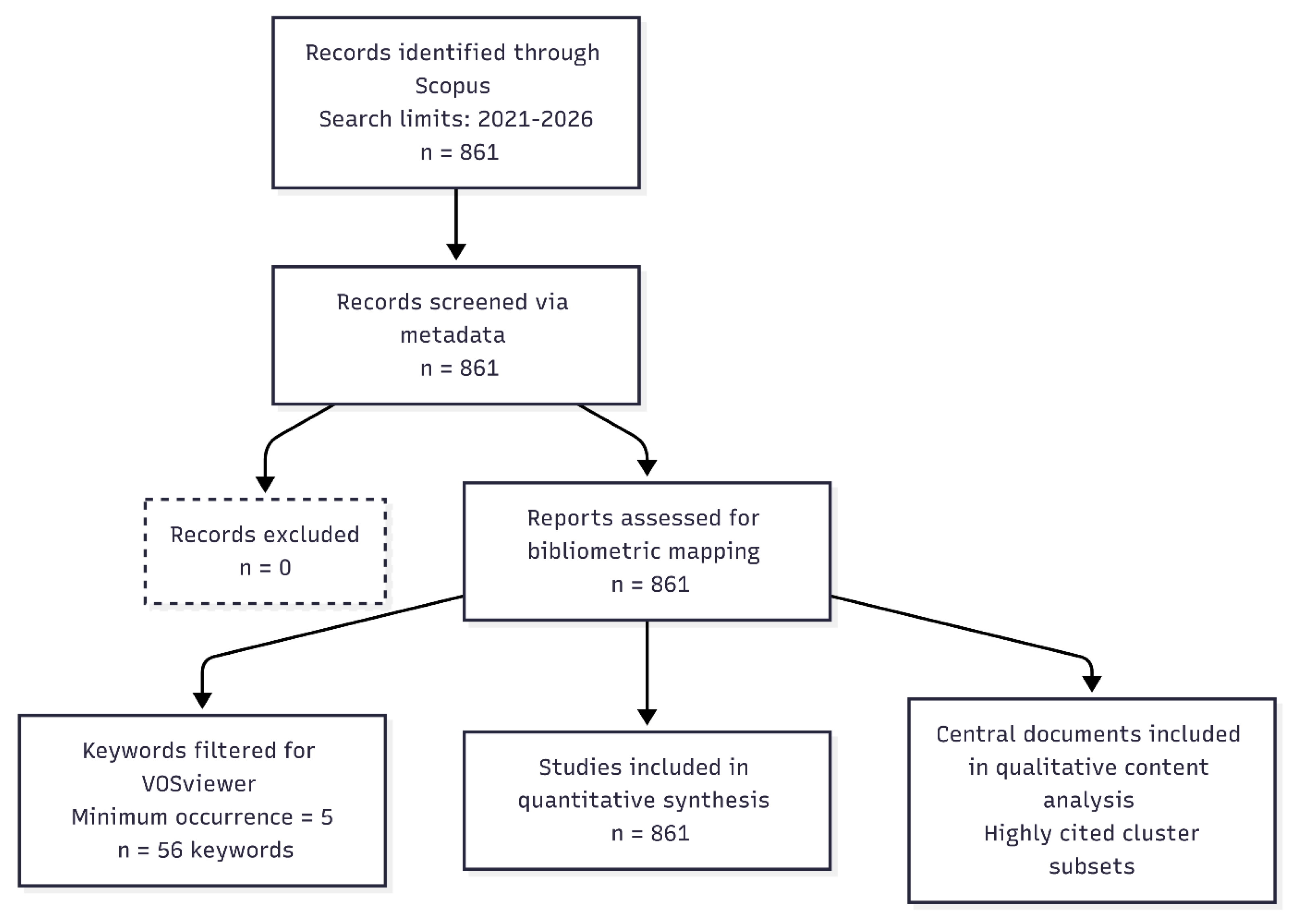
Figure 2.
Longitudinal evolution of research productivity (2021–2026) alongside the distribution of literature by document type.
Figure 2.
Longitudinal evolution of research productivity (2021–2026) alongside the distribution of literature by document type.
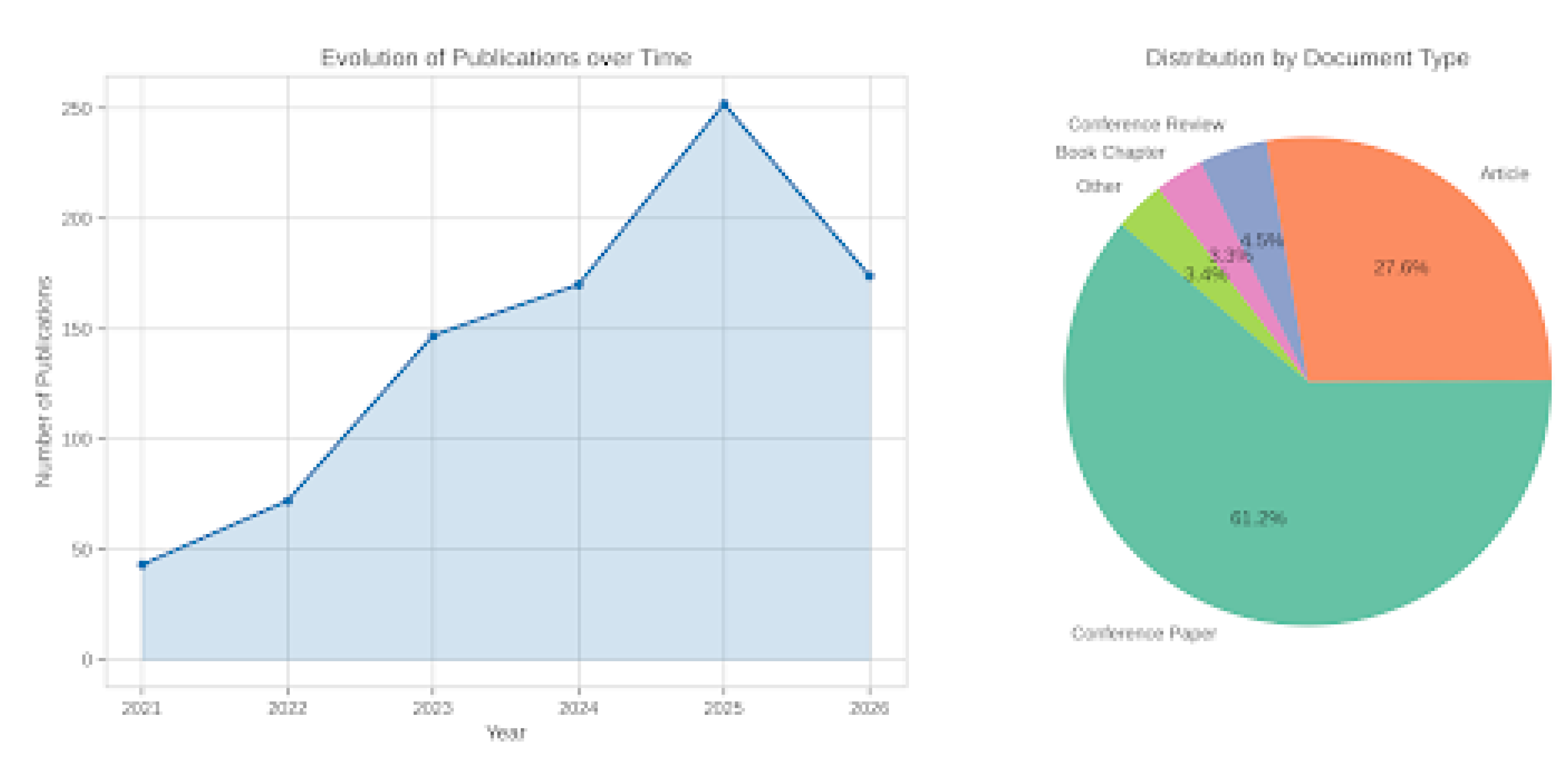
Figure 3.
Top 10 most influential publication venues driving the academic discourse in software supply chain security.
Figure 3.
Top 10 most influential publication venues driving the academic discourse in software supply chain security.
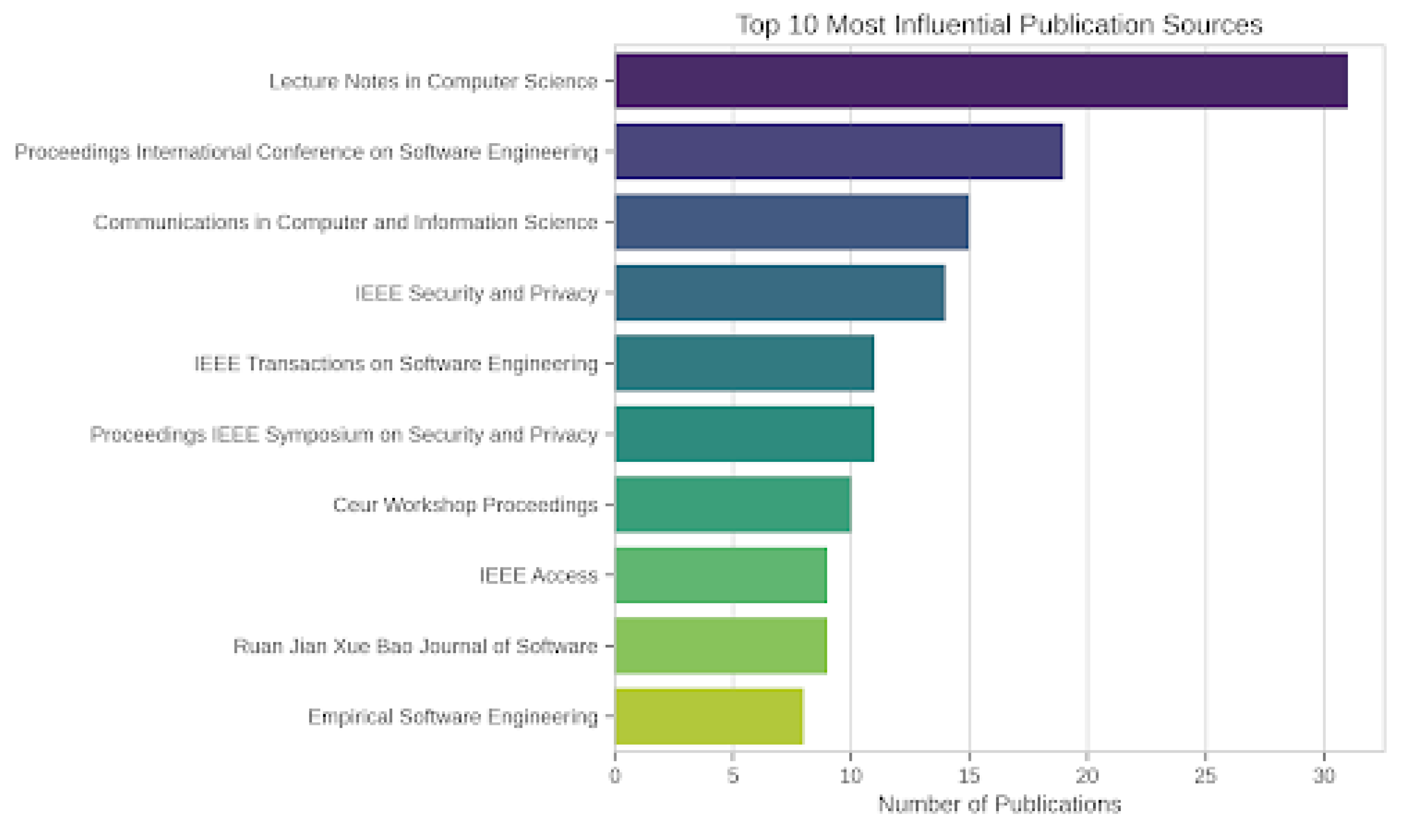
Figure 4.
Geographic and institutional distribution highlighting the top 10 most prolific countries and academic research centers.
Figure 4.
Geographic and institutional distribution highlighting the top 10 most prolific countries and academic research centers.
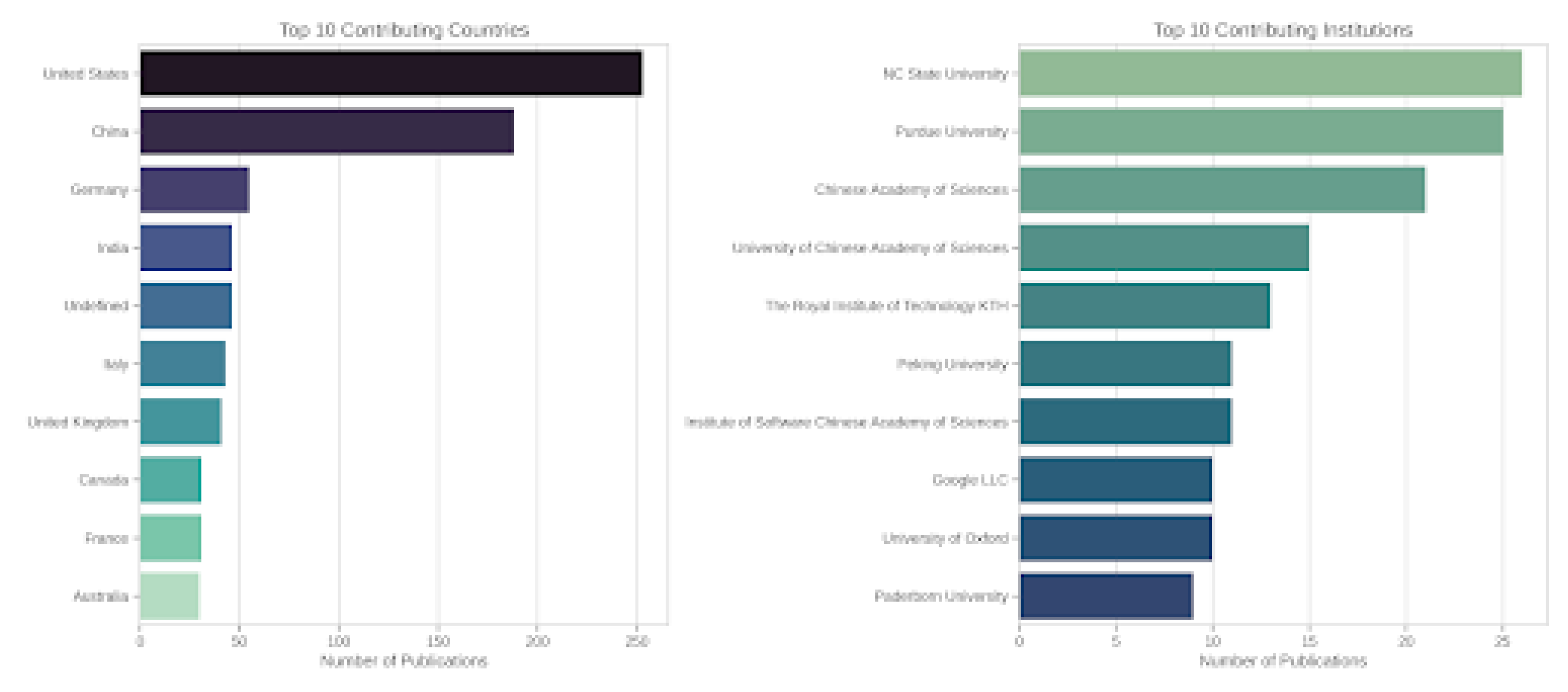
Figure 5.
Leading national, international, and corporate funding agencies sustaining software supply chain research initiatives.
Figure 5.
Leading national, international, and corporate funding agencies sustaining software supply chain research initiatives.
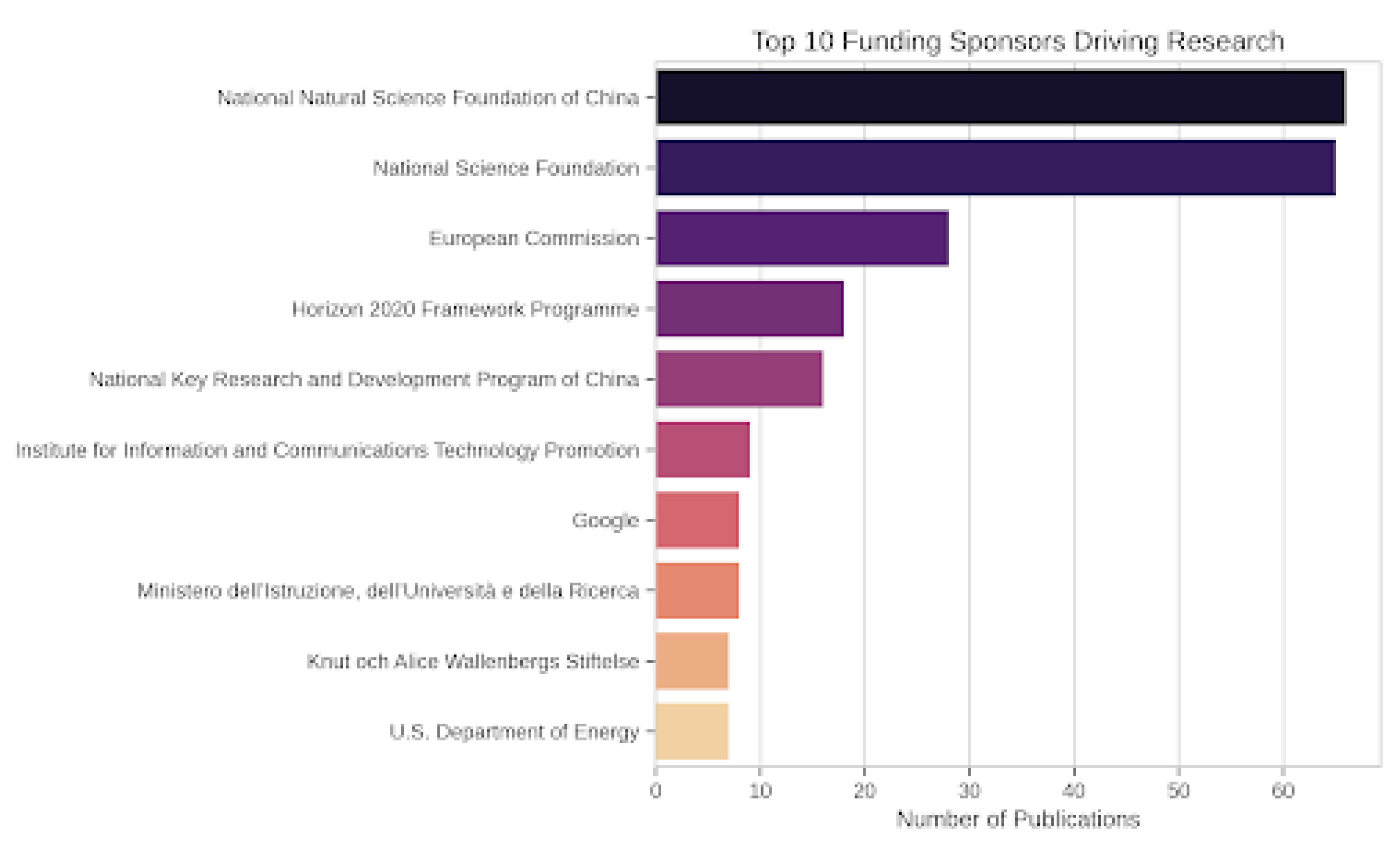
Figure 6.
Author keywords co-occurrence network visualizing the conceptual structure and the five distinct thematic clusters defining the Supply chain ecosystem.
Figure 6.
Author keywords co-occurrence network visualizing the conceptual structure and the five distinct thematic clusters defining the Supply chain ecosystem.
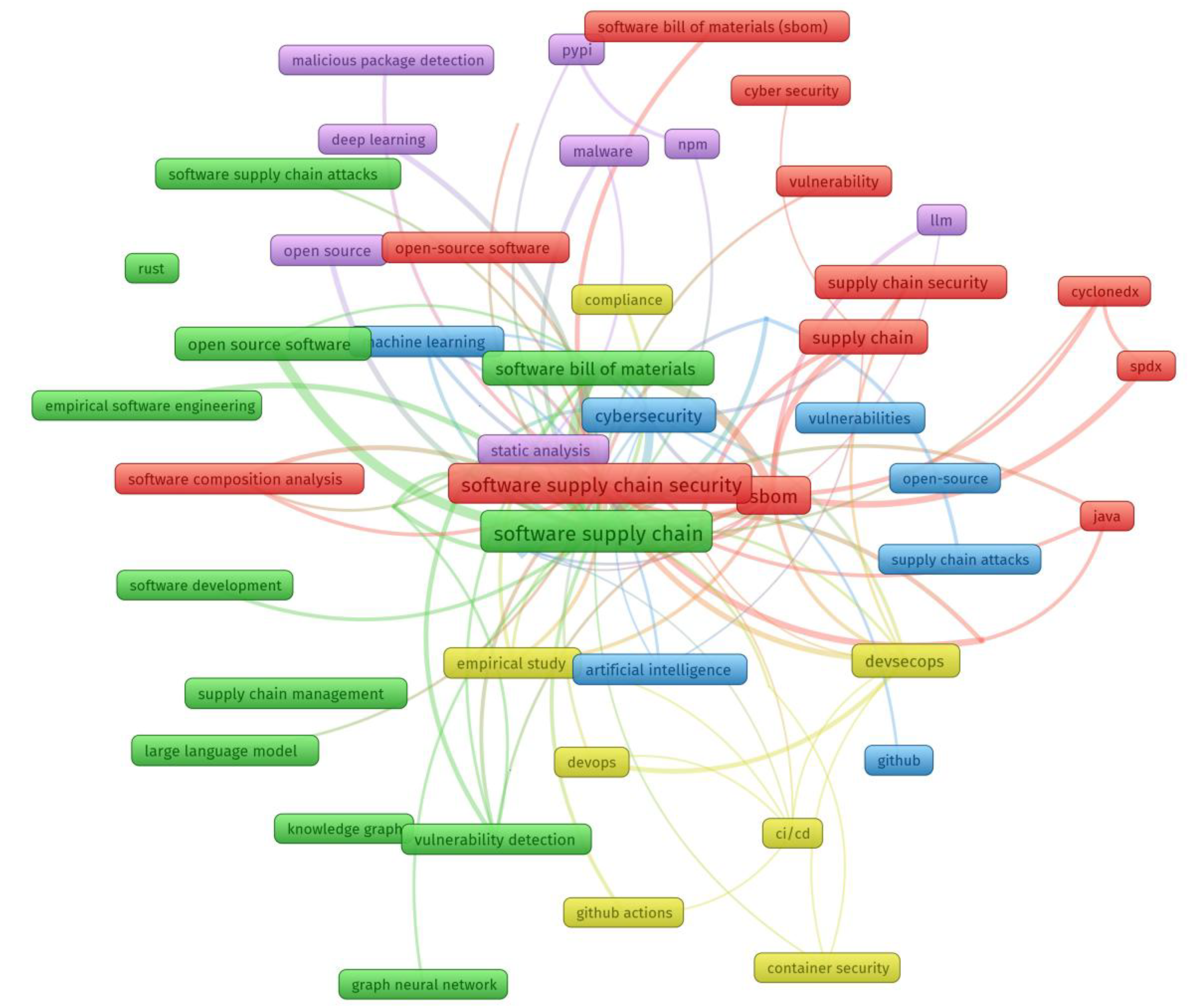

Table 1.
Thematic clusters defining the conceptual structure of software supply chain research, detailing core keywords and overarching research categories.
Table 1.
Thematic clusters defining the conceptual structure of software supply chain research, detailing core keywords and overarching research categories.
| Cluster Color | Keywords | Categories |
| Red | software supply chain security, sbom, software bill of materials (sbom), supply chain, supply chain security, vulnerability, cyber security, software composition analysis, java, spdx, cve / nvd | Software composition analysis of open software for supply chain security and organizational readiness using blockchain; software engineering for cybersecurity; software bill of materials (SBOM) for supply chain resilience; using Java for reproducible builds; CycloneDX as SBOM standard. |
| Green | software supply chain, open source software, software supply chain attacks, empirical software engineering, rust, software development, supply chain management, large language model, knowledge graph, vulnerability detection, graph neural network | Large language models and empirical software engineering in proactive vulnerability detection, supply chain management, and incident preparedness; SBOM and vulnerability detection; Rust and security in software supply chains. |
| Blue | cybersecurity, machine learning, artificial intelligence, vulnerabilities, open-source, supply chain attacks, github | Artificial intelligence, GitHub, and Internet of Things in detecting vulnerabilities, malware detection, and cyberattack mitigation. Cybersecurity in open-source software. |
| Purple | open-source software, malicious package detection, deep learning, static analysis, malware, npm, pypi, llm | Static deep learning-supported analysis for malicious package and malware detection to secure foundational digital technologies. |
| Yellow | empirical study, compliance, devsecops, devops, ci/cd, github actions, container security | Vulnerability management with DevOps and DevSecOps for continuous digital resilience; vulnerability management and empirical studies of compliance in DevOps and CI/CD chains. |
Disclaimer/Publisher’s Note: The statements, opinions and data contained in all publications are solely those of the individual author(s) and contributor(s) and not of MDPI and/or the editor(s). MDPI and/or the editor(s) disclaim responsibility for any injury to people or property resulting from any ideas, methods, instructions or products referred to in the content. |
© 2026 by the authors. Licensee MDPI, Basel, Switzerland. This article is an open access article distributed under the terms and conditions of the Creative Commons Attribution (CC BY) license.
Copyright: This open access article is published under a Creative Commons CC BY 4.0 license, which permit the free download, distribution, and reuse, provided that the author and preprint are cited in any reuse.