

Submitted:
03 November 2026
Posted:
04 November 2026
You are already at the latest version
Abstract
Introduction: African philosophies, including Ubuntu, Botho, Sankofa and related epistemological traditions, are increasingly invoked in scholarship concerned with decolonisation, relationality, epistemic justice and contextually grounded knowledge. However, their use as explicit research philosophies or methodological paradigms remains conceptually uneven. This review examined how African philosophies are integrated and operationalised within academic writing, the epistemic confidence and methodological engagement reflected in the literature, the associated risks and barriers, and the contextual conditions.Methods: The researcher-selected databases and information sources were Google Scholar and ERIC. The eligibility protocol restricted publication years to 2016–2026. The exact calendar date of search execution was not recorded in the verified identification provenance; this is distinct from the publication-year eligibility range. A systematic review searched Google Scholar and ERIC using a verified Boolean strategy and applied eligibility limits covering English-language publications from 2016 to 2026.Results: The synthesis identified four analytical themes. African philosophies were presented as relational, situated and emancipatory bases for knowing; operationalisation was predominantly applied, plural and incremental rather than fully methodological; epistemic confidence was qualified by concerns about authenticity, adequacy and verification; and institutional structures continued to limit meaningful integration. Context, language, community relationships and intercultural dialogue shaped effective use. Evidence about researchers’ confidence was indirect and methodological accounts were less developed than conceptual claims.Discussion/Conclusion: The literature supports cautious confidence that African philosophies can inform research and scholarly practice, but it does not establish a single, mature or consistently operationalised African research methodology. Meaningful integration requires conceptual depth, linguistic and contextual engagement, institutional transformation and transparent methodological specification.
Keywords:
African philosophies
; epistemic confidence
; research philosophy
; thematic synthesis
; Ubuntu
1. Introduction
African philosophies have become increasingly visible in debates about knowledge production, decolonisation, epistemic justice and the transformation of higher education. Across the supplied literature, Ubuntu and related concepts are represented not simply as cultural or ethical ideas but as possible resources for theorising personhood, knowledge, responsibility, community and social transformation. Ubuntu is commonly associated with relational existence, mutuality, compassion, dignity and collective responsibility, while African epistemology is presented as a way of interpreting reality through culturally situated categories and collective experience (Ajayi & Ashir, 2024; Ewuoso & Hall, 2019; Ferlito et al., 2024).
The literature also contains stronger paradigm-level claims. African philosophies are described as sources of concepts, theories, models and evaluation frameworks, and African or indigenous approaches are positioned as contributing to an evolving research and evaluation paradigm (Chilisa, 2024). Other scholarship develops African logic, conversationalism, deliberative epistemology, intercultural philosophy and decolonial approaches as possible methodological or epistemological resources (Chimakonam, 2017; Chimakonam, 2020; Tavernaro-Haidarian, 2018). Applied examples extend across nursing, education, social work, governance, journalism, family business, evaluation and artificial-intelligence ethics (Ferlito et al., 2024; Kupangwa, 2024; Muhammad-Lawal et al., 2022; Tavernaro-Haidarian, 2020).
At the same time, the supplied literature identifies substantial uncertainty. Some authors explicitly limit their claims to an approach inspired by Ubuntu rather than a systematic theory or complete paradigm (Ferlito et al., 2024). Concerns are raised about conceptual ambiguity, rebranding of Western concepts, shallow theorisation, appropriation, linguistic disconnection and the difficulty of verifying situated or esoteric knowledge (Ajayi & Ashir, 2024; Rettová, 2021). Institutional marginality, orthodox curricula, elective ghettoisation and continuing doubts about the legitimacy of African philosophy further constrain adoption (Dladla, 2018).
What remains insufficiently understood is how consistently African philosophies are operationalised as research philosophies in academic writing, how much of the literature demonstrates methodological engagement rather than ethical or interpretive inspiration, and what basis exists for confidence in their epistemic adequacy. The literature includes conceptual, perspective-oriented and applied scholarship, but the extent to which these forms converge on a coherent methodology is unclear. This review was therefore conducted to synthesise the available evidence across disciplines, distinguish conceptual claims from methodological enactment, and clarify the conditions and limitations under which African philosophies may be integrated into scholarly research.
2. Research Objectives
RO1: To examine how Integration of African philosophies (such as Ubuntu) as a research paradigm or philosophical framework influences Extent, conceptual operationalization, methodological patterns, and researcher confidence in applying African research philosophies among Academic writing and scholarly research outputs within Higher education research and academic publishing across scholarly disciplines.
RO2: To analyse the challenges, risks, ethical considerations and implementation barriers associated with Integration of African philosophies (such as Ubuntu) as a research paradigm or philosophical framework for Academic writing and scholarly research outputs.
RO3: To examine the contextual, institutional and practice-related factors that shape the adoption and effective use of Integration of African philosophies (such as Ubuntu) as a research paradigm or philosophical framework within Higher education research and academic publishing across scholarly disciplines.
3. Research Methods
3.1. Review Design
The selected review type was Systematic Review. This design was appropriate because the project sought to identify and integrate a defined body of literature across disciplines using explicit eligibility criteria, structured selection, critical appraisal and a traceable qualitative synthesis. The review was distinguished from PRISMA, which concerns reporting, CASP, which provides study-design-specific critical appraisal, and COSTAQDA, which supported traceability and qualitative synthesis. Review typology and the Search, Appraisal, Synthesis and Analysis logic of SALSA provide relevant methodological context (Grant & Booth, 2009; Costa & Costa, 2024).
3.2. Search Strategy and Information Sources
The researcher-selected databases and information sources were Google Scholar, ERIC. The eligibility protocol restricted publication years to 2016–2026. The exact calendar date of search execution was not recorded in the verified identification provenance; this is distinct from the publication-year eligibility range.
Full Boolean search string (exactly as recorded)
("African Philosophy" OR "African philosophy" OR "African philosophies" OR Ubuntu OR Botho OR Ukama OR "African epistemology" OR Afrocentricity OR "Afrocentric paradigm" OR "Indigenous African knowledge systems") AND ("Research Philosophy and Methodology" OR "research philosophy" OR "research paradigm" OR "epistemological framework" OR epistemology OR "ontological framework" OR methodology OR "academic writing" OR "scholarly research") AND ("Integration and Epistemic Confidence" OR integration OR operationalization OR application OR adoption OR uptake OR implementation OR "epistemic confidence" OR "authorial reflexivity" OR "methodological positioning")
3.3. Inclusion and Exclusion Criteria
Inclusion
- Peer-reviewed academic writing and scholarly literature across any academic discipline.
- Studies that explicitly integrate or operationalize African philosophies (e.g., Ubuntu, Botho, Ukama) as a research philosophy, epistemology, ontology, or methodological paradigm.
- Literature evaluating or demonstrating patterns of implementation, authorial epistemic confidence, methodological execution, or operationalization challenges of African philosophies in research.
- Studies situated within global academic publishing or higher education research practices.
- Publication types limited to peer-reviewed journal articles (including empirical, conceptual, theoretical, and methodological journal articles).
- Studies published between 2016 and 2026 (inclusive).
- Articles published in the English language.
Exclusion
- Literature outside the context of academic writing and scholarly research paradigms.
- Publications that mention African philosophies only as social, ethical, or political concepts without applying them as explicit research philosophies, epistemologies, or methodologies.
- Studies that do not address or report on the implementation, epistemic positioning, authorial confidence, or operationalization challenges of African research philosophies.
- Studies focusing on non-academic or non-scholarly publication environments outside higher education and academic publishing.
- Non-peer-reviewed literature, including book chapters, dissertations, theses, conference abstracts, book reviews, editorials, opinion pieces, and grey literature.
- Studies published prior to 2016 or after 2026.
- Studies published in languages other than English.
3.4. Screening and Study Selection
The PRISMA selection counts are persisted, but the decision rule used during title/abstract screening is not available in the verified audit payload. COSTAQDA therefore reports the recorded workflow counts without reconstructing an unverified screening procedure.
The persisted PRISMA workflow records 149 identified records, 7 duplicates, 141 records screened, 106 reports sought for retrieval, 35 records excluded at the title/abstract stage, 61 full texts assessed, 2 full-text exclusions and 60 included records. These counts describe study selection and are not substantive review findings.
Figure 1.
PRISMA 2020 Flow Diagram — Identification, Screening, Eligibility and Included. Source: COSTAQDA PRISMA Workflow, navigation item 8: PRISMA Flow Diagram; four-stage structure showing Identification, Screening, Eligibility (including CASP critical appraisal) and included; adapted from PRISMA 2020 (Page et al., 2021).
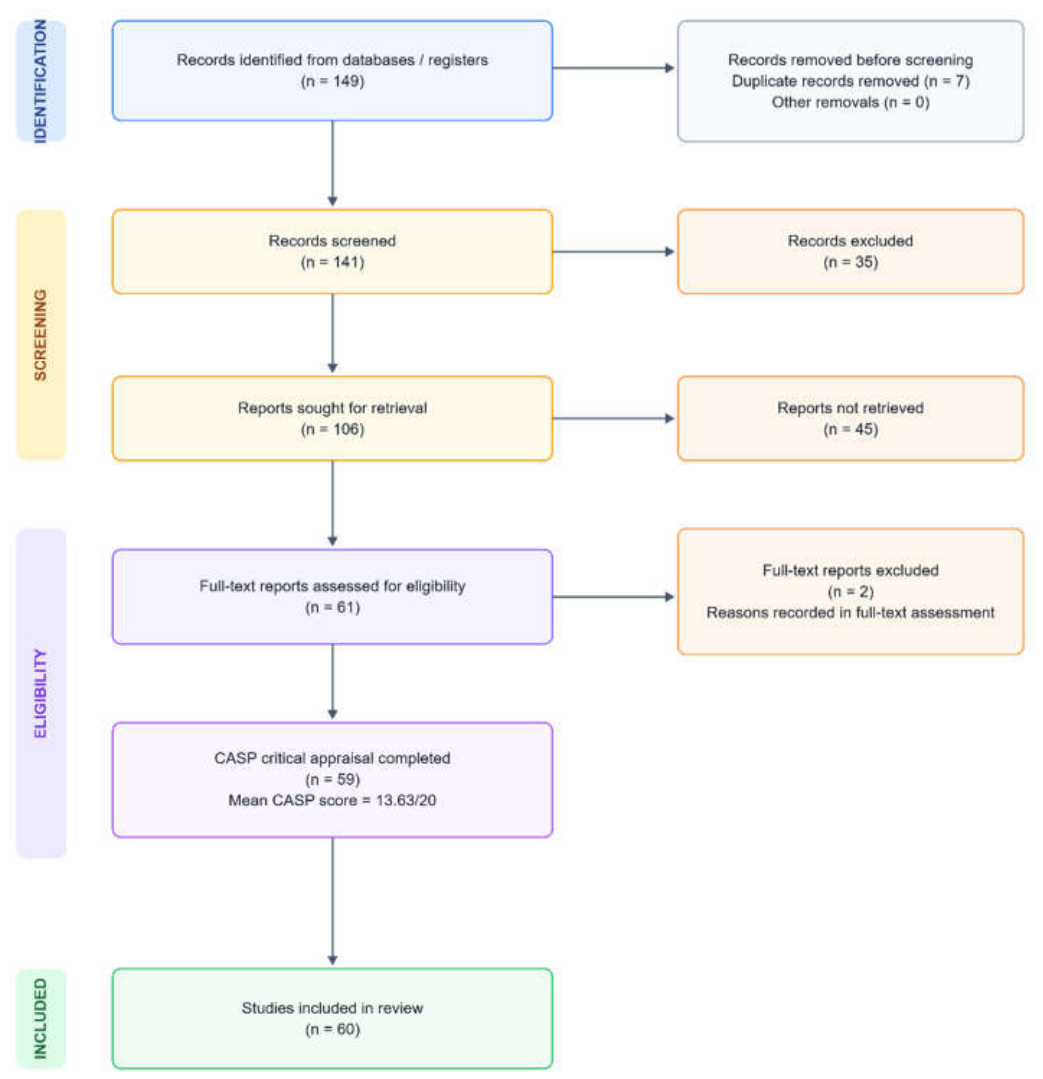
The PRISMA figure represents study identification and selection rather than substantive findings. Its recorded units are records or reports at successive workflow stages: 149 identified, 7 duplicates, 141 screened, 106 sought for retrieval, 35 title or abstract exclusions, 61 full texts assessed, 2 full-text exclusions and 60 included. The figure is useful for transparency because it distinguishes retrieval, screening, eligibility and inclusion, but the two persisted numerical discrepancies mean that the displayed flow should be treated as unverified in the affected transitions rather than silently recalculated.
3.5. Critical Appraisal
Critical appraisal used the Critical Appraisal Skills Programme (CASP) within the PRISMA full-text workspace. CASP offers structured questions concerning methodological validity, the credibility of findings and their relevance; in this project, the applicable tool was recorded as the CASP qualitative research checklist (Critical Appraisal Skills Programme, 2024). Appraisal was completed for 59 of the 60 currently included records. The supplied summary reports a mean score of 13.63, but this mean is not treated as a definitive quality ranking because CASP is a study-level checklist and the record does not supply a validated total-score interpretation.
The available study-linked summary shows broad variation in recorded scores, from 11 to 19 among the displayed appraisals. Higher recorded scores included Muhammad-Lawal et al(2022), Motswaledi and Marumo (2023), and several other studies, whereas lower recorded scores included Oelofsen and Mqalo (2025), Roper and Clarke (2020), and studies addressing epistemic marginalisation. These differences indicate variation in the completeness of the available text evidence, not necessarily equivalent differences in substantive methodological quality.
The appraisal record is unusually important for interpretation because most completed rows contain a conservative text-evidence decision stating that unsupported criteria were recorded as Can't tell and require researcher verification. The configured automated appraisal service was unavailable because of quota exhaustion, after which COSTAQDA completed a conservative text-based appraisal. This preserves an audit trail, but it also means that many criterion-level judgments remain limited by the supplied text and cannot be assumed to be independently verified researcher judgments.
Study-specific limitations are recorded unevenly. For example, Mungwini (2024) has concerns recorded for CASP criteria 2, 3, 4, 6, 7 and 8; Kupangwa (2024) has concerns across criteria 2 through 7; and Muhammad-Lawal et al(2022). has a more limited recorded concern at criterion 6. These records support caution when interpreting conceptual and perspective-oriented claims, particularly where extracted material is partial or derived from webpage content. They do not justify reducing the evidence to a single total-quality score (Long et al., 2020).
The CASP findings constrain the synthesis in two ways. First, the evidence base contains conceptual and perspective scholarship alongside applied work, so convergence of ideas does not establish convergence of research designs. Second, the extraction is uneven and several records contain truncated text, metadata or webpage material rather than complete study findings. Methodological limitations should therefore temper claims that African philosophies constitute an established research methodology, while the recurring conceptual and applied patterns remain relevant to the review objectives (Noyes et al., 2018). No CERQual assessment was recorded, and CASP scores were not converted into finding-level confidence ratings (Lewin et al., 2018).
Figure 2.
CASP Critical Appraisal Intelligence — PRISMA Workflow, Step 6: Full-Text Screening. Source: COSTAQDA PRISMA Workflow, navigation item 6: Full-Text Screening (CASP critical appraisal outputs). The Word figure is generated from the same deterministic COSTAQDA CASP visual.
Figure 2.
CASP Critical Appraisal Intelligence — PRISMA Workflow, Step 6: Full-Text Screening. Source: COSTAQDA PRISMA Workflow, navigation item 6: Full-Text Screening (CASP critical appraisal outputs). The Word figure is generated from the same deterministic COSTAQDA CASP visual.
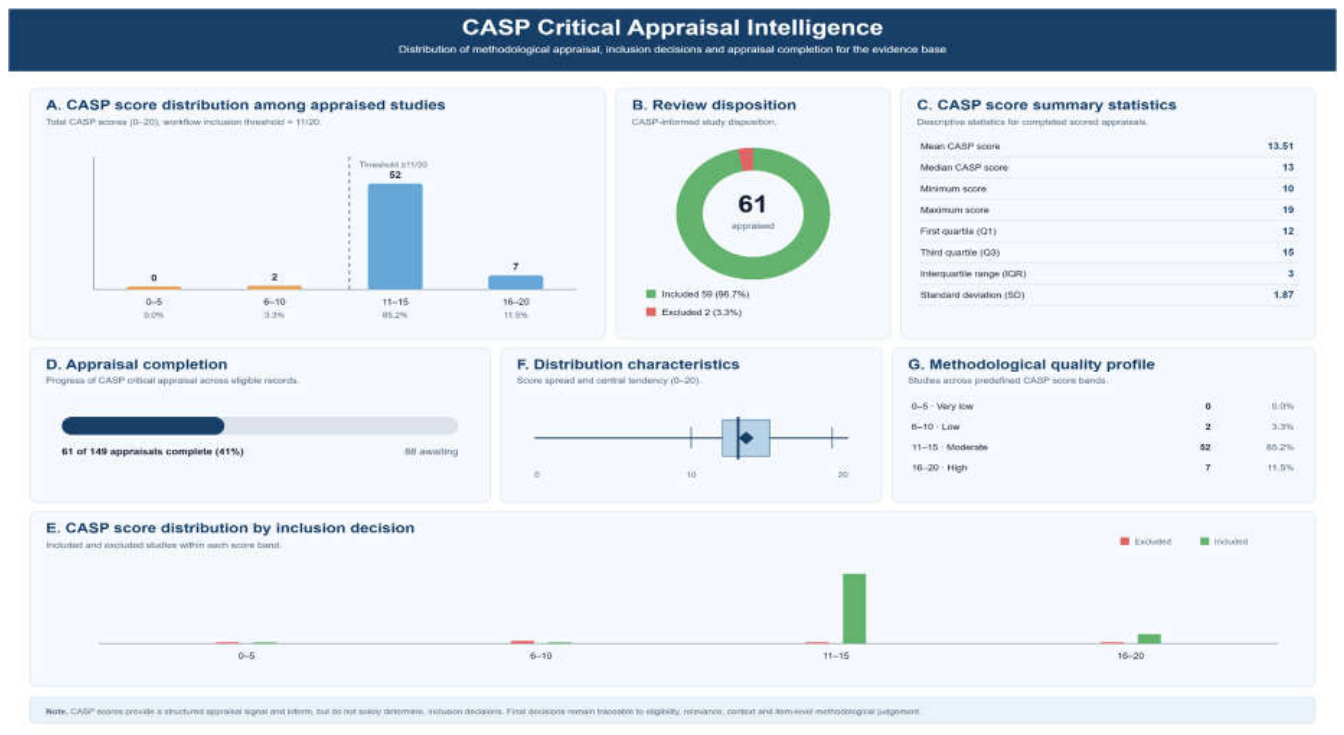
The CASP figure represents study-level appraisal records for 60 included studies, of which 59 were completed, with a reported mean score of 13.63. It is appropriate as a descriptive overview of appraisal coverage and recorded judgments, but the visual should not be interpreted as a validated measure of methodological quality or as evidence that studies with higher scores are more influential or more correct. The scores span a heterogeneous set of conceptual, perspective, qualitative and applied records, and the underlying criterion-level judgments are not fully available.
The appraisal pattern is best read as a map of documented methodological sufficiency and uncertainty. The displayed records include repeated concerns across criteria relating to study clarity, methodological development, analysis, reflexivity and relevance, although the supplied workspace does not provide enough criterion-level detail to specify the meaning of every concern. The inclusion of a study with no completed score, An African Philosophy for Children: Towards a Situated Paradigm, further demonstrates that appraisal coverage was incomplete.
The CASP narrative also records a technical limitation: automated appraisal was interrupted by service-quota exhaustion and replaced by conservative text-evidence appraisal. This is a strength for traceability because unresolved records were not silently omitted, but it limits the authority of unsupported judgments. The figure should therefore inform sensitivity and cautious interpretation, not provide a composite quality verdict (Long et al., 2020; Costa & Costa, 2024).
3.6. Data Extraction
A formal data-extraction procedure was not recorded. The verified synthesis nevertheless demonstrates that finding-level extraction occurred for 27 studies and produced 157 extracted findings. The available extraction fields included bibliographic metadata, abstracts, appraisal information and finding text, with supporting finding and study identifiers retained in the synthesis workspace. Because extraction procedures, fields, duplicate checking and extractor verification were not documented, the completeness and consistency of extraction cannot be independently established.
3.7. Data Synthesis and Analysis
Qualitative evidence synthesis was conducted on 157 extracted findings contributed by 27 studies. The COSTAQDA synthesis engine applied thematic synthesis, moving from traceable finding-level evidence to 10 initial codes, 4 categories, 1 descriptive themes and 4 analytical themes.
Theme development was constrained to the extracted finding-level evidence supplied by eligible studies. Each synthesised theme retained supporting study IDs and finding IDs, while contradictory evidence was preserved where identified. Titles, abstracts and bibliographic prominence were not treated as substitutes for extracted qualitative findings.
Recorded synthesis limitations included: The supplied extraction is uneven: several records contain metadata, webpage material or partial text rather than substantive study findings.; Direct evidence about researchers' confidence in applying African philosophies is limited; confidence is inferred mainly from claims of usefulness, teachability, paradigm development and stated cautions.; Methodological operationalization is described more clearly in applied fields such as evaluation, nursing, education, governance and ethics than in detailed accounts of complete research designs.; The findings include conceptual and perspective-oriented scholarship alongside applied studies, so convergence should not be interpreted as evidence of a single established African research methodology.; Because several findings are truncated, the synthesis cannot assess the full arguments, methods or contextual qualifications of every included study..
3.8. Bibliometric Intelligence and Confidence in the Evidence Base
Bibliometric intelligence provides a structural view of the evidence base that complements PRISMA selection, critical appraisal and qualitative synthesis. The following analyses examine citation relationships, scholarly influence, evidence connectivity and knowledge development within the included corpus. They provide contextual evidence about the intellectual structure and provenance of the literature and are not substitutes for methodological quality appraisal.
3.8.1. Local Citation Network
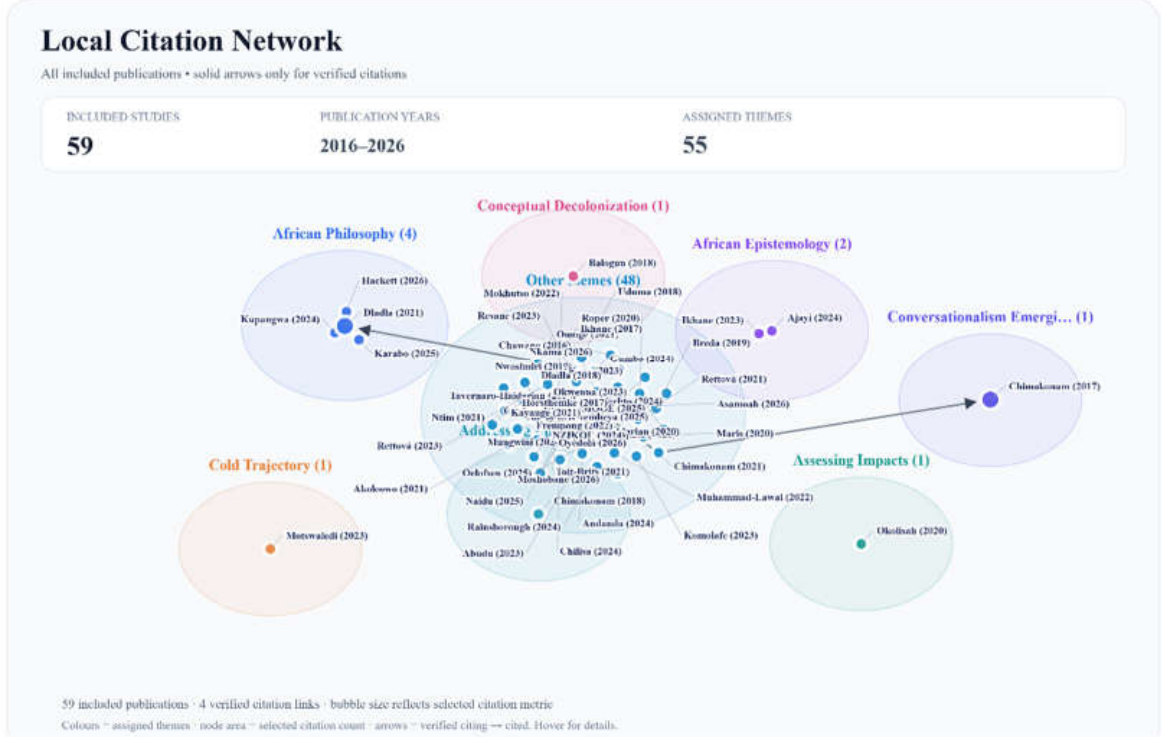
The Local Citation Network maps citation relationships within the included evidence base. It shows how studies are connected within the review corpus and supports examination of intellectual connectedness, centrality, bridging and isolation. These citation relationships describe the structure of the literature and do not, by themselves, establish methodological quality or validity.
Figure 3.
Local Citation Network — Bibliometric Intelligence, Step 12. Source: COSTAQDA PRISMA Workflow, navigation item 12: Bibliometric Intelligence — Local Citation Network.
Figure 3.
Local Citation Network — Bibliometric Intelligence, Step 12. Source: COSTAQDA PRISMA Workflow, navigation item 12: Bibliometric Intelligence — Local Citation Network.
3.8.2. Influence Pyramid
The Influence Pyramid represents the distribution of scholarly influence within the included evidence base. It helps identify how bibliometric prominence is distributed across the reviewed studies. Influence is interpreted separately from methodological quality, which is assessed through critical appraisal.
Figure 4.
Influence Pyramid. Source: COSTAQDA PRISMA Workflow, navigation item 12: Bibliometric Intelligence — Influence Pyramid.
Figure 4.
Influence Pyramid. Source: COSTAQDA PRISMA Workflow, navigation item 12: Bibliometric Intelligence — Influence Pyramid.
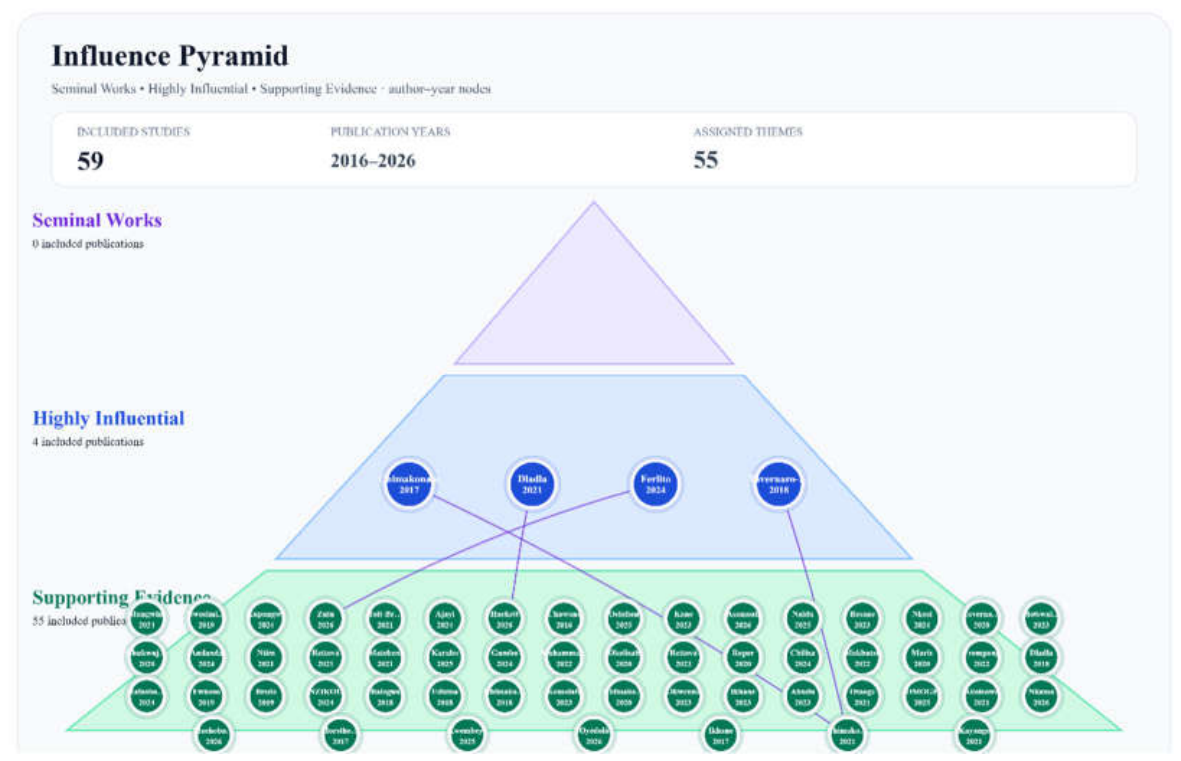
The Influence Pyramid is a bibliometric prominence visualisation whose unit of analysis is included publications or study-linked bibliometric nodes. The supplied OpenAlex metadata cover 59 included records and report global citations, local citations and an influenceScore, with 472 global citations, four local citations and four links recorded overall. Such a visualisation is appropriate for describing the visibility or prominence of works within the retrieved evidence ecosystem, consistent with bibliometric guidance on transparent units, coverage and denominators (Donthu et al., 2021; Zupic & Čater, 2015).
The strongest recorded prominence patterns are concentrated in a small set of nodes: Ewuoso and Hall's Core aspects of ubuntu: A systematic review has 82 global citations; Chawane's The development of Afrocentricity has 77; Chimakonam's Conversationalism has 52; Muhammad-Lawal et al.'s nursing study has 34; and Ferlito et al.'s Ubuntu-inspired AI ethics article has 27. Local citations are recorded for Chimakonam (2017), Ferlito et al(2024)., Tavernaro-Haidarian (2018), Dladla (2021) and Gumbo (2024). These patterns suggest that conceptual, methodological and applied works occupy different positions in the bibliometric landscape, but they do not establish methodological quality, epistemic confidence, causal importance or consensus.
The influenceScore is supplied as a variable, but its formula and underlying citation-coverage procedures are not recorded. Comparability of scores therefore cannot be independently established. The pyramid must not be read as a quality hierarchy or as evidence that highly cited studies provide stronger support for the analytical themes. It is a contextual prominence map only and remains distinct from CASP appraisal and qualitative synthesis (Donthu et al., 2021; Zupic & Čater, 2015).
3.8.3. Evidence Strength
The Evidence Strength analysis examines the structure and strength of relationships within the evidence ecosystem assembled for the review. It complements, but does not replace, CASP methodological appraisal and must not be interpreted as a direct estimate of causal effect.
Figure 5.
Evidence Strength Network. Source: COSTAQDA PRISMA Workflow, navigation item 12: Bibliometric Intelligence — Evidence Strength Network.
Figure 5.
Evidence Strength Network. Source: COSTAQDA PRISMA Workflow, navigation item 12: Bibliometric Intelligence — Evidence Strength Network.
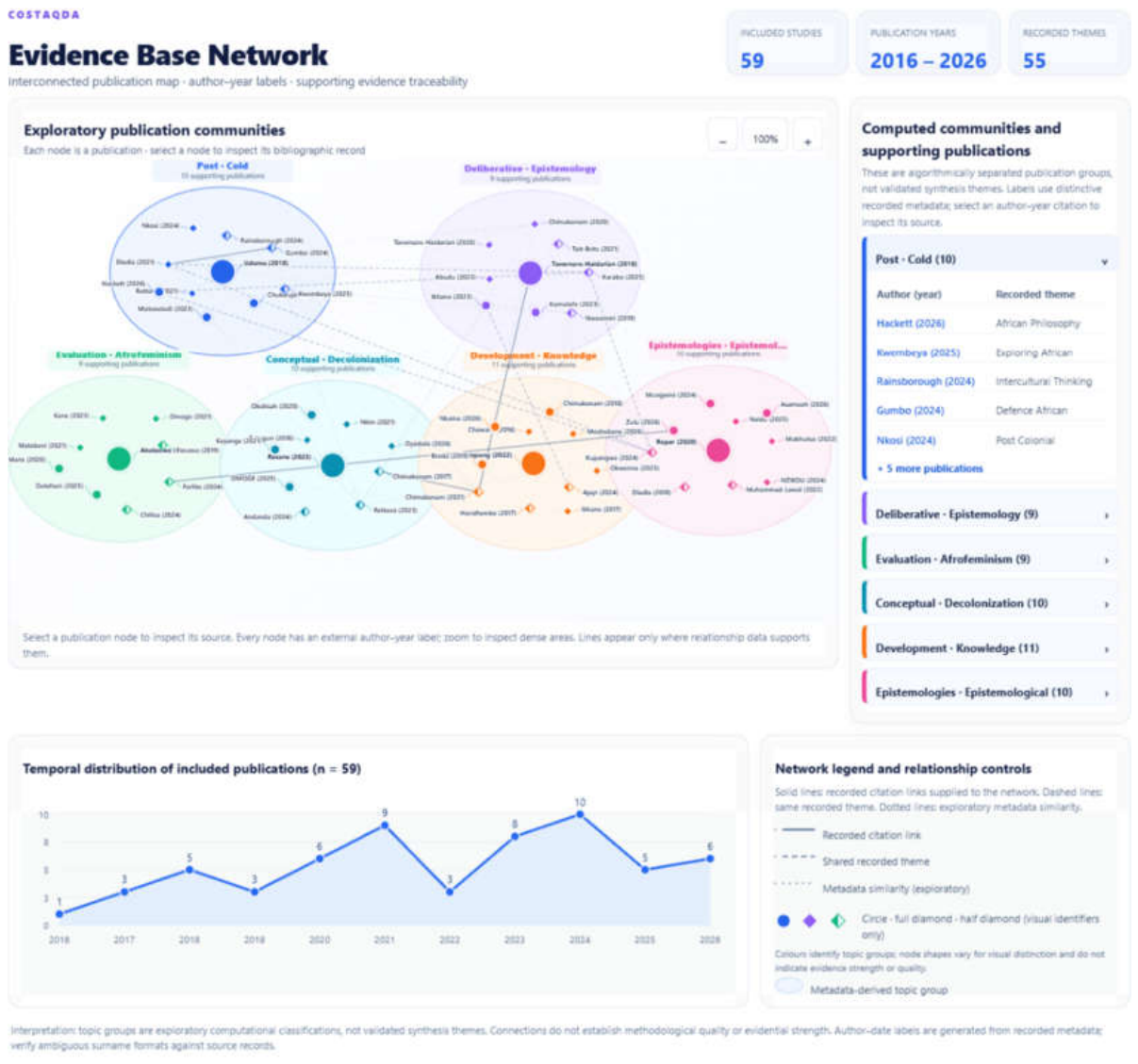
The Evidence Strength Network represents relationships among included-study nodes. Its recorded coverage is 59 included records, four direct edges and three thematic clusters in the OpenAlex intelligence, while the supplied network edges specify relation type as direct and provide no edge weights. This visualisation is appropriate for showing the displayed structure of connections within the evidence ecosystem, but it cannot establish independent corroboration, study quality, causal strength or confidence in an observed effect (Zupic & Čater, 2015).
The observable structure consists of four direct relationships: Ubuntu beyond borders is linked to the Ubuntu-inspired AI healthcare article; In defence of African philosophy is linked to African Philosophy? Questioning the Unquestioned; Toward an African Theory of Knowledge is linked to Conversationalism and to Deliberative epistemology. The network therefore displays connections among works concerned with Ubuntu, African philosophy, knowledge and dialogical or deliberative approaches. Because relation semantics beyond 'direct' and edge weights are absent, the displayed links should be interpreted as structural associations rather than corroborating evidence.
The Evidence Strength Network does not replace CASP or a finding-level confidence assessment. It may help readers understand how selected studies are connected in the evidence ecosystem, but it cannot determine whether linked studies use compatible methods, report similar findings or provide independent support. The lack of weights and the unavailable figure-level data limit more detailed interpretation.
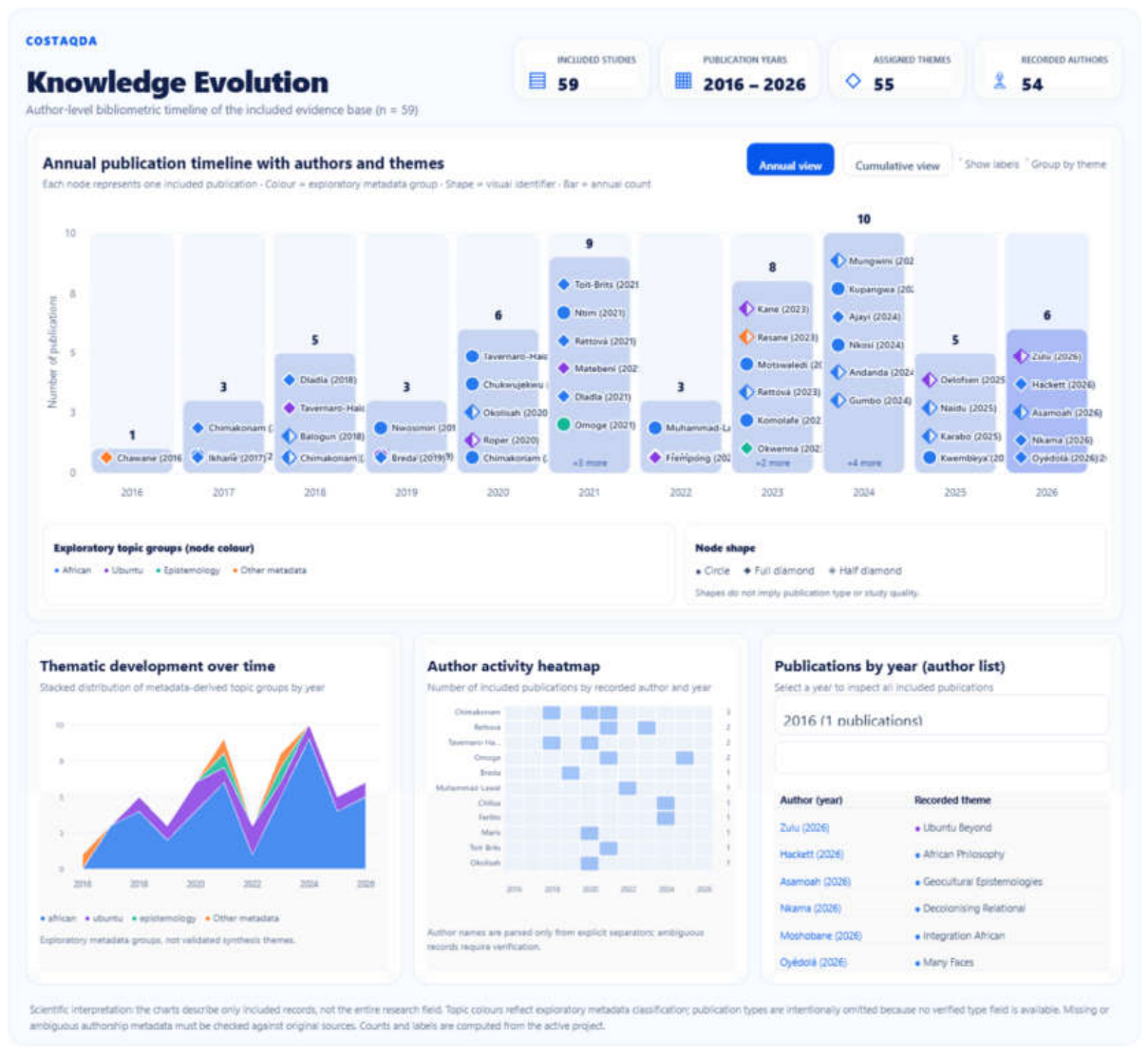
3.8.4. Knowledge Evolution
Knowledge Evolution examines the temporal and intellectual development of the included evidence base. It traces how research contributions develop over time and, where supported by the Step 12 data, how later studies extend, connect, challenge or consolidate earlier contributions.
Figure 6.
Knowledge Evolution. Source: COSTAQDA PRISMA Workflow, navigation item 12: Bibliometric Intelligence — Knowledge Evolution.
Figure 6.
Knowledge Evolution. Source: COSTAQDA PRISMA Workflow, navigation item 12: Bibliometric Intelligence — Knowledge Evolution.
3.8.5. Integrated Confidence in the Synthesised Evidence
No separate finding-level confidence method was recorded. Accordingly, the review does not assign CERQual, GRADE-CERQual or another formal confidence rating. CASP provided study-level methodological appraisal, while thematic synthesis provided the analytic basis for conclusions. Bibliometric outputs were treated as contextual evidence maps rather than confidence assessments, and neither CASP scores nor bibliometric prominence were used as substitutes for finding-level confidence (Lewin et al., 2018).
4. Findings
4.1. Search and Selection Results
The recorded selection workflow comprised 149 identified records, 7 duplicates, 141 screened records, 106 reports sought for retrieval, 35 title or abstract exclusions, 61 full-text assessments, 2 full-text exclusions and 60 included records. These are process findings rather than substantive findings. The identified-to-screened and assessed-to-included transitions contain unresolved discrepancies, so the exact denominator of the final selection cannot be fully verified.
4.2. Characteristics of Included Studies
The included evidence was multidisciplinary and heterogeneous, spanning African philosophy, epistemology, evaluation, nursing, education, social work, governance, journalism, law, family business, artificial-intelligence ethics and higher education. The supplied records included conceptual analyses, perspective articles, qualitative applied studies, literature-based work, systematic review material and records described as chapters or ebooks. The verified thematic synthesis drew on 27 studies and 157 extracted findings, whereas 60 records were recorded as included overall; this difference reflects the subset contributing eligible extracted findings to the synthesis rather than a reconciled count of all included records.
The evidence base was predominantly conceptual or interpretive in the available extraction. Applied methodological engagement was clearest in evaluation, nursing, education, governance, social work and ethics. The qualitative nursing study used eight focus-group interviews and Colaizzi's seven-step analysis, whereas other records proposed frameworks, research questions or philosophical positions without presenting complete empirical research designs (Chilisa, 2024; Muhammad-Lawal et al., 2022; Kupangwa, 2024).
4.3. Methodological Strengths and Limitations of Included Studies
A principal strength was the traceable progression from finding-level evidence to codes, categories and analytical themes, with supporting study and finding identifiers retained. Contradictory evidence was also preserved where identified. The evidence base nevertheless had uneven extraction, truncated findings, webpage material and incomplete methodological information. The stated inclusion protocol also appears misaligned with the final record set because the latter contains chapters, books, ebooks, repository records and Zenodo records.
CASP appraisal was completed for 59 of 60 included studies, but the project did not record a separate confidence method and did not provide full criterion-level judgments or researcher verification for every appraisal. The automated appraisal service was unavailable because of quota exhaustion, leading to conservative text-evidence appraisal. Consequently, conclusions should be treated as a cautious synthesis of heterogeneous evidence rather than a formally graded body of evidence.
4.4. Thematic Synthesis
The thematic synthesis approach postulated by Thomas and Harden (2008), was adopted in this stusy. The study-specific findings and support counts below derive from the included evidence, not from this methodological citation.
Thematic synthesis is a systematic qualitative evidence-synthesis method used to integrate findings across multiple studies while retaining a transparent connection to the underlying evidence. The process moves iteratively from extracted study findings to coding, the grouping of related codes into descriptive categories or themes, and the development of higher-order analytical themes that answer the review question and research objectives. Its purpose is not merely to count how often an idea appears, but to identify patterned meaning across studies, examine convergence and divergence, preserve contextual differences, and develop an auditable interpretation that remains traceable to the contributing evidence.
In this review, thematic synthesis was applied to the verified extracted findings retained in the active COSTAQDA project. Findings were compared across eligible studies, coded and grouped according to conceptual similarity, and then developed into 6 analytical themes represented across 16 evidence-contributing studies. The active synthesis retained 34 verified theme-to-study support assignments, allowing the analytical interpretation to remain traceable to the underlying studies rather than being reconstructed from titles or bibliographic prominence. The resulting analytical themes include “African philosophies as relational, situated and emancipatory epistemic frameworks”, “Applied, plural and incremental operationalisation”, “Qualified epistemic confidence, authenticity and verification”, “Conceptual ambiguity, appropriation and epistemic integrity risks”, with the widest cross-study support recorded for “African philosophies as relational, situated and emancipatory epistemic frameworks” (8 contributing studies). Table 1 therefore operationalises the synthesis as an auditable evidence map linking each analytical theme to the studies that supplied verified supporting findings.
Table 1 presents the thematic synthesis matrix linking the verified analytical themes only to studies with verified extracted evidence supporting at least one of the themes displayed in the matrix. Any study with no verified supporting contribution to any displayed theme is excluded, even if it was included elsewhere in the systematic review or qualitative evidence base. Rows represent analytical themes and columns represent theme-contributing studies. A check mark (✓) indicates that at least one verified extracted finding from that study was assigned to the theme; an em dash (—) indicates that the study contributed evidence to the synthesis overall but no supporting extracted finding from that study was assigned to that particular theme. The absence of a supporting assignment must not be interpreted as contradictory evidence. The totals report the number of evidence-contributing studies providing verified support to each theme. The matrix therefore functions as an audit trail between thematic interpretation and the underlying finding-level evidence rather than as a measure of methodological quality or effect size.
The most widely supported analytical theme was "African philosophies as relational, situated and emancipatory epistemic frameworks", with verified support from 8 of 16 studies. The least widely distributed theme was "Institutional marginality and curricular constraints", with verified support from 4 of 16 studies. Differences in the number of supporting studies indicate the distribution of traceable thematic evidence across the included literature, not the relative importance or quality of a theme. Themes supported by fewer studies may still be analytically important when the underlying findings are conceptually rich, contextually distinctive or directly relevant to the review question. Conversely, wider study support indicates cross-study recurrence but does not by itself establish stronger methodological quality. The thematic patterns shown in Table 1 should therefore be interpreted alongside critical appraisal, contextual variation, contradictory findings where verified, and the detailed theme-led discussion that follows.
4.5. RO1: African Philosophies as Relational, Situated and Emancipatory Epistemic Frameworks
Across the synthesised studies, African philosophies were represented as more than cultural background. Ubuntu and related philosophies grounded personhood, knowledge and responsibility in relationships, community, mutuality and collective experience (Ajayi & Ashir, 2024; Ewuoso & Hall, 2019; Ferlito et al., 2024). African epistemology was also presented as a basis for interpreting knowledge claims through African categories and cultural experience, while decolonial scholarship connected these approaches to resistance against epistemic domination and exclusion (Ajayi & Ashir, 2024; Dladla, 2021; Mungwini, 2024).
The evidence supports a conceptual influence on research paradigms, but procedural operationalisation was less consistent. Chilisa (2024) described relational existence and spiritual reality as resources for theory building, models and an evolving research and evaluation paradigm. Other works proposed African logic, conversationalism, deliberative epistemology or intercultural dialogue as possible methods or frameworks (Chimakonam, 2017; Chimakonam, 2020; Tavernaro-Haidarian, 2018). However, Ferlito et al(2024). explicitly framed their contribution as Ubuntu-inspired rather than a systematic theory, and Kupangwa (2024) mainly proposed research questions and future avenues. Thus, the literature demonstrates paradigm-level aspiration more strongly than consistent enactment across complete research designs.
4.6. RO1: Applied, Plural and Incremental Operationalisation
Operationalisation occurred through applied ethical, educational, professional, organisational, governance and evaluation questions. Examples included Ubuntu-informed AI ethics, holistic nursing, Ubuntu pedagogy, evaluation transformation, local-government leadership, journalism and family-business research agendas (Ferlito et al., 2024; Chilisa, 2024; Kupangwa, 2024; Muhammad-Lawal et al., 2022; Mokganya & Molepo, 2025; Tavernaro-Haidarian, 2020). These applications show that African philosophies can shape research questions, interpretive concepts, professional curricula and normative frameworks.
The engagement was usually plural or incremental rather than a complete methodological system. Muhammad-Lawal et al(2022). found that Ubuntu could be taught and learned in nursing and shared values with holistic care, while also recording that Ubuntu might not be sufficient motivation for every nurse. Ferlito et al(2024). similarly distinguished an approach inspired by Ubuntu from an account solely based on Ubuntu. This divergence indicates practical usefulness without uniform confidence that Ubuntu alone supplies all the methodological resources required for research or practice.
4.7. RO1: Qualified Epistemic Confidence, Authenticity and Verification
Epistemic confidence was qualified rather than uniformly high or dismissive. Some studies argued that African categories, relational ontology and spiritual or collective dimensions could generate theory, models and alternative interpretations of knowledge (Ajayi & Ashir, 2024; Chilisa, 2024). Other findings highlighted difficulties where knowledge was personal, esoteric or culturally situated and therefore difficult to verify through dominant scientific procedures (Ajayi & Ashir, 2024).
The literature also warned that apparent integration may involve appropriation, rebranding or shallow theorisation. Rettová (2021) criticised the renaming of earlier concepts without sufficient differentiation or contextual depth, while Dladla (2018) described institutional and scholarly practices that could appear to Africanise knowledge without sustained engagement with African languages and philosophy. Intercultural dialogue was offered as a corrective, with cultural equality, mutual critique and polylogue rather than replacement of one orthodoxy by another (Rainsborough, 2024).
4.8. RO2: Conceptual Ambiguity, Appropriation and Epistemic Integrity Risks
The main conceptual risks concerned ambiguity, overgeneralisation, appropriation and inadequate theoretical differentiation. African philosophy was itself represented as contested between singular and plural formulations, and scholarship warned against presenting diverse traditions as a single homogeneous worldview (Gumbo, 2024; Chukwujekwu, 2020). Ubuntu-related concepts could be detached from their linguistic and historical contexts or used as general ethical labels without explaining their epistemological implications.
Rettová (2021) identified cases in which concepts appeared to be renamed rather than substantively developed, while Ajayi and Ashir (2024) reported debates about portrayals of African knowledge as mystical, static or insufficiently scientific. These tensions create ethical risks for academic writing: superficial inclusion may reproduce the epistemic marginalisation that decolonial scholarship seeks to challenge, whereas uncritical celebration may obscure internal diversity, contestation and verification problems.
4.9. RO2: Institutional Marginality and Curricular Constraints
Institutional barriers were among the most consistent implementation challenges. Dladla (2018) described orthodox curricula, the elective and peripheral positioning of African philosophy, and the ghettoisation of race and African thought away from core areas such as metaphysics, epistemology, ethics and political philosophy. The supplied synthesis similarly identified doubts about legitimacy, limited institutional change and the persistence of Eurocentric curricula.
The evidence also indicated movement toward institutional visibility without demonstrating substantive transformation. Rainsborough (2024) described African philosophy as participating in international philosophical discourse and intercultural dialogue, while Naidu and Delomoney (2025) reported steps toward integrating Ubuntu into legal education. These developments contrast with continuing marginality and do not show that African philosophies have been embedded consistently across research training, publishing or disciplinary methodology.
4.10. RO3: Context, Language, Community and Practice Shape Effective Adoption
Effective use depended on contextual embeddedness. African philosophies were linked to community histories, relationships, cultural categories, language and collective experience rather than treated as detachable concepts (Ajayi & Ashir, 2024; Kwembeya et al., 2025). Sankofa-oriented methodology connected present concerns with past experience and used community knowledge and mother-language engagement, while Ubuntu was interpreted through relational personhood and collective responsibility (Ferlito et al., 2024; Kwembeya et al., 2025).
Practice-based learning also shaped adoption. Muhammad-Lawal et al(2022). reported that Ubuntu could be introduced into nursing curricula and learned through professional practice. Kupangwa (2024) argued that non-indigenous stakeholders and practitioners require understanding of diverse cultural perspectives when indigenous businesses operate in global contexts. Together, these findings suggest that adoption is strengthened by situated learning, reciprocal engagement and attention to the relationships through which knowledge is produced.
5. Discussion
The review addressed RO1 by showing that African philosophies influence academic writing primarily through relational, situated and emancipatory concepts of knowledge. Ubuntu, Botho, Sankofa, African epistemology, conversationalism and related approaches are used to challenge individualistic and Eurocentric assumptions, formulate alternative questions and support applied frameworks (Ajayi & Ashir, 2024; Chilisa, 2024; Chimakonam, 2017; Kwembeya et al., 2025). However, the synthesis also showed that conceptual influence is more consistently documented than procedural operationalisation. This explains the coexistence of strong claims about paradigm development with explicit limitations to Ubuntu-inspired or partial engagement (Ferlito et al., 2024; Kupangwa, 2024).
The response to RO2 is similarly balanced. The literature identifies genuine ethical and epistemic risks: conceptual appropriation, superficial rebranding, overgeneralisation, institutional marginalisation and difficulties of verification. These risks are not peripheral to the methodological question. If African philosophies are extracted from language, history, community and intellectual debate, their use may reproduce the very hierarchy they are intended to unsettle (Dladla, 2018; Rettová, 2021). Conversely, the literature does not support dismissing these philosophies as merely inspirational or non-methodological. Several records develop explicit epistemological, logical, dialogical or evaluative proposals (Chilisa, 2024; Chimakonam, 2020; Tavernaro-Haidarian, 2018).
RO3 is addressed by the recurring importance of context and institutional conditions. Adoption is shaped by curricula, disciplinary norms, professional practice, community relationships, language and intercultural dialogue. The contrast between institutional marginality described by Dladla (2018) and the more dialogical inclusion discussed by Rainsborough (2024) illustrates that formal recognition and substantive integration are different outcomes. Applied studies show that teachability and practice can support uptake, but they also indicate that Ubuntu does not automatically motivate or guide all practitioners (Muhammad-Lawal et al., 2022).
The apparent convergence across the literature must be interpreted in light of methodological heterogeneity. Conceptual essays, perspective articles, philosophical analyses and applied qualitative studies do not provide equivalent forms of evidence. The CASP workspace recorded appraisal concerns across many studies, and one included study lacked a completed appraisal. The synthesis therefore identifies patterns in the evidence ecosystem rather than estimating an effect or assigning a formal confidence level. The absence of a recorded finding-level confidence assessment means that conclusions should remain proportionate to the traceable but uneven extraction.
The bibliometric evidence adds context rather than validation. Citation prominence and the displayed direct relationships identify visible or connected works, but they do not demonstrate methodological quality, epistemic confidence or consensus. The qualitative synthesis remains the basis for substantive conclusions because it is grounded in extracted findings rather than citation counts or titles. This separation is particularly important in a field where intellectual influence, decolonial significance and methodological adequacy may not coincide.
6. Conclusion
The review concludes that African philosophies such as Ubuntu are being integrated into academic writing as relational, situated, emancipatory and context-sensitive resources for theory, ethics, research questions, evaluation, pedagogy and professional practice. Their influence is substantial at the conceptual level and visible in several applied fields, but methodological engagement is generally plural, partial and incremental rather than consistently expressed through complete research designs. Epistemic confidence is therefore conditional rather than absolute: it depends on conceptual specificity, authenticity, linguistic and contextual engagement, transparency and institutional support. The literature identifies appropriation, verification, curricular marginality and Eurocentric disciplinary structures as continuing barriers. On the supplied evidence, the field is not yet confident enough to claim one established African research methodology, but it is sufficiently developed to justify rigorous, contextually grounded and reflexive methodological experimentation.
7. Recommendations
Practice recommendations should require authors who invoke Ubuntu or another African philosophy to specify its ontological, epistemological, axiological and methodological implications, distinguish inspiration from systematic integration, and document how language, community relationships, reflexivity and power shaped the research. Researchers should avoid treating African philosophies as interchangeable or as detachable ethical labels.
Policy recommendations should support curriculum transformation that embeds African philosophies across core epistemology, methodology, ethics and disciplinary courses rather than confining them to electives or peripheral modules. Institutions and publishers should encourage methodological transparency, engagement with relevant African-language and philosophical sources, and meaningful participation by communities and knowledge holders where appropriate.
Future research should use complete empirical and methodological reporting to examine how researchers actually apply African philosophies across research designs and disciplines. Studies should directly assess researcher confidence, document operationalisation decisions, compare inspiration-based and paradigm-level engagement, and investigate institutional conditions beyond the contexts most represented in the supplied evidence. Further reviews should reconcile eligibility rules with included publication types, document extraction and screening procedures, and apply a verified finding-level confidence approach where appropriate.
Funding
No funding sought for this publication.
Conflicts of Interest
Authors declare that there are no competing interests in this research project. AI-assisted technology and COSTAQDA declaration COSTAQDA was used as an AI-assisted evidence-synthesis and manuscript-development environment. AI-assisted functions supported the organisation, synthesis and presentation of verified project evidence and manuscript preparation within the documented COSTAQDA workflow. AI did not replace researcher responsibility for study selection, eligibility decisions, critical appraisal, verification of extracted evidence, interpretation of findings or final scholarly judgement. The human authors reviewed and approved the final manuscript and remain responsible for its accuracy, integrity, interpretations, citations and conclusions.
References
- Ajayi, T.; Ashir, E. African Epistemology and Culture: Creating a Sustainable Development. NIU J. Humanit. 2024. [Google Scholar] [CrossRef]
- Chilisa, B. Embedding evaluation theory on African philosophies: An asset to evaluation transformation. Afr. Eval. J. 2024. [Google Scholar] [CrossRef]
- Chimakonam, J. O. Conversationalism as an emerging method of thinking in and beyond African philosophy. Acta Acad. Crit. Views Soc. Cult. Politics 2017. [Google Scholar] [CrossRef]
- Chimakonam, J. O. The Philosophy of African Logic. In African Studies; 2020. [Google Scholar] [CrossRef]
- Chukwujekwu, E. S. The problem of understanding and interpretation of African philosophy. RUDN J. Philos. 2020. [Google Scholar] [CrossRef]
- Costa, K.; Costa, A. P. Qualitative evidence synthesis using COSTAQDA. In Computer supported qualitative research (Lecture Notes in Networks and Systems; Ribeiro, J., Brandão, C., Ntsobi, M., Kasperiuniene, J., Costa, A. P., Eds.; Springer, 2024; Vol. 1061. [Google Scholar] [CrossRef]
- Costa, K.; Mfolo, L. Qualitative evidence synthesis using the COSTAQDA online software [Preprint; Research Square, 2024. [Google Scholar] [CrossRef] [PubMed]
- Critical Appraisal Skills Programme CASP checklist: For qualitative research. 2024. Available online: https://casp-uk.net/casp-checklists/CASP-checklist-qualitative-2024.pdf.
- Dladla, N. Racism and the Marginality of African Philosophy in South Africa; Phronimon, 2018. [Google Scholar] [CrossRef] [PubMed]
- Dladla, T. African Philosophy? Questioning the Unquestioned; Phronimon, 2021. [Google Scholar] [CrossRef] [PubMed]
- Donthu, N.; Kumar, S.; Mukherjee, D.; Pandey, N.; Lim, W. M. How to conduct a bibliometric analysis: An overview and guidelines. J. Bus. Res. 2021, 133, 285–296. [Google Scholar] [CrossRef]
- Ewuoso, C.; Hall, S. Core aspects of ubuntu: A systematic review. South Afr. J. Bioeth. Law 2019. [Google Scholar] [CrossRef]
- Ferlito, B.; Segers, S.; Proost, M. D.; Mertes, H. Responsibility Gap(s) Due to the Introduction of AI in Healthcare: An Ubuntu-Inspired Approach. In Science and Engineering Ethics; 2024. [Google Scholar] [CrossRef] [PubMed]
- Gumbo, M. T. In defence of African philosophy. South Afr. J. High. Educ. 2024. [Google Scholar] [CrossRef]
- Grant, M. J.; Booth, A. A typology of reviews: An analysis of 14 review types and associated methodologies. Health Inf. Libr. J. 2009, 26(2), 91–108. [Google Scholar] [CrossRef] [PubMed]
- Kupangwa, W. The African philosophy of Ubuntu and family businesses: a perspective article. J. Fam. Bus. Manag. 2024. [Google Scholar] [CrossRef]
- Kwembeya, M.; Kwembeya, L.; Mutumwa, A.; Chikozho, M. Exploring African Research Methodology. In Indigenous Teaching Disciplines and Perspectives for Higher Education; 2025. [Google Scholar] [CrossRef]
- Lewin, S.; Booth, A.; Glenton, C. Applying GRADE-CERQual to qualitative evidence synthesis findings: Introduction to the series. Implement. Sci. 2018, 13 (Suppl 1), 2. [Google Scholar] [CrossRef] [PubMed]
- Long, H. A.; French, D. P.; Brooks, J. M. Optimising the value of the critical appraisal skills programme (CASP) tool for quality appraisal in qualitative evidence synthesis. Res. Methods Med. Health Sci. 2020, 1(1), 31–42. [Google Scholar] [CrossRef]
- Muhammad-Lawal, A. T.; Anokwuru, R.; Bhana-Pema, V.; Mulaudzi, F. M. Ubuntu as an Instrument to Foster Holistic Nursing: The Views of South African Student Nurses. J. Holist. Nurs. 2022. [Google Scholar] [CrossRef] [PubMed]
- Noyes, J.; Booth, A.; Flemming, K.; Garside, R.; Harden, A.; Lewin, S.; Pantoja, T.; Hannes, K.; Cargo, M.; Thomas, J. Cochrane Qualitative and Implementation Methods Group guidance series—paper 3: Methods for assessing methodological limitations, data extraction and synthesis, and confidence in synthesized qualitative findings. J. Clin. Epidemiol. 2018, 97, 49–58. [Google Scholar] [CrossRef] [PubMed]
- Page, M. J. The PRISMA 2020 statement: An updated guideline for reporting systematic reviews. BMJ 2021, 372, n71. [Google Scholar] [CrossRef] [PubMed]
- Rainsborough, M. Intercultural Thinking in African Philosophy; Routledge eBooks, 2024. [Google Scholar] [CrossRef]
- Rettová, A. Post-Genocide, Post-Apartheid: The Shifting Landscapes of African Philosophy. In Modern Africa Politics History and Society; 2021. [Google Scholar] [CrossRef]
- Tavernaro-Haidarian, L. Deliberative epistemology: Towards an ubuntu-based epistemology that accounts for a priori knowledge and objective truth. South Afr. J. Philos. 2018. [Google Scholar] [CrossRef]
- Tavernaro-Haidarian, L. Deliberative Theory and African Philosophy: The Future of Deliberation in Transitional Societies. J. Deliberative Democr. 2020. [Google Scholar] [CrossRef]
- Zupic, I.; Čater, T. Bibliometric methods in management and organization. Organ. Res. Methods 2015, 18(3), 429–472. [Google Scholar] [CrossRef]
- Ajayi, T.; Ashir, E. African Epistemology and Culture: Creating a Sustainable Development. NIU J. Humanit. 2024. [Google Scholar] [CrossRef]
- Rettová, A. The Nonhuman in African Philosophy. In Handbooks in philosophy; 2023. [Google Scholar] [CrossRef]
- Chimakonam, J. O. Addressing the epistemic marginalization of women in African philosophy and building a culture of conversations. In African Philosophy and the Epistemic Marginalization of Women; 2018. [Google Scholar] [CrossRef]
- Thomas, J.; Harden, A. Methods for the thematic synthesis of qualitative research in systematic reviews. BMC Med. Res. Methodol. 2008, 8, 45. [Google Scholar] [CrossRef] [PubMed]

Table 1.
Thematic Synthesis Matrix.
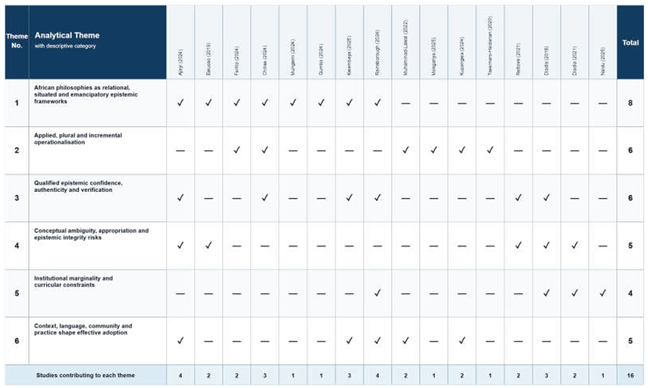 |
Table 1legend: Only studies contributing verified extracted qualitative evidence are displayed. ✓ = verified extracted evidence from the study supports the theme; — = the study contributed to the synthesis but no supporting extracted finding from that study was assigned to this theme. An em dash does not indicate contradictory evidence.
Disclaimer/Publisher’s Note: The statements, opinions and data contained in all publications are solely those of the individual author(s) and contributor(s) and not of MDPI and/or the editor(s). MDPI and/or the editor(s) disclaim responsibility for any injury to people or property resulting from any ideas, methods, instructions or products referred to in the content. |
© 2026 by the authors. Licensee MDPI, Basel, Switzerland. This article is an open access article distributed under the terms and conditions of the Creative Commons Attribution (CC BY) license (http://creativecommons.org/licenses/by/4.0/).
Copyright: This open access article is published under a Creative Commons CC BY 4.0 license, which permit the free download, distribution, and reuse, provided that the author and preprint are cited in any reuse.