

Submitted:
01 November 2026
Posted:
04 November 2026
You are already at the latest version
Abstract
A frame of four real lightlike vectors whose spatial directions point to the corners of a regular tetrahe- dron, a symmetric null frame, is known to reconstruct the spacetime metric from its mutual products. This paper establishes the further exact structure such a frame carries. Its six pairs span the space of two forms, and the incidence of a tetrahedron’s vertices, edges and faces splits them into a gra- dient sector and a circulation sector of three dimensions each, with no remainder. The Hodge star exchanges the two sectors. For a general frame of four lightlike vectors this exchange holds exactly when opposite pairings agree, a family of frames whose spatial directions form a disphenoid, with two shape parameters and a scale; the exchange therefore does not force regularity. The full oriented correspondence between the Hodge star and the incidence structure, J⋆ DT = ±√3 CR with the sign fixed by orientation, holds if and only if the frame is regular. Any four independent future lightlike vectors also determine a unique timelike direction, their relational clock, characterized by a balance equation and constructed as a conformal barycenter; it is Lorentz covariant and unchanged when the vectors are rescaled. The two halves of the paper meet in one equivalence: the clock assigns all four rays equal clock times exactly when the Hodge star exchanges the two sectors. Dividing each ray by its clock time, which in the clock’s frame is the known conformal centering of the four light directions, therefore gives a representative of the four rays that depends only on their directions and satisfies weak exchange, its positive multiples being the only weak exchange representatives, and in that frame the spatial directions form a disphenoid, as Penrose and Rindler showed four null directions can be arranged to do: for fixed null directions weak exchange fixes the relative scales of the vectors, while regularity, which the full Hodge and incidence correspondence detects, fixes their directional shape. Finally, the frame realizes, through one chain of exact correspondences, tetrahedral spinor rays, the qubit measurement they define, nilpotent Clifford elements and a directional decomposition of the flat Dirac operator. All results are exact; a symbolic package machine checks every identity used in the proofs. The parallelotope the frame spans divides into 24 congruent simplices, one for each ordering of the four vectors, each with four lightlike edges and dihedral angles of 30◦, 60◦, 90◦ and 120◦.
Keywords:
null frame
; tetrahedral symmetry
; Hodge duality
; bivectors
; relational clock
; conformal barycenter
; spinors
; simplicial decomposition
; Lorentzian geometry
1. Introduction
1.1. The Question
Four lightlike vectors are among the simplest objects in relativity: four directions along which light can travel. When their spatial directions point to the corners of a regular tetrahedron, they form a symmetric null frame, studied by Derrick, by Coll and Morales and by Finkelstein, and related to relativistic positioning coordinates [1,2,3,4]. It is known that such a frame determines the spacetime metric. This paper asks a further question: what other exact structure does a four null frame carry?
The answer has four parts. The six pairs of vectors carry an exact three plus three decomposition, built from the incidence structure of a tetrahedron. The Hodge star exchanges its two halves, and the conditions for this exchange separate a nonrigid family of frames from a rigid one. The four vectors determine a unique clock, which normalizes every set of four null rays into that nonrigid family, so that, for fixed directions, the family fixes the relative scales of the vectors and rigidity fixes their directional shape. And they determine spinor rays and furnish a directional decomposition of the flat Dirac operator, through a chain of exact correspondences. In the Four Null research program [17] this frame is taken as the cell of spacetime; here it is treated purely as geometry, and nothing about dynamics is assumed.
1.2. How to Read This Paper
Each result is presented in the same way. What we found states it; the equation follows; Symbols defines every symbol in it; What it means explains it in words; Why it matters places it; Scope states its status. Results that are already known are marked Foundation and cited; results new to this paper are marked Discovery. Figures show the structures whenever a picture helps.
Conventions: signature , units with , and . Indices label the four vectors; Greek indices are spacetime indices; repeated indices are summed. The scale is a length that fixes the size of the frame.
1.3. The Results at a Glance

| Result | Status | Section |
|---|---|---|
| Symmetric null frame, Gram matrix, metric reconstruction | Foundation (known) | Section 2 |
| Six channels as a basis of two forms; their Gram matrix | Foundation (exact) | Section 3 |
| Exact three plus three split from tetrahedral incidence | Discovery (exact) | Section 4 |
| Regular frame: full Hodge and incidence correspondence | Discovery (exact) | Section 5 |
| Weak Hodge exchange: equal opposite pairings, a nonrigid family (two shape parameters and a scale) | Discovery (exact) | Section 6 |
| Hodge incidence rigidity: if and only if , then | Discovery (exact) | Section 6 |
| Lorentz covariance of all the relations; ★ changes sign under orientation reversal | Exact | Section 6 |
| Relational clock of four null vectors: existence, uniqueness, covariance | Discovery (exact; barycenter method known) | Section 7 |
| Clock and Hodge equivalence: equal clock times if and only if weak Hodge exchange | Discovery (exact) | Section 7 |
| Canonical normalization: every four null rays, divided by their clock times, satisfy weak exchange; disphenoid normal form | Discovery (exact; conformal centering and disphenoid frame known) | Section 7 |
| Spinor correspondence: tetrahedral spinor rays, nilpotent Clifford elements, directional form of the flat Dirac operator | Discovery (exact; ingredients known) | Section 8 |
| Exact geometric consequences of the frame | Exact (standard identities, realized together) | Section 9 |
| The cell divides into 24 congruent simplices, each with four lightlike edges; dihedral angles , , , | Exact (subdivision known) | Section 9.1 |
2. The Symmetric Null Frame
2.1. Four Lightlike Vectors and the Metric They Determine
What we found. The frame consists of four vectors
Symbols. is the ath vector, with time component and spatial part ; the are unit vectors pointing to the corners of a regular tetrahedron.
What it means. Each vector travels as far in space as in time, so each is lightlike: . The four point in maximally separated directions, and they are balanced: their spatial parts add to zero. Figure 1 shows them on the light cone.
The frame is described by the table of mutual products of its vectors, the Gram matrix,
Symbols. is the product of vectors a and b; is 1 for and 0 otherwise; lists the eigenvalues of G.
What it means. The diagonal vanishes because each vector is lightlike; every pair of distinct vectors has the same negative product. One eigenvalue is negative and three are positive: the frame already knows that spacetime has one time and three space directions.
The metric follows from the frame alone:
Symbols. is the inverse metric; the inverse of the Gram matrix; Q the matrix whose columns are the vectors ; the Minkowski metric.
What it means. Every distance, time and angle can be computed from four light directions and their mutual products. It is convenient to use the reciprocal basis , which satisfies , so that any vector v expands as .
Why it matters. The frame also determines its own rest direction: the sum with , so the frame singles out the unit timelike vector in which its directions are balanced. Any two ordered frames with the same Gram matrix are related by a unique Lorentz transformation; the unlabeled frame has stabilizer in the orthochronous Lorentz group and in its proper part [16].
3. Six Null Channels
3.1. The Six Pairs of Vectors as a Basis of Two Forms
What we found. Each pair of vectors spans a plane, represented by the antisymmetric tensor
Symbols. is the channel of the pair ; the wedge is the antisymmetric product of two vectors. The six channels are ordered .
What it means. A two form, such as the electromagnetic field strength, has six independent components; the six channels are six independent directions in that space, so every two form F has a unique expansion , with coefficients read off by the reciprocal channels, . Strictly the are bivectors; using the metric to identify bivectors with two forms, we use the two terms interchangeably.
Their mutual products, with , are
Symbols. is the inner product of two forms; the eigenvalues are those of the matrix of channel products.
What it means. Each channel plane contains two lightlike directions, so it is a timelike plane; its own Gram determinant is . The channel products have three negative and three positive eigenvalues, the signature of two forms in four dimensions.
Each channel is simple, being the wedge of two vectors:
Symbols. the wedge of a two form with itself is a four form; is the Levi Civita tensor.
What it means. Each channel describes a single plane, the one spanned by and . This is the individual bivector simplicity condition, one of the simplicity conditions that spin foam constructions impose; the others, which constrain several bivectors together, are not claimed here.
Scope. Exact; standard exterior algebra applied to the frame.
4. Incidence and the Three Plus Three Split
4.1. The Six Channels Split Exactly into Two Sectors of Three
What we found. Label the four vectors as the vertices of a tetrahedron. The six channels are its edges and its four faces are the triples . Two incidence matrices record how these fit: D () assigns to each edge the value at b and at a, and C () assigns to each face its three boundary edges with orientation signs. Explicitly, with edges ordered and faces ,
Symbols. rows of D are vertices and columns are edges; rows of C are edges and columns are faces; the face has boundary .
What we found. They satisfy
Symbols.D is the vertex and edge incidence matrix, C the edge and face incidence matrix, the identity; is the transpose of D.
What it means. The first identity says that the boundary of a boundary is zero: going around a face and taking endpoints always cancels, so a gradient has no circulation. The second says that the combinatorial Laplacian on the six edges is four times the identity. Together they split the six channels into two orthogonal sectors,
Symbols.im denotes the image of a matrix; and are the orthogonal projectors onto the two sectors, each of rank three.
What it means. Through the channel basis, a coefficient vector is identified with the bivector , and coefficient subspaces such as with the corresponding bivector subspaces; the Hodge star acts on them through its matrix (Section 5). Every pattern of values on the six channels is, uniquely, the sum of a gradient (differences of values at the four vertices) and a circulation (flows around the four faces), with nothing left over: the Laplacian has no zero eigenvalue, so there is no harmonic remainder.
Why it matters. This is the discrete form of the split of a field strength into its electric and magnetic parts, which the next section makes precise.
Scope. Exact. The identities are standard combinatorial topology of the tetrahedron; their realization on the null channels of the frame is the content here.
5. Hodge Exchange of the Two Sectors
5.1. For the Regular Frame the Hodge Star Maps Gradients onto Circulations Through Vertex to Face Duality
What we found. The Hodge star, , acts on the channel coefficients as a matrix . With the matrix R that sends each oriented vertex to its oppositely oriented face,
Symbols. is the Levi Civita tensor; is the Hodge star written in the channel basis; R maps vertex a to the face opposite it, with the orientation of the boundary .
Theorem 1
(Hodge and incidence correspondence of the regular frame). For the regular frame, with the orientation and the labeling of Section 2, , and .
What we found. In display, the regular frame satisfies
Symbols. is the Lorentzian identity on two forms; the factor comes from the tetrahedral geometry.
What it means. Applying the Hodge star to a gradient produces exactly a circulation, and applying it to a circulation produces exactly a gradient, in each case through the map from each vertex to its opposite face. The two sectors of Section 4 are exchanged by ★, as the electric and magnetic parts of a field strength are exchanged by duality. Figure 2 summarizes the structure.
Why it matters. On real two forms in Lorentzian signature , so ★ has no real eigenvectors: the two real sectors are not themselves the self dual and anti self dual parts. Those appear after complexification, as with , each of complex dimension three. The real statement is the exchange: ★ is an anti isometry of the channel products, , where is the matrix of channel products of Section 3, and it swaps the two real sectors.
Proof. The columns of are the channel coefficients of , read off with the reciprocal channels: . For the regular frame this gives with the integer matrix, in the channel order ,
Symbols.A is times the Hodge matrix of the regular frame; are the reciprocal vectors of Section 2.
and direct multiplication of integer matrices gives , and , which are the three identities stated. □
Scope. Exact; every entry of the proof can be checked by hand. First stated in [16].
6. Weak Exchange and Rigidity
For a general frame of four independent future lightlike vectors the products between distinct vectors are negative. Write their magnitudes as positive pairings .
6.1. Sector Exchange Does Not Force a Regular Frame
Theorem 2
(Weak Hodge exchange). Let be linearly independent future lightlike vectors. The Hodge star maps onto if and only if the four row sums of the Gram matrix are equal, equivalently if and only if , and . A Gram matrix of this form with positive magnitudes is realized by four independent future lightlike vectors exactly when the magnitudes satisfy the strict triangle inequalities.
What we found. The Hodge star exchanges the gradient and circulation sectors if and only if the four row sums of the Gram matrix are equal, which for a lightlike frame means that opposite pairings agree:
Symbols. are the three pairing magnitudes, one for each pair of opposite edges (the colors of Figure 3).
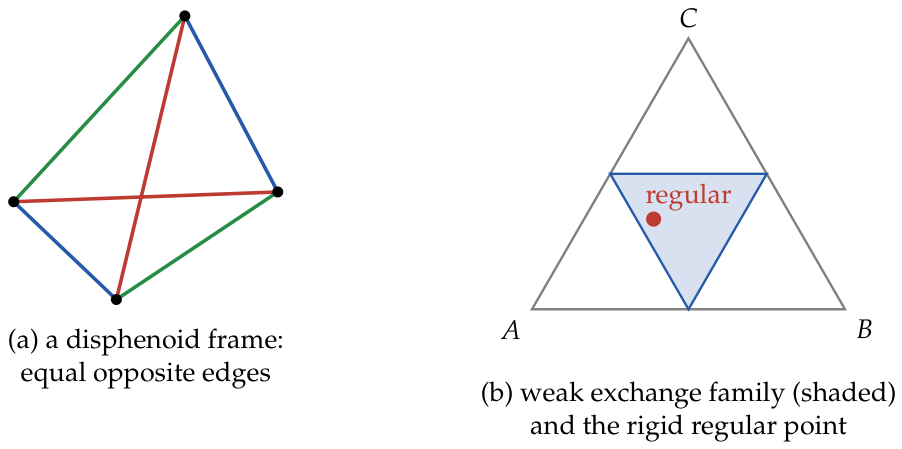
What it means. This is a family of frames, not a single frame: three pairing magnitudes, that is two shape parameters and one overall scale, so that modulo Lorentz transformations and scale the family is two dimensional. Its Gram matrix has eigenvalues
Symbols. these are the four eigenvalues of the Gram matrix of a frame in the family.
What it means. so such a Gram matrix has Lorentzian signature, one negative and three positive eigenvalues, and is realized by lightlike vectors, exactly when satisfy the strict triangle inequalities , , .
What we found. Every such frame is realized, up to scale and a Lorentz transformation, by spatial directions forming a disphenoid, a tetrahedron whose opposite edges are equal:
Symbols. with ; the vectors are .
What it means. For these vectors , and , so and its companions, which are positive precisely by the triangle inequalities, while the scale is fixed by , so that every such Gram matrix is realized with its actual magnitudes. The regular frame is the special case , where .
Why it matters. The exchange of the two sectors, which looks like a statement about the regular frame, is in fact shared by a whole family of irregular frames. Sector exchange alone is therefore not rigid. Section 7 sharpens this: every set of four null directions admits a unique normalization, fixed by the clock, that satisfies weak exchange, so that, for fixed null directions, weak exchange fixes the relative scales of the vectors and not their directions.
Proof. Let , which is timelike because the are independent and future lightlike, and let be the covector with for every a.
- 1.
-
Gradients are the two forms . A gradient pattern givesSymbols. are values at the four vertices; v is the vector they define.so , a space of dimension three.
- 2.
-
Circulations are the two forms on the hyperplane . The boundary of the face givesSymbols. is the three dimensional subspace of vectors w with ; it contains every difference .a wedge of two vectors in ; the four faces span , of dimension three.
- 3.
- The Hodge star of the gradients. Since , the star maps into the two forms on , the subspace orthogonal to K; both spaces have dimension three and ★ is invertible, so .
- 4.
- Comparison. The exchange therefore holds exactly when . A three dimensional subspace is the span of the vectors appearing in its two forms, so this means , that is is proportional to the covector . Evaluating on the , this says that is the same for all a: the four row sums are equal. Since , the exchange then holds in both directions.
With zero diagonal, equal row sums solve to , , . The Gram matrix of the family has the eigenvectors , , and , with the eigenvalues listed above. □
Scope. Exact; proved above. First stated in [16].
6.2. the Full Hodge and Incidence Correspondence Is Rigid
Theorem 3
(Hodge and incidence rigidity). Within the weak exchange family, holds for some scalar λ if and only if , that is if and only if the frame is regular. Then , with for the orientation fixed in Theorem 1 and for the opposite orientation.
What we found. Within the family, the full oriented identity holds only for the regular frame:
Symbols. is a scalar; , D, C and R are as in Section 5; the sign of records the relative orientation of the labeling and of .
What it means. Sector exchange only asks that ★ map the gradient sector into the circulation sector; the full identity asks that it do so through the vertex to opposite face map R, entry by entry. That stronger requirement singles out the regular tetrahedron.
Proof. For the disphenoid frame, normalized as above with , construct exactly as in Section 5, from the reciprocal channels of this frame. A direct computation shows that the entries of at the positions where vanishes are exactly
Symbols. the denominators are positive; is dimensionless and does not depend on the overall scale .
so forces . Since and its companions, this is . Conversely, at the identity holds with in the orientation of Theorem 1, and with in the opposite orientation (Section 5). □
Why it matters. The distinction between nonrigid sector exchange and rigid incidence level Hodge compatibility is the main structural result of this paper. It says precisely what is special about the regular frame: not the existence of an electric and magnetic split, which a family of frames shares, but the alignment of that split with the tetrahedron’s own vertex to face duality.
Scope. Exact; proved symbolically above and in [16].
Figure 4.
(a) A frame in the weak exchange family: its spatial directions form a disphenoid, with each pair of opposite edges equal (colors as in Figure 3). (b) The pairings up to scale, drawn in a triangle of proportions: Lorentzian frames of the family fill the inner triangle where the triangle inequalities hold; the full Hodge and incidence identity holds only at its center, the regular frame.
Lorentz covariance
What we found. All of these relations are Lorentz covariant [16]. Under a Lorentz transformation of the frame,
Symbols. is an orthochronous Lorentz transformation; for proper transformations and for those that reverse the spatial orientation; is the matrix of the Hodge star in the transported channel basis , not a transformation law for a fixed matrix.
What it means. The Gram matrix does not change, because Lorentz transformations preserve products; the metric and the channels transform as tensors; and the incidence matrices D, C and R are pure combinatorics, so they do not change at all. The Hodge star is built from the Levi Civita tensor, which transforms as , so ★ commutes with proper transformations and anticommutes with orientation reversing ones; its matrix in the transported basis is therefore for proper transformations and under orientation reversal, so the full correspondence becomes with the sign of . Weak exchange, rigidity and the three plus three split are therefore properties of the frame, not of the observer describing it.
Scope. Exact; verified numerically to machine precision for boosts, rotations and a reflection.
7. The Relational Clock of Four Null Vectors
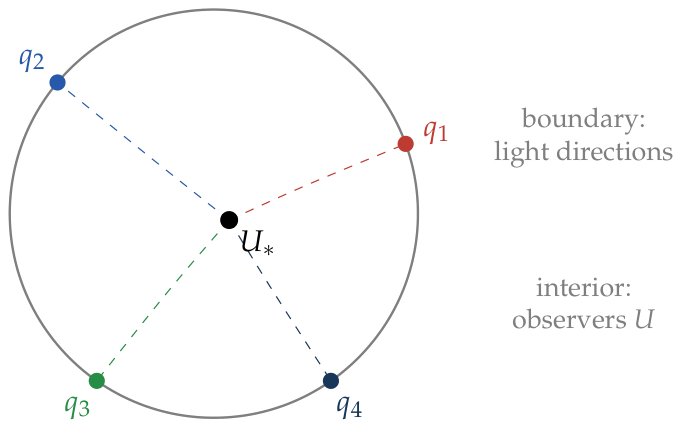
A unit future timelike vector U is the four velocity of an observer. All of them form the hyperboloid , a copy of three dimensional hyperbolic space whose boundary at infinity is the sphere of light directions. Each lightlike vector is a point of that boundary.
7.1. Four Null Vectors Determine a Unique Clock
Theorem 4
(Relational clock). For any four linearly independent future lightlike vectors , and any fixed reference length , the function on has exactly one minimum , independent of . It is characterized by , is Lorentz covariant, and is unchanged by positive rescalings of the individual .
What we found. For any four linearly independent future lightlike vectors, the function
Symbols.U ranges over unit future timelike vectors; is the time spanned by the null vector as measured by the observer U, which we call its clock time (were the momenta rather than displacements, the same contraction would be the observed energy); is any fixed reference length, which makes the argument of the logarithm dimensionless and changes F only by a constant; ln is the natural logarithm.
What we found. has exactly one minimum , the relational clock of the frame, characterized by the balance equation
Symbols. is the clock; each term is the vector divided by its clock time.
What it means. In the clock’s frame the four light rays, each measured in units of its own clock time, add up to a pure time direction: their spatial parts cancel. The clock is the one observer for whom the four rays are balanced. It is determined by the null vectors alone, with no observer chosen in advance.
What we found. The clock is Lorentz covariant and does not depend on the lengths of the vectors:
Symbols. is any orthochronous Lorentz transformation; the are positive rescalings of the individual vectors.
What it means. Boosting the frame boosts its clock; stretching any of the vectors changes F only by the constant , so the minimum does not move. The clock depends only on the four light directions.
Proof. Along a geodesic of , with e a unit spacelike vector orthogonal to , each clock time is with and , because is lightlike. Its logarithm is convex in s, and strictly convex unless lies along the geodesic, which can hold for at most two of four independent vectors; hence F is strictly convex. Along a geodesic running out to a boundary direction , the term of a vector pointing along decreases like and every other term grows like ; at most one of the four points along , so . A strictly convex function that grows without bound in every direction has exactly one minimum. Setting the derivative of F along the hyperboloid to zero gives , and contracting with U fixes . Covariance and rescaling invariance follow from the form of F. □
Why it matters. This is a conformal barycenter in the sense of Douady and Earle [7]: the balance point of four boundary points of hyperbolic space with equal weights, which exists and is unique because no single point carries half the weight. What is specific here is its use as the intrinsic clock of a null frame, the covariant balance equation, and its independence of the vectors’ lengths.
What it means. For the regular frame the clock is the rest direction , and every ray spans the same clock time, . For a general frame the clock is still unique, but the four clock times may differ. Exactly when they are equal is the subject of the next result.
7.2. Equal Clock Times Are the Same Condition as Weak Hodge Exchange
Proposition 1
(Clock and Hodge equivalence). For four linearly independent future lightlike vectors, with clock times measured by their relational clock, the following are equivalent:
Symbols. is the clock time of ray a, the time its vector spans in the clock frame; ; is the ath row sum of the Gram matrix.
In that case , and every clock time equals .
Proof. If for all a, the balance equation reads , so and for every a. Conversely, if for every a, then , , and gives for every a; then , so U satisfies the balance equation and, by uniqueness, is the clock. The last equivalence is Theorem 2. □
What it means. The whole weak exchange family, not only the regular frame, has a clock that assigns all four rays the same clock time. The two halves of the paper therefore meet: the frames whose Hodge star exchanges gradients and circulations are exactly the frames whose four light rays are balanced with equal clock times. Regularity is the stronger condition that also aligns the exchange with the vertex to face duality (Theorem 3):
Symbols. the arrows are logical implications; every non regular disphenoid frame has equal clock times without being regular, which is why the last implication does not hold.
Scope. Exact; machine checked on regular, disphenoid, boosted disphenoid and generic frames.
7.3. The Clock Brings Every Four Null Rays into the Weak Exchange Family
Theorem 5
(Canonical clock normalization). Let be linearly independent future lightlike vectors with relational clock and clock times . The normalized vectors have the same clock, and
Symbols. is the ath ray divided by its clock time; the last expression is the ath row sum of the normalized Gram matrix.
so the normalized frame satisfies weak Hodge exchange. Among all rescalings with , the ones that satisfy weak exchange are exactly with a common . The vectors depend only on the null directions: replacing each by with leaves every unchanged. Thus is the fully canonical representative of the four rays, with unit clock times, and is the complete family of their weak exchange representatives.
Proof. The clock is unchanged by positive rescalings (Theorem 4), so has clock and clock times . The balance equation is then , and contracting with gives row sums ; weak exchange follows from Theorem 2. A rescaled frame has the same clock and clock times , and by Proposition 1 it satisfies weak exchange exactly when these are equal, that is when . Finally, if , the clock is unchanged and , so . □
What it means. Every four light rays, whatever their lengths, can be scaled so that the Hodge star exchanges the two sectors, and there is exactly one way to do it up to an overall scale: divide each ray by its clock time. The result does not depend on the lengths originally assigned to the vectors, only on their directions, so is a canonical representative of the rays themselves.
Corollary 1
(Disphenoid normal form). In the rest frame of its clock, every normalized frame has the form with unit vectors satisfying
Symbols. is the spatial direction of ray a seen by the clock; the dot products are those of ordinary three dimensional vectors.
so the four spatial directions form a disphenoid.
Proof. The first statement is with lightlike, and the sum is the spatial part of . From , squaring gives , and likewise for the other two pairs. □
What it means. Seen by its own clock, any four light directions point to the corners of a disphenoid, a tetrahedron with equal opposite edges. Four null directions are four points on the sphere of light directions, on which Lorentz transformations act as the six dimensional conformal group; configurations of four points modulo that group have parameters, matching the two shape parameters of the disphenoid. The weak exchange family, taken modulo Lorentz transformations and scale, therefore describes every configuration of four null directions, with relative scales fixed by the clock.
Why it matters. This sharpens the central distinction of the paper. For fixed null directions, weak Hodge exchange fixes only the relative scales of the four vectors: any four directions satisfy it after the canonical normalization. After that normalization, regularity fixes the directional shape: the clock sees a regular tetrahedron, , and this is exactly what the full Hodge and incidence correspondence detects (Theorem 3). Figure 5 summarizes the hierarchy.
Scope. Exact; machine checked on frames with random directions and random lengths. In the clock frame the normalization is the conformal centering of the four light directions on the sphere, a known construction [7,8]. That four null directions admit a Lorentz frame in which they form a disphenoid is also known, from Penrose and Rindler [11], see also [12]; the clock recovers such a frame canonically, and that four balanced unit vectors form a disphenoid is elementary. What is new is the identification of this centering with equal Gram row sums and weak Hodge exchange, and its relation to Hodge and incidence rigidity.
Figure 6.
The relational clock. Observers form hyperbolic space (drawn as a disk); light directions form its boundary. The four null vectors are four boundary points, and the clock is their balance point: the unique observer for whom the four rays, each divided by its clock time, cancel in space.
Figure 6.
The relational clock. Observers form hyperbolic space (drawn as a disk); light directions form its boundary. The four null vectors are four boundary points, and the clock is their balance point: the unique observer for whom the four rays, each divided by its clock time, cancel in space.
8. Spinors and the Dirac Operator from the Frame
8.1. One Chain of Exact Correspondences from Four Null Vectors to the Flat Dirac Operator
What we found. Three standard facts combine into a single chain for the frame. First, each lightlike vector is the square of a spinor, determined up to a phase:
Symbols. are the Pauli matrices; is a two component spinor; is its normalized state, whose Bloch vector is ; is the overlap of two states.
What it means. The matrix on the left has determinant and is positive, so it is the outer product of a single spinor [10]; the vector fixes the spinor only up to a phase, that is it fixes a spinor ray. The four normalized states have pairwise overlaps , and with the normalization
Symbols. is the ath element of a measurement; the elements add to the identity.
What it means. they form the tetrahedral symmetric informationally complete measurement of a qubit [13]. The frame’s four light directions and this four outcome quantum measurement are the same tetrahedron.
What we found. Second, each vector defines a Clifford element that squares to zero,
Symbols. are the Dirac matrices, ; is the Clifford element of the light direction .
What it means. A lightlike direction gives a nilpotent element: applied twice it gives zero. The four nilpotent elements reproduce the frame’s Gram matrix through their anticommutators.
What we found. Third, the metric reconstruction of Section 2 turns these into the flat Dirac operator:
Symbols. is the derivative along the spacetime direction ; is the derivative along the light direction ; is the flat Dirac operator.
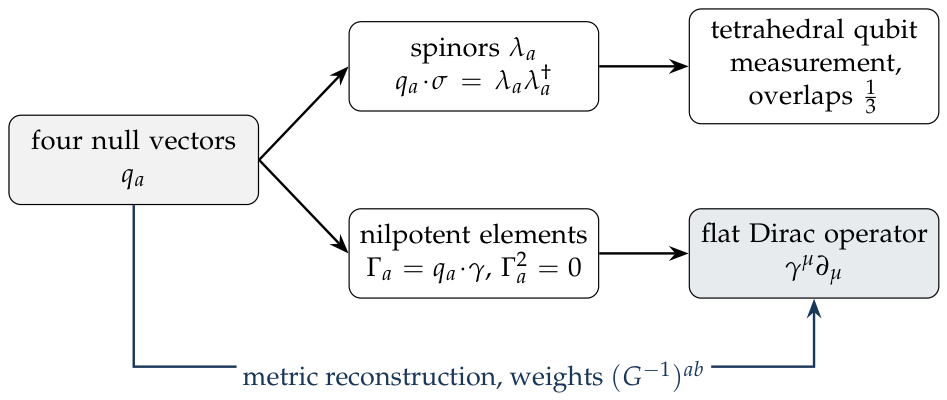
What it means. The flat Dirac operator is a combination of derivatives along the four light directions, each multiplied by a nilpotent Clifford element and weighted by the inverse Gram matrix. In curved spacetime the same decomposition holds locally, with the spin connection added to the derivatives. Figure 7 shows the chain.
Why it matters. Each link is standard: the spinor square root of a null vector, the tetrahedral qubit measurement, nilpotent Clifford elements of null vectors, and the Dirac equation in a basis of four metrically symmetric vectors, which Derrick already considered [1,9]. What is recorded here is that one null frame realizes all of them at once: its spinor rays, the qubit measurement they define, its nilpotent Clifford elements and, through its own Gram matrix, the directional decomposition of the flat Dirac operator.
9. Exact Geometric Consequences
The frame realizes a number of standard identities together. Each is exact, and each is stated for the regular frame. Read from four dimensions down to one, they form a single hierarchy:
Symbols. is the four volume spanned by the frame; the Euclidean metric; the projector onto the plane transverse to ray a; u the rest direction of the frame.
What it means. The four vectors fix a volume in four dimensions; their spatial directions rebuild the three dimensional metric; their transverse planes average to two thirds of space; and along each single ray, the one dimensional level, every ray spans the same clock time in the rest frame. Each level is built from the same four vectors. The individual identities follow.
- Space from four directions.: the spatial metric is recovered from the four directions, the tight frame property of the regular tetrahedron. ( is the Euclidean metric; the ith component of .)
- Screens. The projectors onto the planes transverse to each ray satisfy : on average, two of the three spatial directions are transverse.
- Causal character. Each channel plane is timelike, with Gram determinant . The tips of two vectors are separated by a spacelike interval, , while their sum is timelike, .
- The cell. The four vectors span a parallelotope of four volume , with 16 corners, 32 edges, 24 two dimensional faces and 8 three dimensional cells; its boundary is a three sphere, . Every edge is a translate of a generator and is lightlike; its diagonals, sums of generators, are not. It divides into 24 congruent simplices, one for each ordering of the four vectors (Section 9.1).
- The simplex of the frame. With vertices at the origin and at the four tips, its six triangles through the origin are Lorentzian, each containing two lightlike edges, while its four outer triangles and its outer tetrahedron are spacelike, because the four tips share one time component. This simplex is not one of the 24 simplices of the cell’s subdivision (Section 9.1): it joins the origin to the four tips, while each of the 24 runs from the origin to the opposite corner of the cell.
- The form hierarchy. The exterior powers of the four vectors have dimensions : the scalar, the four vectors, the six channels, the four triples and the volume, matching the empty face, vertices, edges, faces and interior of the tetrahedron (Figure 8).
Scope. Exact. The identities are standard properties of the regular tetrahedron, of exterior algebra and of parallelotopes; their joint realization by one null frame is what is recorded here.
9.1. The Cell and Its 24 Simplices
What we found. The parallelotope spanned by the frame, whose points are with , divides into 24 simplices, one for each ordering of the four vectors. The simplex of an ordering has as vertices the successive partial sums along it, a path of four lightlike steps from the origin to the opposite corner :
Symbols. is an ordering of the labels ; are the vertices of its simplex; A is any nonempty set of labels and its size; every edge of a simplex is the sum of a block of consecutive vectors of the ordering.
What it means. This is the Kuhn and Freudenthal subdivision of a parallelotope [14,15], here realized by a null frame. The interval of an edge depends only on how many vectors it adds, by the formula above, since every vector is lightlike and every pair has the same product. Each simplex therefore has the same edges: four lightlike edges, the steps of its path; three timelike edges of interval , sums of two vectors; two of interval , sums of three; and one of interval , the long diagonal from the origin to the opposite corner, which all 24 simplices share. Because exchanging any two vectors leaves the Gram matrix unchanged, the 24 simplices are congruent, each of volume , one twenty fourth of the cell. Across the cell the edges fall into 15 classes, one for each nonempty set of vectors. Repeated through spacetime, each cell contributes one vertex, 15 edge classes, 50 triangle classes, 60 tetrahedra and 24 simplices, the number of nested chains of nonempty sets of vectors of each length, and , the Euler characteristic a lattice filling space must have; the 50 triangles are the hinges on which a simplicial curvature lives. Every triangle of the subdivision is timelike, with a spacelike plane orthogonal to it, so the angle between the two tetrahedral faces meeting at a triangle is an ordinary rotation angle, and the angles take four values:
| Triangles of one simplex | 2 | 2 | 5 | 1 |
| Over the 24 simplices of the cell | 48 | 48 | 120 | 24 |
Why it matters. The subdivision turns the cell into a simplicial complex whose building blocks are all identical, so that the discrete geometry of the frame can be written in terms of simplices, the form used by simplicial approaches to gravity. The four lightlike edges of each simplex keep the causal structure of the frame inside every building block, and the subdivision of neighboring cells matches across their shared faces, so a lattice of cells becomes one consistent simplicial complex.
Scope. Exact for the regular frame. The subdivision itself is classical; its realization by a null frame, with 24 congruent simplices, four lightlike edges each and the angles above, is what is recorded here.
10. Relation to Known Work
| Known | New here |
|---|---|
| The symmetric null frame, its Gram matrix and the metric it determines [1,2,3,4]; null tetrads [5] | The exact three plus three split of the six null channels from tetrahedral incidence |
| Combinatorial Hodge theory and the boundary of a boundary [6] | The full Hodge and incidence correspondence for the regular frame |
| Weak Hodge exchange: a nonrigid family of disphenoid frames, with two shape parameters and a scale | |
| A Lorentz frame in which four null directions form a disphenoid [11,12] | Identification of the conformal centering of four null rays with equal Gram row sums and weak Hodge exchange; its canonical, direction only representative; its relation to rigidity |
| Hodge incidence rigidity: the full correspondence holds if and only if | |
| The conformal barycenter of boundary points, and the conformal centering of point clouds on the sphere [7,8] | The relational clock of a null frame, its balance equation and rescaling invariance |
| Clock and Hodge equivalence: equal clock times if and only if weak Hodge exchange | |
| Spinor square roots of null vectors [10]; the tetrahedral qubit measurement [13]; the Dirac equation in a symmetric basis [1,9] | The single chain from one null frame to the directional form of the flat Dirac operator |
11. Conclusion
A symmetric null frame, four lightlike vectors pointing to the corners of a regular tetrahedron, is known to determine the spacetime metric. This paper has shown that it carries considerably more exact structure. Its six channels split into a gradient sector and a circulation sector of three dimensions each, and the Hodge star exchanges them. That exchange is shared by a family of frames with two shape parameters and a scale, the disphenoid frames with equal opposite pairings, so it does not by itself single out the regular frame; the full oriented correspondence between the Hodge star and the incidence structure, with the sign fixed by orientation, does. Any four independent future null vectors determine a unique relational clock, balanced among their directions, covariant and independent of their lengths, and the two halves of the paper meet in one equivalence: the clock assigns all four rays equal clock times exactly when the Hodge star exchanges the two sectors, so that equal clock times, like weak exchange, do not force regularity. Dividing each ray by its clock time, which in the clock frame is the known conformal centering of the four light directions, gives a canonical representative that depends only on the four directions and whose positive multiples are exactly the weak exchange representatives, and the clock then sees the directions as a disphenoid, the frame known from Penrose and Rindler: for fixed null directions weak exchange fixes the relative scales of the vectors, and after this normalization regularity, detected by the full Hodge and incidence correspondence, fixes the directional shape. And the same four vectors realize, through one chain of correspondences, tetrahedral spinor rays and the qubit measurement they define, nilpotent Clifford elements and the directional decomposition of the flat Dirac operator.
All of these are exact statements of geometry and algebra, and none assumes a dynamical law. In the Four Null research program [17] the frame is taken as the cell of spacetime, and the structures found here are the ones on which its fields are built: the three plus three split provides the discrete carrier identified with the electric and magnetic decomposition of the field in the normalized frame, the relational clock provides each cell with an intrinsic timelike direction and a canonical normalization, and the spinor chain carries matter. Whether nature uses this cell is a question for the dynamics; that the cell carries this structure is established here.
Appendix A. Symbolic Verification
A symbolic package accompanies this paper and machine checks every algebraic identity, spectrum, projector relation and polynomial reduction used in the analytic proofs, in the conventions stated in the Introduction. It checks: the Gram matrix, its spectrum and the metric reconstruction; the six channel products and their eigenvalues; the incidence identities and projectors; , and ; the weak exchange property and Gram spectrum of the disphenoid frames, the failure of exchange for unequal row sums, and the factored entries in the proof of rigidity; the clock’s balance equation, uniqueness from many starting points and rescaling invariance on a general frame; the equality of the clock times on regular, disphenoid and boosted disphenoid frames, and their inequality on a frame with unequal row sums; the canonical normalization and the disphenoid normal form on frames with random directions and lengths; the spinor factorization, the overlaps , the nilpotency of and the Dirac reconstruction; and the identities of Section 9. The checks support the proofs; the analytic arguments are the proofs.
References
- Derrick, G. H. On a completely symmetric choice of space-time coordinates. J. Math. Phys. 1981, 22, 2896. [Google Scholar] [CrossRef]
- Coll, B.; Morales, J. A. Symmetric frames on Lorentzian spaces. J. Math. Phys. 1991, 32, 2450. [Google Scholar] [CrossRef]
- Finkelstein, D. R. Quantum Relativity: A Synthesis of the Ideas of Einstein and Heisenberg; Springer: Berlin, 1996. [Google Scholar]
- Blagojević, M.; Garecki, J.; Hehl, F. W.; Obukhov, Yu. N. Real null coframes in general relativity and GPS type coordinates. Phys. Rev. D. 2002, 65, 044018. [Google Scholar] [CrossRef]
- Newman, E. T.; Penrose, R. An approach to gravitational radiation by a method of spin coefficients. J. Math. Phys. 1962, 3, 566. [Google Scholar] [CrossRef]
- B. Eckmann, Harmonische Funktionen und Randwertaufgaben in einem Komplex. Comment. Math. Helv. 1944, 17, 240. [CrossRef]
- Douady, A.; Earle, C. J. Conformally natural extension of homeomorphisms of the circle. Acta Math. 1986, 157, 23. [Google Scholar] [CrossRef]
- Cantarella, J.; Schumacher, H. Computing the conformal barycenter. SIAM J. Appl. Algebra Geom. 2022, 6, 503. [Google Scholar] [CrossRef]
- Dale, R.; Herrero, A.; Morales-Lladosa, J. A. Essential Fierz identities for a fermionic field. Phys. Scr. 2023, 98, 085302. [Google Scholar] [CrossRef]
- Penrose, R.; Rindler, W. Spinors and Space-Time; Cambridge University Press, 1984; Vol. 1. [Google Scholar]
- Penrose, R.; Rindler, W. Spinors and Space-Time. In Spinor and Twistor Methods in Space-Time Geometry; Cambridge University Press, 1986; Vol. 2. [Google Scholar]
- Arianrhod, R.; McIntosh, C. B. G. Class. Quantum Grav. 1992, 9, 1969. [Google Scholar]
- Renes, J. M.; Blume-Kohout, R.; Scott, A. J.; Caves, C. M. Symmetric informationally complete quantum measurements. J. Math. Phys. 2004, 45, 2171. [Google Scholar] [CrossRef]
- H. Freudenthal, Simplizialzerlegungen von beschränkter Flachheit. Ann. Math. 1942, 43, 580. [Google Scholar] [CrossRef]
- Kuhn, H. W. Some combinatorial lemmas in topology. IBM J. Res. Dev. 1960, 4, 518. [Google Scholar] [CrossRef]
- Dolu, G. Regular four-null tetrahedral frames: exact bivector and Hodge-star–incidence theorems, Four-Null Part I. Zenodo record 23250815. 2026. [Google Scholar] [PubMed]
- Dolu, G. Four Null Spacetime Theory: A Causal Architecture for Geometry, Gravity, Light and Matter. In Foundations, Results and Research Program, Zenodo; 2026. [Google Scholar] [CrossRef]
Figure 1.
The four null vectors on the light cone. Their tips form a regular tetrahedron in the space orthogonal to the time axis U. Each vector is lightlike; any two distinct tips are separated by a spacelike interval.
Figure 1.
The four null vectors on the light cone. Their tips form a regular tetrahedron in the space orthogonal to the time axis U. Each vector is lightlike; any two distinct tips are separated by a spacelike interval.
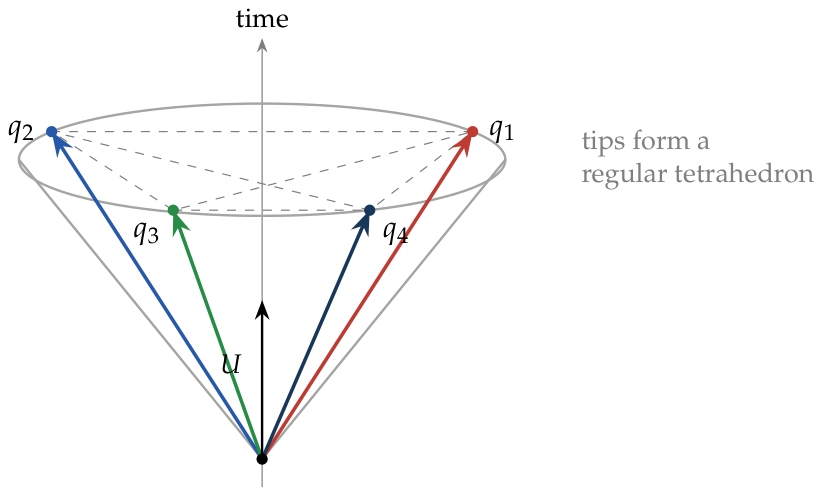
Figure 2.
The Hodge and incidence structure. Gradients come from vertices, circulations from faces; the Hodge star exchanges the two sectors, matching each vertex with its opposite face: .
Figure 2.
The Hodge and incidence structure. Gradients come from vertices, circulations from faces; the Hodge star exchanges the two sectors, matching each vertex with its opposite face: .
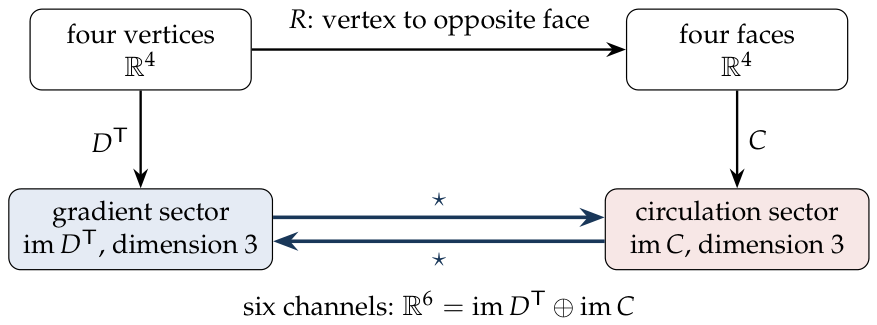
Figure 3.
The tetrahedron of the frame. Vertices are the four vectors, edges the six channels, faces the four triples. Each edge has an opposite edge sharing no vertex with it; the three opposite pairs are marked by colors, and equal pairings across opposite edges define the weak exchange family of Section 6. The Hodge star exchanges the two three dimensional sectors of Section 4, not individual channels.
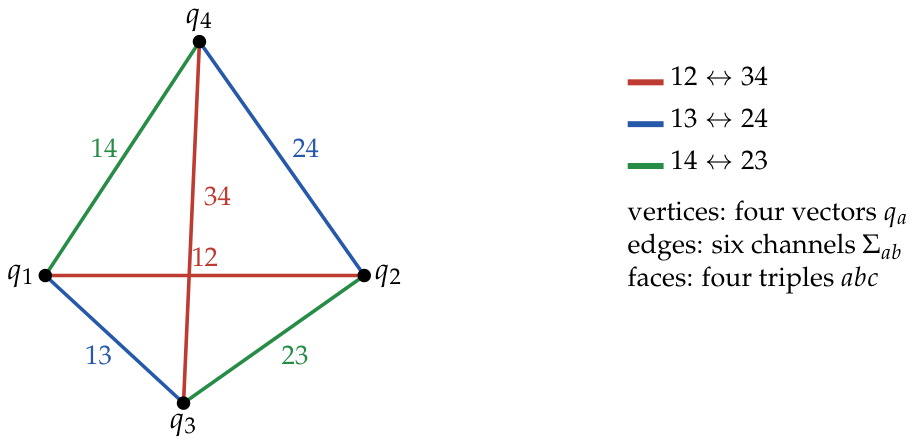
Figure 5.
The hierarchy of the paper. Any four null rays determine a clock; dividing each ray by its clock time gives a canonical frame, unique up to scale, whose directions form a disphenoid and which satisfies weak Hodge exchange. Only when those directions form a regular tetrahedron does the full Hodge and incidence correspondence hold.
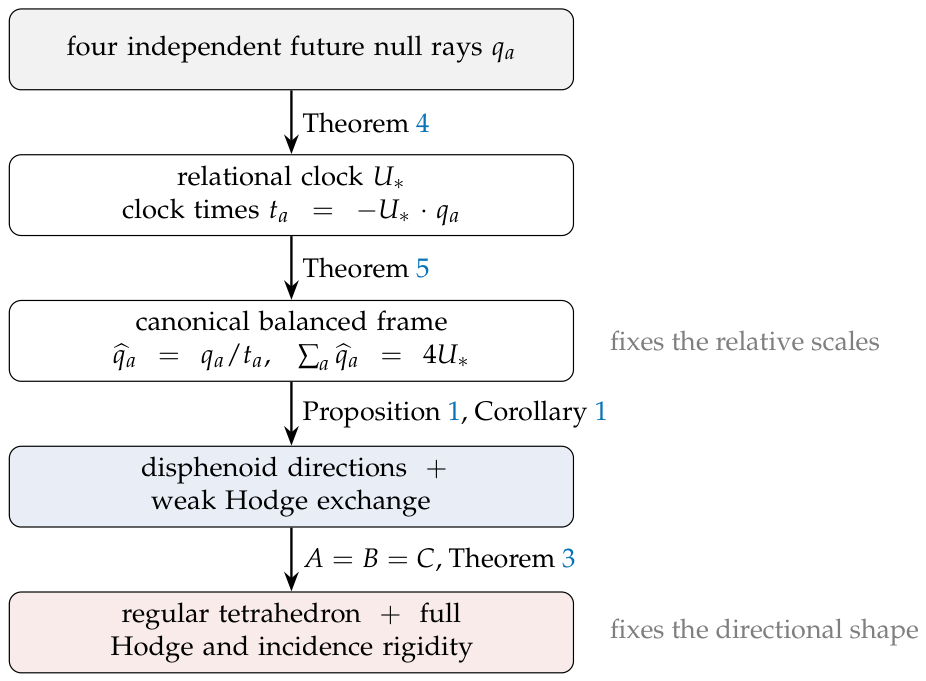
Figure 7.
The spinor and Clifford chain. The same four vectors give spinor rays whose states form the tetrahedral qubit measurement, and nilpotent Clifford elements that the inverse Gram matrix assembles into the flat Dirac operator.
Figure 7.
The spinor and Clifford chain. The same four vectors give spinor rays whose states form the tetrahedral qubit measurement, and nilpotent Clifford elements that the inverse Gram matrix assembles into the flat Dirac operator.

Disclaimer/Publisher’s Note: The statements, opinions and data contained in all publications are solely those of the individual author(s) and contributor(s) and not of MDPI and/or the editor(s). MDPI and/or the editor(s) disclaim responsibility for any injury to people or property resulting from any ideas, methods, instructions or products referred to in the content. |
© 2026 by the author. Licensee MDPI, Basel, Switzerland. This article is an open access article distributed under the terms and conditions of the Creative Commons Attribution (CC BY) license.
Copyright: This open access article is published under a Creative Commons CC BY 4.0 license, which permit the free download, distribution, and reuse, provided that the author and preprint are cited in any reuse.