

Submitted:
01 November 2026
Posted:
04 November 2026
You are already at the latest version
Abstract
This study analyzes the relationship between patterns of artificial intelligence (AI) use and university students’ academic goals, also incorporating a reflection on educational sustainability and the responsible use of digital technologies in higher education. Through cluster analysis, ANCOVA, correlations, and structural equation modeling (SEM), three AI usage profiles (low, balanced, and high) were identified, along with their association with learning, achievement, and social reinforcement goals. The re-sults show significant differences between profiles, as well as positive relationships between AI support dimensions (educational, informational, and emotional) and aca-demic goals.The structural model explains between 29% and 47% of the variance. The R² value was 0.47. The SEM showed an adequate fit to the data (CFI = .96; TLI = .95; RMSEA = .048; SRMR = .041), indicating a satisfactory representation of relationships among variables. The findings suggest that a balanced and ethical use of AI can con-tribute to the development of more sustainable educational practices by fostering learning personalization, resource optimization, and the promotion of responsible dig-ital competencies aligned with sustainability objectives in education.
Keywords:
artificial intelligence
; academic goals
; sustainable higher education
; motivation
; self-regulated learning
1. Introduction
Contemporary university education is undergoing a profound transformation driven by social, cultural, and technological changes that have radically modified the way students’ access, process, and use knowledge (Ben Otman et al., 2025; Delgado et al., 2024; López de la Cruz et al., 2024). In this context, artificial intelligence (AI) has emerged both as a strategic tool and as a theoretical object of study, with practical and conceptual implications for higher education. From a theoretical and scientific perspective, AI models allow us to understand their functioning, predict their impact on learning, and analyze how they influence decision-making and the construction of individualized academic pathways (González de la Garza, 2024; Gutierrez et al., 2025). Among the most relevant approaches are adaptive learning systems, which dynamically adjust content and difficulty according to students' needs. Another important approach is intelligent tutoring systems, which simulate teacher interaction through immediate and personalized feedback. Cognitive assistants are also widely used. They support study planning, complex problem solving, and academic information management (Delcker et al., 2024; González de la Garza, 2024). These models explain how AI-based technologies are used in education. They are also associated with theories of self-regulated learning and digital competencies because they promote metacognition, personalized learning, and the strategic use of educational resources (Boekaerts et al., 2011; Holmes et al., 2022; Ifenthaler & Yau, 2020; Zimmerman, 2002).
Furthermore, the implementation of AI in higher education may contribute to the sustainability dimension of the 2030 Agenda, especially through its alignment with SDG 4 (Quality Education). Intelligent tools can foster more inclusive and equitable learning environments by optimizing educational resources, supporting personalized learning processes, and reducing barriers to knowledge access, thereby helping to mitigate educational inequalities (Gómez et al., 2025; González & Ballesteros, 2024; Suconota et al., 2023).
From this perspective, AI is not only a technological innovation. It is also an opportunity to strengthen sustainable university models. These models focus on student well-being, critical digital literacy, and the development of competencies needed to address the social and environmental challenges of the 21st century.
In university practice, AI is used in many different ways. These include text generation, information search and analysis, and conceptual doubt resolution. It is also used for study organization, exam preparation, and academic competency assessment (Ben Otman et al., 2025).
In this context, educational sustainability and responsible digital transformation have become key priorities for higher education institutions. Universities aim to integrate innovative technologies. The goal is to promote more inclusive and efficient training processes. These processes are also aligned with the Sustainable Development Goals (Castañeda de León, 2024; Gallent et al., 2023; Vélez et al., 2024).
This variety of uses enables the personalization of the learning experience. It reduces cognitive load and provides immediate feedback. It also enhances students’ emotional well-being. These effects influence not only academic performance but also the development of cognitive, metacognitive, and socio-emotional competencies in a holistic way (González de la Garza, 2024; Gutiérrez et al. 2025; Quezada et al., 2025).
The benefits of AI can be grouped into three interrelated dimensions. The academic dimension includes adaptive learning and intelligent tutoring systems. The informational dimension includes advanced search engines and data analysis tools. The emotional dimension includes assistants that support well-being and learning regulation (Vázquez-Cano, 2021).
Furthermore, artificial intelligence can foster co-regulation of learning, understood as a process in which learning activities are regulated collaboratively between the student and a supporting agent, such as teachers, peers, or intelligent systems. Through personalized guidance, the use of metacognitive prompts, continuous feedback, and the suggestion of learning strategies, AI-based assistants can provide scaffolding that progressively enhances students’ self-regulatory capacities and promotes greater autonomy in their learning process.
The evaluation of AI's impact on university students is commonly addressed from three complementary perspectives. These include perceptions of benefits and risks, concrete uses in academic practice, and general attitudes toward its integration into higher education. The latter perspective also encompasses ethical evaluations and students' willingness to use AI. This approach makes it possible to identify different profiles of AI interaction. It also provides a theoretical and methodological framework for understanding how these profiles are related to motivational factors, learning styles, and resource management strategies. In addition, it helps explain how these patterns may contribute to more personalized and efficient academic pathways (Pintrich, 2000; Wickberg & Warchavchik , 2026).
In this context, academic motivation is a key factor in the analysis. Research on motivation seeks to understand what drives students to learn, how they direct and sustain their effort, and how they adopt innovative resources. One of the most influential theoretical models is Achievement Goal Theory. This theory distinguishes between learning goals and performance goals. Learning goals focus on acquiring knowledge and developing competencies, even when mistakes occur. In contrast, performance goals are oriented toward gaining recognition, approval, or good grades while avoiding negative evaluations (Alhadabi & Karpinski, 2020; Fuentes et al., 2023). In this framework, a distinction is made between perceived support and perceived usefulness of artificial intelligence. Perceived support refers to the subjective sense of accompaniment and assistance that AI provides during learning across academic, informational, practical, and emotional dimensions. In contrast, perceived usefulness refers to the cognitive evaluation of AI’s effectiveness in achieving specific academic goals and improving performance. This distinction makes it possible to refine the analysis of usage profiles from a more fine-grained perspective of students’ perceptions.
Within performance goals, social reinforcement goals are identified. These are oriented toward obtaining approval from teachers, peers, or family. Achievement goals are also included. These are focused on academic success and social mobility (Hayamizu & Weiner, 1991).
This theoretical framework is closely related to the perspective of self-regulated learning. This perspective emphasizes planning, monitoring, and evaluating one’s own learning. These competencies can be enhanced through the strategic use of AI (Alfaleh, 2026; Haider, 2024; Lodge et al., 2023; Zimmerman, 2002).
In particular, students in the social sciences show complex and multidimensional motivations. These combine personal learning goals, professional achievement goals, and social or altruistic purposes (Rodríguez, 2011; Saborío & Chaves, 2023; Suárez et al., 2025).
These findings suggest that student interaction with artificial intelligence is functionally differentiated. It depends on academic goal orientations. As a result, different AI engagement profiles are associated with distinct motivational configurations across learning, performance, and social reinforcement goals.
This motivational complexity indicates that interaction with AI may vary significantly depending on the dominant academic goals.
As Suárez Lima et al. (2025) and Daha & Altelwany (2025) indicate, students oriented toward learning goals may use AI to deepen critical understanding, develop analytical skills, and foster creativity. In contrast, students focused on performance goals may use AI mainly to optimize grades, meet visible targets, and improve performance indicators.
Despite extensive research on academic motivation and AI integration in universities, studies that connect both perspectives remain limited. This gap is especially evident among social science students. Exploring this intersection is essential. It helps to understand how AI usage profiles relate to academic goals. It also provides evidence to support the design of more effective, personalized, and ethical pedagogical strategies. In this framework, the main objective of this study is to identify AI usage profiles among university students. It also aims to analyze how these profiles are associated with academic goals.
The study provides a comprehensive view of the role of motivation in the appropriation of emerging technologies. It also considers the promotion of self-regulated learning and the development of digital competencies. In addition, it offers insights to optimize academic pathways in increasingly technology-mediated university contexts.
The main theoretical contribution of this study is the integration of artificial intelligence use in higher education with academic motivation and self-regulated learning. It proposes a joint explanatory framework that links academic goals with patterns of AI use.
The study also introduces AI usage profiles based on perceived support. These include academic, informational, emotional, and practical dimensions. This contributes to an empirically grounded typology of students’ interaction with these technologies.
In the statement “Identify profiles of artificial intelligence use among university students,” the term profile refers to a differentiated configuration of usage patterns. These patterns characterize subgroups of students based on how they perceive, integrate, and use artificial intelligence in their academic activity.
In this context, a profile does not refer to a fixed individual label. Instead, it refers to a typology or grouping based on similarities in AI usage. This allows the identification of common trends among students.
In other words, it involves identifying recurrent ways of interacting with AI. These ways may vary in intensity, purpose, and type of support sought.
In this study, these profiles are specifically defined by the perceived support provided by artificial intelligence. This support is categorized into academic, informational, emotional, and practical dimensions.
- Informational: use of AI to search for, synthesize, or analyze information relevant to studying.
- Emotional: use of AI as support for managing academic stress, motivation, or emotional self-regulation.
- Practical: use of AI to organize tasks, plan study activities, or manage time and resources.
Therefore, profiles represent differentiated patterns of AI use based on the type of perceived support across these four dimensions, which helps to understand how different students appropriate these technologies according to their learning needs and strategies.
Based on these premises, the present study proposes the following research objectives:
- To identify profiles of artificial intelligence, use among university students, considering perceived usefulness for academic, informational, and emotional/practical support purposes.
- To explore whether AI usage profiles differentially influence the academic goals of social science students, distinguishing between learning, performance, and social goals.
- To examine the association between AI dimensions (perceived usefulness for academic, informational, and emotional/practical support purposes) and academic goal dimensions (learning, performance, and social goals), in order to analyze possible relational patterns between both variables.
- To apply a structural equation model (SEM) to comprehensively analyze the relationship between AI perceived usefulness dimensions and academic goals, evaluating the strength and direction of relationships between latent variables.
Research Hypotheses
H1 (AI usage profiles): It is expected that university students will exhibit heterogeneous patterns of artificial intelligence use, such that distinct latent profiles will emerge based on differential levels of perceived usefulness of AI for academic, informational, and emotional/practical support purposes. Specifically, profiles are expected to differ in both the intensity and functional configuration of AI use across these three dimensions.
H2 (effects of profiles on academic goals): The identified AI usage profiles will show statistically significant differences in students’ academic goal orientations (learning goals, performance goals, and social goals), as assessed through ANOVA, MANOVA, or equivalent comparative analyses.
H3 (associations between dimensions): Perceived usefulness dimensions of artificial intelligence (academic, informational, and emotional/practical support) will be significantly associated with academic goal dimensions (learning, performance, and social goals), exhibiting specific patterns of relationships between constructs.
H4 (structural equation model): Higher perceived usefulness of artificial intelligence for academic and informational support is expected to be positively associated with learning and performance goal orientations, whereas perceived usefulness for emotional/practical support is expected to show a stronger association with social reinforcement goals. Overall, it is hypothesized that the proposed structural equation model will show statistically significant positive paths between AI perceived usefulness dimensions and academic goal orientations, with differentiated effects depending on the type of goal.
2. Materials and Methods
2.1. Participants
The study included a sample of 426 students from the field of Social and Legal Sciences, enrolled in different degree programs: 156 in Social Work (36.6%), 117 in Psychology (27.4%), 91 in Social Education (21.3%), and 62 in Criminology (14.6%). Regarding gender, 297 participants were women (69.7%) and 129 were men (30.3%). Students’ ages ranged from 18 to 30 years, with a mean age of 22.56 years (SD = 4.89). By age groups, 183 were between 18 and 22 years (42.9%), 118 between 23 and 26 years (27.8%), and 126 between 27 and 30 years (29.7%). Regarding academic year, 168 were in first year (39.4%), 89 in second year (20.8%), 77 in third year (18%), and 161 in fourth year (37.7%).
2.2. Instruments
To measure academic goals, the Achievement Goal Tendencies Questionnaire (AGTQ) (Hayamizu & Weiner, 1991) was used. This instrument consists of 20 items rated on a 5-point Likert scale (1 = never, 5 = always) and assesses three motivational dimensions in the university context. First, learning goals (LG), composed of 8 items, focus on knowledge acquisition, competence development, and mastery of academic tasks. Second, achievement goals (AG), composed of 6 items, focus on obtaining good grades, academic performance, and progress in the educational trajectory. Third, social reinforcement goals (SRG), also composed of 6 items, assess the search for approval and the avoidance of disapproval from significant others such as teachers or peers. Possible score ranges are 8 to 40 for learning goals and 6 to 30 for achievement and social reinforcement goals. In this study, the instrument showed adequate internal consistency, with reliability coefficients of α = .83 for learning goals, α = .75 for achievement goals, and α = .70 for social reinforcement goals, supporting its psychometric adequacy in university populations.
To assess students’ use of artificial intelligence, a questionnaire was developed encompassing three dimensions: educational support, informational support, and emotional support. The instrument consisted of 12 statements rated on a five-point Likert scale (1 = strongly disagree, 5 = strongly agree).
Educational support (4 items): This dimension examines the extent to which students perceive AI as helpful for understanding course content, organizing and planning their studies, generating ideas, solving academic problems, and promoting autonomous learning.
Informational support (4 items): This dimension evaluates students’ perceptions of AI’s ability to provide reliable information, facilitate the understanding of complex concepts, assist in academic decision-making, and complement traditional study materials.
Emotional support (4 items): This dimension explores the role of AI in reducing anxiety, offering guidance when students encounter academic difficulties, providing a sense of companionship during study, and enhancing motivation and concentration on academic goals.
In addition, the questionnaire included an optional open-ended question aimed at gathering further insights into students’ experiences with and perceptions of AI.
The instrument was designed based on a review of the literature concerning the use of AI in education and academic and emotional support among university students. The relevance and clarity of the items were evaluated by a panel of experts in education and psychology, thereby ensuring content validity.
Exploratory Factor Analysis (EFA) supported a three-factor structure that accounted for approximately 70% of the total variance. In the initial solution, educational support explained 26% of the variance, informational support 24%, and emotional support 20%.
To determine the suitability of the data for factor analysis, several statistical tests were conducted. The Kaiser–Meyer–Olkin (KMO) measure was 0.84, indicating adequate sampling adequacy. Bartlett’s test of sphericity was statistically significant (χ²(66) = 512.37, p < 0.001), confirming sufficient correlations among the items. Factor extraction using Varimax rotation identified three factors consistent with the proposed theoretical dimensions. In this solution, educational support accounted for 26% of the variance, informational support for 24%, and emotional support for 20%, together explaining 70% of the total variance. Factor loadings ranged from 0.45 to 0.84, indicating satisfactory associations between items and their respective factors.
Factor loadings ranged from .45 to .82, and internal reliability was high: α = .85 (educational), α = .82 (informational), α = .80 (emotional), and α = .87 overall.

Table 1.
Questionnaire on the Perceived Usefulness of AI as an Academic Resource.
| Item | Educational | Informational | Emotional |
| 1. AI helps me solve questions or doubts that are important to me. | 0.78 | 0.20 | 0.15 |
| 2. I believe that AI provides me with clear and useful information. | 0.22 | 0.81 | 0.18 |
| 3. I have learned new things thanks to AI-based assistants. | 0.74 | 0.25 | 0.20 |
| 4. Interacting with AI makes me feel accompanied when I am alone. | 0.15 | 0.18 | 0.72 |
| 5. AI responds in an understanding manner when I share something personal with it. | 0.18 | 0.20 | 0.65 |
| 6. I find interacting with AI emotionally helpful when I feel upset. | 0.20 | 0.15 | 0.70 |
| 7. I trust the information provided by AI. | 0.25 | 0.76 | 0.18 |
| 8. I feel that AI understands my questions or needs. | 0.69 | 0.20 | 0.22 |
| 9. I find it easy to use AI applications or assistants. | 0.35 | 0.45 | 0.20 |
| 10. I can use AI without needing help from other people. | 0.32 | 0.48 | 0.18 |
| 11. How often do you use AI or virtual assistants (e.g., ChatGPT, Alexa) for studying? | 0.40 | 0.28 | 0.15 |
| 12. I am concerned that AI may provide incorrect or confusing information. | 0.20 | 0.35 | 0.30 |
| Explained Variance (%) | 26 | 24 | 20 |
2.3. Procedure
Data were collected using an online questionnaire distributed among Social Sciences students at [Removed for double-blind peer review], with authorization from the Vice-Rectorate for Students. The survey was disseminated through the virtual campus, explaining the study objectives and providing a link to the questionnaire. Participation was voluntary, and completion time was approximately 10 minutes. All participants provided informed consent, including information about the study purpose, procedures, confidentiality, and voluntary participation. The study complied with the ethical principles of the Declaration of Helsinki (Asociación Médica Mundial, 2024).
2.4. Statistical Analysis
To identify distinct patterns of artificial intelligence, use as a source of educational, informational, and emotional support, a Latent Profile Analysis (LPA) was conducted using robust maximum likelihood estimation (MLR). Models specifying between one and five latent profiles were estimated and compared using the Akaike Information Criterion (AIC), the Bayesian Information Criterion (BIC), the sample-size adjusted Bayesian Information Criterion (SABIC), entropy, the Vuong–Lo–Mendell–Rubin likelihood ratio test (VLMR-LRT), and the Bootstrap Likelihood Ratio Test (BLRT).
Table 2 presents the fit indices for the estimated models (Hu & Bentler, 1999). The three-profile solution provided the best balance between statistical fit, classification accuracy, and substantive interpretability. This model showed relatively low BIC (3119.60) and SABIC (3075.50) values, high entropy (.86), and a significant improvement over the two-profile solution according to both the VLMR-LRT (p = .012) and the BLRT (p < .001). The addition of a fourth profile did not yield a statistically significant improvement in model fit (VLMR-LRT, p = .284), and therefore the three-profile solution was retained.
To examine the influence of AI profiles on academic goals, ANCOVAs were conducted, controlling for gender and age as covariates. Post-hoc comparisons were performed using Bonferroni correction, and Cohen’s d was calculated to estimate effect sizes. F, p, and partial η² values were reported, along with means and standard deviations for each cluster across academic goal dimensions.
Pearson correlation analyses were conducted between the three AI use dimensions and the three academic goal dimensions to determine the strength and direction of associations. In addition, 95% confidence intervals were calculated for each correlation coefficient.
The data were analyzed using structural equation modeling (SEM) in order to examine the relationships between the dimensions of perceived usefulness of artificial intelligence (educational, informational, and emotional support) and academic goals (learning goals, performance goals, and social reinforcement goals). Previously, a confirmatory factor analysis (CFA) was conducted to validate the structure of the measurement model, and reliability was assessed using composite reliability (CR), while convergent validity was evaluated through average variance extracted (AVE). Discriminant validity was examined using the Fornell–Larcker criterion and the heterotrait–monotrait (HTMT) ratio. Multivariate normality was assessed using Mardia’s statistics (skewness and kurtosis) and the Henze–Zirkler test, and common method bias was analyzed using Harman’s single-factor test and the common latent factor (CLF) approach. Additionally, variance inflation factors (VIF) were calculated to check for the absence of multicollinearity among predictors. Due to the adequate reliability and validity of the measurement model, observed composite scores were used for the structural analysis. All models were estimated using robust maximum likelihood (MLR), which is appropriate for data with potential deviations from normality.
3. Results
3.1. Identification of AI use Profiles
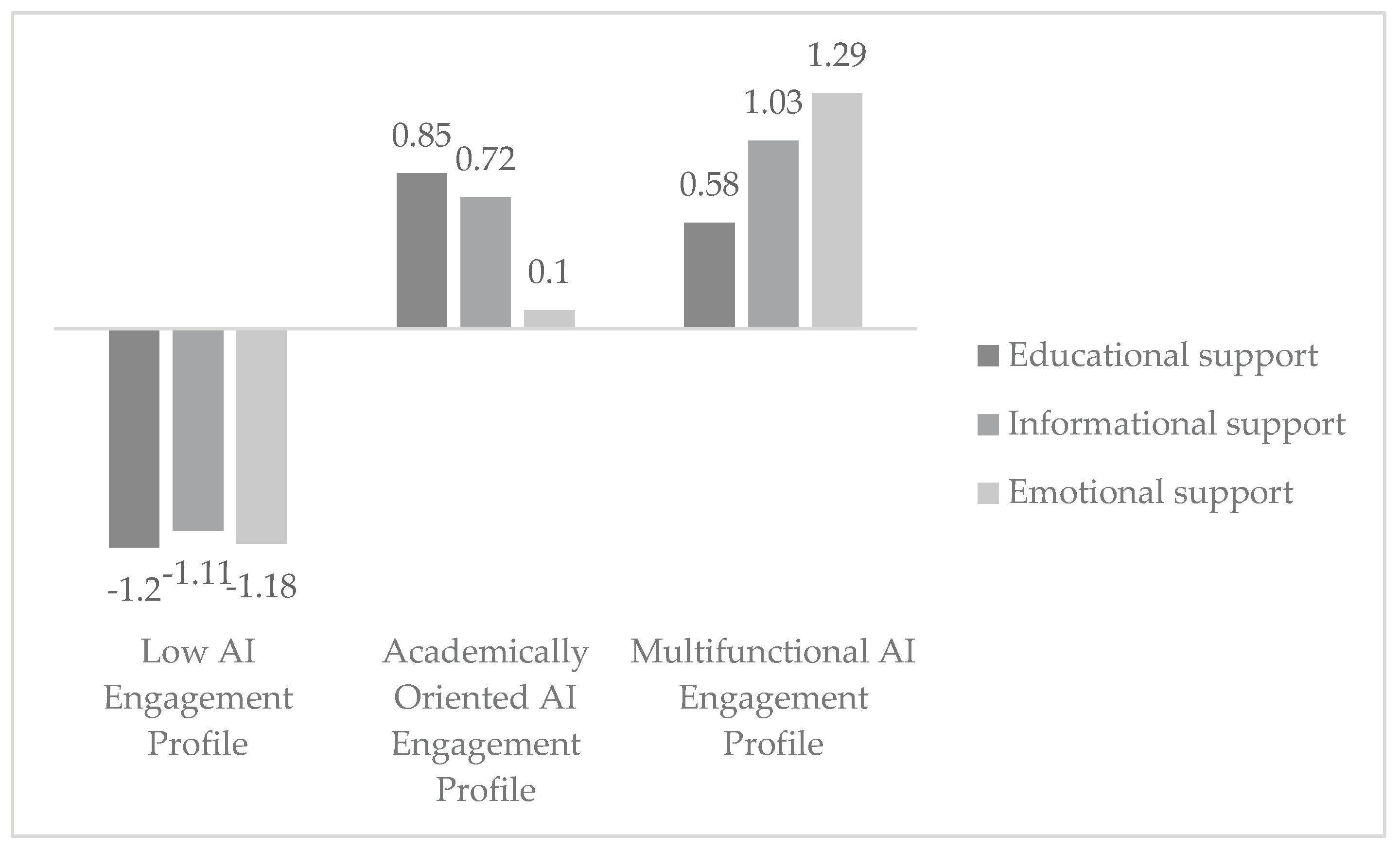
The selected solution identified three distinct student profiles according to their patterns of artificial intelligence use for educational, informational, and emotional support (Table 3). The first profile, labeled the Low AI Engagement Profile (n = 108; 25.4%), was characterized by below-average scores across the three analyzed dimensions, with standardized values of z = −1.20 for educational support, z = −1.11 for informational support, and z = −1.18 for emotional support. These students were positioned approximately one standard deviation below the sample mean in all AI-mediated support modalities, suggesting relatively limited engagement with artificial intelligence tools for both academic and socio-emotional purposes. Rather than indicating a deficit in self-regulation, this profile may reflect a preference for alternative learning resources, lower reliance on AI-assisted support, or the use of more traditional self-regulatory strategies.
The second profile, identified as the Academically Oriented AI Engagement Profile (n = 211; 49.5%), comprised approximately half of the sample and exhibited above-average scores in educational support (z = 0.85) and informational support (z = 0.72), whereas emotional support remained close to the sample mean (z = 0.10). This pattern suggests a predominantly instrumental use of artificial intelligence, mainly oriented toward academic tasks, information seeking, and learning management activities. Students within this profile appear to selectively integrate AI tools into their self-regulatory processes, while making comparatively limited use of these technologies for emotional assistance.
The third profile, labeled the Multifunctional AI Engagement Profile (n = 107; 25.1%), showed positive scores across all evaluated dimensions, with particularly high values for emotional support (z = 1.29), followed by informational support (z = 1.03) and educational support (z = 0.58). These students were positioned between approximately half a standard deviation and more than one standard deviation above the sample mean across the different AI-supported modalities, indicating a pattern of intensive and diversified engagement with artificial intelligence. In addition to using AI for academic and informational purposes, these students appear to rely on such tools as a complementary source of emotional support, reflecting a broader repertoire of technology-mediated self- and co-regulatory practices.
Overall, the three-profile solution highlights the existence of heterogeneous patterns of artificial intelligence engagement among university students. These profiles differ not only in the intensity of AI use but also in the functional role that these technologies play within students' learning and support ecosystems, ranging from limited engagement, to academically oriented use, to multifunctional engagement encompassing educational, informational, and emotional domains.
Classification quality was satisfactory. The average posterior probabilities for class membership exceeded .88 in all cases, indicating adequate precision in assigning participants to the identified latent profiles.
Figure 1.
Z-scores by AI use profile and dimension. Note. Values are standardized scores (z-scores). Positive values indicate levels above the sample mean, whereas negative values indicate levels below the sample mean.
Figure 1.
Z-scores by AI use profile and dimension. Note. Values are standardized scores (z-scores). Positive values indicate levels above the sample mean, whereas negative values indicate levels below the sample mean.
To further examine differences among profiles, a multivariate analysis of variance (MANOVA) was conducted using educational, informational, and emotional support as dependent variables.
The multivariate effect was statistically significant, Wilks’ Λ = .18, F(6, 842) = 131.42, p < .001, η²p = .52, indicating substantial differences among profiles. Univariate analyses revealed significant between-profile differences in educational support, F(2, 423) = 218.36, p < .001, η² = .51; informational support, F(2, 423) = 201.14, p < .001, η² = .49; and emotional support, F(2, 423) = 294.85, p < .001, η² = .58. Bonferroni-adjusted post hoc comparisons showed statistically significant differences among all three profiles across the three dimensions (p < .001).
Overall, these findings highlight the existence of heterogeneous patterns of artificial intelligence use among university students, differentiated both by intensity of use and by the predominant type of perceived support.
3.2. Differences in Academic Goal Orientations by AI use Profiles
An ANCOVA was conducted to examine the relationship between latent AI engagement profiles and academic goals while controlling for gender and age. Post hoc comparisons were performed using Bonferroni adjustment, and effect sizes were estimated using Cohen’s d. The analyses revealed statistically significant differences across the three AI engagement profiles in all dimensions of academic goals (Table 4).
For learning goals, significant differences emerged among profiles, F(2, 421) = 32.41, p < .001, with a large effect size (partial η² = .133; d = 0.85). Students belonging to the Multifunctional AI Engagement Profile reported the highest levels of learning goals (M = 4.21, SD = 0.42), followed by those in the Instrumental AI Engagement Profile (M = 3.75, SD = 0.44), whereas students in the Low AI Engagement Profile obtained the lowest scores (M = 3.12, SD = 0.48). These findings suggest a positive association between broader engagement with AI-supported resources and stronger learning-oriented motivational patterns.
For achievement goals, significant differences were also observed, F(2, 421) = 18.76, p < .001, with a medium effect size (partial η² = .082; d = 0.62). Again, students classified within the Multifunctional AI Engagement Profile showed the highest mean score (M = 3.88, SD = 0.43), followed by those in the Instrumental AI Engagement Profile (M = 3.61, SD = 0.46), while participants in the Low AI Engagement Profile reported the lowest values (M = 3.25, SD = 0.50). This pattern indicates a progressive increase in achievement-oriented motivation as engagement with AI tools becomes more extensive and diversified.
For social reinforcement goals, significant profile differences were found, F(2, 421) = 14.58, p < .001, with a medium effect size (partial η² = .065; d = 0.64). The Multifunctional AI Engagement Profile presented the highest mean (M = 3.89, SD = 0.45), followed by the Instrumental AI Engagement Profile (M = 3.52, SD = 0.44), whereas the Low AI Engagement Profile showed the lowest scores (M = 3.40, SD = 0.47).
Overall, these findings indicate that students exhibiting more diversified and intensive patterns of AI engagement tend to report stronger academic motivation, particularly with respect to learning-oriented goals, whereas lower engagement with AI is associated with comparatively weaker motivational dispositions.
3.3. Correlations Between AI Dimensions and Academic Goals
The results show positive and significant correlations between all AI dimensions and academic goals, although with different levels of intensity. For learning goals, educational support showed the strongest correlation, r = 0.62 (p < .01), followed by informational support (r = 0.55, p < .01) and emotional support (r = 0.42, p < .01) (Table 4).
For achievement goals, correlations were slightly lower: educational support was correlated at r = 0.48 (p < .01), informational support at r = 0.45 (p < .01), and emotional support at r = 0.36 (p < .01).
Finally, for social reinforcement goals, the strongest relationship was observed with emotional support (r = 0.51, p < .01), whereas educational and informational support showed moderate correlations of r = 0.32 (p < .01) and r = 0.28 (p < .01), respectively.
Table 5.
Pearson correlations between AI dimensions and academic goals.
| Academic goal | Educational support | Informational support | Emotional support |
| Learning goals | r = .62** | r = .55** | r = .42** |
| Achievement goals | r = .48** | r = .45** | r = .36** |
| Social reinforcement goals | r = .32** | r = .28** | r = .51** |
Note: **p < .01; *p < .05.
3.4. Structural Equation Model (SEM) and Complementary Diagnostics
The confirmatory factor analysis (CFA) showed a satisfactory fit of the measurement model, with indices of χ²(120) = 286.45, p < .001, CFI = 0.961, TLI = 0.952, RMSEA = 0.046 (90% CI: 0.039–0.053), and SRMR = 0.041, indicating that the proposed model adequately represented the data. Regarding reliability and convergent validity, the results showed adequate composite reliability values across all dimensions (CR ranging from 0.87 to 0.93) and average variance extracted above the recommended threshold of 0.50 (AVE ranging from 0.64 to 0.76), confirming internal consistency and convergent validity of the constructs.
Discriminant validity, assessed using the Fornell–Larcker criterion and the HTMT ratio, showed adequate results. The square root of the AVE for each construct was higher than its correlations with the other factors, and HTMT values ranged between 0.42 and 0.79, below the critical threshold of 0.85, confirming adequate differentiation between constructs. Regarding multivariate normality, Mardia’s results indicated significant deviations (skewness = 12.34, p < .001; kurtosis = 45.21, p < .001), as well as the Henze–Zirkler statistic (1.18, p < .001); therefore, robust MLR estimation was used in the structural analysis.
In relation to common method bias, Harman’s test indicated that the first unrotated factor explained 34.8% of the total variance, below the critical threshold of 50%, while the common latent factor (CLF) approach showed minimal variations in factor loadings (Δλ < .20), suggesting that common method bias does not represent a substantial threat to the results. Likewise, the multicollinearity analysis showed VIF values below 5 for all predictors, ruling out relevant collinearity issues.
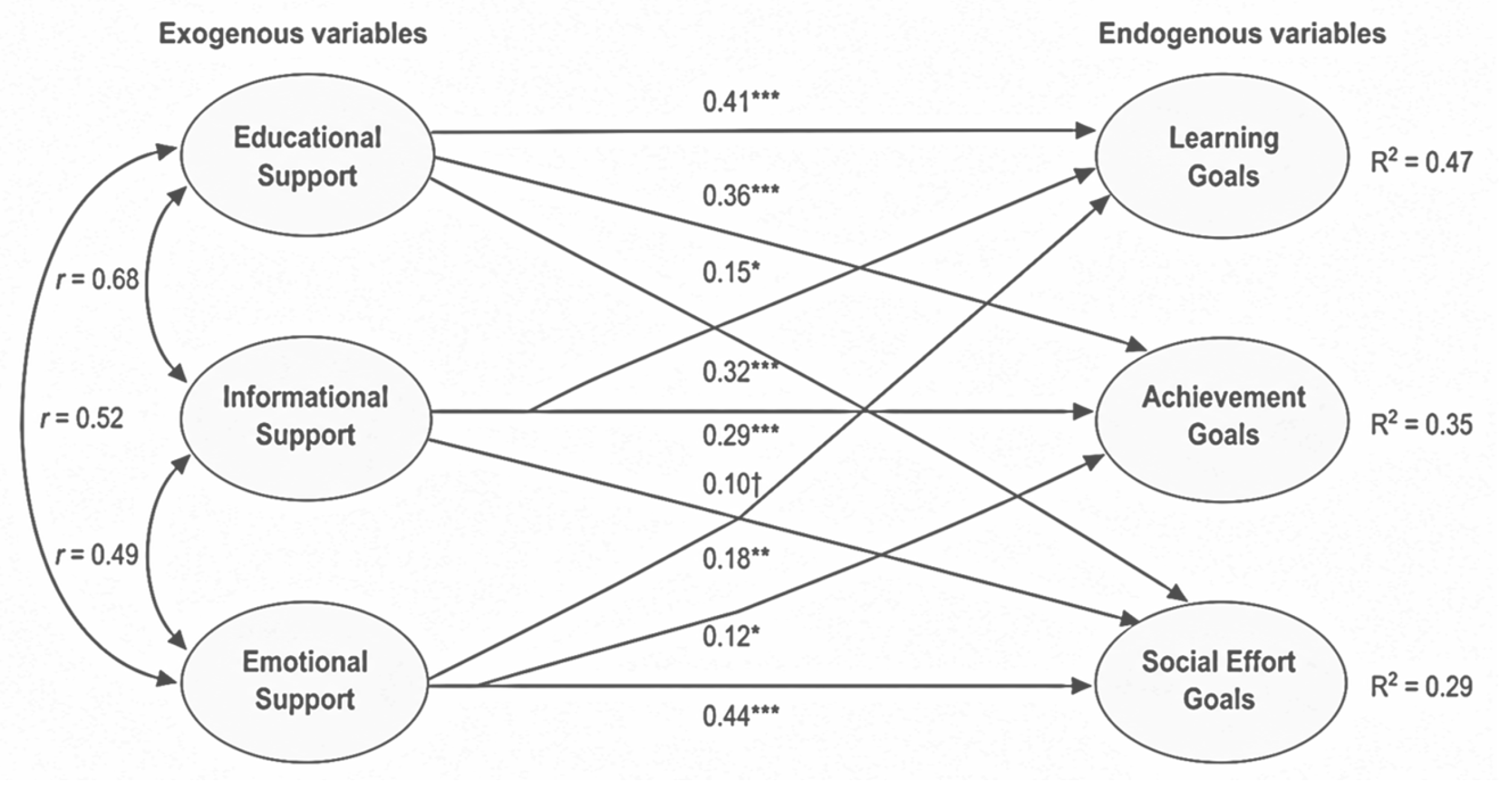
The structural model showed that the dimensions of perceived usefulness of artificial intelligence explain a significant proportion of variance in academic goals. For learning goals, the model explained 47% of the variance (R² = 0.47), with educational support being the strongest predictor (β = 0.41, t = 7.12, p < .001), followed by informational support (β = 0.32, t = 5.48, p < .001), and emotional support (β = 0.18, t = 3.12, p = .002). For performance goals, the model explained 35% of the variance (R² = 0.35), showing a similar pattern: educational support (β = 0.36, t = 6.05, p < .001), informational support (β = 0.29, t = 4.72, p < .001), and emotional support (β = 0.12, t = 2.01, p = .046). Finally, for social reinforcement goals, the model explained 29% of the variance (R² = 0.29), where emotional support was the strongest predictor (β = 0.44, t = 7.31, p < .001), followed by educational support (β = 0.15, t = 2.62, p = .009), while informational support was not statistically significant (β = 0.10, t = 1.78, p = .076).
Figure 2.
SEM model: perceived usefulness of AI and academic goals. Note: *** p < .001; ** p < .01; * p < .05.
Figure 2.
SEM model: perceived usefulness of AI and academic goals. Note: *** p < .001; ** p < .01; * p < .05.
4. Discussion
The results of this study allow an integrated understanding of how artificial intelligence (AI) is embedded in university learning processes as a multifunctional system that influences cognitive, motivational, and socio-emotional dimensions of students.
Regarding Objective 1, the existence of three differentiated AI usage profiles (low, balanced, and high) is confirmed, supporting the hypothesis that interaction with these technologies is not homogeneous but instead forms latent usage configurations (Pintrich, 2000; Wickberg & Warchavchik, 2026). This finding is consistent with Niño-Carrasco et al. (2025) and Stojanov et al. (2024), who also identified differentiated patterns of interaction with tools such as ChatGPT in university students, highlighting that technological dependence is unevenly distributed depending on motivational and cognitive characteristics. These results also invite reflection on educational sustainability in digital university contexts, since balanced and critical AI use can foster more efficient, personalized, and sustainable learning models, optimizing academic resources and promoting responsible digital competencies aligned with the Sustainable Development Goals (Castañeda de León, 2024; Gallent et al., 2023; Vélez et al., 2024).
In this line, the low-use profile, characterized by negative scores across all support dimensions, can be interpreted through technology acceptance models, where perceived usefulness and ease of use determine technology adoption. This connects with Davis (Ben Otman et al., 2025; Davis, 1989) and contemporary approaches to digital competence in higher education, where interaction with intelligent systems depends on metacognitive skills and self-regulated learning strategies (Boekaerts, 2011; Ifenthaler & Yau, 2020; Zimmerman, 2002). Thus, low AI use may reflect limitations in planning and strategic learning management, central aspects of self-regulated learning.
In contrast, the high-use profile stands out especially in emotional support, in addition to educational and informational support, suggesting that AI is not only perceived as an academic tool but also as a companion-like agent. This aligns with Vázquez (2021), who distinguishes three dimensions of AI impact in education: academic, informational, and emotional. Prior studies (González de la Garza, 2024; Gutiérrez et al., 2025; Quezada et al., 2025) also highlight AI’s role in enhancing socio-emotional competencies and personalized learning processes.
From a theoretical perspective, this phenomenon can be explained through Self-Determination Theory (Ben Otman et al., 2025; Decy & Ryan, 2000; Ryan & Decy, 2000), particularly the need for relatedness, which may be partially satisfied through interactions with conversational AI systems. Intelligent tutoring systems and AI agents can generate a sense of social presence, supporting cognitive engagement and motivation (Delcker et al., 2024).
Regarding Objective 2, significant differences in academic goals were confirmed according to AI usage profiles. Learning goals were highest in the high-use group, consistent with Achievement Goal Theory (Ben Otman et al., 2025; Boekaerts, 2011; Delcker et al., 2024; González de la Garza, 2024; Gutiérrez et al., 2025), which links learning goals with mastery orientation. This is also consistent with Alhadabi and Karpinski (2020), Rodríguez (2011), and Saborío and Chaves (2023), who emphasize the multidimensional nature of academic motivation in higher education.
Increases in achievement goals may also be interpreted in relation to academic self-efficacy (Elliot & McGregor, 2001), as AI provides immediate and personalized feedback that may strengthen perceived competence. However, as Hayamizu and Weiner (1991) note, performance goals may also reflect extrinsic motivation oriented toward external evaluation, creating a tension between intrinsic and extrinsic orientations.
Social reinforcement goals also increased in the high-use group, suggesting that AI may indirectly support needs for approval and validation (Ben Otman et al., 2025; Boekaerts, 2011; Delcker et al., 2024; Holmes et al., 2022; González de la Garza, 2024; Gutiérrez et al., 2025). This aligns with Suriá Martínez and Castrillo (2022) and Saborío and Chaves (2023), who highlight the relevance of social motivational dimensions in digitally mediated learning environments.
Regarding Objective 3, positive and significant correlations between AI dimensions and academic goals confirm a functional relationship between perceived support type and motivational orientation. Educational support showed the strongest association with learning goals, consistent with Zimmerman’s model of self-regulated learning (Al-Zahrani, 2025; Zimmerman, 2002), which emphasizes planning, monitoring, and evaluation processes. Lodge et al. (2023) argue that technological environments can enhance metacognitive regulation when they provide structured and adaptive feedback.
These findings also suggest that AI-supported learning environments may facilitate a gradual transition from co-regulation to self-regulation. By engaging learners in reflective dialogues, prompting goal setting, monitoring progress, and encouraging adaptive strategy use, AI systems can help students internalize regulatory processes that were initially supported externally. This progression is particularly relevant in higher education contexts, where fostering autonomous and lifelong learning skills is considered a key educational objective. Nevertheless, the effectiveness of AI-mediated co-regulation may depend on learners’ prior self-regulatory competencies, motivation, and the pedagogical design of AI interventions, highlighting the need for further research on how these factors interact across different educational settings.
Informational support showed moderate relationships with learning and achievement goals, consistent with Ifenthaler and Yau (2020), who emphasize the role of digital systems in efficient academic information management.
Emotional support was most strongly related to social reinforcement goals, aligning with Vázquez-Cano (Ben Otman et al., 2025; López et al., 2024; Pintrich, 2000; Vázquez, 2021) regarding the socio-emotional function of AI.
In this regard, the emotional support dimension can be illustrated through the role of artificial intelligence tools as a socio-emotional accompaniment resource in the learning process. For example, AI can provide immediate feedback, guidance messages, positive reinforcement, or coping strategies in response to academic stress situations (Alyana & Ismail, 2025; Gómez et al., 2025). It can also support students in managing pre-exam anxiety through step-by-step explanations, study planning suggestions, and continuous motivational feedback (Suconota et al., 2023; Suriá Martínez & Villegas, 2022). In this way, it contributes to increasing the sense of accompaniment, reducing perceived academic isolation, and fostering persistence in complex tasks, thereby integrating into students’ motivational and self-regulated learning processes (Alyana & Ismail, 2025; Gallent et al., 2023; Quezada et al., 2025; Vélez et al., 2024).
Finally, regarding Objective 4, the SEM confirms a clear functional differentiation among AI dimensions and provides a more fine-grained understanding of how each type of AI support relates to distinct academic goal orientations. Educational support emerges as the strongest predictor of learning and achievement goals, suggesting that when students perceive AI as a tool for explanation, guided practice, feedback, and adaptive instruction, they are more likely to engage in mastery-oriented behaviors (e.g., deep understanding, skill acquisition, and persistence) as well as performance-oriented outcomes (e.g., improving grades and meeting academic standards). This is consistent with Delcker et al. (2024), who demonstrated the effectiveness of intelligent tutoring systems in improving academic performance through guided problem-solving and personalization.
Informational support shows a moderate instrumental role, being primarily associated with learning goals oriented toward knowledge acquisition and task completion efficiency. In this sense, students who use AI to search, filter, synthesize, and organize academic information tend to frame their engagement in terms of goal attainment and study optimization, reflecting a more utilitarian and strategy-driven orientation toward academic tasks.
Emotional support is positively associated with social reinforcement goals and, to a lesser extent, with persistence in learning processes, indicating that AI may also function as a socio-affective resource. In particular, students who perceive AI as a source of reassurance, motivation, or stress reduction tend to report higher levels of social reinforcement goals, suggesting that AI can fulfill perceived socio-emotional functions in learning environments, especially in moments of academic pressure or uncertainty. The relatively larger standardized coefficient observed for emotional support in relation to social reinforcement goals (β = 0.44) suggests that students who perceive greater emotional assistance from AI tools also tend to place greater value on social recognition and external validation within their academic experience. However, given the cross-sectional design of the study, this relationship should be interpreted as an association rather than as evidence of a directional or causal effect.
Likewise, it is important to qualify the interpretation of the results regarding the emotional support provided by artificial intelligence to avoid an overly optimistic or generalized reading. Although the findings show a positive association between perceived emotional support from AI and social reinforcement goals, this relationship should be understood strictly within the context of the construct assessed in this study, which focuses on the functional perception of support provided by AI tools in relation to academic goals, and not on emotional dependence on these technologies. Recent literature warns that excessive use of chatbots for emotional support may, in certain contexts, be associated with increased social isolation or lower perceived satisfaction with human support. In this sense, our results do not imply that AI replaces or directly substitutes interpersonal relationships or formal university support systems, but rather reflect how students perceive this type of support in relation to their academic objectives within the analyzed sample. Therefore, the interpretation of the observed effects remains strictly limited to the empirical data and should not be extrapolated beyond the scope of the study.
Finally, practical support is primarily associated with self-regulated learning processes and goal management, such as planning, time management, and task organization. Students who make use of these functionalities tend to exhibit stronger behavioral regulation and clearer structuring of their academic goals, facilitating the translation of intentions into sustained academic action. However, it is important to nuance the interpretation that lower or less frequent use of these AI functionalities necessarily reflects a deficit in self-regulatory capacity. From a co-regulatory perspective, reduced reliance on AI tools may also indicate different regulatory configurations, where students rely more heavily on alternative sources of support, such as peers, instructors, or established study routines, rather than on technologically mediated scaffolding. In this sense, co-regulation offers a complementary lens to understand how regulatory support is distributed across social, pedagogical, and technological agents, avoiding an overly individualistic interpretation of self-regulation. Beyond supporting self-regulated learning processes, these practical functionalities may still contribute to co-regulation of learning by providing external scaffolding that guides students in managing their academic activities. Through personalized prompts, reminders, adaptive recommendations, and ongoing feedback, AI-based tools can assist learners in setting priorities, adjusting study strategies, and maintaining engagement with their goals. Such co-regulatory support may be particularly beneficial for students who have not yet developed strong self-regulatory skills, fostering a progressive internalization of regulatory processes and ultimately promoting greater learner autonomy.
Overall, these findings suggest that AI in higher education operates not only as an academic tool but as a complex system integrating cognitive, informational, emotional, and behavioral dimensions, influencing academic motivation in differentiated ways. This is consistent with Self-Determination Theory (Ben Otman et al., 2025; Boekaerts, 2011; Delcker et al., 2024; Holmes et al., 2022; González de la Garza, 2024; Gutiérrez et al., 2025), Achievement Goal Theory (Suriá Martínez & Villegas, 2022), and Self-Regulated Learning models (Alyana & Ismail, 2025; Boekaerts, 2011; Zimmerman, 2002), confirming that AI can contribute both to academic performance and to the development of cognitive, metacognitive, socio-emotional, and self-management competencies.
From a sustainability perspective, these results suggest that responsible and balanced AI integration can foster more inclusive, efficient, and sustainable university models, optimizing learning resources and promoting digital literacy aligned with the Sustainable Development Goals (González & Ballesteros, 2024; Suconota et al., 2023).
Given that the same three AI support dimensions were used both in the clustering procedure and as predictors in the SEM, the results should be interpreted with caution. This shared analytical basis may introduce a degree of overlap in variance, which should be considered when interpreting the magnitude of the observed effects.
The findings of this study also have relevant implications in terms of sustainability in higher education, insofar as they contribute to promoting more efficient, inclusive, and adaptive educational practices. In particular, the identification of differentiated profiles of artificial intelligence use makes it possible to understand how students optimize technological resources to support their learning, which fosters a more efficient management of time, information, and educational processes. Likewise, the use of AI tools oriented toward personalized learning can reduce educational inequalities by facilitating access to academic, informational, practical, and emotional support in a more equitable manner. Overall, these results suggest that the responsible integration of artificial intelligence in universities not only enhances teaching and learning processes but also aligns with principles of educational sustainability by promoting more accessible, efficient, and adaptable environments tailored to the diverse needs of students.
From an integrative perspective, it is important to distinguish between the motivational implications and the sustainability implications derived from the findings. At the motivational level, the results relate to how different types of artificial intelligence support are associated with students’ academic goals, influencing orientations toward learning, performance, self-regulation, and academic persistence. These associations primarily describe psychological patterns of engagement with learning and study management. In contrast, sustainability implications operate at a broader and more structural level, referring to how the integration of artificial intelligence may contribute to more efficient, inclusive, and adaptive educational systems through the optimization of resources, improved access to knowledge, and the reduction of educational inequalities. Thus, while motivational implications explain how students interact with and engage in learning processes, sustainability implications describe the potential impact of these interactions on the development of more sustainable and equitable higher education models.
Despite these contributions, several limitations must be acknowledged. The cross-sectional design prevents causal inferences, and self-report measures may introduce social desirability bias. Additionally, cluster solutions may vary across institutional or disciplinary contexts, limiting generalizability. Finally, the study relies on perceived rather than objective AI usage. Furthermore, although the sample size is adequate, it should be acknowledged that the sample is based on convenience sampling; therefore, caution is required when interpreting the results, as they cannot be generalized to all universities or to other academic disciplines. Future research should include longitudinal designs, mixed methods approaches, and the analysis of mediators such as digital self-efficacy, technological anxiety, and cognitive load. It would also be relevant to explore differences across academic disciplines and further examine how self-regulated learning interacts with AI use in demanding academic contexts.
In terms of practical implications, the findings support the development of tailored educational strategies to promote balanced AI use. Educational support emerges as a key driver of learning and achievement goals, reinforcing the value of integrating AI into self-regulated learning environments. Moreover, the emotional dimension highlights AI’s potential role in student well-being, suggesting that universities should consider AI not only as an academic tool but also as a socio-emotional support resource.
Author Contributions
[Removed for double-blind peer review].
Funding
This study received no external funding.
Institutional Review Board Statement
This research has been approved by [Removed for double-blind peer review].
Informed Consent Statement
Informed consent was obtained from all subjects involved in the study.
Data Availability Statement
The data that support the findings of this study are available from the corresponding authors upon reasonable request.
Conflicts of Interest
The authors declare that they have no conflicts of interest.
References
- Alfaleh, M. Sustainable AI-driven assessment in higher education: A systematic review of fairness, transparency, pedagogical innovation, and governance. Sustainability 2026, 18, 785. [Google Scholar] [CrossRef]
- Alhadabi, A.; Karpinski, A. C. Grit, self-efficacy, achievement orientation goals, and academic performance in university students. Int. J. Adolesc. Youth 2020, 25(1), 519–533. [Google Scholar] [CrossRef]
- Alyana, A.; Ismail, N. M. “Hey Bot, I'm drowning in deadlines, can you really feel me?”: Inquiring chatbots' digital empathy. Proc. Int. Conf. Educ. 2025, 3(1), 83–89. [Google Scholar] [CrossRef]
- Al-Zahrani, A. M. Exploring the impact of artificial intelligence chatbots on human connection and emotional support among higher education students. SAGE Open 2025, 15(2), 1–11. [Google Scholar] [CrossRef]
- Asociación Médica Mundial. World Medical Association Declaration of Helsinki: Ethical Principles for Medical Research Involving Human Participants. JAMA 2024, 333(1), 71–74. [Google Scholar] [CrossRef] [PubMed]
- Ben Otman, S.; Ben Otman, S.; Karahan Adalı, G. The impact of generative AI on university students' learning experience: A study on cognitive and affective outcomes. J. Inf. Organ. Sci. 2025, 49(2), 329–344. [Google Scholar] [CrossRef]
- Boekaerts, M. Emotions, emotion regulation, and self-regulation of learning. In Handbook of self-regulation of learning and performance; Zimmerman, B. J., Schunk, D. H., Eds.; Routledge, 2011; pp. 408–425. [Google Scholar]
- Castañeda de León, L. M. Gobernanza de la inteligencia artificial mediada por gobierno de TIC en la Educación Superior: Literatura científica y no convencional, 2020–2023. TIES Rev. De Tecnol. E Innovación En. Educ. Super. 2024, 10, 86–98. [Google Scholar] [CrossRef]
- Daha, E. S.; Altelwany, A. A. Exploring the impact of using ChatGPT in light of goal orientations and academic self-efficacy. Int. J. Instr. 2025, 18(2), 167–184. [Google Scholar] [CrossRef]
- Davis, F. D. Perceived usefulness, perceived ease of use, and user acceptance of information technology. MIS Q. 1989, 13(3), 319–340. [Google Scholar] [CrossRef] [PubMed]
- Deci, E. L.; Ryan, R. M. The “what” and “why” of goal pursuits: Human needs and self-determination of behavior. Psychol. Inq. 2000, 11(4), 227–268. [Google Scholar] [CrossRef]
- Delcker, J.; Heil, J.; Ifenthaler, D.; Seufert, S.; Spirgi, L. First-year students AI-competence as a predictor of higher achievement. Int. J. Educ. Technol. High. Educ. 21 2024, 18. [Google Scholar] [CrossRef]
- Delgado, N.; Carrasco, L. C.; de la Maza, M. S.; Etxabe-Urbieta, J. M. Aplicación de la Inteligencia Artificial (IA) en Educación: Los beneficios y limitaciones de la IA percibidos por el profesorado de educación primaria, educación secundaria y educación superior. Rev. Electrón. Interuniv. De Form. Del Profr. 2024, 27(1), 207–224. [Google Scholar] [CrossRef]
- Elliot, A. J.; McGregor, H. A. A 2 × 2 achievement goal framework. J. Personal. Soc. Psychol. 2001, 80(3), 501–519. [Google Scholar] [CrossRef] [PubMed]
- Fuentes, S.; Rosário, P.; Valdés, M.; Delgado, A.; Rodríguez, C. Autorregulación del aprendizaje: Desafío para el aprendizaje universitario autónomo. Rev. Latinoam. De Educ. Inclusiva 2023, 17(1), 21–39. [Google Scholar] [CrossRef]
- Gallent Torres, C.; Zapata González, A.; Ortego Hernando, J. L. El impacto de la inteligencia artificial generativa en educación superior: Una mirada desde la ética y la integridad académica. RELIEVE 2023, 29(2). [Google Scholar] [CrossRef]
- Gómez Cano, C. A.; Sánchez Castillo, V.; Jiménez Zapata, E. M. La innovación asistida por inteligencia artificial en la Educación Superior: Un análisis de las principales tendencias y líneas futuras. Rev. Colomb. De Tecnol. Av. 2025, 2(46), 1–12. [Google Scholar] [CrossRef]
- González de la Garza, L. M. Inteligencia artificial y educación superior. Posibilidades, riesgos aceptables y límites que no se deben traspasar. Rev. De Educ. Y Derecho 2024, (2 Extraordinario), 115–145. [Google Scholar] [CrossRef]
- González-Geraldo, J. L.; Ballesteros, J. A. Ecos de sostenibilidad: Reflexiones sobre la inteligencia artificial a la luz de los Objetivos de Desarrollo Sostenible. Edetania. Estud. Y Propues. Socioeducativas 2024, (65). [Google Scholar] [CrossRef]
- Gutiérrez-Castillo, J. J.; Romero Tena, R.; León-Garrido, A. Beneficios de la inteligencia artificial en el aprendizaje de los estudiantes universitarios: Una revisión sistemática. Edutec Rev. Electrón. De Tecnol. Educ. 2025, (91), 185–206. [Google Scholar] [CrossRef]
- Haider, S. Exploring opportunities and challenges of artificial intelligence in social work education. In The Routledge international handbook of social work teaching; Routledge, 2024; pp. 46–62. [Google Scholar] [CrossRef]
- Hayamizu, T.; Weiner, B. A test of Dweck’s model of achievement goals as related to perceptions of ability. J. Exp. Educ. 1991, 59(1), 31–44. [Google Scholar] [CrossRef]
- Holmes, W.; Porayska-Pomsta, K.; Holstein, K.; Sutherland, E.; Baker, T.; Shum, S. B.; Santos, O. C.; Rodrigo, M. M. T.; Cukurova, M.; Bittencourt, I. I.; Koedinger, K. R. Ethics of AI in education: Towards a community-wide framework. Int. J. Artif. Intell. Educ. 2022, 32(3), 504–526. [Google Scholar] [CrossRef]
- Hu, L.; Bentler, P. M. Cutoff criteria for fit indexes in covariance structure analysis: Conventional criteria versus new alternatives. Struct. Equ. Model. A Multidiscip. J. 1999, 6(1), 1–55. [Google Scholar] [CrossRef]
- Ifenthaler, D.; Yau, J. Y.-K. Utilising learning analytics to support study success in higher education: A systematic review. Educ. Technol. Res. Dev. 2020, 68, 1961–1990. [Google Scholar] [CrossRef]
- Lodge, J. M.; de Barba, P.; Broadbent, J. Learning with generative artificial intelligence within a network of co-regulation. J. Univ. Teach. Learn. Pract. 2023, 20(7), 02. [Google Scholar] [CrossRef]
- López De La Cruz, E. C. I.; Baldeón Canchaya, W. T. Inteligencia artificial en la evaluación de la inteligencia emocional en estudiantes universitarios: Un análisis actualizado. Innovación Empres. 2024, 4(1), 35–39. [Google Scholar] [CrossRef]
- Niño-Carrasco, S. A.; Castellanos-Ramírez, J. C.; Perezchica Vega, J. E.; Sepúlveda Rodríguez, J. A. Percepciones de estudiantes universitarios sobre los usos de inteligencia artificial en educación. Rev. Fuentes 2025, 27(1), 94–106. Available online: https://dialnet.unirioja.es/servlet/articulo?codigo=9936060.
- Pintrich, P. R. An achievement goal theory perspective on issues in motivation terminology, theory, and research. Contemp. Educ. Psychol. 2000, 25(1), 92–104. [Google Scholar] [CrossRef] [PubMed]
- Quezada, K. A.; Bajaña, I. M. S.; Peñafiel, M. A. K.; Baldeon, D. P. M. La inteligencia artificial y la producción científica en el campo de la educación: Una revisión sistemática. RECIMUNDO 2025, 9(2), 141–159. [Google Scholar] [CrossRef]
- Rodríguez Salmerón, J. M. Self-determined motivation in nonconventional sport areas. Rev. Española De Educ. Física Y Deport. 2011, (394), 87–97. [Google Scholar] [CrossRef]
- Ryan, R. M.; Deci, E. L. Self-determination theory and the facilitation of intrinsic motivation, social development, and well-being. Am. Psychol. 2000, 55(1), 68–78. [Google Scholar] [CrossRef] [PubMed]
- Saborío-Taylor, S.; Chaves, A. Á. Las metas académicas según escalas de aprendizaje, logro y refuerzo social: Un estudio desde las percepciones según género. Rev. Ens. Pedagógicos 2023, 18(2), 1–24. [Google Scholar] [CrossRef]
- Stojanov, A.; Liu, Q.; Koh, J. H. L. University students’ self-reported reliance on ChatGPT for learning: A latent profile analysis. Comput. Educ. Artif. Intell. 2024, 6, 100243. [Google Scholar] [CrossRef]
- Suárez Lima, G. J.; Posligua Fernández, J. A.; Carpio Cruz, O. J.; Ojanama Guriz, N. Aplicación de la inteligencia artificial para la personalización del aprendizaje en entornos universitarios: Desafíos, oportunidades y su impacto en la mejora del rendimiento académico. Rev. Soc. Front. 2025, 5(4), Article e786. [Google Scholar] [CrossRef] [PubMed]
- Suconota Pintado, L.; Sánchez Prado, R.; Orellana Peláez, C.; Ávila Aguilar, W. Inteligencia artificial y sostenibilidad: El compromiso de una institución de educación superior. Mag. De Las Cienc. Rev. De Investig. E Innovación 2023, 8(4), 12–28. [Google Scholar] [CrossRef]
- Suriá Martínez, R.; Villegas Castrillo, E. Relationship between academic goals and prosocial behaviour in social work university students. Cuad. De Trab. Soc. 2022, 35(2), 139–148. [Google Scholar] [CrossRef]
- Vázquez-Cano, E. Artificial intelligence and education: A pedagogical challenge for the 21st century. Educ. Process Int. J. 2021, 10(3), 7–12. [Google Scholar] [CrossRef]
- Vélez Rivera, R.; Muñoz Álvarez, D.; Leal-Orellana, P.; Ruiz-Garrido, A. Uso de inteligencia artificial en educación superior y sus implicancias éticas: Mapeo sistemático de literatura. Hachetetepé Rev. Científica De Educ. Y Comun. 2024, (28). [Google Scholar] [CrossRef]
- Wickberg Hugerth, M.; Warchavchik Hugerth, L. Seeking knowledge or efficiency: Profiling students' AI-use through survey-based latent class analysis. Comput. Educ. Artif. Intell. 2026, 10, 100531. [Google Scholar] [CrossRef]
- Zimmerman, B. J. Becoming a self-regulated learner: An overview. Theory Into Pract. 2002, 41(2), 64–70. [Google Scholar] [CrossRef] [PubMed]
Table 2.
Fit Indices for Latent Profile Models.
| Number of Profiles | LogLik | Parameters | AIC | BIC | SABIC | Entropy | VLMR-LRT (p) | BLRT (p) |
| 1 | -1825.70 | 6 | 3663.40 | 3687.80 | 3668.90 | — | — | — |
| 2 | -1611.90 | 10 | 3243.80 | 3284.40 | 3252.90 | .82 | < .001 | < .001 |
| 3 | -1517.40 | 14 | 3062.80 | 3119.60 | 3075.50 | .86 | .012 | < .001 |
| 4 | -1509.20 | 18 | 3054.40 | 3127.40 | 3070.80 | .79 | .284 | .071 |
| 5 | -1502.60 | 22 | 3049.20 | 3138.40 | 3069.20 | .77 | .411 | .192 |
Table 3.
Standardized Means of Indicator Variables Across Latent Profiles.
| Variable | Low AI Engagement Profile | Academically Oriented AI Engagement Profile | Multifunctional AI Engagement Profile |
| Educational support | -1.20 | 0.85 | 0.58 |
| Informational support | -1.11 | 0.72 | 1.03 |
| Emotional support | -1.18 | 0.10 | 1.29 |
| Class size (n) | 108 | 211 | 107 |
| Proportion (%) | 25.4 | 49.5 | 25.1 |
Table 4.
Academic Goal Differences According to AI Engagement Profiles.
| Academic Goal | Low AI Engagement ProfileM (SD) | Instrumental AI Engagement ProfileM (SD) | Multifunctional AI Engagement ProfileM (SD) | F | p | Partial η² |
| Learning goals | 3.12 (0.48) | 3.75 (0.44) | 4.21 (0.42) | 32.41 | < .001 | .133 |
| Achievement goals | 3.25 (0.50) | 3.61 (0.46) | 3.88 (0.43) | 18.76 | < .001 | .082 |
| Social reinforcement goals | 3.40 (0.47) | 3.52 (0.44) | 3.89 (0.45) | 14.58 | < .001 | .065 |
Note. M = mean; SD = standard deviation; partial η² = partial eta squared. Analyses were adjusted for gender and age. Bonferroni correction was applied to post hoc comparisons.
Disclaimer/Publisher’s Note: The statements, opinions and data contained in all publications are solely those of the individual author(s) and contributor(s) and not of MDPI and/or the editor(s). MDPI and/or the editor(s) disclaim responsibility for any injury to people or property resulting from any ideas, methods, instructions or products referred to in the content. |
© 2026 by the authors. Licensee MDPI, Basel, Switzerland. This article is an open access article distributed under the terms and conditions of the Creative Commons Attribution (CC BY) license (http://creativecommons.org/licenses/by/4.0/).
Copyright: This open access article is published under a Creative Commons CC BY 4.0 license, which permit the free download, distribution, and reuse, provided that the author and preprint are cited in any reuse.