

Submitted:
02 November 2026
Posted:
03 November 2026
You are already at the latest version
Abstract
The name “Mpemba effect” was given to the finding that “the state that is initially more distant from the equilibrium state may come to the latter earlier”. It may seem that this assertion violates fundamental laws of physics and chemistry, but it has been supported by many experiments on various systems, from water to quantum dots, and discussed in many articles published in leading scientific journals. In fact, the above statement is not as paradoxical as it may seem, since it is well known that a harmonic oscillator comes to its equilibrium point in a time independent of its initial displacement. This gives us a possibility to outline the simplest equation of motion describing systems (in particular, molecular systems) capable of demonstrating the Mpemba-like effects.
Keywords:
Mpemba effect
; nonlinear oscillator
; harmonic oscillator
; colloid
; spin rotation
; molecular interaction
; potential energy
; first-order phase transition
; instability
; temperature
1. Introduction
The counterintuitive statement “hot water may freeze faster than cold water” has become known as the Mpemba effect [1] nearly 60 years ago. Since then, this intriguing effect was observed in many systems – not only in water, but also in polymers, clathrate hydrates, colloids, quantum dots, etc. It has become the subject of numerous experimental (see, e.g., [1,2,3,4,5,6,7,8,9,10,11]) and theoretical (see, e.g., [8,12,13,14,15,16,17]) investigations that have refined this paradox into a more generalized form, which is of interest to physicists and chemists in various areas: “the state that is initially farthest from its equilibrium state may attain the latter at the earliest time” [9,12].
Ironically, the classic Mpemba effect—a phenomenon first observed in the freezing of water and milk [1] —has recently been shown [18,19] to be not to be a deterministic process in the case of water freezing (a first order phase transition): here it is merely stochastic, random in nature.
This accidental Mpemba effect arises because the time ranges for the onset of freeing— near ice nucleation temperature—overlap significantly for both initially hot and initially cool liquid samples. This overlap is so substantial, that it outweighs the delay in cooling of the initially hotter water (see Supplementary Materials), giving rise to the erroneous, yet widespread [20] perception that hot water freezes faster than cool water.
The found accidental nature of the Mpemba effect in freezing might create the impression that this stochasticity refutes the very existence of deterministic Mpemba effects altogether.
To dispel this impression, it is useful to consider the simplest mechanistical model of the Mpemba effect, in which its origin and driving force are quite clear.
To begin with, I should note that the modern, generalized formulation of the Mpemba effect—“the state that is initially farthest from its equilibrium state attains the latter at the earliest time” [9,12]—is not as paradoxical as it might seem. It is well known that a simple harmonic oscillator (where the increase ∆U(x) in potential energy is proportional to x2, the squared deviation from the equilibrium, see Figure 1) comes to the equilibrium point in a time independent [21] of the initial displacement X0 from this point.
And since it is also well known that the time of free fall (when the potential energy ∆U(x) is proportional to the height x) increases [21] with the initial height X0, one can figure out the following: (i) when the potential energy ∆U(x) is proportional to |x|>2, the motion starting from a position that is farther from the equilibrium point will attain it earlier, that is, such a nonlinear oscillator (with ∆U(x)∝|x|>2) should demonstrate the Mpemba effect; and (ii) a conventional harmonic (Galileo’s) pendulum (with ∆U(x)∝x2) belongs just to the border that separates the “conventional” and “Mpemba-like” modes of approaching the equilibrium state.
2. Materials and Methods: Mathematical Description of “Pendulums” Exhibiting a Mpemba-like Behavior
The friction-free motion of a particle of mass m along the coordinate x in the potential ∆U(x) is described by the conventional equation
which can be transformed into . Thus, (law of conservation of energy), so that , or , where X0 is the coordinate of the particle at the initial moment of time, t = 0, when its speed =0.
When the coordinate x ≥ 0 and ∆U(x) monotonically increases with x (so that the particle speed at t ≥ 0),
Thus, , and the time t* required to reach the equilibrium point is
Replacing with z, we have
For a “pendulum” with the potential , where A > 0 and a are constants,
So, the sought dependence of the time t* to reach the equilibrium point on the initial displacement X0 looks as
i.e., t* decreases with increasing X0 when a > 0.
3. Results
Now we see:
- (i)
- when a < 0 — t* increases with the growth of the initial displacement X0 from the equilibrium point;
- (ii)
- (iii)
- when a > 0 — t* decreases with increasing initial displacement X0 from the equilibrium point; this means that a system with such a sharp increase in potential energy at large values of X0 exhibits a “Mpemba-like effect”.
3.1. The Simplest Physical System Exhibiting a Mpemba-like Behaviour
The “Mpemba-like” behaviour is generally inherent to various physical systems, like nonlinear oscillators, whose dynamic behaviour is described by the Duffing equation [23].
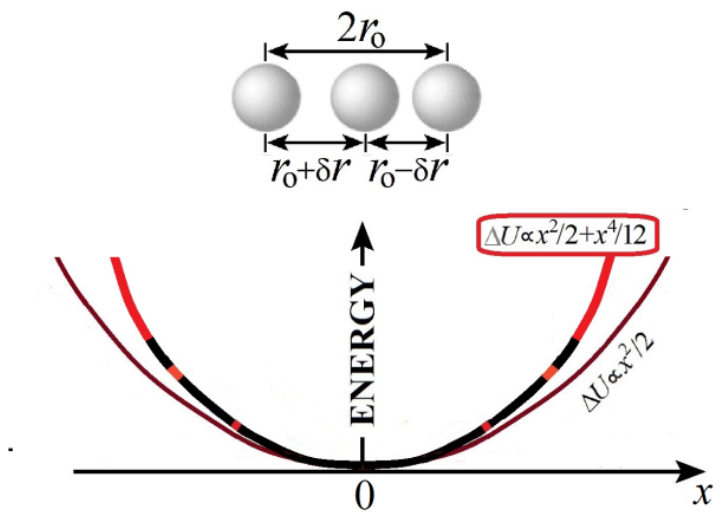
Among others, the “Mpemba-like” behaviour is inherent to a particle (atom, molecule) located between two other particles (Figure 2).
As known, the interaction energy of two atoms at a distance r can be given by the Lennard-Jones potential , where r0 is the optimal distance between atoms, and ε is their interaction energy at this distance. Thus, at a displacement Δr from the equilibrium position of the central particle, ULJ(r0+Δr,r0) + ULJ(r0+Δr,r0), and the potential energy of an atom located between two other atoms at a distance of r0+Δr from one of them and r0−Δr from the other can be represented as 2ULJ(r0,r0)+∆ULJ(r0,Δr), where ULJ(r0,r0) = 2ε does not depend on the displacement Δr, and is the displacement energy.
Replacing with x, we see that this ∆ULJ(r0,Δr) is proportional to . So, in the case of “a particle located between two other particles”, the sharper (than in a harmonic potential ) increase of ∆U(x) with the deviation x from the equilibrium should lead to a Mpemba-like effect connected with an ordinary molecular interaction.
4. Discussion and Conclusions
The above, as well as our previous studies [24], focus on the movement of individual particles, avoiding the temperature issue, while the Mpemba effect, strictly speaking, concerns macroscopic (many-particle) systems and their approach to equilibrium after a temperature change.
However, one can consider an ideal (for simplicity) gas of many particles − which is similar to a system of colloidal particles exhibiting [8] the Mpemba effect.
If these particles are (as it was in [8]) in some external potential ∆U(x), we can determine their average location in this potential at any temperature T, consider the rate of change of this 〈x〉T after a rapid decrease in temperature T, and see that, at ∆U(x)∝x2+a with a>0 (in [8], it was ∝x4 at large deviations x from the center), a “hot” (having greater T and 〈x〉T) system of particles necessarily reaches its low-temperature state earlier than an “only warm” system.
This is the strictly deterministic Mpemba effect for an ideal (or nearly ideal) gas of molecules or colloid particles.
It should be noted that the “particles” of the gas are not necessarily real molecules or colloid particles; they can also be quasiparticles, such as excitons, solitons, etc. The key point is that they possess a certain inertia (“kinetic memory”) and are situated within a potential field that increases sharply—as |x|>2 or faster—when x deviates significantly from its equilibrium position.
Although many specific mechanisms have been proposed to explain the Mpemba effect, there is still no consensus regarding its underlying cause [8,25]. It is no wonder, because there are at least two classes of systems exhibiting the Mpemba-like phenomena, which appear to have completely different mathematical, physical and chemical causes.
Some of these phenomena (such as those associated with systems of colloidal particles [8]) occur in the absence of a phase transition. The processes discussed in this article belong just to this class of events.
The others, like the seminal Mpemba effect [1], concern the moment of freezing, i.e., the onset of a first order phase transition. Paradoxically, the Mpemba effect in freezing of water, where it was first observed [1], turned out to be not deterministic, but merely a stochastic, accidental event [18,19] (see Supporting information) – i.e., it is observed sometimes, but not necessarily. This stochastic Mpemba effect arises solely from the uncertainty of the freezing moment [18,19,26], i.e., in the moment of the onset of a first order phase transition. This uncertainty leads to the substantial stochastic variation in ice nucleation times during this first-order phase transition (when this time variation – close to the temperature of nucleation of the transition – is so large that it exceeds the inevitable delay in cooling the hotter liquid) [19].
However, some systems that lack a first-order phase transition (such as those considered above) can exhibit a strictly deterministic Mpemba effect—in cases where they possess a kind of inertia and their potential energy increases sharply upon significant deviation from the equilibrium point; as a result, for such systems, a longer path may require less time.
Supplementary Materials
The following supporting information can be downloaded at the website of this paper posted on Preprints.org. (Figure S1) Two of a great many experiments (from [19]) on dynamics of water cooling & freezing at thermostat temperature Tth above -7 °C (a) and below -8 °C (b).
Funding
This research was funded by the Russian Science Foundation (grant # 25-14-00260) to AVF. The funder had no role in study design, decision to publish, or preparation of the manuscript.
Acknowledgments
I am grateful to Bogdan S. Melnik, Vladimer V. Filimonov, Gennady A. Yenin. and Andrei A. Klimov for discussions, and to E.V. Serebrova for editing the manuscript.
References
- Mpemba, E. B.; Osborne, D.G. Cool? Phys. Educ. 1969, 4, 172–175. [Google Scholar] [CrossRef]
- Freeman, M. Cooler still—an answer? Phys. Educ. 1979, 14, 417–421. [Google Scholar] [CrossRef]
- Auerbach, D. Supercooling and the Mpemba effect: when hot water freezes quicker than cold. Am. J. Phys. 1995, 63, 882–885. [Google Scholar] [CrossRef]
- Brownridge, J.D. When does hot water freeze faster than cold water? A search for the Mpemba effect. Am. J. Phys. 2011, 79, 78–83. [Google Scholar] [CrossRef]
- Burridge, H. C.; Linden, P.F. Questioning the Mpemba effect: Hot water does not cool more quickly than cold. Sci. Rep. 2016, 6, 37665. [Google Scholar] [CrossRef] [PubMed]
- Ahn, Y.-H.; Kang, H.; Koh, D. Y.; Lee, H. Experimental verifications of Mpemba-like behaviors of clathrate hydrates. Korean J. Chem. Eng. 2016, 33, 1903. [Google Scholar] [CrossRef]
- Hu, C.; Li, J.; Huang, S.; Li, H.; Luo, C.; Chen, J.; Jiang, S.; An, L. Conformation directed Mpemba effect on polylactide crystallization. Cryst. Growth. Des. 2018, 18, 5757–5762. [Google Scholar] [CrossRef]
- Kumar, A.; Bechhoefer, J. Exponentially faster cooling in a colloidal system. Nature 2020, 584, 64–68. [Google Scholar] [CrossRef] [PubMed]
- Joshi, L. K.; Franke, J.; Rath, A.; Ares, F.; Murciano, S.; Kranzl, F.; Blatt, R.; Zoller, P.; Vermersch, B.; Calabrese, P.; Roos, C.F.; Joshi, M.K. Observing the quantum Mpemba effect in quantum simulations. Phys. Rev. Lett. 2024, 133, 010402. [Google Scholar] [CrossRef] [PubMed]
- Zhang, J.; Xia, G.; Wu, C.-W.; Chen, T.; Zhang, Q.; Xie, Y.; Su, W.-B.; Wu, W.; Qiu, C.-W.; Chen, P.-X.; Li, W.; Jing, H.; Zhou, Y.-L. Observation of quantum strong Mpemba effect. Nat. Commun. 2025, 6, 301. [Google Scholar] [CrossRef] [PubMed]
- Brownridge, J. D.; Zinet, M.; Sotta, P.; Ganachaud, F. Unraveling specific conditions for a repeatable Mpemba effect. J. Phys. Chem. B 2025, 129(51), 13277–13288. [Google Scholar] [CrossRef] [PubMed]
- Lu, Z.; Raz, O. Nonequilibrium thermodynamics of the Markovian Mpemba effect and its inverse. Proc. Natl. Acad. Sci. USA 2017, 114, 5083–5088. [Google Scholar] [CrossRef] [PubMed]
- Lasanta, A.; Vega Reyes, F.; Prados, A.; Santos, A. When the hotter cools more quickly: Mpemba effect in granular fluids. Phys. Rev. Lett. 2017, 119, 148001. [Google Scholar] [CrossRef] [PubMed]
- Baity-Jesi, M.; Calore, E.; Cruz, A.; Fernandez, L. A.; Gil-Narviуn, J.M.; Gordillo-Guerrero, A.; Iсiguez, D.; Lasanta, A.; Maiorano, A.; Marinari, E.; Martin-Mayor, V.; Moreno-Gordo, J.; Sudupe, A.; Navarro, D.; Parisi, G.; Perez-Gaviro, S.; Ricci-Tersenghi, F.; Ruiz-Lorenzo, J.J.; Schifano, S.F.; Seoane, B.; Tarancуn, A.; Tripiccione, R.; Yllanes, D. The Mpemba effect in spin glasses is a persistent memory effect. Proc. Natl. Acad. Sci. USA 2019, 116, 15350–15355. [Google Scholar] [CrossRef] [PubMed]
- Nava, A.; Fabrizio, M. Lindblad dissipative dynamics in the presence of phase coexistence. Phys. Rev. B 2019, 100, 125102. [Google Scholar] [CrossRef]
- Bechhoefer, J.; Kumar, A.; Chétrite, R. A fresh understanding of the Mpemba effect. Nat. Rev. Phys. 2021, 3, 534–535. [Google Scholar] [CrossRef]
- Chatterjee, A. K.; Takada, S.; Hayakawa, H. Quantum Mpemba effect in a quantum dot with reservoirs. Phys. Rev. Lett. 2023, 131, 080402. [Google Scholar] [CrossRef] [PubMed]
- Klimov, A. A.; Finkelstein, A.V. The Mpemba effect in pure water has a stochastic origin. Experimental and theoretical resolution of the paradox. arXiv 2025, arXiv:2508.05607v1, 23. [Google Scholar]
- Klimov, A. A.; Finkelstein, A.V. Accidental origin of the Mpemba effect in freezing: reversals in the freezing order are stochastic?Experimentation and theory. Molecules 2026, 31. [Google Scholar] [CrossRef]
- Mpemba effect. Wikipedia. 22 September 2026. Available online: https://en.wikipedia.org/wiki/Mpemba_effect.
- Feynman, R.; Leighton, R.; Sands, M. The Feynman Lectures on Physics; chapters 1, 7, 21; Addison-Wesley Publishing Company, Inc.: Reading, MA, 1963; vol. 1. [Google Scholar]
- Harmonic oscillator Wikipedia. 20 March 2026. Available online: https://en.wikipedia.org/wiki/Harmonic_oscillator.
- Kovacic, I.; Brennan, M.J. The Duffing Equation: Nonlinear Oscillators and their Behaviour, chapter 2; John Wiley & Sons: Chichester, UK, 2011; ISBN 9780470715499. [Google Scholar]
- Finkelstein, A.V. A simple system demonstrating the Mpemba effect in classical mechanics. Phys. Sci. Biophys. J. 2025, 9, 000286. [Google Scholar] [CrossRef]
- Santos, A. Mpemba meets Newton: Exploring the Mpemba and Kovacs effects in the time-delayed cooling law. Phys. Rev. E 2024, 109, 044149. [Google Scholar] [CrossRef] [PubMed]
- Melnik, B.S.; Glukhova, K.A.; Sokolova (Voronova), E.A.; Balalaeva, I.V.; Garbuzynskiy, S.O.; Finkelstein, A.V. Physics of ice nucleation and antinucleation: Action of ice binding proteins. Biomolecules 2024, 14, 54. [Google Scholar] [CrossRef] [PubMed]
Figure 1.
Potential energy for different “pendulums”. Red dashed curves are for “pendulums” whose potential energy increases sharply with large deviations from equilibrium (with ΔU(x) ∝|x|>2); they exhibit the Mpemba effect. The solid brown curve is for a harmonic pendulum (with ΔU(x) ∝x2); it comes to the equilibrium point in a time independent of the initial displacement from this point, so that it exhibits, so to speak, a “zero Mpemba effect”. Green dotted curves are for systems with ∆U(x)∝|x|<2; they do not exhibit the Mpemba effect.
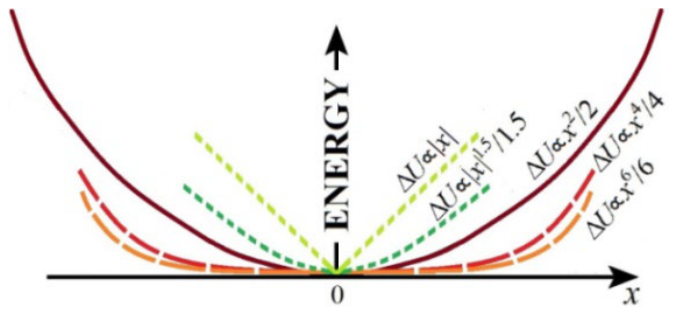
Figure 2.
The increase in potential energy of a particle located between two other particles when it deviates from the equilibrium point between them. The thick black/red curve show the potential energies ∆U of this system compared to the potential energy of a harmonic pendulum shown by the thin brown curve.
Disclaimer/Publisher’s Note: The statements, opinions and data contained in all publications are solely those of the individual author(s) and contributor(s) and not of MDPI and/or the editor(s). MDPI and/or the editor(s) disclaim responsibility for any injury to people or property resulting from any ideas, methods, instructions or products referred to in the content. |
© 2026 by the authors. Licensee MDPI, Basel, Switzerland. This article is an open access article distributed under the terms and conditions of the Creative Commons Attribution (CC BY) license (http://creativecommons.org/licenses/by/4.0/).
Copyright: This open access article is published under a Creative Commons CC BY 4.0 license, which permit the free download, distribution, and reuse, provided that the author and preprint are cited in any reuse.