
Submitted:
31 October 2026
Posted:
03 November 2026
You are already at the latest version
Abstract
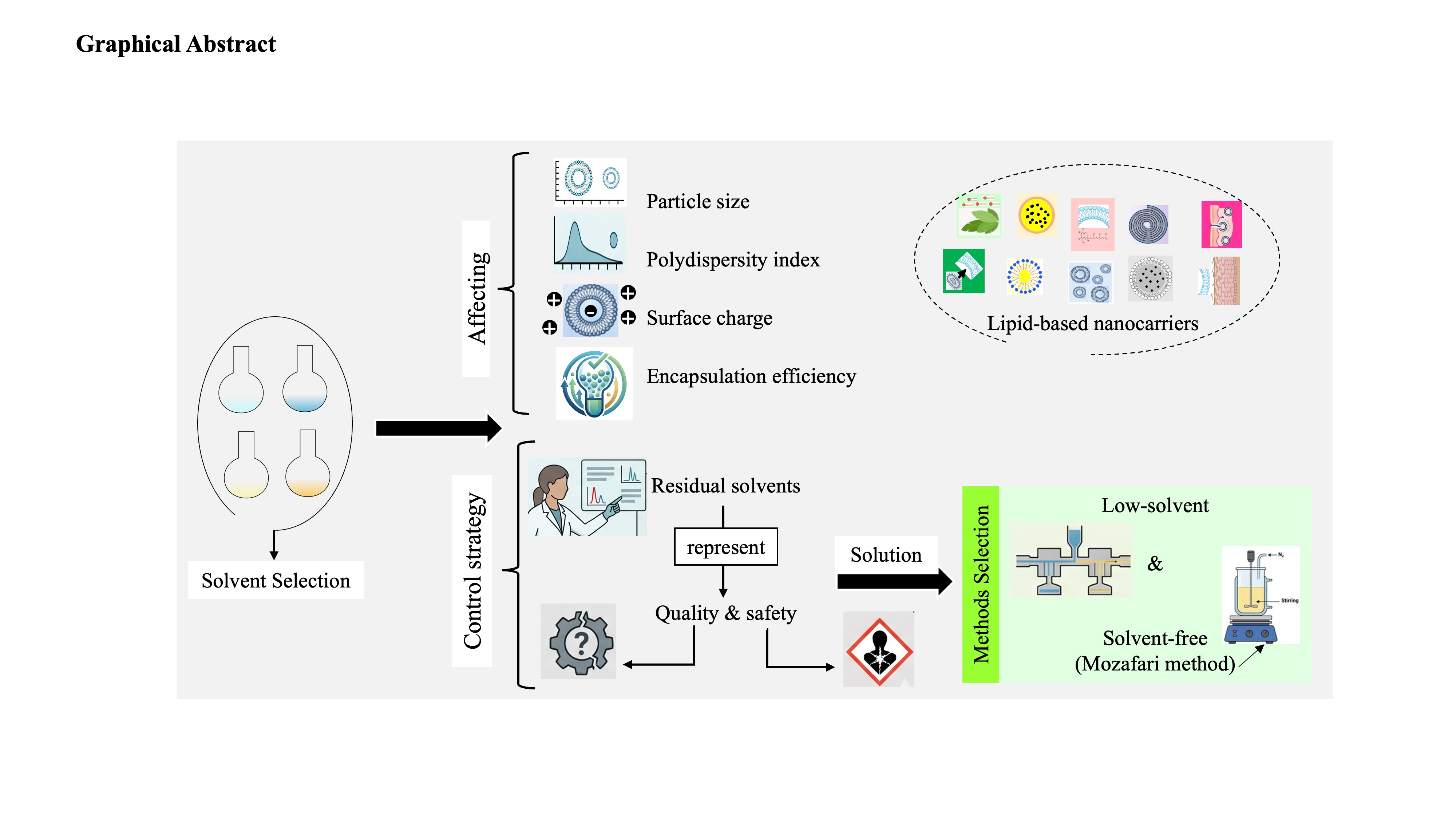
Lipid-based nanocarriers, especially vesicular systems such as liposomes, have gained an important place in the development of nanomedicines due to their biocompatibility and ability to simultaneously encapsulate hydrophilic and lipophilic cargoes. However, component selection alone does not determine the performance and safety of these formulations; the manufacturing process, in particular the solvent system, has a significant impact. In this article, the selection of solvents and co-solvents for the synthesis of lipid nanocarriers is explained, demonstrating how the type of solvent and the conditions of mixing can affect key attributes like particle size, polydispersity index, surface charge, and encapsulation efficiency. In parallel, residual solvents represent a quality and safety concern and form part of the control strategy within chemistry, manufacturing, and controls (CMC). Regulatory requirements on solvent classification and permissible residual limits based on permitted daily exposure (PDE), as well as their implications for designing quality-control strategies, are also reviewed. Finally, by comparing conventional and advanced methods, the opportunities and challenges of low-solvent and solvent-free approaches are discussed as pathways aligned with a risk-based perspective and scalable manufacturing.
Keywords:
lipid-based nanocarriers
; liposomes
; Mozafari method
; solvent selection
; residual solvents
; ICH Q3C
; permitted daily exposure (PDE)
; solvent-free manufacturing
Copyright: This open access article is published under a Creative Commons CC BY 4.0 license, which permit the free download, distribution, and reuse, provided that the author and preprint are cited in any reuse.