

Submitted:
31 October 2026
Posted:
03 November 2026
You are already at the latest version
Abstract
Automated recommendations organise commercial visibility, yet consumers’ support for transparency should not be equated with demonstrated knowledge of recommendation practices or legal remedies. This study examines that distinction using the supplied Group 7 database of 385 adult, consenting, AI-aware respondents in Bangladesh. Law students account for 232 observations; recent online-shopping experience is not independently established. Rather than combine heterogeneous questionnaire blocks into latent constructs, the analysis uses item distributions, paired endorsement contrasts, joint response patterns, rank correlations and adjusted binary and ordinal models. Agreement that misleading AI-generated claims create consumer-protection concerns reaches 81.0%, compared with 56.1% for understanding recommendation influence. Personalisation disclosure receives 69.4% endorsement, while 60.5% endorse clear information about sponsored or manipulated recommendations. Transparency’s perceived decision value exceeds self-reported manipulation recognition by 13.8 percentage points. The four questionnaire blocks have low internal consistency, with alpha between 0.158 and 0.201. No focal predictor survives multiplicity correction in the primary binary model of misleading-claims awareness. Influence awareness is positively associated with the outcome in an ordinal sensitivity model, indicating dependence on outcome coding. These findings distinguish broad protection preferences from narrower self-reported capabilities without establishing a causal literacy pathway, objective legal competence or actual complaint behaviour. The contribution is a consumer-autonomy framework linking recommendation visibility to information usability and contestability. Platform recommendations prioritise intelligible sponsorship labels, accessible explanations and practical evidence preservation. The findings concern a legally oriented sample and should inform targeted behavioural research rather than estimates of national consumer competence.
Keywords:
recommender systems
; consumer autonomy
; personalisation
; commercial transparency
; misleading claims
; Bangladesh
; consumer redress
1. Introduction
Online product discovery increasingly takes place within interfaces that rank, filter and recommend commercial offers. These arrangements do more than display a catalogue: they direct attention towards particular alternatives and make some information easier to encounter than other information. Consumer choice research recognises that preferences and decisions depend partly on how a task presents alternatives and on the effort required to compare them. This provides a basis for examining recommendations as part of the decision environment rather than treating their presence as a purely technical convenience.[1]
The legal concern arises when commercial influence becomes difficult to identify or challenge. A recommendation can reflect predicted relevance, commercial sponsorship, popularity or several considerations at once. A consumer who notices the recommendation may still misunderstand why it appeared. Empirical research documenting dark patterns on shopping websites establishes that potentially deceptive interfaces merit systematic investigation. It does not establish that every recommendation is manipulative, that every dark pattern uses AI, or that Bangladesh platforms exhibit the same prevalence as foreign samples.[2]
For Bangladesh, the question connects contemporary recommendation practices with consumer protection against misleading commercial information. Section 44 and Section 45 of the Consumers’ Right Protection Act 2009 address false advertising and failure to supply promised goods or services, respectively. They provide a relevant starting point for analysis of a particular commercial representation. They should not be described as comprehensive recommender-system regulation or as automatically establishing liability whenever a user dislikes an automated suggestion.[3]
The practical problem is the distance between recognising a general consumer risk and understanding a specific form of commercial influence. Someone may agree that misleading claims are problematic while remaining uncertain about sponsored ranking or personalisation. Someone else may favour greater disclosure without claiming technical expertise. An undifferentiated consumer-rights awareness score can conceal these distinctions, producing a reassuring average that gives limited guidance about what consumers can actually recognise or do.
Responsibility also extends beyond individual literacy. Consumers cannot evaluate a paid recommendation that is presented without usable sponsorship information, and evidence cannot be preserved if relevant representations disappear before a dispute arises. The persuasive environment therefore combines individual interpretation with institutional control over information. Legal scholarship on digital market manipulation identifies the significance of firms’ informational advantages and their capacity to shape commercial influence. The present analysis draws a limited implication: literacy and platform accountability should be examined together, while their actual contributions remain empirical questions.[4]
A further problem concerns measurement. The supplied instrument combines self-descriptions, normative statements and conditional intentions within four nominal blocks. Treating each block as a coherent reflective scale would require evidence that the items measure a common attribute. The issue cannot be resolved by choosing a more complex statistical estimator. Before asking whether AI literacy predicts consumer-rights awareness, researchers must establish what those phrases denote in this questionnaire.
The study addresses a specific inferential gap between broad constructs and the wording available to measure them. The initial conceptual pathway linked AI literacy to rights awareness, trust and redress. However, agreement that consumers should know about personalisation is a disclosure preference; agreement that misleading claims create concerns is a self-reported recognition statement. Neither demonstrates statutory knowledge. Similarly, a desire for business responsibility is different from observed trustworthiness or a consumer’s willingness to rely on a vendor.
The gap is also contextual. The database contains a legally oriented mixed sample rather than a verified sample of recent online shoppers. Law-student status may matter for interpretation, but it does not substitute for evidence of experience with recommendation interfaces. A defensible contribution consequently requires narrower claims: describe the supplied respondents, distinguish statement types and evaluate selected associations without projecting the results onto all Bangladeshi consumers.
The objective is to examine how recommendation-related understanding, misleading-claims awareness and transparency preferences coexist in the supplied responses. Three questions guide the analysis. First, which statements receive endorsement, and how do paired responses differ across distinct aspects of consumer autonomy? Second, how do influence awareness, misleading-claims awareness and self-reported manipulation recognition combine within individual records? Third, are selected literacy and transparency statements associated with misleading-claims awareness after adjustment, multiplicity correction and changes in outcome coding?
The distinctive contribution is an analysis of the distribution and co-occurrence of specific consumer capabilities and protection preferences. It avoids using a broad trust or redress outcome as the organising centre of this student title. Related Group 7 topics may investigate chatbot trust or complaint intention directly; here those items supply limited context for the primary recommendation-awareness question. The central empirical comparison concerns understanding commercial influence and recognising misleading claims.
The contribution is bounded but useful. It provides exact item-level denominators, distinguishes paired differences from relationships between respondents, and shows where an adjusted association changes with coding. The conceptual framework treats transparency as useful only insofar as consumers can interpret and act on information. That proposition informs future research and platform design; the present survey does not establish that a particular disclosure changes purchasing behaviour.
Section 2 develops the theoretical and legal foundations. Section 3 explains measurement choices, collection documentation and analysis. Section 4 presents distributions, paired contrasts, response patterns and adjusted estimates. Section 5 interprets the findings against relevant literature. Section 6 develops implications for theory, platforms and policy. Section 7 states conclusions and research priorities; declarations and exact questionnaire wording follow.
2. Literature Review and Theoretical Foundation
Recommendation governance concerns what consumers see, how they interpret commercial influence and whether they can challenge an adverse outcome. This section connects those questions through consumer decision processes and persuasion knowledge. Trust and planned behaviour provide supporting perspectives, but neither is presented as a fully tested model. The legal discussion separates applicable Bangladesh provisions from comparative approaches and proposed design standards.
2.1. Recommendations and the Consumer Decision Environment
A recommender system selects or orders information for a user according to computational rules and available data. Generative AI can contribute descriptions or conversational responses, but recommendation and generation are different operations. The questionnaire uses both terms. Its results therefore concern respondents’ reactions to the wording presented, rather than a verified technical classification of systems they encountered. This distinction matters because a misleading generated description and an opaque ranking can create different evidential and governance problems.
Dark commercial patterns concern the presentation of choices in ways that can undermine consumer decision-making. The OECD’s policy analysis links their prevalence, mechanisms and harms to possible enforcement responses. That work provides a vocabulary for examining commercial interfaces, not a basis for assuming that every form of personalisation is harmful. Relevant distinctions include whether a representation is accurate, whether commercial incentives are visible, and whether a consumer can make an effective choice.[5]
The FTC’s report similarly places interface design within consumer-protection practice. Its significance here is to reinforce the need to examine actual design features and their consequences. A questionnaire about perceived manipulation cannot identify the prevalence of unlawful interfaces, establish a business’s intent or replace evidence about a specific transaction. These limits preserve the separation between respondents’ beliefs and findings about platform conduct.[6]
2.2. Consumer Decision Processes and Persuasion Knowledge
Constructive consumer choice theory explains why decision strategies vary with task demands, context and cognitive effort. Applied to recommendations, it directs attention to which alternatives are visible and which comparison cues are easy to use. A long explanation may technically increase information while leaving the user less able to compare offers. The present framework therefore asks whether transparency has perceived decision value, rather than assuming that more disclosure necessarily produces better decisions. This is a theoretical application; the dataset contains no behavioural comparison task.[7]
Persuasion knowledge offers a complementary account of consumers’ understanding of attempts to influence them. Friestad and Wright distinguish knowledge concerning persuasion from simple exposure to a message. In a recommendation setting, a consumer may recognise a product suggestion without recognising the commercial purpose of its placement. Knowledge that an algorithm can influence purchases is also broader than knowing whether a particular offer is sponsored. The framework consequently separates influence awareness, information preferences and the ability a respondent claims to recognise manipulation.[8]
These perspectives motivate a layered view of consumer autonomy. Visibility concerns whether influence can be noticed; interpretation concerns whether its commercial meaning is understood; practical agency concerns whether the consumer can compare, refuse or contest an outcome. The layers are analytically useful but not measured as a validated sequence here. The same person may endorse some statements and remain neutral on others. Joint response patterns can describe that coexistence without assigning people to psychological stages or latent classes.
2.3. Trust Intentions and Institutional Protection
Research integrating trust with technology acceptance in online shopping distinguishes confidence in a vendor from evaluations of the interface. Its relevance is that commerce involves both a technological system and a party responsible for the transaction. A favourable reaction to an AI tool does not necessarily imply confidence in a seller’s honesty, and disclosure of AI identity does not establish that product or return information is correct.[9]
The Group 7 trust block contains both conditional trust statements and normative expectations about human support or business responsibility. These statements are related to institutional protection but are not interchangeable manifestations of trust. Accountability theory is useful because it directs attention towards actors who must explain and justify conduct to a forum capable of responding. Applying this reasoning to digital commerce supports identifying a responsible business and a usable complaint route. The survey does not measure whether such a forum exists or performs effectively.[10]
2.4. Literacy and Awareness of Commercial Claims
AI literacy research conceptualises competencies needed to understand and critically evaluate AI. The supplied items capture parts of that domain through perceived awareness of inaccuracies and bias, claimed verification practices, confidentiality precautions and support for human oversight. They are self-reports, not a performance test. A respondent can endorse verification as a practice without demonstrating successful evaluation of a misleading product description. The analysis therefore uses the exact literacy statements rather than labelling respondents objectively literate.[11]
Consumer-rights knowledge requires additional distinctions. Knowing that an online claim may be misleading differs from identifying the legal elements of an infringement or the correct procedure for a complaint. Agreement that platforms should explain sponsorship may express a preferred norm even where respondents do not know the applicable law. In this instrument, CRA4 is the most direct self-report about consumer-protection implications of misleading generated claims; it is selected as the focal adjusted-model outcome for that reason. It is not a legally scored correct answer.
A literature on online manipulation connects hidden influence with autonomy. Its conceptual contribution is to explain why a decision can be affected even when a consumer retains a formal ability to click a different option. The empirical task here is narrower: examine whether respondents who claim broad recognition also claim more specific recognition. No inference about covert psychological mechanisms follows from a correlation between those statements.[12]
2.5. Transparency and Its Limits
Explanation should be evaluated in relation to what a user needs to decide. Recent experiments by Mourali and colleagues show that responses to post hoc algorithmic explanations depend on the method used; explanation is not uniformly beneficial. Their studies concern consumer reactions to algorithmic decisions, and should not be treated as direct evidence about Bangladesh recommender interfaces. They nevertheless justify distinguishing the perceived value of transparency from a generic claim that disclosure always increases trust.[13]
The wording of CRA3 presents an additional difficulty: sponsored and manipulated recommendations appear in one statement. Sponsorship can be legitimate where its commercial nature is clear, whereas manipulation concerns the manner and effect of influence. A combined item cannot reveal whether respondents reacted to sponsorship, manipulation or both. Contemporary dark-pattern classification research provides more differentiated categories that can inform a future instrument. It does not retrospectively make this combined item unambiguous.[14]
2.6. Redress as a Supporting Perspective
The Theory of Planned Behavior distinguishes attitudes, subjective norms and perceived control as antecedents of intention, while intention and control relate to behaviour. This helps explain why willingness to complain and willingness to preserve evidence may differ. However, the present questionnaire does not measure the complete theory, actual complaints, or the resources needed to pursue them. Complaint items are therefore contextual outcomes and paired descriptive comparisons, rather than evidence of a tested planned-behaviour pathway.[15]
A practical complaint requires more than awareness. A consumer may need a transaction identifier, a record of the representation, knowledge of the relevant recipient and sufficient time to act. For this article, contestability denotes a proposed capacity to question and seek review of a commercial outcome. It is not a validated variable derived from the five redress items. Treating it as an institutional design objective preserves its legal relevance without claiming measurement that the study did not undertake.
2.7. Bangladesh Law and Comparative Guidance
The Bangladesh statute supplies a concrete legal anchor. False advertising and failure to deliver promised goods or services may be relevant where an AI-mediated commercial representation meets the statutory requirements. Section 60 requires a complaint within 30 days of the cause arising. This makes timely evidence preservation a practical concern, while leaving open questions about the identity of the responsible party and whether a particular practice falls within a statutory prohibition. No individual dispute is adjudicated in this study.[16]
The EU Digital Services Act provides a comparative example: its provisions address manipulative interface design, advertising transparency and recommender-system parameters. These provisions apply within their own legal scope and are not stated as Bangladesh duties. They illustrate how policy can distinguish commercial identification from explanations of ranking and user influence over parameters. Borrowing a design idea does not establish that foreign legal standards can be transplanted without considering local institutions and enforcement resources.[17]
2.8. Exploratory Propositions and Conceptual Framework
A confirmatory model linking four composites would require defensible measurement of each construct. Measurement inspection does not support that specification. Four exploratory propositions instead organise selected item-level analyses. E1 expects self-reported verification to relate positively to understanding recommendation influence. E2 expects awareness of bias to relate positively to misleading-claims awareness. E3 expects influence awareness to relate positively to misleading-claims awareness. E4 expects the perceived decision value of transparency to relate positively to misleading-claims awareness. They are developed during reanalysis, not preregistered hypotheses.
The primary adjusted model examines CRA4 in relation to verification, bias awareness, influence awareness and transparency, with training and student status included as limited adjustments. Separate paired comparisons describe differences in endorsement across substantively distinct statements. Figure 1 shows the adjusted association specification. It contains no mediation or moderation claim, and it does not imply that transparency or literacy causes legal awareness. Findings are assessed through effect estimates, uncertainty and multiplicity correction rather than a binary narrative of model validation.
Dashed links denote estimated associations, not causal effects. The primary binary outcome is CRA4 endorsement; ordinal sensitivity retains its observed response categories. Disclosure preferences and joint awareness patterns are examined separately.
3. Methodology
The study uses a cross-sectional questionnaire database supplied by the research team as real data. Analysis is deliberately matched to the available statement wording and documented sample. This section distinguishes observable features of the workbook from collection details that cannot be reconstructed, and explains why item-level analysis replaces the original composite-path approach.
3.1. Design and Unit of Analysis
The unit of analysis is one recorded adult respondent. The database contains self-reported perceptions and preferences measured at one point, with no intervention or temporal follow-up. It cannot identify the effect of an explanation, test learning over time, or establish that an expressed intention resulted in a complaint. Observational reporting principles inform the explicit presentation of eligibility, missingness, analysis choices and limitations. They do not supply missing fieldwork information.[18]
3.2. Population and Data Provenance
The supplied Group 7 workbook contains README, Data and Codebook sheets. The Data sheet has 385 observations and 35 columns. All rows record consent, adult eligibility and relevant AI awareness. The profile includes students, graduates, legal professionals and other relevant respondents. Recent online-shopping activity, exposure to a particular recommendation system and knowledge of a statutory complaint process are not verified by those eligibility fields.
The research team confirms that the numerical records are real survey responses. Two Codebook entries containing the word “synthetic” were clerical errors, as clarified by the research team; they do not describe the numerical dataset. The identifier is used only as a row index, and the optional contextual text field is excluded. Collection dates, recruitment channels, invitation totals and source consent records were not included in the materials available for reanalysis. Their absence limits reconstruction of recruitment and administration; no undocumented fieldwork details are asserted.
3.3. Sampling and Sample Size
The realised analytical sample is N = 385, of whom 232 are law students. The recruitment design and inclusion probabilities cannot be verified, so neither random sampling nor national representativeness is claimed. Cochran’s familiar large-population calculation, using 1.96, p = 0.50 and precision 0.05, gives approximately 384.2 and rounds upwards to 385. This explains a numerical benchmark only. It does not establish that this sample has a population margin of error of five percentage points.[19]
All 385 records have complete focal responses and remain in the main analysis. The student-restricted sensitivity analysis uses 232 records rather than replacing the full sample. No undocumented target of 400, recruitment response rate, pilot exclusion or post hoc power claim is inserted. Confidence intervals express model-based or resampling uncertainty conditional on the supplied records and assumptions; they do not correct selection bias.
3.4. Questionnaire and Analytical Roles
Twenty substantive statements comprise four nominal five-item blocks: AI literacy, consumer-rights awareness, trust/perceived protection and manipulation/redress. Responses range from 1 strongly disagree to 5 strongly agree. No substantive item is reverse-coded. Exact analysed statements appear in Appendix A; Table 1 states the principal roles of the consumer-awareness items. Published theories inform interpretation, but the exact wording is from the supplied Codebook, not a claimed validated adaptation of those sources.
CRA4 is the adjusted-model outcome because it directly refers to awareness that misleading generated claims create consumer-protection concerns. CRA1 and CRA5 capture different facets of understanding and perceived decision support. CRA2 and CRA3 describe preferred information conditions. Using their separate responses avoids interpreting a preference for disclosure as demonstrated statutory knowledge. Supporting items are used for explicitly identified comparisons, not to reconstruct a trust or redress scale.
3.5. Instrument Assessment
No verifiable pilot report, cognitive-interview record or validation study accompanied the workbook. A completed pilot is therefore not asserted. Alpha is calculated for each five-item block as a diagnostic of covariance, with values of 0.158–0.201. Alpha alone neither proves dimensionality nor establishes validity, but these low values do not support treating the blocks as reliable reflective composites. No item is removed merely to raise a coefficient. Composite reliability, AVE and HTMT are not reported without a defensible measurement model.[20]
3.6. Screening and Descriptive Analysis
Screening checks eligibility, valid response ranges, missingness, duplicate profiles and constant responding. There are no missing focal or model variables; the optional AI-tool field is missing in 15 records. No exact duplicate is found after excluding identifier and comment. Seven records use the same answer across the five CRA items, but none uses one constant response across all 20 statements. These seven are retained because agreement across related statements is not sufficient evidence of inattentive participation. Timestamps and dedicated attention checks are unavailable.
Endorsement combines categories 4 and 5; categories 1–3 are called not endorsed, including neutral. Counts, percentages, means and SDs are reported, with Wilson intervals for selected proportions. Means are descriptive summaries of ordered categories. Four paired contrasts use exact McNemar tests and 10,000 respondent bootstrap resamples for pointwise intervals; Holm correction covers the four tests. Joint binary patterns are descriptive partitions, not empirically derived latent classes.[21]
3.7. Association and Sensitivity Analysis
Six selected Spearman correlations use original item categories, with 3,000 respondent bootstrap resamples and Holm correction within that family. The primary binomial logistic model estimates CRA4 endorsement using AIL2, AIL3, CRA1 and CRA5 in their original one-to-five coding, adjusted for any formal AI training and law-student status. Adjusted odds ratios use HC0 robust sandwich covariance; Holm correction covers the four focal coefficients. Adjustment is limited by available variables and does not eliminate confounding. The model assumes linear associations of each item score with log odds.[22]
An ordinal logistic sensitivity model preserves CRA4’s four observed categories, with common slopes assumed across cumulative thresholds. Its intervals use observed information; proportional odds is not established as a verified property of the data. A student-restricted binary model omits status and repeats correction across its four focal estimates. These overlapping analyses test dependence on coding and sample restriction; they are not independent replications. No mediation, moderation, causal effect, predictive deployment model or latent structural equation model is estimated.[23]
3.8. Ethical Considerations
The research team reports that an accessible formal review mechanism applicable to this non-interventional adult questionnaire study was unavailable in its institutional setting; formal approval was not obtained. This is a contextual explanation, not a claim of exemption, retrospective approval or a general rule that questionnaire research never requires review. Researchers retained responsibility for participant protection. The team reports informed consent, voluntary participation, anonymity and the opportunity to discontinue before submission. All analysed records contain affirmative adult and consent fields.
The analysis excludes optional contextual text, uses no direct personal identifiers and reports aggregate results. Access to numerical records should remain restricted to the research team, with de-identified sharing subject to confidentiality and applicable requirements. Because an anonymous response cannot reliably be located after submission, discontinuation before submission must be distinguished from guaranteed removal afterwards. The available fields document recorded consent status; they do not independently document the full collection procedure described as unavailable in Section 3.2.
4. Results
Results are organised around specific statements rather than overall construct scores. The full sample denominator is 385 unless stated otherwise. Paired contrasts compare answers from the same records; correlations and adjusted models address a different question about how answers vary together. Statistical findings below describe the supplied database and retain its sampling and collection-documentation limitations.
4.1. Recorded Respondent Profile
Law students constitute 60.3% of the sample, followed by law graduates, advocates or legal professionals, and other relevant respondents. Table 2 presents status and training because they define the principal adjustment variables. Formal training is absent in 222 records; 117 report a short orientation and 46 report a course or certified training.
The age distribution is concentrated at 21–23 years (162; 42.1%), followed by 24–26 (83; 21.6%), 18–20 (60; 15.6%), 27–30 (41; 10.6%) and 31 or above (39; 10.1%). Male and female responses each total 188 (48.8%); five prefer not to say and four select other. Dhaka accounts for 160 records, other city corporations 82, district towns 70, upazila or rural areas 64 and other locations nine. Weekly or daily AI use totals 272 (70.6%). The duration item records nine never-users, while frequency records 12; these fields are not treated as interchangeable measures of commercial exposure.
4.2. Distributions of Consumer-Awareness Statements
Endorsement differs substantially across the five CRA statements. Table 3 provides the complete category counts so that neutrality is visible alongside agreement. CRA4 and CRA5 have the highest means and similar endorsement, while CRA1 has the lowest mean. No response of strongly disagree occurs in any of the five CRA items; disagreement and neutrality remain present.
Influence understanding is endorsed by 216 respondents (56.1%), compared with 312 (81.0%) endorsing misleading-claims awareness. Personalisation disclosure receives 267 endorsements (69.4%), and information about sponsored or manipulated recommendations receives 233 (60.5%). Transparency’s perceived decision value receives 311 (80.8%). These percentages correspond to different statements and cannot be interpreted as performance scores on a common knowledge examination.
Supporting items show 312 endorsements of verification (81.0%) and 316 of bias awareness (82.1%). Self-reported manipulation recognition receives 258 (67.0%). Evidence preservation is endorsed by 264 (68.6%), compared with 310 (80.5%) for considering a complaint. Business responsibility receives 319 endorsements (82.9%), and access to a human representative receives 260 (67.5%). These results describe preferences and intentions rather than verified practices or services.
4.3. Measurement Diagnostics
Alpha is 0.201 for AIL, 0.186 for CRA, 0.158 for CTP and 0.197 for AMR. The diagnostics therefore do not justify an interpretation of four reliable latent constructs. The CRA block’s mixed wording remains substantively important: two statements refer to what respondents understand or recognise, two express information norms, and one evaluates the possible usefulness of transparency. Weak covariance is consistent with the need to preserve those distinctions, although the coefficient does not establish their cause.
No factor loadings, rho_A, composite reliability, AVE or HTMT values are supplied because a confirmatory reflective model is not estimated. This is an analytical decision, not a claim that all individual responses are invalid. The item-level results retain the limitations of single-item measurement and self-report while avoiding a more ambitious construct interpretation unsupported by the available diagnostics.
4.4. Paired Endorsement Contrasts
Table 4 compares four selected pairs using within-record differences. Each interval is a pointwise bootstrap interval and each p-value belongs to the separate four-test McNemar family. All four contrasts remain below 0.001 after correction, although this does not make their different wordings equivalent.
Personalisation disclosure exceeds influence understanding by 13.2 percentage points. Information about sponsorship or manipulation is endorsed less often than misleading-claims awareness, by 20.5 points. The perceived decision value of transparency exceeds self-reported recognition of manipulation by 13.8 points. Evidence preservation is endorsed less often than considering a complaint, by 11.9 points. These are response asymmetries between questions; they are not longitudinal losses in capability or estimates of an intervention effect.
Joint counts clarify those contrasts. In the disclosure versus influence pair, 150 endorse both, 117 endorse disclosure only, 66 influence only and 52 neither. For transparency versus manipulation recognition, 212 endorse both, 99 transparency only, 46 recognition only and 28 neither. For evidence preservation versus complaint consideration, 219 endorse both, 45 preservation only, 91 complaint consideration only and 30 neither. A person counted as neither may have answered neutral rather than disagreed.
4.5. Joint Patterns of Awareness and Recognition
Table 5 partitions records by influence understanding, misleading-claims awareness and manipulation recognition. The purpose is to show coexistence directly rather than infer an unobserved psychological sequence. The largest pattern contains all three endorsements, but it includes fewer than one-third of the full sample.
All three are endorsed in 121 records (31.4%). Another 91 records (23.6%) endorse misleading-claims awareness and manipulation recognition without endorsing influence understanding. Sixty (15.6%) endorse the first two without manipulation recognition, while 40 (10.4%) endorse misleading-claims awareness alone. These combinations caution against treating the three statements as interchangeable indicators or arranging respondents along a validated progression from basic to advanced awareness.
4.6. Selected Ordinal Associations
Table 6 reports the six selected rank correlations. The association between influence understanding and misleading-claims awareness is positive but small: rho = 0.142, with Holm-adjusted p = 0.032. It is the only selected correlation below 0.05 after correction. The paired differences reported above are therefore compatible with weak between-person association.
Verification and influence understanding have rho = 0.125, but adjusted p = 0.069. Bias awareness and misleading-claims awareness have rho = 0.050. Personalisation disclosure and sponsorship/manipulation information have rho = −0.006; misleading-claims awareness and manipulation recognition have rho = −0.003. Transparency and complaint consideration have rho = 0.110, with adjusted p = 0.124. These estimates provide little support for treating the selected relationships as a strong general capability pathway.
4.7. Adjusted Binary Model
The primary model includes 312 CRA4 endorsements and 73 other responses. Table 7 gives adjusted odds ratios and pointwise robust intervals. The model converges; predictor VIFs range from 1.003 to 1.021, providing no indication of substantial collinearity in this specification. Low collinearity does not demonstrate construct validity or adequate control of confounding.
Verification has an adjusted odds ratio of 1.07, bias awareness 1.06, influence understanding 1.27 and transparency 1.26. All four pointwise intervals include one; none of the focal coefficients remains below 0.05 after correction. Any formal training has an adjusted odds ratio of 1.61 with interval 0.94–2.75, and law-student status 0.86 with interval 0.50–1.46. These adjustment estimates should not be read as causal effects of training or legal education.
4.8. Sensitivity Analysis and Summary
The ordinal model uses the observed CRA4 categories: seven disagree, 66 neutral, 170 agree and 142 strongly agree. In this model influence understanding is positively associated with higher outcome categories, with adjusted odds ratio 1.40, interval 1.10–1.78 and Holm p = 0.026. Table 8 compares this result with the student-restricted binary model.
Among 232 students, 186 endorse CRA4 and 46 do not. Transparency has a positive nominal coefficient in this restricted model, but its four-coefficient Holm correction does not retain it below 0.05. The full-sample binary model, ordinal model and restricted model thus do not yield a uniform pattern of confirmed associations. E1 is not retained after correlation-family correction; E2 lacks support; E3 has a small corrected rank association and an ordinal sensitivity association but not a confirmed primary binary coefficient; E4 is not retained in the primary model. These are exploratory findings, not a validated theory test.
5. Discussion
The main substantive finding is differentiation within consumer awareness. Broad recognition of misleading claims and support for transparency coexist with less frequent endorsement of understanding recommendation influence. The statistical findings add a second qualification: a positive ordinal association does not consistently survive a different outcome definition. Interpretation should therefore preserve both the conceptual distinctions and the model dependence instead of reducing the results to a single claim that AI literacy improves consumer rights.
5.1. Disclosure Preferences and Influence Understanding
The 13.2-point difference between personalisation disclosure and influence understanding shows that support for an information norm need not imply a matching self-assessment of understanding. One possible explanation is that consumers favour knowing when personalisation occurs even if they cannot explain the underlying process. Another is the difference between a normative “should” statement and a personal “I understand” statement. The cross-sectional data cannot distinguish those explanations, so the difference is best described as a wording-specific response asymmetry.
Persuasion knowledge supplies a useful interpretive lens because it separates noticing a communication from understanding an attempt to influence. It would be premature, however, to conclude that the 117 respondents endorsing disclosure alone lack persuasion knowledge. Their neutral or disagreeing answer to the broader influence statement may reflect uncertainty, wording or a different understanding of AI recommendations. A future study should present concrete examples and ask respondents to explain the commercial incentives involved.[24]
For platform design, the finding supports testing disclosure with users rather than counting the presence of labels. A notice that recommendations are personalised can answer a basic identification question while leaving sponsorship, ranking priorities or alternatives unclear. Consumer decision theory suggests evaluating whether the information helps comparison at the relevant moment. That is a design implication informed by theory and the observed distinction, not an intervention effect established here.[25]
5.2. Broad Concern and Specific Commercial Information
Misleading-claims awareness reaches 81.0%, while endorsement of sponsorship/manipulation information reaches 60.5%. It is tempting to call this a knowledge gap, but the latter item expresses a preference and combines two different ideas. The defensible conclusion is that agreement with a general consumer-protection statement cannot stand in for agreement about a specific disclosure practice. Nor can a high score on CRA4 establish knowledge of statutory remedies, responsible parties or filing requirements.
Studies of dark patterns provide evidence that concrete interfaces can matter for consumer choices. Luguri and Strahilevitz’s experiments examine actual responses to specified manipulative designs, illustrating the evidential value of behavioural tasks. The present questionnaire lacks an equivalent task and therefore cannot estimate susceptibility, losses or successful identification. Its contribution is to identify where broad self-report should be followed by scenario-based assessment.[26]
Sponsorship also requires separate treatment from manipulation. A commercial relationship can legitimately affect placement if communicated appropriately; an interface may be problematic for reasons beyond sponsorship. Classification work by Gray and colleagues offers differentiated concepts for future measurement. A revised instrument should ask separately about identifying paid placement, understanding recommendation parameters and recognising deceptive urgency or obstruction, with examples reviewed for local language and platform familiarity.[27]
5.3. Transparency and Practical Capability
The 13.8-point difference between the perceived value of transparency and manipulation recognition suggests that desired information support can exceed claimed recognition capability. This does not mean that disclosure has failed: the study observes no actual disclosure. It identifies a reason to evaluate whether a proposed explanation is usable for a particular decision. A consumer may want to know why a product appears without wanting a technical account of model architecture.
Recent explanation research reports that the format and actionability of an explanation can influence consumer reactions. That literature is consistent with treating explanation quality as an empirical design question. It does not establish that the respondents here would make better purchases after receiving a label, and perceived transparency should not be equated with accuracy. Future experiments should jointly assess comprehension, comparison quality and unnecessary confidence.[28]
The distinction also limits a literacy-only policy response. Consumers cannot compensate for information that a business withholds, and information can be present yet inaccessible in timing, language or format. OECD work on digital vulnerability recognises the changing conditions that can make consumers vulnerable. Applied here, this motivates accessible design across different consumer circumstances without assigning vulnerability to a demographic group on the basis of this dataset.[29]
5.4. Evidence Preservation and Complaint Intention
Considering a complaint is endorsed more often than preserving evidence. The 91 records endorsing complaint consideration alone show that general willingness and a practical preparatory step need not coincide. They do not establish that respondents would fail to preserve evidence in a real dispute. The statements are hypothetical, and the difference may partly reflect different understandings of evidence and complaint mechanisms.
The Theory of Planned Behavior helps articulate what remains unmeasured: expected outcomes, perceived control, social influences and constraints on actual behaviour. A future redress study could test whether assistance with screenshots and transaction records changes completed complaint submission. For the present title, the redress findings remain supporting context rather than a demonstrated downstream effect of recommendation awareness.[30]
In Bangladesh, timely action has legal significance because section 60 establishes a 30-day complaint requirement. An interface that lets a consumer retain the relevant representation may support practical access to a complaint process, but this article does not evaluate compliance by a named platform. The legal implication is to make the evidential step visible alongside the invitation to complain, subject to the facts and applicable procedural requirements of a dispute.[31]
5.5. Interpreting Weak and Specification-Dependent Associations
The binary model does not confirm any focal predictor after adjustment and correction. The ordinal model retains influence awareness, while the selected rank correlation for the same pair is small. These results suggest sensitivity to how differences across response categories are represented. Collapsing neutral and disagreeing responses together and grouping agree with strongly agree changes the information used by the model. Neither coding should be selected solely because it produces a smaller p-value.
A null or imprecise coefficient is not evidence that literacy has no importance. The items are self-reported and bounded, several have high endorsement, and unmeasured factors may shape responses. Conversely, a nominal association should not be promoted into evidence of a causal educational effect. Statistical guidance on p-values and absence of evidence supports reporting estimates and uncertainty while keeping substantive claims proportional to design and measurement.[32]
5.6. Integrated Interpretation
The framework is best understood as a set of distinct conditions for consumer autonomy. Awareness of influence, preferred transparency, claimed recognition and usable challenge mechanisms may relate without forming a single scale or a confirmed causal chain. Platform accountability remains a separate institutional question. A user’s inability to recognise manipulation does not remove a business’s responsibility for its own commercial representations, and a business’s disclosure does not guarantee that a user understands it.[33]
The principal empirical contribution is therefore an interpretable map of specific responses, including their non-alignment. The 121 respondents endorsing all three awareness/recognition statements should not be called legally competent, and the other patterns should not be called deficient classes. These are observed combinations that help specify future questions. The approach advances the original topic by showing exactly which broader claims the present questionnaire can and cannot sustain.
6. Theoretical and Practical Implications
The findings direct attention to the relationship between consumer capability and the commercial information environment. The implications below distinguish what follows from the observed response patterns from broader design proposals grounded in theory and legal analysis. None is presented as a measured improvement in purchasing outcomes or a finding of platform non-compliance.
6.1. Theoretical Implications
First, the analysis operationalises a distinction between self-reported understanding and normative support for disclosure. Consumer decision research provides the setting-dependent account of choice, while persuasion knowledge directs attention to recognition of commercial influence. Together they motivate a framework in which information is evaluated for its relevance to a decision rather than assumed to be beneficial merely because it is available. The data support retaining the distinction, not a causal relationship between theoretical layers.[34]
Second, the results refine the meaning of consumer awareness in this instrument. CRA4 concerns the implications of misleading claims; CRA1 concerns influence understanding; CRA2 and CRA3 concern information expectations. A future theory test should separate these domains before specifying mediation or comparing latent means. Single-item analysis is a response to the present measurement limits, not a substitute for developing reliable, content-valid measures. The low alpha values make that development a substantive priority.[35]
Third, accountability should be modelled separately from user confidence. A consumer can favour business responsibility without expressing trust, and a transparent interface can still provide incorrect information. Institutional accountability supplies a distinct theoretical object involving responsible actors, explanation and review. The contribution is a clearer research agenda connecting individual interpretation to available remedies, with neither level reduced to the other.[36]
6.2. Implications for Platforms and Educators
Platforms should test short explanations that identify whether a recommendation is sponsored, personalised or both. Evaluation should ask consumers to identify what influenced placement and compare available alternatives. A label should be judged against comprehension and decision quality, not simply increased engagement. Detailed technical explanations can remain available where useful, while essential commercial information should be visible at the decision point. These are proposed design responses to the observed distinctions, not proven treatment effects.
A second priority is preserving commercial representations. Consumers should be able to retain prices, important conditions, sponsorship labels and relevant automated exchanges in a practical format. Complaint interfaces can explain which records are useful without requiring unnecessary sensitive information. Human escalation should be reachable when an automated response fails to address the substance of a complaint. The support for responsibility and redress in the questionnaire provides context for prioritising these features, but their effectiveness requires independent evaluation.
Educational interventions should use examples of recommendation influence, paid placement and misleading claims rather than relying only on general warnings about AI. Assessment can distinguish confidence from correct recognition, include unfamiliar interfaces and test whether learners can find a complaint route. The current training coefficient cannot establish the value or failure of existing courses because training content, timing and participant selection are unknown. Future evaluations should record those features and compare outcomes over time.
6.3. Policy and Societal Implications
Bangladesh consumer guidance can connect existing protections against false advertising and non-delivery with examples of AI-mediated commercial information. Such guidance should explain that legal outcomes depend on the representation, responsible parties and statutory requirements. The EU framework offers a comparative example of more explicit recommender and advertising transparency duties, but these should be identified as foreign law rather than local obligations.[37]
Regulatory and research collaboration could develop locally understandable examples, test evidence-preservation guidance and assess whether complaint processes are accessible across language and device constraints. Claims about vulnerable consumers should be supported by appropriate samples and task evidence. A shared taxonomy can assist documentation, while enforcement still requires facts about specific conduct.[38]
7. Conclusions Limitations and Future Research
The supplied Group 7 responses distinguish consumer awareness of misleading generated claims from understanding recommendation influence and support for particular disclosures. Among 385 records, misleading-claims awareness receives 81.0% endorsement and influence understanding 56.1%. Personalisation disclosure receives 69.4%, information about sponsorship or manipulation 60.5%, and the perceived decision value of transparency 80.8%. These results concern the statements respondents endorsed; they do not establish the prevalence of lawful or unlawful platform practices.
Paired and joint analyses show that protection preferences and claimed capabilities need not coincide. The primary adjusted binary model does not confirm a focal predictor after correction. An ordinal sensitivity association for influence awareness preserves a narrower possibility while demonstrating coding dependence. Consequently, the study does not validate a general literacy-to-rights pathway. It provides an item-level account of specific consumer perceptions that can inform better measurement and the evaluation of practical information support.
The contribution is methodological and substantive. Analytically, the paper replaces unreliable composite-path claims with explicit statement distributions, within-person comparisons and bounded association models. Substantively, it connects visibility of recommendation influence with information usability and the capacity to contest commercial representations. This keeps consumer autonomy central without equating more trust, more disclosure or more AI use with improved welfare. It also separates this recommendation-focused title from the related Group 7 chatbot-trust and redress-intention topics.
The sample is legally oriented and contains 232 students, with unverified recruitment and no established recent-shopping criterion. Self-report, wording differences, ceiling tendencies and low block consistency limit interpretation. Cross-sectional associations cannot establish temporal order or causality; unmeasured experience, resources and consumer knowledge may confound estimates. Ordinal common slopes are assumed rather than independently validated. The analysis is exploratory and its selected families are not a preregistered confirmatory plan. Collection dates and recruitment records were unavailable for this analysis, limiting assessment of selection and administration. The research team has clarified that the Codebook’s two synthetic labels were clerical errors and that the numerical data are real.
Future work should document recruitment, shopping eligibility, collection dates and instrument administration before estimating general consumer patterns. Cognitive interviews can separate legitimate sponsorship from deceptive design, followed by performance tasks assessing recognition and legal-procedure knowledge. Revised scales should be validated in a separate sample rather than tuned to maximise significance in this database. Experiments can vary explanation format, sponsorship visibility and evidence-retention features, measuring comprehension and decisions alongside confidence. Longitudinal work can examine whether awareness and practical assistance predict actual complaint completion, resolution and costs. These designs would test the mechanisms that the present responses can only motivate.
Generative AI disclosure
Generative AI assisted literature retrieval, drafting, language editing, organisation and analytical code development. Estimates were computed programmatically from supplied numerical data. Authors retain responsibility for analysis, interpretation, references and reporting.
Author Contributions
Tasnim Akter Zafrin: conceptualisation, study materials, data organisation and curation, manuscript development. Prof. Dr Kazi Abdul Mannan: conceptual and methodological guidance, supervision, interpretation of statistical findings, critical review and editing. The student project was conducted under his supervision.
Funding
The authors report no external funding.
Institutional Review Board Statement
Formal ethical approval was not obtained because the authors report that their institutional setting lacked an accessible applicable review mechanism for this non-interventional adult questionnaire research. This does not constitute a formal exemption. Researchers retained responsibility for consent, voluntary participation, anonymity and aggregate reporting, as detailed in Section 3.8.
Institutional Review Board Statement
The research team reports informed consent before questionnaire completion, including purpose, voluntary participation, anonymity and discontinuation. All analysed records contain affirmative consent and adult-eligibility responses.
Data Availability Statement
De-identified numerical data and analytical specifications may be requested from the corresponding author, subject to confidentiality and applicable requirements. Optional contextual text was excluded. Data provenance clarification and collection-documentation limitations are stated in Section 3.2.
Conflicts of Interest
The authors report no competing interests.
Appendix A. Questionnaire Wording
Table A1 reproduces every statement used in the focal and supporting analyses. Their analytical roles follow the wording rather than a claim of validated scale equivalence.

Table A1.
Exact wording of analysed statements.
| Code | Questionnaire statement |
| CRA1 | I understand that AI-driven recommendations can influence online purchasing decisions. |
| CRA2 | Consumers should know when recommendations are personalized by automated systems. |
| CRA3 | Online platforms should provide clear information about sponsored or manipulated recommendations. |
| CRA4 | I am aware that misleading AI-generated claims can create consumer-protection concerns. |
| CRA5 | Greater transparency would help me make more informed online purchasing decisions. |
| AIL1 | I understand that generative AI can produce plausible but inaccurate information. |
| AIL2 | I verify important AI-generated information before relying on it. |
| AIL3 | I understand that AI outputs may reflect bias or incomplete data. |
| AIL4 | I avoid sharing confidential or sensitive information with AI tools unless appropriate safeguards are in place. |
| AIL5 | I believe meaningful human oversight is necessary when AI affects important legal or rights-related decisions. |
| AMR2 | I can recognize some forms of manipulative online design or personalized pressure. |
| AMR3 | I would preserve evidence if I believed an AI-enabled platform had misled me. |
| AMR4 | I would consider using a complaint or redress mechanism after harmful algorithmic manipulation. |
| AMR5 | Awareness of consumer rights increases my intention to seek redress. |
| CTP3 | Consumers should have access to a human representative when an AI chatbot cannot resolve a problem. |
| CTP4 | Businesses should remain responsible for misleading information provided by their AI chatbots. |
Source: supplied Group 7 Codebook. Responses range from 1 strongly disagree to 5 strongly agree. No substantive item is reverse-coded.
CRA4 is the adjusted-model outcome. AIL2, AIL3, CRA1 and CRA5 are focal predictors. CRA2 and CRA3 describe information preferences. Remaining statements support explicitly identified descriptive comparisons; none constitutes an objective legal-knowledge test.
Table of Legislation
Consumers’ Right Protection Act 2009 (Bangladesh), Act No 26 of 2009, ss 44–45 and 60
Regulation (EU) 2022/2065 on a Single Market for Digital Services [2022] OJ L277/1, arts 25–27
References
- Ajzen I, ‘The Theory of Planned Behavior’ (1991) 50 Organizational Behavior and Human Decision Processes 179.
- Altman DG and Bland JM, ‘Absence of Evidence Is Not Evidence of Absence’ (1995) 311 BMJ 485.
- Bettman JR, Luce MF and Payne JW, ‘Constructive Consumer Choice Processes’ (1998) 25 Journal of Consumer Research 187.
- Bovens M, ‘Analysing and Assessing Accountability: A Conceptual Framework’ (2007) 13 European Law Journal 447.
- Calo R, ‘Digital Market Manipulation’ (2014) 82 George Washington Law Review 995.
- Cochran WG, Sampling Techniques (3rd edn, John Wiley & Sons 1977).
- Efron B and Tibshirani RJ, An Introduction to the Bootstrap (Chapman & Hall 1993).
- Federal Trade Commission, Bringing Dark Patterns to Light (Staff Report, September 2022) accessed 30 October 2026.
- Friestad M and Wright P, ‘The Persuasion Knowledge Model: How People Cope with Persuasion Attempts’ (1994) 21 Journal of Consumer Research 1.
- Gefen D, Karahanna E and Straub DW, ‘Trust and TAM in Online Shopping: An Integrated Model’ (2003) 27 MIS Quarterly 51.
- Gray CM and others, ‘An Ontology of Dark Patterns Knowledge: Foundations, Definitions, and a Pathway for Shared Knowledge-Building’ in Proceedings of the 2024 CHI Conference on Human Factors in Computing Systems (ACM 2024) art 289. [CrossRef]
- Holm S, ‘A Simple Sequentially Rejective Multiple Test Procedure’ (1979) 6 Scandinavian Journal of Statistics 65. 65.
- Hosmer DW Jr, Lemeshow S and Sturdivant RX, Applied Logistic Regression (3rd edn, John Wiley & Sons 2013).
- Long D and Magerko B, ‘What Is AI Literacy? Competencies and Design Considerations’ in Proceedings of the 2020 CHI Conference on Human Factors in Computing Systems (ACM 2020) 1.
- Luguri J and Strahilevitz LJ, ‘Shining a Light on Dark Patterns’ (2021) 13 Journal of Legal Analysis 43.
- Mathur A and others, ‘Dark Patterns at Scale: Findings from a Crawl of 11K Shopping Websites’ (2019) 3(CSCW) Proceedings of the ACM on Human-Computer Interaction, art 81.
- McCullagh P, ‘Regression Models for Ordinal Data’ (1980) 42 Journal of the Royal Statistical Society Series B 109. 109.
- McNemar Q, ‘Note on the Sampling Error of the Difference between Correlated Proportions or Percentages’ (1947) 12 Psychometrika 153.
- Mourali M and others, ‘Post Hoc Explanations Improve Consumer Responses to Algorithmic Decisions’ (2025) 186 Journal of Business Research 114981.
- OECD, Consumer Vulnerability in the Digital Age (OECD Digital Economy Papers No 355, OECD Publishing 2023). [CrossRef]
- OECD, Dark Commercial Patterns (OECD Digital Economy Papers No 336, OECD Publishing 2022), doi:10.1787/44f5e846-en. [CrossRef]
- Sijtsma K, ‘On the Use, the Misuse, and the Very Limited Usefulness of Cronbach’s Alpha’ (2009) 74 Psychometrika 107.
- Susser D, Roessler B and Nissenbaum H, ‘Technology, Autonomy, and Manipulation’ (2019) 8(2) Internet Policy Review, doi:10.14763/2019.2.1410. [CrossRef]
- von Elm E and others, ‘The Strengthening the Reporting of Observational Studies in Epidemiology (STROBE) Statement: Guidelines for Reporting Observational Studies’ (2007) 4 PLOS Medicine e296. 4 PLOS Medicine.
- Wasserstein RL and Lazar NA, ‘The ASA Statement on p-Values: Context, Process, and Purpose’ (2016) 70 American Statistician 129.
- White, H. White H, ‘A Heteroskedasticity-Consistent Covariance Matrix Estimator and a Direct Test for Heteroskedasticity’ (1980) 48 Econometrica 817.
- Wilson EB, ‘Probable Inference, the Law of Succession, and Statistical Inference’ (1927) 22 Journal of the American Statistical Association 209.
[1] James R Bettman, Mary Frances Luce and John W Payne, ‘Constructive Consumer Choice Processes’ (1998) 25 Journal of Consumer Research 187. |
[2] Arunesh Mathur and others, ‘Dark Patterns at Scale: Findings from a Crawl of 11K Shopping Websites’ (2019) 3(CSCW) Proceedings of the ACM on Human-Computer Interaction, art 81. |
[3] Consumers’ Right Protection Act 2009 (Bangladesh), Act No 26 of 2009, ss 44–45 and 60. |
[4] Ryan Calo, ‘Digital Market Manipulation’ (2014) 82 George Washington Law Review 995. |
[5] OECD, Dark Commercial Patterns (OECD Digital Economy Papers No 336, OECD Publishing 2022), doi:10.1787/44f5e846-en. |
[6] Federal Trade Commission, Bringing Dark Patterns to Light (Staff Report, September 2022) <https://www.ftc.gov/reports/bringing-dark-patterns-light> accessed 30 October 2026. |
[7] Bettman, Luce and Payne (n 1). |
[8] Marian Friestad and Peter Wright, ‘The Persuasion Knowledge Model: How People Cope with Persuasion Attempts’ (1994) 21 Journal of Consumer Research 1. |
[9] David Gefen, Elena Karahanna and Detmar W Straub, ‘Trust and TAM in Online Shopping: An Integrated Model’ (2003) 27 MIS Quarterly 51. |
[10] Mark Bovens, ‘Analysing and Assessing Accountability: A Conceptual Framework’ (2007) 13 European Law Journal 447. |
[11] Duri Long and Brian Magerko, ‘What Is AI Literacy? Competencies and Design Considerations’ in Proceedings of the 2020 CHI Conference on Human Factors in Computing Systems (ACM 2020) 1. |
[12] Daniel Susser, Beate Roessler and Helen Nissenbaum, ‘Technology, Autonomy, and Manipulation’ (2019) 8(2) Internet Policy Review, doi:10.14763/2019.2.1410. |
[13] Mehdi Mourali and others, ‘Post Hoc Explanations Improve Consumer Responses to Algorithmic Decisions’ (2025) 186 Journal of Business Research 114981. |
[14] Colin M Gray and others, ‘An Ontology of Dark Patterns Knowledge: Foundations, Definitions, and a Pathway for Shared Knowledge-Building’ in Proceedings of the 2024 CHI Conference on Human Factors in Computing Systems (ACM 2024) art 289, doi:10.1145/3613904.3642436. |
[15] Icek Ajzen, ‘The Theory of Planned Behavior’ (1991) 50 Organizational Behavior and Human Decision Processes 179. |
[16] Consumers’ Right Protection Act 2009. |
[17] Regulation (EU) 2022/2065 on a Single Market for Digital Services [2022] OJ L277/1, arts 25–27. |
[18] Erik von Elm and others, ‘The Strengthening the Reporting of Observational Studies in Epidemiology (STROBE) Statement: Guidelines for Reporting Observational Studies’ (2007) 4 PLOS Medicine e296. |
[19] William G Cochran, Sampling Techniques (3rd edn, John Wiley & Sons 1977). |
[20] Klaas Sijtsma, ‘On the Use, the Misuse, and the Very Limited Usefulness of Cronbach’s Alpha’ (2009) 74 Psychometrika 107. |
[21] Edwin B Wilson, ‘Probable Inference, the Law of Succession, and Statistical Inference’ (1927) 22 Journal of the American Statistical Association 209; Quinn McNemar, ‘Note on the Sampling Error of the Difference between Correlated Proportions or Percentages’ (1947) 12 Psychometrika 153; Bradley Efron and Robert J Tibshirani, An Introduction to the Bootstrap (Chapman & Hall 1993); Sture Holm, ‘A Simple Sequentially Rejective Multiple Test Procedure’ (1979) 6 Scandinavian Journal of Statistics 65. |
[22] David W Hosmer Jr, Stanley Lemeshow and Rodney X Sturdivant, Applied Logistic Regression (3rd edn, John Wiley & Sons 2013); Halbert White, ‘A Heteroskedasticity-Consistent Covariance Matrix Estimator and a Direct Test for Heteroskedasticity’ (1980) 48 Econometrica 817; Holm (n 21). |
[23] Peter McCullagh, ‘Regression Models for Ordinal Data’ (1980) 42 Journal of the Royal Statistical Society Series B 109; Ronald L Wasserstein and Nicole A Lazar, ‘The ASA Statement on p-Values: Context, Process, and Purpose’ (2016) 70 American Statistician 129. |
[24] Friestad and Wright (n 8). |
[25] Bettman, Luce and Payne (n 1). |
[26] Jamie Luguri and Lior Jacob Strahilevitz, ‘Shining a Light on Dark Patterns’ (2021) 13 Journal of Legal Analysis 43. |
[27] Gray and others (n 14). |
[28] Mourali and others (n 13). |
[29] OECD, Consumer Vulnerability in the Digital Age (OECD Digital Economy Papers No 355, OECD Publishing 2023), doi:10.1787/4d013cc5-en. |
[30] Ajzen (n 15). |
[31] Consumers’ Right Protection Act 2009. |
[32] Wasserstein and Lazar (n 23); Douglas G Altman and J Martin Bland, ‘Absence of Evidence Is Not Evidence of Absence’ (1995) 311 BMJ 485. |
[33] Bovens (n 10); Gefen, Karahanna and Straub (n 9). |
[34] Bettman, Luce and Payne (n 1); Friestad and Wright (n 8). |
[35] Sijtsma (n 20). |
[36] Bovens (n 10). |
[37] Consumers’ Right Protection Act 2009; Digital Services Act. |
[38] Gray and others (n 14); OECD, Consumer Vulnerability (n 29). |
Figure 1.
Exploratory framework for recommendation and misleading-claims awareness.
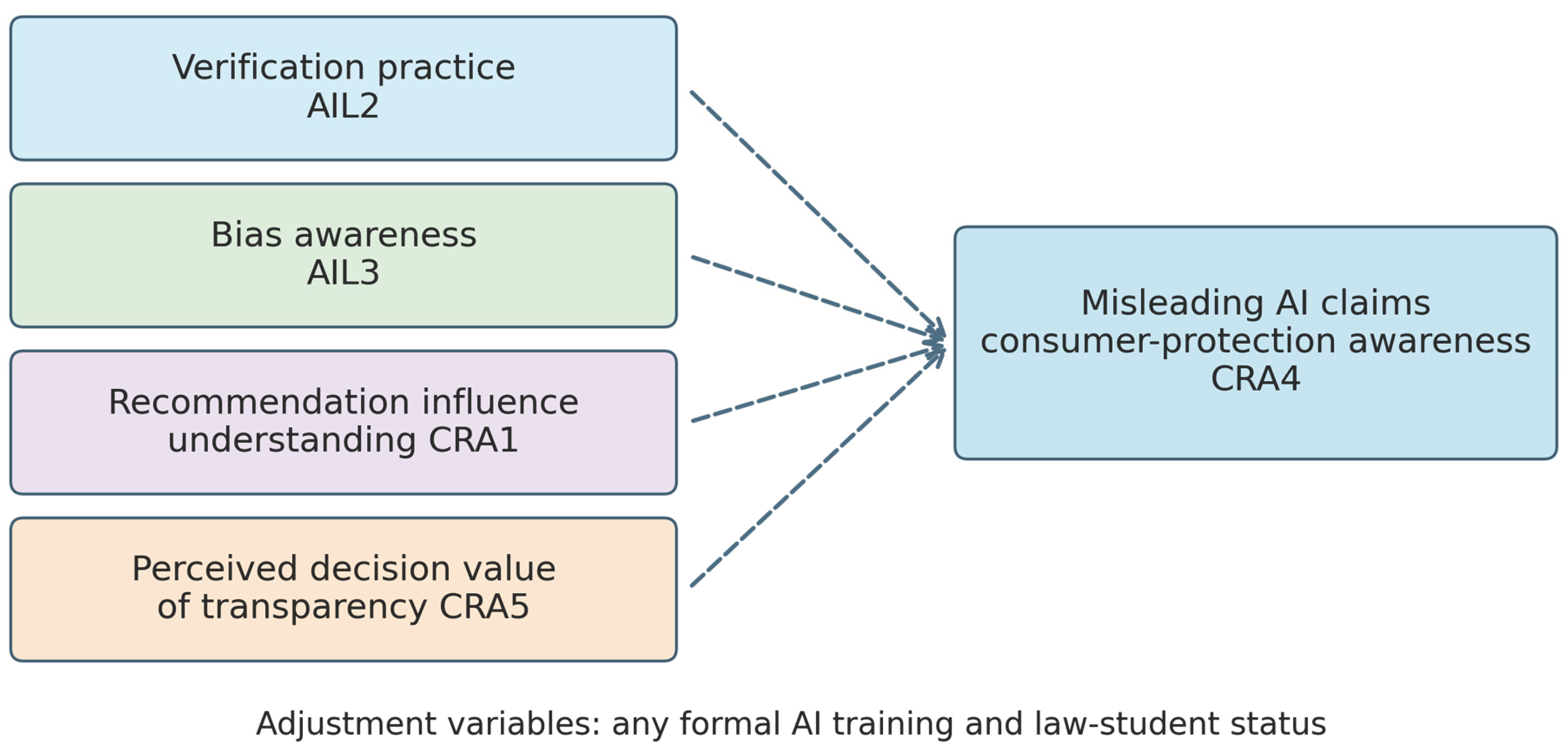
Table 1.
Consumer-awareness statements and analytical roles.
| Code | Statement focus | Interpretation |
| CRA1 | Understanding recommendation influence | Self-reported understanding; focal predictor |
| CRA2 | Consumers should know about personalisation | Normative information preference |
| CRA3 | Information on sponsorship or manipulation | Normative preference; combined wording |
| CRA4 | Awareness of misleading AI claims | Self-reported awareness; model outcome |
| CRA5 | Transparency helps informed decisions | Perceived decision value; focal predictor |
Source: supplied Group 7 Codebook. Exact analysed statements appear in Appendix A. These are not a scored legal-knowledge test or validated reflective scale.
Table 2.
Recorded status and formal AI training.
| Measure | Category | Count (%) |
| Status | Law student | 232 (60.3%) |
| Law graduate | 68 (17.7%) | |
| Advocate or legal professional | 51 (13.2%) | |
| Other relevant respondent | 34 (8.8%) | |
| Training | No | 222 (57.7%) |
| Yes, short orientation | 117 (30.4%) | |
| Yes, course or certified training | 46 (11.9%) |
N = 385. Law-student subset n = 232. Status and AI training do not establish recent shopping or recommendation exposure.
Table 3.
Distributions of consumer-awareness statements.
| Item | Counts 1 / 2 / 3 / 4 / 5 | Mean | SD | Endorsed n (%) | 95% CI (%) |
| CRA1 | 0 / 23 / 146 / 166 / 50 | 3.63 | 0.78 | 216 (56.1%) | 51.1 to 61.0 |
| CRA2 | 0 / 11 / 107 / 195 / 72 | 3.85 | 0.75 | 267 (69.4%) | 64.6 to 73.7 |
| CRA3 | 0 / 19 / 133 / 173 / 60 | 3.71 | 0.79 | 233 (60.5%) | 55.6 to 65.3 |
| CRA4 | 0 / 7 / 66 / 170 / 142 | 4.16 | 0.77 | 312 (81.0%) | 76.8 to 84.6 |
| CRA5 | 0 / 6 / 68 / 164 / 147 | 4.17 | 0.77 | 311 (80.8%) | 76.5 to 84.4 |
N = 385. Categories 1–5 run from strongly disagree to strongly agree. Endorsed = 4 or 5. Wilson intervals are pointwise and do not account for sample-selection bias. Means and SDs are descriptive.
Table 4.
Paired endorsement contrasts.
| Contrast | First only / second only | Difference pp | 95% CI pp | Holm p |
| CRA2 − CRA1 | 117 / 66 | 13.2 | 6.5 to 20.0 | <0.001 |
| CRA3 − CRA4 | 37 / 116 | -20.5 | -26.5 to -14.8 | <0.001 |
| CRA5 − AMR2 | 99 / 46 | 13.8 | 8.1 to 19.7 | <0.001 |
| AMR3 − AMR4 | 45 / 91 | -11.9 | -17.7 to -6.2 | <0.001 |
N = 385; pp = percentage points. Exact McNemar tests corrected across the four comparisons. Pointwise intervals use 10,000 respondent bootstrap resamples. Different wordings preclude interpretation as a treatment effect.
Table 5.
Joint patterns of understanding awareness and recognition.
| Influence CRA1 | Claims awareness CRA4 | Recognition AMR2 | Count (%) |
| Yes | Yes | Yes | 121 (31.4%) |
| Yes | Yes | No | 60 (15.6%) |
| Yes | No | Yes | 23 (6.0%) |
| Yes | No | No | 12 (3.1%) |
| No | Yes | Yes | 91 (23.6%) |
| No | Yes | No | 40 (10.4%) |
| No | No | Yes | 23 (6.0%) |
| No | No | No | 15 (3.9%) |
N = 385. Yes denotes endorsement; No includes neutral and disagreeing responses. Rows partition the sample. These are observed combinations, not latent classes or validated competency levels.
Table 6.
Selected ordinal associations.
| Pair | Spearman ρ | 95% CI | Raw p | Holm p |
| AIL2 / CRA1 | 0.125 | 0.029 to 0.223 | 0.014 | 0.069 |
| AIL3 / CRA4 | 0.050 | -0.053 to 0.153 | 0.328 | 0.985 |
| CRA1 / CRA4 | 0.142 | 0.044 to 0.237 | 0.005 | 0.032 |
| CRA2 / CRA3 | -0.006 | -0.107 to 0.100 | 0.901 | 1.000 |
| CRA4 / AMR2 | -0.003 | -0.101 to 0.095 | 0.956 | 1.000 |
| CRA5 / AMR4 | 0.110 | 0.011 to 0.210 | 0.031 | 0.124 |
N = 385. Pointwise percentile intervals use 3,000 respondent bootstrap resamples. Holm correction covers six correlations. Near-zero estimates do not establish equivalence or the absence of a relationship.
Table 7.
Adjusted binary model of misleading-claims awareness.
| Predictor | aOR | 95% CI | Raw p | Holm p |
| Verification AIL2 | 1.07 | 0.79 to 1.46 | 0.647 | 1.000 |
| Bias awareness AIL3 | 1.06 | 0.73 to 1.53 | 0.766 | 1.000 |
| Influence understanding CRA1 | 1.27 | 0.92 to 1.75 | 0.149 | 0.597 |
| Transparency decision value CRA5 | 1.26 | 0.92 to 1.72 | 0.157 | 0.597 |
| Any formal AI training | 1.61 | 0.94 to 2.75 | 0.084 | — |
| Law-student status | 0.86 | 0.50 to 1.46 | 0.566 | — |
N = 385; CRA4 endorsements = 312; other responses = 73. Item estimates are per one-point increase, with HC0 robust pointwise intervals. Holm correction covers four focal coefficients. Training/status references: no training and non-student. aOR = adjusted odds ratio.
Table 8.
Ordinal and student-restricted sensitivity estimates.
| Predictor | Ordinal aOR (95% CI) | Ordinal Holm p | Student aOR (95% CI) | Student Holm p |
| Verification AIL2 | 0.92 (0.72 to 1.17) | 1.000 | 0.90 (0.64 to 1.27) | 1.000 |
| Bias awareness AIL3 | 1.13 (0.87 to 1.47) | 1.000 | 1.07 (0.64 to 1.78) | 1.000 |
| Influence understanding CRA1 | 1.40 (1.10 to 1.78) | 0.026 | 1.31 (0.90 to 1.90) | 0.484 |
| Transparency decision value CRA5 | 1.02 (0.80 to 1.31) | 1.000 | 1.65 (1.08 to 2.53) | 0.086 |
Ordinal N = 385; CRA4 counts: disagree 7, neutral 66, agree 170, strongly agree 142. Common slopes assumed; observed-information intervals. Student binary n = 232; endorsements = 186; HC0 intervals. Separate Holm families cover four focal coefficients in each model. Analyses overlap and are exploratory.
Disclaimer/Publisher’s Note: The statements, opinions and data contained in all publications are solely those of the individual author(s) and contributor(s) and not of MDPI and/or the editor(s). MDPI and/or the editor(s) disclaim responsibility for any injury to people or property resulting from any ideas, methods, instructions or products referred to in the content. |
© 2026 by the authors. Licensee MDPI, Basel, Switzerland. This article is an open access article distributed under the terms and conditions of the Creative Commons Attribution (CC BY) license.
Copyright: This open access article is published under a Creative Commons CC BY 4.0 license, which permit the free download, distribution, and reuse, provided that the author and preprint are cited in any reuse.