
Submitted:
30 October 2026
Posted:
02 November 2026
You are already at the latest version
Abstract
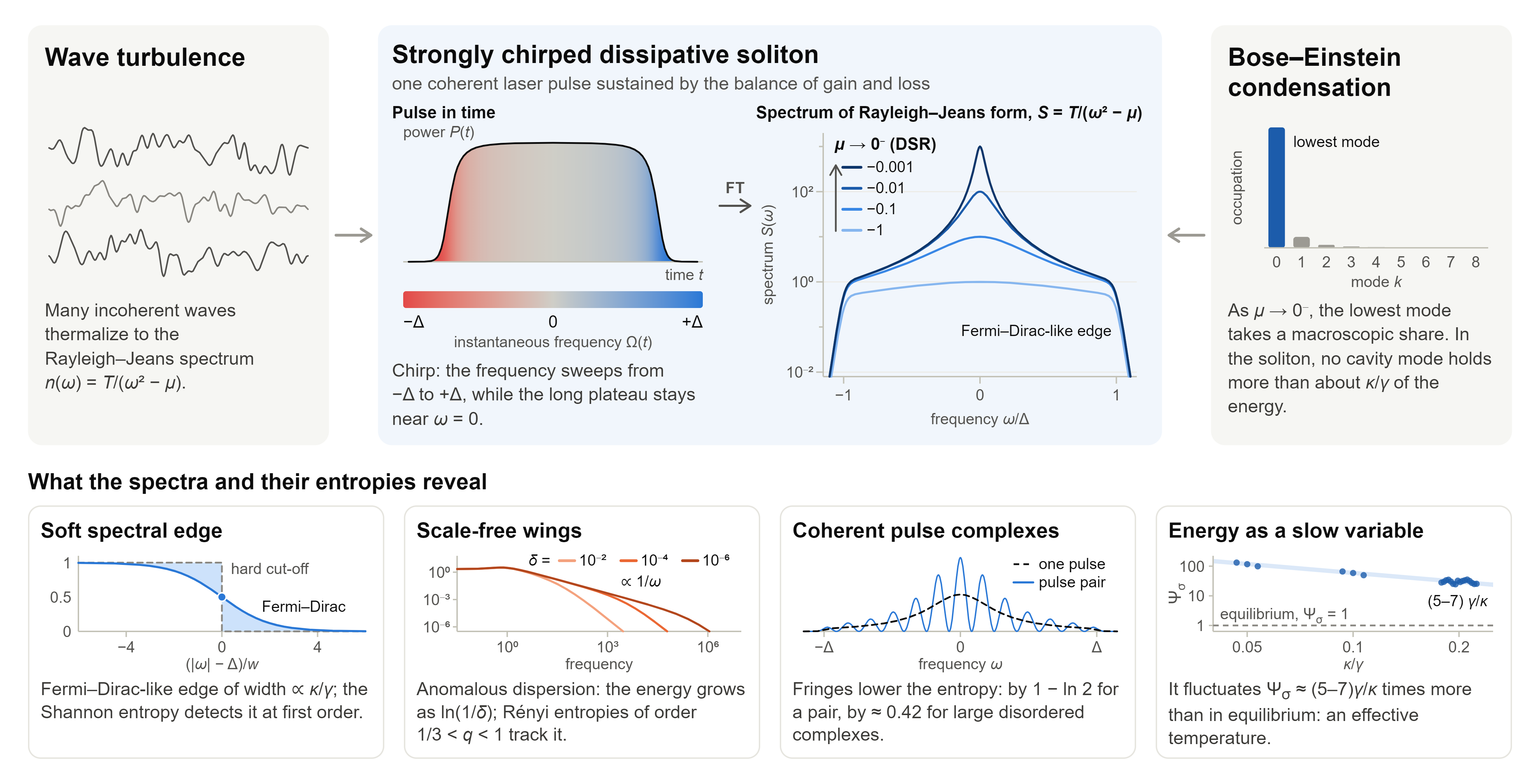
Strongly chirped dissipative solitons are coherent laser pulses sustained by a balance of gain and loss. They sit between two paradigms of statistical physics: their normal-dispersion spectra take the Rayleigh–Jeans form of thermalized waves, while their energy concentrates near zero frequency, as in wave condensation. Information measures quantify this dual character for the cubic–quintic complex Ginzburg–Landau equation. In normal dispersion, a Mellin–Gamma construction yields a Fermi–Dirac-like logistic spectral edge whose width, a dissipative linewidth, fixes the leading entropy correction. In anomalous dispersion, a scale-free spectral range carries logarithmic energy growth, and Rényi entropies of order above one third separate wing spreading from core weighting without truncating the spectrum. Resolved interference fringes lower the spectral entropy of coherent pulse complexes by a deficit that distinguishes in-phase, random, and flat-spectrum phase patterns. Linear fluctuation theory separates the coherent mean from fluctuations and reveals a soft energy mode near dissipative soliton resonance. At fixed net gain, its fluctuations track the static response to loss, with an effective noise strength exceeding the applied one by a factor proportional to the reactive-to-dissipative nonlinearity ratio; no cavity mode holds more than a small energy fraction. These results offer testable diagnostics for photonics and nonequilibrium physics.
Keywords:
dissipative soliton
; complex Ginzburg–Landau equation
; spectral entropy
; Rényi entropy
; Rayleigh–Jeans distribution
; wave turbulence
; Bose–Einstein condensation
; fluctuation–response relation
; nonequilibrium steady state
; mode-locked laser
Copyright: This open access article is published under a Creative Commons CC BY 4.0 license, which permit the free download, distribution, and reuse, provided that the author and preprint are cited in any reuse.