
Submitted:
30 October 2026
Posted:
02 November 2026
You are already at the latest version
Abstract
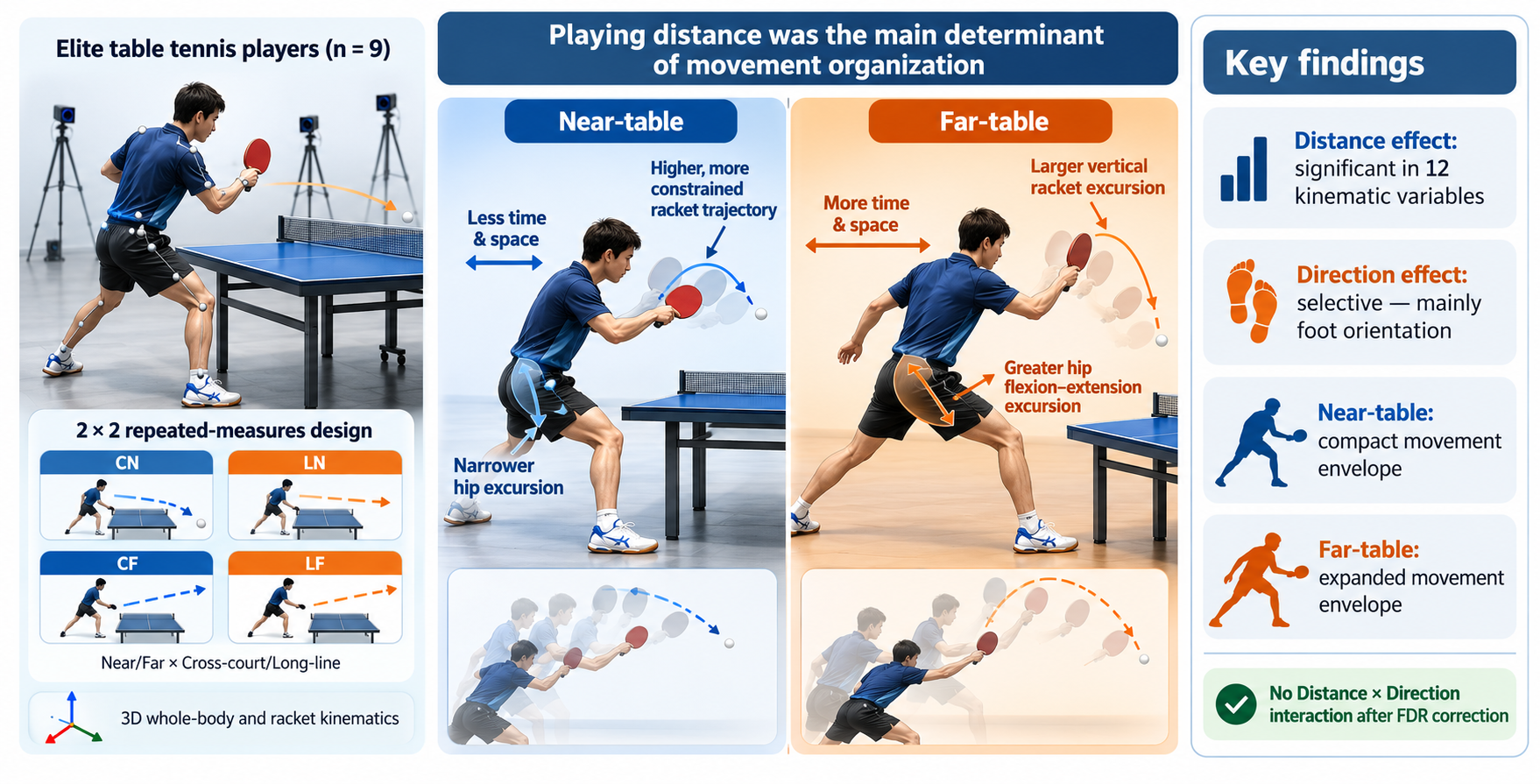
The topspin forehand is a key offensive stroke in table tennis, yet the influence of playing distance on its kinematic organization remains insufficiently understood. This study examined the effects of playing distance and stroke direction on topspin forehand kinematics in nine elite male table tennis players. Participants performed strokes under four conditions combining distance (near vs. far from the table) and direction (cross-court vs. long-line). Three-dimensional kinematics were analysed using a two-way repeated-measures ANOVA, with false discovery rate controlled using the Benjamini–Hochberg procedure across 37 substantive outcomes. After correction, playing distance significantly affected 12 kinematic variables, whereas stroke direction significantly affected only the foot–table angle; no Distance × Direction interaction remained significant. Near-table strokes were characterized by a higher racket position at peak racket velocity (+0.125 m) and a higher minimum racket position (+0.155 m), lower maximum hip flexion (−13.54°), higher minimum hip flexion (+7.69°), and a smaller shoulder–table angle at peak racket velocity (−8.51°). Long-line strokes showed a greater foot–table angle than cross-court strokes (+6.45°). These findings provide quantitative evidence that playing distance primarily modifies the kinematic movement envelope of the topspin forehand: near-table strokes are characterized by a more compact hip-motion pattern and a higher, more vertically constrained racket trajectory, whereas farther-table strokes involve greater hip and racket excursion. Stroke direction exerts a more selective effect, primarily modifying foot orientation relative to the table.
Keywords:
table tennis
; topspin forehand
; biomechanics
; kinematics
; playing distance
; racket trajectory
Copyright: This open access article is published under a Creative Commons CC BY 4.0 license, which permit the free download, distribution, and reuse, provided that the author and preprint are cited in any reuse.