

Submitted:
30 October 2026
Posted:
02 November 2026
You are already at the latest version
Abstract
Per- and polyfluoroalkyl substances (PFAS) remain a major chemical management challenge in textiles. This critical review asks whether recent restrictions eliminate PFAS burdens or redistribute them across chemicals, places, environmental compartments and time. Drawing mainly on primary studies, agency assessments and regulatory instruments published between 2019 and 2026, it develops the Fluorine Displacement Cascade from three premises: PFAS persistence, the limited jurisdictional reach of market-based rules and the dependence of compliance on what is measured. Together, these premises explain five forms of displacement: chain-length, geographic, compartmental, temporal and end-of-life. Geographic displacement is central because most binding textile rules apply where products are sold, while PFAS application, worker exposure and effluent release occur largely in manufacturing economies with few textile-specific controls. Fluorine-free alternatives are mature for most consumer textiles, although substitution remains difficult for a small group of protective applications. The review therefore proposes an essentiality-substitutability-exposure triage for phase-out and recommends production-side controls, including organic fluorine limits for textile effluent, supply-chain fluorine mass reporting, occupational monitoring and producer-funded end-of-life management. These measures can move PFAS governance beyond market restriction toward verified reduction and elimination.
Keywords:
per- and polyfluoroalkyl substances
; durable water repellent
; textile wet processing
; chemical regulation
; regulatory displacement
; regrettable substitution
; essential use
; ready-made garment sector
1. Introduction
PFAS performance arises from the strong carbon-fluorine bond, which provides thermal stability, chemical resistance and very low surface energy [1]. The same bond drives the environmental problem. PFAS resist natural degradation, move between environmental compartments and form terminal products that persist beyond normal regulatory timeframes [2,3].
In textiles, PFAS are used mainly in durable water-repellent finishes, but also as processing aids, levelling agents, wetting agents and yarn lubricants [4,5]. The European Environment Agency estimates that textiles account for about 35 per cent of global PFAS demand and 41,000 to 143,000 tonnes of use in the European Union. Polymeric PFAS comprise more than 75 per cent of PFAS in finished textiles [6]. Other reviews place the sectoral share closer to half of global demand [7,8], showing that sector-wide estimates remain uncertain.
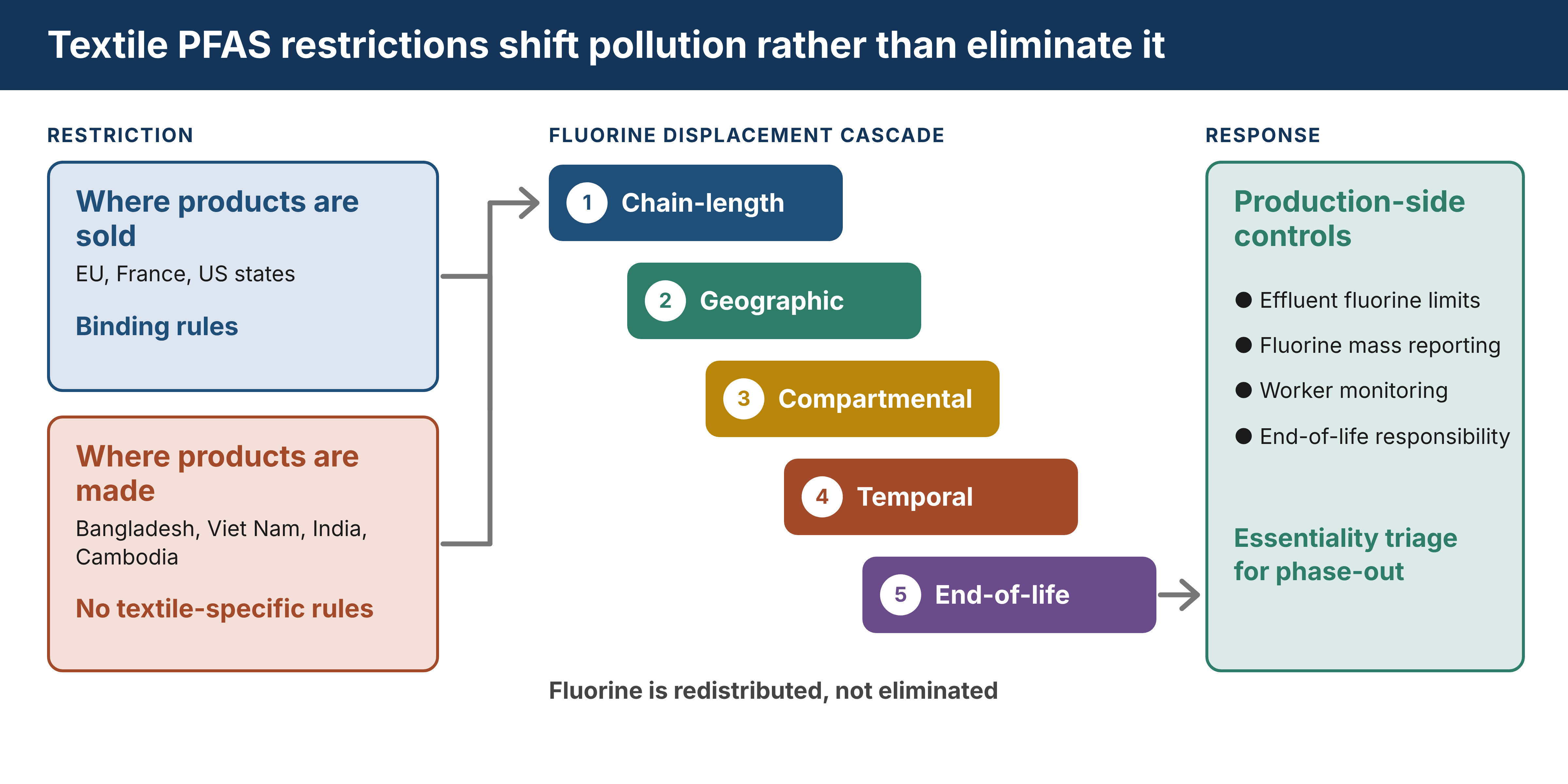
Regulation has accelerated. The International Agency for Research on Cancer classified perfluorooctanoic acid as carcinogenic to humans, Group 1, and perfluorooctane sulfonic acid as possibly carcinogenic to humans, Group 2B [9,10]. In March 2026, the European Chemicals Agency's Committee for Risk Assessment adopted its final opinion supporting an EU-wide class restriction, while the Committee for Socio-Economic Analysis published a draft opinion for consultation [11,12]. France has banned PFAS in consumer textiles and footwear, and several United States jurisdictions have adopted binding thresholds for textile articles. At first sight, the sector appears to be moving toward comprehensive phase-out. Figure 1 summarises the five displacement pathways through which these restrictions may shift PFAS burdens rather than eliminate them.
Recent reviews describe PFAS chemistry, occurrence, toxicity and regulation, and generally support class-based regulation and faster substitution [7,8]. Far less attention has been given to the mismatch between where PFAS are regulated and where they are applied, released and discarded. Textile wet processing is concentrated in Asian manufacturing economies, while many finished products are sold in Europe and North America. Used textiles then move through second-hand trade and waste flows. Point-of-sale regulation therefore reaches only one part of the product system.
This article develops a theoretical argument rather than a comprehensive data synthesis. It argues that consumption-side restriction of a persistent chemical in a geographically dispersed production system can produce predictable displacement. The Fluorine Displacement Cascade combines three established premises and identifies five mechanisms. Section 3 to 6 examine the evidence, and Section 7 derives the framework.
The article makes three contributions. First, it proposes a testable framework for chemical governance in dispersed production systems. Second, it compares the geography of binding PFAS rules with the geography of textile trade. Third, it presents a product-category triage and production-side measures for impacts that market restrictions cannot reach. Particular attention is given to Bangladesh, Viet Nam, India and Cambodia, where textile-specific PFAS obligations remain limited despite their major roles in garment production.
The article makes three contributions. It proposes a testable framework for chemical governance in dispersed production systems. It compares the geography of binding PFAS rules with the geography of textile trade. It also presents a product-category triage and production-side measures for problems that market restrictions cannot reach. Particular attention is given to major garment exporters, including Bangladesh, Viet Nam, India and Cambodia, where textile-specific PFAS obligations remain limited.
2. Scope, Evidence Base and Approach
This critical review evaluates selected evidence to develop a conceptual argument. It is not a systematic review and does not claim exhaustive coverage. Its value rests on the quality and relevance of the evidence, the transparency of selection and the coherence of the reasoning. Table 1 summarises the scope, sources and limitations.
Note. Data reported in this review retain their original units. Conversion between mass-per-mass and mass-per-area conventions requires areal density values that source studies rarely report, so figures from different studies are treated as indicative of magnitude rather than as directly comparable.
3. Chemistry, Function and the Instability of the Sectoral Evidence Base
3.1. Substance Scope and the Polymer Problem
Estimates of the PFAS class have risen as definitions have broadened. Much of the textile literature still cites approximately 4,700 substances from a 2018 inventory, although the European restriction dossier covers around ten thousand and chemical inventories catalogue considerably more [2,11]. The number used in textiles remains unknown [6].
The polymeric fraction dominates by mass. Side-chain fluorinated polymers, with fluorotelomer-derived side chains bound to acrylate or urethane backbones, constitute more than three-quarters of PFAS content in finished textiles [6]. This creates three regulatory problems. Polymeric PFAS escape targeted analytical panels and thresholds based on individual analytes, yet act as reservoirs that progressively release low-molecular-weight species during and after product use [13,14]. Monitoring focused on terminal perfluoroalkyl acids therefore measures only a minority of the fluorine present. Section 7.1 develops this problem as measurement dependence.
Table 2 maps the main functional classes to process locations and release pathways. PFAS application is distributed across wet processing rather than confined to final finishing. A factory-boundary effluent control can therefore intercept a broader fluorine flux than an input restriction focused only on durable water repellents.
Note. Compiled from Buck et al. (2011), Holmquist et al. (2016), Glüge et al. (2020), EEA (2024), Pervez et al. (2025) and Zhang et al. (2026). PFOA, perfluorooctanoic acid; PFOS, perfluorooctane sulfonic acid; PFHxA, perfluorohexanoic acid; PFBA, perfluorobutanoic acid; PFBS, perfluorobutane sulfonic acid.
3.2. What the Sectoral Numbers Can and Cannot Support
Two quantitative claims anchor policy discussion of textile PFAS, and both require caution. The first concerns sectoral demand. The 35 per cent share and the estimate of 41,000 to 143,000 tonnes of EU use derive from one consultancy assessment commissioned by the European Environment Agency [6]. The near-50 per cent figure in recent reviews follows a different evidence chain [7,8]. They are not independent estimates converging on one value, and neither is based on primary production data. The defensible conclusion is that textiles are among the largest PFAS uses, but their precise share is unknown.
The second is product burden. The most rigorous product-level dataset available remains that of Xia et al. (2022), who screened 72 children's textile products marketed as stain-resistant in United States and Canadian markets for total fluorine by particle-induced gamma-ray emission spectroscopy and analysed 57 of them for 49 targeted PFAS. PFAS were detected in every product. Total targeted concentrations ranged from 0.250 to 153,000 ng per gram with a median of 117 ng per gram, equivalent to 0.0281 to 38,100 micrograms per square metre. School uniforms carried a median of 728 ng per gram and were significantly more contaminated than bibs, hats, stroller covers and swimsuits, though comparable to outdoor wear. The dominant compound was 6:2 fluorotelomer alcohol.
Two results within that study deserve more attention than they have received. Uniforms labelled as 100 per cent cotton carried far higher burdens than synthetic blends, on the order of 19,100 against approximately 1.7 ng per gram, because cellulosic substrates require heavier chemical loading to achieve an equivalent stain-resistance claim. The consumer intuition that natural fibres imply lower chemical exposure is inverted in this category. More consequentially, the authors' substance flow analysis estimated that approximately 3 tonnes of PFAS per year, with a plausible range of 0.05 to 33 tonnes, are used in United States children's uniforms alone, of which roughly 0.1 tonnes is non-polymeric. A ratio of polymeric to non-polymeric mass of roughly thirty to one is a compact statement of how much fluorine conventional compliance monitoring does not see.
4. Where Fluorine Goes: Lifecycle Release and the Failure of Interception
4.1. Release is Continuous, not Point-Source
Fluorine enters the environment at every stage of the textile life cycle. At the production stage it enters aquatic systems through wet-processing effluent, and enters air through volatilisation during curing; fluorotelomer alcohols and their precursors have been documented in workplace air, airborne particulates and settled dust in textile manufacturing facilities [7]. At the use stage, laundering releases both dissolved PFAS and PFAS-bearing microfibres. At end of life, landfilling generates leachate, incineration below the temperature required for mineralisation volatilises rather than destroys, and the European Environment Agency notes explicitly that it remains uncertain whether prevailing incineration practice fully destroys PFAS in textile waste [6].
The mechanism that most complicates regulation, however, is weathering. Schellenberger et al. (2022) exposed polyamide fabrics treated with different side-chain fluorinated polymers to natural weathering in Sydney for six months, followed by abrasion and washing. Characterisation revealed both loss of PFAS-bearing textile fragments and in-situ formation of low-molecular-weight PFAS, with each polymer chemistry generating a distinct perfluoroalkyl acid signature and, in some cases, post-weathering concentrations exceeding regulatory limits for textiles. Van der Veen et al. (2022) reached a consistent conclusion under controlled ageing of coated polyamide and polyester, finding that ageing increases the concentration of extractable perfluoroalkyl acids and that washing after ageing amplifies the effect.
The regulatory implication is central. A garment may comply at market entry but exceed the same threshold after ordinary use because its polymer reservoir continues to generate regulated analytes. Point-of-sale testing therefore observes the reservoir before much of this transformation occurs. Section 7 defines this process as temporal displacement.
4.2. Treatment does not Intercept, and Frequently Generates
The engineering evidence on interception is unusually consistent across studies, jurisdictions and plant configurations. Conventional biological treatment does not remove PFAS from industrial wastewater, and in several documented cases it increases measured effluent loads. Figure 2 compiles reported performance.
The mechanism is precursor transformation. Textile effluent contains side-chain fluorinated polymers, colloidal polymer particles and fluorotelomer intermediates that targeted analysis may not detect at entry. Biological and oxidative treatment converts part of this reservoir into measurable terminal perfluoroalkyl acids. The plant does not create fluorine; it converts analytically invisible fluorine into visible forms. A discharge limit based only on targeted analytes can therefore coexist with a large organic fluorine load. Effective limits should use adsorbable or extractable organic fluorine, or pair targeted analysis with a total oxidisable precursor assay.
The mechanism is precursor mineralisation. Textile effluent carries a large mass of side-chain fluorinated polymers, colloidal polymer particles and fluorotelomer intermediates that targeted analysis does not detect on entry. Biological and oxidative treatment converts a fraction of that reservoir into terminal perfluoroalkyl acids, which the method can then see. The plant is not synthesising fluorine; it is converting invisible fluorine into visible fluorine. a discharge limit expressed as a sum of targeted analytes can be satisfied by a plant discharging a large and rising organic fluorine load, and effluent limits must therefore be expressed in adsorbable or extractable organic fluorine terms, or be paired with a total oxidisable precursor assay, if they are to constrain the quantity that matters.
This also affects environmental monitoring generally. Analysis of global surface water and groundwater data indicates that a substantial fraction of sampled waters exceeds drinking water guidance values, and that current monitoring practice probably underestimates environmental PFAS because only a limited suite of substances is typically quantified [15]. The gap between what is present and what is measured is not a textile-specific artefact; it is a general feature of PFAS governance that the textile sector exhibits in an extreme form because of its polymer-dominated use pattern.
4.3. What Does Work, and at What Cost
Control is technically possible, but the available evidence supports substitution as the primary instrument and treatment as a complement. A review of 734 records from 21 full-scale industrial plants across Asia, Europe and North America found that adsorption, membrane technology and Fenton oxidation can exceed 90 per cent removal for long-chain species such as perfluorooctane sulfonic acid, compared with below 50 per cent for conventional processes [16]. Three limitations remain. Performance declines for short-chain species; separation transfers rather than destroys PFAS; and membrane concentrate or spent adsorbent requires terminal management that is unavailable at scale in many manufacturing jurisdictions. The same review also calls for precursor monitoring, returning the problem to measurement.
5. Exposure and Health
In November 2023 an IARC Working Group of thirty scientists from eleven countries evaluated the carcinogenicity of perfluorooctanoic acid and perfluorooctane sulfonic acid. Perfluorooctanoic acid was classified as carcinogenic to humans, Group 1, on the basis of sufficient evidence for cancer in experimental animals and strong mechanistic evidence in exposed humans for epigenetic alterations and immunosuppression, together with limited evidence in humans for renal cell carcinoma and testicular cancer. Perfluorooctane sulfonic acid was classified as possibly carcinogenic to humans, Group 2B, on the basis of strong mechanistic evidence, with limited evidence in experimental animals and inadequate evidence in humans [9,10].
A substantial portion of the textile sector's secondary and guidance literature reports perfluorooctane sulfonic acid as Group 2A. That statement is incorrect. The distinction carries different weight in hazard-based regulatory triggers and in litigation, and the propagation of the error through supply-chain guidance illustrates the fragility of the sector's evidentiary chain of custody, which is one reason this review restricts itself to primary sources.
Textile-specific exposure operates through three routes. Dermal uptake is the pathway of greatest interest for apparel; in vitro three-dimensional human skin equivalent models establish measurable dermal bioavailability for perfluoroalkyl substances, confirming that the pathway is real [17,18]. What remains unresolved is the magnitude of transfer from a treated garment under realistic conditions of heat, perspiration and friction. The modelled median of 1.03 ng per kg body weight per day for children wearing school uniforms [19] should be read as a central estimate under substantial parameter uncertainty rather than a measured intake. Inhalation is the pathway most likely to be underestimated: the dominant compound in children's textiles is volatile, and fluorotelomer alcohols occur at elevated concentrations in textile facility air. Incidental ingestion completes the picture and is material for young children through hand-to-mouth behaviour and mouthing of garments.
Children are the population of concern for textile-mediated exposure specifically, because uniforms are worn against the skin for extended periods on most days of the year, because developmental windows are more vulnerable, and because behavioural factors increase ingestion. the textile-attributable fraction of total human body burden has not been quantified. This is a first-order evidence gap, and it limits what any risk-based argument for or against textile restriction can currently claim.
Children warrant particular attention because uniforms are worn against the skin for long periods, developmental stages may be more vulnerable, and hand-to-mouth behaviour increases ingestion. However, the textile-attributable share of total human PFAS burden has not been quantified. This major evidence gap limits risk-based claims both for and against textile restriction.
6. The Regulatory Landscape and Its Geography
6.1. Instruments in Force and in Progress
Three European instruments now bear on textiles. Under the Persistent Organic Pollutants Regulation, perfluorooctane sulfonic acid and perfluorooctanoic acid are restricted in implementation of the Stockholm Convention. Under REACH, the restriction on C9 to C14 perfluoroalkyl carboxylic acids entered into force in February 2023, and Commission Regulation (EU) 2024/2462 added Entry 79 to Annex XVII on 10 October 2024, restricting perfluorohexanoic acid, its salts and related substances at 25 parts per billion for the sum of the acid and its salts and 1,000 parts per billion for related substances, measured in homogeneous material. That restriction applies to textiles, leather, furs and hides in clothing and related accessories for the general public and to footwear from 10 October 2026, and to other consumer textiles from 10 October 2027, with exemptions for certain category III personal protective equipment, medical devices and construction textiles [20].
The universal restriction remains the decisive instrument. Submitted in January 2023 by Denmark, Germany, the Netherlands, Norway and Sweden, it covers substances on the order of ten thousand across fourteen sectors plus PFAS manufacturing. The Committee for Risk Assessment adopted its final opinion in March 2026, confirming that PFAS hazards and risks justify EU-wide restriction and that existing measures are insufficient to control emissions. The Committee for Socio-Economic Analysis agreed a draft opinion in the same month and published it for a sixty-day consultation closing in May 2026, with a final opinion expected by the end of 2026 [11,12].
The socio-economic committee's reasoning is more consequential for textiles than the risk committee's conclusion. The draft opinion accepts that a broad restriction is appropriate but reframes the question as one of proportionality, concluding that a full ban with a short transition period is unlikely to be proportionate given limited alternative availability in several applications [12]. Here, the essential-use argument becomes operational, and where the triage proposed in Section 9 is intended to intervene: the socio-economic case for derogation is strong in a small number of protective applications and weak across the great majority of sectoral volume, and it should not be assessed at sector level.
Beyond the European Union, France has adopted the most stringent national measure, prohibiting the manufacture, import, export and sale of PFAS-containing consumer textiles, footwear and waterproofing agents from January 2026 and extending to all textiles from January 2030, with exemptions for protective equipment, industrial technical textiles and articles incorporating at least 20 per cent post-consumer recycled material. Denmark restricts clothing and footwear containing total fluorine at or above 50 mg F per kg. In the United States, in the absence of a federal textile instrument, California, New York, Colorado and Maine have legislated, with California capping total organic fluorine in textile articles at 100 parts per million from January 2025, falling to 50 parts per million from January 2027. Federal drinking water regulation moved in the opposite direction over the same period: the Environmental Protection Agency has proposed to retain the 4 parts per trillion limits for perfluorooctanoic acid and perfluorooctane sulfonic acid while extending compliance to 2031, and separately to rescind the standards for perfluorohexane sulfonic acid, perfluorononanoic acid, hexafluoropropylene oxide dimer acid and the hazard index for mixtures [21,22].
Outside these jurisdictions, textile-specific obligation is sparse. China's Ministry of Ecology and Environment published a List of New Pollutants for Priority Management in December 2022, in force from March 2023, which includes perfluorooctane sulfonic acid and perfluorooctanoic acid and applies to the chemical and textile industries. This is a production-side instrument, and as such is structurally different from every other measure in Table 3. No binding textile-specific PFAS restriction was identified for Bangladesh, Viet Nam, India, Cambodia, Pakistan or Indonesia beyond baseline Stockholm Convention obligations.
Note. Compiled from primary instrument text and official agency records. Current to 20 August 2026; several instruments are in active amendment and readers should verify against the consolidated text before relying on any entry. ppb, parts per billion; ppm, parts per million; ppt, parts per trillion; RAC, Committee for Risk Assessment; SEAC, Committee for Socio-Economic Analysis.
6.2. The Regulatory-Production Asymmetry
Setting Table 3 against the geography of production yields the central empirical observation of this review, presented in Figure 3.
In 2024 world apparel exports totaled approximately 557.5 billion United States dollars. China accounted for 29.6 per cent, Bangladesh for 6.9 per cent, Viet Nam for 6.1 per cent, Türkiye for approximately 3.2 per cent and India for approximately 2.9 per cent, with Cambodia, Pakistan and Indonesia contributing a further 5.1 per cent combined. On the import side the European Union accounted for 35.8 per cent and the United States for 15.7 per cent of world apparel imports. China's position in upstream textile production, where wet processing and durable water repellent application predominantly occur, is stronger still, its share of world textile exports reaching 43.3 per cent in 2024 [23].
Every instrument in Table 3 except the Chinese priority-management listing operates at the point of placing on the market. Such instruments regulate the article; they do not regulate the process that produced it. A supplier manufacturing for both regulated and unregulated destination markets faces no legal constraint on the fluorine content of its effluent, on occupational exposure in its finishing department, or on the chemistry applied to goods destined for markets without thresholds. Compliance is achieved through order-level segregation rather than process transformation, and segregation is a commercially rational response that leaves aggregate emission unchanged.
Two trade features deepen the problem. The European Environment Agency notes that most textiles consumed in Europe are imported from Asian countries with generally less stringent chemicals legislation and that little information exists on their PFAS content [6]. Verification therefore depends on testing capacity that cannot easily match import volumes. Supply chains also cross several jurisdictions: a garment exported from Bangladesh or Viet Nam may contain fabric finished in China and sold in Europe or North America. Chemical application, legal export and final sale can thus occur in three different regulatory systems.
7. The Fluorine Displacement Cascade
7.1. Derivation from Three Premises
The framework is not merely a list of outcomes. It derives five displacement mechanisms from three premises, each supported by the evidence reviewed above. The contribution lies in combining them into one testable explanation.
P1, persistence invariance. For a substance that does not degrade under ambient conditions, and in the absence of destruction capacity, an instrument that prohibits a use alters the location, speciation and timing of the substance's environmental appearance but does not alter the mass already synthesised or the mass that continues to be synthesised for uses outside the instrument's scope. This follows from the physical chemistry established in Section 3.1 and from the destruction capacity constraint documented in Section 4.3.
P2, jurisdictional partiality. Regulatory instruments bind at specified nodes of a production and consumption system, typically the node at which an article is placed on a market. Where the system is distributed across jurisdictions, the instrument reaches the nodes within its jurisdiction and does not reach the others. Table 3 establishes that all but one identified textile PFAS instrument binds at the point of sale; Section 6.2 establishes that the application and discharge nodes lie predominantly elsewhere.
P3, measurement dependence. Compliance is defined over measured quantities. Where measurement is a strict subset of what is present, compliance can be achieved without the underlying quantity changing. Section 3.1 establishes that polymeric PFAS constitute the majority of textile fluorine and are invisible to targeted analysis; Section 4.2 establishes that the invisible fraction converts to the visible fraction under treatment and weathering.
From these premises five displacement mechanisms follow. P1 and P3 jointly generate chain-length displacement, because a substance-specific or analyte-specific instrument can be satisfied by moving to an unlisted congener without reducing fluorine mass. P2 generates geographic displacement directly. P1 generates compartmental displacement, because interception without destruction necessarily transfers the substance between environmental compartments. P1 and P3 jointly generate temporal displacement, because a reservoir that is invisible at the moment of compliance testing becomes visible later. P1 and P2 jointly generate end-of-life displacement, because a persistent substance embedded in a durable good travels with that good into jurisdictions the instrument does not reach.
7.2. Scope Conditions and Refutation
The framework predicts displacement in proportion to three system parameters, and is correspondingly falsifiable. Displacement should be large where the fraction of lifecycle emission occurring outside the regulating jurisdiction is high, where the gap between measured and total fluorine is wide, and where destruction capacity is absent. It should be small, and restriction should approach elimination, where production and consumption occur within the same jurisdiction, where compliance is defined over total organic fluorine rather than targeted analytes, and where terminal destruction capacity exists. Sectors satisfying these conditions, for example a chemical use manufactured and consumed within a single regulatory bloc under a total-fluorine threshold, should show minimal displacement. Evidence that class-based restriction in such a setting nonetheless produced the five mechanisms would refute the derivation rather than the observation.
Three observations would refute the framework as applied to textiles. First, evidence that fluorine mass entering the environment from textile manufacturing in unregulated jurisdictions declined following restriction in consuming jurisdictions, absent independent domestic action, would refute geographic displacement. Second, evidence that total organic fluorine in finished textiles declined proportionally with targeted analyte concentrations under existing thresholds would refute measurement dependence. Third, evidence that aged and laundered textiles show declining rather than increasing extractable perfluoroalkyl acid concentrations would refute temporal displacement; the available weathering evidence points firmly the other way [13,14], but that evidence rests on a small number of experimental studies and should be replicated.
7.3. The Mechanisms and Their Evidence
Chain-length displacement. Successive substance-specific restrictions have driven substitution from C8 to C6 to C4 chemistry, and increasingly toward ultra-short-chain species, without reducing persistence. Short-chain species are equally persistent, more mobile in soil and groundwater, more efficiently taken up by plants, less effectively removed by any available treatment, and less well characterised toxicologically [2,3]. Displacement can also exit the regulated class entirely: Herkert et al. (2026) tested twelve used firefighter turnout garments manufactured between 2013 and 2024, three marketed as non-PFAS-treated, and found brominated flame retardants at significantly higher concentrations than PFAS across all three garment layers, with decabromodiphenyl ethane present in non-expanded-polytetrafluoroethylene moisture barriers at 7,290 to 10,600 ng per square centimetre, at levels indicating intentional application rather than contamination. A restriction defined by chemical class rather than by function and hazard can be satisfied without reducing harm.
Geographic displacement. Established in Section 6.2. This is the mechanism on which the argument most depends, the one for which direct emission evidence in the affected jurisdictions is absent.
Compartmental displacement. Where treatment intercepts fluorine, it relocates it. Long-chain species partition to sludge, which is frequently land-applied; membrane concentrate and spent adsorbent constitute concentrated fluorine wastes requiring terminal management unavailable at scale [16]; incineration below mineralisation temperature volatilises rather than destroys; landfilling generates leachate [6]. Separation without destruction converts a water problem into a soil, air or waste problem.
Temporal displacement. Side-chain fluorinated polymers constitute a reservoir converting to terminal perfluoroalkyl acids across and beyond the service life. Weathering and ageing studies document concentrations rising substantially in aged textiles, in some cases from compliant to non-compliant [13,14], and treatment plants exhibit the same mechanism on a shorter timescale [7,24]. Point-of-sale compliance testing measures the reservoir at its minimum.
End-of-life displacement. More than half of disposed textiles in the European Union enter landfill or incineration, and most collected used textiles are exported to Africa and Asia for sorting, resale, dumping or open burning [6,25]. The fluorine embedded in the stock of treated textiles already in circulation will remain in use and in waste streams for decades after any restriction takes effect, and is destined predominantly for jurisdictions with the least waste management capacity and no PFAS control regime.
The framework does not argue against restriction. Class-based restriction is necessary for elimination, and the European proposal is among the most significant chemicals-management initiatives of the decade. The argument is narrower: point-of-sale restriction alone is insufficient, the resulting gaps can be specified, and their burdens fall disproportionately on jurisdictions that receive little of the regulatory benefit.
8. Substitution and the Shape of the Remaining Problem
Fluorinated finishes reduce fabric surface tension to approximately 10 to 20 millinewtons per metre, below the surface tension of both water and most oils, which is why they deliver simultaneous water, oil and stain repellency. Fluorine-free chemistries based on long-chain alkyl groups, organosilicon, polyurethane or dendritic architectures achieve comparable water repellency but cannot reach equivalently low surface energy, and consequently exhibit insufficient oil repellency [8,26].
Four technology classes are commercially mature for water repellency. Organosilicon and polydimethylsiloxane systems are the leading substitute for consumer apparel, delivering high water repellency and moderate oil repellency. Polyurethane systems, including as membranes, deliver high water repellency and high wash durability, and recent side-chain functionalised formulations improve durability further. Polyacrylate systems with long alkyl side chains achieve low surface energy through side-chain crystallinity, with performance that is temperature sensitive. Wax and paraffin treatments remain available for low-specification applications but wash out. Dendritic and hyperbranched architectures are the most promising fluorine-free route to genuine oleophobicity and remain constrained by synthesis complexity and cost.
The research frontier is narrowing the gap through hierarchical surface structuring rather than surface chemistry alone. Hybrid organic-inorganic sol-gel systems based on octylsilane-modified amino-functional polydimethylsiloxane, applied by pad-dry-cure and benchmarked against a commercial fluorinated finish, achieve high water contact angles on both cotton and polyester with comparable handle and breathability [27]. Structured superhydrophobic and amphiphobic systems achieve substantially higher contact angles still. Two constraints persist: repellency against low-surface-tension oils such as decane and octane remains materially inferior, and the mechanical durability of micro- and nano-structured surfaces under repeated laundering and abrasion remains the binding barrier to industrial adoption [26].
The relevant question is not whether fluorine-free chemistry matches fluorinated chemistry, but whether it delivers the performance the application actually requires. Broad-spectrum oil repellency is not a functional requirement of a school uniform, a fashion jacket or an upholstery fabric; it is a marketing claim. It is a genuine functional requirement of chemical-splash workwear and firefighter protective equipment. Functional substitution analysis, rather than performance-parity benchmarking, is the appropriate assessment frame [28,29,30]. The European Environment Agency's judgement is consistent and worth stating precisely, because secondary accounts routinely soften it: the use of PFAS in most types of textiles is not a technical necessity, feasible alternatives already exist for the majority of categories, and for the residual categories where they do not, separate collection and destruction should be considered rather than reuse or recycling [6].
Voluntary governance has moved ahead of law. Some certification schemes prohibit intentionally added PFAS, subject to limited essential-use exceptions, while analytical methods increasingly use alkaline hydrolysis to release PFAS bound within polymers. These advances remain partial. Certification mainly reaches suppliers serving participating brands and regulated markets. Producers serving domestic or weakly regulated markets are less likely to be covered, yet they are also the suppliers that market-entry rules fail to reach.
9. Implications: Triage and Production-Side Instruments
9.1. Sequencing Phase-Out by Product Category
If the socio-economic committee's proportionality reasoning is to be applied without granting derogations far broader than the evidence supports, the analysis must be conducted at product-category rather than sectoral resolution. Figure 4 and Table 4 array textile categories on three dimensions: essentiality under the essential-use concept of Cousins et al. (2019), the readiness of fluorine-free alternatives established in Section 8, and exposure intensity determined by dermal contact duration, population vulnerability and release pathway.
The distribution has a policy-relevant shape. Categories accounting for the great majority of sectoral PFAS volume, namely everyday apparel, home textiles, upholstery, carpet, sports and athleisure wear, footwear and children's clothing, sit in the phase-out quadrants, because mature alternatives exist and the oil repellency that fluorinated chemistry uniquely provides is not a functional requirement. Categories where substitution is genuinely difficult, namely firefighter turnout gear, military and first-responder protective equipment, medical textiles and certain chemical-protective workwear, account for a small share of volume and are precisely those the European Environment Agency identifies as lacking feasible alternatives [6]. The proportionality objection to rapid phase-out therefore applies to a minor fraction of the sector, and should not govern the transition period for the majority.
Note. Essentiality tiers follow Cousins et al. (2019, 2021). Substitution readiness derives from Section 8. Exposure intensity is an ordinal judgement combining dermal contact duration, population vulnerability and documented release pathways. The table is a decision heuristic for regulatory sequencing and is not a risk assessment.
9.2. Instruments that Reach the Unreached Nodes
The policy response is not to weaken consumption-side restrictions, but to add instruments at the points of application and discharge. Four measures address mechanisms that market-entry rules cannot reach and can be integrated into institutions already operating in garment-exporting states.
The highest-leverage instrument is a discharge limit on adsorbable or extractable organic fluorine in textile wet-processing effluent, incorporated into national effluent standards and into the conditions of environmental clearance for wet-processing units. Expressing the limit as organic fluorine rather than as a sum of targeted analytes is essential for the reason established in Section 4.2. Where analytical capacity is limited, combustion ion chromatography for total fluorine provides a screening tier, with liquid chromatography-tandem mass spectrometry and total oxidisable precursor assay reserved for confirmation. This addresses geographic and temporal displacement directly.
Second, brands and retailers should report annual fluorine mass entering their supply chains at the formulation purchase level, rather than reporting product test results. Input-side mass balance is verifiable at a small number of chemical supply nodes, whereas product-side testing requires sampling against a very large and heterogeneous article population and cannot detect polymeric fluorine without hydrolysis. This makes chain-length displacement visible, because substitution at constant fluorine mass shows as no reduction.
Third, extended producer responsibility schemes for textiles should be structured to finance destruction capacity, including in jurisdictions receiving used textile exports, and to require closed-loop collection for the tier 1 and tier 2 categories in Table 4, for which derogations are granted precisely because substitution is unavailable. This addresses compartmental and end-of-life displacement, the mechanisms least served by any existing instrument.
Fourth, no jurisdiction identified in this review has established an occupational exposure limit for fluorotelomer alcohols in textile finishing environments, notwithstanding documented elevated concentrations in facility air and settled dust. Given that these compounds are volatile, that the dominant compound in treated textiles is one of them, and that manufacturing is concentrated in jurisdictions with limited industrial hygiene enforcement, this is the most consequential single gap in the current architecture. Mandatory air monitoring in finishing departments, coupled with engineering control requirements for curing ovens, is within reach of national authorities.
9.3. Implications for Garment-Exporting Economies
For Bangladesh, Viet Nam, India, Cambodia and comparable exporters, the implications are immediate. These economies bear compliance costs through testing, reformulation and order rejection, while many environmental and occupational benefits accrue in consuming markets. Production-side controls, especially effluent organic fluorine limits and occupational monitoring, can convert an externally imposed compliance cost into domestic water-quality and public-health benefits. They can also create a verifiable compliance asset that reduces repeated buyer audits. In Bangladesh, where garments dominate merchandise exports and wet processing is concentrated near heavily used water bodies, the absence of published PFAS monitoring data for textile effluent is both an urgent research gap and the principal empirical limitation of this review.
10. Limitations
Four limitations qualify the argument. First, this is a critical review based on purposive source selection. Sources were chosen for their relevance to the argument, creating a risk that disconfirming evidence is under-represented. No formal risk-of-bias appraisal or blinded selection was undertaken. The article should therefore be read as a structured argument judged by its reasoning and evidence, not as an unbiased estimate of the field.
Second, geographic displacement is the framework's central mechanism, yet no primary measurements of PFAS in textile effluent, occupational air or receiving waters were identified for Bangladesh, Cambodia, Pakistan or Indonesia. The mechanism combines robust evidence on regulatory geography and trade with an inference that findings from Chinese and European manufacturing clusters apply elsewhere. The inference is plausible but remains unverified. Section 7.2 states how it could be refuted.
Third, the triage placements and regulatory tiers are ordinal expert judgements, not measured quantities. They provide a decision heuristic and may change if exposure duration, population vulnerability or substitution readiness is weighted differently. Future work should test their sensitivity.
Fourth, the regulatory landscape is changing. The European Committee for Socio-Economic Analysis had not adopted its final opinion at the time of writing, and the United States rulemakings remained proposals. Table 3 should therefore be checked against primary instruments before legal or compliance use.
11. Conclusion
Textiles are a major PFAS use, and regulation has expanded rapidly since 2023. Yet current action remains structurally incomplete. Rules at the point of sale govern only one node in a global production and waste system. The three premises developed here explain how restrictions can shift fluorine across chemicals, countries, environmental compartments, time and end-of-life destinations without securing equivalent elimination.
Three findings stand out. First, sectoral demand remains uncertain, while polymeric PFAS cause targeted compliance tests to measure only part of the fluorine present. Second, conventional treatment often fails to remove PFAS and can increase measured effluent concentrations through precursor transformation, supporting effluent standards based on organic fluorine. Third, fluorine-free alternatives are available for most high-volume consumer textiles, while genuine technical difficulty is concentrated in a small group of protective applications. Phase-out should therefore be sequenced by product category rather than delayed through broad sector-wide derogations.
Two research priorities follow. Organic fluorine inventories in South and Southeast Asian wet-processing clusters would directly test geographic displacement. Occupational studies are also needed in finishing departments, where volatile fluorotelomer alcohols may be present but exposure limits are absent. Researchers in producing economies are well placed to address both gaps.
The broader lesson extends beyond PFAS. In global production systems, regulatory authority, manufacturing capacity and environmental burden often sit in different places. Chemical governance must therefore reach application and discharge points as well as markets. Otherwise, reported progress in consuming countries may coexist with continued exposure and pollution in producing countries.
Declarations
Funding
No funding received for this research.
Abbreviations
SEAC Committee for Socio-Economic Analysis
REACH Registration, Evaluation, Authorisation and Restriction of Chemicals
RAC Committee for Risk Assessment
PFOS Perfluorooctane sulfonic acid
PFOA Perfluorooctanoic acid
PFHxA Perfluorohexanoic acid
PFBS Perfluorobutane sulfonic acid
PFBA Perfluorobutanoic acid
PFAS Per- and polyfluoroalkyl substances
IARC International Agency for Research on Cancer
EU European Union
EEA European Environment Agency
References
- Buck, R. C.; Franklin, J.; Berger, U.; Conder, J. M.; Cousins, I. T.; de Voogt, P.; Jensen, A. A.; Kannan, K.; Mabury, S. A.; van Leeuwen, S. P. J. Perfluoroalkyl and polyfluoroalkyl substances in the environment: Terminology, classification, and origins. Integr. Environ. Assess. Manag. 2011, 7(4), 513–541. [Google Scholar] [CrossRef] [PubMed]
- Cousins, I. T.; DeWitt, J. C.; Glüge, J.; Goldenman, G.; Herzke, D.; Lohmann, R.; Miller, M.; Ng, C. A.; Scheringer, M.; Vierke, L.; Wang, Z. Strategies for grouping per- and polyfluoroalkyl substances (PFAS) to protect human and environmental health. Environ. Sci. Process. Impacts 2020, 22(7), 1444–1460. [Google Scholar] [CrossRef]
- Kwiatkowski, C. F.; Andrews, D. Q.; Birnbaum, L. S.; Bruton, T. A.; DeWitt, J. C.; Knappe, D. R. U.; Maffini, M. V.; Miller, M. F.; Pelch, K. E.; Reade, A.; Soehl, A.; Trier, X.; Venier, M.; Wagner, C. C.; Wang, Z.; Blum, A. Scientific basis for managing PFAS as a chemical class. Environ. Sci. Technol. Lett. 2020, 7(8), 532–543. [Google Scholar] [CrossRef]
- Holmquist, H.; Schellenberger, S.; van der Veen, I.; Peters, G. M.; Leonards, P. E. G.; Cousins, I. T. Properties, performance and associated hazards of state-of-the-art durable water repellent (DWR) chemistry for textile finishing. Environ. Int. 2016, 91, 251–264. [Google Scholar] [CrossRef]
- Glüge, J.; London, R.; Cousins, I. T.; DeWitt, J.; Goldenman, G.; Herzke, D.; Lohmann, R.; Miller, M.; Ng, C. A.; Patton, S.; Trier, X.; Wang, Z.; Scheringer, M. Information requirements under the essential-use concept: PFAS case studies. Environ. Sci. Technol. 2022, 56(10), 6232–6242. [Google Scholar] [CrossRef]
- European Environment Agency. PFAS in textiles in Europe's circular economy (EEA Briefing). Publications Office of the European Union. 2024. Available online: https://www.eea.europa.eu/en/analysis/publications/pfas-in-textiles-in-europes-circular-economy.
- Pervez, M. N.; Ilango, A. K.; Jiang, T.; Talukder, M. E.; Ehsan, M. N.; Cai, Y.; Liang, Y. PFAS in the textile industry: Sources, fate, detection, and pathways toward sustainable remediation and regulation. Chem. Eng. J. 2025, 522, 168183. [Google Scholar] [CrossRef]
- Zhang, H.; Zhang, L.; Liu, B.; Zai, Y.; Gao, J.; Fan, C.; Su, K.; Sun, J. Progress of fluorine-free water repellents for textiles: A comprehensive review from industry and academia. Prog. Org. Coat. 2026, 213, 109948. [Google Scholar] [CrossRef]
- Zahm, S.; Bonde, J. P.; Chiu, W. A.; Hoppin, J.; Kanno, J.; Abdallah, M.; Blystone, C. R.; Calkins, M. M.; Dong, G.-H.; Dorman, D. C.; Fry, R.; Guo, H.; Haug, L. S.; Hofmann, J. N.; Iwasaki, M.; Machala, M.; Mancini, F. R.; Maria-Engler, S. S.; Møller, P.; ...; Schubauer-Berigan, M. K. Carcinogenicity of perfluorooctanoic acid and perfluorooctanesulfonic acid. Lancet Oncol. 2024, 25(1), 16–17. [Google Scholar] [CrossRef]
- International Agency for Research on Cancer. Perfluorooctanoic acid (PFOA) and perfluorooctanesulfonic acid (PFOS). In IARC Monographs on the Identification of Carcinogenic Hazards to Humans; IARC, 2025; Vol. 135. [Google Scholar]
- European Chemicals Agency. Committee for Risk Assessment: Final opinion on the proposed universal restriction of per- and polyfluoroalkyl substances under REACH. ECHA 2026a. [Google Scholar]
- European Chemicals Agency. Committee for Socio-Economic Analysis: Draft opinion on the proposed universal restriction of per- and polyfluoroalkyl substances under REACH; Consultation document; ECHA, 2026b. [Google Scholar]
- Schellenberger, S.; Liagkouridis, I.; Awad, R.; Khan, S.; Plassmann, M.; Peters, G.; Benskin, J. P.; Cousins, I. T. An outdoor aging study to investigate the release of per- and polyfluoroalkyl substances (PFAS) from functional textiles. Environ. Sci. Technol. 2022, 56(6), 3471–3479. [Google Scholar] [CrossRef]
- van der Veen, I.; Schellenberger, S.; Hanning, A.-C.; Stare, A.; de Boer, J.; Weiss, J. M.; Leonards, P. E. G. Fate of per- and polyfluoroalkyl substances from durable water-repellent clothing during use. Environ. Sci. Technol. 2022, 56(9), 5886–5897. [Google Scholar] [CrossRef]
- Ackerman Grunfeld, D.; Gilbert, D.; Hou, J.; Jones, A. M.; Lee, M. J.; Kibbey, T. C. G.; O'Carroll, D. M. Underestimated burden of per- and polyfluoroalkyl substances in global surface waters and groundwaters. In Nature Geoscience; 2024. [Google Scholar] [CrossRef]
- Jia, Y.; Li, Y.; Kang, S.; Li, C.; Munoz, G.; Hao, S.; Xiao, F.; Zhi, Y.; Liu, C.; Zhang, C. Sources and occurrence of per- and polyfluoroalkyl substances in industrial wastewater and assessment of current treatment approaches: A review. J. Hazard. Mater. 2025, 499, 140195. [Google Scholar] [CrossRef]
- Ragnarsdóttir, O.; Abdallah, M. A.-E.; Harrad, S. Dermal uptake: An important pathway of human exposure to perfluoroalkyl substances? Environ. Pollut. 2022, 307, 119478. [Google Scholar] [CrossRef]
- Ragnarsdóttir, O.; Abou-Elwafa Abdallah, M.; Harrad, S. Dermal bioavailability of perfluoroalkyl substances using in-vitro 3D human skin equivalent models. Environ. Int. 2024, 188, 108772. [Google Scholar] [CrossRef]
- Xia, C.; Diamond, M. L.; Peaslee, G. F.; Peng, H.; Blum, A.; Wang, Z.; Shalin, A.; Whitehead, H. D.; Green, M.; Schwartz-Narbonne, H.; Yang, D.; Venier, M. Per- and polyfluoroalkyl substances in North American school uniforms. Environ. Sci. Technol. 2022, 56(19), 13845–13857. [Google Scholar] [CrossRef]
- European Commission. Commission Regulation (EU) 2024/2462 of 19 September 2024 amending Annex XVII to Regulation (EC) No 1907/2006 as regards undecafluorohexanoic acid (PFHxA), its salts and PFHxA-related substances. Off. J. Eur. Union 2024, L 2024/2462. Available online: http://data.europa.eu/eli/reg/2024/2462/oj.
- United States Environmental Protection Agency. Docket ID EPA-HQ-OW-2025-1742; Proposed PFOA and PFOS compliance extension rule. US EPA, 2026a.
- United States Environmental Protection Agency. Docket ID EPA-HQ-OW-2025-0654; Rescission of regulatory determinations and removal of related provisions for four PFAS substances (PFHxS, PFNA, HFPO-DA, and the mixture of these three PFAS plus PFBS). Federal Register, 2026b.
- World Trade Organization. World trade statistics: Key insights and trends; WTO, 2025. [Google Scholar]
- Kim, J.; Xin, X.; Hawkins, G. L.; Huang, Q.; Huang, C.-H. Occurrence, fate, and removal of per- and polyfluoroalkyl substances (PFAS) in small- and large-scale municipal wastewater treatment facilities in the United States. ACS ES&T Water 2024. [Google Scholar] [CrossRef]
- European Parliament. Waste: MEPs back new EU rules to make textiles circular. In European Parliament; 2022. [Google Scholar]
- Zheng, Z.; Wu, J.; Yang, M.; Zhang, L.; Tong, Y.; Wang, L.; Li, X. Recent advances in fluorine-free hydrophobic surfaces for textiles: Materials, preparation, and applications. Next Mater. 2025, 9, 101265. [Google Scholar]
- Hadhri, M.; Colleoni, C.; D'Agostino, A.; Erhaim, M.; Palucci Rosa, R.; Rosace, G.; Trovato, V. Eco-friendly octylsilane-modified amino-functional silicone coatings for a durable hybrid organic-inorganic water-repellent textile finish. Polymers 2025, 17(11), 1578. [Google Scholar] [CrossRef]
- Cousins, I. T.; Goldenman, G.; Herzke, D.; Lohmann, R.; Miller, M.; Ng, C. A.; Patton, S.; Scheringer, M.; Trier, X.; Vierke, L.; Wang, Z.; DeWitt, J. C. The concept of essential use for determining when uses of PFASs can be phased out. Environ. Sci. Process. Impacts 2019, 21(11), 1803–1815. [Google Scholar] [CrossRef]
- Glüge, J.; Scheringer, M.; Cousins, I. T.; DeWitt, J. C.; Goldenman, G.; Herzke, D.; Lohmann, R.; Ng, C. A.; Trier, X.; Wang, Z. An overview of the uses of per- and polyfluoroalkyl substances (PFAS). Environ. Sci. Process. Impacts 2020, 22(12), 2345–2373. [Google Scholar] [CrossRef] [PubMed]
- Figuière, R.; Miaz, L. T.; Savvidou, E.; Cousins, I. T. An overview of potential alternatives for the multiple uses of per- and polyfluoroalkyl substances. Environ. Sci. Technol. 2025, 59(4), 2031–2042. [Google Scholar] [CrossRef] [PubMed]
- Cousins, I. T.; DeWitt, J. C.; Glüge, J.; Goldenman, G.; Herzke, D.; Lohmann, R.; Miller, M.; Ng, C. A.; Patton, S.; Scheringer, M.; Trier, X.; Wang, Z. Finding essentiality feasible: Common questions and misinterpretations concerning the essential-use concept. Environ. Sci. Process. Impacts 2021, 23(8), 1079–1087. [Google Scholar] [CrossRef]
- Herkert, N. J.; Zhang, S.; Mazumder, N. U. S.; Ormond, R. B.; Urwin, D.; Stapleton, H. M. Per- and polyfluoroalkyl substances (PFAS) and brominated flame retardants (BFRs) in firefighter turnout gear: Two chemical classes of concern to consider. Environ. Sci. Technol. Lett. 2026. [Google Scholar] [CrossRef]
Figure 1.
The Fluorine Displacement Cascade. Class-based restrictions in consuming markets can shift PFAS burdens through five linked mechanisms: chain-length, geographic, compartmental, temporal and end-of-life displacement. The framework identifies where apparent regulatory progress may redistribute fluorine rather than eliminate it across the textile lifecycle.
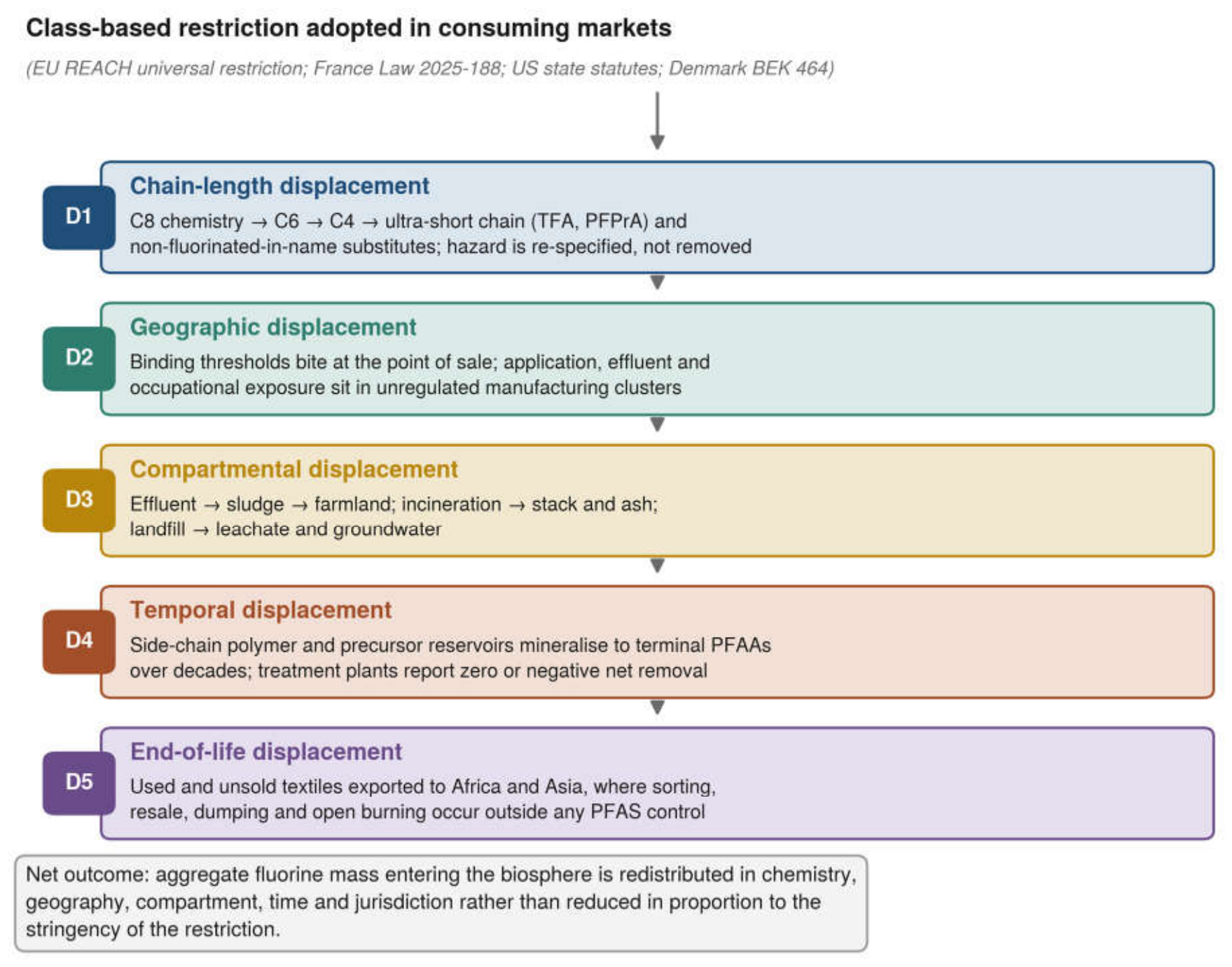
Figure 2.
Reported net removal of total PFAS across treatment configurations. Negative values arise where biological and oxidative processes transform side-chain fluorinated polymers and other precursors into terminal perfluoroalkyl acids, so that effluent loads exceed influent loads on a targeted-analyte basis. Only membrane separation, and adsorption for long-chain species, achieve control.
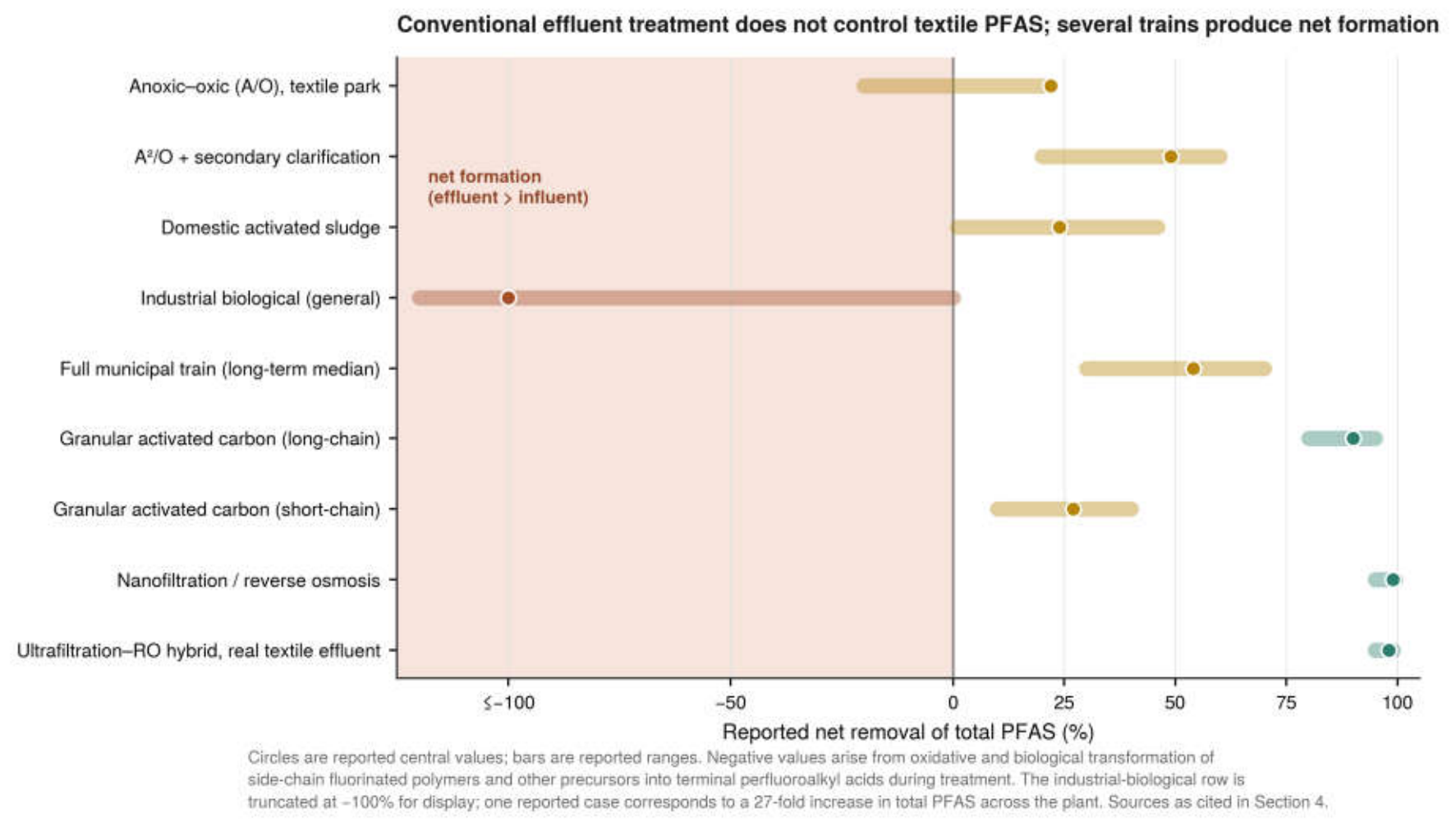
Figure 3.
Distribution of binding textile-specific PFAS instruments against the distribution of apparel production and consumption. Jurisdictions holding roughly half of world apparel imports have adopted binding textile-specific restrictions; jurisdictions accounting for a comparable share of world apparel exports, excluding the European Union, have adopted almost none.
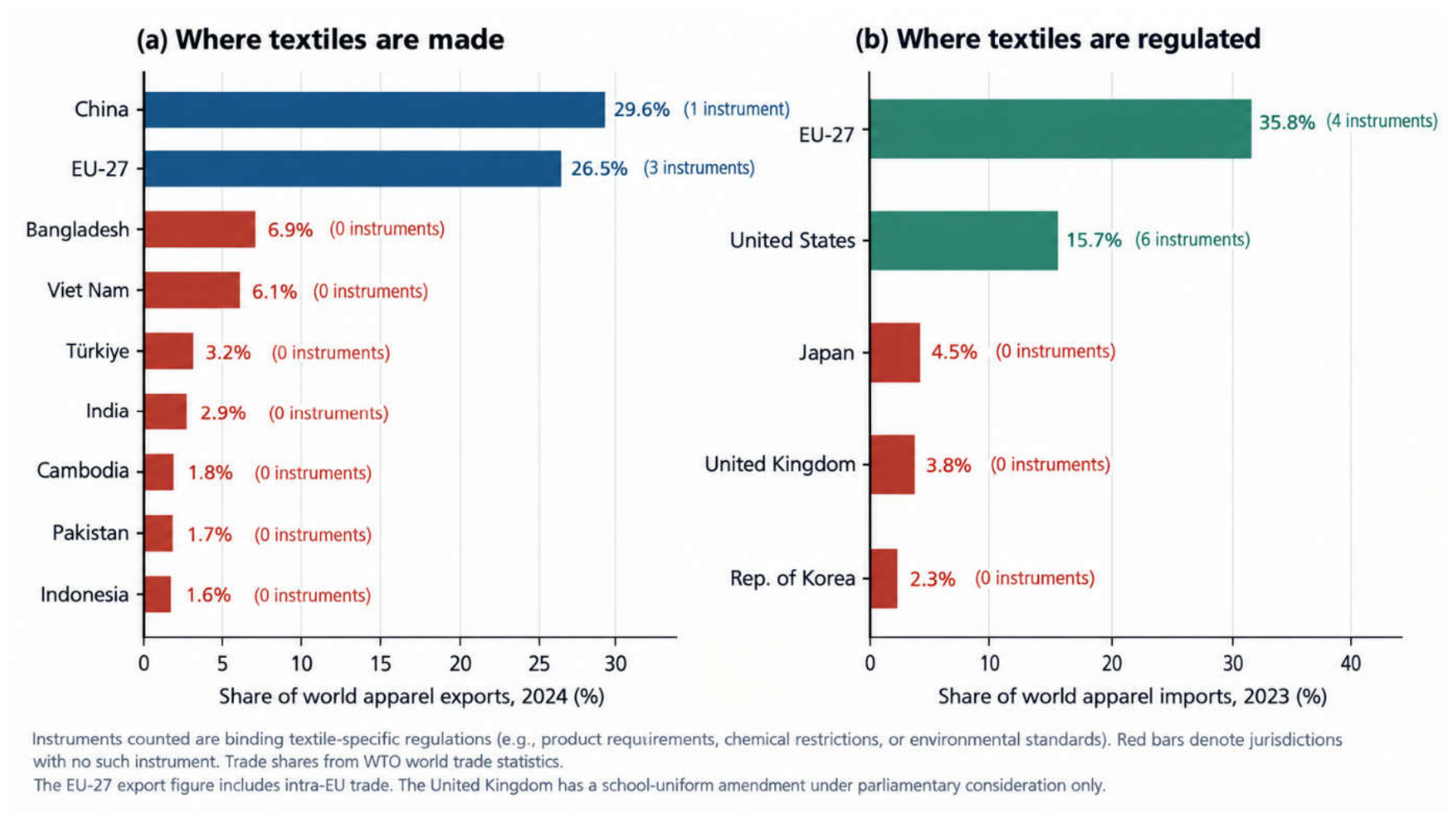
Figure 4.
Essentiality-substitutability-exposure triage of textile product categories. Categories in the upper-right quadrant combine mature alternatives with high exposure intensity and warrant immediate phase-out. Categories in the upper-left quadrant combine genuine essentiality with high exposure and warrant directed research investment with strict containment, not open-ended derogation.
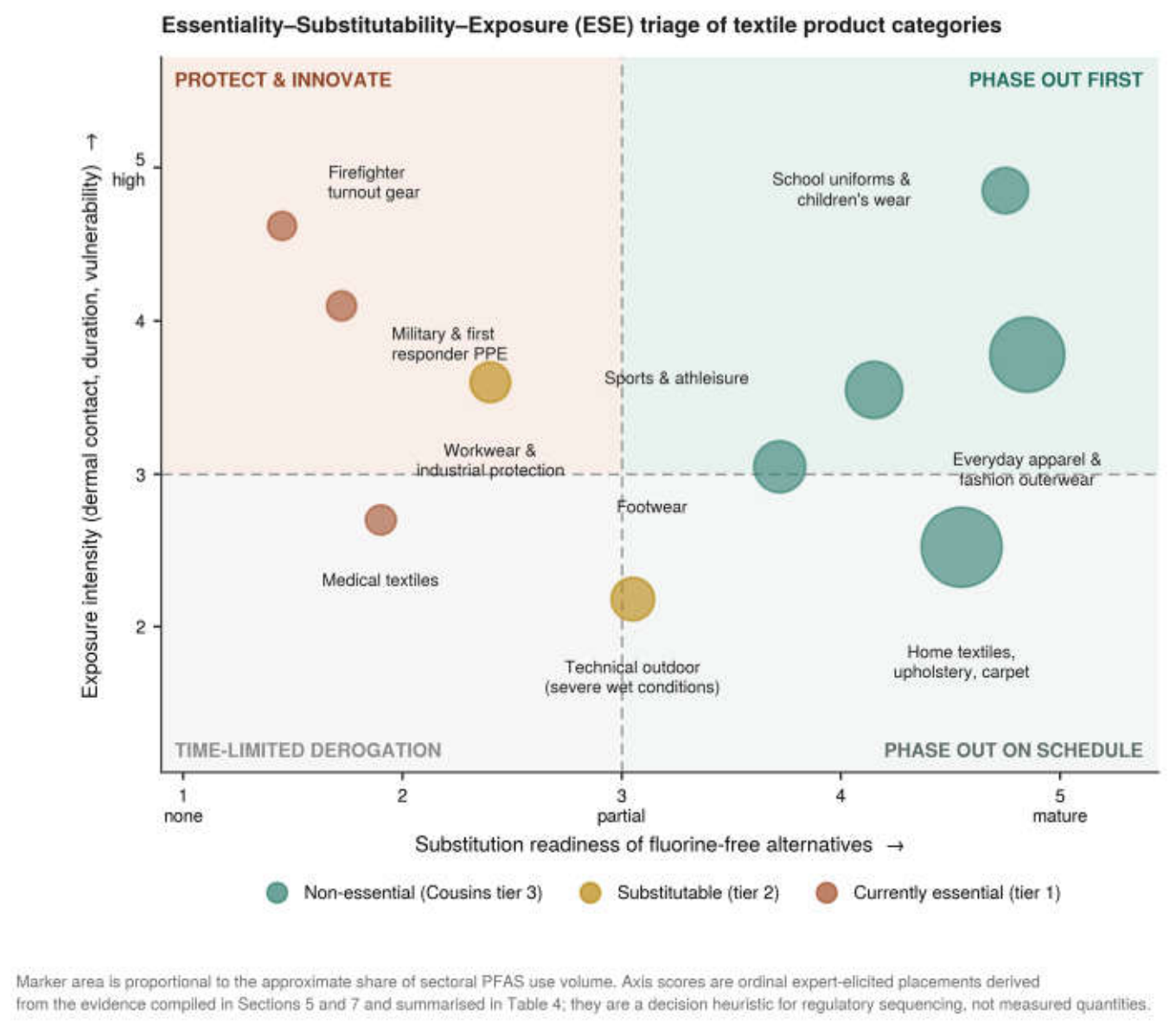

Table 1.
Scope of the review, evidence base and its limits.
| Element | Description |
| Review type | Critical review advancing a conceptual argument. Not a systematic review; no PRISMA flow is claimed and no exhaustive-coverage claim is made. |
| Guiding question | Whether consumption-side restriction of PFAS in textiles is capable of eliminating rather than relocating fluorine burden, and if not, what mechanisms account for the gap. |
| Sources searched | Scopus, Web of Science, PubMed and ScienceDirect for peer-reviewed literature; EUR-Lex, ECHA, US EPA dockets and Federal Register for primary regulatory instruments; EEA and WTO for agency assessments and trade statistics. |
| Search terms | Combinations of (PFAS, per- and polyfluoroalkyl, perfluoroalkyl, fluorotelomer, side-chain fluorinated polymer) with (textile, apparel, garment, durable water repellent, finishing, dyeing), and with (restriction, REACH, Annex XVII, ban), (fluorine-free, non-fluorinated, oil repellent) and (wastewater treatment, removal, precursor). |
| Period | Peer-reviewed sources published 2019 to August 2026, with earlier sources retained where they establish terminology, analytical method or the essential-use concept. Regulatory sources current to 20 August 2026. |
| Selection principle | Purposive rather than exhaustive. Sources were selected for evidentiary strength on a specific point in the argument, with preference for primary measurement studies over reviews, for studies reporting total or oxidisable fluorine over targeted panels alone, and for primary instrument text over secondary regulatory commentary. |
| Sources cited | Every source relied upon appears in the reference list. The reference list is the evidence base; there is no larger unreported corpus. |
| Deliberate exclusions | Commercial and vendor publications were not used as evidence of environmental, toxicological or performance fact. Where a commercial or trade source is the authoritative record of a certification scheme requirement, it is cited as such and identified as such. |
| Principal limitation | Selection was not blinded and no formal risk-of-bias appraisal was conducted. Sources were chosen because they bear on the argument, which introduces a risk that disconfirming evidence is under-represented. Section 10 states where the argument is most vulnerable and Section 7.2 states what evidence would refute it. |
| Geographic limitation of the underlying evidence | Primary occurrence, exposure and treatment studies are concentrated in Europe, North America and China. No primary measurement of PFAS in textile effluent, occupational air or receiving waters was identified for Bangladesh, Cambodia, Pakistan or Indonesia. This constrains the argument in Section 7.3 and is discussed in Section 10. |
Table 2.
Functional classes of PFAS in textile manufacturing: process placement, function and release pathway.
Table 2.
Functional classes of PFAS in textile manufacturing: process placement, function and release pathway.
| Functional class | Process stage | Representative substances | Function delivered | Dominant release pathway |
| Side-chain fluorinated polymers | Finishing, pad-dry-cure | Fluorotelomer acrylate and methacrylate copolymers; fluorinated urethane copolymers | Durable water, oil and stain repellency; soil release | Residual bath liquor to effluent; fibre and particle loss in service; precursor conversion after disposal |
| Fluoropolymers | Membrane lamination | Expanded polytetrafluoroethylene; polyvinylidene fluoride | Waterproof breathable barrier layer | Manufacturing emission; particle release at end of life; incomplete destruction in incineration |
| Fluorotelomer alcohols and residuals | Finishing; product in service | 6:2, 8:2 and 10:2 fluorotelomer alcohols | Unreacted residual and degradation intermediate rather than intended function | Volatilisation to occupational, indoor and ambient air; conversion to perfluoroalkyl acids |
| Perfluoroalkyl acids | Legacy processing aid; degradation product | PFOA, PFOS, PFHxA, PFBA, PFBS | Historically emulsifier and surfactant; now largely terminal degradation product | Aqueous effluent; groundwater; long-range transport |
| Fluorosurfactants and levelling agents | Dyeing and chemical finishing | Non-polymeric fluorinated surfactants | Bath wetting, levelling and foam control | Direct discharge to effluent treatment |
| Yarn lubricants and sizing aids | Spinning and weaving | Fluorinated lubricant formulations | Reduced fibre breakage and improved processability | Desizing and scouring liquor to effluent |
| Ultra-short-chain species | Substitution products; atmospheric degradation | Trifluoroacetic acid; perfluoropropanoic acid | Not intentionally applied; arises from substitution chemistry and degradation | Highly mobile in water; poorly retained by any treatment; largely unmonitored |
Table 3.
Binding PFAS instruments affecting textiles, classified by point of intervention.
| Jurisdiction | Instrument | Point of intervention | Threshold or scope | Status and dates |
| European Union | REACH Annex XVII Entry 79, Regulation (EU) 2024/2462, PFHxA and related substances | Placing on market | 25 ppb PFHxA and salts; 1,000 ppb related substances, homogeneous material | In force 10 Oct 2024; consumer clothing and footwear from 10 Oct 2026; other textiles from 10 Oct 2027 |
| European Union | REACH restriction on C9 to C14 PFCAs | Placing on market | Substance-specific limits | In force from February 2023 |
| European Union | POPs Regulation, Stockholm implementation | Production and market | PFOS and PFOA phase-out | In force |
| European Union | Universal PFAS restriction under REACH | Manufacture, market and use, all sectors | Class-based, order of 10,000 substances | RAC final opinion March 2026; SEAC draft opinion consulted to May 2026; SEAC final opinion expected end-2026 |
| France | Law No. 2025-188 with implementing decree | Manufacture, import, export and sale | PFAS in consumer textiles, footwear and waterproofing agents | From January 2026; all textiles from January 2030; exemptions for protective equipment, industrial technical textiles and articles with at least 20% post-consumer recycled content |
| Denmark | Executive Order on fluorinated substances in clothing and footwear | Import and sale | Total fluorine at or above 50 mg F/kg | Adopted; verify applicable date against instrument text |
| United States, California | AB 1817 | Manufacture, distribution and sale | 100 ppm total organic fluorine, falling to 50 ppm; disclosure label for severe wet condition outdoor apparel | In force January 2025; 50 ppm from January 2027 |
| United States, New York | S.1322 / A.994 | Sale of apparel | Intentionally added PFAS | In force January 2025; severe wet condition outdoor apparel exempt to January 2028 |
| United States, Colorado | HB22-1345 and SB24-081 | Sale | Fabric treatments, then outdoor apparel and textile articles | Fabric treatments from January 2024; full scope from January 2028 |
| United States, Maine | Title 38 section 1614 | Sale | Intentionally added PFAS in most textile articles | In force 1 January 2026 |
| United States, federal | PFAS National Primary Drinking Water Regulation | Drinking water supply, not textiles | 4 ppt for PFOA and PFOS proposed to be retained; four other standards proposed for rescission | Finalised April 2024; proposed amending rules published May 2026 |
| China | List of New Pollutants for Priority Management | Production, including textile industry | PFOS and PFOA listed for priority management | Published December 2022; in force March 2023 |
| Bangladesh, Viet Nam, India, Cambodia, Pakistan, Indonesia | No textile-specific PFAS instrument identified | Not applicable | Baseline Stockholm Convention POPs obligations only | As of August 2026 |
Table 4.
Recommended regulatory sequencing by textile product category.
| Product category | Essentiality tier | Substitution readiness | Exposure intensity | Recommended sequencing |
| School uniforms and children's wear | Tier 3, non-essential | Mature | High | Immediate prohibition. Highest exposure relative to functional benefit in the sector; no requirement for oleophobicity. |
| Everyday apparel and fashion outerwear | Tier 3, non-essential | Mature | Moderate to high | Prohibition with a 24-month transition. Largest volume category; alternatives commercially available. |
| Home textiles, upholstery and carpet | Tier 3, non-essential | Mature | Moderate | Prohibition with a 24 to 36-month transition. Stain resistance is a marketing claim, not a safety function. |
| Sports, athleisure and footwear | Tier 3, non-essential | Mature | Moderate to high | Prohibition with a 24 to 36-month transition. |
| Technical outdoor for severe wet conditions | Tier 2, substitutable | Partial | Low to moderate | Time-limited derogation of 36 to 60 months with mandatory disclosure labelling and a published substitution roadmap. |
| Workwear and industrial chemical protection | Tier 2, substitutable | Limited | Moderate to high | Time-limited derogation with hazard-specific justification and closed-loop collection at end of life. |
| Medical textiles | Tier 1, currently essential | Limited | Moderate | Derogation subject to periodic essentiality review and mandatory separate collection and destruction. |
| Firefighter turnout gear and first-responder equipment | Tier 1, currently essential | None to limited | High | Derogation with directed research funding, occupational exposure monitoring, mandatory take-back, and verification that substitution has not introduced an unregulated hazard class. |
Disclaimer/Publisher’s Note: The statements, opinions and data contained in all publications are solely those of the individual author(s) and contributor(s) and not of MDPI and/or the editor(s). MDPI and/or the editor(s) disclaim responsibility for any injury to people or property resulting from any ideas, methods, instructions or products referred to in the content. |
© 2026 by the authors. Licensee MDPI, Basel, Switzerland. This article is an open access article distributed under the terms and conditions of the Creative Commons Attribution (CC BY) license (http://creativecommons.org/licenses/by/4.0/).
Copyright: This open access article is published under a Creative Commons CC BY 4.0 license, which permit the free download, distribution, and reuse, provided that the author and preprint are cited in any reuse.