

Submitted:
30 October 2026
Posted:
02 November 2026
You are already at the latest version
Abstract
Virtual gifting has become a crucial mechanism for digital content platforms to achieve commercialization. However, existing research has largely approached gifting behavior through creator-centric frameworks and treated user interactions as homogeneous signals, leaving the inherent value of digital content and the multi-dimensional nature of danmaku engagement underexplored. To fill this gap, this study examines the impact of different dimensions of mukbang UGC consumption values and danmaku engagement on virtual gifting amounts in non-real-time content consumption scenarios, and further analyzes the mediating role of video popularity. We collected panel data from the Bilibili platform, and used panel fixed-effects models and bootstrap methods for hypothesis testing. The results show that different dimensions of UGC consumption values and danmaku engagement have heterogeneous impacts on content dissemination performance and economic performance, while video popularity plays a selective mediating role. This study refines the Theory of Consumption Values by revealing its differentiated behavioral conversion in digital content settings, advances the decoupling perspective between content virality and monetization, conceptualizes danmaku as heterogeneous social signals, and extends virtual gifting research to asynchronous environments where content-centered mechanisms take precedence over creator-driven dynamics.
Keywords:
mukbang
; UGC
; consumption values
; danmaku
; virtual gifting
1. Introduction
As participatory online platforms develop rapidly, user-generated content (UGC) has become an important component of the digital content ecosystem. Unlike traditional media, UGC platforms enable users to create, distribute, and interact with digital content, transforming audiences from passive information receivers into active participants [1]. Among various forms of UGC, online video has become an important form of digital consumption by providing informational, emotional, and social experiences. Mukbang videos, in particular, have gained widespread attention on video-sharing platforms by offering viewers sensory enjoyment, emotional companionship, and opportunities for social interaction [2,3]. Simultaneously, platforms have gradually developed commercialization mechanisms such as virtual gifting, allowing users to give back to content creators through financial support. Therefore, understanding how UGC characteristics drive users’ monetary support behavior is of increasing importance for researchers and platform administrators.
Virtual gifting is a notable mechanism for digital platforms to convert user participation into economic value. Existing research has extensively explored gifting behavior in live-streaming scenarios, finding that factors such as streamer characteristics, pseudo-social relationships, emotional attachment, social influence, and platform mechanisms are significant determinants [4,5,6]. However, current research primarily focuses on synchronous live-streaming environments, where real-time interaction between streamers and viewers plays a central role. In contrast, attention to asynchronous video-sharing platforms remains insufficient, where users primarily interact around already uploaded video content. For example, Bilibili allows users to reward videos with virtual currency, but the underlying mechanisms remain largely unexplored. Compared with live-streaming platforms, video-sharing platforms rely more heavily on the inherent value of UGC and the sustained user interaction surrounding that content.
Hence, to explore which UGC characteristics incentivize users to provide monetary support, this study shifts its focus from creator-centric explanations to the inherent value of digital content. Existing research on online content consumption primarily focuses on external factors, such as the appeal of creators and platform characteristics, while research on how the consumption values of UGC influences users’ gifting behavior is relatively limited. According to the Theory of Consumption Values [7], mukbang UGC as a digital product can provide viewers with multiple consumption values: functional value satisfies viewers’ sensory needs through virtual eating experiences; cognitive value provides food-related knowledge and information; emotional value creates emotional experiences; and social value promotes connections between users, creators, and the community. However, whether different dimensions of consumption values equally promote content dissemination and user economic contributions remains unclear.
Furthermore, UGC consumption takes place within an interactive social environment. Danmaku allows viewers to express their opinions and emotions while watching videos, creating a collective viewing experience. Although existing research indicates that online comments can influence user cognition and behavior by providing informative and social cues [8], current research pays relatively little attention to the multidimensional characteristics of danmaku interaction. Based on Emotional Contagion Theory [9], individuals may experience similar emotions by observing the emotional expressions of others. In the context of mukbang, the emotion of danmaku comments may influence viewers’ emotional experience, thereby affecting their supportive behavior. Existing research has also found that online emotional expression can influence user engagement and payment behavior [10].
Beyond the direct impact, UGC characteristics and interactive danmaku comments can also determine virtual gifting through video popularity. Video popularity reflects the degree to which content gains attention, interaction, and dissemination. According to Social Influence Theory, in the presence of uncertainty, users often rely on popularity signals to evaluate online content [11]. Highly popular videos may be perceived by users as having greater value and credibility, thus promoting gifting behavior.
Therefore, this study first provides a theoretical conceptualization of virtual gifting and then addresses the following research questions: (1) How do different dimensions of the consumption values of mukbang UGC influence virtual gifting behavior on video-sharing platforms? (2) How do danmaku engagement influence virtual gifting behavior? (3) Does video popularity mediate the effects of consumption values of mukbang UGC and danmaku engagement on virtual gifting behavior?
To address the research questions, we collected panel data from 550 mukbang videos published on the Bilibili platform by 20 representative creators, and employed panel fixed-effects regression models and Bootstrap methods. This study makes the following contributions. Firstly, it refines the Theory of Consumption Values by showing that different value dimensions generate differentiated behavioral outcomes and platform value rather than uniformly positive responses. Secondly, it advances digital content monetization research by revealing a decoupling between content dissemination and economic monetization. Thirdly, it conceptualizes danmaku as multidimensional social signals, demonstrating that volume, emotional intensity, and emotional valence convey distinct information and shape user behavior differently. Finally, it identifies asynchronous content consumption as an important boundary condition, showing that content value and social signals can drive economic support even without real-time creator-user interaction.
2. Literature Review
2.1. User-Generated Content
User-generated content (UGC) is content created and publicly released by ordinary internet users through non-professional means and possessing a certain degree of creativity [1]. Existing studies have shown that UGC characteristics can influence users’ cognition, attitudes, and behaviors. For example, Kitsios et al. [12] found that perceived enjoyment and perceived value brought by social media UGC can enhance users’ trust in digital tourism services. Goh et al. [13] pointed out that user-generated content has a significantly stronger impact on consumer purchasing decisions than enterprise-generated content. Zhao et al. [14] took online fitness videos as the research object and found that the normative characteristics (favorability) and social characteristics (reply density) of UGC can effectively improve content consumption levels. Berger and Milkman [15] pointed out that content with strong emotions is more likely to be disseminated and shared.
Despite substantial research on the impact of UGC characteristics, two shortcomings remain. First, existing studies primarily focus on specific application scenarios such as e-commerce [16], tourism [17,18], and education [19], while research specifically on mukbang (eating broadcast) video UGC is relatively limited. Existing mukbang research mainly focuses on viewing motivation, social companionship, and interactive experiences [20], with less exploration of the impact mechanisms of mukbang UGC on user engagement behavior from a content characteristic perspective. Second, existing research primarily examines UGC characteristics such as text length, language style, number of images, and emotional expression, with less further segmentation of UGC from a consumer value perspective.
2.2. Danmaku
Danmaku is a popular method of user interaction, which refers to the real-time comments posted by the users appearing on the screen in the form of subtitles, which can be scrolled along the screen or fixed at a designated position, allowing users to view and post comments during playback [21,22]. Regarding its impact on user attitudes and experiences, the most stable positive effect of danmaku is transforming the relatively isolated experience of watching videos into an experience of “watching with others”. Previous studies have generally supported the pathway of “danmaku features—social presence—immersion or shared viewing—behavioral intention” [23,24]. However, some studies have shown that the addition of danmaku increases social presence but causes more cognitive load [25].
Regarding the impact on user behavior or willingness to engage in such behavior, research on danmaku has focused on video-sharing and live-streaming e-commerce platforms. Firstly, research on video-sharing platforms has found that the relationship between danmaku and user engagement is not linear [26]. A moderate amount of danmaku promotes likes by increasing social connection and information richness, while excessive danmaku leads to information overload and weaken social connection, ultimately reducing the willingness to like. Secondly, research on live-streaming e-commerce has found that danmaku can influence users’ perceived value [27], behavioral intentions [28], and tipping behavior [10] by providing social cues and emotional atmosphere. However, danmaku can also impair purchase intention. Zhang and Ruan [29] pointed out that danmaku with completely identical content and format reduce perceived information richness, increase psychological resistance, and thus reduce purchase intention.
Overall, research on the influence of danmaku features has made some progress, including the impact on gifting behavior. Scholars have examined factors such as the number of danmaku, the degree of debate, similarity, and exciting words [10]. Regarding the mechanisms by which danmaku features influence behavior, social presence, immersive experience, pseudo-social interaction, and information overload are among the most studied factors [23,24,30,31]. However, danmaku features may also attract users to gift through other external cues, such as the quality signaling effect of video popularity. This mechanism has not yet been thoroughly investigated.
2.3. Virtual Gifting
Virtual Gifting on video-sharing platforms refers to users voluntarily paying creators a fixed amount or equivalent virtual gifts after consuming their videos, through the platform’s reward or tipping functions, to express their recognition, gratitude, or support for the content [32,33]. Current research explores the influencing factors of virtual gifting from aspects such as content characteristics and emotional connection.
In terms of content characteristics, whether users decide to gift depends not only on content perceivable benefits but also on emotional connections and social influences. Live-streaming research usually distinguishes between hedonic value and utilitarian value: games, talent, and pan-entertainment related content are more suitable to emphasize entertainment, immersion, pleasure, and stress relief; while education, health, and knowledge related content are more suitable to emphasize information quality, professionalism, and practicality [34,35]. In addition, interactivity and emotional expression will also affect users’ virtual gifting behavior. Yang et al. [36] found that social interaction-oriented discourse in live-streaming e-commerce has a positive linear relationship with gifting, but an inverted U-shaped relationship with product purchases. The more the anchor talks about social interactions with the viewers, the more attention and virtual gifts the anchor can receive. However, excessive interaction will distract attention from the product and reduce purchases. Positive expressions such as happiness and surprise from anchors during live streaming can increase viewers’ paid and non-paid gifts, and some negative expressions such as sadness may also promote virtual gifting through sympathy or emotional arousal [37].
Regarding emotional connection, the relationship between creators and users is one of the most stable explanatory pathways in digital platform gifting research. Studies show that presence and entertainment can enhance immersive experience, which indirectly influences virtual gifting intention by further enhancing emotional attachment [5]. Viewers’ parasocial relationships with streamers can simultaneously predict emotional support, instrumental support, and economic support [4]. Streamer attractiveness, professionalism, and parasocial interaction can all increase virtual gifting intention [6].
It can be seen that research on virtual gifting mainly focuses on live-streaming scenarios, with little consideration given to non-real-time live-streaming scenarios such as video-sharing platforms. In fact, websites like Bilibili in China and Clapper in the US allow users to reward uploaded videos by giving coins or gifts. Which characteristics of uploaded videos influence users’ virtual gifting still need to be tested through empirical research.
3. Hypotheses Development
3.1. The Impact of Mukbang UGC Consumption Values on Virtual Gifting Amounts
Consumers purchase and consume products primarily to obtain the values they provide. Through empirical research, Sheth et al. [7] found that the factors influencing consumers’ purchasing decisions can be divided into five dimensions: functional value, cognitive value, emotional value, social value, and contextual value, thus proposing the Theory of Consumption Values.
Since this study considers the value of mukbang UGC from the perspective of the audience as a whole, without setting any special conditions, and assumes that the audience chooses to watch and gift in a general context, the contextual value is not included in the research model. Instead, functional value, cognitive value, emotional value, and social value are selected for analysis.
First, functional value refers to the perceived utility of a product or service in terms of functionality, practicality, and physical attributes. Previous research has shown that the motivations for viewers to watch mukbang videos include vicarious satisfaction, virtual companionship, entertainment, and sensory enjoyment [2,3,38]. In this study, functional value refers to the satisfaction derived from the visual and auditory aspects of the mukbang streamer eating, such as vicarious eating and sensory stimulation, leading viewers to a “watching is equivalent to eating” mentality. The greater the functional value, the more likely viewers are to give gifts. Therefore, we propose:
H1: The functional value of mukbang UGC positively influences virtual gifting amounts.
Cognitive value refers to the utility of a product or service in arousing consumer curiosity and satisfying their pursuit and desire for knowledge. Some creators don’t just record eating scenes; they combine mukbang with “restaurant review” or “travel.” Therefore, in this study, cognitive value refers to the satisfaction of viewers’ thirst for knowledge brought about by the creator’s descriptions of the food itself, the introduction of the history and cultural knowledge behind the food. The greater the cognitive value, the more likely viewers are to gift. Therefore, we propose:
H2: The cognitive value of mukbang UGC positively influences virtual gifting amounts.
Emotional value refers to the utility and ability to evoke emotional expression and change emotional states. In this study, emotional value is manifested in the emotional energy and emotional experience conveyed by the creator in mukbang videos, enhancing the viewers’ emotional resonance. The higher the emotional value, the more inclined the viewers are to gift. Therefore, we propose:
H3: The emotional value of mukbang UGC positively influences virtual gifting amounts.
Social value refers to the perceived benefits consumers derive from product consumption related to connections with a specific social group. In this study, social value is manifested in the utility of mukbang videos, which provide audience with opportunities for social interaction with the creator. When choosing which mukbang video to watch, audience may consider not only the content’s inherent characteristics but also, as enthusiastic fans of the creator, give virtual gifts to satisfy their desire for social connection, parasocial interaction, and a sense of belonging to a community. The greater the social value, the more inclined viewers are to give virtual gifts. Therefore, we propose:
H4: The social value of mukbang UGC positively influences virtual gifting amounts.
3.2. The Impact of Danmaku Engagement on Virtual Gifting Amounts
Psychologist McDougall [39] first introduced the concept of emotional contagion. Emotional contagion is considered a process in which the emotions of two people in an interaction converge and become similar under the influence of one party; people unconsciously imitate the emotional expressions of others and experience similar emotions [9]. Within a group, the interaction of emotions further enhances this contagiousness.
While watching mukbang videos, viewers can express their opinions and emotional feelings through danmaku. Other viewers who see these comments are infected by the emotions expressed, strengthening the emotional resonance and empathy within the viewing group, thus encouraging viewers to gift. Research also shows that emotional stimuli in danmaku, especially excited expressions and group emotional similarity, promote paid gifting [10]. Therefore, we propose:
H5: The emotional intensity of danmaku positively influences virtual gifting amounts.
The emotional valence of danmaku can also influence audience participation. Chen et al. [40], using live streaming data as an example, found that positive anchor emotions induce positive emotions in viewers, stimulating danmaku with high emotional concentrations, which in turn positively incentivizes viewers to give virtual gifts. Liang et al. [41] pointed out that positive emotions motivate people to donate. Jing et al. [27] found that in the context of e-commerce live streaming, positive danmaku enhances viewers’ purchase intention. Therefore, we argue that the more positive the danmaku emotion, the more it evokes positive emotions in viewers and motivates them to take positive responsive behaviors, such as virtual gifting. Therefore, we propose:
H6: The emotional valence of danmaku positively influences virtual gifting amounts.
A higher volume of danmaku indicates that more viewers are interested in the video content, which may lead to a larger number of viewers providing virtual gifts. Furthermore, danmaku often contain valuable information about the video; as more useful information appears, viewers may gain a more comprehensive understanding of the video [8]. In addition, a higher volume of danmaku indicates more interaction and discussion, thereby enhancing the enjoyment of the viewing experience [10]. Zhou et al. [10] found that more frequent danmaku interaction in live streaming is more likely to encourage viewers to gift the streamer. Therefore, we argue that the more danmaku, the higher the likelihood of viewers gifting. Thus, we propose:
H7: The volume of danmaku positively influences virtual gifting amounts.
3.3. The Impact of Mukbang UGC Consumption Values on Video Popularity
Video popularity refers to a video’s performance in terms of user attention, social interaction, and dissemination within a certain period, specifically manifested in the volume of likes, comments, and shares. Drawing on the Theory of Consumption Values, consumers are more likely to purchase products that offer greater utility and value. As a content product, mukbang UGC offers higher consumer value, and viewers are more willing to express their approval and support through likes, comments, and shares after watching, thus expanding the video’s influence and increasing its popularity. Therefore, we propose:
H8: The functional value of mukbang UGC positively influences video popularity.
H9: The cognitive value of mukbang UGC positively influences video popularity.
H10: The emotional value of mukbang UGC positively influences video popularity.
H11: The social value of mukbang UGC positively influences video popularity.
3.4. The Impact of Danmaku Engagement on Video Popularity
According to Emotional Contagion Theory, viewers watching mukbang videos are influenced by the emotional tone of danmaku, generating similar emotions and creating a phenomenon of emotional convergence. The higher the emotional intensity of danmaku, the stronger the emotional arousal effect on viewers, thereby encouraging them to engage with the video through liking, commenting, and sharing, ultimately increasing the video’s popularity. Therefore, we propose:
H12: The emotional intensity of danmaku positively influences video popularity.
The stronger the positive emotional valence of danmaku, the more likely they are to induce positive emotions in viewers, making them feel happy and thus more likely to take positive action such as liking, commenting, and sharing. Research has also confirmed that danmaku with a high concentration of positive emotions can positively motivate viewers to like and comment [40]. Therefore, we propose:
H13: The emotional valence of danmaku positively influences video popularity.
A higher volume of danmaku indicates that more viewers are engaged in interactive discussions, suggesting that the video is more controversial or topical and increasing the likelihood that other viewers share their in-depth opinions through danmaku. Moreover, a higher volume of danmaku may provide viewers with more useful information from the video, making them more likely to express their support and recognition through interactive behaviors such as liking, commenting, or sharing. Therefore, we propose:
H14: The volume of danmaku positively influences video popularity.
3.5. The Impact of Video Popularity on Virtual Gifting Amounts
Cialdini [11] pointed out that when individuals are unsure how to act, they observe the behavior of others as decision-making cues. When watching mukbang videos, viewers are more likely to perceive the video as attractive and deserving of virtual gifts when they observe more attention and interaction, suggesting higher video popularity. Therefore, we propose:
H15: Video popularity positively influences virtual gifting amounts.
3.6. The Mediating Effect of Video Popularity
First of all, the higher the consumption values contained in the mukbang UGC, the more willing the audience is to express their support and encouragement to the creator through participation and interaction during the viewing process, thereby enhancing the popularity of the video. On the other hand, video popularity, as a quality signal for mukbang UGC, can improve the evaluation of other viewers, elicit positive responses and prompt gifting actions. Therefore, it can be considered that video popularity plays a mediating role between the consumption values of mukbang UGC and virtual gifting amounts. Therefore, we propose:
H16: Video popularity mediates the relationship between the functional value of mukbang UGC and virtual gifting amounts.
H17: Video popularity mediates the relationship between the cognitive value of mukbang UGC and virtual gifting amounts.
H18: Video popularity mediates the relationship between the emotional value of mukbang UGC and virtual gifting amounts.
H19: Video popularity mediates the relationship between the social value of mukbang UGC and virtual gifting amounts.
Secondly, the higher the emotional intensity of danmaku, the easier it is to evoke strong emotions in viewers, stimulate their interactive behavior, and increase the video’s popularity. Simultaneously, higher video popularity attracts more viewers, fostering positive attitudes and encouraging virtual gifting. It can be argued that video popularity serves as a link between the emotional intensity of danmaku and virtual gifting amounts. Therefore, we propose:
H20: Video popularity mediates the relationship between the emotional intensity of danmaku and virtual gifting amounts.
H21: Video popularity mediates the relationship between the emotional valence of danmaku and virtual gifting amounts.
H22: Video popularity mediates the relationship between the volume of danmaku and virtual gifting amounts.
The conceptual model of this study is shown in Figure 1.
4. Research Methodology
4.1. Data Sources
We collected our dataset from Bilibili, China’s largest danmaku video website. Bilibili operates on a user-generated content model, covering various categories including film, music, games, knowledge, food, and lifestyle. Among these, the “food” category, particularly videos featuring mukbang, is increasingly popular and well-received by viewers.
This study selects 20 representative food vloggers from the Bilibili Food Section TOP100 list (statistical period: June 2, 2025 to June 8, 2025) on the Newrank website. Using web scraping, a Python program was written to daily scrape relevant data from the vloggers’ mukbang videos within 24 hours of release, from June 16, 2025 to September 25, 2025. This included video content, danmaku content, user participation data, video descriptions, and video tags, resulting in a total of 550 records.
4.2. Measures
4.2.1. Dependent Variables
Virtual gifting amounts (Gifts): virtual gifting amounts are measured by the log-transformed number of coins received by the mukbang video. The reason is that Bilibili coins represent users’ monetary support and are an important indicator of creators’ economic returns.
4.2.2. Independent Variables
To examine the impact of the consumption values of mukbang UGC on virtual gifting amounts, we measured four aspects of consumption values, including:
Functional value of mukbang UGC (MkbFV): The functional value of mukbang UGC denotes the fulfillment of users’ utilitarian needs (e.g., vicarious eating) when viewing mukbang content. Given that collection behavior serves as an indicator of perceived video usefulness [42], we operationalize the functional value of mukbang UGC using the log-transformed collection count of the mukbang videos.
Cognitive value of mukbang UGC (MkbCV): The cognitive value of mukbang UGC denotes the fulfillment of users’ cognitive needs during mukbang viewing. We operationalize this construct using the humanistic content embedded in the videos, measured as the count of words related to historical culture, culinary culture, and festival culture.
Emotional value of mukbang UGC (MkbEV): The emotional value of mukbang UGC denotes the fulfillment of users’ emotional needs during mukbang viewing. We operationalize this construct using the videos’ emotional intensity, i.e., the sum of the absolute values of positive and negative sentiment scores derived from a sentiment lexicon-based word frequency analysis [43].
Social value of mukbang UGC (MkbSV): The social value of mukbang UGC denotes the fulfillment of users’ needs for social interaction during mukbang viewing. We operationalize this construct using the videos’ interaction tendency, namely the frequency counts of first-person pronouns, second-person pronouns, and other forms of address.
In addition, to examine the impact of danmaku engagement on virtual gifting amounts, we measured danmaku emotional intensity, danmaku emotional valence and danmaku volume:
Danmaku emotional intensity (DmEI): Danmaku emotional intensity denotes the degree of subjective emotional content in danmaku. We operationalize this measure as the sum of the absolute values of positive and negative sentiment scores derived from a sentiment lexicon-based word frequency analysis [43].
Danmaku emotional valence (DmEV): Danmaku emotional valence denotes the degree of positive emotional coloring in danmaku. We operationalize this measure as the difference obtained by subtracting the absolute value of the negative sentiment score from the positive sentiment score.
Danmaku volume (DmVo): Danmaku volume denotes users’ active engagement in danmaku commenting. We operationalize this measure as the natural log of the danmaku count for the mukbang video.
4.2.3. Mediator
Video popularity (VP): Video popularity is operationalized as the weighted average of the log-transformed counts of likes, comments, and shares for the mukbang video. We exclude view counts from this measure, as the influence of the consumption values of mukbang UGC on viewers typically manifests only after watching. The computation formula is as follows: VP = 0.3*ln(Likes) + 0.3*ln(Comments) + 0.4*ln(Shares).
4.2.4. Control Variables
Video duration (VD): Video duration is measured by the playback length of the mukbang video, in seconds.
Follower size (FS): Follower size is measured by the log-transformed number of followers at the time of video publication.
Title length (TL): Title length is measured by the number of characters in the video title.
Description length (DL): Description length is measured by the number of characters in the video description.
Tag quantity (TQ): Tag quantity is measured by the number of tags attached to the video.
4.2.5. Model Specifications
To test hypotheses H1–H7, a panel regression model should be employed, given that the collected data are structured as panel data. We conducted a Hausman test to decide whether the fixed-effect or random-effect model specification is more appropriate, and the result suggested the former. Thus, we established the panel fixed-effects model, with virtual gifting amounts as the dependent variable and the functional, cognitive, emotional, and social values of mukbang UGC, as well as danmaku emotional intensity, emotional valence, and danmaku volume, as independent variables. Control variables, including video duration, follower size, title length, description length, and tag quantity, were also included. Model 1 is specified as follows.
To test hypotheses H8–H14, we further developed Model 2, with video popularity as the dependent variable, while all other model specifications remained the same as those in Model 1. Model 2 is specified as follows.
To test hypothesis H15, we constructed Model 3 by adding video popularity to the independent variables of Model 1, leaving the rest unchanged. Model 3 is specified as follows.
To test hypotheses H16–H22, we assessed the mediation effects of video popularity using bootstrapped confidence intervals of indirect effects rather than relying solely on the significance of individual paths [44].
5. Results
5.1. The Effects on Virtual Gifting Amounts
The estimation results of Models 1–3 are presented in Table 1. The results of Model 1 show that the functional value of mukbang UGC has a significant positive impact on virtual gifting amounts (β=0.630, p<0.01), supporting H1; the social value of mukbang UGC has a significant positive impact on virtual gifting amounts (β=0.002, p<0.05), supporting H4; the emotional valence of danmaku has a significant positive impact on virtual gifting amounts (β=0.00004, p<0.1), supporting H6; the volume of danmaku has a significant positive impact on virtual gifting amounts (β=0.349, p<0.01), supporting H7. The results of Model 3 show that video popularity has a significant positive impact on virtual gifting amounts (β=0.277, p<0.01), supporting H15. H2, H3, H5 are not supported.
5.2. The Effects on Video Popularity
According to the results of Model 2, the functional value of mukbang UGC has a significant positive impact on video popularity (β=0.407, p<0.01), supporting H8; the emotional intensity of danmaku has a significant positive impact on video popularity (β=0.00001, p<0.1), supporting H12; the volume of danmaku has a significant positive impact on video popularity (β=0.399, p<0.01), supporting H14. H9, H10, H11, H13 are not supported.
5.3. Mediating Role of Video Popularity
To examine the mediation effect, we employed a cluster bootstrap method within the panel fixed-effects regression framework. Specifically, 5,000 bootstrap replications were conducted using creators (clusters) rather than individual observations as the resampling targets. The indirect effect was calculated as the product of the coefficients for the X→M (a) and M→Y (b) paths, and its significance was assessed using bias-corrected 95% bootstrap confidence intervals. A mediation effect is considered significant when the confidence interval excludes zero. The results are presented in Table 2.
It can be seen that video popularity partially mediates the effects of functional value of mukbang UGC and the volume of danmaku on virtual gifting amounts. Specifically, the indirect effect of functional value of mukbang UGC through video popularity is significant (ab=0.113, 95% CI=[0.049, 0.176]), and its direct effect remains significant after controlling for the mediator (c’=0.517, p<0.01), supporting H16. Similarly, the volume of danmaku exerts a significant indirect effect through video popularity (ab=0.111, 95% CI=[0.037, 0.184]), with a significant remaining direct effect (c’=0.238, p<0.01), supporting H22. However, the indirect effects of mukbang UGC’s cognitive value (ab=-0.001, 95% CI=[-0.001, 0.00003]), emotional value (ab=-0.00002, 95% CI=[-0.0001, 0.0001]), social value (ab=0.00006, 95% CI=[-0.0002, 0.0003]), the emotional intensity of danmaku (ab=0.000003, 95% CI=[-0.0000005, 0.000007]), and the emotional valence of danmaku (ab=0.000001, 95% CI=[-0.000008, 0.00001]) are not significant, as their confidence intervals include zero. Therefore, H17-H21 are not supported.
5.4. Robustness Check
In addition, we conducted further analyses to examine the robustness of the empirical tests. We conducted the robustness checks from the following aspects.
5.4.1. Alternative Independent Variables
In the main analysis, the emotional value of mukbang UGC was measured as the sum of the absolute values of positive and negative sentiment scores in mukbang videos. To minimize the potential influence of alternative variable operationalizations on the findings, and considering that emotional value may be more strongly reflected in the expression of positive emotions, we remeasured the emotional value of mukbang UGC using the positive sentiment score of mukbang videos (MkbPEVi,j) and re-estimated Models 4-6. The results are reported in Table 3. The mediation analysis also yielded results consistent with those presented in Table 2. Overall, the findings remain unchanged, providing further evidence for the robustness of the results.
In addition, the main analysis measured the emotional valence of danmaku as the difference between the absolute values of positive and negative sentiment scores. To minimize the potential influence of alternative variable operationalizations on the findings, and considering that emotional valence can be adequately captured by the level of positive sentiment after controlling for danmaku emotional intensity (measured as the sum of positive and negative sentiment scores), we remeasured danmaku emotional valence using the positive sentiment score of danmaku (DmPEVi,j) and re-estimated Models 7-9. The results are reported in Table 3. The mediation analysis also yielded results consistent with those presented in Table 2. Thus, the findings confirm the robustness of the previous results.
5.4.2. Accounting for Omitted Variables
In Models 1–3, individual fixed effects are controlled for, but time-varying factors other than follower size are not taken into account. Previous research has found that past behavior is a stronger predictor of consumer behavior than demographic or lifestyle characteristics [45,46,47]. Therefore, to reduce the risk of omitted variable bias and further strengthen the robustness of the results, we included each mukbang creator’s historical average virtual gifting amounts received prior to the publication of each video (PGiftsi,j) as an additional control variable and re-estimated Models 10-12. The results are reported in Table 3. The mediation analysis also yielded results mainly consistent with those presented in Table 2. Overall, the robustness of our main findings is confirmed.
6. Discussion
6.1. Discussion of the Findings
6.1.1. The Different Influencing Mechanisms of Mukbang UGC Consumption Values
Our findings reveal that different dimensions of mukbang UGC consumption values influence viewers’ behavioral responses through distinct mechanisms. Specifically, functional value positively affects both virtual gifting amounts and video popularity, whereas social value increases virtual gifting amounts without significantly improving video popularity. By contrast, cognitive value reduces both virtual gifting amounts and video popularity, while emotional value decreases virtual gifting amounts but has no significant influence on video popularity. These findings indicate that different consumption values satisfy varying levels of audience needs, thus exerting heterogeneous impacts on economic support and dissemination. This also suggests that factors that can promote content dissemination may not necessarily be transformed into viewers’ monetary support.
First, functional value is the most important consumer value in promoting audience participation and gifting behavior. As experiential UGC, mukbang primarily attracts viewers by satisfying their vicarious eating needs through food visuals, eating sounds, and an immersive viewing experience. When viewers experience greater sensory enjoyment and functional satisfaction, they are not only more willing to express their recognition of the creator through virtual gifting, but also more willing to participate in content dissemination through likes, comments, and shares, thereby increasing video popularity. This indicates that for mukbang content, functional value can both enhance viewers’ perceived value of the content and further translate into dissemination and supportive behavior. In contrast, while social value can also significantly promote gifting, it has no significant impact on video popularity. This suggests that social value is more about strengthening the parasocial relationship between the creator and existing viewers, rather than increasing the video’s dissemination potential. When creators enhance viewers’ sense of belonging and emotional connection through more interactive expressions, viewers are more inclined to maintain the relationship through rewarding, but this relationship value is insufficient to attract more potential viewers to participate in liking, commenting, or sharing, thus failing to further increase video popularity.
On the other hand, neither cognitive nor emotional value contributed to audience virtual gifting. Cognitive value has a negative impact on both the gifting amounts and video popularity, indicating that the main purpose of viewers watching mukbang videos is still to obtain entertainment experience, sensory satisfaction and emotional comfort, rather than to obtain food culture or historical knowledge. When a video contains too much intellectual content, it is easy to weaken the immersive experience and reduce the audience’s willingness to continue watching and interacting, thus inhibiting reward behavior and video dissemination. At the same time, although emotional value has no significant impact on video popularity, it significantly reduces viewers’ willingness to send virtual gifts. Excessive emotional expression may be interpreted by viewers as deliberately creating emotions, attracting traffic, or conducting commercial marketing, thereby weakening the authenticity and credibility of the content and reducing the audience’s willingness to reward. In addition, different types of emotions may have different effects on communication behavior. High arousal emotions can promote communication, while low arousal emotions may inhibit communication. The two effects cancel each other out at the overall level, so the emotional value ultimately does not have a significant impact on video popularity.
Taken together, this study shows that different dimensions of consumption values have different influence paths on user participation behavior. Functional value mainly promotes communication and gifting behavior by catering to the audience’s experiential needs. Social value mainly promotes virtual gifting by strengthening the relationship between creators and audiences. Cognitive value and excessive emotional expression deviate from the audience’s core needs for watching mukbang, thus weakening the audience’s willingness to participate and give rewards. This finding further illustrates that although there is a certain correlation between video dissemination behavior and financial support behavior, they are driven by different consumption values and their formation mechanisms are not completely consistent.
6.1.2. The Different Influencing Mechanisms of Danmaku Engagement
This study further reveals that different danmaku characteristics influence viewers’ responses through various mechanisms. Specifically, the volume of danmaku simultaneously promotes both virtual gifting amounts and video popularity, while the emotional valence of danmaku only promotes virtual gifting amounts. The emotional intensity of danmaku exhibits a “dual effect”, promoting video popularity but inhibiting virtual gifting amounts. This indicates that danmaku comments are not only a result of viewer engagement but also an important social cue influencing the behavior of other viewers. However, the social signals conveyed by different danmaku characteristics differ significantly, thus having varying impacts on interactive and gifting behaviors.
First, the volume of danmaku is the most comprehensive factor among the three danmaku characteristics. A large number of danmaku not only means that the video attracts more viewers to participate in the discussion, but also that viewers can obtain more viewpoints, evaluations, and supplementary information from the interaction, thereby improving the viewing experience. When viewers perceive that a video has high discussion popularity, they are more likely to participate in dissemination through likes, comments, and shares, and further express their support for the content and creators through gifting. Therefore, the volume of danmaku can not only directly promote virtual gifting, but also further enhance economic returns by increasing the video’s popularity. This shows that, compared with the danmaku content, the scale of interaction is more likely to form social consensus and herding effect, thereby simultaneously driving dissemination behavior and economic support.
In contrast, while the emotional valence of danmaku can encourage virtual gifting, it doesn’t necessarily increase video popularity. Based on the Emotional Contagion Theory, positive emotions spread during group interactions, leading to a more positive viewing experience and enhancing viewers’ positive evaluation of the video, thus increasing their willingness to send gifts. However, expressing positive emotions has become a common interaction method in danmaku communities, and viewers have high expectations for it. Therefore, simply increasing positive emotions is insufficient to further stimulate likes, comments, and shares. This indicates that positive emotions influence viewers’ psychological evaluation more than the video’s overall dissemination.
One noteworthy finding is that the emotional intensity of danmaku has an inverse effect on virtual gifting amounts and video popularity. On the one hand, the stronger the emotional expression, the more likely it is to attract viewers’ attention and spark discussion, thereby promoting likes, comments, and shares, and increasing the video’s popularity. On the other hand, overly strong emotional expression may also reduce the credibility of danmaku content, leading other viewers to believe that these danmaku comments are more of an emotional outburst than an objective evaluation, thus weakening their perception of the video’s value and reducing their willingness to provide gifts. This suggests that while high emotional intensity helps expand content dissemination, it does not necessarily enhance viewers’ financial support for creators.
In aggregate, this study shows that the social signals conveyed by different danmaku characteristics vary significantly. The volume of danmaku reflects the scale of interaction and can simultaneously promote dissemination and rewarding; the emotional valence of danmaku mainly improves the emotional experience of viewers, thereby promoting virtual gifting; whereas the emotional intensity of danmaku is more of an interactive cue that can attract attention but not necessarily build trust. Therefore, not all danmaku characteristics that can promote interaction can be further converted into gifting behavior, and different danmaku characteristics affect viewer participation behavior through different psychological mechanisms.
6.1.3. The Mediating Role of Video Popularity
This study also reveals that video popularity plays a selective mediating role among the consumption values of mukbang UGC, danmaku engagement, and virtual gifting amounts. That is, video popularity is not a common transmission mechanism affecting virtual gifting amounts for all variables, but only plays a significant mediating role in the influence of mukbang functional value and danmaku volume on the gifting amounts. This indicates that video popularity essentially reflects the content dissemination effect, rather than the psychological evaluation of the audience. Therefore, only those factors that can directly promote content dissemination can further generate greater economic returns by increasing video popularity.
First, video popularity plays a significant mediating role between mukbang functional value and virtual gifting amounts. As experiential content, mukbang primarily derives its functional value from the visuals of food, the sounds of eating, and the sensory satisfaction derived from the vicarious eating experience. When viewers have a higher level of consumption experience, they are more willing to participate through likes, comments, and shares, and gain the video greater social attention and wider dissemination. As video popularity increases, more potential viewers are attracted to watch and interact, further increasing the creator’s opportunities to receive gifts. Therefore, functional value can indirectly promote gifting amounts by increasing video popularity, demonstrating that high-quality content can not only directly create consumption value but also be further transformed into economic benefits through the platform’s dissemination mechanism.
Meanwhile, video popularity also plays a significant mediating role between the volume of danmaku and virtual gifting amounts. A large number of danmaku not only reflects the audience’s active participation in the discussion, but also releases social signals to other users that the video has high discussion heat and attention, making it easier to attract new viewers to join in the interaction, forming a continuous diffusion process, ultimately prompting more viewers to send gifts. This shows that the volume of danmaku can not only directly enhance the audience’s participation experience, but can also further increase the economic returns of creators by expanding the scope of content dissemination.
In contrast, the remaining five mediating paths are not supported. Social value, cognitive value, and emotional value mainly affect the audience’s subjective evaluation of the creator and the content, rather than the dissemination ability of the video itself. Therefore, it is difficult to further promote rewards by increasing the video’s popularity. Similarly, although the emotional valence of danmaku can change the emotional experience or interactive atmosphere of the audience, these effects remain more on the psychological feelings during the viewing process and have not been steadily transformed into dissemination behavior. Among them, it is particularly noteworthy that although the emotional intensity of danmaku can increase video popularity, it does not form a significant mediating effect. This means that higher video exposure does not necessarily translate into further financial support from viewers. Compared with interactive behavior, virtual gifting as a support behavior with economic costs relies more on the audience’s continued recognition of the creator and content value, not just whether the video receives widespread attention.
In summary, this study suggests that video popularity is more suitable as a dissemination mechanism than a general psychological mechanism. Only factors that can continuously expand the reach of content can further promote economic returns through video popularity, while factors that influence viewers’ subjective evaluations and emotional experiences primarily affect gifting behavior more directly. These findings further enrich the research on the formation mechanism of online rewarding and also illustrate that while dissemination success and commercial success are closely related, they are not entirely consistent.
6.2. Theoretical Implications
Firstly, this study refines the Theory of Consumption Values by shifting attention from the general effect of consumption value to its differentiated behavioral conversion in digital content environments. Previous studies have typically viewed consumption value as a multidimensional antecedent variable that generates positive consumer responses. However, this study finds that different dimensions of consumption value do not necessarily translate into the same type of behavioral outcomes, but rather into distinct forms of platform value, including dissemination value and economic value. This suggests that consumption value should not be simply viewed as a resource with universally positive effects, but rather understood as a differentiation mechanism whose effectiveness depends on the degree of alignment between value and outcome.
Secondly, this study advances research on digital content monetization by revealing a decoupling between content dissemination and economic monetization. Existing research often implicitly assumes that higher content visibility and user engagement ultimately translate into economic rewards. However, this study finds that video popularity is not a universal path for content value and user interaction to convert into virtual rewards; rather, it depends on the specific value or source of interaction that generates popularity. This suggests that dissemination performance and economic performance should be considered as two related but distinct dimensions of digital content success. Theoretically, this distinction shifts the research focus from whether content becomes popular to whether and how content popularity can be converted into economic value. By identifying the conditions for content dissemination to commercial monetization, this study provides a more detailed theoretical explanation for understanding the relationship between content diffusion and creator economic support on digital platforms.
Thirdly, this study advances research on danmaku engagement by conceptualizing danmaku as multidimensional social signals rather than a homogeneous form of user participation. Existing research neglects the differentiated information conveyed by various characteristics of comments. This study finds that danmaku volume, emotional intensity and emotional valence have different behavioral consequences, indicating that they function as different types of social signals: a quality signal, an emotional cue, and an arousal cue, respectively. Therefore, these different signals play different roles in shaping content dissemination and economic support. This perspective further expands danmaku research and emphasizes the importance of signal heterogeneity in understanding how user interactions influence subsequent user behavior on digital platforms.
Finally, the asynchronous content-consumption environment provides an important boundary condition under which creator-centered mechanisms become less dominant and content-centered value conversion becomes more salient. Existing research on virtual gifting primarily examines scenarios involving real-time, synchronous interaction between creators and users, where interpersonal interaction and creator presence are crucial factors driving economic support. However, this study demonstrates that even in the absence of real-time creator-user interaction, users are still willing to provide economic support, with content value and danmaku-based social signals playing significant roles. This suggests that the mechanisms underlying virtual gifting are not fully generalizable across synchronous and asynchronous settings.
6.3. Practical Implications
This study offers practical insights for both managers of danmaku-based video-sharing platforms and creators of mukbang content. Firstly, this study indicates that platforms should focus not only on the scale of content dissemination but also on its quality to promote the conversion of user interaction into economic value. On the one hand, platforms can further optimize their danmaku content governance mechanisms, utilizing emotion recognition algorithms to promptly reduce exposure to danmaku with extremely emotional expressions, rather than simply deleting such content, thus minimizing its negative impact on users’ willingness to send gifts. On the other hand, the study finds that both the volume of danmaku and video popularity can promote virtual gifting. Therefore, platforms can also optimize features such as displaying popular danmaku comments, recommending danmaku interactions, and sorting high-quality discussion content, thereby enhancing the dissemination effect of videos and further increasing creators’ opportunities to obtain rewards. Furthermore, since video popularity does not universally promote gifting behavior, platforms should not only rely on indicators representing content popularity such as likes, comments, and shares for recommendation purposes but should also further consider the quality of danmaku interaction and the consumption values created by the content itself to improve the effectiveness of content recommendations.
Secondly, for mukbang content creators, this study demonstrates that gaining more financial support depends not only on increasing video exposure, but more importantly on continuously creating consumption values that meet audience needs. The results show that functional value is a key factor in simultaneously promoting video popularity and gifting amounts. Therefore, creators should further enhance the visuals of food, the sounds of eating, and the overall viewing experience to improve the sensory enjoyment and vicarious eating experiences for viewers. Simultaneously, creators should strengthen interaction and communication with viewers, enhancing their sense of belonging and parasocial relationships to increase their willingness to continuously give rewards. However, creators should avoid including too much non-food-related educational content in their mukbang videos, and should also avoid overly exaggerated emotional expressions, as such content not only fails to increase viewers’ financial support but may also weaken the viewing experience and the credibility of the content. Overall, mukbang creators should maintain a balance between entertainment, interactivity, and authenticity, achieving a simultaneous increase in video dissemination and economic benefits by improving content value rather than simply pursuing traffic.
6.4. Limitations and Future Research
Despite these contributions mentioned above, this study has some limitations, providing directions for future research. First, this study only focuses on mukbang UGC, which may limit the generalizability of its conclusions. UGC can be categorized into several types based on content themes, such as science, lifestyle, finance, and fashion, and different types of UGC may offer different forms of consumption values to audiences. For example, cognitive value may play a more significant role in knowledge-based UGC, while emotional and social value may be more prominent in entertainment-based UGC. Therefore, future research could be extended to other types of UGC to examine the differences in the mechanisms by which consumption values influence user engagement behavior across different content domains.
Secondly, this study measures the consumption values of mukbang UGC based on web crawler data and through objective analysis of video text. While this method can reveal user behavior patterns using large-scale platform data, it cannot fully reflect the subjective perception of consumption values by the audience. In particular, due to data acquisition limitations, this study does not further consider contextual value, even though the user’s context may influence their perception of UGC value and subsequent behavioral decisions. Therefore, future research could combine methods such as questionnaires to measure the consumption values of UGC from the audience’s subjective perspective and incorporate contextual value into the research framework to more comprehensively reveal the relationship between UGC value creation and user responses.
Finally, this study uses the number of coins on Bilibili to measure virtual gifting amounts. Although a higher number of coins means that creators get more content benefits, Bilibili coins are mainly obtained by users free of charge, which is still different from real currency. Therefore, whether free virtual rewards and paid rewards have the same formation mechanism remains to be further verified. Future research can distinguish different types of gifting behaviors, to further explore the differences in the impact of UGC consumption values and danmaku engagement on various types of gifting behaviors.
Author Contributions
Conceptualization, Yushang Lei and Xuejiao Lin; Methodology, Yushang Lei; Software, Yushang Lei; Validation, Yushang Lei and Jianming Zhou; Formal Analysis, Yushang Lei, Jianming Zhou and Xuejiao Lin; Investigation, Yushang Lei; Resources, Yushang Lei; Data Curation, Yushang Lei; Writing – Original Draft Preparation, Yushang Lei, Jianming Zhou and Xuejiao Lin; Writing – Review & Editing, Yushang Lei, Jianming Zhou and Xuejiao Lin; Visualization, Yushang Lei; Supervision, Yushang Lei; Project Administration, Yushang Lei.
Funding
This research received no external funding.
Institutional Review Board Statement
Not applicable.
Informed Consent Statement
Not applicable.
Data Availability Statement
Data will be made available on request.
Acknowledgments
The authors would like to thank all individuals who contributed to this research.
Conflicts of Interest
The authors declare no conflicts of interest.
Abbreviations
The following abbreviations are used in this manuscript:
| UGC | User-Generated Content |
References
- Wunsch-Vincent, S.; Vickery, G. Participative Web and User-Created Content: Web 2.0, Wikis and Social Networking; OECD Publishing, 2007. [Google Scholar]
- Kırcaburun, K.; Harris, A.; Calado, F.; Griffiths, M. D. The Psychology of Mukbang Watching: A Scoping Review of the Academic and Non-Academic Literature. Int. J. Ment. Health Addict. 2020, 19, 1190–1213. [Google Scholar] [CrossRef]
- Sanskriti, S.; Guglani, I.; Joshi, S.; Anjankar, A. P. The Spectrum of Motivations Behind Watching Mukbang Videos and Its Health Effects on Its Viewers: A Review. Cureus 2023, 15, e44392. [Google Scholar] [CrossRef]
- Wohn, D. Y.; Freeman, G.; McLaughlin, C. Explaining Viewers’ Emotional, Instrumental, and Financial Support Provision for Live Streamers. Proc. CHI Conf. Hum. Factors Comput. Syst., 2018; pp. 1–13. [Google Scholar] [CrossRef]
- Li, Y.; Peng, Y. What Drives Gift-Giving Intention in Live Streaming? The Perspectives of Emotional Attachment and Flow Experience. Int. J. Hum.–Comput. Interact. 2021, 37, 1317–1329. [Google Scholar] [CrossRef]
- Zhang, Z.; Liu, F. Gift-Giving Intentions in Pan-Entertainment Live Streaming: Based on Social Exchange Theory. PLoS ONE 2024, 19, e0296908. [Google Scholar] [CrossRef]
- Sheth, J. N.; Newman, B. I.; Gross, B. L. Why We Buy What We Buy: A Theory of Consumption Values. J. Bus. Res. 1991, 22, 159–170. [Google Scholar] [CrossRef]
- Chen, Y.; Gao, Q.; Rau, P. L. P. Watching a Movie Alone Yet Together: Understanding Reasons for Watching Danmaku Videos. Int. J. Hum.–Comput. Interact. 2017, 33, 731–743. [Google Scholar] [CrossRef]
- Hatfield, E.; Cacioppo, J. L.; Rapson, R. L. Emotional Contagion. Curr. Dir. Psychol. Sci. 1993, 2, 96–99. [Google Scholar] [CrossRef]
- Zhou, J. L.; Zhou, J.; Ding, Y.; Wang, H. The Magic of Danmaku: A Social Interaction Perspective of Gift Sending on Live Streaming Platforms. Electron. Commer. Res. Appl. 2019, 34, 100815. [Google Scholar] [CrossRef]
- Cialdini, R. B. Influence: The Psychology of Persuasion; HarperCollins, 1984. [Google Scholar]
- Kitsios, F.; Mitsopoulou, E.; Moustaka, E.; Kamariotou, M. User-Generated Content Behavior and Digital Tourism Services: A SEM-Neural Network Model for Information Trust in Social Networking Sites. Int. J. Inf. Manag. Data Insights 2022, 2, 100056. [Google Scholar] [CrossRef]
- Goh, K. Y.; Heng, C. S.; Lin, Z. Social Media Brand Community and Consumer Behavior: Quantifying the Relative Impact of User- and Marketer-Generated Content. Inf. Syst. Res. 2013, 24, 88–107. [Google Scholar] [CrossRef]
- Zhao, K.; Zhang, P.; Lee, H.-M. Understanding the Impacts of User- and Marketer-Generated Content on Free Digital Content Consumption. Decis. Support Syst. 2022, 154, 113684. [Google Scholar] [CrossRef]
- Berger, J.; Milkman, K. L. What Makes Online Content Viral? J. Mark. Res. 2012, 49, 192–205. [Google Scholar] [CrossRef]
- Zhao, Y.; Wang, L.; Tang, H.; Zhang, Y. Electronic Word-of-Mouth and Consumer Purchase Intentions in Social E-Commerce. Electron. Commer. Res. Appl. 2020, 41, 100980. [Google Scholar] [CrossRef]
- Munar, A. M.; Jacobsen, J. K. S. Motivations for Sharing Tourism Experiences through Social Media. Tour. Manag. 2014, 43, 46–54. [Google Scholar] [CrossRef]
- Aboalganam, K. M.; AlFraihat, S. F.; Tarabieh, S.; AlFraihat, S. F. The Impact of User-Generated Content on Tourist Visit Intentions: The Mediating Role of Destination Imagery. Adm. Sci. 2025, 15, 117. [Google Scholar] [CrossRef]
- Hew, K. F.; Cheung, W. S. Use of Web 2.0 Technologies in K-12 and Higher Education: The Search for Evidence-Based Practice. Educ. Res. Rev. 2013, 9, 47–64. [Google Scholar] [CrossRef]
- Choe, H. Eating Together Multimodally: Collaborative Eating in Mukbang, a Korean Livestream of Eating. Lang. Soc. 2019, 48, 171–208. [Google Scholar] [CrossRef]
- Shen, Y.; Chan, H.; Hung, I. Let the Comments Fly: The Effects of Flying Commentary Presentation on Consumer Judgment. Proc. Int. Conf. Inf. Syst. (ICIS), 2014; 3. [Google Scholar]
- Bai, Q.; Hu, Q. V.; Ge, L.; He, L. Stories That Big Danmaku Data Can Tell as a New Media. IEEE Access 2019, 7, 53509–53519. [Google Scholar] [CrossRef]
- Fang, J.; Chen, L.; Wen, C.; Prybutok, V. Co-Viewing Experience in Video Websites: The Effect of Social Presence on E-Loyalty. Int. J. Electron. Commer. 2018, 22, 446–476. [Google Scholar] [CrossRef]
- Yang, T.; Yang, F.; Men, J. The Impact of Danmu Technological Features on Consumer Loyalty Intention toward Recommendation Vlogs: A Perspective from Social Presence and Immersion. Inf. Technol. People 2022, 35, 1193–1218. [Google Scholar] [CrossRef]
- Zhang, Y.; Qian, A.; Pi, Z.; Yang, J. Danmaku Related to Video Content Facilitates Learning. J. Educ. Technol. Syst. 2019, 47, 359–372. [Google Scholar] [CrossRef]
- Zhang, M.; He, L.; Chen, H. Socially Engaged or Informationally Overwhelmed? Effect of Bullet-Screen Comment Quantity on Video-Liking. J. Res. Interact. Mark. 2026, Ahead-of-print. [Google Scholar] [CrossRef]
- Jing, K.; Sun, S.; Chen, L. The Impact of Streamer Type and Danmaku Valence on Consumer Purchase Decision-Making: The Moderating Role of Product Type. Asia Pac. J. Mark. Logist. 2026, Ahead-of-print. [Google Scholar] [CrossRef]
- Zhang, N.; Hu, W.; Chen, H. Do Psychological Ownership and Communicative Presence Matter? Examining How User-Generated Content in E-Commerce Live Streaming Influences Consumers’ Purchase Intention. Behav. Sci. 2024, 14, 696. [Google Scholar] [CrossRef]
- Zhang, N.; Ruan, C. Danmaku Consistency Reduces Consumer Purchases during Live Streaming: A Dual-Process Model. Psychol. Mark. 2024, 41, 2591–2607. [Google Scholar] [CrossRef]
- Mou, Y.; Jing, B.; Li, Y.; Fang, N.; Wu, C. Interactivity in Learning Instructional Videos: Sending Danmaku Improved Parasocial Interaction but Reduced Learning Performance. Front. Psychol. 2022, 13, 1066164. [Google Scholar] [CrossRef]
- Chen, J.; Xia, S. Are Online Users Influenced by What Other Users Say? Meta-Analyzing the Cognitive, Emotional, and Behavioral Impact of Online Comment Valence. Cyberpsychology J. Psychosoc. Res. Cyberspace 2024, 18, 8. [Google Scholar] [CrossRef]
- Zhao, F.; Yao, Z. Predicting the Voluntary Donation to Online Content Creators. Ind. Manag. Data Syst. 2020, 120, 1941–1957. [Google Scholar] [CrossRef]
- Zhang, H.; Yi, Z.; Li, J.; Chen, H.; Zeng, S.; Huang, A. Literature Review of Reward-Based Content Payment. Manuf. Serv. Oper. Manag. 2023, 4, 43–49. [Google Scholar] [CrossRef]
- Lu, B.; Wu, D.; Zhao, R. An Investigation into Factors Affecting Individuals’ Gifting Intention in Live Streaming: A Streamer-Content Perspective. J. Electron. Bus. Digit. Econ. 2022, 1, 90–110. [Google Scholar] [CrossRef]
- Mao, E. How Live Stream Content Types Impact Viewers’ Support Behaviors? Mediational Analysis on Psychological and Social Gratifications. Front. Psychol. 2022, 13, 951055. [Google Scholar] [CrossRef]
- Yang, Q.; Huo, J.; Li, H.; Xi, Y.; Liu, Y. Can Social Interaction-Oriented Content Trigger Viewers’ Purchasing and Gift-Giving Behaviors? Evidence from Live-Streaming Commerce. Internet Res. 2023, 33, 46–71. [Google Scholar] [CrossRef]
- Xi, D.; Xu, W.; Tang, L.; Han, B.; Han, B. The Impact of Streamer Emotions on Viewer Gifting Behavior: Evidence from Entertainment Live Streaming. Internet Res. 2024, 34, 748–783. [Google Scholar] [CrossRef]
- Kırcaburun, K.; Harris, A.; Calado, F.; Griffiths, M. D. Development and Validation of Problematic Mukbang Watching Scale and Mukbang Watching Motives Scale: A Cross-Sectional Study with Adult Mukbang Watchers. Psychiatry Res. Commun. 2023, 3, 100138. [Google Scholar] [CrossRef]
- McDougall, W. An Outline of Psychology; Methuen & Co., 1923. [Google Scholar]
- Chen, C. D.; Zhao, Q.; Wang, J. L. How Livestreaming Increases Product Sales: Role of Trust Transfer and Elaboration Likelihood Model. Behav. Inf. Technol. 2022, 41, 558–573. [Google Scholar] [CrossRef]
- Liang, J. P.; Chen, Z. X.; Lei, J. Inspire Me to Donate: The Use of Strength Emotion in Donation Appeals. J. Consum. Psychol. 2016, 26, 283–288. [Google Scholar] [CrossRef]
- Racherla, P.; Friske, W. Perceived ‘Usefulness’ of Online Consumer Reviews: An Exploratory Investigation across Three Services Categories. Electron. Commer. Res. Appl. 2012, 11, 548–559. [Google Scholar] [CrossRef]
- Cai, S.; Qin, Z.; Li, C.; Yuan, Q.; Zou, B. Study on the Usefulness of Negative Online Reviews at Different Emotional Intensity. Manag. Rev. (in Chinese). 2017, 29, 79–86. [Google Scholar]
- Hayes, A. F. Introduction to Mediation, Moderation, and Conditional Process Analysis: A Regression-Based Approach, 2nd ed.; Guilford Press, 2018. [Google Scholar]
- Guadagni, P. M.; Little, J. D. C. A Logit Model of Brand Choice Calibrated on Scanner Data. Mark. Sci. 1983, 2, 203–238. [Google Scholar] [CrossRef]
- Rossi, P. E.; McCulloch, R. E.; Allenby, G. M. The Value of Purchase History Data in Target Marketing. Mark. Sci. 1996, 15, 321–340. [Google Scholar] [CrossRef]
- Heilman, C. M.; Kaefer, F.; Ramenofsky, S. D. Determining the Appropriate Amount of Data for Classifying Consumers for Direct Marketing Purposes. J. Interact. Mark. 2003, 17, 5–28. [Google Scholar] [CrossRef]
Figure 1.
Research Framework.
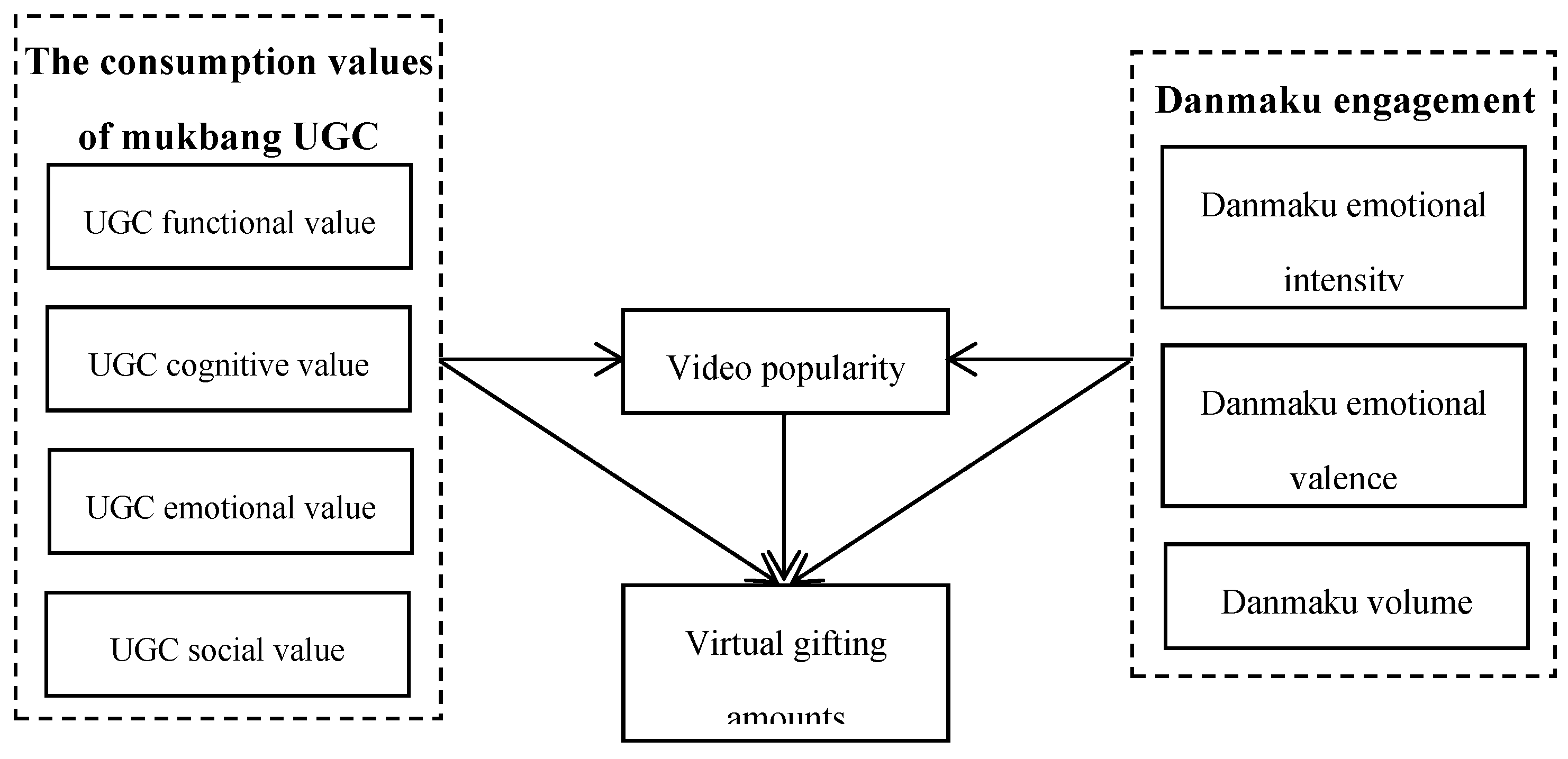

Table 1.
Panel Fixed-Effects Regression Results.
| Variables | (1) Giftsi,j | (2) VPi,j | (3) Giftsi,j | |||
|---|---|---|---|---|---|---|
| Estimate | p-value | Estimate | p-value | Estimate | p-value | |
| MkbFVi,j | 0.630*** (0.109) |
0.000 | 0.407*** (0.066) |
0.000 | 0.517*** (0.126) |
0.001 |
| MkbCVi,j | -0.005* (0.002) |
0.033 | -0.002** (0.001) |
0.041 | -0.004* (0.002) |
0.069 |
| MkbEVi,j | -0.000+ (0.000) |
0.059 | -0.000 (0.000) |
0.582 | -0.000* (0.000) |
0.064 |
| MkbSVi,j | 0.002* (0.001) |
0.018 | 0.000 (0.000) |
0.647 | 0.002** (0.001) |
0.015 |
| DmEIi,j | -0.000** (0.000) |
0.003 | 0.000* (0.000) |
0.094 | -0.000*** (0.000) |
0.000 |
| DmEVi,j | 0.000+ (0.000) |
0.071 | 0.000 (0.000) |
0.752 | 0.000* (0.000) |
0.076 |
| DmVoi,j | 0.349*** (0.086) |
0.001 | 0.399*** (0.050) |
0.000 | 0.238*** (0.078) |
0.006 |
| VPi,j | 0.277*** (0.093) |
0.007 | ||||
| VDi,j | 0.001** (0.000) |
0.025 | -0.000** (0.000) |
0.045 | 0.001** (0.000) |
0.011 |
| FSi,j | -0.195 (0.137) |
0.170 | -0.061 (0.157) |
0.700 | -0.178 (0.105) |
0.105 |
| TLi,j | 0.002 (0.003) |
0.634 | -0.003 (0.003) |
0.310 | 0.002 (0.003) |
0.451 |
| DLi,j | 0.000 (0.001) |
0.828 | -0.000 (0.000) |
0.947 | 0.000 (0.001) |
0.796 |
| TQi,j | -0.014 (0.012) |
0.269 | 0.002 (0.006) |
0.745 | -0.015 (0.012) |
0.236 |
| Constant | 3.211 (2.062) |
0.136 | 2.580 (2.188) |
0.253 | 2.496 (1.637) |
0.144 |
| Within R2 | 0.620 | 0.657 | 0.634 | |||
| Observations | 550 | 550 | 550 | |||
| Number of ID | 20 | 20 | 20 | |||
Note: Creator fixed effects are included. Robust standard errors are listed in parenthesis. *** p < 0.01, ** p < 0.05, * p < p < 0.1.
Table 2.
Bootstrapping Results.
| Predictor | Indirect Effect | Boot SE | 95% BC CI | Mediation |
|---|---|---|---|---|
| MkbFVi,j→VPi,j→Giftsi,j | 0.113*** | 0.034 | [0.049, 0.176] | Yes |
| MkbCVi,j→VPi,j→Giftsi,j | -0.001* | 0.000 | [-0.001, 0.000] | No |
| MkbEVi,j→VPi,j→Giftsi,j | -0.000 | 0.000 | [-0.000, 0.000] | No |
| MkbSVi,j→VPi,j→Giftsi,j | 0.000 | 0.000 | [-0.000, 0.000] | No |
| DmEIi,j→VPi,j→Giftsi,j | 0.000* | 0.000 | [-0.000, 0.000] | No |
| DmEVi,j→VPi,j→Giftsi,j | 0.000 | 0.000 | [-0.000, 0.000] | No |
| DmVoi,j→VPi,j→Giftsi,j | 0.111*** | 0.037 | [0.037, 0.184] | Yes |
Note: *** p < 0.01, ** p < 0.05, * p < 0.1.
Table 3.
Robustness Check Results.
| (4) Giftsi,j | (5) VPi,j | (6) Giftsi,j | (7) Giftsi,j | (8) VPi,j | (9) Giftsi,j | (10) Giftsi,j | (11) VPi,j | (12) Giftsi,j | |
|---|---|---|---|---|---|---|---|---|---|
| MkbFVi,j | 0.632*** (0.109) |
0.407*** (0.066) |
0.520*** (0.126) |
0.630*** (0.109) |
0.406*** (0.066) |
0.517*** (0.125) |
0.629*** (0.095) |
0.418*** (0.069) |
0.509*** (0.106) |
| MkbCVi,j | -0.005** (0.002) |
-0.002** (0.001) |
-0.004* (0.002) |
-0.005** (0.002) |
-0.002** (0.001) |
-0.004* (0.002) |
-0.004** (0.002) |
-0.002** (0.001) |
-0.003* (0.002) |
| MkbEVi,j | -0.000* (0.000) |
-0.000 (0.000) |
-0.000* (0.000) |
-0.000* (0.000) |
-0.000 (0.000) |
-0.000* (0.000) |
|||
| MkbPEVi,j | -0.000* (0.000) |
-0.000 (0.000) |
-0.000* (0.000) |
||||||
| MkbSVi,j | 0.002** (0.001) |
0.000 (0.000) |
0.002** (0.001) |
0.002** (0.001) |
0.000 (0.000) |
0.002** (0.001) |
0.002** (0.001) |
0.001 (0.000) |
0.002** (0.001) |
| DmEIi,j | -0.000*** (0.000) |
0.000* (0.000) |
-0.000*** (0.000) |
-0.000** (0.000) |
0.000 (0.000) |
-0.000** (0.000) |
-0.000*** (0.000) |
0.000* (0.000) |
-0.000*** (0.000) |
| DmEVi,j | 0.000* (0.000) |
0.000 (0.000) |
0.000* (0.000) |
0.000* (0.000) |
0.000 (0.000) |
0.000* (0.000) |
|||
| DmPEVi,j | 0.000* (0.000) |
0.000 (0.000) |
0.000* (0.000) |
||||||
| DmVoi,j | 0.347*** (0.086) |
0.399*** (0.050) |
0.237*** (0.077) |
0.349*** (0.086) |
0.399*** (0.050) |
0.238*** (0.078) |
0.356*** (0.082) |
0.389*** (0.050) |
0.244*** (0.076) |
| VPi,j | 0.277*** (0.093) |
0.277*** (0.093) |
0.287*** (0.086) |
||||||
| VDi,j | 0.000** (0.000) |
-0.000** (0.000) |
0.001*** (0.000) |
0.000** (0.000) |
-0.000** (0.000) |
0.001** (0.000) |
0.000** (0.000) |
-0.000** (0.000) |
0.001** (0.000) |
| FSi,j | -0.162 (0.132) |
-0.055 (0.150) |
-0.147 (0.101) |
-0.195 (0.137) |
-0.061 (0.157) |
-0.178 (0.105) |
-0.114 (0.214) |
-0.018 (0.177) |
-0.109 (0.169) |
| TLi,j | 0.001 (0.003) |
-0.003 (0.003) |
0.002 (0.003) |
0.002 (0.003) |
-0.003 (0.003) |
0.002 (0.003) |
0.003 (0.004) |
-0.003 (0.003) |
0.004 (0.003) |
| DLi,j | 0.000 (0.001) |
-0.000 (0.000) |
0.000 (0.001) |
0.000 (0.001) |
-0.000 (0.000) |
0.000 (0.001) |
-0.000 (0.001) |
-0.000 (0.000) |
0.000 (0.001) |
| TQi,j | -0.013 (0.013) |
0.002 (0.006) |
-0.014 (0.012) |
-0.014 (0.012) |
0.002 (0.006) |
-0.015 (0.012) |
-0.018 (0.013) |
0.004 (0.005) |
-0.019 (0.013) |
| PGiftsi,j | -0.131* (0.072) |
0.036 (0.054) |
-0.141** (0.063) |
||||||
| Constant | 2.709 (2.026) |
2.483 (2.083) |
2.021 (1.626) |
3.211 (2.062) |
2.580 (2.188) |
2.496 (1.636) |
2.962 (2.974) |
1.652 (2.527) |
2.488 (2.375) |
| Within R2 | 0.620 | 0.657 | 0.634 | 0.620 | 0.657 | 0.634 | 0.632 | 0.658 | 0.647 |
Note: Creator fixed effects are included. Robust standard errors are listed in parenthesis. *** p < 0.01, ** p < 0.05, * p < 0.1.
Disclaimer/Publisher’s Note: The statements, opinions and data contained in all publications are solely those of the individual author(s) and contributor(s) and not of MDPI and/or the editor(s). MDPI and/or the editor(s) disclaim responsibility for any injury to people or property resulting from any ideas, methods, instructions or products referred to in the content. |
© 2026 by the authors. Licensee MDPI, Basel, Switzerland. This article is an open access article distributed under the terms and conditions of the Creative Commons Attribution (CC BY) license (http://creativecommons.org/licenses/by/4.0/).
Copyright: This open access article is published under a Creative Commons CC BY 4.0 license, which permit the free download, distribution, and reuse, provided that the author and preprint are cited in any reuse.