

Submitted:
30 October 2026
Posted:
02 November 2026
You are already at the latest version
Abstract
Acute organ failure can be lethal yet often reversible and relatively stereotyped despite diverse triggers. Cells facing resource limitations should direct failure toward fault-tolerant or repairable components. As importantly, the many components and pathways that can fail in different sequences create an underappreciated cybernetic problem: high failure variety, unpredictability and branching. Simplifying the failure process could promote controllability. Specialized organ function imposes load on cell-intrinsic systems, but this dependency is asymmetric: organ function can be reduced and later restored, whereas loss of ion gradients is often irreversible. Continued high performance may couple specialized work to maintenance processes through shared energy, redox, ion and proton systems. Suppressing organ function earlier than necessary could thus be a control action that avoids resource-limitation coupling, reduces failure variety and preserves controllability. Suppression of organ function could occur through regulatory systems or heightened stress-mediator sensitivity.In a sacrificial system, organ function responding to multiple stressors may convert complex failure to a simple output. An embedded sacrificial control system could arise from mediator-controlled failure sequences. Differential sensitivities of cellular processes to stress-mediators would induce sequencing that can be self-similar failure across cells if it has high ordering-probability, reducing tissue-level complexity. Acute organ dysfunction may therefore be an act of control: a simple response pattern to avoid cybernetic chaos of the failure process.
Keywords:
control-theory
; sacrificial-systems
; complex-systems
; failure-variety
; cybernetics
; acute organ failure
; systems-medicine
Background
Acute Organ Failure
Given the complexity of acute organ failure, maintaining a bounded failure compatible with cellular viability and reversible functional loss may be unlikely at random. Theoretically, each component and pathway can malfunction in any permissible sequence. Hence, the combinatorial number of failure modes and cascades in an unregulated failure space seems too large for adaptive systems. Many such issues have been assessed in engineering, system-dynamics, cybernetics and network sciences. This framework applies this to acute organ failure to highlight areas of potential overlap and interest, acknowledging that complex systems may behave completely differently in cells and organs. In electrical power grids, random failure leads to more cascade injuries [1]. Yet, acute organ failure looks relatively stereotypical compared to the number of triggers and is often reversible in survivors. This implies that some form of attenuation towards a bounded and predictable failure space has occurred. Hypometabolism with reduced function has been proposed as an adaptation to bioenergetic stress in acute organ failure [2]. In hibernating myocardium and myocardial stunning, reduced contraction matches low ATP productive capacity resulting from impaired supply chains [3] and hypometabolism in sepsis has also been proposed to be adaptive [4]. At the same time acute organ failure is proposed to be the result of loss of control. Given that failure of such complex systems opens up a large space of failure variety (the number of distinguishable failure states and trajectories), it is difficult to reconcile a concurrent weakening of control with reversibility. This framework expands upon failure variety and sacrificial control systems but is developed from the “Energy First” framework of acute organ failure [5]. Game-theoretical models of multiple organ dysfunction syndrome (MODS) in sepsis of interdependencies have identified that the reward for continuing cell function decreased with oxygen debt. This led to a shift in strategy to greater defection from organ function work [6].
Sacrificial Systems
There are several simple examples of sacrificial systems. Engineering uses sacrificial elements to direct damage or resource consumption toward one part of a system to protect another. Structural fuses are designed to yield and concentrate damage [7]; sacrificial anodes protect metal by corroding preferentially. Fail-safe systems enter a safe state with reduced operational capacity, shutting down or stopping. Fail-operational systems continue relevant functions for a limited period. Degraded mode operations and graceful degradation reduce costly functions and continue to function at lower performance [8]. Such systems sacrifice function to maintain system integrity. In biology, apoptosis can support development and tissue homeostasis [9]. Sacrifice is used to confer robustness to the system by controlling the failure process, often using pre-programmed responses.
When is Sacrifice Protective?
A protective sacrifice must serve a function that matters more than the part or process being yielded. The system must be able to tolerate the loss or reduced capacity, and the response must begin in time to have effect. The sacrifice should remain limited and be sufficiently predictable. It should reduce system demand without irreversible damage to components, being compatible with both continued function and recovery of the system.
Complex Networks with Resource Dependency
Directed metabolic networks contain dependencies through reaction pathways and shared metabolite pools. Local reaction failure can propagate [10]. Large metabolic network analyses identify conserved pools, including the adenylate pool, that couple metabolites across energy-related processes [11]. Resource-dependency models show that resource distribution affects network survival [12] and identify that disconnecting the demand-node with the greatest resource deficit stabilizes the network by reallocating resources, referred to as a sacrificial node [13].
Partial Load Reduction
The dependency studies above concern sacrificial node removal. Network studies have also modelled protective sacrifice as partial, targeted load reduction, where nodes stay connected but curtail part of their demand. In power-grid simulations, strategies that optimize both the location and the amount of load shed can contain cascades while minimizing the total loss of service [14]. In spatially embedded networks, the authors designated a random fraction of nodes as “altruists”: after a failure, these nodes stop acting as sources of demand but continue to conduct flow between other nodes. This reduced cascade size more than node removal [15]. In software, the same principle is formalized as brownout: optional parts of a service are scaled down dynamically under load while the core keeps running [16]. Hence sacrificial nodes may be more effective if graded, reversible demand curtailment occurs with preserved connectivity.
Requisite Variety and Variety Attenuation
Ashby's law of requisite variety establishes that effective regulation requires sufficient variety to counter the disturbances confronting a system [17]. Stafford Beer extended this principle by emphasizing that effective control can be achieved not only by amplifying regulatory capacity, but also by attenuating the variety that must be regulated [18]. In computer science, crash-only design handles an unknown number of errors by one known restart [19]. This distinction is particularly relevant to complex systems in which interacting failures can branch into many possible cascades and end states. One study of power-grid failures identified very high variety of cascade injuries [20]. Attenuation of failure variety may be a high priority for biological systems as it may reduce failure complexity and the cost of adaptation.
Cellular Networks and Robustness
The bow-tie architecture of metabolic networks provides a structural basis for understanding how diverse disturbances may converge on a small set of shared resource pools. In this architecture, numerous metabolic inputs are channeled through a conserved core of energy carriers and precursor metabolites, including ATP and NAD(H), to support diverse cellular outputs [21]. This organization confers robustness to variation in inputs but also creates vulnerabilities at the shared core [22]. In scale-free networks, where the degree-distribution follows a power law, a network considered compatible with cellular networks, the system is remarkably stable to random node removal. At the same time as displaying error tolerance, such systems are vulnerable to attack towards a few nodes that play a vital role by being highly connected [23]. When network function depends on flow through nodes, removing a highly loaded node can redistribute load and trigger a cascade [24]. Highly optimized tolerance (HOT) describes systems in which robustness is allocated against an anticipated distribution of disturbances. Protective resources are distributed in proportion to the expected frequency of insult, producing high performance under common conditions at the cost of acute fragility to rare or novel ones. Such systems are therefore robust-yet-fragile: tolerant of the disturbances that shaped them, and disproportionately damaged by perturbations outside that envelope. Critically, the regulatory architecture that confers robustness is itself a source of fragility, since each layer introduces new points of failure [25].
Sacrificial Systems Applied to Acute Organ Failure
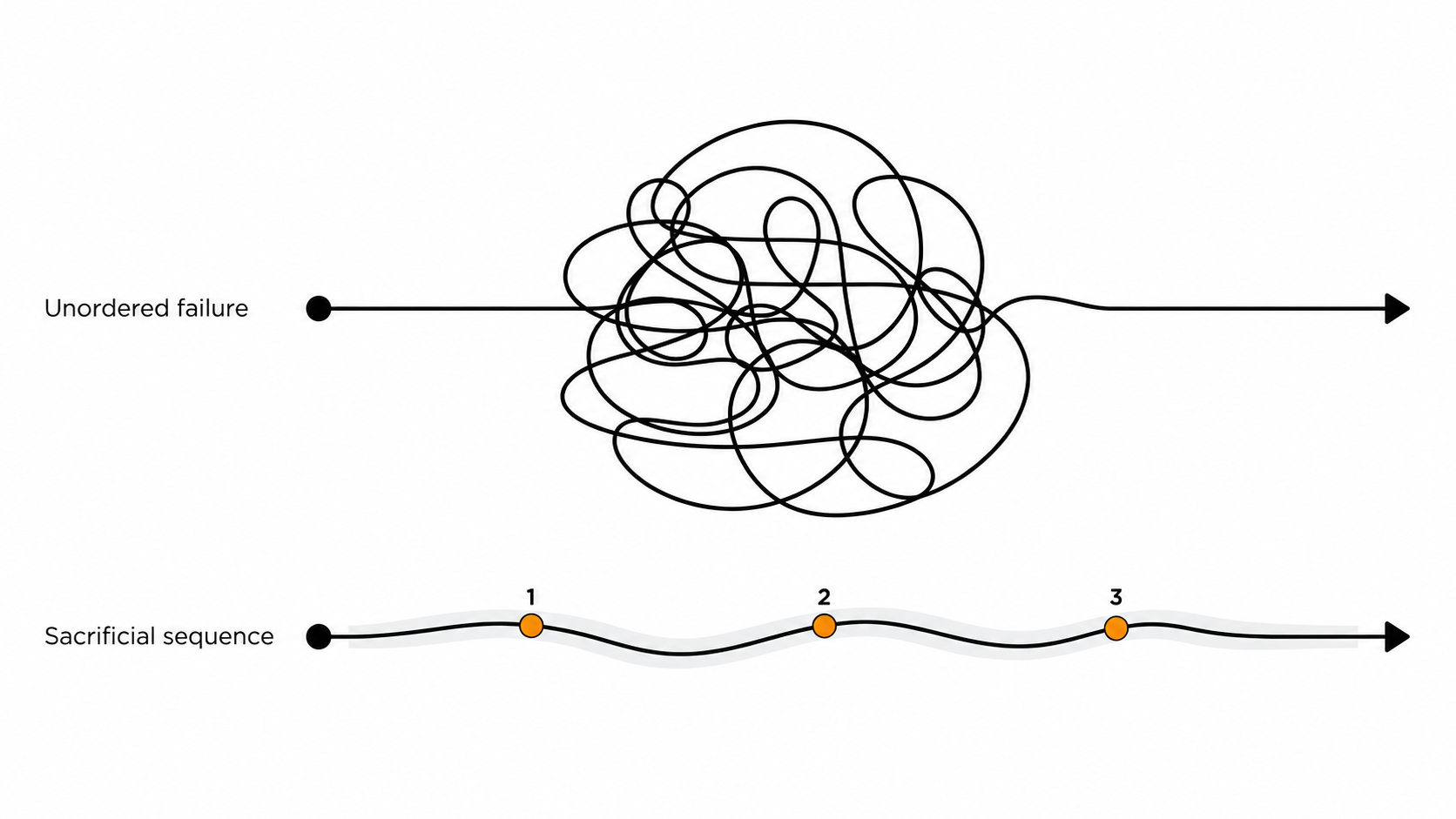
A successful sacrificial system should protect an explicitly prioritized function, such as cell viability or structural integrity, while allowing the sacrificed component or process to enter a tolerated, bounded degraded state. Stress detection and response should occur early enough to preserve this protected function. Sacrifice should reduce demand on a limiting resource without causing unacceptable damage or initiating further failures. Its effects should be sufficiently predictable and the system-level cost acceptable, with a route to recovery or replacement of the sacrificed component [14,26]. Finally, there should be a positive effect on the information-load of the failure process. These criteria synthesize principles from dependability engineering, graceful degradation, and load-shedding research; they have not been validated for biological systems. In this framework, a sacrificial node is a cellular process or specialized function whose suppression reduces resource demand or limits failure propagation, helping preserve cell viability. A sacrificial sequence is an ordered pattern in which such functions are suppressed before processes required for viability. A sacrificial control system is the broader architecture that converts stress, through dedicated signaling or differential sensitivity to stress mediators, into this ordered failure sequence. For such a system to perform, it should unload the system and reduce the complexity of the failure process to promote controllability.
Asymmetric Load-dependency
In cells, shared substrates and cycling co-substrates such as ATP/ADP and NAD(P)H can constrain reaction fluxes. When pool size or turnover becomes limiting, these constraints can couple reactions and pathways [27]. Specialized cellular functions depend on the same fundamental processes and resource pools that maintain cellular viability [28]. However, these dependencies are asymmetric. Specialized organ function processes impose additional loads on these supporting systems, whereas the maintenance of cellular homeostasis does not generally require specialized organ functions except for the indirect dependency on some level of organ function (Figure 1). Organ functions emerge from a collective of cells whereas cellular viability is essentially a unicellular function outside of supply-dependency. For example, electrical activity increases transmembrane ion fluxes and thereby the workload of ion pumps required to restore ionic gradients [29]. Suppressing specialized organ functions unloads ion pumps and redistributes ATP hydrolytic capacity. Conversely, inhibition of the ion pumps without inhibiting the specialized organ function during bioenergetic constraint would overload ion pumps and potentially ATP hydrolytic capacity. Further, with both processes being limited by the same ATP depletion, the processes would become increasingly coupled. Such coupling would also lower control authority of allosteric signals if enzymes become constrained.
Figure 1.
Asymmetric dependencies between specialized organ function, viability maintenance, and shared resources. Specialized organ function imposes an additional load on viability-maintenance processes, while ion-pump service supports the gradients required for organ function. Both process classes depend on shared resource pools. As these resources become limiting, their demands become coupled, potentially linking reduced resource availability to failure of both specialized function and cellular maintenance. At the single-cell level, temporarily giving up specialized organ function may carry little cost if other cells take over its contribution to the organ. This can allow the cell to prioritize its own viability, provided that sufficient function is maintained across the tissue. Abbreviations: ADP, adenosine diphosphate; ATP, adenosine triphosphate; NAD, nicotinamide adenine dinucleotide; NADP, nicotinamide adenine dinucleotide phosphate.
Figure 1.
Asymmetric dependencies between specialized organ function, viability maintenance, and shared resources. Specialized organ function imposes an additional load on viability-maintenance processes, while ion-pump service supports the gradients required for organ function. Both process classes depend on shared resource pools. As these resources become limiting, their demands become coupled, potentially linking reduced resource availability to failure of both specialized function and cellular maintenance. At the single-cell level, temporarily giving up specialized organ function may carry little cost if other cells take over its contribution to the organ. This can allow the cell to prioritize its own viability, provided that sufficient function is maintained across the tissue. Abbreviations: ADP, adenosine diphosphate; ATP, adenosine triphosphate; NAD, nicotinamide adenine dinucleotide; NADP, nicotinamide adenine dinucleotide phosphate.
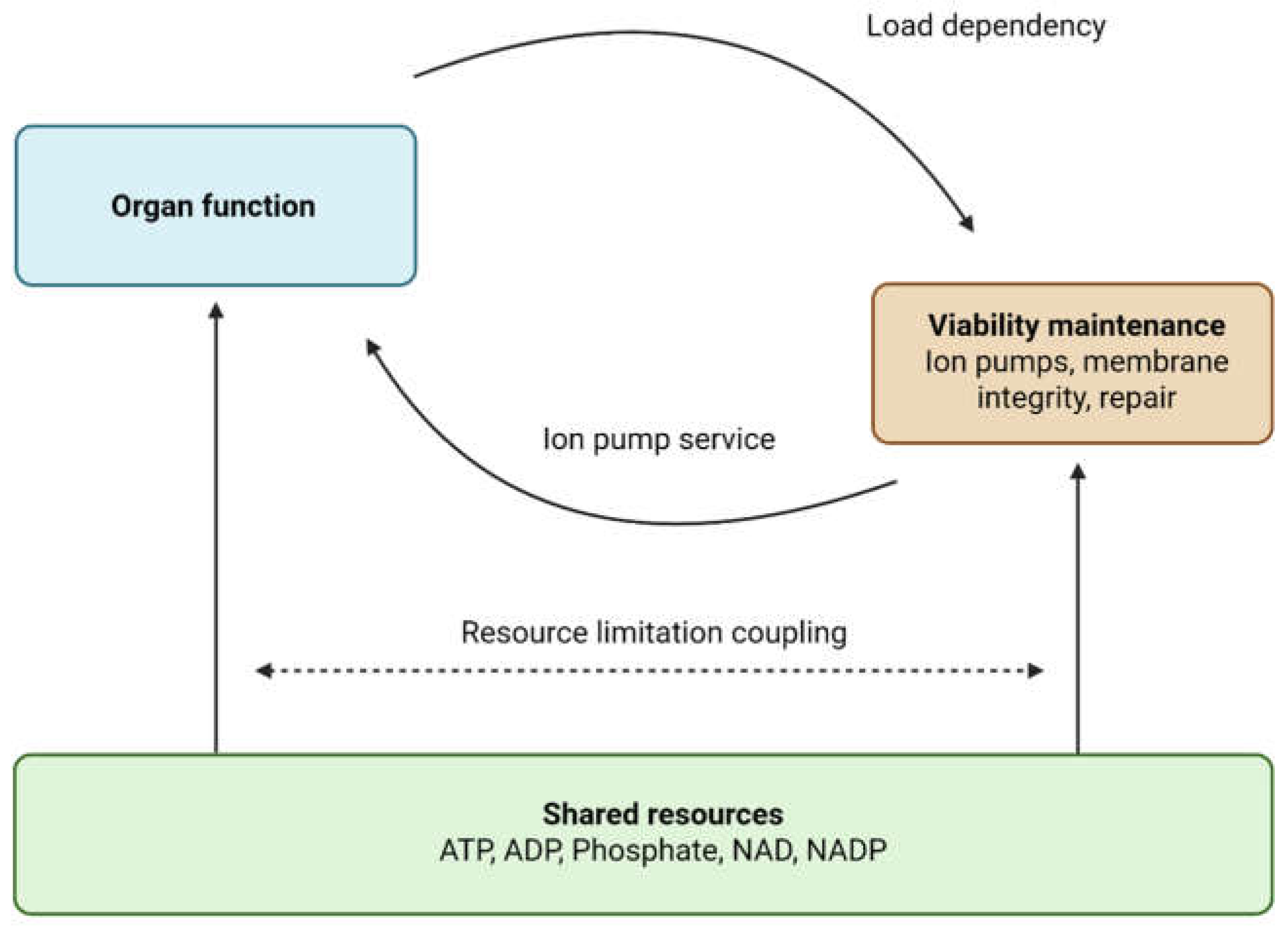
Figure 2.
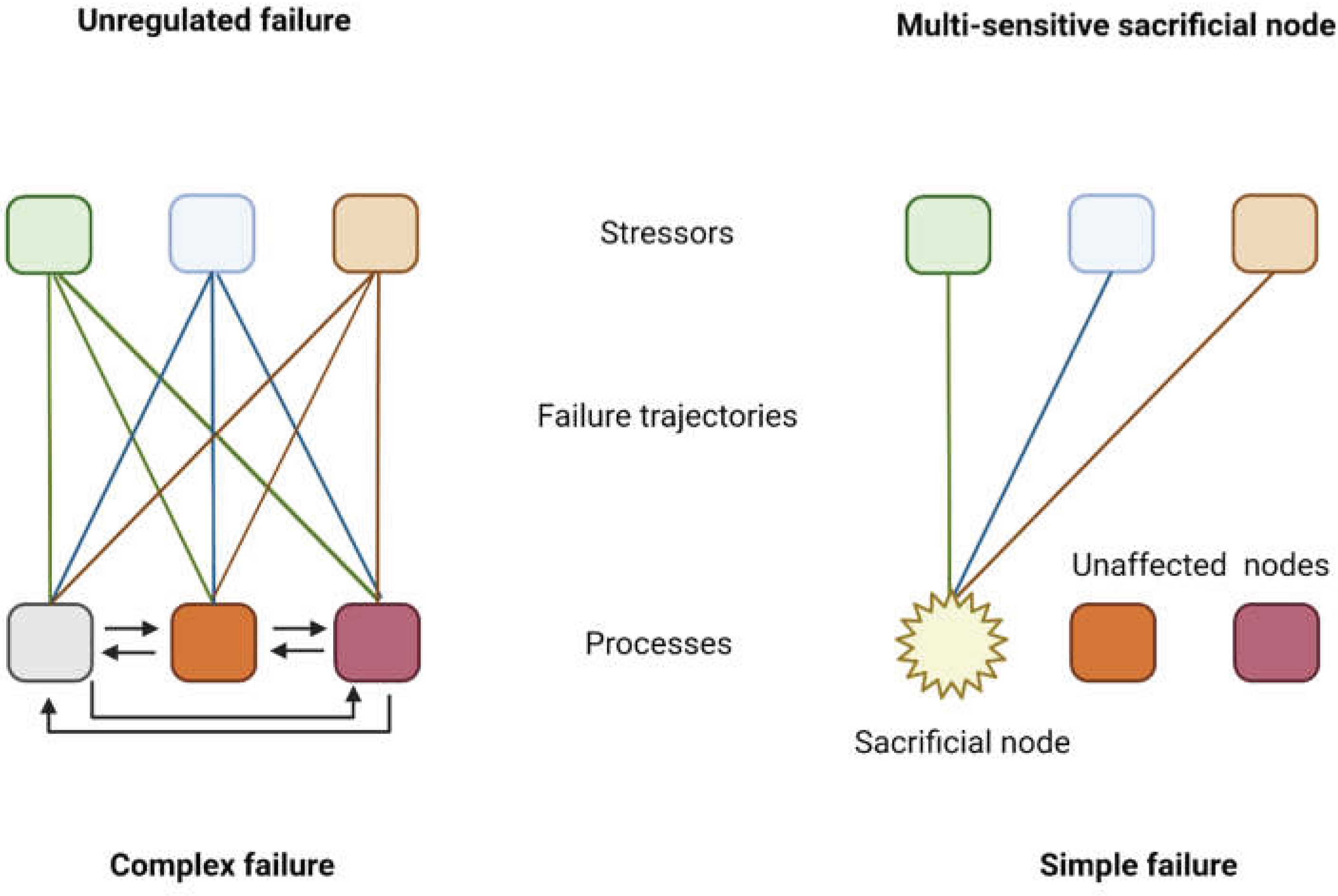
A multisensitive sacrificial node may constrain cellular failure trajectories. Left: In unregulated failure, multiple stressors can affect different cellular processes. Interactions among these processes may permit propagation and branching into diverse failure trajectories. Right: Distinct stressors converge, directly or through shared consequences or signals, on a multisensitive sacrificial node. Selective suppression of this node concentrates functional loss, while other processes remain comparatively unaffected, potentially limiting the number of processes engaged and the accessible downstream trajectories. “Simple failure” denotes this more restricted pattern of process involvement; it does not imply that all downstream failure is prevented. The schematic illustrates a proposed mechanism for attenuating failure-trajectory variety.
Figure 2.
A multisensitive sacrificial node may constrain cellular failure trajectories. Left: In unregulated failure, multiple stressors can affect different cellular processes. Interactions among these processes may permit propagation and branching into diverse failure trajectories. Right: Distinct stressors converge, directly or through shared consequences or signals, on a multisensitive sacrificial node. Selective suppression of this node concentrates functional loss, while other processes remain comparatively unaffected, potentially limiting the number of processes engaged and the accessible downstream trajectories. “Simple failure” denotes this more restricted pattern of process involvement; it does not imply that all downstream failure is prevented. The schematic illustrates a proposed mechanism for attenuating failure-trajectory variety.
This directional asymmetry extends beyond ion transport and ATP hydrolysis. Proton and phosphate generation, metabolic flux requirements and associated demands on redox regulation are all coupled to sustaining specialized organ functions [30]. Constraining organ function before its continued activity becomes unsustainable can therefore function as a control action: the imposed constraint propagates through load-dependent couplings, unloading the processes recruited to sustain that function.
Sacrificial Sequence
A hierarchy of failures suggests between-process differences in sensitivity to energetic stress [28]. If specialized cellular functions are intrinsically more sensitive to stress mediators than cell maintenance processes, this could in control-theoretical terms be a sacrificial sequence. This could arise by a dedicated signal such as adenosine which suppresses synaptic activity by engaging adenosine receptors [31]. However, process-sequencing could arise more simply from differences in between-process sensitivity of controlling enzymes to stress mediators or resource-limitation, which could have evolved from intrinsic enzyme differences. A simple signal can produce a highly complex response if the different recipients can have both different sensitivities to the signal, producing a temporal sequence, and varied effector functions, producing a complex response. This could introduce a very cheap adaptive signal in established processes responding to broadcasted alarm signals such as stress mediators [5]. If failure sequences would occur at random, the number of possible failure sequences in a cell would grow enormously (Table 1). Sacrificial sequences with high ordering-probability would attenuate failure variety, simplifying the work for adaptive survival systems and exert control over the failure process.
Constrained Failure Identity with Dispersion of Failure Degree in Tissues
A cell can reversibly reduce its contribution to specialized organ function and later resume it; cell death removes that option. Because cells can fail through multiple routes, their combinations could generate combinatorial variety at the tissue level. Control that constrains failure identity could limit this variety while allowing failure degree to vary across cells: a common, constrained trajectory expressed with different severity. Microcirculatory and mitochondrial heterogeneity may contribute to that distribution. Under this model, more bioenergetically stressed cells suppress specialized function and prioritize viability, while less stressed cells sustain collective organ function. This could allow severely dysfunctional but viable cells to persist even when their individual contribution would be insufficient to sustain the organ, provided aggregate function remains above the lethal threshold.
Stress-Convergent Load Reduction
Sacrificial systems could reduce failure variety by being sensitive to inhibition from diverse insults. AMPK and ISR, for example, are activated by a range of stressors and converge on suppressed protein translation [32,33]. Specialized organ functions and their supporting enzyme systems are also sensitive to shared consequences of acute stress, including energy depletion, redox stress, inorganic phosphate accumulation, falling pH, and impaired calcium cycling. If specialized organ function is inhibited at lower stress levels than processes required for cell viability, this produces an architecture: diverse insults converge on a common reduction in function, which unloads multiple supporting processes. The many-to-one input with one-to-many effects could reduce complexity drastically. At the network scale, this resembles load redistribution in scale-free networks [23,24] but where hubs undergo a pre-failure ordered load-reduction sequence.
Anticipatory Activation of Sacrificial Systems
If pre-failure sacrificial sequences and systems are in place, the next layer of control is temporal. Early load-reduction and coordination of cells based on sensor-systems detecting early failure could be of benefit. Early metabolic suppression across cells could also improve oxygen distribution which has been observed for nitric oxide (NO) [34]. In cells, adaptive systems often rely on transcription that takes minutes to hours to become active [5]. Cytokines induce shock, acute organ failure and multi-organ failure in experimental models [35,36]. Suggested mechanisms of multi-organ dysfunction syndrome include mitochondrial inhibition [37] and immunometabolic reprogramming [38]. In patients dying from sepsis, cell-death is rare even with antemortem organ failure [39]. It seems counterintuitive that such central signaling systems are maladaptive for a common stressor [22]. One may thus speculate whether inducing a simple early failure to avoid complex and unpredictable failure based on stress sensors such as cytokines may reduce failure variety and activate transcriptional programs early.
Sacrificial Control Systems and Failure Mode Variety
Following Beer's concept of variety engineering [18], sacrificial control systems based on embedded failure sequences activated by stress-mediators that lead to unloading could attenuate failure variety through complementary mechanisms. Suppression of resource consumption can relieve shared constraints. However, controlling the entry points of failure by sacrificial nodes could have large effects on later propagation and downstream branching. Multi-sensitive sacrificial nodes may reduce the dimensionality of the failure process to one shared functional output. Shared sacrificial architectures can constrain variation in failure identity between cells. Together, information compression of the failure process can be substantial. This reduction in failure variety that adaptive systems must match would drastically reduce the cost of adaptation, consistent with Ashby's law of requisite variety. At the system level, this underlying architecture becomes a problem of having enough organ function reserves to survive. At the cellular level, it becomes a method for cells to compress a manifold of internal problems [5].
Parallel Cellular Injury Processes
Sacrificial suppression must operate alongside cellular injuries. If cells die, there is no return of their function but that is also true if the organisms die. Because sacrificial suppression may emerge from distributed cellular sensitivities rather than precise control, organ function may sometimes be reduced more or less than necessary. Hence, studying these relationships may be very important to identify in which patient’s organ load could be increased safely or where unloading should be considered. A combination of bioenergetic measures and cell-death biomarkers could be useful starting point to identify the organs overall state, in addition to functional measures.
Predictions and Falsifiers
In multicellular network models, early suppression of high-demand functions should reduce resource-mediated coupling and failure-mode variety, especially when suppression is multi-sensitive and follows a consistent sequence across cells. This should appear as fewer failure trajectories, branches and end states, and a reduced variety of disturbances that adaptive systems must control. These effects should weaken when resources are abundant or suppression is prevented. Sacrificial nodes that occur early in the failure process reduce failure variety and branching. Sacrificial sequences should stabilize networks more if high load-reduction occurs early for non-critical load-reduction. Mediator-based induction of sacrificial sequences from mediators that occur prior to and predict resource-limitation should outperform systems responding to resource-limitation. This should increase with load-dependency. Pre-failure sacrificial sequences in multi-parallel cellular systems should drastically reduce tissue-level failure variety. Inducing failure by endogenous sensor-effector mechanisms will be pro-survival depending on the reversibility of the induced failure and by how much it constrains failure variety. In patients who die from acute organ failure, there should be a higher failure variety in organs with significant cell death.
A falsifier: if sacrificial sequences are absent in cells, or do not align with load dependency and viability importance, whether implemented by dedicated signaling systems or by between-process differences in sensitivity to stress mediators, the framework fails.
Limitations
This framework applies sacrificial-system principles from network science and engineering to acute organ failure to explore how such thinking could apply to acute organ failure. It is hypothetical and deliberately thought-provoking. To understand failure variety, it must be measured and quantified. Quantifying failure variety is beyond the ambitions of this framework, but a table of characteristics that can be useful to understand organ functions as a scaled and partly sacrificial process is provided in Table 2. Testing the hypothesis requires selectively modifying candidate nodes and measuring effects on failure trajectories, cell viability and recovery under matched stress. Organ function is also essential for survival. This hypothesis focuses on sacrificial control systems. However, for it to work, there must be some control of the lower-bound suppression. This could arise from counter-regulatory mechanisms such as neuroendocrine and autonomic systems or from organ functions having a large regulatory range.
Conclusion
The cybernetic problem of acute organ failure is so large, given the complexity of organs, that some form of control of failure variety seems mandatory for adaptive systems to be effective. In engineering, most failure processes are drastically simplified, planned and made predictable, reducing failure variety. This framework proposes that sacrificial control systems attenuate failure variety by ordering the cellular processes so that they fail in sequence. Cellular processes could have evolved different sensitivities to stress-mediators and specific signals are known to suppress specific cell processes. If organ-functions are suppressed early, this becomes a control-action where broadcasting signals can activate failure sequences given differential sensitivity to such signals. As organ functions are inhibition-sensitive to multiple processes and are supported by common resources and ion pumps that are also needed for cell survival, inhibiting them prior to resource limitation or ion-pump overload could be highly beneficial. This is dependent on residual organ function that can sustain life. With reduced organ functions reducing strain on multiple systems and being part of a sacrificial failure sequence where it fails relatively early, the attenuation of failure variety could be substantial, especially as the same cell-types will have the same sequence. In theory, given the enormous complexity of the failure process, cells must likely be programmed to fail in certain ways and sequences to be able to attain failure variety and maintain reasonable costs for adaptive programs.
References
- Das, P.; Shuvro, R.A.; Povinelli, K.; Sorrentino, F.; Hayat, M.M. Mitigating cascading failures in power grids via Markov decision-based load-shedding with DC power flow model. IEEE Syst. Journal. 2022, 16(3), 4048–4059. [Google Scholar] [CrossRef]
- Singer, M. Critical illness and flat batteries. Crit. Care 2017, 21(3), 309. [Google Scholar] [CrossRef] [PubMed]
- Heusch, G. Myocardial stunning and hibernation revisited. Nat. Rev. Cardiol. 2021, 18(7), 522–536. [Google Scholar] [CrossRef] [PubMed]
- Singer, M. Cellular dysfunction in sepsis. Clin. Chest Med. 2008, 29(4), 655–660, viii–ix. [Google Scholar] [CrossRef] [PubMed]
- Giil, L.M. Putting Energy First, Organs Fail in Order to Survive: A Thermodynamic and Control-Theoretic Perspective on Acute Organ Failure. In Preprints; Preprints, 2026. [Google Scholar]
- Papadopoulos, S.; Parker, R.S.; Clermont, G. Modeling sepsis-induced organ failure. J. Crit. Care 2023, 74, 154204. [Google Scholar] [CrossRef]
- El-Bahey, S.; Bruneau, M. Structural Fuse Concept for Bridges. Transp. Res. Rec. 2010, 2202(1), 167–172. [Google Scholar] [CrossRef]
- Stolte, T.; Ackermann, S.; Graubohm, R.; et al. Taxonomy to Unify Fault Tolerance Regimes for Automotive Systems: Defining Fail-Operational, Fail-Degraded, and Fail-Safe. IEEE Trans. Intell. Veh. 2022, 7(2), 251–262. [Google Scholar] [CrossRef]
- Gudipaty, S.A.; Conner, C.M.; Rosenblatt, J.; Montell, D.J. Unconventional Ways to Live and Die: Cell Death and Survival in Development, Homeostasis, and Disease. Annu Rev. Cell Dev. Biol. 2018, 34, 311–332. [Google Scholar] [CrossRef] [PubMed]
- Smart, A.G.; Amaral, L.A.; Ottino, J.M. Cascading failure and robustness in metabolic networks. Proc. Natl. Acad. Sci. U S A 2008, 105(36), 13223–13228. [Google Scholar] [CrossRef] [PubMed]
- Nikolaev, E.V.; Burgard, A.P.; Maranas, C.D. Elucidation and structural analysis of conserved pools for genome-scale metabolic reconstructions. Biophys. J. 2005, 88(1), 37–49. [Google Scholar] [CrossRef] [PubMed]
- Ingale, M.; Shekatkar, S.M. Resource dependency and survivability in complex networks. Phys. Rev. E 2020, 102(6-1), 062304. [Google Scholar] [CrossRef] [PubMed]
- Hosseinalipour, S.; Mao, J.; Dai, H. Prevention and mitigation of catastrophic failures in demand-supply interdependent networks. IEEE Trans. Netw. Sci. Eng. 2019, 7(3), 1710–1723. [Google Scholar] [CrossRef]
- Pahwa, S.; Scoglio, C.; Das, S.; Schulz, N. Load-shedding strategies for preventing cascading failures in power grid. Electr. Power Compon. Syst. 2013, 41(9), 879–895. [Google Scholar] [CrossRef]
- Asztalos, A.; Sreenivasan, S.; Szymanski, B.K.; Korniss, G. Cascading failures in spatially-embedded random networks. PLoS ONE 2014, 9(1), e84563. [Google Scholar] [CrossRef] [PubMed]
- Klein, C.; Maggio, M.; Årzén, K.-E.; Hernández-Rodriguez, F. Brownout: building more robust cloud applications. In Proceedings of the 36th International Conference on Software Engineering, Hyderabad, India, 2014. [Google Scholar]
- Ashby, W.R. Requisite variety and its implications for the control of complex systems. In Facets of systems science; Springer, 1991; pp. 405–417. [Google Scholar]
- Beer, S. The Viable System Model: Its Provenance, Development, Methodology and Pathology. J. Oper. Res. Soc. 1984, 35(1), 7–25. [Google Scholar] [CrossRef]
- Alonso, J.; Torres, J.; Silva, L. Carrying the crash-only software concept to the legacy application servers. In Presented at the Making Grids Work: Proceedings of the CoreGRID Workshop on Programming Models Grid and P2P System Architecture Grid Systems, Tools and Environments, Heraklion, Crete, Greece, 12-13 June 2007; 2008. [Google Scholar]
- Ghasemi, A.; de Meer, H.; Kantz, H. Interaction graph learning of line cascading failure in power networks and its statistical properties. Energy Inform. 2023, 6 (Suppl 1), 17. [Google Scholar] [CrossRef]
- Csete, M.; Doyle, J. Bow ties, metabolism and disease. Trends Biotechnol. 2004, 22(9), 446–450. [Google Scholar] [CrossRef] [PubMed]
- Carlson, J.M.; Doyle, J. Highly optimized tolerance: A mechanism for power laws in designed systems. Phys. Rev. E 1999, 60(2), 1412–1427. [Google Scholar] [CrossRef] [PubMed]
- Albert, R.; Jeong, H.; Barabási, A.-L. Error and attack tolerance of complex networks. Nature 2000, 406(6794), 378–382. [Google Scholar] [CrossRef] [PubMed]
- Motter, A.E.; Lai, Y.-C. Cascade-based attacks on complex networks. Phys. Rev. E 2002, 66(6), 065102. [Google Scholar] [CrossRef] [PubMed]
- Carlson, J.M.; Doyle, J. Complexity and robustness. Proc. Natl. Acad. Sci. U S A 2002, 99 Suppl 1(Suppl 1), 2538–2545. [Google Scholar] [CrossRef] [PubMed]
- Avizienis, A.; Laprie, J.-C.; Randell, B.; Landwehr, C. Basic concepts and taxonomy of dependable and secure computing. IEEE Trans. Dependable Secur. Comput. 2004, 1(1), 11–33. [Google Scholar] [CrossRef]
- West, R.; Delattre, H.; Noor, E.; Feliu, E.; Soyer, O.S. Dynamics of co-substrate pools can constrain and regulate metabolic fluxes. Elife 2023, 12, e84379. [Google Scholar] [CrossRef] [PubMed]
- Buttgereit, F.; Brand, M.D. A hierarchy of ATP-consuming processes in mammalian cells. Biochem J. 1995, 312 Pt 1)(Pt 1, 163–167. [Google Scholar] [CrossRef] [PubMed]
- Attwell, D.; Laughlin, S.B. An energy budget for signaling in the grey matter of the brain. J. Cereb. Blood Flow Metab. 2001, 21(10), 1133–1145. [Google Scholar] [CrossRef] [PubMed]
- Rolfe, D.F.; Brown, G.C. Cellular energy utilization and molecular origin of standard metabolic rate in mammals. Physiol. Rev. 1997, 77(3), 731–758. [Google Scholar] [CrossRef] [PubMed]
- Gervitz, L.M.; Lutherer, L.O.; Davies, D.G.; Pirch, J.H.; Fowler, J.C. Adenosine induces initial hypoxic-ischemic depression of synaptic transmission in the rat hippocampus in vivo. Am. J. Physiol.-Regul. Integr. Comp. Physiol. 2001, 280(3), R639–R645. [Google Scholar] [CrossRef] [PubMed]
- Trefts, E.; Shaw, R.J. AMPK: restoring metabolic homeostasis over space and time. Mol. Cell 2021, 81(18), 3677–3690. [Google Scholar] [CrossRef] [PubMed]
- Costa-Mattioli, M.; Walter, P. The integrated stress response: From mechanism to disease. Science 2020, 368(6489), eaat5314. [Google Scholar] [CrossRef] [PubMed]
- Victor, V.M.; Nuñez, C.; D'Ocón, P.; Taylor, C.T.; Esplugues, J.V.; Moncada, S. Regulation of oxygen distribution in tissues by endothelial nitric oxide. Circ. Res. 2009, 104(10), 1178–1183. [Google Scholar] [CrossRef] [PubMed]
- Tracey, K.J.; Beutler, B.; Lowry, S.F.; et al. Shock and tissue injury induced by recombinant human cachectin. Science 1986, 234(4775), 470–474. [Google Scholar] [CrossRef] [PubMed]
- Tracey, K.J.; Fong, Y.; Hesse, D.G.; et al. Anti-cachectin/TNF monoclonal antibodies prevent septic shock during lethal bacteraemia. Nature 1987, 330(6149), 662–664. [Google Scholar] [CrossRef] [PubMed]
- Gao, K.; Liu, Y.; Sun, C.; et al. TNF-ɑ induces mitochondrial dysfunction to drive NLRP3/Caspase-1/GSDMD-mediated pyroptosis in MCF-7 cells. Sci. Rep. 2024, 14(1), 25880. [Google Scholar] [CrossRef] [PubMed]
- Wu, F.; Chen, Y.; Chen, L.; Wei, X.; Zhang, L.; Shen, Y. Immunometabolic Reprogramming in Experimental Sepsis: A Driver of Multiple Organ Dysfunction Syndrome. J. Inflamm. Res. 2026, 19, 577143. [Google Scholar] [CrossRef] [PubMed]
- Takasu, O.; Gaut, J.P.; Watanabe, E.; et al. Mechanisms of cardiac and renal dysfunction in patients dying of sepsis. Am. J. Respir. Crit. Care Med. 2013, 187(5), 509–517. [Google Scholar] [CrossRef] [PubMed]

Table 1.
Failure variation occurring from random sequencing of 10 processes
| Components | Possible sequences | Bits (Shannon-entropy) | |
| 1 | 1 | 0 | |
| 2 | 2 | 1 | |
| 3 | 6 | 2.6 | |
| 4 | 24 | 4.6 | |
| 5 | 120 | 6.9 | |
| 6 | 720 | 9.5 | |
| 7 | 5040 | 12.3 | |
| 8 | 40320 | 15.3 | |
| 9 | 362880 | 18.5 | |
| 10 | 3628800 | 21.8 | |
| Number of combinatorial sequences: S = N! Shannon-entropy in bits: HN = log2(N!) In cells, many sequences are not possible although at the same time, cells have many more processes and components. | |||
Table 2.
Possible Components of Failure Processes Contributing to Failure Variety
| State descriptions | Descriptions |
| Failure mode identity | Which process or function is impaired |
| Failure degree | Extent of impairment |
| Spatial distribution | Where failure occurs |
| Temporal profile | Onset, rate, delay, duration, recovery or oscillation |
| Structural characteristics | |
| Entry point | Where perturbations begin |
| Dependency structure | Load, resource and causal relations between processes |
| Shared-resource coupling | How limitation of a common pool couples processes |
| Trajectories | |
| Branching potential | Number of accessible downstream routes |
| Branching propensity | Likelihood of entering routes |
| Number of upstream states mapping to one downstream state | |
| Accessible trajectories | Ordered routes reachable from a given state |
| Sequence and combinations | Which processes fail together and in which order |
| Properties | |
| Reversibility degree | To what degree a state is exit-capable |
| Hysteresis | How the exit-route differs from the entry route |
| Controllability | How the failure state responds to regulators |
| Manifold dimensionality | Independent coordinates needed to describe the failure space |
| For each of these failure mode types there will be a theoretical number of states and an accessible number of states that is compatible with the causal systems in cells. Studies of both are likely valuable to understand sacrificial systems. | |
Disclaimer/Publisher’s Note: The statements, opinions and data contained in all publications are solely those of the individual author(s) and contributor(s) and not of MDPI and/or the editor(s). MDPI and/or the editor(s) disclaim responsibility for any injury to people or property resulting from any ideas, methods, instructions or products referred to in the content. |
© 2026 by the authors. Licensee MDPI, Basel, Switzerland. This article is an open access article distributed under the terms and conditions of the Creative Commons Attribution (CC BY) license (http://creativecommons.org/licenses/by/4.0/).
Copyright: This open access article is published under a Creative Commons CC BY 4.0 license, which permit the free download, distribution, and reuse, provided that the author and preprint are cited in any reuse.